Diary February 2026

RACHMANINOFF’S RHAPSODY

Australian Chamber Orchestra

Elisabeth Murdoch Hall, Melbourne Recital Centre

Saturday February 7 ay 7:30 pm

No, it’s not the composer’s Russian Rhapsody of 1891 for two pianos but – as you’ve anticipated – the Rhapsody on a Theme of Paganini, written in 1934 and these days the most popular of his works for piano with orchestra. To foreground the Australian Chamber Orchestra‘s excursion into this spiky score, Dejan Lazic comes back to work with Richard Tognetti and his gifted players. In keeping with recent ACO practice, the orchestra will be reduced, in this case confined to strings and percussion. It’s improbable that any arrangement will make up for the missing 20 wind players; we’ll all just have to adjust our levels of disbelief. Stravinsky, who was remarkably non-catty about his fellow-exile, also appears on the program with his Concerto in D for strings of 1946 from just about when the composer had become a freshly-minted American citizen. Proceedings open with an ACO commission – Horizon – from the committed environmentalist American John Luther Adams. As a counterweight to all this Americana, home-grown and imported, we hear Lithuanian composer Raminta Serksnyte‘s early work for strings from 1998, De Profundis. It’s a searing, aggressive (for the most part) score of great passion and rigour; just the sort of music that attracts this group which is here playing its Australian premiere. Ticket prices range between $30 for a student to $175 for an adult top seat; you have to add on the excessive ‘handling fee’ of between $7 and $8.50, depending on what your delivery mode is.

This program will be repeated on Sunday February 8 in Hamer Hall, Arts Centre Melbourne at 2:30 pm and again on Monday February 8 in the Elisabeth Murdoch Hall, Melbourne Recital Centre at 7:30 pm.

SYMPHONIC CELEBRATION

Melbourne Symphony Orchestra

Sidney Myer Music Bowl

Tuesday February 10 at 7:30 pm

Some traditions hold fast and the Melbourne Symphony Orchestra‘s free concerts at the Myer Bowl still flourish, I see, even if the format has altered since I last sweltered into the venue along with half of Melbourne. Tonight’s conductor will be Leonard Weiss, the organization’s Cybec assistant conductor (although he doesn’t appear as such on the MSO website); he has an impressive list of accomplishments and engagements here, in New Zealand, and across Europe. His main task tonight will be infusing novelty into Beethoven’s Symphony No. 5 – still in C minor, as one curmudgeonly British critic once wrote. Eventually completed in 1808, it remains one of the composer’s most striking and accessible compositions and concludes with the mother of all C Major codas. The program’s soloist is the MSO’s principal trumpet, Owen Morris, who premiered Sydney composer Holly Harrison‘s Hellbent back in April 2021: ten minutes of jazz-style inflections for the soloist and written by someone who can actually play the instrument. Pleasing us all with its familiarity comes Grieg’s publication of 1888, the Peer Gynt Suite No. 1: Morning Mood, The Death of Ase, Anitra’s Dance, and In the Hall of the Mountain King. This appeared in one of the MSO’s first programs (way back with Zelman’s Albert Street Conservatorium Orchestra?) and satisfies for its emotional canvas and satisfyingly balanced phrase lengths. To begin, the voice of a Cybec (how that organization gets around) Young Composer in Residence is heard in a specially commissioned Fanfare. This is Andrew Aranowicz who has proficiency in this field, having contributed to the fifty fanfares written on commission for the Sydney Symphony in 2022, his brass decet Pride a jaunty, well-crafted sample of the form. We can only anticipate similar.

AUSTRALIAN YOUTH ORCHESTRA

Melbourne Symphony Orchestra

Sidney Myer Music Bowl

Wednesday February 11 at 7:30 pm

Rather than putting themselves out, the Melbourne Symphony Orchestra is giving up one of its Bowl nights to the Australian Youth Orchestra. I haven’t heard this group for many years, long enough for the personnel – both players and administrators – to have changed completely. Anyway, tonight they begin with American writer Anna Clyne‘s This Midnight Hour of 2015: a 12-minute complex that the Australian National Academy of Music performers aired last March at the Melbourne Recital Centre. Next comes Daniel Nelson‘s Steampunk Blizzard, a 2016 fanfare by the American-born Swedish resident whose composition lasts a little over 7 minutes and sets some nifty rhythmic puzzles for young players, mainly to do with dotted quavers. It’s racy and highly atmospheric, especially if you’re into the industry-heavy side of steampunkery, while its progress shows influences of Bernstein and, at one luminous passage, Janacek’s Sinfonietta finale. Then comes Stravinsky’s Firebird Suite from 1945, rearranged so the always-thrifty composer wouldn’t miss out on his American copyright cash. There are three pantomime interludes between the first four dances but, even with this expansion, the score lasts barely half an hour. So, from what I can see, this all adds up to less than an hour’s music, a quick concert – unless there’s going to be a lot of talk. The evening’s conductor is Christian Reif from Germany, currently chief conductor of Sweden’s Gavle Orchestra, his predecessor in that post being Jaime Martin . . . which just goes to show that what goes around, goes around. As usual, this is a free event.

BAROQUE MASTERS

Australian Brandenburg Orchestra

Elisabeth Murdoch Hall, Melbourne Recital Centre

Thursday February 12 at 7 pm

Opening its Melbourne operations for this year, the Australian Brandenburg Orchestra gets back to basics with a fully Baroque program: Handel, Bach, Vivaldi and Pachelbel. As well, the concert’s soloists come from the Brandenburg ranks – all local talent. Nevertheless, much of the content relies on the ensemble’s strings with artistic director Paul Dyer regulating everybody’s input from his centrally-positioned harpsichord. To begin, a Handel concerto grosso from the seminal Op. 6 published in 1739: the first one, in G. Then come the middle two of Bach’s Brandenburg Concertos – No. 3 in G for strings and No. 4 also in G which asks for a front group of solo violin and two recorders. As we all know, these were presented to the idiot Margrave in 1721 and five of them disappeared from public notice. I don’t know what’s happening in this version of No. 4: Melissa Farrow is down to play baroque flute, but Adam Masters is listed as performing baroque oboe. Concertmaster Shaun Lee-Chen will probably take on the solo string line which has just as much work to do, if not more, than the two wind players. Then we’ll have a break from G Major and hear the one Pachelbel piece that everyone knows: his Canon in D for strings which you can encounter at many a wedding or funeral in this country. To end, Vivaldi’s 1705 Trio Sonata Op. 1 No. 12 which is a set of 20 variations in D minor on that useful progression, La Folia. It also involves two violins and a continuo part but I sense that its original modesty in personnel demands might take a turn for overkill. The ticketing is an administrative saga. Full adult prices move from $45 to $167; concession card holders inexplicably fall between $54 and $105. If you’re a senior, your range is $77 to $151; a full-time student sits anywhere for $20; an Under 40 only gets into A Reserve at $36. I won’t carry on about the individual price for groups of 10+ but will excite you with the news that prices vary between this and later performances. A constant is the $4-$8.50 fee exercised by the Recital Centre if you book online or by phone; the grifters we have always with us.

This program will be repeated on Saturday February 14 at 5 pm and on Sunday February 15 at 5 pm.

50 YEARS OF ABC CLASSIC

Melbourne Symphony Orchestra

Sidney Myer Music Bowl

Saturday February 14 at 7:30 pm

In a burst of patriotic fervour, this program from the Melbourne Symphony Orchestra celebrating a pivotal national radio station (and the rest) comprises Australian music only; as far as I can tell, all the soloists are well-known locals. Let’s see what sort of crowd this program attracts, although it strikes me that you could play a night of Berwald alongside Hovhaness and the place would be packed. No, it’s not just because it’s free, but that helps. Benjamin Northey conducts works by ten writers covering a wide range. He opens with Nigel Westlake‘s Cudmirrah Fanfare of 1987: a two-minute jubilation. Then we hear selections from Westlake’s Antarctica Suite, extracted in 1991 from music written for a documentary and tonight featuring guitarist Slava Grigoryan; obviously, we won’t get all four movements. An up-to-the-moment effort comes from Ella Macens with the world premiere of her My Heart on Yours about which nothing is known – yet. A nod to the recent elders with Sculthorpe’s nostalgic Small Town for chamber orchestra of 1963, inspired by D.H Lawrence’s antipodean saga, Kangaroo. A vital contrast comes with the last movement of Ross EdwardsManinyas Violin Concerto, written in 1988 – a voice that can’t be mistaken for anyone else’s and tonight featuring as soloist the MSO’s concertmaster Natalie Chee. We wouldn’t be complete without an Elena Kats-Chernin contribution, and here it’s her 2021 Momentum involving lots of woodwind throughout its seven minutes. As we’ve arrived at the statutory female part of the night, we’ll hear from the mainly expatriate writer Peggy-Glanville Hicks through the Promenade first movement from her Etruscan Concerto of 1954 which also calls for chamber orchestra only and will feature pianist Aura Go. A better-known blast from the past arrives in Miriam Hyde and her Andante tranquillo reworked from the Piano Concerto No. 2 of 1935 and which you’d have to assume will also be delivered with Go as soloist. James Henry, the MSO’s Cybec First Nations Composer in Residence, is contributing his Warrin (Wombat Season for the Wurundjeri, lasting from April to July), written in 2022 for string orchestra. To finish, here come the co-composing Tawadros brothers, Joseph and James on oud and req respectively, with a trio of numbers, all from their 2014 album Permission to Evaporate: first Constantinople, then Bluegrass Nikriz, and the title track to finish. It’s exciting music to experience in person and makes an affirmatively multi-cultural end to this night which has almost exclusively spoken a single if unequivocally imported tongue. Entry is free, of course, and the Bowl gates open, as usual, at 5 pm.

BRAHMS WITH JACK AND KRISTIAN

Kristian Chong & Friends

Primrose Potter Salon, Melbourne Recital Centre

Tuesday February 17 at 7 pm

You can’t ask for a recital more direct in its material than this one. Pianist Kristian Chong is collaborating with violinist Jack Liebeck, the British-German musician who is currently artistic director of Townsville’s Australian Festival of Chamber Music. These artists are working through all three of the Brahms violin sonatas: the meltingly fine G Major of 1879, the direct-speaking A Major from 7 years later, and the D minor, strikingly sombre and aggressive, finished after a long gestation in 1888. Thanks to an old friend, violinist Andrew Lee, I gained early knowledge and affection for all these scores and can’t think of a finer way to spend listening time than with this music. Liebeck has already given ample evidence of his abilities in these sonatas, having recorded them to some acclaim with pianist Katya Apekisheva for Sony in 2010. As for Chong, he’s an unfailing expert in chamber music operations, being one of the few pianists I can think of who’s aware of his function and responsibilities throughout intimate, confessional works like these. Tickets are $20 for students, $45 for concession holders, $55 full adults. Never forgetting the sliding scale fee from $4 to $8.50 if you book online or by phone; the trouble is, you have to or you could miss out because of the small holding power of the Centre’s Salon.

STARBURST

Omega Ensemble

Elisabeth Murdoch Hall, Melbourne Recital Centre

Wednesday February 18 at 7 pm

Beginning its Melbourne operations for 2026, the Omega Ensemble travels down the Hume (or its aeronautical of XPT equivalents) to perform a demanding program bookended by contemporary compositions. The evening begins with American violinist-composer Jessie Montgomery‘s 2012 work for string orchestra (at least, you have to assume this is the format we’ll hear) that gives a title to this event. It’s quick: listen hard or it will pass you by. Then David Rowden, the Omegas’ artistic director and founder, plays solo in Finzi’s Clarinet Concerto of 1949 about which British critics have made extravagant claims regarding value and cultural merit. We’ll see. To follow, the Omega resident pianist Vatche Jambazian and the Sydney Symphony Orchestra’s principal trumpet David Elton go for the Shostakovich Piano Concerto No. 1, with the composer at his enthusiastic best in that happy year of 1933, just before the Soviet apparatchik-generated dung hit the Stalin-generated fan over Lady Macbeth of Mtsensk. To conclude, an Australian work enjoys its premiere: Lachlan Skipworth‘s A Turning Sky brings everyone together in a 2025 score for clarinet, trumpet, piano and strings. According to the quality of your chosen seating position, Under 30s prices range from $39 to $114; the rest of us pay between $64 to $139, concession card holders getting their tickets for $10 less. You can circumvent the Recital Centre’s $4 to $8.50 surcharge by not booking online or by phone; just turn up on the night.

GOLDBERG VARIATIONS BY J. S. BACH PERFORMED BY ERIN HELYARD

Pinchgut Opera

Elisabeth Murdoch Hall, Melbourne Recital Centre

Thursday February 19 at 7:30 pm

Here’s a commendable move by Sydney’s trailblazing opera company: sponsoring a performance of Bach’s brilliantly focused masterwork for keyboard, to be performed by Erin Helyard, our home-grown William Christie. It helps, I suppose, that he is Pinchgut’s artistic director and co-founder, but he became a familiar face here through his role as artist in residence at the Recital Centre in 2022 and his assumption of the same role with the Melbourne Symphony Orchestra through 2024. Hence, I assume, the gamble of having him expound the Goldberg Variations in the Murdoch Hall rather than in the more rewardingly intimate (for him and for us) Primrose Potter Salon. Reassuringly, the performance is scheduled to last for about 70 minutes – which means that he’ll be observing all the repeats, or so you’d have to guess. Still, it’s a solid, fulfilling progress to the performer’s climactic repetition of the fulcrum theme and Bach’s organizational skill is still dazzling today, getting on for three centuries since the work’s initial publication in 1741. It’s fortunate if you’re under 35 as you can get a poor-to-not-bad seat for $35. If you’re older, you have to shell out between $55 and $140, with concession holders paying between $3 and $6 less – a demonstration of appalling niggardliness, especially when you have to accommodate the Transaction Fee imposed by the Recital Centre of between $4 and $8.50 if you book online or by phone.

GHOSTS MAKING FORM

ELISION

Primrose Potter Salon, Melbourne Recital Centre

Friday February 20 at 7 pm

This presentation from the contemporary music ensemble ELISION falls into three sections, the first pair being a ‘normal’ division of the entertainment into two halves. Then there’s an extra bit into which you can opt: a postlude billed as a Special Post-Concert Show. As far as I can tell, the whole recital is special: most of the composers are names I’ve never come across, although I can’t say that about the first one. Liza Lim has been a significant presence on this country’s modern music scene for many years and she begins this evening with her 2024 construct for cello (Freya Schack-Arnott) and piano (Alex Waite), written for a pair of Norwegian musicians which gives this program its title; then comes her brief Ming Qi, composed in 2000 for oboe (Niamh Dell) and percussion (Aditya Bhat or Peter Neville). Speaking of Scandinavia, a piece by Iceland-born writer Einar Torfi Einarsson follows: his Zone of proximity: (and the weakly interacting particles) from 2024 uses the forces of recorder (Ryan Williams) and cello (Schack-Arnott), here enjoying its premiere hearing. Victor Arul is currently Ph. D.-ing at Harvard after time in Perth and here; he is presenting new work from 2023 for the quartet of oboe (Dell), clarinet (Carl Rosman), trumpet (Tristram Williams) and piano (Waite). But he leaves us in a quandary: is this new work a ‘new work’ despite its dating from three years ago? Or is it actually called new work? Anyway, the first half of this exercise ends with Serbian-born Milica Djordjevic‘s 2022 Transfixed for bass clarinet (Rosman), trumpet (Williams), percussion (Bhat or Neville, or both), piano (Waite) and double bass (Rohan Dasika). We come back after a break for American musician Aaron Cassidy‘s 2021 E flat clarinet solo (Rosman, who commissioned it) 27. Juni 2009, taking a Gerhard Richter overpainted photograph as its stimulus. German composer Hakan Ulus is represented by a ‘new work’ but it dates from 2025 so he may not yet have decided on a title; in any case, it’s scored for cello (Schack-Arnott), piano (Waite) and percussion (Bhat/Neville). Amor, a vehement duet for flute (Paula Rae) and oboe (Dell), was written by John Rodgers in 1999, well before disastrous ill-health struck; a Queensland-born musician of high versatility, he died near Christmas 2024. To end this half, Cat Hope is represented by Goddess from last year, written for harp (Marshall McGuire), tam-tam (either Bhat or Neville, probably not both), and double bass (Dasika). The extra bit at the end of the concert proper features music by Lim, Mary Bellamy and Julio Estrada; these pieces will probably last about half-an-hour. Full-time students and concession card holders are charged $45, everybody else $55. And you also have to cope with the Recital Centre’s sliding transaction fee of anywhere between $4 and $8.50: an inimitable silliness that should preclude anybody from ordering online or by phone.

CHINESE NEW YEAR

Melbourne Symphony Orchestra

Hamer Hall, Arts Centre Melbourne

Saturday February 21 at 7:30 pm

These concerts have become a regular part of the Melbourne Symphony Orchestra‘s annual presentations and this observation of the Year of the Horse promises a heady mixture of East and West with five works thrown together without concern for relevance or juxtapositioning. Conductor Li Biao is also an expert percussionist which may give him extra insight to cope with Beethoven’s three-quarters-bouncy A Major Symphony No. 7 of 1812. He also leads the orchestral support for Saint-Saens’ flamboyant Cello Concerto No. 1 of 1872, with American 2019 Tchaikovsky Competition winner Zlatomir Fung as soloist. As for the Chinese content, we’re hearing the last of Wang Xilin‘s Yunnan Tone Poems of 1963, the Torch Festival. Then Mindy Meng Wang takes centre stage with her guzheng for the 1959 Butterfly Lover’s Concerto by Chen Gang and He Zhanhao; it was originally conceived as a violin concerto and I don’t know how it will sound on a zither. Anyway, the night ends with a piece by Julian Yu: an orchestral setting of Jasmine, that haunting Chinese folk song used by Puccini in Tudandot to moving effect on its first appearance in Act 1 when the boys start singing La, sui monti dell’Est. Tickets range from $75 to $127, with concession prices $5 cheaper; hooray. You have to stump up a $7 transaction fee if you order your ticket/s; pretty unavoidable as this event is very popular. God rot all money-grubbers.

MARKIYAN MELNYCHENKO AND RHODRI CLARKE

The Weiland Project

Primrose Potter Salon, Melbourne Recital Cntre

Sunday February 22 at 5 pm

The second violin/piano recital inside a week and with a similar bent. Where Jack Liebeck and Kristian Chong are playing all the Brahms violin sonatas on February 17, this evening/gloaming violinist Markiyan Melnychenko and pianist Rhodri Clarke are presenting four sonatas by Douglas Weiland, the British composer who was a foundation member of the Australian String Quartet and who was fortunate enough to find in one of his colleagues there, William Hennessy, an indefatigable promoter of his music. The Violin Sonatas 1, 2 and 3 are concentrated in a particular few years of Weiland’s creative life. The first, Op. 26, was first performed in January 2000, the second, Op. 28, (which is originally listed for violin and harpsichord) in July 2000, and the third, Op. 29, in December 2001. Added to these scores, which come in at a bit over 45 minutes in performance, Weiland, who will be present, has recently written a work for Melnychenko based on Ukrainian themes in support of that nation’s struggles with a Stalinist revenant. Ticket prices are $75 full adult, $65 concession with the usual $4-$8.50 transaction fee added if you buy online or by phone. But then, it’s risky fronting up to the box office on the night because the Salon capacity is small and you tempt non-admission.

BARTON & BRODSKY

Melbourne Recital Centre

Elisabeth Murdoch Hall, Melbourne Recital Centre

Wednesday February 25 at 7:30 pm

With didgeridoo master William Barton as their guest, the Brodsky Quartet members – violins Krysia Ostostowicz and Ian Belton, viola Paul Cassidy, cello Jacqueline Thomas – are treading a fine line between their traditional fare and the most ancient music I know still to be heard. I’m assuming that Barton won’t take part in certain segments of this program: Purcell’s Fantasia on One Note in Three Parts of about 1680 (or is it his Fantasia in Three Parts upon a Ground ca. 1678?) and Fantasia in D minor also from about 1680, Janacek’s Intimate Letters String Quartet No. 2 of 1928, and Stravinsky’s Three Pieces for String Quartet (finished in 1914 but not published for eight years) although the advertising material suggests that Barton will be participating in this last. You can be fairly sure that he’ll be there for Peter Sculthorpe’s 1990 String Quartet No. 11, Jabiru Dreaming, which has an optional part for his instrument. He’ll also participate in Brisbane composer Robert Davidson‘s Minjerribah (2012?) depicting North Stradbroke Island and performed by Barton and the Brodskys in Auckland during March 2024. I doubt if there’s a role for him in Salina Fisher‘s 2017 Torino for string quartet alone and imitating sounds generated by the versatile Maori putorino instrument. Andrew Ford‘s Eden Ablaze String Quartet No. 7 of 2020 refers to the NSW township menaced by the 2019 bushfires and it was written for Barton and the Brodsky group. I can’t see much room for the digeridoo in the Irish tune She moved through the fair and hope that there’s none to distract from that superb lyric. But Barton himself wrote the final piece on this program: Square Circles Beneath the Red Desert Sand of 2020 which was partly commissioned by the Australian String Quartet. If you’re under 40, you can get a poor or middling seat for $49; full adult prices range from $79 to $139, concession holders paying $79 or $99 for a B Reserve or A Reserve. Everybody has to cope with the online/phone booking fee of between $4 and $8.50, depending on how much you’re prepared to pay for your place. Can’t advise on this one: don’t know how popular Barton and/or the Brodsky Quartet are.

FLEXIBLE SKY

Melbourne Chamber Orchestra

Elisabeth Murdoch Hall, Melbourne Recital Centre

Thursday February 26 at 7:30 pm

Something of an odd collection here. The Melbourne Chamber Orchestra plays under the customary direction of Sophie Rowell and its guest soloist will be guitarist Slava Grigoryan; all well and good so far. Proceedings begin with a new work by Joe Chindamo; well, there are plenty of those flying around (see ELISION above) and this is a welcome MCO commission. It could involve Grigoryan, or it might confine itself to the core string ensemble. The next does require him: Vivaldi’s Guitar (Lute) Concerto in D of 1731 with its moving central Largo of a mere 17 bars. Then comes a true deviation from the norm in a transcription of Beethoven’s Moonlight Piano Sonata No. 14, published by Polish arranger Jakub Kowalewski in 2014 and transposing all three movements up a semitone; the third movement has a laugh a minute. Reason is restored with Bartok’s Romanian Folk Dances in an orchestrated version, though probably not the composer’s own of 1917 which involves pairs of woodwind and horns. At last, we reach the title work, more or less. It was composed by Austrian guitarist Wolfgang Muthspiel, the original recorded in 2017 by Grigoryan and the Australian String Quartet. This is a Redux version which was, like the Chindamo, commissioned by the MCO and so the original quartet will be swollen somewhat. Finally, as we opened with an Australian work, so we close – with Matthew Hindson‘s Song and Dance, composed in 2006 and giving you exactly what it says – a song (largo) and a dance (allegro), in this instance for string orchestra. I don’t know why but the seating prices for this event are extraordinarily complicated. Full adult prices range from $75 to $150; concession and senior entry is somewhat less – from $55 to $135; full-time students and children pay a flat $30; Under 40s can get a poor or middling spot for $40; and groups of 10+ will front up anything between $60 and $120 each. Also, you know that the Recital Centre has its claws out for your $4-to-$8,50 transaction fee if you book online or by phone.

This program will be repeated on Sunday March 1 at 2:30 pm.
A deft fusion

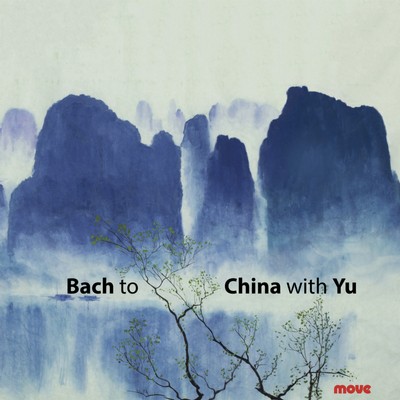
BACH TO CHINA WITH YU

Julian Yu

Move Records MD 3474

Much of this latest volume of works by Julian Yu involves clarinet, violin and cello. In fact, Robert Schubert‘s clarinet features in each of the four varied elements on the CD, as it has on two previous Move Records publications that present the composer’s chamber music involving that instrument. Also appearing here are pianist Akemi Schubert, violinist Yi Wang, and two well-known cellists in Virginia Kable and Josephine Vains.

Now, to content. The album starts and ends with Bach, whose music enfolds Yu’s arrangements of 24 Chinese Folksongs (some of which also contain Bach snippets) and two tracks of Dances from the XII Muqam, a collection of traditional Uyghur melodies. As anticipated, the longest of these four compositions is the assemblage of folksongs, but Yu fans will have heard these some years ago – 2019, to be exact – when pianist Ke Lin recorded the composer’s 50 Chinese Folk Songs. As far as I can see, Yu has revisited 22 of his original 50 and transcribed them for Schubert, Yi and Vains; the two odd-persons-out are Su Wu Tends the Sheep and Wild Lily.

As I said, there’s some Bach included in the folksongs as Yu elects to employ some of this composer’s bass-lines (and those from other composers) as supporting material for his collated melodies. Some of these interpolations are easy to find; others escaped identification by this willing listener.

Beginning with a solid slab of Western music, Yu has arranged the Chaconne in D minor from the Violin Partita BWV 1004, written sometime between 1717 and 1720. He’s not alone in this exercise and admits to drawing on transcriptions by Mendelssohn (who wrote a piano accompaniment for the piece), Schumann (who did the same), Busoni and Raff (who both did simple piano transcriptions, although the latter also made a version for full Romantic orchestra), and Brahms (a splendid version for piano left-hand). In this performance, we hear Schubert, and the string partnership of Yi and Kable for the only time on this CD.

As for the ending, we hear the organ Passacaglia in C minor for organ BWV 582 from sometime between 1706 and 1713. Yu gives us the famous bass line on the cello but has dilated the first note of each bar to a dotted minim, so the time-signature changes from 3/4 to 4/4. On top, the composer introduces scraps from arias and instrumental interludes heard at the Peking Opera; some are original, some Yu-composed. In all, we hear about twelve variations – down on Bach’s twenty – and the results prove to be disarmingly deft.

But you could say that about the whole set of 28 tracks. The arrangements are clever in conceit and clear in texture, if only rarely arresting. As you’d anticipate, the most challenging work comes first with the Chaconne. Yu begins in orthodox fashion with clarinet and cello outlining the eight bars of basic material before the piano enters discreetly with some melodic and harmonic reinforcement. All three are in operation with few signs of disturbance until we reach bar 25 where Schubert takes the melody line and elaborates it into a semiquaver pattern while clarinet and piano take on the chordal punctuation.

From here on, the central melody is shared between all three players while the re-composer begins to add flourishes, distinctly new lines, all the while indulging in some neatly dovetailing klangfarbenmelodie. We come to a slower oasis at bar 77 when the clarinet takes over from the semiquaver-addressing piano, giving us a calmer ambience which lasts up to the arpeggio direction of bar 89 which the piano takes on board and follows with a general attention to the written notes, apart from a few deviations, the whole fraught sequence winding up with a powerful bass line of striding quavers from cello and piano which is not in the score but makes a remarkably Brahmsian lead-in to the D Major reprieve at bar 133.

This is taken at a slow pavane speed and Yu recycles the opening variation of this segment as a subordinate component while gradually building up intensity with the piano adding more arpeggiated ferment, until the reversion to the minor key, at which point the piano disappears and clarinet and cello play the first two variations from this point by themselves, a few triple-stops from the original falling by the wayside. The piano gets an attack of the triplets well before they should turn up in bar 241 but by this stage we’ve been treated to so much linear displacement that the prepositioning hardly raises any eyebrows.

And so to the final peroration which is given with more late Romantic magniloquence in the best Busoni tradition. Also in something of an arranger’s tradition, Yu fleshes out that final noble single D with a full chord. So do Schumann, Mendelssohn, Raff and Busoni (who indulges himself with a tierce). The solitary exception is Brahms, who consents himself with three massive octave Ds – a man who knew when to leave well enough alone.

I heard the folksong Su Wu Tends the Sheep with more interest than most because it concerns a real person: a 2nd-to-1st BC diplomat who was detained on a mission for 19 years and put to menial work while under what amounted to imprisonment. The melody is here given mainly to the violin, the clarinet a late entry to the mix. But the message is clearly one of longing (for the homeland?) even in the middle of pastoral solitude – or so I feel about what is a warm, even sentimental lyric.

The other novelty in this collection is Wild Lily from the Shanxi province. A simple melody in four phrases, Yu sets it simply enough for violin with clarinet discordant underpinning, then again where the clarinet bears the melody while the cello accompanies in an atonal language – nothing too savage in either half, only single notes but deliberately at odds with the tune’s simplicity.

As for the other 22 elements in this collection, I refer you to my review of Ke Lin’s Move Records performances of the 50 Chinese Folksongs back in 2019. I believe I commented on all of the others treated here and have nothing new to add apart from predictable remarks about the new settings’ timbres. The same problems still apply: the arrangements are brief (eight of them are under a minute long, including Wild Lily) and, after a while, they fuse, so that it’s hard to distinguish between something as well-known as Jasmine (thanks to Puccini’s Turandot) and Willows Are New.

Fusing his Chinese melodies with the West, Yu uses a Handel bass to underpin the Mongolian melody Gada Mailin, then a Bach quotation from the B minor Mass in Picking Flowers. A more original device comes in Little Cabbage from the Hebei province where the cello picks out the vegetable’s name notes for underpinning; this probably works well because of the resultant motif’s pentatonic nature. More difficult to discern was the quotation from Brahms’ Symphony No. 4 during Lan Huahua, although Yu made it easier for us by opening A Rainy Day with the first eight bars to this symphony’s Passacaglia.

It’s back to the B minor Mass for the Sichuan tune Jagged Mountain, clarinet and cello presenting it in turn even if it tended to throw the melody into the background. An outburst of familiarity came with the Shaanxi air A Pair of Ducks and a Pair of Geese which enjoyed the bass-line on which Pachelbel constructed his mellifluous Canon in D, beloved of wedding-organizers. Also easy to pick up was the use of the left-hand to the Goldberg Variations‘ opening statement during Taihang Mountains.

But we encountered more difficulties with Willows Are New, during which Yu employed some famous Bach motifs that went straight past this bat into a no-doubt-contemptuous keeper’s gloves. But I recognized at least one of the Brahms Symphony No. 1 bursts that supported the medley of three Shanxi and Shaanxi folksongs and that was the chorale spray that climaxes the finale at bar 407. However, the impact of the German master’s rich chromaticism made the track surprisingly Western/European, a factor that also struck me in the last of the collection, Thunder a Thousand Miles Away, which seemed to be a mix of three-part invention and (limited) fantasia.

But so what? Yu’s compositional career has been informed by his homeland and further education here; the least you’d expect is a happy relationship between the two ‘schools’, as we find on this disc. Still, he strikes the same problem as most other writers when dealing with the material for his Three Dances from the Uyghur people of Xinjiang: the tunes are finite and the changes you can ring on them present challenges beyond simple repetition in new timbres. The first dance is extensive, showing a good deal of inventiveness in edging the basic material in several directions, made all the more difficult by the number of repeated notes involved, especially in the piece’s middle pages.

More surprising was the character of the melody which seemed to share characteristics with the folk music from various countries as collected by Bartok and Kodaly than with the 24 folksongs sitting alongside it on this CD. Yu grouped his second and third dances together; well, sort of: the tempo increases for the third which concludes in an almost Rossinian galop. Oddly enough, only in these dances did you come across faint cracks in the trio’s ensemble work, mainly due to slight hesitations about entries and the delivery of some pretty simple syncopations.

For organists, Bach’s big Passacaglia and Fugue are impregnable musical fortresses. You can’t really take exception to Yu’s employment of its bass progression for his own composition, but he is operating with a melodic and harmonic pair of palettes that are very limited when compared to the original. That said, you can take pleasure in Yu’s interweaving upper voices, particularly if you can keep out of your mind the monumental welter that straddles your consciousness from bar 144 to the end of the great organ construct. And, as the poet says, a man’s reach should exceed his grasp and this CD is witness to Yu’s high level of ambition.

Diary January 2026

FESTIVAL OPENING CONCERT – GLORIA!

Ballarat Organs & Fine Music Festival

St Patrick’s Cathedral

Friday January 9 at 7 pm

It’s all different up the Western Freeway since I’ve been away in the north. This festival has undergone a name change as well as a revamp in administration with long-time artistic directors Sergio di Pieri and Judith Houston gone, replaced by gamba exponent Laura Vaughan. As well, the time-line has been compressed so that it now runs for half of its previous length. And the geography has closed in so that events are limited to the city of Ballarat, with two day-time events in both Clunes and Creswick – nothing to the south. And the number of concerts/recitals has shrunk to 12, with the Festival al fresco Breakfast continuing as an extra-numerary. As usual, we have a celebratory opening event which this year involves the Consort of Melbourne, Consortium of viols, Unholy Rackett, with Donald Nicholson playing harpsichord and Nicholas Pollock on theorbo; Steven Hodgson, the Consort’s director, seems to be in charge of this amalgamation. No specifics are available but the names of Schutz, Hassler and Praetorius are being bandied around, with the promise of multi-choral polyphony. The concert lasts for 70 minutes, promising an early night for everybody – a welcome relief for this largely local audience. Students pay $10, concession holders $35, adults $45; if you want the post-concert supper, it’s $10 extra. The booking fee ranges for 75 cents to $1.88 – so why is this impost so cheap in the country and so monstrously expensive in Melbourne?

THE SINGING PIPES – MUSIC OF HANDEL, BACH, HAYDN & BEYOND

Ballarat Organs and Fine Music Festival

St. John’s Anglican Church, Creswick,

Saturday January 10 at 11 am

This recital is being given on the church’s Fincham and Hobday instrument by Rhys Boak, resident music genius in St. Michael’s Uniting Church, Collins Street. The organ was relocated from the Wesleyan (Uniting?) Church, Barkly St., Ballarat in 2016 and has a solid range of stops for its two manuals and pedal board. Boak is committed to five definite works in his hour-long program: the Overture to Handel’s Occasional Oratorio of 1745-6 without the original trumpets and drums; Bach’s towering Prelude and Fugue in A minor BWV 543 from the Weimar years 1708-13; Haydn’s Eight Pieces for Musical Clocks from anywhere between 1772 and 1793; Mozart’s Minuet in D – possibly K. 355/576b from possibly 1789/90; and contemporary Hungarian Zsolt Gardonyi‘s 1995 jazz-inflected Mozart Changes based on the final movement to K. 576. As well, pieces by J. K. F. Fischer, John Stanley, and Theodore Dubois are promised which fleshes out some odd corners very neatly. Tickets follow the opening concert’s lead – $10, $35, or $45, depending on your age and/or career stage.

BAAZ AVAZ – ON THE SILK ROAD

Ballarat Organs and Fine Music Festival

Creswick Town Hall

Saturday January 10 at 2 pm

So it’s off to Persia and a recital involving music, dance and story-telling during which, somewhere along the hour-long expedition, we’ll doubtless meet up with the cry of the falcon mentioned in the event’s title. Four participants present this amalgam: Vahideh Eisaei contributing vocal work as well as playing the qanun or large zither; Dong Ma on erhu or Chinese two-stringed fiddle which may have links to the (more topical for this recital) rehab; Elnaz Sheshgelani covering the stories and the dance components; and Yang Ying on pipa or Chinese lute which came to that country along the Silk Road. This is one of those occasions where you enter a world unfamiliar to most of us; my experience of Persian music has been confined to an Adelaide Festival recital many years ago from an ensemble playing court music – or so it was claimed. That’s the sort of cultural ignorance that a presentation like this seeks to remedy; it’s not all Omar Khayyam and Hafez or the AliQapu restaurant here in Kew. If you’re a student, you can get in for $10 plus a piffling booking fee of 75 cents; concession card holders ($35) and adults ($45) have to go on waiting lists because their allocations are sold out.

VERSAILLES IN LOVE

Ballarat Organs and Fine Music Festival

St. Paul’s Anglican Church, Bakery Hill

Saturday January 10 at 6 pm

Quite a lot of promises made for this non-specific 60-minute program which features a quintet of musicians, some of whom I know. Soprano Myriam Arbouz, baroque violinists David Rabinovici and Tim Willis, baroque triple harpist Hannah Lane, and theorboist Nicholas Pollock presumably combine and re-congregate in small groups to take us through works by Lully, his father-in-law Michel Lambert, and his student Marin Marais. Two specific forms are designated: the air de cour and chamber music – which is telling us nothing, except that the songs preclude the three composers named who all wrote airs of a different colour. As for the other, these musicians have a wealth of rich, magnificently mannered material from which to select; a pity they haven’t let us into their confidence about what we’d be paying for. Speaking of which, prices follow the usual pattern: $10 for students, $35 for concession holders, $45 for adults with a maximum booking fee of $1.63 and a minimum of 75 cents – almost seems pointless to charge it.

TELEMANN PARIS QUARTETS

Ballarat Organs and Fine Music Festival

Ballarat Performing Arts Centre, Soldiers Hill

Sunday January 11 at 2 pm

These works are being presented by the Coomoora Ensemble, apparently headed by baroque violin Lizzy Welsh (she writes on Instagram about ‘my delightful Coomoora Ensemble’, which strikes me as a pretty obvious statement of ownership. She’s accompanied on her sojourn into Telemann by Alison Catanach on baroque flute, Edwina Cordingley on baroque cello, and Ann Murphy playing harpsichord, as is her wont. It’s not clear if the ensemble can get through all twelve of the Paris quartets – six Quadri published in 1730, and six Nouveaux quatuors printed in 1738. In fact, I doubt if they could, given their recital’s 60 minutes time-span. I suspect that they’re attempting the latter, given that they refer to works composed during Telemann’s visit to the French capital in 1737-8. But then, all of them were written before he hit Paris, so they may be attempting a mixture. Whatever the case, this hour (possibly longer) will cost you $10 a student, $35 a concession holder (but not Seniors’ Cards, apparently), and $45 full adult, with a negligible booking fee ranging from $1.63 to 75 cents.

O FILII ET FILIAE – ORGAN SPLENDOUR OF THE (MOSTLY) FRENCH BAROQUE

Ballarat Organs and Fine Music Festival

St Paul’s Anglican Church, Bakery Hill

Sunday January 11 at 6 pm

Another solo organ recital to balance Rhys Boak’s one on Saturday January 10 in Creswick, this mixed collation lasting an hour is being presented by Donald Nicholson, showing us another side to his musical abilities after he has played harpsichord for the festival’s opening concert. Yet again, details are scant although he is sitting securely in a French gallery by performing works by Couperin, Louis Marchand, Jean-Francois Dandrieu and Nicolas de Grigny. For the first of these, I can find only two organ works, both mass settings; Marchand offers more, some of them formidable elements of the French repertoire; Dandrieu I know only through his Noels but he did write an Easter offertory, published in 1739, based on the plainchant that gives this event its title; de Grigny is celebrated for his only publication – a Premier livre d’orgue from 1699 which has a preponderance of church music in it. Just to offer a change of diet, Nicholson will also play some pieces by Buxtehude to offer a ‘dash of fiery North German contrast’ – just what those French formalists need. Ticket prices follow the usual $10, $35, $45 pattern (student, concession, adult) with a small booking fee too minute to outline, too inconsiderable to make any difference to anybody.

FOUNDATION OF FANTASIE

Ballarat Organs and Fine Music Festival

St. Paul’s Anglican Church, Clunes

Monday January 12 at 11 am

For this excursion to the book-driven town of Clunes, lutenist Rosemary Hodgson and organist Jack Stacey are attempting to draw some parallels between Renaissance architecture and the period’s music. Terrific, and good luck with that. Their 60-minute presentation centres on the works of Alonso Ferrabosco the younger who performed for Elizabeth I and Hodgson is playing all seven of the composer’s extant fantasias, leavening this core with side-steps to vocal intabulations, passamezzi and pavans. An intriguing venture, although the fantasias look to me as being more suited to a chest of viols than a lute, mainly because of some sustained notes that a soloist (apart from an organist) can’t manage. You’re invited to find similarities between the cleanness of form and structural balance of a building from this time in the clarity and formal integrity of the Elizabethan viol composer’s works. As I read things, Stacey is to provide a solo on the church’s organ at the start of the recital but I can’t find anything by Ferrabosco for that instrument; in this case, a Hamlin & Son rarity that sits in remarkably close relationship to the church’s acoustic properties, as I remember from over a decade ago – since which time (2018) the instrument has been restored extensively. The usual entry costs apply: $10 a student, $35 for concession holders, $45 an adult, all with small booking fees that probably won’t put patrons off.

REEDS & RESONANCE – MUSIC FROM THE GOLDEN AGE OF THE BASSOON

Ballarat Organs and Fine Music Festival

Clunes Town Hall

Monday January 12 at 2 pm

This hour-long entertainment brings back some of the opening concert’s contributors: Nicholas Pollock resumes his theorbo and adds a Baroque guitar, while the Unholy Rackett group is identified as Simon Rickard, Brock Imison and Jackie Newcomb, all manipulating curtals and their namesake instrument. Also involved is triple harpist Hannah Lane, returning after her Love in Versailles participation on January 10 and the festival’s director Laura Vaughan consorting with her gamba. And this is one program where you know exactly what is being presented: a Sonata for four trombones from the Op. 22 collection of 1655 by Biagio Marini; two pieces from the Canzone, fantasie e correnti of 1638 by Bartolome de Selva y Salaverde in the soprano and bass song Vestiva hi colli passaegiatto and a canzon for two tenors (trombones?); a set of variations on La Folia by Antonio Martin y Coll from Volume V of his 1706 Flores de musica; Giovanni Bertoli’s 1645 Sonata settima that one would assume was for the bassoon, which was his instrument; Kapsberger’s Tenore del Kapsberger from the 1604 Volume 1 of his Intavolatura di chitarone, plus the Bergamasca and Canario from the Intavolatura Volume 4 of 1640; from Il primo libro de balli of 1578, Giorgio Mainiero’s La lavandera/Caro ortolano, probably for a rackett; the 1609 setting of Es ist ein’ Ros’ entsprungen by Praetorius; two anonymous songs in Vos senora, a maltratada and the Portuguese Renaissance lyric/laugh Nao tragais borzeguis pretos, both played on curtals by the Racketts; Machado’s Dos estrellas le siguen which I have come across as a four-part chorale-type invention from the Cancionero de la Sablonara of 1624/5; finally, Daniel Speer’s first (only?) two Sonatas for two violas published in 1697 and hisSonata for three bassoons (C Major or F Major?) which I believe comes from the same year. Anyway, tickets follow the usual costings: students $10, concession $35, adults $45 plus a nonsensical booking fee of minute proportions, although still a nuisance to fork out.

DARKNESS AND DELIGHT – JERRY WONG

Ballarat Organs and Fine Music Festival

Ballarat Mechanics’ Institute, Sturt St.

Monday January 12 at 6 pm

A 60-minute recital from the Head of Keyboard at the Melbourne Conservatorium of Music is a singular surprise in this festival line-up. Jerry Wong hasn’t detailed what he is going to present, like so many contributors to this enterprise, but he opens a pretty wide door by introducing certain names as contributing agents. There’s Bach, Beethoven, Liszt – and Miriam Hyde, as a kind of satisfaction for our nationalistic yearnings. But the evening’s title gives an immense scope, as all of these composers have dealt with both the highs and lows of human experience. Still, it’s always worth your while listening to an artist of Wong’s calibre and, if the names strike you as promising, then you can get in for the usual fee: adults $45, concession holders $35, students $10, and the small booking fee that nevertheless nags like an itch in the middle of your spine.

MEDITERRANEAN – ELISABETTA GHEBBIONI

Ballarat Organs and Fine Music Festival

Loreto College Chapel

Tuesday January 13 at 11 am

Starting the festival’s final day comes Italian harpist Elisabetta Ghebbioni, a veteran performer at this festival and a professor at the Benedetto Marcello Conservatory in Venice. As is characteristic of so many performers in these Ballarat days, her program is unknown, even if her publicity refers to a few names: Albeniz, Saint-Saens, Einaudi ‘and others’. The first of these will probably involve an arrangement because I can’t find any harp works by Albeniz. Saint-Saens has a solo Fantaisie from 1893 and a 1918 Morceau de concert but nothing else relevant or practicable (apart from more arrangements). As for Einaudi, I assume this artist will be playing pieces from his album Stanze of 1992, although he has endorsed arrangements of some piano works for the harp. By the way, Einaudi is visiting Melbourne next month, playing at the Myer Bowl. Still, what information there is on this recital seems – even in this context – a bit vague, while Ghebbioni’s screed in the festival bumf is too brief to be of much use to anyone. Tickets for this event will be the same as all the others at the centre of this festival: $10 a student, $35 a concession holder, $45 full price, with the nugatory booking fee attached, increasing slightly as your price goes up. But, doing dutiful research, I couldn’t get on to the booking site – Error 404 made its entry for no apparent reason.

SUITES & SONGS

Ballarat Organs and Fine Music Festival

St. Paul’s Anglican Church, Bakery Hill

Tuesday January 13 at 2 pm

Cellist Josephine Vains is at the centre of this recital, although Jack Stacey is again going to preface proceedings with a solo on the church’s J. W. Walker organ, and why not? He’s this church’s organist. You’d have to assume that we’re going to hear at least part of a Bach cello suite; it’s also possible that we’ll hear all or part of one of the three Britten suites written for Rostropovich. Also mentioned in the publicity material is Gabrieli, whose cello works escape me; perhaps Stacey will kick in with some support here for – what? Then another one of the festival’s few dives into the vernacular with Ross Edwards; possibly Prelude & Laughing rock from 2003, or perhaps Monos I from 1970. As well, we’re to hear some Casals, who wrote a fair few works for cello, as you’d expect, but they all involve piano accompaniment; the Song of the Birds from 1941 might enjoy a sentimental visit. It’s all up in the air but tickets run through the familiar format: students pay $10, concession holders $35, and full adult tickets cost $45, all with a handling fee, which I assume only applies if you book on line.

FESTIVAL CLOSING CONCERT – SONGS OF LIGHT & DEVOTION

Ballarat Organs and Fine Music Festival

St. Patrick’s Cathedral

Tuesday January 13 at 6 pm

The subtitle to this final program is Life, Death & the Passion of 17th Century Italian Music; you can’t expect more in a concert than enjoying the two great existential fag-ends and, when you add in the Italian Baroque – be still, my beating heart. As usual, nothing specific is set down, nothing as vulgar as a set program, but we have some insinuations. For instance, we will definitely hear some late sacred music by Monteverdi; pieces from the 1641 Selva morale e spirituale, you’d reckon, or some scraps out of the Messa et salmi of 1650. As well, we can expect one (or more?) of the sacred oratorios by Luigi Rossi, with perhaps some extracts from the famous one for Holy Week whose provenance is even now questionable. Also, there will be a psalm setting or two from Giovanni Rigatti; there’s plenty to choose from as he published them across his brief career in 1640, 1643, 1646 and in the year of his death: 1648. Another name is Domenico Mazzocchi, famous for his motets so there should be a couple sung here, like the Videte et gustate published in 1664. Stephen Grant will be directing (as well as singing bass), principally his e21 Consort, but also Stephanie Eldridge and Lizzy Welch on baroque violins, Linda Kent at her harpsichord, John Weretka seated at (probably) a chamber organ, Hannah Lane bringing her triple harp into play for the third time this festival, and overall director of everything during these past days, Laura Vaughan plays both her gamba and a lirone. Tickets are currently unavailable on the usually reliable Humanitix website – not the best of omens. But I’d anticipate that they mirror those for the opening night and everything else – $10 for students, $35 for concession holders, $45 for adults with the by-now traditional small booking fee that seems to be necessarily attached to any event for which you either book online or pay by credit card.

Exemplary partnership in fluent performances

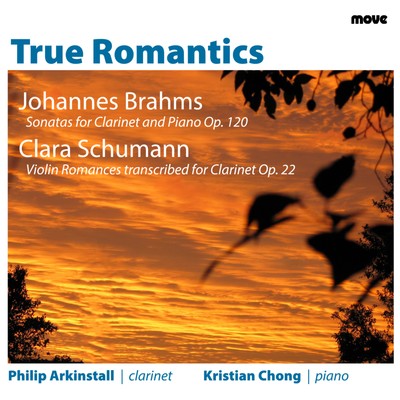
TRUE ROMANTICS

Philip Arkinstall and Kristian Chong

Move Records MCD 668

Well, you can’t argue with this CD’s descriptor. Clara Schumann and Brahms were solidly Romantic, their early lives focused around the lady’s husband, who was one of the great 19th century creators of that school alongside Chopin, Mendelssohn and Berlioz. In these latter days, Amazonian efforts have gone into foregrounding female composers, from Hildegard through Barbara Strozzi to Amy Beach and a multitude of contemporary Australians ( especially on ABC Classic radio). Schumann has enjoyed a revival of interest for decades longer than most of these writers, yet her appearance on programs must still be called – in all charity – uncommon.

The performers of one work by Schumann and two sonatas by Brahms on this disc for Move Records are Philip Arkinstall, associate principal clarinet with the Melbourne Symphony Orchestra for the last 16 years, and Kristian Chong who is an associate lecturer in piano at the Melbourne Conservatorium of Music to anchor his active life as a performer.

On this CD, these performers give us Schumann’s Three Romances of 1853, originally written for violin and piano, here enjoying a transcription by Roger Young, Arkinstall’s colleague in the MSO where he has been a violinist for 26 years. The Brahms Clarinet Sonata in F minor and his Clarinet Sonata in E flat comprise the composer’s Op. 120 and date from 1894; these are the last chamber compositions he produced before his death and they make a magniloquent pair of gifts to an until-then almost non-existent repertoire, apart from a small quiver-full of concertos.

Clara Schumann’s Romances recall her husband’s compositional aesthetic in pretty much every aspect, apparent from the first Andante molto with its ambiguity of rhythm that doesn’t become quite clear until about bar 11, not to mention its floating harmonic underpinning, an adventurous chromaticism seen in the central segment from bar 24 to bar 32, and a steadiness of emotional output that you find in the male writer at his most impressive (the lieder, the chamber works with piano).

Moving to the second romance, complete with a German direction (Mit zartem Vortrage) that might have come from the composer’s nationalistic husband, we find a more orthodox harmonic complex, its ternary form running G minor, G Major, G minor with a quietly assertive main melody that recalls some of the more sparsely textured Songs Without Words. Arkinstall observes an appropriate dynamic restraint throughout this miniature’s length while Chong shows once again a discretion that falls short of self-effacement, always contributing to the partnership as you can hear in the musicians’ sensible and sensitive account of the final twelve bars, the clarinettist even giving us the violin’s final quadruple stop.

Again with the third romance, Robert Schumann’s linguistic choice enjoys pride of place with the direction Leidenschaftlich schnell, the musicians’ collaboration as ardent as you could want, given the benign, self-assured content in another ternary shape with the composer happy to maintain her B flat Major territory in the outer segments. From the start, Arkinstall’s main lyric is supported by fluid triplets from Chong that change only for regular semiquavers in the initial 21 bars where the main material recurs. The pianist once more exercises an assertive discretion throughout, both players investing the work with a tidal ebb and flow in dynamics while the metre stays constant, Arkinstall making gentle work of the three-note pizzicato chords between bars 50 and 57.

After these novelties come two familiarities in the Brahms sonatas. The No. 1 in F minor is more familiar to most of us than its partner in E flat Major; why this is, I have no idea except that performers might find the first more satisfying to play or present, or it might be that audiences are more receptive to its flamboyant style of address. Whatever the reason, Arkinstall and Chong open it up to a remarkably clean airing, right from the opening Allegro appassionato which gives us an object lesson in nuanced shading from the clarinettist and an admirable, mud-free outline of the keyboard part where every bass note registers and Chong’s surges into action ring out clearly, especially when the going gets piano concerto-mode tough (as at the end of the development, bars 116 to 132).

Profitably for us all, the interpretation is invested with dynamic tension, but the piano conclusion starting at bar 225 gives an excellent instance of shared responsiveness where the instruments dovetail with care to make the composer’s last reminiscence of his opening phrase somehow inevitable and poignant. Which makes a fine transition to the restrained and compact Andante that takes us on a simple ternary journey with a slightly surprising chain of modulations before re-settling onto its A flat Major homestead. No surprises here from either performer as they handle this brief segment with a deft mobile lassitude.

Coming out of the A flat Major warmth of the slow movement, we strike it lucky again in the ‘scherzo‘ movement (well, A flat with lots of E flat Major getting in the way). This is an appealing landler that varies its rhythmic predictability in the trio where the piano has an almost continuously syncopated right hand melody line (apart from 12 bars in the second part). You can find some moments of quiet humour like the clarinet’s laconic quiet interpolations when the piano has the main tune in bars 9 to 16, and the woodwind’s suggestions of yodelling in bars 35 to 38. To their distinct credit, these performers find and maintain the movement’s inner bounce and bucolic grace.

Finally, we enter the realms of the Academic Festival Overture with Chong’s expounding of the central theme to this F Major rondo with that combination of strength and lightness that typifies this reading. Despite its arresting opening, the theme moves into staccato chattering in its second and third quarters, but the distinction of this performance is the pleasure you experience on each recurrence. Not to forget the St. Anthony Chorale reminiscences when we move into buoyant crotchet triplets at bar 42 and later at bar 142. Once again, these musicians show a combined delicacy of insight into the score’s energetic bravura and its simple, happy brio.

I suppose what counts against the E flat Sonata from the beginning is the sentimental nature of the opening friendly Allegro‘s first subject. Further, Brahms is not slow in presenting us with several splendid melodies – or fragments of them – while ringing some vivid dynamic changes, like the sudden burst of language from the Piano Concerto No. 2 across bars 15 to 18; this continues in sporadic eruptions like bar 39, bars 60 to 64, and later in the recapitulation. But then, the clarinet writing is so mellifluous and persuasive in its wide arcs that the wonder is these players combine with such great empathy to give us a masterful composite, graced with yet another bout of splendid warmth in the concluding twelve Tranquillo bars.

It’s about now that you appreciate the compression at work in these two works; much of the first and all of the second operate without repeats so that you are in a constant state of discovering fresh country. Even second hearings of what seems like the same matter can be deceptive by means of altered accompaniment or original transpositions and modulations. This may go some way to explaining the sense that this sonata’s second movement is brief although it follows the classic scherzo pattern. Further, Brahms breaks into his four-bar phrase patterns with some arresting interruptions.

The piano writing here suggests parts of the rhapsodies, but the intertwining of both sound sources is admirably supple, both in the ‘dying fall’ passages like bars 48 to 64 and the two noble shared chorales of the central Sostenuto trio. I’ve heard other readings where the atmosphere is darker and angst-driven, but I think Arkinstall and Chong have the right of it with their cool outlining of the controlled agitation that underpins these pages.

And then you come to the last movement which starts Andante on a set of variations that stands with the best of the composer’s more emotionally untrammelled, benign creations. Starting with an ordinary skipping tune, a lyric with a lilt, Brahms brings about a set of cadences that culminate in a satisfying plagal in bar 14. From the opening statement, we move into off-the-beat commentary from the piano, triplets alternating between the players, a demi-semiquaver duel, a variant in which the piano is continuously syncopated while the clarinet outlines a version of the theme sotto voce for the most part, then an E flat minor elegant furiant before an inconclusive Piu tranquillo, the quick allegro returning for a final burst of high spirits with some chortle-rich piano writing from bar 134 almost to the end with cross-rhythms galore against a cooperative if comparatively strait-laced clarinet.

All this comes off very well indeed without any signs of faltering in attack or pace. But that could be said about the whole disc; throughout the three scores, Arkinstall and Chong demonstrate how a chamber music partnership should function, with every phrase mirrored or duplicated, with the dynamic ebb and flow organized carefully with each other, and with every slight rallentando – no, even the big ones – carefully graduated so that entries are pointedly precise. It all speaks for the high worth of this exemplary, polished disc.

Sydney visitors’ laudable initiative

RARE SUGAR

Omega Ensemble

Elisabeth Murdoch Hall, Melbourne Recital Centre

Tuesday December 2, 2025

David Rowden

Saying goodbye to its small Melbourne audience for this year. the Omega Ensemble gave its hope-to-see-you-later recital in the Recital Centre’s larger space; something of a population error as we could all have fitted pretty comfortably into the Primrose Potter Salon downstairs. True, the dynamics could have been overpowering to the point of painful in the smaller space but that’s more a case of having to cut cloth to suit width as opposed to throwing cash into an undertaking that might show promise but has a long way to go before attracting an audience along the lines of the thousand who can fill .the Elisabeth Murdoch Hall.

Much of the performance attention fell on the Omegas’ artistic director, David Rowden, who played in two of the three works presented by the Sydney-based group. He took the clarinet part in Bartok’s Contrasts of 1938, that unusual trio asking for the usual components of a violin (Veronique Serret) and a piano (Vatche Jambazian), alongside the cello-replacing woodwind line. All players took a sedate approach to the opening Verbunkos: a restrained Moderato indeed with the pulse closer to crotchet=94 than to 100. As well, both Serret and Jambazian proved aggressive after the politenesses were out of the way, so that the forte outbreak at bar 23 proved striking.

Still, to his credit, Jambazian refrained from overpowering his colleagues in the sequence of glissandi that emerge between bars 45 and 54. This movement ends with a taxing clarinet cadenza that Rowden handled with clarity and found a restraint of delivery in what amounts to an exuberant series of irregular arpeggios and scales.

In the following Piheno, we came across several instances when the performers’ congruence was off; not by much, but just enough to disturb the fluency of an otherwise eloquent reading. This wasn’t evident in the outer hymn-like segments but came up in the movement’s changes of pace, like the second Movendo and the overlapping of the Tranquillo bars. Nonetheless, I was impressed by the sustained tension across a set of pages that can be marred by preciousness on one hand and over-exertion in bar 25’s Piu mosso and the crisis at bars 33 to 34 for clarinet and violin in duet.

Bartok’s requirement in the concluding Sebes for a change of clarinets and violins cane be messy and Serret needed more than the allowed nearly-five bars to make the switch but the composer set up a repetition of bar 34 until the player is ready to kick off again. When Rowden came to change his instrument at bar 132 (B flat for A, they tell me), the movement just stopped before Jambazian initiated the ‘Bulgarian’ Piu mosso. Admittedly, there’s a caesura in the score but it seemed to last a fair while, all the more noticeable in this rapid movement.

Serret’s version of the violin cadenza proved to be heavy-handed, even those sections with left-hand pizzicato; the entry of everyone back into the fray at bar 214 also gave us another instance of the musicians – clarinet and violin, I suspect – not coming in quite together. To my mind, the exhibition here by Jambazian was remarkable in its variation of attack and responsiveness to the multiple demands that pianist Bartok made on his keyboard performer. Yes, for most of its length, the Sebes is in 2/4, apart from that central 13/8 interlude, but the participating pianist is stretched by alternately setting the running semiquaver pattern and punctuating the other lines in a vital, invigorating series of sustained flurries. I’m afraid that much of my attention centred on Jambazian and his dextrous handling of this rapid-fire exhibition of virtuosity.

Ella Macens wrote her Through the Mist this year for the Omega organization and we were hearing its third performance on this occasion. Serret and Jambazian were involved, as were second violin Emma McGrath, viola Neil Thompson, cello Paul Stender, and double bass Harry Young. This new product struck me as operating, for the most part, in a single tonality – all the white notes – with a modulation coming up in what I think might have been the third movement: Piu mosso, con moto. But the composer’s suggestive atmospherics made this a bland soundscape, compared to which Debussy’s Brouillards is a sonorous typhoon.

At the beginning, the string quintet generated long sustained notes, alleviated by Jambazian’s piano with some cadenza-like interleaving. This continued for a fair while, taking us into the world of some of Macens’ Scandinavian seniors and peers where placidity and repetition become the chief factors in a composer’s creative panoply. We were lulled into this comfortable ambience, so much so that I had no idea when the movement’s changed from Slow, Spacious, Grand to L’istesso tempo although the pianist’s role did become more prominent, and a folk-like tune emerged in the top strings with cello and pizzicato bass eventually joining in the muted merriment.

As for the move to a quicker pace for the third section, that also failed to have any impact on these ears. Then again, I was looking for old-fashioned markers, indicators of sudden alterations as in a suite or symphony whereas I think Macens was concerned with a continuous journey – a slow-moving progress for which the mist provides an all-embracing shield. That’s fine, except that it was hard to find any suggestion of what we are being protected against. If you were expecting more than a pretty monochromatic universe, you would have been disappointed.

This composer occupies an unusual position by straddling the seemingly static sound worlds of the post-Tavener mystics (which is doing them a temporal disservice, I know) and the simpler output of popular music where not much happens but nothing grates or gives offence. Through the Mist could be used to illustrate/support a quiet documentary yet its lack of thrust, of drive puts it in a category of its own. I kept on thinking of Debussy – not just Brouillards, but also Nuages where the return of those low wood-wind chords serves as an anchor, while Macen’s chords are ends in themselves.

Rowden returned for the night’s title work, referring to a concertino by Nigel Westlake for clarinet, piano and a string quartet of the same format that Macens employed, fortuitously enough. This piece in one movement is almost 20 years old and has been adopted by several local artists since 2007; I’ve heard it played by Lloyd Van’t Hoff and way back from Catherine McCorkill so, although it might not be a regular presence on your annual concert scene, it does enjoy more occasional resuscitation than most other contemporary Australian scores. Written as a 90th birthday present for a UNSW chemistry professor who at one stage specialized in rare sugars, the work served as yet another instance of the composer’s skill at engaging us, even if any attempt to find musical correlations with the molecular breakdown of sugar in any form was doomed before it began.

Right from the start, we entered a world of various and variable textures, the ensemble’s output rich and mobile. This was particularly obvious in the clarinet writing, but then you’d expect that from Westlake who was (is?) a notable performer on that instrument and who enmeshed his soloist in the accompanying forces, with some radiant flourishes for the strings en masse. Further, the pleasures kept coming, like a deft duet between Rowden and Verett, and a page or two of fine pointillism between the high strings and piano.

Moving from his initial Scherzo into a central Tranquillo, Westlake contrived a finely-spun duet from Rowden and Jambazian that brought to mind parts of Westlake’s film music (not so much the heavy Romanticism but a trademark simple lucidity) and inevitably brought to mind Messiaen’s slow Louanges with the clarinet replacing the original cello and violin. A general address from all brought us to the short cadenza for clarinet, then the concluding scherzo with a plethora of cross-rhythms and syncopation as well as more suggestions, this time of Copland and his Rodeo jauntiness.

It’s a significant gift, bringing Australian music to the fore, and the Omega administration and players are very welcome for their endeavours in that regard. Of course, it’s a fraught exercise, given the current economic hardships that many of us are undergoing: where is your audience coming from in these piping times of genteel poverty? Like many of our Melbourne-and-environs organizations, the ensemble will probably have to cut corners. But their contribution to the country’s music-making is exceptionally able and worthwhile; I, for one, hope to see them here – and flourishing – in 2026.

Topsy-turvydom in action

Epic Diva

Selby & Friends

Primrose Potter Salon, Melbourne Recital Centre

Wednesday November 26, 2025

(L to R) Kathryn Selby, Elizabeth Layton, Isabella Bignasca, Julian Smiles

This farewell to arms from the Selby & Friends organization for 2025 used a slightly larger format than usual. The program comprised three piano quartets and Kathryn Selby assembled a trio of guests who worked comfortably together with very few signs of discrepant attack across two major works and a home-grown bagatelle. Selby’s violinist was Elizabeth Layton from Adelaide’s Elder Conservatorium, violist Isabella Bignasca on a home visit before returning to a New York fellowship at Carnegie Hall, and cellist Julian Smiles refreshing himself in this milieu after a lifetime with the Goldner String Quartet.

Fair stood the wind for a well-ordered recital, beginning with the occasion’s title work from Sydney academic Matthew Hindson, moving to a translucent Faure, and ending with Brahms’ most substantial chamber work. For reasons that weren’t explained, the order of events was reversed but I’m not sure exactly who gained from this change; I, for one, was feeling well worked over by interval after hearing a solid reading of the Brahms Piano Quartet No. 2 in A Major of 1861. Still, we stuck with it for Faure’s 1887 Piano Quartet No 2 which partly mirrored the German master’s vehemence, and finally came down to earth for the Australian work – originally the finale to Hindson’s Piano Trio from 2007 which was commissioned by the Macquarie Trio (then boasting Selby as its pianist), subsequently transformed in 2012 to this quartet format on a re-commission from the University of Queensland.

Selby set the Brahms score in motion with that willowy oscillation between four-part chord triplets and quavers that initiates the Allegro with deceptive calm, repeated in bar 9 by the three strings. But it took no time at all before the pianist exploded into fortissimo dynamic at bar 27, maintaining a dominance up to the paragraph’s end at bar 37 – and we were well into into the composer’s substantial 120-bar exposition which, as far as I could tell, was not repeated.

It’s not that the movement is convoluted but the material is treated at length with a remarkable differentiation in texture. At times, it sounds like one of the piano concertos, as at the change of key signature to nothing when the piano sets up a bass opposition to unison strings and the effect is of a relentless pounding from everybody. Then, we reach a return to placidity at bar 209 with a slightly thinner texture an octave below where we began, which has a kind of supple inevitability about it that never fails to delight. Still, it was obvious that Selby controlled the movement’s level of address, the strings working hard to make their points across the central pages of contrapuntal interplay.

The pianist is also gifted with the opening sentences to the work’s Poco adagio: superbly shaped lines that the strings eventually get to enjoy at bar 24, from which point we heard some lyrically ideal work from Layton in particular. This was equalled later in a moving duet with Smiles, playing the initial theme two octaves apart from bar 86 on. But the movement’s strength for me lies in its fusion of lines, particularly the powerful F minor outburst at bar 109 with the three strings striving in octaves over the piano’s arpeggios. And then we reach the inevitable resolution back to E Major and the three string lines curving around each other on the path home through Layton’s penetrating trills and E Major scales across the last stages.

For a change, the opening to the scherzo from the strings in octave unison did not come over as weedy/reedy which is an approach you hear on several recordings; just a confident piano to allow Selby a subtle response-repeat at bar 8. Still, you couldn’t avoid the imbalance in dynamics starting with the piano’s bass octaves at bar 80, leading up to an explosive attack at bars 88-9.

The balance improved in the fierce opening to the Trio, in part due to the composer’s giving the string lines some clear air in their alternations with the piano, statement/re-statement continuing pretty much through this segment’s first half. Further, you would be hard to please if you didn’t appreciate the subtle transparency of the forces’ interplay across the soft decrescendo in similar motion of bars 266-276; then, the final stages of this trio where the piano operates by enswathing her colleagues in a decorative reinforcement as the texture changes in stratum from bar 315 to bar 326 through a passage of quiet regret before we return to the scherzo.

It’s an unusually full complex to experience; the analysts point out the employment of sonata form in both parts, scherzo and trio, but it strikes me that Brahms offers us a remarkable fusion of material – not literally, but each segment having enough in common to provide an intellectual and emotional consistency, at odds with the prevailing practice of contrasting the two divisions. This is best illustrated by the lead-in from trio to scherzo where the dividing crack is perceptible but close to seamless; not a passage of high-flying craft but an undemonstrative example of the composer’s power to engage through simple means.

To be honest, the final Allegro often presents itself as a hard-fought kind of celebration to my ears. In this interpretation, it opened with plenty of panache, these players keeping a restrained eye on the accented second beat of fulcrum bars, both at the opening statement and in the communal extension from bars 73 to 78. But then comes that sudden turn into long note values after the rest at bar 142 and the energy drains out of the movement’s forward thrust.

Of course, it resumes its opening drive and episodes of relief and action oscillate for the remainder of the allegro, coming to a concluding lengthy animato: 52 bars of it, although it seems longer, and punchy in dynamic output, not least when the piano operates at ottava alta. It’s a relief to come to the end of this bounding activity which seemed to me to drain the performers, even if they maintained their energetic output to the final bars. You wouldn’t call it a hard-won victory – that would demean the performers’ skill and linear definition – yet the impression I had was of a solid accomplishment rather than a high-spirited completion of the task in hand.

A less insistent voice emerged with the Faure quartet, although the excellent sweep of the composer’s first ten-bar subject with the strings soaring in octaves over the restless piano arpeggio patterns remains in the memory some days after this eloquent interpretation, as does the sound of Bignasca’s mellow voice surging in solo with the second theme, and the eventual interweaving of lines – easily perceptible in this work where the composer gives much of the running (in this opening Allegro, at least) to the string lines.

Selby got her revenge, of course, in the following Allegro molto which is a study in digital evenness for much of its length, a sort of right-hand moto perpetuo complicated by its tied quavers across the bar-line and awkward syncopations when the right-hand moves into octaves. The pianist generated a suitable restlessness, even through the pseudo-Trio interlude where the 6/8 pulse cuts to a sort of fast waltz. Bignasca again came to the fore at the recapitulation-of-sorts, having a turn at the piano’s main theme in an A minor version before she partnered Layton in a vital canonic treatment of it at Letter F in the Hamelle score.

The violist led the way into Faure’s E flat Major Adagio with a firm hand on the opening melody before Layton joined in with a gentle reinforcement and the movement flowered into a fluid nocturne with the composer at his most relaxed with regard to modulations. Later, the finale approach mirrored the veiled power of the work’s opening, Smiles and Bignasca urging through the rise and fall of the G minor melody, before violin and viola took up the theme at an octave’s distance.

Selby observed the prevailing discipline but hit the road with vehemence for her first forte at Letter B, then later at Letter J. These pages always carry the listener along with their rhythmic insistence and the composer’s rapid-fire invitation au voyage, reaching an apogee when the key signature changes to G Major. The players didn’t go overboard in the Piu mosso final page, allowing Layton plenty of room to negotiate the concluding rhetoric.

Not much to say about the Hindson piece. The strings outlined the motif/tune in unison octaves with Selby providing some anchoring chords and semi-florid scale cadenzas across two bars. And then we were off with a boppy piano underpinning that might have come from Michael Kieran Harvey in his teenage years. Bignasca looked happy, swaying along to the syncopations of a bygone era, yet the only player who was tested was Selby whose contribution was essential and unremitting, as far as I could tell. If you like, Epic Diva served the office of showing us how far we’d come over the centuries of Western musical development – a flashy sorbet to wind up another recital from this organization almost full to the brim with solid substance.

No place for the prescriptive

COCTEAU’S CIRCLE

Australian Chamber Orchestra

Hamer Hall, Arts Centre Melbourne

Sunday November 16, 2025

Le Gateau Chocolat

A good deal of what follows might be incorrect. As with many concert-giving organizations these days, the Australian Chamber Orchestra has taken to plunging audiences into darkness from the start, so that a conscientious note-taker might be obliged to come along equipped with a pencil light and act as a constant distraction to anybody in his/her/their neighbourhood. Or you could rely on your memory, as I have done; a difficult task with a program of this nature. I remember Paull Fiddian, one-time manager of the Victorian/Melbourne Symphony Orchestra, telling me that his instructions were to lower the lighting at the start of concerts to 70% of capacity; he would probably have seconded my usual reaction at these current enforced plunges into momentary blindness which echo Florestan’s first words at the start of Act Two.

Anyway, the ACO and some wind guests and a percussionist meandered onstage, led by pianist Stefan Cassomenos who began doodling and set others off to play what I think was Elena Kats-Chenin‘s first background offering for this program; in all, she composed six pieces commissioned for the players – this initial Intermission Music and five Interludes: Les annees folles, L’opera, Le sacre, Les fantomes, and Etonnez-moi. Mood-setting constructs, these were forgettable immediately after they played out and, even if the Sydney composer was no part of the circle that enswathed Cocteau, these samples of musique d’ameublement would have found favour with the poet’s friend, Satie.

In any case, the program proper began with artistic director Richard Tognetti leading his forces in an Ouverture (abridged) by Auric and we were in the world of Les Six, that variously talented group of composers fostered by Cocteau and who frequented Le Boeuf sur le toit cabaret along with most other Paris-dwelling artistic innovators of the 1920s. I’m not sure which overture it was; possibly that one written for his own ballet of 1921, Les Maries de la tour Eiffel (a work I’ve never heard any parts of before last Sunday). Listening to the complete work some days after this performance, I’m not at all sure if this concert-opener was this piece at all The proffered shortened version of whatever extract it was proved amiable and sparky but evanescent.

We enjoyed the first part of a running commentary from Le Gateau Chocolat (George Ikediashi), the concert’s Maitre d’: a big-framed drag performer whose costumes appealed to me more than his words or singing. Still, he set up a scene of Paris in the post-World War One years where creativity with frissons was the expected diet at this cabaret. For some reason, I got the impression that he was presenting himself as Jean Cocteau, occasioning one of the more tensile suspensions of disbelief I’ve enjoyed for many a year. And I believe that he suggested we were to imagine being in the fabled cabaret itself.

In fact, we heard works by five of Les Six whose musical-social lives centred (for a time) on this cabaret. In order, they were: the afore-mentioned Auric overture; a funeral march which was Honegger’s contribution to the amalgam that was Les Maries de la tour Eiffel (Auric asked his fellow group members to write movements as he himself was pressed for time) and re-scored for the available instruments in this ensemble; the first movement of Germaine Tailleferre’s String Quartet finished in 1919 (Modere – thank you, Debussy); Poulenc’s 1940 cabaret waltz-song Les chemins de l’amour, performed with loads of period elan by soprano Chloe Lankshear; Milhaud’s ballet of 1919-20 which gave us all an eventual programmatic context.

None of Les Six got a second showing. Instead, the program was extended to include people who would not or could not have been part of Cocteau’s milieu. For instance, we were offered two Gershwin songs by Le Gateau Chocolat: the jazz standard Oh, Lady Be Good! from 1924, taken at a pace I can only call funereal but which gave the singer plenty of scope to roll out his sonorous bass register; and I Loves You, Porgy from the 1935 opera which is, in its original form, a duet and in a lesser shape should be sung by a woman. By the time this piece hit Paris, Le Boeuf sur la toit was moving to its fourth address and the fun times were well and truly over. We know the American met Ravel, who was a Boeuf habitue, but did he meet Cocteau?

Speaking of Ravel, the ACO performed the final Vif et agite from his String Quartet which dates from 1903 and here given in what I believe was Tognetti’s own arrangement of 2012. The composer definitely knew Cocteau although I don’t believe that they worked together. And what would the purveyor of up-to-date modernity find to relish in this post-Debussyan chamber work? I’d suggest: not much. A flashy showpiece from Act III of Henri Christine’s Phi-Phi operetta of 1918 brought Lankshear into play through Bien chapeautee, in which Greek sculptor Phidias’ wife extolls female fashion as a means of exerting her sex’s superiority. It’s an attractive piece of boulevadierism and the soprano produced a brisk negotiation of a complex text. The piece took a place alongside Poulenc’s chanson as a remembrance of things past, not a bond vers l’avenir in the manner of Cocteau.

Another more contradictory element emerged in the second movement of Debussy’s String Quartet, written way back in 1893 and representing all that Cocteau and his band of self-conscious revolutionaries loathed. Place for this in the cabaret? Non, jamais, even though its was a fine reference point for the concert’s program section called Les fantomes as the composer loomed over so much that followed his death in 1918 when the young moderns started biting and sniping at everything from the near past.

Why was Lili Boulanger’s Pie Jesu included here? She wasn’t connected to Cocteau and this piece, the last she completed before her death in 1918, sits at odds with most of the politely feral products of Les Six. For all that, Lankshear sang its remote vocal line without gilding any emotional lily and coping with an accompaniment that lacked the original’s harp and organ. Perhaps a touch more relevance came with the second movement, Assez vif et bien rhythme, to Francaix’s 1932 Concertino for piano and orchestra, this composer having some connection to the later Ravel as well as being a Poulenc admirer. The piano part gave Cassomenos scope to exercise his clarity of articulation in a a score fragment that exemplified the digital precocity of French inter-Wars chamber music at its most clear-cut.

As for an out-and-out ring-in, what was Janis Ian‘s Stars doing here, apart from giving Le Gateau Chocolat an excuse to sing it? The song was a 1974 hit for the American singer-songwriter but I’m sure Cocteau would have disliked its sentimentality in both text and music; if it was intended to make some connection with the brittle, almost neurasthenic aesthetic that underpins Cocteau’s world, it’s an impossible sell when juxtaposed with the real thing.

One composer who did enjoy a double exposure was Stravinsky, who knew Cocteau too well, having collaborated with him on Oedipus Rex – that unsettling opera-cantata from 1927. On this program, we heard the perky Ragtime from L’histoire du soldat, another 1918 product, here illuminated by Tognetti’s negotiation of the sprightly, difficult violin part and treated with something close to the original’s orchestration. Later came two movements, Danse and Cantique, the outer ones from Trois pieces pour quatuor a cordes of 1918. Once again, you could question whether these would have made much impression on the cabaret patrons; perhaps the first with its insistent melody and rugged second violin counterweight would have been happily received, but definitely the slow-moving Orthodox-hymn suggestions of the second one would have turned off the not-too-heavy thinkers.

To end, the singers collaborated, although Lankshear took the honours, in a version of Piaf’s 1949 Hymne a l’amour: the song that Celine Dion sang from the Eiffel Tower at the opening to the Paris Olympics in 2024. So we ended with a definite congruence: Piaf and Cocteau were friends, dying within a day of each other in October 1963. This made for an unexpectedly moving finale, largely due to Lankshear’s excellent realization of Piaf’s timbre, complete with that inimitable vibrato.

Yes, I know: it doesn’t do to be over-puristic about presentations like these where the event’s title is an indication – an all-round inclusion – not a prescription. In fact, the whole exercise proceeded in the best cabaret fashion by juxtaposing number after number, here punctuated by a master of ceremonies who upped the entertainment aspect with his lavish dresses and camp delivery, although an early attempt at badinage by an audience member fell flat. At its best, the concert brought about some fine singing from Lankshear and excellent ensemble work, not least in the focal Le Boeuf sur le toit ballet by Milhaud which we heard near the performance’s end and during which everybody involved seemed to enjoy some solo or group exposure between the rondo-like recurrences of the infectious central tune that embodies those Slightly Roaring Gallic Twenties more than pretty much anything else we heard.

This time, no oddness

MOZART + MARSEILLAISE

Australian National Academy of Music

Elisabeth Murdoch Hall, Melbourne Recital Centre

Wednesday November 12, 2025

Paavali Jumpaanen

Just finishing his fifth year in charge of the Australian National Academy of Music as that body’s artistic director, pianist Paavali Jumpaanen appeared as soloist in front of his organization’s orchestra last Wednesday morning in an exemplary reading of Mozart’s Piano Concerto in C Major K. 503. I’m not an enthusiast of his Beethoven interpretations; admittedly, it’s been several years since I heard him toying with some of them in this very hall. But you would be scratching at a finely-polished surface to find any holes in his work here.

He played/conducted from a grand positioned vertically into the young ensemble; necessarily when a musician does this, the instrument’s lid has to come off (unless you’re super-secure in your accompaniment). So a reasonable amount of Jumpaanen’s output went straight up to the Murdoch Hall’s ceiling. But you had to make allowances for the uneven balance in any case. The ANAM orchestra had eight violins in this configuration, three each of violas and cellos, and a pair of double basses. Ranged across the back wall were the requisite wind for this work: flute, plus pairs of oboes, bassoons, trumpets and horns, with a discreet timpanist for light punctuation.

The problem came with the over-bright wind dynamic bounding out into our faces. This isn’t to decry the upper strings who spoke with as much firmness and congruity as I’ve heard from ANAM orchestras in the past. They had no problems with Jumpaanen whose attack mode was necessarily muted but, outside the central F Major Andante, the woodwind quintet in particular dominated the combined texture at key moments like bar 54 in the first Allegro, and in antiphonal passages as between bars 84 and 87. Yes, the brass contributed to this ascendancy, the clear trumpets in particular, so that when the whole phalanx was in operation, the violin quartet pairs came close to inaudible.

To add to the problem, this is one of the last concertos and Mozart’s orchestral fabric picks out individual voicers among the woodwind with even more concentration than in earlier works, like the fine F Major K. 459 of 1784, two years prior to this C Major masterwork. In the orchestral ritornelli of the first movement, this quintet follows independent paths, even if the oboes and bassoons are harmonically paired for much of the time. As well, you had some splendid passages of interaction with the soloist in the first movement e.g. bars 195 to 214, then 256 to 282: pointed pleasures that enjoyed transparent delivery from all concerned.

Further, this C Major concerto has an ideal balance as its outer movements are comparable in space allowed for soloistic display and thematic variation/development. With regard to the former, Jumpaanen displayed a mastery of the composer’s hard-hat filigree and calm progress between themes which impress as more concentrated rather than thrown around with abandon, as in the earlier essays by the composer in this form. Indeed, I recall commenting on this lavish abundance of melodic material from the younger Mozart in his early and middle Viennese concertos to Kenneth Hince, who opined that I had much to learn about those works, viz. Nos. 11 to 21 and the composer’s novel treatment of the piano in both of those first movement segments that used to be called exposition and development; these terms seem insufficient, however, when dealing with this C Major score.

For all that, Jumpaanen exercised an unusual discretion that stayed just the right side of finnickiness in the work’s first two sections, then embraced the Allegretto with an effective deliberation, finding a welcome fluency in the piano’s opening from bar 32 with its initial chain of mordents, an abrupt rush of demi-semiquavers, immediately followed by a burst of triplets that at least don’t come out of nowhere but reflect the orchestra’s conclusion to its opening tutti; in all, an exuberant misdirection of attention that keeps you listening hard.

The pianist proceeded to exercise telling control through the triplets that become the instrument’s stock in trade before actually settling down to revisit the opening theme at bar 113. As usual, appealing moments kept lurching out, as at the fluent solo beginning at bar 234 that brings in the first oboe and then flute before a luminous duo-quartet-trio of woodwind takes over the running at bar 187 for several pages of simple, clear-cut dissertation. From here on, apart from a 7-bar break, the pianist is on the go and I liked the way Jumpaanen made himself available to the texture in page after page of supporting passage-work, then broke through with no insistence when the piano moved into solo mode.

A thoroughly engaging reading, then, and quite unlike his eccentric expositions of some decades ago. The only complaint I have is Jumpaanen’s introduction of La Marseillaise in the final moments of his first movement cadenza – I suppose in some effort to justify the pairing of this event’s title. Some commentators have noted a resemblance between Rouget de Lisle’s rousing anthem of 1792 and one of the secondary theme in this concerto’s first movement. The comparison lasts little more than a bar but optimists believe there is some connection between the two composers. Well, the Frenchman definitely wrote the words but the music could date back some years to the violinist Viotti. More importantly, what chance did a French military engineer living in Strasbourg have of hearing an Austrian piano concerto written six years earlier? A small one, you’d think.

To establish some musical context, this concert opened with duo-pianists Timothy Young (ANAM’s resident piano guru) and Po Goh performing a version of the anthem arranged by Young in the best Mozart/Beethoven tradition. As a result, we were treated to a rather restrained interpretation of one of the world’s most rousing national songs, but I suppose Young was setting up a context rather than entering into Berlioz-type histrionics and triumphalism; his atmospherics related more to the salon than storming the Bastille.

As a prelude to the concerto, four ANAM musicians played two of the four-hand Mozart sonatas. Francis Atkins and Sarah Chick worked at the K. 381 in D Major, written in 1772 and the first of the authentic and complete works by the composer in this format. This is digitally easy to negotiate but somehow the players struggled with its mechanics: Atkins with some misfiring soprano notes and Chick handling several muddy Alberti-bass passages, due I think to an over-use of the sustaining pedal. Admittedly, I was comparing this performance with one available online given by Lucas and Arthur Jussen; the Dutch duo are, to put it mildly, very impressive and their Mozart reading flawless.

Still, if you’re attending ANAM, your standard must be close to the near-professional. Unfortunately, the following pair of Liam Furey and Timothy O’Malley sounded uncomfortably paired for the B flat Major K. 358 of two years later, their ensemble occasionally unhappy in its ornamentation as well as erratic in the strict synchronicity that this music requires. As with Atkins and Chick, this duo repeated the first half of each movement (I think!), everybody cutting their work-load by a quarter. But the cleanest accomplished part of the four came from O’Malley, despite the lack of prominence in his Secondo for the Adagio and that infectious Molto presto that concludes this happy brevity.

Diary December 2025

RARE SUGAR

Omega Ensemble

Elisabeth Murdoch Hall, Melbourne Recital Centre

Tuesday December 2 at 7 pm

For the last Melbourne appearance for the year from this mobile group, we’re to hear three works over a 90-minute stretch with no interruptions. To begin, members of the Omega Ensemble present Bartok’s Contrasts of 1938: a trio for violin, clarinet and piano in three movements and based on Romanian and Hungarian folk tunes. Well, you can infer them from melodic shapes and rhythms but you can’t expect anything accessible to hit you over the head because the piece is not simple in any sense and its transformation of material is sophisticated. In the middle comes a new score from Ella Macens, Through the Mist; I can’t find any details about its requirements but suspect they won’t be lavish, given the pretty consistently modest scoring of her previous chamber works. To end, we hear the recital’s title work by Nigel Westlake. Written in 2007, this was a commission celebrating a University of New South Wales academic whose research field was rare sugars chemistry. It calls for clarinet, piano and string quintet. Who’s playing? David Rowden‘s clarinet will grace the Bartok, as will violin Veronique Serret and pianist Vatche Jambazian. Emma McGrath violin two, Neil Thompson viola, Paul Stender cello and Harry Young double bass join in with this Bartok group for Westlake’s score . Top price tickets are $119; then the Murdoch Hall’s three main sections cost $89, $69, and $49 with concessions $10 less in each area. If you’re under 30, you pay $39 for any one of the three divisions. You have to cope with the MRC’s moveable Transaction Fee of between $4 and $8.50 if you book online or by phone – so don’t; show up and buy at the door, then listen to the gnashing of the accountants’ teeth as you slip through their grasping talons.

ORPHEUS AND EURYDICE

Opera Australi

Regent Theatre

Tuesday December 2 at 7:30 pm

This sounds awfully like the production of Gluck’s opera that I saw at the end of 2019 in Brisbane from Opera Queensland, which also involved the Circa ensemble directed by that body’s artistic director, Yaron Lifschitz. The acrobats made a mobile setting for the main singers, Eurydice and Amor were sung by the same soprano, and Orpheus was given to us in countertenor mode. Even the promotional shots bring back memories of that version from six years ago. Of course, it may have been re-imagined for last year’s Sydney Festival that the Opera Australia bumf is keen to single out as the production’s sole genesis – but I doubt it. The company has Iestyn Davies in the male lead role and he’s an English artist well worth attention; his version of Purcell’s An Evening Hymn (which you can hear on YouTube) is the best I’ve come across from a countertenor. He’s partnered by Australian Samantha Clarke in the Eurydice/Amor double; some of the advertising claims that she’s making her debut in these roles which means she couldn’t have been part of last year’s blockbuster success in Sydney. Dane Lam conducts, as he did in Brisbane. Of course, it’s all done in one fell swoop; 80 minutes, the publicity tells us. Still, it’s an artistically unfamiliar step up from the two main components of this ‘season’ – The Barber of Seville and Carmen. The worst seats tonight cost $79 adult, $71 pensioner and student, $39 child; the best cost $295 adult, $265 pensioner and student and child. On top, you can add a well-overblown ‘order fee’ of $9.80 to that, no matter where you sit.

This performance will be repeated on Wednesday December 3 at 7:30 pm, Thursday December 4 at 7:30 pm and Friday December 5 at 7:30 pm.

NOEL! NOEL!

Australian Brandenburg Orchestra

Elisabeth Murdoch Hall, Melbourne Recital Centre

Saturday December 5 at 5 pm

Expect anything and everything. These seasonal celebrations from Paul Dyer and his Australian Brandenburg Orchestra are notable for mixing the best of Christmas music with the tackiest, carrying audiences along in the general festive frenzy. It has a touch of the Carols by Candlelight about it, although nowhere near the spectacular vulgarity of the Myer Bowl celebrations. The artists on stage always include the Australian Brandenburg Choir, as well as the instrumentalists, so you can be assured of a firm choral backing for the audience-involving numbers like O come, all ye faithful or Hark! the herald angels sing. This year’s guests are a real-life couple: mezzo Maria Eugenia Nieva and guitarist Andrew Blanch who have taken to touring for duo recitals here and in the United States. No idea what they’ll contribute to this event; perhaps some Christmas music from the singer’s native Argentina, possibly the original scoring for Silent Night. Dyer and Co. proclaim that their aim is to have a party rather than recreate the atmosphere of the Nine Lessons and Carols: to which oddly similar end, the concert lasts 80 minutes without an interval. Tickets range from $20 to $196 with variations too numerous to detail, but the good thing is that there is no additional booking fee to be added on to your basic price.

The program, whatever it is, will be repeated at 7 pm.

DR. SEUSS’ HOW THE GRINCH STOLE CHRISTMAS LIVE IN CONCERT

Melbourne Symphony Orchestra

Hamer Hall, Arts Centre Melbourne

Friday December 5 at 7:30 pm

You can rail all you like at the sentimentality, including a feel-good finale, but this Ron Howard film of 2000 has lasted in popular affection longer than many of us would have expected. You won’t find much original in the story which has a vague similarity to Dickens’ A Christmas Carol but lacks that masterpiece’s narrative layers and sparkling characterizations. But, for those who need reassurance, the film has all the necessary ingredients of an American cautionary tale with a brace of central personalities that stay well within the bounds of Central Casting. Can’t say I’m familiar with James Horner’s score but he produced an impressive catalogue of soundtracks for Hollywood in his lifetime, cut short tragically in his 61st year. The Melbourne Symphony Orchestra will perform his work for this film with its habitual zeal under Cybec Assistant Conductor Leonard Weiss who is a new face to me in a role I’ve associated for years with Nicholas Buc and Benjamin Northey. Standard tickets range between $49 and $134; concession card holders and children get in for $5 less – and they say the spirit of Scrooge has disappeared in our modern age. You also have to add on a $7 transaction fee if you order online – and you have to, if you want to be assured of a seat at events like these which all too often sell out.

This program will be repeated on Saturday December 6 at 1 pm and at 7:30 pm.

BAROQUE CHRISTMAS 2025

Australian Chamber Choir

Our Lady of Mount Carmel, Middle Park

Saturday December 6 at 3 pm

After a few out-of-town tryouts in Terang and Macedon, the Australian Chamber Choir brings its Christmas music to near-Melbourne Central. Unlike the Brandenburgers and the Royal Melbourne Philharmonic, artistic director Douglas Lawrence is quite specific about what his singers will be presenting at this large and airy church. He and Elizabeth Anderson will control (separately, I guess) the choir in a mixed double for In dulci jubilo with the outer verses by Bach (pre-1750, which is not helpful)) and the inner two from Johann Walther (pre-1570, which is just as useless), before Gabrieli’s Hodie Christus natus est (1615) for 8 lines. Three Saxon motets follow: Eccard’s Resonet in laudibus (1597), and Praetorius’ Es ist ein ros entsprungen plus Singt und klingt (both 1609). Most of this would be known to Baroque fans but then come two Australian premieres in Raffaella Aleotti’s Facta est cum angelo of 1594, and Mikolaj Zielencki’s 1611 motet, Reges Tharsis. Break forward a couple of centuries for some Southern Star, that nine-section collaboration from 2004 between Michael Leunig and Christopher Willcock which asks for SATB choir and harp, here provided by Katia Mestrovic. Lawrence and his forces wind up with some of their signature dishes: Bach’s demanding Jesu meine freude motet (1735?), and a Hammerschmidt jubilation in the four-line Alleluja! Freuet euch, ihr Christen alle (1649/50?) with Machet die Tore weit (1670) as a six-part sorbet. The only seats left are non-premium, starting at $21.50 for students, $46.50 for pensioners, and $71.50 for adults/seniors, to which add on a piddling $1.50 ‘processing’ fee.

HANDEL’S MESSIAH

Royal Melbourne Philharmonic

Melbourne Town Hall

Sunday December 7 at 5 pm

Nice to see that these old traditions are being maintained right across the country, even if it’s a dubious one in this case. Messiah has been associated with Christmas for many years now, mainly because of the opening which deals with the Bethlehem scenes in luminous detail. But Handel’s oratorio premiered in Dublin around Easter 1742. Mind you, it didn’t matter to the composer when his work was performed as long as it got into a concert hall, got heard, and he got paid. As usual, you can presume that people will still stand for the Hallelujah! Chorus even though it’s unlikely that George II ever heard the work, let alone decided to stretch his legs at that particular point. Yet the work rarely fails to move the listener because of its chain of matchless arias and choruses, and the wonderfully satisfying sense of satisfaction at its final Amen chorus. Conducting the Royal Melbourne Philharmonic Choir and Orchestra will be the RMP’s long-time director Andrew Wailes (currently enjoying a 30-year association with the body). His soloists are soprano Sara Macliver, mezzo Fiona Campbell, tenor Kyle Stegall, and bass David Greco. On harpsichord and chamber organ will be Stefan Cassomenos, while another chamber organ and the Town Hall’s monster will be played by Andrew Bainbridge. At time of writing, only balcony seats are left ranging from $65 to $95. You have two distinct extra charges for this concert: a ‘ticket’ fee of 50 cents and a ‘processing’ fee of $2.38; well, it could be (and usually is) worse.

ON CHRISTMAS MORN

Australian Boys Choral Institute

Elisabeth Murdoch Hall, Melbourne Recital Centre

Saturday December 13 at 5 pm

The Australian Boys Choral Institute seems to be a corporate name under which the Australian Boys Choir falls. For this event, we’re to hear the ABC, The Vocal Consort, with participation from some training groups of the Institute and the Kelly Gang who are senior members of the ABC. As for conductors, we have the body’s director, Nicholas Dinopoulos, and long-time staff member Naomi Heyden. Eventually, we come to the details of what is being sung and the ABC does not differ from most of its peers in keeping this information to itself; the exercise is ‘an unmissable traditional festive gala event’, so the door is partly open, especially with that cover-all adjective ‘traditional’ – in other words, no surprises. The recital’s title suggests the full English, complete with holly, ivy, snow and mid-winter; I may be wrong and it could be all-Australian and celebrate oysters, barbecues, Crown Lager and wattle-tree bowers. Tickets cost from $35 for B Reserve student to $60 for A Reserve adult tickets, with $10 of for concession card holders. As far as I can see, there’s a flat $7 transaction fee if you’re booking online or by phone but this will doubtless disappear when the Recital Centre goes completely AI.

HANDEL’S MESSIAH

Melbourne Symphony Orchestra

Hamer Hall, Arts Centre Melbourne

Saturday December 13 at 7 pm

The second reading of Handel’s great oratorio in a week; nothing signals my return to Melbourne more than this doubling-up. Tonight, the work will be performed by the Melbourne Symphony Orchestra under Swedish choral expert Sofi Jeannin who has been chief conductor of the BBC Singers since 2018 and has an impressively wide repertoire. Her soloists will be soprano Samantha Clarke (fresh from her Eurydice/Amor double for Opera Australia), mezzo Ashlyn Tymms, tenor Andrew Goodwin, and baritone Morgan Pearse – all of whom are either resident or have Australian connections. I’ve not heard the MSO Chorus for well over seven years but am assuming a solid continuity of output, thanks to the continued presence over that time of chorus director Warren Trevelyan-Jones. As far as I can see, the MSO administration is being unusually lean on performance details but it’s doubtful that this reading will go the full period hog with Baroque bows, valveless trumpets and twenty-or-so choristers. I’d expect that the interval will come after the His yoke is easy chorus concluding Part 1 and that Part 3 will suffer its usual truncation with the alto recitative, the alto/tenor duet and the soprano’s If God be for us aria all left by the wayside. Standard tickets range from $81 to $139, concessions are $5 cheaper and you’ve got a $7 transaction fee added to test your Christmas spirit.

This program will be repeated on Sunday December 14 at 5 pm.

CAROLS IN THE CATHEDRAL 2025

Royal Melbourne Philharmonic

St. Paul’s Cathedral

Friday December 19 at 8:30 pm

Once again, the Royal Melbourne Philharmonic Choir has the last say for the year with this agglomerated program. Of course, the RMP singers will provide the performance’s backbone under their long-time director Andrew Wailes. But spare ribs will emerge, like the National Boys Choir of Australia, the Box Hill Chorale and the University of Melbourne Choral Society. As for instrumental forces, we will hear soloists from the RMP Orchestra, the RMP’s Brass and Percussion Consort, and the City of Melbourne Highland Pipe Band. Soprano Helena Dix leads the vocal soloists – well she’s the only one, really, while he have duo pianists in Stefan Cassomenos and William Schmidt. Andrew Bainbridge discourses from the cathedral organ and actor/author Roland Rocchicchioli will probably declaim from the pulpit. The terms ‘magnificent’, ‘spectacular’ and ‘glorious’ are tossed around the promotional material for this celebration, even if it sounds very much like the same end-of-year concerts that the RMP was presenting a decade ago. As for the program itself, there’ll be carols along the lines of Once in royal David’s city and Hark! the herald angels sing, alongside contemporary works by the American master Morton Lauridsen, Norway’s own Kim Andre Arnesen (some of The Christmas Alleluias of 2015?) and Ola Gjeilo, British-born Donald Fraser and another American in Dan Forrest. As you can see, the whole exercise is ecumenical in every sense. Ticket prices range from $35 (back and side aisles) to $99 (central pews); all seats are unallocated. And the RMP asks for a 50 cent ‘ticket’ fee and a $2.38 ‘processing’ fee; slim pickings that make you wonder about everybody else.

This program will be repeated on Saturday December 20 at 2 pm and at 7 pm.

Finely balanced Italian-Spanish sojourn

SCARLATTI KEYBOARD SONATAS – INGENUITY AND DELIGHT

James Brawn in Recital Volume 3

MSR Classics MS 1829

Following the nine discs in his survey of the complete Beethoven piano sonatas, British-born musician James Brawn is keeping himself occupied with a new entry for his ‘In Recital’ series on the MSR Classics label. The first in the set, recorded in 2012, featured some Bach, Liszt, Rachmaninov and Mussorgsky’s Pictures at an Exhibition the main work. Three years later came the second in the series, a double album with a fuller scope through Scarlatti, Bach, Mozart, Beethoven, Schubert, Chopin, Liszt, Brahms, Grieg, Scriabin, Rachmaninov, Prokofiev, and Gershwin.

This year, the third of the series has appeared and the focus is pretty concentrated on Domenico Scarlatti. Brawn takes us through 21 of the 555 in the (so far?) accepted canon, two of them revenants from his 2015 marathon: K. 159 in C Major (La Caccia) and K. 380 in E Major (Le Cortege). Many of us would have made our first acquaintance with this composer through the 25 Sonate per clavicembalo edited by Alessandro Longo in a Ricordi publication that I came across in the late 1950s. Brawn plays nine of the sonatas in that volume, including the two referred to above from his ‘In Recital Volume 2’ double-album.

Tagged on at the end, he presents a small-scale sonata by Domenico’s father Alessandro – the shortest track on the disc at 1’33” – and a more substantial sonata in G minor by Pater Scarlatti’s friend, Johann Adolph Hasse. A bit of a problem is the uncertain provenance of the Alessandro Scarlatti D minor Sonata, labelled Arioso. The piece is two lines in its substance, as are many of Domenico’s works: a simple tune above a walking bass. Brawn repeats the first half but not the second, although not much is gained by hearing any of this bagatelle twice.

The Hasse work is often listed as an attribution to the composer, possibly because the composer’s other sonatas are generally not stand-alone movements like this Largo. Still, it has a more mobile bass line than the elder Scarlatti’s piece and actually gravitates towards a wealth of right-hand thirds. Brawn plays repeats of both halves and gives us a gentle, measured account of a pre-Domenico piece that a reasonably competent pianist could probably negotiate successfully at sight.

As for the CD’s major consideration, Brawn opens with No. 1 in the Kirkpatrick numbering system, a D minor here subtitled Toccata. Well, it moves briskly and you come across some of those passages where both hands touch the same note in quick succession (bars 7, 8,11, 15,17, 26 and 27) but it’s more a toccata in the sense of rapidity of manipulation – and Brawn is excellently even-handed throughout – rather than the usual Baroque idea of a series of quick flurries and contrasting sections.

Another D minor follows, K. 9 and it’s one from the Longo 25 Sonate collection, here named Pastorale, which must refer to the musette moments at the end of both halves. This is a transparent view of the work with Brawn treating it as a bit of an amble but adding a sudden pianistic interest to the second half by semi-arpeggiating the left-hand chords across bars 27 to 32 and allowing himself room to breathe after some semiquaver runs; not that any of these raise the interpretation’s placid temperature.

We’re still in the minor (B) with K. 27, which is a fine exercise in hand-over technique, where the left hand plays top note in a chord. This is reliably achieved by Brawn who efficiently skewers these isolated notes, at the same time giving some crotchet weight to notes beginning semiquaver chains of four in passages following the main gauche uppermost bars. The style is outwardly calm, with an undercurrent of mobile gravity.

Once again, we revert to D minor for K. 32, yclept Aria. This one-page sonata has a first half of 8 bars, a second section of 16 and it barely modulates: all the Cs in it but four (in a passing flirtation with F Major) are sharpened. The work proceeds with gravity, a slow minuet, but imbued with grace and without melodrama. Sticking with the same tonality, Brawn next presents K. 34, Larghetto. This is a more progressive minuet, with a first half of twelve bars which modulates to A minor, the conclusion to both halves notable for a flattened supertonic which, in this harmonic context, is a slight shock to the predicting system.

At Track 6, we hit A Major, K.96, subtitled La Caccia and another Longo album favourite. As even small-scale Scarlatti enthusiasts know, this sonata has a variety of tests: repeated notes expressly marked Mutandi i deti, 18 instances of rapid left-hand over, double octave passages in both hands, a splash of Tremolo di sopra, and some pauses that offer no respite. I felt a slight dip in bars 26, 28, 30 and 32 where Brawn appears to offer a small hesitation before the demi-semiquaver duplets in each bar; it’s as if he’s determined to observe the letter of the law and give the upward flourishes extra space to resonate. Also, he sustains the tenor A through bars 103 to 108 the first time round but doesn’t bother in the repeat, following the pattern written at the same place in the second half where the Ds are struck at the beginning of each bar. The work is buoyant enough, if dynamically restrained.

Would you believe, we return to D minor for K. 141? It sports the title Toccata with some relevance because it’s in part a study in rapidly repeated right-hand notes that features in the Longo collection although there’s no indication in my edition that you have to change your fingers while repeating those groups of six notes (Longo prescribes an alteration of 3-2-1, which I suspect Brawn follows). It also features some of those brusque left-hand chords which involve both 4th and 5th above the bass note, a strident rasgueado suggestion that Puyana delivered with incredible punch. And this piece is also distinguished by its requirement for both hands to cross in both halves. This pianist appears to miss nothing, even if the repeated notes sometimes seem on the verge of disappearing.

The A minor K. 149 is new to me and a delight for its inventiveness as Scarlatti leaves his first idea alone in the second half and deals with a figure that presents as an adjunct in the first segment. The references back to prior material demonstrate the felicity and flexibility of the composer’s thought but the sonata radiates that extraordinary combination of power and elegance that distinguished the best of these pieces.

Another favourite from Longo’s album is the K. 159, which also has here the sobriquet La Caccia and is a much easier piece to handle than K. 96 in D Major. Brawn follows some performers in omitting one of bars 14, 15 and 16 in the sonata’s first part, then one of bars 53, 54 or 55 later on, although I can’t find an edition where this liberty is edited in. He also imitates those who repeat the first half’s top note tonic triad elements that are written in all editions I can find, doing the same across bars 18 to 20 in the second half at bars 57 to 59 which I can’t find anywhere even if it is an obvious act of balance. For all that, this is an engaging negotiation of one of the composer’s most attractive keyboard canters.

Speaking of Puyana, one of the sonatas that he transformed into a percussive nightmare for the rest of us is the A minor K. 175 with its plethora of dissonant left hand chords. Brawn splays these at the opening, once again suggesting a flamenco guitar attack but his reading is controlled and light in dynamic; this lets you relish the offered contrast between determined arpeggio material at the start and an unexpectedly gentle bounce at the rapid left-hand cross that comes out of nowhere at bar 85 to provide some contrasting bouts of light-hearted euphony.

The following A Major K. 208 is labelled Cantabile (in my edition, Adagio e cantabile) and is another unknown, moving from slow crotchets, through syncopation, to semiquaver runs in its first sentence, all over a steadily insistent crotchet bass in 4/4 time. It does have a singing quality although on paper the upper line looks jerky; another welcome discovery. A further A Major, K 209, is partnered with this gentle lyric; a complete opposite in atmosphere as it’s a chattering non-stop (initially) linear dialogue, mainly in two voices but succumbing to the necessity for chords to embroider a pretty breathless impetus. Here is some delicious playing, especially in the last 17 bars of each half where the rattling along settles into a pleasurable comfort zone while staying in one uninterrupted major tonality.

I found the Sonata in E minor K. 291 mechanical, in spite of Brawn’s vigorous interpretation which dealt with some ordinary material by bathing it in dynamic contrasts. An insistence on its opening pattern of four quavers followed by six crotchets, allied to a predictable modulation sequence reminded me of Browning’s mocking, ‘Oh Galuppi, Baldassaro, this is very sad to find!’ where the note-spinning leads nowhere in the end. You might say something similar about the next, K. 322 in A Major except that the primary subject melds into further material with particular ease in a work that is essentially a simple two-line construct (and the lower a functional grave procession of subsidiary minims), graced with a stretch of nine uplifting final bars in each half that seem to come through on its own recognizances. Brawn handles this work with a muted determination that still finds the benignity across those codas to each section.

Bouree is how this pianist typifies K. 377 in B minor and it does have lashings of that driving bass mobility you can find in some of Bach’s works using that form. Once again, this is a two-line (almost completely) sonata but blessed with a bass line having a mind of its own with the occasionally-exercised ability to take over the running. The pace is steady, not inclined to give way to any inept dancers and an ideal sample of Brawn’s clarity of articulation, thanks to the absence of any deadening sustaining pedal.

Having reached K. 380 in E Major, we come across one of Scarlatti’s most famous sonatas and a favourite of every aspiring pianist. Brawn gives it an aggressive edge at the start, the ornaments in bars 2, 4, 6 and 8 a tad more martellato than usual. In fact, many another player comes to this work as to a fairly slow minuet, milking those horns of Elfland that begin in bars 19 to 21 for as many Romantic atmospherics as possible. This musician gives a suggestion of echoes but never faintly blowing, and he ploughs through the ‘working’ bars 50-56 at full steam without pulling any punches – an approach he in fact proposes in the first statement of the piece. It’s called Le Cortege on this CD: taken literally, it’d have to be being performed at one of your no-nonsense military funerals.

A fair few of us would know K. 430 in D Major from Tommasini’s ballet of 1917 for Diaghilev’s Ballets Russes: seven Scarlatti sonatas arranged under the title of The Good-Humoured Ladies. It sounds less of a flurry on the piano, in keeping with the direction on my score: Non presto ma a tempo di ballo. This reading is active enough but measured, in line with the frequent moments of rhythmic and harmonic insistence (bars 19-26, 30-38, 72-80, 84-92) and an inbuilt, frequent ‘kick’ as in the right hand’s first three notes.

Brawn goes a touch more affective for the Sonata in F minor K. 466 which has an actively participating left hand. The construct has traces of a two-part invention format, although the right hand introduces new triplet matter that is not handed to the bass until the opening of the sonata’s second part. But this musician sees the opportunity for added sensitivity and inserts small pauses before hitting the first note/chord of several bars. So it becomes a small-scale, soulful vignette with its own brand of melancholy and a reminder that this composer wasn’t ever just a dry figure, playing Toccatas, stately at the harpsichord.

Le Cortege is again the name appended to K 491 in D Major; it’s now plain that this cortege is probably referring to a stately progress in court from one room to another; rather like the movement of Prince Andrew from Royal Lodge to his new two-up/two-down residence in Luton. This also is a well-known work, notable for its triple call to arms in the opening bar and two abrupt changes of key – in the first half from a dominant-suggesting A Major to a momentary C Major setting; in the second, after the same A Major halt, an abrupt switch to F Major. Of particular note are Brawn’s parallel semiquaver thirds at the end to each half of the work – admirably even and crisp underneath the legato.

Second-last in this celebration of the great keyboard master-composer is the Pastorale in C Major, K. 513, which appears in the much-afore-mentioned 25 Sonate edited by Longo.. Brawn plays through the opening saraband deftly enough, negotiating handily the change in speed that comes with the bass G octave drones, and we enter an aristocrat’s view of the bucolics at their dance. He doesn’t repeat this set of pages but launches into the concluding 3/8 Presto with enthusiasm and does repeat that section with only a slight ponderousness across bars 47 to 49 for inexplicable reasons.

Finishing in style, Brawn plays the quicksilver E Major K. 531 which is another element in the Longo collection. He calls it Tarantella. Well, it is and it isn’t; the metre’s right but the material is too well-bred to set the piazza (or plaza) on a roar. It is given an admirable lightness, noticeable particularly in a well-positioned dynamic level for the left hand which has a significant role on the first page in sustaining the vaulting nature of this sonata’s arpeggio-rich main theme. The headlong progress is halted by several fermate but the communication of Scarlatti’s well-being and felicity sends us off, after this final expert demonstration, more than content with Brawn’s informed expertise.