CHOPIN & THE MENDELSSOHNS
Concert Hall, Queensland Performing Arts Centre
Monday November 13, 2023
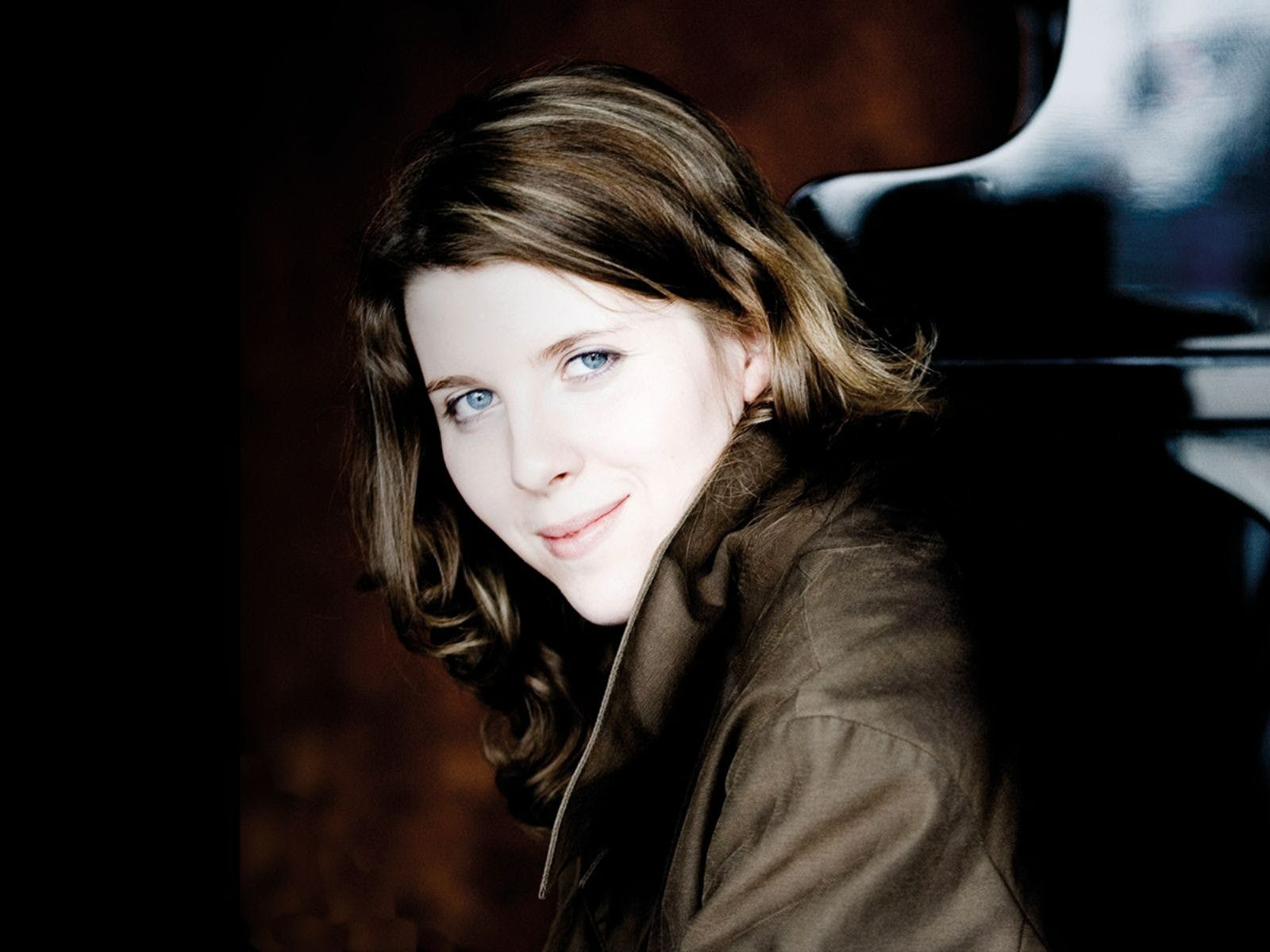
Polina Leschenko
After a presentation in Newcastle and two in Sydney, the ACO presented its fourth rendition of this program here, led by artistic director Richard Tognetti and supporting a well-worked soloist in pianist Polina Leschenko who has appeared with this ensemble several times in the past few decades. For Monday’s exercise, L:eschenko took the solo line in Chopin’s F minor Concerto No. 2 as arranged by the Israeli pianist Ilan Rogoff for string quintet (here amplified to the ACO forces of 5-5-3-3-1); and also partnering Tognetti in Mendelssohn’s early Concerto for Violin and Piano in D minor – the original version for string accompaniment only.
The evening ended, Leschenko-less, with Fanny Mendelssohn Hensel’s String Quartet in E flat Major and this, for me, proved the most interesting and well-played work on the program. Only part of this success was due to the absence of the pianist; more importantly, the arrangement for all 17 of the ACO’s strings proved effective, particularly in the opening Adagio and the ‘slow’ movement Romanze, both of which gave the body space to exercise a free-flowing amplitude and display a mastery of phrase-shaping that typifies this orchestra’s work at its best.
Technically, Leschenko has always impressed as a thorough technician; it’s hard to think of one measure from her during this night that misfired in articulation or energy. But I’ve always found her performances solo-centric, even in a work like the Mendelssohn where dynamic allowances have to be made to give the violin room to be heard. This last wasn’t the case during the first movement; even as early as bar 83, the piano’s fierce volume was too great – both for the actual language of the piece, and for Tognetti who is no shrinking violet but was later swamped by his fellow-soloist’s output.
But then, Leschenko has a habit of pivoting a performance to herself by main force. She had less competition in the Chopin work, here deprived of its 13 wind and timpanist, as the string ensemble put up little competition and Tognetti was constrained to indicate the beat on only a few occasions (in fact, it was remarkable how often he was able to leave his players to follow their parts without direction). And, contrasting with her self-forefronting in the Mendelssohn concerto, the Chopin Larghetto made a positive impression, at least up to the middle segment’s rhetorical flourishes where the minor scale octaves sounded overcooked in this particular context – no, the keyboard was too prominent anyway because the wind contributions here are small almost to the point of intangibility.
As for the rest of this concerto, the composer was best served in the concluding Allegro vivace where Leschenko’s approach demonstrated a welcome restraint right from its initial 16 bar solo, following the score’s kujawiak impetus. later investing solo interpolations with an unobtrusive rubato. This control proved its worth particularly in the col legno interlude which, in this instance, enjoyed a clutter-free delivery with a successful balance between soloist and strings. I can’t say that the following pages of piano triplets engaged heightened attention but they don’t under the hands of more venerable pianists than Leschenko. At least these longueurs went their ways in an amiable fashion.
I suppose this artist has enjoyed more acquaintance with the F minor Chopin than she has with the Mendelssohn hybrid, yet it strikes me that somebody must have been aware how disjunct her approach was with her surroundings. The contrast in mirror passages, as between bars 157 and 167, proved distracting, if not irritating. Much the same took place in parallel work between piano and violin, e.g. bars 179 to 193, during which Tognetti was clearly playing but close to inaudible. And did the piano tremolo between bars 244 and 268 have to threaten like a Rachmaninov rumble?
However, the second movement Adagio with its exposed unaccompanied duets produced a successful chamber-music combination as the violinist’s piercing, true line was given exemplary exposition with few instances of a grab for attention from his partner. It didn’t last, of course; the following Allegro again piano-dominated in what I think was an interpretative fault-line where the requisite brilliance of this style of writing got confused with hammering. It’s easy to understand that the players might not have grasped how forceful Leschenko’s attack came across into the hall, but anyone who was present at a run-through (assuming there was one at QPAC) must have heard the discrepancies in attack and dynamics.
Having said that, I also have to report that the Brisbane audience responded to both concertos with high enthusiasm. I heard the Chopin after moving to the back stalls and an enthusiastic claque of one greeted the performance with the sort of rabble-rousing hoots that you usually encounter after the distorted vocal catastrophes of The Masked Singer. More to the point, Tognetti displayed every sign of enthusiasm and affection for his guest; so, if it’s good enough for him . . .
It was an unalloyed pleasure to come across the solitary string quartet written by Mendelssohn’s sister. This work speaks a consistently idiosyncratic tongue and follows an individual creative path. For example, the opening Adagio begins with a falling figure that takes an upward trajectory after five bars – and the two are deftly fused/juxtaposed/interwoven over the following 68 bars with an unstudied facility that maintains your interest, not least for the writing’s clarity (which must be even more obvious when this work is played as originally written) as well as the composer’s uncluttered style of development.
Later, you find the same good husbandry of resources informed by imaginative breadth in the Romanze where Hensel’s harmonic shifts surprise not so much for their own sakes but through the fluency with which they are accomplished. Added to the seamless part-writing, you were once again struck by the collegial output of the ACO, each line speaking with admirable authority, particularly the three violas who quietly took over the running in their bars 43-4 exposure: the only point in this movement where one part sings unaccompanied.
Putting a firm seal on this program, the players gave a bracing account of the final Allegro with an enthusiastic delivery that carried off the composer’s tendency to worry at a motive (cf. bars 21 to 33) or extend a theme beyond its expected parameters (bars 57 to 75) or keep two balls aloft simultaneously (as across bars 128 to 138). And then you could enjoy the warm embrace of fresh material at bar 217 and the subtle change of rhythmic pattern in the concluding bars. Of course, the work was welcome for its pedigree and its unfamiliarity compared to its predecessors on this occasion. But making assurance doubly sure was the aural comfort of the work in this orchestral format, a guise it assumed with more ease and success than some of the ensemble’s previous attempts at painting on an oversized canvas.
 O'Connell the Music