Conservatorium Theatre, Griffith University, South Bank
Thursday November 23, 2023
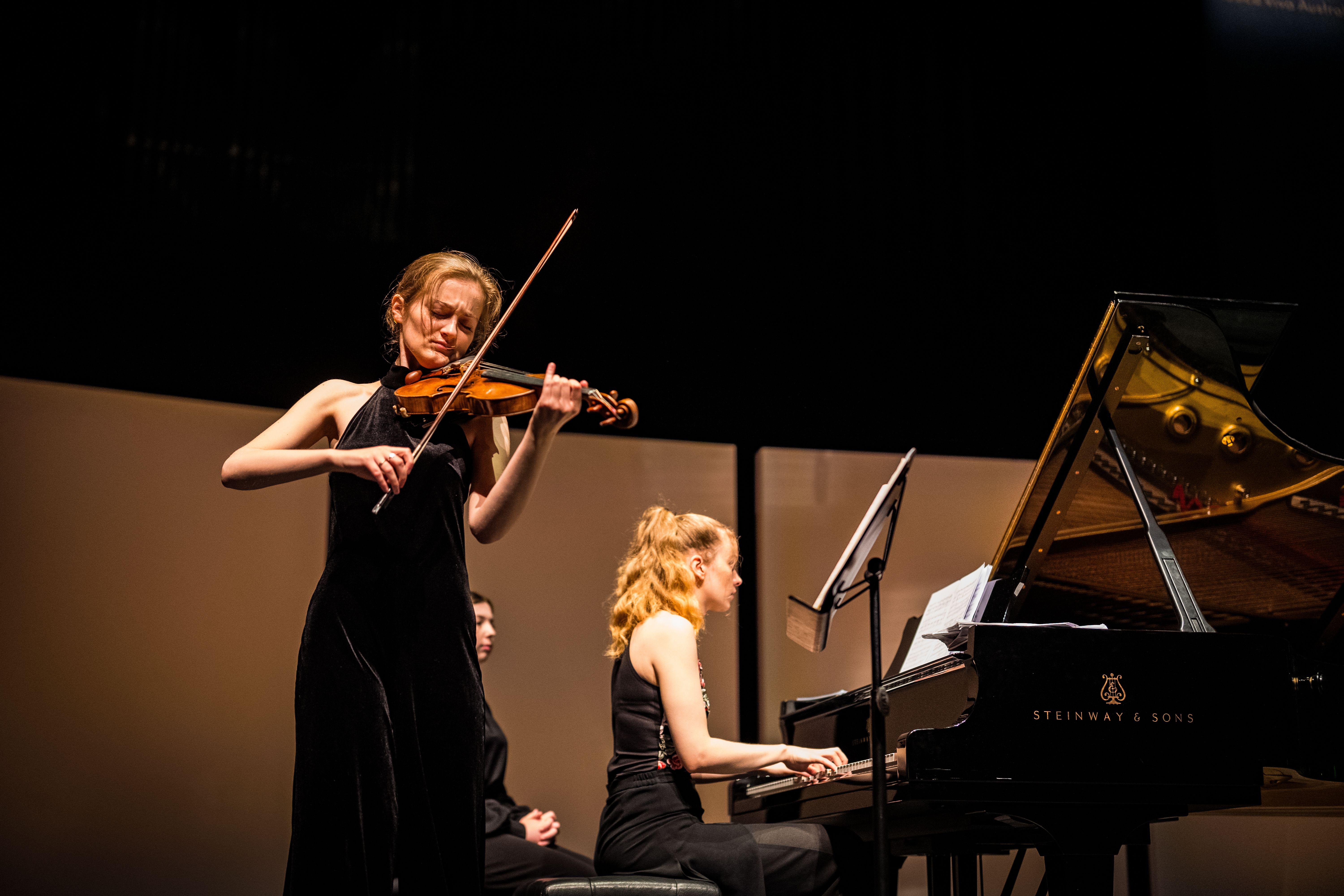
Noa Wildschut and Elisabeth Brauss
Musica Viva’s artistic director, Paul Kildea, heard this duo of Wildschut and Brauss performing the Franck A Major Violin Sonata online in 2019. So impressed was he that they are now here, touring nationally , with the sixth of their nine-stop series in Brisbane. You are confronted by a pair of excellent musicians, working well in their opening bracket of Schumann’s Violin Sonata No. 1 in A minor, Messiaen’s Theme et variations of 1932, and the formidable Sonata in G minor for Violin and Piano by Debussy – the composer’s final (1917) major work.
As for the evening’s second part, I wasn’t so impressed. The pair gave an airing to a new work by May Lyon: Forces of Nature, commissioned by Musica Viva for these players. But the Franck Sonata – the big finale – was only moderately successful; not simply because of some odd choices in delivery but mainly for a disconcerting theatricality hanging over the interpretation’s finale.
I’d done the usual preparation by listening to a few tapes and online readings of each item, apart from the Lyon work, and came to the Belgian masterpiece with an impressive student reading still lingering in the memory – violin Nathan Meltzer (19) and piano Evren Ozel (18), recorded at the ChamberFest Cleveland in 2019 – because of its security and refinement.
I’ve known this work well because of a few years’ playing sonatas in earlier times (many thanks, Andrew Lee). So I’m aware of the piano part’s technical problems (disasters, in my case). But the violin line impresses as one of the most luminous and clear-speaking in the repertoire. Franck certainly exercises the performer (he was writing it for Ysaye, after all) and you can see vehement, virtuosic writing thrown up across the two middle movements. But the craft of a superior reading comes, it seems to me, from generating an unaffected, even simple line. Still, of that, more later.
Wildschut made an impression straight away with a splendidly rich G-string melody at the start of the Schumann’s Mit leidenschaftlichem Ausdruck: 8 bars of a mellow viola timbre. Here, the musicians were on steady ground, the piano inclined to reticence which is not that problematic in this score which gains in semiquaver keyboard activity as the movement progresses. More pleasures came in the following Allegretto where the duo struck a nice balance of contrasts between the quiet, perky opening sentence or three and the broader melodic sweeps interspersed between them. The only problem emerged in the ritardandi and fermate that recur across these pages, for the first time at bars 2-3. Most of the way through, these adjustments to speed and address came off simultaneously, but every so often they didn’t – which spoke to me of insufficient awareness of intention between the players.
Still, the final Lebhaft passed by with loads of verve and satisfying virtuosity in the paired semiquaver patterns and the lyrical swathes of passages like the E Major interlude that mutates so deftly back into A minor so that the rhythmic and linear streams sound seamless in the change-over. It was almost enough to ride over the few slips in violin articulation and a tendency to backpedal from Brauss who gave the foreground to Wildschut, at times beyond the bounds of courtesy.
The pianist sounded more assertive in the Messiaen collation; not surprisingly, as the piano enjoys a good deal of exposure throughout, e.g. the first variation’s chord chains; the interlocking lines of the following Un peu moins modere where the violin takes the upper line but has to endure a mobile harmonic support until the 4th-last bar’s double octave piano explosion; a restless sequence of vehement interchanges in Variation 3 with some fierce keyboard outbursts; the bell-like right-hand quavers and left-hand triplets that set the pattern for Variation 4, leading to a powerful final 8 bars of ff to fff trills and tremolando; and the final apotheosis suggesting the end of the Quartet for the End of Time in its slow processional pace and the terrifyingly risky 6 bars of quadruple-forte at the segment’s core.
Compared with other readings, the Wildschut-Brauss interpretation proved individual because of its urgency, neither musician showing any signs of hesitation, no matter how complex the mixture; the work balanced by a clear definition of outline in both outer sections and a shared confidence. But then, this work is less open to idiosyncrasies than the preceding Schumann.
Or the Debussy sonata where Wildschut again impressed for her low register timbre, even if she came close to scraping in some places; a tendency that was not realized in the second movement Intermede. You could not fault Brauss’s control of dynamic and simple touch here – no crass blurts or attention-grabbing staccato insistencies. Certainly, these pages lived up to their Fantasque direction, but the corresponding leger came over fitfully, and the final dying-away of the last six bars was unusually positive for a good part of its length.
However, the finale proved to be a disappointment, beginning with the violin solo at the time-signature quasi-change to 9/16: a rhapsodic throwaway exuberance at its finest but here lacking punch and/or a rationale. Further, the violin’s output became too forceful for the music itself at certain points, so that you were fretful about upcoming forte passages, like the Molto rit. ten bars before Number 3 in the old Durand edition of 1917. And, while the movement is a creature of fits and starts (which you can actually say about the whole sonata), I found that through these pages the interpreters seemed to be grabbing at one technical problem after another. In short, the realization lacked coherence as a steady building unit.
There’s not much to report about Lyon’s new work. It began with a violin cadenza that supposedly suggested water and ice; it closed with a ferment that represented volcanic fire – or at least that’s what I gleaned from Wildschut’s introductory comments. Fine; that’s what I heard, going along with the composer. Of course, every auditor will have a personal response but Lyon lived up to her projections. All the same, you can’t find much that’s novel here – no ‘new’ sounds or singular developmental touches – and the executants seemed to be in command of a score that painted its illustrative colours with a mild-mannered hand.
It was hard to fault the first Allegretto of the Franck work, especially as it gave us a fair sample of Brauss’s output in the movement’s 2/3 piano solo passages, carried out with eloquence and exactitude. Further, Wildschut’s delivery showed fine restraint – right up to the con tutta forza aphorisms before the second piano solo which were over-emphatic, despite the direction. Even that active opening to the second movement Allegro enjoyed expert rapid-fire handling from Brauss, and Wildschut’s G-string entry cut through effectively. The next extended violin entry sounded over-strident but the delivery of the second theme resonated with well-shaped character.
The violin’s soft line 9 bars after the Quasi lento interruption was intended, I think, to be spectral; both instruments are under a pianissimo direction (in my Schirmer 1915 score) but you still have to phrase the lines, not just let them sit there uninflected. On the other hand, when both instruments at last state the main theme in unison, the violin’s carrying power was exactly proportionate to her escort.
Both players took a spacious approach to the Recitativo-Fantasia, Wildschut unhurried in her two cadenzas. As the pair entered the F sharp minor section, you felt that the sonata was unfurling with purpose, right through those sequences of thematic reminiscences and re-statements up to the climactic violin high F, delivered with loads of bite and gusto 13 bars before the hushed ending.
The first appearance of the main theme in the A Major concluding Allegretto was a delight, mainly because of the musicians’ unfussed attack – just following a tune in canon without giving it amplitude or weight. This ease was too good to last, of course, and the later E Major version that turns into a barnstorming that prefigures the final page was something of a slash feast. And you have to have a control of weight and phrase to get through the passage work either side of the key-signature change to B flat minor, and maintain the listener’s interest in following your journey.
Perhaps Wildschut gave out too much intensity too early – not that Brauss was keeping her powder dry – but the build-up to Franck’s explosion into C Major proved overdrawn: a series of efforts that crushed against each other, the resolution not serving as a mighty release but simply another climax in a series of exercises in crescendo. Mind you, that made the final appearance of the first theme very welcome, even if Wildschut’s intonation faltered as she negotiated the highest notes in her part.
My score for the final page reads poco animato but these musicians upped the ante considerably, racing through the work’s last 21 bars at a very quick pace. They’re not alone in this acceleration, for sure, but you have to consider the music’s poise and, by the time Brauss hit the ascending dominant and tonic dyads, sense flew out the window in a meaningless frenzy. This passage is meant to be a triumph, a powerful variant, but here it was reduced to a vulgarism; an unappetizing end to a recital of good quality, if not consistently so.
 O'Connell the Music