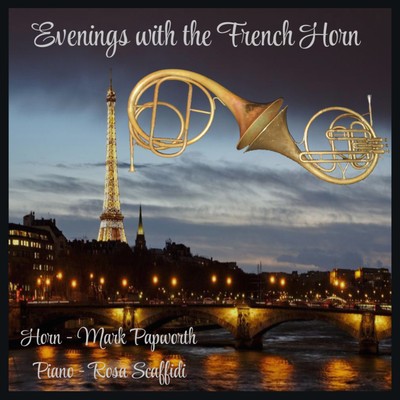
For his latest excursion into the byways of horn performance and composition, Mark Papworth is again allying himself with pianist Rosa Scaffidi, following the success of their 2020 Siegfried’s Story disc with tuba Per Forsberg. This time, the horn-piano duet presents two works only: a bona fide sonata for natural horn by Adolphe Blanc, a versatile 19th century chamber music composer whose life-span overlapped with that of Hector Berlioz, whose six-part song-cycle Nuits d’ete has been arranged for this recorded performance by Papworth.
Admittedly, this latter popular sequence of chansons has been arranged over the years since its first publication. Originally set for mezzo or tenor and piano, later versions by Berlioz accommodated baritone, soprano and contralto. But then, he directed that specific songs be addressed by particular voice types; ah, what a character. That detail is ignored these days where – in concerts, recitals and on CDs – one singer is enough to cope with the series. Nevertheless, as far as I can see, the composer didn’t arrange any of the set for a solo instrument; certainly not by the time he got around to finishing his orchestration of them all in 1856.
Naturally, in this new format the nature of the work changes and Gautier’s verses become unnecessary; well, without a voice, they would, wouldn’t they? It’s fair to say that the horn is not the most malleable of instruments for this set of songs and this is apparent from the opening Villanelle which strikes me as laboured, right from the opening Quand viendra in the vocal line. It’s as if Papworth is at pains to articulate each note, rather than handling Berlioz’s phrases as lyrical continuities. As well, the horn’s weight sounds at odds with the repeated quaver chord accompaniment.
Le spectre da la rose works better, possibly because of the rhapsodic nature of the vocal line and Papworth does excellent service in outlining his part with well-honed phrasing. Scaffidi’s reading of the bar 3 right hand differs from my edition and her attack on the two-bar interlude after the end of stanza 1 is too aggressive by far. For Sur les lagunes, the break inserted in the middle of the held horn note across bars 12 to 14 sounds uncomfortable and the piano’s left-hand chord before Que mon sort est amer! fails to sound convincingly. As this song progresses, you become aware of some notes in the horn part sounding ‘thin’,; I don’t know enough about the instrument to speak with certainty about the facility of even timbre across scale passages, but I’m assuming that certain phrase-shapes are hard to negotiate with a consistency of output.
But then, it must be a limitation of Papworth’s chosen instrument, which is a French piston valve horn. This option is almost certainly brought into play because an 1880s horn should best align with the composer’s usual ‘sound’, rather than the later German rotary vale construct that obtains in most (all?) orchestras today. Chromatic scales seem to be non-existent or rare in horn parts until late Romantic works.
Anyway, we proceed to Absence which presents as suited to the horn’s colour. As well, the simplicity of the recurring refrain gives Papworth room to employ several modes of articulation while taking minimal liberties with the song’s caesurae and downward-plunging arpeggios. You can enjoy some fine moments in Au cimitiere, even if the tempo is rock solid and the pleasures are mainly harmonic, like the piano shift in bar 5 and again in bar 12. But the approach is head-down, tail-up and you miss a singer’s ability to invest tension generated by Gautier’s spectral suggestions.
As at the start, so at the end. The concluding L’ile inconnue suffers from an orchestra’s absence, even if the work has an infectious grandiloquence in its best moments. Scaffidi’s semiquavers underneath the second stanza are muffled and her dynamics are often at odds with the original, e.g. an f for a ppp at the end of this section. Papworth presents a malleable line, touching at the conclusion where the soft reprise of some of the poem’s opening lines offers a fine realization of the poet’s gentle questioning.
As for the sonata, here the ‘faint’ notes become more prominent because of the nature of Papworth’s instrument: a natural horn, the kind that would have been used by Mozart but which you rarely hear employed in live performances of his concertos for the horn – at least, in this country. These performers repeat the exposition of the first movement Allegro which strikes me as unnecessary because the form and melodic character are easy to assimilate and the orthodox lay-out of these pages means that you aren’t faced with any difficulties in recalling what is being established as subject to expansion. No complaints about the horn line but Scaffidi’s quaver octave sequences are suspect in the opening pages and the semiquavers that follow the second subject’s treatment would certainly have benefitted from re-recording; at one point, they simply don’t appear.
However, this is solid writing with no surprises, even for 1861 when post-Berlioz orchestration was affecting a large number of French writers. Much the same could be said of the following Scherzo which features an unexceptional falling arpeggio figure as its main impetus; the horn’s in F, the arpeggio’s in F, the movement’s in F, and the following harmonic shifts in the B flat Major Trio almost exclusively apply to the piano. Once again, I’m not sure about some of Scaffidi’s imitative work in the first segment of this movement but the horn is untroubled in a set of pages that offer no real challenges.
During the third movement Romanze, you have more opportunity to notice the instrument’s ‘faint’ notes and engage in the perennial puzzle as to why the overtone sequence works the way it does. As far as content is concerned, this is a Mendelssohnian bagatelle in A flat Major with a neatly shaped main melody and a middle interlude that begins in F minor and walks an uncomplicated path back to the home key. Scaffidi’s work is reliable and Papworth exercises his presence in pages where the keyboard initially assumes the dominant role.
The concluding Allegro opens bravely enough but it’s in a hefty 6/8 in F and the horn’s inevitable weak notes are more common here than anywhere else in the sonata and more noticeable because the metrical accents are heavy. Neither performer is totally convincing across these pages, the piano part occasionally clumsy in semiquaver passages, notably in the piu vivo coda which fails to sparkle but flounders along its path. It makes an unsatisfying end to this recording that aims to give us an insight into the sound world of the horn as most of us don’t know it. You’d probably need to to be a devotee of this particular musical corner and more receptive than most to its limitations and oddities. As a final note, the CD is rather brief, coming in at a few seconds over 54 minutes long.
This concert was succeeding strongly across a little more than an hour of its 75-minute length. The alternations between music by Bach and Arvo Part did not rub the sensibilities as roughly as they might. Both dancers involved showed masterful athleticism, even if it was hard to find much cross-fertilization between some of the music and the choreography. On this final leg of a 12-performance national tour, the thirteen musicians were well played-in to their work. Admittedly, at the end some of us were rather stiff from sitting through an uninterrupted complete session, but you take that readily enough when a Mahler or Bruckner symphony is under way.
Yet the penultimate programmed component – a three-subject fugue from Bach’s Art of Fugue – came close to dissolving all the good that emerged from this event. It’s hard to tell why; maybe the extract’s complexity sounded at odds with the stage of the night that we had reached: the Into Silence bit. On either side of this contrapuntal web, we heard part of the minimalist Pari intervallo by Part and finally a left-field inclusion in the last movement to Hindemith’s Trauermusik which sets the chorale Vor (Fur) deinen Thron (not Wenn wir inhochsten Noten sein as the program notes have it). You can accept the slow-moving four-line Part piece, even the odd theological connotations that our coming before the throne of judgement involves silence (where have all those laudatory angels gone?). But the fugue, despite its proposals of abstractness and detachment, makes a solid complex – a marvellous web, and the opposite of silence.
The ACO’s artistic director Richard Tognetti and Sydney Dance Company’s equivalent Rafael Bonachela presumably put together their five-part exercise in tandem. They set up a basic alternating pattern through a Prelude that opened the night with an eight-voice canon in C Major by Bach which takes its own course once you set it in motion; followed by a Part toccata which is the opening movement from the composer’s Collage on B-A-C-H, making for some amiable scrubbing before we arrived at the first of the night’s scheduled three gardens.
First (appropriately enough) was the Garden of Eden where the snake appears straightaway in the concluding aria Wer Sunde tut, der ist vom Teufel from Bach’s Cantata Widerstehe doch der Sunde: a forbidding opening gambit, sung with eloquent chromatic ardour by counter-tenor Iestyn Davies who in fact recorded this work in 2017. To soften the blow of our expulsion, Tognetti performed the 38-bar long dolce from Bach’s A Major Violin Sonata, which served as a welcome reminder of the halcyon, God-concordant early days in this Biblical ambience.
Such a state of grace was followed by another effort from Davies with Bach’s alto aria Jesus ist ein guter Hirt, a grave if ornate G minor effusion from the placid Ich bin ein guter Hirt cantata which impressed for the buoyancy of the vocalist and the violoncello piccolo adaptation by (I think) Timo Veikko-Valve. Still, the singer occasionally produced some forced production that recalled the excesses of British cathedral choir altos. To conclude our time in this primordial ambience, we heard Part’s Fratres with which the ACO has previous experience, notably through an ABC recording in 2017. I assume this was the composer’s 1991 version for string orchestra and percussion; at all events, the effect was mesmerizing, in large part for the fluency of the participants in addressing this structurally simple score.
An abrupt move took us to Gethsemane with some more Bach in the Andante from the A minor Violin Sonata of which I remember nothing; it’s just a blind spot in a performance that left the stage illuminated (sort of) but cast the audience into exterior darkness, reliant on memories of a 17-section tapestry of music-plus-ballet in which this sample of Tognetti’s art left not a wrack behind. Still, it was well subsumed by Davies’ launching into more Bach with the Erbarme dich from the St. Matthew Passion: one of the composer’s great penitential arias, even if it does come after the Agony in the Garden chapter. It shouldn’t, but my interest in these pages is almost totally devoted to the mellifluous violin obbligato line, here accomplished with touching empathy.
Part’s Fur Lennart in memoriam was written for the funeral of former Estonian president Lennart Meri in 2006. Its core is a Slavonic hymn, but the surrounds comprise powerful bands of diatonic string sound which seemed appropriate to this segment of the evening. All that I found in question here was volume. The few performances of this threnody that I’ve come across are weighty, rich in string timbre; this abridged body of six violins, pairs of violas and cellos with one double bass was clear enough but not as overpoweringly dynamic as you might have expected.
To facilitate our exit from this venue for tears, Davies sang Part’s setting from 2000 of Robbie Burns’ My heart’s in the Highlands for counter-tenor and organ. The vocal line is a monotone on three different pitches and the singer spiced up his interpretation by mildly shadowing the SDC duo’s steps and hand motions. While the number slotted in to the general air of pre-Crucifixion despondency, I was perplexed by Part’s dour reaction to the poet’s mix of elation and nostalgia. Still, you could hardly fault the delivery of the piece which was as emotionally remote as you’d want.
The last garden is that of Heaven, to which we were welcomed by the 21-bar sinfonia to Bach’s Der Herr denket an uns cantata. This is stately and benign at the same time – definitely relevant for the saints among us approaching this garden – and carried out with an excellent underpinning energy and phrasing. Part’s Vater unser original, for boy soprano/countertenor and piano was arranged for the ACO and Andreas Scholl in 2013 for that counter-tenor’s tour with the ensemble. The music is doubtless sincere but represents the contemporary Nordic norm in religious writing: a melody that outlines the text clearly and without embellishments, a static harmonic scheme, and an absolute rejection of anything that has been written in the 20th (or 19th . . . or 18th) century. As well, it presented no challenge to either Davies or the ACO.
In further acknowledgement that we had arrived safely, Valve gave us the Prelude to Bach’s C Major Cello Suite. This is a triumph of certainty in its happy sequence of scales and sequences, building to the powerful stretch of displaced arpeggios based on a low G that stretches from bar 45 to 61. As far as I could tell, the reading was exact and eloquent: the sort of music that might well be played in this garden, written by a man who is, as Sagan (possibly) indicated, humanity’s boast.
Davies’ final contribution was the Et exsultavit aria from Bach’s Magnificat, usually undertaken by a Soprano II, so that the counter-tenor’s timbre took you by surprise, notably in some of the vocal line’s one-syllable curves. But its repetitions and fecund linear interplay simply continued where the cello suite movement left off. Once again, I’m afraid my interest fell away and onto the ACO’s sprightly escorting abilities. After this, we moved into the Into Silence trilogy which came close to cruelling this lengthy miscellany. But the insertion of Hindemith’s consolatory chorale setting made the end of our journey both moving and elevating.
The SDC dancers – Emily Seymour and Liam Green – demonstrated some engrossing movement phases that mirrored the abstract patterns of the music; fine for Part, hard to find fault with in the Bach instrumental scraps, but superfluous during the numbers sung by Davies – in particular, the cantata extracts. Nevertheless, the interlacing of their bodies and occasional bursts of mirroring rarely grated, often complementing the contrapuntal writing of Bach and balancing Part’s repetitions and simplicity of construction with impressive grace.
Finally, Chad Kelly oscillated cleanly between chamber organ and harpsichord across the program, the former instrument more audible in this large hall which is problematic for any musician operating a keyboard from stage level. As with the ACO itself, his work showed expertise and a devotion to the task throughout this largely successful undertaking.
First off, an admission: I knew Michael Easton – fairly well, in fact. We were, for a time, co-critics on ‘The Age’ in Melbourne before he was rusticated for asking in one of his pieces the perfectly reasonable question of why was Mahler such a melancholy manic-depressive? A touchy editor who revered the composer took umbrage and so I lost another – and by far the best – in a long line of associates. He took me to lunch several times which, among other things, showed what a genial host he was – a bright light in the faded rooms of the Savage Club.
Further, he was a complete musician, far more at ease in his work than any other writer I have come across, except Peter Sculthorpe who shared with Easton a courtesy and ease with his fellow man that was most appealing in the context of Australian composition during the latter half of the last century. Like Sculthorpe, he never complained about criticism of his work – a more rare characteristic than you’d think among their peers. When he died untimely back home in England, he left a hole in the musical landscape of Melbourne where he was indefatigably active until his last sad years.
To commemorate the 20th anniversary of Easton’s death, Move Records has issued this CD which I think was originally put out in 1994, then reissued in 2004 by Len Vorster. Certainly, the prefatory comments on the Move disc’s attached leaflet by Michael Hurd speak of the composer as alive, so no work has gone into updating that appraisal; which would be particularly hard to do as Hurd himself died in 2006. And the time span of the works presented lies between 1981 and 1993 – just before Easton arrived in Australia (1982) and then three years after he co-established the Port Fairy Spring Music Festival (which continues to this day).
Two works date from 1981: Moods for piano solo, and the duo piano Cocktail Suitefor two, five movements of which three are on this CD. Vorster plays the first of these – a four part collection – and collaborates with Easton in the alcohol-inspired dances. The Moods were written in the garden of the composer’s sister; they show Easton’s reaction to British pastoralism and are conveniently paired into slow-fast partners – In reflectivemood, Highspirits, Alone andlonely, Practical jokes – and last a little over five minutes as a collective.
None of these is particularly deep; they’re just deft expressions of . . . well, moods. All are concise and neatly argued constructs; a benign good humour peeking out of the odd-numbered ones, with a cleverly piquant sprightliness in the others. The language is unabashedly tonal – E minor, B flat Major, E flat Major, C Major in turn – with plenty of bitonality and harmonic quirks to keep us and interpreter Vorster on guard. But not aggressively; the set comprises four bagatelles, well worth the attention of inquisitive pianists of the time.
Easton and Vorster begin their duets with the Whisky Sour Waltz where the composer plunges happily into the world of the lounge pianist with an appealing melody that dodges and curves its way across the dance floor with post-Straussian gusto; the performers stay in sync for most of its progress. The following Martini Melody suggests Tea for Two and is loaded with Easton’s panache at imitating/encapsulating the two-step mode with a clever control of the keyboard, even if these executants tend to some sloppiness in their synchronicity close to the piece’s conclusion. Finally, the Schneider Cup Charleston refers to a drink that I don’t know. The Cup itself is easy to trace to an aviation prize in the Charleston era (roughly) but it’s not served in any bar I know. Still, the piece is suitably racy and suggestively derivative; your speakers will fairly drip with reminiscences of Bright Young Things.
How Pleasant to Know Mr. Lear sets five of the master’s products: three of the limericks, Mrs. Jaypher, and the work’s self-ridiculing title poem. Baritone Ian Cousins is accompanied by Vorster in another group that takes a little over five minutes to perform. There was an Old Man who said ‘Hush!’ is a clever take on Britten with its carry-on lines and angularity; There was an Old Man of the Hague presents to my ears as a lesson in bitonality; There was an Old Man of Whitehaven makes syllabic additions to lines 4 and 5 but offers a progress from Victorian-era sentimentality through an atonal glaze to a placid Edwardian resolution.
As for Mrs. Jaypher, Easton gives us a brilliantly lively setting – but of the first stanza only. Cousins is required to go falsetto for most of the heroine’s direct speech but it’s probable that the composer found little inspiration in the lemon-invested second stanza, which would also have required a massive amount of artificial sound-production. In contrast, we hear all eight stanzas of the title song which – for most of the time – follows a rhumba pattern and offers both executants some tests in pitching (for Cousins) and malleable rhythm (Vorster), which they master, for the most part.
The CD’s most substantial work is the Piccolo Concerto of 1986, written for Melbourne Symphony Orchestra flautist Frederick Shade and here recorded at the Port Fairy Spring Festival of 1992 with the Academy of Melbourne and its founder Brett Kelly conducting. You notice straight away the constant presence of the soloist, orchestral ritornelli being kept to a minimum. The score asks for an escort of strings with a percussionist contributing occasionally; in the first Allegro, it’s side-drum and tambourine, I think. The ambience is British pastoral, although the phrase lengths of the first subject are slightly off-kilter; still, the work follows a sonata form layout and this reading holds only one point where the soloist turns slightly flat on a sustained high note,
Easton’s following Andante con moto opens with the main melody confided to a solo cello, Shade eventually taking over with a counter before putting everyone in their places by following this opposing idea while the orchestra continues with the quiet lyric. Once again, the soloist is almost a continuous presence, even if his function is mainly high-pitched decoration or serving as an anti-strophe.
As with the first movement, Easton’s concluding Rondo features a principal theme that is slightly irregular rhythmically but loaded with an attractive piquancy that sets off the intervening episodes very cleverly. Here, the strings have more tutti exposure, if only for a few bars each time, but the work’s procedure offers a clever contrast between Malcolm Arnold-style humour and a controlled lyricism that could be Delius if the older composer held more firmly to a harmonic focus. Just before an ornate final main tune restatement, Shade is given an athletic cadenza which interrupts the prevailing jolliness just long enough.
From 1987 come Deux chansons pour l’arriere-saison – the first a Verlaine setting, Colloque sentimentale; the second by Gerard de Nerval, Dans les bois. Here the singer is soprano Kathleen Southall-Casey, with Vorster accompanying. The first might be familiar from Debussy’s setting of the same lines, but Easton makes it more of a rather difficult cabaret number; not that difficult for the pianist but quite a stretch for the vocalist. While the vocal line has an attractive elasticity, there is not much attempt to differentiate the separate lines and attitudes of the former lovers’ conversational gambits.
As for the rural excursion, the mood is frivolous with a modicum of regret in the third and final stanza. Of course, there’s not much you can do with a short outline of the love-life of a bird but Easton gives his pianist plenty of dexterous exposure and the final lugubrious suggestions are dismissed with a dismissive tail-flick that puts this frivolity in proper perspective.
Bidding farewell to the 1980s is the solo piano piece Conversations of 1988, here performed by Rebecca Chambers who does an excellent job of re-creating Easton’s mercurial temper. The work recalls a tedious restaurant dinner during which the composer was distracted by what he heard coming from other tables which contrasted with the far-from-sparkling talk at his own. It opens with a series of Prokofiev-like scrambles, before a change to a more measured dissertation (his dining partners?). But the bustle and buzz interferes in a less-than-subtle manner, illustrating all too well the composer’s suppressed irritation at being stuck in a conversational trough. Chambers’ reading is suitably aggressive and languid and she invests this brief outburst with the necessary vigour of precise articulation and dynamic heft.
We arrive at the 1990s through the CDs title work which sets four poems by Betjeman, with Southall-Casey again in Vorster’s company. You are instantly puzzled by the first piece, Song of a night-club proprietress which is also known as Sun and Fun; as well, there’s a rather well-known and predictable setting of these lines by Madeleine Dring. Easton views it as a sort of scena with a piano support that works as punctuation for a recitative-like vocal line which gets increasingly vehement and self-obsessed as the poem lurches through its five stanzas.
Harvest Hymn is a savage critique of contemporary farming with its pursuit of profit over the countryside’s good – an old story but a gripping one for those who believe in the myth of Merrie England. Easton’s setting is suitably feisty in the best Brecht-Weill manner; the piano part sets up a nightmare landscape where the machines are winning out while the voice declaims bitterly against the landowners’ greed and enslavement to possessions and wealth. Just a pity that the composer decided to resolve his penultimate, biting discord.
With In a Bath Teashop, Betjeman presents two lovers – an ordinary woman and a thug – looking lovingly at each other. Easton gives this everyday vignette a lavish Straussian vocal line and a throbbing accompaniment that might suggest the devotion underpinning the lyric. Southall-Casey gives a fine sweep to the higher aspirations of the song in its finishing couplet. To end, we get the Dame Edna-suggestive How To Get On In Society which treads the same boards as Walton, if the texts are more mundane. The poem is a monologue by a woman setting up her house for a tea-party; all very middle-class and concerned with trivialities. Easton captures the fussiness and self-absorption of the narrator, the vocal line appropriately four-square and affected. For some reason, the poem’s middle stanza is omitted. And I’m pretty sure – from three different sources – that the line runs ‘I know that I wanted to ask you’, rather than ‘I know what I wanted to ask you’.
From 1993 come two final works. The first is the Flute Sonata written for Richard Thurlby whom Easton met while the latter was studying at the University of Melbourne; from which point he went to the UK and since seems to have sunk from sight. For this CD, Thurlby is accompanied by Len Vorster. The work lasts for about 10 minutes and speaks the French-inflected compositional tongue that Easton inherited from his teacher, Lennox Berkeley. The opening Allegro malicioso strikes me as nothing of the kind, centred around a simple gruppetto of four semiquavers leading to a sustained upper note which serves as a sort of focal point for the movement that unfolds in concentrated swathes before a muted conclusion at odds with the swirling action that has preceded it.
Easton’s following Nocturne: Andante cantabile offers a fine fusion of sentiment and power; the emotional language sounds more determined and sincere than much on this CD. The composer was never one to scale the heights of modernity and the spices he employed in his work were usually mild; these pages in particular speak to the man’s professionalism and the ability to find a particular spectrum of operations, then explore it effortlessly.
The last movement is a moto perpetuo that brings to mind the Presto that rounds out Ravel’s Piano Concerto in G, including a final flourish that appears to borrow a leading figure from the French writer’s pages. Easton revisits that four-semiquaver motif from his first movement, as well as offering a reminiscence of his nocturne just before the final leap back into action. If the frenetic character of this movement reminds you of the Concerto, it still has its own quiet acerbity as both these executants turn it into an entertaining tour de force, eloquently written for the instruments themselves.
The second of these 1993 compositions is another four-part song-cycle: Dorothy Parker Says. This was originally the title of a stage-show for Australian actress Deidre Rubenstein, from which exercise Easton has extracted these vignettes; on this CD, Rubenstein is the vocalist, the composer is her accompanist. The set begins with General Review of the Sex Situation. The poem is a wry eight-line sequence of male-female generalizations that run past as a calm cabaret number, which is then repeated, half in quick-time, then back to the prevailing languor for the final quatrain’s repeat.
With the Song of Perfect Propriety, Parker belts out her desire to indulge in the derring-do of a modern-day pirate behaving like Blackbeard, but she is constrained, at the end of all this wishful thinking, to write slight verses. The song starts with a recall of the Ride of the Valkyrie and ends with a spurt from Mendelssohn’s Spring Song; in between, Rubenstein recites-sings with gusto her bloodthirsty ambitions for a once-upon-a-time masculine life on the ocean wave, etc. The obverse to this comes in Fulfillment which is half-spoken, half-sung. This reviews the writer’s early life under her mother’s care and the disillusionment of disappointed love in adulthood. In medias res, Easton enjoys a solo break before Rubenstein returns to repeat the poem’s final quatrain. It makes for a depressing plaint, if a familiar one and the vocalist makes excellent work of its torch-song potential.
Speaking of which, the last of these songs is a perfect example. But Not Forgotten speaks of a woman’s thoughts at the end of a relationship, one which has been intense enough to linger in the memory well after its disruption. This is a quiet, strolling reminiscence of no great overt passion but delivered with a fetching, breathy calm that finishes off this CD in a highly relevant way: it is hard, at least for some of us, to forget Easton and his unflappable skill.
Just two works being played this afternoon, one of which is a perpetual source of delight: the Brahms String Sextet No. 1 in B flat with its astonishing quantity of warm melodies enjoying the most benign of developments and restatements. As a partner, behold the Sonata for Two Violins by Miklos Rozsa, master of those legendary film scores stretching over a 45-year career. The Hungarian-born writer had the benefit of revising his score several times after its initial appearance in 1933 until the final version appeared in 1973. Which raises the question of what we’re hearing this afternoon because the original is listed as Op. 15, while the revision became Op. 15a; this program lists the former. Whatever happens, the nationalistically-inflected three-movement duet will be performed by Mia Stanton and Sonia Wilson, both from the QSO’s first violins desks. For the sextet, they are joined by violas Imants Larsens and Nicole Greentree, alongside cellos Hyung Suk Bae and Kathryn Close. Once again, I’m perplexed by the recital’s proposed length of 1 hour 20 minutes, as the Brahms lasts about 37 minutes on average while Rozsa’s sonata takes up about 17 minutes. Tickets rage from $59 full adult to $35 for a student, with the QSO’s inexplicably self-indulgent ‘transaction fee’ of $7.95 added on to every purchase.
As usual with the Conservatorium events, I’m in the dark about most details regarding this three-performance season. As you’d expect, the organizers have left out Il tabarro; a pity, because of those two powerful, passionate duets involving Giorgetta. So here we get the trite religiosity of Suor Angelica and then the farce based on one joke that is Gianni Schicchi. You can get involved in the angst that runs through the story of Angelica’s last hour but the eventual redemption from the stigma of suicide sounds to me like special pleading of an unpleasant nature, particularly when faced with the suicide of Doria Manfredi in 1909. The final tableau always strikes me as ridiculously bogus, a sop to the composer’s bourgeois morality and a sad self-justification. The trouble with the comic opera is trying to establish personalities for so many of the dead man’s relatives; two of them are interesting (well, perhaps three), but in productions I’ve seen most of the other six are given nothing to do. Mind you, the compensations include two splendid arias for Rinuccio and Lauretta but the work’s dramatic success depends totally on Schicchi. For all I know, the Con has an able baritone to carry off this difficult role. The conductor will be the establishment’s opera guru, Johannes Fritzsch, and Lindy Hume directs. Tickets are a flat $55 with no extra costs.
This program will be repeated on Thursday September 5 at 7:30 pm and on Saturday September 7 at 2:30 pm.
From various sources, it seems that Jonathan Mills‘ new opera, based on Murray Ball’s all-but-forgotten novel, received its premiere at the Perth Festival on February 21 this year. The work is also on the schedule of Victorian Opera for mid-October, the difference being that the WA premiere was a concert version while the Brisbane and Melbourne presentations are fully-staged, this Concert Hall one directed by Michael Gow, set and costume designs by Simone Romaniuk. From what I can glean from various sites, Desiree Frahn is singing Ellen and her crazy father Holland will be taken on by Simon Meadows. Mr. Cave is sung by Samuel Dundas and the stranger with talk of a world outside the forest that circumscribes the heroine has been entrusted to Michael Petrucelli. Conductor at the premiere and in Melbourne – and therefore here, probably – is Tahu Matheson. The work is in two acts, I suppose; at least we are informed that the opera in its Brisbane shape lasts 2 hours 20 minutes including interval. The odd thing is that I can’t find out when the central body responsible for its creation – Opera Australia – will be mounting this work at its home base (let’s be honest: its home) in the Opera House. After all, the Perth, Melbourne and Brisbane co-commissioning companies have done it the courtesy of a prompt airing or two in their regular venues. Tickets at QPAC range between $89 and $120, with the usual $7.20 ‘transaction fee’ added on, just to ensure that the event attracts even fewer patrons than it might have done.
This performance will be repeated on Thursday September 5 at 7 pm.
Here’s an eerie three-part concert that vaults from one historical phase to an extreme opposite. In the beginning is the overture to Haydn’s The Creation oratorio: The Representation of Chaos which, to Haydn’s mind, meant withholding the resolution of cadences. It’s a very Age of Reason musical depiction of the colossal muck-up that preceded the Big Bang, the Grand Deflation, or whatever descriptor tickles your primordial fancy. The world having been established, Umberto Clerici and his musicians move to Nigel Westlake‘s oboe concerto that gives this event its title. In its original 2016 form, the work was scored for Diana Doherty‘s solo (which she recreates here), four horns, timpani, five percussionists, harp, piano and strings. Westlake found his impetus to write from a visit to Bathurst Harbour in Tasmania, although he knew about the state’s wilderness from his youth. The program’s second half involves American writer John Luther Adams‘ Become Ocean of 2014 which is organised in three instrumental groups that will keep the stage crew busy throughout interval. The score works as a palindrome and the little I’ve heard should not perturb Debussy admirers; Adams spends his 40-plus minutes layering textures in what would function quite satisfactorily as the soundtrack to a sub-marine documentary. A child gets in for $35; the full adult rate is $109 for a good seat. And then there’s QPAC’s usurious credit-card-use fee of $7.20.
This program will be repeated on Saturday September 14 at 7:30 pm. Top price increases to $135 and most other costs rise too, but a child’s ticket continues to be $35.
For this appearance here, the ACO appears unrestricted by any guest appearance(s). The evening’s solitary soloist will be artistic director Richard Tognetti, who takes front position for Bach’s A minor Violin Concerto which he recorded with the ACO in 2006; some of musicians from that time still survive in the ensemble’s ranks. As a preface, the orchestra plays an octet: Illumine, written in 2016 by Icelandic composer Anna Thorvaldsdottir. I’m assuming that this will be expanded to include all 17 or so of the ACO forces; it originally asked for a double bass and cut back by one on the regular number of violins. Anyway, this short piece has nothing to do with intellectual or spiritual light, but dawn: a natural phenomenon that delights you some of the time. We’re also enjoying the premiere of a work by Adelaide-based composer Jakub Jankowski; it’s apparently for string orchestra so will fit right in here but – as yet – the score lacks a title. And the ACO concludes its night with another octet: that by Mendelssohn which we’ve heard from the group several times and which the ensemble recorded in 2013. Entry costs $25 for a student, plus almost an extra third of that price for daring to enter into a financial transaction with QPAC; top tickets for adults cost $139, plus that $7.20 supercharge.
Here’s hoping that Conservatorium faculty member and pianist Daniel de Borah attracts a larger crowd than his last recital in the Hanger space attracted. Tonight he’s partnered with violinist Kristian Winther of whom I’ve heard and seen very little since he left the Australian String Quartet in 2014. In this short outing, the duo perform two 20th century gems. One is the Shostakovich Violin Sonata of 1968, written for Oistrakh and an unsettling instance in its first movement of the composer coming to terms with 12-tone music: that is – use it, then lose it. Still the remaining two segments make for an intensely involving experience. The other piece is Bartok’s Violin Sonata No. 1 in three movements. Written in 1921, this work shows the composer at his most hard-bitten and confrontational with some shatteringly virtuosic passages for both executants. What makes this event most attractive is not the quality of the playing (about de Borah, I have no qualms) but the fact that you rarely hear either of these works on a mainstream program; in fact, I’ve not come across either of them in years. Tickets are $22 and, as far as I can tell, there are no concessions. But there’s also no booking fee – o brave new conservatorium that has such accountants in it.
This sounds sensational but, as you’d expect, needs to be taken with several grains of salt. For one, the Los Angeles orchestra has not arrived at the Queensland Con en masse; just a few of them have made the trip – a wind quintet. Indeed, the group is here primarily to give an Utzon recital in the Sydney Opera House on Sunday September 22. Perhaps there’ll be common ground between the two events but at this Brisbane exercise, the American players will be joined by staff and students for a solid two-hour presentation. The visitors are flute Denis Bouriakov, oboe Marc Lachat, clarinet Boris Allakhverdyan, horn Andrew Bain (whom I remember from a stint he put in with the Melbourne Symphony Orchestra over a decade ago), and bassoon Whitney Crockett. It’s great to see that the visitors are all principals with the LA Phil and – a special Californian tribute to the rightness of things – they’re all male. As usual, there’s no indication what the mixed ensemble will be playing; if you’re interested, you’ll just have to come along on spec. Students get tickets for $25 apiece, the concession rate is $35, and the full adult price is $45. In line with previous recital/concert bookings at this venue, I can’t detect a superimposed fee.
To begin, the choir will be singing Vivaldi’s Gloria RV 589 (vague memories of playing continuo organ for a joint PLC/Xavier performance in Monash University’s Robert Blackwood Hall too many years ago) which ranks among the composer’s best-known vocal works and remains buoyant throughout its half-hour length. I can’t find out the names of the three soloists, if there’ll be an orchestra (oboe, trumpet, strings, continuo), or who is conducting (Kevin Power, probably). After this comes the title work by American composer Dan Forrest, which exists in three versions; I suspect that the full orchestral one will not be given this evening. The composer sets his work in five movements: an Introit/Kyrie, an amalgamated set of Scriptural scraps in sympathy with the usual Dies irae (why not take on Thomas of Celano’s original?), an Agnus Dei (out of sequence in the Mass liturgy), then a Sanctus, finally a Lux aeterna. What I’ve heard of this work is heartfelt and simple-minded, traditional and smoothly accomplished with no problems for singers or instrumentalists. Finally, I’m unsure about the venue: the Choir’s website refers to ‘The Old Museum’, but the Old Museum (Bowen Hills) has nothing on its own website about this concert. Are there two Old Museums in this city?
Here’s a lushly Romantic program that opens with two difficult pieces for any orchestra to negotiate, and then concludes with a magniloquent repertoire warhorse that holds a closetful of taxing moments. Conductor Steven Moore sets the bar high with the Prelude and Liebstod from Wagner’s Tristan undIsolde, following these studies in deferred resolution with Chausson’s Poeme de l’amour et de la mer. The afternoon’s hard-worked soprano in both works is Nina Korbe who will be tested early on by her instant entry into the Wagner outpouring. I remember a hapless guest singing with the Melbourne Symphony Orchestra many years ago, vocally clutching for her entry point and looking desperately at conductor Oleg Caetani for a note after the Vorspiel‘s unhelpful concluding, almost inaudible low G in the cellos and basses; she came in several steps away from the actual E flat required. The French composer’s three-part song-cycle makes a fine if controlled partner to Isolde’s massive stream of abnegation and assertion. Chausson sets up two eloquent vocal landscapes on either side of a refreshing, if puzzling, interlude. And good fortune to the players when venturing into Dvorak’s evergreen Symphony No. 9 with its double-sided character of being both a celebration of the composer’s time in America and his anticipated return home to the welcoming streets of Prague.

 O'Connell the Music