SILENCE & RAPTURE
Concert Hall, Queensland Performing Arts Centre
Monday August 19, 2024
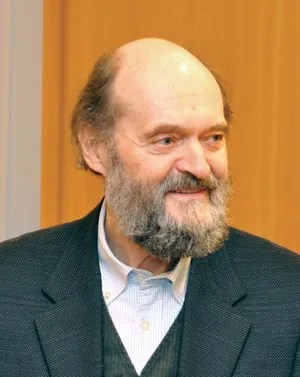
Arvo Part
This concert was succeeding strongly across a little more than an hour of its 75-minute length. The alternations between music by Bach and Arvo Part did not rub the sensibilities as roughly as they might. Both dancers involved showed masterful athleticism, even if it was hard to find much cross-fertilization between some of the music and the choreography. On this final leg of a 12-performance national tour, the thirteen musicians were well played-in to their work. Admittedly, at the end some of us were rather stiff from sitting through an uninterrupted complete session, but you take that readily enough when a Mahler or Bruckner symphony is under way.
Yet the penultimate programmed component – a three-subject fugue from Bach’s Art of Fugue – came close to dissolving all the good that emerged from this event. It’s hard to tell why; maybe the extract’s complexity sounded at odds with the stage of the night that we had reached: the Into Silence bit. On either side of this contrapuntal web, we heard part of the minimalist Pari intervallo by Part and finally a left-field inclusion in the last movement to Hindemith’s Trauermusik which sets the chorale Vor (Fur) deinen Thron (not Wenn wir in hochsten Noten sein as the program notes have it). You can accept the slow-moving four-line Part piece, even the odd theological connotations that our coming before the throne of judgement involves silence (where have all those laudatory angels gone?). But the fugue, despite its proposals of abstractness and detachment, makes a solid complex – a marvellous web, and the opposite of silence.
The ACO’s artistic director Richard Tognetti and Sydney Dance Company’s equivalent Rafael Bonachela presumably put together their five-part exercise in tandem. They set up a basic alternating pattern through a Prelude that opened the night with an eight-voice canon in C Major by Bach which takes its own course once you set it in motion; followed by a Part toccata which is the opening movement from the composer’s Collage on B-A-C-H, making for some amiable scrubbing before we arrived at the first of the night’s scheduled three gardens.
First (appropriately enough) was the Garden of Eden where the snake appears straightaway in the concluding aria Wer Sunde tut, der ist vom Teufel from Bach’s Cantata Widerstehe doch der Sunde: a forbidding opening gambit, sung with eloquent chromatic ardour by counter-tenor Iestyn Davies who in fact recorded this work in 2017. To soften the blow of our expulsion, Tognetti performed the 38-bar long dolce from Bach’s A Major Violin Sonata, which served as a welcome reminder of the halcyon, God-concordant early days in this Biblical ambience.
Such a state of grace was followed by another effort from Davies with Bach’s alto aria Jesus ist ein guter Hirt, a grave if ornate G minor effusion from the placid Ich bin ein guter Hirt cantata which impressed for the buoyancy of the vocalist and the violoncello piccolo adaptation by (I think) Timo Veikko-Valve. Still, the singer occasionally produced some forced production that recalled the excesses of British cathedral choir altos. To conclude our time in this primordial ambience, we heard Part’s Fratres with which the ACO has previous experience, notably through an ABC recording in 2017. I assume this was the composer’s 1991 version for string orchestra and percussion; at all events, the effect was mesmerizing, in large part for the fluency of the participants in addressing this structurally simple score.
An abrupt move took us to Gethsemane with some more Bach in the Andante from the A minor Violin Sonata of which I remember nothing; it’s just a blind spot in a performance that left the stage illuminated (sort of) but cast the audience into exterior darkness, reliant on memories of a 17-section tapestry of music-plus-ballet in which this sample of Tognetti’s art left not a wrack behind. Still, it was well subsumed by Davies’ launching into more Bach with the Erbarme dich from the St. Matthew Passion: one of the composer’s great penitential arias, even if it does come after the Agony in the Garden chapter. It shouldn’t, but my interest in these pages is almost totally devoted to the mellifluous violin obbligato line, here accomplished with touching empathy.
Part’s Fur Lennart in memoriam was written for the funeral of former Estonian president Lennart Meri in 2006. Its core is a Slavonic hymn, but the surrounds comprise powerful bands of diatonic string sound which seemed appropriate to this segment of the evening. All that I found in question here was volume. The few performances of this threnody that I’ve come across are weighty, rich in string timbre; this abridged body of six violins, pairs of violas and cellos with one double bass was clear enough but not as overpoweringly dynamic as you might have expected.
To facilitate our exit from this venue for tears, Davies sang Part’s setting from 2000 of Robbie Burns’ My heart’s in the Highlands for counter-tenor and organ. The vocal line is a monotone on three different pitches and the singer spiced up his interpretation by mildly shadowing the SDC duo’s steps and hand motions. While the number slotted in to the general air of pre-Crucifixion despondency, I was perplexed by Part’s dour reaction to the poet’s mix of elation and nostalgia. Still, you could hardly fault the delivery of the piece which was as emotionally remote as you’d want.
The last garden is that of Heaven, to which we were welcomed by the 21-bar sinfonia to Bach’s Der Herr denket an uns cantata. This is stately and benign at the same time – definitely relevant for the saints among us approaching this garden – and carried out with an excellent underpinning energy and phrasing. Part’s Vater unser original, for boy soprano/countertenor and piano was arranged for the ACO and Andreas Scholl in 2013 for that counter-tenor’s tour with the ensemble. The music is doubtless sincere but represents the contemporary Nordic norm in religious writing: a melody that outlines the text clearly and without embellishments, a static harmonic scheme, and an absolute rejection of anything that has been written in the 20th (or 19th . . . or 18th) century. As well, it presented no challenge to either Davies or the ACO.
In further acknowledgement that we had arrived safely, Valve gave us the Prelude to Bach’s C Major Cello Suite. This is a triumph of certainty in its happy sequence of scales and sequences, building to the powerful stretch of displaced arpeggios based on a low G that stretches from bar 45 to 61. As far as I could tell, the reading was exact and eloquent: the sort of music that might well be played in this garden, written by a man who is, as Sagan (possibly) indicated, humanity’s boast.
Davies’ final contribution was the Et exsultavit aria from Bach’s Magnificat, usually undertaken by a Soprano II, so that the counter-tenor’s timbre took you by surprise, notably in some of the vocal line’s one-syllable curves. But its repetitions and fecund linear interplay simply continued where the cello suite movement left off. Once again, I’m afraid my interest fell away and onto the ACO’s sprightly escorting abilities. After this, we moved into the Into Silence trilogy which came close to cruelling this lengthy miscellany. But the insertion of Hindemith’s consolatory chorale setting made the end of our journey both moving and elevating.
The SDC dancers – Emily Seymour and Liam Green – demonstrated some engrossing movement phases that mirrored the abstract patterns of the music; fine for Part, hard to find fault with in the Bach instrumental scraps, but superfluous during the numbers sung by Davies – in particular, the cantata extracts. Nevertheless, the interlacing of their bodies and occasional bursts of mirroring rarely grated, often complementing the contrapuntal writing of Bach and balancing Part’s repetitions and simplicity of construction with impressive grace.
Finally, Chad Kelly oscillated cleanly between chamber organ and harpsichord across the program, the former instrument more audible in this large hall which is problematic for any musician operating a keyboard from stage level. As with the ACO itself, his work showed expertise and a devotion to the task throughout this largely successful undertaking.
 O'Connell the Music