Revelatory retrospective

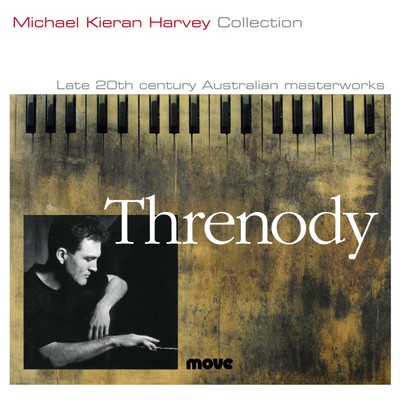
THRENODY

Michael Kieran Harvey

Move Records MD 3475

Here is a re-issue by Move of a recording that was printed almost 30 years ago by the Astra Chamber Music Society. Re-mastered by the indispensable Martin Wright, this CD underlines with pretty heavy scoring the debt that Australian music owes to Harvey, whose dedication to the local product (both the significant and the not-so-remarkable) has remained unswerving across his long, seemingly tireless career. What you hear in this collection is evidence of his professionalism and insights, handling works by six composers (and a couple of his own) with skill and sympathy.

Harvey begins with his own stunning Toccata DNA pf 1993 and later gives us his lesser-known Addict from the following year. Between these two, he plays Carl Vine‘s Five Bagatelles of 1994, Stuart Campbell‘s Quaquaversal from the same year, Eight Preludes by John McCaughey coming from 1991-3, Andrew Byrne‘s Within Stanzas of 1993, Eight Bagatelles by Keith Humble written in 1992, and James Anderson‘s 1994 Reveria im Neuen Stil. He splits the Vine pieces by conserving the last – Threnody – for his final track. All these pieces occupy a compressed compositional time-span, testament to the performer’s intense curatorship as well as demonstrating a sudden temporal rush to the Australian compositional head/brain from composers both well-known and obscure.

Still, there’s not much new to say about this re-issue of a significant body of work that’s been around for so long (that’s assuming that the Astra CD has been available over the years). The portentous opening to Harvey’s toccata with its slow-moving segments brings to mind the variety of Buxtehude before a launch into ostinato-heavy rapidity and that unstoppable headlong flight that seems to me inimitable, this composer-pianist’s own voice speaking with absolute conviction and generating the sort of excitement that you will find only at odd moments in this disc’s later tracks.

With Vine’s Five Bagatelles, we encounter another master-pianist/composer at work in a brilliantly balanced sequence, opening with a rather benign Darkly that presents some material that looks complex on paper but sounds transparent; for example at its splayed chord agglomerations between bars 22 and 25. This is succeeded by the raid-fire syncopations and time-signature oscillations of Leggiero e legato which enjoys a crisp, sparkling run-through.

The control of meshed colour returns in Gentle which opens and closes with more of those splayed chords surrounding the statement of a quiet melody that could have strayed in from an unpublished set of Debussy preludes; shadowy and suggestive in its outer reaches, placid at the core. The untitled fourth bagatelle proposes a raunchy jazz-inflected stroll, like Gershwin’s American brought forward 66 years, but the jauntiness interrupted by more sustained chords offering a brief hiatus, before a nifty note-cluster conclusion expertly accomplished by Harvey.

As many would know, Vine wrote his Threnody for the Australian National AIDS Trust fund-raising dinner, the other four pieces added later with the total work premiered by Harvey at the end of 1994, Its subtitle – for all the innocent victims – is reflected in its character which follows a simple stepping motion that suggests a hymn with an added high mixture stop at a 5th in alt. The result suggests resignation, calm acceptance of an inevitability, and the essential blamelessness of all those trapped in this once-fatal infection. It makes for a sobering conclusion to the CD, a respite from the complexities and abrasiveness of much that precedes it.

Coming round to Campbell’s Quaquaversal, we face a virtuosic complex opening with some massive chords reminiscent of a cathedrale engloutie for our times before a fugal interplay that alters to a ort of ostinato bass supporting a wealth of coruscating darts and flashes. Then the composer’s promise of fluency rather than development sort of takes over with several contrasting episodes (with a mid-level repeated chord featuring in the work’s centre, surrounded by a wealthy of Harveyesque bursts of brilliance). But then, the work was written for the pianist by this one-time member of La Trobe University’s Faculty of Music and it features some pages of dazzling pointillism as it approaches its toccata-like conclusion.

I’m sure a wealth of theoretical depth underpins this work which bursts with verve but you have to assume that the basic impetus comes from the title’s middle six letters. Whatever the case, this is a splendid vehicle for the pianist’s panoply of skills. From another one-time labourer in the La Trobe vineyard, McCaughey’s collection moves us into a more refined landscape; four of his preludes lasting less than a minute, the other four averaging 80 seconds in length. The opening Fluent lives up to its name with some restrained ambles at reserved speed up and down the keyboard. You hesitate to typify the vocabulary but I’d probably light on a compulsive atonality. Presto segreto is not a whirlwind rush but a series of lurches from one pivot to the next, eventually working into its own secret by slowing to a concluding crawl.

With No. 3, Animated, hastening, McCaughey takes us into just that: an atmosphere of abrupt bursts of action punctuated by pivotal mini-pauses, as though the protagonist is faced with a series of dead-ends that set him/her/them doubling back for an alternative outlet. Quick presents as a monophonic sprint, for the most part – possessed by a neurotic elfin urgency. Next, the odd aspect to A sense of slow background tempo is that you’re aware of a rhythmic reticence, as though the work’s progress is being conducted on two levels or in twin layers, even if the overall impression is of a sturdy post-Webernianism.

Mind you, Semplice carries on where its predecessor left off, typified by a forward mobility in which the motives or thematic cells meld into a well-woven fabric; more a handkerchief than a carpet. An overt contrast arrives with Leggiero, recitativo where the principal end is fitfulness, rapid squiggles providing the solid events in this brevity that you could call either whimsical or neurasthenic, depending on your currently predominant sense of aesthetic charity. McCaughey’s concluding Serene seems to be more a journey towards the proposed state rather than a depiction of its prevalence as the piece moves with a confident angularity that occasionally amounts to aggression before a brief resolution.

Byrne recently became a co-director with McCaughey of the Astra organization and he also nurtured his own academic roots in the La Trobe Faculty of Music. After an initial hearing, I thought I discerned four separate sections to this composer’s Within Stanzas; take a few more and you realize that there are a lot more of them. It’s just that they bleed into each other with remarkable fluency so that a sound-production gesture or a timbral-interplay sequence becomes part of a new context or landscape. Mind you, Byrne is lavish with his material which overwhelms your desire for instant auditory analysis, notably in the opening pages’ rhythmic and dynamic conundrums that dazzle with their effective unpredictability. Here again is anther composition tailored to Harvey’s brilliance and premiered by him at an Astra concert, but it is noteworthy that Byrne has withdrawn this score from sale or public performance. He has apparently moved on, and so should we.

Closer to a minute shorter than McCaughey’s preludes, Humble’s brevities show the pianist-composer in assured mode, the score rich in awareness of the instrument’s breadth of colours and most impressive in its rapid-fire virtuosity. You find an illustration of this in the opening Fast which exposes an assured forward thrust while ranging over the piano’s compass before a contradictory slow conclusion. The following Slow is still an instance of forward motion, couched in a compositional style that brings to mind the 19th century more than the composer’s dodecaphonic home ground, with a rich, sustained major chord to cap proceedings.

Easily the longest of these bagatelles is No. 3, For Tony P., very slow, molto rubato. This could be an elegy or just a quiet eulogy; it’s the most placid and stress-less of the collection, opening woth a minor 3rd cell and expanding on this in the best Berg style with a prominent byway to a set of major 3rds articulated at dead-slow before a diabolus in musica finishing interrogation. Move it opens with a confrontational syncopated sequence, full of fast-flying bravura before a fade-to-black close to its 30 seconds length. With Agitato, we’re in Harvey Land through a chain of rapid-fire oscillations across both ends of the keyboard in a fierce display of an unsettled musical state. The No. 6, EKE Bounce easily (and naturally) continues along the frenzy-in-short-bursts path with some brilliant percussive attacks from Harvey before the familiar wind-down final bars.

Slow impresses me as a valse sentimentale manquée, even if the pulse can work against it. But you sense a kind of regret, a nostalgia in this second-longest of the bagatelles, after the (in its context) substantial No. 3. To end, Humble gives us a burleske that is much shorter than the track listing. This is good-humoured and another opportunity to wonder at Harvey’s assured command of what amounts to a study in exuberance. This work brings to a close (as far as I can tell) the CD’s association with La Trobe University where Humble was the first Professor of Music from 1974 to 1984, that faculty eventually shutting down in 1999 to general dismay.

Anderson remains a shadowy figure in Melbourne’s musical world but his Reveria was written for Harvey which speaks to his presence on the city’s contemporary music scene in the early 1900s, at least. This reverie is pitched to the top half of the keyboard with a few low pedal notes to remind you how high is the piece’s operating field. Anderson’s projected state of detachment is packed with vivid flashes featuring frequent flurries of cascading gruppetti punctuated by solid blocks of notes and centre-register diversions. The composer’s emphasis on upper-level flashes does become wearying but Harvey’s account forefronts any inbuilt timbral and emotional variety.

The pianist’s Addict involves a collaboration with sound engineer Michael Hewes who brings computer processing into the mix, complementing Harvey’s playing. Here is the most advanced composition on the CD, chiefly because of its parallels and distortions of the live performance, if only in patches to begin with, but eventually the partnership becomes more challenging. Harvey begins with a rapidly repeated note like a tremolo and he finishes in the same way, but the work evolves soon enough into a rapid-fire moto perpetuo that flummoxes with its tiers of activity.

Hewses employs several electronic/computer techniques, none more prominent than that mirroring effect where Harvey’s sound is duplicated by what sounds like a West Indies steel drum; this has the effect of both reinforcing your impression of Harvey’s trademark agility and also distracts from its purity – which might be a comment on the title character’s state of mind. Whatever the case, the collaboration makes for a wild ride, the emotional state on view very hyped-up and certainly not comatose; this is an addict in search of relief and, even by the end, the sufferer is undergoing nightmares in recollection.

As noted above, Vine’s Threnody brings the CD to a close, an oasis after frenzy in more than one sense. Still, the recording is well worth obtaining (or re-obtaining) as a witness to Harvey’s unfailing musicianship as well as a document of this country’s (well, Melbourne’s, mainly) aggressively active music scene and the wealth of talent at work in it across these few years.

.

Gentle junctions

CROSSING PATHS

Ensemble Liaison and Tony Gould Trio

Move Records MD 3473

First, a few confessions – or better, admissions. I’ve known Tony Gould for about 50 years through our student days when working at a Master’s Preliminary year under Keith Humble at Melbourne University Conservatorium. Tony survived that ridiculously cavalier class and went on to greater things; I left the room and came back years later to take up the same degree with a real teacher. Further, I’ve known the Liaisons for a fair while: pianist Timothy Young since he took on the role of resident pianist at the Australian National Academy of Music in South Melbourne; the other Ensemble members – Svetlana Bogosavljevic and David Griffiths – since pretty close to the formation of this excellent group in 2007.

This CD is not so much a collaborative project but a set of juxtapositions. It begins with the Liaisons playing the Bach/Gounod Ave Maria in a straight arrangement – well, as straight as that sentimental hybrid can get. Then Gould and his colleagues – saxophone Angela Davis, bass Ben Robertson – give their version of the same piece. The Andantino middle movement from Faure’s Trio in D minor follows; again, turn and turn about. A change arrives with Satie’s Three Gymnopedies which the Ensemble plays complete, Young working the original No. 2 by himself with the outer pieces involving his partners. Gould and Co. offer their interpretation of No. 1 only.

Continuing the religious motif, we hear an ‘original’ version of Piazzolla’s Ave Maria before the jazz variant offers an essay in conciseness. We return to Faure with readings of the composer’s popular Apres un reve. Finally, we are treated to a transcription and a brisk interpretation of Schumann’s Traumerei. Then the CD seems to peter out in a version by the Liaisons of Schubert’s Ave Maria (what is it with this prayer?), followed by a piano solo from Gould of Gershwin’s Love Walked In.

All of this makes for what is called ‘easy’ listening, a sequence of tracks that raises no temperatures and plumbs no angst-ridden emotional depths. The Liaison group show their polish in a series of controlled tracks and this calm ambience is reflected in the contributions from Gould and his colleagues. Bach/Gounod’s golden oldie starts with the familiar piano ripples while Bogosavljevic outlines the French composer’s lavish melody with gentle authority and a carefully judged use of vibrato; second verse around, Griffith enters with an almost-not-there adjunct set of sustained notes that weave a most restrained counterpoint that informs but doesn’t intrude.

After a leisurely introduction, Davis generates a quiet meandering line over Gould’s re-invention of Bach’s arpeggio figure with Robertson following the Griffiths’ role of quiet subservience. The modulations are completely different and you’d be going to trace many parallels between the original tune and the sax’s quiet, breathy investigations. But the trio keeps in touch with the original material, a direct quote peeping through at various points.

For the Faure Piano Trio movement, Griffiths’ clarinet takes the original’s violin line with ultra-smooth results, nowhere better than those two points in this gentle movement where the non-keyboard lines operate on a single melody, most movingly in the last stretches from a bar after Number 8 in the Durand score of 1923 – the year of the work’s premiere. Oddly enough, the composer originally planned for a clarinet to take the violin’s usual place and (at least in this Andantino) there’s nothing that the wind instrument can’t achieve technically that makes the transcription a no-no. Faure’s score rises to two modestly passionate highpoints but the harmonic textures show as largely uncomplicated and the performance is suitably restrained in dynamic terms.

Gould and his colleagues’ reading is rather brief – about 2 minutes to the Liaison’s 6 – and the pianist appears to take his brief from bars 8 and 9 of the original, Robertson pattering away at a roving bass while Davis plays a short variant that I can’t source. Still, that’s part of the delight in this exercise where the mutations can take individual forms. Suffice to note that the jazz trio’s emotional stage is less fraught even than that even temper projected by Faure.

As you’d expect, Griffiths and Bogosavlyevic share melody duty in the first Gymnopedie: clarinet first, then cello each time. I’m indifferent to these pages, probably because it’s unclear what the Greek references do for the musical statements, if anything. The performance is clear and properly remote. Young’s solo exposition of the second in the series shows the requisite modesty and dynamic calm that typifies Satie’s prevailing sound-world, albeit with some more interesting chord juxtapositions than its predecessor. To end, clarinet and cello share the melody line turn and turn about while reinforcing the piano’s bass note when they aren’t in the ascendant.

To reiterate, this makes for an amiable enough experience, although I can’t see Satie’s little essaylets adding up to qualifying for inclusion for ‘their timeless beauty’ or ‘melodic and harmonic richness’, as the sparse CD cover text claims of the general content. The Gould Trio’s version of the first of these works is, for the piano, heavily based on the original, albeit with many harmonic changes; but the contours are obvious. Not so much with the sax’s delayed entry which introduces a novel spray of meandering arabesques, even if these settle down near the end of the operation to fall in line with the composition’s later melodic content. And the supple bass reinforcement-cum-elaboration from Robertson makes for a real pleasure as he follows Gould in the four-across-the-bar and duple-in-triple-time interludes in what amounts – in all three pieces – to a slow waltz.

Piazzolla’s setting (is it? I thought this was called Tanti anni prima) is placid enough – a simple ternary structure that begins in C and ends in F. The cello takes the melody at first; when a pronounced key change arrives at about bar 19, enter the clarinet; then both combine in unison/octave for the melody’s return. This last duet is distinguished by Griffiths’ sympathy with Bogosavljevic’s restrained timbre. To be frank, I enjoyed the jazz trio’s reading more than the original, especially when Davis got away from simply outlining the initial melody and introduced some rhythmic wiggles in collusion with Gould to brighten up some pretty bog-standard material.

No objections to the Liaisons’ account of Apres un reve. After the cello’s announcement of the first stanza – word-for-word according to Emmanuele Praticelli’s 2023 transcription of the original song – the clarinet joined in to play the rest of the piece’s melody in unison. All very even and an ideal example of how to match your performing parameters to your partner’s. But we didn’t really need the supplementary line, especially as the work is too well-known as a cello recital component or encore.

When Gould started his variant, you had to wonder what he was about as we heard a few bars of La fille aux cheveux de lin before he started his re-examination which turned out to be twice as long as the original and stuck to this latter’s outline for about half the track’s length, then doubling back for a looser appraisal with Davis’s instrument very breathy and close-miked. Again, the modern version intrigued for its unexpected formality and concentration of the composer’s resources in this most effective chanson.

Whoever did the Traumerei arrangement that the Liaisons played was happy to spread the joy. The marvellous melody with its risings and dying falls was given mainly to the clarinet, the cello vaulting between the various levels of the piano’s subsidiary lines. It looked as though Bogosavljevic was being entrusted with the gentle piece’s last sentence, but no: the clarinet got the last word. Now this was/is a work of timeless beauty and the ensemble’s handling here showed affection and insight.

Once again, Gould showed himself in playful mood, opening his trio’s reading with a reference to the Preambule to Carnaval, before weaving a path back for Davis to start her very individual take on this childhood scene. Just before the end of this extended review, Gould gave another reminiscence of the Op. 9 opening before he and Davis colluded in a reprise of the original’s last phrases almost as written. Yet again, we could relish a deft combination of the old and the relatively new, with some mildly left-field bursts from all three participants.

I missed a few of Schubert’s endless sextuplets from Young; they just failed to sound fully on occasions. Griffiths gave us the vocal line for stanza 1 of the lied, followed by Bogosavljevic in stanza 2, while the clarinet provided some very soft supporting sustained notes. We can all agree on the inestimable merit of this peerless melodic fluency and you could not wish for more benign treatment than that given by the Liaisons.

Gould’s final solo treats Gershwin’s classic liberally, inferring more than stating and an affectionate ramble on its chord sequences with occasional nods to the optimistic melody. Still, it makes for an off-centre rounding-out of this miscellany: a collection of emotionally placid works which kind of satisfies if you’re not looking for a dramatic confrontation in these crossing paths – which, more often than not, contrive to intersect satisfactorily.

Diary November 2024

FRANKENSTEIN!! & THE GOOSE’S MUM

Ensemble Q

Concert Hall, Queensland Performing Arts Centre

Sunday November 3 at 3 pm

Not surprisingly, the second element in this concert’s title is Ravel’s five-part suite Ma mere l’Oye which exists in a piano duet version, a reduction for solo piano and a full orchestra transcription. What are we going to get this afternoon? Probably the piano solo version because Daniel de Borah is the only pianist noted in the personnel list and the remaining musicians number only twelve; too small for the Ravel orchestration. The group also attempts Saint-Saens’ Danse macabre, arranged by American Cicely Parnas for violin and cello; no worries about this ensemble’s cello – Trish Dean – but the violin role could be taken by Adam Chalabi or Anne Horton. Then there’s Poltergeist by William ‘Bolcome’, who I assume is William Bolcom. This is hard to pin down, as there’s a Poltergeist Rag written by Bolcom for solo piano but the advertising bumf claims that this work will be performed by a string quartet: Chalabi, Horton, Dean and viola Tobias Breider. I can’t find any such arrangement in the list of this famous American song-composer’s catalogue. So far, not so much work for the other eight listed participants. Things change for the other title work: Heinz Karl Gruber‘s 1971 ‘pan-demonium’ Frankenstein!! for chansonnier (probably Jason Barry-Smith who is listed in this cast list as ‘narrator’) and an ensemble that takes in everyone except de Borah: the string quartet plus double bass Phoebe Russell, flute Alison Mitchell, oboe Huw Jones, clarinet Paul Dean, bassoon David Mitchell, horn Peter Luff, percussion Jacob Enoka. But who’s playing trumpet? And where does harpist Emily Granger fit into this program, unless the Ravel work is being played in an unidentified arrangement? Anyway, tickets cost $75 or concession $55 with the usual QPAC add-on of $7.20 as a compulsory sting.

A SYMPHONY FOR WINDS

Queensland Symphony Orchestra

Queensland Symphony Orchestra Studio

Thursday November 7

This evening opens with one of Richard Strauss’s later works, the so-called Symphony for Winds No. 2 in E flat of 1944/5, sub-titled (by the composer) ‘Happy workshop’. The more constipated among us call it the Sonatina No. 2, but it’s of a substantial length and sits in happy comparison alongside Stravinsky’s 1920 briefer essay with similar participants but also involving a slew of brass. Strauss involves 16 instruments: pairs of flutes, oboes, bassoons, then four horns, a contra-bassoon, and five clarinets – an E flat, two B flats, a basset horn and a bass clarinet. In terms of time, it’s the longest work on the program. Then a complete change of personnel for Penderecki’s 1961 Polymorphia for 48 strings (24 violins and 8 of everybody else) which could probably be the most advanced music that the QSO has played all year: a splendid sample of graphic notation and a test of Umberto Clerici‘s directional powers. This is followed by British rock guitarist Jonny Greenwood‘s 2011 tribute 48 Responses to Polymorphia which can last either 15 or 19 minutes, depending on the number of movements attempted which will in turn determine whether all 48 players need their own pacay bean shakers. Well, to be fair, it’s not a tribute but a spring-board for an uninspired and unadventurous essay in harmonic conservatism. But that’s just my opinion; listen for yourself and have that finding reinforced. Tickets range from $79 for an adult to $35 for a student or child, with the QSO’s own outrageous $7.95 surcharge on every order.

This program will be half-repeated on Saturday November 9 at 3 pm as the Penderecki and Greenwood spin-off disappear to be replaced by Tchaikovsky’s Serenade for Strings to ensure an afternoon of harmonic emulsion. You’ll be happy to learn that the ticket prices don’t vary; nor does that over-ripe excessive booking fee.

SCOTLAND UNBOUND

Australian Chamber Orchestra

Concert Hall, Queensland Performing Arts Centre

Monday November 11 at 7 pm

Just as the Queensland Symphony Orchestra is finishing up this month, so too is Sydney’s own ACO ending its year with this tour fronted by Scotch-Japanese guitarist Sean Shibe who is going to treat us to a long belt of Hibernian musical craft. With ACO artistic director Richard Tognetti leading the string ensemble, Shibe starts off on a normal classical (acoustic?) guitar, working through some traditional Scottish lute solos collected by the 17th century aristocrat Lady Margaret Wemyss, about whom nobody seems to know anything except her parentage and that she died aged 18. We rush forward to From Galloway by contemporary Scot James MacMillan; this was originally a two-minute clarinet solo from 2000, here transcribed by Shibe. Who continues with a suite of folk songs – could be anything – before we enjoy a new commission from Canadian-born writer Cassandra Miller for guitar and strings. Then Shibe switches to his electric instrument for Lad by American academic and co-founder of the Bang on a Can organization, Julia Wolfe; this is another transcription from the 2007 original that asked for nine bagpipes. Following which it’s over to Irish composer David Fennessy for his Hirta Rounds of 2015 involving nine violins, three violas, three cellos and a double bass; this memorialises a group of now-abandoned islands in Scotland’s St. Kilda archipelago. Like the Miller and Wolfe compositions, Hirta Rounds is receiving its Australian premiere across Shibe’s tour. To end, the electric instrument returns for some selections from another Canadian-Scot: Martyn Bennett’s 1997 nine-track album Bothy Culture which is about all I’ve heard from this musician who died aged 33 in 2005. It’s another arrangement for guitar and strings, but there’s no indication who put this set together. Tickets can be as cheap as $25 for the lucky young and move up to $129 for the affluent old, always remembering that QPAC $7.20 surcharge for exercising your attendance prerogative.

VIRGILIO MARINO

Opera Queensland

Opera Queensland Studio, 149 Grey St., South Bank

Friday November 15 at 7 pm

Here, you take things on trust – not my favourite position. Virgilio Marino is a well-known Queensland tenor; probably less famous than Rosario La Spina but working in the tradition of local legend Donald Smith. I heard Smith in his prime, and La Spina (probably) in his; Marino I’ve yet to come across. Anyway, this occasional recital for the state opera company pairs him with Alex Raineri, so you know the accompaniments will be informed and supportive. But what’s he going to sing? According to the few lines of OQ site information, we’ll hear his ‘favourite arias and songs’ These could include La donna e mobile, Questa o quella and Parmi veder le lagrime because the most important role he has sung for our national company is the Duke of Mantua. Still, he’s performed a host of major roles for Opera Queensland – Don Ottavio, Rodolfo, Nemorino, Pinkerton, Almaviva and Alfredo. Those characters are entrusted with a wealth of arias; as for his ;songs;, I’ve no idea. The event lasts for an hour and you can attend it for $65 full price, $59 if you’re a student or concession-holder (whoopee-do) and a child gets in for $33. As far as I can tell, there’s no charge for using a credit card.

This recital will be repeated on Saturday November 16 at 2 pm but don’t bother: this hearing is sold out. Mind you, there aren’t many seats in the Studio to start off with – a couple of hundred at most.

UMBERTO & NATSUKO

Queensland Symphony Orchestra

Concert Hall, Queensland Performing Arts Centre

Friday November 15 at 7:30 pm

This program is being advertised as the season closing gala and all stops are out, as they say in rugby. The QSO chief conductor Umberto Clerici is conducting two overtures and Strauss’ Four Last Songs, but he’s also returning to his instrument-wielding days and partnering the orchestra’s concertmaster, Natsuko Yoshimoto, in the radiant Double Concerto by Brahms. I, for one, can’t get enough of this masterpiece, which is something of a rarity; the last time I think it was played in Brisbane was when the ACO’s Richard Tognetti and Timo Veikko-Valve gave a dazzling performance about 4 or 5 years ago. So, here we are again with expert soloists and a chance to enjoy the score’s rolling grandeur. But wait: there’s more. Clerici conducts Schubert’s Rosamunde Overture which is no such thing but is as joyfully exuberant (when it gets over its initial solemnity) as the Symphony No. 5. This makes for an amiable if irrelevant preface to the Brahms concerto. For the night’s second half, we begin with Wagner’s Overture to The Flying Dutchman which also sits at odds with the Strauss songs, here sung by soprano Eleanor Amy Lyons. What’s the link between the opera’s youthful wildness or heaped-up tension and the intensely sad final fruits of a resigned and near-disgraced old age? Well, it’s an end-of-term celebration and the aim is clearly to drench listeners in the soporific. Top adult price is $135; children’s tickets are $35 each and there’s plenty of options in between, if no escaping the $7.20 add-on for using your credit card.

This concert will be repeated on Saturday November 16 at 1:30 pm.

MUSICA ALCHEMICA

Musica Viva Australia

Queensland Conservatorium Theatre, South Brisbane

Wednesday November 20 at 7 pm

Last Brisbane cab off the rank for this organization in 2024 is an ensemble put together by Spanish-born violinist Lina Tur Bonet. In fact, there are only three other persons associated on this tour with the metal-transforming ensemble: baroque cello Marco Testori, archlute Giangiacomo Pinardi, and harpsichord Kenneth Weiss. The group has been a mobile one over the years and Bonet has collaborated with Testori and Weiss on some tracks from her records. Most of the 10-part program being presented tonight has featured on these CDs, like the two Biber Mystery Sonatas (Nos. 1 and 10), Westhoff’s Imitatione del liuto, Schmelzer’s Sonata No. 4, the Corelli G minor Sonata and the concluding D minor Sonata from his Op. 5 set, and (I suspect) the Sonata No. 2 from Cima’s Concerti Ecclesistici. The remaining three elements will be Muffat’s G minor Passacaglia for solo harpsichord, a Telemann cello sonata in D Major, and Piccinini’s Toccata (which one?). Entry for adult best seats costs $115; student rush tickets are $15 anywhere in the hall. Once again, Musica Viva stands tall among this city’s entrepreneurs by not adding on booking charges.

CINEMATIC

Queensland Symphony Orchestra

Concert Hall, Queensland Performing Arts Centre

Friday November 22 at 7:30 pm

Nicholas Buc is back to direct this 13-part sequence of soundtrack extracts from films known and unknown – to me. As usual, a lot of composers appear in the lists – two of them get a double serving – but I wonder how enjoyable the experience is if you’re left to summon up the visual recollections in your mind’s eye; it makes for a considerable and lengthy series of mental gymnastics. Proceedings begin with Danny Elfman‘s music for Tim Burton’s 1989 Batman, from which I recall only Jack Nicholson’s outrageously prominent Joker. A bit of Australiana follows with something from Caitlin Yeo‘s Ballarat-celebrating New Gold Mountain TV series score of 2021 (not actually cinematic but what’s in a name?). We can relish Carl Davis’ theme for the 1995 Pride and Prejudice TV adaptation, notable for Colin Firth’s totally unnecessary swimming exploits. Joe Hisaishi‘s 2001 score for Spirited Away is represented by One Summer’s Day; Hans Zimmer is honoured by a suite from his 1994 The Lion King score and later his music for Interstellar of 2014; John Williams also manages a double with his Superman march of 1978 and the theme from the original 1993 Jurassic Park. Continuing the TV encroachment, we hear another suite, this one by John Lunn for the Downton Abbey series that kicked off in 2010. Then a true blast from the past in Dukas’ The Sorcerer’s Apprentice, presumably included because of its use in the 1940 Disney Fantasia film starring Mickey Mouse and Leopold Stokowski shaking hands in a prodigious feat of cinematic legerdemain. John Powell is represented by part of what I assume is his music for the original 2010 How to Train Your Dragon which I’ve not encountered (probably because of my age-group, that being over 10). A confusing extract comes next from Alan Silvestri with both a promised suite from his Forrest Gump score of 1994 and a focus on the composer’s Feather Theme; means nothing to me because I gave up on Tom Hanks after his prissiness when faced with Ricky Gervais’ humour at the Oscars. To end, some Howard Shore in the form of The Lighting of the Beacons (the horns of Rohan loudly blowing) extracted from the last film in 2003 of The Lord of the Rings trilogy. Pianist Daniel Le is soloist but I don’t know a lot of this music so can’t tell in which parts he takes on prominence. Tickets range from top adult of $135 to a child costing $35 and you can eschew your Coke and popcorn bucket as you have to find $7.20 each order for the sake of QPAC’s accounting woes.

This program will be repeated on Saturday November 23 at 1:30 pm and at 7:30 pm. Prices for entry appear to be the same whenever you go.

BEETHOVEN’S ODE TO JOY

Queensland Symphony Orchestra

Concert Hall, Queensland Performing Arts Centre

Thursday November 28 at 7:30 pm

What’s puzzling about this reading of the mighty Symphony No. 9 is its projected length: 1 hour 25 minutes – and an interval is scheduled. Your average performance time is about 65-6 minutes. If you insert a 20-minute interval, you’d have to assume that the work is going to be cut in half, so that we go out for a drink between scherzo and adagio. Can’t see it myself: chief conductor Umberto Clerici plays his Mahler symphonies here straight through, so he wouldn’t be splitting up the more digestible Beethoven, would he? It could detract significantly from the vital experience of hearing the sequence of four movements, rather than just the over-used finale. Clerici’s four soloists are soprano Eleanor Amy Lyons (fresh from negotiating the Four Last Songs by Strauss a fortnight ago), mezzo Ashlyn Tymms, tenor Andrew Goodwin (that’s a brave sound to hear in the Froh variant when we go all Turkish), and bass Samuel Dundas. The Brisbane Chamber Choir will be prepared by director Graeme Morton. Tickets range from a good adult seat for $135 to a child being lucky enough to enjoy the experience for $35. And you won’t forget the joyful privilege of shelling out $7.20 an order to keep the QPAC financial team chuckling in an abundance of fiscal Freude.

This program will be repeated on Friday November 29 at 7:30 pm and on Saturday November 30 at 1:30 pm. No price reduction for the matinee.