You’ll find the cello well-represented in the Brahms catalogue. We have the bountiful Double Concerto Op. 102 as well as multiple chamber works: three definite piano trios, three piano quartets, the F minor Piano Quartet, the clarinet trio and mellifluous quintet, a string trio, three string quartets, the two string quintets and two string sextets. But when considering the instrument as a more exposed voice in Brahms’ output, we’re left with the two cello sonatas: Op. 38 n E minor and Op. 99 in F Major, written 21 years apart. Still, these stand as highpoints of the form, each score a rich repository of power and brilliance, both indispensable elements in every aspirant instrumentalist’s repertoire.
Here is the latest collaboration for Move Records from cellist Zoe Knighton and pianist Amir Farid. It’s the sixth in a sequence that began in 2010 with the complete Felix Mendelssohn product for cello and piano. This was followed a year later by an Argentine collection of odds and sods, with Constantino Gaito’s Cello Sonata of 1918 as its culminating point. Then came the complete Beethoven in 2012, followed by a French collection in 2013 where Debussy’s sonata capped a series of bagatelles and arrangements. A Russian collation came by in 2015, with the Gretchaninov and Prokofiev sonatas taking pride of place. Most recently, in 2021 we heard the ‘complete’ Schumann through the Funf Stuckeim Volkston and the Fantasiestucke Op. 73 juxtaposed with arrangements of 15 lieder by the composer’s wife Clara.
Put both Brahms cello sonatas together and you have about 58 minutes’ worth of music on this particular CD. To flesh out the length, these artists have provided three lieder as makeweights. We hear the first two of the Op. 43 set of four – Von ewiger Liebe and Die Mainacht – along with the middle member of the Op 63 Lieder, Meine Liebe ist grun. All are welcome as reminders of the composer’s mastery at plumbing emotional insights, as in the eternal love statement from the maiden in the first of these, where the rhythm moves from a solid 3/4 to the more consoling 6/8 and Brahms’ tonality changes to the major while his melodic line pursues a complementary path to that urged by the worrisome lad who thinks he’s throwing down a commitment gauntlet at the end of the seventh stanza.
No such affirmation in the melancholy depression of the May night wanderer who clearly thinks the search for his lachelndesBild is fruitless, its only outcome this perfectly posed lied which surges to a compelling ardour in Knighton’s hands at the flattened supertonic downward arpeggio in the seventh-last bar: a superlative example of poetic self-pity.
Separating both is the happy outpouring about love’s freshness and the elation of its emergence in what I assume is a young man’s voice although, in these piping times of transgenderization, nothing can be taken at face value. Knighton and Farid approach this passionate lyric through a vivid realization of its Lebhaft direction, the pianist’s hands full of syncopated middle voices across the lied’s stretch, leavening the cello’s regularly-shaped vocal line.
You’ll find so many indelible pages in Brahms’ output that have maintained their power to move, years after your first experience: the Violin Concerto’s finale opening, the gloom-piercing Ihr habtnurTraurigkeit from A German Requiem, that amiable Menuetto from the D Major Serenade,, the subterranean hugger-mugger of the finale to the Symphony No. 3, an open-handed humanity from the opening bars of the G Major Violin Sonata, the enthralling breadth of the Piano Trio in B Major’s first 44 bars – you could go on for some time.
Among these passages of unforgettable responsiveness strikes is the first movement entire of the E minor Cello Sonata. Knighton and Farid’s reading works as something like a scouring revelation to those of us who play it as a tussle for supremacy; for example, the forceful contest between bars 54 and 65, or the lurching inexorability between bars 111 and 125. In this account, the duel remains rational and disciplined, thanks to Farid’s delivery of a moderate dynamic output. You find plenty of willing power in this disc’s interpretation but the intention of the players’ output is to emphasize the muffled drive of the composer’s construct, peppered with some eloquent detailed work, such as the slight hiatus heralding a change of key at bar 50, and Knighton’s haunting, veiled line at the repeat of the exposition’s opening.
An important factor in the appeal of this movement comes with the performers’ responsiveness to each other, especially in their mirrored phrasing, best exemplified across the development section’s pages which are a model of mutual pliability. Mind you, these musicians stick to a schedule, even at the relaxation of this movement’s coda when we change to E Major for a consoling lullaby and the pace is less stringently marked. Of course, that emotional ease after pages of controlled stress is one of the joys with which Brahms delights us, if nowhere more touchingly so than here.
When it comes to the Allegretto quasi Menuetto, the performers present the movement with an easy grace, their phrasing well-balanced and congruent, Farid happy to set the running from bar 47 to bar 59 where the piano has all the action over an unexceptional bass-reinforcing cello part. Here again, you can find details that pique your attention, as in the Boskovsky-like hesitation concluding bar 70 (that recurs at the end of the pleasantly fluid Trio’s second part).
Unlike most other assaults on the final Allegro, Knighton and Farid have a rather laid-back approach where the fugal lines are given plenty of air, the ambience less fierce than you’d expect. Still, this makes sense when you consider the clarity of the writing and the uncomplicated nature of the entries while the fugue is still in operation. Knighton makes an effective splaying of those solitary cello bass notes in the polemic of bars 25 to 29, But the most noticeable factor in this version is the lucidity of mass from both players, especially in those pages that are often handled as a sweaty welter, which includes pretty much everything from bar 147, through the Piu presto, up to the concluding clincher. This interpretation dances in well-heeled shoes rather than the all-too-common galoshes.
When we come to the Sonata No. 2, the atmosphere changes completely. Its first pages are notable for a tremolando urgency in the piano underpinning a vibrant, buoyant outpouring from the cello, the complex excellently handled by Knighton and Farid as Brahms moves from exuberance to less active, more measured elation, then back again to furious action from both participants. Later, you can relish the narrative directness of the development with its sequence of compressed treatments, culminating in the reversal of roles between bars 92 and 118 where the cello is all a-flutter while the piano articulates quiet, full-bodied chords, this passage remembered in passing before the emphatic conclusion.
An attractive sentiment typifies the Adagio affettuoso and a gentle and pliant approach makes for a reading that involves you, even if it doesn’t overwhelm with emotional weight. Neither player goes for the jugular, except possibly at the emphatic start to bar 64 where Knighton’s pizzicato is unexpectedly percussive; both maintain a consistency of pace and pointed emphasis in crescendo–decrescendo tides, Knighton employing a healthy vibrato while observing the decencies, rather than spilling over into ripe blather.
Once again, you could find much to admire in the following Allegro passionato, particularly Farid’s sensible handling of some very thick writing, not least those hemiolas that start in bars 17-24 and recur (in both instruments) across the movement. Later, what a welcome delight to break out of a particularly emphatic batch of them at bar 109! Then, alongside the galumphing rhythmic high-jinks, you reach a lyrical pearl in the Trio from bar 180 to bar 191, even more welcome in its glowing repeat. Again, you have to thank these performers for the aural rewards they give us in the clear delivery of texture in these pages that are often treated with more bucolic gruffness than is necessary.
We arrive at the final Allegro molto and strike a friendly enough landscape, if not a particularly long-winded one. The only feature of its plain main melody that strikes interest is the flattened leading note in bar 3; the rest of the melodic terrain makes for plain sailing. One of the few later points of interest comes with Farid’s deft account of the right hand in bar 28 where the triplets against regular quavers are enunciated with admirable ease. But then Farid is a model of care in his work, as witnessed across these two sonatas with no detail glossed over and a high degree of consideration for Knighton.
So welcome to this new CD which provides us with a fine demonstration of a partnership in full fruition, the partners’ energies and talents exercised on a brace of cello/piano masterpieces. It makes a welcome addition to the libraries of Brahms enthusiasts and a true pleasure to the ears of those who delight in experiencing chamber music at its most appealing.
Stopping by for an end-of-year visit, I caught up with this festival through one recital only. It proved to be the inaugural appearance of a new trio, Ways By Ways, featuring festival director-pianist Alex Raineri, percussionist Rebecca Lloyd-Jones and flautist Tim Munro – and you have to admit that such a personnel grouping is more than a little unusual. So was its five-part program which began with a kind of structured elaboration of little material and ended with a ‘happening’ reminiscent of the 1960s (perhaps fortunately, it didn’t involve audience participation).
After the opening exercise in artistic togetherness called Collaborative New Work, Raineri gave us a harpsichord solo by Chilean-born Perth resident Pedro Álvarez, Fosforesciamo which roughly translates as ‘We are phosphorescing’ – a state that is always appealing. Both of these works enjoyed their world premieres, the latter particularly welcome as it was composed 12 years ago. A duo followed for Lloyd-Jones and Munro in Irish writer Ann Cleare‘s unable to create an offscreen world, a touching 2012 essay in non-tangibility. Back to the trio format in one-time Brisbane-resident Jodie Rottle‘s blueprint in shades of green from 2022, and the group concluded its first communal foray with Thelma Mansfield, a tribute to the Irish broadcaster-then-painter by her countrywoman Jennifer Walshe, and also the occasion’s oldest music, dating from 2008.
At the opening collaboration, Raineri started out on harpsichord, Munro on piano, and Lloyd-Jones on (I think) marimba. They enjoyed a staggered sort of entry, generating a kind of tintinnabulation, an airy chimes effect in the higher reaches of their instruments, Raineri eventually producing some variety by moving to molest the lower strings of Munro’s piano. The whole thing appeared to ring its changes by a kind of mutual arrangement, without anything printed as far as I could see, eventually petering out in a reductioad silentium.
Alvarez’s piece for Raineri’s harpsichord opened with a chain of splayed chord-clusters that were either sustained, cut short, or disappeared leaving one note reverberating. This output changed to treble action with lavish ornamentation, the whole a set of sound flurries. More emphatic chords followed, to be succeeded by a concluding segment where a minor 2nd tremolo stood out from the general movement, with the eventual post-phosphorescent fade to dun.
Munro and Lloyd-Jones chose to perform the (b) version of Cleare’s piece with piccolo and a thunder tube (I believe) as well as a timpani and a metal sheet enpassant. In line with the composer’s program, this was tentative, spasmodic in effect, the players not following each other; not actually clashing, but failing to coalesce. Such a neurasthenic atmosphere was heightened by emphasized breaths and key-taps from Munro in particular, so that listeners were kept in a state of tension that I thought might have been overdrawn but in fact became quite unnerving as the work lurched along its intentionally disjunct path.
Rottle’s work found the performers in a – for this occasion – strikingly normal situation with Munro breaking us in through a flute solo, Raineri striking a path with a prepared piano, Lloyd-Jones’ contribution eventually noticeable for a scene-stealing vibraphone (Le marteau sans maitre has so much to answer for). A mid-stream duet for piano and flute impressed for the sharp synchronicity of its delivery, even if the main feature I drew from the work was the almost continuous activity from Munro.
But it wouldn’t be a 2022 construct without the pianist eventually reaching for his own strings with a stretch of plucking and stroking that came as an unusually welcome respite from the stifled quality of the actual keyboard work. Lloyd-Jones gave us a soft upper pedal layer towards the work’s end and the last moments made a fine impression with their soft whisperings from Raineri and Munro. The composer points to her work as a celebration of fruitful friendships and I suppose you can infer such a characteristic from her amiable, approachable creation.
Of course, it wasn’t until well after the event that the juxtapositioning of Cleare’s and Rottle’s works struck me as apt: one representing a dissociation of temperaments that doesn’t amount to a definite conflict but an absence of congruity on common ground, the other a melding of personalities demonstrating a kind of affirmative pairing which is sustained by a continuous, malleable underpinning.
With ThelmaMansfield, we came upon a piece of musical theatre where what the players did distracted from the actual sounds that they generated. My notes wound up being a set of observations on action, like the rather incongruous sight of Munro shadow-boxing, or Raineri miming a rifleman and also slicing (admittedly with a stick rather than a sword or knife), while Lloyd-Jones poured a white substance (sugar? heroin?) into a bowl from a colourful container, making minimal audible impact.
As far as I could tell, the intention was to plunge us observers into a set of scenarios that might have amounted to a character sketch of the title character if only we had some kind of key. But the work became more opaque as it progressed, complicated more by the sudden emergence of a taped contribution that came from a mobile phone set into action by Raineri. To be fair, the work presented a sort of narrative structure through a monologue/address begun by Munro (and taken up by others) in which he (they) set out a slew of rules that were preceded for some time by German numbers.
After stopping for a taped downpour (harbinger of what was waiting for us outside at the recital’s end) the trio decided to sweeten the pot by singing for us – at least two hymns, in the end. To follow, all three threw scraps of paper in the air . . . and on it went: event after event in an off-beat Dada demonstration. Raineri sat at a table and dealt cards – loudly; Munro vocalized through his flute, punctuating his pseudo-singing by tapping his instrument’s keys.
One of the performers flashed number cards at us – 4, 7, 3, 5, 2 – and then the ensemble started on the verbal numbers game, now in English. Lloyd-Jones poured her white grain from one bowl into another or picked a handful up and let it dribble back, like a fey Nigella. And we were once again treated to a fizzling finale which contained isolated intervals for Raineri’s piano as one of the few coherent strictly musical memories I’ve retained from this specific exercise, which kept your attention centred on the musicians/actors, most of the focus falling on Munro.
While willing to go a fair way with composers in their search for the everlasting verities, I’m not sure that I gathered much from Walshe’s personal (I presume) salute. It brought the hour-long recital to an entertaining conclusion with its variety and the intelligibility of its discrete parts; even the air-slashing exercises that obtained in the work’s earlier stages made some kind of excoriating point, if Mansfield was in real life the sort of trenchant personality such gestures might imply.
A fortuitous welding of three talents, then, in this short exhibition. I don’t know whether there’s much repertoire for the flute/piano/percussion combination; still, Raineri has shown impressive talent at organizing programs like this one where the performers have ample room to display their talents as soloists, duettists or members of a larger ensemble. Without a doubt, he is flying a lone, brave flag for contemporary creativity in all its colours through this annual festival and I’m only sorry that I couldn’t get to more of its many parts; they are distinctive for their quality of participants and for the catholicity of presentation styles – a true music festival.
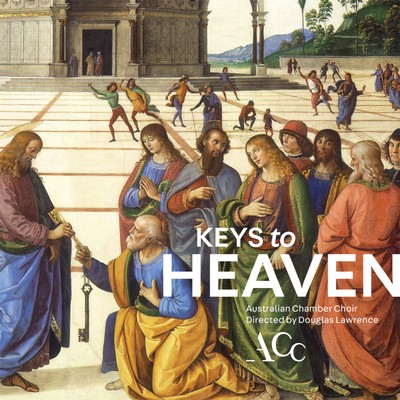
A reconstruction is the main point of interest in this new CD from the Australian Chamber Choir of Melbourne (similar to the Australian Chamber Orchestra of Sydney). Elizabeth Anderson, long-time ACC member and wife of the body’s artistic director/conductor, came across a fragment or six written by Agata della Pieta, one of that fortunate group educated at the Ospedale in Venice with which charitable institution Vivaldi’s name remains inextricably linked. Anderson discovered some parts for Agata’s setting of Ecce nunc (or Psalm 134) in Venice’s Benedetto Marcello Library and built up a working version for public presentation.
As well as this novelty, the choir has produced another reading of Palestrina’s MissaAeterna Christi munera to sit alongside its previous recording of 2014/15. Among a scattering of bibs and bobs, Allegri’s Miserere enjoys an airing; I think I first heard the ensemble sing this polychoral warhorse in 2010. More Allegri comes with Christus resurgens ex mortuis for 8 voices. And there’s a neatly wound version of Palestrina’s papal office-affirming Tu es Petrus for six voices, director Douglas Lawrence making sure we hear the Secunda pars which is omitted in many recordings and scores.
The CD itself is a compendium with the Christus resurgens and Palestrina mass coming from a live performance in Our Lady of Mount Carmel Church, Middle Park, Melbourne given during November 2019. The latter composer’s motet also emerges live from a week before in St. Andrew’s Church, Brighton, Melbourne. The all-too-well-known Miserere setting seems to be a collation of two performances: one at the Middle Park church on August 23, 2023, the other three days later at Mandeville Hall in Toorak, Melbourne.
As for the Agata psalm-setting, the greater part of this recording took place in the Scots’ Church, Melbourne on May 4 2022, eleven days after the work’s world premiere in Terang, Victoria. One solitary track from the ‘new’ score – the contralto aria In noctibus – was taped at the Collins Street venue almost two years later on April 12, 2024. Which makes this last the most recent track on a disc which has enjoyed a five-year gestation.
Anderson’s realization divides the psalm into four sections. The first sentence is covered by two movements: a soprano solo with choral interference, then a plain soprano solo. Unfortunately, the booklet accompanying this disc allots to the aria a line of text that is actually included in the soprano-plus-chorus opener, which led to an inordinate amount of repeating the tracks to trace what was going on. The specially-recorded contralto solo takes care of the second sentence, and the third and final one is given to the chorus. Fleshing out this brevity, we hear a doxology in two parts, the initial Triune extolment given to two solo sopranos, the following unlimited-time guarantee fulfilled by a single soprano and chorus – just as at the work’s opening which provides its material.
Lawrence employs modest forces to bring this score to life, including a string quintet and Rhys Boak on organ. His choral forces are also modest with six sopranos and four each of altos, tenors and basses. Still, the work itself is hardly Baroque-Heavy, as you can predict from its opening ritornello: a mobile, gentle chain of semiquavers, delivered carefully if marginally out-of-tune at the end of bar 3: a predictable problem when playing non-vibrato in stile antico. Amelia Jones‘ soprano makes a clean business of the opening solo and the choral body continues the placid ambience established at the opening.
The following aria for Jones with Jennifer Kirsner‘s obbligato violin, Qui statis in domo Domini, presents an adroit duet contemporaneous with many another more complicated (and more interesting) exercise in this form to be found in Bach’s cantatas and Passions. Reconstructor-contralto Anderson also enjoys Kirsner’s assistance through her aria which shows that the singer’s voice has remained the same over the many years that I’ve been listening to it it; accurate, but awkward in delivery.
The Benedicat te chorus is brief, standing in as a palate-cleanser, just like a chorale in the more substantial German works being written at the same time as Agata was composing this gentle piece. A soprano duet – Jones and Kristina Lang – begins the doxology, distinguished by the excellent complementary timbre of the singers and the occasionally scrappy upper violin contributions in triplets. Then Jones enjoys a solo – shorter than in the opening movement – for the Sicut erat up to et semper, before the choir enters to re-appraise all the concluding lines of this placid wind-up to so many prayers in the Western Christian tradition.
As a whole, the newly-discovered setting gives us an eminently approachable sample of this period’s compositional style, Agata’s instance notable for its benign atmosphere and generally predictable progress. We’re introduced to a creative voice that few of us would encounter across our life-spans, and one that speaks with a sort of quiet confidence. How much is Agata and how much Anderson, we’ll probably never know, but the composite entity makes for attractive listening, excellent material for any chamber choir who wants to engage with a score that is gracious, elegant and reverent – not descriptors that you can apply to much that came out of the magniloquent city of St. Mark.
Palestrina’s motet enjoyed a straightforward interpretation; a bit four-square for my taste, sticking to its pulse with few signs of relaxation (except at the cadences to both parts). But the output remained dynamically balanced across all six lines and the not-too-long melodic arches came across as shapely, except for a length abridgement at the end of the first super terram where sopranos (canti), altos and tenors bounced off the final syllable in order to maintain the rigid tempo. But I suppose when you’re dealing with rocks, the inclination to present an inexorable surface is very tempting.
I’m assuming that there was something of a carry-over of personnel between the mass tapings across the 4/5 year gap; certainly I recognize a few names in this current CD list that were part of the ensemble when I was reviewing the ACC’s Middle Park events. Nothing else I’ve heard has come close to the 1959 recording of this work by the Renaissance Singers in the Church of St. Philip Neri, Arundel: the most riveting, ardent interpretation you could wish for. You’re in for a more balanced demonstration of Renaissance choral music in Lawrence’s hands. Here, tout n’est qu’ordre et beaute, sort of, but you can forget about the luxe and volupte even if calme is all the go.
The ACC’s Kyrie is a model of linear clarity and parity of parts; no change of pace for the Christe but a steady and regular field of play with almost the same disposition of singers as for the Ecce nunc, an extra bass giving substance to that gloriously singable line. More regularity emerged in the Gloria, resulting in a curtailed second syllable in the first Patris just before the Qui tollis chords. However, the ensemble made a fine fist of the piece as a complete construct and – marvel of marvel for us old-time Catholics – you could decipher every word.
A few details intrigued during the progress of the Credo, like the delicate breaks in the Genitum nonfactum statement up to facta sunt; also a softening of dynamic without the usual deceleration at the Etincarnatus moment; as well, a brightening of attack at the Et inSpiritumSanctum affirmation; and the realization of those warm key changes at simul adoratur and Et expecto resurrectionem. Despite the rhythmic inevitability (to this geriatric mind, reminiscent of the Creed in Schubert’s G Major D. 167), the luminous pairing of lines that punctuate this movement sounded finely etched and even the two passages of rather ordinary counterpoint impressed for their transparency.
If you were going to exercise rhythmic fluidity, you’d have to engage in it during the Sanctus, where the Hosanna is ideally staged for drama and a suggestion of haste. Not here; Lawrence keeps his singers bound to an unvarying speed. Not even the Benedictus trio shows any deviation from the regular, although the Hosanna return manages to engender a restrained elation. You can actually sympathize with the conductor’s approach to this composition where the chaste sparseness of its content makes a clear parallel with the abstract eloquence of plainchant.
For the Agnus Dei, the pace is slower, more considered as the composer indulges in plenty of textual repetition (as compared with the speedy despatch of the Gloria and Credo). Again, the balance is very fine, each line distinct in the mesh. But the work’s glory is the expansion into five parts for the final pages. This splits the tenors in two and the ACC singers sound appreciably thinner. Still, they are distinguishable in this reading and refrain from braying their top notes but maintain a quiet and controlled output in sync with their colleagues.
There are very few pages in all Western music that offer the consolations of Palestrina’s concluding bars from the dona nobis pacem emergence to the end. When I’ve sung this in previous incarnations, the pace has generally slowed, possibly because of the nature of these final pleas. Very little compares with the subtle consolatory suggestions of those flattened leading notes in the tenor and bass lines as they approach that breathtaking, concluding plagal cadence, here articulated with cautious devotion.
There’s not much to say about the choir’s version of Allegri’s Miserere. Lawrence has rehearsed his men effectively so that the plainchant sections impress for their gravity and sense of space; just as in the best monasteries, there’s all the time in the world. The five-part choir shows itself willing to give power and impetus to their work while the solo quartet – sopranos Elspeth Bawden and Kate McBride, alto Anderson, bass Thomas Drent – operate comfortably in their remote, exposed roles. I don’t know which of these sopranos takes the high Cs but the pitching is exact, the ornamentation pretty lucid.
But the number of participants involved is only 18, which cuts down to 14 for the five-part body when you deduct the four soloists. More impressive is the solid output of the 21-strong group that presents the Christ resurgens motet. There’s plenty of power at the extremities with 7 sopranos and 6 basses surrounding quartets of altos and tenors. The sound is sumptuous throughout, with a nice difference in character between the two choirs at antiphonal passages, the full-bodied stretches a splendid affirmation, particularly during the powerful Alleluias that conclude the three Epistle to the Romans extracts which make up the elements of this polyphonic gem.


 O'Connell the Music