BRAHMS & BEETHOVEN
Australian Chamber Orchestra
Concert Hall, Queensland Performing Arts Centre
Monday February 17, 2024
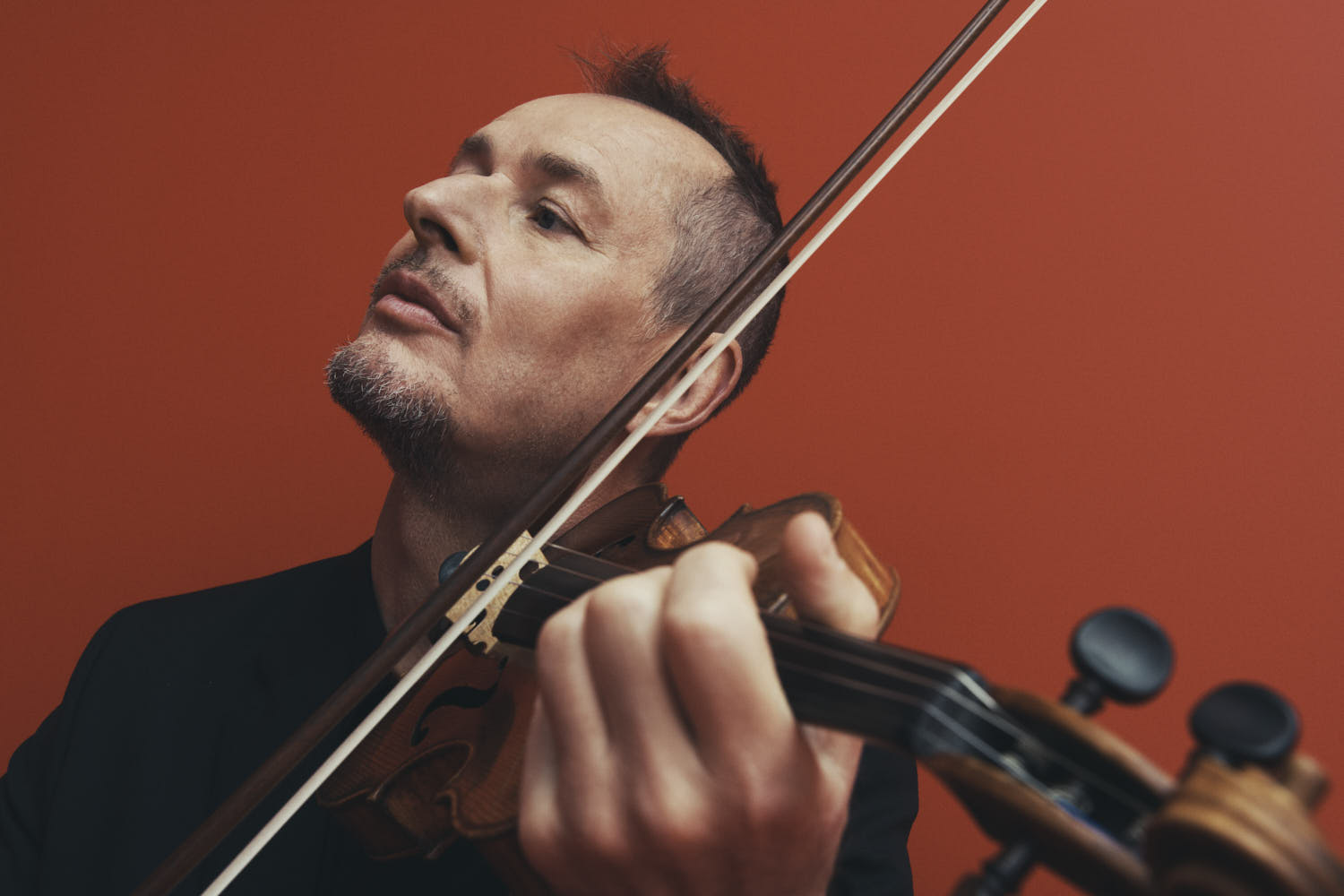
Richard Tognetti
You could see this program as a retrograde step in the Australian Chamber Orchestra‘s ongoing path of achievement. Presenting two repertoire standards like the Brahms Violin Concerto and Beethoven’s A Major Symphony doesn’t put many demands on audiences who would/should be familiar with both masterpieces. Of course, in this case you’re bound to hear exceptional readings of these scores, the ACO being what it is – one of the country’s leading ensembles in terms of skill and interpretative talent.
This was the tenth and final expounding of this double feature, the climax of a tour that took in the three eastern state capitals with a detour to Newcastle along the way. So the accomplishment level was as good as it was going to get. Adding to sixteen core members of the orchestra, artistic director and soloist Richard Tognetti had enlisted the assistance of an extra seven violinists, four more violas, two supplementary cellos and two double bass guests. This practically doubled the string body but such reinforcement proved necessary, given that all players were using gut strings.
The recruited flutes weren’t playing metal instruments, as far as I could tell; oboes, clarinets and bassoons all looked contemporary from my seat. The trumpets appeared orthodox but at least two of the horns were employing crooks and the other one of the four that I could see had an instrument whose middle workings looked unfamiliar to me – neither valved nor crooked. So it seemed that what we heard was something of a mixed bag, although the resulting sound complex favoured the woodwind and brass (as you’d expect).
Among the guests were musicians from the Adelaide, West Australian,, Queensland, Melbourne, Dresden Festival, Age of Enlightenment and Canada’s National Arts Centre Orchestras. Thomas Chawmer from the Orava Quartet was one of the violas, and six of the other string players were from the ACO’s Emerging Artists of 2025 ranks. You’d think this made for a sort of uneasy agglomeration but the whole complex sounded highly polished and assured in its work, probably more impressive in the symphony because Tognetti spent a good deal of his time directing rather than leading his first violins.
Of course, he had his hands fuller when treating with the concerto, across which he produced one of the most refined interpretations I’ve heard live. A thoroughly seasoned performer, Tognetti knows better than most where to find a balance between assertion and reticence, even if this interpretation was pre-ordained towards the latter. Even so, that brave opening flourish from the solo after the ritornello to the first movement registered as imposingly dynamic even if you missed the steely insistence of the quasi-cadenza upward-shooting spirals before this lone voice settles into its beneficent variants on the opening theme.
As the performance continued, I tried to recall when I’d last heard the ACO and Tognetti achieving a similar sound spectrum. It’s faded in the memory but I think it must have been when they were presenting another of the great concertos where solo detailed work, especially when lodged in the lower strings, dissipated into the accompaniment which was, above all, considerate. Because of this infrequency of bite, you had to concentrate with high attention to follow the opening movement’s argument, compensating for the murmuring activity by fleshing out what you know must have been there.
It’s a marvellous expanse, that first Allegro, relieved in this performance by a departure from the usual Joachim cadenza. Tognetti put together an amalgam of his own from those supplied by Busoni, Hugo Heermann and Auer. He adopted the Busoni venture of having a timpani accompany the soloist for a fair way into the novelty, and later brought in the strings for some preliminary chords prior to the return to normal at bar 527. Whatever the traces of Heermann and Auer, I wasn’t quick (or familiar) enough to pick them up but the demonstration proved to be technically spectacular, probably more so than the original.
When it came to the Adagio, we moved onto a different place, more subtle than that usually displayed in orthodox readings. The initial 30-bar wind chorale sounded seamless, the clarinets enjoying pride of place being positioned above their woodwind peers. The soloist’s unveiling of that spine-tingling initial sentence made for an ideal representation of the composer’s lyrical genius and the movement promised a fully burnished outpouring – until some clown’s mobile phone went off, the idiotic alarm tinkling out the opening bar to Handel’s Arrival of the Queen of Sheba.
Tognetti paused, then took up the reins again without complaint, even if some of us were seething at this redneck lack of consideration or concern. Further, I suspect a few of us found it hard to re-enter the calm unfolding of this movement’s later stages without being distracted by an inner rage. For which reason, maybe, the giocoso conclusion came over as more aggressive than expected, the soloist’s line slashing and curvetting turn and turn about, the pulse fluctuating without a sign of discomfort right up to the Poco piu presto gallop to Brahms’ warm-hearted conclusion.
I’m pretty sure that the ACO has played the Beethoven symphony before and that I heard it about a decade ago in Melbourne’s Hamer Hall. As far as I can see, the ensemble hasn’t recorded it but might consider doing so, given the finely-spun detail with this group populated by many ad hoc players. As I’ve said, Tognetti spent much of his time exhorting the ensemble, mainly by indicating swathes of sound rather than bow-pointing to individuals or groups. Did he need to offer such encouragement to a set of musicians that were very well played-in to this score? The results were indubitably successful, so no argument.
But there’s not much to report. The work unfolded with very few flaws; an odd horn bleep and some not-quite-right wind group entries, plus a few moments where the strings were in danger of being out-weighed. Still, the Allegretto moved at a brisk pace, not handled as a lugubrious funeral march; the following scherzo ‘s repetitions came close to wearing out their welcome, as usual, but the players’ briskness of attack took the edge of the composer’s wearing insistence.
Finally, that jubilant Allegro con brio rort rounded off the night with elegant bravura, some novel dynamic points set out for the more jaded among us, and an irresistible drive from the strings that lasted up to Beethoven’s peremptory final bark. I, for one, left the QPAC building with feelings of gratitude and elation – a welcome change from the usual sensation of having been aurally battered into submission. After this genuflection to the tried and true, and having attracted a substantial audience, the ACO will proceed with its birthday celebrations by following more challenging paths, this double-bill definitely being the year’s most conservative Brisbane program.
 O'Connell the Music