After five-and-a-half years on the Gold Coast, we have decided to move back to Melbourne. Unlike our arrival in Queensland, we have no definite address to which we’re headed back ‘home’.
So there will be a delay of some weeks before this site publishes new material.
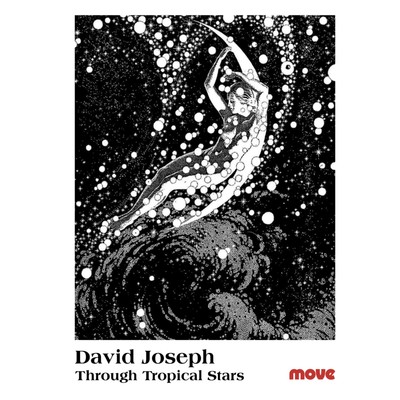
There’s something enigmatic about the music of David Joseph. If it weren’t for Move Record’s initiative, I would know very little about his contribution to Australian music. As it is, any material you come across is deficient in detail. For example, the opening work on this disc, a Concertino for flute, viola and percussion dates from 1988 but doesn’t appear in the Australian Music Centre’s catalogue of Joseph’s works. Likewise, the concluding piece, The Afternoon of 1991 for piano trio, is absent from the same list. Slightly less confusing is the attribution of the title track for two flutes to 1977 on the CD, but 1978 in the AMC’s listing. Ditto for the String Trio No. 2 (CD 1991, catalogue 1990) and a Sonata for clarinet and 2 percussionists (1978 according to the CD, but 1979 in the catalogue demi-raisonne).
Not that such discrepancies will keep anyone awake at nights, but they speak of a certain slovenliness in the provision of accurate information. As for performers, the Concertino boasts members of Sydney’s Seymour Group before that ensemble ceased operations in about 2006; flute Christine Draeger, viola John Gould, percussion Ian Cleworth and Rebecca Lagos (or is it Graeme Leak{e}?) as announced on the CD’s sleeve?). Jennifer Newsome and Zdenek Bruderhans perform Through tropical stars, while Nigel Sabin clarinet and Cleworth with Ryszard Pusz present the sonata. A group appropriately called the String Trio Holland consists of violin Josje Ter Haar, viola Susanne van Els, and cello Job Ter Haar. As for the brief The Afternoon, that features the untraceable Trio Classico comprising violin Urs Walker, cello Regula Hauser Menges, and piano Stefan Fahmi.
As you can see from the dates of each work listed above – 1977 (1978), 1978 (1979),1988, 1990 (1991), 1991 – Joseph’s compositions on this CD are not fruits of the composer’s time spent in Benalla where he has worked as a lawyer for nearly the last 25 years. It would seem that his musical creativity has come to a halt – a lume spento. Nevertheless, these five tracks from the past remind us of the individual voice that Joseph spoke and the sheer attractiveness of his vocabulary. By the way, all offerings on this CD are from live performances – at the Seymour Centre, Elder Hall in the University of Adelaide, Melba Hall at the University of Melbourne, and St. Peter’s Church, Zurich.
What the Concertino offers is a garden scene, albeit a furiously active one where the bird-life approaches the manic in its opening strophes, vivified by a rapid semiquaver flute pattern and viola flutterings above campanile, vibraphone and marimba backing. Every so often, we reach a hiatus point and the motivic matter changes, if the textures remain pretty constant, as does the level of action. When you think things are slowing down (the use of quaver triplets), the flute stirs itself into fresh flights and the percussion mimics the frenzy. For all that, the atmosphere is a benign one and it is conceivable that Joseph is presenting a kind of promenade where a change of vista prompts an alteration in texture.
Still, the soundscape is a consistent one with recognizable patterns enjoying a transmutation process and the ensemble working as a well-oiled rhythmic machine, punctuated by a cadenza flight from Draeger and Gould towards the conclusion . Just when you think the piece is descending into a twilight phase, the initial energy and textures reappear, although the final bars offer a kind of placid resolution. It seems to me that Joseph is most concerned with exercising a timbral palette which he varies most obviously by changing his percussion instruments. This results in an effervescent kaleidoscope of colours to which all four participants contribute in almost equal measure.
According to the AMC site, Through tropical stars is meant to last about twelve minutes; Newsome and Bruderhans get through it in under nine. It’s not intended to be another ‘bird’ piece and in some ways it isn’t, having a wider scope than mere avian imitation. But there are passages where you can’t escape the querulous nature of bird chirrups and competing calls, circling around each other in close imitation. One player uses piccolo, concert flute and alto flute; the other sticks to concert flute throughout. While the work is a dazzling exhibition piece for its interpreters, its atmospheric character suggests a natural world abuzz with growth and light: a brilliant tandem ride of coruscations, here articulated with admirable interdependence.
Something like the Concertino, Joseph’s Sonata works hard to present textural and timbral interplay/contrast. It certainly exploits Sabin’s flexibility and rapid recovery in its initial stages where a dialogue between clarinet and marimba displays a mastery of quick-fire articulation. A chain of sustained wind notes takes us a short space away from the initial chattering, but not for long; when the clarinet is occupied with delivering a high pedal note, both marimba and xylophone indulge in a furious clash of lines.
It makes for an experience that is heavy in events. If a score were available, I’m sure the interconnections and inner references would become clearer but, as it is, you just surrender to the aural avalanche-with-recesses that prevails at the end, despite the sudden emergence of some moments of what pass for rest in this active work. Percussionists Cleworth and Howell are no shrinking violets but take over the running, occasionally drenching the clarinet in powerful mallet work as the score drives towards its affirmative conclusion.
With the string trio, despite the CD leaflet’s stipulation that it is a nature portrait similar to the Concertino, we are in a different landscape where abrasive chords serve as fulcrum points, demanding attention right from the opening. True, you hear whistles and throbbings that might represent wildlife red in tooth and claw, alternating with compulsive motor rhythms that bear witness to the ongoing influence of Stravinsky’s early years. Again, the composer utilises obsessive motives and near-splenetic bursts of repeated chords to animate his intended ambience.
As with its precedents on this CD, the trio deals with patterns that can be transformed or just repeated till the next one appears. What is different is the sense of menace as we move through a sound world that is packed with percussive-sounding bursts. The burbling and twittering has gone and we find ourselves in a world of menace and uncertainty which eventually fades to an uncertain final querulousness: the first piece on this album that ends, like Petrushka, with a question.
The last track, and the latest of Joseph’s works represented here, The Afternoon is a brief vignette that intends to acquaint the listener with the sad quietude of approaching twilight. In fact, the piece succeeds very well in following a path into quiescence, the final words given to the piano after a process that maintains Joseph’s practice of exploiting brevities, even if these ones present themselves with more angularity than we’ve heard so far.
For recordings that were made some time ago – 46 years in two cases, 34 years the most recent – the quality of these tracks is remarkably clear, in particular the final one from Zurich where Walker’s violin and Fahmi’s piano have a fine, piercing character that makes every note resonate. And it serves as an attractive envoi to this series of one-movement scores that remind us of the intellectual and emotional appeal of the music created by this remarkably gifted writer.
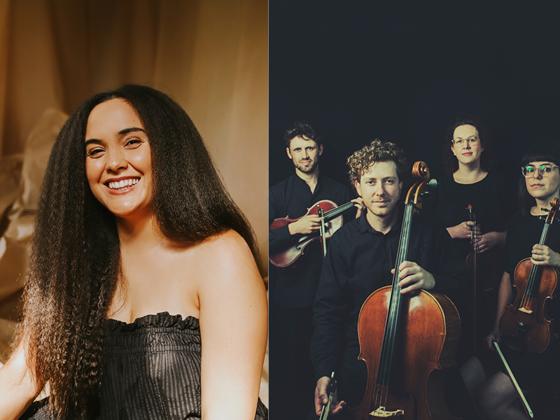
Jess Hitchcock & Penny Quartet (L to R Anthony Chataway, Jack Ward, Amy Brookman, Madeleine Jevons)
It was hard to get a handle on this recital, a rather specialized event from Musica Viva which is being heard in Perth, Adelaide (part of this year’s Festival), Brisbane,, Newcastle and Sutherland. In the program, Glenn Christensen, a former resident with the Australian Chamber Orchestra, is listed as first violin of the Penny Quartet but was he present on this night, your honour? Or has his appearance changed significantly since those halcyon ACO days? The photograph above shows the current quartet’s personnel, according to the body’s website. I didn’t recognize any of the players by sight – three males and a female – although their ensemble output impressed for its deftness.
Jess Hitchcock sang twelve of her own songs and the program included a full set of texts. But then, the organizers turned the lights right down so this information was completely useless. Mind you, the artists wended a lackadaisical way through the mixed dozen lyrics which were not performed in printed order so that you were invited to play a kind of detection game to work out what was going on. In the original concept, the program contained only eleven Hitchcock songs, all of them organized for a string quartet accompaniment by local writers. A fresh arranger – Christine Pan – attended to the additional song.
I think I got them in the right order but, as far as this singer’s work goes, there be no ignorance like unto my ignorance. I believe I heard, in sequence: Days Are Long (arr. Iain Grandage), Homeward Bound (arr. Isaac Hayward), Collide ((arr. Nicole Murphy), Soak To My Bones (arr. Harry Sdraulig), Leader of the Pack (arr. Ben Robinson), By the Sea (arr. May Lyon), On My Own (arr. Holly Harrison), Together (arr. James Mountain), Running in the Dark (arr. Matt Laing), Fight for Me (arr. Pan), Unbreakable (arr. Alex Turley), and Not a Warzone (arr. Grandage).
Apart from the songs, the program also gave an airing to American writer Caroline Shaw‘s Plan & Elevation: the Grounds of Dumbarton Oaks. This quartet was written to commission by Harvard, celebrating the 75th birthday of the university’s famous estate; further, Shaw was the original music fellow at Dumbarton Oaks in 2014-15. Now what I think happened was that the Pennies interspersed the songs with the five movements from Shaw’s work. If so, the work was subsumed into the whole experience very cleverly. I can recall some viola double stops suddenly emerging at one point, as well as some rapid Verklaerte Nacht-style arpeggios with harmonics – both identifiable from Shaw’s score. Sadly, the final effect was to make you think that one of the arrangers had included an above-average postlude or prelude, rather than transporting you to the estate’s Herbaceous Border or Cutting Garden.
Adding to the mix, Hitchcock proved to be a fan of the pre-song address, giving us information about her background, her family, her musical training, her participation in the Voice referendum, her personal relationships with people that she was singing about – all the gallimaufry that might/might not add to a listener’s appreciation of what was being offered. Certainly, this singer is involved in her work and is at some pains to tell us all about it, in the way of the young. Whether we need to hear it is another business.
To be honest, I found it hard to differentiate between many of Hitchcock’s songs. Her melodic language shows balance and general placidity; the harmonic structures are innately simple, if spiced up by her arrangers; the tempo of each song rarely ventures into any territory but the four-square. For instance, the opening Days Are Long presented as a simple melody over a pizzicato support that developed into a thudding bass line, soon turning the lyric into a bit of a chug. Immediately, you were aware that the vocalist was well amplified; after a time, it became apparent that so were her string supporters.
During the following Homeward Bound, you encountered some rhythmic irregularity to complement the loud, punchy nature of the actual content but this spike of interest didn’t seem to be part of the original matter but inserted by its arranger. And so the procedure continued with a quickening of interest before a return to the tried and true e.g. Collide where an intriguing drone effect shuffled back into a fluent chordal support. Or else the arrangement stole much of the thunder, as in By the Sea with its plain vocal line overtaken by Lyon’s ornate string support.
Contrast that with the feistiness of On My Own, an unusually fast and assertive song which brought to mind some traces of American protest songs, although the text appears to point to an inter-personal crisis rather than a recrimination aimed towards the current social order. But then, it could be both.
Nearing the end of the night, Hitchcock started playing on a keyboard at the opening to Unbreakable. Mind you, I was in such a state of identification tension that she might have been making subtle contributions before this. This song fell into the same category as several others on offer that encourage self-belief, self-determination, self-confidence, self-assertion – statements of character development that flourish in the egotism of this age. Possibly these might not have grated so much if the vocal lines offered variety, but they didn’t. All of Hitchcock’s melodic threads bore a close resemblance to each other, and all sprang from a base in the American Neo-Romanticism that has flourished in the republic for some time.
What we heard across the twelve-part cycle was pleasant music-making that cast no threatening shadows of modernity. In this reversion to a well-trodden path, the composer stayed within the limitations you can hear in Sondheim’s Into the Woods – a sampler of song construction for the contemporary writer with a disregard for recent advances in melodic design, metrical ingenuity and harmonic experimentation; when I say ‘recent’, I’m referring to anything past the first decade of the 20th century in the history of Western music. Of the original music of our country, I found no trace. Despite her Torres Strait Islander and New Guinean background/heritage, Hitchcock has been trained in her craft by serious musicians; as far as I can tell, she has yet to take up the mantle of original invention.
As a suddenly applied encore, Hitchcock and the Pennies presented a version of Sidney’s My true love hath my heart. I wasn’t able to decipher Hitchcock’s attribution of musical authorship from her preliminary remarks, but the setting rocked no boats and so was of a piece with everything that preceded it.
In this light program, the five artists collaborated to fine effect and the smaller-than-usual Musica Viva audience applauded each segment with enthusiasm. So what was missing? Perhaps a kind of emotional depth, or an aspiring ardour to lift the evening’s cosy level of engagement. You (meaning I) left the Griffith University venue with a sense that we’d heard a deft sequence of songs, thank you very much, but not much remained in the memory.
 O'Connell the Music