Clarity and calm

HAYDN REEDER SOLOS DUOS TRIOS

Move Records MCD 666

A retrospective for Haydn Reeder in some ways, this CD contains two trios – one in two parts scored for your classic piano trio; the other a single movement combining flutes, viola and harp – a pair of duos for flute and violin, then violin and cello, followed by a welter of solos, pretty much all for piano with a solitary exception for cello. One of the five keyboard solos comprises a set of six rapid studies, but the disc’s sixteen tracks are generally short: all the piano pieces come in at less than five minutes each, two of the studies not getting to sixty seconds. It’s not the slimmest collection I’ve come across on CD but at a little over 56 minutes, you’d be expecting fair quality.

Some of the performers are well-known, like cellist Rosanne Hunt, violinist Susan Pierotti, flautist Johanna Selleck, and pianist Danae Killian. Some have been local presences for several years, like violin Philip Nixon from Orchestra Victoria and violist Barbara Hornung whom I last heard three years ago on Johanna Selleck’s Becoming CD, also from Move Records. The Six Studies are entrusted to Elton Sun, winner of last year’s Young Lev Vlassenko Competition in Brisbane but information about him is hard to track down.; according to Reeder’s CD leaflet, he was 12 when recording these pieces.

As retrospectives go, this is a fairly wide-ranging one covering 25 years’ activity. The oldest of Reeder’s works we hear is the Tolling Bell Song piano solo of 1998; then skip forward eight years for the Two Pieces for Piano Trio. Sun’s readings of the studies come from 2014, while the Lines in a Landscape trio dates from 2016 and is the longest track here at 7’20”. Waxing and Waning, the violin/flute duet, was written in 2019 while everything else comes from 2021 (Rondo, piano solo), 2022 (Wheels Piece, another piano solo), or 2023 (Surrounding the Cello solo, and The Spinning and Weaving of Destiny for solo piano). Still, the first works by the composer I can trace come from 1970, so we’re hearing mature chamber music – well, middle-to-late period material.

Matters open with the two piano trio pieces. The first, Growth and Transformation, has it all in the title. It begins with piano notes which the strings take over; you’ve got to go somewhere from here. And Reeder does with increasingly more complex aphorisms, punctuated by lacunae, until we reach an instrumental interplay of pizzicato and staccato line-crossing. My only problem is that I’m not quick enough to realize what is being transformed, although the growth is apparent. This small sample of musical biology brings us Philip Nixon’s violin, Rosanne Hunt’s cello and Danae Killian’s piano, giving full voice to Reeder’s angular, atonal counterpoint.

The same artists work through Flowering of the Resonances, which opens with a series of thick chords from Killian in a sort of Donaueschingen vallee des cloches. The string instruments enter with a series of vehement brief attack-motifs and Reeder builds his piece around textures rather than any overt development I could find. Again, much of the progress is by short bursts of colour with plenty of room for tremolando and sforzando bolts from a clear sky. The results offer a series of instrumental colours, all three eventually weaving around each other softly near the end.

Selleck opens Lines in a Landscape on alto flute and ends the work on a concert instrument. The main interest here is her partnership with Hornung’s viola as their instrumental parts urge each other forward, in the early stages playing at least twice in unison. Mestrovic’s harp isn’t secondary in interest, her role coming into solitary prominence at specific points, but you couldn’t call her contribution linear. Reeder speaks of the songlines of our First Nations people and there is probably a case to be made for such an image in this music if only I could remember my Chatwin. As things stand, this trio is of a piece with its two predecessors in its calm abstraction, although the latter score is somehow more discursive, even if its setting is the horizonless Outback.

Naturally, the textural interplay is more easy to read in the Waxing and Waning duo, here performed by Selleck and Pierotti. The composer sets up his material very clearly and you can follow his intervallic and chordal workings without befuddlement, mainly because he varies the players’ attack and output with an eye for dynamic contrast, as well as living up to his title’s promise in outlining increases and decreases of activity through a transparent environment so that you are aware of every flutter and trill, no matter how faint. It’s yet another instance of Reeder’s ability to construct a scenario with simple means but maintaining your attention by not wearing out his welcome: being discreet in the best possible way.

Just as easy to comprehend is the following Wheels within Wheels for violin and cello. Pierotti and Hunt circle around each other but the movement only presents as regular in a sustained passage at the centre of the piece where the lines are simultaneous, if not congruent in their notation or direction. For most of the time, the wheels intersect but break off, the patterns momentarily circular but more suggestive of plot-lines rather than anything mechanical. It’s suggestive of a consciousness you have of parts of a complex becoming visible, then being shut off, or replaced by something similar but somehow askew. The effect is slightly unsettling but also refreshing in its open-endedness.

What follows these ensemble pieces is a chain of six solos, mainly for piano. Killian opens the sequence with the CD’s earliest piece, Tolling Bell Song, which is something of a single-minded construct comprising sustained initial sounds with arpeggio-like companion-notes radiating off from the initial stroke. Reeder offers rhythmic differentiation by alternating 2/4 bars with irregular semiquaver ‘fillers’ in 10/16 measures, for example, although even these have their initial bell-type strikes. Yet again, you’re reminded of Ravel, if in a vocabulary that is fifty years further along the historical track.

Sun’s readings of the studies are quietly competent. None of the six is particularly demonstrative or confrontational, all being interrupted, to a greater or lesser extent, by fermate or pauses in the action. As with the duos, Reeder presents his material at the outset and moves gradually (sometimes imperceptibly) into a sort of development, which could be a simple process of adding notes to a melody strand, as in No. 1, or swerving to an opposing piece of materiel, e.g. No. 4. These bagatelles are distinct in character and, to his credit, Reeder speaks in his own voice throughout, not really bringing to mind any significant precedents. And he has found a sympathetic interpreter in this young pianist who outlines each study with composed authority.

Killian opens Wheels Piece with another of the composer’s single-line patterns of five notes that rises, then falls back on itself before another line joins and we enter a now-familiar field of two-line counterpoint with caesurae. The rhythmic movement becomes more insistent and we return to the environs of the Tolling Bell Song with single resonant notes sustained while secondary arpeggio patterns radiate out from them. Then we return to the rising pattern from the opening which is now both assertive and shadowy before the rotation stops in a finishing upward flourish – the wheels have come off?

With The Weaving and Spinning of Destiny, Killian takes us immediately into Meine Ruh’ ist hin territory with a repeated simultaneous arpeggio-type pattern in both hands which moves into some by-now-familiar Reeder vocabulary with sudden stops and repetitions-with-accretions, the complex leading to abrupt bumps, both fortissimo and pianissimo, spiced by some repeated note ostinati. Some bass chords are splayed out until they are reduced to their single top note which is repeated, fading into an inaudible space. This may be the composer’s outline of a personal destiny, or it could be applied to us all but I find philosophy’s big subjects impossible to get a handle on; I’d be lost in Also sprach Zarathustra if it weren’t for Strauss’s signposts and the only dissertation/dialogue of some elevation that means much to me is Bernstein’s party-piece Serenade.

Rosanne Hunt gives a spirited performance of the solo Surrounding the Cello which contrasts a downward-moving initial motif with a set of aggressive double-stop intervals that can move in either direction. Reeder sets some technical hurdles here including (I think) sul tasto work and a moment or two or sul ponticello, your odd scrape and harmonic (I assume intentional). Nothing too outrageous, though, and all carefully compartmentalized thanks to the composer’s insertion of aural station-stops. It strikes me that it’s not so much a question of surrounding the cello but more seeing what it can do – a sort of a propos the cello.

Finally, Killian returns with Rondo, which I found the most difficult of the pieces to imbibe. It begins with shades – as the composer informs us – of Berg (the Piano Sonata opening?) and Schoenberg (Op. 11?), but moves out into more diffuse areas which pile up on top of each other. About a third of the way in, the tonality seems more ‘white-note’ than anything else in a stentorian declamation before we hear bass chords-plus-melody under high-tessitura decorative chord-sparks. The bass/middle register texture remains present for some time before a sudden burst of double-handed furioso which itself shifts into pointillistic staccato in both hands that brings the piece to an enigmatic, Scarbo-like open end.

You could call Reeder a middle voice in the development of Australian music, I feel, because he is not of the melody-rules-and-the-more-diatonic-the-better sept, nor is he part of the look-at-me-and-my-daring tribe. His language is calm, controlled and belongs to those logical, clear-headed and emotionally controlled ranks that work at composition with an awareness of responsibility to communicate with an informed band of listeners. I’m welcoming this CD as disseminating the work of a gifted contemporary writer who speaks to us with remarkable clarity.

Old and easy

MOZART’S CLARINET

Muisca Viva Australia

Elisabeth Murdoch Hall, Melbourne Recital Centre

Tuesday July 22, 2025

(L to R) Nicola Boud, Simon Cobcroft, Erin Helyard

We certainly heard the clarinet sound that Mozart would have been familiar with, although I was slightly disappointed that the more interesting of the two instruments that Nicola Boud wielded – a basset horn – appeared in only one piece: an arrangement of Beethoven’s Horn Sonata Op. 17, written in 1800 and endorsed by the composer in its transcribed version by Joseph Friedlowsky in about 1801. The other Beethoven works for clarinet that we heard saw Boud using a five-key clarinet for the Aria con variazioni of about 1792 which is the last of the Three Duos WoO 27 originally written for clarinet and bassoon but here employing Simon Cobcroft‘s cello for the bass part; and later for the Gassenhauer Piano Trio in B flat which was written in 1797 for tonight’s combination (at last) of clarinet, cello and fortepiano/pianoforte.

Mozart himself fared somewhat less well, being represented by two works. With limited resources, these musicians performed the Kegelstatt Trio in E flat which really calls for clarinet, keyboard and a viola, not a cello, but which proved mildly entertaining as we watched Hobcroft spend lots of time on his two top strings. And that was it, as far as Mozart’s clarinet went because the second work gave Erin Helyard a fortepiano solo in the C Major Sonata K. 545, greeted at its opening bars by a sigh of approval soughing through the Murdoch hall.

In fact, Helyard took the occasion to proffer a slightly different take on this classic. He played through the opening Allegro‘s exposition straight, then decorated the repeat with a smorgasbord of introduced interventions and ornaments. Much the same happened when he repeated the movement’s second part. And on it went through the chaste Andante but, as far as I remember, the concluding Rondo was performed without much elaboration, if any. A bit flamboyant, perhaps, this version but understandable as the sonata was conceived as a beginner’s piece and the temptation to dress up a too-familiar outfit would prove irresistible.

So, a lot of Beethoven’s clarinet in this Musica Viva recital and only one Mozart – and even that was a work that’s familiar to most chamber music lovers. Still, we heard some of the evening’s most convincing playing in the Kegelstatt‘s middle Menuetto, particularly at the start of the Trio’s second half with a finely balanced unison partnership between Boud and Cobcroft. All the same, the cello encountered several moments of dubious intonation – an odd note or two cropping up, admittedly infrequently, in both the outer Andante and Rondeaux that surprised more than a little as Cobcroft was playing the only non-archaic instrument onstage (even if the clarinet and fortepiano were modern copies).

But the point of the exercise was to show the difference between the clarinet timbre that Mozart would have known and the polished product that we have come to expect from the modern instrument when it outlines this particular score. And the results were? Well, not much, as far as I could tell. Boud might have more difficulty in producing the notes because of the lack of flexibility on the Lotz clarinet copy that she was manipulating but you couldn’t really fault the fluency or truth of her articulation which came across with excellent fidelity. Yes, you might have pointed to a couple of awkward moments in phrasing but these were so slight that they barely flickered on the surface of her line.

With the revamped horn sonata, it was hard to understand why Boud and Helyard bothered to repeat the 76-bar exposition to the opening Allegro as the content is bland as far as the horn/clarinet part goes and the only frisson comes in the keyboard alternating semiquaver chords across bars 56 to 61. Against that, we got to enjoy the startling bass notes of Boud’s basset horn. Furthermore, the players compensated for Beethoven’s very short Poco adagio with a vital, breezy account of the final Rondo with a very satisfying partnership in phrase mirroring and a dynamic balance that would have been harder to carry off with the natural brass instrument.

Cobcroft joined Helyard for the Ein Madchen oder Weibchen Variations of 1796: an easily imbibed set of twelve non-complex elaborations on Papageno’s Act 2 wish-fulfilment aria from Act 2 of The Magic Flute. I had more trouble with the cellist’s pitching here than anywhere else on the program, particularly an unhappy start to Variation 2 during which the clefs are reversed, the string playing treble and the keyboard bass in both hands. The outcome seemed momentarily unsure which surprised because the tessitura isn’t that high, only reaching G atop the staff.

Better followed, mainly near the end of these rapidly accomplished variants when we hit the two minore ones, the adagio/poco adagio Nos. 10 and 11 in F minor, particularly the former where the cello emerges only after the first half to take up an entertaining tit-for-tat with the keyboard. But even the penultimate variation has its own charm with a broad string melody set against complaining keyboard triplets that gave way to a brief cadenza for Helyard.

Not much to report about the Aria con variazioni. Beethoven only wrote four diversions on his air, with a rapid 31-bar Allegro in 6/8 as a coda. I found it hard to make sense of the repeats; in my score, every half is given again but it seemed that we only heard one half of each variation being recycled. Not that it mattered over much as the work itself is amiable but slight, with a pretty fair sharing of the labour and exposure between the instruments – perhaps a slight leaning towards the upper line. How about Cobcroft’s cello as a substitute for the bassoon? Well, of course it altered the interplay of colours but there’s not much point going all precious over an all-purpose workmanlike score like this one.

With the program’s concluding Gassenhauer, the trio worked together to better effect than in the preceding Mozart trio. We heard a repeat of the 105-bar exposition which I find is more often omitted, but was welcome here because it gave Boud the occasion to generate a few finely woven strands right from her first solo exposure in bar 12, and later in the movement between bars 184 and 192. Still, most of the clarinet’s work is in tandem with the cello and these musicians sounded comfortably balanced.

The Adagio holds some eloquently interwoven moments for cello and clarinet but I think the keyboard part dominates, not least because it is remarkably active. From bar 26 to bar 53 – the core of the movement – the piano is prominent with melodic content or rapid-fire accompaniment – well, rapid-fire compared to its competition. Here, Cobcroft shone with a clear penetration from his opening statement of the main E flat melody and in his mirror-imaging of Boud, e.g. bars 50 to 52.

The finale’s variations on Weigl’s popular tune came across with loads of drive and clear enjoyment, as in the piano solo Variation 1 and its pendant for clarinet and cello. And it was a pleasure to come across the vigorous return to ensemble status in Variation 3 in bar 61. Boud’s clarinet enjoyed a few exposed moments, as in the response to Cobcroft across bars 132 and 126, but it’s almost as if the composer remembered his wind line in the last variation and gave it a broad canon with the cello, even if everything stops for a sudden keyboard cadenza before the 6/8 syncopated romp home.

An enjoyable recital, in the end, made so by Boud’s liquid sound which disguised with high skill the problems of working through this music on a limited instrument. Across each of her four contributions to the exercise, you heard no irregularities in rhythm or squawks to interrupt the smooth amplitude of her delivery She didn’t elaborate on the difficulties in fabricating an even sound delivery from her two instruments which might have made us more aware of her labour of love in promulgating the older clarinet. But I suspect that most if us were happy to just bask in the warmth of this entertaining, non-aggressive music-making.

Diary August 2025

THE POETRY OF WAR

Melbourne Symphony Orchestra

Iwaki Auditorium, Southbank

Sunday August 3 at 11 am

Here’s another element of the Melbourne Symphony Orchestra‘s Chamber series, in this case combining music and poetry in a program curated by violinist Monica Curro. Of course, the subject/theme won’t be hard to flesh out, and the printed material on the MSO website refers to music by Debussy, Britten and Webern. And that’s not an ‘of course’ matter at all. No worries with Britten who has some war material to his name, even if we’re not being treated to snippets from the Requiem. Debussy’s a bit harder to pin down; you might take one of the three instrumental sonatas as being ‘ of the time’ rather than having any military connotations. Mind you, the same could be said of the Berceuse heroique (a piano solo) or En blanc et noir (probably not on this program as it calls for two pianos). As for Webern, I’ve no idea; the Cantata No. 2 was written during World War II but I doubt if anyone’s taking that on, particularly if you take into account the musical forces that Curro has gathered. They involve herself and Kirstin Kenny on violin, Gabrielle Halloran viola, Michelle Wood cello, Shane Hooton trumpet, Andrew Macleod flute, and Elyane Laussade piano. As for the poetry, that comes from actor Dennis Coard whose contribution is non-specific except that it’s coming from the 20th century. Here’s hoping we get a bit of French and German texts to go along with the Owen and Sassoon. A standard ticket costs $55, concessions go for $50, and kids get in for $20; you have to fork out $7 as a transaction fee, or for having the cheek to place an order.

ATMOSPHERE 3

Corpus Medicorum

Elisabeth Murdoch Hall, Melbourne Recital Centre

Sunday August 3 at 5 pm

Turn it into Latin and immediately the thing takes on gravitas. I don’t know when the Doctors’ Orchestra turned itself into the Corpus Medicorum, but here we are. The group of combined medicals – doctors, students, health professionals – will be directed in this concert by the estimable Fabian Russell; actually, Russell has conducted/is conducting all the Corpus’ events across the year. This evening, the group is going all-French in an ambitious set of forays that opens with Debussy’s La mer, that taxing set of three symphonic sketches from 1905. Violin soloist Natsuko Yoshimoto, currently concertmaster of the Queensland Symphony Orchestra, then fronts Chausson’s Poeme of 1896, the composer’s best-known work and a professional’s staple. She follows this with Ravel’s flashy Tzigane from 1924 – as boisterous a musical joke as the Bolero from four years later. The entertainment ends with more Ravel in La valse, that nightmare vision of 19th century Vienna written in 1920 and apparently having nothing to do with World War I. It asks for a big orchestra and is difficult, even for gnarled old-timers, to carry off persuasively. A standard entry is $65; concession card holders and students both are being charged $30, and ‘Booking fees may apply’, according to the publicity – I think you can count on it.

CIRCA & THE ART OF GUGUE

Australian Brandenburg Orchestra

Elisabeth Murdoch Hall, Melbourne Recital Centre

Thursday August 7 at 7 pm

Is this going to work? We’ve seen previous marriages between the Queensland-based circus company and Paul Dyer‘s Australian Brandenburg Orchestra in the past. I recall hearing/seeing French Baroque and Spanish catch-all programs in the latter years of the past decade. The Italian Baroque collaboration of 2022 didn’t travel live outside of Sydney, but now both organizations have put aside national colour and opted for a massive torso in Bach’s one theme-based collection of 14 fugues and 4 canons. This compendium lasts as long as the performers decide, it seems; one performance barely lasts 50 minutes, several more close to 90 and one I’ve come across goes for over two hours. Most musicologists agree that the work was probably written for – and is best served on – a harpsichord but I have little doubt that the Brandenburgers will not be consigned to the back-blocks by their artistic director’s instrument alone. Of even more moment is the question of the Circa acrobats’ choreography which will need to be of a sharp order to come into line with the matchless skill of Bach’s contrapuntal marvels. Still, the few occasions I’ve seen this collaboration in action, the music has to fight hard to attract any attention from the Circa corps’ brilliant aerodynamics. I don’t understand the ticketing process. A standard costs between $30 and $196; full-time students pay a flat $20; Under 40s pay $40; concession card holders pay between $59 and $109. These prices vary between performances and booking fees apply if you get your seat(s) online or by phone. You’d want to get good Bach for your buck.

This program will be repeated on Saturday August 9 at 7 pm and on Sunday August 10 at 5 pm.

TCHAIKOVSKY’S VIOLIN CONCERTO

Melbourne Symphony Orchestra

Hamer Hall, Arts Centre Melbourne

Thursday August 7 at 7:30 pm

Oh well, it had to happen: a rather orthodox program, even if it holds one surprise. Clearly, the evening’s focus falls on the great concerto of 1878, the most exhilarating of them all, thanks to the composer’s inimitable capacity for drama and colour. As soloist, the Melbourne Symphony Orchestra is initiating Dutch musician Simone Lamsma who has proved highly successful in North America and Europe. I believe she has played with the Sydney Symphony Orchestra but, like so many of her ilk, has not made it to anywhere more southern – until now. The concert’s conductor, Korean-born Shiyeon Sung, has been principal guest conductor of the Auckland Philharmonia and has worked with the Queensland Symphony Orchestra. Her big task is finding even more reserves of warmth in the benign Brahms Symphony No. 2 in D: the happiest of the composer’s four and blessed with a welcome underpinning gleam across its length. It’s also almost an exact contemporary of the night’s concerto, being written in 1877. But up-to-the-moment joy comes in a premiere from Greek-Australian writer Klearhos Murphy, the MSO’s Cybec Young Composer in Residence; his The Ascent, commissioned by the orchestra, is to be revealed – a triptych of (not too exhaustive, one hopes) meditations on the teachings of St. Nikitas Stethatos and that holy man’s proposals for a successful spiritual life. Normal rickets range from $75 to $139; concession holders are charged $5 less (big deal); if you’re under 18, the charge is $20., But everybody has to stump up $7 transaction fee per order; one day we’ll find out where that money goes.

This program will be repeated on Saturday August 9 at 7:30 pm

DANIELLE DE NIESE

Australian Contemporary Opera Company

Elisabeth Murdoch Hall, Melbourne Recital Centre

Friday August 8 at 7:30 pm

A singer with a large profile, Danielle de Niese is going to work through a wide-ranging program that stretches from Marcello and Handel to Weill and Gershwin with not much in the middle. I’ve not heard her (I think) so have no comment about her talent but she has an excellent group of well-known musicians supporting her: violins Curt Thompson and Sophie Rowell, viola Lisa Grosman, cello Richard Narroway, oboe Rachel Curkpatrick, harp Marshall McGuire, piano Coady Green. As well, she is being assisted by a vocal septet from the Australian Contemporary Opera Company: Sophie Bissett, Uma Dobia, Saskia Mascitti, Callum Warrender, William Grant, James Billson and Daniel Felton. The recital’s first half is specific with definite numbers and arias from Jimmy Lopez, Kurt Weill, James Macmillan, Christopher Tin and Patrick Cassidy, as well as the afore-mentioned Marcello and Handel numbers. After interval, it’s just names – Dan Bryer, Mike Needle and Tom Grennan, Kenneth Macmillan (really? The choreographer??), John Denver, Jerome Kern as well as Gershwin. In other words, you’re getting a potpourri of songs that I suppose de Niese likes to present. If you’re attracted, a standard ticket comes in between $75 and $149; concessionaires get in for $10 or $20 less, depending on where you sit; students can get mediocre seating for $35, and Under 40s get the same for $40. In this case, the transaction fee is a moveable feast, somewhere between $4 and $8.50; no idea how they apply this although I suspect the more affluent get stung most.

GERSHWIN & SHOSTAKOVICH

Australian Chamber Orchestra

Hamer Hall, Arts Centre Melbourne

Sunday August 10 at 2:30 pm

My favourite Ukrainian-born Australian pianist Alexander Gavrylyuk is appearing for the first time with the Australian Chamber Orchestra; it’s taken a while for the organization to perceive those talents that, to many of us, have been obvious for years. Still, here he is at last, front man for Gershwin’s Rhapsody in Blue (written in 1924 and here arranged for strings and solitary trumpet backing, God knows how) and the 1933 Piano Concerto No. 1 by Shostakovich for which the ACO and David Elton comprise the proper environment. We also will hear the Chamber Symphony arranged for string orchestra in 1967 by Rudolf Barshai from Shostakovich’s String Quartet No. 8, a work we’ve heard from the ACO on previous tours and which was released on a CD by the current players (you’d think) in February of this year. The event starts with Claude Vivier’s taxing Zipangu, the Canadian composer’s 1980 vision of Old Japan, with the help of some other Asian countries. As well, the ACO presents a newly commissioned work: A Moment of Memory by senior Ukrainian writer Valentin Silvestrov, who fled from Kyiv three years ago to find refuge in Germany after the Russian invasion. This is a remembrance for the victims of fascism and oppression, although it sits somewhat oddly beside Gershwin’s buoyant tour de force. Tickets range from $30 to $167 for full adult cost – now there’s a spectrum of choice for you. Pensioners and Healthcare cardholders get a lower rate (but not much), as do students and those under 35 (why them?).

This program will be repeated on Monday August 11 at 7:30 pm

MUSICAL FRIENDS

Flinders Quartet

Primrose Potter Salon, Melbourne Recital Centre

Tuesday August 12 at 7 pm

This ensemble has kept its shape for a while now – violins Elizabeth Sellars and Wilma Smith, viola Helen Ireland, cello Zoe Knighton. This particular program offers several surprises and two staples of the repertoire that you now hear all too rarely. Of more than usual interest is the presence of two commissions. The first is by Natalie Nicolas, a Sydney writer and a favourite of the Flinders Quartet. This is By the Tide of the Moon and celebrates Aida Tuciute, a former Lithuanian Olympic swimmer who has an affinity with the ocean. As for the second, it’s a joint work by Melody Eotvos from the University of Melbourne and Rishin Singh – Malaysian-born, formerly resident in Sydney, now living in Berlin. Called The Letter Writing Project, this is a joint composition where the composers constructed this work turn and turn-about by sending each other completed portions. In between and following these fresh compositions, we hear Mozart’s Adagio and Fugue in C minor from the ominous (for Mozart, as well as for our First Peoples) year of 1788. And the Flinders end with Borodin in D Major, his second string quartet of 1881 which proved such a fruitful source for Robert Wright and George Frost when they were assembling the score for their 1953 musical Kismet. Tickets are a very reasonable $53 full adult, and $42 for concession card holders and students; never forgetting that oddly varied transaction fee between $4 and $8.50 if you phone or email your request for tickets. Is that range in operation because of a client’s suburb? Bank? Credit rating?

TAKACS QUARTET WITH ANGIE MILLIKEN

Musica Viva Australia

Elisabeth Murdoch Hall, Melbourne Recital Centre

Wednesday August 13 at 7 pm

One of the world’s great string quartets returns under the Musica Viva banner to perform Haydn, Beethoven and a once-local composer’s work commissioned by the organization. This last is Cathy Milliken, born in Brisbane and now based in Berlin. Her new Sonnet in Emigration is a setting of Brecht (probably not the On the Term Emigrants poem of 1937; more likely Sonett in der Emigration of 1941 commemorating when the poor fellow and his family wound up in America). As I understand it, the interpreter of this, with the Takacs Quartet, will be Australian actress Angie Milliken – could be a sister, or a cousin, or completely unrelated. Anyway, before this comes Haydn’s Op. 74 No 3 in G minor, called for no good reason ‘The Rider’, and one of the least performed of the set written for Count Apponyi in 1793. The Takacs recorded this work in 2011 but with different players (now retired) on the two inner voices. The group ends with Beethoven’s Razumovsky No. 3 in C of 1808: the only one of the three which doesn’t have an identifiable Russian tune in its melodic content. But it is a powerful exercise in stamina for any executants, not least for its rapid fugue-finale. Standard tickets range from $65 to $153; concession holders and students pay the same – between $56 and $135. Under 40s get in for $49 and there are special rates for groups of ten-plus. Never forgetting that you have to deal with the swinging-freely transaction fee of anything between $4 and $8.50 if you try to get your tickets any old how except in person at the door.

ELEVATOR MUSIC

Omega Ensemble

Elisabeth Murdoch Hall, Melbourne Recital Centre

Saturday August 16 at 7 pm

Only three works in this program that runs for ninety minutes without interval; shades of a Mahler symphony or two. No need for an interval? No convenient spacing? The Sydney-based Omega Ensemble begins with British composer Anna Clyne‘s Stride of 2020 for string orchestra, premiered in that year by the Australian Chamber Orchestra in Wollongong. It presents as a three-part essay in fusing Beethoven’s Pathetique Sonata with contemporary sound, basing her exploration on the ‘striding’ octaves in the Beethoven work’s first movement left hand (at the start of the Allegro di molto). I suppose the Omegas can rustle up enough strings to deal with this piece, even if it’s hard to tell who will actually be playing on the night. The night’s principal guest is the UK clarinettist Michael Collins who I assume will take the centre spot in Copland’s Clarinet Concerto of 1947/8 which calls for strings, harp and piano. Both these works come in together at less than thirty minutes. Which puts huge emphasis on the last element of this program: a new double clarinet concerto by Graeme Koehne, commissioned by the Omegas and featuring Collins and David Rowden, the group’s artistic director. Will this last an hour? Or will patrons get to enjoy verbal explications of some length? I suppose the night’s title is some sort of tribute to Koehne as he wrote a piece with that title in 1997. Standard tickets range from $49 to $119; concession tickets are $10 cheaper in all categories but the top Premium bracket, which isn’t available; Under 30s get in for $39 in all areas except Premium. I won’t go into the season package deals but wherever you go and whatever you select, you’ll be faced with that transaction fee swinging like an arbitrary pendulum between $4 and $8.50.

MUSETTE

Melbourne Chamber Orchestra

Elisabeth Murdoch Hall, Melbourne Recital Centre

Thursday August 21 at 7:30 pm

In this concert, we enjoy the pleasure of hearing once again cellist Li-Wei Qin who is giving a run-through to a work most of us will have heard from him in his previous appearances here: Haydn’s C Major Concerto No. 1 from somewhere between 1761 and 1765. It’s a jewel among Classic era concertos for its melodic felicity and good-humoured vigour, especially in a lightning-fast finale, Moreover, this player is a dab hand at its sweeps and swerves. He’s also playing Jean Francaix’s 1950 Variations de concert – ten in all, with a short interlude before the last one; a nice match for the Haydn in light-filled bonhomie. Sophie Rowell and the Melbourne Chamber Orchestra begin operations with a work written for the artistic director herself during her time with the Australian String Quartet: Elena Kats-Chernin‘s From Anna Magdalena’s Notebook. Written in 2007, the composer uses two polonaises, two menuets, an aria and a musette from the 1725 collection. To end, the MCO plays Boccherini’s Symphony No 4, named La casa del diavolo. Written in 1771, the work is in three movements, both first and third having the same opening (economical old Luigi). It calls for a flute, and pairs of oboes, bassoons, and horns; but then, the Haydn concerto asks for pairs of oboes and horns, which may stretch the organization’s budget. Ticket prices are of the usual complexity: standard adult ones range from $72 to $144; concession and senior card holders pay between $52 and $129; Under 40s can get mediocre tickets for $40; children and students are admitted for $20; groups of 10+ pay less than the standard price on a sliding scale where the deduction decreases in proportion to your seat price. And you have that $4 to $8.50 variable transaction fee that probably operates on a Boolean intersection grid.

This program will be repeated on Sunday August 24 at 2:30 pm.

Grim but not hopeless

WAR SONATAS

Michael Kieran Harvey

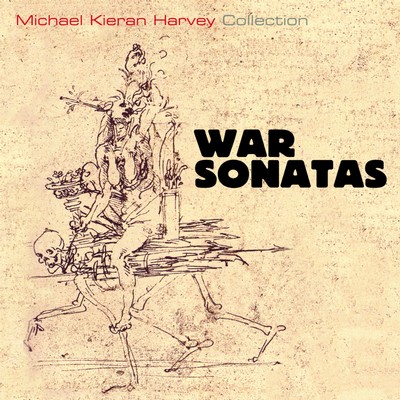
Move Records MD 3477

Behind these three piano sonatas, Michael Kieran Harvey centres on some major crises of our age which are essentially colossal failures of action and inaction. The works operate in ways that are unfamiliar to those of us reared on the conflict portraits of Shostakovich, Nono, Penderecki and Britten; all four masters have compositions to their names that memorialize acts or states of warfare, scores that present emotional and intellectual challenges. Still, as we’re concerned with music, the underpinning principles (or lack of them) involved remain tacit as far as further elaboration is concerned.

Harvey’s Sonata No. 8 bears the title P. Singer, referring to the Australian philosopher to whom the composer is highly indebted for his findings on ethical behaviour and our treatment of the animal world. Much of the teaching of Singer would be familiar to anyone aware of his work with the Greens and his public statements while vying for parliamentary office. Can you present bio-ethical argument in musical form? Probably not but Harvey presents us with a powerful, lopsided sonata with a massive first movement and two much briefer addenda.

Actually, this emphasis on initial dissertations at some length obtains in the following two sonatas. the second entitled Sonata da Caemmerer refers to Harvey’s long-time colleague and friend Arjun von Caemmerer, while also having a bit of word play with the sonata da camera form, even if the most willing of us find it hard to figure out workable comparisons. Its opening Zappaesque lasts as long as the following Rubato and Giusto tempo combined. For Sonata No. 10, you can see the title reference on the CD cover above: Riding with Death. Leonardo’s illustration shows Envy riding on a casket, and I’m assuming that this concerns a different type of dissertation from the previous two personally dedicated sonatas as Harvey is concerned here with AI and its pernicious character in generating weapons used in conflicts across our world today. Here, the first movement lasts a little over fifteen minutes, its lone successor a little less than seven.

Apart from this tenth sonata’s monitory message against giving in to the machines, what have the other works to do that they fall under the War umbrella? The answer is to do with their environment rather than any imitation of the stuttering rifles’ rapid rattle. Harvey sees these three works as a triptych and it is unavoidable that you seek common elements in all of them, even if many of these are simply part-and-parcel of the composer’s compositional arsenal. They were all completed in a stretch of 19-20 months across 2022 and 2023, a time which saw a massive escalation in the war initiated by Russia’s invasion of Ukraine and at its end saw the opening of the Israel-Gaza conflict which has itself become an Old Testament-inspired annihilation. Despite Singer’s anti-Vietnam War stance, you have to stretch mentally to find resonances between that time so full of righteous protest and today’s oscillation of sympathies, compounded by the overtly destructive policies of Putin and Trump and the diplomatic flip-flops from leaders you ought to be able to trust.

In the second of these works, saluting von Caemmerer, the relationship with war comes from the empathy both Harvey and his colleague find in facing the soul-destroying realities of today’s partisanships and the disillusionment that every day produces as the sides in both conflicts become even more imbalanced and any trust in diplomacy proves hollow. Of the three parts to this triptych, this work presents as the least troubled, although that could be just a superficial judgement about its feisty rhythmic jaunts.

Certainly, the most enigmatic is the Riding with Death two-movement construct in which Harvey presents eight Hallucinations for a first movement – reductions to nightmarish scenarios where we waver against artificial intelligence while it weaves its multiple webs of influence and confusion. This is another large-scale essay, or series of paragraphs in which the activity level oscillates between slow angularity and fierce vitality. In the sonata’s second phase, less than half the length of the first, the lessening of humanity is entrenched, leading to a set of final pages where the aural onslaught is overwhelming as we surrender all power to mechanisms that pound us into nothingness – or worse, irrelevance.

The Singer sonata opens with an assertive Allegro giusto that emphasizes athletic leaps, and a motif consisting of a repeated note that accretes companions in an upward or downward-heading flourish, given in both hands. And abruptly, we are in the middle of a Harvey 4/4 mesh of semiquavers, syncopated accents, brief motifs, and an ardently driven energy. Relief comes in a rubato interlude that sees sustained chords wrapped in decorative foliage, the whole leading to a Lisztian climax of epic virtuosity before we return to the giusto and that obsessive wide-ranging percussiveness of the opening.

Another interlude, an A piacere, interrupts a plethora of sextuplets operating at cross-purposes before the composer presents a new chain of atmospheres by way of holding down unstruck chords with one hand and bringing their strings into voice by hammering out abrupt explosions in the other. Eventually we come to a dramatic triple forte climax and a statement of the dedicatee’s surname in complex soft chords; don’t ask me what notes represent S, I, N and R. For good measure, Harvey also gives us Singer’s name backwards in chords that largely have the same components as the originals.

A reversion to the giusto vehement drive, another dramatic a piacere and a series of fortissimo and pianissimo juxtapositions, and the movement ends on a final statement of the single-note-plus-accretions motif leading to a final bass chord of two discordant fourths. What’s next to do but propose a brief Onirico interlude, an unsettled dream that features gruff bass gruppetti and ornate right-hand arabesques while the substance lies in a chain of hefty ten-note sustained chords, the whole dissolving into a five-bar Liberamente excursion prior to folding into the final Ritmico pages.

This finale comprises six permutations and I can see some transferences between two of them but it’s probably best viewed as a set of discrete scenes that offer wide variations in rhythm and harmonic density. Which is not saying much when you look back over the rest of the sonata even if, as in this final movement, the oasis passages blend into the architecture so that the score sounds like a tapestry with consistent threads, brought together at the end by a vital restatement of the fixed-note-with-additions leitmotif.

Harvey begins his Caemmerer score with two identical bars of four double-dotted crotchets in 7/4 time, not wasting his time about submerging this simple material in syncopated cross-measures throughout a movement indebted to one of the composer’s inspirations: Frank Zappa. Disjunction is the game in play here as hefty accents bounce across the frenetic action that finds the executant oscillating between bars with irregular numbers of semiquavers so that you can’t settle into a regular toe-tapping pulse. But then you never can with Harvey who delights in establishing a rhythm that you think is formulaic but which turns out to be deceptive, the accent not where you thought it would be.

Without pause, the score moves into its second phase, Rubato, which proffers a limited meditation on the work’s opening four notes – or perhaps not. This is another set of pages that moves into lavish sound-washes that become more ornate after the movement’s staid, Satie-like opening. The splashes of sound are woven around sustained chords of remarkable complexity that build on the placid sequence initially articulated, before a small transition of about 20 bars Meno mosso breaks open the concluding Giusto tempo set in one of the composer’s most taxing rhythms: 11/16.

You hurtle here from climax through highpoint to explosion, one after another in a powerful exhibition of virtuosity which somehow emphasizes Harvey’s boundless energetic high spirits. You can recognize striding octave bass patterns that transfer to the right hand, punchy block-chords that call and respond across the instrument, hugger-mugger at-the-octave parallel passages like the most taxing five-finger exercises. The composer is here at his most ebullient, giving us some kind of representation of his friendship with von Caemmerer in a sparkling toccata that finally dwindles after a chain of dyads enjoy a diminuendo – as though the dialogue is paused, not ended.

While the first two sonatas in this sequence have been humanized by their dedicatees, the last moves into the realm of a cerebral conflict between AI and its creators. Across the first movement, Harvey offers eight scenarios, states where humans think they are in control. These vary markedly in activity level; a deftly outlined linear argument is followed by an initially calm state that is subjected to pinpricks of doubt or harassment. One of these hallucinations speaks with an updated Webernian angularity while another offers an initial calm underpinned by nervous semiquaver chains that eventually coerce the upper chords into a mirroring rapid angst.

Finally, we arrive at Hammered, relentless which offers a barrage of semiquaver chords in alternating hands with gruff chords as pivots. Harvey is wise enough, even in his anger, to vary the diet with abrupt changes of register and dynamic, not to mention those improbable time signatures that sweep your security blanket away. After some relieving pages in the more fluid ambience of triplets, the opening growling bass recurs and drives the forward motion into a maelstrom of strident chords that grow from seven, through nine to a concluding welter of insistent twelve note chords hammered martellato to an abrupt ending where the human is subsumed in the automaton.

In the end, Harvey’s latest sonatas don’t take war as their subject even if you hear emphatic bursts of energy that speak of turmoil and the suffering that large-scale conflicts bring about. More, the scores have been generated in tempore belli, a grim state that we have been inhabiting for some years, even insulated as we are in this place from the worst of its evils. The composer has been fortunate enough to find a framework for his considerations of these times in the species-broad altruism of Singer, and to hone his aesthetic in van Cammaerer’s friendship and collaboration. In the end, he faces us with the potential for inhumanity in AI and its assumption of authority. But, thanks to the brave agitation and fearlessness of his music, we can follow the best stoic directive and say not the struggle naught availeth.