ELEVATOR MUSIC
Omega Ensemble
Elisabeth Murdoch Hall, Melbourne Recital Centre
Saturday August 15, 2025
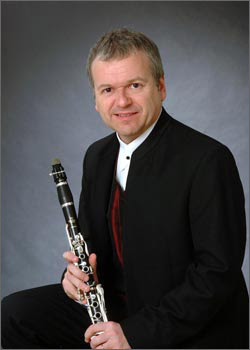
Michael Collins
A Sydney-based group, the Omega Ensemble presents as a moveable feast of artists. For this segment of its national tour, the group comprised string players, alongside some crypto-strings/percussion in piano (Vatche Jambazian) and harp (Paul Nicolaou), with artistic director David Rowden contributing his clarinet to one work. As the Omegas’ guest, Michael Collins brought his clarinet to the stage for the brief evening’s two major works, demonstrating his expertise and interpretative flair with deceptive ease and making something substantial out of an odd scrappy program.
To begin, the Omega strings gave themselves a throat-clearer with the first movement to Mozart’s Eine Kleine Nachtmusik of 1787. Well, it also gave us a chance to get used to the body’s weighting of 4-4-3-2-2 which, from my seat, gave the bass line of this quartet an unexpected prominence. Not that you could complain about such a teaser which made for a congenial tuning-in exercise. As usual, the group overdid the dynamic contrasts well beyond anything the composer would have entertained, but they’re not alone in that. They repeated the exposition, which never fails to be a pleasing 55 bars to re-experience.
American writer Anna Clyne‘s Stride for string orchestra followed. Its three movements employ the melodic and sometimes the harmonic path of Beethoven’s Pathetique Piano Sonata No. 8, albeit with plenty of filler. Apparently, the composer found a similarity between the bass octaves at the first movement’s switch to Allegro di moto e con brio and the stride technique utilised by ragtime pianists; can’t really see it myself, but the shoe obviously fits for Clyne. Mind you, that all becomes irrelevant when she moves on to the second and third movements, the last being most direct of the three in utilizing Beethoven.
This is not the sort of music to stop you in your tracks through its level of inventiveness or novelty of timbres; it’s just akin to hearing the sonata referenced in a mushy web, a kind of filtered Beethoven at an unsettling remove from the original because of the transcription to strings. But it misfired for me because even Clyne’s changes of harmony accompanying the original melodies were ordinary. I suspect that the work’s success in performance relies on the style of attack adopted, which might have been more interesting in the hands of its original commissioners – the Australian Chamber Orchestra, which premiered it in 2020. Added to this, the bass component across the final rondo again overwhelmed whatever was happening upstairs.
We then came to the new double concerto by Australian composer Graeme Koehne called Dances on the Edge of Time, which title emanates from a Tagore poem and which to me promised something along the lines of Messiaenesque mysticism or perhaps a touch of Bengali complexity. But no: Koehne has produced a simple set of three dances – rigaudon, chaconne, gigue – which contain no terrors for players or audience, written in a happy diatonic style that is instantly accessible and free from any pretensions to depth or gravity.
Adding to this piece’s popular backdrop, Koehne heads each movement with a quote from the collected wisdom of either Randall G. Leighton (the American business analyst?), Mark Twain or Satchell Paige (a renowned baseball player). For the opening rigaudon, the instruction or life-message was ‘Work like you don’t need the money’, exemplified by a retrograde-sounding piece in four-square rhythm that called to mind Grainger and Holst in what sounded to be G Major, the two front-of-band clarinets indulging in some jaunty interplay and mimesis.
‘Love like you’ve never been hurt’ was the preliminary advice for Koehne’s chaconne in which I became aware of the harp’s timbre for the first time. For these pages, I thought that the prevailing tonality was D Major; or may be not as I’m finding it increasingly hard to claim having absolute pitch any more and trying to pick out tonality from finger positions is a mug’s game at best. Whatever the case, we enjoyed a few eliding slides into other keys while the cantus firmus moved from treble to bass across the movement’s stretch with a clean fluidity, even if the players didn’t seem to find much excitement needed to be summoned up while conveying these placid A-River-Runs-Through-It pages. Again, I sensed no strain in the output of Collins or Rowden while presenting this lush and predictable slow movement.
With the gigue, we were in unsteady territory at first with a clarinet duet that eventually settled into the expected 6/8 pulse. Here again the music occupied an ‘open’ key – C Major? – that moved into harmonically unchallenging episodes before the catchy main tune slowed down for a more drawn-out statement of its elements: a gentle and soulful interlude with the strings given the main burden while the clarinets sublimated themselves in attention-grabbing burbles. Back to the fast jig tempo and we reached a happily contentment-inducing cadence, all illustrating that timeless adage, ‘Dance like nobody’s watching.’
The composer is not concerned in this work with confronting anything that’s driven the art forward or into detours and culs de sac over the last century. His vocabulary throughout the new double concerto rarely moves beyond that employed by the English pastoralists. Further, he keeps his soloists well in hand with very little room for virtuosic flourishes, content to give them aural prominence among their support colleagues. To my mind, the work is congenial enough but not in the least bit ground-breaking. The program notes for this concert speak of Koehne pursuing a ‘neoclassical kind of aesthetic’ – but there’s no need for the neo qualifier.
As far as I could tell, the rather sparse audience (250? 300?) reacted favourably to this exercise, and I suppose that its reception can be viewed as a success, even if a few of us were nonplussed by the work’s innate conservatism, given the Omegas’ motto: Embrace the unexpected. Celebrate the extraordinary. Not with this work, commissioned by the ensemble itself.
To end, Collins took the lead for Copland’s Clarinet Concerto of 1947-9. As far as I can see, he has produced only one recording of this famous work – a Swedish Chamber Orchestra collaboration released in 2013 – as opposed to the three versions he has produced of Finzi’s less well-travelled concerto. You could find much to relish in the opening slow movement, in particular Collins’ ability to give us a crescendo–decrescendo set of sequences that remained sensible, not straining the barriers of taste and sense. This atmospheric consequent of Appalachian Spring‘s placid stretches maintains its eloquence, even if it does suggest a Meditation on the Prairie ambience.
At last, we came to some hectic playing in Copland’s cadenza where the composer anticipates the coming action. In spite of the sudden heating-up, Collins gave us a sensible and ordered account of this 70-plus bar extravaganza that tests any interpreter’s agility and self-control. Not a squawk or a misdirect to be heard here as the soloist joined up with his Omega colleagues for the jazz- and Latin-inflected finale. Here you felt the lack of violins once again, even from further back in the Murdoch Hall, because of a lack of aggression as the syncopations piled up and some rhythmic anxiety appeared in the rear echelons.
As the freneticism continued, it struck me that Jambazian might have been well advised to have his piano-lid down or off; this instrument’s colour proved very prominent in the movement’s centre. Still, Collins dominated the terrain, not least when Copland exercised his heavy jazz tongue, as at bar 297 with the bass semi-pizzicato slaps while the clarinet saunters across the room. I wasn’t happy about the penultimate bar’s glissando up to the final unison C for everybody but you’d expect that the players will have coordinated that to better effect for tonight’s Sydney and Thursday’s Newcastle performances of this program.
Looking over the Omega appearances past and future for this year, it’s very clear that the body is a solid supporter of new music; its list of previous commissions is the most impressive and all-inclusive I’ve seen in this country from any serious chamber music enterprise. Most of us interested in new developments might have our expectations better fulfilled in the body’s final Melbourne appearance this year which features Bartok’s 1938 Contrasts (like the Copland concerto, another commission by Benny Goodman and still more challenging than anything we heard on this Elevator Music program), Nigel Westlake’s Rare Sugar clarinet concertino of 2007, and a new work from Sydney-based writer Ell;a Macens.
 O'Connell the Music