CELEBRATING 500 YEARS OF PALESTRINA
Ensemble Gombert
Our Lady of Victories Basilica, Camberwell
Saturday October 25, 2025
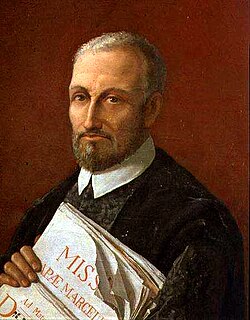
Giovanni Pierluigi da Palestrina
Non sum qualis eram bonae, as the poet said. None of us is, I suppose, but it was a bit of a surprise to find that the Ensemble Gombert is not how I remembered it from about six or seven years ago when I last heard the group live. Yes, there were moments in this Palestrina celebration that brought back recollections of he group’s finest outings, usually in the warmer surrounds (certainly better lit) of the Xavier College Chapel rather than the pre-Vatican II semi-gloom of this Camberwell monument to times long past.
Even without the benefit of a program, it was obvious that the group had changed in personnel. The long-lasting top soprano duo of Deborah Summerbell and Carol Veldhoven has disappeared, and was I mistaken in thinking that only Fiona Seers from those golden years was still singing with this company’s sopranos on Saturday afternoon? I recognized none of the altos but that could be a momentary sight defect due to the prevailing penumbra. Sadly, that group suffered an irreparable loss in the premature death of Belinda Wong during 2021. Among the tenors, I couldn’t see Peter Campbell or Tim van Nooten; only Vaughan McAlley remains of the old guard and he left his position in the ranks to conduct this performance (most of it), as the Gomberts’ founder and artistic guru John O’Donnell was indisposed. I couldn’t see Andrew Fysh in the basses, but then the male lines were reduced to six singers: an economy that was clearly felt in several parts of the program.
To commemorate this great church composer, the Ensemble sang four of his motets and one of the larger-scale masses, Benedicta es, which has two alto and two bass lines, as well as your soprano and tenor blocks. But the afternoon began with the Tu es Petrus motet which also calls for six lines: two sopranos, alto, two tenors and a bass in my edition, although others specify one tenor and two bass parts. I’m not sure how the ‘male’ lines were accomplished with so few singers to go round, or whether some altos took on the second tenor/first bass, although it should have been obvious from bar 8 when the low voices respond to the opening strophe from the sopranos and altos.
It made a brave opening, the reading as full-bodied and steady as any Papacy-endorsing post-Reformation enthusiast could want, the added bonus that we heard the motet’s second part Quodcunque ligaveris, which is so often left out on recordings, even by choirs that have big reputations. Still, this is familiar ground for the Gomberts who made a good deal out of this sample of Catholic affirmative action from 1572.
Next came Ad te levavi. part of a collection published in 1593 and calling for two tenor lines. At this stage, it seemed a good idea to try and work out how many voices had been allocated to the various vocal strata; I believe that the Ensemble for this performance comprised sic sopranos, six altos, three tenors and three basses. With tenor McAlley conducting, this meant either a weakening of volume in one of the tenor lines, or the group possessed a versatile bass-baritone. Or the group simply coped as best as possible.
Things were back to manageable for Senex puerum: five voices, two of them sopranos. I believe that we heard the secunda pars, the verse starting Hodie beata virgo; again, something that is lacking from the few recordings I’ve traced of this particular motet. Then, on to the familiar with Assumpta est Maria where McAlley moved back to the tenors for this motet which asks for two sets of them, as well as two soprano lines. Again, I believe the group sang the second verse, beginning Quae est ista although any vehemence at the phrase terribilis ut castrorum escaped me. The new conductor, whose first name was Luke (maybe not: McAlley has a lot to learn about projection while speaking to an audience, one of the tricks being not turning your head sideways at critical points in addresses), continued with the stolid pace set by the main podium protagonist, so that the metre sounded over-emphatic as Palestrina’s lines were regimented, far from fluent.
And so to the substantial mass. This followed the afternoon’s performance pattern of rather strong downbeats at the expense of fluid inter-meshing and a thin tenor output – I don’t know why as both basses sounded muddy in the opening Kyrie and the upper male line enjoyed unexpected exposure. But the following Gloria produced some fine ‘Gombert’ passages, mainly from the three female lines at points like Domine Deus Rex and an unexpectedly buoyant Quoniam.
Even so, it struck me once more how little attention is given to plosive consonantal sounds by this group which can produce some enthralling polyphonic meshes but which relies on its listeners to be familiar with texts or, more usually, follow them in the organization’s programs, which were also graced with an account of the music to be performed from O’Donnell. Still, I suppose most of the Gomberts’ adherents would be familiar with the words to the Ordinary of the Mass, especially those of us worshippers who suffered it in silence for many years.
Like the Gloria, this Credo interpretation was devoid of drama, with not much to differentiate the Et incarnatus, Crucifixus, and Et in Spiritum divisions, apart from a small lessening of contrapuntal interlay in the second of these where Palestrina’s texture drops its bass lines. For all that, the afternoon’s most impressive work came with the long notes of the composer’s Et vitam, followed by the elevating five-note rising scale aspiration and response from all five parts across a jubilant Amen.
In the Sanctus/Bendictus double, I enjoyed the Pleni sunt interlude for the score’s three middle voices; this proved to be clear (as you’d expect) but also emotionally positive, albeit in a restrained mode. Fortunately, the Hosanna and its repeat came over with excellent mobility to the point where you could ignore the customary chugging action of the ensemble’s style of attack.
Not much remains in this memory of the hard-worked first Agnus Dei. The second did not proceed as usual to the dona nobis pacem strophes but was sung in plainchant by the men before reverting back to Palestrina for the third run with his optimistic final 20 ‘bars’ that steady the triple metre to the prevailing quadruple in a final passage of high consolation.
Only at the end did you appreciate what a sustained bout of singing had been presented by the Gombert voices whose pitch had barely wavered throughout this mass. Certainly, the Ensemble gave us a worthwhile homage to Palestrina in this (possibly) 500th anniversary of his birth, even if I missed the piercing certainty of its former soprano and bass singers. On this occasion, we heard some splendid moments of choral splendour, if not as many as the choir used to produce in its pre-COVID outings.
 O'Connell the Music