The lady’s not for twelve-toning

HOMEGROWN

Rebecca Cassidy and Alex Raineri

Move Records MCD 664

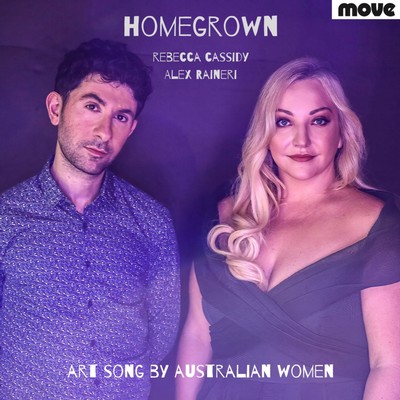
That’s just what they are: art songs by nine Australian composers, one of whom gets a double dip (Lisa Cheney) and another also represented by a piano solo, performed with enthusiastic rhapsody by Alex Raineri. His associate, soprano Rebecca Cassidy, moves through a pretty wide spectrum, even if the greater number of these writers share a brand of lyrical vocabulary that doesn’t move much beyond Debussy at its most sophisticated and Vaughan Williams at its simplest. Alright, let’s say Cyril Scott or John Ireland or possibly Duparc – well-trodden paths, whatever the derivation.

The earliest piece on this Move Records CD is a John Fletcher setting by Peggy Glanville-Hicks that dates from 1931. Next is Miriam Hyde’s 1933 Dream Land to a Christina Rossetti poem, with her piano solo – Brownhill Creek in Spring, dating from 1942. Then comes Dulcie Holland whose Hope in Spring from 1953 is here receiving its first recorded performance. For some reason, there’s a near-forty year break before we come to Betty Beath who, in 1991, wrote her River songs cycle, from which we hear River – Mother, River – Child. A year later, Mary Mageau produced Son of Mine to a poem by Oodgeroo Noonuccal, which is also enjoying its first recording here. Finishing the 20th century is Linda Kouvaras with Distant lullaby from her 1999 cycle Art and Life.

The first Cheney song comes from 2006, a simple Lullaby in its first recording, as are the rest of this CD’s contents. Melody Eotvos features here with one of her Wakeford Songs of 2014; By Train. Penultimately, Deborah Cheetham Fraillon appears with a 2022 commission written for Raineri’s Brisbane Festival: Crepe Myrtle Sky. The finish comes through Cheney’s second contribution, the most substantial on the disc: Gratitude and Grief, written last year and a substantial contribution to the form, even if the vocabulary applied is conservative.

Does that matter? Should we regard the similarities between Glanville-Hicks’ quick lyric and Cheney’s maternal eulogy as evidence of an inner consistency of language and employment of the form? Not as close as nearly100 years apart, I would think. You might find explanations for Glanville-Hicks, Hyde and Holland but the other six writers are working well after a massive explosion of technical and emotional language became available to Australian writers for several decades before, for example, Beath’s product of 1991. Such a discarding of advances in language speak to an undercurrent in the CD’s title where the writers use a compositional vocabulary that was tried and true, well established before most of them were born and which they are obviously happy to re-employ in these latter days of a current reductio ad absurdum in serious composition (see Eurovision or the ABC’s rage for relentless instances).

Cassidy and Raineri give a genteel reading of Glanville-Hicks’ setting of Fletcher’s two-stanza lyric which taxes nobody because of its clarity – one might say, its simplicity. The composer begins in G Major and stays in that key throughout with not a single extra accidental employed. The little prelude provides the initial material for the singer and the postlude reflects the piece’s beginning. Glanville-Hicks wrote it before leaving for England and it shows an 18-year-old making the most of what she has come across by way of instruction in 1930s Australia.

Showing a more adventurous attitude to tonality, Miriam Hyde’s treatment of Rossetti’s four stanzas shows an awareness of chromatic passing notes on its lush Brahmsian A Major path and the composer treats the vocal line as a continuous sheet rather than four repetitions while Raineri arpeggiates and moons soulfully with semitonal droops across the canvas. But I can’t help thinking of Amy Woodforde-Finden’s Pale Hands I Loved of 30 years earlier because of a similar hot-house emotional restraint and a similar vocal curvature, although Hyde’s choice of text makes for a refreshing dash of introspective brilliance.

As for Hyde’s piano piece, this also luxuriates in its A Major neo-Impressionism with some Debussy Arabesque-style arpeggios to begin over a left-hand melody that employs a flattened leading note, leading to a development/elongation of the set material, before a less active section – less full of Jardins sous la pluie or Jeux d’eau – moving more slowly, before a return to water imagery and a quiet coda. The images here are European; probably understandable because the photos I’ve come across of Brownhill Creek are of a lush landscape, even more so than the Esmond George watercolour that inspired it. Raineri has had this music in his repertoire for a few years now and holds its quivering sensibility in the palms of both hands.

With Holland’s love song (to her own text), we have a further reach back into the past, to an almost Victorian mode of communication. Also couched in A Major, its three verses operating in an A-B-A ternary mode, this is a fluent example of limited rhapsody, its emotional language operating inside strict bounds, the excitement limited to a concluding sustained vocal A, the whole typical of this popular writer’s craft in action. Cassidy and Raineri make an elegantly-paired combination in facing its few challenges.

Now we make the forty-year leap to the 1990s and Beath’s setting of a Jena Woodhouse poem which also could be using A Major as its base but is written in neutral tonalities with a kind of prevailing ambiguity, possibly arising from the composer’s time in Bali and Java. Still, there are passages where Europe still holds sway, e.g. bars 15 to 18, and bars 24 to 26; in fact, anywhere that the texture changes from the open-sounding 6/8 quavers set up at the opening. But it manages to avoid the predictable character of this CD’s earlier samples through its angularity and rhythmically varied vocal and piano lines.

Setting this country’s best-known Aboriginal poet is a daunting task, even for an American expatriate. Mageau achieves a good deal in her Noonuccal setting, keeping up a steady A octave bass drone-support for most of the three stanzas, with some grinding dissonances in the pivotal chords underpinning the central quatrain. Despite the poet’s attempts to lift the spirits of reconcilers in her final lines, Mageau maintains the accompaniment’s grimness under the composer’s arioso-type vocal line. The whole exercise reminds me of Schubert’s Leiermann, probably because of that persistent bass and its added notes like Schubert’s use of the appoggiatura.

Both poet and composer change the tone for the work’s central lines which detail some of the crimes committed against Aboriginal people, causing Mageau to break into a confronting discordant piano part that heightens the outrage being communicated, the harmony having moved to C minor, if you take the soaring vocal line into consideration. It makes for grim hearing, but then, the poet was intent on holding her mirror up to white failures – which I think come across strongly in this musical realization.

Distant lullaby is the concluding song in Kouvaras’ six-part cycle and is emphatically tonal from start to finish; I believe it starts and ends in C Major with some moves into the flattened submediant – two of them – that would recall Schubert if the general texture and message of the piece weren’t plain. Art and Life traces a woman’s infatuation with an artist, the baby they have, a growing disaffection, her militancy in the face of abuse, her action (murder?) in facing down the violence against her, and this lullaby sung from her incarceration.

Kouvaras is an academic at Melbourne University but her composition practice comes from a different source than the sophisticated technical bravura prevalent in her workspace. You might find it effective in achieving its end, showing a pretty widespread emotion – love of a child – in a simple consolatory expression but, for me, it’s naïve. Yes, I know that’s the nature of a lullaby but this simplicity sounds inconsistent with our times – too much Richard Strauss, not enough Janacek.

Furthering the trend towards simpler times of yore, Lisa Cheney’s Lullaby stays in a 3/4 metre throughout, I think. Certainly, the key is B flat minor and there are few deviations from it. There’s a lilt and folk-song gentleness about this piece which eventually reduces Raineri’s function (in the third stanza?) to little more than a few supporting notes or chords. Probably the only surprise comes in the presence of a flattened supertonic at the end of a stanza or two; for the rest, the New Simplicity strikes again.

Suddenly, we come to a composition that sounds totally contemporary in Eotvos’ striking lyric which details World War One nurse Muriel Wakeford’s arrival in Cairo prior to heading for Gallipoli (which she survived). By Train is part of a five-song cycle on texts extracted from Wakeford’s diary but the other songs are difficult to come by. Anyway, this composer has a complex vocabulary and puts both her interpreters to the test, particularly Raineri with flurries of notes meant to represent the train itself. Still, the vocal line is in parts jagged, with difficult leaps and it’s rhythmically demanding as the piece operates in a free-flowing ambience. Nevertheless, despite the high chromaticism at work, I sensed an undercurrent of G minor beneath the abrupt forays and excursions from both musicians.

We hit show-tune territory with the Cheetham Fraillon creation. The song’s text – as with Holland, Hyde and one of the Cheneys – was written by the composer and can’t be found online. Neither can you find access to any part of the music, although that doesn’t matter so much because the proportions and content are easy to fathom, often to the point of being predictable. The song appears to begin in an ambiguous C Major (most of the Bs are natural) but ends in a definite F Major. It only strays from these possibilities twice, the second deviation more solid, but you are confronted by a pleasant vocal line that could have found a place in a Sondheim musical.

And so to Gratitude and Grief which is a mixture of scena and meditation with motherhood as its subject. This song is the only one to enjoy any sort of exegesis in the CD’s accompanying leaflet and it’s a backgrounding from the composer on her embrace of the existence of her two young daughters. The text comes from New Zealand poet Jessica Urlichs and, although it does nothing for me because of an innate sexism and misogyny typical in men of my age, the words find a gifted setter in Cheney and evoke a lucid response from these musicians.

The piece rises and falls like a long arc, climaxing in the words ‘I’m still learning to breathe under this waterfall of gratitude and grief’ which are sung with conviction by Cassidy while Raineri evokes an emotional cascade in a fierce wash of notes. On either side is a calm that eventually resolves into a limpid vision of the new-born as infinite but knowable, which is about as consoling a realization as any parent can come to and which mercifully doesn’t tip over into self-congratulation.

Here also, there are traces of the show-tune sentiment in the melodic phrases and that peculiarly American mode of confessional declamation that has its origins in Rodgers and Hammerstein heroines. But Cheney isn’t alone in this penchant for the soulful and accessible, offering the most sustained instance in this CD of a contentment with trusted tropes.

I assure you that the order in which I’ve commented on the4se songs is not that of the CD’s tracks, which jumps all over the shop temporally. For some of us, the album is light-on, coming in under 45 minutes; balance that with exposure to two fine talents who invest their talents and sympathy into each composer that they benefit here with their art.

The flute as we now know it

SHIFTING LANDSCAPES

Kathryn Moorhead

Move Records MCD 672

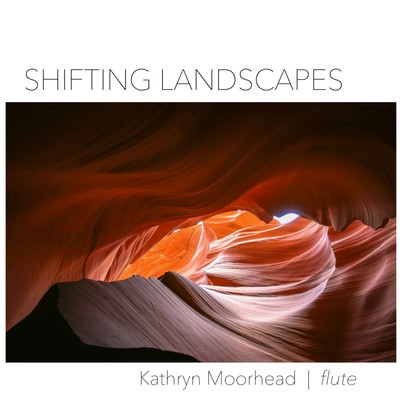
Adelaide-based flautist Kathryn Moorhead plays nine pieces of contemporary music in this, her latest CD for Move Records. She ranges between recently-deceased American Alison Knowles’ Proposition #2: How to Make a Salad from 1962, and two works from 2016: another American and a flautist herself, Nicole Chamberlain‘s Lilliputian for piccolo and music box, and the Pimento study for solo piccolo by British writer Edmund Joliffe, best known for his TV scores.

In between come species of flute-writing covering a wide spectrum: difficult Brit Brian Ferneyhough‘s Cassandra’s Dream Song of 1971, L’ombra dell’angelo by University of Mantua academic Paolo Perezzani from 1985, our own (sort of) Andrew Ford‘s 1993 Female Nude for amplified alto flute, East-and-West fuser American Elizabeth Brown‘s Acadia for flute and shakuhachi (Anne Norman) written in 1999, Laveringar of 2001 by senior Swedish writer Daniel Bortz, and Brisbane-born Damian Barbeler‘s 2006 Confession 2 for piccolo and electronics.

Despite this half-century time-span and variety of instrumentation, Moorhead’s CD is undersized, coming in at 54 minutes. Longest in the list is the Perezzani, almost 12 minutes; the shortest is Pimento which settles itself at a trifle over 80 seconds. The flautist takes on the very challenging Italian work first. This sets up a very physical angel’s shadow ambience with a lengthy sequence of trills from all over the instrument’s compass, giving a brilliant aural image of restless flight partly through the abrupt ‘fill-in’ flights between trills

The attack modes also involve the listener in what sounds like a violent series of curvets, often initiated by a burst of air as the player moves into the territory of over-blowing, although it’s mainly resulting in semi-harmonics rather than Bartolozzi-style multiphonics. What comes over impresses for its ferocity which is contrasted with almost inaudible soft phrases, so that you get some sense of the ethereal as lightning-fast which, in the later stages of the piece, flattens out into long sustained notes with a strange vibrato in the upper register that is produced by using a key (God knows which one) to generate a throbbing, like a wing in fluent action.

Barbeler follows. His piece features a meandering motif from the piccolo which acts as the voice of the confessor while the electronic tapestry that underpins the live instrument’s tale serves as a sort of subterranean admission of deeper deeds. And that presents the listener with a dichotomy in the best botanical sense. The live instrument dilates its opening material – a scale pattern coming down a 4th, then up a 2nd – while the backdrop moves from sustained sound blocks, across to burbling action, then to a concluding combination of both – in line with the composer’s aim of having his confession operate on two levels: the overt and the secretive.

Mind you, I don’t believe that you can achieve anything of the kind in music without words. You might want to believe that the flute represents a sinner/offender and the electronics stand in for the surrounding ambience or morally debilitating environment, but the intellectual construction involved reaches well beyond the probable. Barbeler might tell us the impetus behind his work but he gives us no pins on which to hang his metaphysics, just as Strauss fails to convince us in his score that Nietzsche’s Zoroaster spoke any of the ideas that populate his invigorating tone poem.

In similar fashion, Andrew Ford’s Female Nude for amplified alto flute with vocalisations probably conveys a lot to the writer but any listener would be hard pressed to find anything suggesting the title in this rather monomaniacal obsession with the note A that the composer keeps returning to after a few flights of angular modernity. Moorhead is required to articulate individual consonants and vowels on that same A (or occasionally, its neighbour) in medias res, which makes for a deft display of legerdemain from the performer, generating these noises while playing a rhythmically complex instrumental part which every so often asks for a fusion of voice and flute with some heavily forced notes to leaven the mixture.

As for Elizabeth Brown’s Acadia, the performers present an unnerving mirror of each other in their performance which at various points blurs any distinction between the two sound sources. As we have come to know and love from exposure to Riley Lee’s craft, the Japanese flute can bend notes significantly; in fact this elision process makes Norman’s shakuhachi melodic contour highly distinctive. In this reading, Moorhead can do something like the same on her orthodox Western instrument. In fact, the two lines intermesh with unusual ease and deceptiveness.

The title refers to a national park on a Maine island and probably has some reminiscences for those who know the place. For the rest of us, I’d suggest, our minds inevitably turn to the Japanese archipelago, the less populated parts with suggestions of bird calls and remoteness. Brown’s language proposes a juxtaposition of the two instruments’ timbral possibilities but something more profound than this in that the flute and shakuhachi become more than complementary, but rather inextricably linked so that only the occasional high note from the flute or a breathy near-overblow from the shakuhachi allows for some momentary distinction to be made. A remarkable exhibition from players and composer.

Cassandra’s Dream Song, which remains one of the outstanding flute solos of (nearly) our time, enjoys a spirited reading from Moorhead. The score itself is fearsome, evidence of Ferneyhough’s nomination as an (the) outstanding member of the New Complexity school – which term has always struck me as odd because, although it might be complex, it’s not really new, is it? You can trace the modernization of the flute throughout 20th century decades and find pieces presenting just as many challenges as this one, not least the attention to detail that the composer sets out in his page of sound-manufacture description.

Leaving the order of line performance to the interpreter is not that much of a risk because you will wind up hearing an entity rather than a series of fragments. Further, as an American academic has pointed out, one of the standout performances of the work has not changed over time, the interpreter sticking to his original choices across the years. Not that this matters too much because the piece itself is a nightmare to play and experience; the prophetess is prefiguring the disasters that happen to her home city, its inhabitants, and her own fate when Agamemnon brings her back to Mycenae. Moorhead accounts for the breaths, splutters, note suffocations and piercing bursts of clarity with impressive authority, making a dramatic scenario that does justice to Aeschylus’ doomed concubine.

We move back to a child’s world for Nicole Chamberlain’s gesture towards the Part One of Swift’s novel. The music-box is set up beforehand by the performer punching out the requisite roll, then presumably playing along with it. As far as I can tell, the 6/8 piece in F minor doesn’t move outside that rhythm or key and the results would be quite suitable for a Play School sound track. But it sits uncomfortably in the shadow of the previous track on this CD with only a small downward bend on the last note to queer the surface orthodoxy.

Laveringar‘s subtitle is Tinted Drawings, and is the plural (in Swedish) of the painting term lavering, referring to a wash or thin coat. This is another substantial solo which initially oscillates between urgent upward rushes of demisemiquavers and clarion calls, then quiet moments of near-stasis with long semibreves to calm the action. Bortz also has an initial penchant for bending notes but soon leaves them alone until his final staves. In fact, he embarks on a narrative path that I find hard to follow.

This is in part due to the composer’s quite proper view of his laverings as differing from one painting to another; he isn’t confining his washes to one type or genre but is splashing his colours around with lavish abandon. Which means he can follow his own fancy, of course, as can every writer, but it means that the piece must be, by the act of lavering, inchoate. As the painter allows his/her wash to spread or constrict in alignment with whatever constitutes the standard of composition (if s/he has one), so Bortz’s musical lavering can lead anywhere. To her credit, Moorhead follows each sprouting of colour with enthusiasm, giving each furioso as much care as she does every corresponding piu lento.

The third piccolo piece on this CD, Joliffe’s brief bagatelle, gives a musical picture – as far as one can – of the sweet pepper named in its title. It is very active, a sort of rapid toccata, with variable time signatures and some quirky sound production changes about half-way through. But the piece is quite brief, just long enough to raise your estimation of Moorhead’s precision and agility.

To end, an instance of music in the everyday. Knowles instructs the performer/s to engage in the cutting, slicing, dicing, scraping and mixing that are the aural concomitants of making a salad. This performer makes the required sounds for about 2 1/2 minutes. As with most of these presentations, it’s more engaging to see than to hear, as I found way back when first coming across similar efforts from Cage and Stockhausen (in his later years) where the event had nothing to do with written music but concentrated on (usually minimal) instructions on making sounds and noises that became music, in the best Fluxus sense. Nothing too hard about that; the interaction between art and everyday has become a long-standing (well, several decades off a century) practice in many fields of art.

Yet I feel that this finale to Moorhead’s album will wind up being the least heard of the nine tracks she offers. A nice idea and an unexpectedly relevant celebration of Knowles’ passing less than three months ago, yet Proposition #2 doesn’t quite fill out the spaces after a preceding sequence of works that offer more meat on the bone. Nevertheless, this CD makes a welcome addition to the faltering number of recordings that deal with the flute as it is used in our time.

Diary February 2026

RACHMANINOFF’S RHAPSODY

Australian Chamber Orchestra

Elisabeth Murdoch Hall, Melbourne Recital Centre

Saturday February 7 ay 7:30 pm

No, it’s not the composer’s Russian Rhapsody of 1891 for two pianos but – as you’ve anticipated – the Rhapsody on a Theme of Paganini, written in 1934 and these days the most popular of his works for piano with orchestra. To foreground the Australian Chamber Orchestra‘s excursion into this spiky score, Dejan Lazic comes back to work with Richard Tognetti and his gifted players. In keeping with recent ACO practice, the orchestra will be reduced, in this case confined to strings and percussion. It’s improbable that any arrangement will make up for the missing 20 wind players; we’ll all just have to adjust our levels of disbelief. Stravinsky, who was remarkably non-catty about his fellow-exile, also appears on the program with his Concerto in D for strings of 1946 from just about when the composer had become a freshly-minted American citizen. Proceedings open with an ACO commission – Horizon – from the committed environmentalist American John Luther Adams. As a counterweight to all this Americana, home-grown and imported, we hear Lithuanian composer Raminta Serksnyte‘s early work for strings from 1998, De Profundis. It’s a searing, aggressive (for the most part) score of great passion and rigour; just the sort of music that attracts this group which is here playing its Australian premiere. Ticket prices range between $30 for a student to $175 for an adult top seat; you have to add on the excessive ‘handling fee’ of between $7 and $8.50, depending on what your delivery mode is.

This program will be repeated on Sunday February 8 in Hamer Hall, Arts Centre Melbourne at 2:30 pm and again on Monday February 8 in the Elisabeth Murdoch Hall, Melbourne Recital Centre at 7:30 pm.

SYMPHONIC CELEBRATION

Melbourne Symphony Orchestra

Sidney Myer Music Bowl

Tuesday February 10 at 7:30 pm

Some traditions hold fast and the Melbourne Symphony Orchestra‘s free concerts at the Myer Bowl still flourish, I see, even if the format has altered since I last sweltered into the venue along with half of Melbourne. Tonight’s conductor will be Leonard Weiss, the organization’s Cybec assistant conductor (although he doesn’t appear as such on the MSO website); he has an impressive list of accomplishments and engagements here, in New Zealand, and across Europe. His main task tonight will be infusing novelty into Beethoven’s Symphony No. 5 – still in C minor, as one curmudgeonly British critic once wrote. Eventually completed in 1808, it remains one of the composer’s most striking and accessible compositions and concludes with the mother of all C Major codas. The program’s soloist is the MSO’s principal trumpet, Owen Morris, who premiered Sydney composer Holly Harrison‘s Hellbent back in April 2021: ten minutes of jazz-style inflections for the soloist and written by someone who can actually play the instrument. Pleasing us all with its familiarity comes Grieg’s publication of 1888, the Peer Gynt Suite No. 1: Morning Mood, The Death of Ase, Anitra’s Dance, and In the Hall of the Mountain King. This appeared in one of the MSO’s first programs (way back with Zelman’s Albert Street Conservatorium Orchestra?) and satisfies for its emotional canvas and satisfyingly balanced phrase lengths. To begin, the voice of a Cybec (how that organization gets around) Young Composer in Residence is heard in a specially commissioned Fanfare. This is Andrew Aranowicz who has proficiency in this field, having contributed to the fifty fanfares written on commission for the Sydney Symphony in 2022, his brass decet Pride a jaunty, well-crafted sample of the form. We can only anticipate similar.

AUSTRALIAN YOUTH ORCHESTRA

Melbourne Symphony Orchestra

Sidney Myer Music Bowl

Wednesday February 11 at 7:30 pm

Rather than putting themselves out, the Melbourne Symphony Orchestra is giving up one of its Bowl nights to the Australian Youth Orchestra. I haven’t heard this group for many years, long enough for the personnel – both players and administrators – to have changed completely. Anyway, tonight they begin with American writer Anna Clyne‘s This Midnight Hour of 2015: a 12-minute complex that the Australian National Academy of Music performers aired last March at the Melbourne Recital Centre. Next comes Daniel Nelson‘s Steampunk Blizzard, a 2016 fanfare by the American-born Swedish resident whose composition lasts a little over 7 minutes and sets some nifty rhythmic puzzles for young players, mainly to do with dotted quavers. It’s racy and highly atmospheric, especially if you’re into the industry-heavy side of steampunkery, while its progress shows influences of Bernstein and, at one luminous passage, Janacek’s Sinfonietta finale. Then comes Stravinsky’s Firebird Suite from 1945, rearranged so the always-thrifty composer wouldn’t miss out on his American copyright cash. There are three pantomime interludes between the first four dances but, even with this expansion, the score lasts barely half an hour. So, from what I can see, this all adds up to less than an hour’s music, a quick concert – unless there’s going to be a lot of talk. The evening’s conductor is Christian Reif from Germany, currently chief conductor of Sweden’s Gavle Orchestra, his predecessor in that post being Jaime Martin . . . which just goes to show that what goes around, goes around. As usual, this is a free event.

BAROQUE MASTERS

Australian Brandenburg Orchestra

Elisabeth Murdoch Hall, Melbourne Recital Centre

Thursday February 12 at 7 pm

Opening its Melbourne operations for this year, the Australian Brandenburg Orchestra gets back to basics with a fully Baroque program: Handel, Bach, Vivaldi and Pachelbel. As well, the concert’s soloists come from the Brandenburg ranks – all local talent. Nevertheless, much of the content relies on the ensemble’s strings with artistic director Paul Dyer regulating everybody’s input from his centrally-positioned harpsichord. To begin, a Handel concerto grosso from the seminal Op. 6 published in 1739: the first one, in G. Then come the middle two of Bach’s Brandenburg Concertos – No. 3 in G for strings and No. 4 also in G which asks for a front group of solo violin and two recorders. As we all know, these were presented to the idiot Margrave in 1721 and five of them disappeared from public notice. I don’t know what’s happening in this version of No. 4: Melissa Farrow is down to play baroque flute, but Adam Masters is listed as performing baroque oboe. Concertmaster Shaun Lee-Chen will probably take on the solo string line which has just as much work to do, if not more, than the two wind players. Then we’ll have a break from G Major and hear the one Pachelbel piece that everyone knows: his Canon in D for strings which you can encounter at many a wedding or funeral in this country. To end, Vivaldi’s 1705 Trio Sonata Op. 1 No. 12 which is a set of 20 variations in D minor on that useful progression, La Folia. It also involves two violins and a continuo part but I sense that its original modesty in personnel demands might take a turn for overkill. The ticketing is an administrative saga. Full adult prices move from $45 to $167; concession card holders inexplicably fall between $54 and $105. If you’re a senior, your range is $77 to $151; a full-time student sits anywhere for $20; an Under 40 only gets into A Reserve at $36. I won’t carry on about the individual price for groups of 10+ but will excite you with the news that prices vary between this and later performances. A constant is the $4-$8.50 fee exercised by the Recital Centre if you book online or by phone; the grifters we have always with us.

This program will be repeated on Saturday February 14 at 5 pm and on Sunday February 15 at 5 pm.

50 YEARS OF ABC CLASSIC

Melbourne Symphony Orchestra

Sidney Myer Music Bowl

Saturday February 14 at 7:30 pm

In a burst of patriotic fervour, this program from the Melbourne Symphony Orchestra celebrating a pivotal national radio station (and the rest) comprises Australian music only; as far as I can tell, all the soloists are well-known locals. Let’s see what sort of crowd this program attracts, although it strikes me that you could play a night of Berwald alongside Hovhaness and the place would be packed. No, it’s not just because it’s free, but that helps. Benjamin Northey conducts works by ten writers covering a wide range. He opens with Nigel Westlake‘s Cudmirrah Fanfare of 1987: a two-minute jubilation. Then we hear selections from Westlake’s Antarctica Suite, extracted in 1991 from music written for a documentary and tonight featuring guitarist Slava Grigoryan; obviously, we won’t get all four movements. An up-to-the-moment effort comes from Ella Macens with the world premiere of her My Heart on Yours about which nothing is known – yet. A nod to the recent elders with Sculthorpe’s nostalgic Small Town for chamber orchestra of 1963, inspired by D.H Lawrence’s antipodean saga, Kangaroo. A vital contrast comes with the last movement of Ross EdwardsManinyas Violin Concerto, written in 1988 – a voice that can’t be mistaken for anyone else’s and tonight featuring as soloist the MSO’s concertmaster Natalie Chee. We wouldn’t be complete without an Elena Kats-Chernin contribution, and here it’s her 2021 Momentum involving lots of woodwind throughout its seven minutes. As we’ve arrived at the statutory female part of the night, we’ll hear from the mainly expatriate writer Peggy-Glanville Hicks through the Promenade first movement from her Etruscan Concerto of 1954 which also calls for chamber orchestra only and will feature pianist Aura Go. A better-known blast from the past arrives in Miriam Hyde and her Andante tranquillo reworked from the Piano Concerto No. 2 of 1935 and which you’d have to assume will also be delivered with Go as soloist. James Henry, the MSO’s Cybec First Nations Composer in Residence, is contributing his Warrin (Wombat Season for the Wurundjeri, lasting from April to July), written in 2022 for string orchestra. To finish, here come the co-composing Tawadros brothers, Joseph and James on oud and req respectively, with a trio of numbers, all from their 2014 album Permission to Evaporate: first Constantinople, then Bluegrass Nikriz, and the title track to finish. It’s exciting music to experience in person and makes an affirmatively multi-cultural end to this night which has almost exclusively spoken a single if unequivocally imported tongue. Entry is free, of course, and the Bowl gates open, as usual, at 5 pm.

BRAHMS WITH JACK AND KRISTIAN

Kristian Chong & Friends

Primrose Potter Salon, Melbourne Recital Centre

Tuesday February 17 at 7 pm

You can’t ask for a recital more direct in its material than this one. Pianist Kristian Chong is collaborating with violinist Jack Liebeck, the British-German musician who is currently artistic director of Townsville’s Australian Festival of Chamber Music. These artists are working through all three of the Brahms violin sonatas: the meltingly fine G Major of 1879, the direct-speaking A Major from 7 years later, and the D minor, strikingly sombre and aggressive, finished after a long gestation in 1888. Thanks to an old friend, violinist Andrew Lee, I gained early knowledge and affection for all these scores and can’t think of a finer way to spend listening time than with this music. Liebeck has already given ample evidence of his abilities in these sonatas, having recorded them to some acclaim with pianist Katya Apekisheva for Sony in 2010. As for Chong, he’s an unfailing expert in chamber music operations, being one of the few pianists I can think of who’s aware of his function and responsibilities throughout intimate, confessional works like these. Tickets are $20 for students, $45 for concession holders, $55 full adults. Never forgetting the sliding scale fee from $4 to $8.50 if you book online or by phone; the trouble is, you have to or you could miss out because of the small holding power of the Centre’s Salon.

STARBURST

Omega Ensemble

Elisabeth Murdoch Hall, Melbourne Recital Centre

Wednesday February 18 at 7 pm

Beginning its Melbourne operations for 2026, the Omega Ensemble travels down the Hume (or its aeronautical of XPT equivalents) to perform a demanding program bookended by contemporary compositions. The evening begins with American violinist-composer Jessie Montgomery‘s 2012 work for string orchestra (at least, you have to assume this is the format we’ll hear) that gives a title to this event. It’s quick: listen hard or it will pass you by. Then David Rowden, the Omegas’ artistic director and founder, plays solo in Finzi’s Clarinet Concerto of 1949 about which British critics have made extravagant claims regarding value and cultural merit. We’ll see. To follow, the Omega resident pianist Vatche Jambazian and the Sydney Symphony Orchestra’s principal trumpet David Elton go for the Shostakovich Piano Concerto No. 1, with the composer at his enthusiastic best in that happy year of 1933, just before the Soviet apparatchik-generated dung hit the Stalin-generated fan over Lady Macbeth of Mtsensk. To conclude, an Australian work enjoys its premiere: Lachlan Skipworth‘s A Turning Sky brings everyone together in a 2025 score for clarinet, trumpet, piano and strings. According to the quality of your chosen seating position, Under 30s prices range from $39 to $114; the rest of us pay between $64 to $139, concession card holders getting their tickets for $10 less. You can circumvent the Recital Centre’s $4 to $8.50 surcharge by not booking online or by phone; just turn up on the night.

GOLDBERG VARIATIONS BY J. S. BACH PERFORMED BY ERIN HELYARD

Pinchgut Opera

Elisabeth Murdoch Hall, Melbourne Recital Centre

Thursday February 19 at 7:30 pm

Here’s a commendable move by Sydney’s trailblazing opera company: sponsoring a performance of Bach’s brilliantly focused masterwork for keyboard, to be performed by Erin Helyard, our home-grown William Christie. It helps, I suppose, that he is Pinchgut’s artistic director and co-founder, but he became a familiar face here through his role as artist in residence at the Recital Centre in 2022 and his assumption of the same role with the Melbourne Symphony Orchestra through 2024. Hence, I assume, the gamble of having him expound the Goldberg Variations in the Murdoch Hall rather than in the more rewardingly intimate (for him and for us) Primrose Potter Salon. Reassuringly, the performance is scheduled to last for about 70 minutes – which means that he’ll be observing all the repeats, or so you’d have to guess. Still, it’s a solid, fulfilling progress to the performer’s climactic repetition of the fulcrum theme and Bach’s organizational skill is still dazzling today, getting on for three centuries since the work’s initial publication in 1741. It’s fortunate if you’re under 35 as you can get a poor-to-not-bad seat for $35. If you’re older, you have to shell out between $55 and $140, with concession holders paying between $3 and $6 less – a demonstration of appalling niggardliness, especially when you have to accommodate the Transaction Fee imposed by the Recital Centre of between $4 and $8.50 if you book online or by phone.

GHOSTS MAKING FORM

ELISION

Primrose Potter Salon, Melbourne Recital Centre

Friday February 20 at 7 pm

This presentation from the contemporary music ensemble ELISION falls into three sections, the first pair being a ‘normal’ division of the entertainment into two halves. Then there’s an extra bit into which you can opt: a postlude billed as a Special Post-Concert Show. As far as I can tell, the whole recital is special: most of the composers are names I’ve never come across, although I can’t say that about the first one. Liza Lim has been a significant presence on this country’s modern music scene for many years and she begins this evening with her 2024 construct for cello (Freya Schack-Arnott) and piano (Alex Waite), written for a pair of Norwegian musicians which gives this program its title; then comes her brief Ming Qi, composed in 2000 for oboe (Niamh Dell) and percussion (Aditya Bhat or Peter Neville). Speaking of Scandinavia, a piece by Iceland-born writer Einar Torfi Einarsson follows: his Zone of proximity: (and the weakly interacting particles) from 2024 uses the forces of recorder (Ryan Williams) and cello (Schack-Arnott), here enjoying its premiere hearing. Victor Arul is currently Ph. D.-ing at Harvard after time in Perth and here; he is presenting new work from 2023 for the quartet of oboe (Dell), clarinet (Carl Rosman), trumpet (Tristram Williams) and piano (Waite). But he leaves us in a quandary: is this new work a ‘new work’ despite its dating from three years ago? Or is it actually called new work? Anyway, the first half of this exercise ends with Serbian-born Milica Djordjevic‘s 2022 Transfixed for bass clarinet (Rosman), trumpet (Williams), percussion (Bhat or Neville, or both), piano (Waite) and double bass (Rohan Dasika). We come back after a break for American musician Aaron Cassidy‘s 2021 E flat clarinet solo (Rosman, who commissioned it) 27. Juni 2009, taking a Gerhard Richter overpainted photograph as its stimulus. German composer Hakan Ulus is represented by a ‘new work’ but it dates from 2025 so he may not yet have decided on a title; in any case, it’s scored for cello (Schack-Arnott), piano (Waite) and percussion (Bhat/Neville). Amor, a vehement duet for flute (Paula Rae) and oboe (Dell), was written by John Rodgers in 1999, well before disastrous ill-health struck; a Queensland-born musician of high versatility, he died near Christmas 2024. To end this half, Cat Hope is represented by Goddess from last year, written for harp (Marshall McGuire), tam-tam (either Bhat or Neville, probably not both), and double bass (Dasika). The extra bit at the end of the concert proper features music by Lim, Mary Bellamy and Julio Estrada; these pieces will probably last about half-an-hour. Full-time students and concession card holders are charged $45, everybody else $55. And you also have to cope with the Recital Centre’s sliding transaction fee of anywhere between $4 and $8.50: an inimitable silliness that should preclude anybody from ordering online or by phone.

CHINESE NEW YEAR

Melbourne Symphony Orchestra

Hamer Hall, Arts Centre Melbourne

Saturday February 21 at 7:30 pm

These concerts have become a regular part of the Melbourne Symphony Orchestra‘s annual presentations and this observation of the Year of the Horse promises a heady mixture of East and West with five works thrown together without concern for relevance or juxtapositioning. Conductor Li Biao is also an expert percussionist which may give him extra insight to cope with Beethoven’s three-quarters-bouncy A Major Symphony No. 7 of 1812. He also leads the orchestral support for Saint-Saens’ flamboyant Cello Concerto No. 1 of 1872, with American 2019 Tchaikovsky Competition winner Zlatomir Fung as soloist. As for the Chinese content, we’re hearing the last of Wang Xilin‘s Yunnan Tone Poems of 1963, the Torch Festival. Then Mindy Meng Wang takes centre stage with her guzheng for the 1959 Butterfly Lover’s Concerto by Chen Gang and He Zhanhao; it was originally conceived as a violin concerto and I don’t know how it will sound on a zither. Anyway, the night ends with a piece by Julian Yu: an orchestral setting of Jasmine, that haunting Chinese folk song used by Puccini in Tudandot to moving effect on its first appearance in Act 1 when the boys start singing La, sui monti dell’Est. Tickets range from $75 to $127, with concession prices $5 cheaper; hooray. You have to stump up a $7 transaction fee if you order your ticket/s; pretty unavoidable as this event is very popular. God rot all money-grubbers.

MARKIYAN MELNYCHENKO AND RHODRI CLARKE

The Weiland Project

Primrose Potter Salon, Melbourne Recital Cntre

Sunday February 22 at 5 pm

The second violin/piano recital inside a week and with a similar bent. Where Jack Liebeck and Kristian Chong are playing all the Brahms violin sonatas on February 17, this evening/gloaming violinist Markiyan Melnychenko and pianist Rhodri Clarke are presenting four sonatas by Douglas Weiland, the British composer who was a foundation member of the Australian String Quartet and who was fortunate enough to find in one of his colleagues there, William Hennessy, an indefatigable promoter of his music. The Violin Sonatas 1, 2 and 3 are concentrated in a particular few years of Weiland’s creative life. The first, Op. 26, was first performed in January 2000, the second, Op. 28, (which is originally listed for violin and harpsichord) in July 2000, and the third, Op. 29, in December 2001. Added to these scores, which come in at a bit over 45 minutes in performance, Weiland, who will be present, has recently written a work for Melnychenko based on Ukrainian themes in support of that nation’s struggles with a Stalinist revenant. Ticket prices are $75 full adult, $65 concession with the usual $4-$8.50 transaction fee added if you buy online or by phone. But then, it’s risky fronting up to the box office on the night because the Salon capacity is small and you tempt non-admission.

BARTON & BRODSKY

Melbourne Recital Centre

Elisabeth Murdoch Hall, Melbourne Recital Centre

Wednesday February 25 at 7:30 pm

With didgeridoo master William Barton as their guest, the Brodsky Quartet members – violins Krysia Ostostowicz and Ian Belton, viola Paul Cassidy, cello Jacqueline Thomas – are treading a fine line between their traditional fare and the most ancient music I know still to be heard. I’m assuming that Barton won’t take part in certain segments of this program: Purcell’s Fantasia on One Note in Three Parts of about 1680 (or is it his Fantasia in Three Parts upon a Ground ca. 1678?) and Fantasia in D minor also from about 1680, Janacek’s Intimate Letters String Quartet No. 2 of 1928, and Stravinsky’s Three Pieces for String Quartet (finished in 1914 but not published for eight years) although the advertising material suggests that Barton will be participating in this last. You can be fairly sure that he’ll be there for Peter Sculthorpe’s 1990 String Quartet No. 11, Jabiru Dreaming, which has an optional part for his instrument. He’ll also participate in Brisbane composer Robert Davidson‘s Minjerribah (2012?) depicting North Stradbroke Island and performed by Barton and the Brodskys in Auckland during March 2024. I doubt if there’s a role for him in Salina Fisher‘s 2017 Torino for string quartet alone and imitating sounds generated by the versatile Maori putorino instrument. Andrew Ford‘s Eden Ablaze String Quartet No. 7 of 2020 refers to the NSW township menaced by the 2019 bushfires and it was written for Barton and the Brodsky group. I can’t see much room for the digeridoo in the Irish tune She moved through the fair and hope that there’s none to distract from that superb lyric. But Barton himself wrote the final piece on this program: Square Circles Beneath the Red Desert Sand of 2020 which was partly commissioned by the Australian String Quartet. If you’re under 40, you can get a poor or middling seat for $49; full adult prices range from $79 to $139, concession holders paying $79 or $99 for a B Reserve or A Reserve. Everybody has to cope with the online/phone booking fee of between $4 and $8.50, depending on how much you’re prepared to pay for your place. Can’t advise on this one: don’t know how popular Barton and/or the Brodsky Quartet are.

FLEXIBLE SKY

Melbourne Chamber Orchestra

Elisabeth Murdoch Hall, Melbourne Recital Centre

Thursday February 26 at 7:30 pm

Something of an odd collection here. The Melbourne Chamber Orchestra plays under the customary direction of Sophie Rowell and its guest soloist will be guitarist Slava Grigoryan; all well and good so far. Proceedings begin with a new work by Joe Chindamo; well, there are plenty of those flying around (see ELISION above) and this is a welcome MCO commission. It could involve Grigoryan, or it might confine itself to the core string ensemble. The next does require him: Vivaldi’s Guitar (Lute) Concerto in D of 1731 with its moving central Largo of a mere 17 bars. Then comes a true deviation from the norm in a transcription of Beethoven’s Moonlight Piano Sonata No. 14, published by Polish arranger Jakub Kowalewski in 2014 and transposing all three movements up a semitone; the third movement has a laugh a minute. Reason is restored with Bartok’s Romanian Folk Dances in an orchestrated version, though probably not the composer’s own of 1917 which involves pairs of woodwind and horns. At last, we reach the title work, more or less. It was composed by Austrian guitarist Wolfgang Muthspiel, the original recorded in 2017 by Grigoryan and the Australian String Quartet. This is a Redux version which was, like the Chindamo, commissioned by the MCO and so the original quartet will be swollen somewhat. Finally, as we opened with an Australian work, so we close – with Matthew Hindson‘s Song and Dance, composed in 2006 and giving you exactly what it says – a song (largo) and a dance (allegro), in this instance for string orchestra. I don’t know why but the seating prices for this event are extraordinarily complicated. Full adult prices range from $75 to $150; concession and senior entry is somewhat less – from $55 to $135; full-time students and children pay a flat $30; Under 40s can get a poor or middling spot for $40; and groups of 10+ will front up anything between $60 and $120 each. Also, you know that the Recital Centre has its claws out for your $4-to-$8,50 transaction fee if you book online or by phone.

This program will be repeated on Sunday March 1 at 2:30 pm.
A deft fusion

BACH TO CHINA WITH YU

Julian Yu

Move Records MD 3474

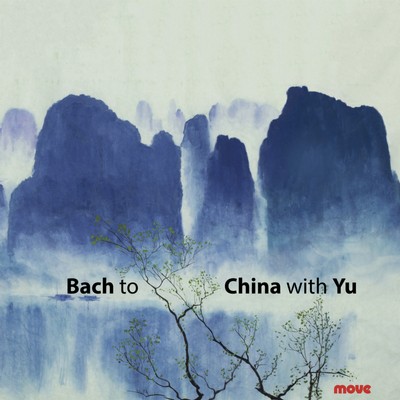
Much of this latest volume of works by Julian Yu involves clarinet, violin and cello. In fact, Robert Schubert‘s clarinet features in each of the four varied elements on the CD, as it has on two previous Move Records publications that present the composer’s chamber music involving that instrument. Also appearing here are pianist Akemi Schubert, violinist Yi Wang, and two well-known cellists in Virginia Kable and Josephine Vains.

Now, to content. The album starts and ends with Bach, whose music enfolds Yu’s arrangements of 24 Chinese Folksongs (some of which also contain Bach snippets) and two tracks of Dances from the XII Muqam, a collection of traditional Uyghur melodies. As anticipated, the longest of these four compositions is the assemblage of folksongs, but Yu fans will have heard these some years ago – 2019, to be exact – when pianist Ke Lin recorded the composer’s 50 Chinese Folk Songs. As far as I can see, Yu has revisited 22 of his original 50 and transcribed them for Schubert, Yi and Vains; the two odd-persons-out are Su Wu Tends the Sheep and Wild Lily.

As I said, there’s some Bach included in the folksongs as Yu elects to employ some of this composer’s bass-lines (and those from other composers) as supporting material for his collated melodies. Some of these interpolations are easy to find; others escaped identification by this willing listener.

Beginning with a solid slab of Western music, Yu has arranged the Chaconne in D minor from the Violin Partita BWV 1004, written sometime between 1717 and 1720. He’s not alone in this exercise and admits to drawing on transcriptions by Mendelssohn (who wrote a piano accompaniment for the piece), Schumann (who did the same), Busoni and Raff (who both did simple piano transcriptions, although the latter also made a version for full Romantic orchestra), and Brahms (a splendid version for piano left-hand). In this performance, we hear Schubert, and the string partnership of Yi and Kable for the only time on this CD.

As for the ending, we hear the organ Passacaglia in C minor for organ BWV 582 from sometime between 1706 and 1713. Yu gives us the famous bass line on the cello but has dilated the first note of each bar to a dotted minim, so the time-signature changes from 3/4 to 4/4. On top, the composer introduces scraps from arias and instrumental interludes heard at the Peking Opera; some are original, some Yu-composed. In all, we hear about twelve variations – down on Bach’s twenty – and the results prove to be disarmingly deft.

But you could say that about the whole set of 28 tracks. The arrangements are clever in conceit and clear in texture, if only rarely arresting. As you’d anticipate, the most challenging work comes first with the Chaconne. Yu begins in orthodox fashion with clarinet and cello outlining the eight bars of basic material before the piano enters discreetly with some melodic and harmonic reinforcement. All three are in operation with few signs of disturbance until we reach bar 25 where Schubert takes the melody line and elaborates it into a semiquaver pattern while clarinet and piano take on the chordal punctuation.

From here on, the central melody is shared between all three players while the re-composer begins to add flourishes, distinctly new lines, all the while indulging in some neatly dovetailing klangfarbenmelodie. We come to a slower oasis at bar 77 when the clarinet takes over from the semiquaver-addressing piano, giving us a calmer ambience which lasts up to the arpeggio direction of bar 89 which the piano takes on board and follows with a general attention to the written notes, apart from a few deviations, the whole fraught sequence winding up with a powerful bass line of striding quavers from cello and piano which is not in the score but makes a remarkably Brahmsian lead-in to the D Major reprieve at bar 133.

This is taken at a slow pavane speed and Yu recycles the opening variation of this segment as a subordinate component while gradually building up intensity with the piano adding more arpeggiated ferment, until the reversion to the minor key, at which point the piano disappears and clarinet and cello play the first two variations from this point by themselves, a few triple-stops from the original falling by the wayside. The piano gets an attack of the triplets well before they should turn up in bar 241 but by this stage we’ve been treated to so much linear displacement that the prepositioning hardly raises any eyebrows.

And so to the final peroration which is given with more late Romantic magniloquence in the best Busoni tradition. Also in something of an arranger’s tradition, Yu fleshes out that final noble single D with a full chord. So do Schumann, Mendelssohn, Raff and Busoni (who indulges himself with a tierce). The solitary exception is Brahms, who consents himself with three massive octave Ds – a man who knew when to leave well enough alone.

I heard the folksong Su Wu Tends the Sheep with more interest than most because it concerns a real person: a 2nd-to-1st BC diplomat who was detained on a mission for 19 years and put to menial work while under what amounted to imprisonment. The melody is here given mainly to the violin, the clarinet a late entry to the mix. But the message is clearly one of longing (for the homeland?) even in the middle of pastoral solitude – or so I feel about what is a warm, even sentimental lyric.

The other novelty in this collection is Wild Lily from the Shanxi province. A simple melody in four phrases, Yu sets it simply enough for violin with clarinet discordant underpinning, then again where the clarinet bears the melody while the cello accompanies in an atonal language – nothing too savage in either half, only single notes but deliberately at odds with the tune’s simplicity.

As for the other 22 elements in this collection, I refer you to my review of Ke Lin’s Move Records performances of the 50 Chinese Folksongs back in 2019. I believe I commented on all of the others treated here and have nothing new to add apart from predictable remarks about the new settings’ timbres. The same problems still apply: the arrangements are brief (eight of them are under a minute long, including Wild Lily) and, after a while, they fuse, so that it’s hard to distinguish between something as well-known as Jasmine (thanks to Puccini’s Turandot) and Willows Are New.

Fusing his Chinese melodies with the West, Yu uses a Handel bass to underpin the Mongolian melody Gada Mailin, then a Bach quotation from the B minor Mass in Picking Flowers. A more original device comes in Little Cabbage from the Hebei province where the cello picks out the vegetable’s name notes for underpinning; this probably works well because of the resultant motif’s pentatonic nature. More difficult to discern was the quotation from Brahms’ Symphony No. 4 during Lan Huahua, although Yu made it easier for us by opening A Rainy Day with the first eight bars to this symphony’s Passacaglia.

It’s back to the B minor Mass for the Sichuan tune Jagged Mountain, clarinet and cello presenting it in turn even if it tended to throw the melody into the background. An outburst of familiarity came with the Shaanxi air A Pair of Ducks and a Pair of Geese which enjoyed the bass-line on which Pachelbel constructed his mellifluous Canon in D, beloved of wedding-organizers. Also easy to pick up was the use of the left-hand to the Goldberg Variations‘ opening statement during Taihang Mountains.

But we encountered more difficulties with Willows Are New, during which Yu employed some famous Bach motifs that went straight past this bat into a no-doubt-contemptuous keeper’s gloves. But I recognized at least one of the Brahms Symphony No. 1 bursts that supported the medley of three Shanxi and Shaanxi folksongs and that was the chorale spray that climaxes the finale at bar 407. However, the impact of the German master’s rich chromaticism made the track surprisingly Western/European, a factor that also struck me in the last of the collection, Thunder a Thousand Miles Away, which seemed to be a mix of three-part invention and (limited) fantasia.

But so what? Yu’s compositional career has been informed by his homeland and further education here; the least you’d expect is a happy relationship between the two ‘schools’, as we find on this disc. Still, he strikes the same problem as most other writers when dealing with the material for his Three Dances from the Uyghur people of Xinjiang: the tunes are finite and the changes you can ring on them present challenges beyond simple repetition in new timbres. The first dance is extensive, showing a good deal of inventiveness in edging the basic material in several directions, made all the more difficult by the number of repeated notes involved, especially in the piece’s middle pages.

More surprising was the character of the melody which seemed to share characteristics with the folk music from various countries as collected by Bartok and Kodaly than with the 24 folksongs sitting alongside it on this CD. Yu grouped his second and third dances together; well, sort of: the tempo increases for the third which concludes in an almost Rossinian galop. Oddly enough, only in these dances did you come across faint cracks in the trio’s ensemble work, mainly due to slight hesitations about entries and the delivery of some pretty simple syncopations.

For organists, Bach’s big Passacaglia and Fugue are impregnable musical fortresses. You can’t really take exception to Yu’s employment of its bass progression for his own composition, but he is operating with a melodic and harmonic pair of palettes that are very limited when compared to the original. That said, you can take pleasure in Yu’s interweaving upper voices, particularly if you can keep out of your mind the monumental welter that straddles your consciousness from bar 144 to the end of the great organ construct. And, as the poet says, a man’s reach should exceed his grasp and this CD is witness to Yu’s high level of ambition.