Comes with a high polish

SIDEKICK

Ziggy and Miles Johnston

Move Records MCD 648

This duo has been around the country – and overseas – for some time. At this point, both musicians are studying – as a guitar duo – at the Juilliard School in New York where their craft will continue to be honed to an even finer point. As is inevitable, these musicians have won prizes from operations like the Guitar Foundation of America, the Adelaide International Guitar Festival, and the Concert Artists Guild Competition. The brothers’ second CD, as far as I can tell, oscillates between Brazilian/Spanish voices and home-grown ones, with sideways glances at one of serious music’s best-known vignettes in Debussy’s Claire de lune, and Welsh composer Katie JenkinsSidekick, written specifically for these players by a co-student at the famous American academy.

Ziggy and Miles begin their excursions with Jongo, a rhythmically clever piece by Brazilian guitarist Paulo Bellinati; it alternates 6/8 with 3/4 in a time-honoured Latin tradition and bases its development on a catchy D Major tune that doesn’t venture outside its home key. We hear a cut version of this arrangement because the musicians omit about a minutes’ worth of ‘percussion work towards the piece’s ending where performers have the option of snapping strings at various points along the neck/fretboard or slapping the instrument’s side, outlining the same rhythmic interplay that has featured so far in the piece.

It all makes for a nice study in ensemble and this duo comes up trumps, even if the last bar’s arpeggiated chord is prepared by a carefully-considered chain of what you’d expect would be rapid acciaccature. Still, its determination leaves you in no doubt that we’ve reached the end of this frolic.

This is followed by the three-movement Tonadilla of Rodrigo. which you can find on YouTube, the Johnston brothers giving a most focused reading of this brightly textured suite. The initial Allegretto ma non troppo sets up the composer’s trademark 2nds, placing E in one instrument against E flat in the other, the bitonal suggestion a continuous spur as the players exchange material and unite for full-blooded rasgueado chords with sparkling clarity.

The second movement Minuetto pomposo doesn’t really get affected until a fair way in, beginning with a delectable alternation of material and spice added by ‘wrong-note’ chords like the opening D Major chord in Guitar 1 set against an F sharp minor triad on Guitar 2; this polarity persists but it’s not that remarkable – just a muted form of bitonality. The stately section starts well into the piece’s centre with a definite change of character, into the minor if anywhere, and a definite strut to the rhythmic motion. A series of concerted common chords (recalling bars 11 and 12 of the opening segment) follow a cadenza for Miles Johnston, and we return to the opening material and a curt conclusion.

Then the concluding Allegro vivace is an infectious rondo, notable for some stunning scale passages from both players. Here, the harmonic spikiness is underplayed although Rodrigo can’t bring himself to complete orthodoxy. But these pages exemplify the finer points of this duo’s abilities – from the carefully managed rubato and decelerandi to the fine timbral eloquence from Ziggy Johnston in a mid-movement minor mode bass-line solo, and the combined effervescence of the concluding bars’ semiquaver unison run.

Now we come to the CD’s longest track in Granados’ Ochos valses poeticos, written sometime between 1886 and 1894 for piano solo. All of them have been transcribed for two guitars, some of them by several arrangers, but the Johnstons have chosen the version assembled by the duo of Christian Gruber and Peter Maklar. In fact, the waltzes are preceded by a bright march-like introduction and the first of the dances recurs as a postlude to the whole collection. Right from the start, you’re aware of transpositions across bars 10-12 where the piano in alt can’t be handled by the guitar; as well, you hear a few supernumerary bass notes starting 13 bars from the introduction’s bridge/conclusion. But the players capture effectively the good-humoured charm of this preface.

Most of the waltzes are a page long in the original; repetitions abound, as they do in Chopin and Brahms, and the Johnstons give great pleasure in their ease of delivery and supple gradations of tempo and timbre. You can’t fault them for accuracy either with many striking passages of close duet. For all that, the waltzes are amiable salon matter, their phrases falling neatly into four-bar patterns with nothing needlingly sharp to their gentle progress. Certainly, the first Melodioso holds the most memorable melody, well worth revisiting at the conclusion to Waltz 8’s Presto in contrasting 6/8 and 3/4 (only an unadventurous two bars’ worth of this).

But the inner pieces have considerable charm under the Johnstons’ care: the gentle, ascending chromatic pattern of the second Tempo di valse noble; the slightly off-kilter shape of the following Valse lente with its groups of three four-bar phrases; an abrupt muffled pizzicato effect in the Allegro umoristico at bars 21 to 24, and later at bars 29 to 32 which are treated with precision by both players in turn; a telling Viennese-style hesitancy applied in Waltz 5, meltingly effective at bars 11 to 18 the first time round; followed by a carefully shaped Quasi ad libitum where the performers take their time but do so with a single mind; the impeccable realization of Gruber and Maklar’s division of labour in the Valse 7 Vivo, even if the piano’s full-blooded chords (e.g., bars 6 and 8) have been thinned out.

The set displays the brothers’ command of Granados’ none-too-complex emotional landscape in these unsophisticated bagatelles. Even the more introspective waltzes (Nos. 3 and 6) make no bones about the modesty of their forays into a (slightly) darker world. Still, the pieces meld successfully into each other, in this instance because of the interpreters’ uniform interpretative vision.

I’ve not much to say about the Johnstons’ transcription of Debussy’s famous piano extract from the Suite bergamasque. Their approach emphasizes the pages’ innate calm, even at the En animant change of key for six bars at the work’s climax. And the transcription manages to keep the melody line prominent – although that might be due to the players’ subtle treatment of the splayed chords/arpeggios at the un poco mosso from bar 27 on. An agreable 5 minutes’ worth.

Most senior of the three contemporary voices is Nigel Westlake‘s Songs from the forest in its original duo guitar form of 1994. I’ve heard the Grigoryan brothers play this work, possibly at Monash University – more a matter of history than actual reminiscence. It has a catchy opening gambit in the best Westlake style and the composer brings this back to round off his sonically effective score. Interpreters are kept busy with a wealth of effects and rhythmic slips and slides, demonstrating Westlake’s insights into his instruments’ capabilities. As expected, the Johnstons find the mellifluous melodic passages and the mildly aggressive interludes suit their partnership down to the ground and – if anything – the work accelerates in interest the further it advances.

Jenkins wrote Sidekick in 2021 during the COVID outbreak at the invitation of the Johnstons. It is intended to be a reflection of the brothers’ relationship, both fraternal and professional – which immediately presents interpretative problems. Which one is the sidekick – Miles or Ziggy? Or are they both each other’s offsider? I guess that Jenkins doesn’t have any narrative in mind; she’s not committing to a story like Macbeth, Don Juan or Till Eulenspiegel but potentially essaying a pair of thumbnails like Lavine or Pickwick. Yes, certain moments present intimations of sequential thoughts racing between the instruments, or even complementary ideas that find common expression, as well as times of divergence from each other.

All the same, the composer is at some pains to outline a kind of aesthetic compatibility where competing flurries of action lead to a common end, quietly fusing into a shared output. The experience is heightened by listening to the track through headphones where the two voices are spatially separate. But that’s the case for the whole CD, by which means you can detect the labour division – or better, the sharing of responsibility. Jenkins’ language is pleasantly catholic, moving into old-fashioned harmony near the piece’s conclusion but tracing a lightly acerbic path in its central pages.

Written last year, Ken Murray’s Trin Warren Tam-boree depicts wetlands in the north-west of Melbourne’s Royal Park; specifically, the bellbird waterhole that sits there, just behind those yellow and red slanted pillars that mark the Tullamarine Freeway’s starting point. Also written for the Johnston brothers, this presents as a meditation on the area’s restless placidity, the piece’s forward motion dominated for the greater part of its length by a minor 2nd oscillation: D-C sharp-D, for example. Over this underpinning, the players outline Murray’s wide-ranging melodic output, the whole complex packed with incident but not alarmingly so. This is an expertly pitched soundscape, created by one of the city’s leading guitarists and a solid contribution to the still-slim catalogue of serious Australian music for duo guitar.

Here is a welcome exposition of the Johnstons’ obvious talents, well placed in a field of musical practice that is not quite unknown or unrepresented but has rarely been graced with such expertise in execution. Admittedly, a substantial track (Granados) and a slight one (Debussy) are arrangements, but the execution of those and the original two-guitar works is exceptionally fine. This CD was recorded at the Skillman Studio in New York and the artists have been well-served by an operational team which captured every detail of their polished interpretations.

Diary September 2023

BIRDSONGS

Birds of Tokyo and Queensland Symphony OrchestraQueensland Symphony Orchestra

Concert Hall, Queensland Performing Art Centre

Friday September 8

And again, the QSO is seeking contemporary relevance by going into partnership with a rock band, viz. this five-man ensemble from Perth. Needless to say, I know nothing of the Birds of Tokyo’s output except that it is not avian-based; nor is it Far Eastern in flavour. But what’s a bit of nomenclatural misdirection between friends? The QSO publicity machine promises us works like Plans (2011), Lanterns (2014), Anchor (2015) and Good Lord (2020) from the Tokian oeuvre and, as with all such exercises, the QSO will be reduced to filling in the background – both physically and sonically. From limited (very) research, I’ve found that the Perth group has distinguished itself by playing at two AFL Grand Finals – a lesson in futility from my remembrances of these events: who is listening? Tickets range between $95 and $129 without concessions: this is no country for kids and the elderly. That usual $7.20 self-tip applies but, oddly enough, the QSO site has no seats on sale at the time of writing; nothing seems to be sold, but nothing is available. If the event materializes, the QSO will be led in their labours by Nicholas Buc who is well-versed in such trans-media exercises.

This concert will be repeated on Saturday September 9 at 7:30 pm.

UNDERWORLD: AN OPERATIC JOURNEY TO HELL AND BACK

Griffith University Faculty of Music

Conservatorium Theatre, South Brisbane

Saturday September 9 at 7:30 pm

This sounds more menacing than it is. The Griffith tyros will engage in excerpts from three operas dealing with the Orpheus myth: Gluck’s Orfeo ed Euridice, Offenbach’s Orpheus in the Underworld, and Philip Glass’s 1991 Orphee. Of the Gluck, I know everything; of the Glass, nothing except that it’s the first part of a trilogy that honours Cocteau by setting his film to music. You’d have to think that the Gluck bits would include Chiamo il mio ben, Che puro ciel, and Che faro: a nice night, then, for a tenor/soprano/mezzo/counter-tenor. As for the Offenbach frolic, there’s always the Galop infernal but much of the score involves a chorus or ensembles for the principals. What I’ve heard (today) of the Glass chamber opera shows the same promise as you can hear in Einstein on the Beach and Akhnaten, i.e. none. But that’s all right: we have a theme and doubtless the promised intersection of these three sources will result in an Orphic illumination. The whole is conducted by Johannes Fritzsch while the director is Michael Gow. Tickets are $40, $50 or $60, depending on your standing as adult, concession-holder, or student. As far as I can tell, there’s no credit-card-use extortion fee.

This performance will be repeated on Tuesday September 12 at 6:30 pm, Thursday September 14 at 7:30 pm, and Saturday September 16 at 2:30 pm.

VOYAGES

University of Queensland Symphony Orchestra

Concert Hall, Queensland Performing Arts Centre

Sunday September 10 at 2 pm

The University of Queensland players come down the river for a night of travel music. They start with a movement from an Hawaiian work by Michael-Thomas Foumai: Raise Hawai’ki: Kealaikahiki, the whole construct celebrating the round-world voyage of a voyaging canoe, Hokule’a, in 2017. It’s an eight-movement choral symphony but I suspect that we’ll be hearing an orchestra-only excerpt. The next trip takes us to Tchaikovsky’s Violin Concerto in the hands of final-year UQ student In Yi Chae. Finally, we travel to Saint-Saens for his Symphony No. 3 in C, the one with the organ, four-hands piano and an irretrievable association with Chris Noonan’s 1995 film Babe. Well, it’s not so much the world-travelling that is the point of this program, but the intellectual and emotional transplantations that come over us while we’re listening. The conductor is local musician Dane Lam who is directing a new Foumai work, Children of Gods, with the Hawai’i Symphony, an organization for which he is all too soon taking on the role of music director. Tickets move from $17 for children and students to $35 for adults, with the usual QPAC fee of $7.20 for handling your booking – the blight continues.

ICONIC CLASSICS

Queensland Symphony Orchestra

Queensland Symphony Orchestra Studio, South Brisbane

Thursday September 14 at 10 am

A Prep to Grade 6 morning where the young ears are attuned to music that sits at the forefront of that art. Truly? The program lasts 50 minutes but there are no details about anything connected with this exercise except that tickets cost $30 each and, for every 10 of these, a teacher gets in for free. That’s one way of ensuring a minimal standard of discipline in what could be a fraught situation. No specific conductor is listed; no particular works are marked down for a run-through. But the aim is to expose these very young people to great music. Can’t go wrong, can you? Especially in the close quarters of the Studio where the audience can get too close and personal with the sound sources and gaze in wonder at the artistry on display. And you’re expecting that from Prep-age children? No, this isn’t going to happen. By the time they approach Grade 6, young people have sometimes acquired the self-control of shutting up for 50 minutes; anything younger and you’ve got no hope. Of course, the program could be structured in such a way that each segment lasts 2/3 minutes – which is about the length of a good Wiggles number. But you can’t reduce many ‘iconic’ classics to that time-span – unless you want to fool your audience that great music comes in pop-song slices.

This concert will be repeated at 11:30 am.

ICONIC CLASSICS

Queensland Symphony Orchestra

Queensland Symphony Orchestra Studio, South Brisbane

Friday September 15 at 10 am

Following from yesterday, the QSO is playing today for students from Years 6 to 10. The program will necessarily change, you’d expect, given that the level of audience naivete will have substantially reduced in this morning’s patrons. By the way, ticket prices stay the same and the stipulation of one free teacher for every 10 paying students still applies. Again, no conductor is listed and no works are scheduled by name. From past experiences at Melbourne school concerts pitched at students in the upper reaches of these ages, you can expect about 5 minutes of tolerant bemusement, even if the work being played is familiar, But you need a charismatic MC or conductor and a few whizz-bang young soloists to encourage your garden-variety students to stay the course. If the orchestra is performing for music students, then you’d have no worries; but your average Grade 9 pupil is not susceptible to anything except the most obvious and loud classic. The organization probably believes in doing public service this way, opening horizons and expanding choices. Maybe so, in a small number of cases, but I believe that a real awareness of great music rarely starts until the age at which these concerts leave off.

This program will be repeated at 11:30 am.

BENJAMIN BRITTEN’S WAR REQUIEM

Brisbane Philharmonic Orchestra, Ensemble Q, Brisbane Chorale, Canticum Chamber Choir, Voices of Birralee

Concert Hall, Queensland Performing Arts Centre

Saturday September 16 at 7 pm

A work that has everything to satisfy a Britten admirer. I had an unalloyed enthusiasm for Britten’s work after coming across the first recording with Vishnevskaya, Pears and Fischer-Dieskau, then buying (and working through) the score, as well as relishing the opportunity to revisit all those Wilfred Owen poems that I’d studied five years before at school. Still, after 60 years, the score has many passages of remarkably affecting effectiveness: the Dies irae opening, the conclusion to The Parable of the Old Man and the Young, the pairing of Strange Meeting and In paradisum – all still impress me as showing the composer at his least prissy. As you can see from the list above, a good many of Brisbane’s musicians are participating; they’ll all be needed to cope with the composer’s triple grouping, including a large orchestra and a sizeable chamber ensemble. This night’s soloists are soprano Eva Kong, tenor Andrew Goodwin, baritone Hadleigh Adams, with the whole shebang conducted by Simon Hewett, taking time off from the opera/ballet pit to lead his forces through this flamboyantly sombre composition. There are no concession tickets; prices move from $49, through $65, to $75 although there are few of the expensive ones left.

GUY NOBLE’S GREAT TUNES

Queensland Symphony Orchestra

Concert Hall, Queensland Performing Art Centre

Sunday September 17 at 11:30 am

To celebrate the conductor/host’s 18 years of directing the QSO’s Music on Sundays series, the organization asked Guy Noble to nominate his favourite works and present them to us. It’s a very broad selection he’s put together but I’d guess it comprises pieces that have meaning for him. The program begins with Humperdinck’s Hansel und Gretel; not the whole thing, I expect, but probably the overture and not much else because no soloists or choir are listed as participating and most of the opera requires one or both. Chabrier’s Espana puts in a welcome appearance; I’ve not heard it live for some time. And another piece of national colour emerges with the first of Enescu’s Romanian Rhapsodies: a mittel-European delight and the sort of thing Bartok could have written if only he hadn’t been so hidebound by reality. We leave Europe momentarily for home with Nigel Westlake‘s Babe Concert Suite which, as far as I can see, involves three parts from the original score. A return to Europe, lurching to Finland for the conclusion to the Sibelius Symphony No. 5 in E flat with its superb move from Lemminkainen’s Return to a swaying sunrise paean. Down to Germany where Weber wrote an Andante e Rondo Ungarese for his viola-playing brother in 1809. By 1813, he’d recast it for a bassoon soloist and this morning we hear QSO principal Nicole Tait fronting this rarely-heard gem. Finally, Noble brings his 80-minute extravaganza to an American close with the end credits from Field of Dreams, the 1989 Phil Alden Robertson film with a score by James Horner. Tickets range from $30 for a child to a top price of $105 for an adult in a good seat – plus the $7.20 handling fee for taking your money.

CLERICI CONDUCTS MAHLER

Queensland Symphony Orchestra

Concert Hall, Queensland Performing Arts Centre

Friday September 22 at 7:30 pm

The orchestra’s chief conductor Umberto Clerici is continuing a Mahler cycle begun by Alondra de la Parra during her stint in Brisbane. I don’t know how far she got, or whether she took the process in numerical order so that Clerici is left with the final four: the big rump. In any case, here he goes with No. 6 in A. I’ve heard a complete series in Melbourne from Markus Stenz who was able to negotiate the vast No. 8 in the Exhibition Building as part of a Federation Centenary shindig. Sir Andrew Davis got through all of the nine except No. 8 which was scheduled for a performance at (I seem to remember) Rod Laver Arena. But that fell through thanks to the advent of COVID and I don’t know if it was ever re-scheduled. Anyway, good luck to all connected with this performance because it’s long and arduous – except for the hammer-player who gets his two (or will it be three?) points of exposure in the grim finale. As well, Clerici will give the premiere of Justin Williams‘ Symphony No. 1, a work co-commissioned by the QSO and the Sydney Symphony Orchestra where the composer is associate principal viola, if more familiar to many of us as the alto line in Melbourne’s Tinalley Quartet. Obviously, he was a colleague of the conductor in the latter’s cello-playing days; useful, that old school bow. Clerici speaks of Williams as a late Romantic voice; not actually a help to those of us who want something from our writers that takes into account developments across the last century, at least. Tickets run the usual gamut from $30 (child) to $130 (full adult in a good seat), plus the $7.20 shakedown/booking fee for the sake of it.

This program will be repeated on Saturday September 23 at 1:30 pm

POSTCARDS FROM ITALY

Australian Chamber Orchestra

Concert Hall, Queensland Performing Arts Centre

Monday September 25 at 7 pm

Only six members of the ACO will be playing at this geographically defined program: leader of the second violins Helena Rathbone, a second-rower violin in Ike See, head viola Stefanie Farrands and colleague Elizabeth Woolnough, principal cello Timo-Veikko Valve and his first desk support Julian Thompson. The night starts with a quartet playing the first movement, Venezia Notturna, from Thomas AdesArcadiana collection; not much to it, especially when compared to other elements in this collection. Valve offers his own arrangement of Bach’s Italian Concerto for an unknown number of participants – possibly a trio, if he’s confident enough. Mind you, the ‘Italian’ name is simply proposing contrasts; in the original, this is achieved by changing dynamics and (possibly) consoles/keyboards. We revert to the solidly Italian with Giovanni Sollima‘s Viaggio in Italia: not the whole thing,, but selections – presumably, ones without a vocal line . . . no, they come from a new version. The original for Schubert-style string quintet has 14 movements, so there’s plenty of scope for choice but, from what I’ve heard, a little goes a long way. Boccherini, that Italian/Spaniard hybrid, is represented by a quintet in the same format as Sollima’s: his Op. 45 No. 1 in C minor – 4 movements, 20 minutes’ worth. And, to end, Tchaikovsky’s Souvenir de Florence sextet, given this name because the composer conceived one of the work’s themes in that city when on an Italian sojourn with his brother following a disastrous attempt at marriage, so sensitively depicted in Ken Russell’s The Music Lovers 1971 film. For all its southern inspiration, the work is half-Russian (the later two movements), so the night will end on an ambiguous note (actually, a triad).

VISION STRING QUARTET

Musica Viva Australia

Queensland Conservatorium Theatre,. South Brisbane

Tuesday September 26 at 7 pm

This group – Florian Willeitner, Daniel Stoll, Sander Stuart, Leonard Disselhorst – is based in Berlin and is now 11 years old. The ensemble’s web-site is full of this visit to Australia, still going the full European scream about travelling to the ends of the earth. Which makes you wonder: how old are these people? Anyway, the lads are performing a standard program, with the extra bonus that they play from memory. First off is Bloch’s Prelude of 1925, subtitled Receuillement – about 5 minutes of eloquent late Romantic angst . . . but you could say that about a good deal of the composer’s more popular output. Bartok No. 4 follows, allegedly in C Major and a riveting score across its 23-minute length. The composer had ideas about expanding this work for string orchestra, so it would be handy to see what there is in this composition that is lacking in the Quartet No. 5 that Richard Tognetti recently expanded for his Australian Chamber Orchestra. To end, the ensemble performs Dvorak No. 13 Op. 106. A bit more lengthy, this delighted-to-be-home construct of 1895 lasts for about 40 minutes and helps to flesh out our chamber music experiences of this composer whose quartet output has been confined (in my experience) to one or two well-worn gems. Tickets can cost as little as $15 and as much as $109; I still don’t know whether Musica Viva charges a booking fee for its events but hope springs eternal.

An achievement with questions

DVORAK’S SERENADE

Australian Chamber Orchestra

Concert Hall, Queensland Performing Arts Centre

Monday August 7, 2023

Bela Bartok

Fourth in an eleven-concert series, this Brisbane appearance by the ACO under Richard Tognetti‘s artistic and concertmasterly leadership divided neatly into opposing halves. Before interval, patrons were offered a fairly contemporary opening with Caroline Shaw’s Entr’acte of 2011, a piece that the American composer wrote while a student at Princeton. This was followed by Tognetti’s new arrangement of the 1934 Bartok String Quartet No. 5, called ‘in B flat Major’ because it starts and ends in that key (roughly). After interval, we moved back in time a tad for Josef Suk’s Meditation on the Old Czech Chorale ‘St Wenceslas’, composed near the outbreak of World War One and used as a musical act of resistance against the German invaders (following in Sibelius’ anti-Russian footsteps). And we concluded with the night’s title, Dvorak’s delectable Serenade for Strings of 1875.

This last is a string orchestra staple but the ACO hasn’t recorded it, as far as I can tell. So what? There’s an awful lot of music for the same forces that the group has not dealt with, but the current personnel could make an impressive interpretation, worth setting down on something more public than the organization’s own tapes. Tognetti encouraged his players to give full vent to the composer’s throbbing expressiveness while keeping the lines clear. Not that clarity in this Romantic product would be a problem with this group where the bass lines feature three cellos and one bass only.

Once again, the two violin contingents made an impressive display, the seconds immediately with a finely shaped outline of the first movement’s opening subject, even more telling on its restatement at bar 13. In fact, the entirety of this Moderato demonstrated great care in preparation, from the soft high chords that concluded bars 22 and 24 to the modestly projected cello lines from bar 66 to near the movement’s end. But then, we’re treated here to one of Dvorak’s most tender lyrics, even quite early in his prodigious output.

The mellifluousness continued in the Valse/Trio with some danger spots deftly achieved, like the strings’ octave doubling from bar 11 on, which many another body plays with bursts of suspect intonation, and the delectable skipping exhibition for second violins and cellos at bar 37 which impressed by its grace and positivity. I admired the pace of the following Scherzo and a uniformity of address that typifies this body, particularly while they worked through the thick-and-fast canonic entries that dominate this movement’s progress. Even the lack of bass heft wasn’t too obvious at the bar 42 fortissimo-for-everyone tutti where cellos and bass have the running. And the ensemble created a finely-spun melancholy moment at the bar 286 a tempo as the melodic material is decelerated and subjected to a placid musing before the concluding rush.

You would be hard pressed to find a more appealing version of the ensuing Larghetto – from the delicate but disciplined opening, straight into the business, to the lightly tripping Un poco piu mosso beginning at bar 47 with not a double- or triple-stop unachieved briskly. Even the note-spinning high violin line that dominates proceedings from bar 54 to bar 63 (an odd creative lapse in this eloquent essay) exercised interest for the piercing thinness of its contour. While you could understand the need for tempo relaxation in the vivace last movement, I’ve never understood why everyone slows down for the episode beginning at bar 85. Is it viewed as the beginning of a new ‘step’, perhaps? At all events, we were caught up in the rapid scurrying of this allegro‘s central pages before the melting-moment return of the work’s opening theme at bar 344, and the brusque furiant that here brought us home to generous popular approval. Just as you’d expect from this outstanding body that is blessed with consistency of personnel.

Not much to report about Entr’acte which moves between rather ordinary chord groupings to some special effects harking back to the 1960s. The only thing I gained from this performance was an appreciation of the work’s variety of timbres – which are not apparent from available recorded versions. Or perhaps American orchestras aren’t fussed about these details which, as far as I can tell, are the work’s main interest . . . alongside the concluding cello solo, carried off here by Timo-Veikko Valve with a kind of phlegmatic consideration.

Similarly, not much remains in the memory of Suk’s brief hymn treatment. The opening pages are lushly scored although the harmonic vocabulary stays in A natural minor for the entire first part of 39 bars – not an accidental in sight. Double bass Maxime Bibeau was put to a difficult task, having to negotiate a part that called for three players, most obviously in the moving (and exposed) A Major triads of the last three bars. But the work was handled with considerable attention to its inbuilt surging character, based as it is on a kind of dour Gregorian chant and not the wider-ranging compass of the Tallis Fantasia with which Suk’s work bears slight comparison.

For my money, the night’s interest came with the Bartok arrangement. After a few days, I’m still doubtful about the point of this exercise, apart from giving the ACO an addition to its repertoire. From the opening avalanche of B flats, it was clear that we were in a new country where individual voices were subsumed in a kind of musical groupthink. Voices impressed as powerful blocks but some polish came off the details, like the trills in bars 21 to 23 of the opening Allegro. Not that this impression was uninterrupted, as in the second subject’s arrival in bar 44 which preserved its striking sinuosity, and the orchestral texture was pared back every so often, yet those unison/octave recurrences dominated the movement’s progress as at bars 59, 126 (minor 2nds, for a change), 159, and 210 – all of which served as anchors in a welter of thick part-writing; difficult to imbibe even in the original.

I seem to remember that the Adagio began with single instruments, the full corps entering at bar 10. Again, here significant details sounded blurred, like the five-note semi-chromatic rapid runs that begin at bar 26 but which lacked the original’s crepuscular mild stridulatory suggestiveness. It was a relief to get back to the slow-moving isolated trills after bar 50’s Piu andante.

Of the work’s five movements, the middle Alla bulgarese emerged best in this string orchestra garb, notably at the burst into a C Major/minor/modal three-bar break at bar 30: one of Bartok’s more folksy surprises. As well, the 3+2+2+3/8 Trio showed the ACO’s expertise in dealing with irregular rhythms; but then, the group’s had plenty of practice, ever since the group played the Sandor Veress Transylvanian Dances nearly 30 years ago. Even so, this Bartok is much more demanding. The composer’s counterpoint is less interwoven in these pages, even if the parallel and contrary motion passages are persistent, particularly in the Trio‘s later stages; so the employment of massed (and supple) strings doesn’t interfere with your enjoyment of this dance.

The outer stretches of the Andante maintained their shadowy atmosphere well enough, if the hard-worked Piu mosso from bar 64 to bar 80 proved wearying with the viola/cello/bass work opaque, if not muddy. Still, that made the following 10 bars of tonally inflected Tranquillo very striking for its purity, exercising a kind of static eloquence. Then, the vivace final movement proved an exercise in stamina, exemplified by an initial attack that was as ferocious as any I’ve heard from a quartet versed in this work. Of course, it had its inbuilt slackings-off and accelerations but the ensemble’s enthusiasm and responsiveness went a fair way to making a positive impression in the rapid-fire presto pages.

Even so, the quartet’s finale raised similar questions to those from the first movement. Has the transference achieved much beyond an emphasis on aggression? Is the exchange of intimacy for amplitude worth the transformation? Even with gifted trios of violas and cellos, is the sacrifice of individual lower voices compensated for by laudable collegiality of articulation? This is not the first of the ACO’s transliterations from quartet to chamber orchestra format but it is a questionable one, chiefly because so much goes on in the original that becomes either muffled or muted in the transference. For all that, the performance enjoyed a hearty welcome from last Monday’s audience here – which shows that – once again – I’m in the minority.

Fine artistry exposed at last

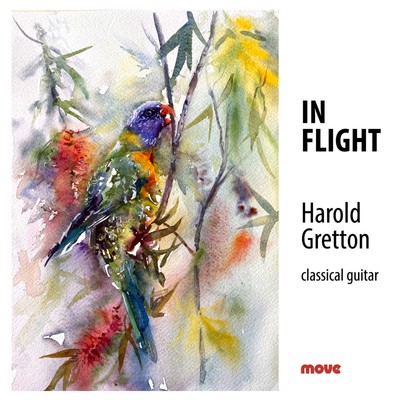
IN FLIGHT

Harold Gretton

Move Records MCD 627

This musician is a new name to me but not to guitar aficionados in Canberra or the Riverina Conservatorium in Wagga Wagga. This CD, recorded in early 2019 at the Holy Trinity Anglican Church in Weston, UK, has been delayed by the universal plague that reduced serious music-making to a dribble for at least two years. Its content is, to put it mildly, eclectic with some classics like Sor’s Introduction, Theme and Variations on ‘O cara armonia‘ (that distracting little number from Mozart’s The Magic Flute), and a quartet of Latin-inflected favourites in Morel’s Danza Brasilera, Lauro’s La Negra, Estrellita by Ponce, and – just to show the performer’s 1990 credentials – Piazzolla’s La Muerte del Angel.

Adding to the regular repertoire security blanket, Gretton performs Mertz’s Fantaisie Hongroise and tucks in three pieces by Weiss. For a bit of contemporary relief, he outlines The Prince’s Toys suite by Moscow-born Nikita Koshkin. Just as interesting is his own five-part collection from 2013, Flock, which gives us Gretton’s musings on Australian birds. And he concludes the CD with another of his compositions: Inarticulate Music, composed after Gretton’s move to Wagga as Deputy Director and Head of Guitar.

Earliest in time is the Weiss trilogy: a Fuga, Passacaille, and the well-thumbed Capriccio. Gretton gives excellent interpretations of them, certainly superior to anything I heard from other guitarists when scrabbling around for comparisons on the internet. The D/B minor fugue version allows for plenty of liberties in placing the bass line in the instrument’s lowest octave or using an upward transposition, e.g. in the middle of bar 10, or across bars 32 and 33. Also, the ornamentation is very discreet, like the small semiquaver run interpolated in bar 40.

He sets up the passacaglia by playing the initial seven bars twice before launching into the 11 variations, which are accounted for with touching sensibility, nowhere better than in the 8th variant in 3rds and 6ths, and the following two semiquaver-rich strophes before a moving reversion to the original: a Goldberg in miniature. What strikes you particularly about the Capriccio is its rapidity, yet all lines remain clear and unfudged, with some finely resonant bass work (viz. bars 4 to 6) and a restrained outline of when the fugato stops from bars 50 to 53 and the splayed chords emerge as an unexpected, final jeu d’esprit.

Sor’s variations on Papageno’s Das klinget so herrlich features among the composer’s most popular works. The portentous preliminary bars, all 24 of them, serve as a kind of tongue-in-cheek prelude to the infectious, superbly balanced melody that Sor elaborates. Gretton observes all the repeats in this, the CD’s longest track, with an expert eye for second-time-around changes and an effective use of vibrato and that muted effect achieved by plucking above the fingerboard rather than directly above the sound hole. Of course, the player uses that time-honoured trope of setting loud against soft in identical repeated passages but it isn’t over-worked. Still, this is a reputable sequence, coming fairly close to the opera’s premiere and before the advent of the thunder-and-lightning virtuoso.

Speaking of which, Mertz’s fantaisie, the first of 3 Morceaux from an 1857 posthumous publication, is a splendid display piece with as many separate sections as a Liszt rhapsody, like a 15-bar lassan marked Lugubre, followed by an Allegro vivace that stands in for a friska. As with the Sor, Gretton includes or ignores bass notes as he pleases, omitting several low fundamentals for reasons (I assume) of articulation clarity. But he follows the wilful Romantic attitude to metre – taking his time over the Adagio maestoso con entusiasmo, and the two volante brief cadenzas.

Then, when he comes to the final 1 and a 1/2 pages, he is an exhibitionist’s delight, playing nearly all the notes I find in an old Haslinger edition and elevating the tension in a dazzling series of semiquaver patterns for the jubilant A Major of the maestoso. No, it’s not profound, but it’s not trying to be anything but exuberant and nationalistically coloured in the Liszt vein; the first 15 of the Hungarian Rhapsodies were available for general consumption by 1853.

Ponce’s Estrellita of 1912 remains the Mexican composer’s most well-known melody, having been subjected to many transformations, but it’s rarely heard in its original form – as a song, a cancion mexicana . But then, how many contemporary vocalists have the required range of a 13th? The arrangement used by Gretton, attributed to Scots guitar master David Russell, underlines the lyric’s plaintive quality with plenty of space allowed for the vocal line to breathe. A pity that the song’s second half was not repeated.

La Muerte del Angel was written as incidental music for a play in 1962 and, in its original shape, is a typical Piazzolla affirmation, packing an impressive punch in its outer sections which cradle a quite substantial central lyric. Gretton plays Leo Brouwer’s arrangement which expands the Argentinean composer’s horizon with an introduction that goes into improvisation-suggestive territory before settling into the biting, catchy main topic. To be honest, I think Gretton plays this piece better than its arranger, with a deft whimsicality colouring the introduction’s more fragmentary elements and a powerful rasgueado attack at the work’s dynamic highpoints. As well, unlike several other interpreters, he doesn’t underplay the final chord’s inbuilt ambivalence.

Another Argentinian, Jorge Morel, produced a samba in his Danza Brasilera of 1968, and Gretton plays it straight, without any irregularities of rhythm; it’s as though he’s accompanying dancers who don’t look for any idiosyncrasies. You can hear a nice sense of urgency throughout this as the main theme’s recurrences lead to a kind of return to a turbulent base after some more texturally transparent excursions, like the central 14-bar repeated bracket leading into a chain or two of quick single quavers before the catchy principal melody returns: excellent articulation throughout, especially the no-fuss negotiation of the harmonics patches.

Last in this Latin bracket, Antonio Lauro’s 1976 La Negra (third in his Triptico suite for Segovia, after Armida and Madrugada) is approached with a more supple rhythmic outline, including some fetching pauses as at the end of bar 16 each time it comes around, later in the work’s central section at the end of bar 32, and – most lingeringly – at the return to bar 2 for the second-last time. This interpretation is a fine example of controlled sentiment with a graceful lilt illustrated by several carefully positioned portamenti.

Russian guitarist Nikita Koshkin achieved initial prominence with his suite The Prince’s Toys of 1980, a variant on Ravel’s L’enfant et les sortileges plot where the abused turn on the abuser; in this case, the toys take the prince to another world/dimension. Gretton plays five of the six elements in this collection, omitting the final Grand Toys’ Parade. His opening, The mischievous prince, is a gratifying setting-up of the central character’s psychopathology in which portamenti play a large part as well as some fiercely (potentially sadistic) hard-hitting single-notes and chords; the whole ending either in melancholy or menace, according to your taste.

Some of the effects achieved during The mechanical monkey are remarkable. A side-drum imitation is highly persuasive but no more so than the cymbal clashes that the toy produces with extraordinary fidelity. Added to which, the central pages in 6/8 (or a variant) pass along with sterling fluency and irreproachable security of left-hand work. Next, The doll with the blinking eyes becomes more intriguing the longer it lasts with Koshkin including in his piece two articulation problems that afflict all guitarists: the audible swipe when rapidly changing fingering positions, and the buzz that comes about when a string vibrates against frets. Both make for fine image suggestiveness, probably bettered by the final music-box harmonics that come in the piece’s final pages.

The soldiers opens bravely enough with tuckets and trumpet imitations, the former achieved by a unique series of intervals rather like an organ’s mixture stop. The movement sticks to a quick march tempo for about half its length when material starts disintegrating until, by the end, the martial sounds have been mutated, the toy soldiers shadows of their former glory, the prince’s miniature army falling on hard times. Here again, Koshkin’s technical skills are outlined with considerable craft by Gretton. As for The prince’s coach, this begins bravely enough with plenty of assurance and forward progression that eventually accelerates until the inevitable crash when the unleashed horses gallop off into the distance.

The whole suite is written for a virtuoso performer with the ability to take on novel sound-production demands and remain unafraid to indulge in sound imitations with panache. Gretton fits the bill with a mastery of Koshkin’s technical panoply and the composer’s blend of vocabularies, mainly coming down on the side of neo-classicism best exemplified by the leading 20th century Russian composers, both resident and expatriate.

So we come to the guitarist’s own compositions. Gretton’s Flock includes the currawong, magpie, blue wren, galah and rainbow lorikeet. and his CD’s booklet is illustrated with five water colours by Penny Deacon from which this ornithologically-challenged observer can identify three birds with some certainty. We are not in Messiaenland where the bird calls are notated and indicated, as in Oiseaux exotiques, Catalogue d’oiseaux, or even Le Merle noir. Gretton is more concerned with each bird’s character – or, better, its characteristics. So his Currawong presents as jaunty, almost cakewalking: the C. J. Dennis of birds, staying firmly on the ground before a transfiguring ending rich in harmonics. Unlike a Collingwood supporter, the Magpie is a conversationalist – or he could be involved in a fluent soliloquy; this personality is amiable enough, apart from the occasional abrupt outburst.

With the Blue Wren, we come across a questing, inquisitive busybody who suddenly bursts into a flurry of activity; the following Galah is similar if more consistent in his activity before normal behaviour gives way to near-aggressively restive, then off-the-wall temperamental flights (the CD’s shortest track). Finally, Gretton’s Rainbow Lorikeet begins with a motif/melody like its predecessors but accretes more lines as it progresses. At its opening, this seems the most harmonically conservative member of the set but, as with some of the others, it moves out of an avian comfort zone into a dissonant and unpredictable landscape with powerful, confrontational chords. Finally, the piece returns to its opening melody, immediately more rich in its setting before a conclusion of heightened power.

Yes, the bird titles aren’t necessarily attached to the music itself and one man’s lorikeet is another woman’s buzzard. Yet each of these five vignettes has a distinct flavour which might as well represent the animal of its title. Gretton writes that, when overseas, he missed Australia’s bird sounds and so we have to approach his suite as a kind of memento sequence, even an exercise in patriotic nostalgia. It’s not on the same intellectual level as the French master’s imagery but it’s certainly easier on the ear.

In the CD’s last track, Gretton is responding to a conversation with a painter who decried the verbiage surrounding art, wondering why art cannot be allowed to speak for itself. Inarticulate Music attempts to create a music that requires no explanation, no exegesis, no apologia. It consists of an alternation between repeated common chords (Major mainly, with one minor excursion) and single notes and, in that, it resembles a simple man’s The Unanswered Question. It’s probably the most conservative piece on the CD in terms of form, vocabulary, melodic content and metrical variety. But it makes for a placid conclusion to Gretton’s considerable efforts, a simple Amen to a string of finely-executed works from across a wide time-frame.

Junior festival hits the mark

COLOUR AND VITALITY

Mackay Chamber Music Festival

Conservatorium Theatre, Central Queensland Conservatorium of Music

Sunday July 23, 2023

Glenn Christensen

To those of us from out-of-state, only one chamber music festival has operated in regional Queensland: Townsville. And each time a message comes through from the Australian Digital Concert Hall people, I’ve been reading ‘Townsville’ for ‘Mackay’. This latter celebration is only five years old, the brain child of Glenn Christensen whom I know mainly as a one-time violinist with the Australian Chamber Orchestra. He has moved on since those days to be deputy concertmaster with the Deutsche Kammerphilharmonie Bremen, and one of his other post-Tognetti moves has been to set up this small-scale festival in his home town.

It’s small because it lasts barely three days with much of its activity pushed onto the last day, which was Sunday where guest artists Arcadia Winds and two-thirds of the resident artists Lyrebird Trio combined for two significant ensemble scores that you rarely hear worked through successfully because of the odd personnel required: Martinu’s Nonet No. 2 which fits the Arcadias but asks for one each of the standard string section – and it’s a rare string quartet that substitutes a double bass for the usual second violin; and Beethoven’s Septet Op. 20, which asks for the same string combination as the Martinu but cuts out the top two woodwind lines.

Beginning the program (after artistic director Christensen’s multiple thank-you messages to his festival helpers) was a duo for violin and double bass by Pekka Kuusisto’s older brother and fellow violinist/composer, Jaako, who died in 2022 from brain cancer. This short piece, Minio (meaning ‘minion’?), exercised violinist Doretta Balkizas (a Bremen colleague of Christensen: same city, different orchestra) and bass Jaan Pallandi from the Sydney Symphony Orchestra. It begins with an insistent pulse/scrape from the bass instrument followed by repeated semiquaver groups from the violin. The delivery is vehement and rough, even when the roles reverse and the bass opts for pizzicato while the violin exercises its own capacity for full-bodied scrapings which eventually accelerate. This far, you won’t hear much melodic content – not even of an angular type; it’s all rhythmic jumps and alterations, punctuated by some high, top-of-the-fingerboard notes from the bass.

But then comes a kind of relieving trio with open A and E string alternations from the top voice with harmonics produced by the bass, before both instruments opt for this harmonics by-play. Some inter-relationship follows where one note for Pallandi underpins three for Balkizas before we return to the opening aggression, more growling before a reminiscence of happier times with a violin tremolando above the bass’s high, aspiring series of 2nd intervals; the whole, finishing with a mutual assault on four semiquavers and a farewell belt. Despite its theatricality, I enjoyed this work but I suspect mainly for the energy and breezy enthusiasm of its executants.

For Martinu’s nonet, the full Arcadia group emerged: flute Eliza Shephard, oboe Rachel Bullen, clarinet Philip Arkinstall, horn Rachel Shaw, bassoon Matthew Kneale. Mind you, that’s a pretty different formation to the one I’m used to with Kiran Phatak on flute, oboist David Reichelt, and clarinet Lloyd Van’t Hoff. Balkizas returned as top string, with Meagan Turner viola, Simon Cobcroft (from the Lyrebirds) on cello, and Pallandi representing the most hard-worked unit of the afternoon. For all that, not much took me by surprise across this sample of neo-classical bounce. All players handled the opening Poco allegro well enough, somehow emphasizing the composer’s stolid use of timbral blocks as exemplified in the wind hymn 3 bars after Number 3 in the Statni Nakladatelstvi/Barenreiter edition of 1959. But the only dubious moment came in the violin line about Number 12 where the tedious soprano-level ostinato wavered momentarily.

It’s always hard to gauge operating conditions from a broadcast but both cello (and later, bass) came across as over-confident in the opening pages of the middle Andante. Yes, I know the cello has the melody from this movement’s opening and for some time after but Cobcroft’s idea of mf put the surrounding string piano well into the background. As the movement progressed, the ensemble displayed a sense of carefully applied rubato and an awareness of dynamic contrasts, even if this latter proved close to overbearing at climaxes as at Number 3, two bars before Number 5, and the explosion a bar before Number 8 where Pallandi’s tremolando F somehow dominated proceedings. Not the most fluent performance but the pieces fell into place properly.

It was a pleasure to encounter the concluding Allegretto with its clever-clever changes in pulse which gave the four strings no problems in the scene-setting opening pages. While the shade of Stravinsky is present in both outer movements, you also come across suggestions of Copland in this finale; for instance, at the Poco meno 6 bars before Number 10. You also encountered some passages of splendidly rich scoring, certain tutti stretches of powerful warmth, pointing to Martinu’s open-minded acceptance of his own emotional stance and compositional vocabulary in his last, very fruitful year.

For the Beethoven Op. 20 Septet, Christensen (also a Lyrebird) replaced Balkizas in the taxing violin part, and both Shephard and Bullen were not required. This work began impressively enough with an excellent communal attack on the Adagio‘s communal chords, loud and soft. With the jump to Allegro con brio, Turner’s viola Alberti accompaniment proved too loud for Christensen’s finely contoured opening subject, if more restrained in the exposition’s repeat. But then, the violinist kept to an appropriate dynamic level throughout these pages, regardless of the curt self-promotions of some colleagues, both wind and strings. However, the movement showed all ensemble members cleanly articulating and eager to engage with the score.

I came across only two problems with the Adagio cantabile: one of the repeated bassoon Fs across bars 22 and 23 went missing in action; and Cobcroft with Pallandi pushed themselves too far forward in Arkinstall’s solo about 36 bars from the movement’s ending. These apart, the players did fine service to this one slow movement of the six in this score. The group’s Tempo di Menuetto enjoyed brisk treatment – more a bucolic stamp than usual – with some welcome rubato at the woodwind’s octave rise and fall at the second half’s centre. Icing on the cake, Shaw’s arpeggios during the Trio proved faultless.

All strings showed to better effect in terms of dynamic responsibility during the first variation of the next movement; but then, the winds are silent here – no competition. Christensen made short work of Variation 2’s demi-semiquaver-packed line, while Arkinstall and Kneale exercised some individuality in the concluding bars to Variation 3’s first half. It’s not that difficult, but what a relief to have Shaw’s accurate horn in play for Variation 4’s opening and closing four bars; it added to the high quality of delivery from all in this segment. And the troupe almost carried off an ideal final variation-plus-coda except for some glitch between violin and viola in the third/second-last bar.

Similarly, something odd happened to the cello line in the latter-stages duet with Christensen in the final stages of the Scherzo‘s Trio. But full marks to the violinist for his E flat arpeggios starting at bar 47 of the movement’s main part; a cleverly understated buzz that enriched his colleagues’ outline of the melody. And the Presto of the finale was the violin concerto that Christensen indicated in his pre-performance talk. All attention here focused on the top string and its interwoven solo exposures, the performer showing a firm, steady style at critical moments like the three-bar solo that leads into the second subject’s reappearance, not to mention the taxing, if ludicrous cadenza that brings this helter-skelter progress to a standstill before the final stanzas, complete with chains of increasingly hectic triplets for the violin.

This Beethoven made a benign conclusion to the Mackay festival which slightly overlapped with the Townsville event that began on this Sunday and lasts till Sunday August 6. I went as a guest to one of the earliest of these latter celebrations in the more northern city but I’m tempted to visit next year’s Mackay gathering because it’s easier to imbibe, less time-consuming, and the quality of performances – on this showing – could proved very satisfying. At the same time, I’m finding it hard to get over the fact that Queensland hosts two such exercises in close succession annually – and not in the state’s capital; a great boon to both regional cities’ residents.

Small-scale, with sympathy

LATIN AMERICAN PIANO MUSIC

Alejandro Alberto Tellez Vargas

Move Records MCD 639

You’d have to assume that this pianist is Mexican-born, if only because the few life details you can glean point to his bachelor’s degree coming from the Escuela Superior de Music, even if his Ph. D. was earned at the University of Melbourne and – as far as I can find – he resides in that city. On this CD, he performs works by seven composers: Cuban writer Ernesto Lecuona enjoys four exposures; Ricardo Castro from Mexico is heard in three tracks; the voice of another Mexican, Manuel Ponce, is heard twice; and three of the remaining four writers, all of whom are heard in one manifestation, are also Mexican – Alfredo Carrasco, Ernesto Elorduy, and Mario Ruiz Armengol. The odd man out is Luis G. Jorda who was born (and died) in Catalonia.

As a preface in the CD’s booklet, Vargas writes a few words in Spanish. As far as I can make out, he says the following: ‘I dedicate this recording to my beloved fathers [artistic?], many thanks for my piano lessons and for all the support during my studies and concerts. Also, I want to thank my dear siblings for all your patience during those long afternoons when I sat practising in the living room.’ Pleasing and charmingly domestic, as is most of the music that the pianist presents which is either of the salon or a small bijou serving well as an encore. I didn’t anticipate that this courtly, colonial music would have much overtly striking about its character and that prediction was largely fulfilled; it’s hard to avoid the impression that this perspective into Latin American art has an all-too-comfortable European veneer – the landscape of the 19th century virtuoso pianist.

So none of the great names of the Romatic-to-Modern Mexican school appear: no Chavez, no Revueltas. Vargas has concentrated on the small-scale compositions of – in the main – a minor rank of writers whose vocabulary is slightly infused with national colour but is chiefly the product of the drawing-room. Fortunately or unfortunately, this ambience lacks any Chopinesque chromatic intrigue or superbly arched melodic contour; in many instances, composition is presented as a pastel-shaded art.

The works representing Lecuona are A la Antigua in D flat Major, Ante el Escorial in E flat minor, La Comparsa in F sharp Major, and Gitanerias in D minor. Well, the first has the key signature for C sharp minor for its first part before changing to D flat Major for the happier, scherzando second section; its main interest lies on the second beat syncopations and also in leaving you with the question: what is so old-fashioned about this? Standing in front of the monastery/palace, Lecuona begins with full slow chords in both hands in a melodic minor shape, a kind of chorale with which he also ends his meditation after a virtuosic flourish and a central passage in G flat Major. In fact, the piece consists of an arch form with the first melody, after those initial chords, being treated later to a left-hand enunciation before the aspirational chords return.

The composer’s vision of a Cuban carnival procession opens softly with a bass figure that persists across the piece’s brief duration as the parade arrives and passes, off into the distance following a resonant climax. The gypsy business comes from the composer’s six-part Suite Andalucia and falls into a predictable ternary shape with a semi-D Major relief in the middle; sprightly and attractive in Vargas’ treatment which disappoints only in a blurring across the crescendo four-bar link before the return of the initial material 54 bars from the end.

Castro presents as less folkloric than Lecuona. His three samples are an A minor Prelude (Barcarola), Polonaise in G sharp minor, and Caprice-Valse in E Major – the composer’s Opus 1. The Venetian-indebted piece is, as far as I can tell, in 9/8 – which might present some challenges for rhythmically illiterate gondoliers. This is eminently acceptable salon music, showing a mastery of orthodox Romantic writing for the piano, the piece notable mainly for its left-hand semiquaver motif. A lot of Chopin is present in the polonaise, including an aggressively strident introduction with plenty of bravely martial repeated chords, although the main theme and its consequents don’t strike me as really assertive. Also, a note at the top of the instrument is sounding out of tune, but I can’t isolate it (maybe the instrument’s top G sharp?); and Vargas inserts quite a few delays while he readies himself for some awkward arpeggiations. This is the second-longest piece on the CD (coming in a few seconds behind Castro’s Opus 1) and its repetitious material tends to fray.

In fact, the Caprice-Valse concludes the CD and is one of the more intriguing tracks of the 15. Your attention is taken up from the beginning by the waltz’s bantering between 3/4 and 6/8 which Castro plays very cleanly so that you don’t lose connection with the basic pulse. The piece begins with a bit of bravura and stops every so often for some interpolated fireworks, handled by Vargas with infectious brio. It isn’t demanding on a Lisztian scale but it does test the executant’s fluency. Castro also spices up this piece de concert with some rhythmic irregularities and a flashy vivo and grandioso that bring us home to general satisfaction.

I suspect that the only name familiar to many of us will be that of Ponce; in my case, almost totally for his association with, and compositions for, Segovia. Here, the first of his works is a Scherzino Mexicano in D Major, the shortest on the CD as Vargas doesn’t play the first part’s repeat of 16 bars’ worth. It’s a generally quiet bagatelle with an adventurous chromatic sequence in its central section, and the main melody is certainly catchy. Its complement is the Intermezzo in E minor, the first of three. This is another ternary construct with a slightly fierce central highpoint, but the main concept of repeated thirds travels just about as far as this work’s length will carry it. The executant allows the final quaver chord to linger for a long time; he probably didn’t agree with the composer’s curt conclusion to this melancholy miniature.

Carrasco’s Adios in A Major is a dance (a habanera, I think) as well as a song, because my copy has words inserted. This is another A-B-A format where the centre is stormy and ardent and the framing passages suggest languor in a set of two-bar phrases in balance with each other. The three danzas called Tropicales by Elorduy are one-page trifles that Vargas extends by playing everything at least twice. Perhaps the most successful is the third which is of a piece, without a fast introduction, and its language shows more sophistication than its companions; being kind, you call them ‘lightly atmospheric’ and the performer adds more of the same while employing an attractive rubato in the slower reaches of all three.

Armengol, last of the Mexican writers celebrated here, contributes a Prelude in E Major for piano or harp which deals with two key elements: a rapidly rising arpeggio-type figure, and a sequence of block chords – grist to the mill of any harpist, of course. What dominates everything is the spirit of Debussy: the Arabesque No. 1 and the Reverie come to mind straight away, followed by La fille aux cheveux de lin, Claire de lune, probably Danseuses de Delphes. For all that, the composer follows a fairly unsurprising harmonic plan and the piece’s elements circle each other with the inevitability of a rondo. Vargas treats these pages with considerable care and sympathy.

And so we arrive at the Spaniard in the works. Jorda’s Danzas Nocturnas is a series of three vignettes: Moderato, Con tristezza, and Mesto; 54, 16 and 48 bars long and in F minor/Major, D minor and A minor/Major respectively. All partake in the habanera rhythmic underpinning, although it’s not a strict observation with a plethora of languid triplets brought into play. Vargas handles these short dances with elegance and fine responsiveness, extending their substance by playing all the repeats and then some, my only quibble coming with his interpretation of mesto which here has little of that depression I usually associate with the term, having first encountered it in Beethoven’s Piano Sonata Op.10 No. 3.

It rounds out a CD of considerable charm, expertly carried off by Vargas who is at some pains to demonstrate the restraint and fresh-eyed inspiration of these writers. Owning a considerable technique, the interpreter offers fluent versions of pieces that have been passed over in favour of more flamboyant Latin productions by famous names, significant composers with advanced skills and insights. Much of the music recorded here can be found on the internet, scores and performances; still, as far as the latter are concerned, few match Vargas in ease of production and sympathy with his small-frame material.

Diary August 2023

NGAIIRE & QUEENSLAND SYMPHONY ORCHESTRA

Queensland Symphony Orchestra

Princess Theatre, Woolloongabba

Friday August 4 at 7:45 pm

Here, the QSO is participating in Open Season, which is basically a government initiative in music and art (so music isn’t one?) run out of the Tivoli and the Princess Theatre and demonstrating how you can fuse anything, I suppose. Ngaiire is a First Nations Papuan New Guinean songwriter whose work is apparently not confined to any specific genre; which is nice to know because, whatever happens, you won’t succumb to any dashed expectations. What the orchestra is doing in collaboration is anyone’s guess but its forces could be amplified by a band of some kind; that’s usually my experience when fronting up to one of these cool-meets-conservative love-ins. Nothing like a program is set down so far but I’m sure the QSO will rise to the occasion with a spirited line in chords, melodies and rhythms that have been weltered to death over the past 600 years. Benjamin Northey conducts and you’d have to wish him well in what I feel – from bitter experience, and not just through this latest NAIDOC week – will add up to something eminently forgettable. Tickets are $79 if you want to sit down, $65 if you’re feeling the need to stand/dance/shuffle, with a reduction to $55 for 4ZZZ subscribers. I’ve tried logging on to the sitting-down Mezzanine option: it doesn’t work. Added to which, regardless of your mode of attendance, there is a ‘handling’ fee (handling what?) of $5.95 as well as a booking fee dependent on how you want your ticket(s) delivered. Good luck with all that.

BOHEMIAN SERENADES

Australian Chamber Orchestra

Concert Hall Queensland Performing Arts Centre

Monday August 7 at 7 pm

We’re applying a pretty broad definition of Bohemianism here. On the one hand, you have the free-for-all of Puccini’s opera; on the other, we’re concerned with the Czech Republic or its antecedents and the earth that it occupies/occupied. So we’re getting Dvorak’s Serenade for Strings and that’s great because the composer was a born Bohemian in the land sense; as far as I know he wasn’t a Beat precursor. As well, we have Josef Suk’s Meditation on the Old Czech hymn ‘St Wenceslas’; a palpable hit as Suk was another native Bohemian and, to keep it all in the nationalistic family, he married Dvorak’s daughter. Then we have a couple of outliers. Bartok’s String Quartet No. 5 gets the Tognetti treatment, arranged for his ACO forces which should be a fine test of ensemble, especially in the middle scherzo/trio. But this composer is all-Hungarian, although his work offers a worthwhile commentary on the Romantic Czechs with whom he is here allied. Tucked in the middle, like the Suk, we hear American writer Caroline Shaw’s 2011/14 Entr’acte which takes its genesis from Haydn’s Minuet and Trio from the Op. 77 No. 2 String Quartet in F Major, the composer’s last work in the form. Why is this here? Well, it’s a sort of dance, so it has some bearing on the Bartok and the Dvorak. And when I say ‘sort of’, the connection is very tenuous; but not everything has to conform to a standard, does it? Tickets are going for between $25 and $129 with a ‘handling’ fee of $7.50 – which goes to somebody for documenting your purchase. What a pity that nothing is actually being handled but a computer.

COSI FAN TUTTE

Opera Queensland

Playhouse, Queensland Performing Arts Centre

Thursday August 10 at 7:30 pm

The least popular of the four celebrated Mozart operas, if the easiest to stage; the dramatic setting stays the same except for a change of costume. Nothing much happens, compared to the riotous action of Don Giovanni, or the fairytale surprises in The Magic Flute, or the Feydeau ins-and-outs of The Marriage of Figaro. Two idiots are tempted to test the fidelity of their women; it all turns out morally badly and I’ve seen productions where the happy reconciliation of both ethically bankrupt sets of partners is undercut by hurt rejection, no matter how jocund the Act 2 finale sounds, with its insistent claims that the happy man bella calma trovera. The two mutable young things, Dorabella and Fiordiligi, are sung by Anna Dowsley and Samantha Clarke respectively; their companions, Guglielmo and Ferrando, are taken on by Jeremy Kleeman and Brenton Spiteri. Don Alfonso will be Shaun Brown, Despina is Leanne Kenneally. The Queensland Symphony Orchestra is to be conducted by Zoe Zeniodi and the director is Patrick Nolan. It’s all great entertainment if the four main principals have interesting voices; otherwise, it can drag to the point of desperation. You can see it for between $75 and $165 with the usual $7.20 fee added on; but the concessions (Senior, Student, Child) are good value, for once.

CHAMBER ORCHESTRA

Queensland Conservatorium Symphony Orchestra

Queensland Symphony Orchestra Studio, South Bank

Friday August 11 at 7:30 pm

Peter Luff, an associate professor at this Conservatorium, is directing an ensemble in a straightforward program featuring works that these young musicians might never encounter again in their professional lives. The night begins with Haydn’s Symphony No. 92, often called the Oxford because the composer is said to have conducted it in that city while receiving an honorary doctorate. Nobody is saying for certain that this is the one but it’s got the name and its academic pseudo-provenance suits this occasion. The night’s finale is Mendelssohn’s Scottish Symphony which occupied the writer, on and off, for 13 years or so. In the end, Mendelssohn didn’t propose the Scottish sobriquet but you can hear enough skirling suggestions to justify the title. The work is unusual in being played without breathing spaces between its movements. Between the symphonies, bassoonist Chris Buckley fronts the Ciranda das sete notas by Villa Lobos which plays around with the C Major scale in the guise of a children’s dance. The accompaniment is for string orchestra but the woodwind soloist dominates proceedings. Tickets run between $25 and $45 but there’s no booking/handling/penalty fee attached.

REEL CLASSICS

Queensland Symphony Orchestra

Concert Hall, Queensland Performing Arts Centre

Sunday August 13 at 11:30 am

Once again, the QSO is drawing a connection between its endeavours and those of Hollywood. We’re treated to a series of musical scores that accompany some outstanding films – and some pretty ordinary ones. But the best feature of this program is that each composer gets a single representation, so the range on offer is pretty broad. Nicholas Buc conducts and hosts. His fare begins with Monty Norman’s theme for James Bond, what you hear at the start of every film when the credits start; the online QSO literature promises ‘Music from James Bond’ but, as far as I can tell, Norman wrote only that one theme for the wavering gun barrel. Miklos Rozsa’s Parade of the Charioteers from Ben Hur will bring back memories of Charlton Heston and Stephen Boyd indulging in their final romantic exchange of looks over the backs of sweating chariot horses. Next comes music from Gone with the Wind, attributed to John Barry; but it was surely written by Max Steiner – unless there’s another screen version of Mitchell’s awful novel that I’ve not come across since the 1939 original. Bernard Herrmann compiled his own suite of three sections from his soundtrack for Hitchcock’s Vertigo. Then come well-remembered images of Richard Todd leading his squadron to wash up the Ruhr dams escorted by Eric Coates’ Dam Busters March. And, while we’re on a British patriotic binge, what better than Evangelos Odysseas Papathanassiou’s Chariots of Fire theme; just the thing to make you want to run along a beach with a cluster of other Hooray Henries. Piling Pelion upon Ossa comes Maurice Jarre’s Overture to Lawrence of Arabia and its relentless combination of desert-longing and the responsibilities of empire. Do an about face for the Love Theme from Nino Rota for The Godfather which shows American-Italo sentimental corruption at its finest. A switchback and here comes Kenneth Alford’s Colonel Bogey March which is to the British Isles what the Radetzky March was to the Austro-Hungarian Empire. It was used in David Lean’s 1958 film The Bridge on the River Kwai to singular effect, a swaggering delight in a plethora of tosh – thanks, Alex Guinness. A real work by John Barry comes with his score (not all of it?) for Out of Africa; one of the better features of this tedious film. Back to the USA for an antidote to Rota’s glorification of the underworld; Henry Mancini’s Moon River from Breakfast at Tiffany’s which celebrates fey idiocy with significant panache. Just in case you thought our own native land had been neglected, we’re treated to a rolling out of the Blue Hills Pastorale by Ronald Hanmer; not exactly film music but who needs Tina Turner belting out We Don’t Need Another Hero? Then, a return to Hollywood with John Williams’ March from Raiders of the Lost Ark – the only Indiana Jones film worth watching. Tickets are $75 to $130 with hefty discounts for children and students but the inevitable $7.20 booking swindle.

SPIRITED

Ensemble Trivium

Old Museum, Bowen Hills

Thursday August 17 at 7 pm

In this presentation, the ensemble has four participants: flute Monika Koerner, violin Anne Horton, viola Yoko Okayasu, and double bass Marian Heckenberg. You won’t find many scores that cater for all four at once, so this program is a hard-worked one, including a new composition by Brisbane’s own John Rotar. Written for flute, viola and bass, this work is called Bromeliad Dances, setting up a rush of floral visions that will probably not be realized, just as Cyril Scott’s Lotus Land disappoints (probably nothing to do with horticulture) and as the Waltz of the Flowers suggests humans more than plant life. As well, Koerner, Horton and Okayasu will present an arrangement of Kodaly’s 1920 Serenade for two violins and viola; not that there’s much re-organization involved. Also, three of the group will play Erwin Schulhoff’s Concertino for flute, viola and bass from 1925; a deft frivolity in which the flute changes to piccolo in the even-numbered of its four movements. Tickets range from $22 to $55, depending on your age and whether you buy at the door; whatever your classification, a 2% credit card fee applies, which is indicative of some performers’/venue penury but, at these prices, isn’t as bad as at nearly every other musical event in Brisbane these days.

DEATH AND THE MAIDEN

Queensland Symphony Orchestra

Queensland Symphony Orchestra Studio, South Bank

Sunday August 20 at 3 pm

Obviously, this afternoon will come to a climax with the great Schubert quartet, a score that always grips you, even if the reading proves mediocre. Here, we have associate concertmaster Alan Smith, his wife violin Jane Burroughs, viola Nicholas Tomkin, and cello Andre Duthoit. They’re all QSO members and play together in what I presume is collegial bliss; more importantly, these four musicians are members of the Adina String Quartet which has been a unit for over 17 years. Before this masterpiece, we are treated to some novelties. First comes Etienne Perruchon’s 5 Danses Dogoriennes, composed as an instance of folk art in the composer’s imagined European country of Dogora and requiring a cello and five timpani (plus three woodblocks, apparently). Then we hear a new work (as yet unnamed) by David Montgomery, the QSO’s long-time principal percussionist. Reciprocity by Texas-born low-brass master James Meador follows, in this incarnation for associate principal trombone Ashley Carter and the orchestra’s Mr. Tuba in Thomas Allely. A final duo comes with West Australian Myles Wright’s Pair Up for marimba and trombone, presumably Montgomery and Carter. Going by the prevailing ethos, you’d have to think that Montgomery’s new work is also a duo, possibly for himself and principal timpanist Tim Corkeron who’ll be on hand for the Perruchon dances. Tickets range between $30 and $55, amplified by an outrageous $7.95 ‘transaction fee’ – a charge for nothing more than having the audacity to attend this recital, it seems.

CLASSICAL CONNECTIONS

Queensland Symphony Orchestra

Queensland Symphony Orchestra Studio, South Bank

Friday August 25 at 7:30 pm

Another small-scale concert from the QSO, conducted by Umberto Clerici, this event runs for 70 minutes without interval. The first two elements of the program are divertimenti: Mozart in E flat K. 166, and Bartok Sz. 113. The first is a five-movement decet for pairs of oboes, clarinets, cors anglais, horns and bassoons and dates from the composer’s 17th year, still in Salzburg. Not much here to cause the plaudits to rain down except its characteristic polish and some unexpected melodic oddities. The Hungarian master’s Divertimento was the last work he completed in Europe and a mild-tempered construct, a more idyllic work than the composer’s previous commission from Paul Sacher and the Basel Chamber Orchestra: the Music for Strings, Percussion and Celesta. For this reading, Clerici is calling on the complete corps of 46 QSO strings, over double the minimum that Bartok specified to handle the score. The last component of this afternoon is Haydn’s Symphony No. 45, the Farewell, where the orchestra gradually denudes itself of players in the last movement until only two violins are left playing an exquisite, moving duet. The only problem I’ve encountered with this eloquent finale is the stomping off by some players where rubber soles should have been the management’s order of the day. You can buy tickets for between $30 and $75, with the traditional QSO charge of $7.95 for paying you the courtesy of taking your money.

FRENCH CONNECTIONS

The Queensland Choir

St John’s Anglican Cathedral, Ann St.

Friday August 25

At the time of writing, only a few details are known about this event. What is certain is that the Choir will be essaying two works: Faure’s Requiem and the Te Deum in D by Charpentier. Which version of the idiosyncratic Mass for the Dead will be used – 1888, 1893, 1900 – is uncertain, as are the identities of the soprano and bass soloist. Also, we don’t know the conductor’s name, although you’d have to anticipate that it would be the Choir’s regular director, Kevin Power. The only part of the Charpentier work that is well-known is the opening Prelude, a march that is popular among organists for post-ceremony wedding music. But it involves a smaller orchestra than the Faure: four woodwind, two brass, timpani and strings (not many). Finally, there are no details about the price of tickets or whether booking fees apply. Which means everything is remarkably up in the air still, about six weeks away from the performance.

ROMANCE

Queensland Youth Symphony

Concert Hall, Queensland Performing Arts Centre

Saturday August 26 at 7 pm

These youngsters will have more than a cupful of romance before this night is over. Under conductor Simon Hewett, they begin with Ravel’s Daphnis and Chloe Suite No 2, basically the last third of the ballet and featuring both a sparkling vision of dawn and a bacchanale several steps more persuasive than Saint-Saens’ effort 35 years earlier. It’s a fine display piece for everyone involved with one of your great non-Debussy flute solos near the start. After interval comes the Symphony No. 2 in E minor by Rachmaninov, very popular on ABC Classic radio – they seem to give it an airing once a week. And it was a favourite of the Melbourne Symphony Orchestra, thanks to Hiroyuki Iwaki’s enthusiasm for the score. It’s long but, thanks to the quality of its melodic inventiveness, never tiring. Guest Lewis Blanchard – well, sort of: he’s the QYS’s principal – will front Copland’s Clarinet Concerto, presumably in the easier version of 1948/9, adapted to commissioner Benny Goodman’s technical limitations. Not so much romance here, although the first movement of the two has its own lyricism which is generally obliterated after the cadenza linking it to the Latin American dance finale. Admission ranges from $18 (student) to $45 (adult) with nothing in between, and the usual QPAC excessive charge of $7.20.

Youth and experience in successful combination

MOZART

Australian Chamber Orchestra

Concert Hall, Queensland Performing Arts Centre

Monday June 26, 2023

Australian Chamber Orchestra

For this national season outing, the ACO under its artistic director Richard Tognetti enlisted the reinforcement of nine string performers from Melbourne’s Australian National Academy of Music, welcome additions in this Concert Hall’s large space (up, if not sideways) to give some competition to the wind-and-timpani guests also roped in for this all-Mozart night. I heard very few glitches from the combined string corps, which says a lot about the leader’s ability to enlist willing, young colleagues for his individual style of attack on some venerable masterpieces.

In all, we heard three symphonies: the Haffner No. 35 in D Major, the Linz No. 36 in C Major, and the Paris No. 31 in D Major. As a filler/irritant, Tognetti and his forces worked through some of the Idomeneo Ballet Music – the Chaconne and its interludes up to the Piu allegro, leaving out the Passepied, Gavotte and unfinished Passacaille. I don’t know why this suite has enjoyed so much prominence in the last few decades as – like nearly all ballet scores of its time – there’s nothing much of interest going on; apart from the opening bold ritornello (and its welcome reprises), little draws attention. Perhaps it needs to be danced, although it seems that its addition to the score wasn’t performed at the premiere. Still, like much of this program, it featured a lot of D Major.

I had only two carping queries about Tognetti’s Haffner. The first occurred early when the first Allegro‘s opening subject reached its second half and the quaver for all strings (and bassoon) in bars 7 and 9 disappeared. It has been a feature of some previous ACO work that certain phrases are allowed to peak and then die away to nothing; so that, in this case, the tender response to the opening bombast seems to end on an unresolved suspension. In the least best of all possible worlds, the first violins’ C sharp and E in those respective bars has to – at least – sound.

As for the second gripe. it concerns the Menuetto and the hesitations inserted before the second beat of bars 3 and 19. This still puzzles as it breaks the pulse of the dance in half, like a prefiguring of the hesitations in Strauss waltzes that Boskovsky implemented. In the Mozart case, it might give some relief from the tub-thumping insistence of this rustic minuet but it also struck me as an unnecessary preparation for the ensuing violins’ triple-stop chords. Oh, another suspected oddity was that I don’t think Tognetti performed the repeat of the Andante‘s second half.

But, like the other symphonies presented, the performance sounded splendidly clear and poised, capped by a revelatory reading of the final Presto with a laudably energetic response to the quiet opening bars coming in the bar 9 tutti outburst – a delight each time it came up. More praise should be given to the doubled/unison bursts starting at bar 20 where the discipline of the combined string forces impressed with its unflappable accuracy. And the dozen wind were hard to fault, most memorable the Trio‘s oboe/bassoon/horn combination which proved eloquently shaped in its finished phrasing.

Little needs to be added about the Linz reading. Its opening 19-bar Adagio came across with excellent precision and a deft giving-way to the two woodwind lines from bars 10 and 15. As with the preceding work, I’m unsure whether the second movement’s second half enjoyed a repeat but this Andante moved briskly, especially compared to some European orchestral interpretations which can turn these pages into a pretty turgid siciliano. Tognetti allowed some woodwind ornamentation to the oboe and bassoon principals for the Trio; not enough to be distracting but sufficient to infuse some individuality.

Then, this symphony’s Presto conclusion showed the ensemble’s high standards under pressure with a crisp pace set from the start which Tognetti whipped into a near-accelerando during the last ritornello from about bar 383 on, achieving a fine flourish to end this substantial score with controlled ebullience, only a suspicion of horn imperfection to disturb the polished surface.

With flutes and clarinets back into the mix, the Paris matched its companions for verve and execution, particularly the main subject’s syncopations in the concluding Allegro which brought about their usual delight when everything flips back to ‘normal’ in bar 7. As well, the group shone bright lights in the transparent fugato beginning at bar 45 – and we had another near-accelerando to finish the night. But you could find equally brilliant patches in the initial Allegro assai, as in the shapely fluency of the second subject and its statement/response clarity, and the unflustered introduction of triplets at the end of the exposition.

As for the Andante, this gave us an object lesson (if one were needed after what had come before) of the group’s treatment of dynamics, in particular those fp markings. In Tognetti’s realization, neither is treated with emphasis: the initial loud notes aren’t whacked out with emphasis; nor do the following phrases undergo an uncomfortable softness of delivery. In effect, the initial attack is made to stand out from its surroundings but not in a black/white contrast, or like a punch followed by a caress. But this is an instance of the composer at his most whimsically honest, pages where the material is both satisfyingly open-ended and treated with Mozart’s stunning breadth of charity – his gift that keeps on giving, no matter how many times you encounter these pages.

You could find nothing to complain about with the ballet music apart from the fact that it was there. At one stage, I was under the impression that the ensemble was going to preface these pages with the opera’s overture, but that didn’t happen. So we were left to admire the performers’ expertise in handling music that doesn’t demand much in terms of interpretative insight. Still, it expanded your awareness of the sort of work that Mozart undertook across the span of 6 years covered by this program. Still, I would have preferred something like the C Major Symphony No. 34; 5 or 6 minutes longer than the ballet music but welcome for breaking the D Major hegemony.

For all that, when the ACO visits, you have to be grateful, particularly on occasions like this where the ensemble indulges in a guest-less, Classical era program where no distractions stand between performer and listener. I didn’t think that such an event would bring out Brisbane’s music-loving public in significant numbers but, as far as I could tell, the stalls (at least) were well-packed. More to the point, the audience seemed well aware of the high quality of this experience.

Peaceful but predictable

ECLIPSE

Concordia Mandolin & Guitar Ensemble

Move Records MCD 612

The latest product by this well-known Melbourne group comprises works by well-known guitar/plucked instrument expert Michelle Nelson who was first guitar with the Melbourne Mandolin Orchestra across this century’s first decade, taking up the same position with Concordia in 2013. In fact, Nelson has been conducting a healthy professional life for 40 years now and has produced several additions to the Concordia repertoire – all of them, as far as one can judge from this CD, traditional in language and instrumental use.

Not that there’s anything wrong with that. This composer is given to wondering how modern music composition (20th century) strayed so far from popular taste of the time. Yeah: it’s the same sort of thing I self-divert with when listening to the Gabrielis and Bach, Gesualdo and Chopin. Funnily enough, I tend to come down on the side of the benighted composer who finds little stimulating in the simple-minded. But, if you want to continue finding your inspiration in the folksy and the English bucolic, be my guest; just don’t wait around for praise on your originality.

This small CD (40′ 45″ long) contains four compositions: Bishops Spell, which is a musical portrait of musicians Ida (recorder) and Frank (mandola) Bishop; the title work Eclipse: Concerto for Mandola and Plucked Strings with soloist Darryl Barron; After the Fire, a rearrangement of an earlier construct expanded into two movements; and Jim Greer’s Jig. This recording was due for release in 2020 but universal infections got in the way; hence, its arrival now. So the family portrait was recorded at Move Studios in 2019, the concerto at the same venue in 2018, the two-movement new construct probably put down in 2022, and the jig recorded live during Concordia’s first post-lockdown concert at Christmas, 2021.

The Bishops’ family portrait begins with a jovial, folk-like tune (British Isles). Will Hardy‘s recorder answering the orchestra’s statements with variations, the whole featuring some extensions that seem to work against the four-bar phrase pattern that matters start off with. Still, the trend is to the non-adventurous, although the atmosphere is jaunty. That’s Ida dispatched. Frank begins more soberly – a slow 3/4 rather than Ida’s brisk 6/8, and the more meditative male enjoys a calm depiction from Darryl Barron’s mandola, even though it has to be observed that Ida is well-represented in this movement, having a definite melodic and descant function in turns. Furthermore, Ida has the last word.

The Family Life third movement has a percussive element as underpinning – just your normal hand-beaten drums (bongos?) supporting the two soloists as they work together through a four-square melody and its small-scale elaborations, It all sounds slightly medieval/Renaissance in character, as though the Bishops were early music enthusiasts; and, as I know from bitter experience, the interest in such complexes generally falls to the solitary woodwind line. Things move from the four-square 4/4 a little after the half-way point to a more meditative triple-beat interlude, before the drums return and we come together for a rousing estampie conclusion. As you’d assume Nelson’s language is eminently assimilable with nothing much to astonish anyone born before 1700.

The composer’s Eclipse concerto has three movements: Eclipse: Approach, Eclipse, and Eclipse: Release. I can’t argue for the shape of the first of these. It takes a firm stand at the start with some block chords, a strong melody based on an upward-rising arpeggio; the composer allows both soloist and orchestra to deal with both elements, then stops before moving into more lyrical territory. Nelson has an occasional habit of curtailing or extending her regular phrases but the working out of material is orthodox with a lot of pattern-work where the development section would be. A return to the opening second-inversion chord/arpeggio melody and we’re not long before the home stretch is in sight.

[As a completely oblique observation, I have to report that the strongest impression I have from what I’ve heard so far on this disc recalls nothing so much as Debbie Wiseman’s theme music to the BBC One production Shakespeare & Hathaway. It might be the suggestion of massed lutes that is produced by the Concordias, or the definite if unadventurous bass line, or the optimistic bent of both Wiseman and Nelson. But the aura is reminiscent of Stratford at its cleanest, as we see it in the series, despite the mandolin’s necessity to play tremolando much of the time.]

The middle slow movement starts out in the same key as its predecessor, the threnody melody articulated over a fixed bass note for the opening strophes. The soloist occupies a semi-prominent role before everything halts for a cadenza where the harmony stays pretty constant, apart from a chromatic frisson about the four-minute mark. The slow march recommences, working on three layers (eventually four when a sustained bass note is added) as the rhythmic level sees people playing with Beethoven’s ‘Fate’ motive. This leads to a climactic point, from which apogee the music dies out to an ambiguous conclusion – which is actually an imaginative depiction of the state in which an eclipse’s maturation leaves us.

The Release is very abrupt: we’re immediately back in clear skies with a slightly threatening march that, for much of its initial statement, follows an iambic metrical pattern. The first antistrophe appears to recapitulate a memory from the first movement, before we slow down for a more melancholy stretch that ends interrogatively before we revert to the march/strut. Another cadenza appears which owes something to Rodrigo although lacking that master’s quirkiness and timbral curiosity. Back to the iambic rhythm and a final reference to the first movement’s chord inversion, and this mainly-minor mode concerto ends with a unison/octave emphasis.

A minor quibble: Nelson entitles her first movement to After the FireIncinerat – as ‘burnt to ashes’. It’s a bit more specific than that as it means ‘he/she/it had burnt it (to ashes)’, the pluperfect of incinero. Not that it means anything to most people except those of us who sweated through six years of the language in secondary school, back in the days when they taught it. In fact, the afore-mentioned tremolando effect is atmospherically suggestive here, especially at the start where a free-standing flickering comes across very well. I’m not as enamoured of the guitar and bass solos that follow because they bring a touch of interruption, of unexpected voices in a bleak aural landscape.

Harmony Returns, the second movement, begins with a reversion to the expected. The ambience is TV soap comfort with a series of rising adjacent chords spreading the benignity until a tune arrives after a minute of preparation: an amiably swinging 6/8 melody which is well-established before a subsidiary figure enters for some more mercilessly predictable repetitions. Then it’s heigh-ho for the original lightly syncopated melody that has suggestions of something that could have been produced by/for Captain Corelli – a nostalgic Mediterranean travelogue, perhaps. As with much of Nelson’s output, it’s not so much a question of harmony returning but more an iteration of the fact that harmony never left.

It’s probable that the composer’s fire is one of the bush infernos that have swept across the country, but the post-crisis ambience that she has constructed is free from any signs of PTSD or shivers of reminiscence – at least, as far as I can tell. As for the CD’s finale, the jig in memory of Concordia member Jim Greer, it’s a pretty rough affair, compared to the preceding tracks. Attack is not as split-second as the group is capable of and the rhythm is heavy-handed; everyone sounds as though they’re not at ease with the work which, for some reason, ends on a chord inversion. Yes, it’s a live performance after a long epidemic-controlled cessation of activities, but the players’ assurance of address does not satisfy as much as in the three preceding scores.


Diary July 2023

RAY PLAYS TCHAIKOVSKY

Queensland Symphony Orchestra

Concert Hall, Queensland Performing Arts Centre

Friday July 7 at 7:30 pm

Nice to see the QSO administration being so relaxed with this guest artist. Violinist Ray Chen has returned to Brisbane where he spent some youthful and adolescent years learning his craft and sweeping various prize pools. He’s here to take on the Tchaikovsky Violin Concerto: one of the most familiar works of its kind in the standard repertoire and a never-failing source of delight to observers as its executants generate rolling lyrical fabric and scintillating technical passages. The little I’ve seen (and heard) of Chen augurs well for this interpretation. Tonight’s conductor, Giancarlo Guerrero, is new to me but not to this city as he appeared here in 2018 to conduct the Shostakovich Symphony No. 10. This time around, he’s directing the same composer’s symphony No 8, nicknamed the Stalingrad in those halcyon days of misplaced trust before the end of World War Two. I don’t know where Guerrero acquired the reputation as a notable interpreter of the Russian master’s works – perhaps the result of too little research from the QSO’s publicity staff – but he’ll have little trouble with this C minor five-movement score that stands out among the composer’s output of 15 symphonies for its stark tension. Tickets range from $90 to $130 with some concessions available, whittled down by a booking fee that could teach the Reserve Bank a thing or two about financial outrage.

This program will be repeated on Saturday July 8 at 1:30 pm

CHOPIN’S PIANO

Musica Viva

Concert Hall, Queensland Performing Arts Centre

Thursday July 13 at 7 pm

This entertainment centres around the composer’s Op. 28 Preludes, written in Majorca where Chopin, George Sand and her children retreated for health reasons – a disastrous venture, except in terms of Chopin’s creativity. The pianist for this dramatised venture is Aura Go who is complemented by actor Jennifer Vuletic in a staging of a book by Musica Viva’s director Paul Kildea, the exercise directed by Richard Pyros. From what you can make out from publicity shots, the instrument being used is not actually an imitation of the small local piano that Chopin used, but a modern-day grand. You’d have to assume that Go plays all the preludes and Vuletic does – what? Also from the Musica Viva publicity, both artists are dressed the same, so perhaps one represents the artist at work while the other represents his psychological workings. All fine, as far as it goes. Why was the choice made to feature women artists only? Is it an ironic comment on the late 19th century idea that the composer’s music was for females – too feminine, too delicate? Or is it a trendy transgender concept: every woman her own Chopin? This staging was first essayed in 2021, so this seems a bit soon to bring it back. Perhaps it’s very good. Tickets move between $15 and $109 (those cheap ones are Student Rush) and I can’t tell whether or not a booking fee is added on.

SUNSET SOIREE

Southern Cross Soloists

Foyer, Judith Wright Arts Centre, Fortitude Valley

Saturday July 15 at 5 pm

This entry is going to be short: there’s no indication yet as to what is being played here in this hour-long recital. The players are listed: Courtenay Cleary violin, James Wannan viola, Guillaume Wang cello, Tania Frazer oboe, Daniel Le piano. The possibilities are many, of course, although you might hope for Mozart’s Oboe Quartet, and you could pretty much name any piano trio, quartet or violin/viola/cello sonata and it could turn up. What I have observed about these Sunset programs given by the Southern Cross younger set is that they rarely contain a complete work; rather, these ad hoc ensembles offer movements from larger compositions. And the three artists listed for the previous exercise in the series are also playing in this one: Wannan, Wang and Frazer. Tickets fall between $30 and $48 without, as far as I can see, any booking fee/extortion.

DAY IN THE ORCHESTRA 2023

Queensland Symphony Orchestra

Queensland Symphony Orchestra Studio South Bank

Saturday July 15 at 7 pm

Here’s the ultimate in popular appeal: an invitation for selected community instrumentalists to play with the state’s leading orchestra in some regular repertoire. The assembled forces begin with The Mastersingers Overture by Wagner, move to Maria Grenfell’s River mountain sky for a touch of (currently) Tasmanian art, switch to the growling nationalism of Sibelius’ Finlandia, finally go for broke with Tchaikovsky’s Romeo and Juliet Fantasy Overture. Comes the day and the combined ensemble sits down to rehearsal – God knows how long it takes to get these four pieces into assimilable shape, but I’m sure conductor Richard Davis will be able to organize the works into position. Or perhaps there are a series of preliminary runs-through and we’ll wind up with excellent readings. In any case, if you were interested in participating, applications have closed and you’re reduced to the rank of spectator like the rest of us. Tickets range from $20 to $39 but the booking fee remains the same at all levels: $7. 95. To be fair, you’re getting about 50 minutes of music for your dollars.

FISH, CHIPS & WARM BEER

Ensemble Q

Concert Hall, Queensland Performing Arts Centre

Sunday July 16 at 3 pm

We’re promised a boozy affair here, with running around, mugs clinking and all the frowsty fun of an English pub. Sadly, a lot of the music on offer militates against this nostalgic (for some) scenario. I’m not even sure about the suitability of the night’s first offering: Vaughan Williams Six Studies in English Folk Song which are mostly rather wistful and slow, apart from the last one (‘As I walked over London Bridge’). The set was originally for cello and piano but the composer authorised versions for violin, viola and clarinet. Next comes Vaughan Williams’ pupil Elizabeth Maconchy’s String Quartet No. 3 which some group played here last year; a 10-minute but somehow lavishly coloured work in one movement with five sections. Leaping from 1938 to 1991, we encounter Thomas Ades Catch Op. 4 for violin, cello, piano and errant clarinet which looks more amusing than its music actually sounds. Still, you’d only encounter this sort of thing in a particularly eclectic hotel. Malcolm Arnold’s Three Shanties require a wind quintet and make much more suitable ‘public’ music, in particular the first which makes play of ‘What shall we do with the drunken sailor’. Frank Bridge’s Phantasy: Piano Quartet, another one-movement score, builds on the composer’s success in Cobbett’s Phantasie competition to have composers revisit ye olde Englishe methodology. This is matched with a score by Bridge’s most famous pupil: Britten’s Sinfonietta Op. 1, probably in its original scoring for five wind and five strings. Last comes an odd Australian composition in Frederick Septimus Kelly’s Elegy in memoriam Rupert Brooke for harp and strings, possibly in the string quartet version arranged by Richard Divall. This is definitely not pub/beer/chips music despite the composer’s devotion to all things British; its first performance was directed by Bridge and it’s become something of an Australian equivalent to the Barber Adagio. As usual, performer details are non-existent but ticket prices are not: $55 or $75, with a $7.20 fee for daring to book and (compulsorily) use a credit card.

DREAMS AND FANTASIES

Orchestra Corda Spiritus

Old Museum, 480 Gregory Terrace, Bowen Hills

Sunday July 16 at 3 pm

From what I can make out, this is an organization of enthusiasts who set themselves a high bar. For this program, they are following a predictable first-half format but change their pace after the concerto. To begin, we hear Weber’s Oberon Overture, which is a none-too-safe staple but we live in some hope. Guitarist Hamish Strathdee then takes the lead for Rodrigo’s Concierto de Aranjuez which asks for a small orchestra – pairs of woodwind, trumpets and horns, and strings (not too many). But the work is scored for transparence and nobody can deviate in pitch or attack. Then the players under Chen Yang take on extracts from Mendelssohn’s music for A Midsummer Night’s Dream, and again you have very clean writing with nowhere to hide. No singers are involved, so that precludes Ye spotted snakes: my favourite from the whole set of 14 pieces. It will probably be the Overture, Scherzo, Nocturne and Wedding March, with the Intermezzo an optional extra. Tickets cost between $20 for students to $33 for an adult, with a few concessions in between.

FINAL FANTASY

New World Players

Brisbane Powerhouse, New Farm

Wednesday July 19 at 7:30 pm

Not sure about this one, but that’s only because this style/school/genre of music is out of my sphere; more attuned to my grandchildren’s tastes, I’m assuming. Final Fantasy is both a media organization and an apparently endless game, capable of limitless variants in action – and music. It’s hard for the venerable among us to take video games seriously; my one-time computer repairman/technician used to snigger into his Kleenex when he saw the games that I played – Solitaire, Super Granny, Turtix, Roads of Rome – and promise to lend a hand when I got into ‘real’ games like the sado-masochistic murderous futuristic warfare that seems to be the current stock-in-trade. But you can come across music for contemporary games on ABC Classic FM’s Game Show, so this sort of output must have gained some cachet with the powers-that-be. What is promised on this program are ‘classics and surprises’ from the music for Final Fantasy, performed by the New World Players under Eric Roth with ‘visionary contributions’ from writers such as Nobuo Uematsu and Arnie Roth (Any relation? Yes, indeed: father and son). To be honest, I’m not smitten with this soundtrack material; what I’ve heard of Meena Shamaly’s offerings strikes me as derivative beyond the realms of belief although I admire the way the man can pronounce the names and products of game show creators – such a change to the usual ABC announcers who fall to pieces when faced with a Georgian, Icelandic or Vietnamese composition/composer (but then, like Eddie McGuire, they never seem to rehearse their offerings). Seats are available at $85 and there is a ‘service fee’ of $6.90 – which seems a trifle odd as the site claims ‘no additional fee’ for having your ticket(s) delivered by SMS or PDF . . . but clearly, there is!

MUSICAL THEATRE GALA

Queensland Symphony Orchestra

Concert Hall, Queensland Performing Arts Centre

Saturday July 22 at 1:30 pm

Yet another in the QSO’s understandable quest to get bums on seats, here with a selection of 21 excerpts from musical theatre. This time around, I’m recognizing more composers, which probably means that the program organizers have erred on the conservative side. Music and lyrics for Guys and Dolls were provided by Frank Loesser and we’re to hear the Overture, If I were a bell and Luck be a lady from that estimable show. Another three products come from Stephen Sondheim in the Night Waltz and Send in the clowns from A Little Night Music, plus Giants in the sky from Into the Woods. Still another treble will appear from Claude-Michel Schonberg: On my own, Bring him home, and Do you hear the people sing?, all from that strange digest, Les Miserables. Bernstein scores two numbers, both from West Side Story: the Cool Fugue from his Symphonic Dances arrangement, and Maria. Single honours are awarded to Jerry Bock for Vanilla icecream from She Loves Me; Stephen Schwartz’s Pippin represented by Corner of the sky; Come what may from David Baerwald and Kevin Gilbert for Moulin Rouge; the classic Anything you can do from Irving Berlin’s Annie Get Your Gun; and, from Jekyll and Hyde, Frank Wildhorn’s This is the moment – the solitary memorable item from that work’s score. But the night’s major contributor is Alan Menken with five numbers: Colours of the wind from Pocahontas; the Overture and Take as old as time from Beauty and the Beast (the latter in its ‘pop version’); from Hunchback of Notre Dame, Out there; and Somewhere that’s green from Little Shop of Horrors. The QSO’s direction falls to the evergreen conductor of such events, Guy Noble, and his vocalists are Martha Berhane, Ashleigh Denning, Daniel Belle and Jonathan Hickey. Tickets come between $90 and $130 with concessions as low as $30 for a child. But the surcharge is $7.20, which is a cover-all for multiple tickets.

This performance will be repeated at 7:30 pm

OTTOMAN BAROQUE

Australian Brandenburg Orchestra

Concert Hall, Queensland Performing Arts Centre

Monday July 24 at 7 pm

The ABO has a habit of mixing its media. Who can forget its concerts involving groups like the Circa troupe or La Camera delle Lacrime where ambition sometimes met up with reality? On this occasion, the Brandenburgers are venturing where the Australian Chamber Orchestra recently ventured in trying to forge a link between the Baroque and Islam; I don’t think there’s much in it but stand to be corrected. Obviously, the entertainment’s main attractions are members of the Mevlevi Sufi Order from that conservative city Konya in southern Turkey. Pushing the local influence even further, the Brandenburg Choir will sing settings of poems by Konya’s own Rumi. We are promised Ottoman instruments ( the oud? ney? kanun?) and a recreation of the mystic ceremony which is the main purpose of these dervishes who aren’t concerned with display but with Islam. Which could be a problem with the ABO and its flamboyant director, Paul Dyer, who tend to be very concerned with the exercise of personality and that brand of Western music-making where the musician is set somewhere above the music by means of virtuosity or the exercise of craft. I don’t know: you could be transported but, for some of us, the whole thing is bound to be an entertainment more than an enlightenment. Will there be anything else, something to justify the Baroque tag? It’s not clear, nor is the length of this concert/meditation. Definitely worth a look, not least because this is the first appearance by the ABO in Brisbane for some time. Concession tickets start at $39 but the regular prices move between $59 and $102, with the usual QPAC add-on fee (for standing in the middle) of $7.20.

BEETHOVEN AND ELGAR

Queensland Symphony Orchestra

Concert Hall, Queensland Performing Arts Centre

Friday July 28 at 11:30 pm

Only two works on this program: Beethoven’s Piano Concerto No. 1 in C and the Elgar Symphony No. 2. Soloist in the concerto is Dalby-born London resident Jayson Gillham whom I’ve heard play with the Melbourne Symphony Orchestra to fine effect. He’s made quite a name for his Beethoven performances, including an album of the complete concertos with the Adelaide Symphony Orchestra under Nicholas Carter which at least got nominated in the 2021 Aria Awards. Elgar in E flat is the one with the Shelley quote on the first page: ‘Rarely, rarely, comest thou, Spirit of Delight!’ – which invocation he goes on to substantiate at some length. The work is a too-fine farewell to the Edwardian decade, a generous encomium dedicated to and wasted on a doggedly unpleasant monarch. The night’s conductor will be Joseph Swensen who was (maybe is) a noted violinist, now translated into the Paradise of musical directors. I can’t see that he has any particular affinity with Elgar but he was principal conductor of the Scottish Chamber Orchestra for ten years, now emeritus with that body. Here’s hoping he has sympathy with the work; otherwise patrons are in for a gruelling hour. But the Beethoven concerto is also substantial: the longest of the five, in fact. Tickets in the normal run of events start at $89 and rise to $130, concessions starting at $30 and the usual gouge of $7.20 still applies for taking your money.

This concert will be repeated on Saturday July 29 at 7:30 pm