Welcome back

LET’S GET PERSONAL

Selby & Friends

Online performance selbyandfriends.com.au

Saturday May 2 – Tuesday May 12, 2020

                                                                                Kathryn Selby

One of the major losses I experienced when leaving Melbourne after 60 years’ residence was that of Selby & Friends recitals.   The ensemble’s venues had moved around like its personnel – from Melba Hall during the Macquarie Trio days, to the BMW/Deakin Edge, to the Tatoulis Auditorium at Methodist Ladies College in Kew.   Now, there is no fixed abode for this Bunte Blätter ensemble, just like the rest of the country’s/world’s chamber ensembles finding themselves adrift musically, if domestically tethered on an individual basis.   Besides, Queensland was never on the S&F touring agenda

Along the lines of the Melbourne Digital Concert Hall started by Christopher Howlett and Adele Schonhardt, Kathryn Selby has taken to the internet, presenting her 2020 season  –  or however much of it she needs to  –  through the web.   This latest program  –  all piano trios  –  veers towards the tried and true, comprising Mozart in B flat K 502, Beethoven Op. 1 No. 1, and Dvorak’s Dumky.   Where the Melbourne recitals come from the Athenaeum Theatre in Collins Street, Selby & Friends work from a well-appointed rehearsal room in Sydney Grammar School (Girls? Boys?) that sounds and looks tailor-made for chamber music, even if the prevailing acoustic properties favour the piano.

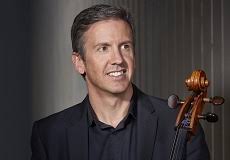
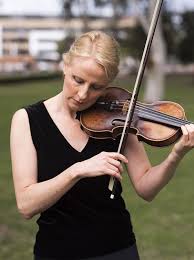
Anyway, it’s a real pleasure to have practised chamber musicians back on display, players who are experienced in the nuances of the format and who have some experience in collaboration from previous seasons.   The Melbourne Digitals have been well and good, in my experience, although more attractive in solo formats than in ad hoc collaborations.   But the mutual experience and the easy relationship between pianist Selby, violinist Andrew Haveron and cellist Umberto Clerici are shown in a trailer provided on the website as a substitute for program notes; even better, as these performers don’t have to stick to talking about the pieces that they are going to perform but can discuss the problems and delights of interpretation for every musician dealing with any work at all.   In this substantial preface (over 45 minutes), Selby acts as chairperson, asking her colleagues for their insights on specific questions, and Clerici shows himself irrepressibly voluble, even if sometimes he doesn’t finish his thoughts when his information outruns his vocabulary.   I don’t think Haveron opens his mouth until about the 12th minute.   But the material is well worth hearing – as it should be, coming from Sydney Symphony Orchestra principals and Selby with her impressively long-running career in chamber music.

A carefully shaped reading of the Mozart’s first movement is distinguished for its quiet assertiveness, reaching a delightful high-point at the short stretch between bars 45 and 48 where the strings play the second subject in tenths while the piano interrupts with piquant punctuation: the sort of moment that is brilliantly simple and here articulated without affectation – just another in the chain of spritzig throwaways that crop up across this score.   The truncated development ends with the smoothest of bridge passages from Selby whose melting from semiquavers to triplets just before the recapitulation gives us all a lesson in how to treat subsidiary matter with the proper respect.

Haveron’s timbre –  sweet, light on vibrato, not attention-grabbing – emerges clearly in the Larghetto‘s re-statement of the ornate first melody.   Another instance of valuing Mozart’s prodigality comes in the move to A flat Major at bar 57 where all three executants relish the innate eloquence of statement up to the return to E flat at bar 85 and another marvellously filled-out gift for the piano until the final bar.   As for the concluding Allegretto, here again is deliciously bright articulation, notably in the modulations at the movement’s core with barely a falter from anyone despite the rapid pace.   Sparkling clear in nature, the whole movement.

I’ve heard Selby powering through the first Beethoven E flat Piano Trio on several occasions in varied venues.   Her approach has become more sprightly, less determinedly full-frontal over the years and the result has been a honing of the score’s impressive continuity of action and thought so that the final impression is of assured deftness.   You notice her delivery subtleties more easily, like a momentary hesitation in the keyboard during the bar 146 syncopations.    To its high credit, this reading is devoid of silly games like unnecessarily inserted hiatus points; here, the complete consort dances together, Haveron a discreet presence, the two strings pretty much consistent with Selby’s definite downbeats.

Although the piano announces the Adagio cantabile‘s melting first theme, the action really gets under way when violin and cello embark on an affecting series of duets – well, a long duet with a few interruptions – that stick to their emotional last, giving delight on every page with Haveron’s eloquent phrase-shaping and Clerici breaking through the sonorous web with unflustered assertiveness.   Similarly, you would be hard pressed to find fault with the Scherzo‘s delivery; right from the start, the players demonstrate their mutual fidelity with those unisons/octaves from bars 8 to 16.   Here, you’re struck by Haveron’s precision and bounce as an incidental character across the second half of this segment.  Sensibly, the ensemble maintains the same tempo for the Trio rather than signposting the change of key as a mood swing, like other groups with less trust in Beethoven’s unshakable doggedness.

Most impressive about this Presto finale is its buoyant perkiness, largely due to Selby’s interrogative right-hand 10th leaps: the movement’s signature gesture.   And all three players keep up the humour without pounding or lumbering, best exemplified in the passage from bar 76 to the end of the first half during which the action hots up while the note values shrink.

Dvorak’s Trio No. 4 finds these musicians in full Romantic flow with an ardent. knock-’em-down assault on the scene-setting Lento maestoso, Clerici in particular happy to play front-of-house.   Selby drowns out her partners in the chromatic chord movement that concludes the first section of the second movement Poco adagio, even if you find no deficiencies in the faster Vivace parts of these opening parts to this colour-rich score.  A rare moment of disunity emerges in the strings’ response to the opening phrase of the following Andante; balancing this, the Poco meno mosso and its consequents sees violin and cello in excellent empathy, their output both mutually supportive and expressively empathetic.  In fact, the return to A Major just before the final Andante gifts us with the most moving moment in this interpretation: deeply-felt music played with admirable sympathy and insight.

Selby moves into supporting, almost self-effacing mode for the fourth dumky Andante moderato, emerging quite politely from retirement for the scherzando breaks to administer a fitting skittish tone to proceedings, then falling back to support the cello’s calm melody outline.  For the ensuing Allegro and its idiosyncratic oscillation between 6/8 and 3/4, the three musicians make a full-bodied shift into Dvorak’s skald-like narrative, the lines intensely strong at the violin/cello canons when the upper string begins playing arco.  Again, in the final Lento maestoso, we are offered another dark story with Haveron producing a powerful vibrato during the mid-movement slow interlude on the G string.    Still, the canvas here is a taxing one, difficult to negotiate without bathos or overkill and an ordeal for the pianist; Selby handles its leaps and twists with admirable security, only an occasional missing left-hand note disturbing the movement’s vital scenario.   You have to admire the remarkable fluency of the C Major prefaces to the final two Vivace stretches and the players’ escapes into vivid action.

No, it’s not the same as being there and watching a live performance.   But, in these non-piping times of enforced peace, close-to-current recorded readings on film are the closest we’re going to get to hearing our professionals at work.   And this is not a doctored CD set of interpretations.   What you hear on this site  (and at least one other) and can enjoy over and over until May 12 (not so on that other one) has to work as a momentary (!) substitute for the real thing.   I, for one, am delighted to have these on-line recitals available and will take them in good part until we get back to normal – a putative date for which seems to matter less to the government than the return of professional rugby matches and the opening of that vitally important indicator of a vibrant, socially undistanced society: tattoo parlours.

Fine performance in there somewhere

BEETHOVEN VIOLIN SONATAS PART 5

Markiyan Melnychenko and Rhodri Clarke

Melbourne Digital Concert Hall

Friday April 24, 2020

                                                                             Markiyan Melnychenko

This evening recital marked the first disappointment (for me) in the series run by Christopher Howlett and Adele Schonhardt.  In one sense, it might have been so not because of what we heard but what we didn’t hear.  On the program were two violinists – Kyla Matsuura-Miller and Markiyan Melnychenko – both to be accompanied by pianist Rhodri Clarke.   As far as I remember, Matsuura-Miller was on board to tackle the Beethoven Sonata No. 2 before Melnychenko went on to account for the Kreutzer No. 9.  Sadly, the former player was taken ill, so we were left with a one-work program.   Well, you can hardly complain about this misfortune in our challenging climate, although patrons have been assured that we will get to hear the earliest of the composer’s sonatas in A at a later stage in this increasingly ambitious series.

The Kreutzer is a complete world in itself, of course, and swamps its fellow-passengers in Beethoven’s violin sonata output.   Most chamber music addicts cling to the concept enunciated by some clown (Goethe?) of a string quartet as ‘a conversation among four intelligent people’; outsiders like me think of a quartet as a contest, a continuous series of assertions that have to be slotted into each other, an ongoing carefully ordered alteration in supremacy.  Yes, the results can be mellifluous, yet the string quartets that stand out in the memory are those that resemble an intellectual conflict – even in Haydn.

Much the same can be said of piano trios and violin sonatas, especially this one.   I played the piano part for it many times in younger days, usually partnering a violinist with much more experience of the score than I brought to the table.   But no matter how many times we worked through it, I was always on edge; not just because of the technical requirements which simply deepen as the score progresses, but also because of the multiple decisions about what goes where and why a particular attack should be chosen and not another way equally as feasible.

Beethoven sets up this tension right from the extraordinary opening with the two instruments playing solos that eventually interlock at bar 11.   Once the tempo changes to Presto, the work moves into competitive mode and not even the individual highlighting of the middle movement variations nor the major key optimism of the tarantella finale can detract from the sonata’s consistent grappling for attention.

Melnychenko did not have the happiest of starts, encountering some trouble with the two simple double stops in his first bar which wavered unnervingly.  When he and Clarke got down to the first movement’s real business, the string line still sounded nervous; thanks to the exposition repeat, the combination began to assert authority over these active, dynamically fluctuating pages with some splendid slashing strokes from the violinist from bar 61 onward and an urgent drive from Clarke’s quaver underpinning after the piano’s C Major cadenza.

This violinist can spin a splendidly fine line in slow, lyrical passages; for example, the second subject – that unfinished E Major melody that slows the compulsive rush into a chorale –  came over with a disarming warmth, as sweet as Ferras in his prime, and meeting the composer’s requirement for an emotional and technical oasis in the heart of a fiery narrative.   Clarke showed willing from the start, inclined to overdraw his dynamics with a powerful delivery of every sforzando and an interpretation that saw a fortissimo in every forte.   Only a spot of fluster in the flat-littered contrary motion territory around bar 229 marred a reliable output from the keyboard part, at this point treated with fitting vehemence.   Whether it was quite appropriate at every stage for this partnership dynamic is another matter.

Nevertheless, we could relish the melting moment in the recapitulation of the second subject starting at bar 412: 26 bars of refined articulation from both executants.   Only a spot of fumbling around bar 467 marred an engrossing rounding-out of this movement.

Clarke did excellent service with his establishment of the second movement’s material, demonstrating a no-nonsense approach to the Andante direction and finesse in giving each of the inner lines its value in the chordal progression.  Both players collaborated in some subtle tempo tightening and easing during the initial statement before moving into an agreable first variation, which only suffered a few absent bass notes as Clarke worked hard to be discreet.    Variations 2 and 3 proved exceptionally fine: crisp in the first, then sombre with no decrease in rhythmic impetus across the latter.  The last of the variations found the pianist over-anxious to exert hegemony in pages where there is –  for once  –  no competition, least of all from Melnychenko’s occasional pizzicati contributions.  Still, the coda exemplified the best qualities that emerged every so often from this partnership: unanimity of direction, awareness of function, consonance in attack and dynamic.

Unfortunately, only a little way into the finale, you could hear that the combination had turned lop-sided.   While the articulation rarely faltered and both players had resolved on a weltering speed, the piano proved too emphatic and insistent to sustain the postulation that this was a conversation.   For instance, at bar 86 where the violin is genially bobbing around on its two lower strings, Clarke was hammering out the D Major theme as though he were engaged in a Brahms concerto.  The sforzandi that start bars 109-11 proved to be not so much emphases but power-punches.  Later, the lead-in to the two Adagio breaches near the end found the piano burying the violin in heavy fabric.

Sadly, this conclusion coloured your perceptions of the entire performance.   It would be unwise to assert that these performers were mismatched – they achieved some fine passages of play – but the result all too often sounded one-sided.   You can’t expect towering, steely lines from Lviv-born Melnychenko; his sound-quality is pointed and refined and is not capable of rising above a very forceful background or support.  It may be that these artists had no chance to calculate at any length the acoustic parameters of the Athenaeum Theatre auditorium.   At all events, this Kreutzer presented as rather imbalanced dynamically.  I’ve plenty of respect for both musicians but this was only an occasionally successful attempt at a taxing musical challenge.

A wide-ranging revelation of self

PRTZL

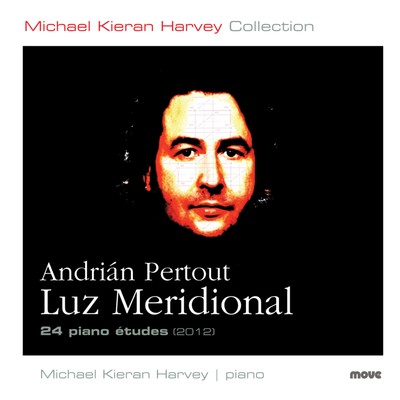
Michael Kieran Harvey

Move Records MD 3447

Wherever you look, you come across Harvey’s name.  He’s omni-present in Australia’s musical landscape, even if he makes his home in Hobart (there’s a bit of mainlander snobbery for you).   For years, he has been a fiercely prominent standard-bearer for contemporary music – Australian and otherwise – with an ability to play anything written for his instrument.    Yes, he can occasionally be heard playing mainstream repertoire, if you’re lucky enough; at various times and places, I’ve watched him perform Chopin and Bartok, Brahms and Beethoven, usually to my enrichment.   Further, I’ve seen him improvise at some long-forgotten (by me . . . more repressed than forgotten) spot in Fitzroy, sweeping an audience up with overwhelming, seemingly endless cataracts of notes.   As well, he has collaborated to splendid effect; in my experience, with Slava Grigoryan, both live and on disc.

As a composer, Harvey is well-represented in the Move catalogue, sometimes juxtaposing his own works with those of other Australian writers.   On this CD, however, it’s all Harvey  –  compositions and performances  –  playing both solo and alongside some new- and long-time collaborators.   Leading the piano solo works is the solid Piano Sonata No. 4   A. Gramsci of 2018, as well as a Module Fugue from the same year; a Divertimento originally written by Anna Amalia, Duchess of Braunschweig in 1780 for a mixed quartet of piano, clarinet, viola and cello, is here arranged by Harvey for piano alone; in this disc’s title work, Harvey uses two pianos – one grand, one electric – during which he seems to twist himself into that shape suggested by the title, although why the word loses its two vowels seems odd – but then, Cage and Lejaren Hiller did much the same with HPSCHD over 50 years ago.

Harvey presents three duos: Astro Labe, Coeur de Lion for electric piano and synthesizer (Harvey plays both) and trumpet Simon Reade; Tubby the President with Reade taking up the baritone horn; and Gestalt Climate for two pianos, Harvey in harness with wife Arabella Teniswood-Harvey.    Then you find two trios: a salute to Deep Purple’s John Lord in Deus est Fabula for violin (Tara Murphy), clarinet (Derrick Grice) and piano (Harvey); Toccata DNA in a version for flute (Peter Sheridan), percussionist (Peter Neville) and piano (Harvey).   Last of all comes a quartet – Aporia II – for three pianos (Harvey, Teniswood-Harvey, Erik Griswold) and percussion (Vanessa Tomlinson).

On Disc One, the Gramsci-inspired sonata takes up most space  –  almost two-thirds of the total area.   On the second, the tribute to Lord, Deus est Fabula, lasts longest, with the toccata coming in a worthy second.   Two related pieces – Astro Labe, Coeur de Lion and PRTZL – are the briefest, both about 2½ minutes each.   To my mind, there is one anomaly among the ten works expounded – the satire on Trump which wears out its welcome, even though anyone with a brain would sympathize with its intentions.

The album’s opening track, Module Fugue, impresses for its rapid-fire elaboration on the notes E, B and F which provide the fundamentals across the piano solo’s length.   These three notes would be the module that Harvey uses for intervallic and transpositional exercise; as for a fugue, there’s little here that brings to mind your concept of that form, although the composer/pianist does insert a small fughetta near the end but it serves as more of a slight episode in the course of this construct, one that looks sensationally difficult on paper but which sounds  –  in patches  –  mellifluously fluent in the realization.  Actually, ‘slight episode’ does this brief fugal passage poor service as it acts as a momentary and slight brake on the fierce action that precedes and follows it.

The piece is full of excitement across its breadth, right from the scene-setting right-hand sextuplets that start the action.   In fact, the work falls into two parts: the first, piled high with crisscrossing meshes typified by irregular gruppetti, irregular arpeggios, irregular rhythmic displacements, irregular time signatures – all depending on your definition of ‘irregular’.    In this instance, the sonorous web that Harvey compiles is  volatile, but moderately so compared to what comes at bar 66 when we reach a stage where the underlying three-note motif becomes the basis for a percussive chord- and rhythm-play, intensely invigorating and packed with the composer/pianist’s delight in alternating time-signatures – 3/4 becomes 5/16, 6/16, 11/16, 7/16: all semiquaver-based but the balance is asymmetrical so that toe-tapping jazz enthusiasts (for instance) would be completely at sea.   Harvey allows himself some liberties with an unscheduled pause here and a disinterest in his own designated accents there; yet, as every time when he gets the bit between his teeth, the pianist carries you breakneck past his mini-fugue and into a rip-roaring torrent of fabric.

The Sonata No. 4 begins with a statement of Gramsci’s name where R is represented by the note D, M by F, S by E flat, and I by B.   I can’t trace how these equivalents were reached but here they are, initially articulated by across-the-strings glissandi.   Some under-the-lid work emerges quickly, but not for long; in fact, manipulation of the strings disappears until near the sonata’s conclusion.   The aim of this first burst of activity is to solidify the seven-note Gramsci-name sequence through harmonic manipulation, a potent bass statement, and – after a pointillist 8-bar flurry – across a firm double whammy in alternate hands before it is subsumed into the work’s contrapuntal workings-out.

From these initial statements on, the seven-note aggregation returns en clair throughout the one-movement sonata’s length, yet you find plenty of distractions/disguises to move the work out of the realm of spot-the-row/inversion/cancrizan games.   But then, I’m slow in realizing a good deal of what development on this scale involves, to the point where it took me several hearings to appreciate how much of the sonata is set in 7/4 or 7/8, and that the first of the many chord clusters that crop up comprises 7 notes.   You can get carried away with this sort of 1950s detective-style analysis, no matter how simple-minded, especially when other features impress so vividly, like Harvey’s fluency with two part invention-style writing, the jumpy energy that breaks in at the Vivace of bar 272, and the ensuing placidity of isolated notes placating the listener and leading into the timeless string glissandi of the last 25 bars to the sonata.

Why Gramsci?   Harvey identifies with the anti-Fascist Italian philosopher’s trademark theory of cultural hegemony, in which the rich have taken over the incidentals of  aesthetic practice –  to be specific, in this case, the piano.    By using the instrument at the opening and close of his sonata in an anti-bourgeois mode, the composer is making a statement about the abstraction by a wrong-minded class of a cultural symbol which can be reprogrammed by changing its use.   OK: I’d go along with that, as long as the inside-the-lid brigade had the same intention – Cowell, Cage, and the rest of the crew.   But it’s improbable that they all march to the unheard beat of a Leveller’s drum.  Not that it matters over-much: Harvey is exemplifying the essential re-allocation of resources that so appalled Il Duce, setting the theory as his sonata’s alpha and omega.   The manifesto is at the edges; to my mind, the true interest lies in the exuberant working-out in the middle.

As for the two-movement Divertimento by Duchess Anna Amalia, this is a fairly straight reduction of the original work with the interesting parts of the non-piano lines incorporated into the keyboard part.   Before, during, and after the noblewoman’s polite work, Harvey indulges in some extemporisations – not long, but energetic to the point of frenzy, sort of putting the 18th century inside a contemporary cocoon.   The repeats are ignored and Harvey goes in for a continuous accelerando at the end of the Allegro second movement, which all sounds as though he’s tired of being polite and is rushing towards his end-of-track explosion.   As well, he allows several wrong notes to survive on the recording, which can be interpreted as uncaring or bringing the music down to earth.  It’s an odd adjunct to this collection and makes no pretensions to much beyond the status of a slight bagatelle.

PRTZL represents something similar.   A player sits in the middle of two pianos (one electric, one grand) and swivels between both – sort of.    The work begins with one instrument, the other joins in pretty quickly, they alternate with bewildering rapidity and are joined by a drum sequencer about 4/5ths of the way to the end.   Even with the score and a pretty decent sound system, I found this hard to follow; after an orthodox start, the player seemed to be following  general contours and, although I knew two keyboards were involved, both timbres combined so that the desired result was achieved and perceptions twisted into a pretzel shape.   You’re not exactly bamboozled but your sense of shape is left in disarray.   Still, Harvey is noted for his individuality: not just putting a fresh lick of paint on works, but indulging in a spot of angle-grinding and radical planing as well; if he wants to do so in his own constructs, it’s essentially his call.

This work is dedicated to Hobart lawyer Craig Mackie.  The unkind among us might see the work as a reflection of the twisting and mental contortions that the practice of law requires, or the necessity on the part of a successful legist to keep several balls in the air simultaneously, never mind about juggling them.   Harvey admires Mackie, not least for his representation of Astro Labe aka DJ Funknuckl who was charged with head-butting then-Prime Minister Tony Abbott on September 21, 2018, for which act the penalty was 6 months’ jail with a minimum of two.   It might be an over-reach, giving Astro Labe the sobriquet of Lionheart, especially as the assault was not occasioned by Abbott’s disregard of the national majority’s feelings concerning marriage equality or by any other of the Prime Minister’s blind spots in social logic, but rather by a general sense of offence caused through the presence of the man himself – rather like the reactions among the population of Cobargo when Scott Morrison showed up.   Would you headbutt him, though?  Well, I wouldn’t take on an Oxford Boxing Blue, especially if you were stupid enough to square up to him properly.  Giving a Liverpool kiss might have satisfied your sense of hubris taken down, but it’s not brave.

The piece itself is mainly an electric piano solo; another of Harvey’s rhythmically compulsive drives, mainly in 7/16 with forays into 4/4, and it hurtles past with superlative performance finesse.   An ad lib short break for synthesizer drums is interrupted by two tritone-forming trumpet notes in the distance, and a high trill before a synthesizer bass explosion and, finally, the sound of a bird tweeting.   It’s obviously a tribute to the titular hero and may reference his DJ career; as a character study, it proves inviting but inscrutable.   Recorded at a live performance, the bird-song conclusion raised some laughter.

That deals with the first disc; the second is all collaborations, the first of them the variant on Kleinsinger’s Tubby the Tuba.   In its original form, the work was a piano/tuba duet, but here the brass instrument is a baritone horn (Simon Reade) which manages the original line with a few octave transpositions.   Its opening suggests The Star Spangled Banner but that melodic contour disappears quickly as the work follows its sevenfold path: Come un imbecille; Ritmico, ma come una personna che non sa ballare; Twittare a mezzanotte; Rubato, osservato una giovane donna; Pesante, inferocito; A tempo, i farmaci per i cappelli stanno funzionando di nuovo; Coda, la vendetta di Melania. Some of these divisions live up to expectations; most are impenetrable, like the last section of all.  To ram home the message, Trump slogans – Fake news, Grab ’em by the pussy, Bad fire-fighter – are called out at certain points.   But the satirical intent remains obscurely expressed.   Not to mention the difficulty in finding material in a person who is a booby beyond the comprehension of Dryden and a yahoo mentality that might have confounded Swift.  As America is finding out with each passing day, the reality cannot be satirized: imitation is the only coping mechanism.

More serious intentions underpin Gestalt Climate where human interference with nature to the latter’s destruction is epitomized in the adjunction of two separate but internally connected sets of material.   Harvey performs a version of his own Module Fugue in which the various elements are revisited, sometimes literally.    In opposition (?) to this stream, Teniswood-Harvey imposes 3, 4 and 5 note chords (the first comprises the B, F and E source mini-row of the earlier work) and isolated interjections derived from the Module Fugue.  This might have worked more effectively if the second piano part had been more assertively written; as things stand here, Harvey wins all the attention, playing a mobile, dynamically volatile role while his partner is subsumed into the welter.

The pianos are treated as independent, although their parts are spelled out.  In the piece’s centre, they operate on different time metrics, so that the first piano occasionally waits for the other instrument to reach some sort of tempo parity.   Not that this matters too much as little relief is built into the first piano’s part.   Indeed, the temporal disjunction serves as a clear sign of the composer’s main proposal to do with ‘the concept of Gestalt prägnanz‘, so that the message comes across in aphorisms rather than paragraphs, especially as the work reaches its final stages.   While its premise is laudable –  to expound the huge problem between what we do and what we need to do  –  I’m left in an interpretative bind: the state of affairs presents as fast as well as furious, which could be the march of progress turned into helter-skelter, and the countermeasure speaks with inexorability as a possible triumph of nature or a Big-Bang Apocalypse.  Harvey’s work speaks in a language that is vital and anxious to a high degree; an uncomfortable if salutary experience.

Jon Lord’s name means very little to me and, I’d suggest. my generation.   His work is very close to Harvey’s heart; the Australian pianist gave the English composer’s solitary piano concerto its premiere performance in 2003.   In Deus est Fabula (God is a fable, Lord is a legend – take your pick), violinist Murphy and clarinettist Grice work work in very close quarters with Harvey through a score that has some of the most complex rhythmic structures and displacements I’ve seen since early Stockhausen.   The major part is as closely argued as you could wish, with some intervening duets for the viola/clarinet combination, and some splashy solos for Harvey.

By this stage, you should be getting used to the composer/pianist’s inventive tropes:  smashing alternating-hands chords, sustained pedal washes of remarkable power, time signatures that favour semiquaver patterns, unusual groupings like quintuplets and septuplets, delight in imitative part-writing (sometimes even for piano in this score), directness of utterance with little room for mawkish self-examination, bursts of syncopation that suggest bebop but defy analysis (Brubeck with his Take Five and Blue Rondo a la Turk are Stone Age vintage compared to this).   The trio is divided into your classical four movements, in a way: yet the piece presents as one movement.  The first division is marked with the Satiesque Credulita, con rubato; then comes a more ordinary Moderato espressivo, followed by Ossessionato, winding up with an almost predictable Impietosamente.

In terms of material, Harvey writes that his trio is based on the first seven prime numbers: 2, 3, 5, 7, 11, 13, 17.    These numbers can certainly be found in the piece but are of little help in piecing together the work’s progress.  By the way, even a tyro at this game can see that the first three bars of solo piano contain all twelve notes of the chromatic scale.   What you hear is a strident sequence of declamations involving all three instruments in solo or combinations before an abrupt launch into one of the composer’s trademark ritmico passages, everybody loaded up with tempo and range problems before the Moderato is reached and the instrumental interplay becomes less angular.  A brief Infuriati explosion of one bar leads to the slow-moving Ossessionato where the pianist operates on the strings, the clarinet enters into this new world with multiphonics, while the violinist indulges in a bit of overpressuer or grating sound production.   The players eventually reach the final merciless section which lives up to its name by sustaining a sonorous barrage to the end.  You can hear – even if you have a very limited knowledge of Lord’s output – how Harvey  hymns the fiery determination and bravura of the rock organist’s performance, if here transmuted into something more complex and intellectually challenging.

Deus est Fabula, written in 2014, is the second-oldest piece in this collection of scores which come mainly from 2018 and 2019.   The oldest track is of Harvey’s celebrated 27-years old (can you believe it?) Toccata DNA – originally for piano, and soon after appearing in this trio format; the work was subjected to further revision three years ago.   On this pressing, the toccata is a triumph for all involved, a marvel of synchronicity and a startling internal transition from a simplicity that is almost tonal to detonations of agility from each sound source – which, in Peter Neville’s case, is quite a few.

In format, the piece follows the segmented tradition that stretches from Buxtehude to Khachaturian,    It opens with a flute-piano duet that sets up a semitone nexus and shortens its note values to increase the activity level until a unison segment with shifting time-signatures leads into the active second part, the marimba establishing a a fast pattern of sextuplets with the piano revisiting the grave semibreve/minim ambience of the opening bars.   A new phase, Flowing, brings all three instruments into play together in what eventually turns into an atonal chorale with florid, complex surrounds.  The work reaches its apex with an extended Giusto sequence, piano dominated and most exciting with its ostinato bass strides and right-hand clusters.

Harvey points to two sources for the toccata: the opening segments derive from the Art of Fugue as reinterpreted by organist Gerd Zacher;  the second part hales from territory claimed by the now-40-year-old group Einstürzende Neubauten, specifically the song Z.N.S. – you can find it on YouTube although its relevance to the toccata is difficult to perceive.  But then, even when you’re given pointers like these, you probably do best to take them as indicators that may not travel beyond the personal; for example, others see Bach but I see Boulez, or someone cites German industrial rock where you hear Mosolov.   If this information proves counter-productive, listen to this reading of the toccata and revel in its helically interweaving strands as well as the pin-point accuracy of the work’s executants.

To end, the quartet Aporia II moves us into a time-honoured realm, that of the controlled aleatoric.   The title refers to a state of doubt – not just about the nature of truth in philosophical discussions, but also to what you think is happening now.   Harvey’s performers divide into two tribes – percussion plus keyboard, and two keyboards –  who respond to an initial stimulus, in 2-minute time limits.   Now, it’s always worthwhile being aware of how something musical works, particularly in the vexed continuum of form.  But, as Schoenberg (if not his followers) insisted, you don’t have to bear this knowledge at the front of your mind when you listen; it’s primary information, but it’s not primary to the experience, pace Die Reihe and all who sailed in her.

What of Aporia I?   That’s the work title for Harvey’s Piano Sonata No. 3 of 2016, in which he attempted to deal with a form of this uncertainty principle.   By contrast, this present work tenders a bare-bones explication.  The piece has four sections – pianissimo, forte, pianissimo again, fortissimo leading to a brief coda that diminishes into silence.   The initial material for improvisation comprises the notes C, A, G, E, D which also provide the coda’s elements.   Section 2 introduces B, F and C sharp alongside the existing pentad.  Section 3 brings into play the missing notes from the chromatic scale: B flat, A flat, G flat and E flat, while Section 4 is a free-for all on all 12 notes.   The player’s entrances are staggered in each part, although all are involved at a bar’s distance (each bar is a 4-second unit) from the start.   It makes for a welcome mobility for the performers, and just as welcome a comprehensibility for the listener.

Aporia II makes for a clever conclusion to this album.   It’s the most ‘adventurous’ piece in the collection, reliant more than any other on the creativity of each performer, and it represents the most challenging foray by the composer into a field that is completely different to the other nine works that precede it, and it’s the most simply structured of them all as well.   There’s something of an open-air temper to Aporia II, even in Section 2 which brings to mind irresistibly the world of the gamelan, with a side-order of Debussy’s Pagodes.

My gratitude to Michael Kieran Harvey for his generous emailing of all the scores played on these two discs.   Allowing critics to have access to your work is a rare characteristic among contemporary composers.   It’s even worse with their interpreters.   My only previous experience of this generosity came from Daryl Buckley in the years when his Elision group was performing in Melbourne and from Peter Sculthorpe, fondly remembered.   This beneficence from Australia’s master-pianist made the act of reviewing his compositions a much more cogent enterprise than it could have been, no matter what you think of the results above.

\

All clear

BACH TO BACH

Calvin Bowman

Melbourne Digital Concert Hall

Sunday April 12, 2020

                                                                               Calvin Bowman

Over the years, some Australian musicians have put themselves forward  –  or been promoted  –  as front-rank Bach experts  and I’ve heard more than a few of them stake their claims with pretensions great and small.   But my vote for primus inter pares not (to mention inferiores) would be organist Calvin Bowman.   He first performed the complete organ works over a series of recitals in 1995, of which I heard a few on the Smenge instrument in St. John’s Lutheran Church, Southgate, Melbourne.   Then I dipped in and out of his presentation of the total Bach output for solo organ across one day/night in the Melbourne Town Hall: a singular event that brightened up an otherwise bland Arts Festival in 2009.   Finally, another complete one-day rendition took place at the 2018 MOFO in St. John’s Church (Cathedral?), Launceston.  A further run-through was planned across several recitals this year in St. Andrew’s Anglican Church, Brighton where Bowman is organist, but that’s been delayed for obvious reasons.

Much of the music for this Sunday night all-Bach recital was for harpsichord originally, although a smattering of organ pieces arrived by way of transcription/transmutation.  Bowman opened with the C minor Fantasia BWV 906 without its attendant fugue, hurtling into the opening arpeggios with gusto and clarity, saving his sustaining pedalling for the mood swings at bar 9, and later at bar 25.   I was elated by the sense of purpose that obtained in the chromatic complexes at bars 14-15 and 37-38, as by the drama released in the concluding statement that begins at bar 34; the whole, a terse construct eloquently brought to life.

Written for lute or harpsichord, the Prelude, Fugue and Allegro BWV 998 is a keyboard favourite that has led many an interpreter into excess, particularly during its opening pages.   Bowman played its first part straight: completely unadorned, letting the meandering right hand speak its part without deviation with only a slight mis-speaking at about bar 34.   The fugue enjoyed a similar uncluttered statement, the sustaining pedal only employed when the semiquavers started in earnest at bar 29.   In fact, Bowman showed himself more than assured enough with the interweaving part-writing to need little help in imposing sense on the movement’s progress.    Nothing major marred the progress of the concluding segment beyond some short, sharp signs of fatigue in the final repeat of the piece’s second part – blips on a serene surface.

A dislike of the Italian Concerto BWV 971 stems from my experiences of its first movement which a teacher constrained me to master in 1960.   The encounter was unpleasant (as is much knowledge gained for exam purposes only) but it gave me an admiration for pianists who can handle its intricacies with at least an appearance of enjoyment.   Bowman bounced through the opening pages, sure of his direction despite some passing treble uncertainty in bar 105; but the whole central part of this movement is an outwardly optimistic, inwardly bedevilling melange and even this gifted musician looked and sounded relieved to come back to clear water at bar 163’s restatement of the opening sequence, the tempo slightly increasing and the delivery buoyant.

Bach’s middle Andante movement found Bowman unafraid to employ rubato and showing a welcome tendency to give the right hand’s long stretches of action a good deal of liberality; no strict lines or rhythms here, the player heightening or lengthening notes to emphasize the piece’s idiosyncratic progress as in bars 30-31 where the syncopations proved notably unpredictable.    Just as tellingly, Bowman eschewed the temptation to use the repeated pedal Cs and As at critical points as hammer blows or portents of doom; they remained simply part of the sombre undercroft to the treble’s extended arioso. Because of the clarity of finger-work, some errors enjoyed unusual transparency in the Presto finale.    Yet, at those stages where the action cuts back to two invention-type lines, the performance gleamed: such interludes  –  between bars 25 and 52, 77 to 96, 155 to 173  –  showed spirit and vitality through simple textural contrast.

With the Fantasia super Christ lag in Todesbanden BWV 695,  Bowman moved back into organ territory, although this piece does not require the pedals that are eventually required for the BWV 718 chorale prelude on the same hymn tune.   This work came over with convincing fluency, the alto-situated chorale processing through the two outer lines with unruffled poise.   Many an interpreter treats Nun freut euch, lieben Christen g’mein BWV 734 as a toccata, with all attention on the treble semiquavers; organists have a better time of it with the tenor melody given to the pedals, but a good pianist can give an informed account of it if the music’s purpose is kept in mind.   I might have preferred Bowman to have taken it a tad more quickly with less four-square stolidity and more use of the piano’s subtle expressive powers, but the end result was jaunty enough, a celebration rather than a race to redemption.

The recital concluded with two arrangements for piano.  The first by Bax of the G Major Fantasia for organ BWV 572 omitted the opening 27 bars and the closing 17 bars.  Admittedly, these are peripheral to the work’s main content: a massive five-part contrapuntal exercise in extended chorale shape that the British composer reinforced with doubled pedal/bass notes and aimed for slight relief from the original’s massive weight by moving the treble up an octave at about bar 104 of the original score, if only for a short while.    Bax also cut out a few bars at the end to give the extract a solid concluding cadence.   All very well as an  exercise but it struck me as heavy going; yes, so is the organ original which is Schweitzer-monochrome in character but the duration of notes in the counterpoint is not compromised, as it must be in a piano treatment.

To end, we heard Max Pirani’s transcription of the 21-bar-long middle Largo of the F minor Harpsichord Concerto.  This is the flip side to the D minor Andante from the Italian Concerto, here labelled Arioso and a much more orthodox melody.   I think it has been transposed up a semitone from its original A flat Major and Pirani fleshed out its length by repeating the first 6 ½ bars.    Some of the right-hand figuration was left out, as were the final 2 or 3 bars – just the same as Bax’s transcription preceding this.  So Bowman chose a pleasant encore piece to conclude: nothing challenging or profound but, in this treatment, appealingly Romantic in timbre.

Certainly, it’s a kind of Bach performance that appalls purists but appeals to pianists who, across the past 270 years, have been unable to leave the composer’s output alone.   Do we need to hear these revisions?    Well, they don’t hurt anybody if they’re carried out with discretion and Pirani has been more careful than most to leave the work close to intact.  Furthermore,  it’s easy to put this sort of thing together and easy to play; not as jejune as Switched-On Wendy Carlos, but not as memorable as Webern’s Ricercar mutation.

It was beyond the reach of this series to have Bowman play an organ; performers are currently limited to the stage of the Athenaeum Theatre and to a minimum of human interactions during their work.   This recital served as an illuminating witness of the Melbourne musician’s encounters with Western music’s father-figure, but such an experience only tells part of the story.    We can but hope that next time Bowman might be able to give us a fuller display of his remarkable insights, albeit from a well-sterilised church.

A long goodbye

SCHUBERT FROM BEYOND: THE LAST PIANO SONATA

Kristian Chong

Melbourne Digital Concert Hall

Friday April 3, 2020

                                                                                 Kristian Chong

For his recital program in this worthy and welcome series, young Australian veteran Chong put most of his interpretative eggs into a Schubertian basket, giving us a reading of the final B flat Sonata that came off successfully, chiefly because the pianist knew exactly what he was about, particularly in his reading of the lengthy opening Molto moderato.  You might have asked for a more relaxed slow movement or for less force exerted during the Scherzo; still, it’s a work that speaks to many people in different voices – Richter, Brendel, Curzon, Radu Lupu for me –  and its emotional breadth is so vast and flexible that it accommodates many readings.

To clear his throat, Chong began with two short pieces that have spoken to him across his career.   Siloti’s famous transcription down to B minor of the E minor Prelude from Book I of Bach’s 48  rose to its high point in bar 15 with careful attention given to delineating the alto line melody, as well as a supple diminuendo from the point where the arranger starts spelling out the specific spacing of his left hand arpeggios.   So far. so fine, if a terse entity without its simple 2-part fugue.

Chong has had notable success with certain works by Rachmaninov: the C minor and D minor Concertos, and the Paganini Rhapsody, as well as the Op. 32 Preludes, which he has made part of his public repertoire for at least a decade.   In particular, the pianist has a predilection for the B minor Prelude, No. 10 in the series.  From where the excitement ramps up in bars 18-19, this performance took on a fine authority with an authentic clangour to the weighty chain of thick chords in both hands, the peroration sinking quickly before the change of texture at Rachmaninov’s L’istesso tempo direction

Similarly, Chong’s subterranean fervour in the bars preceding the cadenza demonstrated his control of the prelude’s structure, tension coming from the inevitable progress towards a rhythmic dissolution as well as a brilliant variation of light and shade, tension and resolution, action and hiatus.   I could have done with more spikiness in the right hand during the cadenza where brisk separation brings some welcome glitter to the work’s overall sombre surface.   But the final reminiscence, in particular the last five bars, rounded off a formidable reading of this piece’s gloom-laden pageant.

Schubert’s final sonata has been appearing on Chong’s recital programs for about six or seven years; you can be quite sure that he knows what he’s doing with it.   Or. at least, he has an informed insight regarding its interpretative challenges.   The work has been over-stressed with insights that range from the incisive to the fanciful, this composer being subject to almost as much formulaic type-casting as Chopin; the creators of Lilac Time have  done Schubert as little service as the brainiacs who devised A Song to Remember, or Magic Fire, or Song Without End, or the truly execrable Song of Scheherazade,  But, while you can find some excuses for the cinematic/musical excesses of certain screen biographies of composers, Schubert has been sentimentalised to an extraordinary degree over the past century.

I remember Michael Easton giving a pre-recital talk for Musica Viva in the stalls foyer of Melbourne’s Hamer Hall and being almost physically assaulted by an elderly patron who was incensed at Easton’s observation that Schubert had contracted syphilis about six years before his death.   This tends to undermine the patina of refreshing wholesomeness that surrounds the composer of Who is Sylvia?, Hark, hark! the lark and Standchen.   But can the disease’s physical destruction be called on to explain the subterranean trill in bar 8 that recurs during the Molto moderato and represents . . . what?   The threat of mercury?  Or simply an intimation of mortality?

Whatever your view, this sonata is not so much a technical mine-field as a long-running test of coherence, presenting pages of long paragraphs as a continuum, rather than a juxtaposition of discrete segments which isn’t helped by a series of pauses/fermatas that punctuate the flow.    Chong’s outline of the opening movement’s exposition proved intelligent – a fine line walked between restraint and excitement, as in the gloves-off exhilaration of the move to F sharp minor at bar 48.    He let the tension sag around the interrogation marks at the bar 110 mark but – wonder of wonders – he then took the first ending and repeated the exposition: something I haven’t heard in years.

Through the development, you could not fault the performer’s drive, finding purpose in the triplet pattern and the build-up to calm waters at bar 173.   Even so, a few final quavers of the triplet pattern tended to disappear, not quite sounding or swamped by left hand action.   (As at a previous recital of this series, at this late stage I discovered that the A above Middle C was slightly off.)   At that pivotal bar 173, we could have done with more dynamic cut-back to signal the move to a D minor oasis.    But the escape into the recapitulation at bars 215-216 found just the right ambience of relief in two senses of the word – contrast and relaxation.   Further, Chong treated us to an especially gracious conclusion, the main theme’s final appearance and transformation an excellent passage, the concluding four chords eloquently placed and articulated.

We’ve grown used to quite slow second movements as even great interpreters tend to linger over phrase/sentence climaxes.   Chong centred more on the Andante direction than the sostenuto  –  quite acceptable, particularly if you want to avoid overdoing the pathos (if you think it’s there).    Matters proceeded very well up to bar 408 where the right-hand alto triplets could have been accounted for with less deliberation; here again, a few of these supporting notes went missing, possibly because of the rate at which Chong was going through them.   Nevertheless, the return to C sharp minor at bar 447 reinforced your realization of the pianist’s arching overview of the movement, with a sympathetic subtlety in the heart-stopping move to C Major 14 bars further along.   An avoidance of indulgence also obtained at the final key signature change which quite a few players treat as a Debussyan shimmer, but here you could admire the unabashed across-the-bar sustaining pedal work in this final section where the forward motion is blurred intentionally and the music aspires to a benevolent sonorous halo.

As for the Scherzo, Chong punched his way through it, slamming with unexpected ferocity into bar 530: those right-hand arpeggiated chords have rarely sounded so abrupt.   No troubles with the minor key Trio which asks for heavier-handed emphasis, but you’d expect more sparkle in the movement’s outer pages which are distinguished for their swift delicacy, not any inbuilt force.   In the finale, the interpretation mirrored the first movement in its consistency of attack, despite the more overt shifts in material treatment and abrupt punctuating breaks.   Chong’s handling of the syncopated left hand quavers between bars 220 and 235 appealed for its lack of jerkiness and made you look forward to the pattern’s three recurrences.    More pounding distracted for a while from bar 375 where both hands are well occupied but not necessarily competing.    Once again,  as with most other readings, the final 27 (28) presto bars were given pell-mell handling, sense sacrificed to speed.   Chong is by no means alone in taking this oddly gabbling approach but he might be better to focus less on excitement and more on clarity, especially with regard to pedalling.

In the end, an interpretation that impressed in its chief contours as it wove the composer’s extraordinarily open-ended melodic fabric across a substantial time-scale, gave a clearly thought-out narrative in three of its four movement-sections, maintained a firm technical command despite the work’s stamina-straining demands, and won you round to many unexpected configurations and expressive insights.

A flurry of flashy favourites

AN AMERICAN IN PARIS

Elyane Laussade

Melbourne Digital Concert Hall

Thursday April 2, 2020

                                                                                 Elyane Laussade

Another in the welcome series of socially distant recitals from Christopher Howlett and Adele Schonhardt’s excellent initiative, this program brought back into play a good many well-known scraps from the piano literature.   Laussade’s aim was to offer an entertainment that demonstrated the two sides to her own situation of having both French and American parents.   So we enjoyed some Debussy, a Chaminade study and the first of Satie’s Gnossiennes; from the United States came a brace by Scott Joplin, a Zez Confrey bracket, and the piano solo version of Gershwin’s Rhapsody in Blue.

All these works were written inside a 45-year window, two studies standing at the temporal extremes; Chaminade’s Automne Concert Etude dates from around 1885 while Confrey’s atypical F sharp minor Concert Etude was written in 1929.   So it was a pretty closely circumscribed world that Laussade showed us, the two pivots of the hour coming in Debussy’s Reflets dans l’eau and the always taxing Gershwin extended fusion – one of the few that actually works and standing tall among the composer’s happier inspirations.

Somewhere along the way, the program was changed.   Originally, Joplin was represented only by his Maple Street Rag; as matters turned out, we also got to enjoy The Easy Winners.   Likewise, Confrey’s etude was partnered with the jazz writer’s much better-known (and more representative) Dizzy Fingers.  To my disappointment, we lost Ravel’s Ondine, that inspired, lavish series of pianistic splashes; instead Laussade performed a very individual reading of the first (and most attractive) in the three-part sequence that constitutes the first set of Satie’s possibly Cretan-inspired meditations.

Chaminade’s well-known piece is not that hard to negotiate if you are gifted with a talent for emphasizing an internal melody line.   Its central Con fuoco section offers more challenges, even if the action dies out into a very conventional couple of cadenza bars before a return to the opening material.     Laussade’s attack was packed with rubato which fitted in with the work’s title, and it emphasized the attractive lyricism of the outer sections, although a plethora of pauses interrupted the piece’s fluidity near the opening of the F minor interlude.  This reading put poetry before drama – a wise decision, given the Frenchwoman’s by-the-numbers attempts at the latter.

Both Joplin pieces were treated with absolute determination, the Maple Street notable for its accurate, striding left hand assurance and a sensible dynamic alternation across some of the repeats.  Later, The Easy Winners gained much from Laussade’s sense of the music’s shape as she refrained from the customary devil-take-the-hindmost assault, interpolating a few hesitations to relieve the potential tedium of a steady four-quavers-per-bar octave bass line.

Nothing much to report of the Debussy pair.   This interpretation of Reflets dans l’eau came across as rhythmically four-square for most of its duration, the executant keeping more strictly in time than most other performers a kind reference to some notably sloppy readings from very big names.   Even the Quasi cadenza stretch between bars 20 and 35 made rhythmic sense – for once.    You might have preferred a lighter approach at the En animant in bar 44 but once again the following strophes were kept on leash rather than given over to a free-for-all.    The piece’s final page passed rather quickly; I suspect that bars 74 and 78 were rushed, but the concluding Lent could not have been bettered for its amplitude and delicacy of articulation.   The following La fille aux cheveux de lin delighted for its lack of self-indulgence: a sensible reading with some clever extension of marked pauses to give some tension to this unforgettable rural idyll; no curls here.

Confrey’s etude is a very competent arpeggio essay which works best if given at a consistent rate.   Laussade took plenty of liberties, interpolating pauses and ritardandi, but even then not quite secure in its negotiation.   Still, she struck through to the post-Czerny, post-Chopin core of these pages – a fully Romantic throwback written a full century after the etude’s actual vogue.   Much more entertainment came from one of Confrey’s greatest successes, Dizzy Fingers, which is a clear successor to the Joplin era and a catchy sample of amiable virtuosity asking for deftness and a moto perpetuo approach.   Laussade had no troubles with this bagatelle, even if she gave it more gravity than it deserved.

The Gnossiennes present a problem because you don’t know how seriously to regard them.   Laussade told us she considers this first one to be ‘dark’, a work ‘that truly represents what we may be feeling in this very difficult time’.   And that’s how she played it – without any quirkiness or laissez aller frivolity, finding an implacable tragedy in the acciaccatura-rich chorus that concludes each paragraph and giving the music plenty of space  –  what else should you do in a work where there are no bar-lines?   This approach gave – to me, at least –  a new view of this familiar piece, one that had always seemed curious, slightly simple-minded in its regularity.

Gershwin’s great rhapsody presents pianists with hefty challenges at every turn, the whole thing made more difficult in the version where accompaniment is absent and the player is left to carry a can full to overflowing.    Even the composer’s own recorded version makes for a wearing experience.  Still, Laussade made a brave start with a gentle, relaxed approach to the opening pages with only the slightest hitch at the first of the ossia bars.   The first and second bars that start with a triplet figure after the poco agitato direction sounded unfocused, improving as the pattern became more common.  Nevertheless, the rest of the piece’s first half proved to be well-considered and delivered with an insightful response to each episode – and God knows, there are a lot of them.

A few notes went missing in bars 34-36 after the tonality changes to G major but the ensuing fortissimo D flat explosion succeeded in rounding out this stomp with resounding success.   And the long ruminations on the Andantino moderato E Major tune made for a fine experience, the performer taking us fully into the composer’s calmly syncopated ambience that has its unmistakable echoes of Tchaikovsky and Rachmaninov.    A few errors cropped up in the shift to Agitato e misterioso when the left hand is asked to cross over; later, the post-left hand glissando bars sounded awkward and laboured, but these are among the hardest pages of this solo version where the executant is lumbered with both the orchestra’s carrying of the sparked-up melody and also the soloists’ syncopated decoration  in the second half of each 4-bar phrase.

Laussade put in two bars extra before bringing the right hand in for the Grandioso cakewalk, and these final pages brought us back full circle to Maple Street, thanks to Gershwin’s inspired braggadocio, here realized with drive and panache.   In fine, an elevating version of this masterpiece, which resounds with confidence and optimism as it hymns the Republic’s self-assurance – qualities that radiated loud and clear from this fine artist’s realization.

Relief in a time of drought

PASTORALE

Tristan Lee

Melbourne Digital Concert Hall

Saturday March 28, 2020

                                                                                  Tristan Lee

Of course!   Use the internet to provide a live-performance musical fix in these alienated times.   Nobody comes into contact with anybody else; although I’m sorry I missed the Arcadia Winds recital, just to see if they observed the 20-metre rule or if they occupied separate booths to avoid breath contamination.   At all events, you have to hand it to Chris Howlett and Adele Schonhardt for setting in motion this exercise where local musicians get to beam out a short program, about an hour long, charging the recipients $20 a pop.

By ‘local’, I mean just that, of course: you won’t be getting any interstate or international visitors dropping in to do a broadcast until the New Age dawns.   So these MDCH performers are well-known quantities, particularly for Melbourne concert-goers: the Arcadians, pianists Tristan Lee and Stefan Cassomenos, early music experts Latitude 37 (are all three Melbourne residents these days?), cellist Zoe Knighton,  pianists Elyane Laussade and Kristian Chong, and the Songmakers Australia quintet.   Yes, it’s a bit heavy on the keyboard element but, with a bit of luck, a string quartet or a piano quintet is not an impossibility in the future of this enterprise with its lowest possible overheads.

The reason I didn’t catch the Arcadia was because I forgot the time difference between Queensland and the other eastern coast states; tuning in for the group’s Mendelssohn/Saint-Saens/Glinka program, only to find the telecast was over. Disappointing, but a timely warning of how go-ahead Palaszczuk’s government is: if you want to hear a 5 pm program from Melbourne, you have to tune in up here at 4 pm.   Just like the Nobel Prize winner sang: The hours they are a-changin’.

In any case, I experienced Tristan Lee’s recital on Saturday afternoon at which he played the Intermezzo No. 1 from the Op. 117 set by Brahms, the Pastoral(e) Sonata Op 28 in D Major by Beethoven, and Liszt’s Two Legends S. 175.   These last-mentioned feature on an earlier Move disc by Lee released a year ago and which is mainly taken up by Volume II of the composer’s Années de pèlerinage.    Lee has been performing Beethoven’s Op. 27 pair of sonatas for some time but I think this might have been his first ‘public’ essay at the next work in the composer’s catalogue.

As for the Brahms, it’s a fundamental in the piano repertoire (wasn’t it on the old AMEB lists?) and, if another person observes how difficult it is to play superficially simple Brahms, I’ll start cursing with associated profanities.   This is a slow-moving piece  –  a lullaby, from the composer’s prefatory quote  –  that asks for the executant to control the interplay of lines so that the melody isn’t obscured by whatever is going on around it.   A simple ternary structure holds what is essentially a study in finger pressure.   Lee found no difficulties here, even if his approach to the middle Piú adagio section was to take it very slowly indeed with not much of an advance in pace for the final page.   But you couldn’t fault his voice-leading discrimination and finesse of delivery.

For quite a few years, this pianist has been programming the two Op. 27 sonatas, not afraid to have his own way with the Moonlight C sharp minor work in the face of massive competition.   He gave a spirited reading of the Op. 28, hitting an agreable speed and timbre for the opening Allegro, inserting his own rubato at proper points, as after the right-hand quintuplet in bar 108, even if making heavy work of part of the development, specifically between bars 177 and 190.

At about this point (late in the day, I know), it struck me that the Kawai instrument’s E below Middle C was out of tune; not that you noticed until those few occasions when the note was played by itself.  But it made a minor distraction during the rest of the work.

While you could find justifications for much of Lee’s rhythmic ebb and flow, an unnecessary mini-pause at a spot like Bar 351 struck me as unnecessary: we’re familiar with the chordal progression and know where it’s leading; so, if you insert a break, the sequence is ruined.

In the following Andante, Lee gave an excellent rendition of the left-hand staccato patterns, present but unobtrusive which is a hard task to accomplish in this context.  Every so often, that over-used series of right-hand thirds would lose the alto part, as at the end of bar 11 where the D got lost.   But Beethoven’s deft agglomeration of motives from bar 53 on in the movement’s coda enjoyed a sensitive delineation with just enough hesitation to add an extra level of interest.   As for the Scherzo, Lee gave it an unexpected heftiness which detracted from the potential sparkle in the little three-note figures that balance the movement’s distinctive octave whacks.

A glitch in the left hand octave passage work raised momentary alarm in the Trio‘s secunda parte; in similar fashion, some sequence work went astray in the stretch between bars 80 to 90 of the final Rondo and a right-hand arpeggio sounded incomplete at bar 119.    But you had to admire Lee’s attack on the Piú allegro coda which turned into a bit of a momentary scramble half-way through.   And the pianist brought out the easily flowing, potentially bucolic essence of the main theme with a keen sense of when/where to pull out the dramatic stops.

Finally, the two Liszt extravaganzas made an excellent impression.   Unlike many another interpreter, Lee kept his birds in line before St. Francis arrived to preach his sermon; plenty of fetching twittering, but well-ordered and disciplined – unusual for Italian birds, let alone an open-air aviary.   Nevertheless, the long-building crescendo to the great A flat explosion was a splendid accomplishment, despite a few missing notes, and the deceleration across the final pages proved to be well-spaced, the move back to bird-calls articulated with a fine eye for careful pacing.

More powerfully virtuosic writing comes in the second Legend where St. Francis of Paula encounters powerful seas and the chromatic urgency in the mini-tone poem’s central section proved exhilarating for the listener, although it tested Lee’s rapidity in hand positioning and register-changing vaults from bar 72 for the next 30 bars.   Just as much as in the St. Francis piece, the eruption into a relieving E Major when the saint masters the waves was a splendid passage of high pianism, Lee’s powerful thundering a tribute to the composer’s ability to generate sonorous torrents from his instrument, as well as evidence of this performer’s sympathy with, and success in, performing some of Liszt’s more challenging constructs.

No matter what you think of the religiose backgrounds to them, this brace provides more than a series of technical hurdles, even if you cannot escape the suspicion that the theatrical scenes are heavy on make-up and lighting.   Lee demonstrated that exemplary ability of carrying you along with him, despite the occasional wobble, so that you embraced the commitment from both creator and interpreter, even tolerating those slightly intrusive scene-setting accoutrements.

Re-released, at last

WHAT IF A DAY OR A MONTH OR A YEAR

Gerald English, Jonathan Rubin, Sharyn Wiels

Move Records MD 3151

This CD was recorded in Ormond Chapel at the University of Melbourne in mid-July 1979.   Scheduled for release as an LP, the pressing did not proceed but was delayed until 1995 when Move issued it as a CD.   Here it is again, remixed and edited by the company’s recording elder statesman, Martin Wright.   English and fellow artists Jonathan Rubin and Sharyn Wicks offer 26 tracks – 18 vocal, 6 for lute solo, 2 instrumental duos.   Some of the pieces are familiar to anyone with a smattering of interest in English composition at the time of Elizabeth I and her successor: Dowland’s In darkness let me dwell, Sorrow, stay and Can she excuse my wrongs; Campion’s Shall I come, sweet love, to thee and It fell on a summer’s day; Robert Jones’ Go to bed, sweet Muse.

As master of the genre, Dowland’s work is well represented with six ayres and The Frog Galiard arranged for the two instruments.  Another major contributor is Alfonso Ferrabosco the younger, who scores five vocal contributions and one pavan.   Thomas Campion, Dowland’s rival in the solo song stakes, is heard in four ayres, Robert Jones in three.   The remainder is all instrumental: Anthony Holborne’s The night watch (the other work for lute and gamba), the anonymous  Robin and Lord Zouch, his march for solo lute, and three pieces by Francis Cutting – Gig, Mrs. Anne Markham’s Pavan, and A toy.   Most of the tracks are brief in length.   The longest song is Dowland’s 4’22” In darkness let me dwell; the briefest, Ferrabosco’s Fain I would, but O I dare not at a minute; the most substantial instrumental offering is Cutting’s Mrs. Anne Markham’s Pavan – the longest track on the disc at 6’22” – and the fastest is Cutting’s A toy at 0″42″.   The whole thing comes out at about 63 minutes in length.

So much for the content.  The two instrumentalists I haven’t come across but, as I understand, they both went to Europe  (Switzerland?) to further their careers, getting married along the way.  Distinguished tenor Gerald English graced these shores for some years, most notably as Director of Opera Studies at the Victorian College o\f the Arts in the 1980s, as well as appearing in all styles of work.   I think he was part of the Deller Consort that toured here in the early 1960s – probably in 1964, appearing in Melbourne as an offshoot of a larger engagement at the Adelaide Festival of that year.  The ensemble sang in Wilson Hall and I was part of a student contingent that had seats on the stage.  The timing is right for English to have been a member but, at a distance of 55-plus years, I can’t be certain.

And as for his appearances in Melbourne, I was present at very few: possibly an early or Baroque opera; The Diary of One who Vanished at the 1992 Melbourne International Festival  –  days when the festival was worth attending for its music content; a one-off appearance  st the Assembly Hall in Collins St for the Chamber Made organization, or is that a completely stuffed-up instance of failing memory?   At all events, I saw him in audiences more often than I heard him: a great pity and I am apparently one of the few among my acquaintance who was not exposed to his high tenor on numerous occasions.

As nearly everyone has said already, English’s voice was a highly individual one; in my mind, it couldn’t be mistaken for any other for its note-centredness, impressive rapidity of negotiation, flawless diction, and unabashedly ‘forward’ projection.   As you can hear in this British music, nothing is lost or thrown away as incidental; dealing with works of this transparency, the tenor knew the value of every scrap of music.  And the most admirable element – one that distinguishes English from his peers – is the lack of ponderousness, self-importance, or ego.

Of the  six Dowland songs, pride of place goes to In darkness let me dwell, the tenor splendidly counterweighted by lute and gamba as he picks his way through the semper dolens melody without going in for over-emphasis, even at hellish jarring sounds; still, he does get a tad agitated in O let me living die and the pointedness of the line Till death do come stands as a lesson in subtle deliberation, albeit in miniature.   Were every thought an eye is rarely sung, possibly for its four-square shape although the internal syncopations and delays/emphases keep you slightly on the qui vive; all is fine except those emphatic three notes at the end of some stanzas.   English takes some pleasure in delicately emphasizing the syncopations during Can she excuse my wrongs, but you would wait a long while before you came across a singer who can despatch the final quatrain of both stanzas with such equanimity, making the awkward disjunction between words and music dissipate.

Sorrow, stay is given without gamba and the lucidity of texture is remarkable.   In this brilliantly conceived song, where the composer’s musical responses are potentially predictable yet seem inevitable, judged to a gloom-laden nicety, the interpretation puts forward motion at its centre; no languishing, no lingering is allowed to interrupt the work’s movement to a quiet despair.   Not quite the other side of the lover’s coin but a more optimistic setting of the same themes of death and love, Me, me and none but me – the second Dowland song without gamba – comes across as an amiably asymmetric construct with an easy fluency that should have appealed to Sting during his brief flirtation with Dowland’s music; alas, no: more taxing masterpieces attracted the British pop star’s attention, to nobody’s benefit.   The final piece by this composer, Lady, if you so spite me, is more ornate than the other Dowland pieces: a fanciful flight to toy with the sexual specificity of the text and a fine example of English’s breath control in the last plangent line.

One of Campion’s most well-known ayres gives this CD its title, a setting for voice and lute alone.   This is an ideal vehicle for English as the poem is articulated with remarkable clarity, lacking the pliability of metre common in this writer’s great contemporary.   What impresses most is the rhythmic heft that both performers give to a simple construct without making any obvious effort.   Shall I come, sweet love, to thee (another voice/lute performance) is missing its middle stanza but the reading makes you believe that the straightforward passage of the first four lines is continued in the following two lines of each sextet – and what a splendid, fitting ritardando at While these cold nights freeze me dead.

English and Rubin reach one of the highpoints of this disc at Campion’s I care not for these ladies which is given with a gentle swagger, particularly in the final couplet of each stanza where the singer avoids the predictable with a foreshortening of specific syllables to unsettle expectations of the four-square.   Its flavour is bucolic and slightly racy, but the delivery is ideally polished.    The most challenging of this set of four selections arrives with It fell on a summer’s day where the metre is displaced in the central lines, and then Campion adds on extra length in the final repeated verses.   Not that you’d know it; the lute and gamba work is as smooth and unflustered as English’s poised delivery which is, again, of some more-than-suggestive lines couched in exquisite lyricism.

Ferrabosco, younger or elder, are – for me – names in a catalogue of Tudor/Jacobean composers, but I would need less fingers than those available on one hand to recall the times when I heard music by either father or son.    So this CD does a service in bringing into context a small sample of the later family member’s work.   The influence of Dowland is evident; not just in subject matter, which is common to all – love and death – but the development of elongated lines in the best of these pieces strikes me as similar if not as idiosyncratic as in the senior writer’s songs.

Fain I would, but O I dare not is a fine example of varying musical line-length to cope with a sestet that is unexceptional in its scansion.   As expected, English smooths out the irregularities so that the piece – one minute long, even with a repeated final couplet – has a fluency of motion in text and music where nothing is wasted even if the inferential level complicates your assimilation or reception of the material.   With Donne’s The Expiration (So, so leave off this last lamenting kiss),  Ferrabosco strikes a fine balance between celebration and resignation: the lovers have to part but the leave-taking is conceit-rich, if not studied.   English and his colleagues ignore the temptation to droop but carve the work into a slow dance of inveigling grace.

In the same vogue, Shall I seek to ease my grief is concerned with a similar sense of loss, although the feeling is clearly one-sided.   There is little relief here, not even the fetching image of Eros shooting a Parthian dart at the wailing lover.   But English brings an unsentimental pathos to the final lines where the singer/poet is looking forward to the grave – or are we to go back to the Eng. Lit 1 re-interpretation where ‘dying’ means something else entirely?    Another rueful lament at falling out of love comes in Unconstant love, which operates in a higher tessitura than nearly everything else on the disc and where English’s voice suffers from some raspiness –  not on the top note; just one or two below it, and not all the time.    Like hermit poor, with its dour repeated-note first lines, is yet another mini-ode to disappointed love.   It doesn’t follow the monochromatic path set at its opening but walks its despairing way with occasional flights of vocal self-indulgence.   This is a polished performance which – as in so many of these songs – displays the composer’s innate fastidiousness; operating within a small palette of colours, yet presenting a unique emotional tableau in each.

The three songs by Robert Jones are apparently simple but ask for a wide-ranging technical equipment from both singer and lutenist – yes, the gamba is present but not as challenged. In Sweet, if you like and love me still, the opening quatrain is simple enough, but the following lines in each stanza are incident-packed with unexpected pauses and sustained notes, along with a few pronunciation oddities – well, they seem so to this untutored ear.   In amiable words and music, the song warns the beloved that the singer/poet/composer is not prepared to tolerate rivals.   But the mooted displeasure comes out of a landscape that is mild and insouciant: it’s a take-it-or-leave-it world here. A more regretful tone comes in Shall I look to ease my grief?, a companion piece to the Ferrabosco song Shall I seek to ease my grief: both composers set the same anonymous text but English has chosen different verses from the original to use as his second stanza. The Jones song moves in a triple metre for four verses, then jumps into a duple rhythm for the final line.  The text is doom-laden – What remains but only dying? – but the setting of these words is frisky.   Not that the performers treat it off-handedly but the impression is that this lover is singing for effect.

The last song on the CD is Jones’ Go to bed, sweet Muse where, possibly for reasons of space, the third stanza is omitted: a pity, as it finishes off the poem with a more overt direction to the listener (the singer, or poet, or composer, or you) to stop any self-torture. The message is a nice conclusion to all that has come before: don’t get upset at disappointment because the nature of love is unpredictable.  Jones’ setting is simple: most of the melody is step-wise and just asks for beauty of timbre – which you get throughout this disc in spades.

The eight instrumental pieces range from less than a minute to the CD’s two longest tracks.   Two solo lute pieces by Francis Cutting – A toy and Gig – are in simple AABB form and are over before you’ve settled in to them; I’ve heard both as guitar solos for intermediate students but Rubin plays them with an attractive piquancy.  The same composer’s substantial Mrs Anne Markham’s Pavan employs a very refined language, the dance’s stately progress disrupted by several ornate flights of semiquavers, although the player omits one of these about 5 or six ‘bars’ from the end.    Added to which, a few notes – three, at least – do not ‘carry’ well in these small fioriture chains.

Another slight product is Anthony Holborne’s The Night Watch, one of the lute and gamba duets.    It’s a simple march in AABBCC format with a sprightly opening gambit, assuredly more suggestive of the city waits in a British town than of Rembrandt’s vain-glorious military officers.   The other duet is The Frog Galiard by Dowland with the bass line given a semi-pizzicato treatment.   This famous piece that brings up memories of the composer’s Now, o now, I needs must part song, is a test of the lutenist’s dexterity; Rubin manages most of the divisions neatly enough, only a handful of notes not registering.

A Ferrabosco pavan is the second-longest piece on offer and one of the finest things on this collection.    Rubin’s colour shadings, his linear clarity and adoption of an unruffled pace all contribute to a fine account of a work that is not long on flashiness but loaded with powerful sentiment.   The two anonymous pieces are Lord Zouch, his march which Rubin performs with a keen eye for rhythm; not as rapid in his attack as some interpreters but better able to handle the decorated repeats with near-faultless clarity.  The other is Robin – which I believe is also/better known as Robin is to the greenwood gone.   Another formally simple piece, the approach is as restrained as other interpreters, but Rubin again distinguishes himself by keeping the work’s fluency as paramount, not indulging in an overt exhibition of skill in handling its difficulties.

I suppose the intention of this re-release was to summon up the memory of a fine singer who gave a good deal to this country through his teaching and the exercise of his skills.  We have few enough records of English’s years in Australia; this disc is a happy demonstration of his craft in a field where he shone – not eclipsing his peers, but standing in their front rank.

April Diary

Wednesday April 1

SERIOUS BUSINESS – AN APRIL FOOLS DAY CONCERT

Conservatorium of Music, Griffith University

Ian Hanger Recital Hall, Queensland Conservatorium at 1:05

What passes for an April Fool north of the Tweed?   This concert may hold the answer.  On the other hand, it could be a simple-minded come-on from a latter-day advertising sad sack; it could be just a few smart young people from the Con using the day’s nickname as a fulcrum for the title of their musical exercise.   Whatever the case, students from the Conservatorium are presenting a program of well-known japes.  Among these are Haydn’s Joke String Quartet Op. 33 No. 2 in E flat where the humour is both broad and refined; Mozart is necessarily represented by his A Musical Joke sextet for two horns and string quartet in which the best of the laughs are formal; Beethoven used the same instruments as Mozart for his three-movement  Horn Sextet Op. 81b.   And that fills out the great Classical trinity’s essays at raising levity, even though few of us know the last of these and are unaware of its relationship to the  April Fool theme.   To end, we get Saint-Saens’ Carnival of the Animals, that great 14-movement compendium of inspired effects which may be given in its original scoring for two pianos, string quintet, flute, clarinet, glass harmonica and xylophone.   Or maybe not.   Whatever comes up on the day, the organizers have it right: getting through this program is going to be a serious concern for the players, no matter how much we are entertained.


Thursday April 2

COMPASSION

Camerata

Concert Hall, Queensland Performing Arts Centre at 7 pm

At this first concert for the year from Brisbane’s chamber orchestra, the focus will fall on a well-travelled collaboration between Nigel Westlake and Lior which gives this concert its title.   I first heard this local equivalent to The Song of the Earth about six years ago in the Sidney Myer Music Bowl; it’s a fine vehicle for the singer (as far as I can work out, he has taken part in every performance since the first one in 2013) who performs tonight, and a very accessible work that carries its philosophical and humanitarian burdens lightly.   While it exists in two versions, you’d anticipate that Camerata will perform the later one that eschews the original large orchestra scoring for the reduced forces of string quartet, double bass, piano and percussion as a background for the tenor’s keening line.   Artistic director Brendan Joyce opens the night with Beethoven’s Grosse Fuge in one of its string orchestra manifestations.   Before the short La Oracion del torero by Turina, presumably in its 1926 string orchestra raiment, we hear the equally brief Echorus for Two Violins and String Orchestra by Phillip Glass, a reworking of the composer’s Etude No. 2.    A 1967 poem by Ginsberg, Wales Visitation, goes with the music and it will be read by local actor Barbara Lowing.   This composite is somehow a tribute to Yehudi Menuhin who might have been nonplussed by the score which is, as usual, an exploration of a simple arpeggio.


Friday April 3

MOZART’S JUPITER

Queensland Symphony Orchestra

Concert Hall, Queensland Performing Arts Centre at 11 am

Last month, the young musicians of Griffith University’s Conservatorium of Music had their say on Mozart’s last symphony; today, the state’s top professionals have their way with it.   Conductor Alexandre Bloch is in charge; getting on for 35 years old, he has conducted the Adelaide Symphony Orchestra (2016) and the Australian Youth Orchestra (2014).   Now he comes to Brisbane to direct the great C Major symphony.   He begins this matinee with more Mozart: the Don Giovanni Overture with its composer-supplied concert ending.   In pride of place comes soprano Emma Pearson to sing the solo line in Les Illuminations by Britten – another child prodigy, if not as flashy a one as Mozart.  Thanks to Peter Pears, many people forget that the cycle – settings of Rimbaud – was originally written for the female voice and the few times I’ve come across it in live performance over recent years, sopranos have done the honours.  The work is brilliant in its melodic sweep and mastery of string orchestral writing.   No, it’s not profound or mentally challenging, but neither is the poetry.   As with a fair amount of music by the British composer, you do best to be content with its splendid surface.

This program will be repeated on Saturday April 4 at 7:30 pm at which the Don Giovanni Overture will be replaced by Schubert’s B minor and Unfinished Symphony.


Friday April 3

SEEN BUT NOT HER

Muses Trio and Vulcana

Visy Theatre, Brisbane Powerhouse at 7:30 pm

A collaboration between two organizations, this event is a performance that will ‘celebrate women being heard and taking up space’.  As all the performers are female, that shouldn’t be too difficult to carry out.   As far as the musical component goes, this will be provided by the Muses Trio: violin Christa Powell, cello Louise King, piano Therese Milanovic; an ensemble that has made an intentional choice to promote music by women composers.  There’s no indication as to what music will be played, however. But the more overtly physical component of this music theatre entertainment comes from Vulcana Circus, an organization that also seems to concentrate on expanding and exposing the talents of female artists.   It all sounds like a version of the sort of concept that we have seen in the past from the Australian Brandenburg Orchestra and Circa, although this latter collaboration finds its musical sources in more reactionary reaches.   You’d hope that the evening’s necessary polemic is tempered to a finer edge than the night’s title which probably seemed clever at the planning stage.   Seen But Not Her lasts for 50 minutes.


Wednesday April 8

Goldner String Quartet & Piers Lane

Queensland Conservatorium Theatre at 7 pm

As with Garrick Ohlsson’s Musica Viva appearances, there are two programs on offer for this latest in the organization’s international series.   The venerable Sydney quartet and expatriate pianist Lane are collaborating in three piano quintets across both programs: Brahms in F minor,  Korngold in E Major, and Elgar in A minor from the remarkably fecund (for the composer) year of 1918.   The artists have recorded the Korngold (2018) and the Elgar (2010), so the performances ought to be exemplary.   Brisbane gets to hear only the British work.   As well, the Goldners trot out that hoary chestnut, Dvorak in F Major Op. 96 from the American years.   But, as a balance, they will premiere a new String Quartet No. 1 by Adelaide composer  Jakub Jankowski; in fact, this will be its third hearing, after Sydney and Perth.   I’ve had no exposure to this composer’s work, as far as I can tell, but am intrigued by the title that the Musica Viva promotional material gives to this quartet: Kairos.   Which means the proper time: not the correct tempo, but the suitable or appropriate moment.   Granted, that’s old-time Greek; in my family, we use the word to talk about the weather.


Wednesday April 15

Leanne Jin

Ian Hanger Recital Hall, Queensland Conservatorium, Griffith University at 7:30 pm

This musician is currently studying at the Sydney Conservatorium of Music and has a string of awards to her name, including last year’s Lev Vlassenko, the Sydney Eisteddfod Kawai Piano Scholarship and the Sydney Conservatorium Piano Concerto Competition. She has won places at competitions in Vienna and New York, but you have to work hard to find out about her repertoire.    A few concertos: she has fronted the Prokofiev No. 1 and Rachmaninov’s Rhapsody on a Theme of Paganini, while only last month, she was soloist in Beethoven’s E flat Emperor in Chatswood, Sydney.   As for recital material, two years ago she was playing Haydn’s E flat Sonata Hob. XVI/49, Scriabin’s Sonata No. 2, Liszt’s Paganini Etude No. 2 from the S. 140 collection of six,  Falla’s Four Spanish Pieces, Beethoven’s Sonata in B flat Op. 22 (the one that featured in Garrick Ohlsson’s recent Musica Viva recital), and Schumann’s Kreisleriana.    She’s presenting Scarlatti, Haydn and Rachmaninov on April 28 at the Camberwell Uniting Church in Melbourne, so you might guess that those three composers will feature on tonight’s bill of fare.  Exactly what Jinn will present remains up in the air – a normal state of affairs with these Conservatorium recital programs.    It’s as though you’re expected to come along on trust and be happy with the music that  is served up.   Whatever we do hear, you can be pretty sure it won’t be too adventurous.


Sunday April 19

BEETHOVEN, ROSSINI AND WEBER

Queensland Symphony Orchestra

Queensland Symphony Orchestra Studio at 3 pm

Here is the second in the QSO’s somewhat checkered chamber music recitals in which success is a hit-or-miss affair.   For all that, they’re popular enough, possibly because of the reasonable price of admission.   This afternoon, the Beethoven 250th birthday celebrations continue with a Rasumovsky, the String Quartet in F op. 59 No. 1 in which the composer gets serious and asks his chamber music interpreters to work hard.    The lucky winners here are violins Alan Smith and Jane Burroughs, viola Nicholas Tomkin and cello Andre Duthoit.   The other major work is Weber’s Trio in G minor for flute (Alison Mitchell), bassoon (Nicole Tait, substituting for the original cello)), and piano (Anna Grinberg, who took part in this year’s first QSO chamber music Sunday afternoon program, herbing powerfully through the Brahms Piano Quintet).   On a lighter note, in the middle come arrangements of arias from Rossini’s The Barber of Seville; well, I’m assuming the intended atmosphere will be on the less hefty side, but who can tell?  These arias (and duets, and trios) have been arranged for two bassoons (Tait and Evan Lewis);  probably the transcriptions by Francois Rene Gebauer of which there are 12.    We’ve all got our favourites, even if the best is over by the time the Act 1 curtain falls; here’s hoping we get All’idea di quell metallo and Zitti, zitti, piano, piano.


Sunday April 19

WHEN THE WORLD WAS AT WAR

Ensemble Q

Queensland Conservatorium Theatre, Griffith University South Bank at 3 pm

When isn’t the world in a state of conflict: Taliban? Daesh? Coronavirus? Brexit?  Nonetheless, this recital has a clear reference to the two world wars, although some of the composers involved were more terribly affected than others.   With regard to World War 1, the Ensemble presents two compositions: Ravel’s remembrance of dead soldier-friends Le tombeau de Couperin (piano solo played by Daniel de Borah, or one of the many arrangements?), and Battle-of-the-Somme sacrifice Frederick Septimus Kelly’s 1915 Elegy in memoriam Rupert Brooke for Strings (presumably Richard Divall’s arrangement for string quintet eschewing the original’s harp).   A victim of a Nazi camp, Erwin Schulhoff wrote his four-movement Concertino for flute, viola and double bass in 1925, before the shadows deepened intolerably.   Another Czech composer, Hans Krasa wrote his Passacaglia and Fugue for string trio in the year of his murder at Auschwitz.   Heinrich Kaminski survived World War II but not by much.  His Quintet for clarinet, horn and string trio dates from 1917, so he sits in this program as a sort of middle-man, straddling the World Wars.   The regular Q Ensemble personnel will host German-Canadian guest violinist Annette-Barbara Vogel


Friday April 24

OPERA GALA

Queensland Symphony Orchestra

Concert Hall, Queensland Performing Arts Centre at 7:30 pm

If there’s no staged opera being offered this late in the year, why not give a greatest hits concert hall selection?    Conductor Giovanni Reggioli has conducted here before, most recently at a similar concert to this one in 2019.    I can’t find out much that is current about his present overseas activities; doubtless he wouldn’t be here unless he had proven his talent.    The concert is a grab-bag, as you’d expect, with four soloists: soprano Emma Pearson, mezzo Bronwyn Douglass, tenor Andrew Goodwin, and bass James Clayton.  The QSO gets to shine in three pieces: the overture to Verdi’s The Sicilian Vespers, the greatest polonaise of all from Tchaikovsky’s Eugene Onegin, and the Intermezzo from Act 3 of Mascagni’s L’amico Fritz which tears a passion to tatters on the flimsiest of excuses. Mascagni’s opera is notable for this extract as well as the Cherry Duet in Act 2 which we also get to enjoy; the rest of the piece is lost in transition.   As for more Verdi, all the singers come together for the Rigoletto quartet, and Clayton has the last say of the night with Iago’s profession of faith.   Rossini scores with three extracts, all from The Barber of Seville: Figaro’s self-introduction, Rosina’s opening gambit, then the pair’s duet Dunque io son.    As well as the Polonaise, Eugene Onegin is further exposed in Lensky’s Kuda, kuda and the Letter Scene, Puskai pogibnu, that lays bare the marvellous character of Tatyana.   There will be two Mozart excursions: the Countess’s Dove sono from The Marriage of Figaro, and that magical quartet No ti fidar, o misera from Act 1 of Don Giovanni.   The two Gounod slabs are unexceptional: the love duet O nuit d’amour from Act 3 of Faust, and the opportunity for Pearson to sparkle in Juliet’s waltz song,  Je veux vivre.    Saint-Saens and Donizetti are represented by one aria each: for the former, Delilah’s neglected solo Amour! viens aider ma faiblesse, while Goodwin is gifted with Nemorino’s  Una furtiva lagrima from L’elisir d’amore.

About half of this program will be performed on Sunday April 26 at 11:30 am.


Tuesday April 28

Umberto Clerici and Daniel de Borah

Ian Hanger Recital Hall, Queensland Conservatorium, Griffith University at 7:30 pm

Clerici is principal cello with the Sydney Symphony Orchestra and my experience of his work has been exclusively through Selby & Friends recitals where he has put in several fine appearances.   Here he is again in that field, partnered with de Borah from the Conservatorium’s staff.    This pianist also has been to my ears a chamber music performer.   From the sketchy details on the concert diary of the Conservatorium, I learn that the pair will play sonatas by Chopin and Mendelssohn.   You’d assume that the Polish composer would be represented by his G minor Cello Sonata.   And you’d be right.  Fortunately, more specific information can be found on de Borah’s website.   Of the two Mendelssohn possibilities, the duo are presenting No. 2 in D Major.   By way of introduction to the proceedings, they will also perform Mendelssohn’s Op. 109 Song Without Words.   Half way through the recital, they intend to play some ‘songs without words’ by Chopin, referring specifically to the composer’s Opus 74.   This work, you’d have to assume, is the composer’s 17 Polish Songs; I’m almost ready to guarantee that Clerici will play the vocal line, not sing it wordlessly.   The scheduled No. 8 ‘song without words’ is indeed in D Major – that finger-snapping hit, Sliczny chlopiec; No. 9 is, however, not in G Major, as the web-site has it, but a Melodia in E minor.


Unknown Handel, some of it

BEYOND MESSIAH

Brisbane Chamber Choir

St. John’s Anglican Cathedral

Sunday March 8, 2020

                                                                        St. John’s Anglican Cathedral

You can’t fault the idea behind this concert: to expand our experience of Handel as more than just the composer of the most famous oratorio in Western music.   You would have expected Graeme Morton‘s choir to provide the bulk of this 75-minute entertainment – and so they did with nine works, the last two of them unexpected because very popular, even if neither of them has anything to do with Messiah.   But Sunday afternoon also included two soprano arias – one of them that famous Handel hit, Let the bright Seraphim – plus an organ concerto and a concerto grosso from the famous Op. 6 set; well, not the whole of The Cuckoo and the Nightingale but just the opening Larghetto and Allegro  .  .  .  and not the complete No. 11 concerto, more’s the pity  –  only the opening Andante larghetto e staccato and its pendant Allegro.

When the choristers emerged, they reminded me in size of Melbourne’s Ensemble Gombert, a group I’ve been listening to with admiration for many years.   Like the Gomberts, the Brisbane group numbered about 19 singers – although one of the more ridiculously irritating questions of the afternoon concerned a missing singer.  Twenty were credited in the program; by my deduction, 5 sopranos and 5 altos, 6 tenors and 4 basses.   As far as I could judge, there was indeed a bass quartet, imbalanced by 7 tenors.  The sopranos numbered 4, as did the altos, although one of the altos sang that famous soprano aria but stood among the altos.

Of course, if the performance itself is engrossing, problems like this fade into the background.   The fundamental difficulty with this Handel compendium was that it was being given in the wrong building.   As cathedrals go, St. John’s is not particularly large (long) but it has a high ceiling which means that a lot of air space has to be filled.  Morton’s singers sounded much too faint and underpowered for this program and, when the parts subdivided, the output was dissipated even more than in a normal SATB setting.    Their supporting orchestra was populated mainly by Queensland Symphony Orchestra personnel: the associate concertmaster Alan Smith led a string decet in which everybody was a QSO regular except violinist Iona Allan and violist Belinda Williams who has played in past years with the orchestra.    Both oboes came from the QSO corps, and the solitary brass player, Michael Whitaker on trumpet, is a freelance musician of excellent quality.   But even this small chamber-size ensemble proved too powerful for the choir.

Of course, the building’s acoustic would be eminently suitable and flattering for a cappella singing, atmospherically suggestive to a high degree during major services and Evensong.  But it was hard weather for all concerned trying to make a fair showing of Handel’s pages, even the more harmonically bald ones.    Your voices tune that concludes the ode Alexander’s Feast opened the afternoon’s first of four sections: In Praise of Music.  Nothing here to frighten the fishes – a fair number of high As for the sopranos and a solitary B flat, but otherwise the work is not taxing.   Unfortunately, only sopranos and tenors were perceptible throughout.   Things might have been even more difficult if the two horns that are meant to join in the mesh at Let’s imitate her notes above had been present; as it was, we settled in for a lopsided sound where the cathedral’s echo distracted from the score’s rapid-moving clarity.   Still, the orchestral fabric sounded exact and engaging.

One of the program’s two Solomon extracts – the chorus Music, spread thy voice around – began without a solo alto, I believe; not that it mattered because the output in this quiet movement was reassuring with regard to the choir’s linear integrity although once again the basses failed to impress.    Soprano Cheryl Fiedler made a straightforward attempt at the famous Samson aria although her interpretation was pretty unvarnished in terms of personality, but Morton whipped through the aria without finding space for any of those pesky fermate that most singers love to interpolate.   Whitaker’s trumpet obbligato, despite the best intentions of the player, dominated the voice in duets; unfortunately, in the last echo effect sequence in the words their loud, Fiedler began with a leap of a 5th instead of a 4th – which wouldn’t have mattered except for the trumpet’s necessary duplication of what she should have sung.

You missed out on some necessary bite during the final Samson chorus, Let their celestial concerts.   Not only bite but some dynamic oomph would have been of great benefit here, although you have to wonder what the outcome would have been if the original’s second trumpet and timpani had been brought in to the complex.   After this, the movements from Handel’s A Major Concerto grosso proved an amiable interlude, well-balanced and notable for a spirited solo contribution from leader Smith.

The briefer second division of this program, In Praise of the Divine, comprised two choruses, both from Judas Maccabeus: the near-the-end Sing unto God, and the concluding Hallelujah, Amen.   Both ask for three trumpets and timpani, as well as the ever-present oboe pair.   Again, in jubilant works like these, you need a sonorous, carrying choral sound and the requisite majestic power came through only sporadically.  As well, I missed the alto and tenor soloists at the start of the first of these works.  Division Three, In Praise of Love, began with May no rash intruder (the second Solomon excerpt) which suited the muted choral output even as the sopranos were divided, although the whole could have been given appropriate colour if Handel’s two flutes had appeared.   The second aria soloist, soprano Elodie Geertsema, worked her way through Endless pleasure, endless love from Semele.   Like Fielder’s, this is a good voice best heard as a choir member rather than being asked to project an oratorio/operatic character.  The process here became something of a trial as the singer carefully negotiated the technical hurdles; an effort, not reassuringly secure.

Mourn, all ye muses from that odd masque/opera/oratorio Acis and Galatea (the heroine’s name given an odd pronunciation by the chorister who read an introduction to this segment) came across with some sensitivity to its context, although a change of texture – some crescendo/diminuendo phrasing – would have been welcome.   The split tenor line could have contributed to the textural smoothness of this small chorus.   Phillip Gearing, organist and choir director round the corner at St. Mary’s, Kangaroo Point, played half the F Major Concerto on a chamber instrument that the Brisbane Chamber Choir gifted last year to the cathedral; a handsome and suitable offering as an alternative to the building’s impressive W. J. Simon Pierce main instrument.   The smaller organ, also by Pierce, has five stops only, so Gearing was constrained in his operations.   You might have wished for maximum volume in the first movement where the soloist was not really in competition with his string escort.   Nevertheless, the work’s chirpy first Allegro succeeded markedly, the elegant passage work from the soloist a welcome pleasure.

Finally, In Praise of the Hero took to the mainstream with two choruses familiar to everybody, not just Handel lovers.    See, the conqu’ring hero comes from the oratorio Judas Maccabeus has always impressed me as the British answer to America’s Hail to the Chief, even if the brassy President’s theme song has become debased by its association with liars and charlatans.   The Handel piece opens with 2 soprano and 2 alto lines, moves to 2 sopranos before the eruption into SATB and a full orchestral accompaniment.  In Sunday’s arrangement, the hard-worked Whitaker and Gearing gave an instrumental backing before the full orchestra entered, minus Handel’s two horns.   But this was one of the program’s more successful events as the interpretation boasted some of the brio and flourish (if they’re not the same thing) of the original composition.

Sadly, the afternoon ended with the Coronation Anthem Zadok the Priest,  this reading unhappy from the outset as the orchestral ritornello was dominated by the oboes’ repeated quavers above the first violins’ scene-setting semiquaver arpeggios.   The original two bassoons were absent, as were the requisite two extra trumpets and timpani needed for the thrilling sonorous explosion when the choir enters.   But here the choral forces were not sufficiently strong in volume and forcefulness to give these all-too-well-known pages enough affirming power.  Even the tension-relieving change to 3/4 at And all the people rejoic’d sounded uninspired.  But I believe that the most taxing hurdle that the singers had to face was their sub-division into 7 lines – except for the body’s most populous entity, the tenors!

Did the exercise reveal much of the unknown Handel to us?   Well, yes and no.  We really know a good deal of the composer’s work because a large amount of it has public currency.    Both the solo arias, not just Let the bright Seraphim, are familiar; that particular organ concerto and that specific concerto grosso feature among the more frequently performed numbers in Chrysander’s catalogue; as for the Samson choruses, if you know any one of them, it’s Let their celestial concerts; Zadok and See, the conqu’ring hero are Handelian cliches.   So a touch over half of the 13 elements on this program are not in need of resuscitation; nor did they expose any unrevealed parts of the Handel canon.   Nevertheless, as a tour d’horizon where you were given a varied selection, this program fulfilled its intentions.  Both the choir and its able scratch orchestra deserve thanks, particularly for giving exposure to some relatively arcane offerings.   It’s just a pity that this event had to be relocated from its original venue  –  St. Andrew’s Uniting Church, a few doors down Ann Street  –  which might have proved a more congenial environment for this strong-boned music.