Satire in short pants

CATALOGUE DES ERRANCES BIBLIQUES

Michael Kieran Harvey & Arjun von Caemmerer

Move Records MD 3457

Something out of left field here. It’s a further collaboration between Harvey and von Caemmerer; their target this time is religion, albeit only a corner of that substantial field – Christianity. Originally written for two pianos, this CD records a concert given at the Australian National Academy of Music on May 25, 2019 in which the participating forces were considerably enlarged. The composer leads the keyboard forces, seconded by ANAM’s resident pianist Timothy Young. Assisting on other keyboards are Sine Winther, Amanda Pang, Hannah Pike, Maggie Pang, Jennifer Yu and Liam Wooding. As well, this alternative version finds room for four percussionists: ANAM’s Head of Percussion Peter Neville playing drum kit; James Knight and Alexander Meagher on assorted instruments; Alison Fane handling the big guns on timpani. Alternating with the 25 music tracks, von Caemmerer reads his complementary poems. While these don’t appear on the small sheet that comes with the disc, they can be found on the Move website, if you need to find them; but the poet’s enunciation is clarity exemplified.

As are his texts, which are hard to ignore in favour of Harvey’s scores. Like the poems, Harvey’s 25 pieces are brief, several lasting a little over a minute, and their titles can be linked to von Caemmerer’s preceding theses. The compendium’s title has a sort of reference to Messiaen’s Catalogue d’oiseaux, a monumental inspiration that Harvey recorded 16 years ago. As well, the pianist/composer refers to another source in The Book of Mormon musical of 2011 – wasted on me as I don’t know the work and am unlikely to come across it. This also is a satire on religious beliefs, emphasizing their unrealistic aspects, and that seems to be part of the rationale behind Harvey/von Caemmerer’s list of Biblical ‘errancies’.

Von Caemmerer’s principal source appears to be The Encyclopedia of Biblical Errancy by American atheist Dennis McKinsey. It appears that much of the spoken material on this CD has been inspired by McKinsey’s publication or springs out of stimuli provided by it. At the end of the on-line booklet accompanying the CD, you can find a list of sources cited in the 25 spoken tracks. Very occasionally, the focus shifts from New Testament miracles and Old Testament history/prophecy to current topics put under a rationalist’s magnifying glass, or to simple instances of religion at fault. One you will encounter deals almost obsessively with George Pell, who is the easiest of marks when documenting Christian errors and a pretty facile choice of target when the CD’s collaborators could have gone after much more nuanced characters like Daniel Mannix, Norman Gilroy or Guildford Young. I can’t detect any time being expended on the towering offence or error in the modern-day Christian churches of paedophilia; you can write volumes about this sin/crime but it’s probably a big ask giving it any kind of musical correspondance.

In terms of targets, von Caemmerer selects an all-too-easy set of ‘errors’ but he also branches out into obvious myths as well as parables. So, alongside Cain and Abel and the Tower of Babel, you get the walking on the Sea of Galilee; with the various versions of the Bible is placed the water into wine at Cana; against the feeding of the thousands and raising of Lazarus are set the transfer of the Sabbath from Saturday to Sunday and the centuries of life-span attributed to the patriarchs. The impression is of a quick-fire farrago that also includes flights of fancy like the location of the Garden of Eden in Tasmania, the survival through two bushfires of St. Raphael’s Church in Hobart, the distortion of Ezekiel’s name to Easy-Kill, American housewife Diana Duyser’s financial killing thanks to her infectious pareidolia, and the estimated worth of the Catholic Church in Australia.

Some of this is clever; a bit less is entertaining; other parts are jejune word-play and the poet’s delivery is a clever combination of the not-so-wide-eyed innocent – a knowing Candide – and clever-clever undergraduate or Mr. Bean smarm. Luckily, it’s all pretty short and your hackles don’t get much of a chance to rise . . . the first time around. Repeated exposure causes impatience, for me at least, and I find the puns just not that amusing; reminiscent of re-reading Wodehouse as opposed to Decline and Fall or Lucky Jim.

Then there’s the music. Here I’m all at sea also. Harvey twins his titles to those of von Caemmerer; for example, the poet goes off on a tangent named Cheesus, where he lists various cheeses of the world and the breads that they could suit, casting Jesus/God as The Big Cheese, while Harvey’s commentary is called Jesus Christ? All right: not very subtle. Later on, The Miracle of St. Raphael is counterweighted by Belief in miracles; a later juxtaposition comes more obviously in Conversion Disorder – From Saul to Paul set beside the composer’s more unpretentious Mixed-up Paul. Which is nice to see: everything is intellectually focused and radiating around specific points. But Harvey preserves his mysteries, playing his satire very close to his chest.

Despite the plethora of keyboards employed and the addition of percussion, the Catalogue retains much of its two-piano focus, showing traces of works in this new model. For me, the most striking resemblance is to do with the physicality of such a sound, like the insistent jubilation found in the last of the Visions de l’Amen, or the visceral pounding of the Sonata for Two Pianos and Percussion; works with which the composer has history. But such comparisons take you only a short way towards Harvey’s creation. The first musical track, The Bible’s chaotic composition, is a welter for keyboards with plenty of percussion interleaving – cymbal crashes and marimbas among the mix. As for the keyboard element, this is bar after bar of double-octave/7ths semiquavers, the patterns pounding out simultaneously or at a short canon. There’s a relaxation into something close to swing before the opening hectic hammering returns. And its all over in 1’17”. The same pattern returns in the last musical track, Life after Biblical errancy, although more elaborate with the added element of massive rising and falling six-black-note arpeggiated chords in both hands disrupting the opening movement’s clarity, the whole sharing honours with a highly prominent percussive element.

The second Harvey track then moves into territory more directly related to jazz with an exploration of Jesus Christ? in 5/4 where the shades of Brubeck and Zappa brood over all with their bright wings. You get a same-but-different flavour in God’s Word where the initial time-signature oscillates between 13/16 and 11/16 with unsettling semiquaver rests in different keyboards at opposite ends of the bar and pertaining to different hands; all very disjunct but a cousin to the Mothers of Invention at their I’m-not-going-anywhere finest. Contradictions begins its deliberately disjunct path dominated by the electronic keyboards and moves towards normal piano sounds and back again, the performers not quite on the beat at a few stages; the effect is assertively querulous, if you like, or possibly just a brisk meander.

And on it goes – a series of bagatelles that rush past, complementing von Caemmerer’s texts in sprightliness and, like them, running through the ear and leaving not much of a wrack behind. Another separation of congruence arises by way of a delaying semiquaver rest, pages that suggest a kind of two-part invention that revisits its framework but piles on extra material. Even the various superimpositions impress as modified frenzies; striding crotchets against quaver triplets sounds harmless but here the interplay is close to impenetrable. A guitar-mimicking keyboard against a slow-moving regular base suggests Hendrix, but this is a simple interlude in a galaxy of rapid repeated block chords alternating between players, throwing you off balance by its carefully crafted irregularity.

You also encounter outbursts of juxtaposition, like the sudden burst of faux-Charleston that enters near the end of Bible characters, in the middle of a rigorous toccata. Or meet the ambling Gershwin-suggestive preamble to Injustice. Put alongside that the jerky pointillism of Science or creationism for which Boulez’s Structures could have been a progenitor. Or the pell-mell rush of Belief in miracles which again undermines expectations of toe-tapping predictability. Anti-Semitism, which moves with improbable rapidity and employs a suitably wide range of sound-sources, could have come straight from a contemporary jazz session, if only the performers had enjoyed an unshakeable sense of purpose. Then comes a track like Intolerance and anti-intellectualism which presents, at heart and like so many of these vignettes, as an elaboration on a rising scale (or note series) with a myriad of colours, some of which are definitely percussion while others could be keyboards with percussive capabilities. Whatever the outcome, the content is unabashedly clear and non-depressing.

Fake prophecies is a less frenetic construct up to about the 50″ mark of its 1’03” length; starting with a quiet murmuring complex, an increase in action bubbling below the surface before erupting into a vehement coda. An electronic siren precedes the pianos’ mixture in Predestination or free will, which enters its main frame with a kind of sophisticated rock rhythm, albeit one that is pure Harvey and complicated enough to scare off any mainstream band. Another side of the same coin emerges in Forty Bible errors which begins with a deadly predictable drum pulse that persists despite the fracturing that comes from the keyboards; there is an acceleration and a rapid dissolution-coda. Further juxtapositioning of opposites, Bible creation conflicts seems to have no set pulse at all, the atmosphere heavy on electronic keyboards with a guitar imitation leading the way in a tonal rhapsody; here the layering of sounds smacks of impressionism – a hazy oasis in a world of sharp edges.

We’re back to the virtuosic with Saturday or Sunday? bringing actual piano sounds into play across a typically chameleonic rhythmic sequence where syncopation rules. A reversion to tonality beguiles at the opening to Mixed-up Paul with a genial rising melody leading into at least two other layers that over-ride the initial placidity, both a restless bass and a sine-wave-type making for counterweights. With Fake Bible news, we’re in another all-man’s land where regular and dissimilar pile on top of each other; a snare-drum trying to impose a measurable metre is subjected to inroads on all sides including a cluster-rich ‘straight’ piano. Then Harvey returns to his atmospheric wash territory for Peter, Paul and Jesus conflicted in which a musing background texture is lit up by jagged piano bursts, mini-explosions in this ambience, all of them resurrecting memories of Stockhausen’s Klavierstucke as well as the could-go-anywhere blurts to be found in pretty much everything I’ve come across from Bussotti.

Throughout the Catalogue, Neville and his percussion colleagues have been a consistent presence, rising and receding over the music tracks – and the spoken ones – with so much authority and idiosyncratic speech that you realize how thorough was Harvey’s re-composition process. In Control by the elite, the percussion elements dominate, apart from a central unit where an electronic organ rushes through what could be taken for a fairly static chorale, all things being equal in this febrile musical world. And the penultimate musical statement, Other holy books, is a fast gallop with what sounds like a side drum and wood-blocks setting the pace while a piano main-line provides some linear interest, if barely touching the ground.

How you connect the compositions to their titles, let alone von Caemmerer’s words, is every listener’s private business. The musical execution is generally exact and consistently enthusiastic, even though it strikes me that the matter from some segments could be interchanged easily with others. Always an exhilarating ride, travelling with Harvey, and the tearaway excitement of many tracks here is well worth hearing. But the intention of the work as a whole remains hard to discern because the 50 tracks rush by so rapidly. The creators’ stance is probably anti-religious but their focus bounces all over the shop. Hence my impression that their product is a set of short satiric gasps rather than a solid assault; a catalogue, certainly, but one with pretty short entries.

Retrospective, but on the move

UNCOVERED GROUND

Felicity Wilcox

Move Records MD 3456

The dominating sounds in this collection of music come from the clarinets of Jason Noble. This musician appears in the first and last pieces recorded; a pity that I know nothing about him or his work but at the end he might just as well be an old friend, since his voices shine out in 8 out of the 10 tracks. Still, I don’t know anything of Felicity Wilcox’s music either, possibly because she has spent much of her creative life so far connected to film and theatre and is also linked to Sydney’s musical life and performing artists. Mind you, such a classification is based pretty much on this recording and the biographical details supplied in its accompanying leaflet; as well, I’ve not encountered her name on Melbourne programs or the little I’ve seen of those in Brisbane.

Her review of her own chamber music begins with People of this Place, a construct for solo bass clarinet that uses many sound-production techniques that became current in the 1960s. Wilcox has an affinity with and respect for the Aboriginal people of this country and parts of this piece resemble corroboree music as well as suggesting the landscape of the continent’s interior – motionless, remote, unadorned – as at the opening when the blown overtones suggest the didjeridu. In fact, the ‘worked-out’ pieces of the work have less interest than these colourful segments. Still, you can see how Wilcox is attempting to manage two separate systems of music-making and certain passages are tellingly effective – but mainly because the Aboriginal element predominates, as at about the 3’30” to 4’40” segment.

The CD’s title work constitutes another kind of fusion – no, that’s not the right word but it’s as close as this limited brain can get. The ground is a bass that Wilcox supplies herself but it’s not heard in its pristine form until near the end – rather like Britten’s lute piece Nocturnal. A double commission from the Sydney ensembles Offspring and Ironwood, its instrumentation is mixed: three Baroque strings from the latter group and violin, flutes, bass clarinet, percussion and piano from the contemporary experts. Wilcox works through juxtapositions of orthodox and adventurous, the work’s body a series of duets – modern and Baroque violins (Liisa Pallandi and Matthew Greco), viola and alto flute (Nicole Forsyth and Lamorna Nightingale), bass clarinet and cello (Noble and Daniel Yeadon), with prepared and normal piano (Benjamin Kopp) occupying the same sound-space; all the while, Offspring founder Claire Edwardes generating a percussion commentary. Mind you, it’s not as compartmentalised as this sounds with enough subsidiary action going on to disrupt any suggestions of a purely binary sound-spectrum.

The final statement – for the three Ironwood strings, I think (no vibrato) – is remarkably well achieved, rising smoothly out of the angular processes that come before. You’d need a full score to work out how Wilcox achieves her ends; after several hearings, you are left admiring a rich tapestry rooted in a baroque language from the first bars but which moves rapidly to a contemporary sound-field and back again. For those of us who have doubts about some hybrid sitting uncomfortably on a fence, or leaping awkwardly backwards and forwards across it, Uncovered Ground impresses for its lucid transitions. As well, the composer is blessed with sympathetic interpreters, notably in those sinewy duets.

Following this major score, we embark on the first of four (five?) tracks from Gouttes d’un sang etranger, Wilcox’s exercises in metamorphosis on parts of Marais’ Suitte d’un gout etranger. My first problem is that Wilcox’s initial piece is called Tambourin, yet that name is missing from the Marais collection of 33 pieces; I’ve tried several CDs and scores but this particular piece keeps its mysteries. In Wilcox’s novel format, Noble and Yeadon collaborate although the cellist has little to do but provide an octave drone on D while the woodwind plays a discernible. four-square melody with flights into melismata. All smoothly accomplished, sophisticatedly brooding and hence the complete opposite to any other tambourin I’ve come across.

A more experimental piece comes next with Le Tourbillon (electronic interlude). Here, Wilcox takes the initial version of her Marais reworking (No. 10 in the original suite) – a duet for viola da gamba (Anthea Cottee) and tenor saxophone (Nathan Henshaw) – and reverses it, with extra processing thrown into the mix. Not much happens beyond a gentle rumbling on several levels. It’s suggestive of Atmospheres but there’s only one. Immediately following is a clear (i.e. non-electronic and played forward) version of Wilcox/Marais’ Le Tourbillon, this time for clarinet (Noble) and baroque cello (Yeadon) where the performers oscillate in the spotlight; sometimes producing clear-cut Marais, more often following Wilcox’s processing of the original whirlwind musical imagery. Both Tourbillon constructs are brief and, while avoiding the pit of whimsical obscurity, are hard not to take at face value as diverting bagatelles.

The longest track on this CD, Vivre sa vie, composer’s cut, is a re-appraisal of Godard‘s 1962 film which was scored by Michel Legrand. Its 12 scenes provide Wilcox with a rough framework, inside which she gives the film’s heroine, Nana Kleinfrankenheim, a voice through Nightingale’s alto flute while Nana’s men – Paul, Raoul, the philosopher, the young man – all speak in the scenario through the bass clarinet (Noble). As well, Edwardes manages a percussion part, Kopp a subtle keyboard contribution. Now Wilcox makes it clear that this accompaniment to a film is a shorter effort than that of Legrand; Godard’s film is 105 minutes long, Wilcox’s suite 15′ 32″. However, I’m sure that a familiarity with Vivre sa vie would help immeasurably in understanding the music’s movement. But what if you’re not prepared to put in the time, no matter how worthy the exercise? It’s a conundrum at least as old as Alexander Nevsky; Prokofiev’s score is a masterpiece of sound painting against which the Eisenstein film can strike you as unnecessary, e.g. the Battle on the Ice.

You’d be engaging in a frustrating exercise if you focus on Wilcox’s product as a strict parallel to Godard’s twelve scenes-with-prefaces. For one thing, this new begleitungsmusik appears to begin with the film’s third scene where the heroine attends a screening of Dreyer’s La Passion de Jeanne d’Arc; Wilcox uses her own slow hymn-suggestive sequence later in her collection. Still, it could be a game for Godard aficionados in trying to match various musical episodes to the film’s narrative; both are episodic and structurally discrete (or so I gather from descriptions of Vivre sa vie). To its credit, the music walks a fine line in mood construction, and the identification game would probably be easier for aficionados when taking into account Wilcox’s efforts to mimic the cadences of the film’s dialogue in her flute/clarinet duets/exchanges.

After this substantial interlude, we rejoin the Marais experiment with La Reveuse, No. 28 in the Suitte but here transformed electronically into La Reveuse – Coda in which Henshaw’s tenor saxophone performance of Wilcox’s mutation is played backwards, with some pedal-work from Cottee’s gamba; then the last third of the piece is given over to Noble playing solo the Marais piece’s coda (did it have one?) straight – well, as straight as Wilcox has contrived it. As with the former electronic effort (Track 4), the results are softly undulating, deliberately non-specific nd atmospherically dour, this last also to be found in Noble’s single line contribution.

SON-ombra, Wilcox’s String Quartet No. 1, is a two-movement score; its first part is to do with sound, the second moves into the shadows – as you might have predicted. Put in simple terms, the movements offer direct speaking, then inferences and shadows. OK: here we get the solid stuff from an ensemble I’ve not come across before: the Sydney Art Quartet comprising violins Thibaud Pavlovic-Hobba and Anna Albert, viola Andrew Jezek, cello/founder James Beck. I know the first of these musicians from the times he has put in at the Australian National Academy of Music, then with the Australian Chamber Orchestra and, more recently, the Flinders Quartet; the other three quartet members are new names to me. Across the work’s duration, you hear a good many sound-production exercises put into effect in a vocabulary that is assertive and contemporary, even if the employment of glissandi gets a touch predictable. It’s above all a music of effects, the players able to encourage their inner taste for expressive hyperbole but not at the expense of sense.

Alone among the performances on this CD, this track is a live performance, recorded at Penrith’s Joan Sutherland Performing Arts Centre in late February 2018. Does the piece contribute to the historical development of the string quartet as a compositional entity? You can’t really judge by one movement alone but these SON pages offer reassurance of intent in their dogged pursuit of the recherche with an infectious and energetic drive accompanied by frequent success in maintaining attention by several unexpected strokes.

There’s a reversion to the Marais connection with Fragments I-IV which serve as side-dishes in the progress of Wilcox’s Gouttes. Slight scraps, gleaned from the French composer’s work, are shared between Noble and Yeadon but modulated and transmuted by Wilcox, the third of these electronic manipulations after Le Tourbillon (electronic interlude) and La Reveuse – Coda. My limited research facilities inform me that this piece was originally written for gamba (Cottee) and soprano saxophone (Henshaw); indeed, these two musicians are acknowledged in the CD’s booklet as participants in the ‘electronic section’ of this track. To my ears, their work is undetectably fused with the two live performers, except towards the end of the sequence where the textural manipulation becomes blatant. In their original shape, each Fragment lasts 3 minutes; this compendium of the four stretches to about 2/3rds of that length. In spite of expectations – of disparate flimsies, I suppose – the total effect is smooth and even, ephemeral rather than confrontationally gnomic.

To end, Wilcox presents Falling, the second movement of her variable trio Snow. In this performance we hear Noble and cellist Freya Schack-Arnott, both of whom assisted at the complete work’s 2016 premiere; the pianist here is Wilcox herself. What is falling is obvious, and it does so with mesmerising effect as the three instruments follow a repetitious sequence that comes close to a chaconne. The effect is placid enough, highly predictable after the first 30 seconds with only a short-lived mini-acceleration in mid-stream to brighten the path (F minor?) of this painless but bland essay.

This disc displays the work of a talented composer, one happy to operate in a generally well-trodden harmonic and melodic framework – with exceptions where a more ambitious and contemporary prospect is in plain view. What surprises me most is that the various tracks are not representative of the composer’s latest products; the Gouttes date from 2014, Uncovered Ground from 2015, People of this Place and Falling from 2016, Vivre sa vie from 2017 and the string quartet movement – the CD’s most original sequence – was written in 2018. This last shows Wilcox in a very different light to nearly everything else to be heard here and I, for one, would welcome more of the adventurous spirit promised in such material.

Easy atmospheres

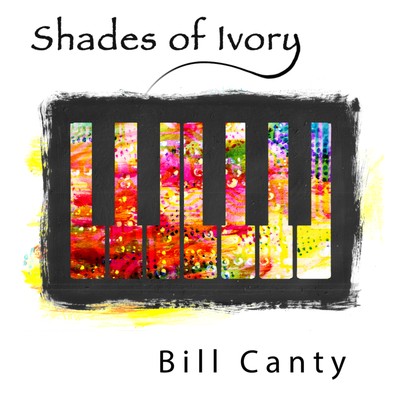
SHADES OF IVORY

Bill Canty

Move Records MCD 605

I can’t honestly admit to knowing anything about Bill Canty; not unexpected, that, as the composer has carved out his career in more popular fields than those I frequent. This CD is a suite of 12 pieces for piano, performed by the composer and using no orthodox piano but rather altered, piano-simulating sounds by means of digital/electronic interference and manipulation. It turns out that the performer/composer is true to his promise and lives up to his descriptors and extract titles. I don’t think there’s much to the whole exercise beyond a satisfaction in arranging sounds into appealing formats. The question is: appealing to whom?

A further problem with this CD pressing is that the tracks that come up on my system are completely unrelated to Canty’s efforts but are entered under the name of Phil Broikos and one of his chef d’oeuvres, A Day in Music. I know what I’m hearing isn’t Broikos because I listened to some of A Day; the things you do for certainty. Anyway, Canty begins with a Fantasia which is a meandering piece of mood music – very euphonious and playing pretty games with arpeggios rolling across the keyboard. It’s all very pleasant and diatonic with bass pedals and a spoonful of upper register tinkling, and it leads straight into Glissade that has a metrically regular Alberti treble with some portamenti between notes, as well as an assortment of downward-heading scales. It starts in the minor and moves to a relieving major about half-way through, but doesn’t stay there long. Dollops of notes are sprinkled across the constant Alberti figure with accompanying bands of sustained bass before we revert to the glissandi/portamenti of the opening and a slowing down.

Immediatelt we are in Rubato land where the continuous quaver figure sustains the forward propulsion but with lots of the promised slowing down and make-up acceleration; a constellation of overheard notes almost meld into a melody, the texture suggestive of extra-terrestrial illustrative music such as you get in programs from NASA or organizations determined to sell you the idea that outer space is benevolent rather than the horrifying chaos we know it to be. But the emphasis is on atmosphere and the one-word titles leave interpretation very open, as you can see in the following Sanctuary. Canty makes reference to the bellbirds in Kew’s Studley Park and you hear plenty of bird-suggestive sounds; not the multi-coloured flourishes of Messiaen but little two-note oscillations piercing a brooding multi-layered backdrop. And that, unfortunately, brings to my mind suggestions of the Picnic at Hanging Rock soundtrack without the interference of Beethoven or pan-pipes.

Then there’s a change of pace as we enter Thirteens which Canty has based on the odd time-signature that opens Mike Oldfield’s Tubular Bells; all credit to Oldfield for creating a lasting album on his lonesome and all that nonsense but, as I read it, his initial track is in 7/8 which may have some mathematical relationship to 13 but I can’t compute it. As things turn out, a ‘straight’ piano plays the underpinning pattern throughout with superimposed dribbling until about the 3’30” mark where the unusual tempo dissipates and we are left with upward scales and growling bass sound bands. The pattern returns just prior to the turn into Droplets which has a fine imitation of that phenomenon in its treble, something like a cross between a finely-tuned marimba and a glockenspiel tinkling away above the (by now) inevitable bass layers that slowly shift. Here, Canty refers to his ‘fascination with controlled randomness’ – which suggests that he is employing some sort of program. But I found the actual musical progress loaded with extraneous gestures like downward-moving rapid portamenti, again suggestive of documentary soundtracks for visions of the moons of Saturn.

Statement begins with a sort of motive comprising a segmented scale that initially moves up, then down, while around it are shadows, delayed repetitions that offer a nimbus of distortions that have immediate reference to the base material. A sort of mental oasis follows in which nothing solid happens but the atmosphere is packed with soft gamelan-type patterns and fragments of what has been secondary in importance so far. The segmented scale returns, now at a higher pitch but with the same nimbus surrounding it. Trance opens with a repeated note – in stereo – being surrounded by accretions and attempted distractions like a heavy counter-rhythm in open 5ths. The repeated note falls in pitch step-wise, this motion setting the activity level for the surrounding matter; the jazzy 5ths continue to interrupt but most of the piece’s colour comes from swathes of texture that offer continuity of effect rather than variety.

In Rebound, we have a reaction to the bouncing of a ping-pong ball which is aurally depicted in the middle of the customary swathes. Once more, the electronic transformations suggest both the Orient and the extra-terrestrial, although I liked the overlapping bouncing lines. But it passes and we are called into the soundscape of Immersion, where gentle descending scales close down into a subterranean sound-wall with isolated piano notes setting off those various downward slides into the depths. Some upper register washes provide a counter-balance in this slow-moving celebration of stasis that comes to a halt before Lucid comes into view with a reversion to middle-layer Alberti pattern-making. The difference here is that Canty offers a tune in the forefront of his texture. This is unexpected and, while he gives it two or three airings, eventually it is abandoned for arpeggios and atmospherics. However, this ternary piece brings back its continuous quaver underpinning and another version of the melody which is not so striking this time around.

Finally, Canty offers a Toccata which is headed by a ‘straight’ piano line but one surrounded by plenty of echoing effects. Soon enough, a ponderous bass layer emerges before the piano and its overlays and mimicries takes off on a pretty predictable set of excursions that wear out their welcome because of an absence of rhythmic variety, something you won’t find in pretty much every toccata from Buxtehude onward. After some grandiose crescendo work, Canty arrives at an affirmative major key conclusion.

Each of the suite’s movements lasts about 5 minutes but, as indicated, most of them run into each other and sometimes you are hard pressed to find a delimiting point, The same can be said about the internal material of many of the pieces. Canty has a definite idea for each one of them, developing or simply stating and restating an idea to give aural sense to his particular title. Yet you come back to the over-arching question of: what is achieved by this exercise? Much of it is harmonically trite and melodically bereft; apart from Thirteens, you look in vain for rhythmic imagination or challenge. While the composer rings changes on his keyboard with transformations of a piano’s normal sounds, little of what we hear has the distinctive feature of novelty. At the end, it strikes me that this is a music that is not to be subjected to analysis but enjoyed as background to one’s own mental ramblings, or as support for rather trippy visual stimulation. Rather than falling in with the CD’s generation process, I’ve unfortunately taken on the cast of Shakespeare’s Cassius – and I don’t mean lean and hungry.

Elegant but insubstantial

TWO

The Marais Project

Move Records MCD 617

This brief CD (less than 40 minutes long) sprang out of the pandemic. Planning for 2020, the Marais Project intended to tour Tommie Andersson playing theorbo, guitar and gallichon and Jennifer Eriksson (the organization’s founder) on her trusty viola da gamba. Each would play a set of solos, then come together for a suite by the ensemble’s namesake. Sadly but predictably, the musicians encountered difficulties in getting around the country but, rather than seeing their efforts go to waste, determined to immortalise their labours through the graces of the ever-cooperative Move Records.

So here we are. Andersson’s contributions include Handel’s Sonata for a Musical Clock, arranged for the gallichon (bass lute), three guitar pieces by Jan Antonin Losy, Mozart’s Adagio for Glass Harmonica K. 536 (also re-shaped for gallichon), and participation in selections from Marais’ Books II and IV for gamba and continuo. Eriksson matches this with a D minor suite by Jacques Lambert du Buisson, the outer movements of a G Major sonata by Abel, a condensing of Paul Cutlan‘s Sarabande from the composer’s Spinning Forth suite, and the lead role in those Marais selections.

As a bonus, the CD’s final track is an anonymous love-song published in 1703: J’avais cru qu’en vous aymant. This begins with Andersson playing through the plaint solo (I think, on theorbo); Susie Bishop comes out of nowhere to add to the complex, eventually taking up her violin for a rehash of the by-now well-thumbed melody. I don’t know why the Rule of Two was broken but it’s always a pleasure to hear Bishop’s clear vocal timbre brought into play.

The Handel sonata seems to have been a two-movement affair; here, you find an Air and Minuet interposed. The pieces are slight and, despite plenty of repetitions, soon over. None of the writing goes beyond two parts, although the opening Allegro boasts a final full C Major chord. If I report that there’s little to say about any of the four parts, I’m overstating the case. Not even the timbre of Andersson’s gallichon brings a ruffle of interest to the surface.

Not much changes when Eriksson launches into the Lambert du Boisson suite. Some double-stops raise the listener’s eyebrow in the first Prelude, while the following Allemande variation follows a familiar path of one line with some cadential multi-string chords. A sarabande shows more emotional depth and the multi-string writing becomes more pronounced in the second half; the concluding courante is complex in this ambience. But the movements pass very quickly and you have only time enough to experience the movements’ shape; the gamba’s texture is finely spun – but that’s the only impression left, even after a few hearings,

Andersson plays the three guitar pieces expertly enough. The opening Prelude is another single line journey; its successor, an aria, has two independent lines – for a while; the concluding Gavote has a similar format, if quicker in tempo. As with the Handel sonata, these are flimsy constructs, and they would probably have been even more ephemeral if the repeats had been omitted. By contrast, Eriksson engages with only a few repeats and omits the central Allegro in my edition of Abel’s sonata. The performance follows a staid path with the frissons coming through some three- and four-part chords punctuating the concluding Minuet‘s progress.

Cutlan wrote his 2014 Spinning Forth suite in four movements for gamba and harpsichord, one of the commissioners being Eriksson. Its third movement, Slow and Sustained – quasi Sarabande, has been rewritten as plain Sarabande. This is one of the recording’s longer tracks – the 2nd most substantial, in fact – and I’m not sure how much rewriting has taken place. The first page of the original is the same as this new version, but I assume matters take a more radical turn at that point where the harpsichord enters in the first version. It’s a stately enough progress, very much in keeping with the other gamba content offered here, with the added charm of discordant intervals. Oddly enough, the piece doesn’t strike me as much of a sarabande but more a slow minuet, chiefly (I suppose) because the second beat gets no emphasis, large or small. Nevertheless, Eriksson’s account is full-bodied and sharply etched.

Mozart’s one-page Adagio serves an amiable purpose for its original instrument and Andersson makes a fair case for its movement to the gallichon, although this arrangement means that some of the secondary notes (lines?) go missing and most of the glass harmonica’s fragility of timbre flies out the window. The first repeat is observed; the longer second part of the piece gets a once through..

When it comes to the Marais compendium, the listener is invited into a world of some gravity; at least, at the start with a Prelude of intense grace and eloquence. A sprightly allemande follows; yes, perhaps that’s to oversell it as Eriksson lumbers through it with hefty support from Andersson. The following Air en Vaudeville/MesmeAir double begins with a downward-moving tune that has an irresistible resemblance to Joy to the world! The double is, it seems, a short variation. A sarabande is treated with high distinction, Eriksson’s melody-shaping a pleasure to experience for its supple breadth. But both players treat this brevity with respect and a keen eye for its shape.

Most of the gigues I’ve heard from Marais suites come across as fairly sober affairs, but this one is more buoyant and perky (at moments) than you’d expect. It’s still more of a tramp than a pieds-en-l’air exercise but its heftiness beguiles even to the very definite final chord. A pair of minuets proved more animated than expected, possibly because of the strength of the performers’ downbeats, but both flow past with an excellent demonstration of Eriksson’s talent at dynamic contouring. To finish, a Branle de Village is over very quickly, having just enough time to impress with its sophisticated rugosity.

The last track, that love-song, brings the Marais Project together – sort of. Bishop’s account of the first verse is accompanied only by Andersson; Eriksson then enters for her go at the tune; then all three combine for Verse 2. Bishop contributes her violin for a last instrumental recap – and that’s it. Certainly, this is a delectably melancholy conclusion to the disc and is in itself an argument for more of the same to offer a change of timbre in a collection of brief vignettes, amiable though they may be.

Art songs with insight

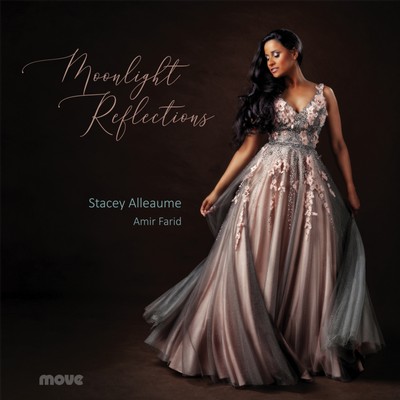
MOONLIGHT REFLECTIONS

Stacey Alleaume and Amir Farid

Move Records MCD 613

Now here’s an unapologetic, old-fashioned CD with content suited to a recital from several decades ago – except for some unexpected American interpolations. Soprano Alleaume has succeeded – as far as anyone can these days – with the national company. I can’t recall seeing her in Melbourne Opera Australia productions – but then, in my last years down south, I got to see very few of them. Here she is partnered with the one of our most gifted piano accompanists who has been stranded in his Australian base town, thanks to the world scourge.

Both artists are concerned with some fine music, a track or four of worthy arcana, and a couple of absolute forgettables. Their presentation lasts a little over 52 minutes in all, the longest track a Victor Hugo setting, the shortest an excerpt from Browning’s Pippa passes, both composed by Amy Beach. Some writers feature a few times – two songs each by Puccini, Massenet and Reynaldo Hahn; three from Respighi, with single submissions by Chaminade, Duparc, Frank Bridge, Pietro Cimara and Saint-Saens. Beach has four samples, the CD ending with her Three Browning Songs Op. 44.

Alleaume sings 18 songs – eight French, six Italian, and four English – which is versatile enough, especially if the intention is to hone in on a particular period. This collection’s earliest sample comes from c.1865 in Saint-Saens’ Clair de lune, while the latest is Reynaldo Hahn’s most popular product, A Chloris, dating from 1916. Most of the material was composed between 1888 and 1913 – 15 tracks in total – while the odd man out that misses these parameters (besides the two extremes) is one of the most famous art songs in the repertoire: Duparc’s 1870 L’invitation au voyage.

In a way stressing the basic difference in art-song potentialities, Alleaume and Farid begin with Chaminade’s L’ete, which is succeeded by the Duparc gem. The first is a show-piece, trimmed with decorative short roulades between a swift-moving melody while the piano curvets in support. It’s superficial, showy stuff and the soprano reaches every note with no indication of stress; perhaps the accompaniment might have been crisper but there also you can hear no flaws. With the Baudelaire setting, it seemed to me that both artists were intent on underlining the last word of each stanza because the approach impressed as slow-paced and indulgent. The chanson was devoid of forward motion; any invitation to travel to the Land of Heart’s Desire lacked direction apart from towards the bed and the piano’s restless accompaniment was slowed down to a sensual fluttering. To my mind, the second stanza’s canals were being viewed from indoors, rather than on a vessel bound for Cythera.

Bridge’s setting of Landor’s O that it were so! has a congenial sentiment underpinning its lyrical flow, excellently managed by both artists as they rise to the central climax and soothingly return to the calm of this song’s opening. There’s a worrying moment as both recover from the rallentando after ‘blest’, but the soprano shows her sense of taste by taking the lower alternative in the 6th last bar. Both Puccini songs enjoy sensitive treatment, the phrasing careful and almost all the sung notes ideally centred. Terra e mare holds indicators of the composer’s confidence in setting heavily Romantic lines while Sole e amore is a familiar friend, having provided material for the La Boheme Act 3 quartet when Mimi sings Addio, dolce svegliare. The oddest thing about this piece is the composer’s inclusion of the dedication (?) to be sung in the last bars, as well as the pretty trite lines, possibly by Puccini, that don’t fit with the music, once you remember their use in the opera for an unforgettable scene.

What do you learn from Amy Beach’s setting of Vicor Hugo’s Chanson d’amour? The American writer had a fine ear for the genre, certainly, best demonstrated in the three choruses of this work, throughout which cellist Zoe Knighton joins her long-time collaborator Farid in weaving some lush lines around Alleaume’s far-ranging part. It’s a persuasive piece, particularly for the care that Beach gave to the supporting material and her differentiations between the verses and choruses. Having said that, you won’t find much here that’s harmonically or melodically original but it slots into the then-contemporary French scene quite easily.

Pietro Cimara’s Stornello is an elegant urbanization of a rustic format wherein funsters capped each other’s lines to entertaining effect in accommodating bars/hotels. This one is a love song of some individuality in its verses by Arnaldo Frateili and a lean eloquence in the music which doesn’t range too far; a quiet, melancholy looking back to the first flush of rapturous love and presenting our performers with absolutely no challenges.

Both Hahn songs – L’enamouree and A Chloris – show restraint, probably a tad too much in the latter where a singer can achieve much with careful dynamic shadings and a disciplined employment of vibrato. But both musicians do the composer excellent service, illustrating an emotional insight that you wouldn’t anticipate from a writer who has been denigrated and minimzed for many years. Even the dropping sequences in the vocal part of the first song don’t irritate as much in performance as they do on paper, and Farid is impressively calm with the attention-grabbing accompaniment, complete with Bach-indebted ground bass, to Hahn’s most celebrated chanson.

In the three Respighi songs, Alleaume runs a cleverly contrived gamut of mainly mild emotions while Farid has plenty with which to make accompanists’ hay. Notte sets up a tautly drawn scene where a garden’s nocturnal placidity masks a world of possible despair; both musicians give the work plenty of breathing space, with an excellent transformation at the half-way point where the bass and alto line triplets rise to the surface while both voice and piano left-hand revisit the opening stanza. Nebbie remains constantly menacing and tragic from the start, a fine scena with lots of dramatic vocal material. Farid gave the impression of holding nothing back in an accompaniment that almost continually reinforces the vocal line with massive minim chords. And Contrasto offers a gently rolling allegretto accompaniment to an amiable if completely forgettable vocal contribution, the text offering an elementary premonition of Pierrot Lunaire with the moon weeping while lovers ignore its suffering; a placid piece that seems to present one side and, not living up to its title, omits the other.

It’s hard to fight against the self-centred rhapsody of Hugo’s Etre aime, as the author is so confident in his statements, emotionally flimsy though they may be. Massenet manages to smooth them out into something almost palatable and Alleaume sustains a nice oscillation between restraint and hothouse ecstasy in her account. The composer’s Amoureuse is a different kettle of semi-erotic fish in its somewhat stately apostrophes to the discontented lover, and the vocal and histrionic range is larger. Both performers do very well in maintaining a forward movement, eschewing the temptation to linger over-much in those scrappy bars treating the ante- and penultimate lines of each stanza. But then, this is not a poetry or a music with which I find much sympathy, perhaps because it impresses as being superficial and displaying a Proustian-corkwood insulation of address.

Saint-Saens has no other vocal portal in my experience beyond Samson et Dalila and his Clair de lune comes as an unexpected oddity, chiefly because his setting of Catulle Mendes’ poem is metrically challenging for its interpreters, notably at the start where the melodic line emphasizes a few unimportant syllables. Farid makes agreable work of the asymmetric piano part but the piece is vocally unremarkable and Alleaume is untested to any noticeable degree.

Beach’s settings of Browning begin with The year’s at the spring, and it reflects the optimism of the young girl as she sets out on her walk. The tone is moderately jubilant, necessarily so as it leads to that famous, life-affirming concluding couplet. You couldn’t call it volatile, but the atmosphere is not far from it and Beach was careful to avoid monotony of metre by stretching lines that she considered focal, as well as indulging in textual repetitions and displacements. Much the same happens in Ah, love, but a day where the repetitions seem more pronouncedly self-indulgent, even if this track ranks among the best on the CD. It also reveals an unexpected visitor in violinist Erica Kennedy who spends some of her time following Farid’s top line – but not slavishly so as she enjoys some passages of individual action. Which makes you wonder whether or not this obbligato is kosher; I can’t find it in any edition of these songs. Still, the piece holds a moving transition from F minor to F Major in the plaintive last 13 bars.

A more consistent achievement comes in the final I send my heart up to thee, the opening seven lines from the verse-dialogue In a Gondola. Here, the male lover’s ardour is expressed in a carefully shaped series of phrases that Alleaume treats with fine craft, using the ossia top note when offered except in the last bars where taking the pitch up an octave would be unnecessary to the lyric’s shape. Again, the composer offers variety for her singer inside the 9/8 time-signature with some lines stretched while others follow a predictable pattern.

Here’s an opportunity to experience Alleaume’s abilities in an unexpected field. She has appeared in several Opera Australia productions over the last six years and it looks as though her career is set to follow that trajectory. This collection of songs reveals an interpretative ability of some accomplishment, the soprano’s laudable efforts reinforced by one of our most insightful accompanists.

Even-tempered retrospective

ELEPHANTASY

Eve Duncan

Move Records MD 3454

Eve Duncan has been a strong force in Australian Music for many years; not just as a composer but also as a teacher and administrator. By this last term, I don’t mean a career-conscious functionary snuffling out a life in some university departmental office, but as a servitor of this country’s composers, principally as founder of the Melbourne Composers League and as a participant in enterprises like the Asian Composers League and director of Federation Music Week when we all decided in 2001 to celebrate a century since the legislated and constitutional combining of states. And we can all see these days how well that turned out.

On this CD, Duncan is chiefly represented by two major works: her 2012 piano concerto in two movements called Sydney Opera House, and excerpts from her opera The Aspern Papers, with a libretto by David Malouf extracted from the Henry James novella. This latter is one of the many products of the American writer’s fertile and prolix imagination with which I am totally unfamiliar. Like all opera-lovers, I know The Turn of the Screw, once upon a time even going back to read the original as a method of assessing Myfanwy Piper‘s skill in transforming the original into something simpler for the composer. Again, like all opera-lovers, I don’t know anything of Britten’s other James incursion, Owen Wingrave, which was also arranged for Aldeburgh consumption by Piper.

Apart from these well-known James-indebted operas, I’m completely ignorant about Douglas Moore‘s The Wings of the Dove 1961 adaptation, Thea Musgrave‘s 1974 The Voice of Ariadne (rising from the bones of The Last of the Valerii), Thomas Pasatieri‘s Washington Square of 1976, and two other treatments of The Aspern Papers by Dominick Argento in 1987 and Philip Hagemann in 1988. I once heard Donald Hollier‘s version of Washington SquareThe Heiress – in its premiere performance by ChamberMade at The Church Theatre in Hawthorn, some time in November 1988; not a rack remains behind. And, in another life, I’ve taught The Europeans but it remains as vague in the memory as an ill-advised assault on The Golden Bowl.

This CD opens with Approaching Venice, which is the prelude to Duncan’s opera. Later, we are treated to a duet – I told you, Mr. Vayne, nothing here is mine; a soprano aria, Do you think I am beautiful?; another couple of duets – Ah, but I do know his face, and Juliana and Jeffrey’s Love Duet; to end, a pair of trios – So this is the dragon’s den, and If you were a relation. These extracts take a little over half the CD’s running time, with a bit of space left for some short instrumental solos: Deep in Summer for trumpet and piano, From a Star Afar for piano solo, and Aer Turas for flute, clarinet and cello.

Adding to the complexity of these several tracks, Duncan has found inspiration and/or structure for many of them in architecture – Utzon’s bastardized masterpiece for the concerto, Palladio and the Venetian environment (somehow) for the operatic fragments. As well, the aria is internally referencing Korean court music on the underlying principle that Venice traded with the Far East. Does any of this help to clarify what we hear? I’ve tried to find connections but don’t have the requisite responsiveness or nimbleness of intellect, not even finding reminiscences of the city’s alleys in the singers’ intertwining lines. Still, over the past five decades I’ve spent only a few days during three visits in penetrating the city’s labyrinthine back-blocks, frequently getting lost, and so am under-prepared for Duncan’s compositional grids.

As an introduction to her opera, Duncan presents an optimistic and healthy view of the city; rather at odds with the unpleasant plot of the novella which involves greed, theft and monomania. The mobility of the cityscape is evident with plenty of rustling strings and brief tuckets, swift trombone glissandi, with some unsettling timpani as a tidal underpinning. Throughout, the emphasis is on action, or at least an active scenario is anticipated even before the curtain rises. Cymbal crashes add to the aura of sparkling light and, despite its sometimes grinding harmonic clusters, the overture’s conclusion is set in a bright brass-dominated major. No adagietto here as your boat crawls up the lagoon but a brightly coloured atmosphere, performed by the Philippine Philharmonic Orchestra conducted by Josefino Chino Toledo – and how that came about, I’ve no idea.

Next come the two parts of Duncan’s piano concerto with Michael Kieran Harvey investing his brilliance in its solo part. He is supported by an unspecified chamber orchestra conducted by ‘Timothy Philips’, who I assume is Timothy Phillips, director of the Arcko Symphonic Ensemble. In any case, the work was recorded by the ABC in the Salon of the Melbourne Recital Centre in 2016 – as were the six vocal excerpts from The Aspern Papers and the trumpet-piano duet.

Duncan begins her score with a semi-cadenza for piano which sets up another rustling soundscape with occasional interpolations from others – percussion, single brass and woodwind, a band of strings. The aim is to focus on Utzon: in Movement 1, he focus is directed to his influences and background as well as what can only be styled as his construction’s topography which the composer has used as a kind of palimpsest. You can pick out motifs and gestures, especially as the orchestral contribution expands, but the work’s impetus is left in the pianist’s hands. To be honest, the score tends to fade into effort when the keyboard is silent – which is fortunately rare. Harvey is quite at home with his peripatetic role, sounding more comfortable than the supporting ensemble, despite some startlingly lucid and confident contributions from clarinet and percussion.

Movement 2 opens with more collegiality as Duncan weaves her orchestra-based scintillations, suggestive of the Opera House site and surrounds. In what follows, the Utzon/piano figure is well-integrated with the other musicians and the texture takes on an Ivesian style of agglomeration before Harvey re-asserts his dominance momentarily at the half-way point. Apparently, this part of the concerto treats the architect’s interior world, the realization of his project being brought up short against the realities of New South Wales politics of the time: an apotheosis of philistinism. Utzon can be discerned putting his head above the parapet but is all too often swamped by the orchestral fabric and some wearing outbursts.

The score would doubtless yield more treasures than those discovered in the few hearings I’ve given it but staying on Duncan’s compositional continuum is very difficult. You can find many reflections of your own attitudes to both Utzon and the Opera House, although it’s more than probable that where I find suggestions of the relentless criticism – by troglodytes from both major political parties – that dogged the architect’s last years on the project, others will hear more benign forces at work, reflecting the industry involved in its protracted construction and the brilliant juxtaposition of the building, harbour and city in what has become a splendid national cliche over its 48-year history.

Harvey appears on the following duo track, with Tristram Williams playing trumpet. This work moves with an energy that relaxes only in its final bars, both instruments handling a limited number of motives to happy effect. As far as the work’s language goes, Duncan walks a kind of middle road between complexity and sophisticated simplicity where even the dissonances aim to strike few sparks and suggestions of tonal underpinning loom large. As anticipated, Harvey performs the solo From a Star Afar with admirable sympathy, the underlying vision here being of observing Earth from outside itself. No tricks as the piece winds its way along with a kind of calm determination – but it’s over very quickly, coming in at under 90 seconds.

The first of the opera extracts is sung by soprano Justine Anderson as Miss Tita and baritone Jerzy Kozlowski taking the role of Henry Vayne, the work’s fulcrum and a shady negotiator who is attempting to acquire memorabilia left by the dead poet Jeffrey Aspern. In the original, this character has no name but opera tends to collapse if anonymity is the go. The two singers engage in a dialogue where each is feeling his/her way into a relationship; it’s all very civilised and artificial with the chamber orchestra giving an appropriate pattering support. The vocal articulation is agreably clear and accurate but few demands are made on anybody. Still, it’s early days.

Soprano Deborah Kayser has the role of Juliana Bordereau, lover of the poet and now a century old vendor in need of money. She mocks Vayne by asking him if he finds her beautiful and sings of her past with something approaching rhapsody, although Kayser has to cope with some tough competition, including a persistent trumpet. Still, you can hear the shaping of a real character, a distant relation to Miss Havisham; the only problems come in Kayser’s breathing as she copes with an angular line.

In the next duet, the old woman shows Vayne a portrait of Aspern, painted by her father, which she might be prepared to sell if the price is right. Even while making the offer, she knows her visitor can’t afford it and appears to take some malefic delight in this realization. Again, Kayser is occasionally menaced by a heavy accompaniment but my main interest is wondering how this scene would be carried off, especially in its later pages where the orchestral contribution is intended (I believe) to be a commentary on the two characters’ mental/emotional states. Next comes a duet of sorts for Juliana and the shade of Aspern, sung by countertenor Dan Walker; well, he’s chronicled as owning that voice type but his sound here was really your normal tenor. The text consisted of both artists singing the other’s name, once more over a turbulent orchestral force. Well, the old lady is dying and Aspern is a ghost; nevertheless, the results are unconvincing; as they say on The Bachelor: what you can’t hear, you can’t feel.

Vayne and Miss Tita search Juliana’s room for Aspern’s letters, but the old lady wakes up from her delirium and denounces Vayne as she dies. Much of this is comprehensible and becomes a real duet while Kayser is confined to forcing out some low-pitched fulminations at the scene’s end. But Duncan does present her characters with skill here; when they sing, they have definite personalities, no matter how distorted or unpleasant they may be. As the crisis approaches, the instrumental forces take over with insistent energy. Oddly enough, the track ends on a tierce – possibly because Vayne has fled the scene.

Finally, Miss Tita asks Vayne to marry her; then he can have the papers in good conscience. He turns over the proposition but is too slow in responding and the deal falls through, whereupon she burns the papers. In a final trio, Juliana revives to carol with the two non-lovers in a calmly flowing retrospective, I suppose; the words are hard to make out, although the final word is a communal Respiro statement – patently not true for one character. I’m assuming this is the opera’s last scene; if so, matters wind down swiftly in a soft lyrical glow.

As far as I can detect, this ABC recording of the six extracts from The Aspern Papers – from October 26, 2016 – is the only time even parts of the opera have been performed in this country. The Australian Music Centre site suggests that a performance took place in Manila a year previously, but that occasion in all probability featured only the overture, Track 1 on this CD. Will we be likely to hear a complete performance at any time soon? Probably not, particularly considering the parlous state of contemporary Australian music in 2021, let alone the fits and starts that beset the larger, tradition-minded companies. A pity, because Duncan’s work has its advantages: its language easily assimilable, its characterization lucid, demands on vocalists and instrumentalists (a chamber group here, conducted by Phillips) falling well inside the competence of professionals.

Finally comes Aer Turas, which translates from the Gaelic as ‘air journey’. This is a reminiscence of travel to four sites: the monasteries of Leh, Tibet; North America’s Appalachians, particularly Mount Washington; the MacDonnell Ranges that lie in the southern reaches of the Northern Territory; and Wollemi National Park stretching from the Blue Mountains to the Hunter. Our participating trio – flute Lisa Breckenridge, clarinet Ian Sykes, cello Claire Kahn – travel with effortless collegiality through this piece which, I think, treats each of the specified destinations in turn; doing so with a deft alternation between curlicuing solos and disciplined ensemble writing.

In essence, this all represents a mini-retrospective of Duncan’s activity, bridging from 2012 (the Sydney Opera House concerto) to 2018 (Aer Turas and From a Star Afar). But its temporally cramped recording conditions – everything taped on the same day, apart from Approaching Venice, the piano solo and that final instrumental trio – indicate how difficult it is for a serious composer to be heard. Of course, the results here are blemished but that’s the cost of getting one chance at performing. However, this CD is commended to those who have sympathy with Australian composition, especially of a type that follows an approachable middle ground and avoids attention-seeking novelty for its own sake.

An unfamiliar voice emerges

MIRABILE IN PRAGUE

Prague Radio Symphony Orchestra

Move Records MD 3448

It isn’t every day that you come across a local composer who has managed to get his work recorded by a well-known European orchestra, directed by a notable musician who has been active in Australia for many years. But that’s been the case for John Allan who has managed to achieve this fortunate outcome, one that is unfamiliar to many a better-known writer of serious music in this country. You’ll find seven tracks on this CD, two of them arrangements: Debussy’s La soiree dans Grenade, the central one of Debussy’s three Estampes; and the Scherzo from Brahms’ Piano Sonata No. 1 in C, his Op. 1.

The original pieces begin with an Aeolian Caprice, which was initially a piano solo but, 15 years on, Allan decided to orchestrate it. One of the major works follows, a Fantasia on Mahler’s Purgatorio: a variant on the third movement from Mahler’s incomplete Symphony No. 10. At the centre of the disc sit three works with the Latin adjective ‘mirabile’ in their titles. The first, like Aeolian Caprice, began life as piano solo celebrating the birth of the composer’s daughter; it was orchestrated a year later, then revised six years after that. As well, there’s Mirabilia Antipodia of 2005 which offers variations on the original ‘mirabile’ theme. Finally, another one of four Allan works that use the same motif/theme, comes Marcia Mirabilis – written a year before Antipodia but revised several times since: in 2010, 2014 and 2017 . . . which makes it the most recently visited work of the seven. The whole lot adds up to a little less than 49 minutes of music.

When I see a title like Aeolian Caprice, I’m reminded of occasional pieces, post-Mendelssohn in character, for amateur pianists. Of course, the naming is ambiguous: it could refer to the Aeolian mode, or it could refer to the Aeolian Islands north of Sicily, or it might be suggesting the wind-driven Aeolian harp. It starts with a suggestion of everything; clarinet-led low melody, low brass following the same pattern, until an orchestral explosion of some power, even if the heftiness is over-bearing. Then comes a series of full-blown melodies, with something a bit odd about the ensemble chording for wind and brass; can’t put my finger on it but it seems very thick and imbalanced. As the work proceeds, the texture gets thicker, then cuts back to leave the violins weaving a spacious melody, which yields to a clumsy passage for wind and percussion.

By this stage the metrical pattern is well established: a swinging (slowly) triple metre which doesn’t endear itself by a lack of variety. In fact, the piece impresses as unsophisticated, the disposition of forces clumsy, the crescendo towards the final-bar climax elementary in style. It’s the earliest work on the disc, and you can tell. As for those worries about Aeolian, I’ve no idea at the end. Probably not the harp; the score’s opening has the faintest traces of Bax’s Tintagel, so maybe the Sicilian islands.

Allan’s Mahler essay follows. Its main feature is to change the time-signature: the original 2/4 goes by the board for a deliberately unbalancing 5/8. That aside, half of this track’s length – no, a bit more than that – follows the original framework pretty closely; that is to say, you can ‘follow’ the published score’s flow without difficulty. Naturally enough, Allan has imposed his own orchestration (who hasn’t?) and so the textures have only shadings of the original. But motives and bursts of melody are transferred between woodwind, for example, or even interchanged between brass and strings. Allan moves away from this a little after the 6 minute mark and manipulates Mahler’s material for the final three minutes.

To his credit, the new score stays close in material to what we have heard already – through a glass splintered – and the entire exercise has an undeniable coherence. But, as the Australian composer observes, the work is changed considerably, its emotional intent less apparent, and the sound fabric less incisive. The whole thing is a clear homage but you aren’t quite sure what has been accomplished here. Allan takes the wind out of your carping sails, however, by calling his score a fantasia – which allows him absolute freedom; the wonder is that he didn’t take more.

At the opening of the root work Mirabile, you are reminded of Delius: a melody slowly rises out of a brooding bass before that melody is pronounced clearly in a solo horn, the lyric shifting harmonically – just like those incessant Delian bass murmurings. As the work progresses, there are shades of Hollywood sound-tracks, with some broadly swelling climaxes and plenty of swoops and ascents for the Prague orchestra to enjoy. Eventually, we come to a broad tutti statement, loaded with swelling strings. But there is also a sort of astringency added to the smooth surface with an input line or two from woodwind and/or brass. The ending is a reinforcement of the score’s orthodox harmonic nature, a triumph of sentiment over spice.

You’d like to think that Mirabile Antipodia has reference to this side of the world – Australia Olympica – but it’s more probable that the reference is formal. Allan has here transposed the voluble ‘mirabile’ theme for this piece; no, more than transposed – he has inverted it in the best Baroque or Webern fashion. The results are more disturbing than in the original work, as the accompanying material has taken on a harmonic complexity that the original didn’t contain. I found the writing here to be more sinewy – or the music’s workings were more discernible and the harmonic language a good deal more complex, although Allan cannot avoid popular tropes, like the downward movement for brass a little after the 3-minute mark, and the following full-orchestral blasts that lead to a full-blown peroration of large proportions, something like Berg piling up his forces. The whole thing then suspends for a reminiscence of Tchaikovsky – the melody’s there, if the supporting surrounds are different – before reverting to several restatement’s of the inverted ‘mirabile’ and a big finale.

So, in a real sense, this is a converse piece which largely avoids the sweetness and predictability of the previous track. Even if Allan indulges again in the lush orchestral resources available to him, they are much more interesting in their application. You feel that his compositional development has resulted in more confidence as a manipulator of possibilities. Mind you, I still think the textures are over-full, despite an attempt to add sparks; a fair bit of the brass writing is pure weight, a mid-ensemble spread.

The march based on the ‘mirabile’ melody would drive any corps to revolt: it’s too slow for military use. Not that you’d take as a principle that all marches have to be marchable; now that Tchaikovsky’s been mentioned, I can think of three major marches from his pen that also don’t fit the regimental bill. In fact, there’s not a good deal to be said about Allan’s march. I eventually found the relevant theme in the content, mainly because its initial phrase is eventually repeated till even the meanest intelligence gets the picture. This is the longest track on this CD, twice as long as the preceding tracks using the same theme; ditto for the Aeolian escapade and the Debussy rescheduling.

There’s a certain pleasure to be found in this work which strikes me as often being a bit of a ramble, despite its jaunty nature which carries it across quite a few trio interpolations. Still, it is very diffuse and, despite the efforts of Kram and his players, it could have stopped several minutes before it actually reached its big finish. Perhaps, if the composer revisits it for a fourth time, he might consider a touch more lopping than grafting because the unavoidable feeling at its end is that all concerned were labouring at their work – not that you could find much here to exercise them unduly.

If you want a benchmark for happy Debussy transcriptions, it’s hard to look past Grainger’s marvellous and richly textured arrangement of Pagodes for harmonium and tuneful percussion which I’ve heard live only once – at a John Hopkins Prom in the Melbourne Town Hall, I seem to recall. It’s colour without self-consciousness. Allan’s reworking of the next Estampe, Evening in Granada, is an orthodox piece of work in which most of the intervening chord work (bars 17-20, in the first instance) is scored in pragmatic fashion, even if the Prague players are not exact in their chord weighting. Also, I was pleased that the arranger took his time before introducing the inevitable castanets (bar 33). The horns came across as far too prominent in the Tres rythme segment; the piccolo at bar 98 was inaccurate; both Leger et lointain sections were far too slow; and surely the G sharp at bar 112 has to resolve two bars later.

Brahms’ scherzo is heavy in its humour, even in the piano original which I recently heard from one of the Sydney International Piano Competition entrants. Allan can’t do much to perk up its weightiness, although he comes close to it across the outer section’s reappearance. To his credit, he tries everything, not just content to make one version and leave it to be repeated; he’s re-scoring wherever you look. The only time anything is really unstuck is in the Trio where the chord at bar 13 – especially its top B flat – is bloated and painful to hear. Against that put the clever re-thinks that came up to revitalise your interest and you can be grateful to Allan for carrying off pretty well what many of us would have considered to be a thankless task.

An intriguing enterprise, this CD. It sounds as if David Kram and his Czech musicians could have gained more certainty from further rehearsal, as Allan could have benfited from the luxury of altering his orchestration at leisure after hearing it. But I admire the effort involved in getting the whole thing recorded and giving us the chance to make the acquaintance of this composer and his catalogue. What we have here is a small sample of his actual output, but it’s something to be going on with while we wait for the larger-framed scores to emerge – possibly from Kram and the biddable Praguers.

Celebration for the seasonally woke

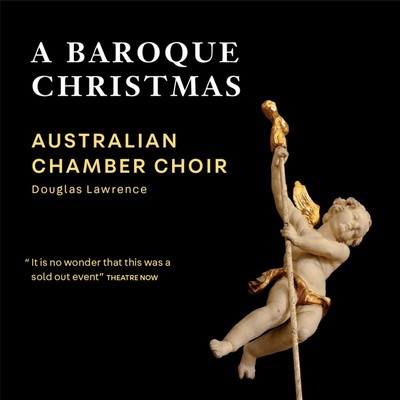
A BAROQUE CHRISTMAS

Australian Chamber Choir

Move Records MCD 607

What’s in a name? Well, Ms Capulet, if you’re lucky, specificity. This new CD from one of Melbourne’s leading choral bodies embraces some odd repertoire reaches in its catch-all title, which includes two works by Josquin, a motet by Victoria,(admittedly, a special case for period encapsulation), and – to end enigmatically – a Basque carol: The angel Gabriel, in David Willcocks’ 1970 arrangement. Still, it could quite easily be argued that, except for the last track which is now synonymous with British choral practice, all the music on offer – Bach, Sweelinck, Praetorius, Giovanni Gabrieli, Scheidt as mainstream representatives – could have been heard in Christmas celebrations during the (roughly) two centuries covered blanket-like by the term Baroque, as it pertains to music history.

One of the significant virtues of the album is its presentation of familiar texts and melodies in settings that you don’t often hear. Christmas music lovers in this country are likely to experience In dulci jubilo through the R. L de Pearsall version, but Douglas Lawrence and his singers have wiped away much Victorian-era sentiment with their two readings: one by Samuel Scheidt, the other a mixture of Bach and Luther’s associate, Johann Walter. Likewise, the Resonet in laudibus that can be heard most often in enlightened churches is the setting by Lassus, so having the opportunity to enjoy Eccard’s work on this particular text is welcome. Most of us have been indoctrinated to accept the opening and closing of Britten’s A Ceremony of Carols as giving the customary Gregorian shape to Hodie Christus natus est; but Sweelinck’s treatment offers a different type of richness. And our knowledge of the Von Himmel hoch tune has been conditioned by Bach’s chorale preludes, fughetta, and canonic variations (further complicated by Stravinsky’s orchestration of these last), so the Gumpelzhaimer revamp also served to crack away at pre-conceptions.

Alongside these, Lawrence and Company offer two O magnum mysterium motets (Victoria and Giovanni Gabrieli), Josquin’s Ave Maria and the Gloria from his Missa Pange lingua, three Praetorius’ treatments (Es ist ein Ros’ entsprungen, Singt und klingt, and three verses of Ein Kind geborn zu Bethlehem where the other four were written by Bartholomaus Gesius), a Halleluja, freuet euch by Andreas Hammerschmidt, and four Bach works (the afore-mentioned In dulci jubilo verses, Lobet den Herrn, the O Jesulein suss soprano solo, and the bookend movements to the organ solo Pastorale). The CD’s content lasts a little under 57 minutes, the Singt und klingt coming in well under a minute, with Lobet den Herrn the longest track at 7’22”.

To open, Lawrence supervises a moving account of the Josquin motet, with some excellent hocket-type syncopations, viz. the tenors from bars 44 to 50 (at the words Caelestia, terrestria nova replet, if you’re uncomfortable with subdivisions applied in later editions), and the altos joining in on the same text. As well, the ensemble work in block chords at the move to triple time – Ave vera virginitas – proved exemplary, as did the splendid reserved reaction at the motet’s wrenching final plea. The ACC’s clarity of delivery is apparent in the composer’s Gloria, recorded in a Hanover church with impeccable acoustic properties for this genre of choral work. [The other 16 tracks were recorded in two Melbourne churches: St. Andrew’s Brighton and Our Lady of Mount Carmel, Middle Park.] Apart from an odd falter in bar 81 (the final miserere nobis), this track is exceptionally fine – the delivery faultless, phrasing carefully intermeshed, inner buoyancy unfailing – and each line impresses for its freshness of timbre.

Victoria’s O magnum mysterium has one of those spine-chilling moments that choristers lucky enough to perform this motet never forget, although it comes early – at bar 10 when the basses first enter. For some reason, the effect of the motet’s first 4-part chord is extraordinarily rich and powerful after those bare 5ths that have dominated the ambience till this point. The choir’s interpretation settles into a regularity of tempo that could have been eased when the iacentem in praesepio text arrives. But the O beata Virgo is finely balanced, as are the overlapping entries and tailing-off to the (what passes in Victoria for) celebratory Alleluia conclusion. With the Gabrieli 8-part setting, recorded in the Middle Park buiuding, the actual recording sound is excellent: crisp, faithful to all lines, controlling the various timbres so that individual voices are subsumed in the overall complex. Only a coarse note from the tenors around the bar 7 mark disrupts a performance that you’d be lucky to hear in Venice for its eloquence and exemplary melding of forces.

Resonet in laudibus in 5 parts gives its extra line (I think) to tenors who tend to be swamped by the formidable female contingent. This is pretty stolid singing, sort of understandable given the composer’s harmonic plan which shows no flights of fancy, but the effect might have shown more festive with a brisker tempo and more punch on linear fulcrum notes. In contrast, you can hear a fair instance of rhythmic bite in the Sweelinck Hodie, to the point where you can forgive the singers for short-changing the third syllable of that word each time it comes around. Another five-line work, this has a deft Gabrieli-like alternation of parts, mirroring each other on a smaller scale than the giant constructions for St. Mark’s. Here again, the Middle Park church is sympathetic to all the forces involved.

The singers have no problem with Gumpelzhaimer’s harmonization of Von Himmel hoch, singing three verses and sparing us the remaining twelve. . It’s nicely carried-off, blokey work without any of those slippery chromatics that will bedizen the tune a century later. All the versions I’ve come across of Scheidt’s In dulci jubilo have two trumpet parts; these look pretty incidental throughout but could have been useful to add sparkle to some sustained notes, especially the final syllable which seems to have an extra C coming in late. Like the Sweelinck, this performance stresses the brightness of the occasion, the score full of spacious textures across its 8 lines and an excellent pair of treble groups leading the changes in metre and tempering their top As with discretion.

As with Gumpelzhaimer, so with Praetorius’ lucid four-part and non-fussy treatment of Es ist ein Ros’ entsprungen, the ACC singing three verses of the five available. They’re inclined to cut the final note of each first line, but you can understand why: taking a breath after accounting for the full note-length runs the danger of turning back the clock to those days when we endured Bach’s Passion chorales with a pause or fermata every time you turned your head. Further, each concluding phrase is carefully articulated with a tension-reducing piano that rounds out the original tune’s shape. For the little Singt und klingt, Lawrence and his choir stick to the German text and ensure that we register each consonant across the piece’s short duration, with a broad final cadence.

The alternation between Gesius and Praetorius for Ein Kind geborn zu Betlehem offers your normal garden-variety four part setting and some bare-bones verses, e.g. in two parts. The whole is well knitted together by the singers even if you have to exercise your perceptions to find much difference between the two Frankfurt cobbers and contemporaries. The following account of Hammerschmidt’s joyous effusion is effectively accomplished. Elizabeth Anderson provides the most subtle of continuo supports to a trio comprising two tenors and a bass with a four-part choir breaking in on them with an infectious Freude, Freude chorus, the whole rounded out with a bounding title refrain. This is music that spills over itself with enthusiasm and fervour – a standout among the choir’s offerings.

As for the concluding Bach group, the level of musicianship here is exemplary, as you’d expect. Soprano Elspeth Bawden is accompanied on the St. Andrew’s organ by Anderson and gives us three verses of this touching melody – well, she repeats Verse 1 – and the voice is an excellent vehicle for it with a persuasive clarity and warmth – a far cry from the hooting boy treble who usually gets to desex the innocent page. Anderson plays the two Pastorale excerpts on the Middle Park church’s instrument, finding plenty of room for its flute stops (what would you expect?) and reminding us that the first evidence some of us had of her talents was in a Bach keyboard concerto competition many years ago, well before she was a soloist/chorister in Lawrence’s choirs. The interpretation is direct and brisk in the work’s last pages, although I missed the sustained alto C in bar 10 on the first play-through; it was there on the repeat.

The large-scale motets are an essential part of this choir’s repertoire, so the Lobet den Herrn performance had much to commend it, including a definition of contour that kept you aware of the score’s progress. The linear interplay proved to be exemplary with few signs of fatigue even if the four tenors refrained from blazing out their top notes. The sopranos and altos showed no fear and made a joy out of the final stretch of sequences across the concluding 20 bars. I wasn’t sure about the very soft soprano/tenor treatment of the last syllable of Ewigkeit in Bar 85, and later didn’t see the need for a pause at the same word in bar 98. But the ACC has the excellent talent of making works like these seem fresh and colour-filled, so different to the dusty bombast and mind-numbing heftiness that typified performances in former times.

Alternating the harmonizations of In dulci jubilo between Bach and Walter made for a mildly interesting study in textures, principally because the latter gave the melody to his tenors, while Bach reserved a good deal of his attention for the bass line – not very clear in this recording from the Middle Park building. But the delivery of this composite impressed during the Walter verses – the middle two. Further, the choir treated this with the sort of care that it needs to preserve its lullaby nature; well, that’s how I see it, even more so in these complementary four-part chorales.

Last of all, Willcocks’ arrangement with its changing 12/8, 6/8 and 9/8 time signatures enjoys an excellent outing, free from British cathedral hooting and incomprehensibility. Here, the singers contrived to make the piece sound amiable without over-cleverness, not emphasizing the cross-accents from the altos and basses in verse 2 and often observing the arranger’s carefully organized expression markings, as well as providing a splendid if unnecessary hiatus on the penultimate chord. It made an impressive conclusion to a fine disc, but I’m damned if I know what this track was doing there.

Family and friends

EIGHT REFLECTIONS

Fraser Thomas Williams

. . . FOR SONJA

Tony Gould

Move Records MCD 517

Two different CDs here, as far as pretty every point of comparison goes. One is an amateur product, in both imagination and execution; the other comes from a one-time senior Melbourne academic and pianist with a wide performance spectrum. Fraser Thomas Williams was a Kyabram dairy farmer for half a century with deep ties to his local community In his senior years, Williams’ family has urged him to record some of his own compositions before they are forgotten; he has done so in a suite of eight miniatures on a disc that takes us into an oddly familiar home-grown territory, reminiscent of middle-grade AMEB piano books of many years ago. Gould’s re-issue from 2015 commemorates a friend, Sonja Krawatt, who died a decade ago; he bookends his ten tracks with original pieces named for Sonja Krawatt, while the remainder are arrangements of Jewish folk-tunes and melodies, with one exception – John Williams’ title theme for the Spielberg film Schindler’s List.

Both CDs offer accessible music on a small scale. Williams’ eight pieces combined last a little over ten minutes, while Gould’s offering falls a bit short of 42 minutes. While Gould’s treatments feature titles that are familiar to plenty of Jewish/Yiddish music aficionados – Tum balalaika, Raisins and almonds, At the fireplace – Williams aims, for the most part, to depict his farming life in Morning Showers, Looking Out, and Beauty All Around. The first of these, for instance, is a simple construct in ternary shape, 6/8 in its pulse, and with no chords – just a line per hand, played with some rubato but not over-sentimental. It sets the pace for what follows in being easy to assimilate, free from any complexities, complete in its own quiet parameters. Rather than following this pattern exactly, Looking Out takes an original motif and provides it with a series of melodic complements. Again, the texture is mainly note against note and the harmony firmly diatonic, but the looking process is slightly varied each time Williams casts his musical glance.

Christmas on the Spot was written for a family get-together for which the composer’s wife had no time to prepare for a proper piano duet, so her husband gave her a one-note left-hand accompaniment while he played a tune on top – for this piece, in chords. The oddest thing is that the opening phrase immediately calls to mind a popular Christmas song from the 1940s that I can’t trace. At all events, this track has a substantial coda relative to the rest of the content. Being Young presents as a more mildly exploratory piece with a well-exposed melody, although the rhythmic pattern – left hand three notes, then right hand three notes – is unbroken in its regularity. Still, it makes an impression of youthful mobility and, at the same time, nostalgia, especially in the first part’s reprise.

Beauty All Around begins unnervingly with an arpeggio left-hand figure that in its shape brings to mind Schumann/Liszt’s Widmung. But Williams’ melody is more orderly and less inclined to modulate beyond well-circumscribed bounds. This is one of the more substantial tracks on the disc; not simply in terms of length, but in the overall texture of the work which once again follows the composer’s preferred A-B-A framework. As for its significance, the piece proposes a view of beauty that is essentially harmonious and mobile, its aesthetic aspiring rather than static. Following this, The Williams Family is a fast hymn with an A-A-B-A format, its melody a well-crafted lyric with a four-square shape that has suggestions of both American revivalist hymns and Australian folk-songs (which, it seems to me, are inevitable revenants of British, Irish and Scottish melodies). What qualities does it suggest about the family? Straightforward, rural, appealingly calm – you can find all this in Williams’ placid memorial.

Sweet Mystery is the most salonesque of the reflections, with a melodic line that oscillates between bass and treble. Rather like Looking Out, this work has a certain unpredictability; you recognize the main motive/phrase, but Williams is not always following the party line as to where it leads. Certainly, the harmonic language is more advanced than in the first four tracks. Finally, Listening In takes its impetus from the composer’s three hearing aids, each of them sounding an individual note each time Williams puts them on. Another ternary piece, it shows a harmonic deftness, mainly at deviation-from-the-expected moments, which adds a gentle piquancy to the last in this miniature suite which is not difficult music but which speaks with an unselfconscious ease and buoyancy.

Gould begins his title track with a gentle meditative walk showing hints of Jewish tropes, including the repetitious shape of certain sequential phrases, the gentlest of intermediary seventh cords,, and suggestions of minor-inflected modes. Cellist Imogen Manins joins in for two interludes. The final track, Encore Sonja, treats the same material as this opening For Sonja, but it’s not simply a copy; rather, its character is more meditative and, to my mind, more introverted, as well as being substantially shorter . . . and all Gould, without Manins’ mellow line. Both tracks are character pieces, I suppose, in the 19th century manner, reminiscent of the mini-essays of Mendelssohn and Grieg, but couched in a placid, ruminative voice that has something of a lament about it, but the grieving is muted and non-demonstrative.

At the fireplace brings Manins back to play the lyric itself, followed by Adam Simmons working through a variant of the tune on what sounds like a saxophone even though he is billed on the CD cover as performing clarinet. Manins returns for a restatement, and finally both instruments perform the rhythmically elliptical tune together with Gould underpinning the process through an accompaniment that begins promisingly but settles into gentle predictability. Simmons returns in the next track, Let us all together, to explore his inner klezmer with lots of ‘bent’ notes, a bit of over-blowing and some mini-glissandi; both he and Gould share the melody, Simmons at his most affecting when shadowing the tune and fading in and out during the process.

Manins and Simmons take the lead in Peace unto you, Gould occasionally raising his head above the parapet in this gentle stepping song. The performance is considered, quiet and, like most of the traditional material that Gould mines, surprises only mildly when it steps into a major key; you try not to, but your mind is drawn to memories of Fiddler on the Roof and the curves of Jerry Brock’s melodies. More central European in character than much else in this collection, Raisins and almonds brings Manins to the fore twice but Gould’s supple keyboard work holds your interest for its delicacy and rhythmic ambiguity, especially in the piece’s first half where the pulse is unpredictable.

The trio participates as an entity towards the end of Tum balalaika, during which Gould enjoys an extended solo, Manins outlines the tune both straight and elaborated, and Simmons offers the most subtle of interference plays in an episode following his own yawp-inflected solo handling of the theme, which appears clearly on both guest instruments in a final round-up. Rayzele isn’t a traditional song, as the CD sleeve index proposes, but a song with multiple verses by the Yiddish composer/lyricist Mordkhe Gebirtig. Gould gives us a solo piano track here, in which he treats the four-square tune with plenty of flexibility and some interesting detours, although nothing far from a well-beaten harmonic track. And he invests it with a placidity that isn’t quite compatible with the original’s forthrightness. Jewish mother is probably the least substantial of the disc’s contents, with Gould handling the introductions, then Simmons outlining the tune – one I haven’t heard before – on what could be a bass clarinet but still has sax suggestions – with Manins playing it again, the whole furnished with a supple coda featuring the two soloists pushing the sentiment in a partnership of cosy 6ths.

Gould’s treatment of the Schindler’s List theme is no-nonsense, he and Manins sustaining a steady metre throughout and avoiding any self-indulgent suggestions. Manins partners the pianist in a brooding introduction before taking up the famous melody that brings to mind the human cost that lies at the core of this remarkable film. Gould allows himself an interstitial elaboration before Manins returns to conclude the longest track on the disc which concludes with its highest cello notes.. I don’t know if Gould’s dedicatee had a connection to the Holocaust – it’s hard to find a Jewish citizen or relative in this country who was not affected, many in shattering ways – but this aching melody fits with unquestionable ease into its surroundings, fleshing out gracefully this affecting musical memento.

The way we were/are

FLUTE PERSPECTIVES 2

Derek Jones, Cameron Roberts

Move Records MD 344

You’ll find something here to stir the embers of recognition, as well as music that is yet to withstand the rigours of memory. On this collection, five works embrace a fair gamut of contemporary music written in this country. Jones and Roberts conclude their survey with Richard Meale‘s Sonata for Flute and Piano of 1960, one of the pivotal moments in Australian composition – not so much for its content as for its language which informed the composer’s Australian colleagues that British bucolicism was no longer reliable as a reputable trail to follow; in fact, European composers had indicated a startling number of paths for the open-minded Australian artist, and had been doing so for at least half a century.

Next, historically speaking, comes Anne Boyd‘s Cloudy Mountain for Flute and Piano from 1981, a product of the writer’s fascination with Asian sounds – which focus she may have inherited from her teacher, Peter Sculthorpe, who visited this region in a handful of pieces, like Sun Music III. Rohan PhillipsFragment III for Flute and Piano dates from 2001-2 and derives from a larger construct, 7 Fragments after Paul Celan; I know very little of this Bendigo-centric composer, having heard live only his Meditations on der Krieg from the Arcko Symphonic Ensemble in 2018. A close contemporary work, Mark Pollard‘s Three miniatures dates from 2004; and the most up-to-date in time, if not in adventurousness, is the Sonata for Flute and Piano of 2015 by Stuart Greenbaum, Pollard’s staff colleague at the University of Melbourne’s Conservatorium of Music,

As well, Greenbaum’s four-movement work is the most substantial on the CD, coming in at close to 20 minutes. Meale’s sonata lasts pretty much on a quarter of an hour, Pollard and Boyd each a little more than half that length, while Phillips is almost minimal: his Fragment requires less than 4 minutes. So you have a cross of expanded canvases and smaller scenes to consider and, as you might have guessed, some capture attention while others fly past without making much impact on their own terms or on those of their listeners.

Greenbaum takes stellar inspiration for his work – well, three-quarters of it. Three of its movements are specifically connected with Jupiter’s moon Ganymede and the projected discovery of an underground ocean on that satellite; an event that preoccupied the world’s astronomical scene in March 2015 although, as far as I can detect, the hidden sea’s existence is still postulated, not a firm scientific fact. Greenbaum’s finale detours in an odd way with its For those in peril on the sea title – which the composer views as a ‘secular benediction’ while others among us are reminded irresistibly of Eternal Father, Strong to Save and that hymn’s association with the US and British navies.

For the first movement, the composer meditates on the distance to Ganymede: 628, 300, 000 km but you don’t find any indications here of immense parameters; in fact, the movement is a contrast between busy groups of four semiquavers and wide-arching lyrical stretches at the movement’s centre with only the slightest trace of the heroic but – for those who go looking – occasional echoes of Holst’s Neptune in a determinedly diatonic harmonic language. Jones and Roberts are well occupied, the former asked for a series of sustained notes towards the movement’s end, and the busy semiquavers of the opening reduced to slower note values in the final page(s).

Next, Greenbaum centres on depicting the moon’s ice crust: 150 km thick, The music is initially slow, solemnly paced and packed with low notes on the flute, silences, small glissandi with the odd quarter-tone. More agile measures emerge at the movement’s core but the motion remains sporadic, regular motion giving way to the opening’s sustained notes and pointillist breaks in the silence. This isn’t as brooding as this description suggests; Greenbaum’s moonscape remains placid and far from threatening. When we move seamlessly to saltwater ocean underground, Greenbaum gives us a meditative flute solo before Roberts joins in with a sort of ever-expanding cantus firmus which eventually moves to the right hand partnering the flute’s triplet fluency. Here, more than anywhere else in the work, you are firmly rooted in a specific tonality and the impression remains one of benignity – a fluent body of water but optimism-generating, not like that which faced Dumbledore and Harry when searching for the locket horcrux but more in line with the interior sea of Verne’s Journey to the Centre of the Earth.

The brief final movement is a sort of antiphon/response dialogue between the instruments, its main motif a short figure of a perfect fifth interval played rapidly twice; it’s something like a bugle call and the piano mainly sticks to it while the flute has more liberty to wander. Still, the wind instrument has the last word, which is a definite exposition of the last line to each verse of the Whiting/Dykes hymn. This produces an unexpected sense of fulfilment to the work, the music’s action a reflection of the preceding two movements in some ways. But the reference also brings the inter-stellar ambience back to something more Earth-bound: a benediction on all humanity, it seems, not just cosmonauts and astronomers.

I’m a Celan virgin, never coming across the poet’s works. My loss, of course. This Fragment III by Rohan Phillips has a prefatory text: In den/verflussigten Namen/schnellen die Tummler. You can hear the darting dolphins, I suppose, in the highly mobile flute line; Roberts’ part is a gloss on the original’s two percussion and cello parts. Here is a definite contemporary sound with solo passages of rhythmic complexity and lyrical leaps alongside Morse-like repetitions, the whole sounding as if centred on F. In the end, you are impressed by Jones’ rapid-fire delivery and rapid recovery, even if the work’s intellectual context remains obscure.

With Anne Boyd’s Cloudy Mountain, we are moved to a world completely alien to the sophisticated modernism of Phillips. Boyd confines herself to a pentatonic scale for structural material, giving the piano some arresting arpeggiated clusters which later move into a sound sphere approximating a gamelan in effect – but not for long. As you’d expect, the flute has most of the focus and the shakuhachi timbre is never far from your thoughts, although Jones’ output lacks the Japanese instrument’s breathiness. But the wind line is a suggestive one with a wealth of acciaccaturas and rapid incidental notes to decorate the cursive melody. Of all five works on this CD, this is the most atmospherically pictorial with a keen delineation of Oriental sounds that could have worked as aural supplement for many a Crouching Tiger-style film.

As rubric measures for his composition, Mark Pollard set up two restrictions: the first sketch of each miniature had to be completed by the time he had made the tram journey from East Brighton to Melbourne’s CBD, and each had to relate to a St. Kilda Road building. Which really limits his endeavours because there’s a fair distance between Brighton and the city’s splendid avenue. So, if we take the compositional commandments at face value, Pollard couldn’t really start sketching until he hit some point a fair way along the journey. Whatever, he picked out his three locations: Sheridan Close, which backs on to Fawkner Park; a little closer to the city, the Amber Room in the Royce Hotel which is between Toorak Road and Melbourne Boys’ Grammar; and Illoura House, now demolished, which stood almost on the Toorak Road/ St. Kilda Road intersection. In other words, the three sites are clustered pretty close to each other.

The composer uses three different flutes for his collection: Sheridan Close calls for a piccolo (or flute); the Amber Room uses either an alto flute or a concert flute; Illoura asks for a flute with no alternative. The first miniature moves placidly past, its opening intervals expanded slightly as a developmental mode. I suppose the aim is to reflect the restrained grandeur of the building which has a splendid facade of almost Georgian regularity with a semi-circular drive sweeping into what looks like a porte cochere. An art deco ambience characterises the Amber Room and Pollard celebrates it with a breathy alto flute address, pretty close to the previous movement in character if a lot more smokey in suggestiveness.

Illoura House was demolished in the mid 1960s and Pollard was born in 1957. The place must have had a great impact on him, as it did on many of us who knew the grand old building in the years of its decay. Pollard’s piece relating to this declining mansion is meditative at its opening but gains in rhetorical flourishes, proving the most dynamic of the three pieces with moments of relative excitement, although the bookend mood is placid. All three of Pollard’s constructs are excellent show-pieces for the instrument, asking for assurance of output rather than virtuosity, and free from effects for their own sake, with only brief touches of flutter-tongue to disturb a surface of pleasant equanimity.

In retrospect, I find it easy to understand why so much attention was given to Meale’s sonata of 1960. In that time’s cultural landscape, the work made a striking impression as it broke away from the English pastoral mould, if not as distant in its language from that country’s more striking voices. But the spirit that hovers over the work is that of Messiaen, if truncated and with less emphasis on the ecstatic line. To give it due credit, the sonata resonated as a new voice in a pretty bland neighbourhood, but from a distance of over 60 years, its bluntness and insistence are irksome, the piece’s finale particularly grating as a sample of trying too hard, too concerned with astonishing the bourgeois.

Other commentators have made much of further influences on Meale, including Boulez. But that particular one strikes me as so much special pleading when you consider that the French composer’s Sonatine was written 14 years before 1960 and set a benchmark for flute/piano composition in rhythmic complexity and dynamic differentiations, not to mention instrumental potentialities and simple virtuosity. Even allowing for the Messiaen influence, Meale’s work every so often breaks into something that sounds very like plodding. Jones gives a careful outline of the opening movement but there’s no disguising the hard work involved in making repeated patterns interesting. As well, Meale’s preference for short bursts of action interspersed with elongated stretches, where the keyboard fixes inexorably on a cluster pattern while the flute enjoys some plain sailing melodic arches, doesn’t so much keep you on the qui vive but wears away at your interest level. Throughout, you feel the lack of the French composers’ sparkle; instead, the movement seems ham-fisted.

It’s brief, Meale’s second movement, in which the piano sustains a bass-heavy gruffness below the flute’s piercing arabesques. Here also, you sense a statement-and-response mode of operations in play, the interlude ending on a major chord, like that breaking through the turmoil in Act 2, Scene 1 bar 116 of Wozzeck. The substantial third movement begins with some bird suggestions in the flute line and a reassuring tendency to have the piano play a melodic line in octaves. But for much of its length, the work is restrained and very fluent for the wind instrument; in fact, it seems threatening, as near the 4 5 minute stretch where both instruments work themselves up to a series of strident climactic points, only to fall back onto the familiar meandering, before Jones takes on the final hushed last words.

Much of the work’s succes d’estime came from its final movement which opens with a Messiaen-suggestive piano solo where the Visions de l’Amen, the Vingt regards and Canteyodjaya spring to mind in turn, with a dash of Oiseaux exotiques thrown in. The flute is given to high bursts of energy, suggestive of the two upper instruments in the Quatuor pour la fin du temps. And the work concludes with a series of gestures, each repeated four times, including the well-known high E yowls for flute. The music’s shape presents as primitive, the content momentarily arresting but . . . from this distance, naive. You can find much to admire in the performers’ address and confidence in negotiating this score which still holds plenty of problems even if the technical ones have been eclipsed by other more outrageous demands in the decades following the 1960s.

For all my reservations regarding the Meale work, it’s obvious that this CD is essential listening for anybody with a commitment to serious Australian music. The five works could not be more varied – a multiple perspective – and their interpretations are informed and make the most of the scores involved.