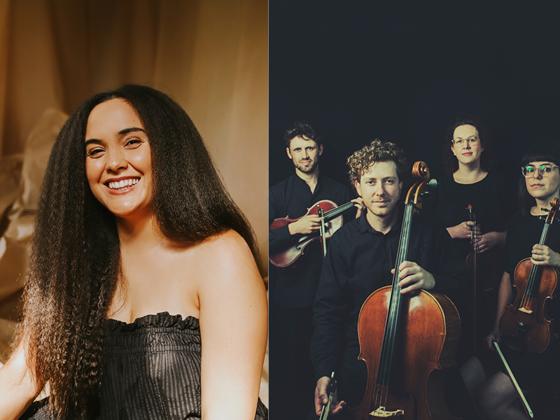
Sydney visitors’ laudable initiative

RARE SUGAR

Omega Ensemble

Elisabeth Murdoch Hall, Melbourne Recital Centre

Tuesday December 2, 2025

David Rowden

Saying goodbye to its small Melbourne audience for this year. the Omega Ensemble gave its hope-to-see-you-later recital in the Recital Centre’s larger space; something of a population error as we could all have fitted pretty comfortably into the Primrose Potter Salon downstairs. True, the dynamics could have been overpowering to the point of painful in the smaller space but that’s more a case of having to cut cloth to suit width as opposed to throwing cash into an undertaking that might show promise but has a long way to go before attracting an audience along the lines of the thousand who can fill .the Elisabeth Murdoch Hall.

Much of the performance attention fell on the Omegas’ artistic director, David Rowden, who played in two of the three works presented by the Sydney-based group. He took the clarinet part in Bartok’s Contrasts of 1938, that unusual trio asking for the usual components of a violin (Veronique Serret) and a piano (Vatche Jambazian), alongside the cello-replacing woodwind line. All players took a sedate approach to the opening Verbunkos: a restrained Moderato indeed with the pulse closer to crotchet=94 than to 100. As well, both Serret and Jambazian proved aggressive after the politenesses were out of the way, so that the forte outbreak at bar 23 proved striking.

Still, to his credit, Jambazian refrained from overpowering his colleagues in the sequence of glissandi that emerge between bars 45 and 54. This movement ends with a taxing clarinet cadenza that Rowden handled with clarity and found a restraint of delivery in what amounts to an exuberant series of irregular arpeggios and scales.

In the following Piheno, we came across several instances when the performers’ congruence was off; not by much, but just enough to disturb the fluency of an otherwise eloquent reading. This wasn’t evident in the outer hymn-like segments but came up in the movement’s changes of pace, like the second Movendo and the overlapping of the Tranquillo bars. Nonetheless, I was impressed by the sustained tension across a set of pages that can be marred by preciousness on one hand and over-exertion in bar 25’s Piu mosso and the crisis at bars 33 to 34 for clarinet and violin in duet.

Bartok’s requirement in the concluding Sebes for a change of clarinets and violins cane be messy and Serret needed more than the allowed nearly-five bars to make the switch but the composer set up a repetition of bar 34 until the player is ready to kick off again. When Rowden came to change his instrument at bar 132 (B flat for A, they tell me), the movement just stopped before Jambazian initiated the ‘Bulgarian’ Piu mosso. Admittedly, there’s a caesura in the score but it seemed to last a fair while, all the more noticeable in this rapid movement.

Serret’s version of the violin cadenza proved to be heavy-handed, even those sections with left-hand pizzicato; the entry of everyone back into the fray at bar 214 also gave us another instance of the musicians – clarinet and violin, I suspect – not coming in quite together. To my mind, the exhibition here by Jambazian was remarkable in its variation of attack and responsiveness to the multiple demands that pianist Bartok made on his keyboard performer. Yes, for most of its length, the Sebes is in 2/4, apart from that central 13/8 interlude, but the participating pianist is stretched by alternately setting the running semiquaver pattern and punctuating the other lines in a vital, invigorating series of sustained flurries. I’m afraid that much of my attention centred on Jambazian and his dextrous handling of this rapid-fire exhibition of virtuosity.

Ella Macens wrote her Through the Mist this year for the Omega organization and we were hearing its third performance on this occasion. Serret and Jambazian were involved, as were second violin Emma McGrath, viola Neil Thompson, cello Paul Stender, and double bass Harry Young. This new product struck me as operating, for the most part, in a single tonality – all the white notes – with a modulation coming up in what I think might have been the third movement: Piu mosso, con moto. But the composer’s suggestive atmospherics made this a bland soundscape, compared to which Debussy’s Brouillards is a sonorous typhoon.

At the beginning, the string quintet generated long sustained notes, alleviated by Jambazian’s piano with some cadenza-like interleaving. This continued for a fair while, taking us into the world of some of Macens’ Scandinavian seniors and peers where placidity and repetition become the chief factors in a composer’s creative panoply. We were lulled into this comfortable ambience, so much so that I had no idea when the movement’s changed from Slow, Spacious, Grand to L’istesso tempo although the pianist’s role did become more prominent, and a folk-like tune emerged in the top strings with cello and pizzicato bass eventually joining in the muted merriment.

As for the move to a quicker pace for the third section, that also failed to have any impact on these ears. Then again, I was looking for old-fashioned markers, indicators of sudden alterations as in a suite or symphony whereas I think Macens was concerned with a continuous journey – a slow-moving progress for which the mist provides an all-embracing shield. That’s fine, except that it was hard to find any suggestion of what we are being protected against. If you were expecting more than a pretty monochromatic universe, you would have been disappointed.

This composer occupies an unusual position by straddling the seemingly static sound worlds of the post-Tavener mystics (which is doing them a temporal disservice, I know) and the simpler output of popular music where not much happens but nothing grates or gives offence. Through the Mist could be used to illustrate/support a quiet documentary yet its lack of thrust, of drive puts it in a category of its own. I kept on thinking of Debussy – not just Brouillards, but also Nuages where the return of those low wood-wind chords serves as an anchor, while Macen’s chords are ends in themselves.

Rowden returned for the night’s title work, referring to a concertino by Nigel Westlake for clarinet, piano and a string quartet of the same format that Macens employed, fortuitously enough. This piece in one movement is almost 20 years old and has been adopted by several local artists since 2007; I’ve heard it played by Lloyd Van’t Hoff and way back from Catherine McCorkill so, although it might not be a regular presence on your annual concert scene, it does enjoy more occasional resuscitation than most other contemporary Australian scores. Written as a 90th birthday present for a UNSW chemistry professor who at one stage specialized in rare sugars, the work served as yet another instance of the composer’s skill at engaging us, even if any attempt to find musical correlations with the molecular breakdown of sugar in any form was doomed before it began.

Right from the start, we entered a world of various and variable textures, the ensemble’s output rich and mobile. This was particularly obvious in the clarinet writing, but then you’d expect that from Westlake who was (is?) a notable performer on that instrument and who enmeshed his soloist in the accompanying forces, with some radiant flourishes for the strings en masse. Further, the pleasures kept coming, like a deft duet between Rowden and Verett, and a page or two of fine pointillism between the high strings and piano.

Moving from his initial Scherzo into a central Tranquillo, Westlake contrived a finely-spun duet from Rowden and Jambazian that brought to mind parts of Westlake’s film music (not so much the heavy Romanticism but a trademark simple lucidity) and inevitably brought to mind Messiaen’s slow Louanges with the clarinet replacing the original cello and violin. A general address from all brought us to the short cadenza for clarinet, then the concluding scherzo with a plethora of cross-rhythms and syncopation as well as more suggestions, this time of Copland and his Rodeo jauntiness.

It’s a significant gift, bringing Australian music to the fore, and the Omega administration and players are very welcome for their endeavours in that regard. Of course, it’s a fraught exercise, given the current economic hardships that many of us are undergoing: where is your audience coming from in these piping times of genteel poverty? Like many of our Melbourne-and-environs organizations, the ensemble will probably have to cut corners. But their contribution to the country’s music-making is exceptionally able and worthwhile; I, for one, hope to see them here – and flourishing – in 2026.

Topsy-turvydom in action

Epic Diva

Selby & Friends

Primrose Potter Salon, Melbourne Recital Centre

Wednesday November 26, 2025

(L to R) Kathryn Selby, Elizabeth Layton, Isabella Bignasca, Julian Smiles

This farewell to arms from the Selby & Friends organization for 2025 used a slightly larger format than usual. The program comprised three piano quartets and Kathryn Selby assembled a trio of guests who worked comfortably together with very few signs of discrepant attack across two major works and a home-grown bagatelle. Selby’s violinist was Elizabeth Layton from Adelaide’s Elder Conservatorium, violist Isabella Bignasca on a home visit before returning to a New York fellowship at Carnegie Hall, and cellist Julian Smiles refreshing himself in this milieu after a lifetime with the Goldner String Quartet.

Fair stood the wind for a well-ordered recital, beginning with the occasion’s title work from Sydney academic Matthew Hindson, moving to a translucent Faure, and ending with Brahms’ most substantial chamber work. For reasons that weren’t explained, the order of events was reversed but I’m not sure exactly who gained from this change; I, for one, was feeling well worked over by interval after hearing a solid reading of the Brahms Piano Quartet No. 2 in A Major of 1861. Still, we stuck with it for Faure’s 1887 Piano Quartet No 2 which partly mirrored the German master’s vehemence, and finally came down to earth for the Australian work – originally the finale to Hindson’s Piano Trio from 2007 which was commissioned by the Macquarie Trio (then boasting Selby as its pianist), subsequently transformed in 2012 to this quartet format on a re-commission from the University of Queensland.

Selby set the Brahms score in motion with that willowy oscillation between four-part chord triplets and quavers that initiates the Allegro with deceptive calm, repeated in bar 9 by the three strings. But it took no time at all before the pianist exploded into fortissimo dynamic at bar 27, maintaining a dominance up to the paragraph’s end at bar 37 – and we were well into into the composer’s substantial 120-bar exposition which, as far as I could tell, was not repeated.

It’s not that the movement is convoluted but the material is treated at length with a remarkable differentiation in texture. At times, it sounds like one of the piano concertos, as at the change of key signature to nothing when the piano sets up a bass opposition to unison strings and the effect is of a relentless pounding from everybody. Then, we reach a return to placidity at bar 209 with a slightly thinner texture an octave below where we began, which has a kind of supple inevitability about it that never fails to delight. Still, it was obvious that Selby controlled the movement’s level of address, the strings working hard to make their points across the central pages of contrapuntal interplay.

The pianist is also gifted with the opening sentences to the work’s Poco adagio: superbly shaped lines that the strings eventually get to enjoy at bar 24, from which point we heard some lyrically ideal work from Layton in particular. This was equalled later in a moving duet with Smiles, playing the initial theme two octaves apart from bar 86 on. But the movement’s strength for me lies in its fusion of lines, particularly the powerful F minor outburst at bar 109 with the three strings striving in octaves over the piano’s arpeggios. And then we reach the inevitable resolution back to E Major and the three string lines curving around each other on the path home through Layton’s penetrating trills and E Major scales across the last stages.

For a change, the opening to the scherzo from the strings in octave unison did not come over as weedy/reedy which is an approach you hear on several recordings; just a confident piano to allow Selby a subtle response-repeat at bar 8. Still, you couldn’t avoid the imbalance in dynamics starting with the piano’s bass octaves at bar 80, leading up to an explosive attack at bars 88-9.

The balance improved in the fierce opening to the Trio, in part due to the composer’s giving the string lines some clear air in their alternations with the piano, statement/re-statement continuing pretty much through this segment’s first half. Further, you would be hard to please if you didn’t appreciate the subtle transparency of the forces’ interplay across the soft decrescendo in similar motion of bars 266-276; then, the final stages of this trio where the piano operates by enswathing her colleagues in a decorative reinforcement as the texture changes in stratum from bar 315 to bar 326 through a passage of quiet regret before we return to the scherzo.

It’s an unusually full complex to experience; the analysts point out the employment of sonata form in both parts, scherzo and trio, but it strikes me that Brahms offers us a remarkable fusion of material – not literally, but each segment having enough in common to provide an intellectual and emotional consistency, at odds with the prevailing practice of contrasting the two divisions. This is best illustrated by the lead-in from trio to scherzo where the dividing crack is perceptible but close to seamless; not a passage of high-flying craft but an undemonstrative example of the composer’s power to engage through simple means.

To be honest, the final Allegro often presents itself as a hard-fought kind of celebration to my ears. In this interpretation, it opened with plenty of panache, these players keeping a restrained eye on the accented second beat of fulcrum bars, both at the opening statement and in the communal extension from bars 73 to 78. But then comes that sudden turn into long note values after the rest at bar 142 and the energy drains out of the movement’s forward thrust.

Of course, it resumes its opening drive and episodes of relief and action oscillate for the remainder of the allegro, coming to a concluding lengthy animato: 52 bars of it, although it seems longer, and punchy in dynamic output, not least when the piano operates at ottava alta. It’s a relief to come to the end of this bounding activity which seemed to me to drain the performers, even if they maintained their energetic output to the final bars. You wouldn’t call it a hard-won victory – that would demean the performers’ skill and linear definition – yet the impression I had was of a solid accomplishment rather than a high-spirited completion of the task in hand.

A less insistent voice emerged with the Faure quartet, although the excellent sweep of the composer’s first ten-bar subject with the strings soaring in octaves over the restless piano arpeggio patterns remains in the memory some days after this eloquent interpretation, as does the sound of Bignasca’s mellow voice surging in solo with the second theme, and the eventual interweaving of lines – easily perceptible in this work where the composer gives much of the running (in this opening Allegro, at least) to the string lines.

Selby got her revenge, of course, in the following Allegro molto which is a study in digital evenness for much of its length, a sort of right-hand moto perpetuo complicated by its tied quavers across the bar-line and awkward syncopations when the right-hand moves into octaves. The pianist generated a suitable restlessness, even through the pseudo-Trio interlude where the 6/8 pulse cuts to a sort of fast waltz. Bignasca again came to the fore at the recapitulation-of-sorts, having a turn at the piano’s main theme in an A minor version before she partnered Layton in a vital canonic treatment of it at Letter F in the Hamelle score.

The violist led the way into Faure’s E flat Major Adagio with a firm hand on the opening melody before Layton joined in with a gentle reinforcement and the movement flowered into a fluid nocturne with the composer at his most relaxed with regard to modulations. Later, the finale approach mirrored the veiled power of the work’s opening, Smiles and Bignasca urging through the rise and fall of the G minor melody, before violin and viola took up the theme at an octave’s distance.

Selby observed the prevailing discipline but hit the road with vehemence for her first forte at Letter B, then later at Letter J. These pages always carry the listener along with their rhythmic insistence and the composer’s rapid-fire invitation au voyage, reaching an apogee when the key signature changes to G Major. The players didn’t go overboard in the Piu mosso final page, allowing Layton plenty of room to negotiate the concluding rhetoric.

Not much to say about the Hindson piece. The strings outlined the motif/tune in unison octaves with Selby providing some anchoring chords and semi-florid scale cadenzas across two bars. And then we were off with a boppy piano underpinning that might have come from Michael Kieran Harvey in his teenage years. Bignasca looked happy, swaying along to the syncopations of a bygone era, yet the only player who was tested was Selby whose contribution was essential and unremitting, as far as I could tell. If you like, Epic Diva served the office of showing us how far we’d come over the centuries of Western musical development – a flashy sorbet to wind up another recital from this organization almost full to the brim with solid substance.

This time, no oddness

MOZART + MARSEILLAISE

Australian National Academy of Music

Elisabeth Murdoch Hall, Melbourne Recital Centre

Wednesday November 12, 2025

Paavali Jumpaanen

Just finishing his fifth year in charge of the Australian National Academy of Music as that body’s artistic director, pianist Paavali Jumpaanen appeared as soloist in front of his organization’s orchestra last Wednesday morning in an exemplary reading of Mozart’s Piano Concerto in C Major K. 503. I’m not an enthusiast of his Beethoven interpretations; admittedly, it’s been several years since I heard him toying with some of them in this very hall. But you would be scratching at a finely-polished surface to find any holes in his work here.

He played/conducted from a grand positioned vertically into the young ensemble; necessarily when a musician does this, the instrument’s lid has to come off (unless you’re super-secure in your accompaniment). So a reasonable amount of Jumpaanen’s output went straight up to the Murdoch Hall’s ceiling. But you had to make allowances for the uneven balance in any case. The ANAM orchestra had eight violins in this configuration, three each of violas and cellos, and a pair of double basses. Ranged across the back wall were the requisite wind for this work: flute, plus pairs of oboes, bassoons, trumpets and horns, with a discreet timpanist for light punctuation.

The problem came with the over-bright wind dynamic bounding out into our faces. This isn’t to decry the upper strings who spoke with as much firmness and congruity as I’ve heard from ANAM orchestras in the past. They had no problems with Jumpaanen whose attack mode was necessarily muted but, outside the central F Major Andante, the woodwind quintet in particular dominated the combined texture at key moments like bar 54 in the first Allegro, and in antiphonal passages as between bars 84 and 87. Yes, the brass contributed to this ascendancy, the clear trumpets in particular, so that when the whole phalanx was in operation, the violin quartet pairs came close to inaudible.

To add to the problem, this is one of the last concertos and Mozart’s orchestral fabric picks out individual voicers among the woodwind with even more concentration than in earlier works, like the fine F Major K. 459 of 1784, two years prior to this C Major masterwork. In the orchestral ritornelli of the first movement, this quintet follows independent paths, even if the oboes and bassoons are harmonically paired for much of the time. As well, you had some splendid passages of interaction with the soloist in the first movement e.g. bars 195 to 214, then 256 to 282: pointed pleasures that enjoyed transparent delivery from all concerned.

Further, this C Major concerto has an ideal balance as its outer movements are comparable in space allowed for soloistic display and thematic variation/development. With regard to the former, Jumpaanen displayed a mastery of the composer’s hard-hat filigree and calm progress between themes which impress as more concentrated rather than thrown around with abandon, as in the earlier essays by the composer in this form. Indeed, I recall commenting on this lavish abundance of melodic material from the younger Mozart in his early and middle Viennese concertos to Kenneth Hince, who opined that I had much to learn about those works, viz. Nos. 11 to 21 and the composer’s novel treatment of the piano in both of those first movement segments that used to be called exposition and development; these terms seem insufficient, however, when dealing with this C Major score.

For all that, Jumpaanen exercised an unusual discretion that stayed just the right side of finnickiness in the work’s first two sections, then embraced the Allegretto with an effective deliberation, finding a welcome fluency in the piano’s opening from bar 32 with its initial chain of mordents, an abrupt rush of demi-semiquavers, immediately followed by a burst of triplets that at least don’t come out of nowhere but reflect the orchestra’s conclusion to its opening tutti; in all, an exuberant misdirection of attention that keeps you listening hard.

The pianist proceeded to exercise telling control through the triplets that become the instrument’s stock in trade before actually settling down to revisit the opening theme at bar 113. As usual, appealing moments kept lurching out, as at the fluent solo beginning at bar 234 that brings in the first oboe and then flute before a luminous duo-quartet-trio of woodwind takes over the running at bar 187 for several pages of simple, clear-cut dissertation. From here on, apart from a 7-bar break, the pianist is on the go and I liked the way Jumpaanen made himself available to the texture in page after page of supporting passage-work, then broke through with no insistence when the piano moved into solo mode.

A thoroughly engaging reading, then, and quite unlike his eccentric expositions of some decades ago. The only complaint I have is Jumpaanen’s introduction of La Marseillaise in the final moments of his first movement cadenza – I suppose in some effort to justify the pairing of this event’s title. Some commentators have noted a resemblance between Rouget de Lisle’s rousing anthem of 1792 and one of the secondary theme in this concerto’s first movement. The comparison lasts little more than a bar but optimists believe there is some connection between the two composers. Well, the Frenchman definitely wrote the words but the music could date back some years to the violinist Viotti. More importantly, what chance did a French military engineer living in Strasbourg have of hearing an Austrian piano concerto written six years earlier? A small one, you’d think.

To establish some musical context, this concert opened with duo-pianists Timothy Young (ANAM’s resident piano guru) and Po Goh performing a version of the anthem arranged by Young in the best Mozart/Beethoven tradition. As a result, we were treated to a rather restrained interpretation of one of the world’s most rousing national songs, but I suppose Young was setting up a context rather than entering into Berlioz-type histrionics and triumphalism; his atmospherics related more to the salon than storming the Bastille.

As a prelude to the concerto, four ANAM musicians played two of the four-hand Mozart sonatas. Francis Atkins and Sarah Chick worked at the K. 381 in D Major, written in 1772 and the first of the authentic and complete works by the composer in this format. This is digitally easy to negotiate but somehow the players struggled with its mechanics: Atkins with some misfiring soprano notes and Chick handling several muddy Alberti-bass passages, due I think to an over-use of the sustaining pedal. Admittedly, I was comparing this performance with one available online given by Lucas and Arthur Jussen; the Dutch duo are, to put it mildly, very impressive and their Mozart reading flawless.

Still, if you’re attending ANAM, your standard must be close to the near-professional. Unfortunately, the following pair of Liam Furey and Timothy O’Malley sounded uncomfortably paired for the B flat Major K. 358 of two years later, their ensemble occasionally unhappy in its ornamentation as well as erratic in the strict synchronicity that this music requires. As with Atkins and Chick, this duo repeated the first half of each movement (I think!), everybody cutting their work-load by a quarter. But the cleanest accomplished part of the four came from O’Malley, despite the lack of prominence in his Secondo for the Adagio and that infectious Molto presto that concludes this happy brevity.

Ad hoc expanded ensemble scores

BEETHOVEN’S SEPTET

Ensemble Liaison & Friends

Hanson Dyer Hall, Ian Potter Southbank Centre

Monday September 22, 2025

Ensemble Liaison (L to R) David Griffiths, Svetlana Bogosavljevic, Timothy Young

Naturally enough, the Ensemble Liaison relied on quite a few friends to mount its attack on Beethoven’s most celebrated work – well, very much so in the composer’s lifetime, and lasting quite a few years after that. For one thing, the Ensemble personnel was cut by a third for this work; see you later, pianist Timothy Young. The remaining members – clarinet David Griffiths and cello Svetlana Bogosavljevic – were assisted by some well-known professionals – horn Carla Blackwood, violin Dale Barltrop, bassoon Lyndon Watts – and a pair of ‘students’ quickly pursuing solid careers in Australian National Academy of Music participant Hanna Wallace on viola, and double bass Rowan Swarbrick who is finishing his Master’s degree at the Melbourne Conservatorium of Music in whose freshly fabricated halls this recital was held.

Not that Young was totally neglected. Indeed, the night’s program was dominated throughout its first rather brief half by Young as both composer and soloist. The evening opened with his relatively new work, Distant Waters of 2024, written for the Liaison forces and based on a simple four-note motif; not really a melody, as outlined by Griffiths pre-performance address. You could distinguish this mini-theme as it was subjected to a kind of free variation treatment that proved charmingly melodious in its amplifications, even if some of these sounded like contrapuntal exercises at their openings.

Young here deals in a harmonic language that might be described as post-Romantic as it was firmly rooted in traditional garb with some mildly adventurous modulation but nothing irregular in its rhythmic structure and an instrumental complex that favoured doubling of lines; not that there’s anything wrong with that – the greats did it, although having the cello and piano play the same bass line isn’t something you hear much of in contemporary compositions. But that’s just it: Young is writing in a style that harks back to less fraught times, devoid of striving dissonance and appealing in its optimism.

However, not much remains in the memory about the performance’s progress apart from its quiescence. Further, Distant Waters was close to submerged by what followed: Ravel’s Gaspard de la nuit suite of 1908, a fine vehicle for Young’s powerful virtuosity. His account of the first movement, Ondine, offered a subtlety eschewed by many another interpreter who expend a thunderous energy at the fortissimo climax of bar 66, which usually strikes me as out of proportion with the aqueous humour of the poetic narrative and a sudden tsunami in the middle of a rash of oblique colours.

As well, you could relish Young’s quiet insistence on the pervading melodic line cutting through the lavishly applied froth, culminating in the single-line address across bars 84 to 87 where (I’m guessing) the human says to the nymph: No dice, sweetie. Then the final page eclat of bitonal arpeggiating burst into play with maximum effectiveness as the last four bars mirrored the piece’s opening frissons in a demonstration of interpretative subtlety.

I can’t be the only listener who focuses attention on the B flat/A sharp mid-works pedal that Ravel sustains throughout Le gibet, so that the chordal web that is meant to distract from it takes second place to working out how the composer welds the two strata together. Certainly, you get involved in the drear and gloom illustrating Bertrand’s speculative poem that only settles into reality in nits final paragraph. Much as the monotone obsessed, my attention eventually turned to Young’s extraordinary hand-span which negotiated many chords flat-on, particularly some that most of us have to arpeggiate, like the 9th constructs at the piece’s opening and the falling figure that comes about in bars 20, 23, 40 and 43.

But, if you know this score, you’re really waiting for the impossible in Scarbo which Young accomplished with enough atmospheric touches to satisfy this listener, mining the movement for its acerbities, overt and muffled. You can’t say it was all plain sailing but each note seemed to be there as well as meeting the composer’s demands for rapid articulation, as in repeated demi-semiquavers that start at bar 2 and recur at bat 396. and in a set of full shoulder powerhouse explosions that finally burst out at bar 366, and again at bar 563 to the immense satisfaction of all concerned; it’s been a long time coming and the intimations nerve-wracking.

Young’s realization of the restless gnome’s activity lacked the vicious sparkle of other interpreters, possibly because he didn’t go in for a dry staccato attack. Yet his sense of the central character’s restlessness, sudden leaps into the foreground and retreats to the shadows, were finely realised across the breadth of this improbably long canvas.

After a brief break, we gathered for the Beethoven Septet of 1800 which is still a real pleasure to experience live, not least for the immediacy of its simple gaiety and open-heartedness. Each of the six movements is a delight to hear, even given my indifference to slow introductions and this work has two at either end. Barltrop and Griffiths established themselves as masters of the performance’s destiny, the former more overtly because of the ornate violin line in bars 3, 5, and 12-15 of the initial Adagio to Movement 1. But the ensemble work that followed in the Allegro was well focused and persuasive in its attack.

In fact, the only flaw that struck me in these pages is that odd hesitation that seems to be interpolated in most readings. It’s a sort of adjustment pause in bar 83 of the exposition where the violin soars up to a high G, then has to leap down to the first E on the D string. Is it that hard a jump that everybody has to wait for the adjustment? It might be harder when the figure returns at bar 218 and the jump is from a top C to the first A on the G string, but the imposed hiatus makes for an obstruction in the movement’s easy flow.

Moving on, the cantabile was finely achieved in the solos for Griffiths and Barltrop that outline the main melody to the Adagio, with some welcome exposure for Watts in a pendant phrase at bar 21: the first bassoon solo so far, I believe, complemented by a slightly longer one for Blackwood beginning at bar 68. Here was playing with a gentle bloom to its character of placid calm, the clarinet and violin in gentle call and response across the final section starting at bar 80’s recapitulation.

No complaints about the bouncy minuet, recycled from the Piano Sonata No. 20 in G Major. This is a point of delivery for the string quartet, mainly the violin but also Bogosavljevic who enjoys sudden exposure in bar 20’s main tune restatement. Beethoven’s equally happy Trio is memorable for the horn E flat arpeggios that punctuate the main melody; Blackwood articulated nearly all of these, only encountering a problem at the top of the mark in her repetition of this segment’s second half at bar 42.

A mildly propulsive attack on the following Tema found Barltrop and Wallace in excellent partnership which continued through the first variation, Bogosavljevic making a resonant contribution through her syncopations in bars 31 and 47. The violinist gave unassertive accounts of the rapid figure-work in Variation 2 and Griffiths and Watts combined to telling effect in the clarinet/bassoon top-and-tail to Variation 3. Blackwood came to the fore again – momentarily – in introducing and ending the B flat minor Variation 4 with unforced penetration.

And the coda came over with simple eloquence as the composer restructures/segments his theme in simple terms setting the clarinet/bassoon duo in antiphonal format against Barltrop/Wallace across the calando final bars. Again, the ensemble relished those deft solo and duet passages inn the Scherzo, especially Bogosavljevic’s long stretch of comfortable outlining in the Trio, until Barltrop entered to double her path at bar 113 for the final thematic restatement.

I can’t think of a happier moment in this work than the violin/cello duet that outlines the prime melodic matter for the Presto finish. This is Beethoven combining enthusiasm and pleasure in one hit of almost eight bars before others enter, and its impetus is infectious, setting a pattern/scene for the most jocund of finales. Once again, we encounter that hiatus as the violin negotiates a leap from a high B flat to the instrument’s lowest F sharp at bars 54-5, and again at bars 177-8 from a slightly lower E flat to B natural below the stave. But what do you expect? By now, it’s common practice, like Trump decrying climate change or the perniciousness of wind farms – well, not as stupid, but just as inevitable.

But the moment that catches my breath every time is the sudden chorale for the three wind that comes out of nowhere at bar 316: both a transformation and an illumination of the vital action that has sustained the movement so far and which leads gently into the violin’s cadenza that Barltrop outlined so precisely and deliberately (the same thing?) that the insertion didn’t jar. Then the rush home with the violinist having the last word with three exposed bars of E flat arpeggios before a climactic E flat in alt.

While the performance might have lacked the gloss of some European recorded readings, you would have enjoyed the brisk immediacy of this one from the Ensemble and friends. At times, the balance was over-favourable to the wind trio, but the string group has so much more meat in its parts, especially the two upper lines that natter endlessly across the score. As well, these players demonstrated an individuality in their work, particularly Griffiths (as you’d expect), Wallace and Bogosavljevic, all of whom displayed an energy and eloquence that supported the emotional involvement of the whole ensemble with an appreciative audience in this acoustically lively space.

Old and easy

MOZART’S CLARINET

Muisca Viva Australia

Elisabeth Murdoch Hall, Melbourne Recital Centre

Tuesday July 22, 2025

(L to R) Nicola Boud, Simon Cobcroft, Erin Helyard

We certainly heard the clarinet sound that Mozart would have been familiar with, although I was slightly disappointed that the more interesting of the two instruments that Nicola Boud wielded – a basset horn – appeared in only one piece: an arrangement of Beethoven’s Horn Sonata Op. 17, written in 1800 and endorsed by the composer in its transcribed version by Joseph Friedlowsky in about 1801. The other Beethoven works for clarinet that we heard saw Boud using a five-key clarinet for the Aria con variazioni of about 1792 which is the last of the Three Duos WoO 27 originally written for clarinet and bassoon but here employing Simon Cobcroft‘s cello for the bass part; and later for the Gassenhauer Piano Trio in B flat which was written in 1797 for tonight’s combination (at last) of clarinet, cello and fortepiano/pianoforte.

Mozart himself fared somewhat less well, being represented by two works. With limited resources, these musicians performed the Kegelstatt Trio in E flat which really calls for clarinet, keyboard and a viola, not a cello, but which proved mildly entertaining as we watched Hobcroft spend lots of time on his two top strings. And that was it, as far as Mozart’s clarinet went because the second work gave Erin Helyard a fortepiano solo in the C Major Sonata K. 545, greeted at its opening bars by a sigh of approval soughing through the Murdoch hall.

In fact, Helyard took the occasion to proffer a slightly different take on this classic. He played through the opening Allegro‘s exposition straight, then decorated the repeat with a smorgasbord of introduced interventions and ornaments. Much the same happened when he repeated the movement’s second part. And on it went through the chaste Andante but, as far as I remember, the concluding Rondo was performed without much elaboration, if any. A bit flamboyant, perhaps, this version but understandable as the sonata was conceived as a beginner’s piece and the temptation to dress up a too-familiar outfit would prove irresistible.

So, a lot of Beethoven’s clarinet in this Musica Viva recital and only one Mozart – and even that was a work that’s familiar to most chamber music lovers. Still, we heard some of the evening’s most convincing playing in the Kegelstatt‘s middle Menuetto, particularly at the start of the Trio’s second half with a finely balanced unison partnership between Boud and Cobcroft. All the same, the cello encountered several moments of dubious intonation – an odd note or two cropping up, admittedly infrequently, in both the outer Andante and Rondeaux that surprised more than a little as Cobcroft was playing the only non-archaic instrument onstage (even if the clarinet and fortepiano were modern copies).

But the point of the exercise was to show the difference between the clarinet timbre that Mozart would have known and the polished product that we have come to expect from the modern instrument when it outlines this particular score. And the results were? Well, not much, as far as I could tell. Boud might have more difficulty in producing the notes because of the lack of flexibility on the Lotz clarinet copy that she was manipulating but you couldn’t really fault the fluency or truth of her articulation which came across with excellent fidelity. Yes, you might have pointed to a couple of awkward moments in phrasing but these were so slight that they barely flickered on the surface of her line.

With the revamped horn sonata, it was hard to understand why Boud and Helyard bothered to repeat the 76-bar exposition to the opening Allegro as the content is bland as far as the horn/clarinet part goes and the only frisson comes in the keyboard alternating semiquaver chords across bars 56 to 61. Against that, we got to enjoy the startling bass notes of Boud’s basset horn. Furthermore, the players compensated for Beethoven’s very short Poco adagio with a vital, breezy account of the final Rondo with a very satisfying partnership in phrase mirroring and a dynamic balance that would have been harder to carry off with the natural brass instrument.

Cobcroft joined Helyard for the Ein Madchen oder Weibchen Variations of 1796: an easily imbibed set of twelve non-complex elaborations on Papageno’s Act 2 wish-fulfilment aria from Act 2 of The Magic Flute. I had more trouble with the cellist’s pitching here than anywhere else on the program, particularly an unhappy start to Variation 2 during which the clefs are reversed, the string playing treble and the keyboard bass in both hands. The outcome seemed momentarily unsure which surprised because the tessitura isn’t that high, only reaching G atop the staff.

Better followed, mainly near the end of these rapidly accomplished variants when we hit the two minore ones, the adagio/poco adagio Nos. 10 and 11 in F minor, particularly the former where the cello emerges only after the first half to take up an entertaining tit-for-tat with the keyboard. But even the penultimate variation has its own charm with a broad string melody set against complaining keyboard triplets that gave way to a brief cadenza for Helyard.

Not much to report about the Aria con variazioni. Beethoven only wrote four diversions on his air, with a rapid 31-bar Allegro in 6/8 as a coda. I found it hard to make sense of the repeats; in my score, every half is given again but it seemed that we only heard one half of each variation being recycled. Not that it mattered over much as the work itself is amiable but slight, with a pretty fair sharing of the labour and exposure between the instruments – perhaps a slight leaning towards the upper line. How about Cobcroft’s cello as a substitute for the bassoon? Well, of course it altered the interplay of colours but there’s not much point going all precious over an all-purpose workmanlike score like this one.

With the program’s concluding Gassenhauer, the trio worked together to better effect than in the preceding Mozart trio. We heard a repeat of the 105-bar exposition which I find is more often omitted, but was welcome here because it gave Boud the occasion to generate a few finely woven strands right from her first solo exposure in bar 12, and later in the movement between bars 184 and 192. Still, most of the clarinet’s work is in tandem with the cello and these musicians sounded comfortably balanced.

The Adagio holds some eloquently interwoven moments for cello and clarinet but I think the keyboard part dominates, not least because it is remarkably active. From bar 26 to bar 53 – the core of the movement – the piano is prominent with melodic content or rapid-fire accompaniment – well, rapid-fire compared to its competition. Here, Cobcroft shone with a clear penetration from his opening statement of the main E flat melody and in his mirror-imaging of Boud, e.g. bars 50 to 52.

The finale’s variations on Weigl’s popular tune came across with loads of drive and clear enjoyment, as in the piano solo Variation 1 and its pendant for clarinet and cello. And it was a pleasure to come across the vigorous return to ensemble status in Variation 3 in bar 61. Boud’s clarinet enjoyed a few exposed moments, as in the response to Cobcroft across bars 132 and 126, but it’s almost as if the composer remembered his wind line in the last variation and gave it a broad canon with the cello, even if everything stops for a sudden keyboard cadenza before the 6/8 syncopated romp home.

An enjoyable recital, in the end, made so by Boud’s liquid sound which disguised with high skill the problems of working through this music on a limited instrument. Across each of her four contributions to the exercise, you heard no irregularities in rhythm or squawks to interrupt the smooth amplitude of her delivery She didn’t elaborate on the difficulties in fabricating an even sound delivery from her two instruments which might have made us more aware of her labour of love in promulgating the older clarinet. But I suspect that most if us were happy to just bask in the warmth of this entertaining, non-aggressive music-making.

Pleasure regained

THIS MIRROR HAS THREE FACES

Selby & Friends

Primrose Potter Salon, Melbourne Recital Centre

Tuesday May 13, 2025

Kristian Winther, Kathryn Selby, Clancy Newman

One of the grievous losses about moving to the Gold Coast was the loss of Selby & Friends recitals; you can hear the various combinations in Sydney, Melbourne, Adelaide, Canberra, even Bowral, but crossing the Tweed has never been part of the organization’s reach. And a great consolation in leaving behind the Not-Too-Deep North’s sybaritic delights is a reacquaintance with Kathryn Selby‘s mobile set of musicians and the assurance that the high quality of these events has not diminished in the interim.

Selby is the fulcrum pianist for this annual sequence of five programs that usually follow the piano trio format and, for this Tour No. 2 in 2025, her associates were violinist Kristian Winther and a long-time favourite of these events in cellist Clancy Newman. The latter I remember seeing several times before leaving Melbourne and being favourably impressed by his enthusiasm and reliability. Winther was a constant presence up to his departure from the Australian String Quartet in 2014 under unsettling circumstances. Since then, his career has remained a series of sporadic appearances in my experience, but clearly the years have been kind to him as he’s playing with the same vivid personality and skill as he showed ten-plus years ago.

Selby encourages her colleagues to share in the introductory talks that have become part-and-parcel of chamber music recitals over the years. Sometimes these can be excruciating because of personal awkwardness or lack of preparation. Newman’s had a layer of personal interest as he introduced Lera Auerbach‘s Piano Trio No. 2 – Triptych: This Mirror Has Three Faces (which may be the case, even if the work holds five movements). This work was written in 2011 and was commissioned by the Arizona Friends of Chamber Music and the Weiss/Kaplan/Newman Piano Trio; the cellist has been asking Selby to program some Auerbach and here she has obviously succumbed.

This score from the Russian/American writer makes an arresting opening with some powerful piano output, and its progress can be traced from moderato to allegro even if the harmonic language remains unsettlingly familiar and confrontational in turn. The composer tends to play through from one panel into another as the several facets (of one person? of three?) that distinguish the construct’s intellectual process are mapped; fortunately the central waltz gave us a fulcrum to work with as the various personality idiosyncrasies of this venture piled up on either side.

As far as I could judge, the final adagio sounded the most substantial of the movements: a spacious postlude that brought to a simpler ground all the compositional complexities that preceded it. But Auerbach’s score is intriguing, even in the abstract; we don’t know what to look for in her mirror, whether the five panels (two exterior, three interior – it’s a triptych, after all) hold a common thread, if the images presented are personal or generic. At the end, it retains its stolid mysteries and, for this listener, it was worth hearing. Which you find hard to say after many another (near-) contemporary composition.

The players then moved to surer ground for their elderly audience through Schumann and Smetana. With the Czech master, you have no choice: he wrote only one, the draining G minor commemoration of his eldest daughter Bedriska’s death. As for Schumann,, you have a choice of three, with No 1 in D minor almost always the one that ensembles pick to display their talents. It’s been a long while in my experience since No. 3 in G minor has been played live, so full marks to Selby and her partners for giving it an overdue airing.

For all its unfamiliarity, Schumann’s opening Bewegt makes a compelling argument with a notably compressed set of materiel sources spiced up by unexpected touches as in a couple of Brahms-like hemiolas before the exposition ends, and a marked lightening of the atmosphere towards the end of the development where the atmosphere thins out to fragments and pizzicato. These players, however, appeared engrossed in the movement’s assertiveness and closely-knit temper, Selby having the most to contribute; at a few stages, she would have benefited from a brief fermata to regroup, but both strings powered forward.

Schumann’s piano part has less to offe4r at the start of the following langsam pages, which begin as a benevolent string duet, finely executed by both these executants with a sense of real reciprocity in their linear entwining. Selby entered the argument with something more than simple chords four bars before the Etwas bewgter direction when the keyboard serves as both protagonist and support. Despite an infusion of welcome placidity at either end of this section, the action in these central pages impressed more because of the amplitude on show, the performers fully invested in the abrupt shift to dynamic motion.

You could have asked for more more contrast in the scherzo, especially at the arrival of each trio in C Major and A flat Major, but they seemed of a piece with the rather hefty approach to the main repeated segment which took the Rasch direction as involving punch alongside the requisite rapidity. Both this movement and its predecessor impress as brief intermezzi, compared to the trio’s discursive bookends, but their pairing is yet more evidence of Schumann’s emotional versatility. When it comes to the Kraftig finale, we appear to be in a much more monochromatic landscape where the ebullient main theme is worked into the ground with restatement after reiteration, albeit consistently optimistic. You find few surprises in these pages beyond the sudden appearance of a rapid violin A Major scale 12 bars from the end, and the dominance of the piano contribution which acts as a doubling agent for much of the movement’s progress and in which role Selby excels.

After interval, we heard the Smetana trio which is well-trodden territory for Selby throughout her career across several distinguished trio combinations. Still, there are plenty of potholes along this score’s path; I may be partial but it seems to me that most of them lie in wait for the pianist, thanks to some pages of Liszt-style virtuosity. As well, you encounter swift changes in temperament that test the adaptability of all performers.

Winther took us all on board with the famous G string solo that sets the trio on its tempestuous path. Even more than with the Schumann interpretation, this treatment impressed for its determination in the clinches and the alternating lissomness of line in passages like the Alternativo 1 which in one page moves from insouciance to high-strung elation. Mind you, the tension was high from the start with Selby eventually exploding in bar 17 where the keyboard breaks free from its accompanying function.

Some moments linger in the memory, like Newman’s eloquent statement of the noble second subject in this first movement at bar 43, followed by Selby’s transformation of the first motif across bars 53 to 55 where optimism turns down its mouth in one of those wrenching changes of ;prospect at which Smetana showed such mastery, specifically in this score. And Winther brought his own voice to the mix with that soaring nine-bar solo beginning at bar 55 when a rhapsodic ascent sinks slowly back to earth. Beside all the heroic clamour of protest and tragedy, passages like these come back to life for days after their articulation if the performance has been vivid enough.

A little later, I was taken aback, as usual, by the sheer carrying power of Selby and Newman doubling a formidable triplet-heavy bass line from bar 80 to bar 89 underneath the violin and right-hand piano’s peroration treatment of this same theme. These players sustained the fire throughout the major part of the movement’s development with its fierce, close canons and harsh insistence before the opening returned and the composer worked his material towards that manic G-dominated acceleration to the end.

Just as striking were both the Alternativo interludes during the work’s central Allegro; first, the simple charm of the F Major, then the switch to grinding power at the E flat Major one’s climax in bar 187 where all three players reinforce each other in a slow march fragment oscillating between C Major and F minor, the strings in fierce competition with the keyboard chords through powerful triple and quadruple stop slashes. – a sudden burst of pageantry in this movement’s pervading aura of secrecy and scuttling.

With a few exceptions, the finale belongs to the pianist who sets the running for a solid initial stretch (bars 1 to 118), and Selby shines in these rapid-fire conditions, making the sudden emergence of Newman with a firm lyric all the more striking. What followed was one of the delights of this afternoon in the duet between cellist and violinist at the score’s Piu mosso marking: a fine instance of intermeshing lines blending in excellent partnership. A repeat of the opening ferment, a revisit of the string duet and we arrived at the movement’s gloomy core: a slow march using a fragmented version of the strings’ theme, followed by another frantic presto rush to an emphatic G Major ending which to me offers no consolation, just a gasp of release.

In sum, an event that reassured us of the consistently high standard that Selby and her confederates can achieve, especially when each of them is versed in both the practices and repertoire of chamber music. Even so, this combination proved singularly effective in its work. Yes, there were surface flaws, mainly of ensemble rather than individual miscarriages. But at the end you were swept up in the participants’ enthusiasm and devotion towards this presentation of contemporary, slightly obscure and all-too-well-known music.

Experts revisit us

HOLLYWOOD SONGBOOK

Musica Viva Australia

Melbourne Recital Centre

Tuesday May 6, 2025

Signum Saxophone Quartet (L to R David Brand, Jacopo Taddei, Blaz Kemperle, Alan Luzar), Ali McGregor

First off, you would find it hard to fault the musicianship of the Signum Saxophone Quartet. When these players are handling music that fits their talents and performing environment, they demonstrate exceptional musicianship; on this night, for example, when they treated us to three excerpts from Copland’s Rodeo ballet from 1942 arranged by Linda Waid, which brought us the brightest and most effective numbers on their program.

Three of the group’s members survive from their last tour in November 2022: Blaz Kemperle (soprano), Jacopo Taddei (alto), and Alan Luzar (tenor). Guerino Bellarosa from that tour has been replaced in the baritone chair by David Brand, who was in fact a former Signum member. So the musicians have experience with one another, and it shows throughout their ensemble stints which covered a wealth of 20th century material.

The saxophone ensemble opened with Stravinsky’s Circus Polka for a Young Elephant, written in 1942 for a troupe of gifted pachyderms. Here, the piece served as an establishment of sound level and timbre, the reading full-frontal with plenty of definition in the quick-march segments, if you missed the subtleties of the composer’s orchestrated version which shows as more hefty than the strident approach of the Signum group. A deft bagatelle, the piece travelled past evenly enough, but you were impressed once again by how powerfully dynamic this quartet combination can be.

More of the same arrived a little later with Schulhoff’s Five Pieces for String Quartet, from which collection we heard the final three: Alla Cseca, Alla Tango milonga, and Alla Tarantella. You missed the acerbity of the original’s strings and the slightly abrasive ‘wrong-note’ language that the composer employed at this optimistic time (1923), compared to what was waiting in the historical wings. When you have four reeds in play, the harmonic shifts are more in-your-face and probably succeeded best in the tango where the ensemble devoted themselves to spun-out lines rather than short sharp ejaculations and taking the pages on at very rapid speed.

To end the program’s first half, the Signum players gave us two well-known excerpts from Prokofiev’s 1935 Romeo and Juliet: Juliet as a Young Girl, and Dance of the Knights. Taking on this kind of work presents several problems, the main one being the ensemble’s monolithic timbre replacing one of the composer’s more brilliantly scored works. For the ponderous Knights’ Dance, the approach showed an awareness of the opening and closing strophes’ ponderousness, although Brand’s bass line came over as noticeably heavy; yet it is weighty in the original, if owning somehow less of an oompah deliberateness. On the other hand, you could admire Kemperle’s top line right from the start of the skittering presentation of Juliet: excellently clear and precise in articulating a difficult sequence.

We heard an authentic suite in Bernstein’s Three Dance Episodes from On the Town, extracted from the musical by the composer a year after the 1944 premiere for concert performance. By this stage, I suppose, most of us were hardened to the prevailing saxophone climate and, in any case, we were hearing a voice that spoke the instruments’ language, particularly in the raucous concluding Times Square: 1944 with its continued references to New York, New York – the only song from the musical that remains in common parlance. It might be an early work, but On the Town established the Bernstein voice – well, the most recognizable one – with its spiky rhythmic jumps and a sugar-and-salt melancholy that owes more than a little to Gershwin, viz. the solid lyric at the heart of Lonely Town: Pas de deux which could be part of the appropriate melancholy stage at the middle of An American in Paris.

Once again, the group gave us a vital, exhilarating account of the last section, packed with energy and an impressive precision on Bernstein’s stops and starts, with an attractive ebullience in their output that found the performers sharing the space like jazz artists, the middle voices of Taddei and Luzar taking the limelight with full-bodied ease, although that is probably due to the skill of arranger Izidor Leitinger who also arranged the Stravinsky and most of the songs.

As I said above, the Signum reading of Buckaroo Holiday, Corral Nocturne and Hoedown from Copland’s brilliant portrait of an America that never was (see also Appalachian Spring) made a striking impact because the simple directness and charm of the composition found a sympathy in these performers that carried us through on their enthusiasm, even during the alarums and excursions of the final piece – which is the most good-natured expression of national colour you will find of the nation, and how many of us would like to believe in it, too.

But you could take pleasure in all three segments; the first for its balance of lines and coherence, the second for its finely-spun lines of melody. As with their Bernstein, the ensemble impressed for their crisp coherence, so much easier to achieve in small numbers as compared to the original orchestral sprawl. And I don’t think any large body, no matter how well-coordinated, could have taken the Hoedown at the pace of these saxophonists, nor could they have achieved the same energetic bite in attack.

far as the vocal part of the night was concerned, I felt sympathetic but ambivalent. Ali McGregor is best known to me for her work in opera (The Magic Flute, Fidelio, Die Fledermaus) where she presented as a bright and polished soprano, informed by an infectious onstage sparkle. Most of this night’s work proved to be brooding, melancholy, if not downright sad, starting with the traditional ballad I Am a Poor Wayfaring Stranger which McGregor turned into a sort of blues over a drone-like backing from the Signum players. This made for a sombre start, but no matter: an attractive melody if not part of what normally passes for membership in a Hollywood songbook.

A brace of songs by Friedrich Hollaender made for a welcome introduction to the real thing. First came Illusions from Billy Wilder’s 1948 film A Foreign Affair which served to show (if you hadn’t picked up on it already) how amplified the singer’s voice had to be in order to cope with Leitinger’s arrangement. More accessible to most of us was Falling in Love Again which distinguished Josef von Sternberg’s The Blue Angel of 1930, helping to promote Marlene Dietrich. McGregor’s version was notable for a security of pitch and articulation which betrays a voice that is properly trained; enjoyable to encounter this classic sung with musicianship allied to mild theatrics.

Kurt Weill was represented by that ode to the bright side, One Life to Live from Lady in the Dark of 1941 and, from two years later, the clever I’m a Stranger Here Myself that graced One Touch of Venus with Ogden Nash’s words and a brilliantly meandering vocal line that found a responsive interpreter despite the often clamorous backing.

On the evening’s second half, McGregor gave a typical chanteuse (chantoosie?) version of Irving Berlin’s Let’s Face the Music and Dance from the Follow the Fleet film of 1936 where Fred Astaire sang it and then danced it into the ground with Ginger Rogers: a memorable Hollywood song which here was given with more power and vim than Astaire could have managed, and rose to a fine peroration at its high-note climax.

We then arrived at the four excerpts from Hanns Eisler’s The Hollywood Songbook of 1943 – the night’s raison d’etre: Hollywood Elegy Nr. 7, To the Little Radio, Die Landscaft des Exils, and The Homecoming. All of the texts were written by Eisler’s most famous collaborator, Brecht, but none of them lasted particularly long, although permeated with the composer’s desolation in a necessary exile. McGregor sang in English, with the exception of her third offering, and all of them recalled the nervous sadness that permeates the between-wars period in German and Austrian cabaret music. But, in the end, there was precious little to get your teeth into, apart from a vague atmosphere of displacement and depression.

We ended the program with two Hollywood evergreens: So in Love by Cole Porter from his Kiss Me, Kate of 1942; and Somewhere Over the Rainbow – an essential for any compendium of Hollywood songs – taken from 1939’s classic The Wizard of Oz film. Both of these succeeded largely through McGregor’s sheer verve when faced with several passages of glutinous support from the Signum men, notably in the Porter lyric – thick and busy at the same time.

An odd juxtaposition, then. Nearly all of McGregor’s material could claim to be Hollywood-bred, apart from the Dietrich reminder. But the saxophone quartet would have trouble finding a link for Schulhoff and Prokofiev; Bernstein’s musical was originally a Broadway production, and Copland’s ballet premiered at New York’s Metropolitan Opera. So not much Hollywood from the visitors. But they’re a smooth organization, experts in their craft, and watching high-quality musicians at work is always rewarding, no matter how haphazard the program’s organizing principles.

Amiable amalgam

JESS HITCHCOCK & PENNY QUARTET

Musica Viva Australia

Conservatorium Theatre, Griffith University

Tuesday March 4 at 7 pm

Jess Hitchcock & Penny Quartet (L to R Anthony Chataway, Jack Ward, Amy Brookman, Madeleine Jevons)

It was hard to get a handle on this recital, a rather specialized event from Musica Viva which is being heard in Perth, Adelaide (part of this year’s Festival), Brisbane,, Newcastle and Sutherland. In the program, Glenn Christensen, a former resident with the Australian Chamber Orchestra, is listed as first violin of the Penny Quartet but was he present on this night, your honour? Or has his appearance changed significantly since those halcyon ACO days? The photograph above shows the current quartet’s personnel, according to the body’s website. I didn’t recognize any of the players by sight – three males and a female – although their ensemble output impressed for its deftness.

Jess Hitchcock sang twelve of her own songs and the program included a full set of texts. But then, the organizers turned the lights right down so this information was completely useless. Mind you, the artists wended a lackadaisical way through the mixed dozen lyrics which were not performed in printed order so that you were invited to play a kind of detection game to work out what was going on. In the original concept, the program contained only eleven Hitchcock songs, all of them organized for a string quartet accompaniment by local writers. A fresh arranger – Christine Pan – attended to the additional song.

I think I got them in the right order but, as far as this singer’s work goes, there be no ignorance like unto my ignorance. I believe I heard, in sequence: Days Are Long (arr. Iain Grandage), Homeward Bound (arr. Isaac Hayward), Collide ((arr. Nicole Murphy), Soak To My Bones (arr. Harry Sdraulig), Leader of the Pack (arr. Ben Robinson), By the Sea (arr. May Lyon), On My Own (arr. Holly Harrison), Together (arr. James Mountain), Running in the Dark (arr. Matt Laing), Fight for Me (arr. Pan), Unbreakable (arr. Alex Turley), and Not a Warzone (arr. Grandage).

Apart from the songs, the program also gave an airing to American writer Caroline Shaw‘s Plan & Elevation: the Grounds of Dumbarton Oaks. This quartet was written to commission by Harvard, celebrating the 75th birthday of the university’s famous estate; further, Shaw was the original music fellow at Dumbarton Oaks in 2014-15. Now what I think happened was that the Pennies interspersed the songs with the five movements from Shaw’s work. If so, the work was subsumed into the whole experience very cleverly. I can recall some viola double stops suddenly emerging at one point, as well as some rapid Verklaerte Nacht-style arpeggios with harmonics – both identifiable from Shaw’s score. Sadly, the final effect was to make you think that one of the arrangers had included an above-average postlude or prelude, rather than transporting you to the estate’s Herbaceous Border or Cutting Garden.

Adding to the mix, Hitchcock proved to be a fan of the pre-song address, giving us information about her background, her family, her musical training, her participation in the Voice referendum, her personal relationships with people that she was singing about – all the gallimaufry that might/might not add to a listener’s appreciation of what was being offered. Certainly, this singer is involved in her work and is at some pains to tell us all about it, in the way of the young. Whether we need to hear it is another business.

To be honest, I found it hard to differentiate between many of Hitchcock’s songs. Her melodic language shows balance and general placidity; the harmonic structures are innately simple, if spiced up by her arrangers; the tempo of each song rarely ventures into any territory but the four-square. For instance, the opening Days Are Long presented as a simple melody over a pizzicato support that developed into a thudding bass line, soon turning the lyric into a bit of a chug. Immediately, you were aware that the vocalist was well amplified; after a time, it became apparent that so were her string supporters.

During the following Homeward Bound, you encountered some rhythmic irregularity to complement the loud, punchy nature of the actual content but this spike of interest didn’t seem to be part of the original matter but inserted by its arranger. And so the procedure continued with a quickening of interest before a return to the tried and true e.g. Collide where an intriguing drone effect shuffled back into a fluent chordal support. Or else the arrangement stole much of the thunder, as in By the Sea with its plain vocal line overtaken by Lyon’s ornate string support.

Contrast that with the feistiness of On My Own, an unusually fast and assertive song which brought to mind some traces of American protest songs, although the text appears to point to an inter-personal crisis rather than a recrimination aimed towards the current social order. But then, it could be both.

Nearing the end of the night, Hitchcock started playing on a keyboard at the opening to Unbreakable. Mind you, I was in such a state of identification tension that she might have been making subtle contributions before this. This song fell into the same category as several others on offer that encourage self-belief, self-determination, self-confidence, self-assertion – statements of character development that flourish in the egotism of this age. Possibly these might not have grated so much if the vocal lines offered variety, but they didn’t. All of Hitchcock’s melodic threads bore a close resemblance to each other, and all sprang from a base in the American Neo-Romanticism that has flourished in the republic for some time.

What we heard across the twelve-part cycle was pleasant music-making that cast no threatening shadows of modernity. In this reversion to a well-trodden path, the composer stayed within the limitations you can hear in Sondheim’s Into the Woods – a sampler of song construction for the contemporary writer with a disregard for recent advances in melodic design, metrical ingenuity and harmonic experimentation; when I say ‘recent’, I’m referring to anything past the first decade of the 20th century in the history of Western music. Of the original music of our country, I found no trace. Despite her Torres Strait Islander and New Guinean background/heritage, Hitchcock has been trained in her craft by serious musicians; as far as I can tell, she has yet to take up the mantle of original invention.

As a suddenly applied encore, Hitchcock and the Pennies presented a version of Sidney’s My true love hath my heart. I wasn’t able to decipher Hitchcock’s attribution of musical authorship from her preliminary remarks, but the setting rocked no boats and so was of a piece with everything that preceded it.

In this light program, the five artists collaborated to fine effect and the smaller-than-usual Musica Viva audience applauded each segment with enthusiasm. So what was missing? Perhaps a kind of emotional depth, or an aspiring ardour to lift the evening’s cosy level of engagement. You (meaning I) left the Griffith University venue with a sense that we’d heard a deft sequence of songs, thank you very much, but not much remained in the memory.

New group offers a final refreshment

WAYS BY WAYS

Brisbane Music Festival

FourthWall Arts, 540 Queen St.

Saturday December 14, 2024

Alex Raineri

Stopping by for an end-of-year visit, I caught up with this festival through one recital only. It proved to be the inaugural appearance of a new trio, Ways By Ways, featuring festival director-pianist Alex Raineri, percussionist Rebecca Lloyd-Jones and flautist Tim Munro – and you have to admit that such a personnel grouping is more than a little unusual. So was its five-part program which began with a kind of structured elaboration of little material and ended with a ‘happening’ reminiscent of the 1960s (perhaps fortunately, it didn’t involve audience participation).

After the opening exercise in artistic togetherness called Collaborative New Work, Raineri gave us a harpsichord solo by Chilean-born Perth resident Pedro Álvarez, Fosforesciamo which roughly translates as ‘We are phosphorescing’ – a state that is always appealing. Both of these works enjoyed their world premieres, the latter particularly welcome as it was composed 12 years ago. A duo followed for Lloyd-Jones and Munro in Irish writer Ann Cleare‘s unable to create an offscreen world, a touching 2012 essay in non-tangibility. Back to the trio format in one-time Brisbane-resident Jodie Rottle‘s blueprint in shades of green from 2022, and the group concluded its first communal foray with Thelma Mansfield, a tribute to the Irish broadcaster-then-painter by her countrywoman Jennifer Walshe, and also the occasion’s oldest music, dating from 2008.

At the opening collaboration, Raineri started out on harpsichord, Munro on piano, and Lloyd-Jones on (I think) marimba. They enjoyed a staggered sort of entry, generating a kind of tintinnabulation, an airy chimes effect in the higher reaches of their instruments, Raineri eventually producing some variety by moving to molest the lower strings of Munro’s piano. The whole thing appeared to ring its changes by a kind of mutual arrangement, without anything printed as far as I could see, eventually petering out in a reductio ad silentium.

Alvarez’s piece for Raineri’s harpsichord opened with a chain of splayed chord-clusters that were either sustained, cut short, or disappeared leaving one note reverberating. This output changed to treble action with lavish ornamentation, the whole a set of sound flurries. More emphatic chords followed, to be succeeded by a concluding segment where a minor 2nd tremolo stood out from the general movement, with the eventual post-phosphorescent fade to dun.

Munro and Lloyd-Jones chose to perform the (b) version of Cleare’s piece with piccolo and a thunder tube (I believe) as well as a timpani and a metal sheet en passant. In line with the composer’s program, this was tentative, spasmodic in effect, the players not following each other; not actually clashing, but failing to coalesce. Such a neurasthenic atmosphere was heightened by emphasized breaths and key-taps from Munro in particular, so that listeners were kept in a state of tension that I thought might have been overdrawn but in fact became quite unnerving as the work lurched along its intentionally disjunct path.

Rottle’s work found the performers in a – for this occasion – strikingly normal situation with Munro breaking us in through a flute solo, Raineri striking a path with a prepared piano, Lloyd-Jones’ contribution eventually noticeable for a scene-stealing vibraphone (Le marteau sans maitre has so much to answer for). A mid-stream duet for piano and flute impressed for the sharp synchronicity of its delivery, even if the main feature I drew from the work was the almost continuous activity from Munro.

But it wouldn’t be a 2022 construct without the pianist eventually reaching for his own strings with a stretch of plucking and stroking that came as an unusually welcome respite from the stifled quality of the actual keyboard work. Lloyd-Jones gave us a soft upper pedal layer towards the work’s end and the last moments made a fine impression with their soft whisperings from Raineri and Munro. The composer points to her work as a celebration of fruitful friendships and I suppose you can infer such a characteristic from her amiable, approachable creation.

Of course, it wasn’t until well after the event that the juxtapositioning of Cleare’s and Rottle’s works struck me as apt: one representing a dissociation of temperaments that doesn’t amount to a definite conflict but an absence of congruity on common ground, the other a melding of personalities demonstrating a kind of affirmative pairing which is sustained by a continuous, malleable underpinning.

With Thelma Mansfield, we came upon a piece of musical theatre where what the players did distracted from the actual sounds that they generated. My notes wound up being a set of observations on action, like the rather incongruous sight of Munro shadow-boxing, or Raineri miming a rifleman and also slicing (admittedly with a stick rather than a sword or knife), while Lloyd-Jones poured a white substance (sugar? heroin?) into a bowl from a colourful container, making minimal audible impact.

As far as I could tell, the intention was to plunge us observers into a set of scenarios that might have amounted to a character sketch of the title character if only we had some kind of key. But the work became more opaque as it progressed, complicated more by the sudden emergence of a taped contribution that came from a mobile phone set into action by Raineri. To be fair, the work presented a sort of narrative structure through a monologue/address begun by Munro (and taken up by others) in which he (they) set out a slew of rules that were preceded for some time by German numbers.

After stopping for a taped downpour (harbinger of what was waiting for us outside at the recital’s end) the trio decided to sweeten the pot by singing for us – at least two hymns, in the end. To follow, all three threw scraps of paper in the air . . . and on it went: event after event in an off-beat Dada demonstration. Raineri sat at a table and dealt cards – loudly; Munro vocalized through his flute, punctuating his pseudo-singing by tapping his instrument’s keys.

One of the performers flashed number cards at us – 4, 7, 3, 5, 2 – and then the ensemble started on the verbal numbers game, now in English. Lloyd-Jones poured her white grain from one bowl into another or picked a handful up and let it dribble back, like a fey Nigella. And we were once again treated to a fizzling finale which contained isolated intervals for Raineri’s piano as one of the few coherent strictly musical memories I’ve retained from this specific exercise, which kept your attention centred on the musicians/actors, most of the focus falling on Munro.

While willing to go a fair way with composers in their search for the everlasting verities, I’m not sure that I gathered much from Walshe’s personal (I presume) salute. It brought the hour-long recital to an entertaining conclusion with its variety and the intelligibility of its discrete parts; even the air-slashing exercises that obtained in the work’s earlier stages made some kind of excoriating point, if Mansfield was in real life the sort of trenchant personality such gestures might imply.

A fortuitous welding of three talents, then, in this short exhibition. I don’t know whether there’s much repertoire for the flute/piano/percussion combination; still, Raineri has shown impressive talent at organizing programs like this one where the performers have ample room to display their talents as soloists, duettists or members of a larger ensemble. Without a doubt, he is flying a lone, brave flag for contemporary creativity in all its colours through this annual festival and I’m only sorry that I couldn’t get to more of its many parts; they are distinctive for their quality of participants and for the catholicity of presentation styles – a true music festival.

One more time

MUSICA ALCHEMICA

Musica Viva Australia

Conservatorium Theatre, Griffith University, South Bank

Wednesday November 20, 2024

(L to R) Lina Tur Bonet, Kenneth Weiss, Giangiacomo Pinardi, Marco Testori)

Apart from some weirdness in presentation, this recital finished off Musica Viva’s Brisbane year quite neatly. The ensemble of four in this Alchemical current incarnation makes a congenial collegium in itself, even if the dynamic balance favours the top line. Mind you, the group’s personnel has changed radically over the years, not least in its participating numbers. But these touring players show a reassuring expertise and their leader worked hard to give the product plenty of Baroque spice through her attack and frequent flights of virtuosity, climaxing in an energetic demonstration of skill in Corelli’s La Folia Violin Sonata in D minor.

Spanish violinist Lina Tur Bonet founded Musica Alchemica some time ago; I can’t be more precise because its genesis seems to have been brought about for an undated performance or two of Handel’s Alessandro under Alan Curtis – which must have taken place some time before the American harpsichordist’s death in 2015. Still, I’ve no idea when Bonet herself was born; to be fair, I can’t find out the birthday of her ensemble’s archlutenist Giangiacomo Pinardi, either. Kenneth Weiss, the Alchemica’s American harpsichordist, is 61 and cellist Marco Testori is 54; Pinardi looks as though he’s more a contemporary of Weiss but it’s unfair to judge on appearances, isn’t it?

For the recital’s first half, Bonet began and ended with two of Biber’s Rosary Sonatas, opening with The Annunciation No. 1 and finishing with The Crucifixion No. 10. Between these, we heard a Sonata a 2 by Cima, Schmelzer’s Sonata Quarta in D Major, and Muffat’s familiar Passacaglia in G minor for harpsichord solo with its 23 variants that involves repetitions of each one (not universally applied). Corelli began and ended the post-interval content, starting with the Op. 5 G minor Violin Sonata, concluding with the afore-mentioned Op. 5 No. 12. In the centre came Telemann’s Cello Sonata in D Major, a solo lute Toccata by Piccinini and Westhoff’s little Imitazione del liuto, with Bonet keeping to a pizzicato account of the melody (obvious, given the piece’s title) while Pinardi took the underpinning in this gentle 40-bar miniature.

Speaking of weirdness, Bonet began her Annunciation by entering from the rear of the theatre and slowly progressing down the stalls’ aisle during the Preludium, joining her confreres onstage for the Aria and Variations, then the submediant-dominated 11-bar Finale full of fierce razzle-dazzle. Cima’s small-scale sonata for violin and violone gave us an amiable exercise in fleshed-out continuo and lashings of florid ornamentation. In my 1958 Erich Schenk edition, the work takes on the nature of a suite halfway through with a sarabande and gigue doing the rounds before the composer moves to a gradually accelerating sectional set of concluding pages. One of my lasting memories of this is Testori’s use of his cello as an unwieldy guitar for the opening strophes. Mind you, he could have maintained the impersonation for much longer as Cima uses the same 4-note descending bass sequence for three-quarters of the work’s length.

But the performance wound up being another Bonet showpiece across the final presto. Something of a relief, then, to experience Weiss’s measured, faultless articulation in the Muffat passacaglia. More than other interpreters I’ve heard, this musician employs rubato to keep the score elastic rather than plodding and predictable, so avoiding rhythmic tedium. Then it was back to Biber in G minor with a nearly comprehensible explanation of the scordatura tuning that makes the set of 15 sonatas so remarkable in its changing of timbres. Once more, a triumph for Bonet with an unexpectedly arresting depiction of the three crosses positioned at the start and an impressively fierce 10-bar earthquake simulation to bring the sonata to a close.

But Bonet is celebrated for her unique approach to these sonatas which have not only gained in performative intensity under her hands but also enjoy a solid fleshing-out, thanks to the timbral complexity that comes with this trio of mobile and responsive escorts. Much the same level of authoritative embellishment emerged in the Corelli G minor Sonata which was loaded with rapid flashes of fioriture, especially in the two Adagio movements. The second of these, if I remember, cut back participation to violin and harpsichord, which change of textural character made for a welcome relief. and a minor point that impressed came through Testori’s cello line which enjoyed an occasional burst of unexpected independence/exposure.

This player’s volume didn’t carry that well to the back of the hall from where I heard this program’s second half. You could enjoy his warm account of the Telemann sonata’s first Lento, which progressed with hints of majestic instancy while avoiding laboriousness. Still, the instrument’s gut strings’ output was frequently undercut later by the archlute/harpsichord continuo, although these supporters obligingly recessed themselves in the ensuing Allegro. For the 21-bar Largo, Testori’s backing dropped back to Pinardi who maintained a fine discretion with both musicians allowing each other a noticeable freedom of rhythm.

Pinardi then performed what I assume was one of the eight toccatas from Piccinini’s second volume of Intavolatura di liuto. This sounded much like a free fantasia in character, the performer treating the score’s bare bones with an intriguing originality in his approach to tempo and dynamic, the whole concluding in an audibility-challenging pianissimo. Further gentillesse came with the Westhoff 6/4 versus 4/4 duet, engaging for its embrace of the intimate and so prefiguring the night’s flamboyant finale.

The last sonata in Corelli’s Op. 5 collection consists of 23 variations on the well-known La Folia or Les follies d’Espagne theme. The composer distributes his varying technical demands across the whole sequence and Bonet led the charge with impeccable musicianship and authority. But, to be honest, I found this offering sounded like over-gilding the period lily – and a compressed one, at that, while Corelli rang his changes on the violinist’s bravura and drive, double-stopping her way to an applause-rousing last gasp for this event.

Bonet is very well-versed in the Corelli Op. 5 as she recorded them with Musica Alchemica in 2017 (you can hear the whole set on YouTube) and framed her recital around these and the Biber works to invite us over ground that is very familiar to her. I know she recorded the Westhoff Imitazione in 2020 and possibly this program’s particular Cima sonata on a CD that involved some other instruments than those appearing on this night (harp, double bass).

But there’s nothing to say that you can’t go over old triumphs; pretty well everyone we see on the concert stage-platform does the same, even if that makes you admire even more those artists who are on an unending exploration of repertoire and present you year after year with music that they are shaping in front of you, rather than refining works that they have been playing for years. True, Bonet has to hone a changing ensemble to cope with her program choices and her own musicianship and skill never falter; well, they didn’t last Wednesday night. And, without doubt, there’s great pleasure to be derived from observing a musician at the top of her game.