Non sum qualis eram bonae, as the poet said. None of us is, I suppose, but it was a bit of a surprise to find that the Ensemble Gombert is not how I remembered it from about six or seven years ago when I last heard the group live. Yes, there were moments in this Palestrina celebration that brought back recollections of he group’s finest outings, usually in the warmer surrounds (certainly better lit) of the Xavier College Chapel rather than the pre-Vatican II semi-gloom of this Camberwell monument to times long past.
Even without the benefit of a program, it was obvious that the group had changed in personnel. The long-lasting top soprano duo of Deborah Summerbell and Carol Veldhoven has disappeared, and was I mistaken in thinking that only Fiona Seers from those golden years was still singing with this company’s sopranos on Saturday afternoon? I recognized none of the altos but that could be a momentary sight defect due to the prevailing penumbra. Sadly, that group suffered an irreparable loss in the premature death of Belinda Wong during 2021. Among the tenors, I couldn’t see Peter Campbell or Tim van Nooten; only Vaughan McAlley remains of the old guard and he left his position in the ranks to conduct this performance (most of it), as the Gomberts’ founder and artistic guru John O’Donnell was indisposed. I couldn’t see Andrew Fysh in the basses, but then the male lines were reduced to six singers: an economy that was clearly felt in several parts of the program.
To commemorate this great church composer, the Ensemble sang four of his motets and one of the larger-scale masses, Benedicta es, which has two alto and two bass lines, as well as your soprano and tenor blocks. But the afternoon began with the Tu es Petrus motet which also calls for six lines: two sopranos, alto, two tenors and a bass in my edition, although others specify one tenor and two bass parts. I’m not sure how the ‘male’ lines were accomplished with so few singers to go round, or whether some altos took on the second tenor/first bass, although it should have been obvious from bar 8 when the low voices respond to the opening strophe from the sopranos and altos.
It made a brave opening, the reading as full-bodied and steady as any Papacy-endorsing post-Reformation enthusiast could want, the added bonus that we heard the motet’s second part Quodcunqueligaveris, which is so often left out on recordings, even by choirs that have big reputations. Still, this is familiar ground for the Gomberts who made a good deal out of this sample of Catholic affirmative action from 1572.
Next came Ad te levavi. part of a collection published in 1593 and calling for two tenor lines. At this stage, it seemed a good idea to try and work out how many voices had been allocated to the various vocal strata; I believe that the Ensemble for this performance comprised sic sopranos, six altos, three tenors and three basses. With tenor McAlley conducting, this meant either a weakening of volume in one of the tenor lines, or the group possessed a versatile bass-baritone. Or the group simply coped as best as possible.
Things were back to manageable for Senex puerum: five voices, two of them sopranos. I believe that we heard the secunda pars, the verse starting Hodie beata virgo; again, something that is lacking from the few recordings I’ve traced of this particular motet. Then, on to the familiar with Assumpta est Maria where McAlley moved back to the tenors for this motet which asks for two sets of them, as well as two soprano lines. Again, I believe the group sang the second verse, beginning Quae est ista although any vehemence at the phrase terribilis ut castrorum escaped me. The new conductor, whose first name was Luke (maybe not: McAlley has a lot to learn about projection while speaking to an audience, one of the tricks being not turning your head sideways at critical points in addresses), continued with the stolid pace set by the main podium protagonist, so that the metre sounded over-emphatic as Palestrina’s lines were regimented, far from fluent.
And so to the substantial mass. This followed the afternoon’s performance pattern of rather strong downbeats at the expense of fluid inter-meshing and a thin tenor output – I don’t know why as both basses sounded muddy in the opening Kyrie and the upper male line enjoyed unexpected exposure. But the following Gloria produced some fine ‘Gombert’ passages, mainly from the three female lines at points like Domine Deus Rex and an unexpectedly buoyant Quoniam.
Even so, it struck me once more how little attention is given to plosive consonantal sounds by this group which can produce some enthralling polyphonic meshes but which relies on its listeners to be familiar with texts or, more usually, follow them in the organization’s programs, which were also graced with an account of the music to be performed from O’Donnell. Still, I suppose most of the Gomberts’ adherents would be familiar with the words to the Ordinary of the Mass, especially those of us worshippers who suffered it in silence for many years.
Like the Gloria, this Credo interpretation was devoid of drama, with not much to differentiate the Et incarnatus, Crucifixus, and Et in Spiritum divisions, apart from a small lessening of contrapuntal interlay in the second of these where Palestrina’s texture drops its bass lines. For all that, the afternoon’s most impressive work came with the long notes of the composer’s Et vitam, followed by the elevating five-note rising scale aspiration and response from all five parts across a jubilant Amen.
In the Sanctus/Bendictus double, I enjoyed the Pleni sunt interlude for the score’s three middle voices; this proved to be clear (as you’d expect) but also emotionally positive, albeit in a restrained mode. Fortunately, the Hosanna and its repeat came over with excellent mobility to the point where you could ignore the customary chugging action of the ensemble’s style of attack.
Not much remains in this memory of the hard-worked first Agnus Dei. The second did not proceed as usual to the dona nobis pacem strophes but was sung in plainchant by the men before reverting back to Palestrina for the third run with his optimistic final 20 ‘bars’ that steady the triple metre to the prevailing quadruple in a final passage of high consolation.
Only at the end did you appreciate what a sustained bout of singing had been presented by the Gombert voices whose pitch had barely wavered throughout this mass. Certainly, the Ensemble gave us a worthwhile homage to Palestrina in this (possibly) 500th anniversary of his birth, even if I missed the piercing certainty of its former soprano and bass singers. On this occasion, we heard some splendid moments of choral splendour, if not as many as the choir used to produce in its pre-COVID outings.
This distinguished group is making its ninth tour for Musica Viva Australia, and this time around it is playing to its strengths – at least as far as the Brisbane program is concerned. One characteristic not on show in this Program 1 is British music; whereas the second bill of fare includes pieces by John Bull, Tallis and Judith Weir, the solitary sample of home-grown art for us was Edgar Bainton’s Revelation Chapter 21 setting, And I Saw a New Heaven. For the rest of this event, the accent fell on France, the main element being Durufle’s Requiem of 1948, with two Messiaen organ solo side panels. A bit of German British maybe in Handel’s Zadok the Priest, a Venetian excursion with Gabriel’s O Magnum mysterium setting of 1587, followed later by an American detour for Martin Laurindsen’s 1994 popular version of the same text, and a friendly antipodean nod through Sydney-based composer Damian Barbeler‘s recent setting of Charlotte, a poem by Judith Nangala Crispin.
Not that you can complain about facing a mixed program because it shows the versatility of the executants – well, it’s meant to do so. But a real practical problem arrived when trying to work out which of the organ scholars – Harrison Cole and Paul Greally – was actually playing specific items. I found out later from the organization that the pair both contributed in the first half while Greally performed the Durufle. My eyesight is certainly not what it was and the players were a fair way up the back wall of the Concert Hall, but I had the allocation of labour completely wrong. Time for the opera-glasses, I suppose. Even so, I can’t specify who accounted for the two Messiaen extracts.
Warming up the listeners with a golden oldie, director Daniel Hyde and his singers opened the night with Zadok the Priest, one of the organists having to work through that long introduction with an abrupt shift in dynamic (keyboard?) early in the process and without the benefits of a true slow crescendo or the initial fluorescence of three violin lines, not to mention the original’s instrumental explosion of three trumpets and timpani when the choir begins its work at bar 23. On top of all all that, the sopranos were unusually faint (drowned?) in the opening choral strophes and the interpretation sounded effete and over-studied, especially when compared to sturdy, top line-reinforced performances like that at the recent British coronation ceremony.
It was unexpected to have an organ supporting the double choir Gabrieli motet, especially as I couldn’t find an edition with such underpinning. What you can come across are readings where some of the vocal lines are given to instruments (those trustworthy Venetian trombones), but who’s to determine what universals obtain when dealing with the Renaissance-to-Baroque crossover years? Here was a much more telling sound despite the work’s eight vocal lines, probably because of the disposition of these voices into a treble-dominated group set against a middle/bass-heavy complement-partnership. Further, the approach was informed by an attractive suppleness, notably in the shifts to the congruence of all parts, as in its first occurrence at bar 10. As with Zadok, the output sounded very well-mannered and lacking any European coarseness of dynamic or fracturing of the ensemble’s cool temper.
Whichever one of the scholars gave us Les anges from Messiaen’s La Nativite du Seigneur generated a mobile series of phrases and harmonic shocks (oh, those multiform modes of limited transposition) and a striking suggestion of ethereal animation, the specifically designated birth corps dancing on the heads of a plethora of needles – in this instance, to celebrate a very pointed moment of transubstantiation.
For a soft leavening, the choir sang the Laurindsen setting of O magnum mysterium which gave the audience a recovery space through its deft concordances and fluent part-writing. This is a gift to any choir with sufficient breath control and the Cambridge musicians made a strong case for its quiet benevolence, although to my ears the finest interpreters of this music are American university bodies whose sopranos yield little to these British boys in intonational exactness but whose basses are, at their best, more full-bodied and supportive. While the attack on the work’s two opening phrases was clumsy, the conclusion proved to be as spellbinding as ever.
Time now for the second Messiaen. This was the toccata specially written to replace the third movement of the orchestral version of L’Ascension when the composer decided to transpose it for organ: Transports de joie d’une ame devant la gloire du Christ qui est la sienne – always the man for a catchy title. One of the Cole/Greally partnership worked through this with some of the improvisatory eloquence shown by the composer in his own recording, even if a couple of manual changes were awkward (when are they not?) as the Swell sounded under-powered. But that might have come from an unfamiliarity with the Klais instrument, not much time elapsing between this appearance and the two Melbourne opening stops on this eight-session national tour. However, the executant made a brave showing in the final stanzas from the Plus vif to that exuberant final cadence.
Back to a more prosaic vision of bliss with Bainton’s treatment of the first four verses of St. John’s towering vision of the new Jerusalem. This is standard Anglican content from the venerable Parry/Stanford tradition (the composer was a pupil of the latter) and the level of ecstasy is kept to a restrained level; more noticeable when coming after the French organ master’s confronting excesses. As you’d expect, these singers were quite comfortable with this elegantly phrased anthem; you can see this in operation on an Easter 2020 performance under Hyde on YouTube which has the benefit of the rich acoustic in the College’s chapel.
Finishing the night’s first half was the new work by Barbeler, Crispin’s poem concerned with searching for information about her great-great-grandmother. The composer is fond of single chanted lines that can intermesh or stand in contrast with each other. These tend to be static while his harmonized passages alternate between sweet and discordant: a fair mirroring, then, of the poet’s journey to a kind of fulfilment. The more white civilization is referred to, the more strained the harmonic vocabulary – or so it seemed to me – but the work rises to an angry. declamatory climax. At the end, the singers throw sheets of paper into the air, a piece of theatre that seemed to this observer to represent a suddenly disturbed flight of white cockatoos. I found the gesture rather disturbing, but one old fellow a few rows back cackled with delight; as with our varied reactions to the Voice referendum, you just can’t tell. Still, Barbeler constructed a definite atmosphere reflecting the poem’s desolation in the search for and discovery of Charlotte’s photo.
The Durufle Mass features regularly on the King’s College Choir performance schedule at home, alternating in November with the Faure Requiem. You’d therefore anticipate an ease with its textures and dynamic stability, and this facility was pretty much in evidence, right from the plainchant Requiem aeternam setting up to the death-mollifying In paradisum. After the placid Introit, the choir’s Kyrie enjoyed some welcome Christe eleison angst. You were pressed to find fault here, as in the following Offertorium which distinguished itself with a memorably affecting final Quam olim Abrahae.
The organ ripples that sustain the Sanctus opening didn’t so much misfire as miss an ecclesiastical ambience; put simply, the Concert Hall acoustic proved too dry for many parts of this Mass, in particular these pages. But that deficiency was apparent even from the opening Zadok ritornello which has become familiar to us form performances recorded in more reverberant spaces.
I believe the solos in this reading – for the Offertorium, Pie Jesu and Libera me – were sung by groups, not individuals. Certainly the contralto Pie Jesu solo was handled by a group of boys who gave the final sempiternam a finely poised decrescendo. The return of full forces for the Agnus Dei brought us some of the night’s best concerted work, even if the organ’s swell-box manipulation sounded awkward at one point. And there is little left to say of the final three movements, except to note some intonational discomfort in a unison passage during the Lux aeterna, a worthy demonstration of reserved ferocity when Durufle gets around to the Dies illa of the Libera me, and a sense of regret for us all that the In paradisum is so short.
Very little drama disturbs the progress of this Requiem which is packed with soft floating passages, the composer avoiding the passions roused in so many other writers by the Sequence and the desire to make a visceral experience out of a mass for the dead. Like its Faure counterpart, it suits boy sopranos in its sober tranquillity. Despite lengthy stretches of calm meditativeness, the work’s standard of accomplishment pleased a well-packed Concert Hall which showed a desire to be gratified throughout – even by those striking organ solos. Sadly, this popular approval resulted in most of the Mass’s movements being greeted by applause – in many another case, not such a bad thing but, with this work, these interruptions disturbed the score’s cumulative effectiveness.
By the way, one of the sopranos – fourth from the left, facing the stage – embodied a delight that you sometimes come across in choirs: a lad who is transported by his work, slightly weaving in sympathy with the musical complex, lowering his score often enough to convince you that he knows the material thoroughly, ever alert to Hyde’s direction.
Oh to be in Melbourne, now that Easter’s near. One delight of living in the Victorian capital is being bathed in choices where choral music is concerned at this time of year. My sense of nostalgia was heightened when the Institute’s director Nicholas Dinopoulos mentioned, in a throwaway line that the Australian Boys Choir would be taking part in a reading of the St. Matthew Passion next Sunday at Monash University (modestly not indicating that he himself would be singing the Christus role). Will we hear the St. Matthew or the St John Passion on the Gold Coast in the next few weeks? Or anything in Brisbane along the Bachian line? I don’t think so.
It came as an unexpected surprise to realize that, in over four decades of reviewing in Melbourne, I’d been inside Lonsdale Street’s Wesley Church only once and the experience had left absolutely no memory. As a venue for this choral recital, the space proved very comfortable for the singers in transmitting dynamic changes successfully and having just enough resonance not to be intrusive. But it was mainly due to the organizational skills of the ABCI’s backing staff that the program moved forward as steadily as it did, what with the organization’s various bodies and sub-groups entering and exiting with near-seamless facility.
I watched this event thanks to the good graces of that invaluable resource, the Australian Digital Concert Hall, but missed the opening number, Australian writer Dan Walker‘s The Wanderer, thanks to a connection glitch in my machinery. Nonetheless, as ADCH patrons know, you have online access to any event you’ve paid for up to seven days after the initial transmission. Both this opening number and the conclusion – Bob Chilcott‘s The Invention of Printing and The Abolition of Slavery from the cycle Five Daysthat Changed the World – called upon all the young men and boys enrolled in the Institute’s various bodies. For all that, a major part of this afternoon’s program was taken on by the organization’s senior members, the Vocal Consort.
This is an expert ensemble with a full-bodied sound and an admirable security of pitch; just as well as much of their work was unaccompanied and it was a true test of these 17 singers that you could rarely point to an enunciative flaw. They began with Robert Shaw and Alice Parker’s arrangement for TTBB of the English sea shanty Swansea Town and straightaway produced an attractive combined timbre of high definition with an even dynamic attack. The top tenor descant sounded rather reticent from bar 29 to bar 32 but you had to appreciate the rhythmical drive and the crisp observation of the dotted-quaver-semiquaver patterns in the opening and closing phrases of each stanza.
Barnby’s setting of Tennyson’s touching lullaby gave this recital its title and here the Consort showed its ability in a much less punchy piece with the original SATB setting preserved comfortably and some passages of particularly elegant phrasing, especially the second stanza’s pianissimo opening at bar 19. About now, you became aware of the group’s possession of an excellent top tenor line – ringing and plangent in turn.
You could find the same restrained eloquence in the group’s reading of Kurt Bestor‘s Prayer of theChildren, one of the richest I’ve come across in terms of choral timbre. I don’t know who did the arrangement but it proved highly suitable for this choir’s personnel; the versions I’ve come across online have a certain amount of metrical fluency but here you came across some moments of mensural originality, climaxing in a long pause before the final powerful ‘help me’ appeal at bar 40 (in my edition); not to mention the brief Croatian murmured ejaculation starting at bar 45 blending into the sombre resignation of the piece’s last moments – a splendidly accomplished sequence.
This group finished their first half offerings with a deft arrangement, again by Robert Shaw and Alice Parker of Vive l’amour/la compagnie which the program refers to as American traditional. Apparently it’s not a product of the republic but of England. Still, in the best USA puritan tradition, the words in this version were a tad bowdlerized and, from what I can make out, the American university glee clubs have taken it over. I can’t find a performance online that’s as clean-cut or deftly outlined as this one from the Consort (with a one-line interpolated solo from Dinopoulos) which sounded bracing throughout and avoided the off-putting tweeness that other bodies bring to the piece.
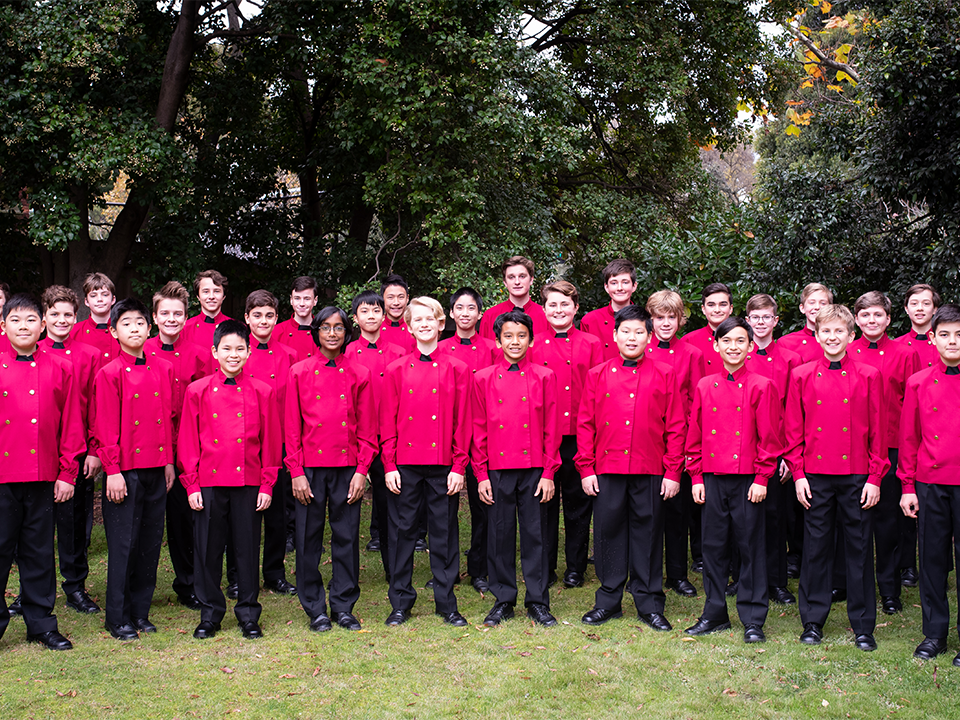
Onstage came the Australian Boys Choir – I think; these were the singers who wear the military-looking red jackets, but I think Dinopoulos referred to them as ‘the performing squad’. This group sang Paul Stanhope‘s Losing the Plot, a four-part suite to texts by Michael Leunig: Talking to My Shoe, Underpantsanthem, La-La Land, and Lost the Plot. Piano accompanist Zachary Hamilton-Russell was put to gainful employment through this work, too enthusiastic in the first section for comfort although his part was active compared to the vocal lines which tended to be easily overpowered. I caught little comprehensible from the second chorus apart from the opening statement because the young singers were exercised staying in rhythm and on pitch so that little effort was put into projecting the words successfully. A similar fate befell the La-La Land section; the title recurred often, which was a kind of anchor, but the text retained its secrets even though the group sounded more comfortable with these pages.
The finale to Stanhope’s composition is a tango and the singers were quite crisp in their observation of the dance’s accents, their vocal lines sounding lucid for the most part. But I had no idea of their verbal content until I went back and listened to the piece again with the great cartoonist’s whimsical poems at my side. The whole exercise would benefit from a few more rehearsals, it seems to me, with an accent on enunciation.
After interval, the Consort returned with a highly charged version of Samuel Coleridge-Taylor’s setting of Christina Rossetti brief Summer is gone lament, in an arrangement for TTBB by (I think) John Bateson. This is not as easy as it looks with some none-too-subtle chromatic slides and a dependence on that feature for individuality. These singers made a fair fist of this mild, unsophisticated sample of Victoriana which is a few salons away from the melodic simplicity and appeal of Onaway! Awake, beloved. But there’s about 12 years between the vibrant generation of Hiawatha’s Wedding Feast and this madrigal with a dying fall.
More assertive Britishness came next with the Vaughan WIlliams arrangement for TTBB of the English folksong Bushes and briars. Yet again, the reading was exemplary for its dynamic fluency and solid probity of line. My only doubts came with some of the top tenor line’s high Gs, e.g. in bars 17 and 18, which sounded a few millimetres short of going flat. This was followed by a difficult if dramatic work, Romanian composer Gyorgy Orban’s Daemon irrepit callidus in a TTBB version that gains in menace when compared to the online interpretations involving SATB forces. This work is a neat example of post-Orff rhythmic hammering in Latin; unlike Carmina Burana, it doesn’t last long – not quite cracking two minutes – and these men knew their work and delivered it with high confidence.
Finally, the Consort entered fully into the American collegiate stream with a groovy outing for Van Morrison’s Moondance, complete with doo-wahs and be-bops while the tenors played havoc with the original tune. But the syncopations were spot-on and the production values slick, such as you only get when real musicians bother to exert their skills on easy-listening material. Staying in character, the group then sang an interpolated encore with Julius Dixson and Beverly Ross’s 1958 hit Lollipop, complete with the original’s mouth pop punctuation. This bagatelle fell into the expected USA groove, carried off with ready skill, the whole accomplished without Dinopoulos’ direction.
Finally, the combined forces of the Institute – from the Consort, through the red-jackets up to the large group of primary-school-age tyros – came together for Chilcott’s two choruses, the first of which proved challenging for the youngest performers, probably because of its pace. As with The Wanderer at the recital’s start, it was difficult to decipher the texts, a bit easier to do so in the slower-paced anthem on Lincoln’s declaration abolishing slavery. Nevertheless, this last made a rousing sound, a call to arms over a righteous cause and an elevating conclusion to an impressive demonstration from this now-venerable institution, currently celebrating its 85th birthday.
In festive celebration/observation, this experienced vocal ensemble presented a 13-item program of varied content, the exercise a simple one that featured minimal interruptions or distractions and – for once - leaving you with considerable thoughts about Christmas . . . well, more searching than those that usually follow attempts at seasonal musical entertainment. After a week where local shopping centres and even my local library were invaded by groups of female retirees warbling through commercial tripe to general shopper/bibliophile indifference, the Octet exercised a particularly welcome professional skill after some trying exposure to Rudolf’s nose and pre-adolescent drummers.
This Advent sequence of optimistic hymns and motets took place in a Melbourne Dominican parish, so the music began with a processional chant: Veni, veni Emmanuel, arranged by Philip Lawson Very relevant for the time of year, it was graced with a resonant solo from tenor Timothy Reynolds in stanza four, supported by open 5ths from the basses. At the head of the cortege came the friars, with the Octet rationing the labour: stanza 1, males only; stanza 2, females and tenors. When all were ranged around the altar, it seemed clear that the direction (at least for this number) came from mezzo/artistic director Helena Ekins-Daukes; not that there’s much to do, either with the straightforward and familiar melody, or with a choral body as well-versed as this one.
The composition that gave this program its title followed, one of Scot composer James Macmillan’s Strathclyde Motets from 2007. This keeps to a safe tradition, the harmonic landscape a well-traversed one. The performance enjoyed a pair of scouring high sopranos from Elspeth Bawden and Kristy Biber, soaring above the ruck, which included the splendid timbre of Jerzy Kozlowski‘s bass. For me, the finest moments from this piece came in its plaintive Amen conclusions.
Parish priest Father Paul Rowse welcomed us with a benevolent, brief address-cum-sermon, concluding with an Advent prayer to set us on our proper liturgical path, and the Octet swung into a setting of the Angelus ad virginem carol, here organized by the American composer Carol Barnett. This was distinguished by cleverly organized 9/8 bars to break up the inevitability of the original’s 6/8 scansion. At the same time, you found no striking harmonic interest here; just a democratic allocation of melodic responsibilities with the introduction of a tambourine towards the end. For all this, Reynolds seemed to be carrying out some light direction.
Josquin’s Christmas Mass sequence, Praeter rerum seriem, is a hard sing, not only for its motivic concentration but also because of its emotional gravity. If anything, this run-through impressed me as driven but stilted, punctuated by a splendid rush of colour from bar 178 on, the words Mater, ave finishing the work with grave veneration. Everyone’s favourite, In dulci jubilo, followed in the Pearsall setting with a plangent solo from tenor Anish Nair at the O patris caritas stanza. My only whinge would have been a preference for taking the repeated final line - O that we were there - more slowly, although that seemed a minor deficit in a gentle and warm account of this Christmas gem.
Speaking of precious moments, they don’t come more striking than the sudden modulation in bar 10 of Victoria’s O magnum mysterium: a split-second that encapsulates all the feast’s marvel. Still, this reading sounded lacking in variety – of phrasing, of dynamic – as the motet’s shape was left to its own devices, with an exception for the treatment of in praesepio from bars 36 to 39. For some reason, I found it hard to detect the alto line throughout much of this finest of settings.
Poulenc’s perky Hodie Christus natus est antiphon enjoyed a lively outing, notable for some excellently contrived communal shakes in the 5th- and 4th-last bars. Rutter’s arrangement of Stille nacht changes the expected opening to the first Schlaf in himmlische Ruh!; not to bruising effect, of course and, for all I know, the English composer is being faithful to Gruber’s original. Bass Oliver Mann articulated a solid solo in the carol’s second stanza, while the soprano duo enjoyed exposure in the melting-moment final verses.
I can’t recall hearing Byrd’s Atollite portas principes vestras before this rendition, either live or recorded. Initially, the most striking feature of this interpretation was the aggressive nature of the bass and tenor lines, possibly because the upper voices each have an individual part. Further, the psalm-motet was taken at a cracking pace, a startling heftiness emerging in both times we encountered the saeculum. Amen conclusion. Most of us know Rachmaninov’s setting of Bogoroditsye dyevo, a Hail, Mary of sorts, from the massive Vespers (All-Night Vigil) of 1915. Arvo Part’s version is a more lively creature, startlingly so for this Estonian writer who specializes in musically mystic stasis. Not that I timed it, but the piece seemed to be over in less than two minutes, Slavic choral timbre being hurled out or muttered with convincing eloquence.
The only potentially challenging music found in this evening’s entertainment came in British composer Cecilia McDowall‘s Advent antiphon O Oriens where initial concords moved to discordant block chords and back again, although some of the composer’s signature grating 2nds are left dangling. At the second strophe Veni, et illumina, the same process is followed with initial consonance disturbed by upper-layer dissonance, the verses ending in a notably grinding tenebris, particularly in handling the word’s third syllable. Mind you, all is satisfyingly resolved at the work’s ending, even down to finishing in the E Major that began the score, with its Orthodox-sounding basses.
First of the last two traditional numbers on the program was Gaudete! Christus est natus, a Renaissance carol here arranged in six parts by Brian Kay, formerly bass in the King’s Singers. This made a gently spiky end to the Octet’s work with deftly organized harmonizations for both chorus and stanzas, each of the tenors enjoying a solo. In fact, the only singer from the group that I can’t recall having a spot in the sun was countertenor Christopher Roache, whom I’ve heard on previous occasions working to laudable effect.
We ended with Hark! the herald angels sing in the well-known Willcocks version. Twenty-two children from St. Dominic’s Primary School sang the soprano line, taking the second stanza to themselves. This wasn’t the happiest ending as the organ moved too slowly, as did the conductor – certainly not fast enough for the Octet and probably not for the congregation which was invited to join in. And, while I’m all for having children participate in a semi-starring role, it’s probably just as well if all of them can stay on the note.
Still, if the current Gaza experience has taught us anything, it’s that a little tolerance goes a long way; if only the conflict’s legalized and guerrilla assassins could appreciate that, but then, it’s not their celebration, is it? A little child could lead them and, if this concert’s finale helped to remind us of Isaiah’s profound vision, then intonation matters less than a pinprick.
This concert, broadcast by the Australian Digital Concert Hall, was encased by Giovanni Gabrieli. At the beginning, the Choir and Camerata performed the Venetian composer’s Jubilate Deo for 10 voices/parts; in the middle, the four-member Camerata played the little Canzon seconda; to finish, we heard the Magnificat a 14 for three choirs, with some brass support, balancing another block-chord gem heard previously: Schutz’s Deutsches Magnificat for a simple double choir.
In between times, Sam Allchurch took his forces through two Australian works written for the SCC – Claire Maclean‘s Christ the King of 1984, and Brooke Shelley‘s Heavenly Father composed last year – as well as Tavener’s A Hymn to the Mother of God from 1985, the first in his pair of such musical devotions to the Virgin. All are written for multiple voices. Christ the King opts for a normal SATB format but one that splits into several parts so that the individual staves become layers of sound fabric, expanding and contracting to sometimes brilliant effect. Shelley’s construct uses eight vocal lines but not the expected division into two choirs; rather – like Maclean’s work – interweaving textures and offering timbral differentiations, most obviously employing vocal gender as a textual discriminant. The British composer wrote for a double choir, each containing six lines equally divided between male and female singers.
The last time I heard Allchurch conducting was also on an ADCH telecast, albeit one that was already a year old: Messiah from Christ Church St. Laurence in Haymarket. That was a run-of-the-mill reading with not much to distinguish it from many another. This chamber choir is a different body, although there might be some crossover between the two, as there was with Douglas Lawrence’s Ormond College group and the Scots Church Choir (and, I suspect, the Australian Chamber Choir). A good, early indication of quality came with the Jubilate Deo, in particular the piercing high As from the sopranos during each of the refrain repetitions. Possibly a hesitation at the bars’ 31-2 qui timet raised a frisson of doubt but this detail disappeared in the luscious fabric that obtained in the tutti-voice parts.
I have to admit to being impressed highly by the clarity from tenor and bass lines, even when reinforced by the occasional sackbut. The Camerata quartet gave a kind of outline to the score’s purely instrumental first 15 bars, Matthew Manchester‘s cornetto sounded quavering at bar 10 but the group gave quiet support to the choral forces, although I found it hard to pick out exactly which of the lines they were reinforcing – apart from the in laetitia bursts from bar 142 onwards when all I could discern of the top line was Manchester in full flight senza sopranos.
Organist Thomas Wilson supported the brass quartet in their essay at the Canzon seconda about which there’s not much to report except that the group got through its 49 bars competently enough; not totally unscathed, mind you and lacking any brio to inform what came across as something of a plod.
Allchurch split his forces into three discrete groups for the Magnificat finale – one in front of him on stage, two on either side of the organ gallery. Not that it made much difference to those of us who were listening online – and possibly not very effective for those on hand in the Verbrugghen space. Some of us have visited St. Mark’s Basilica which boasts the galleries from which Gabrieli’s choirs and instrumental groups operated to provide that much-vaunted ultra-quadrophonic assault on those standing/sitting on the wavy floor below. Fewer, I believe, would have enjoyed an actual Gabrieli concert in this venerable church but, judging by domestic attempts to replicate the Venetian experience (thanks, John O’Donnell), the effect can be remarkable with sheets of sonorous fabric pouring into your ears from different quarters.
By this stage of the evening, the multi-choral techniques had been well exercised. Not that this last work failed to make its grand effect but the chordal juxtapositions and linear imitations proved less striking than might have been the case with less peripheral matter. At places, I again thought that Manchester was taking the top line by himself; but the mesh is so thickly packed at many points that the voices might have been present.
I don’t have much sympathy with Tavener’s works; still, I’m also not sympathetic to any of the Baltic school of religion-inspired writers, either. All that hushed stasis fails to link into my concept of theological discourse, as it verges on the simple-minded or the exploration of a single idea stretched way beyond its initial potential. A Hymn to the Mother of God sets verses from the St. Basil Liturgy, full of striking hyperbole and metaphor that enjoys a simply organized setting – a canon in which the solitary points of interest come when harmonic clashes arise between the inexorable paths of the two choirs. You had to admire the singers’ steadfastness of pitch throughout these purging dissonances, although it seems to me that, once you’re settled into Tavener’s playbook, you simply aren’t that hard pressed to follow his none-too-difficult path.
Maclean’s text emanates from two poems by James Keir Baxter, a New Zealand writer. These particular lines are loaded with symbolism from the natural world and the speaker’s psyche, a series of tragedy-tinged prayers and observations on the poet’s relationship to God – not the happiest, it seems, and reminiscent of St. Peter’s view of the flesh. The composer sets the opening lines to a monophonic chant for female voices, transforming into a canon before the texture spreads for the first interjectory Alleluia. You get the impression that each syllable gets a note but that isn’t exactly true; yet the result is of a quiet vocal martellato.
The composer’s melodic and harmonic spread is not large but the whole piece holds your attention through its turns from simplicity to deftly placed melismata; suddenly, at the words Father, you know that it is so, the work’s movement mutates into the note-per-syllable mode in a reflection of Anglican chant, but the separate stanzas merge into more Alleluias which serve as a kind of transformation, from the core pleading and bleak self-awareness to the transcendental which eventually obliterates everything else in the score’s unsettling, incomplete conclusion. Honestly, I’m much more responsive to this grappling with faith, struggling to place yourself in a metaphysical context, than in the extended panels of placidity found in Tavener where you have to be content with admiration of a thought-shuttering iconostasis.
In some contrast, Shelley’s composition struck me as more four-square. Its opening and closing German strophes suggest a good old-fashioned Lutheran chorale, while the central English octet is processed quite slowly. I think that the work’s impact could have been diminished by its positioning after the Martin Mass, particularly as the new work reflected much of the Swiss master’s close-knit complexes.
Earlier in the program, Allchurch took his forces through the Schutz Magnificat setting with brass and organ accompaniment. All forces worked with fine verve through this score, even if I thought that the second choir’s tenors and basses had the edge over their opposite numbers; for example, the contrast at bars 71-73 on Die Hungeringen. Still, the divided sopranos were equally strong and definite in their articulation and the exchanges of Abraham beginning at bar 97 sounded seamless, capped by the choirs’ handling of the repeated zu Ewigkeit acclamations across the score’s restrained final bars. An impressive demonstration.
Time was when the Martin Mass was seen by many choirs as a high challenge. Its terrors have, to a large extent, vapourised over the decades, and you have a good chance of hearing the work from some organization in this country once a year. The SCC handled its many tests with aplomb, even if the opening Kyrie took a while to settle into a true concordance at the bar 37 Avecmouvement C Major chords. The ensemble displayed excellent pitch control in the built-up chords starting the Gloria, followed by a powerfully moving account of Agnus Dei, Filius Patris through to this segment’s conclusion at bar 84. The following Quoniam for basses at the octave showed appropriate firmness without stridency, and the final two-bar Amen proved to be very Retenu indeed.
The composer’s Credo moves rapidly through the text and I could find only one questionable bar up to the Et incarnatus, somewhere in the Deum de Deo, lumen de lumine passage. You have to wonder, at several stages in this mass, just how ‘old’ it sounds; e.g., the et sepultus est, which strikes me as ersatz Renaissance. But the choir followed Martin’s clear path with dedication, moving into bouncy suppleness at the Et in Spiritum Sanctum verses before a jubilant conclusion to this happy declaration of faith. A respectful, reverent initial move from the male forces began the Sanctus, moving to a controlled handling of the 5/8 rhythm in the Hosanna.
Perhaps the most moving section of this work arrives with the Benedictus and its move from muttered open 5th chords in the lower vocal layers to melodic cells in thirds echoing in both sets of sopranos. This interplay makes for a splendidly dramatic point where ritual intersects with rhapsody; on paper, it presents as difficult to position in rhythm and pitch, but the accession to a final Hosanna proved to be most exhilarating in this reading. I heard no signs of stress during the Agnus Dei, apart from an unhappy conclusion to bar 39 from the first choir sopranos. Otherwise, this movement rounded off a fruitful and vivid interpretation of a ‘difficult’ music, although its trials are just about commensurate with Webern’s Op. 2 written 14 years earlier, and a doddle compared to the same composer’s two cantatas – but then, what isn’t?
This Sydney ensemble has been functioning for almost 50 years and its performance standard is on a level with some of the better Melbourne choirs I’ve come across (certainly superior to anything I’ve heard in Brisbane) if not quite up to the mark of the Ensemble Gombert. Its program worked very cleverly to a specific brief – music for more than one choir – with each performance well-rehearsed and – insofar as any such thing was offered – insightful. The organization’s presentations later in the year are filled with works both intriguing and bland (Jacques Brel? Arvo Part??), but what you cannot doubt is the singers’ enthusiasm in their work – a sine qua non of public performance.
This performance of Messiah comes from December last year. Which is a tad disappointing – that the Australian Digital Concert Hall is projecting a year-old concert when you might have expected something fresh, like an interpretation from this year; there must have been some around the traps, especially of a score so inexplicably linked to Christmas time. Added to which, the Christ Church St. Laurence occasion itself was distinguished from others by only a few factors like the participation of the church’s ensemble in residence, the Muffat Collective, and the presence of guest tenor soloist Andrew Goodwin. Several other elements did not work to similar fine effect in this reading of a very familiar masterpiece.
I was tempted to attend a local Messiah last Sunday, given in the Brisbane Town Hall; after all, nothing is quite as effective as a live performance. What put me off was the invitation to interested members of the public to participate in the afternoon as members of the Queensland Choir. Of course, such postulants had to attend rehearsals but I don’t know if I want to pay good money to enjoy this sort of pro-am experience, embittered in my old age by memories of execrable Handel informed principally by good intentions rather than skill. But what do I know? Plenty of people were prepared to put their cash towards this public-involving exercise, if the online box-office seating map was any guide.
Under Sam Allchurch, the Sydney onslaught began well enough, an expanded Collective taking to the Sinfony with bracing vigour and exemplary purity of enunciation (making a good argument for repeating this number’s allegro – but then, nobody ever does). The group’s core – violinist Matthew Greco (this occasion’s concertmaster), violinist/violist Rafael Font-Viera, cellist Anton Baba, keyboard Anthony Abouhamad (handling the harpsichord continuo here) – was supplemented by a clutch of string accomplices, with a trumpet duo and timpani lolling around for most of the night before their big moments at the end of Part the Second and Part the Third. We missed the pair of oboes and bassoon that are required for the chorus Their sound is gone out. Not that this made too much difference because I couldn’t find any details about any supernumeraries; whatever program was originally available (was there one?) was not supplied for this broadcast.
Obviously, I know Goodwin and value his work highly. Bass David Greco has crossed my path (thanks to the ADCH) on a few occasions. Neither soprano Anna Fraser nor alto Hannah Fraser has fronted any ensemble I’ve come across. As the night wore on, both female singers showed themselvcs to be capable if uninspiring Handel interpreters, with a shared penchant for shortness of breath and a resultant unhappy habit of interrupting their lines at unsettling or downright inappropriate places. Greco took up his challenges with relish and some dash, even if his bravura passages didn’t quite come off despite clear efforts to work hard at getting his notes out on pitch and in time.
Goodwin started us off with a best-of-British Comfort ye/Ev’ry valley bracket, showing a slight lagging in the recitative, then a smooth pair of heels at the awkward leaps on exalted (bars 56 to 58), and eschewing the temptation of a cadenza in his second-last bar – thereby displaying a taste and a musicianship that would (should!) shame many another inferior executant.
Next came the first chance to hear the choir through And the glory of the Lord. On first impressions, the six tenors and six basses were dynamically light in comparison with the well-populated soprano and alto forces, the latter quite a presence in this chorus. Yet you waited for something individual about the composite body and, by the end of this amiable set of pages, the overwhelming sense was of a competent Anglican ensemble carrying out their work honestly but without any fire in the belly. So we settled down for a staid night.
Greco worked with force through Thus saith the Lord, notable for a poorly disciplined string entry in bar 7 – completely unexpected and one of the night’s few instrumental anomalies – and a finely regulated 2 1/2 bars of semiquavers (19-21) from the bass himself. Allchurch did not present his alto soloist for But who may abide, taking the alternative – and very rarely heard – bass recitative, thereby reducing the expected 158 bars to 6.
And he shall purify began easily enough with the sopranos clear and consistent; the following bass entry was not as definite in its outline of the 32 semiquavers that occupy the centre of their initial sentence. As is all too common, the chorus settled into a bit of a jog-trot without much concern for phrasing. You could find some powerful, driving phrases in the later stages but these singers were happy enough to get the notes out and in place.
Hannah Fraser stepped out for the Behold, a virgin/O thou that tellest sequence and soon revealed that odd interpolation of breathing stops, notably across bars 29 to 35 on the third repetition of get thee up into the high mountains, and later across bars 90 to 98 at the treatment of is risen upon thee. This voice is mild in delivery, not convincing as far as conveying dramatic import goes, and I wasn’t impressed by the decision to move the concluding D up an octave just before the chorus entered; there’s no need, because the accompaniment is a simple bass line at this point.
Greco returned for the bass accompagnato and song For behold, darkness/The people that walked which flowed past easily enough, apart from some sparked-up rhythmic irregularities when he reached but the Lord shall arise. This singer also avoided the low G and F in bar 8 of the aria and took the final notes of his line an octave above the normal position – apparently not sure of his carrying power in a low register.
Everybody’s second-favourite chorus For unto us a childis born passed by without much fuss – or much drive; the combined forces didn’t make any effort to point up the pages’ magnificent coup de theatre at the first Wonderful exclamation in bar 33. Despite a lack of competition, the altos’ semiquaver run proved indecipherable from bar bar 57 onward, but throughout the expanded Muffats provided a vital and punchy underpinning that attracted more than its usual share of attention.
We heard the short 12-bar version of the Pifa interlude before Anna Fraser gave us the recitative/accompagnato Nativity quartet that prefaces the Glory to God chorus. The soprano soloist showed some spirit in this brief exposure, giving the choir a finely purposeful and saying lead-in. Sadly, you listened in vain for much jubilation in the angels’ acclamation, even if the choral output was accurate in timing and pitch. I convinced myself that trumpets were added to the mix, but they were remarkably faint in volume.
It was hard to tell whether Anna Fraser was taking Rejoice greatly too fast or too slow for comfort. Things were proceeding smoothly enough but a whole group of four semiquavers disappeared at bar 22, and an unsettling twitch was the singer’s occasional portamento elision between closely adjacent notes. Probably the only other notable factor in this bouncy reading came in a rare violin error at bar 104 where someone played a B for the requisite B flat.
Hannah Fraser returned for the Then shall the eyes recitative and led the way into He shall feed his flock, with Anna Fraser doing the usual and taking over the second half at bar 25/26; I was pleased by the sudden piano at the repeat of take his yoke upon you, although it isn’t an original stroke. Again, the chorus ambled through His yoke is easy, the sopranos showing best reactions to Allchurch’s pace and producing a satisfying final top B flat seven bars from the chorus’s (and Part the First’s) end.
Behold the Lamb enjoyed a typically lugubrious outing, and I thought for a moment that matters were coming close to a dead halt at bar 18 where taking away the sins of the world grew into a seriously weighty undertaking. But the chorus wasn’t quite on point, their dotted quaver-semiquaver rhythmic cells coming close to triplet pulses. Handel lays on the tragedy with He was despised, which is a superb alto vehicle. Hannah Fraser gave a muted account of this song, during which her odd vocal line interruptions for breaths had me puzzled, particularly in a piece where Handel gives his interpreter plenty of congenial rests; a rushed intake before grief in bar 31 seemed highly intrusive. The central He gave His back to the smiters would have gained considerably from a general elevation – in dynamic, in attack, in consonantial ferocity – but the Muffats compensated with plenty of bowing bite here.
Then the focus shifted to the chorus and something might have been made of the start to Surely He hath borne if only the ensemble hadn’t smoothed out the composer’s crisp setting of the piece’s first word; but the whole segment was sanded back into blandness. And with his stripes is admittedly uninspiring, a fugato with little to capture the imagination, and the St. Laurence group realised its dour character appropriately. But the atmosphere improved at All we like sheep which showed some humour in all that straying, climaxing in a moment of magic with an a cappella reading of the last phrase: the iniquity of us all. I believe I’ve experienced this same choral isolation in previous performances but none as breath-catching as here.
Goodwin returned for a striking All they that see Him, prefacing yet another chorus, He trusted in God, which is yet a further set of pages where the rhetoric becomes prosaic and the temptation to work through it at full throttle is hard to resist – as proved to be the case here where solidity outweighed complexity of phrasing. Goodwin returned for the Thy rebuke hath broken/Behold and see double, both carried off with impeccable serenity and security. Anna Fraser provided the compliment with He was cut off/ But thoudidst not leave; her enunciation not as lucid as the tenor’s, she seemed rough and ready in some passages, the whole spoiled by her mangling of the song’s final word into kerruption.
With Lift up your heads, the chorus’s sopranos are split into two parts for 30 bars; the effect is a loss of impetus in most choirs and the Laurentians fell into the general mould. Still, when the usual SATB was re-established, the top line made a brave crescendo showing from their exposed the Lord of Hosts in bar 55 up to the resumption of homophony in bar 62. Then we lost a chunk of the score: Unto which of the angels tenor recitative, Let all the angels chorus, the alto’s Thou art gone up, another chorus in The Lord gave the word, and the How beautiful are the feet song were all omitted. After a brief alto recitative, we heard a solid and respectable Their sound is gone out chorus, although the male lines seemed occasionally under-represented.
There followed an attacca on bass Greco’s Why do the nations song where his vocal rhythmic ducks and drakes gave a peculiar uncertainty to this stern rage aria. Nonetheless, this mildly truncated version (without the recitative insert) held attention for its energy. I couldn’t work out why the singer avoided the four note rise across bars 91 and 92; possibly confusion, perhaps fatigue. Whatever the case, another attacca led us into Let us break their bonds which action the chorus threatened to do with initial inertia. Goodwin returned for He that dwelleth in heaven/Thou shalt break them, the latter resonant and splendidly controlled from a singer who knows when and where to take breaths that make sense of the vocal line.
Ending Part the Second is the chorus Hallelujah, in which the soloists joined for some reason; it was (you may say) satisfactory if a tad overblown. Anna Fraser tended to slow down the pace of I know that my Redeemer liveth but Allchurch restored power quickly enough. More of those odd stops for breath came up during her at the latter day upon the earth passage. We also had an unexpected (and rare for this performance) cadenza on the last setting of fruits in bar 151; what that added to this stately piece is beyond me.
The most effective segments of Since by man came when the chorus worked without accompaniment, in the Grave phrases; by this stage, however, the top line was fading while the men found renewed oomph. Then Greco gave us the final solo in Behold, I tell you a mystery/The trumpet shall sound in the latter of which the aforementioned instrument enjoyed two palpable errors during the initial ritornello. A breadth of mobile vocal line quavers was interrupted for the sake of a breath between bars 60 and 65 and the singer moved the low B up an octave at bar 138 for no apparent reasons of either audibility or taste. The middle For this corruptible segment of the aria was omitted.
So were the alto recitative Then shall be brought to pass, the alto/tenor duet O death, where is thy sting?, the But thanks be to God chorus, and the soprano solo If God be for us. We moved straight to the final choruses (soloists also taking part) with Worthy is the Lamb which gratified in its imposing largo sections and the clarity of Blessing and honour even if the singers didn’t complement the timpani’s pounding; and the final Amen which was surprisingly clear in texture. But you waited in vain for that spine-tingling moment in bar 80 (151) when the sopranos cut through the turmoil with their top A; it was there, of course, but not hurled out with sufficient conviction.
So a reasonable Messiah, but not a memorable one. It confused me for most of the night because of the dichotomy between a period chamber orchestra of considerable skill and a choir of conservative bent; I’m not sure that the results of that fusion were calculated to satisfy anyone except either the charitable or the undiscerning. Anybody would like to give approbation for the effort involved; yet that’s impossible to confer honestly. If you’re going to put yourself in the public eye, you have to have a reason for doing so; you could have something original to offer by way of interpretation, or you might have a high level of expertise in the Baroque. Too often, I felt that this reading was marking time, constrained by an unresolved interpretative vision.
Following an out-of-town performance in Geelong’s St. Mary’s Basilica, the Australian Boys Choir/Vocal Consort combination, supported by an unpressured Australian Romantic & Classical Orchestra, worked through an attractive program on Sunday afternoon in the Sacred Heart Church, Carlton: the last venue in which I heard these singers before leaving Melbourne for the defrosting North. When I say ‘attractive’, I mean, of course, attractive to me, bouncing off many years of trying to resurrect Classical-era masses in the choir loft of Sacred Heart Church, Kew; to its credit, not the most intransigently backward-looking post-Vatican II congregation in the city.
Artistic director/conductor Nicholas Dinopoulos took his combined forces through two LitaniaeLauretanae – one by the young Mozart, the other one of three settings by Haydn’s younger brother, Johann Michael – each preceding a mass: first, the Missa Brevis ‘Sancti Joannis de Deo’ by Joseph Haydn; finally, Mozart’s Spatzenmesse K. 220. As soloists, we heard soprano Suzanne Shakespeare, contralto Emily Bauer-Jones, tenor Henry Choo, and baritone Stephen Marsh. A central chamber organ played a fulcrum role, manipulated by Michael Fulcher. Oh, and a welcome encore involving most parties was Mozart’s Laudate Dominum from the K. 339 Vespers of 1780.
If you were looking for faults in these performances, they were fairly rare – apart from one rather large one: not enough sopranos. From the camera work supplied by the Australian Digital Concert Hall, it was hard to tell which members of the red-surpliced central corps of singers were handling the top line, and how many were contributing to a quite forward alto layer. I understand that illness had depleted the treble ranks – the luck of the performance-supervising gods these days – but a lack of soprano gusto told pretty early in the program’s first element: the Mozart litany. By the time the ensemble had reached the Kyrie movement’s second ‘miserere’ in bar 20, the top F sounded ‘off’; not that this unreliability lasted, but it’s the kind of flaw that is best insured against by finding accuracy through reinforcing numbers.
We heard the four soloists early in the following Sancta Maria; a well-matched group, apart from the two males’ tendency to relish their own sound. An odd factor that persisted through all four works was incidental but distracting: from tenors or basses in the chorus, there was a practice of emphasizing certain initial consonants or fricatives, so that ‘clemens’ or ‘causa’ in this movement came across as near-Welsh. Still, the musical contours were fluent here, and also in the consequent Salus infirmorum and Regina caelorum, Emily Bauer-Jones a capable if hard-pressed contributor to the latter.
For the final Agnus Dei, in the choral output at bars 27 to 30 for the last repetition of ‘qui tollis peccata mundi’, the top line simply disappeared for most of the time; probably because of the lower-lines’ supporting trombones, a trio that had played with discretion up to this stage. But the sopranos managed the awkward G flats and A flats of this concluding movement’s final bars with equanimity.
Onto the Little Organ Mass by Joseph Haydn and again the sopranos wavered in the soft Fs of bars 9-10. But then, you could not fault their delivery of the G and F at bar 19 and the F of the second ‘Kyrie’ in bar 22. This mass’s Gloria is a telescoped melange where each line has a separate text – getting through the liturgy at break-neck speed in 31 bars – while everyone comes back into communal focus when the Holy Spirit appears. Much the same takes place in Haydn’s Credo, with conformity of text at the ‘Et incarnatus’ through to ‘sepultus est’, before the singers go their four separate paths until the declaration of eternal life comes around, at which point we all reassuringly find common ground. Both these Mass sections are hard to decipher (did Haydn mean them to be intellectually coherent?) but the passages of textual uniformity provided welcome resting stages. We had further sibilant stresses: ‘sepultus’, ‘Sancto’, even ‘Crucifixus’ which scored a consonantal attack that would have done credit to a Sassenach-belittling Glaswegian.
In the Sanctus, the choral rhythmic impulse proved very satisfying, those passages in thirds between sopranos and altos at bars 23 and 27 a high-flying delight. Fulcher’s solid organ solos for Haydn’s Benedictus proved to be just that: without much flexibility and not as precise in a few scale passages as you might have expected. Shakespeare’s solo came across with fine purity of output; some breath points sounded oddly positioned, compensated for by a smooth treatment of that challenging 12th leap in bar 47. Still, the overall approach to this movement struck me as too fast, the organ’s right-hand work very prominent, although to be sure small organs don’t leave you with much latitude in timbre choices.
Plenty to appreciate in the Agnus Dei, especially the choral ensemble’s unanimity of attack on the block chords that obtain before Haydn reaches his ‘dona nobis pacem’ settings. In this noble fabric, the emphasis of the first letter in ‘qui’ was unnecessarily intrusive; but then, so were the two lower lines at the movement’s climactic explosion of bar 50 where the sopranos disappeared. Nevertheless, the reading of this mass succeeded for its assurance of delivery, the choral fabric supported by a pliant ARCO ensemble.
After interval came a true curiosity in the junior Haydn’s litany setting, probably receiving its first Australian performance; indeed, you’d be hard pressed to find reports of any other renderings since the work’s first publication around 1765. Fulcher’s organ played an important instrumental role in the initial Kyrie eleison; once again, a few digital errors interrupted the right hand’s decorative outpouring. But the trumpet duo and timpani support lightened the prevailing ambience considerably. For the Sancta Maria, Dinopoulos opted for a measured semi-slow march tempo, while the scourifying enthusiasts continued with a vehement last syllable articulation of ‘mystica’ and made more hay with ‘Consolatrix’ (bar 77) and ‘Christianorum’ (bar 84). Haydn’s polyphonic interplay proved occasionally thick in these pages, complicated by the trombones working in vocal support – a sonorous factor I wasn’t expecting, given the participants in my score.
Again, the disappearing sopranos problem emerged at odd moments in Regina angelorum, e.g. the admittedly low tessitura from bar 29 during which the altos took charge. But the singers aren’t over-exercised in this section, the main aural interest emerging in the interchanges between organ and violins across two entertaining interludes. A top G required in bar 1 of the Agnus Dei made a hefty demand very early in the finale; but later, at bar 14, the youngest singers had no trouble generating a resonantly full and forceful projection. And the entire body, singers and instrumentalists, bounced happily to the score’s conclusion in an infectious 12/8 fugato-rich sequence that teetered on the verge of being too clever for its own material. A highly intriguing work, in the end, and I hope the Choir keeps it fresh in its repertoire.
There’s little to report about the familiar Mozart Mass in C. I would have been happier if the composer’s crotchets had been given their full worth throughout the Kyrie. One of the most elevating experiences of the afternoon came in the Gloria with its choir-soloists alternations,. in particular the elated joy that starts after ‘Qui sedet’ and here climaxed in a benign 15-bar ‘Amen’. I’d forgotten the strikingly dramatic effect of those triple-stop violin chords at ‘Crucifixus’, not to mention Mozart’s restraint in not lingering over the tragic core of the Credo. Dinopoulos set a brisk pace for the Sanctus with its bird-imitating violin strokes starting at bar 8, his sopranos in unexpectedly fine fettle here.
Shakespeare shone again in the intervening Benedictus; not surprisingly, as the soprano line has a melody while her colleagues are restricted to providing chordal support. This made an effective contrast to the surrounding happy ‘Hosanna’ acclamations which found the choir happily home-bound. Nonetheless, the top line impressed as pretty tired at the ‘miserere’ conclusion to the second Agnus Dei (the very exposed bars 32 to 37). You can always count on a rallying of strength for a Classic-era mass’s final Allegro; so it was here with a forceful finish to this easy-flowing gem.
Shakespeare enjoyed a third exposure in the encore, a piece which has the great virtue of benign reflection rather than technical display; a moving lyric which asks for calm articulation and a capacity for long breaths. Dinopoulos handled this final exhibition of his singers at work with quiet control and a sincerity of purpose that kept his audience rapt for some time at its conclusion. You rarely get tributes to your work as sincere as that.
Louis Hurley, Chloe Lankshear, Philip Murray, Simon Martyn-Ellis, Amy Moore, Stephanie Dillon, Christopher Watson
There’d be those who think that we should always find room for another vocal consort; others might think that you’d need to be pretty good to start such a body, given the high standard of some ensembles these days. With regard to standards, I’m not talking about a creditable fact of musical life in Australia: the best that’s currently on offer here is several levels lower in quality than what’s coming out of England, America, the Baltic states and Japan. The first consort of voices that I ever heard live was that headed by Alfred Deller which performed in Wilson Hall (1964?) when I was an undergraduate; with very few exceptions, even from big-name internationals, it’s been downhill since then.
So I’m a tad jaundiced when such an ensemble announces itself, even when it arrives with lashings of enthusiasm. Here comes Castalia, taking its name from my favourite Delphic spring. This online recital seems to have been a recording of the group’s debut performance at the aMBUSH Gallery in Waterloo, Sydney on February 12 this year. Which rather surprised me, although it shouldn’t have; I was labouring under the pre-conception that this recital would be live, like most of the Australian Digital Concert Hall events that I experience. In looking up the ensemble’s website to identify the individual singers, matching names to faces, I came upon some ‘reviews’ of the February 12 program – published observations that, like so much similar writing these days, has nothing to do with criticism but more with offering ludicrously inflated praise alongside a dearth of information about the work attempted.
In an attempt to demonstrate versatility, the Castalia sextet gave us a mixture of the time-honoured and the very new (well, almost). We heard 21 pieces in all, two of them instrumental from theorboist/lutenist Simon Martyn-Ellis; most of the madrigals emerged from across the Renaissance (surprise, surprise), with a throwback to Landini and a trio of throw-forwards – to American writer Caroline Shaw’s 2016 setting of a Renaissance text, to Italian historical tear-off Salvatore Sciarrino’s 2008 Rosso, cosi rosso, and to the still-desperately contemporary Englishman Michael Finnissy and his take on a mad scene, Quel ‘no’ crudel of 2012. Too much? Despite the pretty seamless co-ordination of personnel, the experience proved rather opaque as pieces melded into each other, despite the audience’s insistence on applauding every one. Castalia had organized its program in seven sections, but the temptation to clap when silence broke out was too great to be resisted.
As the first of their Dolcissimi collation, the group worked through Arcadelt’s Il bianco e dolce cigno, a solo female voice singing the verse through before the other three lines joined in for a restatement with lute underpinning; a gentle, modest first gambit. Gesualdo’s Luci serene e chiare made a telling platform for Chloe Lankshear‘s soprano; the work is not as difficult as some of the Prince of Venosa’s effusions and the five singers handled its demands with ease, making a fine passage out of the central homophonic O miracol d’amore across bars 38 to 40. Something went wrong in the later stages of Strozzi’s Silentionocivo where all lines had their final turn with affetuose from bar 107 on; an early entry, possibly. Last in this opening group, Monteverdi’s Si ch’io vorrei morire lacked dynamic variety in its opening pages but an erotic suggestion from the second tenor line at Ahi bocca perked up a rather staid reading of this ambiguous marvel.
As an odd opening to the second grouping, Primavera, Martyn-Ellis performed the first of Piccinini’s chiaconne, which is agreable enough to be Spring-suggestive. One of my many defects is that I can’t read tablature but it seemed to me that this reading was a few variants short; as well, the soprano quaver (for want of a better word) runs occasionally suffered from a mis-step., and the final bars sounded tame. Both tenors (Louis Hurley, Christopher Watson) worked through another truncation in Landini’s Ecco laprimavera with Lankshear providing a supporting tambour – the whole medieval intrusion negotiated very rapidly and gaining little by the tenor substitution for a more resonant bass timbre. Another Monteverdi rounded off this segment: Io mi son giovinetta. This is another buoyant and bouncy stream of inventive responses to a text (by Boccaccio?) with an ambiguous, possibly minatory ending.
Augelli opened appropriately enough with Casulana’s Vaghi amorose augelli, its original four vocal lines reduced to a middle register-rich duet for Stephanie Dillon‘s mezzo and lute. A clever balance followed with Settimia Caccini’s Cantan gl’augelli for which soprano Amy Moore was accompanied by Martyn-Ellis’s theorbo, although I found this treatment to be pretty strict in metre but gifted with an elegantly contrived conclusion. The first of the three contemporary works ended this bracket: Caroline Shaw’s Dolce cantavi for three female voices to a text by a Renaissance contessa. In a pretty continuous chordal movement, the composer has produced a clever piece of mimicry, her piece distinguished by an individual modulatory quirk or two and slotting into its environment here with remarkable facility.
Up next, a Crudelta grouping, beginning with yet another solo, this time from tenor Watson with a rich bass support from theorbo for Giulio Caccini’s Amor, io parto. Yet another instance of contrasting rates of activity, this song impressed for its rhythmic curvaceousness with some intriguing ornamentation; was that a 1610 Vespers-type set of repeated quavers on the final A in bar 26? Strangely, the following Crudel acerba by Arcadelt came over as emotionally bland, despite an increased vocal expansion to a quintet with lute support. A pity, as the setting is a potentially sonorous plaint. Finishing the hard-done-by nature of this segment, the group presented an intriguing rarity by Sigismondo d’India: Se tu, Silvio crudel. After a solid solo from Lankshear, the madrigal broadened out into five parts and a textural contrast between rapid block chords and interleaving duets, the whole a dramatic highlight handled with some welcome urgency.
Who better than Gesualdo to kick off a set called Infiammare? Castalia gave a reliable reading of ‘Merce!’ grido piangendo, treating its chromatic shifts and shocks with excellent ease, making a sensible creature out of the infamous Moro, dunque tacendo bars (12-17) and sailing through the remarkable shifts that begin at bar 28. My only quibble came with the last chord which I would have liked to be sustained longer – a safe arrival after a whale of a journey. Sciarrino’s study in red asked for a vocal quintet (all singers bar Hurley), proving to be strong on glissandi and some pointillist bursts, the work heavily atmospheric, although I was left in the dark as to what was being achieved. Much the same for Finnissy’s restless duet with Lankshear and Moore chasing each other’s cues in a high tessitura with some squeals and squalls to unsettle your expectations. The composer’s vocabulary remains as fluent and acerbic as in earlier instrumental pieces that I’ve come across: these latter were extremely challenging to examine and penetrate, although the actual outcomes didn’t sound anywhere near as aurally confrontational as they looked. Strozzi’s L’amante modesto enjoyed brisk handling – and it is substantial, peppered with sudden changes in timbre and rhythm that might have brought out the best in all six singers if the lower lines like that of Philip Murray had been more clear in articulation. A slight error of timing disrupted the flow at about bar 121 but I couldn’t trace the fault.
The solitary occupant of a Tirsi e Clori segment was Monteverdi’s Rimanti in pace; a bit puzzling, as the dialogue of the madrigal is between Thyrsis and Phyllis. For this piece, Lankshear rested, as did Martyn-Ellis; they were sadly missed when some of the chord work impressed as skimpy, possibly due to passing uncertainty in the middle voices. But it is a solid work, demanding in its occasionally transparent scoring.
Finally, we came to Sospiri, beginning with Capirola’s Recerchar primo; not a really happy experience with some passages of uneven delivery and several muffed notes that proved too obtrusive to be ignored. First of the Verdolets, Quante dolceca amore, has been recorded by Watson who sang it with lute support. Both musicians demonstrated a well-honed partnership with a fetching breadth of phrasing throughout this short work. Then all singers joined in for Ultimi miei sospiri, a splendid sample of emotional self-flagellation couched in limpid and mobile textures that gave this recital-exhibition a well-honed, surprise-free ending.
Pretty much everything that has happened to The Song Company over recent years has escaped my notice. The group made several visits to Melbourne during my last years there, performing at the Recital Centre with impressive results; I believe Roland Peelman conducted at a few of these programs, although he resigned from his directorship in 2015, about four years prior to the organization being put into receivership and the unholy mess that followed. All the singers that I saw then have left the ensemble; the octet for Tuesday night’s live-stream program from Sydney’s St Philip’s Church in York Street featured completely new faces/voices, and any efforts to identify them all have met with little success.
This online experience was actually the middle one of five performances presented over three afternoons/nights from St. Philip’s and its companion Garrison Church over the hill in Miller’s Point. A thematically well-ordered program divided into four sections found the Company covering a wide range of repertoire, setting the celebratory ball rolling with O come, o come, Emmanuel pronounced by a male solo in Latin before the rest of the singers joined in to work through all eight verses – which rather threw me because I’d only ever come across seven – variety here catered for through groovy harmonic changes and soprano descants that increased in range and intensity. All of this was handled without the support of organist Kurt Ison; when he and his instrument entered for the last verse, the choral body had slipped slightly in pitch. It’s always a risk, that device, and probably best left on one side or not attempted so blatantly, no matter how secure the singers.
Conductor/associate artistic director Francis Greep was working from two compilations new to me: the Naxos Book of Carols and the Patmos Book of Carols. In fact, 10 of the 18 works heard on this program came from the Naxos collection, 2 from the Patmos, one appeared to be a fusion of both Patmos and Naxos – a sort of Dodecanese-Cycladic melange – and five were original compositions or arrangements by contemporary writers: one-time professional cartoonist Brian Kogler (two carols), indigenous musician Elizabeth Sheppard, Sydney lawyer Rachel Scanlon, and British singer Richard Eteson. This all made for an invigorating experience, as the Oxford Book of Carols and Jacques/Willcocks/Rutter Carols for Choirs compendia were swept aside in a welter of novelty.
Coming from the once-free north, I didn’t know that masks had been instituted (re-instituted?) in Sydney and this twilight audience was hard pressed to participate in the congregational numbers: Hark! the herald angels sing, Silent night, Away in a manger, and O come, all ye faithful – so much so, that the Company proved very powerful in dynamic, unlike the usual experience where people in pews discover lungs and diaphragms that have rested unused all year. Of course, this prominence might also have had something to do with the M/ADCH recording system. Whatever the cause, we heard all Company personnel clearly in whatever was being sung.
A regular at many Christmas services, The Angel Gabriel from the Basque territory here enjoyed new garb with a hummed first statement before the first verse began. Here came some harmonic shifts from the version that we all know, if not love. In less try-hard territory, the singers’ articulation and clarity of notes made a striking impression, particularly for a group that is new to their work. A group of three pieces combined came next – A Song of Joy, Christmas Day, and The Song of Angels – all ascribed to Orlando Gibbons. Well, I knew the last by name but its precedents left me out in the dark, even if the singers’ delivery again impressed for its clarity and balance.
Mendelssohn came upon us with the refreshment of different linear content, a very prominent organ, and a striking descant that would have proved improbably difficult for your common or garden-variety church choir. Moving into the second quarter, as we say in the AFL, The Holly and the Ivy had acquired a new tune from the BBC archives and this novelty was entwined with the regular Cecil Sharp-collected melody which was entrusted to a solo bass, a tenor-and-alto duo, then a soprano-and-bass combination (I think: this vagueness comes from hasty notes scribbled down while trying to find the new tune’s origin) with an impressive fusion in the final verse/chorus.
In another Continental excursion, the Company sang Es ist ein Ros entsprungen, according to Michael Praetorius. As far as I could hear, the first two verses were trios with all in for verse 3 – an arrangement I’ve not come across before – but the intra-linear spatial balance proved to be one of the program’s delights. Back home, we were just settling in to Kogler’s The King of Blis – which presumably used the same text as John Rutter had in 2010 – when it stopped! To be followed by the Silent night feast for the Company, with a solo male voice adding in some passing excrescences to the middle verse while his companions provided a hummed backdrop, the whole capped by a sad glissando on the first ‘born’.
Sheppard’s Mary, gentle Mother brought about a change in position for the singers but what actually came across was predictable and Anglican-sweet with an orthodox harmonization, although the composer displayed a deft realization of texture in her moves from homophony to part-writing. Baby Jesus, hush! now sleep was the Rocking Carol of Czech origin, notable for a brisk harmonic surprise in bar 2. Again, the ensemble’s carefully applied equanimity impressed, even when the linear texture increased in complexity. Britten made the Balulalow text inseparable from his A Ceremony of Carols setting, although a few composers have made their own versions, including Brisbane’s own Colin Brumby. Rachel Scanlan’s version suffered from an unclear women’s contribution at the beginning, but the work improves when it starts at Oh my dear heart and captures attention for its insightful response to the Wedderburn brothers’ words and for an unexpectedly brisk conclusion.
Part the Third’s finishing mark, Away in a manger, found the tenors riding the blast across Verse 1 in a Naxos arrangement that seemed to put off the congregation. In the choir-only Verse 2, something odd happened at the end of line 2, a move that I couldn’t put my finger on although it left the sense of an unflattering flattening. Whoever improved on William J. Kirkpatrick’s original was still aiming to keep the tenors on the qui vive in the final stanza.
Into the final phase and we encountered It came upon the midnight clear by Jonathan Pitts, a relative of Song Company artistic director Antony Pitts. An organ fanfare led into a monolinear opening strain, followed by a harmonized stanza, before reverting to the opening’s atmosphere of hushed excitement at going nowhere. And still they came: an alto solo leading to stately chorale sounds and a return to a sort of neo-syncopation at For lo! the days are hastening on, and an under-emphatic organ at the conclusion. Kogler emerged again with an aphoristic contribution in Gaudete. I heard the pendant Christus est natus/Ex Maria virgine,/gaudete! lines, even if the composer was livening things up by having his singers clap to punctuate their single line. It’s a lively piece, welcome in this context but – as with Kogler’s previous The King of Blis – it didn’t stick around long enough to make a lasting impression.
Eteson has used the tune Gallants Come Away as the basis for his version of A Jolly Wassel-Bowl, which has twelve stanzas because it was to be performed on Twelfth Night. The combinations offer variety – males, females, male duet, female duet, monolinear, rich harmonization, mixed duet, change of metre, full choir with descant. But it wears out its welcome – how could it be otherwise? – like Tchaikovsky’s employment of folk-song; a little dressing-up doesn’t take you very far. Nearing the end, the Company’s reading of In dulci jubilo boasted a line of sources: Praetorius, Bach and Stainer – the lot arranged by Antony Pitts. This might have worked to better effect with more variety of dynamic but little stuck out from the clever arrangements beyond an unexpected simplicity at Nova cantica and In regis curia. Good King Wenceslas from the Naxos collection again offered some sophisticated harmonic alterations but I found the organ contributions to be the main point of interest in this well-worn classic.
Full time. Here the lack of congregational input sounded most apparent. A vox populi presence was allowed in Verse 2 – the words were printed in the program – but, by this stage, it seemed as if the St. Philip’s turba was following the practice in many other churches where the experts are left alone at this point. Verse 3 employed a descant in canon, which seemed a trifle attention-grabbing; something similar happened with the grating chords at Word of the Father.
Nevertheless, this evergreen concluded a ceremony-of-sorts that removed decades of verdigris. Not all of it was congenial, especially to listeners heavy with preconceptions and expectations of a familiar experience; with respect and congratulations to the Patmos/Naxos innovations, I’m unsure what future these new interpretations will have outside professionally distinguished choirs like this ensemble. Still, I found cause for gratification in the continued existence of the Song Company and appreciate the efforts by Greep and Pitts to persevere in shaping a future for the ensemble: still one of the more impressive and meritorious blooms in Sydney’s serious music chaplet.
It’s hard to remember much about last year’s Christmas in musical terms. Did anything happen? Certainly nothing much in Brisbane, where such activity was more likely to come about than anywhere else in the country. At all events, this year we came upon an unexpected pleasure, one I found at the last minute and featuring a spartan ensemble – our own version of VOCES8 – that worked through a near-hour’s worth of choral music. We began with Perotin’s famous organum exercise, Viderunt omnes (well, some of it) and ended in Martin and Blane’s sentimental Have Yourself a Merry Little Christmas of 1943. For obvious reasons, the whole enterprise took on characteristics from all over the place. You had music that only choirs like the Ensemble Gombert would mount; soon after came pieces that could have graced an Australian Brandenburg Orchestra’s Noel! Noel! program; alongside these, you fell into Australian Boys Choir mode; creeping under the cultural portcullis came shades of the anything-goes approach typical of every Myer Bowl Carols by Candelight.
As well as negotiating hairpin bends of repertoire, I also relished coming across singers whose work I’d enjoyed many times in bygone years, like bass Jerzy Kozlowski who enriched my experiences through his appearances with the Gomberts and Nick Tsiavos’ Jouissance ensemble, not to mention turning up in unexpected places like playing the Sacristan in an Opera Australia Tosca. Also making a welcome re-appearance was tenor Timothy Reynolds whose clean timbre is still clearly piercing through multi-line complexes. In fact, I have experienced most of the Octet’s male voices – bass Oliver Mann in Bach, Christopher Roache’s tenor/countertenor in Ballarat, Southgate, and the Mornington Peninsula. The one male voice I didn’t know was that of tenor Christopher Watson.
Of the women, I have seen soprano Katherine Norman in a variety of ensembles but not her colleague Elspeth Bawden. Alto Helena Ekins’ profile indicates that I must have heard her on several occasions; alas, the memory is not what it was. However, as a unit, the singers managed quite well, if the balance proved uneven in some of the earlier pieces attempted, and a few wavering pitches showed that the operating zone wasn’t completely comfortable for everyone – neither in ensemble nor in physical situation.
To put it bluntly, much of this program would have come off more successfully in a church with a bit of resonance. The Athenaeum 2 space is an odd area where I’ve seen little beyond the premiere of Gordon Kerry’s opera Medea 30 years ago, and another event I recall only for its inclusion of Schoenberg’s arrangement of Funiculi, Funicula. For my taste, the Octet sounded too close – or too closed in – which meant that any errors were immediately obvious, especially production imbalances and the occasional early entry. Watson didn’t push himself forward as the body’s fulcrum but remained a model of discretion, especially once his various ships had been launched. Moving into first gear, that initial Perotin work impressed for its still-breathtaking vitality, thanks to the bright top three lines. Still, it finished at bar 37 in my edition, the title words having been treated but not the rest of the Gradual. Moving along a few temporal spaces, the male voices initiated a fair attempt at the medieval English carol Sing we to this merry company, working through three of the five verses I’ve come across and showing a keen responsiveness to its harmonic crises.
I believe that the Praetorius version of In dulci jubilo involves 8 parts. As the piece moved on, Elspeth Bawden was – to put it nicely – challenged by the complexity of her support; a shame as this carol stands above nearly all others in any language for its splendid shape of line and eloquent verbal matter. Only a slightly enthusiastic entry from Kozlowski in the last line ruffled the group’s unanimity. Another Praetorius motet, Joseph, lieber, moved smoothly along its way with only a falter in the pulse at a couple of measures near bar 29 to distract us, compensated by a finely shaped last five bars.
Dering’s Quem vidistis got off to an uncertain opening but impressed for the briskness of pace adopted for its duration. A pair of arrangements by John O’Donnell followed in quick succession: Noel nouvelet involving a lot of melodic repetition but featuring an unattractive mini-canon for male voices set against an excellent conclusion to very four-square material; and Il est ne, le divin Enfant, enriched by a plethora of Noe interjections, musette imitations, modulations to quicken the pulse, and a fine fade-out with only a querulous soprano note disturbing the final chord.
The Octet continued a trek through the realm of Australian Arrangement Land, and for a while it looked as though we were in for the long haul. Lachlan McDonald paid his respects to Gabriel’s Message with plenty of 2nds to add briskness to this usually mild carol. It was during this piece that Christopher Roache’s versatility became apparent – a facet or two that should have struck me much earlier in the night. The male voices provided appropriate humming while both sopranos jaunted through the Virgin’s response, ‘To me be as it pleaseth’. McDonald also took the opportunity to bathe us in Gloria treatments, later allowing Mann and Kozlowski to take on the original melody while a ferment erupted above them which didn’t aid the textual clarity or the light narrative. As with O’Donnell’s treatments, the harmonic sliding here proved rich and sometimes unexpected.
Regarding the almost unavoidable Away in a manger, Michael Leighton Jones’s version employs a soprano solo in the outer verses with a supporting syncopated susurrus of ‘lullaby’. All forces participated in a harmonized middle stanza before the final quatrain saw a refreshing rhythmic flexibility applied in the top line. Another inevitability, Silent night, gained some tension from David Brinsmead’s version which proved satisfyingly rich for the first two stanzas, including a forceful soprano descant at the opening to Verse 2, a glee club-style modulation to enter the final sextet, and a consoling recapitulation of ‘Sleep in heavenly peace’ at the carol’s final bars.
Michael Leunig has written several poems to do with Christmas, but nothing as moving as his I see a twinkle in your eye. Calvin Bowman’s setting alternates between monolinear and chorale, although it moves into greater complexity for a time before its emotionally warm conclusion on ‘The manger where the real things are’, which was definitely one of those points in this program which cried out for an ecclesiastical echo. As did Britten’s A Hymn to the Virgin which suffered from a lack of resonance and the equality of numbers in both choirs, as well as the first choir’s soprano trying to carry off the climactic Of all thou bear’st the prize against her enthusiastic colleagues. By contrast, Warlock’s Benedicamus Domino sounded earth-bound and beery, handled with fitting emphasis and dynamic girth.
Back to more arrangements with the Austrian escapee, Still, still, still, featuring a spotlight on Reynolds riding a genial support. British choral expert Alexander L’Estrange left nowhere for his sopranos to hide when the text turned English, but interest returned with the melody’s displacement between tenor, bass, and female voices, not to mention a little burst of ‘Schlaf in Himmlischer Ruh!’ to round off the carol. L’Estrange’s handling of In the bleak midwinter gave prominence to Christopher Watson who had the first and last words, Mann making a worthy if less substantial contribution in between. A canon between sopranos and the male voices made a mish-mash of Verse 3’s opening while Roache was granted the briefest of solos. But then, L’Estrange’s final verse moved the focus across the whole ensemble in a rather slick/smooth version that tended to make thick plum sauce of Christina Rossetti’s poised lines.
At last, we came to Jingle Bells in an arrangement by British musician Ben Parry that revived the groovy Swingle Singers’ sound, providing air space to Kozlowski’s deep and perky timbre, Roache’s tenor giving him a run for his money. As you’d expect, the whole crowd got right in there with a-ring-a-ding-ding as the sleigh-bells got a working over. Parry moved us into 6/8 for a bar or two in the sort of exercise that would go down a treat at Marquette University. Ditto Have Yourselfetc. in a version by another British musician-of-all-trades, Peter Gritton. Here were more ‘close’ harmonies and laid-back sentimentality with a memorable glissando. Watson introduced an encore – yet another L’Estrange product, this time I’llbe home for Christmas. A world premiere, no less, it held plenty of exposed work for Watson’s own light timbre. Just the thing to finish off a final trio of originally-USA products and standards from the formidable republic and testifying to that nation’s terrifyingly banal debasement of a great Christian festival.
Still, at the end of this recital, we had the shades of Perotin and Praetorius still hovering to show us what Christmas can be, or better, what it can mean to musicians of stature, what it meant – and could mean – to be committed to the mystery of God made Man and finding something to be celebrated in that, rather than demeaning your intelligence to the level of a Dudley Dursley count-the-presents regime or seeking a Nativity vision at the bottom of a glass through which a red-nosed reindeer brings the promise of seasonal surfeit and stupidity. This recital made for a double-edged gift from the Octet, then – but thanks anyway; in this time of distress and disappointment, we’ll take whatever small-scale treasures we can find.