STARBURST
Omega Ensemble
Elisabeth Murdoch Hall, Melbourne Recital Centre
Wednesday February 18, 2026
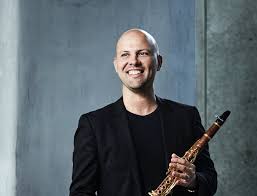
David Rowden
Back for another year of Melbourne endeavours, the Omega Ensemble, a Sydney-based contemporary music group, opened its 2026 account with a 90-minute-long program that began with an American work and ended in an Australian composition. Neither of these spoke a convincingly modern language but both found favour with this audience which reacted positively after each. In the middle came two concertos: Gerald Finzi’s Concerto for Clarinet and Strings of 1949, which has clearly been on the musicians’ minds since the visit last year of Michael Collins, a noted exponent of this work, here fronted by Omega artistic director/founder David Rowden; and the 1933 Piano Concerto No. 1 for Piano, Trumpet and String Orchestra by Shostakovich which featured Omega stalwart Vatche Jambazian taking on the keyboard role while the Sydney Symphony Orchestra’s principal David Elton negotiated the brass line.
As a preliminary foray, a string nonet – which constituted the Ensemble for this evening – played the concert’s title work by Jessie Montgomery which has proved one of the composer’s more popular works, I’d suggest, because of its sunny, festive nature. Written in 2012, the composer specifies a minimum requirement of 3/3/3/2/1 for participant numbers; in this case, she got two cellos and a double bass, but had to be content with two each of the upper strings.
Listening to or watching recordings of this work gives you some insight into contemporary music playing in the US as compared to the UK and here. While the American orchestras approach this score with caution, a body like the Philharmonia gives it a vigour and elegance of execution that elevates the music above a kind of plodding insistence. Just so with the Omega group which gave a vital and involving execution of a work that is strong on ostinati and semiquaver runs while short on rhythmic or harmonic innovation.
Add a significant virtue in that the work lasts just long enough and the conductor-less performers made Starburst into an initial burst of energy which was carried on to the Finzi concerto. Just as well that Rowden pitched his dynamic to the accompaniment because the composer has most of his forces playing divisi at some point, particularly the cellos in the first Allegro and, with the best will in the world, one player per line is stretching your volume requirements a long way. This lack of depth also meant the movement’s big moments, like the peroration up to the clarinet’s entry at Number 1 in the Boosey & Hawkes score, the triple forte outburst seven bars before Number 5, those insistent Gs from everybody before the cadenza, and the last eight powerful maestoso bars, came over as light imitations of the real thing.
A similar difficulty infected the following Adagio which was impossible to linger over, senza rigore, because of a lack of full-body timbre. You couldn’t say that Rowden rushed through it but the ritardando and ritenuto moments, apart from that before the clarinet’s first entry ad lib., were hardly spacious enough for this eloquent, elongated lyric. Still, the combined forces rose to the occasion of the movement’s powerful highpoint at Number 5 where the main theme is given in an unexpectedly vehement voice. As well, you would be hard of heart not to be moved by the last pages of this section, Rowden’s progress to the last F finely balanced.
Finzi’s finale, a folk-tune reminiscent allegro, passed without making much impact, apart from its melodic fluency and the soloist’s flexibility of articulation. It strikes me as a stop-start series of pages where striding certainty peters out regularly for ‘busy’ work, interrupted by a hard-to-ignore flavour of the Introduction and Allegro in the strings’ ritornello before Number 8. At the end, you’ve have to say this was a worthy outing for the score but one deficient in gravity and variety of timbre, particularly as the string body is responsible for the carrying-forward of the score; more so than the soloist, I’d suggest.
For the Shostakovich, Jambazian played the keyboard with his back to us and without a lid on his instrument. What followed was inevitable: his sound flew up to the Murdoch Hall ceiling and the biting attack of the composer’s pianistic brilliance was dissipated. Mind you, with such small string forces, that had its compensations but it gave Elton’s trumpet an unusual prominence. As with the Finzi work, this one also suffered from insufficient strings; not in the soloists-absent (for a short while) stretches, like the Allegretto in Movement 1, but when piano and strings are operating imitation around Numbers 21 and 22 (also in a Boosey & Hawkes edition) – you could see the gestures but the output sounded faint.
Even with the muted piano, you could hear that Jambazian was in control of this score; quite obviously in the Lento with its outer casing of a mournful slow waltz holding some highly dramatic pages. Elton’s treatment of the solo starting at Number 34 in tandem with Jambazian generated an impressive elegiac moment or two, if muted in timbre and nature. But it’s a startlingly fraught segment in a concerto where the emphasis is emphatically on hectic jollity.
Again, the Moderato interlude gave Jambazian the opportunity to be heard clearly in the solo that opens these pages; welcome after previous showings, the whole not helped by some hefty employment of the sustaining pedal. Our string nonet gave a forceful account of the lament that breaks from them, mutes off, a bar after Number 45, bringing another tragic undercurrent to this chameleonic score.
Which reaches its apex in the breakneck finale and found both soloists in fine fettle. Jambazian’s solo contributions at the upper level of his instrument travelled well enough but the two solos sounded muddled, especially that starting in F minor at Number 76 which sounds like a Hungarian Dance gone wrong. It’s hard to misfire with the ongoing exhilaration that fills these pages and, while the strings were often completely subsumed by the pianist’s ferocity, they were at least able to make their points during the intervening commentaries – and supporting Elton who maintained a cogent and expressive line to the insistent final bars.
Last came a new concerto written for Rowden and Elton, commissioned by the Omega Ensemble: A Turning Sky. The composer is Lachlan Skipworth from Western Australia who has here favoured the traditional three-movement format; as well, he employs an unadventurous rhythmic foundation and a harmonic scheme that delights the ears of the groundlings but does little for any soul in search of a 21st century language.
You’re left in no doubt that Skipworth has a facility for well-constructed melody and he negotiated flamboyant roles for both his soloists, although Elton enjoyed more of the limelight, especially in concerted passages for both soloists. But I’m afraid this style of writing makes me impatient with its hankering for the past and by its following a path that has been travelled by too many other feet. I’ve said something similar before – frequently – but I don’t think you can ignore the entire progress of 20th century music and pretend that Stravinsky, Bartok, Schoenberg, Boulez, Stockhausen, Ligeti and a collection of American and British masters never existed.
We’ve come too far in the development of advanced vocabularies to turn back the clock and find inspiration in the tropes of popular music. There are excuses trotted out regularly for the pursuit of beauty through diatonicism once more, that we need old-fashioned tunes, that there is still much good music to be written in C Major. Well, for this last, perhaps there is but it will require a brilliant talent to accomplish it. In faith and hope and love, I’m still waiting.





 O'Connell the Music