Two more talents on the rise

SYDNEY INTERNATIONAL PIANO COMPETITION

Session 19

Monday July 12, 2021

Kyoungsun Park

Park was one of this competition’s entrants whom I’d not come across before this. He presented his semi-final program from Alpheton New Maltings, Sudbury, recorded on a Fazioli instrument on March 29. As his thematic framework, he chose Op. 1 and C – in other words, he fell into the increasingly common group of those bemused young players who read ‘fact’ for ‘theme’. In fact, all three works here were in C and two of them were their famous composers’ Opus 1. Park chose to read out his preliminary statement; might as well – the whole process is seen as an obstacle by some survivors. And what could you expect? Some kind of aesthetic projection? A backgrounding of cultural/social/ethnic insights? The clever found a clear-cut if superficial identifier and stuck with that, rather than looking for links that threatened to prove tenuous.

Park opened with Mozart: Twelve Variations in C on a Minuet by Fischer K. 179, from the composer’s 18th year. These were despatched without repeats, apart from the penultimate Adagio which has them in-built. Now this musician’s approach was noticeably deft and clean with a liking for staccato, as in II, VIII and X, and a determination to stay on-track with his tempo, apart from oddities like the elongated trills in bars 9 to 11 of III. More difficult to understand was the accent on speed, moving through some defenceless pages with startling velocity, as in IV. His attack could be attractively bright – see VII – but some pages seemed as soul-less as a Clementi study. Certainly, Park has a talent in terms of polished delivery, as in the Alberti-basses and limpid scales of IX, and he has the confidence to use the sustaining pedal only rarely in this crystalline music. So, in the end, a sure and certain delivery but an interpretation that kept the composer at a distance.

Chopin published a Rondeau as his Opus 1: a sophisticated product, even for a composer of genius at 15 years old. This began auspiciously enough but suffered from fast tempi and inexplicable accelerandi, first seen at bar 45 where the performer seemed impatient with the pattern repetitions. The same take-to-the-hills ambience recurred from bar 100 up to the key-change to A flat; again, this might have been generated out of a desire to add interest to repeated mini-structures, but it wound up sounding garbled. As in the preceding Mozart, you came across eloquent and finely-spun work, as at the sequence after bar 230 up to the Piu lento at bar 275. Another clean reading in which Park wasted nothing – no note left untilled – but also deficient in freedom of motion, despite the employment of rubato and timbral spruceness by this entrant.

In the Brahms Piano Sonata No. 1, Park made a properly bold foray into the first subject, not using his sustaining pedal for ages – until the second subject? As with his Mozart, once through was enough and the exposition enjoyed but one hearing – a pity, as the following sections sounded deft but uninvolving. Then we reached the coda where the piece sprang into life with a strong Brahmsian majesty to it and some much-needed weight behind the delivery, especially welcome after a development segment that seemed like tinkering at the edges. The following Andante variations were sympathetically accomplished – and varied, as far as possible. No repeat of the Trio in the Scherzo – much missed as this was excellent playing – and Park tried for lightness in the outer pages, which here cried out for a more ponderous tempo and a heftier deliberateness.

This tendency to speed up everything reached its highpoint in the Allegro con fuoco finale. How much more sense the rondo would have made in its varied A sections if the fire had been applied to temperament rather than tempo alone. Fortunately, the performance came to a purple patch in the G Major interlude but, after the concluding Presto had been reached, errors started to creep in, too obvious to ignore, and the last crashing chords finished an interpretation that left me perplexed rather than satisfied at a major achievement.

Calvin Abdiel

This Australian/Indonesian competitor I had heard in the preliminary round and admired his slashing authority in some fiercely virtuosic material. For this semi-final, he remained in the Verbrugghen Hall of Sydney’s Conservatorium of Music, playing a Fazioli on March 29. Abdiel went for a simple jugular: his theme was Spain – just like many a restaurant or Scenic tour. As well, so far he is the most verbal (as our American allies say) of the participants, almost as full in his commentary as a program booklet. Did these discourses make much difference? They were fluent, for sure, and proposed the appearance of certain colours and emotions in his program, but I think we could have been left to discover most of these for ourselves.

The theme was clear and then illustrated in eight pieces. What I found a constant distraction throughout Abdiel’s recital was the sound quality. Perhaps it came from the crisp and clear acoustic of the preceding semi-finalists, but each of this pianist’s pieces came across as though the hall had suddenly acquired a lot of muffling fabric. This meant that headphones were crammed tight and the volume was close to the maximum, just to distinguish detail; a peculiar anomaly as Abdiel had the services of the same sound engineer at both recitals so far.

Another problem came with the program’s (necessary?) temporal cramping. Abdiel went back to Scarlatti (an honorary Spaniard, at the very least) and Soler, but then made a great leap forward to the trilogy of Albeniz, Granados and Falla, with a side-bar to the last-named’s significant student, Ernesto Halffter. So we left the Baroque/Classical for a set of four writers whose nationalism and use of colours was profound – and which brought about a plethora of similarities, even if aficionados can tell them apart with ease. By the end, to be honest, I was saturated in suggestions of blood on the sand, castanets in the cantina, and festive foot-stamping. But Abdiel lived up to his theme with bells on.

The Scarlatti sonata was a well-known quantity – the A minor K. 175. It came over as rather restrained, a significant shock to someone raised on Puyana’s electrifying version of 1966. Still, the repeats were observed, it was almost error-free (apart from a mishap at bar 62 in the repeat), and the player inserted some delicious ornamentation coming home in bars 100-102. The graver Soler sonata – No. 21 in C sharp minor – passed without blemish, taken at a sensible speed, like the Scarlatti, and invested with careful character, although I didn’t see much point in the pauses imposed at the trills in bars 68 and 124.

Abdiel began with two Granados works, both from the Goyescas suite: El Pelele and El Fandango del Candil. The first of these demonstrated the pianist’s talent for sustaining a metre without making its insistence irritating, mainly because of an attack style that impressed as benign, the outpouring in the closing pages all the more impressive as coming after a gradual slow crescendo. As an introduction to Abdiel’s powers of restraint, this made a considerable impact – smooth in delivery and poised in style. You found much of the same in El Fandango de Candil with passages of splendid subterranean murmuring and intonative delicacy, so that the sudden flurries into the sunlight burst out with added force. I lost track of Abdiel near the powerful conclusion – to my shame, I’m probably using an incorrectly modernised edition.

After the Scarlatti/Soler double, Abdiel presented two Albeniz pieces: El Corpus en Sevilla (from Book 1 of Iberia) and Eritana (the last number in Book 4). While he was introducing this pair, it struck me that the pianist was talking too much, the explanations verbose and, in some instances, self-indulgent as he struggled to find/remember the right word. Nevertheless, you came across fine treasures in the first piece, particularly a deftly drawn ebb and flow at the a tempo un peu plus calme point . Later, the work brought back memories of Rubinstein and Horowitz-style transcriptions, chiefly because of the fiddly manner of writing – not actually getting anywhere but marking time brilliantly. The sheen was definitely wearing off with Eritana, as far as content went; you could still find room to admire the grandeur of Abdiel’s interpretation, mirroring the score’s movements in every particular, despite the composer’s long-windedness.

Halffter didn’t bring much new to the party with his Danza de la gitana; at this point, I felt that we’d heard it all before, in particular the imitations of rasgueado strokes and hot collations of fast triplets. And it went over ground that had been treated by greater composers with more sophistication. Abdiel ended with Falla’s Fantasia Baetica of 1919, which has the gloriously atmospheric Nights in the Gardens of Spain written all over it – and very welcome it was. Here, the performer showed himself in full blistering flight, his glissandi breathtaking in their rapidity, the detail attended to with throwaway mastery, the whole an admirably persuasive pianistic tone-poem that, the mid-way Intermezzo apart, increased in intensity until its percussive – no, timpanic – ending. Oddly enough and very much to the player’s benefit, this solid work reanimated the Spanish theme rather than going over previously-tilled ground. Now, if only the recording character had been bright-edged enough to give this formidable artist more vital performing conditions.

The old dilemma

SYDNEY INTERNATIONAL PIANO COMPETITION

Session 18

Sunday July 11, 2021

Shion Ota

Here was an artist working hard to meet the requirement of verbalising her program’s theme. Ota appeared to be reading from a screen but needed subtitles to be completely understood. OK, a sensible move, but it would have been much more intelligent to have her speak her language and have a translation provided, rather than put her through an obstacle when she had so many waiting just around the corner. As it turned out, her underpinning rationale was romantic variations; actually, that was exactly what she played but is that really a theme? Or a format descriptor?

Ota began with the Busoni transcription of Bach’s Chaconne from the Violin Partita No. 2 in D minor. She took a considered and reserved path for the opening variants, intent on exposing the melody at all places. Later, her octaves in both hands proved reliable and, after the first group of more note-filled sequences, she introduced a very long hiatus point before sailing into quieter waters. The same GP came up when moving to the major key, and then another when shifting into the home key – although in this last she allowed the one to merge into the other, ignoring the cut-off that appears in my old Bretkopf edition. Ota showed admirable care for the work’s coherence, not just in the connections between variations but also with the positioning of weight in Busoni’s sometimes clotted harmonization. Her intensely powerful conclusion stands at one end of her spectrum; at the other, a limpid grace obtaining across the three variations that begin the Majore sequence.

One Romantic variations down. Next, Rachmaninov’s Variations on a Theme of Corelli – continuing the D minor parameter – exposed Ota’s ability to handle larger-scale internal content, i. e. more substantial clumps of score. No. I saw her fine control with subsidiary accompaniment; No. II, her deft dealing with suspensions; next, a welcome sign of humor, reacting to the composer’s bluff whimsy. As in the Chaconne, No. V saw the pianist’s sensitivity in handling decorative interpolations. And on it went, half your time spent admiring the execution – the full-bodied texture of Nos. VII and IX, soon superseded by a fine clangour in XI – and the other half in tracing the composer’s trickery with its suggestions of the Paganini Rhapsody.

Along with the forceful pages, climaxing in the virtuosic final variation, the pianist revealed a clear responsiveness to the less exciting sections, as in the Adagio VIII (probably a shade gnomic), that welcome shift to the major in XIV and a sensitive delineation of the chords in this variations 4th- and 3rd-last bars, a clever split personality in XVII‘s nervous left hand against a serene melody, and a well-weighted balance in the Intermezzo‘s octaves. In fact, Ota contrived to vault around the score with just the right schizoid emotional shifts, rounding her work off with a carefully judge rubato across the Coda.

Finally, the young musician chose Liszt’s Rhapsodie espagnole to amplify her tour of Romantic variations. Inner continuity was assured as Rachmaninov’s handling of La Folia was followed by another treatment of that over-popular theme. As well, it appeared that Ota was leaving no stone unturned when it came to displaying technical skill; no worries – we can take a lot of that in this competition. Her opening cadenza flourishes came across with arresting scintillation and she sustained a vitality throughout the work’s most arduous pages. A fine illustration of this emerged early, in the often stodgy Folia statement at bar 58, and her double octaves from bar 106 to 117 were almost perfectly precise as well as appropriately driving.

It’s always something of a relief when Liszt turns his attention to the Jota aragonesa at bar 134 and this player immediately switched tack, adjusting to the filigree work that followed in profusion and working across her instrument’s top register with refinement. From here on, you are bombarded with replay upon slightly different replay as the composer toys with this catchy tune and decks it in ornaments and interpolations to befuddle your perceptions. But we were carried along by Ota’s enthusiastic attack on each change, no matter how slight – Pelion upon Ossa. But there’s no denying the magnificence of the La Folia return at bar 633 in D Major – a coup submitted to us with impressive conviction by this performer, pounding through the score’s last (and welcome) page.

Adam Balogh

The solitary entrant from Hungary, Balogh played at his old school, the Franz Liszt Academy of Music in Budapest, recording this second program on March 23. His address proved to be quite fluent, reflective of his time studying in America; in fact, this musician spoke between every one of his contributions, amplifying the material printed in the competition’s digital program. He confined himself to two brilliant piano writers – Chopin and Bartok – finding a common ground in both composers using speech and language as an inspirational source – which is certainly true in one case, dubious in the other – and extending from this the proposition that both told stories in their compositions. Nothing wrong with that concept, although music writers suggest wildly differing backgrounds and illustrations for Chopin; even his nine-year relationship with George Sand didn’t result in music related directly to literature. Just the 19 Polish Songs stand out from that astonishing welter of piano music and you’d be going to find programs behind most of it, apart from the more militaristic polonaises.

I was assuredly warmed by Balogh’s encounters with the Polish composer, here limited to the Three Op. 59 Mazurkas and the F minor Ballade No. 4. In the A minor Mazurka, he wove a lean, melancholy soundscape, leavened by powerful statements in the central A Major/B Major-G sharp minor segments. I was even more impressed by this player’s breadth of vision in the following A flat Major work, with its just-rich-enough affirmative nature and its ideal fusion of resignation and action. With the last and longest of the three, in F sharp minor, Balogh employed rubato more sparingly and rose with clear purpose to meet its many challenges, its chopping and changing from one state to another, certainty to ambling, sudden impulses of passion yielding to a kind of valse triste gloom – music with a dying fall, indeed.

Possibly this performer’s work on the ballade might have carried more weight if I hadn’t heard Alexander Gadjiev’s reading of it in Round 1. It began well enough as Balogh showed a keen sensitivity to the composer’s key shifts, and he used rubato sparingly, as at bar 35 and the following lead-in to G flat. He also had me onside with his return to taws at bar 135 where the initial narrative comes round again; here was a fine sense of completion, even if we were only half-way through. But you were aware of mishaps peppered across the surface and something went wrong at the bar 183-4 mark where the flow was disrupted. In the end, I didn’t find this account as authoritative and clear as anticipated, especially given its program precedents.

On the other hand, I could listen to this young fellow play Bartok till the cows come home. He is right on target for interpretation and what you can only call Bartokian ethos, best shown through his facility across an 11-year tour d’horizon involving the Two Romanian Dances Op. 8a, the 1916 Suite, and the Eight Improvisations on Hungarian Peasant Songs, finished in 1920. Balogh played these in reverse chronological order, starting his recital with the Eight Improvisations and handling them with remarkable facility. This score begins simply enough, the song’s accompaniment simple but growing in complexity, the second song increasing in complexity. The interpreter used a wealth of rubato in No. III, as directed at the start, and infused the work with eloquence as the improvisation took over from the tune; unlike IV where the melody is omni-present, if transmuted.

Balogh gave an exemplary lesson in musical dissection across V, pointing both the simple song line and the aggressive accompanying figures moving from 2nds to 5ths then 7ths with the occasional 9th until the final 12 bars which resolve into biting clusters. An extra-brusque start to VI, then three statements of the tune with abrasive escorting figures to which Balogh gave just the right amount of weight, before a fierce bitonal conclusion, expertly handled. It was at about this point that you gave yourself over into the executant’s management, secure in his command of this collection.

At VII, the improvisation element has swollen in significance; the melody is still stated clearly at the start, but as the piece lurches forward, keeping track of it is close to impossible unless you’re following a score and can trace lines in its challenging harmonic cross-fire. The last piece strikes me as both the most exciting of the set and the most complex. Again, you can discern the melody clearly at three points, even at the grandiose conclusion, but the brief ostinati, polytonal breaks and chordal explosions that murder any folksy simplicity turn this into a striking world unto itself. Balogh must have been using a different edition to mine because a double-octave crotchet in the third last bar was not in my Dover 1998 reprint.

After this, much of the Suite presented as formally less adventurous. Balogh’s Allegretto took no prisoners, flowing past with exemplary facility. In the Scherzo, discords were given full weight, serving as an antidote to the previous movement’s harmonic placidity. At the Allegro molto, the interpretation moved into a rhythmic feast – not so much disparate, off-the-beat material but an observation of different accents in both hands; particularly outstanding was the build-up and arrival at the Tempo I return. Balogh took his time in the Sostenuto, taking care with the acciaccaturas and maintaining a moderate pace in the central four bars. Even the close-knit bass chords in the last six bars made their presence felt in a splendidly-executed descent into quiescence.

I didn’t know either of the Romanian Dances, the Allegro vivace moving close to Allegro barbaro territory later on as the texture gains complexity, level piling on layer. I heard a few errors in the six-bar lead-in to the Molto agitato race, but this was the final element of the program and Balogh had put in a mammoth effort before this. The following Poco allegro dance might have been a bridge too far. It opened chirpily enough but inexactitudes started to creep in and the gradual increases in textural complexity and tempo strained the pianist’s precision. But, as with his previous forays into this composer’s works, the overall experience was elevating and cast a welcome spotlight onto an unparalleled master of keyboard writing.

Opening the cast of survivors

SYDNEY INTERNATIONAL PIANO COMPETITION

Session 17

Saturday July 10, 2021

Alexander Gadjiev

Here we are on the competition’s home stretch. Well, something like it, now that the original 32 entrants have been winnowed to twelve. Of these, I’ve heard only two in what was a random sampling of sessions over the past week. But then, I’ve never seen much point in force-feeding during such affairs. I tried to do it one year with the international chamber music competition held at the Australian National Academy of Music but had to miss some sessions because of work commitments. Naturally, the organizers, some colleagues and a battery of press officers told me that I’d missed the best two programs and the finest ensembles in the whole enterprise. Of course, this turned out to be nonsense – malicious, in some cases – and the winners were easy to predict from the semi-finals. But it made me leery at the idea that you have to suffer along with the jury.

Even with this last dozen, quite a few are presenting programs that are close to repellent, and I suspect that the reason for this is not wholly to be ascribed to the players. According to the regulations, each semi-finalist has to present a themed recital, which I take to mean that the works presented have to have some thread running through them. That can take you anywhere and nowhere. What a limping explanation of a program tells you about the performer is negligible, but what the implementation of such a process tells you about the organizers makes you question their intelligence.

A further refinement is the demand that pianists introduce their music and the rationale behind their choices. This is easier said than done, especially as the requirement is that everyone has to speak in English on the odd assumption, announced by Piers Lane early on in the first round, that ‘everybody does’. Insularity above and beyond the call of duty because, as we have heard in those inane pre-recital interviews, some of the entrants have limited skills in this language. The one-tongue-suits-all concept ranks among the most inept arguments that could be applied and is shown to be draining as we will have to endure laboured addresses over the coming sessions as musicians try to explain their choices in terms that are not their own. I’d see a point if each pianist could offer his praeludium in his/her own language, to be translated or subtitled, but I doubt if such forethought/consideration is being applied here. In future, I want to see all Tchaikovsky competition aspirants explain themselves in Russian, or Chopin competition hopefuls churn out their explications in Polish; In fact, I’m doubtful that many young Australian pianists would pass such a linguistic hurdle at the Long-Thibaud-Crespin or the Queen Elisabeth.

So, along with making their own running in terms of doing their own recording, getting their own sound engineers, camera operators, venues and pianos, these musicians now have to say something sensible about their music. Sorry but, after many years of experience (more so in recent times), I’ve very rarely heard anything valuable come out of a musician’s mouth, unless it involves the identification of an encore. And, scarred by experience, I’m not holding out much hope for these unfortunate Sydney competition performers.

Alexander Gadjiev gave an all-Russian program, recorded in the Fazioli Hall, Sicile, on February 24. Naturally, he used a Fazioli instrument for his tour of Shostakovich, Prokofiev and Tcherepnin with a heavy emphasis on the middle name. He gave his introductory talk with more ease than most but I’m not sure I took much away from it except that he wanted to demonstrate a relationship between Europe and Russia in terms of musical influences. Or perhaps I misconstrued.

He began with a Shostakovich prelude and fugue set, No. 4 in E minor from the Op. 87 collection of 24 in homage to Bach. No problem here seeing the Russian’s debt to the Baroque; even the clashing 2nds of the prelude present as a contrapuntal inevitability. Gadjiev was happy to give the work a Romantic gloss – rubato, emphases, firm forte passages – but measured, for all that. Attacca to the double fugue and, with the second subject’s arrival, more complexity and intensity which the pianist delivered with deliberation, showing throughout that he had a fine consciousness of what needed stressing and what required subordinating: an excellent gift in Bach, and here.

Prokofiev’s Visions fugitives is an odd stop-start collection, rarely programmed complete. So it turned out to be in this instance where Gadjiev offered 14 from the cycle of 20 vignettes. The Fazioli’s bass came over with excellent resonance in Vision 1, especially in bars 9 and 22, while in II the pianist showed an excellent care for murmuring passages, as at bars 5 and 6. His left hand work in Vision III showed a clever balance of crispness and laissez-faire delivery, while the following Animato pushed its forte markings hard. At the Arpa No VII, the inbuilt pulse was sustained but not at the expense of an appealing ebb and flow. I was distracted completely by Gadjiev’s large right-hand stretch throughout IX, but particularly between bars 16 and 19, and the scherzo No. XI shone in its 8-bar middle section which emerged with startling simplicity from its flippant surrounds.

For the waltz-like XII, Gadjiev proposed a fitful whimsicality – exact for the occasion. Feroce is the direction for Vision XIV and the ultra-percussive Prokofiev was given full rein; the bass shifts across bars 17 to 21 of the Inquieto sounded delectably reticent; you had to be concerned about the continuity of emotion in the one page XVI Dolente because of the skipping quality that emerged at bar 9 with the pizzicato bass – an insoluble problem (thanks, Sergei) but almost nullified by the pianist’s excellently smooth management of the three staves/layers from bar 19, a feat revisited in bars 23 to 32 of the ensuing Poetico, only in closer order.

Gadjiev took the last two words of the following Con una dolce lentezza and made much of them with an unexpectedly lavish rubato; his outlining of the upward steps from bar 24 to the end proved exemplary for its clarity of detail, revisited in the Lento Vision XX from bar 9 to the end, which the pianist spoke of later – quite correctly – as ‘evanescent’. I’m assuming that the European influence here was Debussy, and possibly Satie, even if some of the visions were too brusque and aggressive to fit into such a comparison.

The Tcherepnin miniatures came from the composer’s 8 Pieces Op. 88 and were quickly negotiated. No. 1, Meditation, proved to be an amiable wander with a strong central climax – pianist’s music, I’d suggest – while No. 5, Invocation, turned out to be much the same with the added attraction of interpolated recitatives – presumably to denote the actual summonings.

These small-scale pieces made a prelude for Prokofiev’s Sonata No. 7 which Gadjiev handled with considerable mastery. His Allegro inquieto showed a fine command of the work’s rhetoric, not to mention its chord sequences, here treated with feisty crispness. All the accents were in place and the returns to the Allegro tempo generated an infectious excitement, although the second Andantino‘s appearance seemed like that of an old friend because of its relieving character. The interpreter managed to infuse the movement’s rapid segments with more military suggestiveness than I’ve heard for many years, thereby observing the piece’s ‘war’ status.

More force came into play in the Andante caloroso at the Poco piu animato section, yet this pianist was able to keep the fabric lucid, even at the Piu largamente crisis. And I was most taken by his insistence on the alto line G/A flat tocsin strokes leading away from turmoil back to the Tempo 1; in fact, this typified the sonata’s prime intent most profoundly for me – a remembrance of huge-scale disaster. This two-note oscillation turned into a threatening creature in the Precipitato finale where Gadjiev thundered out the B flat/C sharp motif with a near-manic determination, thereby stressing the frightening nature of this movement. As he’d probably planned, the pianist made an overwhelming impression here – his last gasp – with a muscular exhibition of uncompromising pianism, including an admirably accurate outlining of a chain of mobile block chords on the sonata’s last two pages.

Anna Geniushene

This Russian musician recorded her recital in the Niko Art Gallery, Moscow on March 27 using a Kawai instrument that I don’t think comes with the venue. Geniushene introduced her program – Schumann, Scriabin, Tchaikovsky – with hesitation and not much of an idea of what was required. She spoke of the ‘states of mind’ of each composer but spoke of her three works discretely; well, I heard no links being drawn between them, so perhaps the message was too subliminal for us morons.

She opened with Schumann’s 3 Fantasiestucke Op. 111. Here was a free-moving, ultra-Romantic reading of the initial Sehr rasch, the notes all there but the tempo a free-wheeling beast with a near-predictable pause on the first beat of each bar. The following Ziemlich langsam proved not as tempo-varied as its predecessor, yet the pianist contrived to find an unsuspected ebullience in the central Etwas bewegter section where the concluding 8 bass notes came over with high emphasis. To her credit, the bookend segments proved most appealing, Geniushene exploring their interrogative placidity with fine insight. Best of all was her Kraftig und sehr markirt third piece where the temptation to transform everything into a Davidsbundler tramp was resisted and we were treated instead to a more relaxed attack and given the contours of a narrative.

Scriabin’s Vers la flamme found the pianist extolling its prescient nature, which I’m inclined to doubt; it’s an ecstatic outpouring but its effect on keyboard technique and possibilities from a 1914 perspective is not that striking – or obvious. Anyway, Geniushene gave it an excellent exposure, even if, like every Scriabin piece I’ve heard in this competition, metre turned into a changeable factor, especially during the slow-moving opening Allegro‘s sustained chords where I gave up counting beats and just surrendered to the going rate. As intended, all bets for exactitude were off at the arrival of the joie de plus en plus tumultueuse where texture becomes all and the piece triplets and trills itself to an insistent conclusion that reflects the work’s opening in a lavish transformation.

Finally, the pianist introduced Tchaikovsky’s Grande Sonata in G Major, where Schumann’s Concerto without orchestra was cited as a precursor; a useful tip and one that I recalled several times across this long work. An opening Moderato e risoluto – heroic chord sequences – was pretty secure with very few mishaps at crisis points and the performer hit her straps with the second subject and an increase of internal interest for the listener . Unfortunately, the composer opted all too soon for a return to his portentous opening matter and the performer had little recourse to anything but exercising her hefty volume.

The Andante non troppo provided much relief after the preceding grab-fest of notes and made a fine space for exercising that tempo flexibility from the Schumann pieces. There isn’t much you can do with that peculiar interlude of 8 bars before the Moderato con animazione where the composer focuses on G, and a repetition of the same note 19 bars from the movement’s end, but Geniushene made a fair attempt at cloaking them with variety. She seemed impatient as the long movement neared its conclusion – not by rushing but by the hard edge that she imposed on the melodic line and a ponderousness that crept in from the first movement at the lead-up to the E flat Major triumph before the second set of obsessive bars. Much more attractive was the Scherzo, carried off with excellent drive and character and all-too-reminiscent of the composers B flat minor Piano Concerto at its most delightfully gossipy.

The finale brought back memories of the sonata’s opening character, although faster-paced with a syncopated main subject that in this performance seemed more than usually off-balance. By this stage, I was a tad worn out by the work’s hectic eloquence and found the revisitings of the syncopated main theme a constant puzzle. In this condition, you tend to find odd faults, like the F6 which, at this stage, I thought had gone out of tune. But you have to balance against that the player’s more ruminative pages and you understood why the jurors picked her out for a revisit. Nevertheless, this experience made me understand why I’ve never heard this Tchaikovsky sonata in live performance. I’m not a convert, even though Geniushene made a formidable apologist for it.

Two types of elegance

SYDNEY INTERNATIONAL PIANO COMPETITION

Day 8, Session 13

Thursday July 8, 2021

Dominic Chamot

The solitary Swiss competitor in this competition, Chamot enjoyed the advantage of Australian/Indonesian entrant Abdiel by playing to a small audience. He worked on the Fazioli 278 instrument found at Opus 278, Davidstrasse 40, St. Gallen, the tape made on March 14. Here was another chaste program; I didn’t time it but he certainly didn’t go over his allocated time-limit. At all events, this was mature music-making, the accent on interpretation rather than atmospherics, even in the second offering, which somehow managed to cope with an innate theatricality without losing focus on the musical framework – such as it is.

The session began with Janacek’s In the Mists cycle and you could see immediately that making the music sensible and self-integrated counted more than any other factors. The opening Andante proved interesting, Chamot seizing its options for rambling and interspersing tempo variations that actually reflected the phrase-lengths. At the same time, these pages were treated with restraint and emanated an atmosphere of bucolic brooding – which, for me, typifies a fair amount of this composer’s later output. With a score that is not lavish in performance directions, Chamot suited himself about the following Molto adagio‘s contrast of the base tempo with several Presto interpolations. But this musician is probably working from a later edition than the venerable 1938 one available to me, again illustrated by the refined rubato at exercise in the Andantino which appeared to me to be well-suited to the two-page text, helping to bring out the melody’s occasional transference to an inner line. Unlike most commentators on this collection, I find this movement to sound the most folk-tune inspired of the four.

Last came Janacek’s Presto, which struck me as an overstating descriptor. Here you come across falling 3rds and 4ths that suggest Bartok at his most sentimentally rural/bucolic and, as with the Hungarian master, a nerve-tingling harmonic restlessness. Among the many examples of ferreting out a suitable course of action, the central repeat involving 6, then 4 bars gave us a fine burst of sustained fabric in pages that twist around obvious nodes with spare rigour. The player made us wait an unconscionably long time at the final Meno mosso for two quaver rests at the bar’s centre, but that – once again – could have been a fault in my score because the rest of the movement radiated authority and a convincing sense of taut emotion, some steps short of tragedy.

Chamot then headed for the virtuosic heights with Liszt’s Reminiscences de Norma which is a cow to handle, worse in its way than much of the bigger-named original works, let alone the other operatic transcriptions – well, those that I know. Getting the notes was rarely a problem, although an error sullied the final phrase of the second restatement of Ite sul colle and something odd happened in the right-hand octaves of the martellato con strepito descent. Little pin-pricks like these aside, the player had the work’s inner drive and drama controlled from the start. You would be hard to please if not impressed by the expertly balanced full chords across the last 10/11 bars preceding the piece’s central Recitativo.

Alongside the thunder, Chamot displayed a discrimination of considerable stature in fore-fronting the central melody – Qual cor tradisti – of the Andante con agitazione, where it moves to the alto register following the mid-way cadenza. After the time-consuming but lavish arpeggios – two per bar – that conclude this section, the pianist’s move back to vehemence made an unusual effect for its control as the Guerra guerra chorus sprang into full bellicose mode at the Presto con furia (has anyone matched Liszt for lavish tempo directions?). Apart from a few mid-torrent mishaps, including an obvious one in the 3rd or 4th last bar – all those double octave E flats – the interpretation stuck to its brief and Chamot entered into the fierce spirit of the strong, as passionate as possible coda to this summa of the virtuoso school.

The necessary Australian piece was Arthur Benjamin’s Scherzino of 1936, a gigue of sorts which gave more evidence of this pianist’s characteristics of precision and regularity, probably best illustrated by his last page which backed away from a genteel fortissimo to the requisite quadruple-piano ending.

Siqian Li

It’s been my fate to hear a good many of the competition’s later invitees in a random selection of sessions so far. Piers Lane thanked Siqian Li fulsomely for agreeing to come in on things late in the process, and she played her recital on April 3 from a private residence in London – which turned out to be a well-proportioned salon with a formidable Steinway as the artist’s base of operations. She played a set of Mozart variations, all of Vine’s 5 Bagatelles, the B minor Fantasie by Scriabin, and a well-loved Debussy prelude as her party piece.

The Nine Variations on a Minuet by Duport K. 573 were carried out with impressive elegance and a forensic clarity of detail, the sort of purity that we came to expect as the norm after Ingrid Haebler showed us how it should be done throughout the 1950s and beyond . Li proved no stranger to varying her attack when repeating the variations’ halves, the which practice she maintained for the length of the work, alternating legato for staccato, and mezzoforte with mezzopiano in Variation 2. None of this proved intrusive or attention-grabbing and a similar discretion obtained in Variation 3 with her employment or abstention from the sustaining pedal.

In Variation 4, Li bore out the distinction between staccato and detached notes with quiet skill, indulging in a slight ritenuto at the chromatic semi-scale in bars 13 and 14. Another differentiated two-pronged attack distinguished Variation 5, a fair amount of expressive emphasis distinguishing the second half’s opening four bars. A higher degree of note-pointing emerged in Variation 6, like the opening chord of bar 22 at an unexpected harmonic switch. Li handled the next variant as a gallop – well, a fast canter – not putting a semiquaver out of place across its length. She found her melting moment in the following Adagio at bars 23 to 24, a touchingly gentle final gesture in this solitary variation without repeat markings. And she ended as she began with agile and elegant finger-work across the last variation.

Rather than keeping one of Vine’s pieces for an encore as did many of her peers, Li elected to play the 5 Bagatelles at the centre of her program , If she wanted to provide a contrast to her Mozart interpretation, she chose well, responding effectively to the first, Darkly, and its abrupt jerks and underpinning tension. Her Leggiero e legato was very much so, ultra-clean in its delivery. The Gentle enjoyed an excellently-managed calmness and control, while the unspecified IV showed that this pianist could happily enter into a suddenly jaunty, jazzy ambience and enjoy the piquancy of Vine’s interludes and commentaries. The set’s concluding Threnody found Li taking time over its slow-moving pointillism, with care given to the piece’s top notes; but she exercised her innate delicacy throughout these pages, carefully targeting each eloquent resonance to realize the composer’s striving for timelessness in his requiem.

I’ve heard more Scriabin in this past week than in a half-century of reviewing, Li expanding this experience with the Op. 28. As with previous interpretations of this composer’s work in recent days, tempi were a catch-as-catch-can affair and regularity of metre was treated as a vague universal rather than a specific. Again, in common with other entrants, Li concentrated on the music’s sweep and vehemence of declaration across the abrupt turns to Presto and Piu vivo, which turned out to be less differentiated than anticipated. But the acceleration into florid action at the final Tempo I point where the upward and downward surges featured irregular groupings of 9, 7 and 5 demi-semiquavers came across with impressive gusto: a fine build-up to the work’s well-anticipated B Major emphatic end-point.

The encore Debussy, La fille aux cheveux de lin, proved to be a straightforward business with plenty of discretion in pedalling and phrase shape, the only question a pause inserted before the C flat Major chord in bar 16. Still, it brought the Siqian Li experience to an intelligent conclusion, reinforcing a distinctive quality of her work – a kind of placid certainty.

Home ground advantage

SYDNEY INTERNATIONAL PIANO COMPETITION

Day 6, Session 10

Tuesday July 6, 2021

Sergey Belyavsky

When you get right down to it, there are 8 Russian entrants in this competition; that’s a quarter of the total. Chinese musicians are next in the poll with 6, then Japan and Ukraine tie on 3 each. Not that this means anything much, except to bear further witness to the devotion that Russians have for competitions, vide the Olympic Games. Belyavsky was another of Piers Lane’s last minute substitutes to maintain the set number of participants at 32, and he is yet another pianist who rushed – or was rushed – to put his programs together. He is, apparently, the only player who has taken part in a previous Sydney competition, having appeared in the 2016 extravaganza.

But let’s not be flippant: it was certainly an advantage for Belyavsky to have something to aim towards as, according to his pre-recital interview, appearances have been scarce for him and for most of his colleagues. We (and the competition organizers) were lucky to have him on the books. Which is more than can be said for his home country, it seems. Belyavsky did his recording at the Russian State Specialized Academy of Arts in Moscow on April 9. Before he began, patrons were screened a message pointing out discrepancies between sight and sound on the tape; doesn’t matter much to me because I’ve usually got my head in a score, although I did watch his Australian piece (another Vine Bagatelle, would you believe) . What was depressing was his – no, the Academy’s – instrument: a Steinway with an F5 clearly out of tune, and some other notes on the border of the same fault.

So much for care of musicians in Putin’s regime. But, working against the odds of a late call-up and a deficient instrument, Belyavsky gave a solid program comprising Schubert’s Wanderer-Fantasie and three of the Transcendental Etudes by Liszt: No. 12 Chasse-neige, No 5 Feux follets, No. 11 Harmonies du soir. He encored with one of Vine’s 5 Bagatelles – the untitled IV.

The fantasie came across with excellent drive in its first phases, boasting an onward thrust that only occasionally held itself up, as at an oddly solid pause before bar 108, even allowing for the leap and tonality change involved. The pianist displayed a fine responsiveness to the melodic outline of the Adagio, giving it plenty of breathing space and rubato, all of it comprehensible in context. Very few notes disappeared in the hemi-demisemiquaver figuration edifices across bars 227 to 245, which is saying something as the action is relentless here.

An infectious Viennese lilt informed the Presto which managed to avoid the steely edge that many interpreters aim for. Later, Belyavsky maintained an attractive clarity across the long arpeggio run from bar 564 to bar 585 and his texture remained a sensible model of restraint even when the action got messy from bar 627 on. To his credit, the executant gave us a suitably clangorous set of final pages, but the mesh was not over-pedalled or ineptly thunderous.

Liszt’s Chasse-neige etude made its muffled points with high success. I could pinpoint no obvious errors that I’d swear to, but it’s a rapid-fire exercise and Belyavsky brought out its unsettled, enervating character. The Etude No. 5, another rapid piece, worked well enough with its restless chromatic cluster-runs and a few excellent throw-away right-hand moments starting at bar 124 where the approach sounded ideal for this swindling-away-to-nothing conclusion. Of the three pieces, I preferred the last, Harmonies du soir, probably because you have solid material to deal with, and Belyavsky coped with the initial flourishes well enough but blossomed at the consolidation process of the Poco piu mosso with telling individuality. His execution of detail and even negotiation of those ever-present arpeggios were highlights of his recital; indeed, throughout this piece you realized that you were listening to an artist with character, with something to communicate beyond the predictable, who can stir up excitement but knows just how to pitch it and withdraw intelligently.

Vine’s Bagatelle IV is instantly recognizable for its jazzy/bluesy strut and craft in making much of a deft chord sequence or two. Belyavsky handled it with an attractive fusion of spirit and control, keeping the pace active and delighting with his unexpected insouciance, especially his leisurely left-arm lean in the final bars.

Calvin Abdiel

Abdiel was classified for the competition as Australian/Indonesian, although he seems to have spent most of his later educational years in Sydney. He recorded his program on March 21 in Verbruggen Hall in that city’s Conservatorium of Music, which is the competition’s usual focus; as well, he had a small audience – an asset/drawback not available to most of the other entrants. Compared to the purity of the preceding program, Abdiel’s was multi-faceted, beginning with Scriabin’s Sonata No. 5. Right from the start, you were instantly aware of this pianist’s brilliant technical armoury; it was well-tested in this extremely taxing work which exemplifies to the full its creator’s neurasthenic personality. Abdiel held back little, content to smash out an abrupt climactic point, like the imperioso at bar 107. Yet, you could not complain that sense disappeared in welters of fabric as the sprightly textures remained just that: the wonder lay in the abrupt twists from thunder to Mendelssohnian friskiness.

As with nearly everything presented here, Abdiel faced you with breathtaking facility illuminated by passages of remarkable accomplishment, like the outburst at bar 144 – one of many – that impressed for its fire and its fluency. The executant seemed engrossed by the work’s internal obsessiveness, like the Languido repeats and the leggierissimo volando beginning at bar 235. Not that Abdiel took everything at face value; he made free with some of the detail like the irregular groups of 4 and 5 from bar 300 onward. But the whole melange was delivered with unstoppable conviction, leading to a final two bars that impressed so much more in performance than they do on paper.

Two Debussy Preludes followed the ultra-virtuosic trend. Les collines d’Anacapri startled for its percussive interpretation. Even Modere et expressif in the middle section was heavy-handed and the over-riding Vif proved numbingly rapid. Feux d’artifice, as expected, was brilliantly achieved, a marvellous exhibition from this musician who showed the cleanest pair of heels I’ve come across in this glittering jewel.

The Three Movements from Petrushka that Stravinsky put together for Arthur Rubinstein gave a centre to this program, and it enjoyed an unusually glittering reading. The Russian Dance held no hesitations or pauses but was treated with a fearless directness, even in those trademark sequences of block chords that ask for both rapid finger adjustment and full shoulder heft. No time for relaxation in Petrushka’s Room, either; the second appearance of the famous tritone was taken at a very fast pace, and the ten-bar Furioso enjoyed a massive pounding, including a final D Major chord that I thought would damage the instrument. Set against that an extraordinarily clean handling of the massive trills 11 bars from the movement’s end. The energy and fluency of The Shrovetide Fair probably took the night’s honours: a dazzling display as Abdiel burst through each of the composer’s scenarios – the nurses, gypsies, coachmen, bear and peasant – with masterful ebullience that occasionally bordered on hysteria.

But this was a display night and the presenter wasn’t finished. The program proper ended with a Scriabin study, the D flat Major from Op. 8, which simply put a hothouse-grown cherry on the pianist’s cake. An exercise in right-hand 3rds, it floated past with effortless ease, not making much impression on those of us left gasping in the wake of Abdel’s Stravinsky. And as an encore, he veered away from Vine’s little pieces and went the whole hog: Grainger’s In Dahomey ‘Cakewalk smasher’, where the clue is in the last word. For my taste, this was performed too fast, to the point where it occasionally made no sense. A brilliant negotiation of the score, I’ll be the first to attest, but not true to the composer, clogging his period piece with tumultuous overkill.

A further dip into Sydney’s virtual competition

SYDNEY INTERNATIONAL PIANO COMPETITION

Day 3, Session 6

Sunday July 4, 2021

Rustam Muradov

One of a phalanx of Russian pianists in this competition. Muradov was yet another of the late entrants invited to participate after several successful applicants withdrew. He recorded this recital on March 20 in the Rodion Shchedrin Hall of the Mariinsky Theatre, St. Petersburg, and was (inevitably) interviewed by Piers Lane before he started playing – yet another uncomfortable experience, although rather more relevant to the occasion than Lane’s discussion with a local piano tuner about previous competitions, a diversion which opened the session. I can see the point of such a chat in any year but this one where an Australian piano tuner has absolutely nothing to contribute to anything but the historical record.

Our artist began with a true rarity: the Op. 116 Fantasies by Brahms which nobody plays; they certainly haven’t during my years of concert/recital attendance and it’s not hard to understand why. They present problems in delivery, mainly to do with off-centre metre but also because of a dearth of melodic power and a penchant for deliberation which is rarely disrupted. Muradov set an excellent standard with the opening Capriccio, not making it easy for us but staying faithful to the piece’s characteristic syncopation. The player’s sensitivity emerged in the No. 2 Intermezzo with an obvious error at the top note of bar 15, but the Non troppo presto which kept to the original right hand lay-out came across with unexpected lucidity.

Some more obvious errors crept into the No. 3 Capriccio, specifically during the central Un poco meno Allegro; mainly finger slips and not detracting from a forward-thrusting account of these pages as a whole, followed by an excellent reprise. Muradov seemed much happier with his work in the following Intermezzo which is a pretty transparent piece and which here radiated security. Like the first in this set, the No. 5 Intermezzo has pretty much everything off-balance, metrically out-of-kilter, until the first double bar when the left hand imposes regularity. Here again, the pianist stayed loyal to the composer’s quirkiness. We could take pleasure in the excellent moulding of the G sharp minor middle pages of the No. 6 Intermezzo as also in the performer’s care with Brahms’ part-writing.

Finally, the No. 7 Capriccio featured more off-the-beat work after the first 10 bars; a challenging work to make coherent and Muradov played a good hand with its physical and harmonic urgency, only one noticeable error coming out 24 bars from the end. So, we heard an honest grappling with this rather enigmatic collection, even if my main impression was of hard work rather than comfortable achievement.

Then came a Haydn sonata, Hob XVI: 20 in C minor that we heard on he competition’s opening day. This was a quick version with no repeats but the rhythmic impulse stayed constant. The Moderato‘s delivery proved to be clear and expertly detailed, even if a note would occasionally go missing, as in the downward right-hand scale of bar 63. But the main feature was the regularity of delivery. A similar no-nonsense approach distinguished the Andante con moto, with a carefully aimed crescendo from bar 45 to bar 50. As for the Allegro ending, you could be happy with the small-scale sturm attack but, once again, not every note registered, even though you could see them being depressed.

Written for an earlier Sydney Competition (2012), Carl Vine’s Toccatissimo gave Muradov scope for virtuosity and histrionics; needless to say, he seized the opportunities with plenty of panache and an obvious relish in the piece’s many flourishes and idiosyncratic textural changes. And, as the prescribed encore, we heard Scarlatti in B minor K. 87, a well-judged companion piece with the preceding Australian work, thanks to its placid inevitability and the elegant lapidary shaping of phrase. No repeats here, either, which was disappointing, as were some imposed pauses and ritenuti – bars 29 and 54, for instance. Still, you have to make the best use of your 40-minute time-limit, as this pianist did to present a mini-recital with many fine pages. But were there enough?

Alexander Malikov

You see the name and think, “Another Russian?” but you’d be sort of wrong: since he was 10 years old, Malikov has called Canada home. This artist made his recording on April 4 at the Glenn Gould School in Toronto and Lane made much in his interview of how late this artist was drawn into the competition, actually entering after the cut-off time and imbibing a Vine bagatelle very quickly to have it off from memory as his compulsory acquaintance with musical Australiana.

Where Muradov ended with Scarlatti, Malikov began his submission with two of the sonatas. K 519 in F minor/Major distinguished itself for its impeccable ornamentation and articulation throughout, with both halves repeated. The K545 in B flat put the same precision on show although the player allowed himself some metrical easing across this Prestissimo‘s second half. An excellent interpretation, the sonata brought to mind Couperin’s Les Maillotins in its requirement for a sympathetic automatism which only faltered into a near-error at bar 62 where Scarlatti turns to settle into his home key.

Malikov followed his competition predecessor with Haydn, Hob XVI/50 in C Major, finding the optimistic bounce in the initial Allegro and making an attractive entity out of the movement, so that I was disappointed that the exposition was not repeated. Amid the genial flow, some clearly-stated brisk chords at bars 100-101 brought the development to an emphatic end, and we encountered two instances of ‘open pedal’ – which, it seems, allows the executant to keep the sustaining pedal down for the specified length.

Haydn’s Adagio is a whimsical set of pages, and Malikov brought a subtle happy calm to its apparent juxtaposition of slow arches and sudden bursts of irregularly-shaped action. Rather than becoming an eccentric hodge-podge, this movement was interpreted with a steady underpinning, the whole piece a slow-moving amble-with-diversions. You found plenty of surprises in the Allegro molto ending to this sonata, thanks to the pianist’s communication of sparkling humour, particularly in those frequent pauses that lead into bar after bar of headlong high spirits, e.g. bars 160 to 161.

Debussy’s Voiles prelude made an interesting choice, mainly because Malikov’s interpretation avoided self-indulgence but somehow impressed as four-square in its approach to the composer’s initial request for a rythme sans rigueur. Later, the bar 29 direction tres retenu made no difference to the prevailing approach of getting on with it all. As with everything this competitor essayed, the result was excellently articulated but these sails had a firm canvas fabric. Mind you, such metrical regularity served the young musician well in the following Liszt legende, St. Francois de Paule “marchant sur les flots”, the lashings of left-hand scales and arpeggios kept to a steady, firmly administered pulse. Here was a highly physical reading, Malikov entering into its blazing flamboyance with gusto, especially at the massive build-up from bar 78 to 85 that takes us into our saint’s buoyant triumph over the Strait of Messina, here given full heroic status.

Continuing the exhibition of technique came the Allegro de concierto by Granados where this performer responded with open hands to the work’s not-particularly-nationalistic opulence. This is a show-piece, one without higher pretensions to depth, and we enjoyed an expert rendition that kept a rein on its fits and starts. I welcomed the imposed rubato around the change in key signature to 5 sharps only and the elegant melodic outpouring when matters moved to G Major – and when the composer actually got on with the business of writing a discernible tune. Finally, Vine’s III. Gentle from the 5 Bagatelles was played with exemplary deliberation – no lingering over its textures but a clear outlining of the brief piece’s atmospheric delicacy.

A full day’s work

SYDNEY INTERNATIONAL PIANO COMPETITION

Day 1

Friday July 2, 2021

The more you find out about this competition, the sorrier you feel for the competitors. This enterprise might be called The Sydney, but that city is the least important part of anything. Entrants are not coming to Australia, presumably not even to collect prizes. Rather, they have had to record their recitals and post them to jurors. This process has involved finding their own pianos, their own venues, their own recording engineers, cameras, lighting – the whole kit and caboodle. All of this decreases the attraction of the competition as a whole, although some would argue that the times call for these straitened conditions. Faced with all this, certain pianists have withdrawn and had to be replaced by “extraordinary” pianists – about 8 of them, I believe. In any case, hyperbole is still the order of the addresses we enjoy from jury non-voting chairman, Piers Lane who is still promising “extraordinary range” across the taped recitals as we embark on a “great journey together.”

Lane also introduced the jury panel by name; so did the competition’s executive director straight after him. As in pianism, does my left hand know what my right hand is doing?

Maxim Kinasov

Leading the pack was Maxim Kinasov from Russia. He taped his program on April 11 in the Menuhin Hall, London, and was one of Lane’s replacements. As is apparently going to be the custom, Lane conducted a laboured zoom interview with Kinasov about his path thus far, including a teacher who discouraged his ambitions. It’s rather like Eddie McGuire dragging out tedious details from the lives of contestants on Millionaire Hot Seat.

Kinasov opened with Sergei Slonimsky’s Intermezzo in Memory of Brahms from 1980, a late Romantic-reminiscent elegy of sorts with loads of agreable surges and a wealth of Brahmsian tropes, building to a passionate conclusion and distinctive for the performer’s use of his fist on bass notes. Real Brahms followed with the first book of the Paganini Variations. Kinasov demonstrated an excellent delicacy in Variation 3, a predilection for rubato during Variation 4 which led to a loss of tension by lingering on certain final notes of bars in Variation 5. By the time he got to Variation 8, I would have welcomed something of a return to a steady tempo, and an odd rallentando in bar 4 of Variation 9 seemed unnecessary, as did the elongation process in this section’s second half. But Kinasov’s balance in the doubled melody line of Variation 11 was exemplary; his little glissandi in Variation 13 almost convinced all the time, and he kept the best wine till last with a powerful Variation 14 that kept on growing in stature.

Prokofiev’s Sonata No. 7 impressed thanks to Kinasov’s lightness of touch, an authoritative exhibition especially in the secondary group of the slow Andantino. Here, Kinasov’s flexibility proved welcome to give freshness to some drab textural work. In the middle movement Andante caloroso, the attack impressed for its weight at the Piu largamente marking, and this movement continued to make a favourable impression for its controlled response to Prokofiev’s insistence and stringent emotional agony. Kinasov generated an excellent feature of the tocsin repetition beginning at bar 197 in the alto line and the merciless pursuit of a minor 2nd underpinning the movement’s later progress. The Precipitato finale came across as unstoppable, remarkably fluent and vehement as it should be in the most persuasive interpretations.

Kinasov concluded with his compulsory Australian piece: Vine’s Threnody from the 5 Bagatelles, a lament or elegy for the victims of AIDS. The pianist made a fine delineation of the piece’s well-spaced textural continuity, including the moving imitation of an organ’s mixture stop, akin to a soft sesquialtera.

Alexandra Pavlova

This Kazakhstan artist recorded herself in the Faziola Hall of the piano manufacturer’s factory in Sacile on March 29. She opened with the Sonata No. 6 from 1960 of Mieczyslaw Weinberg. Pavlova was another of Lane’s late entrants and enjoyed a slightly more vivacious taped encounter with the Australian expatriate. This final piano sonata from the Polish composer opens with a clangorous Adagio threnody, succeeded by a meandering semi-bucolic counterweight. The performance impressed for its focus and negotiation of juxtaposed segments, like a Prokofiev-style soft march, but the harmonic language proved more restrained than you’d expect from the period. The complementary Allegro molto presented a motif that expanded on itself in an assured framework, Pavlova’s rendition controlled and assured, but the work didn’t say much to me, apart from some brisk and spasmodic outbursts in a restless moto perpetuo. If anything, the movement illustrated Pavlova’s ability to persuade you of merit through imposing weight of output.

More Prokofiev: the Sonata No. 2 opening with a rubato-rich Allegro ma non troppo. You couldn’t object to this freedom in what was a student work, although it had its drawbacks, like an occasionally muddy bass-line. Pavlova almost got through the work unscathed, right up to the final D minor chord which admittedly concludes a hectic four-bar stretch. She gave an excellent airing to the succeeding Scherzo, showing both willing and aggressive. She reached a powerful highpoint rather early in the Andante at bar 17 and over-egged the drama six bars before Prokofiev neutralizes all his key-signature sharps. Possibly demonstrating that she is better suited to rapidity of motion, Pavlova relished the toccata-like Vivace finale, taking it at a very rapid speed in a sterling exhibition of legerdemain, best typified by a delectable poco a poco accelerando after the time change back to 2/4.

Glinka/Balakirev’s The Lark proved to be a simple lyric in B flat minor that begins unassumingly enough and becomes more florid as the Balakirev contribution swells. Unlike most of Liszt’s song arrangements, this one is over-egged, even if it served a dual purpose of giving Pavlova a chance to exercise her Romantic interpretation skills as well as her skill in detailed cadenza work, which only let her down at the start of the final exercise in bravura seven bars from the end. Her necessary Australian work was Kats-Chernin’s Russian Rag II – no worries with this slightly effervescent illustration of he composer’s prodigal imagination, but it goes past too quickly to illustrate anything in the performer’s arsenal.

Timur Mustakimov

This Russian pianist performed his tape on March 30 in the Klavierhaus Manhattan, New York, using a Fazioli instrument, as had Pavlova. He began with mainstream repertoire in Haydn Hob XVI: 20 in C minor. A Moderato first movement proved measured and often lucid, with plenty of give-and-take in its on-the-page fitfulness – as in bar 19, bar 59, bar 76. The exposition was repeated. Mustakimov displayed a fine steadiness in the mordents, most of which came across cleanly. I was a tad worried about the first right-hand note at bar 91 but the player showed no other flaws, possibly because he gave himself plenty of liberty in his pacing. At the Andante, it suddenly struck me how dry the acoustic of this space was, possibly because the performer allowed himself just as much freedom in pulse – again. In part-writing, he observed the note values scrupulously, but then would labour unexpectedly, distending phrases as at bar 54.

As with all three movements, Mustakimov repeated the first section of the Allegro and was able in these active pages to keep to a regular beat, particularly in passages with extended runs of semiquavers, beginning at the set between bars 23 and 32. In fact, the less he gave ‘point’ to phrases and sentences, the more impressive his delivery.

I didn’t understand what this pianist was hoping to achieve with his transcription of the Prelude from Bach’s D minor Cello Suite, which he performed straight with the left hand alone; a show of sensitivity to line, perhaps, but it stood like an enigma in this setting until he morphed into the Busoni transcription of Bach’s Chaconne that concludes the D minor Violin Partita. Here was a splendid reading, temperamental and spectacular in its fireworks. As with other performances I’ve heard recently, one of the variations was omitted – is there some doubt about its authenticity on either Bach’s or Busoni’s side? – but you had to be impressed at the change of key signature, the Quasi tromboni segment, where Mustakimov made a fair fist of accomplishing just that. A brilliant accelerando preceded the move back to D minor and the last pages hurtled past with obvious effort but sustained ferocity.

Australia sort of got covered by Grainger’s arrangement of the Dowland lute song Now, O now I needs must part. The interpretation tended to give plenty of attention to the American resident’s chord changes from the work’s centre onwards. It’s not intended as a put-down, and the interpretation proved as languorous as you’d want, but this work stands as as a rich resource for any cocktail pianist.

Alexander Gadjiev

This Italian/Slovenian pianist played a Kawai instrument at the Kawai Europa centre in Krefeld, Germany, and he recorded himself on March 19. For my taste, this was the most intriguing program of Day 1 and the most impressive in its interpretative breadth. Gadjiev opened, like Mustakimov, with Haydn – Hob XVI: 48 in C Major. His straightforward Andante proved to be very much more regular after the previous experience and you were not confronted by dynamic shocks. The movement had its abrupt features, but the dynamic changes remained coherent. An excellent pointillism informed the Rondo, a true presto and a delight every time Gadjiev repeated the movement’s main melody. You (well, I) thought: here’s a player with discernment and a real interpretative insight, submitting to us a Haydn on the composer’s own terms.

Chopin’s F minor Ballade also impressed for its excellent communication of construction, not to mention a sense of phrasing that seemed to emerge from the pages, rather than being imposed on them. Gadjiev forged a sensible path through the huge pitfalls that are peppered across the composer’s canvas but, as with his Haydn sonata, the interpreter proved to be a force in himself, dealing elegantly with the chromatic-rich framework and giving us as powerful a stretto as you could wish for after the mid-flight five dotted minim chords,

For his compulsory acquisition, Gadjiev gave us two of Vine’s 5 Bagatelles: III Gentle, and V Threnody. He outlined the first, easing out its deft effects and mild suspense, and gave an extra edge to the mixture-stop melodic line by emphasizing the lower part while displaying a welcome responsiveness to the piece’s fluency, letting it speak for itself without exaggerating its elegiac quality.

A clever stroke at this point was to perform part of Messiaen’s Vingt regards sur l’enfant-Jesus, indeed one of the more significant movements of the suite: Le baiser de l’enfant-Jesus, which begins with a similar meditative placidity to Vine’s last bagatelle . Some of the pedal work interfered with the instrument’s early output but the performer was very comfortable with the composer’s placid emotional environment – until, of course, it moves into ecstasy-land with a storming surge and billow that presage the upcoming Turangalila-symphonie. It’s a solid piece of work to handle but you felt confident in this exponent’s hands which, as far as I could tell, articulated those chord-complexes without flaw.

Gadjiev concluded with Scriabin’s 1904 Feuillet d’album, a living-up-to-its-name miniature that somehow brought us back from the French composer’s Heaven-storming essay to nothing like the Russian master’s eclectic pantheism – more, the salonesque atmosphere found in many of the Preludes. It made for an easing of tension and was a real encore piece in that there was nothing here to frighten the pigeons – or non-believers.

Free for all

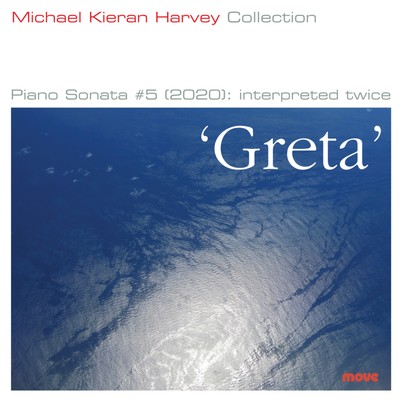
PIANO SONATA NO. 5 ‘GRETA’

Michael Kieran Harvey

Move Records MD 3452

This CD offers the same work twice. First, Harvey performs his Piano Sonata No. 5 on your common or garden-variety piano . Then he offers a second performance given on different forms of keyboard. The first movement, 100 bpm, uses an electric organ; the following Misterioso, a Fender Rhodes piano; Retorico, an electric harpsichord; Ritmico, electric bass; and the final, shortest section – Maestoso stoico, con rubato – employs an electric piano. The work is in five parts, dictated by the letters in the first name of activist Greta Thunberg. R? and T? I hear you cry? Well, make allowances: for Harvey, R transmutes to D, and T becomes F. So the fundamental notes run G-D-E-F-A – which tends to be forgotten in a work that, as only Harvey can, takes you by the throat and carries you along on yet another brilliant virtuosic ride.

Actually, I’m not sure that this particular work needs much coverage. If you want to hear its content, you can find it on YouTube where you can also find the long poem REGRET by Harvey’s long-time collaborator, Arjun von Caemmerer, which documents the number of Australian species, animal and botanical, that is at risk or has disappeared. It hardly needs saying that the sonata and poem are tributes to Thunberg’s environment-defending passion, an atonement for Harvey who has dedicated the work to his own children – which is probably both an apology and a promise to do better on behalf of us all.

The work starts in an ambience somewhere between a formal sonata with a prodigious wealth of ideas and a hefty toccata. Is there a preponderance of the note G? Not so you’d notice but the movement hurtles past in a welter of athleticism. Sure, you come across passages of tamped-down action. Open octaves alternate with syncopated block-chords that dominate the opening pages, but the work’s progress is chameleonic; you hear scraps that seem semi-familiar – revisitings for example, of the cadenza-like flights that punctuate the opening firm assertions. Textural transparency in two parts gives way to intense and thick writing, the whole typical of Harvey’s often overwhelming fluency, climaxing in a series of frenetic right-hand glissandi.

No break before we are in the Misterioso; in fact, there is a deliberate blurring before the opening high D repetitions take control, sounding like a kind of musical Morse code. It might be mysterious in ambition, but the activity level is hardly pulled back and before long Harvey is back with his intense and loud pointillism: another toccata with some astonishing repeated note demonstrations, followed later by brilliant, even trills. And the riches keep on coming when the player’s two hands operate on different levels, apparently independent of each other in rhythm, dynamic and what I can only describe as digital content and attack. Suddenly a rapid-fire canon between the hands begins and keeps you guessing about its shape, before the Morse note returns and the movement halts on a soft chord.

Which is immediately followed in attacca mode by the middle Retorico which opens with a rash of flourishes and dramatic pauses, these gestures punctuated by multi-layered trills. You are aware that, despite the occasional, outburst of first-movement vehemence, these pages are fundamentally intent on hard-edged melodic lines, to the point where repetitions become apparent even in the middle of the movement’s latter-part welters. At the end, Harvey comes back to his opening with its crisp flights between anchor points and trills, leading without pause into the Ritmico.

Which brings us again into Harvey’s stunning virtuosic field that carries you forward on an irresistible tide, here comprising a constant underpinning of semiquavers, sometimes at the octave and at others in parallel or contrary motion, with a five note figure sporadically emerging in both hands. The actual rhythmic continuum is a sequence of surprises; you think you have a handle on things moving in fast groups of three, but suddenly you’re in duple (or quadruple?) territory with irregular emphases to make an irrelevance of counting before the 5/16 gruppetti enter. And, abruptly, the onrush is halted at about 4’15” for a series of slow, portentous chords that recall Rachmaninov 2 in a strange manner. before a final brilliant set of coruscations leads to a definite ending.

The last movement is separated from the preceding four by a track break. It starts on an unequivocal A minor chord and is the most polemical of the five with a wide-ranging compass in both hands and makes its statements with a Brahmsian stoicism – it’s far from relevant but the opening chords with the intervening sets of triplets suggest (to this cluttered mind) the opening to Brahms’ B flat Concerto, even if the harmonic language is centuries distant. As you might predict, the temperature warms up considerably and the work moves through a series of segments that suggest fragments from previous movements, although most of these are fleeting apart from a brilliant chain of repeated notes. The last word is energetic in the extreme, the sonata concluding with an upward, optimistic inflexion.

When you come to the alternative version for electronic instruments, the work’s character necessarily changes. Movement 1 for electronic organ is memorable for the sustained chords and some brilliant pointillist high note sequences that recall early studio experiments by Kagel and Stockhausen. I think Harvey is using a two-manual instrument – or perhaps he’s lightning fast between registration changes. Here, and elsewhere, the bucket-loads of chords take on a more muted effect because the percussive attack is absent. Oddly enough, you have a more informed view of the movement’s content, its form and its recapitulations more obvious.

There is a break before the next track; naturally, as Harvey changes instruments to a Fender Rhodes piano with a lavishly employed sustaining pedal, Mind you, it seems that there’s an inbuilt quality that the executant is anxious to explore, moving between non-reverberant staccato runs in the centre of this Misterioso and summoning up washes of sound. Here again, the uses of fabrics and material seem more easy to pick out. Not all the time, of course, but shapes take on distinct form in particular parts of the Fender’s compass. By contrast, the harpsichord timbre in the following track aids Harvey in adding bite to the opening rapid flurries of ornamentation. As well, the unusual ability to sustain notes gives an extra dimension to this clear-speaking set of pages, and the multiple-trills sections towards the end have a ferocity that recalls Puyana playing Scarlatti.

You can hear little break between the Fender Rhodes and the harpsichord, and the fourth movement’s shift to electric bass is seamless. Once more, the textural variety available on this instrument aids in observing the movement’s rhythmic activity and its ever-moving layers, each with its own timbral qualities. I wasn’t sure much was being gained by using an electric piano for the final Moderato stoico – until Harvey inserted a section of organ sound, then went in for some electronic pointillism, before coming back to the piano sound spectrum with an even more shattering final crescendo than that in Track 5.

As I reported above, you don’t need to buy this CD; Move has made it available online for anyone to hear. At the end, I was full of admiration for Harvey’s tribute to Thunberg; not that you should read anything into this sonata that the composer subtitles ‘Concerto in no need of an orchestra’ – quite understandably as the performance in both forms is an inspired solo torrent, for which any accompaniment would be a distraction. If you like, you can draw some parallel between the music’s energy, its urgent purpose and the career to date of the Swedish environmentalist who stands as a beacon in a landscape populated by time-wasters and political lick-spittles. It’s a remarkable musical work, certainly assisted on its vehement trajectory by association with Thunberg, a character whose single-mindedness and unflinching vigour for change here enjoy a high-powered salute.

Heavy-handed visions

RACHMANINOV, RAMEAU & COWELL

Timothy Young

Melbourne Digital Concert Hall

Friday December 11, 2020

Timothy Young

Well known and cherished as the long-time resident piano guru at the South Melbourne-sited Australian National Academy of Music, as well as his foundation status as the keyboard component of that excellent trio, Ensemble Liaison, Timothy Young has appeared in two previous events of Christopher Howlett and Adele Schonhardt’s Melbourne Digital Concert Hall series before this solo recital on Friday evening. For those of us who had categorized this performer as straight-down-the-line orthodox, his Cowell/Rameau/Rachmaninov program served as an eye-opener in nearly every aspect that matters.

You’d be stretching to find anything disturbing about the two Cowell pieces that began the night. Aeolian Harp from 1923 comprises only 26 bars and these days it impresses as what it probably is: an early study in re-imagining the piano, the composer daring to venture inside the lid and play rapid arpeggios/glissandi on the strings. Young told us that he had to effect some transpositions because Cowell’s piano differed from the one in the Athenaeum Theatre. Apart from the necessity to hold down the relevant keys while operating them also inside the instrument, the player has to follow the composer’s dynamic directions which admittedly aren’t difficult. Thanks to Young for resurrecting this piece, even if it sounds like no Aeolian harp I’ve heard or imagined.

The second of the Cowell pieces, The Tides of Manaunaun, opens the composer’s 1917 Three Irish Legends suite and stands as the best-known example of his use of tone clusters. While the right hand plays a melody with ensuing transpositions and amplifications, the left hand and forearm produce note clusters of differing shapes . . . well, that’s not really true as the specified compass comprises two chords until the piece’s semi-climactic point where the melody is imitated out of contention by matching sound blocks in the bass. Young performed this innovative two-page, 36-bar composition with impressive power, happy to deliver Cowell’s glowering four bars of quadruple forte before, like Aeolian Harp, the fabric dies away to silence.

Although the quiet didn’t last. I thought my score had been truncated as Young continued playing in Manaunaun mode before suddenly bursting into Rameau’s Tambourin from the 1724 Suite in E minor. This well-known Baroque gem came over with unusual aggression, using the piano’s percussive powers to an elevated degree. Some of the right hand work occasionally misfired; surprising, as there’s nothing to distract you in the bass. Again, we had an improvised lead-in to Le rappel des oiseaux which appears in the same collection. From the start, Young punished the lower mordents that provide much of this insistent piece’s atmosphere of persistent avian strife. I didn’t understand why the pianist took a long pause at bar 30; the sonic melange changes but not by much and not for long. The mordents in both hands from bar 48 on fairly spat at each other before the quarrel led, via a reminiscence of Purcell’s Dido, into Les tendres plaintes. Here again, Young gave ample room for added notes, accents and rhythmic ups and downs in an approach that dressed Rameau’s bare bones in ornate clothing, like changing quaver scale passages into dotted quaver-plus-semiquaver patterns, and repeating single notes in quick succession like some passages in the Monteverdi Vespers of 1610.

Similar alterations emerged in Les tourbillons, which followed without a link. Here again, the approach emphasized the percussive and the rhythmic fun and games mirrored the piece’s title with a free-hand approach to the arpeggios and scales that come near the conclusion to the large central segment of this piece. A lead-in of repeated patterns took us into the final Rameau work, Les cyclopes where we heard a fair rendering of a refined forge in operation. Some digital errors were obvious in the central part, probably brought about by over-emphasis, and also in the rapid alternating hands quaver pointillism, while the last four bars forfeited clarity for the sake of a sonorous deluge.

Which led without a pause into the Rachmaninov Sonata No. 2. Eventually, I worked out that Young was performing the revised 1931 version of this splendid score; the MDCH program notes arrived late up here in the north. But the first movement interpretation disappointed because of its bull-at-a-gate mode of attack. Whole pages rattled by in a driven mesh, melodies overwhelmed by passages stuffed with escorting incidentals, the process coming to an occasional halt like the second subject’s emergence at the 12/8 Meno mosso point. But the movement ‘s focus fell on broiling action and over-weighty dynamics, any forward progress also dissipated by a liberal application of rubato.

Thankfully, the following Lento brought a more pointed and deliberate approach with a fine control over the soft clutters that broaden into a spacious fortissimo burst at the movement’s heart. Still, the concluding Allegro molto turned into a welter in which fortissimo became the default position for long stretches. Further, the insistent nature of Young’s production meant that anything that did go wrong was all too obvious, like a miscarried emphatic right hand note four bars before the Tempo I direction. I struggled to find any directional sense in the entire page preceding the Tempo rubato section, not assisted by a relentless application of the sustaining pedal.

Finally, the Presto that starts 27 bars from the end muddied the waters even further. Any contrast between triplets and straight quavers at the start to this section was hard to pick out; that wonderful skipping motion at the right hand octavo sign was articulated too rapidly to relish; and you felt no relief at the 2nd Piano Concerto alternating chords starting seven bars from the end. I didn’t time the performance but it would have been one of the fastest I’ve attended with a huge amount of energy expended for a frustrating outcome. Young has the sonata at his fingertips but what he conveys with this knowledge amounts to little more than virtuosic display – which is part of the score’s fabric, certainly, but it’s only where your interpretation starts. I think the work would have been better handled with less haste, more definition in its many note-crowded pages, and a clearer perception of the composer’s long bouts of heavily-complected languor.

A dry season trifecta

BERNADETTE HARVEY

Musica Viva

Thursday October 1, 2020

Bernadette Harvey

The latest in Musica Viva’s direct telecast recitals, this program found pianist Bernadette Harvey performing in a Sydney gallery to a small audience. As far as I can remember from previous MV escapades of this kind, having a live audience is a new move, a sign that what we used to consider as normal could be on the way back. Of course, the Melbourne Digital Concert Hall has been spruiking for live audience members over the past weeks but then Adele Schonhardt and Christopher Howlett have been at the forefront of pandemic-time musical activity since the first hit revealed that life for all artists had changed, these two blazing a trail for everybody else to follow – tentatively, in the main, especially considering the talent allowed to lie fallow that emerges in lots of orchestral rehashes and solo instrumental squibs.

No point in getting bitter, is there? Even if the thought of all that salaried talent fallen into quiescence makes you wonder about an absence of enterprise from bodies with pages of patrons and sponsorships, all quite content to show minimal signs of life, leaving real and useful activity up to the MDCH and Brisbane Music Festival’s Alex Raineri. Musica Viva is doing its best, faced with the enforced absence of its usual rota of overseas guests. So Harvey’s hour of performance brightened up an operational landscape that currently depends largely on the drive of three young musicians.

Her program fell into three sections: a completely unfamiliar (to me, if not to you, mainly because I can’t trace a published score or a recorded performance) Second Sonatine by Donald Hollier who stands among the least-performed of this country’s senior composers; a selection of five pieces from Chopin’s Op. 10 Etudes – Nos. 1, 3, 8, 9 and 4; and Alternating Current by the American writer Kevin Puts, which is one of Harvey’s party pieces as she recorded it for the Tall Poppies label in 2011 and on YouTube you can find her authoritative live performance from March last year in Tucson.

Written in 1997, Alternating Current proved to be the most interesting work on this program. Its three movements kept you engaged through their motoric energy and Puts’ mastery of making his material work to fine effect, both in terms of virtuosity and simple emotional messaging. The opening is reminiscent of a toccata – not necessarily a Bach, but more a Buxtehude with its constant changes of pace. This enjoyed a brilliant expounding from Harvey, who showed herself quite aware of the composition’s metrical dispositions and the often relentless digital precision required to swamp the listener in a benign hammering. Despite the brilliance of these pages – an exhilarating updating of Le Tic-toc-choc – I was more taken by the following slow movement with its descending bell-like chords and simple melodic motives – the whole a mono-chromatic canvas in the end where the insistence on a root tonality (E flat? Couldn’t tell for sure because of screen/sound delay and creative camera angles) generated an all-too-appealing immersive web of sonority.

For a finale, Puts went all out in another rapid movement, also something of a toccata but an intentionally bitonal one – each hand playing in the ‘key’ of the preceding movements. I tried keeping track of the matter under discussion but soon gave up because clearly the urgent forward motion was the prime aim. Here, Harvey proved most persuasive, generating full-bodied washes of sound, making light work of the deft syncopations. As with the first movement, you were taken up by the energy and insistence although, thanks to the superimposed tonalities, this finale showed more bite in its dissonances and more variety in its march towards a harmonically satisfying, if orthodox, conclusion.

Hollier’s 1996 Second Sonatine, subtitled On popular themes, runs to four movements and cites themes that everyone should know – if only they were recognizable. But it’s not the composer’s job to make his music over-simple, although Hollier goes some way towards that in his third movement Ayre: Nostalgico, con molto rubato – a rumination on the Lennon(?)-McCartney song Yesterday. Thank God Harvey told us at the end which other sources had been recast.

A choral (?) prelude made for an elegant opening in the slow and stately mode that the title probably was meant to suggest, samples of it discernible in everything of this genre from Bach to Reger. What first impressed you was Hollier’s whimsical mordents in the progress of his melodic line, which was punctuated by quick block chords moving in either direction. Climaxing in a state of quasi-hysteria, the movement covered itself with a dark, slow conclusion. This used Joseph Kosma‘s Autumn Leaves, carefully transmuted. A passacaglia followed, but nothing like the big C minor for organ; this was a dance that moved in metre between 5/8 and 6/8 and covered in its freneticism the title song from Jerry Herman‘s Hello, Dolly! Although the fluctuating time-signature suggests a bumpy ride, this was a steady set of pages, regularly irregular but well-equipped with clusters and rapid scale-work. And brief.

The Yesterday treatment brought to mind Grainger’s musings on Gershwin, although Hollier was not so tightly bound to his original, deviating from the original and lingering over fragments of the whining melody, like the rise and fall of a 6th at the words ‘Why’d she have to go? I don’t know, she wouldn’t say’. For all the clever loitering, this experience reminded me of nothing so much as the sort of thing you’d hear in an up-market piano bar. Harvey held on to some notes longer than any lounge pianist would dare, and Hollier’s ending sounded disappointingly bland and ‘easy’ – or perhaps he was making a sardonic comment on his material.

The sonatine’s finale, a Fugue: Allegro ritmico, was certainly that and more. Shades of Prokofiev and Bartok proved hard to ignore with loads of cutting harmonic clashes and the fugue’s lines running into each other rather than coalescing into a mellifluous whole. Hollier’s headlong progress came to a sort of stretto climax with hand-smashes across the keyboard, although the whole thing wound up with a kind of fugal flourish as the composer finished dealing with the Toreador’s March from Carmen (or was that just Escamillo’s aria from Act Two?) and Strangers in the Night by Bert Kaempfert. In the end, this unknown piece turned out to be great entertainment and a fine showcase for Harvey’s virtuosity and ready sympathy – a deft reflection from the other side of the Pacific on Puts’ powerhouse construct written a year later.

As a preface to the five Etudes, Harvey spoke of the differences between Chopin and herself, which didn’t lead to many insights, probably because the address seemed diffuse and unsure of what it intended to accomplish. During No. 1 in C Major, the right hand arpeggios proved pretty reliable, although a squeaky top D flat six bars from the end detracted from the work’s fluency. You could find much to like with No. 3 in E Major, even if Harvey showed a tendency to ‘point’ notes too often – lingering in a mini-rubato at melody-disturbing points. By contrast, her handling of the central poco piu animato section was powerful and eloquent in both passion and drive. No. 8 in F gave us a good deal of perky left hand work underneath the semiquaver-happy right hand which again did not maintain absolute accuracy.

You rarely hear No. 9 in F minor, unless the executant is presenting the complete set. Harvey made a persuasive case for the piece’s characteristic restlessness but also found out its declamatory quality, particularly when Chopin gives octaves to the right hand. I don’t know whether a decelerando in the final bars works, but if that’s what you think makes a suitable conclusion, you can only choose to disagree on principle when it’s accomplished with this amount of finesse. Harvey’s decision to wind up with No. 4 in C sharp during which both hands enjoy a thorough workout was successful; here, you could find few flaws in the technical work and she managed to sustain the study’s interest despite the temptation to segmentalise it into a series of two-, four- and six-bar challenges.

Again, thanks to Musica Viva for presenting this event, more worthwhile than many in that I’ve rarely heard Harvey in my time in Melbourne and am probably unlikely to experience her work live in the Light North. Among a plethora of artists with few conceptions about how to interpret difficult music, she has been – and continues to be – a welcome presence that should be exposed more often.