Talent to spare

MOZART’S PIANO

Melbourne Chamber Orchestra

Melbourne Recital Centre

Sunday August 14, 2016

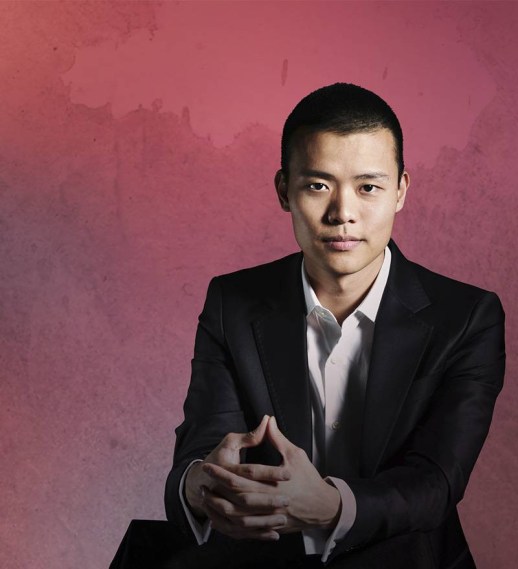
David Fung

                                                                                       David Fung

Nothing but Mozart in this latest subscription series concert.  Well, almost; somewhere along the way, Australian writer Nicholas Buc‘s new Shadow Dances put in a brief and not too painful appearance, even if the pacy score stuck out in this context like an intellectual in the current Senate.   But artistic director of the MCO, William Hennessy, was obviously relishing his Mozartian commitment as he led his young musicians through the Serenata Notturna, the Symphony No. 29 in A, and supported David Fung in two early Piano Concertos:  No. 11 in F Major and No. 14 in E flat.

Opening with the serenade, Hennessy took on mini-Orchestra 1 duties with Courtenay Cleary, viola Merewyn Bramble and double bass Emma Sullivan.  The performance of the first two movements proved exemplary: balanced in phrasing and attack, well-organized dynamically and infused with the welcome sense of a unified ensemble at work.  In the final multi-sectioned Rondo, Hennessy allowed his group a certain amount of licence in tempo torques, but not to the self-indulgent extent that other ensembles go in for.   More to the point, the MCO players were well prepared for the alterations.   What I (eventually) missed were the timpani that should form part of the work’s sound complex.  Yes, the part is not an exciting one and any tyro could perform it at sight, but it does add an edge to the outer movements, especially in the pizzicato bars 5-6 and 11-12 of the opening march’s second part, which is where I first noticed that the drum sound was absent.

Buc’s piece followed, a bagatelle that began as an active Latin-American dance with lots of snap and bounding action.   The work moved from tango to tango, as far as I could tell; the promised detours to different dance beats and major/minor contrasts passed me by, mainly because I was expecting the changes of pace to be more marked, more obvious to distinguish.  Then, the piece ended before any re-orientation had set in.   My fault for trying to over-analyse a happy frippery whose function was primarily to entertain.

David Fung gave an incisive reading of the F Major Concerto, a work you would be lucky to hear once in a double-decade.  His Mozart is no limpid aristocrat but a vital, even prickly individual with a turn for the idiosyncratic, like the Beethoven-heavy left-hand chords for the soloist that come out of nowhere in bars 82 and 86 of the first Allegro, and the oddly unsettling shape of the first two phrases of the Larghetto‘s main theme.   Fung made interesting work of each paragraph, notably in the solidly argued initial movement but what impressed most was his fusion with the MCO; he’s an ideal soloist in his awareness of where he fits in to a concerto’s framework, which made his merging into the score’s activity after tutti passages and cadenzas a model of responsibility.

Even better came with the E flat work; but then, it’s more engaging in its material.   Fung raised the aggression level slightly so that his initial entries came across with energizing brio.   Still, his legato passage work proved admirable – evenly paced and set out with care for its crescendo/diminuendo potential – and throughout this and the preceding work his ornamentation was worked into the fabric with a sensibility that would have done credit to a player many years his senior.   Of special note was Fung’s account of the first movement cadenza – Mozart’s own?  – where the brusque power of the preceding development came into a kind of heightened focus.   Across the whole work, Fung displayed an authority and decisiveness that made even the main body of the four-square finale a feast of elegantly contoured articulation.

Hennessy’s account of the splendid symphony was all the more welcome for the absence of first-half repeats in the outer movements and the Andante; yes, there is much to be said for the formal and spatial balance these provide, but they seem unnecessary in a work as well-ploughed as this one.   The MCO strings made a fine showing here, even if the body could have done with another viola to reinforce Bramble and her solitary colleague.   But a significant distraction here – and in the concertos, for that matter – came from the two horns who were positioned very close to the Murdoch Hall’s back wall and who performed with resonant gusto, more than suited many pages of this music, especially as much of their content is reinforcement, not real and intended dynamic prominence as in bars 171-2 of the K. 201’s concluding Allegro.

A generous collection of masterpieces

BASICALLY BEETHOVEN

Selby & Friends

Deakin Edge, Federation Square

November 25, 2015

Kathryn Selby

I’ve not seen or heard a Selby & Friends recital for some time; renewing acquaintance, the most obvious change has been in audience size.  From the years when numbers were thin at Melba Hall, patronage has swollen to the point where seats are at a premium because the Edge space last night was sold out.  Maybe people were attracted by an all-Beethoven program; perhaps the combination of Melbourne Symphony Orchestra co-concertmaster Dale Barltrop, the Australian Chamber Orchestra’s principal cello Timo-Veikko Valve and Selby’s brave, polished pianism made an exceptionally attractive proposition.  Those music-lovers who managed to hear this recital were treated to a bracing tour of achievement peaks from the composer’s middle period.

Putting her guests to best use, Selby programmed a sonata for each, framed by two piano trios – one that’s almost not there, the other a trail-blazing masterwork.   In terms of substance, the No. 12 Trio offers little: one movement, an Allegretto that consists of a simple minuet, soon over and leaving not much impact.  A curtain-raiser, then, but one with a muted vivacity, particularly the piano part which holds the lion’s share of the (admittedly brief) action.

Beethoven’s final violin sonata, No. 10 in G Major, comes as a relaxation of tension after its famous predecessor, the A minor Kreutzer and follows that irregular oscillating pattern of power and placidity in the composer’s output – the jocund B flat Symphony between the Eroica and No. 5 in C minor, the rollicking alla tedesca Piano Sonata No. 25 sitting between the deeply-felt A Therese and Les Adieux pieces, that amiable Op. 74 Harp String Quartet sitting between the voluble final Rasoumovsky and the terse, unsettling F minor.  For all its approachability, the last violin sonata has not appeared regularly in chamber music programs, not as often as the Spring or C minor favourites.

Commentators have found a sort of farewell to arms in this work which comes from the centre of Beethoven’s middle period but which was, as a form, ignored by the composer from then on.  Selby and Barltrop performed it with an unfussy relish, both well-matched in the question-and-response opening strophes and maintaining a calm path through even those pages that tempt most to declamation.  As with all three major works on this night, the players had searched out a mode of operating that sprang from the score’s possibilities; rather than the usual smash-and-grab display of temperament, this was a considered, mutually respectful interpretation, riveting in passages like Selby’s negotiation of the low-lying chords and octaves that support the Adagio‘s opening statements, and later in the interlocking cadenzas of the finishing Allegretto where the usual flashiness was avoided and the work’s sinewy power spoke for itself.

The most familiar of the cello sonatas, the middle No. 3 in A Major, proclaimed its intentions from the start as well.  Timo-Veikko Valve outlined the unaccompanied first melody with restraint and the two brief cadenzas that tail each sentence were made to count as integral to the preliminary statement, rather than being tossed off as flourishes. When the movement proper began, both performers set a steady pace – Allegro, but not too much, as the direction requires – and at every turn you heard something new; not necessarily unexpected, but a shift in focus like a paragraph-ending rallentando, a hitherto-unknown doubling of the bass line, weight applied sparingly and not the often-encountered mindless pounding.  More than this, the work held an unusual fluency,  best heard in the last movement where Selby in particular negotiated the octave runs with a sotto voce grace and provided Valve with a true partnership like the miraculous moment at the centre of the movement where the cello has the main theme and the piano’s accompaniment of a rolling A Major triad supports it with a balalaika-style rustling – the effect here and the detail of accomplishment at many other stages achieved through innate musicality and a fine depth of preparation by both executants.

As you’d expect after this groundwork, the Archduke realization proved exceptionally fine: determined in attack, meticulous in dynamic balance, both strings ideal in their close ensemble work, most evident in the chain of sixths and thirds at the start to the Andante cantabile and the interleaving sustained notes at the movement’s end.  But the performance was loaded with extraordinary moments, like Selby’s strong Weber-reminiscent chord/arpeggio upward bounds punctuating the Scherzo‘s trio, the precision of her rapid trills in the finale and the amiable sharing of sound-space between the musicians with every contributor audible throughout.  We may wait some time before coming across a reading as enriching, informative and spirit-lifting as this one.


Birdsong from the North

ALAN HOLLEY

Australian Voices

Salon, Melbourne Recital Centre

November 5, 2015

This series – a collaboration between the Recital Centre and the Australian National Academy of Music –  has tended to air music by composers whose names are familiar or well-established.  While Sydney-based Alan Holley is verging on the age requirement for a senior Australian creative figure, his music has rarely travelled to Melbourne; at least, in my experience.  All the more welcome, then, that Thursday evening gave an audience of enthusiasts the chance to hear a variety of works covering Holley’s activity over the past eleven years.

                                                                   Salon, Melbourne Recital Centre

Thanks to the expertise of a chain of talented young ANAM musicians and the committed direction of curator/trumpeter David Elton, we experienced two of Holley’s larger-framed constructs, interspersed with some solos from Elton alongside a few short pieces that served to illustrate the writer’s skill in finding congenial frames of operation for wind and brass instruments in particular.  Canzona for Ligeti begins with an off-stage horn solo – and, no matter what you do, the shade of Britten’s Serenade casts a long shadow – before a short and dynamic tribute written on the Hungarian composer’s death.  Clear in its linear interplay and texturally warm and spiky in turn, this set a fairly high standard of expectation for the rest of the night’s content.

Comprising a mixed nonet – five strings, three wind, horn – loaded with dream juxtaposes musical images of Australia’s first white settlers with the country’s indigenous peoples, the intellectual/emotional landscapes of both races spelled out in a score notable for some eloquent bass clarinet contributions from Luke Carbon.  Here again, Holley employed a varied sound palette, best exemplified by some striking low wind textures supporting a reticent string group.

Elton himself performed Ornithologia, splitting its two parts (in reverse order) at either end of a piano trio, the estuaries of time, which, like the nonet, marked a new e. e. cummings period in the composer’s style of nomenclature.   The trumpet solo gave the first overt reference to Holley’s preoccupation with birdsong, an influence that colours his work – well, the instances we heard here – and Elton’s eloquent performance gave an object lesson in rapidity of articulation as well as demonstrating an unshakable grip on the piece’s sequence of abrupt sonic explosions.

As for the birds, Holley uses a limited and local number of them.  There are no Messiaen-like ornate chromatically complex flurries; rather more suggestions than direct imitation although, to be even-handed, a world of difference in intention lies between the Calling section of Ornithologia and the French composer’s obsessively detailed Oiseaux exotiques.  Holley, unlike Messiaen, presents as more inclined to use what is available rather than to search out the more arcane sounds of rarer species.  Certainly, birdsong adds to the colour, the context even of Holley’s works’ progress, but its use  is not all-engrossing for the listener.

The piano trio opens with long solos for two of the participants; when the instruments coalesce, your attention tends to wander as the contrapuntal interplay is less engaging than Holley’s exploration of individual lines; as a result, I tended to focus on Iona Allan‘s violin or Alexandra Partridge‘s cello as distinct threads rather than looking for the score’s ensemble tension.  In this program’s context, the estuaries of time opened bravely enough but wore out their welcome, the pools they led to rather brackish despite the interpreters’ clear dedication to the task.

The last work of the night, The Winged Viola, was the earliest written, in 2004.  Soloist Gregory Daniel met its challenges with fine equanimity, his line piercingly clean in the Salon’ close situation.  Like the trio, this is a substantial work and deserved earlier placement; as it was, the lyrical curves and sprightly moments of technical brilliance impressed for their clarity, although the later-written scores already heard held more polished, more tautly enunciated content.  Less importantly, this chamber concerto came onto the scene well after the scheduled finishing time of the recital; enervating for those of us with a commitment later yesterday evening.

Mastery at close quarters

VIOLIN SONATAS

Daniel de Borah & Friends

Melbourne Recital Centre

October 27, 2015

Daniel de Borah

Part of the Recital Centre’s Local Heroes all-embracing chain of recitals, pianist de Borah’s initiative acts as a sort of complement to Kathryn Selby’s long-lived series where musical colleagues join in ensembles either on an ad hoc basis or in an ongoing relationship.  Selby’s environment is usually that of the piano trio or quartet while de Borah gravitates to the duo format – his friends including another pianist, another singer or instrumentalist.

For yesterday’s program, the associate artist was Adam Chalabi: a familiar face as one-time leader of Orchestra Victoria, then that body’s artistic director, Head of Strings at the Australian National Academy of Music in 2012, currently first violin in the Tinalley String Quartet and a professor in violin at the University of Queensland.

Rather than picking over repertoire gems, the duo took on two differing but neglected sonatas.  Mozart K. 379 in G is hardly calculated to appeal to a violinist; the keyboard has all the running, particularly in the second-movement variations.  Chalabi’s strongly-voiced output gave de Borah’s active piano part a fair amount of competition but, for much of the work’s length, the string instrument runs in second place.  Which might explain why only a few of Mozart’s works in this form appear with any frequency. Elisabeth Sellars performed the set at St. Michael’s Church in Collins St. nine years ago but I doubt if this particular sonata has seen much light since then.

De Borah made a deft apologist for this small-framed piece gifted with many repeated sections.  His performing style serves as an object lesson; supple wrist work, each note carefully searched out, the hand curved in the time-honoured, teacher-approved style yet capable of sonorous and vehement passages without physical histrionics.

The violinist had all the running in what followed: The Lark Ascending, Vaughan Williams’ spare pastoral romance with its atmospheric, emotionally centred cadenzas that soar to impossibly high Ds. Most often, we hear this poem to the English countryside in the later violin-plus-orchestra format, in halls where kind acoustics help the soloist in the fluttering and swoops that illustrate Meredith’s rhapsodic lyric.  Chalabi span a strong, uncluttered thread with telling confidence, keeping his powder dry for the chain of double-stops at the score’s Largamente climax.  Even in the close quarters of the Salon, you could find few flaws in this artist’s pitch and firm right-hand address.

Continuing the Edwardian vein, the duo gave exposure to another rarity in Elgar’s E minor Sonata, among the composer’s last works and pretty contemporaneous with Vaughan Williams’ rural meditation. By contrast, this sonata looks four-square on the page, inclined to direct statements and sturdy development of set material.  De Borah and Chalabi infused it with vigorous character, in particular the expansive if plain-speaking first movement.  Even more success came with the final Allegro’s energetic canvas, interrupted by a reminiscence of the central Romance’s central theme.   After the pellmell drive and busyness of a Brahms-thick textural expedition, this retrospective moment demonstrated the musicians’ clear-minded skill in treating difficult material.  A standout recital from two performers in their prime.