The flute as we now know it

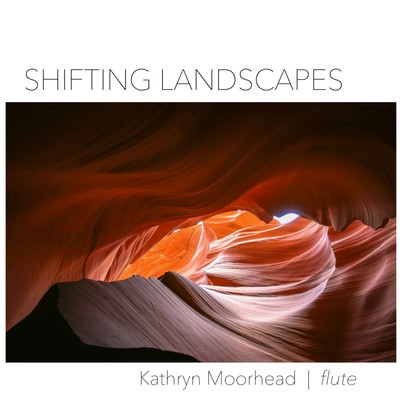
SHIFTING LANDSCAPES

Kathryn Moorhead

Move Records MCD 672

Adelaide-based flautist Kathryn Moorhead plays nine pieces of contemporary music in this, her latest CD for Move Records. She ranges between recently-deceased American Alison Knowles’ Proposition #2: How to Make a Salad from 1962, and two works from 2016: another American and a flautist herself, Nicole Chamberlain‘s Lilliputian for piccolo and music box, and the Pimento study for solo piccolo by British writer Edmund Joliffe, best known for his TV scores.

In between come species of flute-writing covering a wide spectrum: difficult Brit Brian Ferneyhough‘s Cassandra’s Dream Song of 1971, L’ombra dell’angelo by University of Mantua academic Paolo Perezzani from 1985, our own (sort of) Andrew Ford‘s 1993 Female Nude for amplified alto flute, East-and-West fuser American Elizabeth Brown‘s Acadia for flute and shakuhachi (Anne Norman) written in 1999, Laveringar of 2001 by senior Swedish writer Daniel Bortz, and Brisbane-born Damian Barbeler‘s 2006 Confession 2 for piccolo and electronics.

Despite this half-century time-span and variety of instrumentation, Moorhead’s CD is undersized, coming in at 54 minutes. Longest in the list is the Perezzani, almost 12 minutes; the shortest is Pimento which settles itself at a trifle over 80 seconds. The flautist takes on the very challenging Italian work first. This sets up a very physical angel’s shadow ambience with a lengthy sequence of trills from all over the instrument’s compass, giving a brilliant aural image of restless flight partly through the abrupt ‘fill-in’ flights between trills

The attack modes also involve the listener in what sounds like a violent series of curvets, often initiated by a burst of air as the player moves into the territory of over-blowing, although it’s mainly resulting in semi-harmonics rather than Bartolozzi-style multiphonics. What comes over impresses for its ferocity which is contrasted with almost inaudible soft phrases, so that you get some sense of the ethereal as lightning-fast which, in the later stages of the piece, flattens out into long sustained notes with a strange vibrato in the upper register that is produced by using a key (God knows which one) to generate a throbbing, like a wing in fluent action.

Barbeler follows. His piece features a meandering motif from the piccolo which acts as the voice of the confessor while the electronic tapestry that underpins the live instrument’s tale serves as a sort of subterranean admission of deeper deeds. And that presents the listener with a dichotomy in the best botanical sense. The live instrument dilates its opening material – a scale pattern coming down a 4th, then up a 2nd – while the backdrop moves from sustained sound blocks, across to burbling action, then to a concluding combination of both – in line with the composer’s aim of having his confession operate on two levels: the overt and the secretive.

Mind you, I don’t believe that you can achieve anything of the kind in music without words. You might want to believe that the flute represents a sinner/offender and the electronics stand in for the surrounding ambience or morally debilitating environment, but the intellectual construction involved reaches well beyond the probable. Barbeler might tell us the impetus behind his work but he gives us no pins on which to hang his metaphysics, just as Strauss fails to convince us in his score that Nietzsche’s Zoroaster spoke any of the ideas that populate his invigorating tone poem.

In similar fashion, Andrew Ford’s Female Nude for amplified alto flute with vocalisations probably conveys a lot to the writer but any listener would be hard pressed to find anything suggesting the title in this rather monomaniacal obsession with the note A that the composer keeps returning to after a few flights of angular modernity. Moorhead is required to articulate individual consonants and vowels on that same A (or occasionally, its neighbour) in medias res, which makes for a deft display of legerdemain from the performer, generating these noises while playing a rhythmically complex instrumental part which every so often asks for a fusion of voice and flute with some heavily forced notes to leaven the mixture.

As for Elizabeth Brown’s Acadia, the performers present an unnerving mirror of each other in their performance which at various points blurs any distinction between the two sound sources. As we have come to know and love from exposure to Riley Lee’s craft, the Japanese flute can bend notes significantly; in fact this elision process makes Norman’s shakuhachi melodic contour highly distinctive. In this reading, Moorhead can do something like the same on her orthodox Western instrument. In fact, the two lines intermesh with unusual ease and deceptiveness.

The title refers to a national park on a Maine island and probably has some reminiscences for those who know the place. For the rest of us, I’d suggest, our minds inevitably turn to the Japanese archipelago, the less populated parts with suggestions of bird calls and remoteness. Brown’s language proposes a juxtaposition of the two instruments’ timbral possibilities but something more profound than this in that the flute and shakuhachi become more than complementary, but rather inextricably linked so that only the occasional high note from the flute or a breathy near-overblow from the shakuhachi allows for some momentary distinction to be made. A remarkable exhibition from players and composer.

Cassandra’s Dream Song, which remains one of the outstanding flute solos of (nearly) our time, enjoys a spirited reading from Moorhead. The score itself is fearsome, evidence of Ferneyhough’s nomination as an (the) outstanding member of the New Complexity school – which term has always struck me as odd because, although it might be complex, it’s not really new, is it? You can trace the modernization of the flute throughout 20th century decades and find pieces presenting just as many challenges as this one, not least the attention to detail that the composer sets out in his page of sound-manufacture description.

Leaving the order of line performance to the interpreter is not that much of a risk because you will wind up hearing an entity rather than a series of fragments. Further, as an American academic has pointed out, one of the standout performances of the work has not changed over time, the interpreter sticking to his original choices across the years. Not that this matters too much because the piece itself is a nightmare to play and experience; the prophetess is prefiguring the disasters that happen to her home city, its inhabitants, and her own fate when Agamemnon brings her back to Mycenae. Moorhead accounts for the breaths, splutters, note suffocations and piercing bursts of clarity with impressive authority, making a dramatic scenario that does justice to Aeschylus’ doomed concubine.

We move back to a child’s world for Nicole Chamberlain’s gesture towards the Part One of Swift’s novel. The music-box is set up beforehand by the performer punching out the requisite roll, then presumably playing along with it. As far as I can tell, the 6/8 piece in F minor doesn’t move outside that rhythm or key and the results would be quite suitable for a Play School sound track. But it sits uncomfortably in the shadow of the previous track on this CD with only a small downward bend on the last note to queer the surface orthodoxy.

Laveringar‘s subtitle is Tinted Drawings, and is the plural (in Swedish) of the painting term lavering, referring to a wash or thin coat. This is another substantial solo which initially oscillates between urgent upward rushes of demisemiquavers and clarion calls, then quiet moments of near-stasis with long semibreves to calm the action. Bortz also has an initial penchant for bending notes but soon leaves them alone until his final staves. In fact, he embarks on a narrative path that I find hard to follow.

This is in part due to the composer’s quite proper view of his laverings as differing from one painting to another; he isn’t confining his washes to one type or genre but is splashing his colours around with lavish abandon. Which means he can follow his own fancy, of course, as can every writer, but it means that the piece must be, by the act of lavering, inchoate. As the painter allows his/her wash to spread or constrict in alignment with whatever constitutes the standard of composition (if s/he has one), so Bortz’s musical lavering can lead anywhere. To her credit, Moorhead follows each sprouting of colour with enthusiasm, giving each furioso as much care as she does every corresponding piu lento.

The third piccolo piece on this CD, Joliffe’s brief bagatelle, gives a musical picture – as far as one can – of the sweet pepper named in its title. It is very active, a sort of rapid toccata, with variable time signatures and some quirky sound production changes about half-way through. But the piece is quite brief, just long enough to raise your estimation of Moorhead’s precision and agility.

To end, an instance of music in the everyday. Knowles instructs the performer/s to engage in the cutting, slicing, dicing, scraping and mixing that are the aural concomitants of making a salad. This performer makes the required sounds for about 2 1/2 minutes. As with most of these presentations, it’s more engaging to see than to hear, as I found way back when first coming across similar efforts from Cage and Stockhausen (in his later years) where the event had nothing to do with written music but concentrated on (usually minimal) instructions on making sounds and noises that became music, in the best Fluxus sense. Nothing too hard about that; the interaction between art and everyday has become a long-standing (well, several decades off a century) practice in many fields of art.

Yet I feel that this finale to Moorhead’s album will wind up being the least heard of the nine tracks she offers. A nice idea and an unexpectedly relevant celebration of Knowles’ passing less than three months ago, yet Proposition #2 doesn’t quite fill out the spaces after a preceding sequence of works that offer more meat on the bone. Nevertheless, this CD makes a welcome addition to the faltering number of recordings that deal with the flute as it is used in our time.

Diary August 2025

THE POETRY OF WAR

Melbourne Symphony Orchestra

Iwaki Auditorium, Southbank

Sunday August 3 at 11 am

Here’s another element of the Melbourne Symphony Orchestra‘s Chamber series, in this case combining music and poetry in a program curated by violinist Monica Curro. Of course, the subject/theme won’t be hard to flesh out, and the printed material on the MSO website refers to music by Debussy, Britten and Webern. And that’s not an ‘of course’ matter at all. No worries with Britten who has some war material to his name, even if we’re not being treated to snippets from the Requiem. Debussy’s a bit harder to pin down; you might take one of the three instrumental sonatas as being ‘ of the time’ rather than having any military connotations. Mind you, the same could be said of the Berceuse heroique (a piano solo) or En blanc et noir (probably not on this program as it calls for two pianos). As for Webern, I’ve no idea; the Cantata No. 2 was written during World War II but I doubt if anyone’s taking that on, particularly if you take into account the musical forces that Curro has gathered. They involve herself and Kirstin Kenny on violin, Gabrielle Halloran viola, Michelle Wood cello, Shane Hooton trumpet, Andrew Macleod flute, and Elyane Laussade piano. As for the poetry, that comes from actor Dennis Coard whose contribution is non-specific except that it’s coming from the 20th century. Here’s hoping we get a bit of French and German texts to go along with the Owen and Sassoon. A standard ticket costs $55, concessions go for $50, and kids get in for $20; you have to fork out $7 as a transaction fee, or for having the cheek to place an order.

ATMOSPHERE 3

Corpus Medicorum

Elisabeth Murdoch Hall, Melbourne Recital Centre

Sunday August 3 at 5 pm

Turn it into Latin and immediately the thing takes on gravitas. I don’t know when the Doctors’ Orchestra turned itself into the Corpus Medicorum, but here we are. The group of combined medicals – doctors, students, health professionals – will be directed in this concert by the estimable Fabian Russell; actually, Russell has conducted/is conducting all the Corpus’ events across the year. This evening, the group is going all-French in an ambitious set of forays that opens with Debussy’s La mer, that taxing set of three symphonic sketches from 1905. Violin soloist Natsuko Yoshimoto, currently concertmaster of the Queensland Symphony Orchestra, then fronts Chausson’s Poeme of 1896, the composer’s best-known work and a professional’s staple. She follows this with Ravel’s flashy Tzigane from 1924 – as boisterous a musical joke as the Bolero from four years later. The entertainment ends with more Ravel in La valse, that nightmare vision of 19th century Vienna written in 1920 and apparently having nothing to do with World War I. It asks for a big orchestra and is difficult, even for gnarled old-timers, to carry off persuasively. A standard entry is $65; concession card holders and students both are being charged $30, and ‘Booking fees may apply’, according to the publicity – I think you can count on it.

CIRCA & THE ART OF GUGUE

Australian Brandenburg Orchestra

Elisabeth Murdoch Hall, Melbourne Recital Centre

Thursday August 7 at 7 pm

Is this going to work? We’ve seen previous marriages between the Queensland-based circus company and Paul Dyer‘s Australian Brandenburg Orchestra in the past. I recall hearing/seeing French Baroque and Spanish catch-all programs in the latter years of the past decade. The Italian Baroque collaboration of 2022 didn’t travel live outside of Sydney, but now both organizations have put aside national colour and opted for a massive torso in Bach’s one theme-based collection of 14 fugues and 4 canons. This compendium lasts as long as the performers decide, it seems; one performance barely lasts 50 minutes, several more close to 90 and one I’ve come across goes for over two hours. Most musicologists agree that the work was probably written for – and is best served on – a harpsichord but I have little doubt that the Brandenburgers will not be consigned to the back-blocks by their artistic director’s instrument alone. Of even more moment is the question of the Circa acrobats’ choreography which will need to be of a sharp order to come into line with the matchless skill of Bach’s contrapuntal marvels. Still, the few occasions I’ve seen this collaboration in action, the music has to fight hard to attract any attention from the Circa corps’ brilliant aerodynamics. I don’t understand the ticketing process. A standard costs between $30 and $196; full-time students pay a flat $20; Under 40s pay $40; concession card holders pay between $59 and $109. These prices vary between performances and booking fees apply if you get your seat(s) online or by phone. You’d want to get good Bach for your buck.

This program will be repeated on Saturday August 9 at 7 pm and on Sunday August 10 at 5 pm.

TCHAIKOVSKY’S VIOLIN CONCERTO

Melbourne Symphony Orchestra

Hamer Hall, Arts Centre Melbourne

Thursday August 7 at 7:30 pm

Oh well, it had to happen: a rather orthodox program, even if it holds one surprise. Clearly, the evening’s focus falls on the great concerto of 1878, the most exhilarating of them all, thanks to the composer’s inimitable capacity for drama and colour. As soloist, the Melbourne Symphony Orchestra is initiating Dutch musician Simone Lamsma who has proved highly successful in North America and Europe. I believe she has played with the Sydney Symphony Orchestra but, like so many of her ilk, has not made it to anywhere more southern – until now. The concert’s conductor, Korean-born Shiyeon Sung, has been principal guest conductor of the Auckland Philharmonia and has worked with the Queensland Symphony Orchestra. Her big task is finding even more reserves of warmth in the benign Brahms Symphony No. 2 in D: the happiest of the composer’s four and blessed with a welcome underpinning gleam across its length. It’s also almost an exact contemporary of the night’s concerto, being written in 1877. But up-to-the-moment joy comes in a premiere from Greek-Australian writer Klearhos Murphy, the MSO’s Cybec Young Composer in Residence; his The Ascent, commissioned by the orchestra, is to be revealed – a triptych of (not too exhaustive, one hopes) meditations on the teachings of St. Nikitas Stethatos and that holy man’s proposals for a successful spiritual life. Normal rickets range from $75 to $139; concession holders are charged $5 less (big deal); if you’re under 18, the charge is $20., But everybody has to stump up $7 transaction fee per order; one day we’ll find out where that money goes.

This program will be repeated on Saturday August 9 at 7:30 pm

DANIELLE DE NIESE

Australian Contemporary Opera Company

Elisabeth Murdoch Hall, Melbourne Recital Centre

Friday August 8 at 7:30 pm

A singer with a large profile, Danielle de Niese is going to work through a wide-ranging program that stretches from Marcello and Handel to Weill and Gershwin with not much in the middle. I’ve not heard her (I think) so have no comment about her talent but she has an excellent group of well-known musicians supporting her: violins Curt Thompson and Sophie Rowell, viola Lisa Grosman, cello Richard Narroway, oboe Rachel Curkpatrick, harp Marshall McGuire, piano Coady Green. As well, she is being assisted by a vocal septet from the Australian Contemporary Opera Company: Sophie Bissett, Uma Dobia, Saskia Mascitti, Callum Warrender, William Grant, James Billson and Daniel Felton. The recital’s first half is specific with definite numbers and arias from Jimmy Lopez, Kurt Weill, James Macmillan, Christopher Tin and Patrick Cassidy, as well as the afore-mentioned Marcello and Handel numbers. After interval, it’s just names – Dan Bryer, Mike Needle and Tom Grennan, Kenneth Macmillan (really? The choreographer??), John Denver, Jerome Kern as well as Gershwin. In other words, you’re getting a potpourri of songs that I suppose de Niese likes to present. If you’re attracted, a standard ticket comes in between $75 and $149; concessionaires get in for $10 or $20 less, depending on where you sit; students can get mediocre seating for $35, and Under 40s get the same for $40. In this case, the transaction fee is a moveable feast, somewhere between $4 and $8.50; no idea how they apply this although I suspect the more affluent get stung most.

GERSHWIN & SHOSTAKOVICH

Australian Chamber Orchestra

Hamer Hall, Arts Centre Melbourne

Sunday August 10 at 2:30 pm

My favourite Ukrainian-born Australian pianist Alexander Gavrylyuk is appearing for the first time with the Australian Chamber Orchestra; it’s taken a while for the organization to perceive those talents that, to many of us, have been obvious for years. Still, here he is at last, front man for Gershwin’s Rhapsody in Blue (written in 1924 and here arranged for strings and solitary trumpet backing, God knows how) and the 1933 Piano Concerto No. 1 by Shostakovich for which the ACO and David Elton comprise the proper environment. We also will hear the Chamber Symphony arranged for string orchestra in 1967 by Rudolf Barshai from Shostakovich’s String Quartet No. 8, a work we’ve heard from the ACO on previous tours and which was released on a CD by the current players (you’d think) in February of this year. The event starts with Claude Vivier’s taxing Zipangu, the Canadian composer’s 1980 vision of Old Japan, with the help of some other Asian countries. As well, the ACO presents a newly commissioned work: A Moment of Memory by senior Ukrainian writer Valentin Silvestrov, who fled from Kyiv three years ago to find refuge in Germany after the Russian invasion. This is a remembrance for the victims of fascism and oppression, although it sits somewhat oddly beside Gershwin’s buoyant tour de force. Tickets range from $30 to $167 for full adult cost – now there’s a spectrum of choice for you. Pensioners and Healthcare cardholders get a lower rate (but not much), as do students and those under 35 (why them?).

This program will be repeated on Monday August 11 at 7:30 pm

MUSICAL FRIENDS

Flinders Quartet

Primrose Potter Salon, Melbourne Recital Centre

Tuesday August 12 at 7 pm

This ensemble has kept its shape for a while now – violins Elizabeth Sellars and Wilma Smith, viola Helen Ireland, cello Zoe Knighton. This particular program offers several surprises and two staples of the repertoire that you now hear all too rarely. Of more than usual interest is the presence of two commissions. The first is by Natalie Nicolas, a Sydney writer and a favourite of the Flinders Quartet. This is By the Tide of the Moon and celebrates Aida Tuciute, a former Lithuanian Olympic swimmer who has an affinity with the ocean. As for the second, it’s a joint work by Melody Eotvos from the University of Melbourne and Rishin Singh – Malaysian-born, formerly resident in Sydney, now living in Berlin. Called The Letter Writing Project, this is a joint composition where the composers constructed this work turn and turn-about by sending each other completed portions. In between and following these fresh compositions, we hear Mozart’s Adagio and Fugue in C minor from the ominous (for Mozart, as well as for our First Peoples) year of 1788. And the Flinders end with Borodin in D Major, his second string quartet of 1881 which proved such a fruitful source for Robert Wright and George Frost when they were assembling the score for their 1953 musical Kismet. Tickets are a very reasonable $53 full adult, and $42 for concession card holders and students; never forgetting that oddly varied transaction fee between $4 and $8.50 if you phone or email your request for tickets. Is that range in operation because of a client’s suburb? Bank? Credit rating?

TAKACS QUARTET WITH ANGIE MILLIKEN

Musica Viva Australia

Elisabeth Murdoch Hall, Melbourne Recital Centre

Wednesday August 13 at 7 pm

One of the world’s great string quartets returns under the Musica Viva banner to perform Haydn, Beethoven and a once-local composer’s work commissioned by the organization. This last is Cathy Milliken, born in Brisbane and now based in Berlin. Her new Sonnet in Emigration is a setting of Brecht (probably not the On the Term Emigrants poem of 1937; more likely Sonett in der Emigration of 1941 commemorating when the poor fellow and his family wound up in America). As I understand it, the interpreter of this, with the Takacs Quartet, will be Australian actress Angie Milliken – could be a sister, or a cousin, or completely unrelated. Anyway, before this comes Haydn’s Op. 74 No 3 in G minor, called for no good reason ‘The Rider’, and one of the least performed of the set written for Count Apponyi in 1793. The Takacs recorded this work in 2011 but with different players (now retired) on the two inner voices. The group ends with Beethoven’s Razumovsky No. 3 in C of 1808: the only one of the three which doesn’t have an identifiable Russian tune in its melodic content. But it is a powerful exercise in stamina for any executants, not least for its rapid fugue-finale. Standard tickets range from $65 to $153; concession holders and students pay the same – between $56 and $135. Under 40s get in for $49 and there are special rates for groups of ten-plus. Never forgetting that you have to deal with the swinging-freely transaction fee of anything between $4 and $8.50 if you try to get your tickets any old how except in person at the door.

ELEVATOR MUSIC

Omega Ensemble

Elisabeth Murdoch Hall, Melbourne Recital Centre

Saturday August 16 at 7 pm

Only three works in this program that runs for ninety minutes without interval; shades of a Mahler symphony or two. No need for an interval? No convenient spacing? The Sydney-based Omega Ensemble begins with British composer Anna Clyne‘s Stride of 2020 for string orchestra, premiered in that year by the Australian Chamber Orchestra in Wollongong. It presents as a three-part essay in fusing Beethoven’s Pathetique Sonata with contemporary sound, basing her exploration on the ‘striding’ octaves in the Beethoven work’s first movement left hand (at the start of the Allegro di molto). I suppose the Omegas can rustle up enough strings to deal with this piece, even if it’s hard to tell who will actually be playing on the night. The night’s principal guest is the UK clarinettist Michael Collins who I assume will take the centre spot in Copland’s Clarinet Concerto of 1947/8 which calls for strings, harp and piano. Both these works come in together at less than thirty minutes. Which puts huge emphasis on the last element of this program: a new double clarinet concerto by Graeme Koehne, commissioned by the Omegas and featuring Collins and David Rowden, the group’s artistic director. Will this last an hour? Or will patrons get to enjoy verbal explications of some length? I suppose the night’s title is some sort of tribute to Koehne as he wrote a piece with that title in 1997. Standard tickets range from $49 to $119; concession tickets are $10 cheaper in all categories but the top Premium bracket, which isn’t available; Under 30s get in for $39 in all areas except Premium. I won’t go into the season package deals but wherever you go and whatever you select, you’ll be faced with that transaction fee swinging like an arbitrary pendulum between $4 and $8.50.

MUSETTE

Melbourne Chamber Orchestra

Elisabeth Murdoch Hall, Melbourne Recital Centre

Thursday August 21 at 7:30 pm

In this concert, we enjoy the pleasure of hearing once again cellist Li-Wei Qin who is giving a run-through to a work most of us will have heard from him in his previous appearances here: Haydn’s C Major Concerto No. 1 from somewhere between 1761 and 1765. It’s a jewel among Classic era concertos for its melodic felicity and good-humoured vigour, especially in a lightning-fast finale, Moreover, this player is a dab hand at its sweeps and swerves. He’s also playing Jean Francaix’s 1950 Variations de concert – ten in all, with a short interlude before the last one; a nice match for the Haydn in light-filled bonhomie. Sophie Rowell and the Melbourne Chamber Orchestra begin operations with a work written for the artistic director herself during her time with the Australian String Quartet: Elena Kats-Chernin‘s From Anna Magdalena’s Notebook. Written in 2007, the composer uses two polonaises, two menuets, an aria and a musette from the 1725 collection. To end, the MCO plays Boccherini’s Symphony No 4, named La casa del diavolo. Written in 1771, the work is in three movements, both first and third having the same opening (economical old Luigi). It calls for a flute, and pairs of oboes, bassoons, and horns; but then, the Haydn concerto asks for pairs of oboes and horns, which may stretch the organization’s budget. Ticket prices are of the usual complexity: standard adult ones range from $72 to $144; concession and senior card holders pay between $52 and $129; Under 40s can get mediocre tickets for $40; children and students are admitted for $20; groups of 10+ pay less than the standard price on a sliding scale where the deduction decreases in proportion to your seat price. And you have that $4 to $8.50 variable transaction fee that probably operates on a Boolean intersection grid.

This program will be repeated on Sunday August 24 at 2:30 pm.

No cease from exploration

FLUTE PERSPECTIVES VOLUME 4

Derek Jones, Jerry Wong, Joshua Hyde

Move Records MD 3476

Following his own particular path, flautist Derek Jones presents a fourth collection of music written for his instrument by (generally, in this instance) living local composers. His associate pianist is a carry-over from the preceding album, Jerry Wong, and the works on this particular CD cover a wide time-span. The oldest work is venerable Sydney composer Anne Boyd‘s Bali moods No. 1 of 1987; Boyd has also featured on the first and second in Jones’ Flute Perspectives discs. She is closely followed in time by Keith Humble’s five-movement Sonata for flute and piano of 1991, written four years before this notable writer’s death. Alan Holley‘s River Song and Rosella date from 1997 and 1999 respectively. Then we jump to Harry Sdraulig‘s Sonata for flute and piano of 2014, before coming to last year’s Firefly’s Dream by Linda Verrier (a writer who also featured on the previous Flute Perspectives CD) and Folding outward into traces by Joshua Hyde who features on the CD itself, escorting Jones electronically through his score.

Boyd is of the school that sees this country’s musical creativity as indebted to/part of Asia. I don’t know if this creed has maintained its former strong influence; there’s little sign of it in the current crop of younger composers, but Boyd has maintained the faith which also formed part of the inspiration for her teacher, Peter Sculthorpe. Bali rounds No. 1 is part of a triptych of flute+piano pieces that take their impetus from Indonesian sounds and modes. In form, it’s like a rondo with a gamelan-type scene-setting from the piano before the flute enters to toy with the piece’s opening pattern. This atmospheric segment recurs after two cadenzas for flute, one of them with some piano gong-chords, the whole coming to a fade-out conclusion.

As with several of Boyd’s works, this Indonesian-Balinese character is deftly accomplished in a score with a quiet attractiveness, its peaceful progress brought to stasis at the two cadenzas which sound free-form as far as rhythm is concerned. Worlds away in every respect is Humble’s sonata which is more attuned to the world of Boulez’s Sonatine pour flute et piano of 1946 in its bursts of action from both performers. You might expect suggestions of twelve-tone and you’d be right, but the disposition of the series is free-form, as far as I can make out – at least in the opening movement..

The abrupt fits and starts in an improbable rhythmic scheme dissipate near the movement’s end, which is dead slow and sombre. Much the same process occurs in the brief second movement which opens with splashes of sound that seem more formally organized than in the preceding pages. But there is a similar reduction in action to a quiet, brooding conclusion. With the third movement, you first encounter a similar landscape to those of its predecessors, if the process appears to be more prone to an even keener (or more practicable) synchronicity. The players’ mutual mobility comes to a halt for a long flute solo which again moves us into darker-hued territory with few signs of freneticism. A near-funereal coda from Wong concludes this pivotal segment of the work.

Humble’s brief fourth movement sees an ongoing juxtaposition of the leap-frogging calisthenics of post-Webern chamber music and a placid oasis or two of firm pulse and support rather than the bleep-and-commentary nature of the mise-en-scene in the score’s separate parts so far. Yet again, the final stages of these pages are more restrained, near-formal in some scale-like steps from Jones. And the not-quite-as-brief Final follows the same format with a pointillistic opening that gradually gives way to murmurs from both instruments. Not to say that all five movements are replicas of each other but the shape of each one has much in common with its fellows.

Still, this sonata shows the composer in a sharp-edged light with a more placid emotional aspect than in the handful of his works that I’ve encountered over the last near-60 years. But it speaks a European language in its active moments, as you’d expect from a writer who spent a significant amount of time and enjoyed success in France. Jolley’s two solo flute pieces are of a different heritage, one that sounds local in its suggestions of Australian Bucolic, as in River song which sets up its central motifs and more or less elaborates on them without straying too far from the originals. It’s a French-indebted work also, but more Debussy than Dutilleux and making no claims to rhythmic spasms or aggressive sound-splays.

The second of Jolley’s solos, Rosella, is just as concentrated in its material disposition with some more florid outbursts and its concentration is more noticeable as it’s less than half the length of River song. You won’t heard rosella sound transcriptions but a series of images that suggest the bird’s mercurial change of life-pattern, if delineated in a tautly stretched aural canvas. Both pieces show a solid workmanship in construction, as well as the composer’s talent at suggesting aspects of the bush and its denizens. Jones gives eloquent and sympathetic readings of these scenic pieces, engaging them both with a calm authority.

The sonata by Sdraulig is an early work, if his online catalogue is any indication as it comes from his second year of compositional operations. It’s in four movements – Prelude, Badinerie, Romanza, Finale – and the first two are brief while the last is the longest and something of a mixed bag. Nevertheless, the work has a clear shape and direct mode of address even while the composer explores his possibilities. For instance, the Prelude sets up a bitonal piano pattern of soft semiquavers in 5/8 before the flute enters with high sustained notes that acquire rapid-fire ornamentation. But despite a central complexity before reverting to the opening Moderato e molto misterioso, these pages have a firm character and ease of utterance.

The only badinerie I know is the final movement from Bach’s Orchestral Suite in B minor with its grasshopper flute line. Sdraulig applies a light fragility to his at the start with a repeated note in 6/8 (I think) to begin, skirmishing with the piano before setting out on a rapid-fire journey that offers stronger affirmations of the opening pattering and some assertive striding around for both players. Not that the performance here is forced but there are a few passages that come across as laboured and I can’t determine whether it comes from the performers’ determination or some awkwardness in Sdraulig’s writing. But the movement’s bookend pages are feather-light and deft.

Sdraulig’s Romanza presents as a slow waltz, one that meanders harmonically through the piano’s initial statement, immediately mirrored by the piano. Gradually, the intensity deepens and the movement rises to an emphatic climactic point before receding and returning to its origins in a kind of resigned leave-taking that eventually comes to a settlement. You could view it as a song, a lyric of both casualness and intensity. But the last movement is an assemblage where you can pick out some recurring features but the dynamic and emotional landscape is highly varied: fom a rapid-fire opening that recalls the Badinerie to long melodic arcs for the flute (including one exposed solo) that recall the Romanza. I think any listener can detect six or seven sections that are juxtaposed but, despite this variety, the effect is not really successful. Jones and Wong sound stodgy in some of the quick-fire passages and a lack of light touches, of sparkiness prove disappointing.

A more successful blending can be found in Linda Verrier’s piece where the atmosphere is pervasively melancholic. Where, in the summers of her youth, the composer saw fireflies galore, returning years later she finds only one. In any case, she celebrates the insect with a mobile line for alto flute, realized through plenty of trills and repeated notes to suggest a visible presence. At the same time, she seems to be lamenting its solitariness in strophes that come close to an elegy. To her credit, Verrier contrives to keep these two strands in balance in a score that taps into this instrument’s capacity for darker, chalumeau-type colours.

Hyde’s construct is the longest track on this CD, even if to my ears it splays out a limited amount of substance, some of which is extended well beyond its power to engage. Jones plays multiphonic chords or intervals while Hyde treats the given material electronically. For the first half of the work, the emphasis is on amplifying or subduing different layers of the flute/electronic construct. Sound strata come and go as lights do in an aurora. Later, additional sounds enter the mix; one sounds like a chainsaw but might only be an agglomeration of pitches; towards the end, we are hit with what sound like motorcycle exhaust noises.

Not that this welding of live and electronics is that novel a concept or practice. But there’s something endearing in Hyde’s exercise where you can hear the effort involved in his and Jones’ folding outward, taking notes and welding them into an unusual composite. Well, these days there’s not much that’s unusual but this work pursues its traces with determination and invention. In its concluding phases, Jones is subsumed into the texture, his original sounds mere trace elements in the sound environment. It’s a fine way to bring us up-to-date, concluding this latest exploration in Jones’ corner of Australian music.

Diary March 2025

VIVALDI VESPERS

Brisbane Chamber Choir/Chamber Players

Queensland Conservatorium, Griffith University

Sunday March 2 at 3 pm

This has me beat: I can’t find a mention in the composer’s catalogue of any Vespers setting. But there they are on YouTube – a Vespers for St. Mark from which comes the well-known Beatus vir setting; and a Vespers for the Blessed Virgin with a friendly Domine ad adiuvandum. You can get a recording (presumably of one of them) from the Ex Cathedra ensemble. There’s even a putative vespers available of how an imaginary service for the Feast of the Assumption might have sounded if Venetian composers had clubbed together for such a celebration. Whatever the foundation for this event, the Brisbane Chamber Choir and Brisbane Chamber Players (who are they?) will work together under the choral body’s founding director Graeme Morton with two soloists taking front-and-centre: soprano Sara Macliver and countertenor Michael Burden (know the former, of course; looked up the latter who is a Sydney product, it seems). Well, it could be a revelation but, I suspect, mainly for those of us who know only the Magnificat and Gloria. Students can attend for $15; if you’re under 30, it’s $50; with your concession card, the price is $70; the cost for a full adult is $90. Whatever category you fall into, there’s the extraordinary bonus of no booking/handling fee.

JESS HITCHCOCK & PENNY QUARTET

Musica Viva Australia

Queensland Conservatorium, Griffith University

Tuesday March 4 at 7 pm

This combination is new to me and, I suspect, won’t be familiar to Musica Viva audiences, although the Penny Quartet members are well-known quantities as individuals: violins Amy Brookman and Madeleine Jevons, viola Anthony Chataway, and cello Jack Ward. Vocalist Jess Hitchcock hasn’t come my way before, but she’s one of those multi-discipline musicians who sings opera and jazz, as well as writing her own music. Indeed, she appears in this recital as singer and song-writer but, to give it a twist, she is giving us arrangements of eleven of her own songs as organized by a bevy of young Australian composers. Tack on to that a composition by Caroline Shaw, the Pulitzer Prize-winning American composer who is here represented by Plan and Elevation: The Grounds of Dumbarton Oaks: a musical depiction for string quartet of five aspects/features in the famous estate. As for the song arrangers, they are Ben Robinson, Matt Laing, May Lyon, James Mountain, Iain Grandage, Harry Sdraulig, Holly Harrison, Isaac Hayward, Alex Turley and Nicole Murphy. I don’t know any of the songs but wait for their unveiling with high expectations. Entry prices range from $49 to $125 and there’s a transaction fee of $7, which I don’t believe was the practice in previous years but someone has finally hit on the usual way to screw the consumer.

LA CENERENTOLA

Opera Queensland

Concert Hall, Queensland Performing Arts Centre

Tuesday March 4 at 7 pm

To my mind, this is a stand-out Rossini work which appeared as a transient jewel in the national company’s repertoire many years ago and which I saw at the Vienna Opera sometime around 1982 – one of the few unalloyed pleasures I’ve experienced in that city’s opera house. It’s a sparkling construct, capped off with the heroine’s finely graduated Non piu mesta with the Ramiro/Dandini Zitto, zitto, piano, piano duet a true delight. We have here a concert version, I think, because of the venue but a director (Laura Hansford), costumiers (Karen Cochet and Bianca Bulley) and a lighting designer (Christine Felmingham) are included in the performance personnel. Richard Mills conducts a partly unfamiliar cast: Mara Gaudenzi (Angelina), Petr Nekoranec (Don Ramiro), Samuel Dundas (Dandini; well I know this baritone and believe I’ve seen him in this role), James Roser (Don Magnifico), Shaun Brown (Alidoro), Sarah Crane (Clorinda), and Hayley Sugars (Tisbe). The Queensland Symphony Orchestra appears, as does the Opera Queensland Chorus. Full adult tickets range from $75 to $149; the concession rate is small and students pay the same. Never forget the $7.50 charge for the organizers being unable to handle credit cards without smashing the consumer around the head.

This performance will be repeated on Saturday March 8 at 1:30 pm.

THE BIRTH OF BEL CANTO

Opera Queensland

City Tabernacle Baptist Church

Wednesday March 5 at 7 pm

You get few indications of what exactly will be presented from the Opera Queensland site. You get much more information on the website of One Equal Music, the choral ensemble that is at work on this occasion. Apparently, bel canto begins with Renaissance madrigals by Monteverdi, Gesualdo, Strozzi (the recently discovered and extravagantly lauded female composer of the Baroque) ‘and others’ who, according to the OEM pages, are Verdelot, Lotti, Luzzaschi, Fresobaldi, de Wert, d’India and De Monte. From the organization’s ten or eleven members, we have six singers participating, sopranos Louise Prickett and Cara Fox , alto Eleanor Adeney, tenor Tomasz Holownia, bass James Fox. The ensemble, founded and directed by husband-and-wife team Adeney and Holownia, will be accompanied by an unnamed cellist and harpsichordist. A full adult admission is $65, with a reduction of $6 – count them – for concession card holders and students; children get in for about half-price. Still, as far as I can see, there’s no booking fee; must be the venue which is warding off that ever-menacing mammon of iniquity.

PETITE MESSE SOLENELLE

Opera Queensland and The University of Queensland

St Stephen’s Cathedral, 249 Elizabeth St.

Friday March 7 at 7 pm

It’s anything but little, as the composer well knew. When he got around to orchestrating it, the truth came out as the forces employed were very substantial. But this appears to be the original version for four soloists who emerge from the choir of twelve, two pianos and a harmonium. As this is a collaboration with the University of Queensland, the pianists are two of that institution’s staff: Anna Grinberg and Liam Viney. But it doesn’t stop there: the singers come from the University of Queensland Chamber Singers, the UQ Singers, and the Lumens Chamber Choir – which seems a lot to populate a chorale force of a dozen strong. Graeme Morton will play the organ (the cathedral doesn’t run to the more humdrum instrument?) and the whole will be conducted by Richard Mills. Recorded performances range from a bit over an hour to 80-85 minutes; lots of interpretative leeway, one would guess, but this reading is scheduled for 90 minutes uninterrupted. Ticketing follows the same process as for the Bel Canto recital: adults need $65, concession and student entrance is $59, a child gets in for $33. There’s no booking fee but it costs you $1.15 if you want your ticket)s) mailed.

RED DIRT HYMNS

Opera Queensland

Opera Queensland Studio, 140 Grey St., South Bank

Saturday March 8 at 7:30 pm

With this opus, composer Andrew Ford is providing us with secular hymns; I don’t know how many or specifically who is going to perform them. The poets involved are Sarah Holland-Batt, John Kinsella, and Ellen van Neerven. As for the performers, all that you can glean from Opera Queensland is that students are involved, and they come from the Jazz Department of the Queensland Conservatorium at Griffith University. Still, I’m puzzled by the genre promoted by Ford. A hymn is a song of praise, at bottom. It’s usually addressed to God or a deity of some kind. What we have here are praises of the everyday – ‘the shape of a vase or desire by a river bank at dusk’ are two projections from the OQ website. So the term has been distorted just a tad. When this kind of re-appraisal comes up, I automatically think of Brahms and the German Requiem where the Latin format is ignored and the composer sets a plethora of Biblical texts to do with death. But the construct doesn’t ignore the fundamental requirements for a requiem. I can imagine someone writing encomia to the things of this world, but hymns? Still, we’re in for a hefty dose of Australiana, if the red dirt descriptor is any indication. Anyway, Patrick Nolan is directing the event, so there’ll be a certain amount of staging involved, and the music director is Steve Newcomb who is, among other things, the Head of Jazz at the Queensland Conservatorium. The evening lasts for 80 minutes without interval and admission prices follow the same path as for previous OQ recitals across this month: $65 full adult, $59 concession and student, $33 a child, with no extra fees bar $1.15 if you want your ticket(s) mailed.

BARBER & PROKOFIEV

Queensland Symphony Orchestra

Concert Hall, Queensland Performing Arts Centre

Friday March 14 at 11 am

One of our favourite violinists, Canadian James Ehnes returns to Australia where he’s playing the 1939 Barber concerto: a suitable choice, just before the performer’s country becomes the 51st state, Mind you, Brisbane is the only city on Ehnes’ tour where he plays this work; the rest of the time, it’s Brahms pretty much all the way with a few Vivaldi and Mozart detours in Melbourne and Ballarat. All very nice, even if the American concerto isn’t long; but that leaves more time for encores, doesn’t it? The concert begins with conductor Jessica Cottis directing Matthew Hindson‘s Speed from 1997 which could be giving us a musical image of a racing car meet, or possibly the sensation of just driving quickly, or it could be an imaginative foray into the world of drug-taking. The frenetic pulse coming from a ‘synthetic’ drum-kit, this piece lasts for about 18 minutes, according to its publisher. Which makes it double the length of the Australian composer’s better-known Rush from 1999. Finishing this presentation comes the first movement of Prokofiev’s Symphony No. 5, the only one of the seven that is potentially familiar these days to a discerning concert-goer. I’ve heard the No. 1 Classical all too often, and this one rarely. The others? Never. I suppose the reason behind having only the one movement played this morning is because this event forms part of the QSO’s Education series – and a little learning is more than enough in this era of ignorance. Adult prices for tickets range from $80 to $115, with the usual sliding scale for concession, student and child entry. You’ve still got to pay the $7.50 fee for broaching the Concert Hall doors.

This program will be repeated on Saturday March 15 at 7:30 pm, the only difference being that the QSO will play all of Prokofiev’s symphony. Full prices here move between $100 and $140, which means that three movements of Prokofiev are worth $20/$25 on the current Queensland market. And the $7.50 booking slug still applies.

JAMES ROSER & ALEX RAINERI – AN DIE MUSIK – SCHUBERT’S ART OF SONG

Opera Queensland

Opera Queensland Studio, 140 Grey St., South Bank

Friday March 14 at 7 pm.

These musicians won’t be hard-pressed for material. Fresh from his appearances as Don Magnifico in the company’s La Cenerentola , baritone James Roser takes on a selection of Schubert lieder, accompanied by Opera Queensland’s go-to accompanist, Alex Raineri. From the promotional material, we are hinted towards Wohin?, Der Lindenbaum, Rast, and ‘the harmonic pangs of unrequited love’ – which last covers a hell of a lot of Schubert territory. As well, patrons are probably justified in expecting the recital title’s setting of Franz von Schober’s verses. As for the rest of this hour-long program, you just have to trust to the discernment of the performers. I’m not that crazy about placing faith in many musicians who are faced with a white program slate, but I think that Raineri would have enough discretion to balance the well-known with some rarities. Ticket prices follow the same path as for the other recitals this month: $65 full adult, $59 concession and student, $33 per child – with the bonus of not having to front up the cash for any extra charges, except for $1.15 if you want your ticket(s) mailed.

This program will be repeated on Saturday March 15 at 2 pm.

TREE OF LIFE

Collectivo

Thomas Dixon Centre, 406 Montague Rd., West End

Saturday March 15 at 1:30 pm

The Collectivo ensemble is a mobile group, its participants moving in and out according to programmatic requirements. This first recital for the year features the Sydney Symphony Orchestra’s concertmaster Andrew Haveron, oboe Tania Frazer (Collectivo’s artistic director), soprano Eden Shifroni, piano Vatche Jambazian, and cello Rachel Siu They’re beginning with Arvo Part‘s Fratres of 1977, probably played in the violin/piano combination. Then Shifroni sings two well-known arias: Lascia ch’io pianga from Handel’s 1711 opera Rinaldo, and Mozart’s Ach, ich fuhl’s lament from Pamina in Mozart’s The Magic Flute of 1791. Frazer comes on board with Schumann’s Romance No. 1 from the Op. 94 group of three, written in 1849. Just before interval, Shifroni returns for a selection of Debussy songs. So far, so varied; Yggdrasil would be pleased. No rest for the singer when we return as she says goodbye with Caccini’s (Vavilov’s) 1970 Ave Maria, just before Haveron and Jambazian combine for Franck’s epic Violin Sonata of 1886. The exercise concludes with a piece by Argentinian/Israeli clarinettist Giora Feidman called The Klezmer’s Freilach, released in 1998 and a brilliant sample of this branch of Jewish popular music; I’m assuming all the instrumentalists will join in this work to provide a rousing finale. It’s a regular two-hour recital with an interval and tickets cost a flat $74.50; there’s a transaction fee of $5 which is better than some but much worse than others.

LISZT & VERDI

Brisbane Chorale

St. John’s Cathedral, 373 Ann St.

Sunday March 30 at 2:30 pm

Conducted by Emily Cox, the Brisbane Chorale works through four gems of the repertoire, accompanied by organist Christopher Wrench. First up comes Liszt’s Via Crucis, a musical Stations of the Cross for soloists, four-part choir and organ written in 1878/9. This is a solid sing, lasting about an hour. We change from the funereal to the celebratory with Verdi’s Te Deum from the Quattro pezzi sacri, this extract dating from 1895/6 and lasting about 15 minutes (Verdi allowed for 12 only). It asks for two four-part choirs with a short soprano solo and you’d have to guess that Wrench will substitute for the original’s orchestra. Brahms’ Geistliches Lied of 1856 calls for a four-part choir with organ support. At a little over five minutes long, the piece interests for its contrapuntal severity and a combination of warmth and gloom. Finally, the Chorale contributes another five minute-plus delight with Faure’s Cantique de Jean Racine from 1864/5 when the composer was a student at the Ecole Niedermeyer. This also follows the Brahms lied‘s pattern of asking for a four-part choir and organ. Tickets cost $60 full price, $53 Centrelink concession, and $22 for a full-time student. The add-on handling fee is only $1.25, which at least is among the more piddling rates of extortion for using a credit card.

Diary August 2024

HEROIC TALES

Queensland Symphony Orchestra

Concert Hall, Queensland Performing Arts Centre

Friday August 2 at 11:30 am

There’s an obvious candidate to fill us in for this concert and your first guess is the right one. It’s Richard Strauss’s musical self-portrait Ein Heldenleben during which the composer goes to great lengths to show you the nobility of his publicly constructed life – a hero from start to finish. Along the way, from bold opening flourishes in the most positive ‘Look at me! salute you’ll ever hear to the benign finale where the hero relishes his successful and oh-so-well-deserved retirement from the field, Strauss spends time on his critics (through the rather odd figure of satire embodied in parallel 5ths), on his beloved (the composer’s rather horrible wife, Pauline de Ahna), on his conflict with the world (yeah, especially after 1933), and on his triumphs (recognizable in about 28 quotes from his own previously written scores – Look on my works, ye mighty . . .). It’s probably worth pointing out that the composer had about 51 more years left to live, so the leben in consideration here is not even half over. The morning’s other content is Ravel’s three-part song-cycle Sheherazade which uses texts by Tristan Klingsor written in response to Rimsky’s famous suite. The required (soprano) soloist will be Siobhan Stagg, the whole program to be conducted by Nicholas Carter who is still on the right side of 40 but who will always be to me the fresh-faced young twenty-something-year-old musician I first came across in Melbourne several decades ago. Entry costs from $76 to $109 full price, with plenty of concessions so that a child can get in for $35 to a really awful seat but still, like everybody else, pay the mandatory $7.20 booking fee/compulsory excess.

This program will be repeated on Saturday August 3 at 7:30 pm, with the addition of Helen Grime’s Near Midnight: a 12-minute evocation by the contemporary Scottish composer/academic of a D. H. Lawrence poem which occupies four stanzas – just like this score. You’ll pay from $95 to $135 full price here for the thrill of enjoying the extra Grime product and as a means of compensating the companies involved for staff overtime.

BOOTS & ALL

Ensemble Q

Concert Hall, Queensland Performing Arts Centre

Sunday August 4 at 3 pm

You’ll find a great many samples of folk music in this expansive recital that features mezzo-soprano Lotte Betts-Dean as guest artist. Her major contribution to the afternoon will be Berio’s Folk Songs of 1964, that strange collection of 11 works, four of them written by either Berio himself or the American John Jacob Niles. The singer’s instrumental escorts are flute/piccolo (Alison Mitchell), clarinet (Paul Dean), harp (Emily Granger), viola (Christopher Moore), cello (Trish Dean), and percussion (Jacob Enoka and A. N. Other because the composer asks for two of them). The night starts with Betts-Dean singing a Gaelic lament, Chaidh mo Dhonnachadh ‘na bheinn, arranged by Stuart Macrae and which the singer recorded last year with the Sequoia Duo (violin and cello); tonight she’ll be partnered by Adam Chalabi or Anne Horton, and Trish Dean. Nielsen’s three-part Serenata in vano of 1914 will call on the services of Paul Dean, David Mitchell‘s bassoon, an as-yet unknown horn player, Trish Dean, and Phoebe Russell on double bass. The Rashomon Confessions, composed by James Ledger in 2009, are based on Kurosawa’s film, which is also in four movements, and calls for Paul Dean’s clarinet and the string quartet of Chalabi, Horton, Moore and Trish Dean. About the Ash Lad, nine mini-movements following a Danish-Norwegian story and a source for Ibsen’s Peer Gynt, was written by Melody Eotvos in 2020 and requires Mitchell, an oboe (unknown at this stage), violin (Chalabi? Horton?), Moore and Trish Dean. Next come Dvorak’s Op. 47 Bagatelles, five amiable scraps from 1876 for string trio and harmonium (or piano if you’re faint-hearted), here arranged by Trish Dean for an unspecified septet. Finally, we experience an Ensemble Liaison delight in Osvaldo Golijov’s Lullaby and Doina from 2001, to be performed by Mitchell, Paul Dean, Chalabi or Horton, Moore, Trish Dean and Russell. All tickets are $75 (concession $55), with the inevitable $7.20 charge for somebody pressing a button.

MAXIM VENGEROV IN RECITAL

Concert Hall, Queensland Performing Arts Centre

Monday August 5 at 7:30 pm

The formidable Russian violinist is appearing in a role that would be unfamiliar to many in this country. I’ve heard him perform the Beethoven concerto at the 1999 Melbourne Festival and the Tchaikovsky 18 years later, both in Hamer Hall. For the latter, he also took on the role of conductor post-interval to direct the Melbourne Symphony Orchestra in Rimsky’s Scheherazade. Yet, even though he has given recitals here over the past two decades, I’ve not heard him in that format. Tonight he teams up with pianist Polina Osetinskaya for the first of three appearances in the country. According to the promotional material of his publicity machine, these recitals celebrate Vengerov’s 50th birthday – a milestone of some importance although what it has to do with his performance appearance is opaque. To begin, we score two Prokofiev works: the Violin Sonata No. 1 in F minor that is under-performed when compared to the very popular No. 2 (originally a flute sonata); and the 5 Melodies Op 35 which was also re-composed from a set of vocalises for soprano and piano. Then it’s on to a recital regular with Franck’s Sonata in A, a superbly urgent showpiece for both executants and blessed with a chain of memorable melodies; followed by Ravel’s Tzigane which showers its listeners with fireworks and colour, best appreciated in this no-contest version (original) for violin and piano. The QPAC ticket information claims that prices range from $88 to $188; they don’t – the cheapest you can get is $108. As far as I can see, there are no concessions available and you have to stump up the hall’s over-inflated $7.20 handling fee; great to see another unfettered triumph of capitalism, but what else would you expect from a resident of Monaco?

POSTCARDS

Brisbane Music Festival

FourthWall Arts, 540 Queen St., Brisbane

Saturday August 10 at 7 pm

Artistic director of this festival, Alex Raineri, is launching his annual series of chamber music recitals with a one-composer program. Connor D’Netto‘s name rings a bell but not one I can trace easily as far as detecting performances I’ve heard; currently he’s working as a lecturer at the University of Queensland (and at his art, of course). Bringing D’Netto’s works into the light are pianist Raineri, mezzo Lotte Betts-Dean and guitarist Libby Myers. The focal point of this program is a new work: Postcards, written this year. Commissioned for these performers, it comprises five movements to texts by different authors, the whole lasting 25 minutes. As well as that premiere, patrons will also hear the first performance of a 2020 creation, Seen from Above; a 6-minute piano-guitar duet, the work attempts to aurally suggest the process of observing a landscape photo which you can manipulate to bring its dimensions and their suggestions into play. Fleshing out the experience will be Glenro, written in 2019 for piano and tape and lasting a bit over 3 minutes; this recalls the composer’s original home in India and a house of the same name which his family established in Brisbane. Memories of Different Homes from 2021 was written for Myers as a 6 minute solo, finding correspondences between the guitarist’s one-time homecoming and the composer’s similar experience, both returning here after extended residences in Europe. The Humanitix booking process shows one price fits all – $25 – with extra costs of $1.99 for computer science classes (what? why?where?) and a GST add-on of 20 cents not incorporated in the ticket cost.

CHAMBER PLAYERS 3

Queensland Symphony Orchestra

Queensland Symphony Orchestra Studio, South Bank

Sunday August 11 at 3 pm

This afternoon musicale features three works: one standard, one obscure, one completely new. The freshly minted but as-yet-unnamed composition is a string quintet by one of the QSO’s violas: Bernard Hoey. From the QSO site’s layout of information, I think it’s possible to work out who will participate in this score: violin Natsuko Yoshimoto, viola Imants Larsens, Hoey also on viola, cello Hyung Suk Bae, double bass Phoebe Russell. All of which argues for an emphasis on middle-to-low range output. Then comes Mozart with the String Quartet K. 387, called ‘Spring’ for no apparent reason as it was written in mid-summer 1782; it was the first of the Haydn Quartets set. Here I’m guessing the participants will be violins Alan Smith and Jane Burroughs, viola Nicholas Tomkin, and cello Andre Duthoit. Bringing up the rear is Max Reger with his Serenade for Flute, Violin and Viola in D: a three-movement frolic written in 1915 and at odds with everything you think you know about this writer of turgid chromaticism (see any of the organ works). This should feature flute Kate Lawson, violin Rebecca Seymour, and viola Charlotte Burbrook de Vere. The event is scheduled to last for 1 hour 20 minutes, which seems to me to allow considerable space for Hoey’s new piece; good luck to him. Prices range from $35 for a child to $59 for an adult with the QSO’s ridiculously over-the-top extra fee of $7.95 for handling your card; at that rate, you could be dealing with a bank.

CONCERTOS FESTIVAL

Conservatorium Symphony Orchestra

Queensland Symphony Orchestra Studio, South Bank

Friday August 16 at 7:30 pm

Tonight consists of a series of movements from concertos; as far as I can see, no participant gets to go the whole hog. In this showcase for high-achieving Con students, pianist Lavinia Lee attempts the Liszt Concerto No. 1; that is, parts of it although each of the four movements is brief. Luke Hammer fronts the eloquent Prokofiev Violin Concerto No. 2 from 1935 – with luck, the first movement. Then, a true novelty in Alyssa Deacon‘s account of the Koussevitsky Double-Bass Concerto No. 3, first heard in 1905; probably the third movement only because the first two are linked. Hanuelle Lovell sets her sights on part(s?) of the Bartok Violin Concerto No. 1, written in 1907/8 and which is even less heard live than the once-popular No. 2; but then it wasn’t discovered until well after the composer’s death. Catherine Edwards takes her clarinet to the Finnish-born composer Bernhard Crusell’s Concerto No. 2 in F minor of 1815; either the opening Allegro, or both the Andante pastorale and Rondo. Finally, Isabella Greeves fronts Oskar Bohme’s Trumpet Concerto of 1899 which does for the Romantic era what Haydn’s concerto did for the Classical; bad luck for the German composer however, as he spent most of his working life in St, Petersburg and was shot in one of Stalin’s anti-foreigner purges. Anyway, Greeves will probably play either the opening Allegro moderato, or both the following Adagio religioso plus the concluding Allegro scherzando. Prefacing all this, the Con orchestra, under Peter Luff for the night, performs Dale Schlaphoff‘s That Night the Universe Breathed which will probably act as a kind of shock to the system, this composer an explorer of ‘contemporary, electro-acoustic musical landscapes’: the sort of music that will surely provide the perfect lead-in to Liszt. This evening is meant to last for 90 minutes with an interval thrown in; sounds like over-optimism to me. Students can enter for $25, concession holders for $35, adults for $45; there appears to be no sign of any ubiquitous, iniquitous booking fee.

MAHLER 1

Queensland Youth Symphony

Concert Hall, Queensland Performing Arts Centre

Saturday August 17 at 7 pm

As with any orchestra, the QYS will be sorely tested by this symphony which bristles with challenges, not least the continuous one of cumulative dynamic levels as the composer swells and surges along a lengthy path that usually falls just short of an hour. Simon Hewett conducts – not only this large-scale score (if not as massive as some of the composer’s later symphonies), but also the five Ruckert-Lieder of 1901-2 with their strange changes in instrumentation across the board; not to mention the prodigality of asking for an oboe d’amore in only one of the pieces, Um Mitternacht. Still, it will be interesting to see if Hewett cuts down on his string numbers to suit the chamber dimensions that Mahler wanted for these brief songs (on average, 3 minutes 30 seconds each). Fronting these will be soprano Nina Korbe, the QYS’s current artist in residence. As for the 1887/8 symphony, you’ll expect an orthodox performance without the Blumine movement that wandered in and out of favour during the work’s first performances. And there’s enough drama and tunefulness to satisfy most audiences, especially those who expect a storm-to-triumph finale which this score delivers fully. Students get in for $18, the concession charge is $40, and your full adult pays $47, Never forget the additional QPAC extra fee of $7.20 which must surely put off any students who have to add on between a half and a third of the original cash needed to buy a ticket.

DREAMS & STORIES

Queensland Symphony Orchestra

Concert Hall, Queensland Performing Arts Centre

Sunday August 18 at 11:30 am

Plenty of space here for your imagination to take flight, as the organizers hope it will. Hosted by Ashleigh Denning, matters begin in a strait-laced fashion with Mendelssohn’s Overture to A Midsummer Night’s Dream of 1826; still an inextricable colour supplement to the play and an astonishing accomplishment from the 17-year-old composer as it encapsulates with brilliant skill so much of the characters and action. A gap of 42 years brings us to Johann Strauss II’s Tales from the Vienna Woods waltz which will have an imaginative effect on us more senior audience members, although I understand the Wiggles put out a bastardized version for children’s consumption in 2008, which might have some reminiscence-value for today’s 20-year-olds. Then conductor Katharina Wincor will have the QSO cope with the Infernal Dance, Berceuse and Finale from Stravinsky’s Firebird ballet of 1910 which remains the most popular work – and one of the earliest – in the composer’s vast catalogue. One of the touches of Australian dreaming comes through Peter Sculthorpe’s 1988 symphonic essay Kakadu, a sturdy sample of the composer’s talent at suggesting landscape, to which he later added a didjeridu part, here played by guest William Barton. Then, entering an imaginary world with which we’ve all perforce become familiar, the musicians play part of John Williams’ score to the 2001 film Harry Potter and the Philosopher’s Stone: Harry’s Wondrous World, which encapsulates plenty of the composer’s sweeping melodic flights. Bringing us right up to date with the most ancient instrument and music-making will be Barton’s own composition Sky Songs which I’m fairly sure was compiled in about 2022 and which, at its last Brisbane appearance in 2023 with the Australian Pops Orchestra, featured the composer’s mother and partner as front-liners along with Barton. A child’s ticket costs $35, a student’s $49, a concession holder’s $65, and a full adult’s $76: all these in the back row of the stalls and balcony. Adjust the last two upwards for better seating, but never forget your obligation to stump up QPAC’s $7.20 surcharge on every order you place.

SILENCE & RAPTURE

Australian Chamber Orchestra

Concert Hall, Queensland Performing Arts Centre

Monday August 19 at 7 pm

Here is a collaboration between two moderately progressive Sydney organizations in the ACO and the Sydney Dance Company. The organizations’ respective artistic directors – Richard Tognetti and Rafael Bonachela – have put together a program that features the music of Bach and (God help us) Arvo Part, both familiar territory for the musicians, if not for the dancers. As you’d hope, there’s a scheme to this amalgamation. We have a prelude in the shape of a Bach canon and a Part toccata on BACH. Then we’re taken through three gardens: Eden, Gethsemane, Heaven. Finally we move into the promised silence: always tricky for instrumentalists. But in the Bachian horticultural realms, we’re faced with two violin sonata movements, a couple of cantata solos, the Matthew Passion‘s wrenching Erbarme dich aria and that bounding Et exultavit from the Magnificat, plus a cello suite prelude and a cantata sinfonia. With the Part numbers, we face the inevitable Fratres, a Vater unser, an in memoriam for the Estonian composer/statesman Lennart Meri, and a setting of My heart’s in the Highlands. Then, for Silence, we delight in a Part exercise in the composer’s special field of tintinnabuli called Pari intervallo, an unfinished fugue with three subjects from Bach’s Art of Fugue, and the final Sehr langsam chorale setting from Hindemith’s Trauermusik for George V. As for participants, you have violin Tognetti, viola Stefanie Farrands, cello Timo-Veikko Valve, organ and harpsichord Chad Kelly. The singer is countertenor Iestyn Davies and I expect more ACO members will be assisting. About the dancers, I know no specifics; not even if Bonachela is taking part. You can get a student ticket for $25 in the back rows, and a full adult ticket in the best position for $150 – and each purchase attracts the usual QPAC extortion fee of $7.20

LIEDER HORSE TO WATER

Brisbane Music Festival

FourthWall Arts, 540 Queen St., Brisbane

Friday August 23 at 1 pm

Kicking off a hefty weekend of operations for this chamber music festival, clarinet Luke Carbon presents an impressive collection of his own transcriptions of vocal solos, moved whether they like it or not into the range of his normal B flat or A instrument, as well as some forays into bass clarinet territory. Escorting him on the self-imposed, self-choreographed journey is the festival’s artistic director, pianist Alex Raineri. Most of the pieces are true lieder or art songs: Schubert’s Erlking matched with the more benign Elfenlied by Hugo Wolf, Clara Schumann’s Lorelei paired with Bizet’s La sirene, Mendelssohn’s happy spring-delighting Hexenlied preceding everyone’s-favourite-American-woman-composer Amy Beach’s Fairy Lullaby (which leaves out all the threatening animals from Shakespeare’s Ye spotted snakes and just uses the sweetness-and-light chorus). Szymanowski’s six Songs of a Fairy-Tale Princess based on poems by his sister offer more bravura work for both executants, just before the chaste delights of one of Haydn’s English Canzonettas, The Mermaid’s Song. But smack-bang in the middle of the exercise sit two opera excerpts. First is Oberon’s solo I know a bank from Britten’s A Midsummer Night’s Dream; don’t know how this will go with the clarinet because it’s a countertenor aria. Still, it continues the underpinning supernatural theme of the recital. But then we get soprano Elektra’s Orest! Orest! Es ruhrt sich niemand! from Richard Strauss’s blood-drenched early masterwork: the point where the heroine at last meets up with her brother who has returned in secret to kill his (and her) mother. It’s probably the lyrical highpoint of the work but more concrete and of this (Mycenean Greek) world than anything else you’ll hear from these artists. Entry costs a base fee of $25, with added extras of the separately applied GST (20 cents?) and $1.99 going towards books for schools (that’s Humanitix for you).

This program will be repeated at 6:30 pm.

BLAZE OF GLORY

Queensland Symphony Orchestra

Concert Hall, Queensland Performing Arts Centre

Friday August 23 at 7:30 pm

Johannes Fritzsch, the QSO’s conductor laureate, is directing two of these orchestral fires, both slow-burners. He begins with Schubert’s Symphony No. 8 in B minor, the Unfinished, comprising two movements that hang in ideal balance and ask for an equal control from their executants, lest they turn into a pair of plods lacking the necessary menace and consolation. Still, that score takes only 25 minutes or so; then it’s time for interval. When everybody settles back, Fritzsch launches into the Bruckner Symphony No. 9 in D minor, and we can only hope that there’ll be no attempt to perform one of the fourth movement completions. Bruckner finished three movements over the work’s long gestation of nine years: a Feierlich, a scherzo, and an adagio – the outer segments generally equal in length and the whole lasting about an hour. Even in its incomplete form, like its program companion, this large-frame composition makes for a moving experience, particularly in this instance for its final determination which comes after grating dissonances. The performance has plenty of seats available; judging by Clerici’s last Mahler outing with the QSO, I don’t know whether or not there’s much of a Brisbane appetite for either composer. Tickets range from $95 to $105 full adult, but you can find some unremarkable reductions for concession card holders, with even more substantial ones for students and children (if you can imagine your average 8-year-old writhing through the Bruckner).

This program will be repeated on Saturday August 24 at 1:30 pm.

STAGED

Brisbane Music Festival

FourthWall Arts, 540 Queen St., Brisbane

Friday August 23 at 9 pm

Apparently, this production proved very popular on its appearance in the festival last year. Here it is again, brighter and better – well, longer and (you’d suppose) more substantial. The work takes as its basis anxiety dreams from musicians. Not just in Brisbane: these offerings come from everywhere, the common thread being that they are of a performative nature, I suppose; otherwise, why bother? You might just as well take on the nightmares of America’s Republicans, the fearful trauma of Australia’s Olympic swimmers, or the anguished somnambulism of CFMEU members. But here we are with unspecified musicians’ tales of nocturnal disturbance. Or perhaps the libretto is salted with feel-good sleep recollections. You are invited into the world of those performers who usually keep you at a distance; it’s all like a post-Vatican II general confession . . . in public. Our exhibitors are Jenna Robertson (voice and interpretation), Daniel Shearer (cello and interpretation), Finn Idris (electronics) and Alex Raineri (director and concept/composition). It can’t just be self-indulgence, can it? You’d have to hope for a substantial self-examination. Anyway, you’ll pay a ticket fee of $25, plus a cut-price GST of 20 cents, plus $1.99 (so booking agency Humanitix can send books to schools) for a total of $27.19.

This program will be repeated on Saturday August 24 at 9 pm

CLAIRE DE LUNE

Brisbane Music Festival

FourthWall Arts, 540 Queen St., Brisbane

Saturday August 24 at 10 am

As anticipated, Debussy’s well-known 1905 evocation of moonlight will feature in this piano recital by Maxwell Foster who is, among other things, a duo-pianist partner with festival director Alex Raineri. The other all-too-familiar piece of lunar poeticism is also on Foster’s program: Beethoven’s Piano Sonata in C sharp minor, the Moonlight, of 1801. We also hear a classic example of the contemporary nocturne in Bartok’s The Night’s Music from his 1926 suite (or so it’s become), Out of Doors. As for the rest, it all comes from the last 35 years, beginning with American writer Lowell Liebermann‘s four Gargoyles of 1989, continuing in the recently late (died last year) Kaija Saariaho‘s 2007 Prelude, and reaching an up-to-date apogee right at the start of proceedings through Melbourne-based artist Rose Riebl‘s In every place, composed during 2023. It’s a well-devised program: following a theme in its well-known elements, and suiting itself with the three recent works, although all of these seem to be speaking a more conservative tongue than that of composers more grounded in real experimentation. As usual with this festival, tickets all cost $25, but that cost swells to $27.19 when you cough up a strange GST of 20 cents and a booking fee substitute of $1.99 that is designated as being earmarked by Humanitix for ‘literacy skills’.

This program will be repeated on Sunday August 25 at 6 pm.

IN THE SHADOW OF EDEN

Brisbane Music Festival

FourthWall Arts, 540 Queen St., Brisbane

Saturday August 24 at 12 pm

Here’s a taxing, strangely recherche program from Australian soprano Bethany Shepherd and the festival’s artistic director, pianist Alex Raineri. They begin with an American picture of childhood peace and wonder in Samuel Barber’s Knoxville: Summer of 1915: a 15-minute soliloquy set on a hot summer’s night, the writer James Agee’s describing familiar non-events attached to philosophical self-examination while his family sleep outside on quilts. I’ve only heard this in its original orchestrated version but a close-up performance will be revealing. Then the duo performs an Australian rarity and another 1947 composition in Peggy Glanville-Hicks’ 13 ways of looking at a blackbird, settings of brief poems by American eminence Wallace Stevens. Following which we hear a true-blue American song cycle in Jake Heggie‘s 2000 eight-segment Eve-Song, which gives us our direct link to Eden, although you’ll look hard for any Biblical gravity in this smart music. Finally, the duo comes back home with the aria Where? from the 2015 opera The Rabbits by Kate Miller-Heidke and Iain Grandage; watch out for the song’s last lines – so welcome after the maudlin depression of the song’s main body. Tickets go for $25 with the Humanitix booking fee of $1.99 being directed to computer science classes (hopefully for elders), and a slight GST sting of 20 cents brings you up to $27.19.

This program will be repeated on Sunday August 25 at 12 pm.

ZIGGY AND MILES

Brisbane Music Festival

FourthWall Arts, 540 Queen St., Brisbane

Saturday August 24 at 2 pm

Ziggy and Miles Johnston are guitar-playing brothers who crossed my path a little while back; I reviewed their CD Sidekick for Move Records last year – a synchronized pleasure, at the very least. Artistic director of this festival Alex Raineri has brought in their talents to play a program of (mainly) breezy music that will be new to most of their Brisbane followers and admirers. They open with Slovakian-born Canberra-based composer Marian BudosWelcome to the Stage: a freshly minted work which is here enjoying its Australian premiere. Then we get to enjoy another Australian piece in Nigel Westlake‘s Mosstrooper Peak of 2011, previously promoted by the Grigoryan brothers. in its two-guitar format. This score comprises six movements, each memorializing a site where the composer and his family set up small remembrance monuments, some destined to disappear, for their son/brother Eli who was killed by a drug-affected driver in June 2008. American musician Shelbie Rassler wrote Notice the Ripples in 2022 to the Johnston brothers’ commission; they have certainly performed the piece at their Juilliard alma mater and here they give its Australian premiere. Another component of that Wilson Theatre recital is the Suite Retratos by Radames Gnattali: the oldest music heard this afternoon as it dates from 1965 and comprises a group of four dances, each dedicated to musical pioneers in the composer’s native Brazil.

This program will be repeated on Sunday August 25 at 4 pm.

WILD FLOWERS

Brisbane Music Festival

FourthWall Arts, 540 Queen St., Brisbane

Saturday August 24 at 4 pm

Based in London (but there is/was some connection with the University of Southampton), Mark Knoop is back in Australia doing a round of recitals (well, he’s definitely playing in Brunswick, Melbourne at the end of the month), including this series of part-revelations for Alex Raineri’s festival. He begins with a clutch of Debussy Preludes: Danseuses de Delphes, Voiles, Le vent dans la plaine, Les sons et les parfums tournent dans l’air du soir, Les collines d’Anacapri – which is to say, Book 1, Nos. 1-5. Then he performs two sonatas by Galina Ustvolskaya: Nos. 4 and 6 from 1957 and 1988 respectively. The latter is particularly intransigent, packed with wide clusters and an extremely loud dynamic, while No. 4 is, in its four movements, a compendium of the extremist sounds this individualistic writer was finding suitable for her piano essays. Neither makes for easy listening, but what strikes you at the end is the writer’s compression. To send us out laughing, Knoop gives us the Australian premiere of Michael Finnissy‘s 1974 work that gives this recital its title. The pianist has been playing this piece for about two decades, even performing the usual two-piano version with the composer. It’s a fitting companion to the Russian pieces that precede it, if far more rhythmically sophisticated. Admission costs the usual base rate of $25; add on the idiosyncratic GST of 20 cents, as well as $1.99 for Humanitix to subsidise books for schools.

This program will be repeated on Sunday August 25 at 2 pm.

BLOOM

Brisbane Music Festival

FourthWall Arts, 540 Queen St., Brisbane

Saturday August 24 at 6 pm

With this duo-pianist/two piano recital, Alex Raineri concludes the first of the three stretches that make up this year’s festival. He will be performing with Maxwell Foster, the two musicians having combined for a rapid tour of United States cities (Washington, Chicago, Baltimore) earlier this year. Three of the constituents they are presenting this evening are carry-overs from their American schedule: the recital’s eight-minute title work of 2021 for piano four-hands by Australian writer Natalie Nicolas, Peter Sculthorpe’s three-minute Little Serenade of 1979 (also for piano four-hands), and Anteo FabrisDiffusions written this year, although I’m not sure about this last because the Swiss/American sound artist’s construct is billed on tonight’s proceedings as a world premiere. New matter comes with a Radiohead (beloved of the Australian Chamber Orchestra for impenetrable reasons) number: 2+2=5 – a thriller lasting a bit over three minutes from 21 years ago arranged by Australian-born US-based James Dobinson. Then we hear local Damian Barbeler‘s Night Birds of 2012 for two pianos: a 17-minute composition based on the sounds of the grey fantail. To end comes Kusama’s Garden by Australian writer Alex Turley; 12 minutes long and scored for two pianos in 2017 with a stereo electronics element. Tickets are $25 each, but also account for a 20 cent GST and $1.99 for Humanitix to direct towards literacy skills – to be developed in some unidentified section of the population (musicians?).

This program will be repeated on Sunday August 25 at 10 pm.

THE FLYING ORCHESTRA

Queensland Symphony Orchestra

Queensland Symphony Orchestra Studio, South Bank

Wednesday August 28 at 9:30 am

This event is recommended for primary school children, who are being charged $35 each. If you’re an interested member of the public, forget it: the only way you get in is through a school application. As I understand it, the 40-minute entertainment revolves around a picture book by children’s author Clare McFadden, but it’s hard to work out anything from the author’s website which is set in a faint grey print. It seems that the orchestra represents the fact that music is a state of being, as the Buddhists would believe. That is, music is universally present, which is just groovy and oh so real. Whether this will result in 40 minutes of Cagean atmospherics or a series of white noise capsules to entertain the young troops, I don’t know. But it’s more than probable that the QSO will play a more mundane role in the formation of entertaining sounds to brighten an otherwise dull morning. The conductor for this event is New Zealander Vincent Hardaker whom I don’t know but who has been active in conducting circles since 2014. Furthermore, supervising the progress of this saga is Karen Kyriacou of whom I’ve heard through her recent association with the Melbourne Symphony Orchestra as a sort of educational artist in residence. And it seems as though McFadden herself will be present at this aural realization of her award-winning magnum opus.

This program will be repeated on Wednesday August 28 at 11:30 am, and on Thursday August 29 at 9:30 am and 11:30 am.