DAVID JOSEPH: WORKS FOR STRING ORCHESTRA
Melbourne Chamber Orchestra, Zagreb Soloists, Ripieno Kammerorchester
Move Records MD 3460
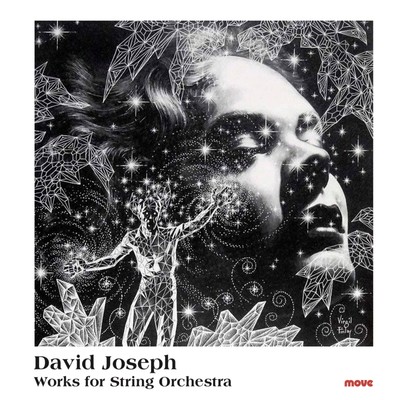
This CD is a blast from the past; three blasts, in fact. Australian composer Joseph wrote two of the three works offered here in 1992, the other in 1999. Honourably aged, you may think, if not exactly ancien regime. But the recordings have not been available since their premieres, as I understand it. For instance, tracks 1 and 2 comprise the Chamber Concerto for Piano and Strings, , commissioned by the then-director (1992) of the Melbourne Chamber Orchestra, violinist Spiros Rantos. Originally conceived for Rantos’ wife, Brachi Tilles, the first soloist was Michael Kieran Harvey. So far, fine. The score was premiered at Melba Hall in Melbourne University’s Faculty of Music. What we hear on this CD is a performance recorded in the former ABC studios at Waverley, Harvey as soloist with Rantos conducting his MCO. This must have taken place between 1992 and 1995, after which the ABC moved to Southbank.
As for the second work, Scheherezade was written for the Zagreb Soloists, one of Europe’s premier chamber orchestras. I’m assuming that the composition date of 1999 was also the year of the work’s first performance (which is heard on this CD), but it’s hard to be sure. In Joseph’s catalogue, the work appears as Study for strings, ‘Also known as : Scheherezade’, and an undated presentation of this work by the late lamented Academy of Melbourne under Brett Kelly is also documented, as well as appearing on a previous Move Records collection of Joseph’s music which was released in 2006. The remaining composition, Dialogues of 1992, was written for violinist Urs Walker and the Ripieno Kammerorchester of Winterthur. Its first performance under conductor Howard Griffiths took place on September 5, 1993 and what we have here is a recording of that occasion.
Now, the Chamber Concerto is written in three movements, according to the disc booklet: Toccata, followed by Poem of Love/Meditation. In the original, there were no musing moments but you take what you’re given. In the Australian Music Centre documentation, this work was actually written for the Rantos Collegium, which disbanded in 1996 or thereabouts. Somehow, the Melbourne Chamber Orchestra was spun out of the Collegium – or did it really emerge from the dying throes of the Pro Arte group? Well, the orchestral group is strings, which could be sourced from any one of the three ensembles.
The Toccata is a hard piece to pin down. It follows an almost moto perpetuo chugging rhythmic pattern which is relieved for only a few seconds at two places. The harmonic language is dissonant, suggesting Bartok and Prokofiev, although the overall texture is reminiscent of Mosolov’s short-lived brutalism, or even the less sloppy moments of Messiaen’s Turangalila. For all that, the movement radiates energy, Harvey’s realization of the solo part both hard-edged and scintillating, the pianist addressing his work with unflappable authority and a determination of output that every so often leaves the strings in his wake.
I think I’ve found the separation between the second part’s two sections. For the Poem, we’re apparently in Messiaen-Land where the strings settle into an ascending or descending motif of two chords, Harvey’s keyboard offering a rhapsodic commentary. The impression is less firm in contour than the French master’s Chant d’amour excursions but much less populist, even if Harvey’s contributions suggest several of those Messiaenic modes of disposable musical income. And these pages are definitely proposing an emotionally benign state; if not the Turangalila garden of Sanskrit delights; rather, a calm and welcoming landscape in which the dissonances mutate with remarkable smoothness, a cleverly achieved absence of surface friction no matter what progressions are quietly taking place.
The Meditation, I suspect, begins when the piano sets off on a sequence of stately chords that pass up and down the keyboard from top to bottom against a shimmer of strings from which a solo violin emerges with a soothing if angular melodic line. The musing is carried out with something of a forced-march mentality behind it, as though the action itself rendered the mind active rather than flooding it with random impressions or metaphysical ephemera. You couldn’t call this section of the work vehement or threatening but the consciousness being exercised has a clear, if repetitive, path to follow. Yet again, the spectre of Messiaen rises up, mainly in the shape of the chord processional, but the uses that Joseph puts this sequence to is less aspirational, less grasping for the ideal.
Joseph’s Scheherezade is not the gorgeous panoply of Rimsky-Korsakov but seems more empathetically related to Ravel’s Asie, even if the colour is monochromatic. The work starts with a unison/octave melody that eventually takes on a mildly astringent harmonic coating, Joseph taking his theme (such as it is) from the slow movement (presumably the first Moderato of the two in the score) to Vaughan Williams’ Symphony No. 6 in E minor. The atmosphere remains fairly taut and menacing throughout with what seems like closely argued harmonic structures kept well-leashed; Joseph stays well away from sentiment and colour for its own sake.
You can find some Oriental flourishes, but they are pretty rare in a dour landscape. The composer insists on a hefty attack style (or perhaps that’s just the Croatian players’ reading) and the work’s progress enjoys a heavy-handed treatment with semi-tragic undertones; perhaps Joseph is less concerned with the narrator’s flights of fancy and more with the sad, if not downright tragic, extracts from the 1001 Nights. Just on a technical point, the writing is monolithic as far as string technique is concerned: the only pizzicati I heard came in the last minute; maybe there is a slight use of harmonics, although to me it simply sounded like high violin work; you won’t come across any behind-the-bridge or on-the-fingerboard work; the work’s progress is too slow to admit of anything as frivolous as saltando or staccato. In sum, this is a rather grim Oriental fantasy, more illustrative to me of the current situation in Syria, Gaza or Lebanon than in the head-in-the-sand images we have of life in Jordan or the smothering of gross cruelty in Saudi Arabia or the Emirates.
Finally, we come to the Dialogues, contemporary with the Chamber Concerto. This is the shortest work on the CD but not by much, coming in at 19′ 40″ minutes (not 9’04” as the CD booklet states), while Scheherazade stretches to 20′ 48″ and the concerto a few seconds less at 20′ 42″ in total. All one movement as a set of variations on ‘natural sounds – birds etc.’, this is an aggressively punchy work. driving and dramatic from the opening: its avian life is prehistoric, non-stop in its vehemence apart from a few short releases from about the 15 minute mark.
The performance is admirably committed, although you can hear a few discrepant moments that got away from conductor Howard Griffiths – the basses not quite in sync with an upper-string layer at a few dramatic passages. Further, the acoustic of the recording’s venue – St Peter Church, Zurich – is rich in resonance with a pronounced echo; this building’s high ceiling, tiled floor and richly wooded gallery contribute to a sound that can be overwhelmingly clear. Still, the memorable contribution in this reading comes from soloist Walker whose line is dazzling, vital, toweringly virtuosic. In all, Dialogues is the sort of score that should appeal to a body like the Australian Chamber Orchestra with its requirements for split-second discipline, an unyielding ferocity of attack, and a sustained convulsive power.
As matters present themselves on the web, Scheherezade is the most recent composition listed in Joseph’s output, if the Australian Music Centre information is any guide. This composer’s absence (of 24 years?!) from the lists is most regrettable, even if he has shifted his career path from music to law. These three works show a granite-hard assurance in their creative character, as well as a command of form and purpose that impresses mightily. Their re-discovery in the composer’s analogue recordings archives was a happy chance and we are the richer for their airing on this CD.
 O'Connell the Music