Diary September 2025

MOSTLY MOZART – EINE KLEINE NACHTMUSIK

Australian National Academy of Music

Elisabeth Murdoch Hall, Melbourne Recital Centre

Wednesday September 3 at 11 am

As the old saying has it, what goes around, goes around. On August 10, we heard the Australian Chamber Orchestra plumbing our depths with the Barshai arrangement of Shostakovich’s String Quartet No. 8 of 1960, added to the composer’s catalogue as Chamber Symphony Op. 110a. This morning, the Australian National Academy of Music strings give it another airing but the Russian score doesn’t have the final word, as it did at the ACO event. That honour goes to Mozart’s Eine Kleine Nachtmusik of 1786, one of the most popular pieces by the composer and familiar to everyone from the priest ministering to Salieri at the opening of the film Amadeus to patrons of the Omega Ensemble’s appearance here on August 16 where we heard the opening Allegro alone. Adam Chalabi, the current Head of Violin at ANAM, will take his charges through these two works. He might also conduct the ANAM brass in two Mozart arrangements: the Kyrie and Lacrimosa of the Requiem, the composition of which 1791 torso dominated the concluding scenes to Forman’s aforementioned film of 1984. This is a run-through event lasting 75 minutes and tickets are a flat $59 or $52 concession, with the added wriggle of that transaction fee that lands anywhere between $4 and $8,50 if you phone up for tickets or go online.

A MUSICAL AWAKENING

Australian Chamber Orchestra

Elisabeth Murdoch Hall, Melbourne Recital Centre

Saturday September 6 at 7:30 pm

Director for this event is the Australian Chamber Orchestra‘s principal cellist, Timo-Veikko Valve. He will have a lot to deal with as the program moves across medieval chant and into contemporary American and Australian constructs. Guest Genevieve Lacey rouses us with one of Erkki Veltheim‘s Illuminations, which seem to be versions of some Hildegard efflorescences; in this case, Ave generosa. I note that last year, Lacey played a different Illumination by Veltheim in Hobart – O ignis spiritus – so he must be conducting an ongoing collaboration with everyone’s favourite mystical abbess. Back to earth for something from the unaccountably popular Max Richter in On the Nature of Daylight which comes from a 2004 album and has been used remorselessly in many contemporary films, none of which I’ve seen. Then we have a five-year-old commission by the ACO from Australian writer Melody Eotvos called Meraki: a Greek word meaning putting yourself into your work; well, what could be more lovely? That’s the local modern component while David Lang‘s newly written flute and echo represents the United States and here enjoys its world premiere. Back to Europe for the rest, beginning with Peteris Vask‘s Musica serena: a 2015 homage on his 70th birthday to the composer’s friend, conductor Juha Kangas. We’re back to Veltheim for what I suppose is another version of older music supplied by Monteverdi, Vivaldi and Ms Strozzi, the whole called Imaginary Cities; all right, but you’d have to suspect that they’ll be redolent of the composers’ homeland. And our last awakening features an arrangement by Valve of the Molto adagio in Beethoven’s Op. 132 String Quartet of 1825, as a sort of balance to the German nun’s controlled ecstasy. At the MRC for this event, you pay between $30 and $141, depending on your age (of course) and your financial resources; you also pay a fee between $4 and $8.50 per order to the Centre’s cent-counting gurus.

This program will be repeated in Hamer Hall, Arts Centre Melbourne on Sunday September 7 at 2:30 pm and back in the Elisabeth Murdoch Hall, Melbourne Recital Centre on Monday September 8 at 7:30 pm.

SPRING BLOSSOM, AUTUMN HARVEST

Australian New Goldberg Orchestra

Elisabeth Murdoch Hall, Melbourne Recital Centre

Sunday September 14 at 6:30 pm

New to me, the Australian New Goldberg Orchestra has been in existence since 2013. Its chief function seems to be linking European and Chinese musical traditions, offering a swinging diet comprising both cultures – as is the case with this program, the latest in a series with the above title. Conductor Thaddeus Huang begins this event with Reba Dance by Fang Kejie, a 71-year-old Chinese composer who won fame with this 1999 composition that has Tibetan roots and is therefore a questionable artefact. Huang ends the program with the Hai Xi Suite by Ming Wang who could be one of several composers with that name. In the middle comes a great favourite: Mozart’s Sinfonia Concertante K. 364 of 1779. In this instance, the soloists will be Zoe Black violin and Caroline Henbest viola; we’re all looking forward to a stylish C minor central Andante. As well, representing more of the West, Glenn Riddle is soloist in Poulenc’s Piano Concerto of 1949, a work that has rarely been heard here but holds a combination of sophisticated naivete and amiable heartiness (at least in its first movement) that distinguishes it from plenty of contemporaneous boiler-rattlers. Your full-price tickets range from $59 to $109; concession prices are $9 cheaper; students go $40, $60, and $90. Oh, and if you phone or order online, you won’t forget the moveable feast transaction fee of between $4 and $8.50, will you? It all helps . . . somebody.

SONGS WITHOUT WORDS

Selby & Friends

Primrose Potter Salon, Melbourne Recital Centre

Monday September 15 at 2 pm

You’d be expecting some Mendelssohn in a Selby & Friends program with this title and you’d not be wrong, But things are seldom what they seem and so it is here: these songs without words were produced by Australian composer Anne Cawrse in 2020. Three of them in all, their titles are Ornamental, Lied and Swansong; no surprise to anyone that they fall into the mould of tributes to both Fanny and Felix through their diatonic framework and the felicitous sweetness of interplay between violin, cello and piano. Following this none-too-exacting remembrance comes the Chopin Piano Trio in G minor, written in 1828 or 1829 and a surprising piece of bright juvenilia that makes you wonder why the composer didn’t try the form later in his life, even if you have to agree with those pundits who find the violin line unadventurous. Kathryn Selby and her associates for this event – violin Alexandra Osborne, associate concertmaster in the Sydney Symphony Orchestra, and cello Catherine Hewgill, principal cello with the same body – finish off their time with us through the big Schubert Piano Trio in E flat of 1827: a massive masterwork gifted with one of music’s most unforgettable slow movements. Tickets move between $63 and $81, with the unavoidable transaction fee of anywhere between $4 and $8.50 if you have the cheek to book online or by phone.

This program will be repeated at 7 pm.

CLARA-JUMI KANG + LATITUDE 37

Melbourne Recital Centre

Elisabeth Murdoch Hall, Melbourne Recital Centre

Monday September 15 at 7:30 pm

Let me not to the marriage etc. but what is going on with this exercise? In the first half, the period instrument group Latitude 37 which we have come to know and love is presenting a brace of works: Erlebach’s Sonata sesta in F of 1694, and Buxtehude’s Trio Sonata in A minor from about 1670. Now I’m assuming the ensemble’s personnel hasn’t changed: violin Julia Fredersdorff, viola da gamba Laura Vaughan, harpsichord Donald Nicholson. If so, welcome to all the pleasures, short-lived as they may be. Anyway, in Part 2 of this recital, violinist Clara-Jumi Kang will play three solo violin works of disparate flavours, beginning with Mieczyslaw Weinberg’s Sonata No 3 of 1979, the last of the unfortunate composer’s three. Piling on the fireworks will be the Ysaye Sonata No 3, called Ballade and written in 1923; for many of us, it’s the only one of the composer’s six that we can call familiar. To end, Kang presents the big Bach Partita in D minor, which ends with the taxing Chaconne and, I suppose, gets us back to the Baroque sound with which this event began. The South Korean-German violinist is making her Melbourne Recital Centre debut and good luck with that, but what is the point of the Latitude people preceding her? An act of sponsorship? Or friendship? Anyway, tickets move from $67 to $115; concession applicants get a cut of $15 or $20, depending on where you sit; and everybody phoning in or booking online pays the transaction fee of anything between $4 and $8.50. Don’t ask me why: I would have thought that the same amount of work went into handling the credit card arrangements for a cheap seat as for a pricey one.

STEPHEN MCINTYRE PLAYS SCHUMANN

Melbourne Recital Centre

Primrose Potter Salon, Melbourne Recital Centre

Thursday September 18 at 7 pm

Most of we old-timer music critics in Melbourne (not many left, you’ll be glad to hear) have a special affection for pianist Stephen McIntyre, and not only because he won the National Critics Award back in the days (1970s and 1980s) when you felt privileged to belong to that happy band of authorities which included Kenneth Hince, John Sinclair, Felix Werder, Peter Mladenov and a bevy of interstate also-rans. McIntyre won the award for performing the complete solo piano works of Ravel in (I think) the Warden’s Lodge of Trinity College. Tonight he presents two Schumann works, one being the three-movement Fantasie in C by the 26-year-old composer; written in 1836 and very demanding, even for its dedicatee – Liszt. But McIntyre opens with a rarity in the complete Bunte Blatter: 14 pieces written across the span 1834 to 1849 and assembled for publication in 1850. I know only the first (and easiest, apparently) from an AMEB exam back in the 1950s but, to counter my ignorance, the collection has been recorded by the well-known – Clara Haskil, Sviatoslav Richter, Vladimir Ashkenazy – and the (to me) totally unknown (a lot more). Both works last a bit over a half hour each and the pianist will play straight through. Full price tickets are $50; concessions are $40. And you have to take a punt on your booking fee being somewhere between $4 and $8.50 if you phone for tickets or try to get them online – and that’s what I call artificial intelligence.

MOZART’S GREAT MASS

Melbourne Symphony Orchestra

Hamer Hall, Arts Centre Melbourne

Thursday September 18 at 7:30 pm

As with many programs these days, this one leaves me at a loss as it does a historical reverse job with three completely different works. To begin our travels, Australian conductor Nicholas Carter, currently on a career vault from Bern to Stuttgart, takes the Melbourne Symphony Orchestra through an episode from Richard Strauss’s opera Intermezzo: the second of the interludes, Dreaming by the Fireside, where the female lead remembers her idyllic partnership with her husband (the composer gilding the lily in this autobiographical story-line, his real-life wife being a conceited pain-in-the-arse). This 1923 piece of broad late Romantic comfort-food is followed by the gravity of Brahms’ Song of Destiny which, despite a good many years spent listening to choral music, I’ve never heard live. Here, of course, the MSO is joined by the MSO Chorus for this uncomplicated and masterful 1871 tapestry, a treat especially for the tenors. You’d assume that, at this point, there’ll be an interval after about 25 minutes of playing and singing. Then we move back almost a century (and into the hall) to hear the Great Mass of 1782-3 which is imposing even in its unfinished state (it’s missing a good deal of the interesting parts of the Credo – everything after the homo factus est – and there’s no Agnus Dei). But you have a really substantial Gloria to enjoy and a mass that ends with jubilation is something of an improvement on the usual pleadings for a restful death. Soloists are sopranos Siobhan Stagg and Samantha Clarke, tenor Matteo Desole, and bass David Greco. Your standard ticket costs between $81 and $139; concessions are $5 cheaper (oh, the charity); children (anyone under 18) enjoy the occasion for $20; and you face a $7 transaction fee for your pains – patronage at a cost.

This program will be repeated on Saturday September 20 at 2 pm.

CARMINA BURANA

Melbourne Bach Cho

Elisabeth Murdoch Hall, Melbourne Recital Centre

Friday September 19 at 8 pm

Carl Orff’s popular cantata (meant to be staged but it never is) from 1935/6 somehow brings out the best in choirs, so you’d have to believe that it will be a walk in the park for the Melbourne Bach Choir, given the scores that its members have grappled with over the last 20 years. It’s a gift to interpreters, even the hard-pressed soloists who have to come out of the blocks prepared for some very risky work, like the soprano’s Dulcissime solo and the tenor’s falsetto-rich Olim lacus colueram. You’d have to assume that the conductor will be the Choir’s artistic director Rick Prakhoff, although he’s not mentioned in the Recital Centre website’s dramatis personae. The soloists will be soprano Jane Magao, tenor Robert Macfarlane, and bass Christopher Hillier. Patrons won’t hear the original instrumental forces – no woodwind, no brass, no strings, no celesta; just the two pianos, timpani and percussion (lots of the last, I’m hoping). It sounds like the arrangement brought about by Wilhelm Killmayer in 1956, which was approved by Orff. The Australian Children’s Choir will be on hand to help Magao through Amor volat undique and twitter through Tempus est iocundum. Yes, the score is at the other end of German musical history from the Bach Passions that I’ve heard Prakhoff and his forces tackle so successfully, but here’s a body that doesn’t rest on its laurels. Tickets range from $33 for a student right up the back of the balcony to $99 for your premium adult seat in the stalls; concessions sit on a sliding scale, depending on the regular price. As always, you face a a doing-business fee of between $4 and $8.50 if you’re flush enough to phone in or go online to make your purchase.

ENSEMBLE LIAISON & FRIENDS – BEETHOVEN’S SEPTET

Ensemble Liaison

Hanson Dyer Hall, Ian Potter Southbank Centre

Monday September 22 at 7 pm

As you can see, the Ensemble Liaison will host several guests to flesh out the personnel needed for Beethoven’s highly popular (in his lifetime and well after) Septet in E flat, completed in 1800. As well as the group’s regular members – cello Svetlana Bogosavljevic, clarinet David Griffiths, piano Timothy Young – we’ll be hearing violin Dale Barltrop from the Australian String Quartet, horn Carla Blackwood from the University of Melbourne and the Australian National Academy of Music, ditto bassoon Lyndon Watts. We are left with an unnamed viola and double bass (no part for Young in this long delight) but they could be ‘Students from the Melbourne Conservatorium of Music’ as the Melbourne Recital Centre’s publicity bumf specifies non-specifically. If Young sits out the septet, we hear him in a double role during the first two program components. First, he’s the composer of Distant Waters, a trio for the Liaison members premiered last year at a Musica Viva recital in Hobart. It’s Young’s Opus 2 and is apparently a series of variations in E minor. Straight after, he becomes solo pianist for Ravel’s triptych pf 1908, Gaspard de la nuit, which is one of the more demanding works for piano, from the irregular ripples at Ondine‘s opening to the menacing jocularity of Scarbo disappearing into the furniture. Ticketing for this night is simple: standard tickets cost $53; concessions are $42, and you also will have to find somewhere between $4 and $8.50 for the Centre’s odd booking fee range.

AN EVENING ON BROADWAY

Melbourne Symphony Orchestra

Hamer Hall, Arts Centre Melbourne

Wednesday September 24 at 7:30 pm

Lending their combined talents to this exercise, the Melbourne Symphony Orchestra will be conducted by Western Australian-born Jessica Gethin who has recently become connected to Orchestra Victoria. Her two soloists are Amy Manford and Josh Piterman, the latter being the first Australian to sing the lead roles of The Phantom of the Opera and Les Miserables in London. Mamford also hales from the west and has had success in London as well as partnering with Piterman in Andrew Lloyd Webber‘s 1986 musical treatment of Leroux’s novel for the Sydney Opera House production of 2022. Naturally, this work and the Claude-Michel Schonberg 1980 reduction of Hugo’s epic canvas feature prominently in the list of musicals to be mined for this celebration of New York’s theatre district. We also hear Bernstein’s West Side Story of 1957 which occupies a class of composition some levels above this night’s other music. As well, there’s Evita, written in 1976 and an early feather in the Lloyd Webber tricorne. Not to mention the same composer’s Cats of 1981 which does for T. S. Eliot what Florence Foster Jenkins did for Mozart. But that’s not all: there is the promising ‘and more’ added on to the list of specific shows that are to be selected from. Enjoy the orchestra. Standard tickets range from $80 to $135; concession tickets are $5 cheaper (that’s your MSO social conscience at work). The transaction fee is $7 which is par for the course these days; not that such regularity makes the imposition any more justifiable.

This program will be repeated on Thursday September 25 at 7:30 pm, and on Friday September 26 at 1 pm and at 7:30 pm.

.
Amiable but neither unexpected nor extraordinary

ELEVATOR MUSIC

Omega Ensemble

Elisabeth Murdoch Hall, Melbourne Recital Centre

Saturday August 15, 2025

Michael Collins

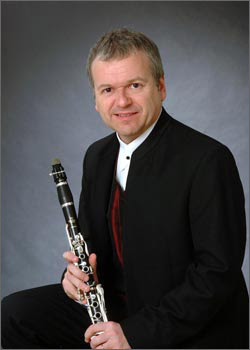
A Sydney-based group, the Omega Ensemble presents as a moveable feast of artists. For this segment of its national tour, the group comprised string players, alongside some crypto-strings/percussion in piano (Vatche Jambazian) and harp (Paul Nicolaou), with artistic director David Rowden contributing his clarinet to one work. As the Omegas’ guest, Michael Collins brought his clarinet to the stage for the brief evening’s two major works, demonstrating his expertise and interpretative flair with deceptive ease and making something substantial out of an odd scrappy program.

To begin, the Omega strings gave themselves a throat-clearer with the first movement to Mozart’s Eine Kleine Nachtmusik of 1787. Well, it also gave us a chance to get used to the body’s weighting of 4-4-3-2-2 which, from my seat, gave the bass line of this quartet an unexpected prominence. Not that you could complain about such a teaser which made for a congenial tuning-in exercise. As usual, the group overdid the dynamic contrasts well beyond anything the composer would have entertained, but they’re not alone in that. They repeated the exposition, which never fails to be a pleasing 55 bars to re-experience.

American writer Anna Clyne‘s Stride for string orchestra followed. Its three movements employ the melodic and sometimes the harmonic path of Beethoven’s Pathetique Piano Sonata No. 8, albeit with plenty of filler. Apparently, the composer found a similarity between the bass octaves at the first movement’s switch to Allegro di moto e con brio and the stride technique utilised by ragtime pianists; can’t really see it myself, but the shoe obviously fits for Clyne. Mind you, that all becomes irrelevant when she moves on to the second and third movements, the last being most direct of the three in utilizing Beethoven.

This is not the sort of music to stop you in your tracks through its level of inventiveness or novelty of timbres; it’s just akin to hearing the sonata referenced in a mushy web, a kind of filtered Beethoven at an unsettling remove from the original because of the transcription to strings. But it misfired for me because even Clyne’s changes of harmony accompanying the original melodies were ordinary. I suspect that the work’s success in performance relies on the style of attack adopted, which might have been more interesting in the hands of its original commissioners – the Australian Chamber Orchestra, which premiered it in 2020. Added to this, the bass component across the final rondo again overwhelmed whatever was happening upstairs.

We then came to the new double concerto by Australian composer Graeme Koehne called Dances on the Edge of Time, which title emanates from a Tagore poem and which to me promised something along the lines of Messiaenesque mysticism or perhaps a touch of Bengali complexity. But no: Koehne has produced a simple set of three dances – rigaudon, chaconne, gigue – which contain no terrors for players or audience, written in a happy diatonic style that is instantly accessible and free from any pretensions to depth or gravity.

Adding to this piece’s popular backdrop, Koehne heads each movement with a quote from the collected wisdom of either Randall G. Leighton (the American business analyst?), Mark Twain or Satchell Paige (a renowned baseball player). For the opening rigaudon, the instruction or life-message was ‘Work like you don’t need the money’, exemplified by a retrograde-sounding piece in four-square rhythm that called to mind Grainger and Holst in what sounded to be G Major, the two front-of-band clarinets indulging in some jaunty interplay and mimesis.

‘Love like you’ve never been hurt’ was the preliminary advice for Koehne’s chaconne in which I became aware of the harp’s timbre for the first time. For these pages, I thought that the prevailing tonality was D Major; or may be not as I’m finding it increasingly hard to claim having absolute pitch any more and trying to pick out tonality from finger positions is a mug’s game at best. Whatever the case, we enjoyed a few eliding slides into other keys while the cantus firmus moved from treble to bass across the movement’s stretch with a clean fluidity, even if the players didn’t seem to find much excitement needed to be summoned up while conveying these placid A-River-Runs-Through-It pages. Again, I sensed no strain in the output of Collins or Rowden while presenting this lush and predictable slow movement.

With the gigue, we were in unsteady territory at first with a clarinet duet that eventually settled into the expected 6/8 pulse. Here again the music occupied an ‘open’ key – C Major? – that moved into harmonically unchallenging episodes before the catchy main tune slowed down for a more drawn-out statement of its elements: a gentle and soulful interlude with the strings given the main burden while the clarinets sublimated themselves in attention-grabbing burbles. Back to the fast jig tempo and we reached a happily contentment-inducing cadence, all illustrating that timeless adage, ‘Dance like nobody’s watching.’

The composer is not concerned in this work with confronting anything that’s driven the art forward or into detours and culs de sac over the last century. His vocabulary throughout the new double concerto rarely moves beyond that employed by the English pastoralists. Further, he keeps his soloists well in hand with very little room for virtuosic flourishes, content to give them aural prominence among their support colleagues. To my mind, the work is congenial enough but not in the least bit ground-breaking. The program notes for this concert speak of Koehne pursuing a ‘neoclassical kind of aesthetic’ – but there’s no need for the neo qualifier.

As far as I could tell, the rather sparse audience (250? 300?) reacted favourably to this exercise, and I suppose that its reception can be viewed as a success, even if a few of us were nonplussed by the work’s innate conservatism, given the Omegas’ motto: Embrace the unexpected. Celebrate the extraordinary. Not with this work, commissioned by the ensemble itself.

To end, Collins took the lead for Copland’s Clarinet Concerto of 1947-9. As far as I can see, he has produced only one recording of this famous work – a Swedish Chamber Orchestra collaboration released in 2013 – as opposed to the three versions he has produced of Finzi’s less well-travelled concerto. You could find much to relish in the opening slow movement, in particular Collins’ ability to give us a crescendodecrescendo set of sequences that remained sensible, not straining the barriers of taste and sense. This atmospheric consequent of Appalachian Spring‘s placid stretches maintains its eloquence, even if it does suggest a Meditation on the Prairie ambience.

At last, we came to some hectic playing in Copland’s cadenza where the composer anticipates the coming action. In spite of the sudden heating-up, Collins gave us a sensible and ordered account of this 70-plus bar extravaganza that tests any interpreter’s agility and self-control. Not a squawk or a misdirect to be heard here as the soloist joined up with his Omega colleagues for the jazz- and Latin-inflected finale. Here you felt the lack of violins once again, even from further back in the Murdoch Hall, because of a lack of aggression as the syncopations piled up and some rhythmic anxiety appeared in the rear echelons.

As the freneticism continued, it struck me that Jambazian might have been well advised to have his piano-lid down or off; this instrument’s colour proved very prominent in the movement’s centre. Still, Collins dominated the terrain, not least when Copland exercised his heavy jazz tongue, as at bar 297 with the bass semi-pizzicato slaps while the clarinet saunters across the room. I wasn’t happy about the penultimate bar’s glissando up to the final unison C for everybody but you’d expect that the players will have coordinated that to better effect for tonight’s Sydney and Thursday’s Newcastle performances of this program.

Looking over the Omega appearances past and future for this year, it’s very clear that the body is a solid supporter of new music; its list of previous commissions is the most impressive and all-inclusive I’ve seen in this country from any serious chamber music enterprise. Most of us interested in new developments might have our expectations better fulfilled in the body’s final Melbourne appearance this year which features Bartok’s 1938 Contrasts (like the Copland concerto, another commission by Benny Goodman and still more challenging than anything we heard on this Elevator Music program), Nigel Westlake’s Rare Sugar clarinet concertino of 2007, and a new work from Sydney-based writer Ell;a Macens.

After the fun, a sobering reality

GERSHWIN & SHOPSTAKOVICH

Australian Chamber Orchestra

Hamer Hall, Arts Centre Melbourne

Sunday August 10, 2025

Alexander Gavrylyuk

In some ways, this afternoon’s event impressed for the breadth of its span in emotional content. Richard Tognetti and his Australian Chamber Orchestra performed three works that exposed their talent for breathing fresh life into a near-classic and giving two newer scores every opportunity to stake their claims for inclusion here. It might have had a lot to do with the age and predispositions of this particular audience but it struck me that the opening gambit in this concert made less of a case for itself than its companion while the program’s final work exercised its usual impact of uplifting despair.

For starters, we heard Zipingu by Canadian writer Claude Vivier, written for thirteen strings; I counted fifteen in the ACO ranks but you can’t have modernity (awkwardly, the piece is 45 years old) without flexibility. Sadly, I’ve not seen the score of Zipingu – a word used in Marco Polo’s time to refer to Japan – but its chief characteristics indicate that colour is the main objective. Vivier intended a kind of pan-Asian atmosphere, in which he achieved no little success with, as far as I could see, nobody attempting a vibrato throughout although tremolando proved king as a sound source.

For all its supporting polemic, Zipangu worked on this listener as a sort of musical diuretic as it lacked most of the connectors that your average Western concert-goer expects, or clings to. The composer’s canvas is full of incident but nothing stays with you and the absence of investment in the individual note – simply sounding it without much intellectual impulse, as if applying white to a white canvas – made this fifteen minutes or so quite challenging. I’m assuming that Vivier was seeing his Japan flat-on, without embellishment and the invitation was for us to absorb an abstract sequence of disparate shades.

As for the following Moments of Memory (VI) by Valentin Silvestrov, a Ukrainian composer who fled from Kiev to Germany when the Russians began the latest phase of their invasion, the ACO performed this world premiere (the organization had a hand in commissioning it) with assured ease. Still, little remains in this particular memory about a set of seven movements that melded into each other. It presented as a type of cafe music, a series of waltzes that might have been reminiscences of life in Ukrainian cities before disaster and drones made the composer’s homeland unliveable. Not that Silvestrov struck a tragic level and confronted us with suffering; his memory proved melancholy but warm, especially as vibrato had rarely made such a welcome comeback.

At the program’s end, Tognetti led his forces through Shostakovich’s Chamber Symphony in C minor, the 1964 arrangement by Rudolf Barshai of the composer’s String Quartet No. 8 which was written four years earlier. This was splendid work, the performance notable for its final two slow movements that gradually sink to that individual gloom that the composer made his own: the Largo that ends the composition one of the bleakest resolutions in Western music. Of course, this work would have been at the performers’ fingertips as they released a new CD of it in February this year, although the recording sessions date from 2021.

Yet again, the ACO demonstrated its depth of expertise and accomplishment by a vitally emphatic account of the Allegro molto second movement, clear-speaking in its crisp chord slashes and the power underpinning group statements of its single-line melodies. Likewise, the players managed to bring out the chameleonic nature of the middle Allegretto which seems innocent, almost simple-minded, but teeters on the brink of despair as its overt insouciance alternates with bitter vehemence, concord and discord masterfully balanced until the aggressive attacca opening of the finale.

From there it’s all downhill through the second Largo which, in this orchestral version, bears witness to Shostakovich’s inner torture. You can say what you like about the composer’s naivete in Russia’s political sphere and, if you like, share in the derision heaped on him by other Western composers who lived under no restrictions. But, when it comes to baring the soul’s dark places, nobody equals this composer who shows you a world of dour resignation which is, in the end, an affirmation of stern nobility.

Which made it all the more understandable that Tognetti interpolated a brief pause in these final pages when audience coughing proved intrusive. This was nothing you could blame on the unthinking young because the blight of expectorations and catarrh clearances were clearly produced by some of the elderly patrons in Hamer Hall who have forgotten (if they ever knew) the lessons of COVID and the benefits of masking your breathing difficulties. The ACO leader was too kind in waiting for these self-absorbed geriatrics, especially while in the process of constricting a profoundly moving experience; I’m just surprised (and grateful) that he didn’t walk off, taking his earnest colleagues with him.

Mind you, this work worked in several ways alongside displaying the ensemble’s gift for outlining an emotionally concentrated score like this one. It offered a sharp contrast with Silvestrov’s regretful farewell to things past; along with the personal trauma experienced by the Russian master, you cannot forget that part of the quartet’s impetus came from the composer’s visit to Dresden and the sight of that city still recovering from the fire-bombing of mid-February, 1945. The work commemorates a cataclysm while the Ukrainian writer seems to be memorializing a never-to-be-regained vision of his native land..

As well, the Chamber Symphony moved us into a different sphere, following as it did a dazzling performance by Alexander Gavrylyuk of Gershwin’s Rhapsody in Blue of 1924, a brilliant compilation of jazz-inflected piano solos linked, after that unforgettable opening clarinet solo, by big-band tutti passages. My standard for this work is the Bernstein recorded performance of 1959 with the Columbia Symphony which still raises the spirit for its breadth of vision and force of character. Gavrylyuk came close to this level with a muddle-free approach to the orchestra-supported solos, the piano ever clear throughout, and with an awareness of the exhibitionism, the bravura that an interpreter has to contribute to succeed across the score’s span.

Given the ACO’s personnel constraints, an arrangement was made for strings, trumpet (David Elton) and piano by Bernard Rofe, the organization’s artistic planning manager. That opening sort-of-glissando run was given to the trumpet which played a sterling role in making up for the missing woodwind and brass ranks from Grofe’s orchestration, and the ACO strings welcomed the chance to soar through the big E Major tune at No 28 in the old two-piano edition. But, despite everyone’s best intentions, the band/orchestral backing fell short in terms of timbre and bite, especially in that jubilant final cakewalk.

Before interval, Gavrylyuk and Elton fronted the Shostakovich Piano Concerto No. 1, all forces producing a reading of immaculate clarity, even in the final frantic galop. The pianist and trumpeter made a fine fist of their first real collaboration at No 8 in the Muzyka edition; controlled but headlong in its forward thrust and almost mellifluous when the tonality hits E flat Major. Gavryluk showed no hesitation (if the occasional touch of rubato) when handling the brilliant passagework of this first movement, particularly brilliant in the top-of-the-keyboard register, picking out the melodic line with pointillistic precision.

Elton gave a lucid account of the second movement’s trumpet solo beginning at Number 34. It’s a startling moment in this Lento, the instrument muted (who isn’t?) and spinning out its commentary in well-etched exposure above the strings’ murmuring 3/4 – more a pavane than a waltz – accompaniment. I suppose the Moderato that follows acts as a circuit-breaker after the subdued nature of the slow movement’s E minor fade-to-black. Its two-part invention opening devolves into another plaint for the strings, which serves as another red herring before the piano launches into the concluding Allegro con brio where exhilaration reaches its apex in this work.

Yes, there are moments when you think that the composer’s thumb-to-the-nose humour seems like overkill, as at that famous splat-chord in the middle of an Italianate trumpet solo nine bars after Number 63, or the rich supply of ‘wrong’ notes in the rage-over-a-lost-penny cadenza for piano that precedes the final Presto at Number 72,not to mention that extraordinary deviation to a mittel-European folk-stomping piano solo at Number 76. But the persistence with a military-inspired cadence right up to the final bar still presents as a sparkling piece of musical cheek, here briskly carried off by soloists and their quicksilver support.

I got the impression that the ACO members admired Gavrylyuk and his impressive commitment to the task, whether striking sparks in the 1933 piano-and-trumpet opus or weltering through America’s exemplary fusion of jazz and serious music. For some time, he has impressed me as a musician with very broad shoulders, capable of taking on many challenges and forging a triumph out of each one. You’d have to hope that his next appearance with this ever-ambitious ensemble will not be too far off.

Sweet and simple

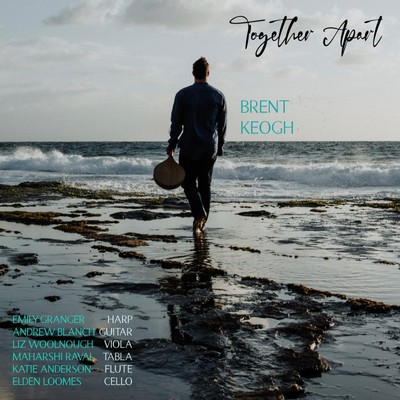
TOGETHER APART

Brent Keogh

Move Records MCD 643

I suppose that the most significant point of interest on this CD is the presence of the composer playing oud. Brent Keogh has been a student of Joseph Tawadros, who brought that Middle Eastern lute to our attention through his collaboration with the Grigoryan brothers and his several excursions alongside the Australian Chamber Orchestra. Keogh appears in all but the first four tracks of this recording, working in various ensembles with his guests. Still, it’s slim pickings as the disc comes in at a tad over 40 minutes’ playing time. Which makes this a sequence of eleven short pieces – four of them less than 3 minutes long, another four less than 4 minutes in length, one less than five minutes with one a little over that length, the longest piece lasting for 6’20”.

A further disconcerting factor is the minor research needed in trying to date the works performed. No information comes on the disc leaflet, and there’s nothing showing on the composer’s Australian Music Centre entry. When visiting Keogh’s own website, we learn that two major works here, the Hagia Sophia Suite (Emily Granger harp and Andrew Blanch guitar) and the Turimetta Suite (Katie Anderson flute, Elden Loomes cello, Maharshi Raval tabla, Keogh oud) were written in 2021. So was a brief piece for oud, viola (Elizabeth Woolnough) and tabla called Stormfront. I can’t find a composition date for The Red Candle oud solo; Rosie’s Dance for oud, cello, flute and tabla was co-written with Anderson some time before July 20, 2019 (you can see it performed on a YouTube video, although with a double bass substituting for cello). Alunir, the final track for oud and cello dates from 2020 (also found as a YouTube video but with Keogh playing oud and guitar!).

Much of this disc’s content consists of melodies that are simple and folk-inflected; you’re not hearing anything that is challenging here. Keogh sets his bar level pretty clearly in the opening Prelude to his suite on the great church-turned-mosque-turned-museum-turned mosque again. This section is for Granger’s harp alone and begins with a short motif that is minimally expanded before we hit a melody that could be Turkish, or anything. It also undergoes restatement and sits in a fixed tonality, a minor scale rather than a mode which is reinforced by the repetition of a bass note/anchor. One moment of harmonic deviation: that’s all. The atmosphere is firm, slow-stepping, ruminative rather than meditative.

The composer seems focused on giving us a hieratic setting, this musical vorspiel being in the nature of a call to prayer, I suppose. Blanch joins Granger for the following three movements, the first of which is a fast dance in which guitar and harp play a rather intricate melody line in unison to excellent effect. This is repeated in the movement’s last third/quarter while the central panel is taken over by an amplification/treatment of the harp’s opening motif. Does it bring the building to mind? Sort of, in an elegiac way and giving a good deal more picturesque an image than I remember finding in the interior some eight years ago.

In the next phase of this suite, the movement is slower, more measured and less rhythmically irregular. The guitar opens and the harp intrudes by reinforcing individual notes, but then enters fully into the partnership. You can find three melodies that are repeated with slight ornamentation and some differing antistrophes. As with the first movement, the bass note stays constant throughout (it’s the same across the three of them, I think). Unlike its predecessors, the third piece begins with a promising angularity in both instruments, but soon reverts to the minor scale/mode language that has prevailed so far. Keogh refers to major key sections radiating some relief in this not-too-sombre atmosphere: I counted one-and-a-half such breaks, and they didn’t stick around for long. The linear interplay is momentarily interesting but these pages struck me as meandering, somewhat laboured in the antiphonal moments, happier when the initial experimentation was done with.

In his three-movement opus celebrating Turimetta Beach, the composer offers musical reminiscences of three birds that he and his family encountered on their outings during the COVID epidemic’s early years. In the CD leaflet, these are identified as hawk, eagle and heron; on the Move Records website relating to this disc, they are kite, eagle and heron. As one who doesn’t know a hawk from a kite, but is determined to finish off a career spent in distinguishing a hawk from a handsaw, I found the first movement of this suite as simple as any bird. Keogh uses the flute for an initial phrase over a cello drone, even allowing the wind instrument a ‘bent’ note or six in its lyrical outpourings; the oud provides a simple Alberti bass imitation. We come to a halt and what Keogh calls the ‘alap’ is finished. He pairs flute and oud in unison on a catchy melody, eventually giving Loomes’ cello a go at it before suddenly moving everyone on to a more striking rhythmically varied thought and following that to the end of this amiable, breezy lyric refreshed by Raval’s gentle tabla patters

Keogh proposes that the second lot of matter in this movement suggests a chase; maybe, but it’s an orderly, single-minded pursuit that projects more of play than purpose. He uses a static melodic and harmonic vocabulary in which the modulations are as obvious as those in any popular music of these days. Things change when we deal with the eagle. Here, the rhythmic delineation is far more sharp as Keogh sets up a pattern of alternating time-signatures that would do his former master Tawadros proud. He allies the oud and cello in unison combination and puts the flute up as a respondent. The whole atmosphere has sort of moved from Turkey (and Australia) to India with some sustained sitar-like explosions of action in the cello, not made any less suggestive by the tabla support which promises Shankar or Ali Akbar Khan without delivering anything of those masters’ complexity.

The motion is rapid, almost headlong but the output stays disciplined, even through the last pages’ shifts in pairings. Once again, this suggestion of dynamism in flight gives the performers room for individual deftness, although the whole thing is too well-mannered to give us life in the wild, let alone on a Northern Sydney unpatrolled beach. When we get to the heron, we’re in minuet land with Anderson’s flute in control of the melody line and the oud remaining in a supporting role throughout. I found here that even the rather strait-laced creative energy in operation so far had become even less interesting as the instruments followed predictable patterns in nearly every compositional parameter.

Keogh’s disc leads into four isolated pieces via Stormfront which offers an initial theme in disjunct bars of 7/8 and 4/4 with oud and viola in unison while Raval offers slight cross-rhythms that really amount to doubling. The action is fast and repetitive, Keogh’s opening bars coming back again and again, but I find insufficient bite in the complex to give you a sense of approaching weather disruptions, although the composer might have hit on a way to outline musically what passes for a barometric drop in Sydney – not much ado about very little.

Four muffled chords begin The Red Candle, which moves to a melody that is restated several times with some interruptions from the opening chords, the whole conducted over a recurring pedal note which is either present or – in the best linguistic fashion – ‘understood’. The rhythmic pattern stays the same although the melodic direction alters about half-way through the piece, but we soon return to the opening chords (intervals, rather) and the initial melody. Finally, the melody and ostinato disappear and we’re left with another double restatement of the fulcrum chords. I’m not sure that this oud solo lives up to the composer’s intentions of the piece being symbolic of partly-revealed mysteries and a consolation that surpasses the pains of our existence. It’s simply a gently flowing cantilena which, for much of its length, maintains a single melodic strain set to a minor scale.

There’s a Gaelic side-trip in Rosie’s Dance: a mild jig in alternating 6/8 and 3/4 time – three of the former, one of the latter – which presents in ternary form, as do quite a few of Keogh’s products so far. Flute and oud play the melody line together for most of the time, the cello providing a gentle pulse-reinforcement while the tabla also stays with the prevailing rhythm for most of the short piece’s duration. Nobody gets up to any adventurousness, but that’s not this composer’s path. We are quietly entertained by a slight frippery, and that’s about all.

If any of these works is puzzling, it’s the last track. ‘Alunir means to land on the moon,’ writes Keogh who contextualises his work by a lengthy Einstein quote about humanity faced with the cosmos: we know something, but it’s nothing compared to the vastness of our incomprehension. Fair enough: we can all subscribe to that statement of affairs. Still, this piece speaks in a rather Earthy voice as it stays, for the most part, in a mode (Lydian, writes the composer) with a regular pulse, most noticeable when the oud and cello double each other. Some interludes emerge but the score ends with elaborations on and disjunctions of the modal melody, suggesting not so much the moon as cafe entertainment anywhere from Ankara to Alexandria.

Keogh is content to couch his thoughts in familiar guises, without any modernist trappings. He’s indebted to the Arabic world for the more exotic aspects of his output on this CD; you can also hear strains of this country’s folk music shining through. On the present showing, he seems content to occupy an unstressed emotional world, each work shaped with care and (for the most part) avoiding awkwardness. This is a placid voice, a gentle music that on this CD proffers an undemanding sequence of short-lived bonbons.