TOGETHER APART
Brent Keogh
Move Records MCD 643
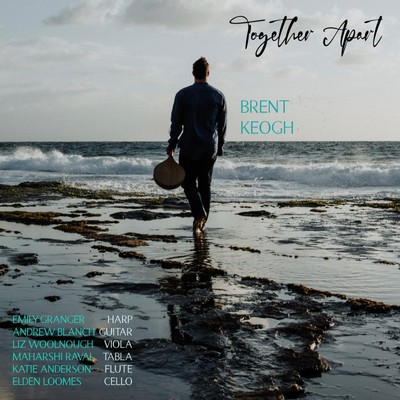
I suppose that the most significant point of interest on this CD is the presence of the composer playing oud. Brent Keogh has been a student of Joseph Tawadros, who brought that Middle Eastern lute to our attention through his collaboration with the Grigoryan brothers and his several excursions alongside the Australian Chamber Orchestra. Keogh appears in all but the first four tracks of this recording, working in various ensembles with his guests. Still, it’s slim pickings as the disc comes in at a tad over 40 minutes’ playing time. Which makes this a sequence of eleven short pieces – four of them less than 3 minutes long, another four less than 4 minutes in length, one less than five minutes with one a little over that length, the longest piece lasting for 6’20”.
A further disconcerting factor is the minor research needed in trying to date the works performed. No information comes on the disc leaflet, and there’s nothing showing on the composer’s Australian Music Centre entry. When visiting Keogh’s own website, we learn that two major works here, the Hagia Sophia Suite (Emily Granger harp and Andrew Blanch guitar) and the Turimetta Suite (Katie Anderson flute, Elden Loomes cello, Maharshi Raval tabla, Keogh oud) were written in 2021. So was a brief piece for oud, viola (Elizabeth Woolnough) and tabla called Stormfront. I can’t find a composition date for The Red Candle oud solo; Rosie’s Dance for oud, cello, flute and tabla was co-written with Anderson some time before July 20, 2019 (you can see it performed on a YouTube video, although with a double bass substituting for cello). Alunir, the final track for oud and cello dates from 2020 (also found as a YouTube video but with Keogh playing oud and guitar!).
Much of this disc’s content consists of melodies that are simple and folk-inflected; you’re not hearing anything that is challenging here. Keogh sets his bar level pretty clearly in the opening Prelude to his suite on the great church-turned-mosque-turned-museum-turned mosque again. This section is for Granger’s harp alone and begins with a short motif that is minimally expanded before we hit a melody that could be Turkish, or anything. It also undergoes restatement and sits in a fixed tonality, a minor scale rather than a mode which is reinforced by the repetition of a bass note/anchor. One moment of harmonic deviation: that’s all. The atmosphere is firm, slow-stepping, ruminative rather than meditative.
The composer seems focused on giving us a hieratic setting, this musical vorspiel being in the nature of a call to prayer, I suppose. Blanch joins Granger for the following three movements, the first of which is a fast dance in which guitar and harp play a rather intricate melody line in unison to excellent effect. This is repeated in the movement’s last third/quarter while the central panel is taken over by an amplification/treatment of the harp’s opening motif. Does it bring the building to mind? Sort of, in an elegiac way and giving a good deal more picturesque an image than I remember finding in the interior some eight years ago.
In the next phase of this suite, the movement is slower, more measured and less rhythmically irregular. The guitar opens and the harp intrudes by reinforcing individual notes, but then enters fully into the partnership. You can find three melodies that are repeated with slight ornamentation and some differing antistrophes. As with the first movement, the bass note stays constant throughout (it’s the same across the three of them, I think). Unlike its predecessors, the third piece begins with a promising angularity in both instruments, but soon reverts to the minor scale/mode language that has prevailed so far. Keogh refers to major key sections radiating some relief in this not-too-sombre atmosphere: I counted one-and-a-half such breaks, and they didn’t stick around for long. The linear interplay is momentarily interesting but these pages struck me as meandering, somewhat laboured in the antiphonal moments, happier when the initial experimentation was done with.
In his three-movement opus celebrating Turimetta Beach, the composer offers musical reminiscences of three birds that he and his family encountered on their outings during the COVID epidemic’s early years. In the CD leaflet, these are identified as hawk, eagle and heron; on the Move Records website relating to this disc, they are kite, eagle and heron. As one who doesn’t know a hawk from a kite, but is determined to finish off a career spent in distinguishing a hawk from a handsaw, I found the first movement of this suite as simple as any bird. Keogh uses the flute for an initial phrase over a cello drone, even allowing the wind instrument a ‘bent’ note or six in its lyrical outpourings; the oud provides a simple Alberti bass imitation. We come to a halt and what Keogh calls the ‘alap’ is finished. He pairs flute and oud in unison on a catchy melody, eventually giving Loomes’ cello a go at it before suddenly moving everyone on to a more striking rhythmically varied thought and following that to the end of this amiable, breezy lyric refreshed by Raval’s gentle tabla patters
Keogh proposes that the second lot of matter in this movement suggests a chase; maybe, but it’s an orderly, single-minded pursuit that projects more of play than purpose. He uses a static melodic and harmonic vocabulary in which the modulations are as obvious as those in any popular music of these days. Things change when we deal with the eagle. Here, the rhythmic delineation is far more sharp as Keogh sets up a pattern of alternating time-signatures that would do his former master Tawadros proud. He allies the oud and cello in unison combination and puts the flute up as a respondent. The whole atmosphere has sort of moved from Turkey (and Australia) to India with some sustained sitar-like explosions of action in the cello, not made any less suggestive by the tabla support which promises Shankar or Ali Akbar Khan without delivering anything of those masters’ complexity.
The motion is rapid, almost headlong but the output stays disciplined, even through the last pages’ shifts in pairings. Once again, this suggestion of dynamism in flight gives the performers room for individual deftness, although the whole thing is too well-mannered to give us life in the wild, let alone on a Northern Sydney unpatrolled beach. When we get to the heron, we’re in minuet land with Anderson’s flute in control of the melody line and the oud remaining in a supporting role throughout. I found here that even the rather strait-laced creative energy in operation so far had become even less interesting as the instruments followed predictable patterns in nearly every compositional parameter.
Keogh’s disc leads into four isolated pieces via Stormfront which offers an initial theme in disjunct bars of 7/8 and 4/4 with oud and viola in unison while Raval offers slight cross-rhythms that really amount to doubling. The action is fast and repetitive, Keogh’s opening bars coming back again and again, but I find insufficient bite in the complex to give you a sense of approaching weather disruptions, although the composer might have hit on a way to outline musically what passes for a barometric drop in Sydney – not much ado about very little.
Four muffled chords begin The Red Candle, which moves to a melody that is restated several times with some interruptions from the opening chords, the whole conducted over a recurring pedal note which is either present or – in the best linguistic fashion – ‘understood’. The rhythmic pattern stays the same although the melodic direction alters about half-way through the piece, but we soon return to the opening chords (intervals, rather) and the initial melody. Finally, the melody and ostinato disappear and we’re left with another double restatement of the fulcrum chords. I’m not sure that this oud solo lives up to the composer’s intentions of the piece being symbolic of partly-revealed mysteries and a consolation that surpasses the pains of our existence. It’s simply a gently flowing cantilena which, for much of its length, maintains a single melodic strain set to a minor scale.
There’s a Gaelic side-trip in Rosie’s Dance: a mild jig in alternating 6/8 and 3/4 time – three of the former, one of the latter – which presents in ternary form, as do quite a few of Keogh’s products so far. Flute and oud play the melody line together for most of the time, the cello providing a gentle pulse-reinforcement while the tabla also stays with the prevailing rhythm for most of the short piece’s duration. Nobody gets up to any adventurousness, but that’s not this composer’s path. We are quietly entertained by a slight frippery, and that’s about all.
If any of these works is puzzling, it’s the last track. ‘Alunir means to land on the moon,’ writes Keogh who contextualises his work by a lengthy Einstein quote about humanity faced with the cosmos: we know something, but it’s nothing compared to the vastness of our incomprehension. Fair enough: we can all subscribe to that statement of affairs. Still, this piece speaks in a rather Earthy voice as it stays, for the most part, in a mode (Lydian, writes the composer) with a regular pulse, most noticeable when the oud and cello double each other. Some interludes emerge but the score ends with elaborations on and disjunctions of the modal melody, suggesting not so much the moon as cafe entertainment anywhere from Ankara to Alexandria.
Keogh is content to couch his thoughts in familiar guises, without any modernist trappings. He’s indebted to the Arabic world for the more exotic aspects of his output on this CD; you can also hear strains of this country’s folk music shining through. On the present showing, he seems content to occupy an unstressed emotional world, each work shaped with care and (for the most part) avoiding awkwardness. This is a placid voice, a gentle music that on this CD proffers an undemanding sequence of short-lived bonbons.

