BACH’S MOTETS
Bach Akademie Australia
St. John’s Lutheran Church, Southgate
Thursday February 5, 2026
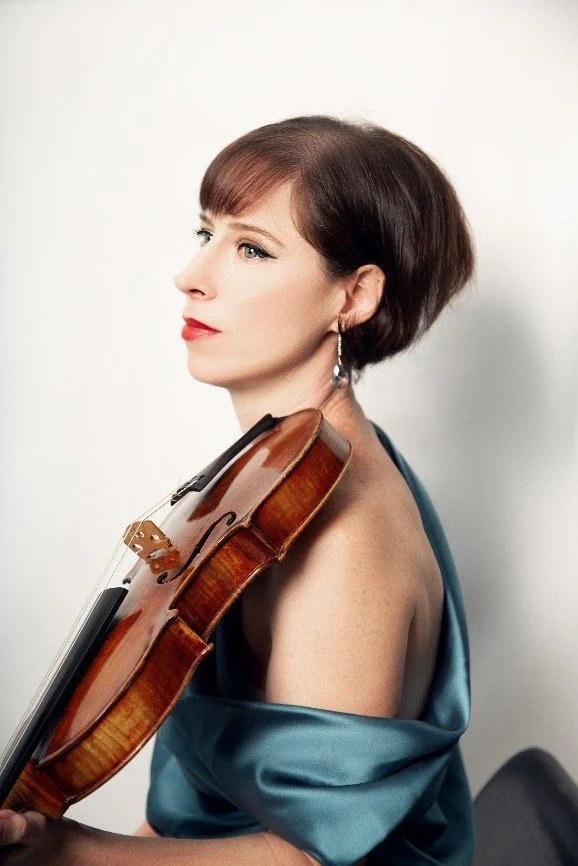
Madeleine Easton
The image above is inaccurate, for this recital specifically. Madeleine Easton is founder/violinist with Sydney’s Bach Akademie Australia but on this night she was directing a few musicians only from her ensemble of expert players: cello Daniel Yeadon, double bass Pippa MacMillan, and two organists in Neal Peres Da Costa and Nathan Cox (who seemed to be giving the major contribution in this area). Her main focus beyond this functional continuo line-up, was the Song Company, another Sydney group but familiar here, thanks to its Melbourne Recital Hall appearances in recent years.
As I remember it, the Company numbered six singers, although it expanded when necessary. As for this mammoth bout of Bach’s seven motets, now that Ich lass dich nicht has been (finally) admitted into the canon. Some faces/voices are familiar: soprano Susannah Lawergren, tenor Timothy Reynolds, bass Andrew O’Connor. Others are new to me: soprano Michelle Ryan, alto Hannah Fraser, tenor Christopher Watson and bass Tom Herring. One other is new to the country: guest alto from the Netherlands, Iris Korfker.
Naturally, you need at least eight voices to negotiate the double choirs required for all the motets except the first one treated on this night: Lobet den Herrn which burst on us with unexpected vehemence. It was the original Song Company’s nature to sing forcefully; you were the only negotiator of a particular line, for the most part, and so no point was served in holding back in timbre. When you have four lines being treated by two singers each, used to individual projection, the results are powerful. Forget the solemn, respectful treatment from the British university college choirs, or even the bravely confident approach of German choirs these days. We were in for a night of dramatic exhalations and this opening gambit proved dynamically potent.
A slightly distracting sight was that of a soprano conducting herself ever so slightly. This might be a nervous performance tic but seemed unnecessary, given the fluency and directness of Easton’s gestures, which revealed a sterling familiarity with all of the night’s material. It also stuck out because nobody else did anything similar, all of them focused on their conductor as the sole fount and origin of their output.
Da Costa emerged for the following Komm, Jesu, komm, written possibly about 1731-2. His function on a chamber organ, like the efforts of Yeardon and Macmillan, was straightforward and based on the supposition that Bach might have employed a continuo group, as well as the two choirs that actually feature in his score; I haven’t been able to trace an edition of this work which has a written-out continuo line. Easton managed to elicit a deft balance from both forces in this consolatory construct, although Reynolds’ output proved clarion clear, dominating the mix at certain stages to an inordinate degree.
Giving us what was probably intended to be a modern leavening, possible latter-day imitations/homages to Bach, Easton and her company programmed two contemporary works, the first of which was written by Brisbane-based musician Sandra Milliken for a 2025 Bonhoeffer Project which interwove a Mass text with extracts from the Lutheran pastor’s writings while a prisoner of the Nazis. The composer arranged her original Herr Jesus Christus for eight-part choir and the results were amiable enough; not strikingly contemporary – indeed, it seemed to be couched in G minor, with minor 2nds thrown in, but couched in the English choral tradition, those discordant touches brightening an orthodox vocabulary. The metrical set-up sounded stolid, as did the rate of modulation where the home tonality moved into the major (E flat?) half-way through. Oddly enough, the last bars held a taste of the glee club about them, the parts moving with glib facility.
Two more motets preceded interval. First, the brief Ich lasse dich nicht which starts out in straight statement/response format, then moves into four-parts at the change of metre with the sopranos steeling the chorale melody over a restless quaver support from the lower voices. Indeed, musicologists have warred over the piece’s stages of composition, the first part coming from 1713 or earlier, the second section dating from 1735 or earlier. This latter section struck me as one of the more collegial sections of the program where personalities subsumed themselves for once.
Da Costa relieved Cox at the organ for Der Geist hilft of 1729 where basses O’Connor and Herring enjoyed plenty of continuo reinforcement, which was probably original as Bach orchestrated the piece with separate timbres for each of the choirs. The whole built to an alarming stridency at the height of the fugue that starts at sondern der Geist before it settles into doubling the parts (except the sopranos, of course). Still, the complex ended with a deliberate and considered reading of the chorale Du heilige Brunst with its superb text by Luther and Bach’s abruptly touching first Halleluja!
Back after the break, our singers gave Furchte dich nicht of 1726, or possibly over ten years earlier, which has instruments allocated to the vocal lines, even if none of them are specified. This was also striking for its animation in attack, which came as a relief, given the amount of textual repetition in the work’s main body. Even though Reynolds cut through the mix at some points, the whole body involved us in the action which seems to resolve itself, but doesn’t, when the sopranos take up the chorale tune Herr, mein Hirt and the complications are reduced to three lines, not six.
Yeadon then generated a thrusting version of the Prelude to Bach’s D minor Cello Suite, his fabric solid and informed by a clear articulation that wobbled only on a handful of occasions, although I was perplexed by the length of time he took over the dominant chord caesura at bar 48. You could find no fault with his negotiation of the concluding triple/quadruple-stopped chords, those sinewy strong pillars that anchor the movement’s restlessness.
Next came the large-framed Jesu, meine Freude of possibly 1723, even more possibly 1735 or thereabouts. In this 11-movement glory that oscillates between four and five parts, we hit the theatrical early with a feisty Es ist nun nichts, Easton making obvious points with the forte/piano oscillations and heightening the tension to a point that reminded us of the Sind Blitze, sind Donner eruptions from the St. Matthew Passion. Some of this fire came over even in the following (usually) sedate chorale with its klacht und blitzt with some Holle schrecken thrown in.
Light, mainly non-competitive relief arrived with the brief sopranos+alto trio Denn das Gesetz before we returned to the hit-outs of Trotz in five parts, again notable for its biting drama and percussive attack. In contrast, the work’s central fugue was generated with uniform clarity, attention focused on the linear interplay rather than any potential for vocal shocks; not that you can find many of these in one of the two drier texts that Bach employed, arguing for spiritual as well as physical commitment to Christ.
Another real pleasure came in the trio So aber Christus which I think featured Reynolds, O’Connor and the visiting alto, Korfker; whatever its composition, the group intrigued for its mixture of vocal timbres, here pitched at comparable dynamic levels and carefully articulating the second theologically practical text in the motet, again decrying the value of the body as compared to the soul – fair enough, for a believer. The lighter texture continued with a lightly-stepping Gute Nacht, without basses, an alto and a tenor. But I was taken aback by an unfortunate soprano solo at the end of So nun der Geist which stuck out from the smoothly accomplished five-part handling of this semi-reprise of Es ist nun nichts.
To follow, another contemporary interlude in Scottish writer James MacMillan’s O Radiant Dawn: one of the composer’s more well-travelled contributions to choral music and part of his 2007 Strathclyde Motets set. The Company probably enjoyed this ‘easy’ music after Bach’s complexities and the outstanding feature of the work, those ‘snaps’ or accacciature in bars 2, 4 and in the tenor for the work’s final chord (bar 45), even if these all sounded atypically faint, even given the forte direction at the opening and a piano dynamic prevailing in the chain of six Amens that MacMillan inserted along with an Isaiahan prophecy, negotiated by the ensemble’s female voices with excellent fluency.
And we ended with the joyous Singet dem Herrn (possibly 1727), Da Costa back at the organ; the Barenreiter edition (acting as God disposing) proposes ‘Instrument ad libitum’. Once again, tenor Reynolds’ timbre dominated proceedings, soaring over his peers in the opening chorus and reinforced by Watson when the tenors doubled each other from about bar 103 to bar 128. Mind you, the further into this opening gambit we go, the less energy seems to come from its hard-worked negotiators. It’s all a magnificent complex, if an aural assault that resolves itself into a four-part fugue for the final Alles, was Odem strophes which mirrored the jaunty bounce we heard at the evening’s start.
In the end, an extraordinary test of stamina for the performers, an unexpected demonstration of vocal clarity for us listeners in a series of performances that startled for their directness of address. Which I’m coming to believe is a Sydney characteristic; I can’t think of any Melbourne choir that would have infused these motets with similar bite and dynamic heft. Many thanks to these generous visitors.
 O'Connell the Music