RACHMANINOV’S RHAPSODY
Australian Chamber Orchestra
Hamer Hall, Arts Centre Melbourne
Sunday February 8, 2026
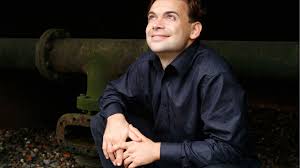
Dejan Lazic
Beginning the year with a rather short program, the Australian Chamber Orchestra visited Melbourne for its regular three appearances across as many days, of which this Sunday concert was the middle. Richard Tognetti led his regular 17 musicians (with the addition of percussionist Brian Nixon for the last number) through four works, one of them a new ACO commission enjoying its premiere: John Luther Adams‘ Horizon, which deals with two levels of perception and attempts to contrast the aspect we see from our current positions and that which is visible in open spaces like the desert or the sea.
What Adams gives us is a music-picture of these dual horizons. My problem is that I can’t tell the difference because, after one hearing, my sense is that the enclosed horizon is not depicted in the score which begins and ends in the same fashion: low didj-like drones from the bass strings, everybody else entering independently and making their own contributions to the sonorous melange of layers and twittering that comprise the work’s forward motion.
Several performers seem to stand alone to a certain extent throughout the performance, although two cellists and Maxime Bibeau‘s double-bass sat/stood together at the rear of the stage. In front of it all, Tognetti led a string quartet that could have been serving as a fulcrum body; if so, its function proved ultra-discreet because the members appeared to have the same freedom of delivery as everybody else in the ACO group. Which was probably not as great as I’m suggesting because the surges of crescendo and ebbings of decrescendo sounded well-organized across the score’s length.
You’d be hard pressed to find much more meat in Horizon than its shifting colours, the general texture changing all the time but not markedly. Lines become prominent for a moment, then recede into the over-arching texture – a kind of glimmering sheen, like visible heat-waves off the Outback’s sand surface or a mobile sea mist. You find yourself being wrapped in a sonorous cocoon, without events interfering to break you out of a pleasant torpor, least of all when players start dropping out of the mesh, replaying Haydn’s Farewell practice, if not actually leaving the stage.
And what dropped into this luminous silence? A phone going off, in the middle stalls on the right-hand side of the hall. Yet another inconsiderate swine demeaning a carefully prepared and staged moment. Only in Melbourne? Only in an elderly audience? If only. Still, the work had achieved its effect of depicting something close to an austere monumentality, putting Adams in a chain of US writers starting with the can-hardly-stand-still Ives, alongside Ruggles, Harris and Hovhaness – all, to some extent, concerned with nature, the environment, and unanswerable questions.
A complete change in pace arrived with Stravinsky’s Concerto in D ‘Basle’ of 1946; one of only two works I’m aware of for string orchestra by the composer (along with the ballet Apollo from 1927). Is this the first time the ACO has played this piece? The composer doesn’t loom large in the ensemble’s discography; in fact, I can’t find him at all, even if this type of whip-smart writing is ideally suited to these players.
That’s what they gave us: a reading that showed precise, clear-cut and impressive for its ensemble, requiring minimal direction from Tognetti in its opening slightly febrile Vivace which begins with a clash between Major and minor mediants and maintains its bitonal flavour all the way through its neo-classical byways. An admirable smoothness emerged in the following Arioso with its melodic leaps of 9ths and studied courtliness, while the concluding Rondo, in an unchanging 4/4, enjoyed a brilliant outlining delivered with the inimitable ACO panache.
This Stravinsky is a music that suits this ensemble and you’d have to look far and wide to find anything approaching the interpretation given here. It probably helps that much of the score is clever-clever, even the central movement studied in its sentiment. But the outer segments illustrated the poise and uniformity of control and output that the ACO produces on its best days, right down to the final, almost-tonal, nearly uniform D Major double- and triple-stop chord.
After a long interval, we moved on to the program’s second novelty, here enjoying its Australian premiere. Lithuanian writer Raminta Serksnyte wrote her De profundis in 1998 as a Bachelor’s degree graduation piece, scored for a string chamber orchestra, slightly larger than the ACO forces performing it this afternoon. Gidon Kremer made an extravagant claim for this work – ‘the calling card of Baltic music’ – but I found it only moderately interesting. Serksnyte begins with a wealth of activity in a rapid-fire light barrage of sounds, after which we come to what might be considered as a real plaint, justifying the title.
But the composer is not interested in the religious or liturgical suggestions of Psalm 130; rather, she sees it as a kind of hook on which to hang her tableau of a young soul migrating to experience, discovering life’s realism after youth’s exuberance. I suppose ‘Growing up’ doesn’t carry the same suggestion of elevated concepts as a Latin tag. In any case, the language changes back to the original Allegro/vivace flurries and chitterings, which reversion suggests a circularity of experience if not informed by subtle depths. Its impact speaks to a lively mind at work, but is this really the best of Baltic?
At last, we came to the program’s title work: the Russian pianist/composer’s brilliant 1934 set of excursions based on Paganini’s Caprice No. 24. For prime interpreter, we heard an ACO friend in Croatian-born Dejan Lazic who proved both sympathetic to the work’s spiky Romanticism as well as its richly flamboyant strain. All right, it’s a hard piece to get wrong in terms of technique: you either have it or you fumble, obviously so. But finding each point of equilibrium as it turns up – from the assertive opening, through the Dies irae mini-phantasmagoria, into the middle etudes-tableaux excursions that arrive finally at the soulful apex of that melting moment Andante cantabile in D flat, concluding with the spiky final set of six variants that eventually bring to mind every lush piano concerto finale, up to the finishing in-my-end-is-my-beginning quirk – that is demanding, a series of challenges that Lazic met with high success.
Indeed, in this 20-odd-minute journey, Lazic showed an impressive mastery of material, relishing each abrupt turn and wholly prepared to give free rein to the usually dour composer’s high spirits and what amounts to an emotional elation that permeates this most appealing of his piano-orchestra scores.
As was the case last year with the ACO’s attempt at Gershwin’s Rhapsody in Blue, I missed the usual orchestral voices to a significant degree. Bernard Rofe‘s arrangement for piano, percussion and strings proved serviceable enough; as far as I could tell, Lazic wasn’t required to carry out anything but his own role and Nixon provided discreet additions to the texture (but did he have the complete set of the original score’s instruments, including glockenspiel and bass drum?). We missed a harp and ten each of both woodwind and brass.
Naturally, it’s beyond the ACO’s budget to carry 21 or 22 extra musicians around the country on an 11-concert operation, even if this particular tour covered only cities on the eastern side of the mainland. And I’m sure plenty of patrons would rather hear a truncated-in-forces version of this welcome work than not. But at certain moments, I missed individual and group timbres, the absence of which came as a cross between surprise and disappointment.
Even from the introduction, without the brass punctuation starting at Number 1 in the old Boosey & Hawkes score, you knew that you weren’t going to enjoy the usual environmental sparks; not to mention the clarinet/bassoon semiquaver slide three bars before Number 2. And on it went: the burbling clarinet gruppetti at bar 9 and bar 1 before Number 15 in Variation 6; the wind triplets that give a piquant edge to the Variation 9 texture at Number 26; the brass blazoning at Number 28 in the middle of Variation 10; the sprightly march that opens Variation 14 quasi Tromba in the woodwinds which reaches its bombastic best at Number 37 when all the brass enter wholeheartedly.
And still it continued: the plangent oboe at the start of Variation 17, followed by the first clarinet two bars after Number 45 – a brilliant complement; that energetic build-up of powerful bass layers under the piano’s full-blooded chords from Number 63 to two bars after Number 64; the vital pointillism in the woodwind starting Variation 24; and the hefty pesante of the brass hurtling out the Latin chant at Number 78.
You’d say that there’s no use crying over what couldn’t be done. I’d query why you’d bother doing something half-cocked. Even more so than with the Gershwin, you could sense the underdone nature of this effort, despite the soloist’s excellent demonstration of expertise and interpretative skill. Needless to say, Rachmaninov’s Rhapsody received enthusiastic applause from a pretty full house which clearly didn’t mind the thin orchestral fabric. De gustibus non est disputandum . . . except for mine, which are impeccable.
 O'Connell the Music