A WINTER’S JOURNEY
Musica Viva Australia
Elisabeth Murdoch Hall, Melbourne Recital Centre
Monday February 16, 2026
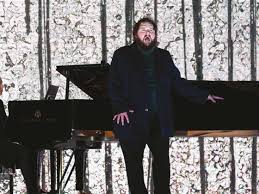
Allan Clayton
Here we are again with an updated Winterreise. British tenor Allan Clayton is collaborating with pianist Kate Golla on a Musica Viva Australia tour of Schubert’s song-cycle that started in Perth and moves to Brisbane, Sydney, Canberra and Adelaide over the coming fortnight after its two-night stint here. This version has been semi-staged by director Lindy Hume, with a background of Fred Williams’ paintings/drawings screened on a large pair of walls by David Bergman‘s video design, the whole lit by Matthew Marshall.
All right: that takes care of the credits. As for the experience itself, you were left with no little admiration for the singer’s embrace of the required theatrical action and the manner in which he tailored his output to the 24 situations that Schubert’s manic wanderer enjoys/endures. You could find little fault with Golla’s realization of the accompaniments, although that term is something of a diminution of the pianist’s responsibilities in this score.
With the Williams’ art, I’m not really convinced by the stated aim of finding common ground between three geniuses – poet, composer, painter. Not that the background distracted from the cycle’s progress; indeed, Williams’ work presented as a sober complement to some of the songs, even if there was one unexpectedly vehement painting exemplifying the later Romantic musical direction of sturmisch bewegt that I couldn’t trace in the supplied list of the artist’s works employed on this occasion. But while you could accept the Kosciusko depictions from the mid-1970s as mildly credible support for Gute nacht, the later landscape dots of vegetation looked centuries remote from anything in Muller’s poems.
Hume made an excellent start and ending to this enterprise, having Clayton isolated on left-stage, from which he moved into the central raised section holding Golla’s piano and the two walls around her, V-shaped towards the audience, with the Williams images imposed on them. This was the position he eventually re-occupied when left alone (so to speak) with the Leiermann at this work’s bitter end. In between, he raced around the raised platform, coming to rest and curling up about the Auf dem Flusse point, then finding another resting place somewhere near Der Wegweiser.
Fortunately, Clayton steered clear of too much pantomime, although he did use his long-coat, I seem to recall, to mimic Die Krahe. But you were spared the full mimesis for lieder that could – and have – been physically illustrated by the singer. I still have memories, fortunately fading, of Simon Keenlyside presenting a choreographed reading of this cycle in the State Theatre at the Melbourne International Arts Festival of 2004; on that occasion, too many textual cues were seized upon to ram the verbal messages down our communal throat.
My reaction was not shared by a gaggle of fellow critics who found inexplicable merit in this exhibition and bestowed that Winterreise with a critics’ award on odd grounds that had nothing to do with Schubert, and little connection to Muller although one of the plaudits came from an accompanying husband who found the singer’s German to be ‘very good’. Recalling this whole situation still leaves me thinking: Was it for this the clay grew tall?
Another reading of this cycle that proved more pleasing, although generating no little confusion in some of the songs, came from soprano Louisa Hunter-Bradley and pianist Brian Chapman who recorded this work on the Move label in 2006. Having the work’s central character change gender requires a good deal of interpretative latitude on the listener’s part but at least the score was given straight, without deviations from a normal recital format . . . insofar as you can have such a thing on CD.
Isn’t that enough, though? Why is it necessary to dress up a work which was intended to communicate directly with the listener, without any distractions? One of the reasons given for providing supporting illustrative matter is that audiences don’t understand the words; not everyone is familiar with the texts, let alone with German. Yes, but surely that deficiency can be covered by surtitles? They were employed on this night; even if we didn’t get the full texts, sufficient was provided to communicate the songs’ emotional gist.
What you can do is, of course, close your eyes, as I did for a good deal of the time. Many of us have an admiration for Williams’ work, egged on by the 1980 hagiography produced by Patrick McCaughey which brought the artist into the mainstream, sponsored by the country’s most well-known art curator/academic/historian. But even this measure had its problems as, if you looked at the stage between songs, some striking scenes were on show, some of them with little input as to what we’d just heard.
In the end, Clayton and Golla enjoyed a rapturous reception which they deserved despite the visual salad behind them. The pianist demonstrated a fine responsiveness to Schubert’s piano writing, my only query a soft right-hand output during Mut, e.g. the piano’s commentary in bars 9-10 coming straight after Clayton’s clear account of the melodic contour. But then you encountered Golla’s intensely moving account of the following Die Nebensonnen, with a lucid reading of that song’s bass-heavy accompaniment.
But you could find similar examples of subtlety across the work’s spread, Clayton’s dynamic palette a continuing source of delight in lesser-known pieces like Letzte Hoffnung as well as the all-too-familiar extracts like Der Lindenbaum. In fact, the hallmark of this interpretation came through its attention to shadings from both musicians, Golla establishing a scene with admirable directness and following Clayton’s line with excellent fidelity. Next time, we could do without the visual input, OK?
 O'Connell the Music