Lucid and airy

ANGELA HEWITT

Melbourne Recital Centre

Tuesday May 16, 2017


                                                                                    Angela Hewitt

The Canadian-born pianist has appeared here under a few organizational banners – Melbourne Symphony Orchestra, Impresaria, Australian Chamber Orchestra, and Musica Viva which is sponsoring this latest tour of two programs and a clutch of masterclasses.   Oddly, her stellar Bach recordings and live appearances with the Australian Chamber Orchestra don’t rate a mention in the MV program, which is a pity because her readings of the concertos and even a strange Brandenburg No. 5 where she has the solos and Linda Kent’s harpsichord does continuo duty were/are remarkable weddings of soloist and accompaniment.

On Tuesday, Hewitt opened with Bach, of course; you don’t build a reputation like this, with its attendant expectations, and then avoid the obvious  –  God knows there’s plenty of material to deal with.   For both programs on offer, the pianist is performing two partitas: the big No. 4 in D Major (which is common to both nights), balanced – sort of – on this occasion  by the better-known No. 1 in B flat.   After interval, we branched out into five Scarlatti sonatas, the Ravel Sonatine, and the final solo piano work by Chabrier, his Bouree fantasque.

No short-changing in her Bach, Hewitt played all repeats; like every pianist with sense, she made sure the second time around was more than a simple here-we-go-again exercise.   For the familiar B flat Partita, she impressed as always by the clarity of her linear work.   Given her instrument’s ability to make life easy, she continues to be most sparing with the sustaining pedal, which makes her load more taxing but fills these pages with a welcome sparkle; even the opening Praeludium with its (mainly) three layers came over with excellent lucidity, aided by a supple dynamic range that avoided heroic clangour.

This clear-speaking delivery continued through the work’s dances, notable for a sturdy Sarabande informed by a gently applied rubato, and as close to ideal as you could expect in the concluding Giga in which the supplementary quavers enjoyed a burbling subservience to the crotchet melody line – far from the more common and leaden Solfeggietto cross-hand exercise we usually have to endure.

For the D Major work, Hewitt began the Ouverture with an attractive declamatory style that emphasized the key movement rather than the brusqueries of the demi-semiquaver scales and written-out ornaments, before a stunning account of the movement’s latter section that begins with a light-hearted fugue motive before working into a striking polyphonic complex at about Bar 62, a nexus that doesn’t take itself too seriously; in Hewitt’s hands the  bouncy good humour is maintained, particularly through the bass-heavy bars 105 to 109.   The following dances and Aria became intriguing for the executant’s mode of presentation rather than for her technique which was hard to fault: the poised solemnity of the large-scale Allemande where Hewitt made the occasional triplet or pair of them serve as placid disturbances of the regular metre; a sturdy drive in one of the finest Courantes from the composer; a similarly firm impetus in the odd-man-out Aria; the deft folding-in of the Sarabande‘s opening two-bar question with its lengthy, ornate response; in the Menuet, a simple example of art concealing art in the gentle handling of congruent triple and duple passages; all capped by a buoyant Gigue where yet again the more active passages of interplay – like bars 16 to 19, or 78 to 85 – delighted for their purity of detail and Hewitt’s remarkable gift of keeping three balls in the air.

The post-interval events began with five Scarlatti sonatas.  Two of them were among the composer’s most well-known: K. 491 in D Major, and the E Major K. 380.   If anything, Hewitt makes these works speak more simply than many another pianist; her chording is less flamboyant or filled out, the ornamentation veers towards spartan, dynamics rarely move below mezzo forte.   The D Major K. 492 enjoyed brisk treatment, a fine contrast with the courtliness of the two better-known sonatas.   And the final K. 24 in A Major came over with plenty of braggadoccio, the pulse maintained throughout without turning towards a martellato effect.   I must admit to being distracted by the middle work in the bracket, listed as ‘Sonata in B Major, K 377’  –  a piece I didn’t know and which proved even more unfamiliar as it was actually in B minor; puzzling about this and doubting my sense of pitch distracted from whatever Hewitt was accomplishing with it.

The Ravel piece also came in for firm treatment.  Hewitt is not disposed to apply washes to these pages and the Modere, despite its lush underpinning figure-work, impressed for a no-nonsense delivery where ppp remained a definite entity rather than a wisp.   The Menuet impressed for the rhetoric brought into play at its central climactic point, while the concluding Anime gave the pianist ample space to show her talent at unflustered dexterity in what amounts to a toccata, albeit a remarkably tautly structured one.   The only quality missing was verve, like the elation you experience when hearing the main motive striking out from an underlying susurrus of semiquavers.

Hewitt has a passion for Chabrier’s piano music, and most of us know too little of it to react one way or the other.   The Bouree fantasque is a formidable show-piece without much substance but packed with excitement and flurries of virtuosity.   This performance was lively enough, if it lacked the punch that you can see in the score; the reading caught fire at the return of the main theme proper after Chabrier has finished with his F major central section and the florid chromaticising he employs to get back to his C minor home key.   Its final rousing 24 bars brought this entertaining if unwieldy bonbon to a glittering conclusion.

Hewitt plays her second program on Saturday May 20 at 7 pm.   Along with the Bach Partita No 4, she will play the C minor Partita No. 2.   The rest is Beethoven: Sonata No. 1 in F minor and the Moonlight No. 14 in C sharp minor.

Bully for us

SPANISH BAROQUE

Brandenburg Chamber Orchestra and CIRCA

Melbourne Recital Centre

May 13-14, 2017

                                                                                           Circa

I’m sorry but, try as hard as I may to wish it were otherwise, the musical content in these collaborations often goes through to the back of the net.   After three exposures to Circa, I thought I’d seen all their manoeuvres and manipulations; this last experience shows that, even when working with the tried-and-true, this troupe can often strike out in unexpected directions.   Added to which, the off-the-cuff showmanship and near-flawless expertise on display tends to swamp out the Brandenburg offering which on this night often became, to be kind, something close to aural wallpaper.

Paul Dyer and his small band of players began with an Entrada dinamica y ruidosa, put together by the man himself.   It was certainly noisy enough, being mainly for percussion and reminiscent of the sound onslaught generated by Les Ballets Africains of many years ago.   A canarios by Santiago de Murcia followed in an arrangement by Dyer and film-music writer Alex Palmer, which I seem to recall backed a rather impressive series of tall totem-poles and pyramid shapes  constructed from themselves by the eight Circa members.

Two women from the troupe then played balancing games on a long seesaw construct while soprano Natasha Wilson sang a Tarquinio Merula aria, Su la cetra amorosa – negotiated well enough although the singer’s range of vocal colours is not large and I think she underestimated the force of her accompaniment.   A Murcia fandango followed, arranged by Palmer and Stefano Maiorana, guest guitarist with the ABO for this program; lively and fiercely rhythmic, it was overshadowed by one of the Circa men twisting himself round a vertical pole, finishing off his routine with a heart-stopping vertical drop – the sort of accomplishment that threw the musical action well into the background, sad to say.

An organ solo from Dyer that sounded like a scrap from the Bologna school followed before Wilson contributed an anonymous cancion, Muerto estais, in an adaptation by Dyer, Palmer, and the renowned Argentinian-born lutenist Eduardo Eguez.   This proved most interesting because of the singer’s restrained address and the fore-fronting of Tommie Andersson‘s theorbo (amplified?), while the acrobats performed four pas de deux, interweaving and exchanging places in an engrossing display of inter-dependence.

Suddenly, we left the Spanish Baroque for the familiar Spanish Modern when Maiorana broke into Albeniz’s Leyenda, arranged by Palmer for the rest of the ensemble to join in but a touch demanding for the baroque instrument that the main executant was using; the version moved beyond the original’s simplicity of texture, naturally enough, with various accretions and excisions while a female acrobat climbed up a cluster of white ropes in an enthusiastic if not over-original solo.

Wilson sang Con que la lavare, better known to most of us as one of Rodrigo’s Cuatro madrigales amatorios; the earlier version by Luis de Narvaez sung here is a more languorous construct, even in this arrangement by Sydney-based composer Tristan Coelho.  As things turned out, the singer gave some of her best work in this piece, supporting seven of the Circa players before the rope-specialist from the preceding turn came on for an ensemble displaying sheer muscular control.   Vivaldi’s version of La folia, that simple theme subjected to so many variation-sequences across the centuries, is inevitably more light-filled than most, handled here with plenty of free-wheeling abandon by the Brandenburg strings (what there were of them), while a female trapeze artist dealt handsomely with the four Circa men who tried to disrupt her routine.

Palmer’s arrangement of the traditional Catalan song La mare de Deu, another Palmer arrangement, also gave Wilson fine exposure as her visual competition was a solitary female carrying out a sequence of hand stands on three slender-looking pillars – again, simple craft without fireworks but somehow matching the quiet tension of the musical content.   Back came the men with a table for plenty of diving across and under with a scattering of near-misses to the backdrop of an anonymous villancico called Rodrigo Martinez, reshaped by Dyer and Palmer.   This pre-Baroque melody is fairly familiar – Jordi Savall has treated it and it turns up in all sorts of formats from other ensembles – but, once you’ve played it, there’s not much else to do except elaborate it; yes, you could say the same about a wealth of material on this program.   Eventually, of course, the whole Circa corps joined in this perfectly-judged and -calculated frolic.

Another Catalan song, La dama d’Arago, enjoyed the Palmer treatment,  Wilson again given a considerate Brandenburg accompaniment while a female acrobat re-visited a Circa regular in manipulating herself up two cloth ribands, although she avoided that extraordinary move where the performer wraps the cloth around her, then lets herself fall floor-wards, spinning all the while; yes, the child in me (never far from the surface) missed it.

A  jacara by Murcia put the spotlight again on Maiorana who revelled in the slashing rasgueado chords in this version constructed by himself and Palmer, while a wheelbarrow provided a bull-representation for the Circa’s turn as matadors – Spanish, I suppose, but not over-entertaining.   The finale came in an improvisation called Passacaglia Andaluz, notable for yet more apparently off-hand body-throwing and a sense of predictability from the musicians, their creativity well-harnessed to a set pattern – naturally enough, given this traditional format, but we could have done with more linear and vertical extravagance.

Look, it was most entertaining; my grand-daughter loved it from start to finish, the whole experience bringing out her latent Nadia Comaneci.   But, like quite a few in the packed Murdoch Hall, she was barely aware of the Brandenburg players.   Which may have been the musicians’ intention – not to distract from their guests.   But I think that the collaboration has reached its use-by date and could well be rested for a few years.   Their first appearance together in 2015 proved extraordinarily exciting, exhilarating even to these well-worn eyes and ears; Circa alone at the Playhouse for a Carnival of the Animals production reinforced impressions of the company’s prowess; this Spanish night entertained but, when all’s said and done, the prevailing ethos at work is physical.   Until the two bodies can mesh more with each other with both bodies inside each other’s space for extended periods rather than a few slight juxtapositions, the gymnasts will enjoy the limelight and the formidable Brandenburgers might just as well be sitting in an orchestral pit.

Try-hard maths: two into one

CAVALLERIA RUSTICANA/PAGLIACCI

Opera Australia

State Theatre, Arts Centre Melbourne

Wednesday May 10, 2017

                                                                               Cavalleria Rusticana

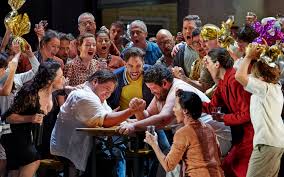
At first glance, this looks like a cost-cutting exercise – having these two often-paired contemporaneously-composed operas set in the same locale, so that the subtle distinctions between Mascagni’s representation of Sicily and Leoncavallo’s deep-south Calabrian village are fused.   You can economise on sets, costumes and, in some cases, singers.   But the bare-bones production look of both operas, particularly Cavalleria Rusticana, is deceptive and, thanks to the State Theatre’s revolving-stage mechanism, each opera has a variety in its presentation, even if some of the director’s staged events are cringe-making.

But what and how an opera is acted out has taken on undue prominence these days; what really matters is the music and how the company copes with it.   Luckily, Opera Australia has some fine artists at work here, with not really any unsatisfactory principals, even if their ardour was rarely matched by a full body of choristers.

The Mascagni piece enjoys a welter of fine melodies, beginning with Turiddu’s offstage siciliana that in this instance brought Diego Torre‘s hefty tenor into play well before he actually showed up in person.  Dragana Radakovic‘s first appearance as Santuzza showed a singer hard at work but getting very little across the pit, up to the fourth scene’s Romance, Voi lo sapete, o mamma, where the soprano moved into high gear with a driving force that continued throughout her confrontations with both Turiddu and Alfio.

Santuzza, in fact, carries the action and is a continuous presence.   Dominica Matthews sang Mamma Lucia, who spends most of her time reacting to others in dumb-play with some inane recitative.   None of this challenged the singer who went through the expected motions required of an overwrought mother of a wastrel son.   The other female principal, Sian Pendry‘s Lola, produced a fair off-stage Fior di giaggiolo and played up to Torre fetchingly in the Brindisi scene.   As the most (only?) attractive woman on-stage, she exhibited the requisite relish for attention but, as so often happens with Lola, she is hard-pressed to make any vocal impression, even in her nasty dialogue with Santuzza.

Torre maintained a striking vocal presence through the opera’s second half, matching Radakovic’s vehemence in their confrontation, playing an effective lad-about-the-village in the catchy Viva il vino spumeggiante, playing efficiently for undeserved sympathy in the remarkable Mamma –  quel vino e generoso aria with its move from hectic, subdued excitement to valedictory lyricism: for me, the work’s finest moment.   The only problem with this Turiddu was the one-dimensional attack, which was rarely less than full-throttle; as a result, the young man presented as an intransigent ne’er-do-well, with whose fate it was hard to feel much sympathy.

Having less to work with, Jose Carbo took this night’s honours as Alfio, bringing some much-appreciated vitality to the opera through his Il cavallo scalpita self-introductory bragging – an aria that puts a bass through his paces with several top E flats and a pair of taxing F sharps.   As with Matthews, most of his vocal work is confined to recitative, yet Carbo built a firmly-etched personality in the short scene of Santuzza’s betrayal, finishing with a convincing Infami loro quatrain, then offering a self-composed balance with Turiddu’s self-recriminations in the duel challenge.

Andrea Licata conducted, giving full weight to the score’s mellifluous arches of melody and bringing out a steady response from Orchestra Victoria.   The ensemble’s place to shine, the well-loved Intermezzo, passed along well enough, although the pit’s tinny organ substitute dimmed the piece’s timbral lustre more than a little.   In the opening pages, the Opera Australia Chorus sounded lively enough, even if the male voices dominated; but the performance pace slipped to dragging for the Ineggiamo procession.

Director Damiano Michieletto updated both operas to the 1980s, which presents no problem as long as you subscribe to the theory that nothing has changed in the social life of Italy’s poorest region over a century.   The Prelude is played out over a tableau, the villagers all gathered around the dead body of Turiddu; the stage unfreezes and the opera’s action begins.   Much of it involves a bakery, staffed by two men, one of whom I think was Samuel Dundas, who turned up in the same clothes as Silvio for the Leoncavallo opera.   The impression is of a clean but run-down community; Dundas’s yellow t-shirt is a colour highlight, Lola goes in for seductress black, Alfio sports a spivvish orange-brown suit, but the main impression is of soul-quelling dowdiness.

Then the producer has introduced a few oddities.  Why the statue of the Virgin in procession comes to life to make imprecatory gestures to Santuzza strikes me as unnecessary theatrical padding.   Updating Alfio to a car-driving purveyor of women’s gear would be fine, except for the self-identifying text he has to sing.   Also, it’s working against the placid rest from action that the Intermezzo gives us to have Yellow-T-Shirt and a passing girl carry on a little gauche flirtation; that kind of interpolation strikes me as indicative of a belief that, if nothing is happening on stage, then the audience is bound to be bored.   Maybe, but I think that people who can’t just listen to a master-stroke for three minutes should stay at home with their play-stations.

During the work’s progress, someone puts up posters advertising the coming appearance of Pagliacci in the village’s theatre; so we know what’s coming, I suppose.   Still, you’d have to be pretty thick not to be aware of what’s on the other side of interval.

In the second opera, Torre plays and sings Canio with impressive dedication.   This character is a tenor’s delight, revealing himself on every page in every line.   The role’s high-point, Vesti la giubba at the end of Act 1, was a minor triumph with the tenor making every point a winner and giving a vital counterbalancing picture to the jealous brute who is the outward manifestation of the troupe’s leader.   But Torre made his mark at the beginning with a gripping Un tal gioco where he prefigures what would happen if he found his wife Nedda had taken a lover: a fine crescendo of barely-suppressed rage and violence, shrugged off at the end of this solo in a most non-persuasive show of benignity.

At the work’s climax – the entertainment that the strolling players are providing for the villagers – Torre displayed a vocal and emotional command right from his appearance as Pagliaccio, Nome di Dio!   As the scene moved forward and the actor’s self-control deserted him, the tenor gave a gripping realization of Canio’s move into homicidal anger, thus bringing the opera full circle: we were warned what would happen, and it did.

Carbo also performed in the second work, this time as Tonio who enjoys the inestimable gift of Leoncavallo’s wide-ranging prologue, Si puo?   This could have been a fine experience but the baritone was hampered by Licata’s leaden-footed tempo.   Better followed in the Nedda-Tonio scene, Carbo making an excellent self-apologia in the So ben che difforme solo, loaded with self-pity but showing his unhappiness and longing with a rich sound-colour and something approaching dignity before he throws it all to the winds and assaults the disdaining object of his love/lust.

Anna Princeva, the production’s Nedda,  opened with a fine study in contrasts, from her fear of Canio in Qual fiamma avea nel guardo! to the extended flight of fancy where she identifies herself with passing birds, Oh! che volo d’augelli.   This soprano possesses a crisp, bright quality, very accurate in delivery and manipulating her line’s phrasing with admirable flexibility.   To her credit (and that of her colleague), the love duet for once didn’t pall, in large part due to the sprightly nature of her vocal attack and the mobility she demonstrated in segments like Non mi tentar! and the ravishing Nulla scorda! sestet.

Dundas, in a windcheater over the previous opera’s t-shirt/jeans outfit, sang an assertive Silvio, the young lover who has no solo but must delineate himself in his love-duet with Nedda.   Where Carbo suffered from the slow pit pace, this baritone had to work with direction that had him jumping around the stage like a pre-match athlete from an American university, his physical restlessness detracting from the longing and desperate pleas that make up the greater part of his work.

John Longmuir sang Beppe, the general hand/actor whose only chance to shine comes in the play-scene where he acts the 11 lines’ worth of Arlecchino and rarely gets noticed because of the crisis that looms throughout this Commedia scene.

For this opera, the chorus showed a good deal more vocal energy; but then, the demands placed on them are greater – from the opening frenzied excitement, through the Vespers chorus, to the play-within-a-play’s disastrous progress. Licata’s orchestra appeared un-pressurized, but the great surges of vitality in the work’s middle pages came over efficiently.

Michieletto raised these eyebrows again with his Pagliacci.   For the interlude between the acts, he has Santuzza onstage receiving post-Confession absolution from the priest who led the Easter procession.   She meets Mamma Lucia and demonstrates that she is pregnant; the two go off arm-in-arm.   Some might consider this elevating; I think it’s bordering on ridiculous.   Still, it’s part of the intention of having the two operas cross-fertilise each-other  .  .  .  perhaps that clause is unfortunate.    Of more interest is the strange scene concurrent with the presentation to the village in which Canio hallucinates that he sees Nedda  being unfaithful to him – a vision that leads him into his murderous dementia.

A slight problem is one that bedevils every Pagliacci.   Canio catches Nedda embracing Silvio, but the lover escapes without Canio being able to recognize him.   It’s generally a clumsy piece of staging – how can the clown not see his wife’s lover? – and this particular effort is reliant on Canio being pretty myopic .  .  .  or possibly he can’t identify yellow.

Also, as usual, the Leoncavallo work engages an audience more immediately than its Mascagni companion; the drama is more taut, the characters’ motivations more clear-cut, the score more energetic.   But the joint productions’ attempts to bleed one piece of verismo into the other are marginally successful, it seems to me.   If the musical content is taken as the dominant guide in approaching each work, then their internal differences argue for treating each work as a discrete construct, rather than supporting an attempt to push them into the same space.

Further performances will take place at 7:30 pm on Saturday May 13, Monday May 15, Wednesday May 17, and at 1 pm on Saturday May 20.

Bit of this, bit of that

ACO SOLOISTS

Australian Chamber Orchestra

Hamer Hall

Sunday May 7, 2017

Satu Vanska

You may be from an old school, so you tend to look for themes, thematic links, but sometimes the search is futile.  Take this latest program from the country’s premier chamber orchestra.  The ensemble opened with a scrap of semi-modern Americana and ended with yet another string quartet arrangement, this time of Mendelssohn No. 2 in A minor .  At the core of the afternoon came two Baroque violin concertos – Vivaldi for two violins and cello, RV 578; and Locatelli in D Major, the Harmonic Labyrinth which is really nothing of the kind – an arrangement of Debussy’s Cello Sonata which became a new piece in the process, and a fresh work by Perth-based composer James Ledger, The Natural Order of Things.

A mixed bag, then, but not unpalatably so.  Under temporary director Satu Vanska, the ACO gave an airing to Ruth Crawford Seeger‘s Andante for Strings, an arrangement by the composer of the slow movement from her own String Quartet of 1931.   In the concert program, an appreciation of this movement came from critic Peter Dickinson, who described Crawford Seeger’s work as that of ‘a kind of American Webern’.   The assessment seems to have been based on the composer’s practice in this movement of quick crescendi so that the melodic element moves between the parts.  Cute but, even given the composer’s somewhat acerbic language, it falls a fair way short of the Viennese master’s Klangfarbenmelodie, which is what Dickinson is attempting to persuade us that the American innovator was attempting.

The Andante is pretty brief, but you wouldn’t want it more prolix, chiefly because the surges and recessions can’t hope to capture as much interest as that constant flickering of textures and gruppetti in Webern’s setting of the Ricercar a 6 from Bach’s Musical Offering, or, to be fairer, his master Schoenberg’s famous Farben movement in the Five Pieces for Orchestra.   The American work is quaint, a moderately interesting experiment but – and there’s nothing macho-sexist about this – the piece is bland in character when juxtaposed with Ives’ scores dating from previous decades.

More contemporary still, Ledger’s work was being given its second performance on Sunday, after an out-of-town reading in Wollongong.   The work celebrates the life of Simon Libling, an escapee from the Plaszow Concentration Camp in Poland (associated in my mind with the efforts of Oskar Schindler) who eventually migrated to Melbourne in 1960.   Ledger was commissioned by Libling’s son and daughter-in-law and has produced a five-movement work that offers a kind of odyssey; pictures marking certain stages in Libling’s life.   Ledger employs an accessible vocabulary, reaching its most aggressive reaches in the central Threatening and agitated section.   But he doesn’t overtax his audience in any of the movements, each segment having its own discernible character and dynamic impetus.   If anything, Ledger is determined to construct his five life-chapters without frills and sustains the atmosphere for just long enough.   Above all, it’s a music without self-consciousness, the composer’s voice present but channeled into the work’s narrative, not drawing attention to itself with sound-production tricks.

Satu Vanska and ACO regular Glenn Christensen worked pretty well as top lines in the Vivaldi concerto, principal Timo-Veikko Valve the sublimated cello.  You were hard pressed to find flaws in the soloists’ attack, although I would have preferred the violinists to work alongside each other, rather than facing from opposite sides of the stage.  The opening spiccato sounded less fierce and abrupt than when Richard Tognetti is at the first desk but, even for a L’estro armonico stalwart, this piece is forgettable.

Vanska took the solo Locatelli part and negotiated its endless stream of semiquavers with very few misses.   Most of the score’s interest comes in the solo capriccios/cadenzas of the outer movements, and Vanska gave bracing accounts of both.   But the work is over-hyped: it’s not complicated in any sense – it’s just busy.   For instance, the solo that interrupts the first Allegro is little more than a series of arpeggios in D Major and its close associates; playing them rapidly generates excitement but it strikes me as being little more than an eighteenth century precursor of Czerny.   Vanska gave considerable personality to the middle movement’s substantial melodic lines but raised the audience’s temperature with the long capriccio in the finale, packed with double-stops and flights across the instrument’s compass, including Locatelli’s favourite trick of asking for notes above the fingerboard.   In the end, the player displayed a formidable technique; pity about the repetitive content, but that’s the period.

At this work’s start, a baroque guitar crept in behind cellists Valve and Melissa Barnard; it took me a fair while to realize that this was the third of the ACO’s regular players – Julian Thompson – revealing an unheralded talent.   Speaking of personnel, the scheduled viola Alexandru-Mihai Bota didn’t seem to be present behind guest principal Jasmine Beams and Nicole Divall, unless he has altered radically in height and complexion.

It was hard to warm to the Debussy Cello Sonata, although Valve made an excellent solo voice surrounded by a small group of piano-substituting strings.   You missed the keyboard’s bite and percussive force, of course; even stranger was the lack of contrast in this version, the cello merging into a bland cocoon of fellow strings.   The pay-off was that the string instrument remained prominent, unchallenged in that regard by its accompaniment.   Every pizzicato from Valve told and the calculated immersion of the string instrument’s activity in the piano’s occasionally vehement attack didn’t occur.   In this form, the piece is a radically different entity and you find that you’re pulling yourself up short when an anticipated harmonic clash is muted almost into non-existence.

The ACO is renowned for its adaptation of string quartets from the mainstream repertoire as expansions of its programs.   Alongside understandable fleshings-out of Tchaikovsky’s Souvenir de Florence, the ensemble has recorded and/or performed quartets (and the occasional quintet) by Grieg, Janacek, Schubert, Beethoven, Szymanowski and Haas.   Now Mendelssohn’s most accessible work in the form has enjoyed the string orchestra treatment (whose arrangement it is, I don’t know).   The work is big-statement-rich in its outer movements and so stands up well to dynamic and timbral aggrandisement in its bookends; added to which, the musicians are responsive to Mendelssohn’s shapely counterpoint, each line melding into its peers with the group’s inimitable mix of urging power and elegant finish.

As with other similar arrangements that the organization has presented, you experience the odd moment of dislocation, when the forces reduce themselves and the texture thins to regular quartet individuality, as in the Andante con lento, or at Vanska’s solo towards the final Adagio‘s conclusion; so that, when the full complement of players comes back on board, reinforced by Maxime Bibeau‘s bass, you have to make a jump back to accepting the larger sound as the norm.   They’re not as impressive in construction as this Beethoven homage, but I’d be more interested in hearing some of the composer’s early symphonies for strings than these re-writes.

Nevertheless, Sunday’s patrons were quite happy with the ACO’s work, even if one lady behind me commented unfavourably about Ledger’s piece.   You can’t please everyone all the time – which is the best rationale for a bitzer of a program like this one.

Pratt takes the honours

LA SONNAMBULA

Victorian Opera

Hamer Hall, Victorian Arts Centre

Friday May 5, 2017

                                                                                     Jessica Pratt

Somehow I’ve missed the Victorian Opera’s previous concert versions of Bellini operas – Norma and I puritani.  A real pleasure, then, to come upon the latest enterprise, particularly as the performance worked very well, notable for a top-notch cast, a willing if distant chorus and a revitalised Orchestra Victoria, coping easily with this score and revealing a good deal more polish than had obtained during the previous night’s Carmen for Opera Australia.

Not that the opera has a large principal line-up.  The sleep-walking heroine Amina is a virtuoso role – well, it’s made so by the insertion of ornamentation to taste; Jessica Pratt proved more than equal to the task with admirable technical control and a fine characterization of open-hearted simplicity.  As her betrothed, Elvino, tenor Carlos Enrique Barcenas maintained a firm delivery throughout the night; if the high notes sounded strained, they were present and correct, although they would be more telling if the singer would treat them with greater relaxation of his physical equipment.   Paolo Pecchioli, a bass new to me, proved an exceptional Count Rudolfo, capable of responsible phrasing and varied delivery as evident from his first appearance where you immediately gained insight into a personality capable of command and sensitivity.

Another substantial contributor was Greta Bradman who, as Lisa, enjoyed two arias, including that which follows the opening chorus, Tutto e gioia, and the later one with chorus, De’ lieti auguri, where she thinks Elvino will marry her instead of the ‘unfaithful’ Amina.  The pyrotechnics came less thick and fast than in Pratt’s line but Bradman balanced her fellow principal soprano with a more solid timbre in production, and brought some welcome relief to the work’s sweetness and light with her barbed responses to her courting by Alessio.  This latter role brought bass Timothy Newton down from the chorus for the character’s contributions, although his role in ensembles often simply mirrored his upstage colleagues.

Mezzo Roxane Hislop sang Amina’s foster-mother, Teresa, with seasoned security, blotting her copybook only once with an early entry, almost cutting off the distant horns at  Ma . . . il sol tramonta, but quickly pounced on by conductor Richard Mills.  Tenor Tomas Dalton followed Newton’s lead, coming down from the choir for the Notary’s brief contribution when all things are going swimmingly at the betrothal scene.

Pecchioli had only two significant passages in which to shine.  The deceptively long Vi ravviso and its pendant Tu non sai is the more important in revealing something of the Count’s character as an informed, benevolent if somewhat secretive aristocrat with a splendid line in rolling reminiscence.   In Act 2, he attempts to explain (briefly and lucidly) to the village what a somnambulist is, V’han certuni che dormendo, before Elvino leads a chorus of denial.   As you’d hoped, the singer’s tone quality retained a carrying amplitude, not over-stressed in the part’s upper register and satisfyingly dark at the other end.

Barcenas made a favourable impression from his opening recitative, although the strain to get through the mordent to the upper B flat at rendesti il padre interrupted a well-controlled delivery.   But the following duet  Prendi: l’anel ti dono turned out to be one of the performance’s gems, the tenor gifted with the high road and keeping it.   Still, the four high Cs that turn up later in the scene would have gained from a less determined approach.   As shown better in Act 2, this tenor has an attractive authority across most of his compass, if not yet the floating elasticity of an ideal Elvino like Tagliavini.   A short burst of regret in Ah! Perche no posso odiarti gave us a telling insight into Barcenas’ talent at instant communication – address without complications, the lyric falling in the nutty kernel of his talent.

Pratt gave us an excellent Amina, from her first appearance to the happy (and quick) resolution of the opera’s action.   In the initial Come per me sereno cavatina, she demonstrated how to handle the composer’s thick fioriture, particularly in a throw-away piece of brilliance at non, non brillo (the sort of startling facility that typified Sutherland at her best). and again at a quicksilver non ha forza a sostener.   In fact, Pratt sustained her role beyond expectations at the crucial point where she is spurned by Elvino, maintaining our sympathy throughout the D’un pensiero quintet and the following Act 1 finale where again the character yields dynamic and range primacy to her ex-fiance –  whom any spirited girl outside opera would have now given up as a waste of space.

But it’s Ah non credea mirarti that crowns the opera – a surprisingly non-flamboyant peak, but you can expect only a few flashes of brilliance from a sleepwalking heroine (unless you happen to be watching Lady Macbeth or Lucia).   Pratt mirrored her opening aria’s happiness with a moving depiction of a credulous soul finding consolation in her dreams. But the pretty-well packed hall was waiting for the fireworks of Ah! non giunge, and Pratt didn’t disappoint, although the top E flat in her final solo bar was a close thing.

Without claiming to have made a concerted study of the scores, I find it hard to recall an opera of this type that requires so much chorus work.   Looking through the music afterwards, I was taken aback by the number of principal solos, duets and other ensembles that featured support, in this case from the near-omnipresent villagers.  On this night, the VO Chorus carried out their work with diligence, even if you might have wanted more power from the 32 singers involved.   Mind you, the body operated from behind Mills and his orchestra, who were nothing if not lively.  But their contribution assisted considerably in raising the work’s involvement level.

Another oddity that struck me after this performance was Bellini’s delight in his own triplet-rich, meandering melodies; his operating principle appeared to be that, if something was worth saying twice, it was probably worth repeating once more.   This can take its toll in Act 1 where the lovers’ idyllic satisfaction goes on for a patience-wearing stretch of time. However, the absence of staging, costumes, and scenery meant that the performance centred solely on the music – a real concert, in other words, and so an experience to be treasured for giving all executants, both vocal and instrumental, a blank field to work in, and handing to an audience the inestimable gift of witnessing music-making without theatrical distractions, in an arena where the performers stand purely on their own abilities.   After this, I’m more than a little regretful that I missed the company’s previous Bellini expeditions.

You can take the girl out of Seville . . .

CARMEN

Opera Australia

State Theatre, Arts Centre Melbourne

Thursday May 4, 2017

                                                                                 Stacey Alleaume

You’re pressed to put your finger on significant faults in the national company’s opening salvo for the Melbourne Autumn season, yet the net result doesn’t satisfy as much as you’d want it to do.  The Carmen, Rinat Shaham, is gifted with a full-bodied mezzo ran\ge and she plays her role well enough, if not distinctively.   Her Jose, Dmytro Popov, gets all the notes and is an assertive enough figure, even in that drawn-out final duet.   Shane Lowrencev is a competent Escamillo, his big number ringingly confident.  Our heroine’s gypsy/smuggler cohorts – Jane Ede (Frasquita), Sian Pendry (Mercedes), Luke Gabbedy (Dancairo), Benjamin Rasheed (Remendado) –  handle the middle act ensembles with gusto and reliability.   Even the principal soldiers – Christopher Hillier as Morales, Adrian Tamburini playing Zuniga – work through their parts with unswerving directness.

But the only time you felt that something exceptional was taking place occurred during that difficult Act 3 aria, Je dis que rien ne m’epouvante when the night’s Micaela, Stacey Alleaume, gave a flawless interpretation that clearly woke up a house that till that point was polite but not off its collective face with enthusiasm.   Yes, you could quibble with some of Alleaume’s breathing decisions but the careful construction of the lyric and her treatment of its melodic arches were not only memorable, but as good as I’ve heard live.

The opera’s last real solo made as good a high-point as any for the night, although its usual reception is often to be under-rated; after all, Micaela is the only decent character in the whole work and she can cast a pallid shadow in the middle of so much passion and nationalistic colour.   But Alleaume’s success was obvious, especially at curtain-call time when her appearance was greeted by the closest thing a first-night Melbourne audience comes to a roar of approbation.

Shaham’s Carmen follows the usual path.  She’s physically attractive, dominates the Habanera scene very well, handles her duets with Popov successfully enough, although there seemed to be a hesitant moment when a cue was dropped at the point in Act IV when Don Jose gives up the wimping appeals and turns violent.   Her fault?   His fault?   I wasn’t quick enough to pick it up.   But the best part of Shaham’s reading came early; her L’amour est un oiseau rebelle made deft work of an all-too-familiar aria, but her Seguidilla proved to be vocally distinctive and well-pitched – I don’t mean just the notes’ placement but the nice mix of sultriness and pseudo-innocence that constitutes Carmen’s quick-moving seduction of Don Jose.

Later, the brilliantly atmospheric opening to Act 2, Les tringles des sistres tintaient, worked to fine effect vocally, while the staging and choreography walked a distracting uninspired path.    Even Carmen’s sudden change of character into a freedom-fighter came over without generating too much scepticism.    But the Act 3 card scene, where Carmen takes over for the solo En vain pour eviter, the pace slowed to an improbable adagio, sucking out the music’s fluency and this section’s tragic resignation to the inevitable.   Shaham gave excellent work in the vituperation of the last act’s closing stages where the semi-erotic posturing of the previous three acts has no place, but the same can be said of many another Carmen that the company has given us.

Popov impressed in Act 1 for his straightforward delivery, even if he faced the same problem as every Don Jose in making his rapid fall from grace an occasion of general disbelief suspension.   His tenor is solid, stentorian rather than elegant, as evident in his Act 1 duet with Micaela, Ma mere, je la vois, where Alleaume turned into an emphatic second fiddle.   His La fleur que tu m’avais jetee had everything but suppleness; even the climactic top note wasn’t the usual bellow you get from many another singer.   But the duel scene with Escamillo held little suggestion of danger from either singer and Popov, while convincing in his communication of despair at the end, missed out on communicating the fierce brutality of murdering Carmen; equipped vocally to invest this duet with force and energy, the tenor failed to impress as deranged and heartbroken at what he has done.

One of the night’s successes emerged in the delicious Nous avons en tete une affaire quintet where the vocal combination came across as precise and well-judged, Jane Ede’s soprano occasionally riding without unnecessary force above the others.   Lowrencev’s big Votre toast number worked well enough; its refrain is difficult to freshen up but this bass-baritone refrained from bellowing.   The trouble with his characterization was its lack of spark; the invitation in Act 3 to his upcoming corrida sounded perfunctory, even when he got specific with Carmen.

Brian Castles-Onion conducted Orchestra Victoria and, the louder the forces involved, the better the score sounded.  To general gratification, the ensemble’s horns acquitted themselves very creditably in exposed passages, but every so often a fault marred the good work: a missed flute note in one of the entr’actes, an off-kilter upper string phrase, some heavy vibrato from the cellos, an over-egged percussion during choruses.

Teresa Negroponte‘s costumes concentrated on unsubtle bubble-gum colours: pink, orange, greens of various shades, purple.   Both adult and children’s choruses were dressed in a contemporary fashion, the latter looking as though they could have stepped off any street corner in Melbourne.   These bodies’ singing was solid in delivery, the males tending to hog the limelight, but then they are the force that sets the opera’s tone right from the opening scene.

Michael Scott Mitchell has constructed a touring set, a three-wall frame that could fit anywhere and doesn’t change throughout the opera.   A truck features in three acts – Lillas Pastia’s easily transportable tavern, then the contraband conveyance, finally the triumphal dais at the entrance of Escamillo and Carmen for their four lines of love declaration. Mitchell’s stage is on two planes with some connecting stairs along the stage’s length; this only proved a problem at one point in the last act where things were in danger of coming adrift between singers on the upper level and the pit.

Director John Bell has re-situated the opera’s locale to ‘somewhere resembling today’s Havana’.   As it’s only a semblance, he can gloss over references to Seville in the libretto.   Why Havana?   Because he knows it and he enjoys ‘the audience’s shock of recognition’ (of Havana, that much visited city?) and ‘the dramatic tension between a contemporary vision and an older text’  –  which is fine if difficult to achieve when dealing with a work so much wedded to its original place in both words and music.

Bell also wanted to avoid the ‘traditional . . .  flamenco dancers, gypsies and toreadors’.   Sadly, a lot of these remain, although I have to admit the dancers have been replaced  –  by four couples who specialize in a New York-style 50s latter- day jitterbug, co-existing with stretches of languorous leg movements, stylized sexual gestures reminiscent of a camped-up tango club, and some aimless gesturing from the non-dancing chorus.   More Havanian relevance comes to Bell with the findings that ‘it’s hot, it’s Spanish, it’s sexy, and right now seems to be flavour of the month’.   Much the same –  hot, sexy, Spanish – could be said about Mexico and the Philippines, but flavour of the month?   It was heading that way with the recent relaxation of  restrictions but any recovery from its Castro-era greyness (or jungle greenness} will be a long while coming.    As, I suspect, will a meaningful influx of tourists.

But these are all accidents of performance, attempts to set a scene and sustain it.   You’d have to work hard to find Cuba in this production; you might just as well look to Buenos Aires or Bogota for a locale positioning.   Sadly, to my mind, the city that came to mind most was Miami – clashing colours piled on and juxtaposed, old-time honky-tonk eroticism, rank depression in this nether-world behind a Mar-a-Largo facade.

But what you don’t get is any sense of urgent menace and, without that, the opera suffers considerably.

As for what the principals and chorus actually do, you won’t find much difference here to any other Carmen.  There’s an absence of crowds to populate the opening scene’s plaza; the official parade of the last act is not on-stage but in the audience, the chorus looking out at us as a poor substitute for the spectacle they’re observing.   But it’s in the principals’ activity that you look for some freshness of approach and I, for one, found not much.   Bell has not caused any chance of a frisson of outrage or excitement to interfere with his production; by its underlying staidness, it is probably for some a reassurance, for others a disappointment.

The work will be performed at 7:30 pm on May 6, 11, 16, 18, 20, 22, 24, 26 and at 1 pm on May 13.   As far as I can see, the cast remains unchanged.

Greatest of Centuries?

IN HONOUR OF LIFE: 20TH CENTURY SELECTIONS

Ensemble Gombert

Xavier College Chapel

Saturday April 29, 2017

Frank Martin

                                                                                      Frank Martin

James J. Walsh, safe in the pre-World Wars harbour of 1907 New York, believed that the Thirteenth was the Greatest of Centuries, and he wrote a lengthy appraisal to prove it.   He may still be right but, considering music, there’s a case for placing the Twentieth as the most significant period in that art’s development.   It’s not just that populations exploded and so did the numbers of musicians; after all, a huge number of them became involved in the post-1950 popular music industry, turning their backs on the development of their art to bog themselves down in endless repetition and debasement to the point where the music itself became secondary to peripherals – costumes, lighting, dry ice –  and where the great world of possibilities released in the field of electronic music was reduced to an endless array of incompetents and non-musicians recycling the trite and the cliched, reducing rhythm to a sub-primal jog-trot, avoiding any harmonic progress beyond Brahms, refusing to employ any material for melody outside a diatonic scale.

Counterbalancing this descent to the gutter, the century enjoyed incredible liberation across every musical parameter, sustaining remarkable leaps in aesthetic theory and virtuosity of performance.   The consoling fact for some of us is that musical craft marches on, despite frequent lurches sideways into mediocrities so that, while the popular bent is to hallow Prince or David Bowie or Jimi Hendrix – none of whom I would have trusted with singing a line in a Palestrina mass – the massive figures of Stravinsky, Schoenberg, Webern and Boulez continue to shine lights onto the compositional practices of our more adventurous (and musically educated) contemporaries.

On Saturday, John O’Donnell and his uncompromising Ensemble Gombert veered once again away from their habitual Renaissance stamping-ground into near-contemporary regions, their program’s chief work being the oldest.   The singers opened their night with in time of, a well-known piece originally produced in 1995 by composer/conductor Stephen Sametz.   This e. e. cummings setting is a representative sample of the Ethereal American, which has some similarities with the pseudo-mysticism of John Tavener and the slew of Baltic composers who favour slender immobility.   Sametz’s work sets the five stanzas in cummings’ botanically referential lyric in straight-through fashion before returning to earlier sections and confounding the text in a striking exhibition of verbal polyphony.   Sametz uses high soprano textures like many of his peers but the music has a dynamic fervour that separates it from the ruck. Unlike several US performances of this piece, the Gombert version gained clarity from the Xavier Chapel acoustic which exposed the vocal interplay to better effect than the heavy echoes favoured by choirs from across the Pacific.

John McCabe‘s Motet from 1979 sets a poem by James Clarence Mangan which sounds like a fusion of Swinburne and Christopher Smart.   The music’s most obviously striking feature comes at the start of each of its nine stanzas on the words Solomon! where is thy throne, and Babylon! where is thy might; wide common chords provide an arresting contrast with the score’s main body with is satisfyingly complicated, a test for the double choir involved.   Like the Sametz preceding it, McCabe’s work sustains a consistent atmosphere, arresting and idiosyncratic.

From 1976 come Mervyn Burtch‘s Three Sonnets of John Donne; no recherche surprises here with Oh my blacke Soule!, Batter my heart and Death be not proud.   The first presents on the whole as a contrast between monody and a sparing harmony, both alternating between the lines; in the most famous of the sonnets, Burtch uses unison more sparingly although the vocabulary he employs is chorally congenial with only a few points to cause some eyebrow-lifting – the attack on Yet dearely sounded clumsy, while the magnificent last line begins in monody before branching into parts for the last four words which seem tame for their content; while the last of the trio delighted for the rich treatment of Rest of their bones, and soules deliverie, and the clever alternation of forces in the final couplet.   The Welsh composer wrote these settings for simple SATB choir and the Gomberts  – in slightly amplified form with five each of altos, tenors and basses, and seven sopranos –  invested each sonnet with firm eloquence and some splendid soft chord-work.

Antonin Tucapsky‘s In honorem vitae, five Horace settings, also requires only four vocal lines.  The composer has selected the opening stanzas to odes from Book 1 – Nos. 2 (with an extra two words) and 37; the first stanza of Odes II, 14 with the address that rings across the centuries  –  Eheu, fugaces, Postume; the initial stanza of Carmen 9 from Odes IV; and the complete Odes I, 11.

Written in 1975, this composition opens with appropriate vigour for Ne forte credas, before moving into a more severe strain for the second set of verses.   Iam satis terris, in ternary shape, employed a dynamically reduced plane.   For Nunc est bibendum, bubbly enough, Tucapsky seemed engrossed by the suggestive clause, nunc pede libero pulsanda tellus, which eventually took over the setting; the address to Postumus made little impression; the last line of the Tu ne quaesieris octet surprised for its employment of fugato – a touch dry after the investment of ardent emphasis on isolated phrases and words like quem mihi, quem tibi, or Ut melius, or sapias.   Still, the composer contrived an intriguing composition with loads of variety in texture as he worked through what he called ‘madrigals’.

It was a source of enjoyment to hear the singers present Frank Martin‘s Mass for Double Choir, one of those choral masterworks that for many years lived an existence outside of performance, given a reputation as un-singable.  These days, its difficulties seem manageable and its alleged fearsomeness is belied by interpretations like this one which shine with facility and consoling humanity.   As with the opening Sametz work, the Xavier chapel proved a gift for this score, despite the carpet that covers most of the building’s floor; the choir enjoyed plenty of resonance, much preferable to a definition-softening echo.

The Christe eleison in the first movement demonstrated very ably how to construct an impressive ecstatic outpouring without losing dynamic control.   Ditto for the racing energy of the Cum Sancto Spiritu of the Gloria, during which Martin gives the basses a hefty presence for the first time in the Domine Deus segment.  You realized the advantages of having this work sung by female voices during the imaginatively mobile Credo.   The gain in expressiveness is remarkable, even when compared with the last time I heard this work – from the Choir of Trinity College Cambridge in July last year; a fine reading, certainly, but the Gomberts gave you a more telling vision of the composer’s passionate humanism.

The Sanctus got off to a clumsy start from the Choir I sopranos but both Osanna segments were among the night’s high-points for their bright, light-filled bravura.   The Agnus Dei has Choir Two maintaining a slow march-like tread as it outlines the text while the other force delivers a fluid, near-Gregorian melody in unison, before both bodies combine for the final dona nobis pacem.   At certain stages, the various lines split into two: a device which does not trouble larger choirs.   But the Ensemble rarely sounded attenuated – partly because of their innate musicianship, partly because of Martin’s excellent distribution and allocation of labour.

This Mass capped off a night where the Gomberts showed their ability to turn their combined talents to unexpected enterprises and come through the trials of 20th century compositions with high success.

Once were giants

FROM RUSSIA WITH LOVE

Duo Chamber Melange

Melbourne Recital Centre

Thursday April 27, 2017

Duo Chamber Melange

                                                                             Duo Chamber Melange

On one of those Indeterminacy discs that John Cage put out more than half a century ago, he told a story about his then-cobber Stockhausen.   The famous electronic music master pronounced, ‘I ask two things from a composer: invention, and that he astonish me.’   Which possibly goes some way to explaining the intellectual isolation of the German composer’s last years.   At pretty much every concert or recital I get to, I’d be happy in being met with one of his two criteria in operation.   But it’s the kind of apophthegm  that’s hard to forget, once you’ve heard it,  because it usually applies to those phenomenal works that dominate our musical landscape in the world of Western art.

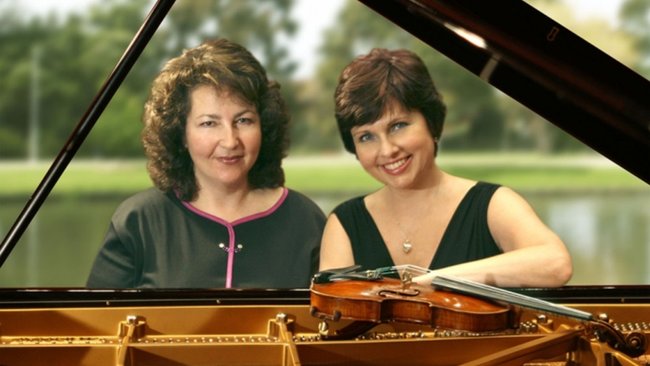
As I suspect, for the rest of us mortals outside the rarefied realm of Donaueschingen, one or the other could be enough, even if the days of astonishment come less and less frequently as the years wear on.   Sadly, the first work on this latest program from Duo Chamber Melange – violin Ivana Tomaskova, pianist Tamara Smolyar – satisfied neither benchmark, under-flying the inventiveness quality by many feet.   Alla Pavlova, born in Ukraine, has resided in New York since 1990 and has provided our duo with other pieces that I’ve not heard.   The six-part orchestral Suite from her ballet Sulamith, completed in 2005, has been recorded several times; she has abstracted from this suite a set of three movements for violin and piano which seem to come from the ballet suite’s first half: Introduction, Ritual dance and Love duet.

After a pretty lengthy opening statement from Smolyar, Tomaskova took over the running with some soaring melodic work, the atmosphere altering for the dance movement, then moving back to lyrical apostrophes for the finale.   Nothing wrong about the performance, even if the violinist urged out her high passages with a touch too much emphasis; the music passed over with no signs of stress.   But its vocabulary proved to be early Romantic, without even the harmonic grinding of Brahms or the chromatic interest of Chopin.   Every so often, the duet reminded me of a particularly fleshy Song Without Words, spiced up by some rhythmic energy in the middle movement which bore a trace of Khatchaturian-style folksy charm from over the Black Sea.   But inventive?   Not much.   Perhaps it all works better as ballet music in that dancers would find it easy to follow.   As for colours suggesting the world of King Solomon (whose love for the serving girl of the title provides the action), they escaped this listener.

Shchedrin‘s In the style of Albeniz is a slight encore piece, originally for piano solo but arranged to employ violin, trumpet or cello in a duo format.   After the Pavlova piece, this came as a welcome bagatelle of modernity.   Written in 1952, the pages offer something like a parody of the Spanish composer’s Espana but their flourishes and semi-moody languishings cleverly summon up the intended atmosphere, here delineated with plenty of firm directness of speech by both executants.

Smolyar then took a solo: an arrangement of the finale to Rachmaninov’s D minor Trio elegiaque No. 2.   This was constructed by the pianist and Anthony Halliday.   I don’t know the piece, although the score shows that it is piano-heavy.   Sadly, little of it remains in the memory apart from a gaucheness in its piling-up of episodes and a surprising lack of sophistication in the piece’s language; but then, Rachmaninov was only 20 when he wrote the work as a memento mori of the recently-departed Tchaikovsky.

The evening’s main work was Prokofiev’s Violin Sonata No. 1 in F minor which is rarely presented by any duo, glossed over in favour of the No. 2 in D Major, a re-working of the composer’s splendid Flute Sonata.  The collaboration throughout this score proved exemplary, if again inclined to stress the inbuilt polemics.   More impressive as an achievement was the whispering-winds-through-a-graveyard passage in both the outer movements, handled with discipline and muted confidence.   The Allegro brusco lived up to its title; the temptation here is to do a Shostakovich and remain on the one taut and loud level for too long.   The succeeding Andante proved masterly, a full-bodied elegy articulated clearly and in excellent dynamic balance, succeeded by a full-frontal, determined Allegrissimo.

What the players seemed to be pursuing in this interpretation was Prokofiev’s clear anti-war message, although, even in the brusco, he doesn’t venture far into the brutal but lightens the texture with something approaching satire.  The emotional atmosphere, despite occasional breaks, remains morose but not depressing.  To the credit of both musicians, we were taken faithfully on a dark journey, one whose ending the composer realized was not going to be achieved by the armistice of May 8, 1945.   Nothing astonishing here, but this sonata is brim-full with inventiveness and it gave a welcome depth to the duo’s presentation.

May Diary

Thursday May 4

BETWEEN STRINGS

Katapult

Melbourne Recital Centre at 6 pm

A kick-off for the Metropolis New Music Festival, this program comes from ‘ a trio of internationally acclaimed soloists’ and is part of a Festival sub-set called the Resonant Bodies Festival.  As far as the actual players go, they include Dylan Lardelli, Lizzy Welsh, Laura Moore, and an extra body in Eric Lamb.  Lardelli is a New Zealand-born guitarist; Welsh is a Melbourne resident and is practised on both violin and baroque violin; Moore is a Sydney-based baroque cello and gamba specialist.  The outsider, Lamb, is an American flautist.   As for their program, there’s a new work by Lardelli, as yet unnamed; Melbourne son Vincent Giles’ silver as catalyst in inorganic reactions and also an apparent spin-off, . . . of sediment; New Zealand musician (I think) Nancy Haliburton’s Music for Guitar; another unnamed piece by Chris Watson, the senior British composer (again, I think); and Austrian conductor Roland Freisitzer’s Music for Eric Lamb of 2015.  It’s a lot to fit into an hour but variety is the spice of new music recitals.


Thursday May 4

Metropolis 1

Melbourne Symphony Orchestra

Melbourne Recital Centre at 7:30 pm

The MSO’s contribution to this festival seems to have shrunk behind my back to two programs instead of three.  And the definition of ‘new music’ also  has undergone something of a sea-change.  This night opens with a gem from the orchestra’s Composer-in-Residence, Elena Kats-Chernin: her re-version of the Prelude and Toccata from Monteverdi’s opera L’Orfeo.  To balance this, the C-i-R has produced a real new work for the occasion in Ancient Letters, although the title suggests a provenance older than the late Renaissance.   Conductor Brett Kelly (or is it Mahan Esfahani, who shares leadership duties and is apparently making a harpsichord contribution?) will revive Brett Dean’s Carlo, the Australian composer’s 20-year-old monument to the murderous Prince of Venosa.   Guest soloist Joseph Tawadros fronts his fresh Oud Concerto and the night is rounded by Boulez’s 1985 Dialogue de l’ombre double, a stunning near-20 minute solo, here in an authorized version for the night’s second/third? soloist, recorder player Erik Bosgraaf, the performer reacting as he moves across the music stands to a pre-recorded tape of himself.


Thursday May 4

Hong Kong Philharmonic Orchestra

Hamer Hall at 8 pm

This ensemble is here for the first time ever, so I know nothing about them.  Not that they’re spreading their riches lavishly; just the one program performed for one night here, the following night in Sydney, and it’s home, James.   Their conductor is Jaap van Zweden, who is shortly going to take up a post as chief conductor of the New York Philharmonic as well.   The program is not exactly breaking new ground, apart from a work by one of the orchestra’s composers-in-residence, Fung Lam; Quintessence was premiered in 2014 and has been performed by the HK Philharmonic every year since. The main work is Mahler’s Symphony No. 1 and guest Ning Feng, with his MacMillan Stradivarius, fronts the Mozart Violin Concerto No. 4.


Friday May 5

LA SONNAMBULA

Victorian Opera

Hamer Hall at 7:30 pm

VO is making a habit of  Bellini concert stagings  –  Norma and I Puritani in previous seasons  –   so we’re inured to the disbelief suspensions required for this smaller-framed masterpiece.   Jessica Pratt sings Amina and here’s hoping she has a happier time than she endured in the company’s Lucia di Lammermoor.  Another survivor from the Donizetti, Carlos Enrique Barcenas, has the role of the sleepwalking heroine’s fiance, Elvino;  Greta Bradman is the advantage-seeking  innkeeper  Lisa; Paolo Pecchioli features as the nobleman with the revolving bedroom door, Count Rodolfo, while Roxane Hislop appears as the heroine’s foster-mother, Teresa.  As yet, I can’t find details of who will take the role of Alessio, the song-writer who has the misfortune to be devoted to Lisa.   Richard Mills conducts and this is a one-night only presentation scheduled to last three hours, which seems pretty excessive unless the interval is a gargantuan one.


Saturday May 6

THE THINGS THAT BIND US

Latitude 37

Melbourne Recital Centre at 6 pm

In an unexpected change of repertoire, this period music trio takes on a contemporary field as part of the recitals in this year’s Metropolis New Music Festival.    The players cast a wide net, with music from Iceland, the UK and America, as well as New Zealand and Australia.  Two works from Maria Huld Markan Sigfusdottir will enjoy an airing: Clockworking for violin, viola, cello and electronics will present the players with a how-many-of-us-are-there challenge, while Sleeping Pendulum calls for only a violin and an electronics operator.   The music is pleasant enough – starkly folksy, if anything.   David Chisholm’s 2011 Trick fits Latitude’s personnel, as far as I can hear;  for bass viol alone comes Lines Curved Rivers Mirrored from 2014 by British writer Edmund Finnis; then follows the delightfully named Slow Twitchy Organs by that brilliant American arranger, Nico Muhly – I’ve heard Fast Twitchy Organs which is electronics only, I think, but not this one; New Zealand’s John Psathas is represented by a piano solo, Waiting for the Aeroplane from 1988, close to the first thing he wrote; Australian Brooke Green’s Reza Barati is a 2016 elegy for the Iranian refugee killed on Manus Island, written for gamba solo, viol consort and drum; and finally comes the work that gives the night its title, a 2013 piece by Australian Luke Howard for organ, violin and gamba.


Saturday May 6

METROPOLIS 2

Melbourne Symphony Orchestra

Melbourne Recital Centre at 7:30 pm

A night of excess; there’s too much here.  Brett Kelly conducts but Mahan Esfahani is also billed as ‘play conductor’.  We begin with Ligeti: the Passacaglia ungherese for solo mean-tempered harpsichord (Esfahani).  Which is followed by Bach’s Keyboard Concerto No. 6 (the Brandenburg No 4 re-arranged).  A recorder concerto by Dutch composer Willem Jeths will enjoy its Australian premiere from Erik Bosgraaf, its dedicatee.  A Vivaldi violin concerto in A minor has been transcribed for oud by the ubiquitous Joseph Tawadros who presents it tonight; British composer Anna Meredith’s Origami Songs, also written for Bosgraaf, end the program.   And somewhere in the middle come two works from the Cybec Twentieth Century Composers Program earlier this year: Ade Vincent’s The Secret Motion of Things, and Connor D’Netto’s Singular Movement.


Saturday May 6

FRAGMENTS

Alicia Crossley

Melbourne Recital Centre at 10 pm

This is the Metropolis New Music Festival’s last gasp and it features a solo artist in recorder player Alicia Crossley.   She kicks off with Bach – the whole G Major Cello Suite arranged for one of her instruments.  Another familiar name is Debussy whose Syrinx for solo flute will also be moved across to a new/old medium.  From her own recording Addicted to Bass from 2015, Crossley performs Andrew Batt-Rawden’s E and Mark Oliveiro’s Calliphora, both for bass recorder and electronics.  Johann George Tromlitz, a contemporary of Haydn, was a flute master of that time; Crossley performs one of his partitas as well as contemporary Dutch writer Jacob Ter Veldhuis’ 2003 work for oboe and ‘soundtrack’, The Garden of Love.  This last, the Bach, Debussy and Tromlitz have also been recorded by Crossley on the Move Records label.


Sunday May 7

ACO SOLOISTS

Australian Chamber Orchestra

Hamer Hall at 2:30 pm

Eschewing the attractions of visitors, the ACO uses its own people as front-runners for this latest program in the national subscription series.  Satu Vanska is director in her husband’s absence and she takes solo responsibilities in Locatelli’s Harmonic Labyrinth Violin Concerto in D Major.   Glen Christensen partners her in Vivaldi’s Concerto in G minor for Two Violins and Cello, that bottom line taken by principal Timo-Veikko Valve, who also gets exposure in an arrangement of Debussy’s Cello Sonata.  The program ends with Mendelssohn’s Beethoven-quoting String Quartet No. 2 in a string orchestra arrangement.  The odd men out are a new work, as yet unnamed, by Western Australian-based James Ledger, and an Andante for Strings, the slow movement from the String Quartet of 1931 by American innovator Ruth Crawford Seeger, Pete’s step-mother.

This program is repeated on Monday May 8 at 7:30 pm


Thursday May 11

BENJAMIN NORTHEY CONDUCTS SIBELIUS 2

Melbourne Town Hall at 7:30 pm

Well, the youngish Australian conductor studied in Finland, so we’re expecting something of an affinity for this most popular of the composer’s seven symphonies; not that studying there or even being a Finn gives you much of an edge in these internationalist days.   The night’s first half is all-Beethoven: the Coriolan Overture, then the Emperor Piano Concerto in E flat where Stefan Cassomenos is entrusted with the solo part.   I suppose this last is what will bring in the punters and hopefully justifies the MSO presenting this Prom (or have they discarded that nomenclature?) on two consecutive nights.

This program will be repeated on Friday May 12 at 7:30 pm.


Saturday May 13

BAROQUE JOINS THE CIRCUS 2

Australian Brandenburg Orchestra/Circa

Melbourne Recital Centre at 7 pm

I thoroughly enjoyed the last collaboration between the Brandenburgers and the Circa troupe in a French Baroque program, part of the orchestra’s 2015 season.  The focus has moved south this time round to Spain and, while actual details are currently lacking, the program will include works by Monteverdi, Falconieri, Kapsberger, Merula and Cazzati – none of whom, as far as I can see, ever visited Spain.  The orchestra has mined its own Tapas CD, which features tracks of music by each of the above-mentioned composers.  But then, most of the time your attention is focused on the acrobats and their extraordinary feats.

This program will be repeated on Sunday May 14 at 5 pm


Saturday May 13

TOGNETTI: PENDERECKI & BRAHMS

Australian National Academy of Music

South Melbourne Town Hall at 7:30 pm

Taking up a residency at the National Academy, Richard Tognetti directs a program split in two.  He concludes operations with the Brahms Symphony No. 1, that much-deferred and well-worth-the-wait product of the composer’s 43rd year.  By way of a lead-in, the ANAM forces perform Penderecki’s 1961 composition for 48 strings, Polymorphia, and the more famous Threnody to the Victims of Hiroshima, written a year earlier for 52 strings.   In between the Polish master’s works comes Jonny Greenwood’s 48 Responses to Polymorphia, a construction that the Radiohead personality wrote in collaboration with Penderecki.   All very neat, concise and inter-related but you’ll need the interval to carry out some mental gear-changes, swerving from 40 minutes of mid-20th century (pace Greenwood’s 2011 homage) experimentation to late 19th century conservatism.


Tuesday May 16

Angela Hewitt

Melbourne Recital Centre at 7 pm

Of course, there’s Bach: two partitas – No. 1 in B flat and No. 4 in D: well-known quantities just waiting for the clarifying exposition of this expert performer.   It’s a solid dose; Hewitt’s reading of both adds up to about 40 minutes’ worth.  Then comes a selection of Scarlatti sonatas, as yet unspecified but you’d expect about six of them, probably extracts from the pianist’s Hyperion album of 16.  Hewitt vaults across time for a bit less than 20 minutes of French music in  Ravel’s Sonatine and Chabrier’s Bouree fantasque, both also recorded on Hyperion.   Oh well, you play to your strengths but, for the dedicated fan, there’s nothing new here.

Angela Hewitt will perform a second program on Saturday May 20 at 7 pm, including Bach’s Partitas 2 and 4, and two Beethoven sonatas: No 2 in C minor and the Moonlight C sharp minor.


Saturday May 20

MSO + JAMES MORRISON

Melbourne Symphony Orchestra

Hamer Hall at 7:30 pm

After a day-time effort for the younger set (Fri May 19 at 10:30 am for Years 7-12), this is an event for those aged over 13 and ‘all  adult lovers of jazz’.   Trumpet veteran James Morrison, one of the most recognized characters in the field, is the focus on this limited odyssey of a night.  For the jazz/classical fogies, Benjamin Northey conducts the MSO in Gershwin’s tone-poem An American in Paris and the Symphonic Dances from Bernstein’s West Side Story.   The rest is less substantial, although covering a wide ambit.  There’s Spencer Williams’ Basin Street Blues of 1928,  Ray Henderson’s The Birth of the Blues from two years earlier, Benny Goodman’s Seven Come Eleven for his own sextet in 1939, and Cat Anderson’s El Gato, written for Duke Ellington and the Newport Festival of 1958  –  a real test for Morrison.   Other items will be Miles Davis’ All Blues, also from 1958; an Afro-Cuban classic, Manteca, by Dizzy Gillespie, Chano Pozo and Gill Fuller; Weather Report‘s Joe Zawinul’s classic 1977 fusion gem and homage to Charlie Parker, Birdland; then back to 1931 for Ellington’s It Don’t Mean a Thing.   Pretty comfortable listening, nothing too confrontational and experimental, but then the night has to showcase Morrison’s trumpet and much of this will carry out that mission very well.


Sunday May 21

SHOULD AULD ACQUAINTANCE

Team of Pianists

Rippon Lea at 6:30 pm

With an obvious Scotch touch and a promised Australian twist, this night in the National Trust stately home’s ballroom stars three singers  – Icon Trio –  and the Team’s own Robert Chamberlain.   Soprano Justine Anderson and mezzos Vivien Hamilton and Jeannie Marsh will lilt their various ways through Ye Banks and Braes, Charlie is my Darlin’, the Eriskay Love Lilt and a few other songs that generally lie undisturbed in the Caledonian ersatz-folk musical crypt.   As well, there’ll be no forgetting Beethoven, who arranged more than his fair share of Scottish airs for sundry vocal combinations.  And contemporary Scottish lights get a guernsey or three; first, the  prolific John Maxwell Geddes will have three extracts from his Lasses, Love and Life song-cycle expounded; we’ll hear two pieces from another cycle  –  William Sweeney’s five-part Luminate: from the Islands; the genders remain imbalanced despite the presence of three excerpts from Claire Liddell’s Five Orkney Scenes; Chamberlain gets to play music by Manchester-born Peter Maxwell Davies and the nationalistic drum beats loud with some more keyboard scraps from Percy Grainger.  Oh, and there’ll be a few Burns recitations to ram the message home.


Thursday May 25

DEATH AND THE MAIDEN

Melba Quartet

Melbourne Recital Centre at 6 pm

What you see is all you’ll get  –  or is it?  The Recital Centre’s handbook promises a two-hour program in the Salon but the only work scheduled is the great Schubert quartet.  For the sum of $199, you and a select group of 64 others will also enjoy preliminary canapes and Narkoojee Winery drinks before and after the performance, an introductory address from the organisation’s executive director Richard Jackson, and the opportunity to mingle with the performers (violinists William Hennessy and Elinor Lee, violist Keith Crellin and cellist Janis Laurs) after they have expended their energies on one of the most draining works in the chamber music repertoire.   As they say in the world of PR, enjoy.


Thursday May 25

MSO PLAYS PETRUSHKA

Hamer Hall at 8 pm

Bramwell Tovey, that amiable British pianist/conductor/raconteur, is back in town for a night of Russian music, more or less.  There’s no denying the provenance of Stravinsky’s great ballet of 1911, written before the composer said goodbye to his motherland for many decades; of course, this is the 1947 revision, carried out from the physical safety if copyright badlands of the United States.   The best-known Russian piano concerto, Tchaikovsky No. 1 in B flat minor, will enjoy the services of Cuban-born Spanish resident Jorge Luis Prats who I believe is performing here for the first time.   He is of an age with Tovey so I’m expecting a steady two pairs of hands on the score.   Russian at one remove, Elena Kats-Chernin is this year’s Composer in Residence with the Melbourne Symphony Orchestra.   To celebrate her position, she has produced Big Rhap and tonight will be its world premiere.  The Tashkent-born composer can always be relied on for accessibility.

This program is to be repeated in Costa Hall Geelong on Friday May 26 at 7:30 pm, and again back in Hamer Hall on Saturday May 27 at 2 pm.


Saturday May 27

STEFAN DOHR: FANFARE & FANTASIES

Australian National Academy of Music

South Melbourne Town Hall at 7:30 pm

Dohr has been principal horn with the Berlin Philharmonic Orchestra for 24 years, which is testament to his enduring ability and sense of service – although, once you have a job like that, where else can you go?   He is taking the Academy brass musicians (and others) through a program of ten segments, beginning with the famous and uplifting Fanfare from Dukas’ ballet, La Peri, followed by some more Dukas in the horn test-piece Villanelle arranged with brass accompaniment.   Thierry de Mey’s Table Music, where three or more performers percussionize on available table-tops, provides a break, after which the Belgian-French fin de siecle ambience continues with Trois Melodies by Debussy, arranged for trombone quartet.   Slovenian composer Vito Zuraj jolts us back to de Mey territory with his Quiet Please from 2014, a construct for three brass mouthpieces.    Back where we belong come Henri Tomasi’s Fanfares liturgiques – well, the final Good Friday Procession from this 1947 suite for brass, timpani and drums.   No concert of this nature would be complete with Copland’s Fanfare for the Common Man, derived from the splendid Third Symphony.   Chou Wen-Chung’s Soliloquy of a Bhiksuni for trumpet solo, brass octet and three percussionists continues the American connection briefly, only to have the night wrenched back to the mainstream with a Tristan Fantasie involving 6 horns, which I assume will offer a digest of the Wagner opera’s main points of interest.  But finally, The Great Satan has the last word with a suite from Bernstein’s West Side Story – arranged for brass and percussion, of course.


Monday May 29

Nikolai Demidenko

Melbourne Recital Centre at 7:30 pm

Two composers only on this program – Scarlatti and Schubert.   Like Angela Hewitt (see above – Tuesday May 16), Demidenko has recorded some of the sonatas – 39 on two albums – so he’s got a lot to choose from.  As with Hewitt, at the time of writing, which ones he will perform has not been determined; well, not to the stage of telling us.   He has also recorded one of his Schuberts – the A flat Impromptu from Op. 90.   But the big C minor Sonata, one of the great final three from the composer’s last months, is a fresh offering.  Mind you, I’d be content to hear this musician play even his beloved Medtner live; like Garrick Ohlsson, he enriches us by the insight and devotion he invests in large-scale and small works alike.


No better way to spend Good Friday

ST. JOHN PASSION

Melbourne Bach Choir and Orchestra

Melbourne Recital Centre

Friday April 14, 2017

andrew-goodwin

                                                                                 Andrew Goodwin

After last year’s sterling performance of the St. Matthew Passion, conductor/artistic director Rick Prakhoff elected this Easter to take his Bach singers and instrumentalists into the St. John score, using pretty much the same soloists as in 2016 (their ranks cut a tad because there’s less work to go round).   With the orchestral and choral forces, I can’t comment on any continuity because the program for that event has gone the way of most print.

But the reading was comparable with its predecessor in general security and consistency.   Prakhoff pointed out in a program note that he had no intention to present a total period interpretation, complete with gut strings, lute, and oboes di caccia ; rather, he utilised what he found practical in performance methodology and, if it sounded well-rounded or even orotund, the aim was to propose one way to interpret this moving work.   Fair enough, I say; better to have a comfortable sound, even if it suggests 19th century practice, rather than witness players struggle with unreliable instruments or trebles jog-trotting through page after ornate page without a clue of what they’re doing.

The Bach Choir is a large body which packed quite a punch in this hall.    After a suitably restless orchestral ritornello, the opening chorus’s Herr ejaculation came as an abrupt explosion; gripping in effect and setting up the operating ambience for the rest of the night with the instrumental fabric falling into the background, even in power-attenuating polyphonic complexes.   But the sheer mass of singers acted as a kind of brake so that, even as early as the semiquaver-heavy unser Herrscher passage, the action was being pulled back; a traction that re-appeared later on in turba segments like Lasset uns den nicht zerteilen and Ware dieser nicht ein Ubeltater.   Still, the chorales impressed uniformly, particularly the spot-on attack on the unprepared Part Two opening Christus , der uns selig macht.  The only flaw in these singers’ work was the tentative sound produced by the tenors; for a body that can boast 20 of them, you’d expect a more resonant presence, particularly in fugato entries.

Prakhoff’s orchestra was fortunate in its bass elements, including a willing double bass pair and Matthew Angus‘ bassoon.   I couldn’t see much of the band’s interstices but gamba Laura Vaughan apparently offered her skills to the complex obbligato for Es ist vollbracht!; Jasper Ly and Nicole Misiurak alternated oboes with cor anglais for the da caccia appearances late in the score;  flutes Jennifer Timmins and Alyse Faith made a clean sweep of Ich folge dir gleichfalls, leader Susan Pierotti led a safe string corps and generated a driving top line in the Betrachte/Erwage double.

If you had to typify this performance succinctly, you’d call it forthright.   None of the soloists showed any sign of lingering over his/her work and the standard of production veered towards clear-cut definition with little space for sentiment or supple elisions.   Once again, Warwick Fyfe sang the Christus role but with an adamantine firmness; this was no figure of pathos but an activist, speaking with directness to everyone from the apostles to Pilate.   For those of us brought up on the tradition of Christ’s words being encased in a nimbus of sustained string chords, Fyfe’s interpretation represents a novel approach where the text’s drama is dominant and the impetus towards death is unabated.

Also continuing from 2016, Andrew Goodwin sang the Evangelist with, if possible, even more distinction.  This tenor has a flawless delivery, projecting each note across his compass with an exemplary balance; not gabbling the lengthy slabs like Die Juden aber and the narrative-ending Darnach bat Pilatum but vaulting sensitively through the recitatives, maintaining the sense of John’s gospel, although prepared to give rein to the slow chromaticism of Peter’s weeping and that hurtling descending flight at the description of Christ’s scourging.   Singing of this elating assurance is experienced rarely these days, and Goodwin struck a fine balance between empathy and simple story-telling; for most of us, I’d suggest, we felt privileged to be in the hall each time the tenor stood up.

Lorina Gore was among the revenants, gifted in this work with two arias only.  Her sprightliness of delivery served well in Ich folge dir gleichfalls, interweaving to telling effect with the escorting flutes; later in the ornate Zerfliesse, mein Herze, the soprano’s craft shone through in her negotiation of the exquisitely figured vocal line and in a well-judged handling of breath control in some difficult legato passages.

Dominica Matthews sang the Passion’s alto arias; she did not feature among the preceding year’s soloists but put her own stamp on this work, handling her allotted arias with a firmness that mirrored her male colleagues.  Her version of the pivotal Es ist vollbracht! proved excellent for its sense of forward motion, in tune with the general dynamic of this performance.   Matthews made sure of offering maximum contrast when the pace quickened for the Der Held aus Juda siegt mit Macht pages, a riveting explosion of bravura in the middle of an elegy.

Henry Choo was indisposed by a back injury, which meant that he carried out his work but then retired backstage rather than sitting in front of us for the performance’s length.   You could hear no signs of stress in his athletic Ach, mein Sinn, the top As in this aria’s central section punched out with a vigour that typified the tenor’s approach to these restless pages.   And his energy remained constant in that exhausting Erwage aria which holds three of the entire work’s most continuous passages of rest-less singing; luckily, Choo has a bright, clarion-clear timbre that made following his line a rare pleasure.

Bass Jeremy Kleeman impressed in the St Matthew Passion and enjoyed similar success on Friday.  While Part One held little content apart from some recitative contributions, he produced a pair of stalwart gems in the score’s second part where the soloist is interrupted/escorted by choral forces; first, with sopranos, altos and tenors in the scale-rich Eilt, ihr angefochtnen Seelen handled here with deftly-controlled restlessness; then, in one of the work’s most consolatory sequences, the chorale Jesu, der du warest tot underpinning the lilting Mein teurer Heiland – a stretch of unabashed candour in this Passion’s high drama and a joy for any bass.

So yet again, the organization achieved a successful Good Friday commemoration, giving Bach’s formidable score a fine airing, crowned by a real sense of accomplishment with a fervent declamatory attack on the concluding Herr Jesu Christ, erhore mich, ich will dich preisen ewiglich!   On which promise, the Bach Choir, Orchestra and soloists delivered handsomely.