Soprano leads the way

L’AIR PARFUME

La Compania

Deakin Edge, Federation Square

Saturday July 16, 2016

Jacqueline Porter

                                                                                  Jacqueline Porter

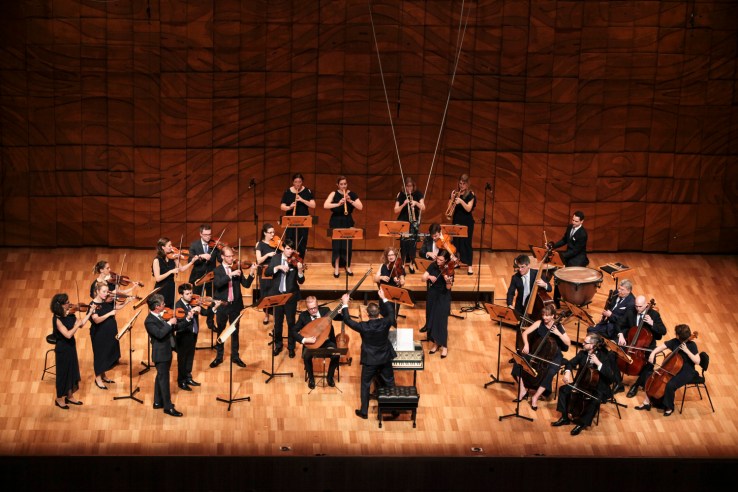
A short program, as is this excellent period music ensemble’s wont, but an entertaining exposition of the subtle pleasures of the air du cour, the court song genre that is linked with the reign of Louis XIII, although those particular decades seem to have seen its finest final flowering.   Much of the music from this program preceded Louis’ accession in 1610; indeed only two names – Pierre Guedron and his son-in-law Antoine Boesset  –  actually worked at that monarch’s court.   On Saturday night, most of the other representatives heard from who worked in this form were retained by Louis’ predecessors, Henri III (Girard de Beaulieu) and Charles IX (Guillaume Costeley).  One of the names – Philippe de Vuildre – actually held posts for the Tudor monarchs Henry VIII and Edward VI.

Danny Lucin and his band – a pretty compact group this time around – gave us a fair tour of the air’s expressive breadth, punctuated by three bransles, a compact group of sequential allemandes by Claude Gervaise, and the only composition by Gervaise’s business partner Pierre Attaignant that you hear today: Tourdion, or Quand je bois du vin clairet if you’re in a singing mood.

This is music that can take you by surprise, breaking an anticipated pattern as in the opening anonymous Bransle de Loraine where the tune’s second half doesn’t balance the first, making you feel that the shape is about two bars short; dancing to this, you’d need to keep your eyes on your partner.  Much the same obtained in a balancing phrase during Guedron’s suspiciously racy Je suis bon garcon, where the singer is nothing of the kind.   Anonymous gave us two of the recital’s more intense pleasures in the air Une jeune fillette with its caressingly soft accompaniment from Rosemary Hodgson‘s lute and the gamba of Victoria Watts, and the Bransle de la Torche, a stately stepper with some resonant open string punctuation marks from Emma Williams‘ violin.

In soprano Jacqueline Porter, the company scored a bright carrying voice, very handy in some of these songs that occupy a middle register for a good deal of the time.   Yet the singer had room to be heard to fine effect in the plaintive Me voila hors du naufrage which lutenist Charles Tessier set at a more sustained high tessitura than much else on this program.   She also made light work of the off-centre accents in Beaulieu’s Rosette, pour un peu d’absence, a lucid expression of disappointment and disdain from a lover whose girl proved  .  .  .  inconstant, as they say.   And another sample of mixed emotional language emerged in Costeley’s Mignonne, allons voir si la rose which sweetly invites the addressee to bed with that tired excuse that her beauty won’t last; as old as Vivamus, mea Lesbia, et amemus but full of innocent charm in Porter’s calm, beguiling delivery.

Porter held her own in terms of audibility, the only occasions giving cause for concern emerging when Lucin’s cornetto and Glen Bardwell‘s sackbut were together in the mix.   Even so, she fared better than Hodgson and Watts who were inaudible during some of the dance doubles.   Christine Baker contributed a stolid if timbrally unadventurous percussion, but the ensemble needed more textural variety  –  at least another violin, or the buzzing energy of a dulcian or two.    A possible move might be to utilise two singers – even three? – as some of this music could be performed to fine effect with the supporting upper lines sung rather than (or as well as) played.

La Compania ends its Deakin Edge year on Saturday November 12 with Il Paradiso, a turn around the early Italian Baroque with particular reference to the age of Monteverdi and his contemporaries.

Remembering the gentle man

PETER SCULTHORPE: A RETROSPECTIVE COLLECTION

Various artists

Move Records

Peter Sculthorpe

He was the most fortunate composer of his time and place; everything came to him without apparent effort – critical plaudits, friends, commissions, public appreciation, honours and prizes.  Nobody had a bad word to say about him, although some of his contemporaries were snippy at his run of successes.   Even his failures served as momentary hiccups rather than career-threatening disasters; the 1974 opera Rites of Passage at the Sydney Opera House scored some favourable reviews.  When Peter Sculthorpe died two years ago aged 85, a national presence closed up shop and suddenly we were poorer for it.

Critics and composers usually react uneasily together; I don’t know many of the former who go out of their way to offend deliberately – a few, always unqualified for the job – but many musicians have no desire to read anything but praise and, if they are writers, have little charity with even the most benign mind that grapples with their work and reaches an ambiguous or a disappointed finding.   Sculthorpe, pretty much alone in my experience, had broad shoulders for public appraisal; moreover, he seemed to bear no grudges.

I met him once only but had some slight correspondence over the years.   Attempting an eventually futile M. A. in 1974/5 with a poorly equipped supervisor, I contacted three Australian composers about specific pieces in their respective oeuvres.  One of them informed me where I ‘might’ be able to buy a copy of his deathless masterwork; another refused to correspond except through his publisher; within a few days, Sculthorpe sent back a Faber edition of his score with an encouraging inscription.   A bit less than 30 years later, this time essaying a M. Mus., I contacted four composers asking for interviews.   All obliged, but Sculthorpe as host in his Woollahra house was particularly welcoming – affable for hours, unflappable when confronted with unintended impertinences and, after he finally read the thesis, generous in remarking on its few strengths.

This CD offers a miscellany, much of it familiar to hardened concert-goers because of certain pieces’ popularity with musicians, but nearly all of the content speaks in Sculthorpe’s own language.   The tracks come from previous recordings, nearly all on the Move label with one ring-in from the Colgate-Rochester Divinity School Chapel, New York. The period covered is two decades – 1975 to 1995 – but one piece harks back to the occasion of a memorable Sculthorpe success: Love 200, written for a 1970 Sydney Symphony Orchestra Town Hall Proms concert and featuring the group Tully.   You won’t find that psychedelic extravaganza here, nor any of the Sun Musics or Kakadu; all of this particular retrospective is confined to chamber music.

A few of the pieces are arrangements, some of them enthusiastically endorsed by the composer, like Wagogo Plains (originally the Morning Song, one of the composer’s more popular lyrics) which has Max Cooke and Darryl Coote performing the piano duet parts but superimposed is throat singer Dean Frenkel contributing a high flute-like melody above a softly whirring vocal support drone.   Reshaped for plucked instrument ensemble, the Little Suite of 1983 sounds more French in flavour than ever, the Concordia Mandolin and Guitar Ensemble timbre dripping Piafian nostalgie; Michelle Nelson‘s orchestration suits the opening Sea Chant, its string ripples and sizzles highly atmospheric for the lilting main melody; the following Little Serenade with its rueful sequences of 2nds veers closely towards the sound world that Sculthorpe aimed for in the suite’s concluding Left Bank Waltz.

The version of Songs of Sea and Sky that opens the CD is performed by flautist Derek Jones and pianist Leigh Harrold.   Of the original work’s seven parts, six appear in this reading, quite obviously with Sculthorpe’s endorsement.  Based on a Torres Strait island song, the suite is an integrated composite, even with the introduction of bird chirps in the Mission Hymn movement which turns the basic material to illustrate a Western evangelical end. The performance has all you could want: flawless articulation from Jones and an unflurried handling of the keyboard part, notably at the start of the Dance-like movement.

The odd-man-out from New York is guitarist Jonathan Paget playing From Kakadu, for which the composer re-employed the main theme from his large-scale orchestral work.  Written for Darwin’s 1993 Shell Guitar Festival, this sequence of four movements sits astride complementary worlds of remote landscape musing and responsive observation.  For example, the initial Grave suggests isolation, a lonely figure in a country without horizon; the following Commodo gives the impression of a complaisant visitor, ambling through the Territory, mirrored in the warmly responsive account that Paget gives of the final Cantando –  contented music without much exertion to interrupt the atmosphere of languor.

Dream Tracks for clarinet/violin/piano trio is another Territory piece in four sections that offers exposure to all its executants: a long piano solo for Stephen Emmerson at the start, an unusually concordant duet for Floyd Williams‘ clarinet and Michele Walsh‘s violin during the  third Lontano movement, while Sculthorpe revisits one of his distinctive Arnhem Land chants, Djilile, in the even-numbered movements to hypnotic effect, the whole rising to a sort of cock-crowing jubilation and peroration as the finale circles onto a rousing D Major full-stop.

The piece that harks back to Sculthorpe’s 1970 Proms triumph, Night Song, appears in an arrangement for violin, cello and piano performed by Trio Melbourne (Isin Cakmakcioglu, Rachel Atkinson and Roger Heagney respectively).  Its minor mode melancholy still has great appeal; a slow-moving work, it makes few demands on its interpreters or its listeners – a placid, sonorous oasis.  The Melbourne String Quartet plays Sculthorpe’s 9th exercise in the form:  one movement with five sections, the first two accomplished very quickly, soundscapes of little depth preceding a long central elegy which boasts a 12-note melody which is humanised by plenty of tonal unde

rlay.   I’d forgotten how this ensemble   –  violins Carl Pini and Gerard van der Weide, viola Jane Hazelwood, cello Arturs Ezergailis   –  could produce a laudably clean and mobile output on its better days.  This version has no surprises outside a few in the score itself, like a sudden ponticello slash of semiquavers across a quiescent soundscape, showing the teeth behind the muzzle.

The collection ends with 11:59 PM, originally the Nocturnal of 1989 which Robert Chamberlain recorded the following year for Move.  Over his agile piano part, Dean Frenkel offers his own superimposed throat-singing commentary.  Once again, it must have been all right with Sculthorpe as he has included this superscription in his catalogue of works; after the Wagogo Plains effort earlier on this disc, I think that a little goes just far enough.

At the end, you have heard a fair sample of the composer’s smaller works, enough to give those unfamiliar with his voice a good idea of his individual language and his emotional breadth, as well as an unabashed statement of connection to the continent’s vastness as he perceived it.  For those of us with more years of Sculthorpe experiences than we might care to remember, some of these pieces surprise by their power to recall those years when the 20th century came alive in Australia’s music, and when a new work by this amiable musician was a matter to generate passionate discussion and interest.    And it brings back to the mind  –  well, this one  –  memories of a kind, generous and gentle soul whose avuncular presence is greatly missed.

Everything you ever wanted to know

RUSSIAN RARITIES

Larry Sitsky

Move Records MD 3328

Russian Rarities

Heading towards his 82nd birthday,  Larry Sitsky is a surviving member of that group of composers who came to prominence in the 1960s when Australia’s musical world woke up to the 20th century.   Not part of the Sydney collation of Sculthorpe, Meale and Butterley; non-allied with the Melbourne league of Dreyfus, Werder and Gifford; Sitsky has made his base for many years in Canberra, where he is still Emeritus Professor at the Australian National University.   His renown as a pianist has endured through his teaching and recordings, this particular one being a double album released in 2010; on it, one of his major preoccupations is given ample space and you would find it hard to detect a similar undertaking elsewhere.

Born in China of Russian parents, the composer/pianist studied with Egon Petri and, through him, can claim some descendant status from Busoni.  Throughout these discs, you come across example after example of a 19th century European virtuoso approach to interpretation where the letter of the law is not strictly observed, the player comfortably taking liberties, mainly with respect to rhythm which becomes a moveable feast.  Much of this music I’ve not heard before and some of it fails to engage immediate sympathy.  Yet the enterprise is much more than a musicological research tool and the performer’s authority of utterance is mightily impressive.

Towards the end of Disc 2, the program  moves to an assemblage of small pieces, several of them so slight in length and substance that they almost disappear simply through weight of numbers.  But the chief works that Sitsky presents constitute a remarkable journey from the next-to-last stages of Russian Romanticism, through the outbreak of mysticism spearheaded by Scriabin, to the Constructivist movement that followed the 1917 Revolution.  These focal tracks begin with Anton Rubinstein’s Op. 88 Variations in G, Vladimir Shcherbachev‘s Sonata No. 2,  Nikolai Roslavets‘ Second Sonata, and the First Sonata by Alexander Mosolov, the man once famous for his Iron Foundry orchestral essay in Futurism.   Scattered between these are  smaller scores by Leonid Polovinkin, Nikolai Obukhov, a suite for sophisticated children by Rebikov, and will-of-the-wisp bagatelles by Vladimir Deshevov and Stravinsky’s one-time intimate, Arthur Lourie.  And that’s not all: some scraps by Roslavets and Mosolov offer slight fleshings-out of these writers’ sonatas.

Listening to these discs in succession is certain to lead to empathy overload, sometimes disguised as fatigue, so you’re best advised to oscillate between the long and the short in bursts, rather than embracing Sitsky’s program as a one-sitting continuum.  Not that the opening  Rubinstein Variations offer many difficulties.  Unlike the rest of the album’s contents, this was a live performance from 2006, performed on an elderly Ronisch instrument at the Canberra School of Music.  Rubinstein wrote his solid construct in 1871, and Sitsky’s piano was made for the Melbourne International Exhibition of 1880 so there is a kind of historical congruence to the recording, even if the Ronisch is not exactly in tune in parts of its higher compass.

The theme is a noble extended chorale that emerges after an opening recitative for bass octaves.  Sitsky adopts a free approach to the bar-line’s exigencies as early as Variation 2, by which stage you realize that the shade of Chopin is present, even if the Polish composer’s inspired manipulation of the keyboard is not.   The Marcia Variation 3 would never do for any parade ground, thanks to lots of indulgent arpeggios.  The Vivace of Variation 6 comes over as leaden-footed, a Teutonic romp.  During the following two variations, the work takes on a predictable format; Rubinstein is never happier than when leading you into the obvious.  At Variation 11, Sitsky employs a different rhythmic pattern to the printed one, and lets fly with the individuality in the final segment with octave transpositions, hefty use of the sustaining pedal that blurs any rapid-fire passage work, idiosyncratic emphases of notes, semiquavers transform to triplet quavers.   All of which could have been part of contemporary practice in the composer’s era, especially as we know that masters like Liszt and Paganini delighted in adding quirks to stable if ordinary structures. The only real objection to this interpretation is a looseness in the joints, too much rubato when strict persistence in the pulse would give the work some flesh-strengthening muscle.

The Shcherbachev Sonata was written in 1914 when the composer was 25 and gamely experimenting.   A one-movement rhapsody, it shows an awareness of developments in harmonic vocabulary, at times a less hard-edged Prokofiev tongue, at others a Rachmaninov-like chromatic facility with much roaming anchored in tonality.   This composer is prone to employing a strong-voiced melody with plenty of surrounding ferment, his climactic moments as rhetorical and passionate as anything in the preceding Rubinstein variations.

On Disc 2, Sitsky’s first major reading is of the Roslavets sonata which reveals – as do several other tracks on this album – the influence of Scriabin, although this later composer differs from his predecessor by being pretty keen on octave declamations in both hands.   Sitsky continues to treat the set tempi erratically, with clipped triplets and a breezy treatment of time values in gruppetti.   The single-movement sonata follows the Liszt practice of referring to itself but what impresses above all else are Sitsky’s pains in mastering its myriad chord structures, its abundance of trills and its typically 20th Century tendency to leap inconsiderately across the full compass of the piano itself.

Mosolov’s vocabulary is about as confronting as Soviet music gets; the Iron Foundry is an object lesson in depicting industrial, i.e. factory, power with relentless drive, and my only other experience of this writer’s work,  Susanna Stefani-Caetani’s execution of the Piano Concerto No. 1 with her husband Oleg Caetani and the Melbourne Symphony Orchestra in August 2006 was memorable for its execution more than its material.   Sitsky gives the opening tone-row outline plenty of breadth before the inevitable barrage of massive block chords oscillating with discernible melodic motives over bass rumbles.  Once again, this sonata comprises one movement that juxtaposes episodes of varied texture, employing cells rather than more solid continuous arches, but at the core its world is pure Constructivist, heading towards the brutal.   Mosolov is happiest pounding ideas around the instrument rather than settling in for a good round of development.  For all the talk of his use of rows and a genre of 12-tone writing, the composer was no doctrinaire in his composition’s organization, as witnessed by the multiple repetitions of notes, chords and phrases. Sitsky contrives to preserve the 1924 sonata’s ebbs and flows of tension, right up to the soft, gloomy concluding gestures.

Of the less substantial pieces, Polovinkin’s Ereignis VII stands out.  Three internally fraught fragments make an arresting sequence, enigmatic in their terseness.  During the second, L’action, the composer inserts some notes for prepared piano – a card inserted between some centre-range strings – that startle for their unexpectedness.  The third, Souvenir, loses its drive as the performer again suits himself about both pulse and pace.

Lourie’s Formes en l’air, written without bar-lines or time signatures, reveal a moody quiescence, typified by some staccato pointillism and abrupt blurts of activity.  The last of the three pieces is formally apprehensible, the most impressive – and impressionistic  – of the set, with some Ravel washes initiating an unpretentious if brief experimental paragraph.  This composer’s slightly earlier five Syntheses occasionally startle by their anticipation of the sort of writing that came into vogue about 1950, but the revenant at this particular feast seemed to me to be Schoenberg; while Lourie’s brevities seem flighty, there are suggestions in them of the 1909 Drei Klavierstucke.  Like his great contemporary at this developmental stage, Lourie is not breaking away from his time, yet these tracks are like nothing else in Russia from the period – at least, judging from the context of these discs – and much more sophisticated in their elements than anything that his colleague Stravinsky had produced at this stage.   If one of the Syntheses stands out, it is No. 4: fertile in manipulation of material, its movement both strong and delicate.

Rebikov’s Music for Children and three extracts from the Op. 15 Melomimiques enjoy fine service from Sitsky, the former not as patronising as you might think, certainly not over-saccharine in flavour but packed with whole-tone, bitonal, and suspense-through-non-resolution surprises. The program concludes with two samples of Obukhov’s pianistic mysticism.   Revelation consists of six excursions into metaphysical areas such as Death, Immortal, and The Distress of Satan.   In atmosphere, the suite is placidly neurasthenic, hard to penetrate because of the composer’s mysticism where The Void turns out to be a pretty active plane.   The state of perpetual existence is typified by bleak isolation, and the Devil’s agony lasts only long enough for a few punitive pin-pricks.  The final diptych of Le temple est mesure: l’esprit est incarne and La paix pour les reconcilies would have delighted Messiaen with its three-stave spread and clangorous chords juxtaposed with reserved lulling.

A labour of love, then, this large-scale exercise.   You have to admire Sitsky’s dedication and erudition, as well as the clear evidence throughout these recordings of his innate virtuosity.   A lot of it makes for hard listening – not just the sheer percussiveness of a morsel like Deshevov’s Rel’sy which imitates Bartok’s Allegro barbaro in several respects – but the sustained aural onslaught of the three focal sonatas.   This music-making gives some welcome substance to our knowledge of a strikingly fertile time in Russia’s musical activity that, for many years, was in danger of being wiped from the memory of all but a few true believers.  We should thank Sitsky for his remarkable gift of restoration.

Impressionism lives

THE SKY IS MELTING

Marianne Rothschild and Glenn Riddle

MOVE Records MCD 505

The Sky is Melting

Here’s a window into a corner of the country’s musical composition world, one that is centred around Melbourne.  Both performers are locals: violinist Rothschild studied at the Victorian College of the Arts and the Australian National Academy of Music and has freelanced round the country; Riddle is currently Lecturer in Keyboard at Melbourne University’s Conservatorium of Music and a pedagogical force in the national music sphere.  Much of what they present on this now somewhat dated disc (released in 2014) is bound up with their collaboration; in fact, the major work on this recording, Linda KouvarasBundanon Sonata for Violin and Piano, was written for the duo.  Andrian Pertout‘s Sonus Dulcis – a construct that the composer keeps on re-framing – was arranged for these executants, who also gave the premiere performance of William James Schmidt‘s Argentine Etching.

Kouvaras has provided both the opening (and title) piece of this CD, as well as the substantial sonata.  Both have connections with the composer’s stints as artist-in-residence at the Shoalhaven River estate of Arthur and Yvonne Boyd.   In the brief initial vignette, Kouvaras gives the piano high arpeggio patterns to offset a slow-moving violin melody which suggests the heat of mid-day at Bundanon, although the images come courtesy of an impressionist sound-world so that the pictured countryside has a Gallic tang complete with whole-tone chords and little rhythmic variety beyond a 4/4 pulse.  Some double-stops around the 4:20 mark make a small change of diet, but the last pages move into a more satisfying atmospheric area with the violin meandering in desultory style above a stolid piano part, this combination making a fair proposition for sonic heat exhaustion.

Stuart Greenbaum‘s six Occasional Pieces are just that: bagatelles written for two specific birthdays, as well as a birth-day, a funeral, a marriage and the last of the set (and longest) serving as a wedding gift.   How to be in the world makes for pleasant listening, Rothschild’s violin operating in a high register for the most part, with inescapable shades of Vaughan-Williams’ lark, some small jazz interpolations disrupting the idyllic sweetness.  The lament of Life Cycles emerges as a violin solo; a slowly striding line, generally diatonic in matter, punctuated by some Celtic-style skirling and a series of ‘snaps’.   For Alette begins with  brisk pizzicato that moves to a rising scale motive with Riddle’s eloquent piano doubling the string line until the ternary shape is finished off with a sparser version of the opening gestures.   Ideas follow each other in quick succession during The 4th Saturday in April piano solo, which offers no real development but maintains an optimistically major tonality, appropriate for this small-scale epithalamium.   Another violin solo, Curves on the Great Ocean Road, proposes a pattern of self-reflecting turns, nowhere near as unsettling as the real thing, but its central section has intimations of the drive’s rugged terrain. Finally, The Lake and the Hinterland revisits the British early 20th century folk music arena with a broad tune treated in turn by both instruments, a dour middle interlude, before a reversion to the Midsomer landscape.  Some spikiness interferes with the prevailing harmonic sweetness but the piece concludes in an unambiguous D Major.

Better known to me as a pianist, William James Schmidt avoids the temptation to do a Piazzolla in his Argentinian Etching, although you can hear a plethora of Latin suggestions as well as irrepressible murmurs of a the dansant.   It maintains a steady common time pulse in a combination march-tango.  Following the crowd in this disc’s ternary form feast, Schmidt stops for a gentle meander, charming if aimless, which comes to a mutually reflecting and reinforcing climactic point before the duo hurtles back to the dance where the cross-rhythms and syncopations become pronounced and the dynamic tension heightened.

Sonus Dulcis by Andrian Pertout has a Japanese modal foundation, yet it’s not as simply utilised as it would have been in less interesting hands.   On occasions, Rothschild makes sounds that could suggest a bowed lute but, apart from some pizzicato, a dash of col legno and a hefty sprinkling of piano movement in fifths, the Orient is hinted at more than imitated.   At about the 3:30 point, the unlikely spirit of Spain and de Falla emerges, interrupted by a violin cadenza loaded with Japanese folk colour, before the Hispanic/Nipponese combination returns in a sort of 6/8 gigue finale. Most of the works that Rothschild and Riddle perform can be taken at face value; this piece offers more of an interpretative challenge.

The Kouvaras sonata, in four movements, has its feet firmly planted in the Boyd estate’s landscape.  The substantial opening, Pulpit Rock, is a sonic view of Boyd’s paintings focused on this geological formation with the violin as unabashed preacher while Riddle underpins with solid, pillar-like chords.  The composer uses brief phrases from the Ein feste Burg chorale and, on tremolo violin, a fragment from Mahler’s Des Antonius von Padua Fischpredigt song to add a bit of European context to the abstract sermon that this landscape advances.  But the portentous keyboard chords wear out their usefulness well before the movement’s clangorous conclusion where the violin alternates high and low notes as a gravity-loosening device.

For her second movement, The River Changes,  Kouvaras begins with a floating violin line, supported by a supple ripple of piano figuration.  Rothschild generates a clean unstressed arch, her vibrato well-regulated throughout what amounts to a meditation on the Shoalhaven, revisited after a decade-long gap.   As the sonata’s scherzo, Ballad of the Singleman’s Hut takes a syncopated waltz format; not that distracting in its soundscape surroundings but with something contrived about its shape, possibly in the rhythmic basis which lacks consistency, as though the intention is to unsettle the listener by substituting the incomplete for the spectral.

The sculptures at Bundanon, some of which are in trees, gave Kouvaras the impetus for Earth Art Could Fall from the Skies which jumps from one block of activity to another, bringing to this listener’s mind the formal practices of Carl Nielsen.  The action ceases at about 3:22 for an interlude of high tessitura violin and low bass movement – a bush silence passage – and then the rapid-fire action returns with the opening repeated patterns revisited.  A series of smash-and-grab piano chords with violin top notes bring this considerable composition to an affirmative end.

While the performers demonstrate a fine precision and finish in their work, neither Rothschild nor Riddle is greatly overtaxed by much on this CD, the Kouvaras sonata offering fair but not virtuosic challenges.  What makes the collection surprising is the conservative nature of most of the compositions.  Schoenberg said, ‘There is plenty of good music to be written in C Major’; much of the work to be heard here could be used as an attempt to substantiate the thrust of that statement.  Not that this adoption of neo-orthodoxy in compositional parameters should be decried; it’s just something that takes me aback – not for the first time and probably not the last.

A few of my favourite things

TIMELESS

Tamara Smolyar

MOVE MD 3372

Smolyar

A luminary at the Sir Zelman Cowen School of Music at Monash University, Tamara Smolyar is one of this city’s foremost pedagogue/practitioner pianists.   The product of an extensive number of Ukrainian, Russian and Australian teachers. she is well-known outside Monash circles for her partnership with violinist Ivana Tomaskova in the Duo Chamber Melange recitals at the Melbourne Recital Centre.   On this disc, she performs a pretty broad program of works that she has made part of her repertoire, a few of them familiar but most more honoured by reputation than by performance.  As she indicates, the music itself transcends its own time of creation, having become part of our long-running and all-too-familiar European tradition.

Smolyar begins with the CD’s earliest music, Beethoven’s 32 Variations in C minor, which she works through with assurance and a no-nonsense approach, handling the first eleven of the set as a continuous unit before the tone changes to the major at Variation 12.  The performer is linked to a substantially authoritative and orthodox school which takes its Beethoven without reconstructions or torques on accepted practice, so the return to the home key in Variation 17 continues the direct, somewhat pell-mell attack that leads to the elongated final variant which brings the piece to a determined conclusion.  The work is carried off clearly enough, although Smolyar is not hesitant in using the sustaining pedal, even during the more thick-textured passages.

Next come two Chopin nocturnes from the back of the book: the Op. 62 No. 2 in E Major and the posthumous Op. 72 No. 1 in E minor which are the last and first written in the sequence.   For the E Major Nocturne, Smolyar holds back on the potential for glitter, taking plenty of time over the mini-cadenzas that punctuate the melodic flow but heightening the drama where it should be emphasized from bar 40 on with a sensible subdued thunder in the work’s low-lying central segment.  The composer held back the E minor attempt and, to me, the piece only gets into its stride at the octave restatement of the first theme.  But this interpretation offers a fair case for the nocturne’s survival in the canon, the later treatments of the material handled by Smolyar with sensible restraint and flexibility.

A bracket of Rachmaninov impresses for its internal variety.  The Elegie in E flat Minor makes its points across a canvas of slowly rising passion with some fierce moments of intensity in the later pages, the elegiac quality eventually subsumed in tragedy.  Smolyar comes closest to familiar ground on this disc with the Prelude in G sharp minor giving a generous account of the piece’s difficult central stages, the metrical disposition changing from the continuous current of semiquavers in groups of six.   To her credit, Smolyar makes light work of the many punctuating splayed chords, even if you might have expected a greater dynamic explosion in the lead-up to the D sharp Major climax.  But the outstanding element in this set comes with the Etude-tableau Op. 39 No. 1, coherent for once as a study that tests the right-hand’s stamina and the rhythmic security of the left.  A continuous energetic surge that becomes more impassioned as it progresses, this remarkable exercise in dexterity enjoys an unexpected clarity of texture in this realization.

Shostakovich’s Prelude and Fugue in E flat minor provide a bracing, slightly acerbic interlude with an enviable lightness in the four-part fugue, all the more appreciated after the fraught, tremolo-informed harbingers of disaster that precede it.

So far, the recording’s origin has been the Iwaki Auditorium in the ABC building, Southbank.   For the last piece, Franck’s Prelude, Chorale and Fugue, Smolyar changes venue and piano.   It remains unclear what instrument the ABC provided but she uses a Schimmel Concert Grand for this last offering and the sound becomes less full-bodied; clearer to discern the composer’s contrapuntal interweaving, but more bright in its timbral quality.  The artist handles with calm virtuosity the score’s many demands – the roiling sequential exercises of the first part, those solemn rolled chords in the chorale and the all-in-together-boys textual imbroglio of the work’s last section – yet the final impression is more of a task well accomplished than an engrossing journey from restlessness to affirmation.   Still, the CD as a compendium serves as a reminder of the many byways available for exploration to be found in between (or behind) the better-known masterworks of the serious pianist’s basic repertoire.

Wiping the floor

TEMPESTA

Australian String Quartet

Melbourne Recital Centre

Monday July 4, 2016

Australian String Quartet

                                                                            Australian String Quartet

And then there are the nights when everything pans out   –   the playing is as close as live performance gets to flawless, the works programmed combine (despite appearances) to offer a solid display of prowess and musical intelligence, any defects are swamped by the context in which they momentarily rear up.  The latest subscription series recital from this ensemble was exemplary: four performances that should have had the Murdoch Hall audience roaring for more.

Violinists Dale Barltrop and Francesca Hiew again impressed for the unusual nature of their upper-layer combination. Both seem to read each other like performers with an inbuilt agility resulting from decades passed in shared experience, their partnership generating lines rich in fine synchronicity and balance.  At the same time, each has a distinctive colour: where Barltrop produces a finely spun, athletic line, Hiew offers a sturdier heft to the combination with a vitally pronounced lower register.  Further to this, violist Stephen King and cellist Sharon Draper collaborate in similar style, King’s trenchant output a fine match for one of the fiercest bass lines at play on the local chamber music scene.

Not that this harnessed aggression came to the fore straight away; the group opened with Webern’s Five Movements for String Quartet, that ground-breaking suite of atonal wisps and blurts that somehow manages to make a set of individual statements that cohere to present its listeners with a coherent sound-world, despite those sound-production techniques that still have the power to startle, especially the lavish use of sul ponticello directions and the application of mutes.  What took you aback about this reading was a tenderness given to the disjunct strands of sound that permeate each page; in the ASQ’s hands, Webern’s pp markings were barely audible and the expressionist suggestions of the opening movement and later the restless ostinati and unison eruption of the third came over with a veiled drama that satisfied much more than the galvanic spasms of action that other ensembles favour.

A rigorous respect again emerged in the following Haydn,  Op. 20 No. 2 in C Major.  Draper’s cello set the scene with an impressive firmness as the composer begins jockeying with his force’s contrapuntal interplay, and the group’s determination was sustained up to the jaunty fugue/finale.  What you noticed was a lack of over-simplification, so that the Menuet came across with an unexpected grittiness; not that the reading lacked bounce, but the chromatic fall of the movement’s second half impressed for its dourness after the high-flying skittishness of Barltrop’s G major ascent to a high B immediately beforehand.  And the unison opening to Haydn’s Adagio, in its purity of articulation, brought back memories of the Webern’s more dramatic bars.

Joe Chindamo‘s 2013 String Quartet No. 1 is cast in the traditional four movements: Tempesta, Lament/Seduction, Frenzy and Flight.  An amiable work, its emotional statements avoid extreme expression; the promised storm is a pretty well-controlled outpouring and the frenetic pages later on show up surprisingly balanced and well-proportioned.  For all its moderate temper, the piece enjoyed a deft, enthusiastic exposition from these players who ensured that the composer’s expression markings and tempo shifts were given full measure, from the oscillations between storm and momentary calm in the opening movement, through the pizzicato-heavy vibrancy of the Frenzyscherzo, to the psychologically ambivalent finale.  Chindamo employs lucid melodic and harmonic structures, looking back on the quartet’s accepted heritage rather than employing the lingua franca of the post-Webern school; a blast definitely back to the past, but none the less attractive for that.

Just in the right program position, the ASQ came to Mendelssohn’s last in F minor which is inextricably linked with the death of his sister Fanny.  The score is a moving revelation of the composer’s profound reaction to this loss, an essay in a quality that rises above gentlemanly despair, where the composer’s craft is subsumed in an atypical and sustained tragedy.   Here the performers gave another sterling interpretation, maintaining the tension from the first Allegro‘s urgent rustlings onward.   Despite the intensity of attack, each musician maintained a consistent dynamic level in the ensemble, the work reaching its climax at the change in key signature in the core of the Adagio where the  delivery of Mendelssohn’s fortissimo outburst with Barltrop riding the blast was both emphatic and dangerously intense, the sort of risky straining at the bit that you rarely hear from more temperamentally circumscribed ensembles.

In this powerful piece, the ASQ capped off a generous and redoubtable stretch of playing where memorable passages remain in the memory long after, like the insistent syncopations disrupting the even pulse during the first part of the Allegro assai, and the beneficence of those two melting passages where the quavers and triplets stop for the first movement’s placid interludes.

In  fact, the only complaint you could make about this night would have to do with the audience.  It amazes me that some concert-going individuals will insist on giving full vent to their adenoidal or catarrhal problems at inopportune moments mid-performance.  Even more startling is the dual practice by such recital hall offal of continuing to inflict their medical drawbacks at large for extended periods, at the same time making no effort to muffle their all-too-audible mucous movements.  You can sit in the Recital Centre’s Salon for a solid hour and not experience any of this unpleasantness; up in the Hall, it seems, anything goes.  An experienced usher once told me that elderly people are often unaware that they are acting offensively; maybe, but more than a few of these clowns look suspiciously middle-aged.   Some old adages make good sense – like, if you’re sick, stay home.

That’s entertainment

GIOVANNI SOLLIMA: SEQUENZA ITALIANA

Australian Chamber Orchestra

Hamer Hall

Sunday July 3 and Monday July 4, 2016

Giovanni Sollima - Copy

                                                                                  Giovanni Sollima

In the absence of their resident guru, Richard Tognetti, the ACO players hosted Italian cellist/composer Giovanni Sollima as soloist and, in some cases, director.  As the afternoon rushed past, you weren’t quite sure how much direction was involved; three of the four works in the program’s first half didn’t involve Sollima, although he made up for that in a dominant display after interval.  In all, he played a Leo concerto, an arrangement by his father of one of Rossini’s Old Age Sins, and wound up with his own concerto, Fecit Neap 17..  And there is no doubt that these three comprised Sunday afternoon’s most remarkable playing.

He’s an attention-grabbing cellist, although at the first instance this was due to his remarkable virtuosity in the Leo Concerto No. 3 in D minor, that composer one of the masters of the Neapolitan Baroque.  The four-movement work, patterned roughly on the church-sonata form, can be treated with too much care,  but not this time.  Sollima vaulted into its wide melodic arches with no fear and a powerful right-hand urging on zealously the opening Andante grazioso with its melodic minor peculiarities.   As the concerto moved past, the tenor-clef solo line took on an added fascination thanks to Sollima’s chameleonic handling of texture and dynamic; for all the surprises (limited as they were) in the development of the Con spirito and Allegro movements, what really captured attention was the volatile cellist.

Of course, the ACO loves a showman and they got one in spades with Sollima.  While the Leo concerto walked a fine line between extraversion and control, the second part of the program spilled over into unbridled display, first through Rossini’s Une larme Theme and Variations with the ACO strings playing straight-man to the soloist’s wise-cracking hero, the languid and frenetic variants revealing a fully-realized catalogue of devices and effects,  negotiated with both legerdemain and humour.   Sollima’s own composition refers in its title to an inscription abbreviation that features on 18th century manuscripts from Naples; in its content, the concerto moves between a stringent cantabile mood and hurtling dance rhythms that suggest 20th century dance music, simplified Bartok, and Stravinsky without an editor.   The soloist plays games – walking on after the piece has begun and wandering round the ACO, finding a hole in the floor to put his instrument’s end pin, twirling his cello like a dance partner, racing his accompaniment in stretto passages – and gives himself a breath-stopping series of production hurdles to handle.

It all made for fun times, with the benefit of seeing and hearing a charismatic musician at work.  Sollima makes a fine jewel in this ensemble’s setting; he is all fire and passion, bounding through his work with animal spirits and sensuality, while the ACO keeps its cool, giving strait-laced support for the most part and, while appreciating the skills of their guest, seemingly content to surrender the limelight, even in the hyped-up irregular rhythms of the wilder stretches in the cellist’s own composition.

All the program’s music made up a sort of Italian sequence, beginning with an arrangement for strings (with harpsichord and theorbo providing continuo) of Monteverdi’s Lamento della ninfa madrigal; pleasant enough as a throat-clearer but quite vapid in effect because the (eventual) movement of the four vocal lines over a four-note cantus firmus loses most of its dramatic punch unless the piece is sung.

Then came some a massive temporal leap and a realization of the program’s title: Berio’s Sequenza VIII for violin and Sequenza XIVb for double bass (originally for cello but produced with the composer’s authorization after his death).   Well, when I say ‘real’, that’s not really true .  What ACO leader Satu Vanska and bass Maxime Bibeau did was play about half of their respective sequenze in alternation, so that the pieces interwove, thereby offering two nodes of concentration at either end of the stage.   Both performers made a fair fist of their semi-pieces, Bibeau more comfortable in negotiating an adventurous gamut of sound-manufacturing techniques although his instrument was over-amplified.  You can see why this fusion was attempted – each work on its own lasts over 13 minutes and that level of concentration on challenging aleatoric music would have been a powerful demand for even the most charitably-minded ACO enthusiast.   But was there really a need to perform both?

Vanska later offered some Paganini: the Introduction and Variations by Paganini on the prayer Dal tuo stellato soglio from Rossini’s opera Moses in Egypt.  One of the great tests on a violinist’s ability to transcend improbable limitations, the work asks the soloist to perform only on the G string.  Vanska gave a good account of this trial, which is much more interesting to watch than to hear, the theme itself enunciated with throbbing strength.   Most of the upper-register filigree came off, apart from a couple of very exposed harmonics; like the Rossini piece, the whole point here is exhibitionism – brilliant technique displayed in throwaway frivolity.

Bibeau also enjoyed another solo spot in Giacinto Scelsi‘s C’est bien la nuit from the 1972 diptych Nuits.  Here was an engrossing reading, music of concentrated vigour and informational intensity that established a cogent voice using limited materials and sustained attention throughout a tantalisingly brief time-span.   This composer’s work is rarely played here; indeed, the few times I’ve heard any Scelsi products occurred many years ago when the ELISION contemporary music ensemble under the benevolent artistic direction of Daryl Buckley was operating in Melbourne.   This brief remembrance of things past came as a standout, an enjoyable surprise in this often-sparkling, sometimes brilliant concert.

Powerful persuasiveness

MICHAEL BERTRAM  FANTAISIE-SONATA

Michael Kieran Harvey

Move Record  MD 3407

Michael Bertram Fantaisie-Sonata

It’s not a form you come across too often, the fantasy-sonata combination.  There are the two by Scriabin – an early one outside the canon and the Op. 19 in G sharp minor (there’s a lovely key for you) – one by Raff, another by Turina. Only the German composer uses the same title word-order as Michael Bertram; not that it would make too much difference, I suppose, except in giving some hint about the composer’s set of priorities.  The Australian work is a confronting amalgam that has a great freedom in its opening, then becomes more formally conservative as it moves towards its ending.

The Fantaisie-Sonata is this CD’s major offering, coming in at a little under 50 minutes.  In comparison, the other compositions are slighter: two of the Six Bagatelles from 2012, the Seven Sarcasms for an Out-Of-Tune Piano, and an isolated Violet 2, written five years ago.  None of these cracks the five-minute mark, the Sarcasms cycle’s elements decreasing in time-span as the work moves to its conclusion.  But, as a job lot, these comprise a substantial amount of the composer’s output for solo piano.   Still, the oldest piece is the CD’s title work which has waited 16 years for its appearance here, performed by its initial interpreter with splendid technical mastery and obvious sympathy.

Bertram’s Fantaisie-Sonata consists of three movements that offer a progress from the particular to the general, a fairly localised background to something approaching the transcendental.   If you search for the fantasy element, the work’s first and longest segment comes closest to it.  Each of the movements is explicated  –  or not –  by a quotation and, for the first, Bertram cites part of The Wanderings of Oisin by Yeats:

And then lost Niamh murmured, ‘Love, we go

To the Island of Forgetfulness, for lo!

The Islands of Dancing and of Victories

Are empty of all power.’

‘And which of these

Is the Island of Content?’

‘None know,’ she said  .  .  .

The aim is to set up a ‘Celtic phantasmagoria’, and so the listener is given this mental framework of the legendary Irish hero wandering through the centuries with his loving fairy princess before coming to the realization that his age is past.  The movement opens with Morse code-style twitterings in the instrument’s high register above a sequence of repeated chords and gestures; a heavy start that fades to placidity, where the material moves to manipulating intervals and motifs, like oscillating 3rds and 4ths.  At the 10/11 minute mark, the texture moves to washes of colour, semi-impressionist in flavour where a mid-range ostinato supports small flashes or flourishes in the piano’s upper and lower reaches alternately.   The movement turns darker with block bass chords punctuating the restless onward flow before a release of tension as Bertram takes his dominant line for a Klee-like walk.   More formal patterns come into play, almost an exercise-type interlude when Dr. Gradus ad Parnassum is suggested at the 13-minute mark.  The key of C minor dominates in this sudden excursion into Debussyanism which at one point could almost be breaking into a reminiscence of Jardins sous la pluie, but the ominous ostinato returns to centre the action and also move away from any focal tonal suggestions.  The fantasy element continues to a small nodal point where the work breaks into oscillating 3rds at the 16-minute point before a burst of Rachmaninov-style roulades, taken with infectious dash by Harvey, the movement’s climactic point arriving after some determined crescendos, with an error at 19:13 distracting for a moment from the high-point’s stentorian insistence which dwindles, you would think, to silence before an emphatic big bass full-stop.

For his second movement, Bertram sets the scene with a sentence extract from the Conclusion to Pater’s The Renaissance:

we have an interval, and then our place knows us no more.

After the first movement’s freedom, this offers stark contrast in a set of variations on a brief theme.   It begins with softly-drawn pastel textures punctuated by some more colourful outbursts.   The segments that follow offer: a Gershwin-style jaunt with plenty of artfully placed grace notes; an etude of restrained elegance; a burst of Latin rhythm that suggests a habanera/tango hybrid couched in salonesque language; an exercise in Bartok-style intervallic play (if not as rigorous in its counterpoint as the Hungarian master’s practice) which develops into rhetorical bravura before a return to the opening’s discipline; yet another Debussy suggestion as a shimmering backdrop underpins a long-ranging melody weaving above the susurrus, before the four-note theme appears, set in high, soft relief before broken arpeggios and triads conclude the movement peacefully.  Bertram presents this as a ‘life-story’, an abstract on Everyman and I suppose there’s plenty here to suggest the multiplicity that our existence has to offer.

For his concluding pages, the composer resorts to Kepler’s Harmonices Mundi :

Man [in imitation of his creator] wanted to reproduce the continuity of cosmic time  .  .  .

In this section of his text, the mathematician/astronomer is postulating that making music or song is an attempt by man to share God’s joy in creation.   So Bertram has moved from the specific if imaginary that Yeats hymns, to the mundanity of real life with its ups and downs, to this plane where the world disappears and we observe – and participate in – the opposition of darkness and light.   The first is given musical voice through a sequence of ‘synthetic’ scales, which suggest Messiaen’s modes of limited transposition but are simpler in presentation and employment; the light takes the form of insistent notes and chords.  This Manichaean juxtaposition opens with clouds of ascending and descending scales, Harvey’s sustaining pedal applied lavishly; Bertram obviously enjoyed this textural mesh as he maintains it almost to the stage of irritation.  Then come the repeated notes, recalling the first movement, here tamed by supporting chords that are eventually repeated common chords.  The scales return, then the chords in quick succession before a long sequence of composite textures rooted in the C tonality.  A final downward scalar plunge precedes the victory of the light’s repeated chords alternating between left and right hands, fading to a concluding broken C major triad.

For its breadth – of intellectual ambition, of pianistic skill, of emotional flexibility, of sustained continuity – this is an extraordinary construct, Harvey giving it as eloquent an interpretation as you could want.  What I find particularly attractive about it is that it maintains your attention; it excites, puzzles, illuminates in turn and what sense you make of its language, form and imaginative processes depends on a willingness to enter Bertram’s idiosyncratic but remarkably open sound-world.

No. 2 of the Six Bagatelles, called Chant, is based on a Russian folk-song fragment that has obsessed the composer for some time.  The melody is not covered in additional excrescences; rather, you notice the large number of repeated single notes in its outline with a modest application of harmonizing chords.  At the end, the tune is left pretty much to speak for itself.    No. 5, Uranus, uses an upper spaced/broken arpeggio pattern with isolated, sustained chords underneath.  Bertram cites Brian Eno as inspiration; I presume, the appeal lies in the British composer’s minimalist ventures as you hear a fair amount of pattern work while Bertram is proposing his sound-images of this icy, faceless planet.

Violet 2 is a travel piece that employs a central minor chord ostinato as an immediate suggestion that the journey is either fraught at the start or going to turn unpleasant, if not tragic.  The tune begins with an alternating 2nd interval in the soprano register, the focus changing to a slightly more interesting motivic cell in the bass.  The texture grows pointillist, reverts to the juxtaposition of high and low sound-layers before a clear expression of frustration at a dissonant-laden high-point.  The piece’s ending is as dark as the music gets on this CD.

Finally, the Seven Sarcasms suggest Prokofiev in their title and the first of them has a tang of the Russian composer although the parallels don’t go very far in a short piece notable for its use of repeated chords.   The second, a waltz, eventually moves into a regular rhythm but stops continually for pregnant pauses; the piece hints at satisfaction but remains unfinished, stunted in its progress.   No. 3 uses the Es ist ein Ros’ entsprungen melody, opening in orthodox mode before veering into Messiaen-suggesting chords above the tune with a repeated pedal note to add to the fun. The following piece seems Webernian in character – it’s disjointed enough – but the referent sounds come through only in flashes;  Bertram is too fond of sustained washes to mimic the serial master’s acerbic scintillations.   The fifth of the series seems to propose one effect after another; despite an arresting and original cluster series, this terse scrap avoided engaging attention.   No. 6 skipped past in Hindemith’s Lebhaft mode; happy if brief.  To end, a Presto with quick pattern-work bubbled above some striding left hand Hindemith-style action.

These smaller-scale works give some further samples of Bertram at work, all of them assimilable and often atmospherically convincing.   Still, the effect of the disc as a whole is rather lop-sided because of the impressive canvas on which the composer has set his fantasy-sonata.   For all that, Move has done us all excellent service by giving a voice to this impressively questing, challenging composer and by providing a forum once again for the insights and artistry of this country’s finest pianist.

An eloquent enthusiasm

MOUNTAIN ASH

Music by Hugh Crosthwaite

Scots’ Church, Collins St.

Monday June 20, 2016

Hugh Crosthwaite - Copy

                                                                             Hugh Crosthwaite

Since Monday night, I’ve been trying to remember when, or if, this kind of concert has been done here before: a young composer decides to mount an event consisting only of his own music and chooses performers of top quality, some of the best his city can provide, to help expose his craft.   There are precedents, of course; you don’t have to look far to find plenty of chronicled self-expository concerts given by Haydn, Beethoven, Mozart, Brahms, Berlioz, Mahler, Wagner, Strauss although many of these had powerful, well-heeled aristocratic sponsors.  With a small band of supporters, individual and organizational, Hugh Crosthwaite, a young Melbourne composer/lawyer, presented us with three works, about an hour’s worth of music, attracting a respectable and enthusiastic audience to hear what he had to say.

First, the actual compositions are rational, well-organized and deftly orchestrated.  While Crosthwaite is not going to prick your ears with startling modulations or spiky melodic leaps and turnabouts, his sound world is accessible and pretty well consistently congenia l. If one compositional parameter falls behind the others, it comes in rhythm which tends to be measured; a presto is rarely encountered, at least in these three products.  Crosthwaite operates quite happily in a regular harmonic framework with bursts of consonances and simple modulations that bathe the listener in a comfortable sonic cocoon.

Along with various commissions from local organizations and individuals, the composer has also constructed music for films, providing the score for 2012’s winner at Tropfest, Lemonade Stand.  And, from the first pages of the tone poem Moonah and Whirlpool, I must confess to looking for a screen because the work impresses primarily as film music and you spend your time conceiving complementary images while the score illustrates Brian Walters’ poem to do with the love between Moonah and Whirlpool, possibly real-time lovers kept apart by kinship law, more probably natural or transcendent forces that eventually merge.   Crosthwaite begins with bells, cymbal crashes and timpani rolls, the main interest coming from woodwind and brass who have all the initial running while the string body plays sustained chords.  The melodies tend to be brief, more motives than extended sentences.  A violin solo from concertmaster Monica Curro breaks out from a thick orchestral impasto, refreshing and diatonic; at its conclusion you realize that this writer is happy to repeat a phrase or a cadence multiple times – having found the effect, he insists that we know it fully.

Any inspirational background for this music is solidly European in its lavish Romantic blocks.  The story may be a form of Aboriginal legend or allegory, the Moonah may in fact refer to the melaleuca as trees play a significant role in this night’s major work, but you won’t find any of the bare-bones back-country spareness of Sculthorpe’s Sun Musics or Kakadu here, not the slightest hint of musical Jindyworobakism.   At its climaxes, the tone-poem employs a brass choir as portentous as anything in Bruckner.  But, behind it all, you sense a pictorial flow, as though the score is primarily illustrative and its fabric is the work’s pivot.

Thoughts are Free, a poem by an unknown author, has a strong association for Crosthwaite with the German jurist Hans Litten, who brought Hitler to court for a grilling during a 1931 trial, cross-examining him for hours and eliciting the first public-record information about the Nazi party and its pseudo-philosophy.   Needless to say, Litten was punished for this lese-majeste, eventually dying by his own hand in Dachau.   The poem was Litten’s brave contribution to a  compulsory celebration concert for Hitler’s birthday at a prison in Lichtenburg, with SS members in attendance.

Leana Papaelia sang the poem’s three verses truly enough but it was a struggle.  The orchestra enjoyed plenty of reflecting bounce from the semi-circular wainscoting in the Scots’ Church, horns and trumpets in the back row having a particular dynamic dominance.  Papaelia, standing in the body of the church alongside conductor Patrick Miller, would have needed a Bayreuth-quality diaphragm to compete with her accompaniment.   When matters thinned out, the singer’s sound travelled well enough, her voice a natural, naive soprano with a fresh, youthful quality that brought plangency to the vocal line, especially effective in the closing quatrain which seemed to speak for innocence resurgent the world over.  Between verses two and three, Crosthwaite inserts an orchestral interlude amounting to an extra verse, a kind of heavy commentary on the poem’s simplicity of utterance.   This had its points, although the scoring smacked of Rimsky-Korsakov richness, somewhat at odds with the pure transparency of the vocal line.

Crosthwaite’s major work, a piano concerto that gave the night its title, had Stefan Cassomenos as soloist.  The work is an extended environmental essay in 8 parts, referring to the mountain ash forests near Melbourne but giving them a context.  Once again, the urge is hard to resist to use the work as a springboard towards visual images; program writing in the vein of Strauss’s An Alpine Symphony or Symphonia Domestica.

Crosthwaite opens with a kind of Fanfare for the Common Ash: massive brass chords, mimicked by the piano which brought to mind the grandeur of the opening to Tchaikovsky’s B flat Concerto.  Possibly less stolidity might have made the impression less wearing; every beat does not necessarily require a hefty note, and slow marches can out-wear their usefulness as scene-setting.   In any case, after the imposing mountains prelude, we moved to consider the earth and rock, then water, followed by flora, and eventually the mountain ash itself.   Cassomenos expounded several cadenzas, packed with full-bodied arpeggios and emotional polemic.   By the time the tree itself appeared, the composer had revealed his particular pleasure in using horn, oboe and cymbal textures.   With this ash section came a return to the opening polemic-style writing where Crosthwaite leaves you in no doubt that he is on a mission to persuade his listeners of the vital necessity to preserve these trees, investing the salvation exercise with a majesty and naturally epic character.

The concerto is in two sections but I found it hard to detect any break before the last three segments: the fauna of these forests, the fires that sweep through them where the compositional context moved from a barely unruffled conservative harmonic layout to a kind of Shostakovich-lite, but returning to the prevailing ambience with a climactic apotheosis or homage culminating in a rather overwrought piano solo before the concluding blazes of optimism.  Like Papaelia’s soprano in the night’s central aria,  the concerto speaks an uncomplicated message, even if yet again a relish in his rich orchestration tended to cushion Crosthwaite’s challenge to us to help environmental conservation.

In the 47-strong orchestra, 17 musicians were MSO members, many of the others occasional players in that body, one from Orchestra Victoria, and several familiar faces from National Academy concerts.  While the first two works moved steadily enough, the synchronicity between Cassomenos and the orchestra was questionable at certain stages in Mountain Ash, made more obvious because of the composer’s habit of using one or the other elements as beat-specific reinforcement.

The conclusion to Mountain Ash brought a ringing endorsement of Crosthwaite’s endeavours, the audience giving him – and his interpreters – a standing ovation.  You were left in no doubt of his earnestness, his professionalism and the gravity of his commitment.   Still, the three works are couched in a musical language that is undemanding.   Some find that unobjectionable, happy to have no barrier to instant assimilation.   But you can be sympathetic to Crosthwaite’s message and still want him to speak through more challenging sounds.  These three works together construct a fine sonorous tapestry – but there has to be more.

Bach by the beach

BACH: SPIRIT & SPECTACLE

Melbourne Chamber Orchestra

Peninsula Community Theatre, Mornington

Saturday June 18, 20, 2016

Macliver-Sara-04 - Copy

                                                                           Sara Macliver

Quite a pleasant experience catching up with the MCO at an out-of-town centre, although you are hard pressed to call Mornington that any more, with Melbourne’s suburban tentacles and freeways stretching further south by the month.   The community’s theatre is a no-frills but suitable venue for William Hennessy‘s young string players, their sound fabric coming through the hall with plenty of clarity and no error-shrouding echo.  Then again, a fair bit of this night’s output was as straightforward as you can get, the ensemble quite happy to bound through their work at full bore.

Apart from Calvin Bowman‘s song-cycle Die Linien des Lebens, seven Holderlin settings, the MCO played Bach, beginning with a Stokowski arrangement of the simple aria Mein Jesu, was vor Seelenweh.  Starting with a finely balanced statement for cellos and double-basses, a pair of violas joining in later, this was a luscious, lustrous setting in which the upper strings emerged for two strophes but left the bulk of the work to these lower-voiced musicians.  And it made a fine impression, especially the sympathetic solo of Michael Dahlenburg who gave full value to the famous conductor’s heart-on-sleeve, Romantic view of Bach.

The orchestra thinned down, though not by much, for the following Brandenburg Concerto No. 3, one instrument a line and the support of a chamber organ which gave an added weight to the bass texture, revivifying the spirit of Stokowski and not for the only time in the evening.  The reading proved to be beefy in tutti passages, the cellos urging through the first movement’s mix with enthusiasm.  As a substitute for the two-chord slow movement, we heard the C minor Violin Sonata’s opening Siciliano given with finely-spun eloquence by leader Shane Chen, Dahlenburg’s cello support a prominent presence.  The rapid last Allegro gave us loads of Baroque burble, heavy on the two accents in each bar, Merewyn Bramble heading a resonant viola trio with Hennessy showing his versatility by taking the third of these  lines.  Yet this finale also generated that individual Bach sound texture, thick with wood and vibrating strings as physical elements.

A scrap from The Art of Fugue, the Contrapunctus V where the inversions and stretti of the great compendium start, made for a moment of placid exposition, even if the concluding bars were ramped up dramatically to a this-is-the-end bloated statement.   Soprano Sara Macliver then began Bowman’s cycle, only to stop in the second Sybille segment as an audience-member was taken ill and interval was brought forward.  Beginning again, the soprano and MCO gave a sympathetic outing for this work which alternates full-blown lyrics with fragments of verse given sparse, mainly pizzicato accompaniment.  From the opening to Fruhling beginning the cycle, Bowman strikes a lyrical vein, suggestive in its violin writing of Tippett, if more concordant than the English master-composer.  But the work’s vocabulary refrains from being over-saccharine or too amiably pastoral with a good deal of assertive string support at play under Macliver’s wide-ranging line.

Later, in Abbitte, the emotional flavouring smacks more of Richard Strauss, showing a lavish richness of consonance between voice and orchestra, which dissipates in the succeeding Aus ‘Der Adler’ which exposes the most interesting, demanding vocal writing of the sequence.   A focus on viola timbre throughout Auf die Geburt eines Kindes offered a tenor-pitched complement to Macliver’s warm timbre in the cycle’s most comfortable pages, while the Strauss shadows gathered again for the final An Zimmern which opened with a substantial and moving solo cello paragraph under Hennessy’s tremolo violin.  In this quatrain comes the cycle’s title and the work concludes with sustained string chords, giving a sombre, majestic opulence to Macliver’s spacious outlining of the final transcendence-suggestive line, Mit Harmonien und ewigem Lohn und Frieden – Mahlerian in tone if not as sparse as that composer’s final philosophical musings.

This work shows a different aspect of Bowman’s output; well, different to me.  The harmonic language remains orthodox, for the most part, the vocal line clean and uncomplicated if willing to linger on specific phrases.  You hear fewer of the bucolic Vaughan Williams suggestions than in earlier pieces and, although the influences are still discernible, the composite language of these songs remains individual, the composer’s own.

Macliver returned to the program’s regular path with the second soprano’s Laudamus te from the B minor Mass, Bete aber auch dabei from the cantata Mache dich, mein Geist, bereit with Hennessy’s violin substituting for the original flute obbligato, and Vergnugen und Lust from the wedding cantata Gott ist unsre Zuversicht where pairs of violins and violas stood in for Bach’s two oboes d’amore.  The soprano’s subtle, underplayed ornamentation proved as delectable as ever, her articulation penetratingly precise through pages of highly mobile writing, with never a hint of unease or hesitation.  If you needed a key-point to demonstrate the singer’s expertise, it would be hard to surpass her smooth negotiation of the final aria’s central section: Das Auge, die Brust Wird ewig sein Teil An susser Zufriedenheit haben – here, words and music found an ideal fusion, each textual repetition to be relished.  After this bracket, you wondered why many another soprano bothers in the face of artistry in Bach of this quality.

Finishing the night, Anne-Marie Johnson gave a firmly administered treatment of the D minor Violin Concerto, probably the original format of the famous keyboard work in the same key.   Speaking of which, this definitely needed a harpsichord to add sparkle to a heavy string mass, Michael Fulcher‘s chamber organ again providing heft to an already well-encouraged bass component.   Johnson gave as good as she got in terms of output, urging out her line against an unapologetic string backdrop, although the slow central movement revealed a steely lyricism, welcome between the hectoring pair of Allegros. Some relief might have been brought into play by cutting numbers back in non-tutti moments; as it was, the finale’s continuo homophony became a driven chugging – energetic, for sure, but deficient in timbral variety or intellectual challenge.