Or what’s a heaven for?

THROUGH NATURE TO ETERNITY

Tinalley String Quartet

Melbourne Recital Centre

Wednesday May 4, 2016

Tinalley String Quartet

                                                                             Tinalley String Quartet

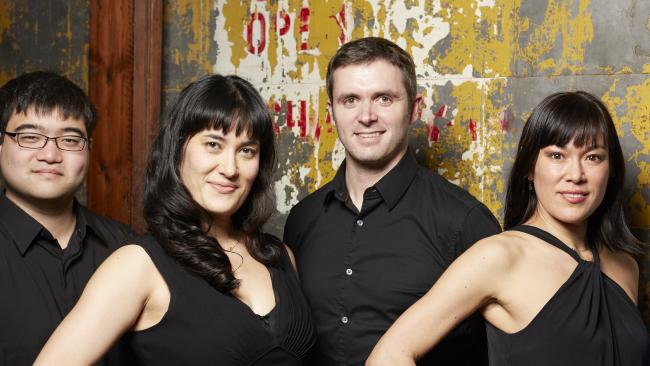
Doing the right thing by its patrons, this amiable ensemble opened  the first of its skeletal Melbourne series (two recitals?!) with an ever-welcome standard: Ravel in F.   First violin Adam Chalabi invested the deceptively open-ended first theme with just enough sweetness while second violin Lerida Delbridge mirrored his approach when the time came to share the melodic statement’s second strophe.   But violist Justin Williams‘ first point of exposure at bar 28 sounded roughly delivered in this context, a moment of discomfort in the work’s steady progress.   Not that this persisted as Williams gave a moving account of the D minor duet at a few octaves’ distance with Chalabi a bar after Letter 4: one of the most memorable passages in the quartet, both here and when it recurs in the rather reactionary recapitulation.

For the following Assez vif, cellist Michelle Wood made fine work of a solid underpinning in the oscillation between 3/4 and 6/8 that makes these pages a challenge in preserving clarity of metre.   Even better came in the harmonic shifts of the quartet’s Tres lent central movement, here handled with appreciable sensitivity, especially given the complexity of Ravel’s scoring with demi-semiquavers and semiquavers bandied about across all lines in the central pages.   More to the point, the Tinalley musicians took a firm grip on the composer’s slow ascent to a fierce climax in the passionate fortissimo at the Letter 8 shift to a Modere change of pace: a tellingly balanced passage of play.

Following the Ravel work’s half-hour length, interval signified a point of demarcation.  What followed came as an abrupt change of pace, both musically and emotionally.  With guest artist Lior Attar, the quartet worked through a compendium intended to illustrate the recital’s title, those last lines of Gertrude’s self-justifying first speech to her sardonic son.   A collaboration between Ade Vincent and Lior sets both Thomas’s Do not go gentle and American poet Hazel Hall‘s Hours as a matched pair.  For the Welsh writer’s vehement elegy, the composers have opted for a largely diatonic language, the quartet offering chords that slip and slide with some Sculthorpe-type rapid glissando swipes as colour-points.   The vocal line is a simple lyric with suggestions of Celtic folk-music, the only aggression coming in the fourth Wild men verse when the violins  make substitutes for guitars, the cello indulges in a slap-bass underpinning while the viola intones the melody line.   At the end, the singer is left unaccompanied to repeat the poem’s last line with fading strength – which bears comparison with Thomas’s own hypnotic reading of his poem.

The Hall setting begins with an instrumental hoe-down, changes for the second verse into sustained chords for the Hours eternal in their pain before reverting to the heftier movement, violins and cello rapping their instruments alongside pizzicato chords from the viola.   Again, the poem’s final line enjoys a repetition, but the matter that Lior sings again falls into the folk-song genre.   As companion pieces, the songs offer a mildly different atmosphere and, while nobody is over-stretched, both instrumentalists and singer gave the work every care.

Three of Dvorak’s Cypresses moved us into the land of the love-lorn, Chalabi bearing responsibility for pretty much all the vocal line from the original songs, Williams’ viola putting in a momentary helping hand for O nasi lasci, the last of the three extracts performed.   These sat uneasily beside the preceding songs, mainly because the Czech master’s melodies impressed as more sophisticated and expressive, evoking both desire and melancholy without self-indulgence and also having the unteachable gift (one that Dvorak did not always exercise) of being just long enough.

Lior sang his well-known My Grandfather to his own guitar accompaniment; again, the melody is Celtic-suggestive but also has an undercurrent of bush balladry.  Even after several performances, it still makes a direct emotional impact and earned its place in this program’s Seven Ages of Man musical symposium by bringing several significant strands together – feckless youth, old age sans everything, the cares of maturity.

Answering this, the Tinalleys played Barber’s Adagio in its original setting, a piece that has become a sort of American national elegy since its association with the deaths of Franklin D. Roosevelt and John Kennedy; a lesser source of grief was its performance on the day that Trump won his way through to the Republican nomination.  In their carefully-paced interpretation, the players reminded us of how voluble this set of pages can be without that corner-rounding smoothness you hear in the commonly-heard string orchestra arrangement, and how finely Barber contrives his slow progress to the work’s massive climactic chords.

Lior returned for the recital’s finale: Sim Shalom from the Compassion cycle, which he wrote for voice and orchestra with Nigel Westlake who transcribed it for this program.   Here, the vocal inflections are Judaic and Arabic, the modes employed suggesting both heritages in an affecting prayer for peace.    Again, this is not challenging music, making its points with a simple sincerity but bringing into play Lior’s extraordinary alto register, strikingly clean and penetrating   –  just the right vehicle for this final review of life’s span in a program that, throughout its latter half, made an ambitious grasp at illustrating the ineffable.

Striking singers, senseless setting

LA BOHEME

Opera Australia

State Theatre, Arts Centre Melbourne

Tuesday May 3, 2016

Lianna Haroutounian
                                                Lianna Haroutourian

Not a new production, this offering from director Gale Edwards, revival director Andy Morton, set designer Brian Thomson and costume designer Julie Lynch – but of a piece with the company’s Autumn season pattern in that it updates and transposes the work’s action, as the following The Pearl Fishers and Luisa Miller will also do.   For all the distractions that these peripheral changes involve, this current version of Puccini’s touching score has a significant benefit where it counts: the voices of those involved onstage.   After some underwhelming principal line-ups in previous years, it came as a pleasant shock to hear an Act 1 that succeeded in engaging the inner musician in each member of the opening night audience.  Well, perhaps that’s being over-optimistic but, for those of us who were listening for quality, a good deal was there to be enjoyed.

Gianluca Terranova is a new voice to me but a welcome one.  His work as Rodolfo proved exceptional, not so much for insights into the character himself (are there any, apart from the furious confession of Act 3?) but simply for the fierce temper of his tenor which invested the line with vigour and a continual ardour.  Like most of his tribe, Terranova is no respecter of bar-lines when in full uninterrupted flight, so that Che gelida manina enjoyed a fluidity that a conductor more prickly than Andrea Molino would have brought into line, yet the travelling power of his top notes and their almost-total security swept aside a good deal of trivial nit-picking  .  .  .  like gripes about keeping in time.

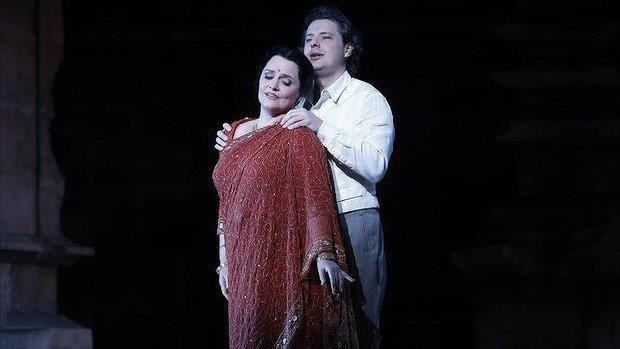
A match for the tenor, Lianna Haroutourian sang a dedicated Mimi with a splendid carrying power not held back by the character’s racking consumption.  Her Si, mi chianamo Mimi matched Terranova’s opening aria with a soaring ma quando ven lo sgelo sequence and her following collaboration in O soave fanciulla demonstrated a responsiveness that front-lined the composer’s melodic and spacious lyric arcs as well as giving weight to the lightly-sprung dialogue to which this rhapsody momentarily descends.   Haroutourian even put up with her partner’s brashness in seconding the Act-ending high C that, for once, stayed on pitch, although this magic moment’s effectiveness was squashed, as usual, by over-anxious patrons drowning out the delicacy of Puccini’s orchestration across the last bars, harp harmonics and all.

The lovers’ confrontation in Act 3 proved less persuasive dramatically but you would be hard pressed to fault the desperation of Terranova’s Marcello. Finalmente! duet with Andrew Jones.   Later, after Haroutourian set up an excellent framework with Donde lieta usci, the tenor found it hard to convey Rodolfo’s grief through the Addio dolce svegliare alla mattina! quartet, compensating for it with a determined O Mimi, tu piu non torni duet to open the last act, then wringing the death scene for as much tragedy as a jaundiced audience would find credible; that final curtain came down in silence.

Jane Ede‘s Musetta carried out her responsibilities with moderate brio, the Quando m’en vo’ showpiece carefully delineated.   But you were rarely convinced of Musetta’s humour and brightness of personality; not even in the name-calling fight with Marcello at Act 3’s end, although Ede made a concerned, condoling figure at Mimi’s deathbed.   Jones, her counterpart, made a much more interesting fist of the jealous painter, working with professional ease through the romping that starts the outer acts and contributing a strong vocal presence in his duet with Mimi  at the Barriere d’Enfer toll-gate.

Richard Anderson relished his one chance to shine, Colline’s Vecchia zimarra aria, taken at a lugubrious pace, emphasizing the philosopher’s gravity rather than the ludicrous charity that he is exercising.    Graeme Macfarlane‘s landlord Benoit and Adrian Tamburini‘s Alcindoro fulfilled their obligations without striking any notes of originality.   But the children’s chorus for the Cafe Momus scene sounded as confrontational a pack of ragamuffins as you’d want to avoid on a dark night while the adult chorus gave a vocally colourful backdrop to the principal sextet in the same act.

The setting has been moved to 1930s Berlin.  You can tell this by a few black uniforms, a customs official dressed like the Fuhrer himself, some cross-dressing attendants on Shane Lowrencev‘s Schaunard, and the Momus establishment turning into a quasi-brothel/cabaret scene with a plethora of loges, at least one pair of bare breasts for ornamentation, an outbreak of garter belts, a band of ersatz Hitlerjugend coming on for the act’s final military blaze.   The changes in time and locale make no difference to the outer acts in the artists’ garret, the opera’s core action arenas.   Further to this puzzlement, at night’s end, you are left wondering exactly what correspondances are intended to exist between this Baz Luhrmann-redolent refreshment essay and the original’s Parisian Latin Quarter of a century before.

Orchestra Victoria responded well to Molino across the night, with a particularly keen briskness through Act 2, the body’s strings unexpectedly rich in the State Theatre’s close acoustic, some small passages of woodwind/string doubling whistle-clean, while the brass corps also surprised by its quick rate of response; no chain-dragging on this night.

In fine, this Boheme is worth visiting for its main players, both excellent calibre singers – which makes it hard to understand the premiere patrons’ lukewarm curtain-call reaction to Haroutourian.   Admittedly, she was dressed in an oddly dowdy costume for much of the night but that should have provided no impediment for a worthy response to her impressive vocal powers.    Among the locals, Jones shone with a secure and confident baritone.   As always, if the production’s look strikes you every so often as ineffective, if not over-affected, you can ignore the stage work and simply revel in some of the more transporting Italian operatic lyricism this theatre has sponsored for quite a while.

There will be a further eight performances of La Boheme, the last on Saturday May 28.

A massive music

MUSIC OF THE CAPILLA FLAMENCA

Ensemble Gombert

Xavier College Chapel

Saturday April 30, 2016

Ensemble Gombert
                                                          Ensemble Gombert

Holding back nothing at the start of their annual subscription series, John O’Donnell and the Ensemble Gombert presented an impressive night’s work on Saturday, filled with music from composers for the Flemish Chapel, that central religious music body associated with the Holy Roman Emperors.   Pierre de la Rue, Brumel and the ensemble’s namesake are familiar quantities to most lovers of Renaissance activity; Noel Bauldeweyn and Thomas Crecquillon, not so much; for this program, the latter provided two motets that shamelessly flattered (or did they?) Emperor Charles V, while Bauldeweyn contributed a motet on which Gombert wrote the mass that gave this recital its spine.

It is a mighty work, the Missa Quam pulchra es; so much so that O’Donnell served it up in discrete sections, with interpolations from those other Franco-Flemish composers mentioned above.   A fine initiative, as far as it went; the trouble here was that some of these interstitial pieces were not small passages of relief but considerable constructs, like the Brumel Laudate Dominum in caelis amalgam of Psalms 148 and 150 that proved just as substantial as parts of the Gombert mass, with the added quality of a text crying out for hyperbole, insofar as that existed among these composers.

De la Rue’s Magnificat octavi toni made an expansive initial gambit, alternating four-part polyphony with plainchant and distinguished by its unexpected musings on certain phrases in the central verses Fecit potentiam in brachio suo, and, further on, the dispersit superbos mente cordis sui observation.  But the impression at the end was of continuous variety, two-part settings with over-lapping entries set against bursts of full choral texture.  This bounding around also gave the venerable text a welcome gaiety, mirroring the Virgin’s delight in her treatment.

Bauldeweyn’s motet, its inspiration taken from the Song of Songs, made the mildest of introductions to the mass, an upward step pattern of a 4th providing a jumping-off stone for nearly all Gombert’s Ordinary settings; nothing particularly striking to be found, either, in later phrases but all clear grist to an inventive mind on the lookout for a cantus firmus or three.  In the Kyrie, apart from the rich complex of six interweaving and contrasting lines, the only oddity came in an unexpected upward inflexion at the end of the Christe eleison.

But the Gloria was a whole new matter.  Gombert massed his forces and kept up the pressure in a welter throughout the first half, up to that traditional hiatus point before the Qui tollis change of purpose from incessant apostrophes of praise to pleading for redemption.   At the start of the extolling sequence – Laudamus te. Benedicimus te. Adoramus te. Glorificamus te. – the strong suggestion was of bell-like vocal cannonades, constant and even in a seamless paean.   This was followed by a full-bodied sequence of acclamations as the choir asserted the divine attributes, from Domine Deus through to Filius Patris.  The less sympathetic could see this as pounding away at doubt or scepticism through a technique of musical bludgeoning that admits of no argument; a less sympathetic anti-Reformation response than Palestrina’s, for example.  But the effect from these singers was close to overwhelming, splendidly assured and confident.

A similar feat occurred in the Credo which spread its affirmations in one chain from the opening bold declaration to the assertion of God made man.  After the block assault thus far, the Crucifixus and its consequents provided a relief in tension through more obviously varied textural oppositions but the movement reached its uplifting climax in the Confiteor section, a ferment of linear and metrical action.  Still, it seemed to me that the finest singing came in the Sanctus/Benedictus, particularly in a mellifluous delineation of the Pleni sunt caeli segment where the Gomberts’ balance and clarity of output impressed most fully.

Both Crecquillon motets praising his emperor were given a steady, martial interpretation, Carole magnus erat enjoying a striking soprano kick-off, its directness of speech a contrast to the preceding formidable Gloria, as was its sober ending where the poet and composer collaborate to celebrate the good intentions of the emperor, truly pious rather than obsessed by his own glory.   A theme that returned in Quis te victoriam dicat? where the march-like metre celebrates the royal figure’s victory over his enemies but, more to the point, over himself – a message that was reinforced two-and-a-half times with determined grace by this hard-worked but rarely faltering body of singers.

For this occasion, the Gombert personnel numbers were slightly greater than usual with an extra alto and another tenor while regular Peter Campbell paid a peripatetic visit to the altos every once in a  while.   Still, for those of us who were there, the Ensemble demonstrated yet again why its reputation as the city’s indubitable experts in Renaissance choral music is unchallenged.

We should remember them

NOIR

Ensemble Liaison

Melbourne Recital Centre

Wednesday April 27, 2016

Ensemble Liaison

                                                                                  Ensemble Liaison

As the group’s front-man said, this was a program of composers who don’t get many performances these days.  Well, that’s certainly true but a further problem is that, with two of them, we used to hear only a few works from their considerable compositional achievements, yet even these popular choices are currently falling by the wayside.  Still, this night went some way towards resurfacing their names, even if the point of the night’s title seemed rather arcane after the first ten minutes or so.

At the opening, the Liaisoners welcomed Sophie Rowell, Associate Concertmaster of the Melbourne Symphony Orchestra.  With foundation members Svetlana Bogosavljecvic, cellist, and pianist Timothy Young, Rowell performed Bloch’s Three Nocturnes of 1924, the year when the composer took out American citizenship.  As Griffith’s indicated, Bloch’s name is one that is becoming a rarity in concert halls, although time was when the Schelomo rhapsody was a welcome annual revenant, the Concerto Grosso No. 1 was not unknown, the Israel Symphony had its adherents, and every violinist had Baal Shem in the repertoire, as cellists did the From Jewish Life sketches.

If anything in the program impressed as black, these small pieces came close, even though the darkness suggested was simply the same night that permeates Chopin’s works of the same descriptor.  In fact, both the opening Andante nocturnes bore the Chopin imprint, if the vocabulary proved more complex.  While the first is scenic, its successor held more expansive character with some splendidly broad melodic speeches in its central pages with a lavishly Romantic violin/cello duet.  As for the last one –  Tempestuoso – being jazzy, as Griffiths and other commentators suggest, you could find faint traces if you listened hard but the piece impressed more for its irregular metre and sudden vivid strokes of vitality that served as comparison with the piece’s predecessors.  The trio gave the set fine treatment, Young a responsive support for the two dominant and active string players.

As for strangers on  a program, Dohnanyi would seem to be in a worse case than his Swiss/American contemporary. Not too long ago, the Variations on a Nursery Tune appeared in every Youth Concert series I can remember, as well as occasionally hitting the big-time Red Series or Master Series sequences.  But as for the Hungarian composer’s operas, the symphonies, the piano and violin concertos, any of the piano pieces (and he was a great pianist, as the recordings attest) – you can live a lifetime and not come across them.  I seem to remember his Stabat Mater being sung by an adventurous women’s choir or three many years ago.  All the more welcome, then, was this airing of the Sextet in C Major with guests Elizabeth Sellars on violin and Christopher Moore playing viola alongside Bogosavljecvic’s cello in a trio facing Griffiths’ clarinet and final guest Roman Ponomariov‘s horn, with Young acting as circuit-breaker.

The shade of Brahms falls across much of this score, especially in its grandiose moments like the opening Allegro appassionato which sounded at its best when the adjective applied full-bore.  With plenty of octave/unison work and surging, eloquent melodic swathes, the score maintained involvement from the start and sustained it – which you would be hard pressed to assert about many another post-Brahms piece.  Ponomariov impressed throughout the work but nowhere more than in this section where he played the opening subject and powered through a wide-reaching part with only one slight slip.

Young and the string trio made a beguiling start to the Intermezzo: Adagio in A flat, giving the sentiment room to settle before the 12/8 march interlude introduced the wind duo’s direct-speaking statements that made an excellent study in timbre-mixing and just how much leeway to allow your partner.   In place of a minuet, Dohnanyi uses another allegro in 2/4 with the clarinet giving out a tune that might have escaped from one of the Brahms Serenades. This multi-partite sequence leads to a reminiscence of the horn’s first movement initial melody and suddenly the composer takes us into his finale with a perky and simple C major piano tune that is shared  by all (even the horn) despite its fast-moving opening mordent shape. As with the opening pages, this section of the work impresses most when the tension is high – a hard thing to achieve with so simple a tune – but Dohnanyi eventually works his players into an emphatic D flat Major, only to slip sideways in to a C Major perfect cadence.  It’s not witty music (what is?) but its expansive good-humour is patently obvious and these performers gave it rousingly firm handling with not a noir trace in sight.

Osvaldo Golijov‘s The Dreams and Prayers of Isaac the Blind bases itself on the work of a medieval Provencal Kabbalist rabbi, specifically his dictum that the universe’s objects and occurrences are founded on the combinations of the letters in the Hebrew alphabet.  As a musical illustration of this theory, Golijov’s work for clarinet and string quartet holds three main movements celebrating, Aramaic, Yiddish and Hebrew.  These are encircled by a prelude which takes in the first movement’s Aramaic tone while the Postlude leads out of the final movement’s extended prayer for clarinet-as-cantor.

The performance proved engrossing, dramatic but not blackly so, although for this listener the interest fell pretty strongly on its physical character: the sounds urged from the quartet and their lengthy phases of near-stasis, and Griffiths’ oscillation between piccolo clarinet, instruments in B flat and A, bass, and a concluding passage featuring the basset horn.  As for what was played  –  Golijov’s material  –  that seemed, in essence, interchangeable in structure and melodic process; but what else would you expect with three aspects for the same linguistic heritage, especially when the klezmer-heavy middle movement contained so many Jewish popular-music tropes that somehow seemed to leach into surrounding areas?   As a display by Griffiths, the work gave testament to his technical skill and his ability to construct and sustain the composer’s emotional and sound worlds.   What was missing, I suppose, was something that the composer could not provide or never intended to cover in the first place: an original illustration in music of the complex mentality and imagination of a great Jewish mystic.   As things turned out, at many stages of the middle Yiddish and final Hebrew movements, I was highly distracted by memories of the  Schindler’s List sound-track by John Williams.

Yet the night’s work provided some worthwhile insights into two Jewish composers – one who imbibed his heritage and turned it into a fluent individual voice, and another who grapples with the opportunities and responsibilities of the jaded present day.  Oh, and it also brought to vivid life that marvellous, reassuring sextet, filling out our experiences of a fine musician’s work.

May Diary

Sunday May 1

Three of the Best, Melbourne Symphony Orchestra Chamber Series, Iwaki Auditorium, Southbank, 11 am

This recital’s name promises much.  I’d be prepared to go along with 2/3rds of its claim: the program contains the Ives Piano Trio, now enjoying a re-discovery as players realise that it is negotiable, if hard work; and it ends with the Smetana Piano Trio.  But the opener is an unknown quantity, to me at least: the Francaix String Trio of 1933, written when the composer was 21.  Of course, in the limited world of such trios, it may be outstanding.  We’ll see.   Performers are violin Robert Macindoe, viola Lauren Brigden, cello Rachael Tobin, with chamber music expert pianist Caroline Almonte doing duty in the morning’s major works.  This series usually attracts a sell-out crowd, although this menu is a pretty rarified one.


Monday May 2

Schubert’s Flights of Fantasie, Kristian Chong & Friends, Melbourne Recital Centre, 6 pm

A local reflection of the Sydney-based Selby & Friends series, this sequence of three recitals spread across the year starts tonight with the personable pianist-host in alliance with Sophie Rowell, the MSO’s current Associate Concertmaster.  Their title, with its specific last word, holds little mystery: the evening’s main content will be the famous duo in C, D. 934, preceded by a Mozart violin sonata, the last one to be written in B flat, and also Andrew Schultz’s Night Flight, which Chong premiered with Dmitry Tkachenko at an Australia House London Remembrance Day recital in 2003.   Both artists bring plenty of experience to the scores,  Rowell’s violin a familiar sound thanks to her years with the Australian String Quartet.


Tuesday May 3

La Boheme, Opera Australia, State Theatre, 7:30 pm

This starts the national company’s autumn season here.  Gale Edwards’ production with Brian Thomson’s sets moves the locale forward to 1930s Berlin; keep an eye out for Schoenberg et al in Act 2’s crowd scene, I don’t think.  Conductor is Andrea Molino and the Mimi/Rodolfo pairing features singers not heard in this city, I believe: Lianna Haroutounian and Gianluca Terranova.   Musetta is Jane Ede, Marcello will be sung by Andrew Jones.  There are 10 performances, the last on Saturday May 28.   I think this version has been played here before but can’t be sure; so much Puccini and middle-period Verdi has been temporally and geographically relocated over the past 30 years or so to cater for a generation of directors and their acolytes who have an unnerving fascination with the Weimar Republic and World War Two.  Still, if the look upsets your sensibilities, you can always shut your eyes and trust that the singing will be of a decent quality.


Wednesday May 4

Through Nature to Eternity, Tinalley String Quartet, Melbourne Recital Centre, 7:30 pm

Back in Melbourne, this ensemble that took its name from the University of Melbourne’s only straight-through thoroughfare is hosting singer/songwriter Lior Attar, who contributes his well-known My Grandfather from the Scattered Reflections album, Sim Shalom which opens his Songs of Compassion collaboration with Nigel Westlake, and a new song cycle written in partnership with Melbourne composer Ade Vincent.   Framing these sung pieces, the Tinalley group plays Ravel in F, three of Dvorak’s twelve Cypresses, and the Barber Adagio.  The recital is in the Murdoch Hall; just as well, as the Australian/Israeli musician has a considerable following and possesses undoubted musical ability, as shown in his 2014 performance under Westlake when the composer/conductor led the MSO in the Compassion construct during that year’s Myer Bowl free concerts.


Saturday May 7

The Pearl Fishers, Opera Australia, State Theatre, 7:30 pm

Bizet’s second-best-loved work, although the way Australian companies keep on pushing it, you’d have to think it now takes precedence over Carmen.  The run lasts for 8 performances, ending with a matinee on Saturday May 28, and the production is directed by Michael Gow with Robert Kemp’s set and costume design.  This version fits the opera with a 19th century French colonial backdrop, although the main action stays in Ceylon/Sri Lanka.  Emma Matthews has the role of the priestess Leila, torn between two men and gifted with the fine Comme autrefois aria.  The best friends/rivals will be Dmitry Korchak as Nadir, who scores that wonderfully languid solo Je crois entendre encore,  and Jose Carbo sings Zurga, the poor high-minded bastard who stays behind to face the music while the feckless lovers run off; which just goes to show how ephemeral is friendship, even when it gives rise to such a superb achievement as the Au fond du temple saint duet – music that permeates this opera to wrenching effect.   Conductor is Guillaume Tourniaire, a firm presence in this company’s operatic personnel.


Sunday May 8

Richard Tognetti: Beethoven Mozart V, Australian Chamber Orchestra, Hamer Hall, 2:30 pm

Settling down after the all-in-together nature of the recent Cinemusica program, the ACO reverts to the venerable canon with an afternoon of Beethoven, Bach and Mozart.  The content begins and ends with fugues by Beethoven: the middle-to-late Op. 137 for string quintet featuring two viola lines, here arranged for string orchestra, and the Grosse Fuge which was the original last movement to the String Quartet in B flat Op. 130 and which, I suppose, will here be tacked on to the scheduled performance of that chamber music masterwork in its revised form.   Maintaining the afternoon’s path, we hear the first four Contrapunctus from Bach’s The Art of Fugue; these open the entire work and are simple fugues, all based on the subject that Bach treats throughout his incomplete compendium. At the centre of the event, Richard Tognetti is soloist in Mozart’s Violin Concerto in A Major, the last of the five and a sprightly effervescent joy in this company.

The program is repeated on Monday May 9 at 7:30 pm


Saturday May 14

Beethoven and Crumb 2, Australian National Academy of Music, 7 pm

Paavali Jumppanen is back, bringing a pianistic lift to ANAM with two programs juxtaposing a name synonymous with Western classical music and a senior member of the American avant-garde.   On Friday May 13 at 11 am, Jumppanen shares the stage with Academy pianists putting Beethoven’s last three sonatas alongside parts of Crumb’s Makrokosmos, Zeitgeist and Celestial Mechanics cycles.  On this night, he is soloist/director for the Emperor Concerto and Makrokosmos III: Music for a Summer Evening, scored for two amplified pianos and a pair of percussionists – yet another Bartok semi-reference.  What do the two have in common?   Having listened to the Crumb construct, I’d have to say: not much.   But that is clearly not the point; perhaps its simply a preconception-boggling juxtaposition of two completely different, original voices.  If so, you couldn’t hope for better.


Saturday May 14

City Life, Melbourne Symphony Orchestra, Melbourne Recital Centre,  8 pm

The first of three Metropolis New Music concerts where the MSO takes on the contemporary – maybe.   The podium presence for all of these events is Robert Spano, chief conductor of the Atlanta Symphony Orchestra.  This year’s over-arching theme is music dealing with the urban, tonight’s title referring to the program’s final work by Steve Reich that puts 1995 New York into the minimalist-style cross-hairs.   Another American, Michael Daugherty, does much the same for Los Angeles in his 1999 frolic, Sunset Strip.  For light relief, Spano changes focus to South Korea, with Unsuk Chin’s Graffiti for chamber orchestra – let’s hope she has some positive sounds about what is for most of us a civic blight.   And Alex Turley’s city of ghosts, first heard earlier this year at the Cybec 21st Century Australian Composers concert in the Iwaki Auditorium, gets another guernsey; this time around, one hopes, with a fuller complement of strings.


Sunday May 15

Germanic Cello, Team of Pianists, Rippon Lea, 6:30 pm

They don’t come any more German than Schumann and Brahms.  The MSO’s Rohan de Korte and the Team’s Darryl Coote work through both Brahms Cello Sonatas, which is worth the price of admission in itself.    As for the senior composer, the pair review his Op. 70 Adagio and Allegro, originally written for horn and piano but less stressful for the listener in this garb.   Further in this alternative instrumentation penchant, de Korte and Coote will play Schumann’s Fantasiestucke Op. 73 that, in its original form, asked for a clarinet rather than a cello, although the composer said either a viola or cello could also get the job done.   I’ve missed quite a few of the TOP’s events over the past few years but this one is very inviting; and, a friendly warning:  it doesn’t take much to pack out the stately home’s ballroom.


Monday May 16

Luisa Miller, Opera Australia, State Theatre, 7:30 pm

A mid-career Verdi opera and one among several in the composer’s earlier output from which I don’t know a bar; well, apart from the tenor show-piece Quando le sere al placido. Based on a Schiller play, the work proceeds in three fraught acts to a Romeo and Juliet-style conclusion.  The company knows that interest will be limited and has scheduled four performances only.  Original director Giancarlo del Monaco prepared this production for the Opera de Lausanne; its revival is being managed by Matthew Barclay.   Andrea Licati conducts a cast headed by Nicole Car as the heroine, Riccardo Massi as Rodolfo, the object of her affections, Steven Gallop sings the intriguer Wurm and David Parkin his partner in secret criminality and blackmail, Count Walter.  Like the company’s La Boheme production, this version of the opera’s setting moves the time to the 1930s, rather than the 17th century; the promotion photos suggest that the setting is no longer a Tyrolean village; and, similar to The Pearl Fishers in this season, the opera is told in flashback.


Wednesday May 18

Cityscapes, Melbourne Symphony Orchestra, Melbourne Recital Centre, 8 pm

Second in the series, this concert continues its metropolitan theme with Copland’s Music for a Great City of 1964, based on his own soundtrack to Something Wild, the last film for which he provided music and which depicts an unappealing New York.  Conductor Robert Spano has also programmed two Cries of London: Orlando Gibbons’ early 17th century God give you good morrow and Berio’s 1974 cycle.  The Italian composer’s work was originally written for the King’s Singers sextet; two years later, he expanded it to 8 lines.  As the Song Company is performing them, I’d suspect the earlier version might appear.  Michael Kurth, bassist with the Atlanta Symphony, is represented by his three-movement Everything Lasts Forever which Spano premiered in 2013; the piece shares a link with the first Metropolis concert’s Graffiti by Unsuk Chin in that it too was inspired by ‘street art’. The program is completed by Jennifer Higdon’s City Scape, written for the Atlanta orchestra in 2003, celebrating that city in three substantial movements, and also premiered by Spano.


Thursday May 19

Paavali, Poulenc, Debussy & Beethoven, Australian National Academy of Music 7 pm

Another product of the Finnish pianist’s visit.  Beethoven begins and ends the night with the early Trio for clarinet, cello and piano, the Gassenhauer, and the Quintet for piano and winds Op. 16.  Poulenc, fecund in the chamber music field, is also represented by two pieces: the Elegie in memory of Dennis Brain for french horn and piano, distinctive for a 12-tone row flirtation, and the early Trio for oboe, bassoon and piano.  And, would you believe, Debussy has two brackets as well: the all-too-brief Cello Sonata of 1915, and selections from the Preludes.  How much Jumppanen takes on will be an interesting question: the Preludes, you’d expect, but it’s significant that every other work involves a piano.  Certainly, the night gives some of the ANAM musicians a chance to shine, especially the wind players.


Saturday May 21

Heavenly Cities, Melbourne Symphony Orchestra, Melbourne Recital Centre, 8 pm

Yes, it’s Messiaen time in this final Metropolis New Music concert.  Couleurs de la cite celeste is a 1963 composition for piano, 13 wind and 6 percussion, first performed at the following year’s Donaueschingen Festival with Boulez conducting his Domaine Musical people and the composer’s wife, the phenomenal Yvonne Loriod, at the keyboard.   It is based on five quotations from the Apocalypse and sets about the Celestial City depiction with sharp-edged aggression, rich in the whole Messianic panoply: Hindu and Greek rhythms, bird song, Gregorian chant, grinding and repeated dissonances.  Oliver Knussen’s The Way to Castle Yonder is a potpourri extracted from his children’s opera Higglety, Pigglety Pop!, a collaboration with Maurice Sendak.   Barry Conygham’s Diasporas (about which I can find out absolutely nothing) will enjoy its world premiere while Michael Bakrncev’s Sky Jammer, the pick of the Cybec 21st Century Australian Composers concerts in January, will enjoy its second hearing.   Fleshing out the night is senior German composer/academic Heiner Goebbels’ Surrogate Cities: Samplersuite of 1993/4.  The suite is, in fact the real thing: a set of ten Baroque period dances using sampler and orchestra, the electronic implement allowing the use of non-orchestral sounds while Goebbels gives us his aural insights into the ‘phenomenon’ of the city; Heidegger’s still around, no matter where you look.


Sunday May 22

Sax and Sensitivity, The Melbourne Musicians, St. John’s Southgate, 3 pm

Through sheer forgetfulness – here comes Alzheimer’s – I missed the Musicians’ last concert on March 20 which promised a fine program.  Today’s one offers Molly Kadarauch of the Sutherland Trio, Monash University and guest spots with the Melbourne Symphony and Melbourne Chamber Orchestras in C.P.E. Bach’s Cello Concerto in A minor, refined and tempestuous at once.   Saxophonist Justin Kenealy, a young musician with an impressive list of awards and educational personnel and institutions behind him, takes centre-stage for the one-movement Glazunov Concerto, a staple of the instrument’s repertoire and lavishly Romantic in its language.  Frank Pam and his players also offer an alternative Russia to that of Glazunov in Shostakovich’s Sinfonia Op. 110, which I assume is Rudolf Barshai’s arrangement for string orchestra of the composer’s even-more-fraught-than-usual String Quartet No. 8.


Monday May 23

Homage to the Classics, Inventi Ensemble, Melbourne Recital Centre, 2 pm and 6 pm

This group is new to me, although it has been active since the start of 2014.  Its brief comprises concerts, workshops, community outreach and corporate/wellness performances.   Founded by flautist Melissa Doecke and oboist Ben Opie, the personnel for this recital include violinist Jessica Bell, violist Phoebe Green and cellist Blair Harris.  What they have set their combined talents to perform is a Quintet in D, the last of the Op. 11 set by J.C. Bach which offers freedom of choice for its top lines – two violins, or an oboe or a flute (or both) substituting for one of the strings (or both); Mozart’s Flute Quartet in D, the first of the ever-fresh series of four; Britten’s Op. 2 Phantasy Quartet for oboe, violin, viola and cello, written for Leon Goossens when the composer was 19; and Prokofiev’s Classical Symphony No. 1 arranged for the five musician-participants in this recital.  An ambitious program with a well-proportioned mix of names and styles.


Thursday May 26

The Lonely Planet, Flinders Quartet, Melbourne Recital Centre, 7 pm

Cutting down on its number of performances, this popular ensemble starts off its MRC appearances under the Local Heroes banner with Mozart in G, K. 387, the first of the Haydn set and distinguished by its fugato finale opening.   Local composer/academic Stuart Greenbaum’s String Quartet No. 6, which gives the night its title, comes next – the first performance after the Flinders players premiere the work (which the ensemble commissioned with support from Julian Burnside) four days previously at the Montsalvat Gallery.  Complementing the Mozart comes Haydn’s No. 2 from the Op. 33 set which, all things being equal, should be that one nicknamed The Joke with its audience-deceiving finale-rondo.   And, as a capstone, we hear Beethoven No. 4, the only one from the six-strong Op. 18 set in a minor key.  Because of the rarity of Flinders appearances, I find it hard to keep up with changes in personnel but, as far as I know, Helen Ireland continues on viola and Zoe Knighton on cello.  The first violin is Shane Chen and the second chair is now occupied by Nicholas Waters.


Saturday May 28

Finishing the month with an old-style program after the Metropolis detours, the MSO plays a solid but odd program, juxtaposing three disparate works of the highest quality. Guest conductor Christoph Konig begins with Ravel’s Le tombeau de Couperin, four movements in memory of friends who died in World War I and still, almost a hundred years on,  a series of hurdles for any orchestra.   Soloist is British violist Lawrence Power, celebrated among other things for his work in the Nash Ensemble.  He is fronting the Bartok Concerto, a work he has recorded on the Hyperion label.  The score, left in sketch form by the composer at his death in 1945, has been subjected to revisions and amendments, not least the one by Bartok’s son, Peter.  For the inevitable symphony, Konig & Co.offer Brahms in E minor, the most clear-headed of the composer’s four, climaxing in that magnificent, sombre chaconne which possibly provides an emotional link to the world-weariness of the night’s concerto . . . if you’re feeling charitable.

This program is also performed on Friday May 27 in Costa Hall, Geelong.


Monday May 30

Joe Chindamo and Zoe Black I, Melbourne Recital Centre, 6 pm

Tonight is the first of two appearances across the year in the Salon by this pianist/violin partnership; like the Flinders Quartet, they also appear under the MRC’s Local Heroes catch-all category.  The musicians perform original works by Chindamo and also re-imagine classics, as they did with Bach’s Goldberg Variations, recently performed both in New York and here.   As with every sustained experiment, some of these re-creations work better than others but the duo has the talent of persuading  you – sometimes – to re-conceive familiar works that have become stale through repetition over the years.


Recital’s insightful first half

STEPHEN HOUGH

Melbourne Recital Centre

April 19, 2016

Stephen Hough (musicavivaaustralia.wordpress.com)
                                          Stephen Hough

Here was one of those nights when it might have been better to leave at interval.  The popular British pianist, on his third solo tour for Musica Viva, is playing a program that has been well honed as Hough has toured with it through minor (and sub-dominant) English centres, France, Taiwan, China, Japan, Belgium, the Barbican, Canada, followed by a clutch of appearances in the United States.  With his final Australian performance here on April 30, Hough will have given this sequence an airing nearly 30 times in ten months – which is putting to one side his many concerto appearances and interpolated recitals with cellist Steven Isserlis.  The man is nothing if not driven to perform and, judging by Tuesday’s audience, he has an enthusiastic following.

True to his reputation for favouring the less-trodden paths of repertoire, Hough began his night with Schubert’s Sonata in A minor, D. 784.   A clean delivery with a firm hand on the middle movement’s andante direction made this one of the event’s highlights, even if you might quibble with some pauses and hiatus  points in the first movement that admittedly gave some respite to the slow-to-hatch dramatic bursts in this spartan set of pages.  The pianist’s treatment of the finale with its oscillation between overlapping triplets and its seamlessly extended melodic line in the more regular/straight 3/4 interludes helped to underline the message that, with this composer, more is required than just relying on the score to give interest through inbuilt contrasts; Hough treats Schubert as an ongoing narrative where the parts have to be knitted into an intellectual complex.

The following version of Franck’s Prelude, Chorale and Fugue impressed even more for the executant’s clarity of texture in a piece where such a quality is often hard to find under washes of pedal clouding.  While the opening pages held interest for Hough’s digital control, his exposition of the chorale with its long sequence of arpeggiated chords complicated by the left hand crossing over, sometimes awkwardly, to outline the melodic line, was remarkable for its authority, the progress of this section fluent and rhythmically sensible.   For once, the fugue capped the triptych, Hough making the later pages almost lucid, even where the action borders on the over-rich in chromatic shifts.  At the conclusion, you were left with the sense of a task accomplished with firm discipline and a brake on any form of excess.

As before interval, two composers featured in the recital’s second half – Liszt, and Hough himself.   His recently composed Piano Sonata No. 3 was commissioned by the British Catholic periodical, The Tablet, to celebrate the publication’s 175th year of operations.   Subtitled Trinitas, it has religious connotations beyond its title but the most prominent feature of its nature is its basis in 12-tone row compositional technique.  You will find only traces of the Schoenberg ethos, let alone style, here and pretty much nothing of anything serial.   Hough bases his row on major and minor triads and the work’s tendency is towards giving these building blocks pre-eminence in their natural state. The concept is at least as old as the Berg Violin Concerto with its overlapping triads as initial G minor-establishing (for a moment!) material.  Hough’s first-of-three movements, a Lento subtitled ‘Bold, stark’, lives up to its own descriptors and leaves a spacious, clangorous impression.   The middle Allegro, ‘Punchy, jazzy’, struck me as a kind of toccata, one-note-at-a-time passages at high speed punctuated by some chordal breaks.  The last part, an Andante, eventually quotes a hymn – again bringing up memories of the Berg concerto – and also makes use of a high tintinnabulating punctuating sequence, serving as a kind of decorative motif but wearing out its welcome all too quickly.  Certainly, the flavour in this last segment of the sonata seems to be semi-liturgical. in many listeners’ cases proposing an emotional response; to this listener, however, it seemed a comedown after the harmonic challenges of the work’s earlier stages.

The Liszt bracket contained the first two Valses oubliees; elegantly outlined by Hough, assuredly, but works where the memories summoned up are of gestures and fripperies, lacking anything to feed on apart from a kind of subdued virtuosity and, in the first, an elegiac resonance that Liszt intended to evoke.  Finally came two of the Transcendental Studies: No. 11, the Harmonies du soir extravaganza, and then its antecedent, once known as Appassionata.

Hough made fine work of the first of these, especially when the richly-chorded melody of the Piu mosso emerged triple-piano at bar 38: a fine example of gradually intensifying the dynamic scale.   The No. 10 is intensely demanding and rapid in its figuration; in this case, it sounded over-pedalled and often hard to decipher.  In fact, the pace was so punishingly allegro molto agitato right from the beginning that the concluding stretta simply melded into the work’s pell-mell execution rather than actually raising the energy level.

Youthful enthusiasm pays off

THE GYPSY PALACE

Melbourne Chamber Orchestra

Melbourne Recital Centre

April 17, 2016

Rebecca Chan
                    Rebecca Chan

Despite a lurching process from one end of Western music’s history to  the other – a Josquin motet from 1485  to Carl Vine‘s Third String Quartet of 1994  – the latest MCO concert was an invigorating business, presided over by Rebecca Chan who took on directorial duties as well as the solo line in Haydn’s G Major Concerto.   In a quest to make connections between gypsy music and some Baroque and Classical period writers,  Chan punctuated her offerings with excerpts from the Uhrovska Collection, a Slovakian miscellany of melodies arranged by the violinist for the forces available (11 strings and a lutenist), and occasionally serving as links while stands and players’ positions were being adjusted.

From her time with the Australian Chamber Orchestra, Chan brought to this afternoon’s work that sort of scouring effect that Tognetti has made a feature of his group’s approach to pre-Romantic scores.  Setting the standard straight away, the MCO took an aggressive road with Telemann’s G minor Suite, La musette, making a biting attack on the Ouverture that grabbed your interest and sustained it through the following brief movements, Samantha Cohen‘s theorbo a vital presence as substitute for the usual harpsichord continuo.   In contrast to many another ensemble playing this music, the viola line made its presence felt, the duo of James Wannan and Simon Gangotena a contributing thread to the mix.

Vivaldi’s Four Violin Concerto, the first of the L’estro armonico set, found Roy Theaker taking the top line, with Shane Chen, Monique Lapins and Lynette Rayner his colleagues in a reading that continued the forward-projecting character of these performances, sustaining the suspension-rich tension even through a few patches of rhythmic discrepancy in the opening Allegro.  Michael Dahlenburg‘s account of the solo part in the same composer’s A minor Cello Concerto opened with a rapidly paced Allegro that turned placid arpeggios into exciting bouts of play, relieved by some effective if predictable dynamic terracing and a subtle rubato.

Chan’s Haydn interpretation proved to be polished and unaffectedly refined, animated in its opening, just as urgent in the Adagio‘s attractive arcs, then packed with vim for the bracing finale.  This violinist has the insight to leave any histrionics to the cadenzas and let the solo part speak for itself, without over-emphasizing the many trills or semiquaver runs.  Still, she can project well enough to dominate the texture, an audible voice even in tutti passages like the concerto’s final non-flamboyant bars.   This exercise in clarity made a fine companion piece for the C.P.E Bach String Symphony in B flat, which Tognetti and his band played here last October and which I have a fading memory of the ACO performing in Hamer Hall many years ago.   Just as with their Telemann, the young players gave this a surface layer of punchy drama, complete with action-packed leaps across the admittedly limited violin compass.   By the time of the final Presto, however, the intonation was suffering, not as reliably true as it had been in the program’s first half.

The concert proper concluded with part of Carl Vine’s Smith’s Alchemy, the assertive final movement with lashings of sound-rocket unisons and a trademark rhythmic emphasis that compensates for a dearth of interesting melodic matter.  It made for a brisk conclusion to this event, mirroring the vitality that permeated the opening Telemann suite.   Certainly, it showed more of a relationship with the gypsy pieces than two other oddities that emerged from nowhere in each of the afternoon’s halves.  String arrangements of Josquin’s Ave Maria and a Gesualdo madrigal., O dolce mio tesoro, gave service chiefly as respites from the program’s main urging thrust, but apart from an alleviation of tension, it was hard to work out if either of these texturally transparent pieces served any other purpose.

Nevertheless, Chan’s arrangements of about eight pieces from the Uhrovska collection made for pleasant listening.   The influence of gypsy music was admitted by Telemann and very obvious in parts of Haydn’s output, if not necessarily that clear in this afternoon’s violin concerto.   But the effect of these interpolations proved bracing, especially the second one of three that followed the opening work; Chan’s suggestion here of a dulcimer was remarkably effective. Later, a metrically changeable construct that preceded the Bach symphony brought the twin spectres of Bartok and Kodaly to the Recital Centre’s hall.  These fragments, moulded into shapely entities, mirrored the vivacity of Telemann’s Murky and Harlequinade movements in particular.

The pity is that MCO patrons stayed away in numbers.   While quite happy to pack in for yet another run-through of Mozart’s Clarinet Concerto, when it comes to a mildly experimental afternoon such as this one, without the presence of an over-familiar masterpiece or three, people would rather stay at home, it seems.  Well, their loss: this was a vital, interesting afternoon’s work, a tribute to Chan’s organizational skills and her talent at infusing other musicians with her enthusiasm.

A firm, fruitful friendship

JUST ‘C’

Selby & Friends

Deakin Edge, Federation Square

Wednesday April 13, 2016

Kathryn Selby (www.smh.com.au)
                                                            Kathryn Selby

She’s fortunate in her friends, Kathryn Selby.  I know that she has collaborated in past seasons with violinist Susie Park and cellist Clancy Newman, both musicians with Australian connections if US-based; clearly, their styles and personalities resonate with the pianist and this latest series recital showed an ideal professional fusion in play throughout trios by Copland, Mendelssohn, Shostakovich and Brahms.   All three major works were in the key of C, but then, with two of the composers, you’re as often in the key as out of it, if not more so in the case of the Russian master.

The executants tweaked the order of play, opening with Shostakovich  –  not the very familiar E minor work so popular at chamber music competitions where young tyros learn in real time how dangerous this open-faced score can be, but a piece of juvenilia from the composer’s late teens.  A one-movement construct, the trio owes obvious debts to late Romantic influences, the shade of Rachmaninov looming large in the active piano part during the central fast section, but simultaneously displaying the young composer’s spiky, nervous traits and a determined taste for percussive dissonances.   Distinguishing this reading was the immaculate dovetailing of lines at nodal points, and Newman’s remarkable colour.  I have little liking for comparisons between instruments and voices but for once it can be justified.   This young player’s cello has a distinctly vocal character which may spring from an ability to phrase his line as an informed singer does, or it could spring from the nature of his instrument which can provide a real tenor voice, not a consistently applied bull-roar rumble.

Next came Brahms No. 2: not as often performed as its predecessor but much better known than the composer’s last C minor composition in this form.  Here, both strings gave an object lesson in partnership, both in the unison statements of the opening, in details like the strong triple-string pizzicati later on, and in the sheer excitement of the first movement’s post-Animato concluding pages.   To this, you could add the control demonstrated in the final variation of the second movement, the antiphonal interplay carefully effected against Selby’s arpeggio-rich decorative support.

Everybody aimed to make the Scherzo‘s opening as sotto voce as possible but the result was a lack of definition – a series of whispers that eventually resolved into metrical clarity only at about bar 11.   The Trio found an infectious swing in the score, Selby bringing a fine complex into play as she pitched her 3/4 melodic balance against the movement’s underpinning 6/8 rhythm.  The finale made a powerful statement, Park a vivid presence from the start with a searingly penetrating line most evident on the work’s final page where she and Newman put up a telling resistance to Selby’s massive fortissimo chord work.

A curiosity even among what is a notably heterogeneous body of work, Copland’s Vitebsk  – Study on a Jewish Theme here enjoyed a crackling airing, both strings’ shofar imitating boldly accomplished, to the point that I (probably alone in this audience, judging by the discomfort of some neighbouring patrons) felt disappointed when the musical text moved into more orthodox paths for its examination of the Jewish melody.  Clancy’s enunciation of the central theme once again attested to his ability to suggest vocalisation, and the following brusque commentaries sustained the tension that this remarkable piece demands. Almost 90 years later, it stands as the solitary work in Copland’s output that depicts something of his religious background, still startling for its fierce, unyielding character.

Selby and her colleagues brought the ‘Key of C’ night to a warm conclusion with Mendelssohn No. 2, a once-neglected masterpiece that also features more and more at chamber music competitions.   Like the Archduke performance at the all-Beethoven program of last November where Selby collaborated with Melbourne Symphony Orchestra Co-concertmaster Dale Barltrop and the Australian Chamber Orchestra’s principal cello Timo-Veikko Valve, you felt that being present was in the nature of a gift: a passage of chamber music performance typified by brilliant execution and insightful mastery.

At the same time,  the work is a blessing to its players: the ever-increasing flamboyance of the piano in the opening Allegro, the wrenching beauty of the string duo’s opening statement in the second movement Andante/Barcarolle, the Dream spirit that invests the G minor spiccato Scherzo and its buoyant Trio, with the interpolation of the Genevan hymn Vor deinen Thron ringing through the finale in the most up-lifting of finales. At every point, this trio showed their partnership was far from an ad hoc arrangement but a true alliance of like minds in a congenial collegiality of top-notch quality.

In fact, not just Selby but all three of these musicians are lucky in their friendship.  Here’s hoping for more future visits; given a night like this, they’ll be more than welcome.

Love, loud and clear

SONGS TO A DISTANT BELOVED

Songmakers Australia

Salon, Melbourne Recital Centre

April 13, 2016

Songmakers Australia (www.melbournerecital.com.au)

Opening this year’s short account – two recitals only – the vocal quartet and pianist that make up the Songmakers Australia personnel headed for the top with a program of Mozart, Beethoven and Schumann, although not necessarily familiar pages from these keystone markers of the song repertoire.   Mozart’s Six Notturni, for example, are rarities on disc and in performance; not surprising when you take into account the required accompaniment of three basset horns in four of them, with two clarinets and one basset for the others.  On this occasion, the Songmakers’ founder, Andrea Katz, played a piano reduction which robbed the small-framed scraps of a textural interest but you had to wonder if much of that buzzing colour would have stood out under the combined voices of soprano Merlyn Quaife, mezzo Sally-Anne Russell and bass-baritone Nicholas Dinopoulos.

In fact, these vocal trios are dubious in their attribution to Mozart, although the authorities are as one in sourcing the final one, Mi lacero tacendo, to the composer while divvying up responsibility for the earlier ones between Mozart and a member of the Jacquin family for whose entertainment they were written.  Whatever the case, the writing is cleverly contrived so that the voices enjoy a balance in performance, these singers by now well used to collaborating.  Even so, you won’t find any shrinking violets in this ensemble and I suspect that some of these mainly binary-form bagatelles enjoyed a sturdiness of attack that they would rarely have experienced, but the final Mi lagnero tacendo, through-composed, brought to mind, more than its companions, the Act 1 trio in Cosi fan tutte, prefiguring Soave sia il vento by seven years but giving hints of its  elegantly drawn phrasing and slightly chromatic bite.

Tenor Andrew Goodwin gave a masterly account of Beethoven’s seminal cycle An die ferne Geliebte, investing each of the six linked songs with  a ringing force that proved more than a little compelling in the Salon’s closed space.   Recently, Goodwin sang the Evangelist’s part for the Melbourne Bach Choir’s Good Friday performance of the St. Matthew Passion and thereby brightened an experience that can be more penitential than needed.  This Beethoven exposure gave fresh insights into the quality of his voice: evenly-applied colour across most of his range, bright and crisp articulation, absolute confidence in pitching, penetrating individual richness to each sustained note, no hesitation in taking on  slightly awkward melodic arches as in the first part of the final Nimm sie hin denn, or lending an interest in passages where the vocal line stalls like the monotone at the centre of the second song, Wo die berge so blau. Further to this, Goodwin made an excellent counter-force to Katz’s strong delivery of the accompaniment; a persuasive alternative to the often soppy, Schubert mimicry of many another interpretation.

Schumann’s Spanisches Liederspiel came to me – and quite a few of us, I think – as a complete novelty.   None of the songs was even vaguely familiar; seven of them are duets or quartets but not even the solos rang any reminiscent bells. With all four vocalists ready and keen, the original 12-song cycle took off with gusto from Quaife and Russell’s volatile reading of Erste Begegnung, through to Goodwin and Dinopoulos’s gentler Intermezzo. Several pieces stood out: Quaife’s ardent reading of In der Nacht, joined half-way through by Goodwin who continued the lambent intensity of this interpretation; Dinopoulos enjoying the lilting jauntiness of Flutenreicher Ebro (one of the songs Schumann cut from the cycle after its premiere) and struggling to keep up in Der Contrabandiste which, even if its tempo direction is Schnell, would have gained from a less pell-mell approach; the elation that characterised each verse of the concluding Ich bin geliebt, coming to rest in a final rousing A Major chorus of affirmation.  At its end, a pleasure to make the acquaintance of this collection and to hear it treated with a bracing combination of brisk animation and sensibly-applied musicianship.

Lucia just clears the hurdles

LUCIA DI LAMMERMOOR

Victorian Opera

Her Majesty’s Theatre

April 11-21, 2016

Lucia di Lammermoor (victorianopera.com.au)

We’ve been spoiled in this country as far as this Donizetti opera is concerned; well, when I say ‘we’, I mean those who came of age in the middle of the last century and so experienced the performances  –  live, filmed, recorded – of Joan Sutherland in the title role.   Certainly, the challenge has attracted many great coloratura singers, but the Australian soprano’s interpretation throughout the 60s and into the 70s remains unparalleled for its staggering fluency and sheer technical brilliance; her Mad Scene is the standard by which all other sopranos are judged and – largely due to the precision and stinging truth of her fioriture – everybody else comes up wanting.

So, in a sense, Jessica Pratt was up against it when she took on the role for the state company’s big ‘grand’ opera for the 2016 season.   Yes, she has sung the role many times: Zurich, Florence, Cantanzano, Genoa, Naples, Tel Aviv, Novara, Deutsche Oper Berlin, Ravenna, La Scala, Amsterdam – houses large and not-so-large, major opera venues and some minor ones.   She brings to the role a good deal of experience, then, and she is definitely the outstanding voice in this production.   But the role is not an easy one to negotiate, especially with that assurance necessary to put an audience at ease.  This Lucia shows an awareness of the dramatic traits needed to convince us of the character’s flight into madness, yet the singer’s efforts fail to convince.

Pratt was labouring against some disadvantages in this theatre which, thanks to its plush furnishings, has little resonance on offer to help with dynamic subtleties.   Indeed, when conductor Richard Mills began the work’s prelude, the orchestra might as well have been playing from behind the scenes; the horns, faultlessly though they articulated, sounded improbably distant throughout the night while the string ensemble, about 30 in number, made a small sound, a murmur for the most part.   Like her six associate principals, Pratt also had to cope with Henry Bardon‘s original set(s), which sits above a long set of steps, meaning that access to the front-of-stage was limited, matters not helped by Pratt stumbling on her first appearance while coming down a smoke-filled stairway to her mother’s tomb-site.

Her opening Regnava nel silenzio aria came across competently enough if the rapid semiquavers and trills here and in the ensuing Quando rapita were treated with care rather than infused with an invigorating confrontation. The following duet with Carlos E. Barcenas‘ Edgardo again impressed more for the effort than by any communication of devoted affection.   Both singers saw each other through the Verranno sull’aure duet with stolidity, punctuated by some over-emphatic delivery of the music’s highest notes.  Better came in Lucia’s confrontation with her brother Enrico, Jose Carbo‘s baritone a confident foil for Pratt during the Soffriva nel pianto pages, even if the heroine’s surrender seemed too rapidly accomplished, the personality here presented rather unlikely to cave in without registering more emotional discomfort.

At some stages of the Mad Scene, Il dolce suono, Pratt impressed for her vocal work, notably her imagining of the wedding ceremony she desires with Edgardo, beginning at  Ardon gl’incensi.  But the more Donizetti’s vocal part accumulated force and impetus, from Spargi d’amaro pianto on, the more laboured the output, as though each problem required extra determination.  The whole point of Lucia’s mental collapse lies in the delusions she lives through and the visions she sees, all of which combine into an organized vocal flight towards an eventual physically unbearable delirium.   When this process sounds less than freely flowing, the dramatic impact is sapped until only the negotiation of hurdles is left to engross one’s attention.

Michael Petruccelli‘s brief appearance as Lucia’s one-night-stand husband Arturo showed an agreeably light tenor voice in command of its responsibilities, a light in a dark place as his costume made him appear like a refugee from Der Rosenkavalier in the middle of the setting’s Hibernian gloom.   More to the point, his vocal production displayed flexibility and dynamic nuance – much appreciated among a set of male principal characters who, like Michael Lapina‘s Normanno, remained on one interpretative level for most of the evening, whether for solos, smaller ensemble numbers or contributing to the opera’s splendid sextet, Chi mi frena.  Jud Arthur sang the role of Raimondo, the Ashton family’s resident Calvinist chaplain, but found projection in this theatre difficult, notably in his dialogue with Lucia; a more firmly contoured vocal contribution might have aided in persuading the onlooker of the draining force that brought about the girl’s surrender to family and spiritual pressure.

Cameron Menzies‘ direction broke no new ground, every move predictable even in the Mad Scene where Pratt’s actual stage movement missed out on using the music itself to underline her mental disturbance.   Chorus groupings ensured that each member had an unencumbered view of the conductor – which worked some of the time.  But you had to wonder about what was going on after the first chorus, where the male Ashton clan members, headed by Normanno, encourage each other to keep searching the estate in order to uphold a sort of household security, only for them all to stand around listening to the plot-establishing private conversation between Normanno, Enrico and Raimondo.

Not to be outdone, the pit produced one of the night’s sonic surprises.  The composer originally called for a glass harmonica to accompany Lucia’s escape into insanity, but the San Carlo producers made him change this instrumentation for two flutes.  Perhaps the novel sound didn’t travel well in the Naples theatre; it certainly didn’t do very well on this occasion, either – otherworldly, it could have been but, in this presentation, it might have been played in the Her Majesty’s foyer for all the impact it exerted on the aural character of the scene.

A well-dressed chorus fitted into the general ambience of the production by sounding half-hearted in pretty much every scene except the two Per te immenso and D’immenzo giubilo outbursts of merriment either side of the fateful wedding, and the unexpectedly forceful male reinforcements in the graveyard scene who, for all their doleful vehemence, are constrained to stand around uselessly while Edgardo commits a spectacularly unimpeded suicide at the final curtain.   Of the small dash of choreography that some members were involved in, there is little to remark except that it took place.

If you were looking for a straight-down-the-line, no-nonsense account of Lucia di Lammermoor, you could hardly ask for better than this production.  In fact, it looked like every other version I’ve seen, if somewhat mustier than most.   But, like all bel canto creations, this opera requires highly gifted singers to carry it off, particularly if the dramatic interplay stays on an unsurprising, time-honoured melodramatic level.   In this instance, I don’t believe that the talent onstage carried the work’s performance level beyond an also-ran standard.