Starting the year embryonically

AUSTRALIAN HAYDN ENSEMBLE – MOZART – VIENNESE STAR

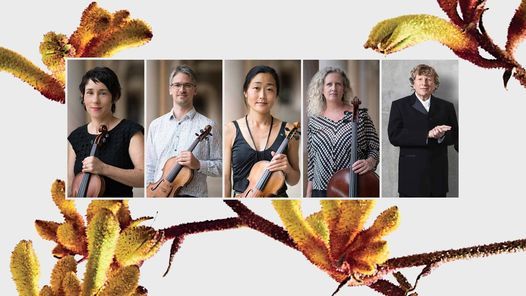
Australian Haydn Ensemble String Quartet

Australian Digital Concert Hall

Monday March 14, 2022

Skye McIntosh

Streaming once again from Chatswood’s Concourse Theatre, this Australian Digital Concert Hall recital was given by members of the worthy Sydney ensemble: artistic director Skye McIntosh, AHE regular Matthew Greco in violin 2 position, viola Karina Schmitz who may be just passing through on her way back to America, and cellist Daniel Yeadon without whom no period music performance in this country can lay claim to credibility. On paper, the quartet makes an impressive group; in the flesh, I’m afraid that these players have a fair way to travel before convincing us that they speak with one voice. Currently, the AHESQ fails to satisfy on a number of important levels.

We were presented with three works: Haydn Op. 33 No. 5 in G Major, Boccherini Op. 32 No. 5 in G minor, and the great Mozart K. 465 in C Major. Fine – an excellent launch to this year’s AHE season, if a tad chaste in personnel. But then, the live audience was not strong in numbers, as far as I could tell from the broadcast – unless a large crowd was packed into the back stalls. And I was hard pressed to find anyone in the crowd younger than (let’s be kind) 60. Not that there are any proscriptions currently in operation for events like this recital; venue organizers can ask those in attendance to wear masks, but I didn’t see any being worn. And, while it appears to be a pleasant enough space, what’s the Chatswood attraction? Previous online events show that CBD venues in Sydney have trouble attracting audiences, let alone the young; why promenade your wares in an ultra-conservative demographic that might as well block independently-thinking ne’er-do-wells from travelling further up the line at North Sydney?

Sadly, of the three works performed, I found the group’s Haydn to be the most unsatisfying. During the initial Vivace assai, first violin notes kept disappearing as early as bar 11. But McIntosh wasn’t alone: the ambient texture sounded scratchy and scrappy. Still, the first violin’s dominance is inbuilt and attracts your attention continuously – not always to a performance’s betterment, as the flimsy top notes across bars 21 and 22 demonstrated, and later a clumsiness in attack at bars 134-5. Up to this night, the players had performed in Canberra, Berry and up the road from there in Burrawang, so their roughness of ensemble surprised and disappointed.

Even in the relative safety zone of this quartet’s Largo, the question of weight distribution arose as problematic, like the accompaniment provided by second violin and viola in tandem for much of the piece’s length. As well, the uniformity of attack proved a moveable feast – either scatter-gun or over-aggressive (bar 44) – while the firm concluding measures lacked subtlety of dynamic. In the opening to Haydn’s scherzo, we were left up in the air rhythmically because of the inchoate chromatic scale across bars 4 and 5. Luckily, the trio made a more positive impression – but then, it’s four-square by comparison.

Refreshing to hear Greco and Schmitz being exposed in bar 33 of the set-of-variations finale, and Schmitz and Yeadon partnering for the penultimate excursion before Haydn moved to Presto and thereby brought about a much-needed infusion of verve and punch across that 26-bar stretch. However, this concluding glimpse of energy was insufficient to rescue a reading that seemed to be tinkering at the edges without giving the composer’s work its robust due.

Apart from devotees who have graduated beyond the Minuet from the E Major String Quintet and that entertaining mini-tone poem, La Ritirata di Madrid, most of us don’t know Boccherini’s 100 string quartets. Which is a pity, as this program’s central work demonstrated. Like the contemporary Haydn work just heard, this score favours the first violin, although Greco came in for a few partnership moments. Certain moments stood out, like McIntosh’s deft triplets peppered through the opening Allegro comodo‘s development. During the Andantino, Boccherini generated a well-tilled field of rhythmic titillations through the contrast of triplets with straight 3/4 crotchet passages. Happy to report that the ensemble’s unanimity of attack was pretty fair here, apart from a notable early strike from someone at the start of the movement’s fourth-last bar.

The composer gave his interpreters a good deal of interweaving and individual highlighting during the Minuetto con moto, the players here dealing out several clever touches, especially in the Trio‘s second part. Indeed, this movement generated some passages of individuality where the participants invested a certain layer of personality in their work, the which persisted into the concluding Allegro giusto where you gained some insight into how brisk and clear this music could be. McIntosh’s back-to-Bach Capriccio ad libitum cadenza sent a minor shock-wave through these ear-drums, probably because of the performer’s relish in the triple-stop chords that interrupted Boccherini’s busy-work demi-semiquavers.

Here was an intriguing inclusion in this recital book-ended by unquestionable and familiar masterworks. It gave plenty of indications – if they were needed – of the Italian writer’s capacity for originality and delight in experiment; nothing exceptional or disturbing like the opening passage of what was coming after this night’s interval, but venturing into the unexpected and not weighing down his lower-voiced players with supplementary pap.

Despite some drawbacks, the final piece proved the night’s most satisfying experience, in part because of the group’s employment of vibrato and the consequent production of a less strident sound colour, even in the chromatic meanderings of Mozart’s opening Adagio. Not everything went swimmingly, Yeadon sounding stressed for no apparent reason at bars 101 to 102. But the writing quality had moved onto a more finished plane than that which obtained in the program’s other content so far; even the polyphonic interplay was more satisfyingly couched and striking, as at the eloquent entry from Schmitz at bar 45. As well, the musicians allowed a fluency to their delineation of metre and pulse, giving space for moments of individual difficulty which is one of the vital requirements in chamber playing.

It’s the composer’s genius, of course, that carries off his opening Allegro, evident in the subtle changes that tittivate the recapitulation. But the performance was not able to maintain its sometimes worthy standard, displaced by odd distractions like an uneven first violin-viola duet across bars 225 and 226 and an absence of joyful elation in the effusiveness that begins in bar 235: that brilliant final gesture that carries us to the subdued final six bars.

Such imbalance in weighting also bedevilled the Andante cantabile, in particular the dynamic shifts that begin at bar 31 where the tailoring of voices proved to be something of a catch-as-catch-can affair. Across some pages, it struck me that the central pair – second violin and viola – had moved into a dynamically congruent space that sat at odds with the top and bottom lines. But the balance hadn’t improved by the time the ensemble reached that simple set of detached repeated chords in bar 81, and imperfections like that meant that these pages as a unit failed to capture this mind and heart.

Mozart’s Menuetto had its moments under these hands, despite occasional disruptions like the squeaky last F crotchet in bar 42, and several questionably pitched leaps in the Trio‘s second part. What you missed in the minuet itself was a sense of continuity; as it came across, you heard amiable scraps, if carried out with welcome fervour. I liked McIntosh’s manipulation of the metre in the opening strophes of the Allegro molto, slightly bending its shape up to the end of the first subject’s treatment at bar 34. In fact, this movement flew past with pleasing polish to the point that I was sorry we heard no exposition repeat – the only practicable one omitted throughout the night. This finale yielded a number of real pleasures, like the splendid duet for McIntosh and Yeadon beginning at bar 308 and an informed elegance at bar 391, and later at bar 404: points where other quartets batter the notes with Beethovenian passion. Certainly, this movement gave the program a convincing conclusion, if not one that wiped out the memory of a tentative Haydn interpretation and an absence of character in that unexpectedly original Boccherini.

Gifted group returns

Ensemble Liaison

Australian Digital Concert Hall

Wednesday February 23, 2022

Opening its season for 2022, this venerable group (at least 18 years on the go) displayed once more its penchant for mixing its programs: the rough with the smooth, old-fashioned with up-to-this-minute, time-honoured with temporary, full lungs versus short pants. Because of an injury to cellist Svetlana Bogosavljevich‘s left (I assume) hand, the scheduled Zemlinsky Op. 3 Trio of 1896 disappeared from the published agenda, replaced by the Brahms Clarinet Sonata in E flat, the second of his late two and part of the composer’s twilight-years affair with this instrument that produced four masterworks with the clarinet as fulcrum.

As things turned out in the Athenaeum 2 space, all three players appeared in the opening and closing numbers. Timothy Young‘s piano served as benign bindweed for three of Bruch’s Eight Pieces Op. 83; then later shared an equal load with Bogosavljevich and David Griffiths‘ clarinet for Armenian-Canadian pianist Serouj Kradjian‘s salute to the Carpathians, Dracula’s Ballad, newly arranged for the Liaison’s instrumental format. Another piece of make-weight appeared with Tema III from Giovanni Sollima‘s music for the 2005 remake of Il bell’Antonio, popularized by the cellist composer and Yo-Yo Ma.

Not that film music has to be fragile in construction, limited in melodic scope or rhythmically predictable – but it usually is. Bunuel had the right idea in using it as little as possible, if at all. But the extract from Sollima’s film score was pretty typical of the genre with a slowly developing theme on the cello while the piano backgrounded itself through an ostinato middle C. As atmospherics go, this sounded like a close cousin to John Williams’ main theme for Schindler’s List, mainly for its inner self-reduction to short motives woven into a thin-ply C minor fabric. Little disturbed the predictable flow apart from some unexpected harmonic clashes in the piano part and a few cello glissandi colouring a high-pitched climax. At about this point, you were aware of Bogosavljevich’s handicap with her vaults to high notes coming off accurately three times out of five.

The cello’s passage in octaves also sounded slightly off-colour, more so than when this musician is in her usual form; the moment was an exposed one while Young’s piano went all Sinding on us. A powerful highpoint sounded the conclusion to this more active middle section before the score moved back to a recapitulation of its moody opening, this time with a G/C ostinato. It’s a well-contrived display piece for both instruments, even if I can’t work out how it fits into the film’s scene-setting scheme which appears to balance the main character’s sexual impotence with the political situation in Fascist Italy of the 1930s. But it added another facet to Sollima’s musical personality, which I’ve only previously experienced through his 2016 guest appearance with the Australian Chamber Orchestra.

As for the Dracula-centric piece, this turned out to be a folkloric hodge-podge, opening to a martial rhythm with a perky tune from the clarinet punctuated by loads of dynamic belting from Young’s piano. An inexplicable mental deviation made me think of The Soldier’s Tale, although Kradjian showed no tendency to harmonic acerbics. A shift into tango mode and we were treated to some excellent concerted passages where each trio member folded into the ensemble mix enthusiastically before a bridge led into a presto that could have been in G minor and where a hell-for-leather set of pages showed the composer flirting with 1920s jazz, a klezmer touch or two, plus some pale-Bartok freneticism with a mass of octaves bringing down the curtain. Comparing this with a recorded reading, the Melbourne trio gave the score an unexpected bite and relentless vigour.

Did I last hear some of the Bruch pieces from this group? Probably, because not many groups have the characteristic ensemble needed to negotiate them. In the opening Andante, Bogosavljevich’s rich timbre emerged at the change to A Major at Letter E in the 1910 Simrock edition but her colleagues also made rubato-rich going across the piece’s length. the bars flowing past easily and the texture enriched by some slight string portamenti. The second piece, Allegro con moto, intrigued mainly for the changes that Bruch made to his original viola line, the score’s ongoing surges reaching a deftly placed slight pause at Letter F 13 bars from the touching, muted conclusion.

Last selection from this work, the No. 6 Nachtgesang, immediately impressed for the determination in Young’s bass notes even when the prevailing ambience asked for a restrained attack. Luckily, the nocturne is a gift for all interpreters, Griffiths and Bogosavljevich eloquent across imitative and parallel motion passages, an excellent instance of both at Latter G. Still, the cello’s pitching three bars from the end fell just short of true and Griffiths spiked his penultimate note.

This program’s most substantial component, the Brahms sonata, was an up-and-down experience, the opening subject delivered with little character, the first instance of striking work coming with Young’s tender, muffled chords beginning at bar 28. But the outbursts that pepper this Allegro were not always crisp, possibly because Young was making instant adjustments to cope with a few out-of-tune notes, particularly an unhappy A5 and sudden unhappy complexes like the simple parallel piano part at bar 66. Nevertheless, the duo showed ideal pairs of heels in the benign regression starting at bar 138, and later a splendidly graduated intermeshing when the triplets started for the Tranquillo and those magical last 12 bars.

Griffiths and Young gave an impressive account of the Sostenuto trio in the middle of the following Allegro appassionato, even if the piano’s bass came over with extra power and the return at bar 139 was dynamically over-blasted. indeed, both players appeared over-exercised in the movement’s final third, with lots of fortissimo when forte would have sufficed.

But the Andante con moto variations were hard to fault, the theme a ravishing construct, particularly for that touching plagal cadence in bar 14. Then, the delights kept coming; carefully paced and delivered syncopations in the piano at bars 22 and 23; the elegantly balanced handling of triplets in the second variation; an attractive juxtaposition of responsorial and concerted across the following grazioso; Young’s laid-back off-the-beat progress right through Variation 4; and an infectious drive that reinforced the rush home from bar 135 onward.

As I said, this somewhat-less-than-an-hour’s worth of musical action proved to be an alternation between the venerable and the contemporary; in line with the Liaison group’s practice of offering a wide range. For all that, the Brahms and Bruch scores were written only 16 years apart, Sollima’s and Kradjian’s pieces composed even closer in time. Relieving one of my long-time bugbears, we heard no oddly-voiced arrangements but only versions of works totally endorsed by their creators. To general reassurance, this temperamentally vital ensemble is off on its way for a full year’s operations; here’s hoping nothing gets in the way this time.

Noli me tango

PIAZZOLLA

Australian Chamber Orchestra

Concert Hall, Queensland Performing Arts Centre

Monday February 14, 2022

Back in Brisbane after two years’ absence, the ACO opened its break-out live-again lease of life here with one of the organization’s more popular guests. Accordionist Crabb has enjoyed a 20-year-long association with the Sydney players, given vivid life by a 2003 Chandos CD which contains all four Piazzolla works in this concert’s concluding melange, as well as the evening’s unexpected encore: Oblivion.

While the Argentinian composer’s music framed the program, the interstices proved more intriguing for this listener. At the centre of each half came a sample of orthodoxy: first, Handel’s A Major Concerto grosso, penultimate in the Op. 6 set and a reworking of one of the composer’s own organ concertos in the same key; later, the Bachiana Brasileira No. 9 by Villa-Lobos, obviously in the string orchestra version. Frippering around these scores came one-time Piazzolla collaborator Antonio Agri‘s Desde adentro arranged by Crabb (as was the opening Libertango); Elena Kats Chernin‘s 20-year-old Torque, an automobile engine celebration, which Crabb premiered with the ACO who commissioned the score. Additions to the night’s second half were Gardel‘s Por una cabeza in an arrangement by John Williams for Itzhak Perlman, the whole transcribed by Crabb and bringing back memories of Pacino in the Scent of a Woman film from 1992; the fourth movement, Coqueteos, from Gabriela Lena Frank‘s Leyendas – An Andean Walkabout which raised no eyebrows or much interest, I’m afraid; and the Piazzolla concluding tetralogy in yet another Crabb transcription: Milonga del Angel, Vayamos al Diablo, Romance del Diablo, and La Muerte del Angel.

Crabb sat front and centre for the night, contributing to everything in the first half, including a tenor-bass support in the concerto grosso, but was silent for the Frank and Villa-Lobos. Pianist for the program, Stefan Cassomenos, relished his role in the tangos and the Kats-Chernin escapade, but seemed to be silent for the Gardel – or else he was being super-subtle and merging selflessly into the ensemble. Most of the ACO personnel remained familiar apart from violinist Lily Higson-Spence and violist Meagan Turner. Despite the program’s information, Maxime Bibeau was not at the double bass stool; his place was taken by David Campbell from the Sydney Symphony Orchestra.

I’ve been to few enough concerts in recent times and the trend has been to present a program as a unit, without interval. However, the ACO took us back to pre-COVID practice – which has its good points (mainly, physical relaxation) and drawbacks (principally, the facility to find room for programmatic flab). This occasion’s particular sequence of works depended for its appeal largely on the South American components which – the Handel apart – were all-pervasive, even in Kats-Chenin’s Torque.

The ensemble’s account of Libertango took its time getting to the main melody; indeed, artistic director/ concertmaster/soloist Richard Tognetti‘s articulation of this tune seemed overdue after a lengthy span of scene-setting flourishes. Crabb’s solo contributions had that welcome character of sounding improvised, framed for the performance itself. My only problem came with the tuning of both first and second violins playing unison phrases; a touch off-point in some stretches – which surprised as this was the tail-end of the ensemble’s eleven-night national tour. Tognetti also starred in Desde adentro with a substantial solo; but then, he has an ideal fluency with this genre where it’s rare to have a player sensitive to the inbuilt style of production who also has an unshakeable technique.

Not much to say about the Handel concerto. Tognetti enjoyed dominating exposure; that’s the nature of this particular Handelian beast. The whole work was treated with an abundance of dynamic flexibility, some contrasts verging on bizarre. Still, the uniformity of attack reminded us of how much we have missed the expertise of this body, its sheer precision when the musicians are operating at their best. As well, certain moments startled both for the composer’s sense of theatre and the performance immediacy, like the bass entry in bar 8 of the first Allegro, the reassuring repeated notes in the prime melody to the appealing Andante, a splendid dovetailing of soloists and ripieno in this same movement and Tognetti’s semiquaver flights after bar 127, followed by a whip-cracking finale with just the right amount of ornamentation to distract from the movement’s bouree-like heftiness.

While she began with some tango-suggestive rhythmic movement in the first third of Torque, Kats-Chernin’s piece appealed most in its central slow section, in particular a chain of 2nds between Crabb and Cassomenos that spiced up a long melodic chain. But when the composer entered into a musical description or simulation of hurtling down the highway in the score’s last segment, it struck me that the journey could have been cut by half, if not more: the motoric only takes you so far – in music, not on the road where your wallet sets the limit.

Beginning the program’s second part, Tognetti set the mind-set for Gardel’s clever curvetting and ardent swoops. This is music that invites you to dance, thanks to its infectiousness, rather than asking you to leave the floor to professionals: my response to Piazzolla’s nuevo tango which is – thanks to its adoption by too many should-know-better musicians – in great danger of becoming viejo because of over-exposure and the mistaken belief that any combination will do . . . rather like the federal government’s mix-and-match approach to vaccines.

Frank attempts to meld classical traditional format with Andean folk music, although I feel that the former wins out over the latter in this movement from her Leyendas. The composer’s language is accessible enough and her scoring for strings shows a keen awareness of textural potential, but it was difficult to find the folkloric element. Probably my fault as, like so many Australians of my generation, west coast South American music has remained unexplored territory. For all that, the ACO presented the score with apparent mastery of its none-too-troubling mysteries. After, the Villa-Lobos prelude-and-fugue construct came across with a firm unanimity from all concerned, although I believe a compromise was worked out with the composer’s double bass line which requires three performers at the Preludio‘s beginning; one of the cellos was deputed to engage in lowest-level support duties for both segments. While the 37-bar first movement has a restrained ardour in its wide-spaced layers, the fugue shows the Bach strain more obviously in play. Most attractive is the central action where the fugue subject almost disappears in a chromatic ferment, threatens to come back in full force with the violas at bar 109 but dissipates its semiquaver energy, only for a real recapitulation 20 bars later in a score that is not too clever-clever but errs on the side of Brazilian jubilation rather than exercising Bach’s deceptive formal control.

Probably nothing new came to ACO veterans with the last Piazzolla bracket; if you know the Song of the Angel CD, the only major change for this night was that Benjamin Martin wasn’t on piano. A deft alternation between fast and slow, the pieces formed an amiable suite, albeit one where the harmonic shifts made for comfortable listening. Cassomenos achieved some penetration but the main memory I have is of Crabb dominating the mix, demonstrating his instrument’s capacity for explosive bursts of vehemence and piercing single-note melodic contours. Further, Vayamos al Diablo presents listeners with an unexpected rhythmic shape: 4/8 + 3/8 – enough to test even the most musically woke tango dancers.

But I’m operating at a disadvantage because of a lack of sympathy with Piazzolla and the tango. Perhaps the problem lies in a lack of varied exposure to the composer’s music; from a catalogue of about 3,000 pieces, I’d know a maximum of 10 (well,13 if you individualize the Estaciones Portenas) and repeated hearings of those few is the only way I can distinguish nearly all of them. As for the dance as choreography, it’s difficult to find an attraction because of its self-consciousness. Even the dedicated advocacy of Clive James wasn’t persuasive, though the spectacle of that great writer performing with characteristic understatement showed how the steps need not become ridiculously stilted.

That’s the way the cards fall; not every program is going to bring complete satisfaction and, if you are fated to encounter a musical genre that leaves you cold, it’s best to face the experience in the company of a distinguished, always distinctive body such as the ACO. Yet again, we have to be grateful that these musicians are at liberty to visit, raising both standards and spirits in a time that is still beset with uncertainty.


Best wine first?

SUMMER NIGHTS SERIES 1 OPENING GALA

Bendigo Chamber Music Festival

Australian Digital Concert Hall

Capital Theatre

Wednesday February 2, 2022

Breaking in from the south, the Australian Digital Concert Hall put an end to Queensland’s long serious music drought by presenting all the recitals programmed for this Bendigo celebration which is, for the first time (as I understand it) devoted to chamber music. Co-directors Christopher Howlett and Howard Penney began the gala concert with addresses that demonstrated how pleased they were to be back participating in live performance in front of an actual audience, while Mayor Andrea Metcalf opened the festival with something approaching proprietorial pleasure.

As Penny pointed out, no undertaking like this occurs without some problems. In this case, violinist Sulki Yu from Orchestra Victoria had incurred the joys of being a close contact and had to withdraw, replaced by Andrew Haveron moonlighting from his Sydney Symphony Orchestra concertmaster duties. As well, Emma Sullivan stepped in to the double bass chair (or stool) – an absence that had me worried in the festival’s program notes when the instrument was completely absent although specifically required for one of the scores being attempted.

In fact, we heard three works: Vivaldi’s In furore motet from the early 1720s, Saint-Saens’ double bass-requiring Septet of 1979-80, and Dvorak’s 1889 Piano Quartet No. 2. None of these is a regular in the concert hall and I would think that many of us were hearing the motet and septet live for the first time, although the former has been thrust into the early music spotlight by Julia Lezhneva whose recorded reading is little short of spectacular, particularly as she is assisted along the way by Il Giardino Armonico who make Vivaldi’s instrumental support a vital and chameleonic creation.

Soprano Chloe Lankshear displayed a fine clarity and near-precision in the opening movement and the concluding Alleluia, employing some of Lezhneva’s interpolations in the repeat of the opening aria, with only a few omitted notes in bar 64 disrupting an excellent seam of virtuosic production notable for some expertly despatched high notes. The string body was a formidable one with violins Natsuko Yoshimoto, Sophie Rowell, Rachael Beesley and Haveron; violas Tobias Breider and Stephen King; cellos Penney and Howell; bass Sullivan, with Donald Nicholson providing a crisp harpsichord tang. Thanks to Lankshear, the opening pages radiated verve although the singer’s phrase-shaping still has some way to go.

I would have preferred the central Largo beginning Tunc meus fletus to have been handled with less room for pauses; they were of little use to the singer and the result was a romanticisation of the texture, even if the performers believed they were giving these fairly simple pages some flexibility. For all that, the ensemble functioned very well here while all forces handled that unexpected flattened 3rd at bar 31 with equanimity. Lankshear eschewed noteworthy ornamentation in the repeats of this section, reserving her powers for the final jubilant pages which needed just a bit more punch on downbeats to move this reading from pleasing to remarkable.

In his Septet, Saint-Saens employs an eclectic mix: string quintet (including double bass), trumpet and piano. And the greatest of these is the piano which relishes the composer’s flashy brand of virtuosity and dominates the mix all too often – or perhaps that was just Daniel de Borah exercising his dynamic potential which is bound to determine your opening impressions in the initial Preambule right up to the Piu allegro change, just before Saint-Saens goes all Schumann Piano Quintet with thematic and motivic sharing. In the initial flurries, de Borah only blotted his page once, as far as I could hear: half-way through bar 17. In the semi-exposed trumpet part, the Sydney Symphony Orchestra’s David Elton showed precise and measured delivery in a part that wouldn’t tax many players, except for a final low E flat which I couldn’t detect.

Following his antique path, Saint-Saens moved to a Menuet where a rare Elton mis-step came up during the repeat of the first 10-bar sentence. Later, the strings-minus-bass unison pages (involving Yoshimoto, , Haveron, King and Howlett) with trumpet above a rippling piano proved a purple patch in a reading that depended above all else on the musicianship of its disparate participants, coming as they did from across the lower eastern seaboard. Despite the rather brash high-stepping nature of the Menuet itself, de Borah introduced a pleasantly subtle disruption in his short solo twelve bars from the ending to this segment of the movement. Later, some interest during the Intermede came in solos from King and Howlett which promised much but petered out all too soon, the aggression that bursts out at Letter C (in the Durand. Schoenewerk & Cie 1991 reprint) a welcome relief from a glut of sweetly intersecting lines. Still, the finest achievement of this section – possibly the whole reading – came in a sensitively couched 11-bar coda with some eloquent gradations of softness in all layers.

Being open-minded and chauvinistic in equal measure, I found the shade of Percy Grainger lingering over the opening to the Septet’s Gavotte et Final; don’t know how this came to mind except in the generous. bumptious leaps at the beginning. Again, this movement is a fairly easy ride for everyone except the pianist whose break into triplets towards the first double-bar is a delicacy as toothsome as anything else in Saint-Saens’ chamber music. The keyboard work apart, the remainder of these pages is pretty plain sailing with lashings of mutual support in the Piu allegro/ Stringendo/Animato acceleration until the restrained welter of the final bars. At which point, the only clear defect in the performance came as Elton essayed the third-last bar’s top E flat where a more cautious performer would have taken the composer’s ossia and left that ascending arpeggio well alone. The note cracked, of course, and left this listener a tad dispirited.

Nevertheless, the performance succeeded because the timbral mixtures came over with vigour and freshness in an acoustic that seemed boxy. I’ve not been inside this theatre – ever – but I suspect there’s a lot of absorbent material apart from the stage curtains in the building. Lankshear coped admirably with a lack of resonance/echo in her Vivaldi and the two exposed soloists in this second work showed an essential agility.

Eschewing an interval, the program then launched into the Dvorak with Amir Farid making a banquet for himself of the rich piano part; his colleagues were Rowell, Breider and Penney. From its opening Allegro con fuoco declamation, this ensemble left little doubt that it was determined to be involved in the proposed struggle, their dynamic levels hefty and the strings’ bowing often stretched to a strained mark. In writing of this thickness, you could forgive a few errors from Farid, since the composer gives his pianist an often virtuosic role where keyboard hammering sits across and alongside strident string lines.

The Lento opens with a three-segment cello solo, an opportunity here for Penny to go all wooly on us with a searching throb to his vibrato in alternation with Farid’s echo. And each participant had the opportunity to emote, thanks to changes of emphasis and texture, as well as sudden turns to rhetoric before reversions to eloquent poetry, as at the change to D flat Major at Letter D in the post-1945 Simrock edition which received a carefully detailed interpretation that once again made you realize what close conditions the players were enduring, especially when Penny returned to draw us back on track at Letter E. This melting moment was well-matched by Farid’s assumption of primacy at Letter F as he canoodled through the prime melody with a hushed support of string chords. Indeed, the whole movement came over with alternating sentiment and passion – but that’s what the score proposes.

Given the first movement’s aggressive emphasis, the group’s approach to Dvorak’s third movement impressed as muted or muffled, the landler-style dance an example of the composer’s prolixity, so that the Trio change to B Major came upon us as very welcome. Penney’s three exposed quaver bars at Tempo I came across as rough in context; the violin/viola duet work 15 bars before Letter C didn’t live up to the standards of congeniality and accord that obtained through the other three movements; the final cadence would have gained from a more decisive communal attack.

Farid again took the dynamic high road in the Allegro ma non troppo finale, even in the support role required prior to Letter E. I think this assumption of authority might have had something to do with a faltering across the chromatic shifts in bar 5 before Letter C. The only major flaw in this movement came from the restrained nature of Rowell’s violin which impressed as elegant and reliable but too refined to offer much competition to her string colleagues, let alone the emphatic keyboard.

In the end, this quartet struck me as the most put-together, confected segment of the gala program; four excellent musicians, without doubt, but not given the time needed to put together a consistently integrated interpretation. And in this Dvorak, more than in the motet or septet, such a uniformity of approach is fundamental.

Luxe, calme et volupte

SOFIA TRONCOSO, PATRICK NOLAN & ALEX RAINERI

Music Viva

Queensland Conservatorium Theatre

Wednesday November 24, 2021

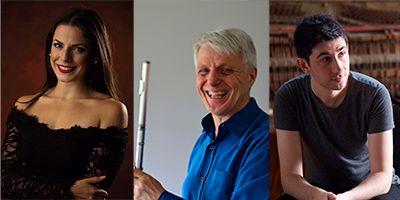
(L to R) Sofia Troncoso, Patrick Nolan, Alex Raineri

Closing its never-say-die year, Musica Viva once again celebrated the talents of local musicians which, in these dodgy times, means Queenslanders. This particular evening focused on the salon; specifically, the French variety and, by and large, the program stuck to the task, although the opening offering seemed a tad out-of-place. But who’s to say that Bellini arias weren’t standard fare in the greenhouse atmosphere of the Guermantes and Verdurin get-togethers? That’s what soprano Troncoso began this night with – Eccomi in lieta vesta/O quante volte from I Capuleti e i Montecchi and which is Juliet’s first appearance, coloured by prominent, mournful horns that were here replaced by Nolan‘s flute. The only part of this opera that I know, the recitative/aria gave the singer plenty of space to exercise her range and dynamic control, the higher reaches of the work heading towards pitch problems with a a strong vibrato intruding across the word intorno but disappearing for some creditable mini-cadenzas to brillar il giorno and the second-last in tuo sospir, this last a sensitive preparation for the concluding bar-and-a-bit.

More likely fare for the salon came in Doppler’s Mazurka de Salon, a non-stop show-piece for Nolan with pianist Raineri (once again fulfilling his occupation as accompanist for all seasons by replacing the scheduled Stephen Emmerson) offering discreet chord support. Both artists appeared quite happy with each other in the frequent stops, starts, rallentandi, accelerandi, swoops and curvets that typify this highly decorative material. While the Mazurka presented as not so blatantly virtuosic as when expounded by other flautists, Nolan kept a fine grasp on the work’s mobility and preserved its sense, eschewing the temptation to make a gabble of its prolix solo line.

Reaching for the highest point that can be associated with the salon, Raineri played three of Chopin’s Op. 28 Preludes, beginning with No. 20 in C minor, its Largo enjoying a very slow approach from this pianist who showed a clear relish for the bass octaves across the opening bars and a determination to elongate the distance between chords in the repetition of the second strophe. No. 22 in B flat found the pianist doing his best to give us high-flying Romanticism, using plenty of rubato and taking more opportunities to vary phrase lengths than most interpreters I’ve come across. In the final Prelude of this collection, the D minor pedal dominated the first 10 bars, but that made the eventual move off it all the more dramatic. I wasn’t over-impressed by the first scale-rush to a top F in bars 14-15 because of a lack of definition and the famous descending chromatic 3rds run sounded indistinct rather than fulfilling its anticipated scouring effect. As with his first Chopin, Raineri presented a most distinctive and individual version of this prelude, well worth the experience for its drive and responses to parts of the score that are often glossed over.

More indisputable salon music arrived with three Hahn songs from Troncoso and Raineri. L’heure exquise saw the singer manage her upward 6th and 7th leaps with telling smoothness – high points in a fairly monochromatic song. A Chloris gave Raineri room in his interludes to execute some elegant note-pointing while the vocal line sustained the required measured and even style of delivery that infuses this work with ancien regime elegance. Still, I thought the third number, L’enamouree, came off best in the group, Troncoso demonstrating clean output and deliberation in her work, caressing the line in an example of eloquent sentiment – the exercise a moving partnership between these musicians.

In the evening’s solitary voice/flute duet, Troncoso and Nolan gave a finely executed reading of Roussel’s Rossignol, mon mignon, their interleaving mutually considerate to the point where good manners went too far; more self-assertiveness, especially from the instrumental line, might have mitigated the effect of a fluent but aimless set of pages. More persuasive although a less accomplished piece was the program’s only genuine voice/flute/piano trio: the first of the 3 Odelettes ancreontiques by Maurice Emmanuel, Au printemps – another example of how much the Greeks have to answer for. This was harmonically lush, thanks to Raineri ensuring that each change of colour made its point, while Nolan pulled back in dynamic power, even at that tempting point where poet Remi Belleau speaks of birds playing in water and Emmanuel responds with some telling glissades. But then, this is a soft song, rising to an mf marking at Number 2 in the Durand edition for barely five bars.

Having celebrated the early 19th century salon with his Chopin bracket, Raineri moved to the last century with some of Szymanowski’s Nine Preludes, the composer’s Op. 1: intriguing products as the composer’s own choices from his juvenilia, as being indebted to Chopin’s Op. 28, and as indicative of Szymanowski’s experiments with novel compositional language. We heard three of these works: No. I which sets three against two throughout its brief duration; No. IV does the same thing but with more chromatic swerving around an ambiguously applied key signature; and the E flat minor No. VIII which was the most Chopin-suggestive of the three and a splendidly fluid creation expertly accounted for.

Finally, Nolan had his turn in the spotlight, for which he chose the most famous flute solo of modern times (apart from Varese’s Density 21.5): Debussy’s Syrinx of 1913, actually written for a ballet and to be played off-stage. This player is highly experienced and has the craft and insight to shape the piece into a fluent construct, in this interpretation covering an ample dynamic range and tempering the lengths required for breaths as well as maintaining the work’s direction through the cedez, rubato, un peu mouvemente points, the whole finishing with a masterfully controlled final 5 bars and the softest concluding D flat.

More Debussy followed with the Chansons de Bilitis, again demonstrating the sympathy between Troncoso and Raineri as they negotiated the slightly tinted character of long stretches in these three works. For instance, La Flute de Pan is recitative with clear stretches where the vocal line stays on one note while the piano employs several colourful additives – the titular flute, certainly, but also details like the frog imitation just before the last rushed line about the singer deceiving her mother.

About this point, the performers were distracted by some buzzing or electrical interference which could have been feedback from the Conservatorium hall’s recording system, or its speakers, or a hearing aid turned up too loud – this last an all-too-common feature of musical events I’ve attended in the Salon of Melbourne’s Recital Centre, or at the Australian National Academy of Music, or even in Hamer Hall. Whatever, the sound, lowered itself, if not quite to nothingness, and the duo simply pressed on.

In La chevelure, Troncoso generated a fine lyrical arch at la meme chevelure and maintained the song’s urgency up to the final Quand il eut acheve, from which point the composer gives us a superb exhibition of near-stasis harmonically while the vocal line folds in on itself. Finally, I found great pleasure in Raineri’s block chord work across Le tombeau des naiades and the clarity of his parallel right-hand 3rds from bar 11 till the fourth-last measure. On top of this, Troncoso gave a fine display of controlled power leading to the song’s explosion into F sharp minor.

Finally, all three artists came together for another hybrid in La flute enchantee from Ravel’s lopsided Sheherazade triptych. I can’t trace who did the arrangement but it made for an engaging if brief conclusion to the program, the performers making a generous gift of the opening three lines, keeping their heads in the active central Allegro, and observing the letter of the law in the brief free-for-all in the Lent before Number 4 in the Durand edition. A gem to finish this tour de chambre, even if the Ravel song belongs in the concert hall rather than a more intimate space, and it was delivered with a quiet panache that had graced a good deal of this varied entertainment.

No marriage impediments here

PIERS LANE & ENSEMBLE Q STRING QUARTET

Musica Viva

Queensland Conservatorium, Griffith University

Thursday October 7, 2021

(L to R) Anne Horton, Imants Larsens, Natsuko Yoshimoto, Trish Dean, Piers Lane

Yet again, a professional performer has had to cut his pandemic cloth to suit prevailing circumstances. Expatriate pianist Piers Lane was all set to tour the country for Musica Viva in collaboration with the Sydney-based Goldner String Quartet. Lockdown put an end to that organizational fantasy but Lane did get to exercise his craft in the rarefied double-doughnut purity of a city very familiar to him. As substitute for the Goldners came a quartet made up of Ensemble Q members: violins Natsuko Yoshimoto and Anne Horton, viola Imants Larsens, cello Trish Dean. I’m not sure how far back Yoshimoto’s relationship with the Ensemble stretches prior to her recent assumption of the co-concertmaster position with the Queensland Symphony Orchestra, but she slotted in ideally with her colleagues on this night, heading a highly persuasive reading of Szymanowski’s Quartet No. 2 – a work with which this group has had experience already in 2021.

In this reading, you were immediately inveigled into the composer’s unique sound world by the rapid sul tasto pattern-work from Horton and Larsens that, despite its harmonic distress on paper, gently backgrounded an excellently spun at-the-double-octave duet from Yoshimoto and Dean; the atmosphere a delicate web up to the punchy jump to forte at bar 28 where you realize just how aggressive yet disciplined Szymanowski’s counterpoint can be. While the players coped with the movement’s central matter, you were impressed by the congruent ensemble work, each attack finely slotted into position to sustain the dissonant argument. As one simply effective instance, it was hard to go past the lead back to the first subject, a duet for both violins between bars 60 and 67 that could have come from one instrument.

Yet again, Yoshimoto demonstrated her chamber music insights, leading from the front; not carrying her colleagues but heading the enterprise without hogging the limelight, as heard in the whispered final two bars’ close to a benevolent G Major cadence with plagal suggestions.

Mutes off for the second movement Vivace where aggression oscillates with languor and this group kept the prize in constant sight: making formal sense of the piece’s abrupt turns from rapidity to calando and sostenuto with a meno mosso or two along the way, Here also you could admire the soaring power of Yoshimoto’s high register between bars 194 and 205, mounted against rhythmically disjunct pizzicati from all other lines. As the slow last movement opened, Horton’s exposed line came across as clumsy, more in outline than pitching, even if order came quickly on the heels of Larsens’ arrival in the canon. All four musicians found a rich and eloquent vein from the bar 21 Doppio movimento point, the atmosphere rising to very aggressive very quickly after the pivotal Moderato compression of argument, preceded by a delicious pair of brief affretando passages in bars 45 and 47.

Yoshimoto displayed her command of idiom and linear crafting just as much in these pages as earlier in the quartet, sharing the honours with Horton in a downward spiralling duet from bar 14 on and giving room for some penetrating viola exposures, Larsens owning a fine and forward tenor voice of exceptional and distinctive character. But the group played with exemplary control and passion throughout the work’s precipitate last moments – no scraping, no line over-prominent, the timbral placement rich and ardent.

Lane then appeared for a solo, shedding light on Lili Boulanger’s Theme et variations which the young composer eventually finished writing in 1914. It’s not a piece that has hit a posthumous big time, but, as Lane pointed out, the work isn’t a significant one – except as a bump along Boulanger’s career-path trajectory. In this score, she delivered exactly what she nominated: this is one of the most lucid, even plain-speaking set of variants you’ll come across, especially in a 20th century context. The only place where the theme becomes difficult to pick out is during Variation 7, pages Boulanger describes as Theme totalement modifie: the time signature changes and the theme gains some extra feet in its second half.

This reading emphasized the work’s sombre C minor character, Lane giving loads of sustained resonance to the first Theme a la basse and preserved the atmosphere through No. 2 Sur la tete du theme and later in No. 4 La basse et le surtout. Fortunately, the account of No. 6 Theme modifie a la partie superieure proved a welcome change of texture, if not scene, with its rippling underpinning layers of demi- and semiquaver figuration. But the dour character returns all too soon, and in spades for the final Theme a la basse where the final stretch from bar 141 to 148 is an aural sinking away to nothing – no hope, no promise, eventually no movement. All right. Thanks to Lane for dusting this piece off but I suspect its prevailing post-Brahmsian thickness of texture and reliance on harmonic shifts almost exclusively for interest will work against its proliferation on recital schedules.

Both parties, Ensemble Q and Lane, came together for the great Brahms Piano Quintet in F minor, their collaboration resulting in a performance of warm conviction and coherence. Lane kept very little back dynamically, trusting that the quartet could hold its own; a confidence that was almost universally justified except for those passages of grandiose piano striding in tandem with the strings. What sprang out from the performance early on was the strength of Larsens’ contribution, as at bar 27 and his elegant melodic shaping between bars 55 and 58. Having chosen not to repeat the exposition, the ensemble worked with polished sensitivity through the mainly subterranean development to the last segment which was peppered with excellent passages like the duet for Yoshimoto and Larsens from bar 230: one of the performance’s memorable flashes of excellence.

It wasn’t just a case of balancing the piano’s heavy contributions. At the recapitulation in particular, where the action is wrenchingly powerful, you heard an ensemble in ideal balance where each line could be discerned, even Dean’s mirroring of Lane’s bass. Further, the players seized with passion on those moments of unstoppable affirmation, like the burst into D flat Major at bar 286 and the subsequent arpeggio feast till the end, and hurled them out to formidable effect.

After the storm of that opening Allegro, Brahms’ following Andante is an emotional balm, loaded with melting solos and duets, as when the piano eventually lays off at bars 25/26; Horton urging out a melody line of refined sweetness, then combining with Larsens for an exemplary unison octave passage, chiefly of triplets, that emerges and recedes into soft meanderings – which might well be the prime characteristic of these pages. Dean stayed just the right side of overbearing in her lengthy lyrical duet with Yoshimoto beginning at bar 83 and persisting with some interruptions until bar 117 when the composer lets his material collapse in on itself for a hushed, benevolent conclusion.

Still, there’s no getting away from Lane’s dominance in this movement, opening with a carefully poised, bass-rich statement that returned to intensely moving effect at bar 75, those parallel 3rds murmured over with lapidary care. A turn of the page showed us a different approach in the vital Scherzo, the pianist taking off the gloves for exhilarations like the fortissimo explosion for everyone at bar 57 and (my favourite) those B flat oscillations between keyboard and strings across bars 100-109, followed by an extension of the same pattern at bar 158: splendidly compelling in its negotiation here. While the attack remained dogged in the movement’s Trio, pianist and strings ladled on the lyricism across the first two of its three pages, the Scherzo repeat an active powerhouse to be savoured right up to its rough-hewn end.

While we can all appreciate the craft of this work’s Sostenuto/Allegro finale, the working-out comes as a let-down after the satisfying emotional splaying of its precedents, the whole verging on disappointing with the rather whiney theme brought into play at the bar 94’s un pochettino piu animato. However, that’s a story for another decade and you had to appreciate the stamina of this ensemble which followed the composer’s jumps and transformations with assiduous zeal. Once again, you were able to appreciate Lane’s consideration, notably at places where the competition is fragilely placed, like the triplet-heavy stretch from bar 137 through to bar 159 where the piano has a reinforced top line and a potentially thunderous left-hand counterpoint. As in the first movement, the interpretation held a consistency of outline, the return of main themes en clair impressing as organically achieved – which is the formidable gift and problem of developing variation.

Speaking of stamina, that quality shone out keenly in the solid (150 bars!) coda to this finale, pages where the pace is furious and the players’ negotiation skills are tested over and over, especially those of the pianist who is involved in a juxtaposition of elements that bring to mind the inbuilt energy of the composer’s piano concertos. Lane missed the company of his Goldner allies, with whom he has made at least 8 recordings: he told us so. But I don’t believe any of us could find fault with the Ensemble Q players; rather, this night opened my eyes and ears to the existence of a local string quartet of impressive accomplishment.

No blush of shame to these cheeks of modesty

MYTHOLOGY OF NAKED FLESH

Brisbane Music Festival

Sunday October 3, 2021

Katie Stenzel

Before going any further, I have to say how impressive the musical elements of this farrago turned out to be. In essence, here was a duo recital with a cornucopia of accoutrements. Brisbane Music Festival director Alex Raineri engaged with soprano Katie Stenzel in Britten’s Cabaret Songs and Ligeti’s Mysteries of the Macabre, the latter a tour de force from both performers, not just the singer. Raineri also performed two piano solos: Scriabin’s Vers la flamme and his own arrangement of the Dance of the Seven Veils from Strauss’s Salome – actually, it seemed to me to include a bit more than the dance alone.

The odd program constituent came in a world premiere: Australian writer Alex Turley‘s Piano Flesh XXX in which Raineri shared the spotlight with actor Matthew Connell. As things turned out, not so much a spotlight as a split-screen exposure with the pianist working in Brisbane, the actor in Melbourne and – as seems to be the norm these days – never the twain did meet . . . not for this piece, anyway. As you might have expected, Turley’s segment of the program was the hardest to interpret; an arcane gesture-laden performance from both artists made even more puzzling when a scrap from Ravel’s Une barque sur l’ocean emerged out of nowhere and went back all too quickly into the ether.

Thrilling the pedants among us no end, Stenzel proved to be a model of clarity for most of the Britten songs; an achievement to be treasured when you listen to some of the available readings from better-known artists who think that ‘cabaret’ is a synonym for ‘slovenly’. The soprano observed the correct pitches and triplets throughout Tell me the truth about love, giving us accurate chromatic slippages and investing the song with a personality in each of its three stanzas. The following Calypso impressed for its crescendo and accelerando motions and the security of a few sustained top notes in a work that operates for much of the time in a low-ish register. During Johnny, I missed the vocal portamento at the end of the Charity Matinee Ball stanza and, as in many another execution, Stenzel’s below-the-staff notes in Auden’s final stanza tended to disappear while the final note (F?) lacked definition. On the other hand, Funeral blues succeeded on every level, here treated as an ascendant threnody with a defiant, negative finish of impressive power, not forgetting Raineri’s telling give-way-to-none under- and over-pinning.

For the Scriabin poem, Raineri’s preliminary address proposed an erotic subtext; along with the composer’s intended universal conflagration towards which we are all hurtling, you might also find a more personal interpretation in which the short work illustrates a drive towards orgasm. Good luck with that. I was happy to revel in the pianist’s splendid communication of direction and coherence in a score that can degenerate into unabashed flamboyance. Here, the eventual employment of double-note and three-against-one note trills was subsumed into the piece’s dramatic fabric; if I couldn’t rise to the occasion and find a sexual thread, I was able to appreciate the heightening of both tension and fabric as the apocalypse broke out.

Elgar Howarth, the British musician who conducted the premiere of Ligeti’s opera Le Grand Macabre, made arrangements of three of that work’s arias for the Chief of the Gepopo (Secret Political Police), who is trying to warn of an impending disaster but can only produce meaningless vocalisms. One of Howarth’s reductions was for voice and piano; I haven’t been able to trace it, so have little informative to report about this rendition. Further, the two participants took on characters that I can’t find in the opera: Stenzel (in overalls) as Harley Quinn (Harlequin) and Raineri a punk-of-sorts. They performed in front of a pixilated backdrop for most of the time but the arias were punctuated by abrupt shots of the participants alone, Raineri vocalising sometimes as much as Stenzel. You’d be going to find much that made sense here as the exclamations and expostulations flew thick and fast but the interweaving of lines and simultaneity of attack were carried out with excellent skill.

Turley’s piece saw Raineri spend much of his time inside the piano, working on the strings with his hands and using at least one over-sized drum stick with a soft head. Prior to the sounds, we had a mimed approach to the piano, an opening of the keyboard, the change from inside the instrument to orthodox sound production via the keyboard, and what looked like a farewell caress that might have been fetishistic – one of the ‘amazing possibilities’ that the pianist referred to in his introduction. Connell, as far as I could tell, made no sounds at all but attitudinized semi-seductively throughout the work’s four parts.

Then came the Seven Veils finale, executed with high brilliance and an object lesson in transferring a sumptuously colourful orchestral fabric to fit a piano’s limitations. Above his skill in negotiating Strauss’s harmonic vagaries, Raineri fulfilled the essential task and made a convincing dance of it all, complete with the expected curvets and wayward darting forward and then receding with a satisfying sense of balance. Indeed, the performance impressed most when you simply shut your eyes and enjoyed the sonorities rather than looking at the extra-musical element of this concluding gambit.

What Raineri attempted in this Strauss work, he said, was to offer an exercise in subversion. In the opera, the heroine strips herself to nudity; here, Raineri did the same, taking off a seven-part black costume, devised by Joel Dunkley, at various points in his performance. Nothing wrong with that exercise in the abstract but the realization was another thing. It would have been better to have Raineri’s clothes taken off him, in similar style to many productions of the opera where the heroine gets a helping hand or six. As it was, the undressing points were awkward; the final rapid removal of a pair of black briefs suggested nothing so much as misplaced modesty in a change-room. As well, it’s probably advisable to have some reason to take off your clothes; to my vulgar way of thinking, the body has to live up to the music. While I admire Raineri’s pianism mightily, his physique is slight and undeveloped in terms of muscle and tone, as well as in matching Strauss’s whirling score Still, this was probably part of the projected sapping away at both musical and situational parameters in the work.

Something similar came through in the Turley enterprise. In the Melbourne/Connell screen, the actor appeared in facial close-up, looking in to the camera with a narcissistic self-awareness. Eventually, it was revealed that he was sitting on a bed, dressed in a bunny costume which he slowly took off to display his torso. The process struck me as little more than a pale imitation of striptease; Connell seemed to be wearing a female wig as well as the forced smile that typifies this entertainment. But, for all the ambisexual suggestions from Melbourne and the Brisbane intimations of the piano-as-sexual-substitute, you found nothing in the presentation that raised a frisson of eroticism: we had a piano, we had a bit of flesh, but the triple X promise needed the input of a sympathetic and daring dramaturge.

With the Ligeti, I believe that most of us would have been distracted or titillated by the visual dickering provided by Jai Farrell which reflected the quick-fire musical content of Ligeti’s arias and superimposed a Dadaistic visual complement. Raineri referred to ‘energy of a sexual nature’ that could be found in these pages, an observation which might have been a distinct possibility although, viewed from my vague memories of sexual energy, this experience proposed a kind of benign phantasmagoria projecting a wealth of energy from both executants but not much that would strike you as sexual – rather the opposite, in fact. Possibly the pianist was referring to the mutual sparks that the performers struck off each other but those appeared to be entirely a matter of split-second timing . . . which, to be fair, has a definite relevance to sexuality.

While Raineri worked through the Scriabin work, we were offered some visual stimuli from Eljo Agenbach who began with a black screen, a quasi-human-shaped flame appearing at bars 27/28, transforming into a hand holding the flame, before a full-screen shot of a fire spread across the horizon, like part of those immense bushfires in our Black Summer, the focus moving closer to the white centre of the conflagration as Raineri took us to the brink. Sorry: that’s exactly how I took the work – as illustrative of the physical world rather than proposing an erotic vision; mainly this was due to the final scene from Agenbach’s visual commentary which moved us straight into the composer’s definite vision of the world collapsing into fire.

Easiest on this program to take in without caveats, Farrell’s contribution to the Britten songs came mainly through different backdrops for each one: an up-market bar for Tell me the truth about love with Raineri in shirtsleeves and waistcoat while Stenzel stood at the piano’s end like a real-deal chantoozy; a colourful city-road at night for Calypso; a graveyard for Funeral blues with Stenzel sporting a face-veil. All right: this was another instance of over-egging the pudding, yet the results worked surprisingly well, giving us four contrasting scenas with limited musical materiel.

From the way Raineri introduced each work on this program, particularly the last two for which he asked his online audience to refrain from copying or storing, you might have anticipated something a good deal more visually daring than what actually occurred. You gleaned the impression that the artistic director and his collaborators were intent on breaking boundaries, crashing into a new juxtaposition or junction of revolutionary art forms. That didn’t come to pass. I don’t know about past Brisbane events but for decades I’ve been present at plenty of musical/physical exhibitions in Bourgeois Sin City where boundaries haven’t been stretched: they’ve just disappeared, as in Les Ballets Africains, the Samson et Dalila bacchanale from the Victorian State Opera, visiting dance companies for the Melbourne Arts Festival, Stuart Ringholt’s nude gallery tours.

In sum, such an exercise is not the rarity it once was. Further, I believe that the various premises behind this night’s segments fell between two stools and, in the end, failed to yield much aesthetic illumination for their audience. If anything, the demonstrations of proposed eroticism showed a naivete in the face of physical/sexual reality. That’s not to be lampooned or decried but I don’t think this innocence will lead us anywhere new. Even for this battle-scarred but tolerant concert-goer, Sunday’s recital illustrated the truth of that celebrated maxim: prima la musica e poi la sessualita.

En ce bordeau ou tenons notre etat

FRENCH TRIPTYCH

Natsuko Yoshimoto & Alex Raineri

Melbourne Digital Concert Hall

Thursday September 23, 2021

Natsuko Yoshimoto

Not the best week for a French/Australian entente that has become quite a bit less cordiale. While the Prime Minister writhes and wriggles his way round the truth, hoping that aimless meetings will eclipse his bad faith and ineptness, the world – well, the small part of it that’s interested – looks at the sabotaged submarine deal with a mix of surprise and contempt. Not that Francophiles have always been easy to find in the immediate environment. I remember a parish stalwart in Kew coming up after a Sunday service and asking for more Bach for voluntaries, but certainly ‘none of that French stuff’. And teaching the language (badly) for about ten years didn’t make it any more attractive – to me or the students. Of course, it’s a useful tongue to know, as I found out at the Vienna Opera, the market in Monte Carlo, and the back blocks of Melbourne’s Southbank.

But its main use has been to do with French music, of which I’ve heard and played more than is consistent with the bounds of propriety. Knowing something of the exclusivist culture that produced Perotin and Yves Prin helps in both knowing what to expect and learning to exercise tolerance. So this all-French (well, actual and adopted) hour of great violin/piano sonatas served as a refresher course in marvellous achievement and in witnessing two excellent local musicians at work. Mind you, ‘local’ is a loaded term in Yoshimoto’s case; she has been playing with the Adelaide Symphony Orchestra for the last ten years before coming to Brisbane as the Queensland Symphony Orchestra’s co-concertmaster. Her fellow artist Raineri has been a local resident for some time (forever?), running the peripatetic year-long Brisbane Music Festival since 2018 to fine effect.

On Thursday, working from Opera Queensland’s Studio, these artists opened their innings with the Debussy sonata of 1917 which begins with deceptive simplicity even though wheels are turning at a great rate beneath the placid surface. The work sprang into high relief at a splendid burst of energy with the Appassionato 8 bars before Number 2 in the Durand edition, the executants working with fine collaboration across the piece’s ebbs and flows. Yoshimoto exercised a supple rubato throughout, nowhere better applied than when specified five bars after Number 3, but the partnership rose to an attack both crisp and fierce over the last rhetoric-rich final page. Debussy’s Intermede proved to be packed with high jinks and jerks in an individualistic reading that took some liberties, like the violin’s employment of rubato well before it was called for at Number 3, and again before Number 4; perhaps it’s a personal reading of Meno mosso. As a counterweight, the duo’s pliability from the final au Mouvement direction to the violin’s fading flashes was excellently achieved.

A reversion to the opening movement’s whirling crispness shone out in the hectic Finale, Yoshimoto glancing off her top notes in passage-work with an easy grace. Still, the most impressive facet of the partnership came in their rhythmic congruency across pages that sound effervescent, a cycle of explosions and oases, even though the movement is packed with difficulties in shape-moulding and dynamic harnessing, e.g. Raineri’s active underpinning from Number 3 to the shift at Expressif et soutenu, the whole reaching an exhilarating high point in the final 12 clamorous bars.

Where the violinist tended to push hard in this opening work, coming close to vehement scraping in G-string forte moments, she worked for more purity of output in the following reading of Ravel No. 2, initially during the high melodic outline 6 bars before Number 2. But then, the opening Allegretto holds long passages of lean activity, best exemplified by the placidity obtaining around Number 4. Still, the work also erupts in bursts of excitement, like the long series of shuddering violin demi-semiquavers from Number 9 to Number 11, and the multi-level piano activity that surges in at Number 13 and sets the emotional basis for this movement’s luminous, magical ending.

Yoshimoto made us aware of every note in her pizzicato chords during the Blues, as well as producing some hefty glissandi when she eventually went arco. Raineri impressed for his pointillist polish at the key signature change to F sharp, gradually increasing his heftiness until the movement’s first biting explosion at Number 7. I’m not sure the Gs in both instruments came together at Number 12, but the sul tasto slide of a 7th rounded off the experience with just the right dose of soft salt. A few notes dropped out in the piano’s assault on the Perpetuum mobile, notably when the octave work stopped after Number 5, but this movement is hard-going for both players; even when Ravel pits them against each other in canonic activity, the pace for both remains relentless Yoshimoto demonstrated skill and understatement in her pianissimo low-string mutterings at Number 12 and beyond, and the conclusion was a model combination of discipline and excitement.

When it comes to the Franck sonata, you enter a big league of sorts. The emotional canvas is splayed out in the best Romantic tradition, the form exceptionally satisfying, the virtuosity required highly demanding. Both Yoshimoto and Raineri went for big strokes, even when the dynamic level dropped to minimal, although matters seemed a bit shaky at the opening to the initial Allegretto with a thin-sounding D from the violin in bar 6. But as an early illustration of the expansive style of attack, you only had to wait for Raineri’s largamente solo starting at bar 31 to experience the noble breadth of this reading. Of course, the piano has much of the attention in these pages and this executant made a feast of his three exposed points, at the same time making allowance for Yoshimoto’s smoothness of line, as at bar 71’s dolcissimo.

Both musicians took to the D minor Allegro with obvious relish after the lilting restraint of the sonata’s opening gambit. Raineri tended to treat his energetic main theme flurries beginning at bar 4 in an unexpectedly four-square manner, the rhythm too regular for the material, which might have been a question of beat-emphasis. Speaking of stressing the point, the working from both back to stage 1 that begins at Bar 94 came across with unexpected determination at bar 94; not enough build-up but straight into the dynamic required for bars 96 and 100. At the same time, this urging resulted in several splendid passages, as in the soaring arch from Yoshimoto at bar 172 where also I became aware of the boomingly rich bass notes of Raineri’s Kawai, both executants hurling themselves into the devil-take-the-hindmost presto build-up to the jubilant D Major ending.

Yoshimoto let Franck’s recitatives speak unvarnished in the Recitativo-Fantasia, verging on overkill with some forceful bowing in exposed passages. But this meandering movement enjoyed a voluble airing, particularly in that long build-up from bar 71 to a dramatic climax at bar 105, replicated in the last movement. Many commentators regard this set of pages as the sonata’s high-water mark but the first canon of the final Allegretto still strikes me, after many years, as a musical blessing for the simplicity of its opening and the open-endedness of its resolution. Raineri set a brisk tempo, which I prefer to ladling on the sugar right from the start, even if Yoshimoto showed that she can do just that with a splendid leaning-in entry at bar 52. The stretto that the piano kicked off at bar 87 gave notice of what was coming up but without stealing too much thunder. One of the few errors I encountered in this hothouse maelstrom came in a piano solo at bar 127 when Raineri was involved with the composer’s false-canons on the way to a resolution (of sorts) into that blinding C Major cascade at bar 169.

If anything more needed to be demonstrated, this finale gave illustration after instance of how well these players fed off each other equally effectively in moments of stress and calm. Yes, this sonata lends itself to slathering around the point with lashings of ad lib, real and potential, but here was an interpretation that worked brilliantly in passages of mutual dependence, right up to the jubilant last 21 bars, complete with the minute pause on Yoshimoto’s high E beginning bar 232. This completed a memorable recital – almost ideally secure, insightful, emotionally consistent and a testament to the enduring excellence of French serious musical art which will doubtless endure, no matter what else takes place – like contemporary external boorishness.

Filling Festival fare

THE CONFERENCE OF THE BIRDS

Camerata Chamber Orchestra

Concert Hall, Queensland Performing Arts Centre

Friday September 10, 2021

Part of the current Brisbane Festival, this remarkable program demonstrated once again how fortune slips and slides around this continent with irresponsible abandon. Most of us have given up trying to keep a mental grip on which performers are where and what the prospects are of scheduled events going ahead; you just take what you can get and are grateful. Thanks to the premier of Queensland’s desire to keep her state out of lockdown as long as possible (even with the delta virus knocking at our south-eastern portal), much of what is promised here comes to fruition. Unlike what is going on in the southern states where compromise and replacements/deferrals are the new order, Brisbane regularly gets to go to the theatre big-time; for instance, on this Camerata night, a musical was playing in the Lyric Theatre and something else was happening in the Playhouse (I know, because the code-inspectors were on duty at the foot of the staircase). Mind you, at Southbank on Friday evening, everyone inside or out was masked, whether they needed to be or not – such a biddable population.

Brendan Joyce and his 17 string players – 4 firsts, 4 seconds, 4 violas, 3 cellos, 2 double basses – warmed up with Mendelssohn’s Sinfonia in B minor which enjoyed an enthusiastic run-through, its Allegro exposition repeated and enough energy in the communal tank for a hefty accelerando at the piu presto from bar 352 to the end. Mind you, the actual sound definition proved not as crisp as you get in recorded readings of this work, but Camerata has to cope with the acoustic boom in QPAC’s large hall. Nevertheless, you found a pleasing attention to phrasing in a score that plays its Sturm-und-Drang cards with a tight fist, the energy contained if not constrained.

Joyce then took the solo line in Vaughan Williams‘ The Lark Ascending. He brought in the accepted number for a chamber performance – single woodwind and a horn, with one of the front desk violins doing the triangle tinkles that start four bars before Letter M and last just a few bars after Letter P in the old OUP score (actually, this instrument’s pitch was questionable [aren’t they all?]: the composer notates it as a treble clef B but overtones cruelled that likelihood). More importantly, we heard only part of the piece; Joyce and his forces stopped just before the Allegretto molto tranquillo at Letter R; at least, I think so. At all events, the piece took up from this break at the end of the night to round out a large-scale avian experience.

This was Lembit Beecher‘s composition that gave this particular event its title. Based on a lengthy poem by the Sufi Attar of Nishapur, the work concerns a quest by the world’s birds for their leader, who turns out to be themselves but, like Bunyan’s Pilgrim, the covey has to overcome tests in the form of seven valleys before their self-apotheosis. American illustrator Peter Sis contributed the visual element to support this occasion – pictures of various birds, the valleys, and the climactic confrontation with the Mountain of Kaf and self-awareness. As well, he also provided the translation articulated by Brisbane actor and singer Liz Buchanan which introduced the music and followed Movement 1, but then split up the other two movements (which are to be played without a pause, if the composer is any guide). As well, I didn’t have access to a full program but it looked to me as if the first violins were down by a member, according to Beecher’s original requirements.

I’ve nothing to offer about the poetry reading by Buchanan. It was obviously a selection from the original which is packed with allegorical stories and sidelines to illustrate various morals that the central character, the hoopoe bird, inflicts on his swiftly diminishing flock. Beecher starts his score with bird imitations: high brief glissandi and whips of sound, all seemingly individual and as aleatoric in effect as you’d like. The narrative itself probably begins with low pedal notes/chords although the bird imitations last for a considerable time – long enough to convince you that you’re in mid-conference. Just when you wonder if there are any more strings to these bows, the movement becomes concerted and people tend to move in blocks before we are returned to the original chirps.

A poetic interlude as Buchanan outlined the progress across the seven valleys, and we are on to Movement 2 Part A. This has a far more savage ambience. You can still find traces of avian activity but the journey has turned grim; well, it would with so many travellers dying off or leaving the caravan. Beecher inserts fraught unison onslaughts and insistent rhythmic motives that suggest a sort of homophony, albeit a discordant one. You had to admire the Cameratas’ industriousness, particularly in sustaining clouds of fabric with ideal ensemble. But all intensity has to end somewhere and this section concluded with many of the players using sandpaper to generate a gentle stridulating effect as the notated material ceased for the final recitation.

Buchanan gave Sis’s conclusion to the quest for Simorgh and we came to Movement 2 Part B – or what I assume was Movement 3. This proved memorable for a plangent segment involving three violins and one cello, swerving into a series of slow chords in a high register and a final chord that wasn’t quite as uniform as expected; but then, that could have been what the composer wanted. It brought to an end a work which left little in the memory, possibly because of the visual distraction although, after the bird drawings, nothing else in Sis’s pictorial catalogue struck me as mildly interesting. Further, Buchanan’s introduction and interpolations tended to reduce the poet’s remarkable verses to a tale redolent of the nursery, undercutting the sophistication to be gleaned from even a superficial reading of the original.

Then we were back with Vaughan Williams with Joyce continuing an interpretation that, even split as it was, I found most impressive, with only a slight waver early in the piece’s first cadenza. While the solo line delighted for its lack of affectation and its fidelity, the supporting forces also deserved credit, coping well without a conductor, in particular the wind quintet who made only one scatter-gun block entry, possibly at the a tempo after the soloist’s first flight of double-stops after Letter S. As well, the Camerata strings showed an admirable sympathy with the piece, excellent in pursuing the ebb and flow of the longer bursts of tutti and pitching their responses to congruent effect in the colla parte bars.

Would we have enjoyed Beecher’s work more if we’d experienced it in isolation – without interpolated text and without the paintings? Hard to say. Would the audience have reacted with such enthusiasm if the score had not been bookended by the great English composer’s evocative gem, Joyce’s concluding solo a model of restraint and faultless pitching, right to that last splendidly elongated falling-third interval? Maybe; having listened to a ‘straight’ reading from the work’s commissioners, A Far Cry, I have to wonder.

Finally, the new Camerata pre-performance explanatory process is to hand out a sheet with basic performance details, referring patrons to a QR code at the bottom for access to the full program. Which is, of course, a sign of the times, reminiscent of having to scan yourself into every public building you enter. I’ve tried to access the document but something is lacking in both phones I employed, let alone the myriad QR ingress platforms that now sit in my apps stores. I assume that more specific information is to be found at this online repository; as the Gershwin brothers sang, but not for me.

A sophisticated oncer

ENSEMBLE Q

Musica Viva

Queensland Symphony Orchestra Studio, Southbank

August 23, 2021

Huw Jones, David Mitchell, Trish Dean, Paul Dean, Peter Luff, Virginia Taylor

Apologies for the photo above. As time goes on, the reproductive capabilities of this WordPress system become more and more unsatisfactory – I’d change product if I knew how.

In any case, the blurred figures above are members of Brisbane’s Ensemble Q which had a national tour lined up before the latest branch of the pandemic struck and all travel intrastate became impossible. Full marks to Musica Viva for taping/recording/transmitting one sitting of this program that proved to be remarkably professional and even-tempered. Which just goes to show that musicians of calibre can keep their heads while all around . . .

The ensemble’s offering-sheet included two solos, a very mixed trio, two well-known wind quintets, and a chamber concerto for cello and the afore-mentioned wind quintet. For the mildest of openings, Virginia Taylor performed Debussy’s flute solo Syrinx, an integral element in most flautist’s repertoire, here getting off to an unfortunate start because the sonic part of this transmission didn’t actually begin until bar 3; you could see Taylor making all the right moves but without sound. For one dreadful moment, I thought that we had moved into the land of the pre-avant garde and the program was to be totally gestural. Fortunately not, although there was a further tremor between bars 11 and 12. These technical problems aside, the reading proved impressively intense at its two mild climaxes, Taylor taking the work into more well-defined country than most other interpreters who are quite happy in doodling chromatically.

For all that, I couldn’t make out the D that concludes bar 17 and the B flat in the middle of bar 24 didn’t travel strongly enough for my equipment to register it. On the other hand, the Tres retenu conclusion worked very well indeed, just the right side of stop-all-engines.

The other solo came from cellist Trish Dean who strode through the Ciacona from Britten’s Second Suite. Here was intense playing, determined and aggressive after the opening variants, particularly when negotiating the strident double-stopping segments. Fortunately, Dean also reacted sensitively to the flashes of piquant writing that relieve what could become an unrelievedly overwrought slab of drama tending to tragedy. As happens every time this piece is heard, you marvel at Britten’s knowledge of the instrument, specifically the sudden jolts when his attack shifts from one technical demand to another.

Mind you, the jolts are deftly accomplished and, as with a lot of Britten’s instrumental music, you look back at particular points and wonder how you arrived at a certain stage. The piece progresses in a deceptively organic way; it looks sensible on paper but the actual sound being generated is packed with surprise and event. Dean swept her way to the Bach-suggestive (what isn’t, in this piece?) D Major quadruple-stop chord sequence at the chaconne’s climax and her deep-delving attack reinforced the drive-relax-presto character of the final 30 bars.

Probably the most curious part of the evening came in Beethoven’s 1795 Variations on La ci darem la mano WoO 28, originally scored for a trio comprising two oboes and cor anglais. There is an arrangement for oboe, clarinet and cello by Tom van der Grinten and I’d assume that this is what we heard but, of all the other transcriptions, this one strikes me as the oddest, simply for its combination – to be specific, the inclusion of a cello. Not that you’d want to be over-fussy about this because the variations – eight of them, plus a coda – treat Mozart’s duet-melody pretty easily; some flashes of energy but not much to mark them out from many other works of the time.

As it turned out, this performance was as straight and ordinary as the music itself. Variation I avoided any tempo liberties, forging directly through points where a ritardando might have relieved the steadiness. The following variation gives the lowest line all the work and here a necessary (?) alteration in register changed the nature of the piece, not to mention the timbral switch. Again, I would have welcomed a tad more subtlety at the oboe solo 8 bars from the end of Variation III. At Variation V, the top oboe line has a brisk demi-semiquaver sprint that allows only only two bars rest, well-achieved by Huw Jones with only one mis-step somewhere in the chromatics of bar 19.

For sure, the trio – Jones, clarinet Paul Dean, cello Trish Dean – showed at their expressive best in the minore Variation VI where you couldn’t complain about a lack of rhythmic flexibility; just so, you could admire the precision and jauntiness in the following reversion to the home key. Dean travelled safely through the rapid-fire figuration in his part for Variation VIII, while all three executants rattled through the Coda before Beethoven’s restrained last 13 bars where we are brought back to the original melody and a soft landing. Obviously from all this, it appeared to me that this trio worked at its most effective in the later stages when the executants were facing more pliable material.

Ligeti’s Six Bagatelles for wind quintet have enjoyed popularity with audiences and ensembles since their 1953 appearance. They’re a test of rhythmic exactness, starting with a smart-as-paint Allegro con spirito which sounded as bright and jaunty as you could want, the only problem coming with a bassoon hesitation from David Mitchell at bar 41. In the following Rubato. Lamentoso, pitch sounded uncertain at bars 7 to 8 but the whole group generated a brave complex at the tragic strophes between bars 21 and 28 and observed a tight stringendo leading to the movement’s highpoint, although you might have asked for a more subtle approach to the dynamics obtaining in and around bar 34. Fluency characterized the Allegro grazioso – one of the more exceptional parts of this collection – and the ensemble’s rhythmic responsiveness in Ligeti’s 7/8 Presto ruvido achieved the intended purpose of making irregularity sound normal.

With the Adagio. Mesto, the Hungarian composer writes a brief, pointed elegy for his compatriot Bartok, not quite mirroring the senior writer’s night music but coming close. Here, the only defect came in a not-altogether-congruent first note from Mitchell, but the construction of an elegiac atmosphere was expertly accomplished, the final resolution a blessing as satisfying as the concluding cadence to the Third Piano Concerto’s Adagio religioso. As happens so often in these later years, my initial reaction to the concluding Molto vivace. Capriccioso was to detect a completely improbable influence: the spirit of Fellini – or, rather, Nino Rota, a decade before the appearance of 8 1/2. Peter Luff‘s horn near the end, about bar 118, sounded over-aggressive in the current context but it made a minor blemish in a fine outlining of this life-filled music.

Barber’s Summer Music worked very well with these players, Luff showing excellent assurance and fidelity at his extended solo about Figure 27, while Jones’ oboe showed purity of line at every turn. As I said above, this work is popular, a regular at wind chamber music events and I’ve become accustomed to its pleasures in recent times thanks to the Arcadia Winds whose excursions into Barber-Land are a never-failing delight. The Q players demonstrated an unflappable expertise throughout, each exposed solo – like Taylor’s, Dean’s and Mitchell’s flurries during the opening bars – slotting into the process with high skill. But the outstanding characteristic of this reading was its smoothness; even when he works hard to counteract it, the composer’s fabric remains urbane, emotionally even, and this ensemble infused it with a fluent sophistication that proved both appealing and comfortable through the score’s various segments, in particular that rapid block-chord work that begins at Figure 5 and serves as a contrast to the prevailing languor.

Paul Dean’s concerto dates from 2018 when it enjoyed its premiere at an Ensemble Q event. It has also been heard from these same musicians at a July recital this year, so our streamed performance presented it at its best, thanks to this temporal proximity. The composer gives his cello soloist prime position right from the start, Trish Dean’s long-note melody-spinning rising over a low-wind ostinato. While not looking for echoes that may not be there, I was hard put to ignore a certain First Nations texture in the subterranean wind writing, as well as a touch of Sculthorpe in the string arches. Whatever the case, the score moves at its own sweet will as Jones took over from Dean for a change of timbre before both instruments combined in a touching duet.

The score accelerates and gives more independence to the winds; phrases are tossed in the air and transformed in their flights. It’s all suggestive of a scherzo, but you’d be reaching to impose a specific format on this composition. Pretty soon, the motion slows and the quintet flickers with motivic lights around the cello’s melodic drawl. At three points (at least), Dean gives his soloist a cadenza, albeit brief, then allows the soloist an extended exposure above some semi-static accompaniment.

Dean’s language is not exactly tonal but, at the same time, not far from it. Perhaps it’s a deft way of using nodes in his melodic structures that makes you sense that the score is grounded on points in-touch more than recurring modal or tonal progressions. At the work’s most potent pages, the cello is momentarily drowned by a vehement, urging quintet before another short cadenza and a reversion to the solo line’s dominance before this segment moves into what sounds like a threnody.

A final cadenza leads to a perky ‘finale’ and here matters became unnerving because traces of Ligeti and Barber occasionally surged out. Of course, this might have been (probably was) wishful thinking – making connections while grasping at first-time straws – but the segment/movement took on a buoyancy in both solo and accompanying lines, the action growing in fervour before a brisk conclusion, just when you thought that the energy was in danger of toppling into excess.

So much for first impressions. We’d all do better after more experiences with this work but, as I’ve said too many times about other new creations, that possibility seems more and more unlikely, given the nature of our world at present with troops at the border and an unnerving air of national intransigency from far too many quarters. Nevertheless, Dean’s concerto makes a solid contribution to Australian chamber music, emerging in a format that I’ve not encountered before, tailor-made for his accommodating and capable Ensemble Q colleagues.