Sweet and low

WORKS FOR PERCUSSION AND RECORDER

Duo Blockstix

Move Records MCD 581

Despite the best intentions of its practitioners, the recorder doesn’t lend itself to contemporary sounds; that is, if you treat it fairly and don’t over-amplify it to a ludicrous degree.   Not only does it have a limited projection power, but also its mechanics make it hors de combat when considering harmonically complex instrumental fabric.   So it’s only to be expected that this CD doesn’t contain anything confrontational or challenging; indeed, a fair number of its twelve tracks make for very easy listening.   Even though the results sound pleasant enough, you come across a few patches where a sterner editorial hand might have been of service – moments where the fluency falters; not by much, but just enough to disturb a listener’s expectations.

Duo Blockstix comprises recorder player Alicia Crossley and percussionist Joshua Hill.  Both are Sydney musicians and, as far as I can tell, have not had much contact with Melbourne, except that Hill is a member of the Synergy Percussion group, so I must have seen him somewhere down the track.   Both are promoters of modern music but what they present on this CD is very comfortable listening and, it seems, just as comfortable playing.  The disc contains works by seven composers, most of whom are unfamiliar names to me. Daniel Rojas rings some tango-connected bells but nothing memorable.   I’ve looked at the catalogue of Peter McNamara‘s works and nothing springs out.   Julian Day is a well-known personality from ABC radio but his Five Easy Pieces are the first of his compositions that I’ve heard; very strange for a Bendigo-born writer with an impressive back-log of national and international appearances.

Damien Barbeler has made some glancing appearances here but is, like all composers mentioned so far, a Sydney resident.   Mark Oliveiro, educated in Sydney, now appears to be resident in America.   Tim Hansen has also enjoyed similar associations with the United States but his main area of activity seems to be New South Wales and the Australian Capital Territory.  Tasmanian-born Paul Cutlan doesn’t fit the rest of the CD contributors’ mould in his origins but, like all of them, his career path has been – to put it mildly – adventurous.

The players open with  .  .  .  of magic and realism by Rojas.   The composer’s notes refer to Llosa and Marquez, as the title would suggest, and the piece itself is intended to reflect an occasional junction of the everyday and the supernatural.   To my regret, I found nothing of the kind in experiencing this track.  It sets up a Latin beat which rouses in this listener’s mind the unexpected but ever-welcome shade of Arthur Benjamin and his Jamaican Rumba; it stays with the same pulse and the recorder and marimba ring changes on an amiable sequence of motives.   In the piece’s second half, a bit after the 4 minute mark, the players show slight signs of uncertainty – not with each other, but the progress of their individual parts.   Still, the 7 minutes’ duration passes by agreeably enough with plenty of colourful tinctures.

McNamara’s Duo Generere requires a bass recorder, marimba (both struck and bowed) and suspended cymbal.   The composer begins with a sequence of soft low-lying textures, then moves into a quiet development of his initial material; the instrumental interplay impresses as pretty simple and any rhythmic novelties that arise hold no difficulties. In spite of its modestly inventive opening, the work is heavy on ostinati and the overlapping ascending scales leading to the muted final notes, even with some plosive recorder punctuation, wear out their welcome.

With Day’s pieces, we are taken into a world that is reassuringly contemporary and involved with sound manipulation. The first gives slow-moving single notes and repeated-note patterns to both recorder and marimba; this pattern obtains for most of the other sections as well, with an occasional overblow or semi-tonal wavering to spice up the sparse Webernian atmosphere.   Like some of the master’s products, the dynamic level rarely rises above piano and the five elements take five minutes to negotiate.   Day’s creation presents as ultra-controlled, emotionally calm and –  as the title has it  – easy.

Hill’s marimba is rested for Barbeler’s Resonant Voice, but plenty of other percussion instruments are employed – gongs and cymbals  – and this complex follows a similar path to that of Crossley’s bass recorder.  The composer has given a poem (intentionally unidentified) to the performers to ‘read’; their interpretation constitutes the score, as far as I can tell.   The recorder line suggests folk-tunes; the percussion spends some time mirroring the wind instrument but enjoys an exposed cadenza near the performance’s ending.

Some of the writers comment on the odd combination they are working with but the general solution is to give the recorder prime position.   Barbeler restrains his percussion part – or Hill does – so that this sudden solo strikes you as remarkably aggressive, coming after Day’s pastel shades and – up to this point – courteous support for the recorder.

Oliveiro also employs the bass recorder/marimba combination for his Auto Dafe Suite.   The composer has produced four movements that call on various traditions or influences: medieval European modes, Malaysian kompang rhythms, Japanese sho clusters.   The title’s reference to Inquisition torments and the impact of Catholic missionaries and military forces on older civilizations is deliberate.   Sesquialtera Ritual summons up images of an organ rank although the actual sound is more primitive than European.   Rentak Silat Ritual refers to rhythm and martial arts, possibly Malay, and the effects are occasionally suggestive of a gamelan.   Iteration Ritual follows a repeated pattern, of course: a rising third, followed by two staccato explosions; Oliveiro offers variants but the basic path follows these two elements with a keen sense of suspense.   Finally, Reflection Ritual sets up a repeated note ostinato, then recorder and marimba follow the same melodic path under that relentless treble pecking.  The pattern is broken just at the end.

It’s an intriguing experiment and the combination of cultures works well enough.   One thing I missed was the composer’s reference to the ‘violent effect’ of Europe on Asian culture.   If anything, this piece sounded as though those cultures were doing quite well.   But it is heartening to see that the fascination of Eastern music still finds a response in at least one young Australian composer, all these years after Dreyfus, Meale and Sculthorpe were writing seminal scores – Clouds now and then, From within, looking out, Sun Music III – that revealed a welcome preoccupation with our place in Asia.

Three Pencils is Hansen’s suite for recorder and marimba where the spirit of Les Six is alive and well, as well as the Nino Rota of Fellini film scores.   The Cartoon Philosopher refers to Michael Leunig and is a very appropriate jaunt, quietly syncopated but as innocent as a landscape populated by Mr Curly, Vasco Pyjama and a multiplicity of ducks.   Five Year Arrival celebrates Shaun Tan’s famous book that occupied the artist for five years; a long-note melody curves over a continuous odd-notes arpeggio marimba figure, the result a fusion of action and musing.   Finally, Self Portrait in HB is a slow bluesy amble that suggests a personality along the lines of C J. Dennis’s Sentimental Bloke.

The Duo leave the longest work to the final track.   Cutlan’s Affirmations, originally written for amplified bass recorder, cello with electronic effects and didjeridu, starts placidly with a phrase-sentence for bass recorder and forward motion gathers speed as the marimba enters.   Then everything stops for a flute cadenza which circles around the same notes. The marimba returns and you become conscious of Cutlan’s plan of opening his main theme by degrees, as the marimba performs a cadenza also.

When the two musicians are working in tandem, the rhythmic patterns are regular, but the work’s interest comes in these interstitial solos.   With the concerted passages – even in the final melody revelation – the writing is unexceptional, despite some supple syncopations and the surprise of the recorder’s last gesture.   For a good deal of time, you have the impression of note-spinning: the duo could go on for quite a long time manipulating a limited suitcase of notes without necessarily getting anywhere new..

For sure, this duo combination is an exceptional one in its composition and the confidence of its members.   Crossley and Hill are to be applauded for their enterprise in working closely with pretty well all of the seven composers and getting music out of them.   Four of these works come from this current year – Rojas, Day, Oliveiro, Barbeler – while the other three date from 2014.    All works were premiered (Cutlan’s piece in this format) during a recital by Duo Blockstix on June 15 this year at the Wesley Music Centre, Canberra.    If you are after about 52 minutes of generally soothing, breathy music that makes no demands but just nibbles at your consciousness, this CD fits the bill.

Pratt takes the honours

LA SONNAMBULA

Victorian Opera

Hamer Hall, Victorian Arts Centre

Friday May 5, 2017

                                                                                     Jessica Pratt

Somehow I’ve missed the Victorian Opera’s previous concert versions of Bellini operas – Norma and I puritani.  A real pleasure, then, to come upon the latest enterprise, particularly as the performance worked very well, notable for a top-notch cast, a willing if distant chorus and a revitalised Orchestra Victoria, coping easily with this score and revealing a good deal more polish than had obtained during the previous night’s Carmen for Opera Australia.

Not that the opera has a large principal line-up.  The sleep-walking heroine Amina is a virtuoso role – well, it’s made so by the insertion of ornamentation to taste; Jessica Pratt proved more than equal to the task with admirable technical control and a fine characterization of open-hearted simplicity.  As her betrothed, Elvino, tenor Carlos Enrique Barcenas maintained a firm delivery throughout the night; if the high notes sounded strained, they were present and correct, although they would be more telling if the singer would treat them with greater relaxation of his physical equipment.   Paolo Pecchioli, a bass new to me, proved an exceptional Count Rudolfo, capable of responsible phrasing and varied delivery as evident from his first appearance where you immediately gained insight into a personality capable of command and sensitivity.

Another substantial contributor was Greta Bradman who, as Lisa, enjoyed two arias, including that which follows the opening chorus, Tutto e gioia, and the later one with chorus, De’ lieti auguri, where she thinks Elvino will marry her instead of the ‘unfaithful’ Amina.  The pyrotechnics came less thick and fast than in Pratt’s line but Bradman balanced her fellow principal soprano with a more solid timbre in production, and brought some welcome relief to the work’s sweetness and light with her barbed responses to her courting by Alessio.  This latter role brought bass Timothy Newton down from the chorus for the character’s contributions, although his role in ensembles often simply mirrored his upstage colleagues.

Mezzo Roxane Hislop sang Amina’s foster-mother, Teresa, with seasoned security, blotting her copybook only once with an early entry, almost cutting off the distant horns at  Ma . . . il sol tramonta, but quickly pounced on by conductor Richard Mills.  Tenor Tomas Dalton followed Newton’s lead, coming down from the choir for the Notary’s brief contribution when all things are going swimmingly at the betrothal scene.

Pecchioli had only two significant passages in which to shine.  The deceptively long Vi ravviso and its pendant Tu non sai is the more important in revealing something of the Count’s character as an informed, benevolent if somewhat secretive aristocrat with a splendid line in rolling reminiscence.   In Act 2, he attempts to explain (briefly and lucidly) to the village what a somnambulist is, V’han certuni che dormendo, before Elvino leads a chorus of denial.   As you’d hoped, the singer’s tone quality retained a carrying amplitude, not over-stressed in the part’s upper register and satisfyingly dark at the other end.

Barcenas made a favourable impression from his opening recitative, although the strain to get through the mordent to the upper B flat at rendesti il padre interrupted a well-controlled delivery.   But the following duet  Prendi: l’anel ti dono turned out to be one of the performance’s gems, the tenor gifted with the high road and keeping it.   Still, the four high Cs that turn up later in the scene would have gained from a less determined approach.   As shown better in Act 2, this tenor has an attractive authority across most of his compass, if not yet the floating elasticity of an ideal Elvino like Tagliavini.   A short burst of regret in Ah! Perche no posso odiarti gave us a telling insight into Barcenas’ talent at instant communication – address without complications, the lyric falling in the nutty kernel of his talent.

Pratt gave us an excellent Amina, from her first appearance to the happy (and quick) resolution of the opera’s action.   In the initial Come per me sereno cavatina, she demonstrated how to handle the composer’s thick fioriture, particularly in a throw-away piece of brilliance at non, non brillo (the sort of startling facility that typified Sutherland at her best). and again at a quicksilver non ha forza a sostener.   In fact, Pratt sustained her role beyond expectations at the crucial point where she is spurned by Elvino, maintaining our sympathy throughout the D’un pensiero quintet and the following Act 1 finale where again the character yields dynamic and range primacy to her ex-fiance –  whom any spirited girl outside opera would have now given up as a waste of space.

But it’s Ah non credea mirarti that crowns the opera – a surprisingly non-flamboyant peak, but you can expect only a few flashes of brilliance from a sleepwalking heroine (unless you happen to be watching Lady Macbeth or Lucia).   Pratt mirrored her opening aria’s happiness with a moving depiction of a credulous soul finding consolation in her dreams. But the pretty-well packed hall was waiting for the fireworks of Ah! non giunge, and Pratt didn’t disappoint, although the top E flat in her final solo bar was a close thing.

Without claiming to have made a concerted study of the scores, I find it hard to recall an opera of this type that requires so much chorus work.   Looking through the music afterwards, I was taken aback by the number of principal solos, duets and other ensembles that featured support, in this case from the near-omnipresent villagers.  On this night, the VO Chorus carried out their work with diligence, even if you might have wanted more power from the 32 singers involved.   Mind you, the body operated from behind Mills and his orchestra, who were nothing if not lively.  But their contribution assisted considerably in raising the work’s involvement level.

Another oddity that struck me after this performance was Bellini’s delight in his own triplet-rich, meandering melodies; his operating principle appeared to be that, if something was worth saying twice, it was probably worth repeating once more.   This can take its toll in Act 1 where the lovers’ idyllic satisfaction goes on for a patience-wearing stretch of time. However, the absence of staging, costumes, and scenery meant that the performance centred solely on the music – a real concert, in other words, and so an experience to be treasured for giving all executants, both vocal and instrumental, a blank field to work in, and handing to an audience the inestimable gift of witnessing music-making without theatrical distractions, in an arena where the performers stand purely on their own abilities.   After this, I’m more than a little regretful that I missed the company’s previous Bellini expeditions.

You can take the girl out of Seville . . .

CARMEN

Opera Australia

State Theatre, Arts Centre Melbourne

Thursday May 4, 2017

                                                                                 Stacey Alleaume

You’re pressed to put your finger on significant faults in the national company’s opening salvo for the Melbourne Autumn season, yet the net result doesn’t satisfy as much as you’d want it to do.  The Carmen, Rinat Shaham, is gifted with a full-bodied mezzo ran\ge and she plays her role well enough, if not distinctively.   Her Jose, Dmytro Popov, gets all the notes and is an assertive enough figure, even in that drawn-out final duet.   Shane Lowrencev is a competent Escamillo, his big number ringingly confident.  Our heroine’s gypsy/smuggler cohorts – Jane Ede (Frasquita), Sian Pendry (Mercedes), Luke Gabbedy (Dancairo), Benjamin Rasheed (Remendado) –  handle the middle act ensembles with gusto and reliability.   Even the principal soldiers – Christopher Hillier as Morales, Adrian Tamburini playing Zuniga – work through their parts with unswerving directness.

But the only time you felt that something exceptional was taking place occurred during that difficult Act 3 aria, Je dis que rien ne m’epouvante when the night’s Micaela, Stacey Alleaume, gave a flawless interpretation that clearly woke up a house that till that point was polite but not off its collective face with enthusiasm.   Yes, you could quibble with some of Alleaume’s breathing decisions but the careful construction of the lyric and her treatment of its melodic arches were not only memorable, but as good as I’ve heard live.

The opera’s last real solo made as good a high-point as any for the night, although its usual reception is often to be under-rated; after all, Micaela is the only decent character in the whole work and she can cast a pallid shadow in the middle of so much passion and nationalistic colour.   But Alleaume’s success was obvious, especially at curtain-call time when her appearance was greeted by the closest thing a first-night Melbourne audience comes to a roar of approbation.

Shaham’s Carmen follows the usual path.  She’s physically attractive, dominates the Habanera scene very well, handles her duets with Popov successfully enough, although there seemed to be a hesitant moment when a cue was dropped at the point in Act IV when Don Jose gives up the wimping appeals and turns violent.   Her fault?   His fault?   I wasn’t quick enough to pick it up.   But the best part of Shaham’s reading came early; her L’amour est un oiseau rebelle made deft work of an all-too-familiar aria, but her Seguidilla proved to be vocally distinctive and well-pitched – I don’t mean just the notes’ placement but the nice mix of sultriness and pseudo-innocence that constitutes Carmen’s quick-moving seduction of Don Jose.

Later, the brilliantly atmospheric opening to Act 2, Les tringles des sistres tintaient, worked to fine effect vocally, while the staging and choreography walked a distracting uninspired path.    Even Carmen’s sudden change of character into a freedom-fighter came over without generating too much scepticism.    But the Act 3 card scene, where Carmen takes over for the solo En vain pour eviter, the pace slowed to an improbable adagio, sucking out the music’s fluency and this section’s tragic resignation to the inevitable.   Shaham gave excellent work in the vituperation of the last act’s closing stages where the semi-erotic posturing of the previous three acts has no place, but the same can be said of many another Carmen that the company has given us.

Popov impressed in Act 1 for his straightforward delivery, even if he faced the same problem as every Don Jose in making his rapid fall from grace an occasion of general disbelief suspension.   His tenor is solid, stentorian rather than elegant, as evident in his Act 1 duet with Micaela, Ma mere, je la vois, where Alleaume turned into an emphatic second fiddle.   His La fleur que tu m’avais jetee had everything but suppleness; even the climactic top note wasn’t the usual bellow you get from many another singer.   But the duel scene with Escamillo held little suggestion of danger from either singer and Popov, while convincing in his communication of despair at the end, missed out on communicating the fierce brutality of murdering Carmen; equipped vocally to invest this duet with force and energy, the tenor failed to impress as deranged and heartbroken at what he has done.

One of the night’s successes emerged in the delicious Nous avons en tete une affaire quintet where the vocal combination came across as precise and well-judged, Jane Ede’s soprano occasionally riding without unnecessary force above the others.   Lowrencev’s big Votre toast number worked well enough; its refrain is difficult to freshen up but this bass-baritone refrained from bellowing.   The trouble with his characterization was its lack of spark; the invitation in Act 3 to his upcoming corrida sounded perfunctory, even when he got specific with Carmen.

Brian Castles-Onion conducted Orchestra Victoria and, the louder the forces involved, the better the score sounded.  To general gratification, the ensemble’s horns acquitted themselves very creditably in exposed passages, but every so often a fault marred the good work: a missed flute note in one of the entr’actes, an off-kilter upper string phrase, some heavy vibrato from the cellos, an over-egged percussion during choruses.

Teresa Negroponte‘s costumes concentrated on unsubtle bubble-gum colours: pink, orange, greens of various shades, purple.   Both adult and children’s choruses were dressed in a contemporary fashion, the latter looking as though they could have stepped off any street corner in Melbourne.   These bodies’ singing was solid in delivery, the males tending to hog the limelight, but then they are the force that sets the opera’s tone right from the opening scene.

Michael Scott Mitchell has constructed a touring set, a three-wall frame that could fit anywhere and doesn’t change throughout the opera.   A truck features in three acts – Lillas Pastia’s easily transportable tavern, then the contraband conveyance, finally the triumphal dais at the entrance of Escamillo and Carmen for their four lines of love declaration. Mitchell’s stage is on two planes with some connecting stairs along the stage’s length; this only proved a problem at one point in the last act where things were in danger of coming adrift between singers on the upper level and the pit.

Director John Bell has re-situated the opera’s locale to ‘somewhere resembling today’s Havana’.   As it’s only a semblance, he can gloss over references to Seville in the libretto.   Why Havana?   Because he knows it and he enjoys ‘the audience’s shock of recognition’ (of Havana, that much visited city?) and ‘the dramatic tension between a contemporary vision and an older text’  –  which is fine if difficult to achieve when dealing with a work so much wedded to its original place in both words and music.

Bell also wanted to avoid the ‘traditional . . .  flamenco dancers, gypsies and toreadors’.   Sadly, a lot of these remain, although I have to admit the dancers have been replaced  –  by four couples who specialize in a New York-style 50s latter- day jitterbug, co-existing with stretches of languorous leg movements, stylized sexual gestures reminiscent of a camped-up tango club, and some aimless gesturing from the non-dancing chorus.   More Havanian relevance comes to Bell with the findings that ‘it’s hot, it’s Spanish, it’s sexy, and right now seems to be flavour of the month’.   Much the same –  hot, sexy, Spanish – could be said about Mexico and the Philippines, but flavour of the month?   It was heading that way with the recent relaxation of  restrictions but any recovery from its Castro-era greyness (or jungle greenness} will be a long while coming.    As, I suspect, will a meaningful influx of tourists.

But these are all accidents of performance, attempts to set a scene and sustain it.   You’d have to work hard to find Cuba in this production; you might just as well look to Buenos Aires or Bogota for a locale positioning.   Sadly, to my mind, the city that came to mind most was Miami – clashing colours piled on and juxtaposed, old-time honky-tonk eroticism, rank depression in this nether-world behind a Mar-a-Largo facade.

But what you don’t get is any sense of urgent menace and, without that, the opera suffers considerably.

As for what the principals and chorus actually do, you won’t find much difference here to any other Carmen.  There’s an absence of crowds to populate the opening scene’s plaza; the official parade of the last act is not on-stage but in the audience, the chorus looking out at us as a poor substitute for the spectacle they’re observing.   But it’s in the principals’ activity that you look for some freshness of approach and I, for one, found not much.   Bell has not caused any chance of a frisson of outrage or excitement to interfere with his production; by its underlying staidness, it is probably for some a reassurance, for others a disappointment.

The work will be performed at 7:30 pm on May 6, 11, 16, 18, 20, 22, 24, 26 and at 1 pm on May 13.   As far as I can see, the cast remains unchanged.

Take my breath away . . . sometimes

BACH VIOLIN CONCERTOS

Australian Chamber Orchestra

Hamer Hall

Sunday April 2 and Monday April 3, 2017

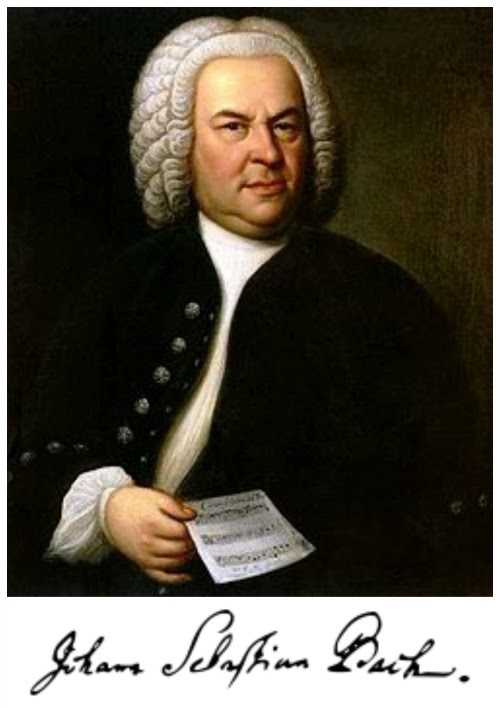
Johann-Sebastian-Bach

A congenial combination of Haydn and J. S. Bach provided the fodder for Richard Tognetti‘s ACO concerts over the weekend.   Playing to indubitable strengths, the ensemble presented three Bach concertos: that for solo violin in E Major BWV 1042, which some of us may know better as a keyboard work; the overwhelming D minor Concerto for Two Violins BWV 1043, fixed firmly in this backward-gazing mind by the inspired recording of David and Igor Oistrakh from the early 1960s; and the Concerto for Three Violins BWV 1064R, reconstructed from the Three Keyboards pseudo-original, but by whom I’m not sure – there’s an edition by Christopher Hogwood but the arranger could easily have been someone less familiar/eminent  .  .  .  like Wilfried Fischer (probably not).

Interwoven with the concertos came some smaller gems.  Tognetti began Sunday afternoon with the Preludio of the Violin Partita in E Major which he himself arranged, taking the semiquaver-stacked solo himself and leaving the ACO strings to pizzicato an accompaniment that struck me as having its basis in the organ-fronting Sinfonia score to the composer’s Cantata No. 29 where Bach indulged in yet another piece of recycling.   In the middle of the program’s second part, room was made for principal cellist Timo-Veikko Valve to perform the Sarabande from the E flat Suite straight, without any accompaniment.

The pair of Haydn symphonies were early: No. 22 in E flat, called The Philosopher for no apparent reason, and No. 27 in G Major.   Both were written within 15 years of Bach’s death but have little relationship with the Bach scores, except as possible commentaries on why the senior composer’s work fell into neglect as a less contrapuntally fixated generation took over the reins.

The Preludio lollipop worked as a throat-clearer, I suppose, its non-stop onward rush a test of left-hand dexterity in negotiating scales and arpeggios interspersed with some interest-raising leaps; Tognetti dispatched it with brisk authority.   More solid matter emerged in the solo concerto and on this wider canvas you could appreciate the violinist’s manipulation of what looks so four-square on the page.   Taking Eliot to heart, Tognetti does not cease from exploration but treats Bach’s bare bones with flexibility – not just inserting ornamentation but investing those long phrases with something close to rubato, just not as obviously following the wait/catch-up process that the term entails. In fact, it’s not just a case of being flexible, but more a pliable quality and, if the distinction seems non-existent, the only explanation I can offer is that you can hear that Bach’s solo line is being manipulated but it comes across as unforced, as part of the performer’s approach: not trying it on but treating the linear contour with respect for its organic elements.

In this work, Tognetti was more able to demonstrate this originality of approach, something that amounts to affection for the composer’s product informed by a fine array of dynamic shades and juxtapositions where the soloist could take familiar passages and re-animate them with unexpected differentiations of attack, in particular eschewing the sawing heftiness of many interpretations that emphasize the composer’s harmonic insistence rather than the chromatic subtleties that come between those solid tutti passages.   He might have been following a similar pattern in other works, but this was one where harpsichordist Joao Rival swapped his harpsichord continuo for a chamber organ in the Adagio movement, supporting the momentarily placid ACO strings – nine violins excluding Tognetti, three violas, three cellos and Maxime Bibeau‘s bass.

Later, principal violin Helena Rathbone joined her artistic director for the second solo part in that urgent double violin concerto and again the central players eschewed heft for sinuosity. as in the long intertwining exposed passage in the first Allegro from bar 58 to bar 84, or in the light application of two double-stop passages in the finale where both players pulled back and exposed the orchestral movement, rather than churning out their chords fortissimo.

It would be difficult to find a more affecting interpretation of this work’s central Largo where the pliability of tempo was a shared quantity between Tognetti and Rathbone but the players eschewed that  non-stop mimicry that you expect to hear in these pages.   By contrast, the last Allegro showed the ACO at its most exhilarating, with plenty of bite in attack and lots of brisk work near the nut in a reading that contrasted the linear clarity of its precedent with a fast-paced aggression.   An odder unexpected touch came with the first movement’s concluding tierce de Picardie where probably every other version I’ve heard is content to leave the violas with their F natural.

The last performed of these concertos, that for three violin soloists, brought Satu Vanska to the front as third-line specialist.   This sounded the most virtuosic of the program’s offerings with loads of exposure for each principal either in solo, duo or trio format. with some mini-cadenzas thrown in.   Both outer movements came across with loads of vim and gusto, all concerned obviously enthusiastic about the score’s emotional spaciousness, even in the plangent B minor Adagio.   Vanska eventually enjoyed the limelight in a rapid-fire moment of sustained exposure during the Allegro assai but the principal trio impressed chiefly by dovetailing and curvetting around each other with eloquent elegance.

The Haydn G Major Symphony in three brief movements brought some super-numeraries to the stage in braces of oboes and horns.   Not that this slight piece tests anybody except in clarity.   Unfortunately, the horn work generated an occasional blooper which, in this transparent score, makes more of an impact than usual.   Despite the repeats, this symphony is quickly accomplished and, if the speeds were on the rapid side, that’s fine as there isn’t much ground for meditation.   The E flat Major work sticks out from the ruck by asking for a pair of cor anglais rather than oboes; Michael Pisani from the Melbourne Symphony Orchestra and visitor Dmitry Malkin from the Jerusalem Symphony made a well-matched pair, offering antiphonal interplay with the Sydney Symphony’s Ben Jacks and Stephane Mooser  on horns in the initial ceremonial Adagio.  The ACO itself bounded through the work’s three following segments with as much finesse and dedication as they had shown throughout the program, but I have to confess that the second movement’s Presto repeats made for dutiful listening rather than the totally elevating experience that previous program components had brought about.

On Calypso’s island

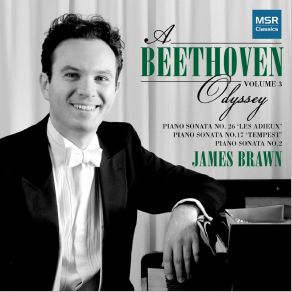
A BEETHOVEN ODYSSEY VOLUME 3

James Brawn

MSR Classics  MS 1467

brawn-4

For the third disc in his Beethoven sonatas cycle, James Brawn has picked out three works across a (roughly) 14-year span of production.  He starts with the consistently even-tempered, happy No. 2 in A Major, hurtles forward to No.. 17 –  the D minor Tempest of 1802  –  and finishes on the cusp of the second-to-third period interchange with the exultant  Les Adieux No. 26 in E flat.   With  this recording, Brawn moves closer to the half-way mark of his journey and the rewards from accompanying him, or just going along for the ride, keep on coming.

He finds a satisfying vein of restrained jocularity in the A Major work; not piling on the humour but giving a pleasurable heft to the staccato chords that recur in this sonata’s opening.   As expected, he keeps the texture clear, right from the opening pages’ semiquaver triplets alternating between the hands.   Even better proof of the player’s executive lucidity emerges whenever he has to negotiate a quick mordent or three, and the stretch of development past the first double bar is impressive in its transparent delivery – both times, since Brawn observes the second-half repeat.

Again, in the Largo‘s opening sentence, Brawn strikes a persuasive emotional level with his shaping of the near-static melody over that strangely moving pizzicato bass – Beethoven as a young man showing his capacity for inexorability with consolation.  The pianist’s innate polish of delivery shines out in the finely-judged trills of bars 9-11.  On the repeat, you get to take in the amiable charm infused into the extended melody line and the unflustered character of the movement’s ornamentation.   But with Brawn, detail is vital and makes a large element in the satisfaction of his performing style; each movement has some luminous instance, like the excellent accuracy of his pacing in the last six-bars where the slurred right-hand motive balances the left-hand’s combination of slurred and detached notes, leading to a moving subsidence in the final notes.

For the Scherzo, Brawn takes a level-headed look at the many staccato/accent markings, implying that, if Beethoven puts a dot over a crotchet, he doesn’t want the note under-valued but negotiated in such a way as to form part of the central motif.  There’s no lack of crispness as the message passes across treble and bass registers.  With the Rondo, the performer takes the Grazioso direction literally, employing as much room as he needs to make an elegant statement of the main theme’s arpeggiated upward sweep in all its disparate rhythmic transformations.  And you feel no need to have emphasized the second bar’s semiquaver rest after the leap of a 12th downwards: it’s a breath, not a separation mark.  When the key signature changes to accommodate A minor, Brawn moves into more declamatory, punchy territory, so that the eventual move back gains by contrast in this movement’s gradual unfolding.

Speaking of contrast, in this CD’s reading of the D minor Sonata,  those famous opening Largo bars are given dead slow – which makes the move to Allegro all the more invigorating.   Here also, the use of staccato is carefully positioned in a relentlessly driving urgency that prevails until the slightest of rallentandi at the end of the exposition.   The atmosphere moves into the spacious for the arpeggio-rich passage that follows the double bar and the progress becomes tightly-argued until the Largo returns, capped with two small recitatives that impress for their pianissimo understatement.  And Brawn is to be praised for his control of touch in the dynamic deceleration to silence during the movement’s uncompromising conclusion.

Another detail among many, it was hard to ignore the demi-semiquaver triplet/quaver rhythmic motto during the Adagio, mainly because you heard no smudging, the tattoo making its presence felt with telling regularity each time.   Brawn gave these pages the correct tension with his effectively administered crescendi cutting abruptly back to piano, a kind of emotional delaying tactic until the last six bars, here played at a slower tempo as Beethoven gives a final chaste valediction.  In the Gretchen-at-the-Spinning-Wheel Allegretto finale, the pianist treats each repetition of the main four-note figure as part of a sentence-length contributing to a composite, rather than as a series of perky individual blobs.  The effect makes this reading more legato than most, the interpreter trusting in the expression markings, particularly crisp sforzandi, to provide dramatic character, as in the passage leading back to the rondo tune after the post-exposition chromatic shenanigans.  Brawn is his own man here in what he chooses to link up and what he isolates; yet the spinning-wheel is unfaltering, right up to the final bars’ fade to black.

With the Les Adieux program piece, the shortest sonata on this disc, we come closer to the taxing masterpieces at the end of Beethoven’s piano sonata achievement.  The initial Lebewohl  is taken slowly, reinforcing Brawn’s consistent reaction to tempo and mood directions; the Allegro that follows proves brisk but not as much as its counterpart in the preceding sonata’s first movement.   The leave-taking nervousness comes through pretty consistently despite some cluttered chordal writing.   During the busy wide arpeggios in the left-hand, a few notes are ‘dropped’ or fail to register fully.

Luckily, Brawn stays the right side of Chopinesque melancholy in the Abwesenheit, abstaining from going maudlin at the Archduke Rudolph’s absence which this interlude memorialises.   Still, a more pliable outlining of the movement’s rise and fall might have given the pages more humanity; for example, the right hand solos at bars 13-14 and later at bars 28-30 which come across as too self-regarding and prim.  To compensate, Brawn promises suspense with a cleverly arranged breath-holding in the change-over bars.  The Wiedersehen movement captures an admirable vein of delight-in-action, dodging any hint of hysterical relief at the money being back in town.   Brawn eases the tension – or Beethoven’s insistence – with a deft pause or rallentando at various points; for instance, in the stretch between bars 130 and 140.   But he gives the movement’s interior linear mobility its due, right up to the pause for reflection at bar 218’s Poco andante  –  which is actually a bit more than poco as the pace is pulled back considerably more than you’d anticipate.   Still, it gives the segment’s tolling thirds and sixths time to reinforce the quietly celebratory underpinning of this interlude before the exhilarating conclusion.

In the next disc of this series, Brawn performs five sonatas – No. 9 in E Major, the Pastorale No. 15, No. 24 A Therese, the alla tedesca No. 25, and the two-movement No. 27.   This current CD whets the appetite considerably because of the continuously fresh approach and emotional breadth of Brawn’s interpretations.

Easy-listening guitar

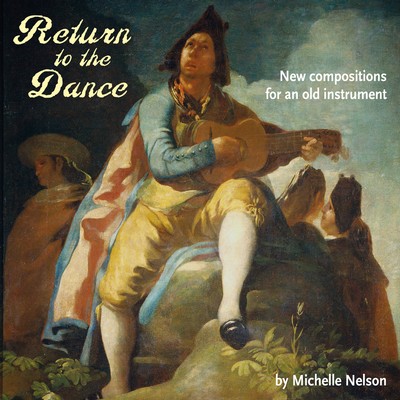
RETURN TO THE DANCE

Michelle Nelson

Move Records MCD 531

return

This is a short (41 minutes) disc consisting of some homages, pastiches, imitations, take-offs – apply whichever term you like – and several original compositions.   Melbourne guitarist Michelle Nelson has constructed and recorded a set of six works (well, five: the first and last tracks employ the same material in different guises) that are intended to link the old and the new as well as to bring art-music back into the popular domain.  The results make for soothing sounds but nothing to challenge or excite the intellect.

Nelson’s creations vary in their persuasiveness.  While the debt to other composers presents as obvious in the specified cases, Nelson’s melodic and harmonic material can be sledge-hammer in impact.   For instance, for the CD’s title (and opening track) we are referred to Gaspar Sanz and Santiago de Murcia; the former became more familiar than Murcia because of Rodrigo’s use of six dances from the Baroque composer’s Instruccion as the basis for the Fantasia para un gentilhombre concerto of 1954.  Even dipping a toe into the treasury of guitar music that both writers have left gives you a pretty good idea of the basis on which this sequence of three pieces – Danza, Minuet, Return – was constructed: harmonic orthodoxy, simplicity of melodic elements, a steady rhythm in each (reinforced by bongos with occasional bar chimes for extra colour from Mark Murphy).  Nelson uses these tropes in fairly basic adaptations; her imitations tend to be lacking in interest, deficient in bite and lyrical appeal.

The Return is a rephrasing of the main melody from the opening Danza, but it eventually gives up on melody as a contributing element and simply alternates a dominant/tonic sequence.  The first two parts have suggestions of the two Spanish masters but Nelson’s variants sound pretty tame by comparison with those of her forebears.

Like many before her, Nelson heads for the summit with The Guitarist’s Bach: Hommage a J.S. Bach.   This is a five-movement suite, starting with a clear reference to the E Major Violin Partita’s opening Preludio; but, where the master uses the two semiquavers-quaver as the kick-off for an invigorating moto perpetuo, Nelson settles in for a more moderate. ambling progression with a simple underpinning that alternates between A and E, while some awkward figuration passages dawdle on top.   The Courante that follows holds more harmonic interest at the outset with some gentle early 20th-century key switches – but these are very quickly passed through.   Too little interest blights the Sarabande which gets stuck in a repetitious groove far longer than Bach would have allowed himself.   The Bouree has some odd touches, like an asymmetrical two beats added on to the first half  that make the dance’s internal balance questionable, because these extras don’t appear in the dance’s second half.   As for the Gigue conclusion, the tune is fluent enough but any supporting notes are functional at best and the harmonising structure that is provided remains unadventurous.

Ice Crystals, five individual vignettes, acknowledge no obvious ancestry and strike a quietly original note.   Nelson sticks to her last with a predictable framework of operations and, once she puts her focus onto a particular gesture, she exploits it relentlessly, as in the spread-eagled chord of the first piece, and the Villa-Lobos-suggestive harmonics of the second crystal.   Then comes a piece that succeeds because Nelson uses her descending arpeggio figure in modulations and shapes the piece’s movement with a finesse suggestive of a post-impressionist prelude.   Although No. 4 maintains its three-chord rhythm for most of the time, it impresses for its limpidity and the atmospheric echo provided by the CD’s engineers, while the final member of this bracket seems to revert back to the disc’s opening track although the melodic trajectory has changed.

Platypus Rag involves Nelson’s guitar with a ‘taropatch’ played by Lesley Gentilin.  This latter is a ukulele commonly found in Hawaii; from what I can glean, the taropatch nomenclature refers more to its slack-key tuning than to the instrument itself.  The rag itself is amiable but short – less than 2 minutes.

Dances for the New World begins with New Volta, an updating of Elizabeth I’s favourite choreographic exercise involving a partner.   I’m not sure whether the revision offers much advance on the older style, chiefly because Nelson’s updating lacks even the small variety of divisions that a volta aficionado like Byrd provided.   Rock ‘n Rolan: Hommage a Marc Bolan puts a sedately stepping tune into the bass with an inverted pedal note (progressing after a while to a chord) to provide a petty superfluous root function.   As for its relationship to the British rock musician, I can’t make any worthwhile comment, knowing only two Bolan songs.   Mirage offers a pleasantly euphonious series of chords above a cantus firmus of one rhythmic motif; however, it serves the purpose of giving the New World target audience a reassuring outcome   –   there’ll be no change to the expected and predictable.

Finally, Return to the Dance IV involves electronics alongside a normal classical guitar and one of Yamaha’s silent guitars.   The work refers back to the opening track but is as static as much of the rest of the disc: happy to keep the bass constant and proposing little above it except repeated chord patterns which are subjected to synthesizer manipulation.  In the end, the track turned into tedium.  Yes, you found plenty of easy listening in this album, which is at its most appealing in the Ice Crystals tracks.  But the overall effect is to put your receptors into neutral; the CD is pleasant, but there’s not much going on.

Much of a muchness

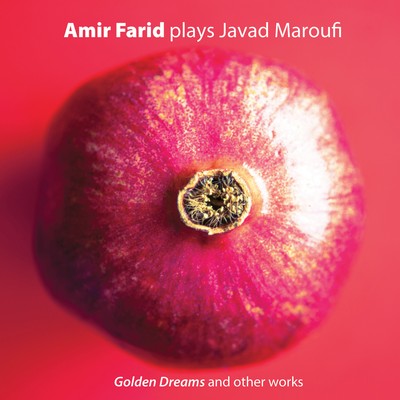
GOLDEN DREAMS AND OTHER WORKS

Amir Farid

Move Records MD 3380

amir-farid

A tribute by local pianist Amir Farid to one of the significant figures in modern Persian/Iranian music, this is an album which holds a limited fascination, mainly because it speaks of a world that most of us will never encounter.  Not that Persian music is a completely unknown quantity; I can recall hearing Court music at an Adelaide Festival many years ago and any listener can easily gain access to the nation’s traditional and folk music at the flick of a Google switch.

Javad Maroufi attempted to fuse his country’s music with that of Europe: a hard task when compared with his predecessors in that endeavour as most of them were by birth entrenched in the European tradition.   Maroufi’s education embraced both worlds and his piano music shows the way in which he tried to craft a language that spoke to listeners in both tongues.

Farid begins with Armenian Rhapsody, a soulful piece with a B minor tonality that doesn’t stray far from closely related keys.   A suggestively Oriental melody enjoys a straight common chord arpeggio underpinning and, in a treatment that quickens the tempo, Maroufi uses a dulcimer effect in the right-hand, imitating the santur  –   a cimbalom that is common to pretty much every country in the region from Turkey to India.   The composer faces the same problem faced by every writer using folk-songs: what can you do except play the tune louder or softer, as Tchaikovsky did with his little fir-tree?  The problem here is that, because of the unadventurous harmonization, the melody soon palls.

Fantasie follows the same pattern although the melodic content is more interesting and varied – well, there’s more of it – but the harmonic support is just as staid with no changes offered from a predictable series of underpinning chords. The santur imitation is heavily employed here.   Still there are modal deflections, including a recurring flattened second that contributes some much-needed colour in a none-too-atmospheric ambience.  Golden Dreams is one of Maroufi’s most well-known pieces and it has been subjected to a myriad arrangements.   After a burst of semi-improvisational-sounding introduction, the simple tune – a 6/8 lilt – begins with an Alberti bass underneath.   Farid gives it interest by his maintenance of the work’s underlying melancholy and by investing as much dynamic variety and pliability as he can in a construct that is easy to assimilate, no matter what your language.

Chargah-e-Esfahan strikes a heroic, quasi-Lisztian pose at its opening but quickly reverts to the by-now natural status quo.  A further  burst of action leads to a central section where the melody is interrupted by some flashy scale-work, but the piece seems to be an amalgam of segments, not at all difficult to decipher; some of them have a passing resemblance to folk-dances from further afield than Esfahan.   But Maroufi is concerned to end as he began with the same decorated melody returning to finish, with a final flourish of octaves that irresistibly recall Brahms and Liszt at their most ersatz Hungarian.

Rumi is the shortest piece on the CD; a brief musical vision, I suppose, of the 13th century Persian poet and mystic whose work underpins his homeland’s culture and those of many neighbours.  Any difference to what preceded it on the disc totally escaped me.   Jila’s Fantasy refers, I think, to one of the composer’s daughters and begins with an E minor melody in dulcimer mode; followed by a quicker movement which seems dependent on a simple descending scale and plenty of triplet passages, the opening melody later emerging in transmuted form.  Another tune follows with more obvious modal inflections.  Kuku is the longest work on the disc, but it breaks no new ground.  A tune that could be popular/folkloric in origin is given concordant treatment, as well as the all-too-familiar dulcimer/santur oscillating effect.   By this stage, the cupboard seems to be bare; Maroufi makes no effort to give his works any chromatic spike or rhythmic variety. Indeed, you feel that much of this music is suited to pianists of much less talent than Farid; a fair bit could be sight-read without stress.

The five Preludes owe much in atmosphere to Chopin, but not exclusively so.  There is a repeated passage in the first E Major one that brings to mind effortlessly Schubert’s Standchen and the over-use of sequences in thirds is a Romantic piano trope of the easiest kind; the santur device appears in the piece’s coda.  As it also does at the opening to the next F minor prelude.  But by this stage, the sequences and chord progressions were so predictable that I could play along with Farid, the score for the most part not needed.  The third in the series evokes suggestions of the Chopin D flat Nocturne but without its melodic adventurousness and avoidance of cliche.   A burst of aggression in the centre defuses into dulcimer-work before a return to the first material.   No. 4 in F sharp promises an original touch or two with its opening motive but cannot avoid slipping into the predictable; and, by this stage, those transient heroic flourishes are wearing pretty thin.  The last B minor begins with a deft modal turn or two; then, when the development begins, it reverts once more to a predictable modulation pattern.

Concluding the disc are two short lyrics: Pish-Daramad-e-Esfehan and Sari Galineh.  The first, Prelude on Esfahan  seems to be a well-known tune that Maroufi set in a more brisk arrangement than most others I’ve heard, here splendidly carried off by Farid.  The last work might refer to a village in Azerbaijan but it follows the same pattern as its companion with a few tricks of truncation at the end of phrases.

It’s a set of pieces, in the end, that present no problems – to us or to Farid, who has absolute mastery of the contents. But, compared to what we have seen him accomplish in the Benaud Trio, as a solo recitalist and in concertos, this is not very challenging matter; rather, an Iranian Album for the Young.   You can appreciate the point that Maroufi is straddling two stools and what he achieves in his efforts is not to be derided.  But, in a world used to the folk-song settings and utilizations of Bartok, Kodaly, Vaughan Williams, Holst, Grainger, Copland, even Berio, it seems that the Persian/Iranian pianist-composer was inclined to content himself with the use of too great a formulaic approach to his compositional constructs; at least, these piano ones.   A pleasant enough collection, but a little goes a long way.

Over the top, down the other side

SATO & THE ROMANTICS

Australian Brandenburg Orchestra

Melbourne Recital Centre

Saturday September 10, 2016

shunske-sato

                                                                                      Shunsuke Sato

A simple enough program – three works from the Romantic period, so to speak – but the realization was disappointing, to say the least.   Guest violinist/director Shunsuke Sato began his concert with the ABO as though he were directing Il Giardino Armonico in Vivaldi – rushes and retentions, louds abruptly juxtaposed with softs, bite and sweetness mixed in after each other.  But where the Venetian master profits by a passive/aggressive chameleonic approach, Mendelssohn quite simply doesn’t.   Neither does the Grieg of the Holberg Suite.   I’m not that convinced that the Grieg of the Slatter does, either, but that’s a story for another day.

Sato took the leader’s role in the Mendelssohn String Symphony No. 3: one of those transparent adolescent pieces of exemplary craftsmanship that the composer completed as homework for his teacher, Carl Zelter.   The initial Allegro has a quasi-fugal shape, including plenty of imitative work for the two violin bodies.   In this performance, the firsts ruled, led from the front with a vehemence that would have amazed the composer, if not appalled him.   From the opening bars on, fluency was out the door, replaced by a welter of swoops and surges, massive dollops of ferment followed by sudden vaults back to murmuring softness.   The central Andante suffered less from this push-me-pull-you approach but the final movement made a reversion to the initial aural juggernaut.

It could have been dazzling, but with another piece – one less formally lucid and free from the strait-laced directness, without a wasted note, that this short score displays.  You were left wondering what this sprucing-up was meant to achieve.  Frissons of shock for the musically bourgeois?   A re-appraisal of the 12-year-old’s emotional depth?  A desire to set the mood for this entertainment?  The effect was of a muddle, as though the original clear lines had been thrown into disarray;  the ABO strings carried out their roles with enthusiasm, but the small symphony’s rationale as a demonstration of lessons learned was obliterated by this look-at-me approach.

The personnel numbers for both the symphony and Grieg’s suite – 6,6,4,4,2 – were sufficient for the task, if the second violins made a subsidiary force most of the time, positioned on the right side of the stage so that their instruments faced the back wall.  Yet with the whole group in full cry, you were hard pressed to point to many moments of clarity. The Grieg Prelude was overplayed, given too much heft for its congenial buzzing stream of semiquavers; the following Sarabande showed that, in Sato’s interpretative world, the portamento is alive and well, as is the disturbingly long pregnant pause.   In the Gavotte pages, the Musette emerged as a welcome oasis: regular in metre, sprightly in its phrasing, gaining much by not encouraging extra weight in the drone bass.  For the Air, Sato led from the front, urging his forces on with what sounded like impatience, at points ahead of his firsts cohort who responded quickly enough but appeared to be taken by surprise at their director’s rubato.

Sato’s duets with Monique O’Dea‘s viola punctuating the Rigaudon came across with the necessary vitality, if the lower voice sounded somewhat muffled, but the full-orchestra passages were heavy-handed.   Still, this weight exertion had been a consistent feature of the whole interpretation, particularly at cadence points – both half-way marks and concluding bars – where the ritenuti were laboured to an irritating point time after time.

Saturday evening’s second half was dedicated to the Paganini Violin Concerto No. 4 in D minor.   Sato’s distinction in this repertoire is that he plays on gut strings, thus following the period requirement and giving you a sound that the composer himself would have produced.   The ABO’s artistic director, Paul Dyer, conducted an orchestra with a full complement of brass, woodwind and two percussionists on timpani and bass drum; Dyer rather awkwardly took over the function of triangle player for the third movement Rondo.

You could find certain aspects to admire in Sato’s reading of this work.  The high melodic lines on his E string carried ringingly throughout; the more concordant double-stops, as at Letter B of the first movement, proved to be authoritative and true; ditto the tenths that first appeared 7 bars further on; another purple patch followed after Letter D.   The more chromatic passages in thirds failed to impress for purity of articulation; ditto some of the octave and saltato work; but then the entire section in 6/8 proved remarkably fine.   This oscillation between the excellent and the fair enough continued for much of the opening Allegro, capped by a cadenza of unknown provenance and some vulgarity.

By eschewing the delights of metal strings, Sato also missed out on the strikingly brilliant passage work characteristic of the Accardo, Ricci, and even the early Grumiaux recordings where the rapid-fire technique-taxing passages make an indelible impact, not to mention the harmonics interludes which in Sato’s performance were pretty faint by the time they reached the back of the Murdoch Hall.

The central Adagio enjoyed a sympathetic airing, but then it’s a close-to-uninterrupted lyrical gift for the soloist after the introductory 16 bars and there is little wriggle-room except to play it as written.    As for the galant finale, Sato enjoyed his work right up to the last theme statement at Letter M; I must confess to being relieved to reach the finish. The technical display was satisfying to watch, especially when it succeeded fully, but you missed any sense of bouncy jauntiness, any personality; the movement was a sustained effort in display.

Now, it would be foolish to expect no emphasis on physical execution in a Paganini concerto; the greatest violinist ever had no compunction about setting himself ridiculously difficult hurdles to overcome and his reputation depended greatly on his genius at making the violin do the apparently impossible.   For all that, Paganini was a serious composer and a work like this D minor concerto is formally exact, developed in perfectly orthodox manner and, if the soloist occupies the greatest focus of the limelight, that’s integral to the piece.   Yet it has to be negotiated carefully, with consideration that its demands don’t twist its shape.   Sato’s treatment occasionally took metrical liberties as he gave himself plenty of space to leap into a problem, then also took his time over a piece of lush lyricism.

Dyer’s orchestra was overblown to an almost painful point in the tuttis, the brass and percussion combination taking over at all the loudest moments, the three trombones over-encouraged to a ludicrous degree; in fact, the strings needed to be at least double in number – and a bit more – to offer any balance to the mix.   The conductor made an active figure, gesturing voluminously at any group or individual who had the main melody, bouncing from leg to leg in the Rondo, sharing a laugh with the audience at a Harpo Marx moment in one of the cadenzas.   I think it’s fair to say that, if you’re in charge of the orchestra in a Paganini concerto, you’re really a cipher; the soloist gets, and deserves, all the attention.   The conductor’s job is to spearhead the full orchestra interludes – and they play themselves – but mainly to keep the soloist’s accompaniment supple, following his/her lead and, above all, staying in the background. Like a surgeon, your first duty is to do no harm.

Sorry, but I came away from this night dissatisfied, unhappy with the interpretations offered of all three program constituents, wishing that the orchestra had stuck to its Baroque last rather than making forays into a period currently outside its expertise.

Wineing the ghosts of yester-year

UNFOLD

Kreutzer Quartet

Move Records MD 3371

Kreutzer Quartet

This CD consists of four string quartets composed between 1964 and 1975 – the heyday of contemporary Australian composition – coming from four once-important names: the Melbourne music critic Felix Werder, Sydney visionary Nigel Butterley, leader-of-the-pack Richard Meale, and returned expatriate Don Banks.  The performers are an ensemble new to me; British in origin, it would seem, and with a respectable discography of modern British and American music, although this particular CD seems like a well-meant stretch from their usual field of operations.

The performances are vehement and splendidly sharp in detail, nowhere more so than in the earliest work, Werder’s String Quartet No. 8 – Consort Music; one of the composer’s 12.  To my shame,  I’m struggling to remember a live performance of any of them.   Immensely fecund, Werder did not get much of his large output recorded, so this reading comes as a chance to fill in at least one gap in our knowledge.   I used to own a World Record Club LP which contained  No. 6 in the composer’s catalogue,  performed by the Austral String Quartet; unfortunately, one of its companion pieces was Butterley’s Laudes, which  took my attention away from its companions –  both the Werder work and Dorian Le Gallienne’s worthy four Donne settings.

This Consort Music begins with arresting discords, scrapes, glissandi – incidents, really – and proceeds to follow an inscrutable path of hot and cold action that at times is static and remote, then rorts through passages of disjunct violence; at times, you suspect that the organizational field is 12-tone, but the usage of glissandi and a few patches of clear repetition make you suspect that possibility.   Whatever the case, the work is often repellently active: ideas piled on top of each other, varied modes of articulation superimposed, a few wisps of motive-melody treated with ironic wistfulness before being hurled aside for the next eclat.   I’ve listened to it on and off for about a fortnight and it retains its secrets – although it is emphatically a product of its time, one where local writers were keen to embrace the brave new world of post-Webernian composition, fusing the sound-production trickery with Schoenberg’s assertiveness of voice.  As far as I can tell without a score, the Kreutzers do this one-movement piece good service.

Butterley’s 1965 quartet, the first of his four, is in two movements and the first is perceptibly 12-tone in its initial material and, for the most part, slow-moving and meditative with most of its dynamic coming not from decibel strength but from contrapuntal interplay – waiting for a line to enter as a complement or following a strand in a field of Nebenstimme backdrop.  The second part opens with a fortissimo free-for-all without bar-lines, although the cello is the organizational fulcrum.  Here, Butterley attempts to embody the opening of Henry Vaughan’s The Revival:

‘Unfold, unfold!’ Take in his light

Who makes thy cares more short than night.

In fact, in its later stages, this movement suggests a spiritual awakening or epiphany through slow-moving homophony/chorale motion, jagged bursts of solo flight as striking as affirmations of belief, and a near-cessation of action at the work’s end where the top line is still left inquiring despite the accomplishment of an emotional peace. This work is, despite its central eruption, more orthodox than its predecessor on the CD, but its intellectual trajectory is much more accessible, the composer’s language harnessed to a discernible course.

Richard Meale begins his String Quartet No. 1 with aggressive sustained, clashing chords that lead to a sequence of variations.  As with the Werder work on this CD, the emphasis falls on the event for its own sake as timbres and attack modes alternate to signify new material, or new treatment.  The environment is unrelentingly contemporary, with passages that move slowly in a dream-world alongside spiky angularity, broad swathes of sustained discordant work for all lines.  It’s an alternation of worlds that both interests and irritates; you sense that the instrumental discourse is controlled and directed but the matter is so diffuse in its presentation that assimilation is difficult.   Meale’s second movement, far away, has the players seated with their backs to the audience, distant from each other at the back of the performing space or stage; a debt to Elliott Carter’s String Quartet No. 2 which has the intention, by physically separating the executants, of making it seem as though we are hearing four different pieces.  Meale’s second movement soundscape is slow, loaded with harmonics and long single notes underneath this upper scintillation.   The first movement’s studied activity has disappeared, replaced by a placid landscape of pointillism: a remarkably effective farewell to modernism because, after this piece, the composer moved to tonality with results that disconcerted a good many of his admirers.   The Kreutzers negotiate both halves of this work with equanimity, giving vent to the opening segment’s oscillating brutalism and close argument, then taking pains to give space to the second part’s calm juncture of pinpricks and stasis.

The String Quartet by Banks is the composer’s only work in the form, written during his time at the Canberra School of Music and a strictly controlled work in its first five minutes where the writing is acerbic, almost to the point of gratingly doctrinaire.   Luckily, the composer’s whimsy emerges, the academic stringency loosens and, when he quotes his opening strophes near the 10-minute mark, the effect is to show how genial the work’s atmosphere has become.   Now there is room for hints at lyricism, even sentiment, interspersed by the odd abrupt wriggle, as in the section where the first violin follows a melodic line in harmonics while the cello bubbles with slight menace below it.  The basic material doesn’t appear to have changed; its manipulation certainly has and, one outburst reminiscent of the opening pages apart, Banks stays in nocturne mood to the end with its haunting F-Fsharp-F cello repetitions fading to black.  Of all four quartets, this one is the least difficult to follow as an organic construct and the performers are comfortable with its clear-cut requirements which, even if it is the most ‘modern’ work here, are comparatively conservative.

No, string quartets don’t tell the whole story of the renaissance in Australian music that came with the 1960s but this representative sample offers an intriguing study in approaches to the form; how tradition was adopted, discarded, mutated by these composers whose voices – apart from Butterley, who is still living – have been largely forgotten. Thanks to the Kreutzers, we can hear resonances of some decades that were full of vigour and enterprise, when the music world in this country was smaller and new work was greeted with unusual readiness and an almost compulsory approbation.

One out of three?

THREE TWENTIETH-CENTURY MASTERPIECES

Ensemble Gombert

Xavier College Chapel

Saturday September 3, 2016

Ralph-Vaughan-Willia_60619a - Copy

                                                                            Ralph Vaughan Williams

It’s a fraught business, picking masterpieces, and trying to do so when treating music of more recent times presents substantial difficulties.   Most of us would not argue with John O’Donnell and his Ensemble Gombert when they selected Vaughan Williams’ Mass in G minor as the opening to this ambitiously named concert.  The work is much loved in the English-speaking world for its serene fluency, a sort of inevitability that takes you back across centuries of self-regarding English church music to the magnificent assurance of the Tudor masters.

Expanded slightly for this occasion to twenty voices, the group produced a perfectly satisfying reading, with a splendidly full interlocking of voices at the great double-choir moments: the opening to the Gloria and its Cum Sancto Spiritu pages, both the Cujus regni and Et vitam venturi from the Creed, those seraph-suggesting Osanna antiphonal strophes, and the spacious breadth of the last page’s Dona nobis pacem pleas.  In the best British choral tradition, the four soloists proved equal to their tasks, carried out with care and no attention-grabbing quirks; the only glitch I detected came in the last exposed tenor solo of the Agnus Dei where the high G sounded strangled.

Hugo Distler‘s Totentanz is an impressive construct  . . .  but a masterpiece?   It could be, but the choral components bear only part of the score’s weight.   The work is a real Dance of Death  –  a voluble character who invites a range of representative individuals to give themselves up to the inevitable.   Starting with an emperor and working through the social ranks to a new-born child,  Death orders each to join the dance, answering their pleas for mercy/understanding with an unanswerable response concerning what each of the condemned could have or should have done before facing the Judgement.

This is conducted in rhymed spoken dialogue, the source Johannes Klocking who shaped his verses for Distler’s use.   The choral contribution comprises a group of 14 Sayings, aphorisms by Angelius Silesius from his The Cherubinic Pilgrim of 1657, the ones that Distler chose all commenting on the coming interchange between Death and his newest victim.   After a fashion, these spruchen serve as off-centre chorale-preludes, proffering brief statements about the condemned one’s condition or failing(s).  The problem is that DIstler’s settings, apart from the bookends, are truly aphoristic – no sooner begun than over – which makes it hard to find a consistent field of operations from the composer.  The choral writing is challenging for its application of dissonance, but the briefness of Distler’s statements has the impact of diffusing any compositional personality.

O’Donnell had one singer reciting Death’s lines and shared the roles of bishop, physician, merchant, sailor and the rest around his ensemble, which coped with some stickily consonant-rich German quatrains quite well, if a few of the nouns and verbs were transmuted in the process.   Yet, at the work’s conclusion, despite the encircling and infiltrating effect of the music, the greatest impression is made by Klocking’s stanzas with their no-nonsense self-evaluations and insistence.

Petr Eben‘s Horka hlina or Bitter earth is an early work from 1959-60 when the composer was 30.   It consists of a setting for baritone (not an over-taxed role), mixed choir and piano, of poems by Jaroslav Seifert, the Nobel Prize-winning Czech poet who produced these nationalistic verses in 1938 as his country faced Nazi invasion.   The imagery is emphatic and repetitious – a bayonet, a painted jug, grapes/flowers/grain/stones and pebbles – and the settings are either stentorian or folk-style sentimental.   Both outer movements – Song of the Men and Women, and Song of the Poor – have voluble piano accompaniments, here performed by O’Donnell.   Streams of powerful virtuosity introduce and sustain chorus work that is declamatory and full-blooded.  The central piece, a mainly a cappella Song of the Homeland, has a quieter ambience and more lyrical melodic content. But on one hearing – and I could find no recordings of the work – it is hard to enter into evaluative detail of worth.    A masterpiece?    I think Eben would have proposed others among his works more qualified for that title.

Nevertheless, the Gomberts’ performance of this and the Distler work, with the participants coming down from the altar to the front of the chapel pews, proved highly persuasive, particularly the ensemble’s mastery of Seifert’s texts in the original Czech.