A broad gamut for the cello

BEING

Daniel Pini

Move Records MCD 622

Cellist Daniel Pini comes from a well-known Australian string family. His father Carl founded the Australian Chamber Orchestra, handing over artistic leadership to Richard Tognetti about 200 years ago, and he led the Melbourne Symphony Orchestra in the first half of the 1990s. I also remember a string quartet performance (part of an all-Beethoven cycle?) he led which was held in the Athenaeum Theatre many years ago. As well, Daniel Pini’s mother, Jane Hazelwood, still plays with the violas in the Sydney Symphony Orchestra, and some of his siblings are also musicians.

This is Pini’s debut CD album and he is promulgating local composers and their solo cello works with a will. Brett Dean provides the longest work in Eleven Oblique Strategies, written in 2014 for that year’s Emanuel Feuermann Competition held in Berlin. Carl Vine‘s 1994 Inner World for amplified cello and pre-recorded tape (the best kind) is next in size, followed by Liza Lim‘s Invisibility written in 2009 for French composer/cellist Severine Ballon. Red Earth, White Clay was written for Nicholas McManus by Victoria Pham in 2018, the product of an archaeological expedition to Sri Lanka during that year. As for the briefest piece, that comes from Deborah Cheetham Fraillon in her Permit Me of 2020, commissioned by the Canberra Symphony Orchestra and first performed by principal cello Patrick Suthers.

Dean’s work takes its impetus from a collection of aphorisms published in 1975 by Brian Eno of ambient music fame and visual artist Peter Schmidt. These mots were intended to provide either inspiration or stimulus, depending on the respondent’s state of play (or non-play), Dean’s first piece, Listen to the quiet voice, offers specific cells – quite a number of them – and hardly finishes elaborating some of them before he moves into the next piece without a pause: A line has two sides. This employs a vaulting interval that could derive from the first piece’s opening gambit, but the strategy concludes with a catchy, skipping motive familiar from the centre of the initial piece.

Don’t stress one thing more than another acts as a moto perpetuo in which the performer simply churns out notes in a repetitious pattern that obeys the instruction of not emphasizing anything. Until its ending when the action changes in dynamic to strong assertiveness before moving to a study in concentration with Look at a small object, look at its centre which revolves around an insistently repeated note with arabesques spiralling out from it. This piece is notable for the fulcrum study moving out-of-kilter into descending quarter-tones; possibly, an excess of concentration is implied.

When we arrive at What are the sections sections of?, Dean outlines some more cells that appear to juxtapose rather than intersect – a glissando mimicking the work’s opening gesture, a skittering dance fragment, finally a single yearning note that seems to be played consecutively on two different strings. Possibly, the answer to this segment’s question is that the sections are just sections – discrete, not sub-sections. Or perhaps the proposal goes in one ear and rattles in empty space, as so much does with me these days. In Don’t be frightened to show your talents, the composer revisits Strategy Three with a fast-moving chain of notes that gradually move from the cello’s bass to its centre before entering a new field where virtuosic double-stops interrupt the flow and the forward motion moves up the instrument’s register in a splendid mimesis of 19th century concerto writing.

This continues throughout Disciplined self-indulgence which consists almost entirely of double-,triple- and quadruple-stops with an accent on the last of these as the level of intensity – already sharp – rises to an extreme level. Suddenly, we are faced with a striking descending figure in single notes that prefaces Bridges – build – burn. We begin with a powerful rhetoric that returns to the slashing quadruple stops of the previous section, before the fabric slowly collapses in a descending sequence of tremolo shakes, moving down the cello’s range until an inevitable silence.

Ghost echoes is the longest of these short pieces and, as you’d guess from its title, the most ephemeral as we occupy a soundscape where nothing rises above the piano level; in fact, much of its length sounds to be played in pianissimo territory: a music of suggestions, inferences only with a few clear remembrances of aphorisms past. For the Buddhist Disconnect from desire, the composer asks for his player to administer a series of double-stops non vibrato, surely projecting the absence of emotion as a state of what I can only describe as mobile stasis; the music changes notes and register but the effect is a dissociative one.

To end, we are In a very large room very quietly where the atmosphere is just a tad less soft than in Ghost echoes and the sound palette is rich in harmonics and shadows, with a final hint of the leap at the opening to the whole work. Which makes a splendid, challenge-filled contribution to the solo cello repertoire, putting an interpreter through plenty of hurdles and sustaining a sure continuity as Dean juggles his brief bursts of activity with fine craft. I’m still a bit doubtful about Pini’s realization of some high-pitched, soft sections which seemed to waver in their security. But the work convinced for the player’s realization of its inbuilt dramatic shifts in attack and colour.

How big is Vine’s Inner World? It’s a multi-partite entity, for sure, which begins promisingly enough with a series of arresting gestures: a minor 10th vault upwards, sets of demi-semiquavers and hemi-demi-semiquavers, rapid flourishes after sustained notes, further and more elaborately finished variants on that initial springboard – then a tape is added, based on sounds generated by the piece’s original performer and dedicatee, David Pereira. Once this new voice enters, the piece embarks on an often predictable path with two fast segments urged on by a regular motor rhythm surrounding a lyrical, rich nocturne.

The opening sounds like free-fall where the approach is rhapsodic, with the live cello following a lyrical path while the tape provides background colour. This makes for a ‘modern’ sound if not too adventurous, even by the standards of 1994, But then a sequence of tape sparkles and a kind of duet between taped and live cello take over; the sparkles transform to a cimbalom punctuation and the duet/canon continues with more intensity, although the taped component leaves the imitative set-up quickly and opts for harmonic distancing.

The slow middle-or-thereabouts segment gives space to the live cello outlining a slow neo-diatonic melody with an active but hazy background from the other sound source. Some almost menacing taped glissandi and percussive knocks with an overload underpinning pulse bring us to the happy final section where notated and electronic glissandi lead to a happily concordant coda. complete with common-chord quadruple stops from Pini and an abstention from discord that would warm the heart of any reactionary who has endured those previous indications of experimentation.

A good deal of the tape content employs familiar electronic tropes, like the falling bird calls that eventually end the piece, blocks imitative of organ chords, percussive bands that propel the work’s progress with as much subtlety as a rock drummer. I’m not experienced enough in the field to tell if all this material came from Pereira’s instrument or whether some of it was manufactured by studio equipment, but the resulting entity impresses as a suite springing from the work’s first flourishes; rather like Dean’s Strategies.

Lim operates on an aesthetic level far beyond my ability to imbibe fully, but her scores offer an overwhelming breadth of sounds and timbres, each refined and directed to allow for little deviation. She presents a world of subterranean shifts in dynamic and textural shivers across the canvas of Invisibility which calls for two bows: one orthodox, the other with the hair plaited around the stick. To be honest, I don’t understand how the latter produces continuous sounds, but it works – in this recording and in other YouTube performances.

Still, the sonic output stretches the instrument’s array of sound production, even when the player shifts to an orthodox bow when the score accelerates its level of ferocity and initial bite. Towards the work’s conclusion, the player is called upon to use both bows simultaneously, the plaited one eventually ranging up and down the fingerboard in an eerie conjunction of the earthbound and the otherworldly. And that, to me, forms the attractiveness of the experience: a double-barrelled world where nothing can be anticipated and your ears are stretched by the whole engagement.

Easier to imbibe, Victoria Pham’s Red Earth, White Clay appears to exist in discrete sections that might have thematic links but presents on the surface as moving into distinct atmospheres through changes in pulse (where there is one) and the presence of key motifs. The composer’s intention is to revisit the sights and sounds of a dig in which she participated at the northern tip of Sri Lanka. During the central pages of the piece, we have aural references to village/tribal dancing through a repeated bass note punctuated by a melody and some brisk chords. The outer sections that mirror each other (with a bit of Bach suites-like broad-beamed arpeggios suddenly emerging) might pertain to the dig site itself and the impossible-to-convey title of the score.

Pham’s vocabulary, despite glissandi and other gestures towards the contemporary (including some striking harmonics), is conservative, the work beginning with emphatic suggestions of G and D minor; even the post-dance-chugging segment presents a melodic flow that is packed with Romantic nuances. In harmonic sympathy, Deborah Cheetham Fraillon employs an even more limited language in her Permit Me which opens with an A minor cell and stays with that tonality for much of its little-over-three-minutes’ length. The composer projects a mournful ambience, suggesting a lament or at least regret, peppered up slightly in the centre by an abrupt burst of action.

Still, I don’t know for what the composer is asking permission; every time I see those words, I’m reminded, in my culturally blinkered fashion, of the heroine’s address to Bunthorne in the Act 1 finale to Gilbert and Sullivan’s Patience. But you’d have to suspect that Cheetham Fraillon’s intentions are more severe, given the brooding quality of this near-elegy.

The CD is not a long one – about 49 minutes’ worth. Nevertheless, it’s a wide-ranging compendium of solo cello compositions written over a 26-year stretch, demonstrating the broad gap between the innate complexity and sophistication of senior writers when opposed to the reversions embraced by younger voices to that old-time creation. Pini’s performances, as far as I can tell without scores, are temperamentally faithful although a few details in the more complex works come over as wavering, uncertain, and I suspect that he takes the occasional rhythmic liberty. But he’s to be congratulated on putting his talents at the service of local creative minds, some of them highly demanding.

One more time

MUSICA ALCHEMICA

Musica Viva Australia

Conservatorium Theatre, Griffith University, South Bank

Wednesday November 20, 2024

(L to R) Lina Tur Bonet, Kenneth Weiss, Giangiacomo Pinardi, Marco Testori)

Apart from some weirdness in presentation, this recital finished off Musica Viva’s Brisbane year quite neatly. The ensemble of four in this Alchemical current incarnation makes a congenial collegium in itself, even if the dynamic balance favours the top line. Mind you, the group’s personnel has changed radically over the years, not least in its participating numbers. But these touring players show a reassuring expertise and their leader worked hard to give the product plenty of Baroque spice through her attack and frequent flights of virtuosity, climaxing in an energetic demonstration of skill in Corelli’s La Folia Violin Sonata in D minor.

Spanish violinist Lina Tur Bonet founded Musica Alchemica some time ago; I can’t be more precise because its genesis seems to have been brought about for an undated performance or two of Handel’s Alessandro under Alan Curtis – which must have taken place some time before the American harpsichordist’s death in 2015. Still, I’ve no idea when Bonet herself was born; to be fair, I can’t find out the birthday of her ensemble’s archlutenist Giangiacomo Pinardi, either. Kenneth Weiss, the Alchemica’s American harpsichordist, is 61 and cellist Marco Testori is 54; Pinardi looks as though he’s more a contemporary of Weiss but it’s unfair to judge on appearances, isn’t it?

For the recital’s first half, Bonet began and ended with two of Biber’s Rosary Sonatas, opening with The Annunciation No. 1 and finishing with The Crucifixion No. 10. Between these, we heard a Sonata a 2 by Cima, Schmelzer’s Sonata Quarta in D Major, and Muffat’s familiar Passacaglia in G minor for harpsichord solo with its 23 variants that involves repetitions of each one (not universally applied). Corelli began and ended the post-interval content, starting with the Op. 5 G minor Violin Sonata, concluding with the afore-mentioned Op. 5 No. 12. In the centre came Telemann’s Cello Sonata in D Major, a solo lute Toccata by Piccinini and Westhoff’s little Imitazione del liuto, with Bonet keeping to a pizzicato account of the melody (obvious, given the piece’s title) while Pinardi took the underpinning in this gentle 40-bar miniature.

Speaking of weirdness, Bonet began her Annunciation by entering from the rear of the theatre and slowly progressing down the stalls’ aisle during the Preludium, joining her confreres onstage for the Aria and Variations, then the submediant-dominated 11-bar Finale full of fierce razzle-dazzle. Cima’s small-scale sonata for violin and violone gave us an amiable exercise in fleshed-out continuo and lashings of florid ornamentation. In my 1958 Erich Schenk edition, the work takes on the nature of a suite halfway through with a sarabande and gigue doing the rounds before the composer moves to a gradually accelerating sectional set of concluding pages. One of my lasting memories of this is Testori’s use of his cello as an unwieldy guitar for the opening strophes. Mind you, he could have maintained the impersonation for much longer as Cima uses the same 4-note descending bass sequence for three-quarters of the work’s length.

But the performance wound up being another Bonet showpiece across the final presto. Something of a relief, then, to experience Weiss’s measured, faultless articulation in the Muffat passacaglia. More than other interpreters I’ve heard, this musician employs rubato to keep the score elastic rather than plodding and predictable, so avoiding rhythmic tedium. Then it was back to Biber in G minor with a nearly comprehensible explanation of the scordatura tuning that makes the set of 15 sonatas so remarkable in its changing of timbres. Once more, a triumph for Bonet with an unexpectedly arresting depiction of the three crosses positioned at the start and an impressively fierce 10-bar earthquake simulation to bring the sonata to a close.

But Bonet is celebrated for her unique approach to these sonatas which have not only gained in performative intensity under her hands but also enjoy a solid fleshing-out, thanks to the timbral complexity that comes with this trio of mobile and responsive escorts. Much the same level of authoritative embellishment emerged in the Corelli G minor Sonata which was loaded with rapid flashes of fioriture, especially in the two Adagio movements. The second of these, if I remember, cut back participation to violin and harpsichord, which change of textural character made for a welcome relief. and a minor point that impressed came through Testori’s cello line which enjoyed an occasional burst of unexpected independence/exposure.

This player’s volume didn’t carry that well to the back of the hall from where I heard this program’s second half. You could enjoy his warm account of the Telemann sonata’s first Lento, which progressed with hints of majestic instancy while avoiding laboriousness. Still, the instrument’s gut strings’ output was frequently undercut later by the archlute/harpsichord continuo, although these supporters obligingly recessed themselves in the ensuing Allegro. For the 21-bar Largo, Testori’s backing dropped back to Pinardi who maintained a fine discretion with both musicians allowing each other a noticeable freedom of rhythm.

Pinardi then performed what I assume was one of the eight toccatas from Piccinini’s second volume of Intavolatura di liuto. This sounded much like a free fantasia in character, the performer treating the score’s bare bones with an intriguing originality in his approach to tempo and dynamic, the whole concluding in an audibility-challenging pianissimo. Further gentillesse came with the Westhoff 6/4 versus 4/4 duet, engaging for its embrace of the intimate and so prefiguring the night’s flamboyant finale.

The last sonata in Corelli’s Op. 5 collection consists of 23 variations on the well-known La Folia or Les follies d’Espagne theme. The composer distributes his varying technical demands across the whole sequence and Bonet led the charge with impeccable musicianship and authority. But, to be honest, I found this offering sounded like over-gilding the period lily – and a compressed one, at that, while Corelli rang his changes on the violinist’s bravura and drive, double-stopping her way to an applause-rousing last gasp for this event.

Bonet is very well-versed in the Corelli Op. 5 as she recorded them with Musica Alchemica in 2017 (you can hear the whole set on YouTube) and framed her recital around these and the Biber works to invite us over ground that is very familiar to her. I know she recorded the Westhoff Imitazione in 2020 and possibly this program’s particular Cima sonata on a CD that involved some other instruments than those appearing on this night (harp, double bass).

But there’s nothing to say that you can’t go over old triumphs; pretty well everyone we see on the concert stage-platform does the same, even if that makes you admire even more those artists who are on an unending exploration of repertoire and present you year after year with music that they are shaping in front of you, rather than refining works that they have been playing for years. True, Bonet has to hone a changing ensemble to cope with her program choices and her own musicianship and skill never falter; well, they didn’t last Wednesday night. And, without doubt, there’s great pleasure to be derived from observing a musician at the top of her game.

Highlands and Lowlands

SCOTLAND UNBOUND

Australian Chamber Orchestra

Concert Hall, Queensland Performing Arts Centre

Monday November 11, 2024

Sean Shibe

To shut up its Brisbane shop for 2024, the ACO went all Hibernian on us, showcasing the talents of Scot-Japanese guitarist Sean Shibe. The visitor began on your normal everyday guitar – Spanish or acoustic or classical – treating us to a Scottish lute solo extracted from an early 17th century collection and ended the night on electric guitar with selections from rock musician Martyn Bennett‘s Bothy Culture album of 1997. Between the two, the guest played a couple of vignettes, a guitar concerto from Canada and a sort of aural rort by American composer Julia Wolfe.

In all of this, the arranging hand of James Crabb loomed large. The Scottish accordionist/friend of the ACO was responsible for the three orchestra-alone efforts in the night’s first half, as well as arranging the Wolfe and Bennett works for guitar and strings. Indeed, arrangements were all the go on this occasion, Shibe himself transcribing the initial lute piece, an impossible-to-trace George Duthie responsible for a guitar-plus-strings arrangement of James MacMillan‘s From Galloway bagatelle, and Crabb again putting his talents to the service of another guitar/strings transcription, this time a version of Friedemann Stickle’s Da Trowie Burn.

Much of this program’s initial content proved easy enough to take in. From this showing, Shibe is not promoting the last word in Scottish musical modernity as a good deal of his native-made material was folk music or indebted to that branch of the art. The initial A Scots Tune proved amiable enough, a solo to concentrate focus, even if its later stages sounded harmonically suspect for the period, preparing us for the wry mini-dissonances of MacMillan’s brevity which was originally a piece for solo clarinet, complete with quickly arpeggiated chords. It’s a slow-moving lyric with a moody ambience that unfolded gently enough, without raising any stress levels in participants or audience.

The possibly/probably non-existent Stickle left behind a quietly atmospheric melody in Da Trowie Burn, the main interest in this Crabb setting lying in its occasional hemiolas. Shibe and the ACO made this arrangement into a mildly interesting conclusion to the guitarist’s opening round of activity but it re-activated the perennial problem of what to do with a folk tune once you’ve played it; unless a singer is involved. There’s precious little, except to repeat with elaborations. Still, this introductory gambit left you impressed with the guitarist’s restraint and ability to establish his homeland’s musical traits.

Speaking of perennials, ACO artistic director Richard Tognetti then led his ensemble through three Crabb arrangements, the first named Ossian by Victorian-Edwardian fiddler James Scott Skinner. Most of us would subscribe to the theory that Ossian was a fictional poet and a few of us might believe that Skinner was happy to trade on the legend. His original melody follows the melancholy path already set up in this program with its only distinction an un-flattened leading note; I can’t remember if Crabb followed this peculiarity.

The next piece, Niel Gow’s Lament for the Death of his Second Wife (by the eponymous lamenter) gave us a very well-known Scots melody but, by the time Crabb’s changes had finished ringing on it, I’d had enough. Certainly the tune is expressive in its rising, falling and fluency, but it came in a chain of folksy products and I, for one, grew impatient with the Robbie Burns’ quaintness that had prevailed for about a quarter of an hour so far. Which is not to say that the performances were under par; just that a lot of it sounded . . . well, unremarkable. Even the final part of this ACO-only trilogy, the traditional Shaun Robertson’s Rant, resurrected from Tognetti’s music for the 2003 Master and Commander film, raised the temperature only slightly, until the strathspey turned into a reel imported from Northumbria and a rush of blood raised expectations before the evening’s major element.

Cassandra Miller wrote her Chanter guitar concerto for Shibe. It’s based in part on the sound of his singing, and then somehow singing in his sleep – all the time following the lead (live or recorded, I don’t know) of smallpipes player Brighde Chaimbeul. Miller points to the chanter of her title as that part of the bagpipes that changes the instrument’s notes, the recorder-like attachment that sticks out of the bottom of the bag/wind-sack. I’m assuming that Shibe’s singing and sleep-singing bear on the chanter’s melodic potentialities in some way.

You might be able to trace the work’s five sections if you could rouse yourself from the trance that Miller wishes to establish. No problems with the first section, Rippling, but then the divisions became blurred, possibly distinguished by the upward or downward motifs that were articulated at great length by both soloist and strings. So we moved unknowing through Bellow-breathing, Sleep-chanting, and Slowing Air before coming to the change in character that heralded the coda, Honey-dreaming. Nothing disturbs the placidity of the score’s central parts where the repetitions are mind-numbing. For those of us not given to satisfaction with seemingly endless mantras, Chanter became irritating when you (I) started wishing for a change in timbre or pulse..

But I can’t improve on the observation of my neighbour at the end of it all. As we filed out of the Concert Hall doors in something like a communal daze, she muttered, ‘It does go on a bit.’ To which I felt like shouting, ‘A BIT?’ Perhaps, with another hearing, I might find subtleties of delivery in Shibe’s solo line, or shades of timbre in the string orchestral backdrop. There may be closely devised alterations in the movements’ rhythmic structures, or unremarked harmonic deviations across the general fabric. On the other hand, it’s more probable that what you hear is what you get.

After interval, Shibe returned for Wolfe’s Lad; like Miller’s concerto, it is enjoying Australian premiere performances across this tour. Originally composed for nine bagpipes, the work is an angry contemporary three-movement tombeau for the death of a friend. It begins with (Drones) which presents exactly those, verging in and out of a minor 2nd, expanding to an upward-moving scale with the use of rapid in-your-own-time glissandi to colour the melange. To 3end (I think), we move back to a unison, strung out to great length.

I missed the changeover to The Slow Melody which somehow emanated from (Drones); possibly this segment arrived with the scalar motion mentioned earlier. Still, we all were aware of The Fast Melody which was couched in what sounded like a 6/8 rhythm and shared in the biting rage that typified the work’s opening. You take the point that the composer is aiming at a bagpipes imitation in this final quick section, noticeably in the strings’ activity. Throughout, Shibe’s guitar dynamic tended to dominate, at times wailing over everything else to fine aggressive effect. In certain moments, this composition came close to verging on contemporary music-writing but, for the most part, its progress – for 2007 – didn’t move into new ground.

Serving as a hiatus between Shibe’s two electric guitar exhibitions came Hirta Rounds by Irish-born David Fennessy. This modern take on the tone poem concentrates on a now-deserted island off the Scottish Atlantic coast. This was excellent illustrative music, the bleak atmosphere set early by a harmonics-laden solo from principal ACO cello Timo-Veikko Valve. This set up the prevailing action of a short motive or pattern moving quickly into a diminuendo: a clever depiction of emptiness and desolation. As participants had a degree of freedom within their groupings, the results came over as freshly textured, even if the loud-to-soft pattern began to pall, especially at the half-way pause-point where the score appeared to take up almost where it began.

Nevertheless, as a representation of emptiness in a landscape, of humanity leaving not a wrack behind, this work showed a surprising individuality if, like Miller’s concerto, it moved nowhere but was content to revolve around a series of repeated gestures; well, what did you expect of a work that specifies rounds in its title? Further, being one of only two works on the program specifically written for strings, Fennessy’s score distinguished itself with its fluctuating timbral display, specifically the filigree work for upper strings. Also, to be much applauded, it didn’t quite wear out its welcome.

With the three selections from Bothy Culture Ud the Doudouk, Aye?, Shputnik In Glenshiel – we encountered another facet of Scottish modern musical practice where the old forms meet up with the contemporary-of-a-sort in rock, or rock inflections. To be honest, this type of fusion (the third Australian premiere on the program) leaves me cold and I found little of interest, apart from double bass Maxim Bibeau moving to a bass guitar for most of its duration, and cellist Julian Thompson, who appeared to be providing an extra player from the scheduled three in Hirta Rounds (although positioned between second violins and violas) also taking up a bouzouki (could that be right?) in the rear ranks alongside Bibeau.

To be fair, I don’t know the original Bennett album, but this exposure to Crabb’s arrangement didn’t inspire me to research it overmuch. Like several pieces earlier in the program, the main practice seemed to be to take a tune and then give it variants. I also suspect that the order was changed for the last two pieces and we heard the Shputnik In Glenshiel reel before the program concluded with Aye? that was notable for Shibe’s spoken monosyllables as well as his playing. Or perhaps by this stage I was hallucinating and the night’s many elements were merging into one long Caledonian mental miasma.

Despite the acclaim that greeted Bennett’s compilation on its release, I’m not convinced that it does more than confirm a generic sound through the three ‘grooves’ that served to differentiate these final pieces. For all that, you could admire Shibe’s assured performance, particularly in the clear-speaking pieces early in the night. And you have to credit Tognetti and his players for their handling of this material and their imperturbability when faced with its unadventurous, atmospherically repetitive nature.

Diary December 2024

ADRIAN STROOPER – A WINDOW INTO SONG

Opera Queensland

Opera Queensland Studio, 140 Grey St. South Bank

Friday December 6 at 7 pm

As its last gasp for the year, our state company presents Australian tenor Adrian Strooper accompanied by Alex Raineri in a program that currently (early November) is completely unknown/unspecified. But it will include operatic arias (not surprising, considering the singer’s substantial European career and residencies, including a decade at Berlin’s Komische Oper) and lieder – which does come as a surprise as that art form doesn’t feature significantly in Strooper’s biography. But it’s always a pleasure to hear any local artist of this vocal type, although good tenors are not as rare as they used to be, say, 30 years ago. Adults can get in for $65, with a lousy concession rate of $59 (which also applies to students); as far as I can see, there’s no booking fee. Still, I can’t find any indication as to the recital’s length.

This program will be repeated on Saturday December 7 at 2 pm

BACH’S CHRISTMAS ORATORIO

Queensland Symphony Orchestra

Queensland Conservatorium Theatre, Griffith University

Saturday December 7 at 7:30 pm

All is not as it seems here. The QSO and Brisbane Chamber Choir won’t be presenting all of the Bach collation but only four of the usual six cantatas that make up this magnificent seasonal celebration. I must confess to being spoiled with regard to the Christmas Oratorio, having heard the Australian Chamber Orchestra perform it (twice, I think) with a very lively band and a chorus made up of soloists who turned the chorales into musical bliss. Tonight, we get to hear Part 1, Jauchzet, frohlocket!, which is festive Christmas music streets above all the rest; Part 2, with that miraculous double of Und es waren Hirten with the soul-stirring Brich an, o schones Morgenlicht chorale to follow; then a rush to Part 5 and the bouncy joy of its opening Ehre sei dir, Gott, gesungen chorus; and Part 6 to finish in a blaze of affirming D Major at both ends, the final revisiting of the O Haupt voll Blut chorale reworked into a musical image of Christ’s life and work encapsulated with consummate art. Conductor Benjamin Bayl is in charge and, with his big reputation in period performance, we’re likely to get the oboes d’amore that feature across these four cantatas, as well as the oboes da caccia that feature in Part 2’s opening sinfonia as a four-part ensemble and stay that way across this cantata up to the final pastoralization of the Von Himmel hoch tune. Also, we can but hope for a trio of brisk Baroque trumpets. Bayl’s soloists are soprano Sara Macliver, mezzo Stephanie Dillon, tenor/Evangelist Paul McMahon, and baritone Shaun Brown. The only tickets left are sight-restricted in the Con theatre’s gallery and their full cost is $119 with concessions available for the elderly, students and children. Wonder of wonders, there’s no booking fee because (I assume) this event is being held in Griffith University.

BRISBANE SINGS MESSIAH

The Queensland Choir

Brisbane City Hall

Sunday December 8 at 3 pm

Here comes your annual dose of Handel being presented at the wrong time of year, but who cares? For reasons beyond rationality, Messiah is trotted out in this country’s state capitals as a matter of course around December. For this one, TQC director Kevin Power again leads his own choir, the Sinfonia of St. Andrew’s and a quartet of soloists – soprano Leanne Kenneally, mezzo Shikara Ringdahl, tenor Sebastian Maclaine, baritone Leon Warnock – in the memorable oratorio. Well, I’ve got it pretty much by heart after too many years of exposure, staying awake through many performances only by following the score – especially for the choruses where you can delight in the non-existent alto line or the disappearing tenors. To make this performance even more involving, members of the public have been encouraged to join the Choir, presumably having given prior evidence of ability as well as having attended rehearsals. It’s very democratic and might even bring some useful performance experience to a young generation. Or perhaps not. Stalls tickets range between $15 and $60; sitting further away in the balcony costs you between $20 and $70. There’s a $1.25 fee added on, which is not as irritating as the much larger charges required by other organizations but still makes you wonder what you’re being squeezed for. The performance is scheduled to last for 2 hours 45 minutes which, with an interval, is about right for the usual Part the Third-truncated readings.

CHRISTMAS AROUND THE WORLD

Brisbane Chorale

Christ Church, St. Lucia

Sunday December 8 at 5 pm

It will last only an hour but that’s enough (apparently) to perform a universally applicable Christmas celebration. The Chorale will work under its music director Emily Cox with Christopher Wrench, inevitable and indefatigable in support on the Christ Church digital organ. Their program is going to be multicultural, which is itself a promise of joy in this increasingly blinkered world now blighted even further by the prospect of another four years of Trumpian moral mayhem. We’ll have a welcome infusion of multicultural community carols, which will be a source of aesthetic balm after the usual cultural domination in enterprises like these. overwhelmed year after year by Anglican content. Further, we are assured that refreshments will be provided; presumably at extra cost. Patrons are also asked to bring a gift, pre-wrapped, to the event with intended gender and age group attached. As for the ticket prices, these range from full adult of $35 to $30 for Seniors and Concession Card Holders to $15 for students. Even with a limited knowledge of Brisbane’s geography, I know that St. Lucia is outside the central city area but it does have the advantage of being the University of Queensland’s suburb and it’s only 8 kilometres from the CBD.

PARALLEL PLAY

Brisbane Music Festival

FourthWall Arts, 540 Queen St..

Friday December 13 at 1 pm

As anticipated, the final events in this calendar come from Alex Raineri‘s chamber music festival that illuminates the closing months to each serious music year in Brisbane. This final slew of seven recitals begins with a duo recital by flautist Lina Andonovska and pianist Raineri. They open with Richard Strauss’s Violin Sonata in Andonovska’s own arrangement; what she’s done with the quadruple and triple stop chords will be revelatory, I’m sure. But this work takes up half the recital’s allotted hour length, so the remaining four works must be rather brief. First comes the Australian premiere of American composer Sarah Kirkland Snider‘s 2019 duo that gives this recital its title. Then a world premiere in an as-yet unnamed new work by Judith Ring; could it be her All You Can Do Is Hang On For Dear Life which is the solitary flute/piano duet in her catalogue and dates from this year? After the Dublin composer’s offering, we hear a new work, still unnamed, and another Australian premiere from Mark Mellet (or is it Mellett?) who could be another Irish writer but he’s difficult to source, as they say. Unlike the last name on this program – Paul Dean – whose 2015 Falling Ever Deeper enjoys a resuscitation after Raineri’s previous 2021 performances with Johnathan Henderson. Tickets remain at $25 with the usual $1.99 surcharge for computer science classes (for whom?) and, out of nowhere, a GST add-on of 20 cents; you pay $27.19. And that’s progress.

This program will be repeated on Saturday December 14 at 6 pm.

THE DIARY OF ONE WHO DISAPPEARED

Brisbane Music Festival

FourthWall Arts, 540 Queen St.

Friday December 13 at 6:30 pm

A real rarity, Janacek’s 1920 song-cycle is a big ask for its tenor, a doddle for the alto and easy pickings for the three female voices that pop up (off-stage?) for two songs in the middle of operations. The only performance I can vaguely recall is one featuring Tyrone Landau during one of the Musica Viva festivals held at the Domaine Chandon winery many years ago. This time, the tenor is Brenton Spiteri whom I have probably heard in Melbourne but whose talents have not remained in the memory. His alto beloved will be sung by soprano Katherine McIndoe and the three females come from the ranks of that distinguished ensemble, The Australian Voices, which puts them in patriotic company with Spiteri, while McIndoe comes from New Zealand. Their piano accompaniment is undertaken by Alex Raineri, the impossibly hard-working festival artistic director. On either side of the Janacek are two settings of Um Mitternacht: the first that of 1901 by Mahler from his Ruckert-Lieder, which could be sung by either McIndoe or Spiteri; the second by Britten from 1959 and a setting of Goethe’s poem. This will go to Spiteri, I should think, although I remain ambivalent about what sort of voice it requires – a tenor, perhaps a baritone; certainly, a male. But it brings the event to a sombre ending, which is just right, given the program’s other content. Tickets can be bought for $25, with an added impost of $1.99 going towards books for schools, and a 20 cents GST, which I haven’t noticed in previous festival recital charges from Humanitix.

This program will be repeated on Saturday December 14 at 2 pm.

ORPHEUS

Brisbane Music Festival

FourthWall Arts, 540 Queen St.

Friday December 13 at 9 pm

Alex Raineri is taking on the great Greek myth as pianist and composer, performing his own new temples in your hearing – a world premiere – as well as three pieces by female composers to give us the Euridice viewpoint, I expect. His other collaborator is visual artist Eljo Agenbach who will provide materiel to satisfy the eyes. Samantha Wolf‘s Life on Earth was first performed by Raineri in 2022 at a Brisbane Music Festival recital (also named Orpheus) and apparently revised for this re-presentation. Another revenant will be Jane Sheldon‘s Ascent: soft, uncertain and without impatience. Besides these reconstructions, patrons will be treated to Natalie NicolasDescent which is offered without revision but also featured in that 2022 first appearance of Orpheus. Festival aficionados will be pleased to reacquaint themselves with this event featuring four Australian writers which proposes a contemporary take on the tale of all-too-human love that ends in disaster, ignoring with ridicule the deus ex machina intervention by Gluck’s Amor, and forgetting the poet’s eventual dismemberment by those maddened precursors of rock’s female devotees, who also can whip themselves into hallucinatory states with a little help from their friends. Admission costs $25, the usual $1.99 impost to be spent on books for schools; not forgetting the 20 cent GST which somehow applies to the non-booking fee rather than the ticket itself.

This program will be repeated on Sunday December 15 at 10 am.

ARAGONITE

Brisbane Music Festival

FourthWall Arts, 540 Queen St.

Saturday December 14 at 10 am

Aragonite is a mineral that forms in fresh or salt water environments. Melbourne-based musician Thea Rossen‘s new work, here enjoying its world premiere, utilises ceramics, corals and metal instruments to construct its aural world, one that is intended to suggest deep oceans. Or it might be intended to focus our attention on the properties of the night’s honoured mineral, although that might be a rather dry (please) exercise and not a La mer for our times. Rossen herself will play percussion, as will Rebecca Lloyd-Jones. Possibly the festival’s omni-present Alex Raineri will assist on piano. Three woodwind artists could also participate – flute Lina Andonovska, flute Tim Munro, bass clarinet Drew Gilchrist. But, as I can’t find out any specifications regarding Aragonite, the whole compositional complex might just feature the percussionists, particularly since Rossen is an expert in this field. the others could just be hanging around for American composer Terry Riley‘s In C, a historically important 1964 essay in aleatoric minimalism for an unspecified number of participants and lasting anywhere from 15 minutes to over an hour. Tickets still only cost $25, with the $1.99 fee going towards books for schools, while the 20 cents GST will end up God knows where.

This program will be repeated on Sunday December 15 at 6 pm.

WAYS BY WAYS

Brisbane Music Festival

FourthWall Arts, 540 Queen St.

Saturday December 14 at 1 pm

Here is a new trio ensemble – flute Tim Munro, percussion Rebecca Lloyd-Jones, piano Alex Raineri – and it’s called Ways By Ways, but let’s not get started on the possible modifications of that name. Setting their bar on a personal level, the musicians begin with a collaborative new work called (wait for it) Ways By Ways which I suppose will outline the ensemble’s performing/aesthetic/polemical agenda. Chilean-born composer resident in Perth (last I heard) Pedro Alvarez will at last hear the world premiere of his Fosforesciamo from 2012; the four-section piece (we know it’s glowing in the dark??) that investigates block chords and their assemblage is written for harpsichord solo. Then we experience Irish composer/academic Ann Cleare‘s 2010 unable to create an offscreen world for piccolo and percussion, which I’ve only heard in its electronic manifestation; the experience didn’t make much of a positive impression because of its suggestion of industrial burps. I can’t tell whether or not Jodie Rottle was born here or in America, but she spent a decade on the new music scene in Brisbane before settling down in Melbourne this year. She is represented by blueprint in shades of green (where did this e e cummings fad come from?) of 2022, an obsessive 7-minute gem which is written for flute, alto flute (I think) and assorted percussion (Lloyd-Jones played in the first performance). Finally, we hear Irish composer Jennifer Walshe‘s Thelma Mansfield from 2008, written for Ways By Ways’ actual combination and which takes its name from an Irish TV presenter who became a painter in a worthwhile career change. Tickets are $25, with the $1.99 extra fee going towards computer science classes. And don’t forget the 20 cent GST – keeping the whole country economically stable.

This program will be repeated on Sunday December 15 at 4 pm.

HOLD YOUR OWN

Brisbane Music Festival

FourthWall Arts, 650 Queen St.

Saturday December 14 at 4 pm

You don’t come across solo cello recitals that often, unless somebody wants to work through several or all of the Bach suites. Gemma Kneale is treading a new path here by playing eight works, all of them by women composers, three of them undergoing their Australian premieres. More to the point, I’ve heard none of these scores and am only vaguely aware of the output of one of the writers; a sad state, of course, and all too typical of my antique generation and a damnable witness to a lifetime of undeveloped exposure. Kneale begins with the afternoon’s oldest music in Anna Clyne‘s Fits + Starts of 2003 for amplified cello and tape; this is, as far as I can see, the British-born composer’s first composition. Jump forward twelve years to Gemma Peacocke‘s Amygdala which explores feelings of anxiety; a malfunctioning part of the brain, then, depicted by this New Zealand composer who is based, like Clyne, in the USA. We move to Missy Mazzoli, who is a native-born American and issued her A Thousand Tongues in four different versions; we’re hearing the one for cello and electronics written (like all the other three interpretative choices) in 2011. Molly Joyce, another American (born in the let-us-down state of Pennsylvania) studied with Mazzoli and wrote It has not taken long three years ago; it is also written for cello and pre-recorded electronics. Melbourne-based Australian composer Zinia Chan wrote In Transition in 2018. It concerns an individual’s journey through space towards the unknown – which applies to most of us, I suppose, except for the space bit. The work involves cello and tape but also a flute (piccolo); I suppose someone will step in to lend a helping hand. Next is Australian Kate Neal‘s A Game from A Book of Hours, written last year and originally a composition for a quartet (flute, cello, piano/harpsichord, percussion) and screendance; doubtless this extract will be reduced in scale here. We’re back to the once-great republic for Brooklyn-born Nathalie Joachim‘s Dam Mwen Yo of 2017 which brings us back to cello+tape territory, even if the recorded content strikes me as uninspired. Finally, it’s full steam ahead into Scottish writer Anna Meredith‘s brief Honeyed Words, written in 2016 and bringing to an end a solid sequence of cello-and-electronics compositions. Entry costs $25, with the usual $1.99 compulsory contribution dedicated to books for schools, and add on that irrational 20 cents for GST.

This program will be repeated on Sunday December 15 at 12 pm.

IN PLATONIA

Brisbane Music Festival

FourthWall Arts, 540 Queen St.

Saturday December 14 at 8 pm

Bringing this year’s festival to a crashing New Complexity conclusion, director-pianist Alex Raineri partners with clarinet/bass clarinet Drew Gilchrist in three contemporary works, the first by Melbourne (or is it Ballarat?)-based writer Chris Dench which gives this event its title. My limited research has led me to believe that platonia is a type of tree, rather than a physical space dedicated to the Greek philosopher. But that turns out to be useless information/fantasy. Dench has, in fact, based his 12 capsules on insights by British physicist Julian Barbour concerning the immense number of instants that make up our existential and temporal planes and which he calls Platonia. This piece was written to suit Gilchrist (bass clarinet here) and Raineri who have featured (and will continue to perform) Dench’s compositions. Michael Finnissy‘s one-movement Clarinet Sonata of 2007 is here given its Australian premiere by Gilchrist and Raineri, the latter having much to do with the British composer’s use-in-reversal of Beethoven’s Piano Sonata Op. 110 across his 20-minutes-or-so construct. Finally, the duo takes on Welsh composer Richard Barrett‘s Flechtwerk, written between 2002 and 2006. This is impossibly difficult music to synchronise for the clarinet in A and the piano, thanks to its subdivisions of tempo and virtuosic leaps across the instruments’ compasses. But the title, as I read it, means an interlacing and you can’t deny the relevance while you’re listening to it . . . or trying to take in its brushes with comprehensibility. Admission costs $25 base price, with an additional $1.99 for Humanitix’s charitable endeavours in providing literacy skills (for whom, we’re not told) and a 20-cent dollop that’s meant to cover GST – somehow.

This program will be repeated on Sunday December 15 at 2 pm.

Revelatory retrospective

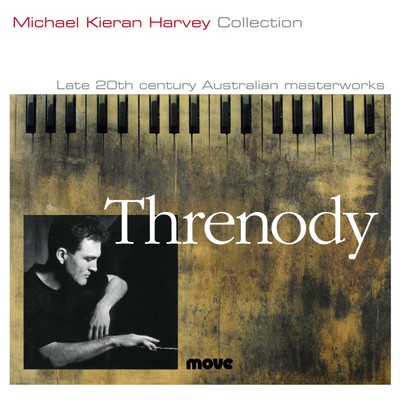
THRENODY

Michael Kieran Harvey

Move Records MD 3475

Here is a re-issue by Move of a recording that was printed almost 30 years ago by the Astra Chamber Music Society. Re-mastered by the indispensable Martin Wright, this CD underlines with pretty heavy scoring the debt that Australian music owes to Harvey, whose dedication to the local product (both the significant and the not-so-remarkable) has remained unswerving across his long, seemingly tireless career. What you hear in this collection is evidence of his professionalism and insights, handling works by six composers (and a couple of his own) with skill and sympathy.

Harvey begins with his own stunning Toccata DNA pf 1993 and later gives us his lesser-known Addict from the following year. Between these two, he plays Carl Vine‘s Five Bagatelles of 1994, Stuart Campbell‘s Quaquaversal from the same year, Eight Preludes by John McCaughey coming from 1991-3, Andrew Byrne‘s Within Stanzas of 1993, Eight Bagatelles by Keith Humble written in 1992, and James Anderson‘s 1994 Reveria im Neuen Stil. He splits the Vine pieces by conserving the last – Threnody – for his final track. All these pieces occupy a compressed compositional time-span, testament to the performer’s intense curatorship as well as demonstrating a sudden temporal rush to the Australian compositional head/brain from composers both well-known and obscure.

Still, there’s not much new to say about this re-issue of a significant body of work that’s been around for so long (that’s assuming that the Astra CD has been available over the years). The portentous opening to Harvey’s toccata with its slow-moving segments brings to mind the variety of Buxtehude before a launch into ostinato-heavy rapidity and that unstoppable headlong flight that seems to me inimitable, this composer-pianist’s own voice speaking with absolute conviction and generating the sort of excitement that you will find only at odd moments in this disc’s later tracks.

With Vine’s Five Bagatelles, we encounter another master-pianist/composer at work in a brilliantly balanced sequence, opening with a rather benign Darkly that presents some material that looks complex on paper but sounds transparent; for example at its splayed chord agglomerations between bars 22 and 25. This is succeeded by the raid-fire syncopations and time-signature oscillations of Leggiero e legato which enjoys a crisp, sparkling run-through.

The control of meshed colour returns in Gentle which opens and closes with more of those splayed chords surrounding the statement of a quiet melody that could have strayed in from an unpublished set of Debussy preludes; shadowy and suggestive in its outer reaches, placid at the core. The untitled fourth bagatelle proposes a raunchy jazz-inflected stroll, like Gershwin’s American brought forward 66 years, but the jauntiness interrupted by more sustained chords offering a brief hiatus, before a nifty note-cluster conclusion expertly accomplished by Harvey.

As many would know, Vine wrote his Threnody for the Australian National AIDS Trust fund-raising dinner, the other four pieces added later with the total work premiered by Harvey at the end of 1994, Its subtitle – for all the innocent victims – is reflected in its character which follows a simple stepping motion that suggests a hymn with an added high mixture stop at a 5th in alt. The result suggests resignation, calm acceptance of an inevitability, and the essential blamelessness of all those trapped in this once-fatal infection. It makes for a sobering conclusion to the CD, a respite from the complexities and abrasiveness of much that precedes it.

Coming round to Campbell’s Quaquaversal, we face a virtuosic complex opening with some massive chords reminiscent of a cathedrale engloutie for our times before a fugal interplay that alters to a ort of ostinato bass supporting a wealth of coruscating darts and flashes. Then the composer’s promise of fluency rather than development sort of takes over with several contrasting episodes (with a mid-level repeated chord featuring in the work’s centre, surrounded by a wealthy of Harveyesque bursts of brilliance). But then, the work was written for the pianist by this one-time member of La Trobe University’s Faculty of Music and it features some pages of dazzling pointillism as it approaches its toccata-like conclusion.

I’m sure a wealth of theoretical depth underpins this work which bursts with verve but you have to assume that the basic impetus comes from the title’s middle six letters. Whatever the case, this is a splendid vehicle for the pianist’s panoply of skills. From another one-time labourer in the La Trobe vineyard, McCaughey’s collection moves us into a more refined landscape; four of his preludes lasting less than a minute, the other four averaging 80 seconds in length. The opening Fluent lives up to its name with some restrained ambles at reserved speed up and down the keyboard. You hesitate to typify the vocabulary but I’d probably light on a compulsive atonality. Presto segreto is not a whirlwind rush but a series of lurches from one pivot to the next, eventually working into its own secret by slowing to a concluding crawl.

With No. 3, Animated, hastening, McCaughey takes us into just that: an atmosphere of abrupt bursts of action punctuated by pivotal mini-pauses, as though the protagonist is faced with a series of dead-ends that set him/her/them doubling back for an alternative outlet. Quick presents as a monophonic sprint, for the most part – possessed by a neurotic elfin urgency. Next, the odd aspect to A sense of slow background tempo is that you’re aware of a rhythmic reticence, as though the work’s progress is being conducted on two levels or in twin layers, even if the overall impression is of a sturdy post-Webernianism.

Mind you, Semplice carries on where its predecessor left off, typified by a forward mobility in which the motives or thematic cells meld into a well-woven fabric; more a handkerchief than a carpet. An overt contrast arrives with Leggiero, recitativo where the principal end is fitfulness, rapid squiggles providing the solid events in this brevity that you could call either whimsical or neurasthenic, depending on your currently predominant sense of aesthetic charity. McCaughey’s concluding Serene seems to be more a journey towards the proposed state rather than a depiction of its prevalence as the piece moves with a confident angularity that occasionally amounts to aggression before a brief resolution.

Byrne recently became a co-director with McCaughey of the Astra organization and he also nurtured his own academic roots in the La Trobe Faculty of Music. After an initial hearing, I thought I discerned four separate sections to this composer’s Within Stanzas; take a few more and you realize that there are a lot more of them. It’s just that they bleed into each other with remarkable fluency so that a sound-production gesture or a timbral-interplay sequence becomes part of a new context or landscape. Mind you, Byrne is lavish with his material which overwhelms your desire for instant auditory analysis, notably in the opening pages’ rhythmic and dynamic conundrums that dazzle with their effective unpredictability. Here again is anther composition tailored to Harvey’s brilliance and premiered by him at an Astra concert, but it is noteworthy that Byrne has withdrawn this score from sale or public performance. He has apparently moved on, and so should we.

Closer to a minute shorter than McCaughey’s preludes, Humble’s brevities show the pianist-composer in assured mode, the score rich in awareness of the instrument’s breadth of colours and most impressive in its rapid-fire virtuosity. You find an illustration of this in the opening Fast which exposes an assured forward thrust while ranging over the piano’s compass before a contradictory slow conclusion. The following Slow is still an instance of forward motion, couched in a compositional style that brings to mind the 19th century more than the composer’s dodecaphonic home ground, with a rich, sustained major chord to cap proceedings.

Easily the longest of these bagatelles is No. 3, For Tony P., very slow, molto rubato. This could be an elegy or just a quiet eulogy; it’s the most placid and stress-less of the collection, opening woth a minor 3rd cell and expanding on this in the best Berg style with a prominent byway to a set of major 3rds articulated at dead-slow before a diabolus in musica finishing interrogation. Move it opens with a confrontational syncopated sequence, full of fast-flying bravura before a fade-to-black close to its 30 seconds length. With Agitato, we’re in Harvey Land through a chain of rapid-fire oscillations across both ends of the keyboard in a fierce display of an unsettled musical state. The No. 6, EKE Bounce easily (and naturally) continues along the frenzy-in-short-bursts path with some brilliant percussive attacks from Harvey before the familiar wind-down final bars.

Slow impresses me as a valse sentimentale manquée, even if the pulse can work against it. But you sense a kind of regret, a nostalgia in this second-longest of the bagatelles, after the (in its context) substantial No. 3. To end, Humble gives us a burleske that is much shorter than the track listing. This is good-humoured and another opportunity to wonder at Harvey’s assured command of what amounts to a study in exuberance. This work brings to a close (as far as I can tell) the CD’s association with La Trobe University where Humble was the first Professor of Music from 1974 to 1984, that faculty eventually shutting down in 1999 to general dismay.

Anderson remains a shadowy figure in Melbourne’s musical world but his Reveria was written for Harvey which speaks to his presence on the city’s contemporary music scene in the early 1900s, at least. This reverie is pitched to the top half of the keyboard with a few low pedal notes to remind you how high is the piece’s operating field. Anderson’s projected state of detachment is packed with vivid flashes featuring frequent flurries of cascading gruppetti punctuated by solid blocks of notes and centre-register diversions. The composer’s emphasis on upper-level flashes does become wearying but Harvey’s account forefronts any inbuilt timbral and emotional variety.

The pianist’s Addict involves a collaboration with sound engineer Michael Hewes who brings computer processing into the mix, complementing Harvey’s playing. Here is the most advanced composition on the CD, chiefly because of its parallels and distortions of the live performance, if only in patches to begin with, but eventually the partnership becomes more challenging. Harvey begins with a rapidly repeated note like a tremolo and he finishes in the same way, but the work evolves soon enough into a rapid-fire moto perpetuo that flummoxes with its tiers of activity.

Hewses employs several electronic/computer techniques, none more prominent than that mirroring effect where Harvey’s sound is duplicated by what sounds like a West Indies steel drum; this has the effect of both reinforcing your impression of Harvey’s trademark agility and also distracts from its purity – which might be a comment on the title character’s state of mind. Whatever the case, the collaboration makes for a wild ride, the emotional state on view very hyped-up and certainly not comatose; this is an addict in search of relief and, even by the end, the sufferer is undergoing nightmares in recollection.

As noted above, Vine’s Threnody brings the CD to a close, an oasis after frenzy in more than one sense. Still, the recording is well worth obtaining (or re-obtaining) as a witness to Harvey’s unfailing musicianship as well as a document of this country’s (well, Melbourne’s, mainly) aggressively active music scene and the wealth of talent at work in it across these few years.

.

Gentle junctions

CROSSING PATHS

Ensemble Liaison and Tony Gould Trio

Move Records MD 3473

First, a few confessions – or better, admissions. I’ve known Tony Gould for about 50 years through our student days when working at a Master’s Preliminary year under Keith Humble at Melbourne University Conservatorium. Tony survived that ridiculously cavalier class and went on to greater things; I left the room and came back years later to take up the same degree with a real teacher. Further, I’ve known the Liaisons for a fair while: pianist Timothy Young since he took on the role of resident pianist at the Australian National Academy of Music in South Melbourne; the other Ensemble members – Svetlana Bogosavljevic and David Griffiths – since pretty close to the formation of this excellent group in 2007.

This CD is not so much a collaborative project but a set of juxtapositions. It begins with the Liaisons playing the Bach/Gounod Ave Maria in a straight arrangement – well, as straight as that sentimental hybrid can get. Then Gould and his colleagues – saxophone Angela Davis, bass Ben Robertson – give their version of the same piece. The Andantino middle movement from Faure’s Trio in D minor follows; again, turn and turn about. A change arrives with Satie’s Three Gymnopedies which the Ensemble plays complete, Young working the original No. 2 by himself with the outer pieces involving his partners. Gould and Co. offer their interpretation of No. 1 only.

Continuing the religious motif, we hear an ‘original’ version of Piazzolla’s Ave Maria before the jazz variant offers an essay in conciseness. We return to Faure with readings of the composer’s popular Apres un reve. Finally, we are treated to a transcription and a brisk interpretation of Schumann’s Traumerei. Then the CD seems to peter out in a version by the Liaisons of Schubert’s Ave Maria (what is it with this prayer?), followed by a piano solo from Gould of Gershwin’s Love Walked In.

All of this makes for what is called ‘easy’ listening, a sequence of tracks that raises no temperatures and plumbs no angst-ridden emotional depths. The Liaison group show their polish in a series of controlled tracks and this calm ambience is reflected in the contributions from Gould and his colleagues. Bach/Gounod’s golden oldie starts with the familiar piano ripples while Bogosavljevic outlines the French composer’s lavish melody with gentle authority and a carefully judged use of vibrato; second verse around, Griffith enters with an almost-not-there adjunct set of sustained notes that weave a most restrained counterpoint that informs but doesn’t intrude.

After a leisurely introduction, Davis generates a quiet meandering line over Gould’s re-invention of Bach’s arpeggio figure with Robertson following the Griffiths’ role of quiet subservience. The modulations are completely different and you’d be going to trace many parallels between the original tune and the sax’s quiet, breathy investigations. But the trio keeps in touch with the original material, a direct quote peeping through at various points.

For the Faure Piano Trio movement, Griffiths’ clarinet takes the original’s violin line with ultra-smooth results, nowhere better than those two points in this gentle movement where the non-keyboard lines operate on a single melody, most movingly in the last stretches from a bar after Number 8 in the Durand score of 1923 – the year of the work’s premiere. Oddly enough, the composer originally planned for a clarinet to take the violin’s usual place and (at least in this Andantino) there’s nothing that the wind instrument can’t achieve technically that makes the transcription a no-no. Faure’s score rises to two modestly passionate highpoints but the harmonic textures show as largely uncomplicated and the performance is suitably restrained in dynamic terms.

Gould and his colleagues’ reading is rather brief – about 2 minutes to the Liaison’s 6 – and the pianist appears to take his brief from bars 8 and 9 of the original, Robertson pattering away at a roving bass while Davis plays a short variant that I can’t source. Still, that’s part of the delight in this exercise where the mutations can take individual forms. Suffice to note that the jazz trio’s emotional stage is less fraught even than that even temper projected by Faure.

As you’d expect, Griffiths and Bogosavlyevic share melody duty in the first Gymnopedie: clarinet first, then cello each time. I’m indifferent to these pages, probably because it’s unclear what the Greek references do for the musical statements, if anything. The performance is clear and properly remote. Young’s solo exposition of the second in the series shows the requisite modesty and dynamic calm that typifies Satie’s prevailing sound-world, albeit with some more interesting chord juxtapositions than its predecessor. To end, clarinet and cello share the melody line turn and turn about while reinforcing the piano’s bass note when they aren’t in the ascendant.

To reiterate, this makes for an amiable enough experience, although I can’t see Satie’s little essaylets adding up to qualifying for inclusion for ‘their timeless beauty’ or ‘melodic and harmonic richness’, as the sparse CD cover text claims of the general content. The Gould Trio’s version of the first of these works is, for the piano, heavily based on the original, albeit with many harmonic changes; but the contours are obvious. Not so much with the sax’s delayed entry which introduces a novel spray of meandering arabesques, even if these settle down near the end of the operation to fall in line with the composition’s later melodic content. And the supple bass reinforcement-cum-elaboration from Robertson makes for a real pleasure as he follows Gould in the four-across-the-bar and duple-in-triple-time interludes in what amounts – in all three pieces – to a slow waltz.

Piazzolla’s setting (is it? I thought this was called Tanti anni prima) is placid enough – a simple ternary structure that begins in C and ends in F. The cello takes the melody at first; when a pronounced key change arrives at about bar 19, enter the clarinet; then both combine in unison/octave for the melody’s return. This last duet is distinguished by Griffiths’ sympathy with Bogosavljevic’s restrained timbre. To be frank, I enjoyed the jazz trio’s reading more than the original, especially when Davis got away from simply outlining the initial melody and introduced some rhythmic wiggles in collusion with Gould to brighten up some pretty bog-standard material.

No objections to the Liaisons’ account of Apres un reve. After the cello’s announcement of the first stanza – word-for-word according to Emmanuele Praticelli’s 2023 transcription of the original song – the clarinet joined in to play the rest of the piece’s melody in unison. All very even and an ideal example of how to match your performing parameters to your partner’s. But we didn’t really need the supplementary line, especially as the work is too well-known as a cello recital component or encore.

When Gould started his variant, you had to wonder what he was about as we heard a few bars of La fille aux cheveux de lin before he started his re-examination which turned out to be twice as long as the original and stuck to this latter’s outline for about half the track’s length, then doubling back for a looser appraisal with Davis’s instrument very breathy and close-miked. Again, the modern version intrigued for its unexpected formality and concentration of the composer’s resources in this most effective chanson.

Whoever did the Traumerei arrangement that the Liaisons played was happy to spread the joy. The marvellous melody with its risings and dying falls was given mainly to the clarinet, the cello vaulting between the various levels of the piano’s subsidiary lines. It looked as though Bogosavljevic was being entrusted with the gentle piece’s last sentence, but no: the clarinet got the last word. Now this was/is a work of timeless beauty and the ensemble’s handling here showed affection and insight.

Once again, Gould showed himself in playful mood, opening his trio’s reading with a reference to the Preambule to Carnaval, before weaving a path back for Davis to start her very individual take on this childhood scene. Just before the end of this extended review, Gould gave another reminiscence of the Op. 9 opening before he and Davis colluded in a reprise of the original’s last phrases almost as written. Yet again, we could relish a deft combination of the old and the relatively new, with some mildly left-field bursts from all three participants.

I missed a few of Schubert’s endless sextuplets from Young; they just failed to sound fully on occasions. Griffiths gave us the vocal line for stanza 1 of the lied, followed by Bogosavljevic in stanza 2, while the clarinet provided some very soft supporting sustained notes. We can all agree on the inestimable merit of this peerless melodic fluency and you could not wish for more benign treatment than that given by the Liaisons.

Gould’s final solo treats Gershwin’s classic liberally, inferring more than stating and an affectionate ramble on its chord sequences with occasional nods to the optimistic melody. Still, it makes for an off-centre rounding-out of this miscellany: a collection of emotionally placid works which kind of satisfies if you’re not looking for a dramatic confrontation in these crossing paths – which, more often than not, contrive to intersect satisfactorily.

Diary November 2024

FRANKENSTEIN!! & THE GOOSE’S MUM

Ensemble Q

Concert Hall, Queensland Performing Arts Centre

Sunday November 3 at 3 pm

Not surprisingly, the second element in this concert’s title is Ravel’s five-part suite Ma mere l’Oye which exists in a piano duet version, a reduction for solo piano and a full orchestra transcription. What are we going to get this afternoon? Probably the piano solo version because Daniel de Borah is the only pianist noted in the personnel list and the remaining musicians number only twelve; too small for the Ravel orchestration. The group also attempts Saint-Saens’ Danse macabre, arranged by American Cicely Parnas for violin and cello; no worries about this ensemble’s cello – Trish Dean – but the violin role could be taken by Adam Chalabi or Anne Horton. Then there’s Poltergeist by William ‘Bolcome’, who I assume is William Bolcom. This is hard to pin down, as there’s a Poltergeist Rag written by Bolcom for solo piano but the advertising bumf claims that this work will be performed by a string quartet: Chalabi, Horton, Dean and viola Tobias Breider. I can’t find any such arrangement in the list of this famous American song-composer’s catalogue. So far, not so much work for the other eight listed participants. Things change for the other title work: Heinz Karl Gruber‘s 1971 ‘pan-demonium’ Frankenstein!! for chansonnier (probably Jason Barry-Smith who is listed in this cast list as ‘narrator’) and an ensemble that takes in everyone except de Borah: the string quartet plus double bass Phoebe Russell, flute Alison Mitchell, oboe Huw Jones, clarinet Paul Dean, bassoon David Mitchell, horn Peter Luff, percussion Jacob Enoka. But who’s playing trumpet? And where does harpist Emily Granger fit into this program, unless the Ravel work is being played in an unidentified arrangement? Anyway, tickets cost $75 or concession $55 with the usual QPAC add-on of $7.20 as a compulsory sting.

A SYMPHONY FOR WINDS

Queensland Symphony Orchestra

Queensland Symphony Orchestra Studio

Thursday November 7

This evening opens with one of Richard Strauss’s later works, the so-called Symphony for Winds No. 2 in E flat of 1944/5, sub-titled (by the composer) ‘Happy workshop’. The more constipated among us call it the Sonatina No. 2, but it’s of a substantial length and sits in happy comparison alongside Stravinsky’s 1920 briefer essay with similar participants but also involving a slew of brass. Strauss involves 16 instruments: pairs of flutes, oboes, bassoons, then four horns, a contra-bassoon, and five clarinets – an E flat, two B flats, a basset horn and a bass clarinet. In terms of time, it’s the longest work on the program. Then a complete change of personnel for Penderecki’s 1961 Polymorphia for 48 strings (24 violins and 8 of everybody else) which could probably be the most advanced music that the QSO has played all year: a splendid sample of graphic notation and a test of Umberto Clerici‘s directional powers. This is followed by British rock guitarist Jonny Greenwood‘s 2011 tribute 48 Responses to Polymorphia which can last either 15 or 19 minutes, depending on the number of movements attempted which will in turn determine whether all 48 players need their own pacay bean shakers. Well, to be fair, it’s not a tribute but a spring-board for an uninspired and unadventurous essay in harmonic conservatism. But that’s just my opinion; listen for yourself and have that finding reinforced. Tickets range from $79 for an adult to $35 for a student or child, with the QSO’s own outrageous $7.95 surcharge on every order.

This program will be half-repeated on Saturday November 9 at 3 pm as the Penderecki and Greenwood spin-off disappear to be replaced by Tchaikovsky’s Serenade for Strings to ensure an afternoon of harmonic emulsion. You’ll be happy to learn that the ticket prices don’t vary; nor does that over-ripe excessive booking fee.

SCOTLAND UNBOUND

Australian Chamber Orchestra

Concert Hall, Queensland Performing Arts Centre

Monday November 11 at 7 pm

Just as the Queensland Symphony Orchestra is finishing up this month, so too is Sydney’s own ACO ending its year with this tour fronted by Scotch-Japanese guitarist Sean Shibe who is going to treat us to a long belt of Hibernian musical craft. With ACO artistic director Richard Tognetti leading the string ensemble, Shibe starts off on a normal classical (acoustic?) guitar, working through some traditional Scottish lute solos collected by the 17th century aristocrat Lady Margaret Wemyss, about whom nobody seems to know anything except her parentage and that she died aged 18. We rush forward to From Galloway by contemporary Scot James MacMillan; this was originally a two-minute clarinet solo from 2000, here transcribed by Shibe. Who continues with a suite of folk songs – could be anything – before we enjoy a new commission from Canadian-born writer Cassandra Miller for guitar and strings. Then Shibe switches to his electric instrument for Lad by American academic and co-founder of the Bang on a Can organization, Julia Wolfe; this is another transcription from the 2007 original that asked for nine bagpipes. Following which it’s over to Irish composer David Fennessy for his Hirta Rounds of 2015 involving nine violins, three violas, three cellos and a double bass; this memorialises a group of now-abandoned islands in Scotland’s St. Kilda archipelago. Like the Miller and Wolfe compositions, Hirta Rounds is receiving its Australian premiere across Shibe’s tour. To end, the electric instrument returns for some selections from another Canadian-Scot: Martyn Bennett’s 1997 nine-track album Bothy Culture which is about all I’ve heard from this musician who died aged 33 in 2005. It’s another arrangement for guitar and strings, but there’s no indication who put this set together. Tickets can be as cheap as $25 for the lucky young and move up to $129 for the affluent old, always remembering that QPAC $7.20 surcharge for exercising your attendance prerogative.

VIRGILIO MARINO

Opera Queensland

Opera Queensland Studio, 149 Grey St., South Bank

Friday November 15 at 7 pm

Here, you take things on trust – not my favourite position. Virgilio Marino is a well-known Queensland tenor; probably less famous than Rosario La Spina but working in the tradition of local legend Donald Smith. I heard Smith in his prime, and La Spina (probably) in his; Marino I’ve yet to come across. Anyway, this occasional recital for the state opera company pairs him with Alex Raineri, so you know the accompaniments will be informed and supportive. But what’s he going to sing? According to the few lines of OQ site information, we’ll hear his ‘favourite arias and songs’ These could include La donna e mobile, Questa o quella and Parmi veder le lagrime because the most important role he has sung for our national company is the Duke of Mantua. Still, he’s performed a host of major roles for Opera Queensland – Don Ottavio, Rodolfo, Nemorino, Pinkerton, Almaviva and Alfredo. Those characters are entrusted with a wealth of arias; as for his ;songs;, I’ve no idea. The event lasts for an hour and you can attend it for $65 full price, $59 if you’re a student or concession-holder (whoopee-do) and a child gets in for $33. As far as I can tell, there’s no charge for using a credit card.

This recital will be repeated on Saturday November 16 at 2 pm but don’t bother: this hearing is sold out. Mind you, there aren’t many seats in the Studio to start off with – a couple of hundred at most.

UMBERTO & NATSUKO

Queensland Symphony Orchestra

Concert Hall, Queensland Performing Arts Centre

Friday November 15 at 7:30 pm

This program is being advertised as the season closing gala and all stops are out, as they say in rugby. The QSO chief conductor Umberto Clerici is conducting two overtures and Strauss’ Four Last Songs, but he’s also returning to his instrument-wielding days and partnering the orchestra’s concertmaster, Natsuko Yoshimoto, in the radiant Double Concerto by Brahms. I, for one, can’t get enough of this masterpiece, which is something of a rarity; the last time I think it was played in Brisbane was when the ACO’s Richard Tognetti and Timo Veikko-Valve gave a dazzling performance about 4 or 5 years ago. So, here we are again with expert soloists and a chance to enjoy the score’s rolling grandeur. But wait: there’s more. Clerici conducts Schubert’s Rosamunde Overture which is no such thing but is as joyfully exuberant (when it gets over its initial solemnity) as the Symphony No. 5. This makes for an amiable if irrelevant preface to the Brahms concerto. For the night’s second half, we begin with Wagner’s Overture to The Flying Dutchman which also sits at odds with the Strauss songs, here sung by soprano Eleanor Amy Lyons. What’s the link between the opera’s youthful wildness or heaped-up tension and the intensely sad final fruits of a resigned and near-disgraced old age? Well, it’s an end-of-term celebration and the aim is clearly to drench listeners in the soporific. Top adult price is $135; children’s tickets are $35 each and there’s plenty of options in between, if no escaping the $7.20 add-on for using your credit card.

This concert will be repeated on Saturday November 16 at 1:30 pm.

MUSICA ALCHEMICA

Musica Viva Australia

Queensland Conservatorium Theatre, South Brisbane

Wednesday November 20 at 7 pm

Last Brisbane cab off the rank for this organization in 2024 is an ensemble put together by Spanish-born violinist Lina Tur Bonet. In fact, there are only three other persons associated on this tour with the metal-transforming ensemble: baroque cello Marco Testori, archlute Giangiacomo Pinardi, and harpsichord Kenneth Weiss. The group has been a mobile one over the years and Bonet has collaborated with Testori and Weiss on some tracks from her records. Most of the 10-part program being presented tonight has featured on these CDs, like the two Biber Mystery Sonatas (Nos. 1 and 10), Westhoff’s Imitatione del liuto, Schmelzer’s Sonata No. 4, the Corelli G minor Sonata and the concluding D minor Sonata from his Op. 5 set, and (I suspect) the Sonata No. 2 from Cima’s Concerti Ecclesistici. The remaining three elements will be Muffat’s G minor Passacaglia for solo harpsichord, a Telemann cello sonata in D Major, and Piccinini’s Toccata (which one?). Entry for adult best seats costs $115; student rush tickets are $15 anywhere in the hall. Once again, Musica Viva stands tall among this city’s entrepreneurs by not adding on booking charges.

CINEMATIC

Queensland Symphony Orchestra

Concert Hall, Queensland Performing Arts Centre

Friday November 22 at 7:30 pm

Nicholas Buc is back to direct this 13-part sequence of soundtrack extracts from films known and unknown – to me. As usual, a lot of composers appear in the lists – two of them get a double serving – but I wonder how enjoyable the experience is if you’re left to summon up the visual recollections in your mind’s eye; it makes for a considerable and lengthy series of mental gymnastics. Proceedings begin with Danny Elfman‘s music for Tim Burton’s 1989 Batman, from which I recall only Jack Nicholson’s outrageously prominent Joker. A bit of Australiana follows with something from Caitlin Yeo‘s Ballarat-celebrating New Gold Mountain TV series score of 2021 (not actually cinematic but what’s in a name?). We can relish Carl Davis’ theme for the 1995 Pride and Prejudice TV adaptation, notable for Colin Firth’s totally unnecessary swimming exploits. Joe Hisaishi‘s 2001 score for Spirited Away is represented by One Summer’s Day; Hans Zimmer is honoured by a suite from his 1994 The Lion King score and later his music for Interstellar of 2014; John Williams also manages a double with his Superman march of 1978 and the theme from the original 1993 Jurassic Park. Continuing the TV encroachment, we hear another suite, this one by John Lunn for the Downton Abbey series that kicked off in 2010. Then a true blast from the past in Dukas’ The Sorcerer’s Apprentice, presumably included because of its use in the 1940 Disney Fantasia film starring Mickey Mouse and Leopold Stokowski shaking hands in a prodigious feat of cinematic legerdemain. John Powell is represented by part of what I assume is his music for the original 2010 How to Train Your Dragon which I’ve not encountered (probably because of my age-group, that being over 10). A confusing extract comes next from Alan Silvestri with both a promised suite from his Forrest Gump score of 1994 and a focus on the composer’s Feather Theme; means nothing to me because I gave up on Tom Hanks after his prissiness when faced with Ricky Gervais’ humour at the Oscars. To end, some Howard Shore in the form of The Lighting of the Beacons (the horns of Rohan loudly blowing) extracted from the last film in 2003 of The Lord of the Rings trilogy. Pianist Daniel Le is soloist but I don’t know a lot of this music so can’t tell in which parts he takes on prominence. Tickets range from top adult of $135 to a child costing $35 and you can eschew your Coke and popcorn bucket as you have to find $7.20 each order for the sake of QPAC’s accounting woes.

This program will be repeated on Saturday November 23 at 1:30 pm and at 7:30 pm. Prices for entry appear to be the same whenever you go.

BEETHOVEN’S ODE TO JOY

Queensland Symphony Orchestra

Concert Hall, Queensland Performing Arts Centre

Thursday November 28 at 7:30 pm

What’s puzzling about this reading of the mighty Symphony No. 9 is its projected length: 1 hour 25 minutes – and an interval is scheduled. Your average performance time is about 65-6 minutes. If you insert a 20-minute interval, you’d have to assume that the work is going to be cut in half, so that we go out for a drink between scherzo and adagio. Can’t see it myself: chief conductor Umberto Clerici plays his Mahler symphonies here straight through, so he wouldn’t be splitting up the more digestible Beethoven, would he? It could detract significantly from the vital experience of hearing the sequence of four movements, rather than just the over-used finale. Clerici’s four soloists are soprano Eleanor Amy Lyons (fresh from negotiating the Four Last Songs by Strauss a fortnight ago), mezzo Ashlyn Tymms, tenor Andrew Goodwin (that’s a brave sound to hear in the Froh variant when we go all Turkish), and bass Samuel Dundas. The Brisbane Chamber Choir will be prepared by director Graeme Morton. Tickets range from a good adult seat for $135 to a child being lucky enough to enjoy the experience for $35. And you won’t forget the joyful privilege of shelling out $7.20 an order to keep the QPAC financial team chuckling in an abundance of fiscal Freude.

This program will be repeated on Friday November 29 at 7:30 pm and on Saturday November 30 at 1:30 pm. No price reduction for the matinee.

Listening in a vacuum

DREAMING IN THE SAND

Bentley String Quintet

Move Records MCD 620

It’s hard to get a handle on this newly-recorded work. Robbie James is an unknown to me. although he has a listing in the Australian Music Centre files and he’s well-documented on web spaces like Facebook, Linkedin, YouTube and he clearly has a firm guitar-based relationship with the group GANGgajang and was at one time a member of the Yothu Yindi personnel. For all that, you won’t find much material about the composer and what material there is on internet sources is repetitious and not very informative.

Matters are complicated by the official data on his works at the AMC. For one thing, this particular disc is not mentioned, but four other string quintets are. First off is one from 1999 called Suzannah, which follows a female First Fleet convict who, at the work’s end, is left ‘dreaming in the sand.’ Next came Kangaroo in 2003 which gives you the animals’ view of the arrival of Governor Phillip in 1788. No. 3, as listed at the AMC, bears the title of The Dreamt World and dates from 2016. And finally – and somewhat confusingly – we come to String Quintet No. 4 which was produced in 2009. This is entitled The Marree Sisters and follows the paths of a mother and her four daughters who leave the small eponymous town at the fundament of the Oodnadatta and Birdsville Tracks to find new lives in Adelaide; these women are/were the composer’s own relatives.

So far, so fair. The out-of-sequence dates for the later two works aren’t that important. What is perplexing to those of us unfamiliar with James’ compositional trajectory comes with the constituents of this third quintet. The work begins and ends with Dreaming in the Sand tracks, which generic title is meant (I think) to cover all of these compositions. Then we encounter a Kangaroo movement, which could be the first movement of Quintet No 2. A little later, we arrive at Kangaroo Rides the Desert Skies and The Gentle Warrior, which are the fourth and third movements of this same quintet.

Track 3 is called Ghost on the Beach which, as near as I can tell, refers to the conclusion of String Quartet No. 1. Suzannah Sails is a definite reference to the same piece. Dance on the Divide was the original conclusion to the first live performance of Dreaming in the Sand in 2021, while The Crow and the Irishman (this CD’s penultimate track) appears to have no precedent, although James does refer to his use of Irish folk music in the Suzannah work.

So what do we glean from all this? You’d have to assume that the format of this (perhaps) new String Quintet No. 3 uses material from its predecessors. Or possibly the composer has re-assessed his previous efforts and recast them. We’ll probably never know because no recordings of the first two quintets are extant. We do know that the String Quintets 1, 2 and 3 all enjoyed their first performances on October 15, 2021 during Brisbane’s Restrung Festival; The Maree Sisters has been recorded by the ABC on July 29, 2022 as performed by the Bentley String Quintet. This ensemble has changed somewhat over the years but its surviving members are cellist Danielle Bentley and double bass Chloe Ann Williamson. The upper lines on this latest Move product are Camille Barry (violin 1), Eugenie Costello-Shaw (violin 2) and Charlotte Burbrook de Vere (viola).

String Quintet No. 3 has nine movements, as detailed above. The work lasts for 31’44” which gives us an average length per movement of about three-and-a-half minutes, so the aim is non-developmental in the usual sense. Nothing lasts long; the sketches of colonial/aboriginal/natural scenes make their presence known and are gone. The problem that the work faces is that very little of it is memorable; pleasant enough music-making, certainly, but nothing to challenge, astound, delight, or arouse. It’s not a half-hour that you grudge but I can’t go along with those commentators who find profundity or insight in these old-fashioned vignettes.

According to what I can glean from the available online sources, Robbie James is an auto-didact (according to the Australian Music Centre) as far as serious composition goes. Which is fine and not that unusual if you accept the claims of several writers who claim that they gained nothing from their teachers. What you have to do if you teach yourself is to work twice as hard so as to make up for what nobody tells you, and that’s why this quintet strikes you as well-intentioned but diffuse. Not that James should have taken to studying his Boccherini and Dvorak; who wants to offer interference? But writing without an awareness of what precedes you is to put huge trust in yourself and your capabilities.

James’ first track, Dancing in the Sand (part one), opens with a single diatonic line, joined by two other instruments; then the rest emerge into a nice harmonic mesh of no complexity. Another scrap emerges on the violin, is repeated, then supported in a restatement by underpinning sustained notes. It’s a nice tune that doesn’t venture outside a simple scale format. We get an antiphonal response from the lower strings, then another collegial chorale before an abrupt change where the lower strings provide a hefty chugging underpinning for a few bars, before a reversion to the pervading placidity and a final statement of the movement’s tune.

So what we have is statement and restatement, a touch of shared labour/melodic responsibility, but nothing that would befuddle any 18th century composer. It’s hard to se a contour to these pages; you get restatements and a harmonic scheme that would have been unremarkable in the early Renaissance. And that’s where auto-didacticism comes unstuck because, if you don’t know what’s been happening in Western (string quintet) music over the past 300 years, where is your edge?

Kangaroo is an improvement, chiefly because it sets up a mobile rhythm that keeps going until a restrained final page or so. The melodies employed are busy but come one after the other with little distinction. What this segment relies on is a three-note rhythmic figure that attracts more attention than anything else. To be fair, James’ vocabulary here moves up a notch in richness with some piquant added notes. When the composer introduces a few irregularities about a third of the way through, you are pleased, even if the performance level is ragged. But the movement might just as well have been called Magpie or Indian Mynah for all the suggestiveness you receive of the titular animal’s motion or natural standing.

Ghost on the Beach is a slow benevolent lament, I suppose, although for what I can’t imagine; the coming of the white man? There’s nothing supernatural about its colour or emotional landscape as it moves between chords that support a violin line which weaves a long contour holding no surprises. Beginning with a perky jauntiness, Kangaroo Rides the Desert Skies calms down to a hymn-tune and follows a stately path to its ambiguous conclusion; less of the wilderness here and more of a European concept of Heaven.

Who is The Gentle Warrior? Possibly the kangaroo because the movement comes from the quintet that deals with that animal. But no: it’s an Aboriginal male that Suzannah is destined to encounter when she arrives in this new land. Again, the mode is upbeat and jaunty with a few passages of decent part-writing alongside others that are clumsy. The interest lies in the rhythmic patterns, although these are nothing to write home about, least of all in 2024. For a little over half its length, Suzannah Sails states, restates and rehashes what sounds like a British Isles folk song; the polyphonic interplay is unsophisticated and the movement’s progress stops after some semiquaver flurries a little over half-way through before James embarks on another melody. But then I’m not sure whether this melody leads anywhere as later focus falls on a figure that seemed to be an accompaniment provided by the cello.

This is a reversion to the simple diatonic writing of the first movement; not that the language ever got far beyond such a happy state. Nothing novel emerges in that regard during Dance on the Divide which sounds like a hoe-down, especially when the movement forward drifts into some elementary syncopation. I think I counted about five tunes being announced but can’t be sure because they merged into each other and the basic key didn’t change – apart from a couple of try-hard momentary modulations near the end. Still, it was cheerful in character.

As is The Crow and the Irishman which boasts a melody line with some Celtic suggestions, although nothing you could definitely hang your hat on. In essence, it is a cross between a minuet and a waltz, graced with some excellent doubling of a subsidiary chain a little before its somewhat lopsided conclusion; I mean, it stops but not exactly on the note that formed part of your mental projection. Dreaming in the Sand (part two), the longest track, begins with a couple of solo violin scraps before we enter into some full-bodied chords and move along our predictable path where the composer seems to be trying out a few devices but coming back inevitably to harmonization exercises.

You could look on this composition as an essay in naivete. The stated attempt behind the exercise is a symbiosis of two cultures: an imposed white one and a pre-existing Aboriginal one. The trouble is that you look in vain for any traces of the latter; whatever the dreaming going in this particular sand is firmly based in a none-too-advanced European vocabulary, not helped by the fact that the only ‘other’ string production technique employed throughout is pizzicato. For all its aspirations, this quintet remains a divertissement; to get beyond this level, you simply have to have compositional technique – information and knowledge about the craft as it is practised today.

Funny thing, memory

SUMMER WAVES

Len Vorster

Move Records MCD 661

This must be a re-issue because the pianist’s copyright on it goes back to 2004 and the credits listed on the slim leaflet point to original production and design by an entity called MANO MUSIC. This organization is listed as a Norwegian company and the sort of music it publishes these days is (as far as I can tell) soft-core pop. Whatever the history, here is Len Vorster‘s CD under the Move label and this musical content is impressive, if much of it is light. Still, that’s only to be expected when the background to the recording are this musician’s recollections of his youthful holidays by the sea in South Africa.

The leaflet also notes that Vorster is celebrating the centenary of one of the composers he performs: Lennox Berkeley, who was born in 1903 – which puts the recording into an even firmer temporal location. Mind you, it also means that these liner notes have not been updated; more to the point, a biographical screed printed here on Vorster is also possible to date from 2004 or thereabouts because his career details after that time remain unrecorded.

The CD opens with Gershwin’s three Preludes of 1926, familiar pieces that betray a sort of compositional constriction despite the ebullience of the outer numbers. Then we have a clutch of disparate pieces by de Falla: Cancion (1900), Serenata (1901), Nocturno (1896), Serenata Andaluz (1900), Vals-capricho (1900). Two pieces by Lord Berners follow – a 1941 Polka and a 1943 Valse. Continuing the sudden British detour, Vorster airs the 1945 Six Preludes for Piano by Berkeley. Two nocturnes follow – one in B flat Major of 1817 by Mr. Nocturne, John Field; the other more well-known one coming from Grieg’s Lyric Pieces of 1891. Then it’s all Gallic fun with Debussy’s La plus que lente waltz of 1910, Poulenc’s Les chemins de l’amour song dating from 1940 but here pianized, and Ravel’s Valses nobles et sentimentales of 1911 – at close to 15 minutes, the longest track on this recording.

As you’d expect, the so-called ‘jazz’ preludes enjoy an expert airing, the first Allegro not exactly in synch with the published dynamic markings and a heavier accent than most on the last quaver chord in bars 4 to 6, and later when that bass support pattern emerges. But there’s a delicious elegance in the forte-to-piano run pf demi-semiquavers across the penultimate bar and Vorster maintains his syncopated initiative from first bar to last. He takes the middle ‘blues’ prelude slowly and doesn’t really press forward during the middle F sharp Major interlude, taking the right path out of a contradiction between a tempo and largamente con moto.

And I liked the alternation between arpeggiating some of those 10th left-hand stretches and landing the notes together; sort of in keeping with the relaxed ambling pace of the composition’s most successful pages. For the final Allegro prelude, Vorster maintains a consistent rhythmic and dynamic output; my only complaint is that the final statement of the theme in octaves across the score’s final 8 bars impresses as hard-won rather than the virtuosic powerhouse made of it by other interpreters.

Fall’s Cancion follows Gershwin’s ternary shape and stands as an unremarkable, melancholy piece of salon music with a deftly reinforced re-statement of the composer’s balanced tune. A bit more national colour flavours the Serenata which is given with an agreeable rubato that invests the piece with a quasi-improvisatory ambience, even if all the notes are there to be articulated – in this case, with great sympathy. Not much distinguishes the Nocturno, apart from an infectious descending figure of two demi- and one semiquaver across a Major/minor 3rd; which lends the piece a kind of Andalusian kick. Otherwise, it’s a Chopin rip-off with no claims to longevity.

Speaking of that province, we come next to another serenade in the Serenata Andaluz which is a tad more diffuse in its shape than its precedents by this writer. Here, the colours applied have a very familiar character, not least the triplet that comes at the start of the bar which concludes several of the main tune’s phrases (after we get to a tune, 16 bars after a frippery-filled preamble). The piece oscillates between D Major and minor, expanding to a polonaise-rhythm coda that eventually recalls the decorative opening as de Falla harvests his material – sort of. But Vorster’s reading is infectious and eloquent.

After this composition, we enjoy yet another just as fulsome in its expression. The Vals-capricho is an ebullient piece of semi-virtuosic salon music, certainly more digitally challenging than anything we’ve heard in the Spanish composer’s output so far. The performance is excellent, finding out the rather trite sentiment and its flashy expression, maintaining a steady pulse throughout, handling the right-hand flights in alt with obvious mastery.

But it’s about this stage that I started to wonder about the relationship between Gershwin’s brassy combination of Latin rhythms and jazz, de Falla’s ambivalent unhappy fusion of his country’s folk music with the effete ‘art music’ of his youth, and Vorster’s summertimes at home in South Africa. You might call it all holiday music, possibly: nothing heavy, most of it pretty skittish, a lot of it amiable and forgettable. And the vivacity keeps on coming with the two dances by Berners, the Polka a heavy-handed romp with a penchant for ending a phrase on an inappropriate note, but the atmosphere jaunty and vulgar in a 1920s style – impossible to imagine without its generic forebear in Walton’s Facade of nearly 20 years previous. Vorster sounds comfortable with the piece’s flourishes and loud peroration, but the piano sound is inclined to be harsh and jangly.

The Waltz is longer as well as more polished in its modulation scheme and shape. Vorster performs it with a liberal rubato and plenty of languid hesitations but the most interesting element lies in its irregular phrase lengths and the whimsical interchange of the anticipated with the eccentric. You wouldn’t call it a serious dance by any means but you are drawn in by its impetus and spiritedness. Both these Berners pieces are emphatically tonal; any of the contemporary experiments and rule-breaking that the composer would have been more than well aware of, considering his rich field of acquaintances, find no place in his own work.

You have to assume that the inclusion of Lennox Berkeley’s Six Preludes would be partly due to Vorster’s friendship with Michael Easton, a pupil of the venerable English composer. While you might find traces of holiday romps in Berners’ frivolities, these almost contemporaneous pieces have more gravitas to them. The first, Allegro, is a serious near-toccata with a continuous run of triplets underpinning the aggressive chords that constitute the central matter. As becomes the pattern in the series, the second prelude is much more relaxed in tempo, a slow-moving Andante, following a recognizable developmental path and staying within the rather sophisticated harmonic boundaries that Berkeley set himself.

No. 3 of the set, Allegro moderato, is the shortest and another busy construct, loaded with purposeful activity and clever in its progress, if not leaving much to roll around the tongue. The following Allegretto is a slow-moving waltz based on a simple enough melody memorable for a mid-motion demi-semiquaver snap, its evolution cloaked in a sequence of ever-mobile modulations; the whole finely realized by Vorster whose delivery is both deliberate and insouciant.

No. 5 is an Allegro whose outer segments appear to be in 7/8, the central page moving to a regular 6/8. The material is light-hearted at either end with a piquant, elliptical stepping melody that is subjected to less stressful handling than its predecessor. Finally, the longest of these preludes, another Andante, takes us back to the quiet and contemplative ambience of the other even-numbered pieces, serving as a rather sentimental envoi to the set, here handled with excellent suppleness. Berkeley’s work, more than anything so far on this album, might suggest the happy days of the performer’s youth, if one spent in elevated company.

An odd miscellany follows, starting with Field’s Nocturne No. 5 that is distinguished for its gentle charm and dexterous right-hand writing, Vorster takes his time over the fioriture but gets to the heart of the gentle sentiment that colours these two pages. He brings admirable breadth to Grieg’s Notturno, notably the concluding nine bars where he makes a good deal out of the composer’s sleight-of-hand coda. As well, you have to admire the precision of those quiet, exposed trills in bars 16, 19, 57 and 60.

We end in France, first with Debussy in slower-than-slow mode. Here, the rubato direction is employed fully and the interpretation is one of quite legitimate pushes and pulls, fits and starts, action and languor. Even if it was written as a benign satire, La plus que lente is a highly effective, moody score that oozes seductiveness, more persuasive than pretty much anything else in the belle époque‘s musical output. Poulenc’s waltz-song, originally to Anouilh’s words, has a genial spirit with a considerable sweep to it, but it seems to me to be indistinguishable from many others of its type. Further, its language smacks of the music hall and presents as simplicity itself when compared to its Debussy companion. As we’ve come to expect, Vorster’s reading is excellent: an enthusiastic rendition of a piece of fluff.

Ravel’s collection of eight waltzes is remarkable as an extended essay in pianism if unsettling in its juxtapositions of tonal high spirits and bitonal or added-note chords in eventually-resolved discord-to-concord movement. Each of the constituents, apart from the concluding Epilogue Waltz 8 which is a downward-looking Lent, passes by rapidly. There is a kind of contrast available – for instance, the stentorian call-to-arms of the first Modere – tres franc, followed by the 7th-rich ambivalence of the following Assez lent. But the impression is of studied cleverness in the clashing thirds and fourths that pepper the No. 4 Assez anime which in turn is set alongside the quiet appeal of the lilting pp and ppp calm of Ravel’s Presque lent No. 5.

I’m not much of a fan of the middle F Major (ostensibly) pages in No. 7 where the accents get displaced and the outcome is a blurred mess; not Vorster’s fault but a triumph of smartness over sense. Still, the final quietly resonant pages with their premonitions of Britten’s Moonlight interlude bring this odd, challenging miscellany to a cogent end. Yet, for the last time, I have to wonder how these off-centre waltzes put us in mind of holidays. To me, they anticipate the 1920 La valse which some see as a glorification of the dance form, while the rest of us find it close to a post-war nightmare.

Faintly bowing

TOGNETTI. MENDELSSOHN. BACH

Australian Chamber Orchestra

Concert Hall, Queensland Performing Arts Centre

Monday, September 16, 2024

Einojuhani Rautavaara

First piece on the program for this latest ACO mid-tour appearance was not scheduled in the original material. Rautavaara’s Pelimannit – Fiddlers is a five-part suite for strings, fantasias on tunes by folk-fiddler Samuel Rinda-Nickola. This Opus 1 was originally a piano solo that the composer arranged for strings and it employs a good many fiedel techniques or – better – habits like no vibrato, flat-bowing, passages with unvaried dynamic and (I suspect but can’t prove) some microtonal output to establish roughness of group articulation.

The work was expertly carried off by the players, with an outstanding passage or two when ACO artistic director Richard Tognetti‘s violin shadowed the cello melody line of Timo-Veikko Valve – possibly in the second Kopsin Jonas movement – where the folk-music suggestiveness reached an apex; more convincingly than the strident sweeps of the suite’s outer movements where the ethnic flavours were slathered on. Naturally, what come to mind on exercises like this are the works of Bartok: the employment of national musics from across Europe in settings of folk tunes, if not the Hungarian master’s transmutation of such material into his own music.

In this arena, Rautavaara sounds dependent on the players’ vitality and community in combination more than making much of the melodies as subjects for treatment. In fact, my impression was that the variants didn’t travel very far from home-ground and the harmonizations were more intriguing for their timbral qualities rather than for any polyphonic interlacing. But then, the work comes from 1952, seven years after Bartok’s death and the composer was pushing his up-to-datedness hard at the age of 26 in an unadventurous environment. Still, Pelimannit enjoyed a performance that elevated the score to an absorbing level.

Adelaide-based composer Jakub Jankowski wrote his Ritornello to the ACO’s commission and the score is enjoying its premiere performances in this series. The score begins with gestures: all players extending their bows like duellists, swishing them, then a communal shout reinforced by a hefty foot stomp and the work proper begins with long, slow bands of sound that move into a melodic strand (a Ukrainian folksong, the composer claims). Several features struck me as original, like the harmonics produced on Maxime Bibeau‘s double-bass and a kind of orthodox tutti that seemed to me to be the ritornello itself. But the most novel sound came with a kind of regular one-note bouncing effect, thanks to some wooden comb-bows utilized by the performers.

Still, I’m probably all at sea about the ritornello source and character as the score carefully wound up its strands into a composite; e.g., those extended bow gestures being given to individual players who used them as directive punctuation points during the work’s progress. It is paying Jankowski no small compliment to observe that his score kept his listeners intrigued; not so much for the theatrics but for the exercise of tension and release, for the generous spread of sound-sources around the eleven participants, and by his afore-mentioned sense of shape, of formal probity.

We then experienced a Bach violin concerto, the BWV 1041 in A minor with Tognetti as soloist. I’ve not experienced the Bach recording of this, the E Major Concerto, the Violin and Oboe Concerto and the D minor Double Concerto that this violinist and his orchestra produced to significant acclaim in 2006. But this night’s reading was unsettling because of Tognetti’s interpretation which eschewed the bold strokes of most players and favoured a remarkably light right hand under which notes tended to disappear. I don’t mean tutti passages but solo-dominated sections where the executant is meant to administer a clear line.

So no soaring aspirations in this version which was equivalent to seeing through a glass darkly where all too often the progress of Tognetti’s voice drifted into inaudibility. Certain aspects of the supporting decet’s work also puzzled, like the sudden pizzicato that was employed once during the opening Allegro, and the vibrato-less chains of detached and continuous quavers that populate the middle Andante‘s length. Of course, this latter methodology gave the soloist a plain setting above which to outline the composer’s splendid arabesques. Again, reticence came into play and the movement’s emotional eloquence was ignored for a polite, unassuming series of statements, distinguished by an occasional rhythmic liberty amounting to a sort of slurring of a gruppetto.

The gigue finale moves too rapidly for much beyond slotting the notes into place but here again, the soloist was determined to be self-effacing. At bars 31-32, the semiquaver interruptions to the regular quaver set-up didn’t come as a relief but a faint set of quivers. As the movement bounced past, you looked in vain for any assertion of primacy in the top line; rather, Tognetti followed an eccentric path that dipped in and out of prominence, blending in with the ritornelli bursts but leaving even these pages to succeed by an inbuilt minor-flavoured vivacity.

After the break, we came back to a smaller ensemble for Anna Thorvaldsdottir‘s Illumine; the pairs of violas and cellos remained, as did the bass, but the violin forces were halved to Helena Rathbone, Anna da Silva Chen and Ike See. The briefest work programmed, this short nature (I believe) poem was meant to indicate a physical transition to light – or was it one solid movement from quiescence to enlightenment? Shuddering, slow bands of discordant (later, concordant) sustained notes, suddenly fore-fronted sounds yielding to complaining short scales, Bartok pizzicato snaps, finally a series of soft glissandi: it’s all there in an amiable compendium of technical tropes common to your contemporary writers. Will I want to hear it again? Probably not because I didn’t catch anything individual about it.

To end, we had more of the disappearing violin approach across Mendelssohn’s E flat Major Octet, one of the ACO’s showpieces. Tognetti and Rathbone divided the softly-softly attack style between them, with Ilya Isakovich and Tim Yu rounding out the requisite violin quartet. Here also, we met with the absence of a hero top line; rather, we were faced with one that was content to meld in with the ensemble, yielding place to anyone with a moderately interesting subsidiary contribution – just playing along with the gang. The first Allegro came into high focus for this approach as the lengthy exposition was repeated. Even the opening climactic points at bars 4 and 8, the sforzandi in bars 10 and 11: all were under-emphasized.

And the story continued through a shadowy interpretation of the Andante where the soft outline prefigured what was to come in the very light Scherzo. In this latter, miraculously deft movement, the emphasis on collegiality reached a new high; even that splendid counter-strophe that begins at bar 37 failed to rollick even subterraneously. Still, the sudden break into visibility that came with Stefanie Farrands‘ solo at bar 188 served to leaven the piano-to-pianissimo, leggiero affettuoso atmosphere that dominated proceedings.

Dynamically, the Presto conclusion gave us a relief from the soft-stepping of the preceding two movements with cellists Melissa Barnard and Valve making a welcome forte start to the composer’s opening fugato. Tognetti and Rathbone occasionally moved into a dominant role but my interest (when it was roused) fell on the violas and cellos who seemed to be straining against the bit, unleashing an impressive power and drive when exposed.

This was certainly the most polite version of Mendelssohn’s youthful masterpiece that I’ve heard; fit to be played at the British court of the composer’s time in its polite titillation and well-couched reserve. For all that, the QPAC audience sounded delighted with it. But these patrons were also more receptive than I’d expected to the Pelimannit and Ritornello excursions of the evening’s first half and at least two fellow-passengers on the train home declared their enthusiasm for the Icelandic writer’s exercise. As with nearly everything that the ACO brings to town, you could admire the ensemble’s overall achievement and its polish, but I missed the usual urgency and dramatic sweep that you usually encounter in readings of the two older works.