New clothes for Christmas

HARK!

The Song Company

Melbourne/Australian Digital Concert Hall

Tuesday December 21, 2021

St. Philip’s Church, Sydney

Pretty much everything that has happened to The Song Company over recent years has escaped my notice. The group made several visits to Melbourne during my last years there, performing at the Recital Centre with impressive results; I believe Roland Peelman conducted at a few of these programs, although he resigned from his directorship in 2015, about four years prior to the organization being put into receivership and the unholy mess that followed. All the singers that I saw then have left the ensemble; the octet for Tuesday night’s live-stream program from Sydney’s St Philip’s Church in York Street featured completely new faces/voices, and any efforts to identify them all have met with little success.

This online experience was actually the middle one of five performances presented over three afternoons/nights from St. Philip’s and its companion Garrison Church over the hill in Miller’s Point. A thematically well-ordered program divided into four sections found the Company covering a wide range of repertoire, setting the celebratory ball rolling with O come, o come, Emmanuel pronounced by a male solo in Latin before the rest of the singers joined in to work through all eight verses – which rather threw me because I’d only ever come across seven – variety here catered for through groovy harmonic changes and soprano descants that increased in range and intensity. All of this was handled without the support of organist Kurt Ison; when he and his instrument entered for the last verse, the choral body had slipped slightly in pitch. It’s always a risk, that device, and probably best left on one side or not attempted so blatantly, no matter how secure the singers.

Conductor/associate artistic director Francis Greep was working from two compilations new to me: the Naxos Book of Carols and the Patmos Book of Carols. In fact, 10 of the 18 works heard on this program came from the Naxos collection, 2 from the Patmos, one appeared to be a fusion of both Patmos and Naxos – a sort of Dodecanese-Cycladic melange – and five were original compositions or arrangements by contemporary writers: one-time professional cartoonist Brian Kogler (two carols), indigenous musician Elizabeth Sheppard, Sydney lawyer Rachel Scanlon, and British singer Richard Eteson. This all made for an invigorating experience, as the Oxford Book of Carols and Jacques/Willcocks/Rutter Carols for Choirs compendia were swept aside in a welter of novelty.

Coming from the once-free north, I didn’t know that masks had been instituted (re-instituted?) in Sydney and this twilight audience was hard pressed to participate in the congregational numbers: Hark! the herald angels sing, Silent night, Away in a manger, and O come, all ye faithful – so much so, that the Company proved very powerful in dynamic, unlike the usual experience where people in pews discover lungs and diaphragms that have rested unused all year. Of course, this prominence might also have had something to do with the M/ADCH recording system. Whatever the cause, we heard all Company personnel clearly in whatever was being sung.

A regular at many Christmas services, The Angel Gabriel from the Basque territory here enjoyed new garb with a hummed first statement before the first verse began. Here came some harmonic shifts from the version that we all know, if not love. In less try-hard territory, the singers’ articulation and clarity of notes made a striking impression, particularly for a group that is new to their work. A group of three pieces combined came next – A Song of Joy, Christmas Day, and The Song of Angels – all ascribed to Orlando Gibbons. Well, I knew the last by name but its precedents left me out in the dark, even if the singers’ delivery again impressed for its clarity and balance.

Mendelssohn came upon us with the refreshment of different linear content, a very prominent organ, and a striking descant that would have proved improbably difficult for your common or garden-variety church choir. Moving into the second quarter, as we say in the AFL, The Holly and the Ivy had acquired a new tune from the BBC archives and this novelty was entwined with the regular Cecil Sharp-collected melody which was entrusted to a solo bass, a tenor-and-alto duo, then a soprano-and-bass combination (I think: this vagueness comes from hasty notes scribbled down while trying to find the new tune’s origin) with an impressive fusion in the final verse/chorus.

In another Continental excursion, the Company sang Es ist ein Ros entsprungen, according to Michael Praetorius. As far as I could hear, the first two verses were trios with all in for verse 3 – an arrangement I’ve not come across before – but the intra-linear spatial balance proved to be one of the program’s delights. Back home, we were just settling in to Kogler’s The King of Blis – which presumably used the same text as John Rutter had in 2010 – when it stopped! To be followed by the Silent night feast for the Company, with a solo male voice adding in some passing excrescences to the middle verse while his companions provided a hummed backdrop, the whole capped by a sad glissando on the first ‘born’.

Sheppard’s Mary, gentle Mother brought about a change in position for the singers but what actually came across was predictable and Anglican-sweet with an orthodox harmonization, although the composer displayed a deft realization of texture in her moves from homophony to part-writing. Baby Jesus, hush! now sleep was the Rocking Carol of Czech origin, notable for a brisk harmonic surprise in bar 2. Again, the ensemble’s carefully applied equanimity impressed, even when the linear texture increased in complexity. Britten made the Balulalow text inseparable from his A Ceremony of Carols setting, although a few composers have made their own versions, including Brisbane’s own Colin Brumby. Rachel Scanlan’s version suffered from an unclear women’s contribution at the beginning, but the work improves when it starts at Oh my dear heart and captures attention for its insightful response to the Wedderburn brothers’ words and for an unexpectedly brisk conclusion.

Part the Third’s finishing mark, Away in a manger, found the tenors riding the blast across Verse 1 in a Naxos arrangement that seemed to put off the congregation. In the choir-only Verse 2, something odd happened at the end of line 2, a move that I couldn’t put my finger on although it left the sense of an unflattering flattening. Whoever improved on William J. Kirkpatrick’s original was still aiming to keep the tenors on the qui vive in the final stanza.

Into the final phase and we encountered It came upon the midnight clear by Jonathan Pitts, a relative of Song Company artistic director Antony Pitts. An organ fanfare led into a monolinear opening strain, followed by a harmonized stanza, before reverting to the opening’s atmosphere of hushed excitement at going nowhere. And still they came: an alto solo leading to stately chorale sounds and a return to a sort of neo-syncopation at For lo! the days are hastening on, and an under-emphatic organ at the conclusion. Kogler emerged again with an aphoristic contribution in Gaudete. I heard the pendant Christus est natus/Ex Maria virgine,/gaudete! lines, even if the composer was livening things up by having his singers clap to punctuate their single line. It’s a lively piece, welcome in this context but – as with Kogler’s previous The King of Blis – it didn’t stick around long enough to make a lasting impression.

Eteson has used the tune Gallants Come Away as the basis for his version of A Jolly Wassel-Bowl, which has twelve stanzas because it was to be performed on Twelfth Night. The combinations offer variety – males, females, male duet, female duet, monolinear, rich harmonization, mixed duet, change of metre, full choir with descant. But it wears out its welcome – how could it be otherwise? – like Tchaikovsky’s employment of folk-song; a little dressing-up doesn’t take you very far. Nearing the end, the Company’s reading of In dulci jubilo boasted a line of sources: Praetorius, Bach and Stainer – the lot arranged by Antony Pitts. This might have worked to better effect with more variety of dynamic but little stuck out from the clever arrangements beyond an unexpected simplicity at Nova cantica and In regis curia. Good King Wenceslas from the Naxos collection again offered some sophisticated harmonic alterations but I found the organ contributions to be the main point of interest in this well-worn classic.

Full time. Here the lack of congregational input sounded most apparent. A vox populi presence was allowed in Verse 2 – the words were printed in the program – but, by this stage, it seemed as if the St. Philip’s turba was following the practice in many other churches where the experts are left alone at this point. Verse 3 employed a descant in canon, which seemed a trifle attention-grabbing; something similar happened with the grating chords at Word of the Father.

Nevertheless, this evergreen concluded a ceremony-of-sorts that removed decades of verdigris. Not all of it was congenial, especially to listeners heavy with preconceptions and expectations of a familiar experience; with respect and congratulations to the Patmos/Naxos innovations, I’m unsure what future these new interpretations will have outside professionally distinguished choirs like this ensemble. Still, I found cause for gratification in the continued existence of the Song Company and appreciate the efforts by Greep and Pitts to persevere in shaping a future for the ensemble: still one of the more impressive and meritorious blooms in Sydney’s serious music chaplet.
Gimme that old-time Espana

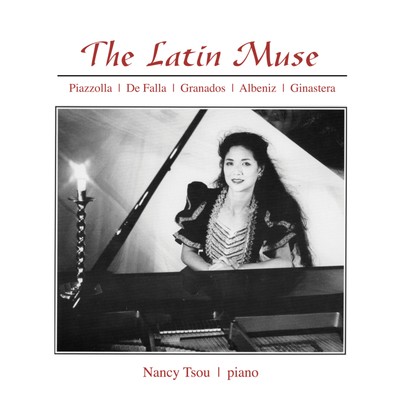
THE LATIN MUSE

Nancy Tsou

Move Records MCD 619

With her latest CD, Tsou is using the word ‘Latin’ in a trans-continental sense. At the start, she plays three familiar works by the Argentinian tango explorer, Astor Piazzolla; she concludes with another set of three pieces by the much more talented Argentinian writer, Alberto Ginastera. In the centre, we are treated to much well-circulated material in two works each by Granados, Falla and Albeniz – foundation-stones of 20th century Spanish music. The whole collection of a dozen tracks adds up to a little under 46 minutes but it has some interesting points – for me, these arise in the Ginastera Op. 2, the youngest music on the CD as it came from the composer’s 21st year.

Even at this early stage, you can relish the driving rhythmic energy, clear-voiced melodies and added-note harmonic clusters to be found in Ginastera’s masterworks like the contemporaneous Panambi ballet – a thunderbolt from my mid-adolescence when extracts appeared on Goossens’ 1958 recording alongside a truncated version of Antill’s Corroboree – and the more sophisticated 1953 Variaciones concertantes. These Danzas Argentinas begin with a Dance of the old herdsman – a particularly spry senior, it seems, with a taste for the bitonal as the right hand plays white notes exclusively while the left hand stays on the black with very few deviations. Tsou handles this with a clever mixture of restraint and jauntiness, my only problem her slight deceleration in tempo about 12 bars in after a very brisk opening. But the cross-rhythms are treated with excellent command.

The second dance, that of the Delightful Young Lady (more ‘elegant’, I would have thought), is a languid piece in 6/8 during which the melody gains an additional line that moves in 4ths and 5ths, acquires full chord status before sinking back to its quieter beginnings. The piece is more than a little suggestive of Piazzolla, albeit some decades earlier, and Tsou performs it with excellent malleability of its basic elements. Finally, Danza del gaucho matrero proves to be the most emphatically characteristic Ginastera work of the three with a welter of cross-rhythms to begin which Tsou complicates even more by adding in her own sforzandi; followed by a move into less bitonal territory and a clear tune weltered out on top of the constant whirl of a bass line. This interpretation is long on excitement if not on clarity, but then the composer was clearly intent on whipping up energy and bota-stamping enthusiasm, even if you had to keep an eye out for melodic syncopations that left-foot you and your expectations of predictability.

Those of us dedicated to the Australian Chamber Orchestra through successes and missteps became pretty familiar with Piazzolla at his best when Scots accordionist James Crabb collaborated with Richard Tognetti and his amiable band in a concert tour many years ago, the outcome one CD in 2003, Song of the Angel, and another two years later – Tango Jam, Vol. 1. Crabb is back this February for the first of the ACO national series concerts in a program that includes Libertango (still to be heard on the Tango Jam CD). Tsou’s two other Piazzollas – Oblivion and Milonga del Angel – also appeared on the ACO/Crabb 2003 recording.

This CD begins with Oblivion and Tsou handles it without any complications, but also without much interest. The composer’s melancholy melody is strait-jacketed into a shape where its sudden semiquaver bursts disappear and unexciting quavers balance each other in every second bar; the piece needs some bite but in this approach it suffers from an excess of rubato and a cloying lushness in the harmonic arrangement. Not much different comes in the Milonga where the harmonies are smoothed into cocktail bar inoffensiveness. Tsou’s ornamentation is welcome if not as spiky as I would have preferred and only a few liberties are taken with the metre. Libertango comes across as – eventually – clumsy. Tsou’s opening sounded fair enough as she worked through an extended introduction before hitting the chief melody, but at a few spots the rhythm paused while a glissando was negotiated with too much care, or a register move wasn’t snatched but proved ponderous. It’s a dance,. after all, and you have to provide certainty to the punters involved in this exhibition of self-indulgent strutting.

Granados appeared first in the Spanish contingent with his Spanish Dance Andaluza, fifth in the 12 Spanish Dances collection of 1890; not from the two Op. 37 dances as listed here, I believe. This is a familiar piece, Tsou tending to elongate the first downbeat notes in some bars – like the first. The interpretation is highly coloured, even if one of my favourite details goes missing: the little semiquaver figure that ends bars 16 and 17, in which the lower right-hand notes do not sound most of the time. Then, what to make of Tsou’s reading of the Intermezzo from Goyescas? Any suggestion of guitar pizzicato is absent, ritenuti are inserted at will. syncopations are mushy, the counter-melody that takes over at bar 40 is over-emphasized, the few fortissimo explosions are not emphatic enough, and the overall approach lacks firmness.

The Falla brace begins with an extract from The Three-Cornered Hat ballet, the Miller’s Dance which must feature among the composer’s most well-known works. Tsou makes a firm case for this boldly-contoured set of pages with no complaints coming to disrupt attention until the final accelerando which could have been less slow to take off. There’s no indication as to where this CD was recorded, nor by whom, but this particular track lacks acoustic resonance and would have gained from a favouring of sympathetic upper strings for a piano piece that stays firmly in the middle to low instrumental ranges. As for the second track, this is labelled La vida breve; it turns out to be only the Spanish Dance No. 1 from that opera’s score and the performance is a mixed bag with some nimble finger-work early on alongside some labouring when sections draw to a close. Most surprising of all is the conclusion that Tsou provides which is a light tinkle to round off the Animando poco a poco stretch; of the final Piu vivo 17/18 bars which usually bring this extract to a rousing conclusion, there is no sign.

Prelude/Asturias/Leyenda by Albeniz is one of the most popular pieces of Spanish music – up there with Rodrigo’s Concierto de Aranjuez middle movement and De los alamos vengo, madre – but you can see pretty quickly why it’s such a gift for guitarists. Tsou has the usual trouble in negotiating those full-blooded right-hand chords between bars 25 and 45, later bars 147 to 167: it’s very hard to make the jumps and keep in time. But her handling of the middle cantando (bars 63 to 122) is excellent, part from a tendency to cut short the rests after each fermata. Most of the staccato running line is clear and clean. Finally, No. 3 in Albeniz’s Chant’s d’Espagne finishes of the echt-Spanish tracks. Sous le palmier receives a fine interpretation, packed with atmosphere and highly responsive to the composer’s tango rhythmic underpinning but rhythmically fluid, Tsou secure enough to follow her instincts in shaping the melody line and inserting some subtle hesitations throughout this most successful of her essays in ye (comparatively) olde-time Spanish music.


We won’t all be home for Christmas

THE OCTAVE OF CHRISTMAS

Melbourne Octet

Melbourne Digital Concert Hall

Thursday December 9, 2021

It’s hard to remember much about last year’s Christmas in musical terms. Did anything happen? Certainly nothing much in Brisbane, where such activity was more likely to come about than anywhere else in the country. At all events, this year we came upon an unexpected pleasure, one I found at the last minute and featuring a spartan ensemble – our own version of VOCES8 – that worked through a near-hour’s worth of choral music. We began with Perotin’s famous organum exercise, Viderunt omnes (well, some of it) and ended in Martin and Blane’s sentimental Have Yourself a Merry Little Christmas of 1943. For obvious reasons, the whole enterprise took on characteristics from all over the place. You had music that only choirs like the Ensemble Gombert would mount; soon after came pieces that could have graced an Australian Brandenburg Orchestra’s Noel! Noel! program; alongside these, you fell into Australian Boys Choir mode; creeping under the cultural portcullis came shades of the anything-goes approach typical of every Myer Bowl Carols by Candelight.

As well as negotiating hairpin bends of repertoire, I also relished coming across singers whose work I’d enjoyed many times in bygone years, like bass Jerzy Kozlowski who enriched my experiences through his appearances with the Gomberts and Nick Tsiavos’ Jouissance ensemble, not to mention turning up in unexpected places like playing the Sacristan in an Opera Australia Tosca. Also making a welcome re-appearance was tenor Timothy Reynolds whose clean timbre is still clearly piercing through multi-line complexes. In fact, I have experienced most of the Octet’s male voices – bass Oliver Mann in Bach, Christopher Roache’s tenor/countertenor in Ballarat, Southgate, and the Mornington Peninsula. The one male voice I didn’t know was that of tenor Christopher Watson.

Of the women, I have seen soprano Katherine Norman in a variety of ensembles but not her colleague Elspeth Bawden. Alto Helena Ekins’ profile indicates that I must have heard her on several occasions; alas, the memory is not what it was. However, as a unit, the singers managed quite well, if the balance proved uneven in some of the earlier pieces attempted, and a few wavering pitches showed that the operating zone wasn’t completely comfortable for everyone – neither in ensemble nor in physical situation.

To put it bluntly, much of this program would have come off more successfully in a church with a bit of resonance. The Athenaeum 2 space is an odd area where I’ve seen little beyond the premiere of Gordon Kerry’s opera Medea 30 years ago, and another event I recall only for its inclusion of Schoenberg’s arrangement of Funiculi, Funicula. For my taste, the Octet sounded too close – or too closed in – which meant that any errors were immediately obvious, especially production imbalances and the occasional early entry. Watson didn’t push himself forward as the body’s fulcrum but remained a model of discretion, especially once his various ships had been launched. Moving into first gear, that initial Perotin work impressed for its still-breathtaking vitality, thanks to the bright top three lines. Still, it finished at bar 37 in my edition, the title words having been treated but not the rest of the Gradual. Moving along a few temporal spaces, the male voices initiated a fair attempt at the medieval English carol Sing we to this merry company, working through three of the five verses I’ve come across and showing a keen responsiveness to its harmonic crises.

I believe that the Praetorius version of In dulci jubilo involves 8 parts. As the piece moved on, Elspeth Bawden was – to put it nicely – challenged by the complexity of her support; a shame as this carol stands above nearly all others in any language for its splendid shape of line and eloquent verbal matter. Only a slightly enthusiastic entry from Kozlowski in the last line ruffled the group’s unanimity. Another Praetorius motet, Joseph, lieber, moved smoothly along its way with only a falter in the pulse at a couple of measures near bar 29 to distract us, compensated by a finely shaped last five bars.

Dering’s Quem vidistis got off to an uncertain opening but impressed for the briskness of pace adopted for its duration. A pair of arrangements by John O’Donnell followed in quick succession: Noel nouvelet involving a lot of melodic repetition but featuring an unattractive mini-canon for male voices set against an excellent conclusion to very four-square material; and Il est ne, le divin Enfant, enriched by a plethora of Noe interjections, musette imitations, modulations to quicken the pulse, and a fine fade-out with only a querulous soprano note disturbing the final chord.

The Octet continued a trek through the realm of Australian Arrangement Land, and for a while it looked as though we were in for the long haul. Lachlan McDonald paid his respects to Gabriel’s Message with plenty of 2nds to add briskness to this usually mild carol. It was during this piece that Christopher Roache’s versatility became apparent – a facet or two that should have struck me much earlier in the night. The male voices provided appropriate humming while both sopranos jaunted through the Virgin’s response, ‘To me be as it pleaseth’. McDonald also took the opportunity to bathe us in Gloria treatments, later allowing Mann and Kozlowski to take on the original melody while a ferment erupted above them which didn’t aid the textual clarity or the light narrative. As with O’Donnell’s treatments, the harmonic sliding here proved rich and sometimes unexpected.

Regarding the almost unavoidable Away in a manger, Michael Leighton Jones’s version employs a soprano solo in the outer verses with a supporting syncopated susurrus of ‘lullaby’. All forces participated in a harmonized middle stanza before the final quatrain saw a refreshing rhythmic flexibility applied in the top line. Another inevitability, Silent night, gained some tension from David Brinsmead’s version which proved satisfyingly rich for the first two stanzas, including a forceful soprano descant at the opening to Verse 2, a glee club-style modulation to enter the final sextet, and a consoling recapitulation of ‘Sleep in heavenly peace’ at the carol’s final bars.

Michael Leunig has written several poems to do with Christmas, but nothing as moving as his I see a twinkle in your eye. Calvin Bowman’s setting alternates between monolinear and chorale, although it moves into greater complexity for a time before its emotionally warm conclusion on ‘The manger where the real things are’, which was definitely one of those points in this program which cried out for an ecclesiastical echo. As did Britten’s A Hymn to the Virgin which suffered from a lack of resonance and the equality of numbers in both choirs, as well as the first choir’s soprano trying to carry off the climactic Of all thou bear’st the prize against her enthusiastic colleagues. By contrast, Warlock’s Benedicamus Domino sounded earth-bound and beery, handled with fitting emphasis and dynamic girth.

Back to more arrangements with the Austrian escapee, Still, still, still, featuring a spotlight on Reynolds riding a genial support. British choral expert Alexander L’Estrange left nowhere for his sopranos to hide when the text turned English, but interest returned with the melody’s displacement between tenor, bass, and female voices, not to mention a little burst of ‘Schlaf in Himmlischer Ruh!’ to round off the carol. L’Estrange’s handling of In the bleak midwinter gave prominence to Christopher Watson who had the first and last words, Mann making a worthy if less substantial contribution in between. A canon between sopranos and the male voices made a mish-mash of Verse 3’s opening while Roache was granted the briefest of solos. But then, L’Estrange’s final verse moved the focus across the whole ensemble in a rather slick/smooth version that tended to make thick plum sauce of Christina Rossetti’s poised lines.

At last, we came to Jingle Bells in an arrangement by British musician Ben Parry that revived the groovy Swingle Singers’ sound, providing air space to Kozlowski’s deep and perky timbre, Roache’s tenor giving him a run for his money. As you’d expect, the whole crowd got right in there with a-ring-a-ding-ding as the sleigh-bells got a working over. Parry moved us into 6/8 for a bar or two in the sort of exercise that would go down a treat at Marquette University. Ditto Have Yourself etc. in a version by another British musician-of-all-trades, Peter Gritton. Here were more ‘close’ harmonies and laid-back sentimentality with a memorable glissando. Watson introduced an encore – yet another L’Estrange product, this time I’ll be home for Christmas. A world premiere, no less, it held plenty of exposed work for Watson’s own light timbre. Just the thing to finish off a final trio of originally-USA products and standards from the formidable republic and testifying to that nation’s terrifyingly banal debasement of a great Christian festival.

Still, at the end of this recital, we had the shades of Perotin and Praetorius still hovering to show us what Christmas can be, or better, what it can mean to musicians of stature, what it meant – and could mean – to be committed to the mystery of God made Man and finding something to be celebrated in that, rather than demeaning your intelligence to the level of a Dudley Dursley count-the-presents regime or seeking a Nativity vision at the bottom of a glass through which a red-nosed reindeer brings the promise of seasonal surfeit and stupidity. This recital made for a double-edged gift from the Octet, then – but thanks anyway; in this time of distress and disappointment, we’ll take whatever small-scale treasures we can find.

Unabashed, continuous sweetness

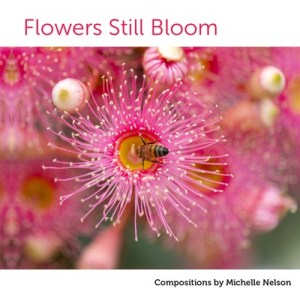
FLOWERS STILL BLOOM

Michelle Nelson

Move Records MCD 621

Well-known guitarist Nelson presents 22 tracks on her latest CD. The first three are, in terms of length, the most substantial, hovering around the 4-minute mark. The rest tend to be slight, particularly her Eight Bagatelles for recorder (Will Hardy) and guitar which average out to about 1′ 30″. Yet there can be quality in brevity, as Webern is our perennial witness. But then, Nelson is not weaving skeletal miracles of organization but vignettes that soothe your frazzled receptors into calm territory with a quiet amiability. And that intention is not to be disdained in times that hold unpleasant surprises and uncertainties around every press conference.

The composer’s bagatelles are surrounded by an Isolation Suite for solo guitar, four movements each side. As its title suggests to most Melbournians, the work gives various musical reflections on aspects of the First Great Lockdown of 2020; well, it wasn’t that impressive as it lasted a matter of weeks rather than the months that this year’s venture reached. But there’s more. Those first tracks comprise Two pieces for Harp and Guitar, with Megan Reeve supporting Nelson; as well, Nelson plays an isolated solo, La despedida, which is the CD’s longest work at 4’10”. Finally, Nelson branches out to offer Short & SweetThree Pieces for Concert Ukulele.

We start with the harp/guitar duets, beginning with Falling Ashes which is an excellent example of combining timbres to the point where their interweaving comes close to indecipherable. Starting with a falling arpeggio shape, the piece sort of inverts this motif, torquing it into mild transformations but eschewing the temptation to revert back to it verbatim. A gentle exercise all round, its 4/4 metre enjoying some slight compression in its latter pages. Falling Ashes‘ companion is Floating Free, which begins with some scene-setting of water sounds; here, the previous piece’s falling pattern is inverted – at least, until the harp enters, the guitar restricted for a long time to Alberti-type supporting groups while the partner instrument sets all the running with the upper line and some syncopation to add interest to its single-note pointillism. The water noises permeate the piece at various stages: you might be floating but this body of water is not to be trusted, it seems to me.

The lengthy Farewell guitar solo follows. Here is your classic rondo form – ABACA+coda – and a deftly couched main theme/melody to carry it all along. As you’d anticipate from its Spanish title, the work reflects a world of guitar salon music, but this piece has a deft, no-nonsense attitude to its leave-taking: the major key (D? I’m losing any capacity to determine tonality from open strings) dominates and both interludes don’t venture too far away, so that the chief tune’s return becomes more of a welcome than a goodbye. For all that, Nelson has a gentle if predictable lyricism to her compositional language that soothes, never confronts.

She then switches to the ukulele for three pieces: Poco allegro: espressivo e rubato, Vivace: quasi waltz style, and Moderato : delicato e rubato. Thanks to these descriptive titles, there’s mot much further to say. The first is a gentle piece operating on two levels – a regular, plucked (what did you expect, idiot?) bass and a top tremolo line that doesn’t have much vertical motion to it. In the waltz – a not-too-distant cousin to similar exercises by Sculthorpe and Michael Easton – the triple rhythm is regularly displaced by a 5-count bar but the work operates on a sort of three-layered system, the top lines outlining the melody in euphonious thirds. The final constituent of this brief collection is a numbingly repetitious offering in which each bar appears to begin with a triplet before the bar’s other three quavers emerge in regular tempo; and when I say ‘regular’, I mean ‘unchanging’. Well, that’s not exactly true as a modicum of modulation takes place, but the rhythmic pattern impresses as inexorable. The composer refers to using the guitar’s ‘ligado’ technique which, as far as I can hear, refers to the opening triplet being played in one stroke/attack. Or maybe I’ve missed the point entirely. Whatever the case, this is the longest of the three ukulele pieces and the least interesting in its material.

Nelson returns to the guitar for her salute to COVID – the first half of it, anyway. Each section has a suggestive title, the first rather oddly named Isolationist, which suggests a political attitude to me, rather than the state of being alone, which is Nelson’s intention. It’s a mainly one-line meander with a catchy opening motif; it could suggest the state of emotional/intellectual solitude to a suggestible listener. Quietude follows, proposing the silence of Melbourne’s physical world during a severe shutdown. Here again, the movement is single-note, operating on two levels with an upper melody followed by a lower arpeggio support that takes on a night-following-day regularity. With Steel Grey, the accent changes to ennui and depression as the days of solitariness creep ever onward. This piece starts boldly enough but soon settles into a tweaking of cells that suggest the unvarying nature of each unwelcome day and even a concluding tierce does little to raise the emotional stakes. A change of scene coms in a flowing Sunset Reflection which celebrates an uplifting, unexpected sight in a page (or half a page) of mild optimism; this is also the shortest element in the suite so far.

After the Eight Bagatelles, the suite resumes through Rising Tension which has two elements: a quick minor 2nd interval, time-honoured for suggesting unrest or a Disturbance in the Force; and a set of chords where the treble seems to stay the same but the lower harmonies change slightly, signifying the physical realization of social discord – a marvel of prescience, considering the demonstrations that have hit our capital cities on recent weekends when the disaffected have had to find some way to flesh out their new – and clearly undeserved – freedoms. Following this unconscious imagery connected to the recent Storming of the Winter Palace, we have Anamnesis working as a kind of curative element where a calm and predictable melody is played with consoling charm, calculated to revive the drooping spirit. Miller’s mental odyssey then turns to the concept of weathering the months of durance vile imposed by Daniel Andrews; Endure revolves around appoggiatura which eventually seems to appear in every beat of a slow march that rises and fades away like Mussorgsky’s Bydlo. If anything, this piece emphasizes the numbing repetition of time in universally enforced quarantine. Finally, we reach the CD’s title track which observes the hiatus between the southern capital’s two lockdowns and the advent of spring, the piece’s forward movement packed with promise in a major mode, leading from lower reaches to higher ones, the suite concluding with an alternation between major and minor. It’s as though happy days may be here again but they can be deleted from your expectations bank all too easily.

Sitting in the middle of these Melbourne mediations, the Bagatelles are excellent examples of easy-going duets; for instance, the first one, Allegro, has the recorder play the tune twice, then a deviation, and a return; pleasant and piquant without any affectations. More of the same comes with Poco allegro where the sequences are unsurprising, apart from some interpolations from Hardy, and an unexpected coda that cuts across the piece’s quietly busy ambience. Giocoso is a light jig with the recorder still maintaining top-dog status, the part animated by some delayed entries and a smidgeon of syncopation. This up-beat, naive mode continues with Poco allegro e cantabile, Nelson sustaining a steady single-note pulse throughout while the recorder follows the optimistic path set by a signature upward 4th leap.

The composer contributes a single-note 6/8 bass support in Piacevole which lives up to its name – not so much for the regular guitar underpinning but more the follow-your-nose aspect of Hardy’s contribution which every so often sounds improvised; it isn’t, but the later melodic twists are carried out with telling individuality. In fact, this musician’s essays at glissando spice up a pretty unconvincing Poco adagio in which the modulations – such as they are – don’t convince because of a sort of tentativeness that was not quite as obvious in the preceding movement . Yet again, the guitar’s role is a subservient one. A straight ternary shape provides the framework for Animato, another jolly jig which acquires some folksy quality with the occasional first-beat crushed 2nd from the guitar and an opening melodic gambit that suggests Pancakes, Lisela. Finally, another gentle if unadventurous melody arrives in Allegro e sempre legato which reinforces the characteristics of this collection: a clear-singing melody line that doesn’t move far outside its original scale range, a simple accompaniment that draws little attention to itself, an even dynamic level without any surprises, and a four-square structure as reassuring as that of Grieg.

Luxe, calme et volupte

SOFIA TRONCOSO, PATRICK NOLAN & ALEX RAINERI

Music Viva

Queensland Conservatorium Theatre

Wednesday November 24, 2021

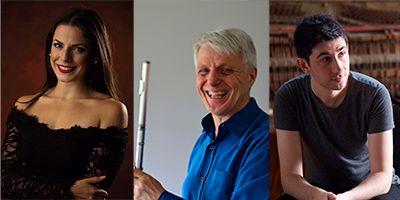
(L to R) Sofia Troncoso, Patrick Nolan, Alex Raineri

Closing its never-say-die year, Musica Viva once again celebrated the talents of local musicians which, in these dodgy times, means Queenslanders. This particular evening focused on the salon; specifically, the French variety and, by and large, the program stuck to the task, although the opening offering seemed a tad out-of-place. But who’s to say that Bellini arias weren’t standard fare in the greenhouse atmosphere of the Guermantes and Verdurin get-togethers? That’s what soprano Troncoso began this night with – Eccomi in lieta vesta/O quante volte from I Capuleti e i Montecchi and which is Juliet’s first appearance, coloured by prominent, mournful horns that were here replaced by Nolan‘s flute. The only part of this opera that I know, the recitative/aria gave the singer plenty of space to exercise her range and dynamic control, the higher reaches of the work heading towards pitch problems with a a strong vibrato intruding across the word intorno but disappearing for some creditable mini-cadenzas to brillar il giorno and the second-last in tuo sospir, this last a sensitive preparation for the concluding bar-and-a-bit.

More likely fare for the salon came in Doppler’s Mazurka de Salon, a non-stop show-piece for Nolan with pianist Raineri (once again fulfilling his occupation as accompanist for all seasons by replacing the scheduled Stephen Emmerson) offering discreet chord support. Both artists appeared quite happy with each other in the frequent stops, starts, rallentandi, accelerandi, swoops and curvets that typify this highly decorative material. While the Mazurka presented as not so blatantly virtuosic as when expounded by other flautists, Nolan kept a fine grasp on the work’s mobility and preserved its sense, eschewing the temptation to make a gabble of its prolix solo line.

Reaching for the highest point that can be associated with the salon, Raineri played three of Chopin’s Op. 28 Preludes, beginning with No. 20 in C minor, its Largo enjoying a very slow approach from this pianist who showed a clear relish for the bass octaves across the opening bars and a determination to elongate the distance between chords in the repetition of the second strophe. No. 22 in B flat found the pianist doing his best to give us high-flying Romanticism, using plenty of rubato and taking more opportunities to vary phrase lengths than most interpreters I’ve come across. In the final Prelude of this collection, the D minor pedal dominated the first 10 bars, but that made the eventual move off it all the more dramatic. I wasn’t over-impressed by the first scale-rush to a top F in bars 14-15 because of a lack of definition and the famous descending chromatic 3rds run sounded indistinct rather than fulfilling its anticipated scouring effect. As with his first Chopin, Raineri presented a most distinctive and individual version of this prelude, well worth the experience for its drive and responses to parts of the score that are often glossed over.

More indisputable salon music arrived with three Hahn songs from Troncoso and Raineri. L’heure exquise saw the singer manage her upward 6th and 7th leaps with telling smoothness – high points in a fairly monochromatic song. A Chloris gave Raineri room in his interludes to execute some elegant note-pointing while the vocal line sustained the required measured and even style of delivery that infuses this work with ancien regime elegance. Still, I thought the third number, L’enamouree, came off best in the group, Troncoso demonstrating clean output and deliberation in her work, caressing the line in an example of eloquent sentiment – the exercise a moving partnership between these musicians.

In the evening’s solitary voice/flute duet, Troncoso and Nolan gave a finely executed reading of Roussel’s Rossignol, mon mignon, their interleaving mutually considerate to the point where good manners went too far; more self-assertiveness, especially from the instrumental line, might have mitigated the effect of a fluent but aimless set of pages. More persuasive although a less accomplished piece was the program’s only genuine voice/flute/piano trio: the first of the 3 Odelettes ancreontiques by Maurice Emmanuel, Au printemps – another example of how much the Greeks have to answer for. This was harmonically lush, thanks to Raineri ensuring that each change of colour made its point, while Nolan pulled back in dynamic power, even at that tempting point where poet Remi Belleau speaks of birds playing in water and Emmanuel responds with some telling glissades. But then, this is a soft song, rising to an mf marking at Number 2 in the Durand edition for barely five bars.

Having celebrated the early 19th century salon with his Chopin bracket, Raineri moved to the last century with some of Szymanowski’s Nine Preludes, the composer’s Op. 1: intriguing products as the composer’s own choices from his juvenilia, as being indebted to Chopin’s Op. 28, and as indicative of Szymanowski’s experiments with novel compositional language. We heard three of these works: No. I which sets three against two throughout its brief duration; No. IV does the same thing but with more chromatic swerving around an ambiguously applied key signature; and the E flat minor No. VIII which was the most Chopin-suggestive of the three and a splendidly fluid creation expertly accounted for.

Finally, Nolan had his turn in the spotlight, for which he chose the most famous flute solo of modern times (apart from Varese’s Density 21.5): Debussy’s Syrinx of 1913, actually written for a ballet and to be played off-stage. This player is highly experienced and has the craft and insight to shape the piece into a fluent construct, in this interpretation covering an ample dynamic range and tempering the lengths required for breaths as well as maintaining the work’s direction through the cedez, rubato, un peu mouvemente points, the whole finishing with a masterfully controlled final 5 bars and the softest concluding D flat.

More Debussy followed with the Chansons de Bilitis, again demonstrating the sympathy between Troncoso and Raineri as they negotiated the slightly tinted character of long stretches in these three works. For instance, La Flute de Pan is recitative with clear stretches where the vocal line stays on one note while the piano employs several colourful additives – the titular flute, certainly, but also details like the frog imitation just before the last rushed line about the singer deceiving her mother.

About this point, the performers were distracted by some buzzing or electrical interference which could have been feedback from the Conservatorium hall’s recording system, or its speakers, or a hearing aid turned up too loud – this last an all-too-common feature of musical events I’ve attended in the Salon of Melbourne’s Recital Centre, or at the Australian National Academy of Music, or even in Hamer Hall. Whatever, the sound, lowered itself, if not quite to nothingness, and the duo simply pressed on.

In La chevelure, Troncoso generated a fine lyrical arch at la meme chevelure and maintained the song’s urgency up to the final Quand il eut acheve, from which point the composer gives us a superb exhibition of near-stasis harmonically while the vocal line folds in on itself. Finally, I found great pleasure in Raineri’s block chord work across Le tombeau des naiades and the clarity of his parallel right-hand 3rds from bar 11 till the fourth-last measure. On top of this, Troncoso gave a fine display of controlled power leading to the song’s explosion into F sharp minor.

Finally, all three artists came together for another hybrid in La flute enchantee from Ravel’s lopsided Sheherazade triptych. I can’t trace who did the arrangement but it made for an engaging if brief conclusion to the program, the performers making a generous gift of the opening three lines, keeping their heads in the active central Allegro, and observing the letter of the law in the brief free-for-all in the Lent before Number 4 in the Durand edition. A gem to finish this tour de chambre, even if the Ravel song belongs in the concert hall rather than a more intimate space, and it was delivered with a quiet panache that had graced a good deal of this varied entertainment.

Very welcome if brief view

BAROQUE IN BLOOM

Australian Brandenburg Orchestra

Brandenburg One

Saturday November 20, 2021

Paul Dyer

It’s been years – well, over two – since I last heard the Australian Brandenburgers at work. Not that you could have expected more frequency, given the off-again, off-again nature of Australian concert-giving during our pandemic. Added to which, the organization would have put Brisbane excursions on the backburner when facing the shrinking possibility of getting on-stage in its home town. In our communal gap years, we’ve been offered some online scraps from specific orchestra members and two digital screenings, of which this program is the more recent.

Plenty of familiar faces emerged across the six constituents of this program which found the ABO mining one of its finest seams in Italian Baroque violin scores. Associate concertmaster Matthew Bruce has been a Brandenburg member almost since the beginning, as has guitarist/theorboist Tommie Andersson. Cellists Anthea Cottee and Rosemary Quinn are very familiar faces, as are violists Monique O’Dea and Marianne Yeomans. Some other participants have become familiar in different contexts, like Madeleine Easton from the Bach Akademie Australia, Matthew Greco from the Australian Haydn Ensemble and the Muffat Collective, Anton Baba from the Australian Romantic & Classical Orchestra.

Others were complete unknowns to me, like the violinists James Armstrong, Rafael Font, James Tarbotton and bass Bonita Williams, although this last I must have come across as she performed with both Orchestra Victoria and the Melbourne Symphony Orchestra before settling into the Opera Australia pit in 2016. Whatever their provenance, the composite ensemble worked with fine rapport for most of this brief (35 minutes) program which comprised Marini’s Capriccio Per Sonare il Violino con tre corde a modo di Lira with Easton leading an elegantly contrived quartet; three of the ten concerti grossi in Giovanni Lorenzo Gregori’s Op. 2 set, a different concertmaster for each; Vivaldi’s C Major Sinfonia RV 116, Dyer directing with customary brio; and Corelli’s Ciacona Trio Sonata, the last of his Op. 2, with Tarbotton and Armstrong in excellent partnership.

Mind you, this broadcast was a fair while in arriving: it was recorded on September 24 in the Sydney Recital Hall. The program’s title was given substance by surrounding the performers with floral arrangements amounting to mini-jungles from some angles. Still, the entertainment had an appealing shape, moving from the solo spotlight on Easton for the Marini, through the exposed two Corelli violins, the exercise ending with exuberant full-blooded panache in the Vivaldi romp.

One of the delights of the Baroque is that room for improvisation or manipulation is wide; most of the performances we hear fulfil expectations because the scores are complete and set in stone, e.g. the St. Matthew Passion, The Four Seasons, Judas Maccabeus. Dyer and his band are quite prepared to take liberties, particularly with music that is all bare bones. For instance, the Marini Capriccio; the score I’ve come across is 53 bars long and heavy on unadorned chords at the opening, in the middle, and at the end. Easton opened with an unaccompanied solo, setting up her main interpretative model of arpeggiated three-part chords, before the continuo – Dyer on organ, Andersson on theorbo and Baba’s gamba – entered. From which point on, the interpretation followed Marini’s chord progressions faithfully in a reading that – quite -rightly – left all the running to Easton’s crystalline upper part.

For the one-movement Corelli sonata, the same three players provided the accompaniment, Dyer moving to a harpsichord, and each of them having a statement of the chaconne in turn before Tarbotton and Armstrong entered with flawlessly articulated and balanced interweaving lines. From both violinists, the style of address proved congruent, the dynamic changes calculated to a nicety and both sequences and canonic writing clean enough to sound as though one player was operating both instruments. All right: it’s not difficult music, not even when it switches in bar 17 to Allegro, but the piece requires finesse and empathy to carry off. Here was another example of music you don’t want to stop and, for a moment, I thought it wouldn’t when the soloists repeated their opening plangent Largo.

Then the ABO cohort presented the three Gregori works in a boxed set – Nos. 1, 2 and 5 with Greco, Bruce and Font serving as respective concertmasters. Of these, No. 1 in C Major and No. 5 in B minor were enjoying their Australian premieres; fine work, resurrecting some amiable material which could stand light comparison with the composer’s contemporaries Vivaldi and Corelli. All listed personnel except Baba took part in Gregori’s scores. In the outer two, the flower arrangements disappeared but the playing didn’t suffer; indeed, Greco’s control of the C Major work was exemplary for its restraint and sympathy. The rather ordinary melodic content enjoyed some relief with a sinuous solo from the leader in the central Adagio, the whole concerto enjoying several sparkling duets in its finale from Greco and Armstrong.

Bruce directed the No. 2 Concerto in D with just as much security as had Greco. After a bar or two of the opening Grave, Dyer took over with an extended harpsichord solo of high tedium – a series of arpeggios wandering around D Major for the most part and calling to mind the Brandenburg No. 5’s cadenza for no apparent reason. Maybe Gregori wrote it; possibly it was an add-on but to me this solo sounded out-of-character with everything else we heard. Its meandering path eventually led to a dominant pause and we entered the jolly, welcome Allegro. Bruce prepared us for the Adagio with a brief cadenza and closed up the movement with another one before the vivacious rush of Gregori’s Allegro finale which featured some more duets between Bruce and Greco, the latter leading the second violins who had changed position and faced Bruce and his firsts.

No. 5 in B minor was performed in a dark purple lighting to match its tonality, although Scriabin attached this shade to C sharp, investing B with blue. For this reading, some bass players had been moved but the two sets of violins still stood on opposing sides of the space; Dyer moved between organ and harpsichord, starting out at the former for the initial Largo, moving for the tuckets of the first Allegro, then back to the organ for the Adagio and staying there for the gigue-style finale. Leader Font kept his focus on the job in hand and showed an admirable mastery of piano dynamic in rapid-fire passages as well as rounding out the excellent duo playing – a prime feature in all three Gregori compositions – by his partnership with Greco in the concluding pages.

All too soon, we came to the Vivaldi sinfonia, which was all Dyer; well, there’s no show without Punch. For this, the harpsichord took centre stage, surrounded by flowers, with all other players (including Baba) standing/sitting in a circle around this floral fulcrum. A bracing allegro, in which everybody seemed to know exactly what they were about despite Dyer’s gesturing, came across with commendable crispness. Prior to the Andante, we were gifted another Dyer solo between the work’s bars 76 and 77, a further one at the movement’s halfway point at bar 90, and finally yet another leading into the last Allegro which was a triumph for the Brandenburgers’ precision and elan. Yes: it was C Major and moved only to the dominant and back, so it’s not as though people were grappling with demands on their left-hand technique. Still, it was a welcome chaser to an enjoyable half-hour and bracing to hear these strings performing close to their best.

The life so brief, the art so long in the learning

SIMPLY BACH

Christopher Howlett

Melbourne Digital Concert Hall

Wednesday November 17, 2021

Christopher Howlett

Is there life after the Melbourne Digital Concert Hall? Will the organization slip into the background or into nothingness when we enter the world’s springtime of no more lockdowns, vaccination of the total population extending to children in the womb, the relegation of the Morrison cabinet to exile on Pitcairn, and the accession of Greta Thunberg to President of the World? Put simply, no. As far as can be told, the Concert Hall shall not cease from exploration but will continue to fund its contributing musicians, ensuring them some kind of income from their professional practice in the same manner as has seen both Chris Howlett and Adele Schonhardt deliver 430 concerts/recitals since they began operations last year.

This achievement was modestly celebrated through Wednesday evening’s recital from Howlett comprising two Bach cello suites: No. 1 in G and No. 3 in C. All six suites are part of every serious cellist’s aesthetic DNA, just as the 32 Beethoven sonatas have primacy of place in each pianist’s professional world. It was evident that these suites are imbedded in Howlett’s fibre as both readings spoke with firmness and an integrity of delivery that showed a disciplined approach, each movement interleaving temperamentally with its companions. Along the way, you could take issue with some rhythmic choices peculiar to this player and some unexpected line-shaping idiosyncrasies, but such problems worked as pin-pricks, forgettable in the general scheme of these performances – unless you expend too much energy being a literalist or are captious about everything.

In the first suite’s Prelude, a kind of Apotheosis of the Arpeggio, I welcomed Howlett’s avoidance of emphasis on the low Gs in the first 4 1/2 bars, and later on the F sharps and Gs beginning at bar 15. Mind you, he made up for this with a hefty address on the repeated D that dominates bars 27 to 41, eloquently leavened by a splendidly light approach to the final four semiquavers of bar 39: a touch of shading that relieved the glorious clamour of these concluding strophes. The following Allemande showed several traces of individuality like the near-staccato approach to the cadential D before the double bar, and the aggressive attack on the A-B-C chain in bar 19.

As with all other interpreters, Howlett suited himself – within reason and musical logic – about where he inserted his phrasing pauses, nowhere better illustrated than in his Courante to this suite. It’s a delicate and difficult balance, keeping the fluency that’s so obvious on the page but at the same time investing the musical progress with breathing spaces that amount to interruptions of such significance as to ask the listener to compensate for any absence of metronomic regularity. My only problem came in bar 27 the first time round where the F sharp or E misfired. As for the Sarabande, you would be hard to please if you found this less than masterful, even in its splayed multi-stop chords which punctuated a generous and powerfully-limned upper line.

While giving both Menuets a welcome regularity of approach – they’re essentially dances, more than anything heard so far – Howlett reacted sensibly at the concluding notes to bars 18 and 20 of the minor-key Menuet II by observing a slight hiatus on both; after all, these are the crisis points of this benign amble. And the Gigue was handled as a driving burst of energy, unimpeded in its thrust by that solitary triple stop in bar 4. The delivery here smacked of the bucolic in its affirmative downbeats and a noticeable avoidance of polish – just the crunch of bow on string and a fine highlighting of Bach as a base mechanical (for once).

For the opening Prelude of the C Major Suite, Howlett changed tack and made a feature of accenting most of the first beats – extra weight, extra time. Against this came the urgent drive in play from bar 45 to bar 61 with the displaced arpeggios built on G constructing a compelling sonorous edifice. Finally, a startlingly undemonstrative treatment of Bach’s dramatic conclusion: a peroration that opens with an abrupt four-part chord putting a stop to the incessant run of semiquavers, followed by a superb rhetorical flourish or four that remind you in miniature of the violin Chaconne – the whole capped by a harking-back to the opening bar. Howlett’s double-stops in bars 6 to 7 of the Allemande worked more effectively on the repeat, and the final crotchet’s worth of bar 19 came over as rather throwaway in an otherwise evenly fluent environment. Otherwise, the rhythmic consistency proved steady and clear, in the main.

A generous weightiness informed the Courante‘s opening, infectious enough to make both halves’ repeats all the more welcome, their punchiness leavened by a delicate hesitancy across bars 73 to 77. A few questionable points of articulation arose during the Sarabande with some notes sounding an octave above pitch, probably due to bowing lapses, although both repeats proved impeccable as the interpreter delineated this movement’s remarkable variety of utterance involving rich aggregations and chords leading into unpredictable single-line bursts.

Both Bouree movements recalled the bounce and bucolicism of the G Major Suite’s Menuets, the attack demonstrating Bach’s matchless facility of inspiration, making much out of the simplest material and demonstrating a splendid emotional power, notably at the repeat of the first Bouree – those first notes a heartwarming restoration of the natural order (not really, but that’s the way I hear it). Even here, small details impressed, like the last four notes of bar 11 in Bouree II which piqued interest for their staccato character, and the early sounding of this piece’s final bass C (or was that unintentional?). Apart from a dodgy B in bar 17, the Gigue proved very persuasive with a well-plotted contrast between the deft sequential writing – bars 8 to 18, then 57 to 64 – and that infectious scrubbing motion across bars 20 to 32, later more aggressive between 80 and 92.

Both works have become very familiar in their original forms, most recital-giving cellists presenting either one of these or, occasionally, one of the other four. Even in concerto appearances, you’d be hard pressed to recall an encore that wasn’t a Bach suite movement. Expert visitors have impressed with their power of projection, or their smooth articulation, sometimes a welcome vehemence that drags Bach out of the 19th century salon. Howlett’s versions made their mark through an honesty of insight – no affectations, just a few more frills than the composer required, and an impressive coherence by means of which the suites maintained their intellectual and emotional rigour. In other words, a fine realization of craft – in the notes themselves, and in their delivery.

Satire in short pants

CATALOGUE DES ERRANCES BIBLIQUES

Michael Kieran Harvey & Arjun von Caemmerer

Move Records MD 3457

Something out of left field here. It’s a further collaboration between Harvey and von Caemmerer; their target this time is religion, albeit only a corner of that substantial field – Christianity. Originally written for two pianos, this CD records a concert given at the Australian National Academy of Music on May 25, 2019 in which the participating forces were considerably enlarged. The composer leads the keyboard forces, seconded by ANAM’s resident pianist Timothy Young. Assisting on other keyboards are Sine Winther, Amanda Pang, Hannah Pike, Maggie Pang, Jennifer Yu and Liam Wooding. As well, this alternative version finds room for four percussionists: ANAM’s Head of Percussion Peter Neville playing drum kit; James Knight and Alexander Meagher on assorted instruments; Alison Fane handling the big guns on timpani. Alternating with the 25 music tracks, von Caemmerer reads his complementary poems. While these don’t appear on the small sheet that comes with the disc, they can be found on the Move website, if you need to find them; but the poet’s enunciation is clarity exemplified.

As are his texts, which are hard to ignore in favour of Harvey’s scores. Like the poems, Harvey’s 25 pieces are brief, several lasting a little over a minute, and their titles can be linked to von Caemmerer’s preceding theses. The compendium’s title has a sort of reference to Messiaen’s Catalogue d’oiseaux, a monumental inspiration that Harvey recorded 16 years ago. As well, the pianist/composer refers to another source in The Book of Mormon musical of 2011 – wasted on me as I don’t know the work and am unlikely to come across it. This also is a satire on religious beliefs, emphasizing their unrealistic aspects, and that seems to be part of the rationale behind Harvey/von Caemmerer’s list of Biblical ‘errancies’.

Von Caemmerer’s principal source appears to be The Encyclopedia of Biblical Errancy by American atheist Dennis McKinsey. It appears that much of the spoken material on this CD has been inspired by McKinsey’s publication or springs out of stimuli provided by it. At the end of the on-line booklet accompanying the CD, you can find a list of sources cited in the 25 spoken tracks. Very occasionally, the focus shifts from New Testament miracles and Old Testament history/prophecy to current topics put under a rationalist’s magnifying glass, or to simple instances of religion at fault. One you will encounter deals almost obsessively with George Pell, who is the easiest of marks when documenting Christian errors and a pretty facile choice of target when the CD’s collaborators could have gone after much more nuanced characters like Daniel Mannix, Norman Gilroy or Guildford Young. I can’t detect any time being expended on the towering offence or error in the modern-day Christian churches of paedophilia; you can write volumes about this sin/crime but it’s probably a big ask giving it any kind of musical correspondance.

In terms of targets, von Caemmerer selects an all-too-easy set of ‘errors’ but he also branches out into obvious myths as well as parables. So, alongside Cain and Abel and the Tower of Babel, you get the walking on the Sea of Galilee; with the various versions of the Bible is placed the water into wine at Cana; against the feeding of the thousands and raising of Lazarus are set the transfer of the Sabbath from Saturday to Sunday and the centuries of life-span attributed to the patriarchs. The impression is of a quick-fire farrago that also includes flights of fancy like the location of the Garden of Eden in Tasmania, the survival through two bushfires of St. Raphael’s Church in Hobart, the distortion of Ezekiel’s name to Easy-Kill, American housewife Diana Duyser’s financial killing thanks to her infectious pareidolia, and the estimated worth of the Catholic Church in Australia.

Some of this is clever; a bit less is entertaining; other parts are jejune word-play and the poet’s delivery is a clever combination of the not-so-wide-eyed innocent – a knowing Candide – and clever-clever undergraduate or Mr. Bean smarm. Luckily, it’s all pretty short and your hackles don’t get much of a chance to rise . . . the first time around. Repeated exposure causes impatience, for me at least, and I find the puns just not that amusing; reminiscent of re-reading Wodehouse as opposed to Decline and Fall or Lucky Jim.

Then there’s the music. Here I’m all at sea also. Harvey twins his titles to those of von Caemmerer; for example, the poet goes off on a tangent named Cheesus, where he lists various cheeses of the world and the breads that they could suit, casting Jesus/God as The Big Cheese, while Harvey’s commentary is called Jesus Christ? All right: not very subtle. Later on, The Miracle of St. Raphael is counterweighted by Belief in miracles; a later juxtaposition comes more obviously in Conversion Disorder – From Saul to Paul set beside the composer’s more unpretentious Mixed-up Paul. Which is nice to see: everything is intellectually focused and radiating around specific points. But Harvey preserves his mysteries, playing his satire very close to his chest.

Despite the plethora of keyboards employed and the addition of percussion, the Catalogue retains much of its two-piano focus, showing traces of works in this new model. For me, the most striking resemblance is to do with the physicality of such a sound, like the insistent jubilation found in the last of the Visions de l’Amen, or the visceral pounding of the Sonata for Two Pianos and Percussion; works with which the composer has history. But such comparisons take you only a short way towards Harvey’s creation. The first musical track, The Bible’s chaotic composition, is a welter for keyboards with plenty of percussion interleaving – cymbal crashes and marimbas among the mix. As for the keyboard element, this is bar after bar of double-octave/7ths semiquavers, the patterns pounding out simultaneously or at a short canon. There’s a relaxation into something close to swing before the opening hectic hammering returns. And its all over in 1’17”. The same pattern returns in the last musical track, Life after Biblical errancy, although more elaborate with the added element of massive rising and falling six-black-note arpeggiated chords in both hands disrupting the opening movement’s clarity, the whole sharing honours with a highly prominent percussive element.

The second Harvey track then moves into territory more directly related to jazz with an exploration of Jesus Christ? in 5/4 where the shades of Brubeck and Zappa brood over all with their bright wings. You get a same-but-different flavour in God’s Word where the initial time-signature oscillates between 13/16 and 11/16 with unsettling semiquaver rests in different keyboards at opposite ends of the bar and pertaining to different hands; all very disjunct but a cousin to the Mothers of Invention at their I’m-not-going-anywhere finest. Contradictions begins its deliberately disjunct path dominated by the electronic keyboards and moves towards normal piano sounds and back again, the performers not quite on the beat at a few stages; the effect is assertively querulous, if you like, or possibly just a brisk meander.

And on it goes – a series of bagatelles that rush past, complementing von Caemmerer’s texts in sprightliness and, like them, running through the ear and leaving not much of a wrack behind. Another separation of congruence arises by way of a delaying semiquaver rest, pages that suggest a kind of two-part invention that revisits its framework but piles on extra material. Even the various superimpositions impress as modified frenzies; striding crotchets against quaver triplets sounds harmless but here the interplay is close to impenetrable. A guitar-mimicking keyboard against a slow-moving regular base suggests Hendrix, but this is a simple interlude in a galaxy of rapid repeated block chords alternating between players, throwing you off balance by its carefully crafted irregularity.

You also encounter outbursts of juxtaposition, like the sudden burst of faux-Charleston that enters near the end of Bible characters, in the middle of a rigorous toccata. Or meet the ambling Gershwin-suggestive preamble to Injustice. Put alongside that the jerky pointillism of Science or creationism for which Boulez’s Structures could have been a progenitor. Or the pell-mell rush of Belief in miracles which again undermines expectations of toe-tapping predictability. Anti-Semitism, which moves with improbable rapidity and employs a suitably wide range of sound-sources, could have come straight from a contemporary jazz session, if only the performers had enjoyed an unshakeable sense of purpose. Then comes a track like Intolerance and anti-intellectualism which presents, at heart and like so many of these vignettes, as an elaboration on a rising scale (or note series) with a myriad of colours, some of which are definitely percussion while others could be keyboards with percussive capabilities. Whatever the outcome, the content is unabashedly clear and non-depressing.

Fake prophecies is a less frenetic construct up to about the 50″ mark of its 1’03” length; starting with a quiet murmuring complex, an increase in action bubbling below the surface before erupting into a vehement coda. An electronic siren precedes the pianos’ mixture in Predestination or free will, which enters its main frame with a kind of sophisticated rock rhythm, albeit one that is pure Harvey and complicated enough to scare off any mainstream band. Another side of the same coin emerges in Forty Bible errors which begins with a deadly predictable drum pulse that persists despite the fracturing that comes from the keyboards; there is an acceleration and a rapid dissolution-coda. Further juxtapositioning of opposites, Bible creation conflicts seems to have no set pulse at all, the atmosphere heavy on electronic keyboards with a guitar imitation leading the way in a tonal rhapsody; here the layering of sounds smacks of impressionism – a hazy oasis in a world of sharp edges.

We’re back to the virtuosic with Saturday or Sunday? bringing actual piano sounds into play across a typically chameleonic rhythmic sequence where syncopation rules. A reversion to tonality beguiles at the opening to Mixed-up Paul with a genial rising melody leading into at least two other layers that over-ride the initial placidity, both a restless bass and a sine-wave-type making for counterweights. With Fake Bible news, we’re in another all-man’s land where regular and dissimilar pile on top of each other; a snare-drum trying to impose a measurable metre is subjected to inroads on all sides including a cluster-rich ‘straight’ piano. Then Harvey returns to his atmospheric wash territory for Peter, Paul and Jesus conflicted in which a musing background texture is lit up by jagged piano bursts, mini-explosions in this ambience, all of them resurrecting memories of Stockhausen’s Klavierstucke as well as the could-go-anywhere blurts to be found in pretty much everything I’ve come across from Bussotti.

Throughout the Catalogue, Neville and his percussion colleagues have been a consistent presence, rising and receding over the music tracks – and the spoken ones – with so much authority and idiosyncratic speech that you realize how thorough was Harvey’s re-composition process. In Control by the elite, the percussion elements dominate, apart from a central unit where an electronic organ rushes through what could be taken for a fairly static chorale, all things being equal in this febrile musical world. And the penultimate musical statement, Other holy books, is a fast gallop with what sounds like a side drum and wood-blocks setting the pace while a piano main-line provides some linear interest, if barely touching the ground.

How you connect the compositions to their titles, let alone von Caemmerer’s words, is every listener’s private business. The musical execution is generally exact and consistently enthusiastic, even though it strikes me that the matter from some segments could be interchanged easily with others. Always an exhilarating ride, travelling with Harvey, and the tearaway excitement of many tracks here is well worth hearing. But the intention of the work as a whole remains hard to discern because the 50 tracks rush by so rapidly. The creators’ stance is probably anti-religious but their focus bounces all over the shop. Hence my impression that their product is a set of short satiric gasps rather than a solid assault; a catalogue, certainly, but one with pretty short entries.

Love short-changed

TO LOSS | FROM LOVE

Chloe Lankshear & Alan Hicks

Melbourne Digital Concert Hall

October 28, 2021

Chloe Lankshear

Great to see the MDCH enterprise is forging ahead, maintaining a bit of a cash flow for its participating artists, even as tentative steps are being made back to normal practice. Still, the way we were is a long time coming back and, even though various premiers and ministers are promising the end of lockdowns, I don’t believe them. This whole pandemic experience has been a farrago of mismanagement, lies and delusion to the point where, even in the so-called safety of Queensland, I still think twice before engaging with non-vital contacts. Recitals and concerts are still going on but the price to be paid for attending live performances is wearing a mask – almost endurable for an hour’s worth of chamber music, lethal for The Marriage of Figaro.

Hence, this non-intrepid music-lover’s delight in digital offerings. Thursday’s duo recital was a perplexing business in some respects. For one thing, it was short, the whole thing lasting about 40 minutes. Not that brevity is unusual in vocal recitals but another offering or two would have spun this out to an acceptable length. Another odd occurrence was that Strauss’s song from the Op. 68 set, Amor, was repeated and, further down the track, the Er, der herrlichste von allen from Schumann’s Frauenliebe und -leben, disappeared – quite a loss in a series that either managed to put men (really? men only?) in a curious or negative light or lamented their absence/death; I, for one, would have welcomed a splendid outburst of praise, particularly the way Schumann wrought triumph out of self-abnegation by concluding with a repetition of the first heroic verse.

Whatever the case, we heard the Strauss lied twice – and Hicks made a false start on Debussy’s Apparition . . . or did he? I was looking at the score, not the screening from Chatswood’s Concourse concert hall, but it seemed to me that the introductory bar stopped and began again before Lankshear emerged from the E Major mist with appropriate dreaminess.

What we did hear proved varied enough. These musicians opened with the earliest music on their tour of love’s highways and byways: Purcell’s The Cares of Lovers from Shadwell’s masque on Shakespeare’s Timon of Athens. Real opera followed with Despina’s Act 1 aria in Cosi fan tutte, In uomini, in soldati. The double-dose of Strauss followed, then Debussy’s Mallarme setting and his pacific Beau soir to Paul Bourget’s gather-we-rosebuds verses. From about 45 years later came Nadia Boulanger’s J’ai frappe, before Lankshear and Hicks vaulted back to Handel’s Piangero la sorte mia from Giulio Cesare of 1724, 46 years after the Purcell/Shadwell collaboration and very well known to Opera Australia survivors of that company’s surrender to the countertenor vogue.

Rameau’s Tristes apprets, the first aria for Telaire (or, indeed, anybody human) in Rameau’s Castor et Pollux (1737), completed a tripartite homage to the Baroque, although the French master’s deploration was partnered with something of a similar character in Ravel’s Kaddish, even if the Jewish anthem is a single-minded hymn of praise. On either side of these two European works came two settings from George Crumb’s 1947 Three Early Songs: Wind Elegy and Let it be forgotten, to texts by Sara Teasdale. These also are flavoured with leave-taking, and absence amounting to death. So, with a few detours, the night’s promise was fulfilled, moving to personal loss (if not always death) from observations on love’s vagaries.

Lankshear handled her Purcell like the mini-rhapsody it is, employing a variable metre to which Hicks reacted with fidelity. My only question mark arose with some portamenti, like that between the last two notes of bar 3; not inappropriate exactly but a touch too suggestive, although the soprano employed the device temperately, setting up a contrast with the semiquaver figuration that erupts in the first 12 bars and in bars 19 to 21. Even better followed with the Mozart aria, both musicians clear in articulation except for a slight sluggishness in Lankshear’s final vanita. As well, one of the piano notes sounded flat in the orchestral interludes – the A above Middle C?

With the twice-heard Strauss Amor, the singer displayed a suitable fluency in handling the key shifts and brought out a modified ebullience of attack in the song’s hectic action. Still, the five crotchets’ worth of ornamentation at the first lachelt didn’t register; less noticeable problems, like the short quaver in the middle of ihn die Glut made little difference to the singer’s fluency. Later, the trills on the high B and B flat of Flamme didn’t register and a late entry on Brentano’s last line was another misfire in a work that is quite disciplined despite its sprightly-looking pages.

The first Debussy, Apparition, found the musicians hurling themselves into the composer’s purple patches with impressive gusto, particularly the lushness of Et j’ai cru. For all that rich smoothness, I didn’t understand what was going on at the change from laisse to La cueillaison; my old 1926 Revue musicale score doesn’t show any need for a pause or a here-changeth-the-key-signature highlighting. No worries with Beau soir which is easier on the imagery and the harmonic shifts; Lankshear blended with Hicks’ muted output in a reading of light sensitivity, memorable for its control in those hushed final 9 bars.

Lili Boulanger’s brief song continued the implied despair of Bourget’s poem – actually, well beyond implication to definite despair, this duo milking it for its dramatic potential throughout the second stanza and into the start of the third where poet and composer become more frantic in their abandonment. Hicks impressed with his emphatic chords in bars 6 and 11 and the abrupt turn to gloom in the sepulchral concluding Lent stretch. I’d not come across the piece prior to this night but admired greatly its atmosphere of concise hysteria. As you might have anticipated, the Handel aria held a few oddities which simply amounted to editorial choices, I suppose, like delaying the octave leap at bar 20 and ironing out any rhythmic irregularities in the later reaches of Handel’s central Ma poi morta display of temperament. More to the point, Lankshear made a sensible gear-shift back to pathos at the return to Piangero, well-suited to the recital situation if not quite emphatic enough for a staged performance. At the end, that final dotted crotchet on avro could have been held a tad longer.

The first of the Crumb songs, Wind Elegy, presents immediately a nice keyboard flourish to illustrate its title’s first noun. The vocal line is congenial enough, although I lost track of it during the Sparrows mate in the eaves verse; however, the song’s conclusion is a gift for both interpreters – and for us listeners, too, with its unresolved quality illustrating the ambivalence between sleep and death. Later, Let it be forgotten impressed as a slow-moving, steady plaint, treated with careful consideration and heading to an engrossing languor in the last lines’ three similes and to the fine stroke of leaving the voice with the last word – literally.

Between the American works came the Rameau solo. As with certain previous pieces like the Purcell, this presented as dramatic but essentially restrained, stately in its delivery from both musicians and striking in those bars where the voice is left unaccompanied; but then, the whole aria is spartan (appropriately). My only question mark came with the extended semibreve on Non at bar 30, although you can understand why a singer would want to emphasize its singularity in the aria’s context even if you disrupt the funereal inevitability. Then, completing this gloomy grouping that covered the last seven offerings in this 11-part program, Ravel’s half kaddish (congregation only) enjoyed an informed interpretation for which Lankshear kept focus during the cantillation sequences . . . actually, the whole thing is a cantillation but the soprano treated it to a ‘pure’ outline, apart from some small interpolations like the elision at the end of venehemata that concludes the prayer’s second last line, as well as a pause before the last Amen which, to my mind, should flow straight on from ve’imru.

Despite its early conclusion, this recital served to exhibit Lankshear’s range which does show a fair level of accomplishment from hard-edged precision to a creamy-smooth full timbre. You could find sure delight in her French components but what lives in the memory well after Thursday’s transmission are her Crumb readings: clear in direction and output, the notes slotting into place without fretfulness, the composer’s understated lines floating out with convincing sincerity.

Retrospective, but on the move

UNCOVERED GROUND

Felicity Wilcox

Move Records MD 3456

The dominating sounds in this collection of music come from the clarinets of Jason Noble. This musician appears in the first and last pieces recorded; a pity that I know nothing about him or his work but at the end he might just as well be an old friend, since his voices shine out in 8 out of the 10 tracks. Still, I don’t know anything of Felicity Wilcox’s music either, possibly because she has spent much of her creative life so far connected to film and theatre and is also linked to Sydney’s musical life and performing artists. Mind you, such a classification is based pretty much on this recording and the biographical details supplied in its accompanying leaflet; as well, I’ve not encountered her name on Melbourne programs or the little I’ve seen of those in Brisbane.

Her review of her own chamber music begins with People of this Place, a construct for solo bass clarinet that uses many sound-production techniques that became current in the 1960s. Wilcox has an affinity with and respect for the Aboriginal people of this country and parts of this piece resemble corroboree music as well as suggesting the landscape of the continent’s interior – motionless, remote, unadorned – as at the opening when the blown overtones suggest the didjeridu. In fact, the ‘worked-out’ pieces of the work have less interest than these colourful segments. Still, you can see how Wilcox is attempting to manage two separate systems of music-making and certain passages are tellingly effective – but mainly because the Aboriginal element predominates, as at about the 3’30” to 4’40” segment.

The CD’s title work constitutes another kind of fusion – no, that’s not the right word but it’s as close as this limited brain can get. The ground is a bass that Wilcox supplies herself but it’s not heard in its pristine form until near the end – rather like Britten’s lute piece Nocturnal. A double commission from the Sydney ensembles Offspring and Ironwood, its instrumentation is mixed: three Baroque strings from the latter group and violin, flutes, bass clarinet, percussion and piano from the contemporary experts. Wilcox works through juxtapositions of orthodox and adventurous, the work’s body a series of duets – modern and Baroque violins (Liisa Pallandi and Matthew Greco), viola and alto flute (Nicole Forsyth and Lamorna Nightingale), bass clarinet and cello (Noble and Daniel Yeadon), with prepared and normal piano (Benjamin Kopp) occupying the same sound-space; all the while, Offspring founder Claire Edwardes generating a percussion commentary. Mind you, it’s not as compartmentalised as this sounds with enough subsidiary action going on to disrupt any suggestions of a purely binary sound-spectrum.

The final statement – for the three Ironwood strings, I think (no vibrato) – is remarkably well achieved, rising smoothly out of the angular processes that come before. You’d need a full score to work out how Wilcox achieves her ends; after several hearings, you are left admiring a rich tapestry rooted in a baroque language from the first bars but which moves rapidly to a contemporary sound-field and back again. For those of us who have doubts about some hybrid sitting uncomfortably on a fence, or leaping awkwardly backwards and forwards across it, Uncovered Ground impresses for its lucid transitions. As well, the composer is blessed with sympathetic interpreters, notably in those sinewy duets.

Following this major score, we embark on the first of four (five?) tracks from Gouttes d’un sang etranger, Wilcox’s exercises in metamorphosis on parts of Marais’ Suitte d’un gout etranger. My first problem is that Wilcox’s initial piece is called Tambourin, yet that name is missing from the Marais collection of 33 pieces; I’ve tried several CDs and scores but this particular piece keeps its mysteries. In Wilcox’s novel format, Noble and Yeadon collaborate although the cellist has little to do but provide an octave drone on D while the woodwind plays a discernible. four-square melody with flights into melismata. All smoothly accomplished, sophisticatedly brooding and hence the complete opposite to any other tambourin I’ve come across.

A more experimental piece comes next with Le Tourbillon (electronic interlude). Here, Wilcox takes the initial version of her Marais reworking (No. 10 in the original suite) – a duet for viola da gamba (Anthea Cottee) and tenor saxophone (Nathan Henshaw) – and reverses it, with extra processing thrown into the mix. Not much happens beyond a gentle rumbling on several levels. It’s suggestive of Atmospheres but there’s only one. Immediately following is a clear (i.e. non-electronic and played forward) version of Wilcox/Marais’ Le Tourbillon, this time for clarinet (Noble) and baroque cello (Yeadon) where the performers oscillate in the spotlight; sometimes producing clear-cut Marais, more often following Wilcox’s processing of the original whirlwind musical imagery. Both Tourbillon constructs are brief and, while avoiding the pit of whimsical obscurity, are hard not to take at face value as diverting bagatelles.

The longest track on this CD, Vivre sa vie, composer’s cut, is a re-appraisal of Godard‘s 1962 film which was scored by Michel Legrand. Its 12 scenes provide Wilcox with a rough framework, inside which she gives the film’s heroine, Nana Kleinfrankenheim, a voice through Nightingale’s alto flute while Nana’s men – Paul, Raoul, the philosopher, the young man – all speak in the scenario through the bass clarinet (Noble). As well, Edwardes manages a percussion part, Kopp a subtle keyboard contribution. Now Wilcox makes it clear that this accompaniment to a film is a shorter effort than that of Legrand; Godard’s film is 105 minutes long, Wilcox’s suite 15′ 32″. However, I’m sure that a familiarity with Vivre sa vie would help immeasurably in understanding the music’s movement. But what if you’re not prepared to put in the time, no matter how worthy the exercise? It’s a conundrum at least as old as Alexander Nevsky; Prokofiev’s score is a masterpiece of sound painting against which the Eisenstein film can strike you as unnecessary, e.g. the Battle on the Ice.

You’d be engaging in a frustrating exercise if you focus on Wilcox’s product as a strict parallel to Godard’s twelve scenes-with-prefaces. For one thing, this new begleitungsmusik appears to begin with the film’s third scene where the heroine attends a screening of Dreyer’s La Passion de Jeanne d’Arc; Wilcox uses her own slow hymn-suggestive sequence later in her collection. Still, it could be a game for Godard aficionados in trying to match various musical episodes to the film’s narrative; both are episodic and structurally discrete (or so I gather from descriptions of Vivre sa vie). To its credit, the music walks a fine line in mood construction, and the identification game would probably be easier for aficionados when taking into account Wilcox’s efforts to mimic the cadences of the film’s dialogue in her flute/clarinet duets/exchanges.

After this substantial interlude, we rejoin the Marais experiment with La Reveuse, No. 28 in the Suitte but here transformed electronically into La Reveuse – Coda in which Henshaw’s tenor saxophone performance of Wilcox’s mutation is played backwards, with some pedal-work from Cottee’s gamba; then the last third of the piece is given over to Noble playing solo the Marais piece’s coda (did it have one?) straight – well, as straight as Wilcox has contrived it. As with the former electronic effort (Track 4), the results are softly undulating, deliberately non-specific nd atmospherically dour, this last also to be found in Noble’s single line contribution.

SON-ombra, Wilcox’s String Quartet No. 1, is a two-movement score; its first part is to do with sound, the second moves into the shadows – as you might have predicted. Put in simple terms, the movements offer direct speaking, then inferences and shadows. OK: here we get the solid stuff from an ensemble I’ve not come across before: the Sydney Art Quartet comprising violins Thibaud Pavlovic-Hobba and Anna Albert, viola Andrew Jezek, cello/founder James Beck. I know the first of these musicians from the times he has put in at the Australian National Academy of Music, then with the Australian Chamber Orchestra and, more recently, the Flinders Quartet; the other three quartet members are new names to me. Across the work’s duration, you hear a good many sound-production exercises put into effect in a vocabulary that is assertive and contemporary, even if the employment of glissandi gets a touch predictable. It’s above all a music of effects, the players able to encourage their inner taste for expressive hyperbole but not at the expense of sense.

Alone among the performances on this CD, this track is a live performance, recorded at Penrith’s Joan Sutherland Performing Arts Centre in late February 2018. Does the piece contribute to the historical development of the string quartet as a compositional entity? You can’t really judge by one movement alone but these SON pages offer reassurance of intent in their dogged pursuit of the recherche with an infectious and energetic drive accompanied by frequent success in maintaining attention by several unexpected strokes.

There’s a reversion to the Marais connection with Fragments I-IV which serve as side-dishes in the progress of Wilcox’s Gouttes. Slight scraps, gleaned from the French composer’s work, are shared between Noble and Yeadon but modulated and transmuted by Wilcox, the third of these electronic manipulations after Le Tourbillon (electronic interlude) and La Reveuse – Coda. My limited research facilities inform me that this piece was originally written for gamba (Cottee) and soprano saxophone (Henshaw); indeed, these two musicians are acknowledged in the CD’s booklet as participants in the ‘electronic section’ of this track. To my ears, their work is undetectably fused with the two live performers, except towards the end of the sequence where the textural manipulation becomes blatant. In their original shape, each Fragment lasts 3 minutes; this compendium of the four stretches to about 2/3rds of that length. In spite of expectations – of disparate flimsies, I suppose – the total effect is smooth and even, ephemeral rather than confrontationally gnomic.

To end, Wilcox presents Falling, the second movement of her variable trio Snow. In this performance we hear Noble and cellist Freya Schack-Arnott, both of whom assisted at the complete work’s 2016 premiere; the pianist here is Wilcox herself. What is falling is obvious, and it does so with mesmerising effect as the three instruments follow a repetitious sequence that comes close to a chaconne. The effect is placid enough, highly predictable after the first 30 seconds with only a short-lived mini-acceleration in mid-stream to brighten the path (F minor?) of this painless but bland essay.

This disc displays the work of a talented composer, one happy to operate in a generally well-trodden harmonic and melodic framework – with exceptions where a more ambitious and contemporary prospect is in plain view. What surprises me most is that the various tracks are not representative of the composer’s latest products; the Gouttes date from 2014, Uncovered Ground from 2015, People of this Place and Falling from 2016, Vivre sa vie from 2017 and the string quartet movement – the CD’s most original sequence – was written in 2018. This last shows Wilcox in a very different light to nearly everything else to be heard here and I, for one, would welcome more of the adventurous spirit promised in such material.