Two types of elegance

SYDNEY INTERNATIONAL PIANO COMPETITION

Day 8, Session 13

Thursday July 8, 2021
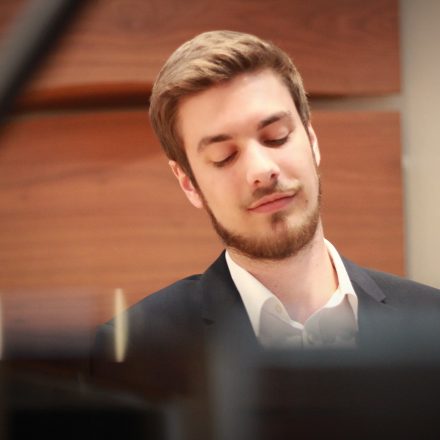
Dominic Chamot

The solitary Swiss competitor in this competition, Chamot enjoyed the advantage of Australian/Indonesian entrant Abdiel by playing to a small audience. He worked on the Fazioli 278 instrument found at Opus 278, Davidstrasse 40, St. Gallen, the tape made on March 14. Here was another chaste program; I didn’t time it but he certainly didn’t go over his allocated time-limit. At all events, this was mature music-making, the accent on interpretation rather than atmospherics, even in the second offering, which somehow managed to cope with an innate theatricality without losing focus on the musical framework – such as it is.

The session began with Janacek’s In the Mists cycle and you could see immediately that making the music sensible and self-integrated counted more than any other factors. The opening Andante proved interesting, Chamot seizing its options for rambling and interspersing tempo variations that actually reflected the phrase-lengths. At the same time, these pages were treated with restraint and emanated an atmosphere of bucolic brooding – which, for me, typifies a fair amount of this composer’s later output. With a score that is not lavish in performance directions, Chamot suited himself about the following Molto adagio‘s contrast of the base tempo with several Presto interpolations. But this musician is probably working from a later edition than the venerable 1938 one available to me, again illustrated by the refined rubato at exercise in the Andantino which appeared to me to be well-suited to the two-page text, helping to bring out the melody’s occasional transference to an inner line. Unlike most commentators on this collection, I find this movement to sound the most folk-tune inspired of the four.

Last came Janacek’s Presto, which struck me as an overstating descriptor. Here you come across falling 3rds and 4ths that suggest Bartok at his most sentimentally rural/bucolic and, as with the Hungarian master, a nerve-tingling harmonic restlessness. Among the many examples of ferreting out a suitable course of action, the central repeat involving 6, then 4 bars gave us a fine burst of sustained fabric in pages that twist around obvious nodes with spare rigour. The player made us wait an unconscionably long time at the final Meno mosso for two quaver rests at the bar’s centre, but that – once again – could have been a fault in my score because the rest of the movement radiated authority and a convincing sense of taut emotion, some steps short of tragedy.

Chamot then headed for the virtuosic heights with Liszt’s Reminiscences de Norma which is a cow to handle, worse in its way than much of the bigger-named original works, let alone the other operatic transcriptions – well, those that I know. Getting the notes was rarely a problem, although an error sullied the final phrase of the second restatement of Ite sul colle and something odd happened in the right-hand octaves of the martellato con strepito descent. Little pin-pricks like these aside, the player had the work’s inner drive and drama controlled from the start. You would be hard to please if not impressed by the expertly balanced full chords across the last 10/11 bars preceding the piece’s central Recitativo.

Alongside the thunder, Chamot displayed a discrimination of considerable stature in fore-fronting the central melody – Qual cor tradisti – of the Andante con agitazione, where it moves to the alto register following the mid-way cadenza. After the time-consuming but lavish arpeggios – two per bar – that conclude this section, the pianist’s move back to vehemence made an unusual effect for its control as the Guerra guerra chorus sprang into full bellicose mode at the Presto con furia (has anyone matched Liszt for lavish tempo directions?). Apart from a few mid-torrent mishaps, including an obvious one in the 3rd or 4th last bar – all those double octave E flats – the interpretation stuck to its brief and Chamot entered into the fierce spirit of the strong, as passionate as possible coda to this summa of the virtuoso school.

The necessary Australian piece was Arthur Benjamin’s Scherzino of 1936, a gigue of sorts which gave more evidence of this pianist’s characteristics of precision and regularity, probably best illustrated by his last page which backed away from a genteel fortissimo to the requisite quadruple-piano ending.

Siqian Li

It’s been my fate to hear a good many of the competition’s later invitees in a random selection of sessions so far. Piers Lane thanked Siqian Li fulsomely for agreeing to come in on things late in the process, and she played her recital on April 3 from a private residence in London – which turned out to be a well-proportioned salon with a formidable Steinway as the artist’s base of operations. She played a set of Mozart variations, all of Vine’s 5 Bagatelles, the B minor Fantasie by Scriabin, and a well-loved Debussy prelude as her party piece.

The Nine Variations on a Minuet by Duport K. 573 were carried out with impressive elegance and a forensic clarity of detail, the sort of purity that we came to expect as the norm after Ingrid Haebler showed us how it should be done throughout the 1950s and beyond . Li proved no stranger to varying her attack when repeating the variations’ halves, the which practice she maintained for the length of the work, alternating legato for staccato, and mezzoforte with mezzopiano in Variation 2. None of this proved intrusive or attention-grabbing and a similar discretion obtained in Variation 3 with her employment or abstention from the sustaining pedal.

In Variation 4, Li bore out the distinction between staccato and detached notes with quiet skill, indulging in a slight ritenuto at the chromatic semi-scale in bars 13 and 14. Another differentiated two-pronged attack distinguished Variation 5, a fair amount of expressive emphasis distinguishing the second half’s opening four bars. A higher degree of note-pointing emerged in Variation 6, like the opening chord of bar 22 at an unexpected harmonic switch. Li handled the next variant as a gallop – well, a fast canter – not putting a semiquaver out of place across its length. She found her melting moment in the following Adagio at bars 23 to 24, a touchingly gentle final gesture in this solitary variation without repeat markings. And she ended as she began with agile and elegant finger-work across the last variation.

Rather than keeping one of Vine’s pieces for an encore as did many of her peers, Li elected to play the 5 Bagatelles at the centre of her program , If she wanted to provide a contrast to her Mozart interpretation, she chose well, responding effectively to the first, Darkly, and its abrupt jerks and underpinning tension. Her Leggiero e legato was very much so, ultra-clean in its delivery. The Gentle enjoyed an excellently-managed calmness and control, while the unspecified IV showed that this pianist could happily enter into a suddenly jaunty, jazzy ambience and enjoy the piquancy of Vine’s interludes and commentaries. The set’s concluding Threnody found Li taking time over its slow-moving pointillism, with care given to the piece’s top notes; but she exercised her innate delicacy throughout these pages, carefully targeting each eloquent resonance to realize the composer’s striving for timelessness in his requiem.

I’ve heard more Scriabin in this past week than in a half-century of reviewing, Li expanding this experience with the Op. 28. As with previous interpretations of this composer’s work in recent days, tempi were a catch-as-catch-can affair and regularity of metre was treated as a vague universal rather than a specific. Again, in common with other entrants, Li concentrated on the music’s sweep and vehemence of declaration across the abrupt turns to Presto and Piu vivo, which turned out to be less differentiated than anticipated. But the acceleration into florid action at the final Tempo I point where the upward and downward surges featured irregular groupings of 9, 7 and 5 demi-semiquavers came across with impressive gusto: a fine build-up to the work’s well-anticipated B Major emphatic end-point.

The encore Debussy, La fille aux cheveux de lin, proved to be a straightforward business with plenty of discretion in pedalling and phrase shape, the only question a pause inserted before the C flat Major chord in bar 16. Still, it brought the Siqian Li experience to an intelligent conclusion, reinforcing a distinctive quality of her work – a kind of placid certainty.

Home ground advantage

SYDNEY INTERNATIONAL PIANO COMPETITION

Day 6, Session 10

Tuesday July 6, 2021

Sergey Belyavsky

When you get right down to it, there are 8 Russian entrants in this competition; that’s a quarter of the total. Chinese musicians are next in the poll with 6, then Japan and Ukraine tie on 3 each. Not that this means anything much, except to bear further witness to the devotion that Russians have for competitions, vide the Olympic Games. Belyavsky was another of Piers Lane’s last minute substitutes to maintain the set number of participants at 32, and he is yet another pianist who rushed – or was rushed – to put his programs together. He is, apparently, the only player who has taken part in a previous Sydney competition, having appeared in the 2016 extravaganza.

But let’s not be flippant: it was certainly an advantage for Belyavsky to have something to aim towards as, according to his pre-recital interview, appearances have been scarce for him and for most of his colleagues. We (and the competition organizers) were lucky to have him on the books. Which is more than can be said for his home country, it seems. Belyavsky did his recording at the Russian State Specialized Academy of Arts in Moscow on April 9. Before he began, patrons were screened a message pointing out discrepancies between sight and sound on the tape; doesn’t matter much to me because I’ve usually got my head in a score, although I did watch his Australian piece (another Vine Bagatelle, would you believe) . What was depressing was his – no, the Academy’s – instrument: a Steinway with an F5 clearly out of tune, and some other notes on the border of the same fault.

So much for care of musicians in Putin’s regime. But, working against the odds of a late call-up and a deficient instrument, Belyavsky gave a solid program comprising Schubert’s Wanderer-Fantasie and three of the Transcendental Etudes by Liszt: No. 12 Chasse-neige, No 5 Feux follets, No. 11 Harmonies du soir. He encored with one of Vine’s 5 Bagatelles – the untitled IV.

The fantasie came across with excellent drive in its first phases, boasting an onward thrust that only occasionally held itself up, as at an oddly solid pause before bar 108, even allowing for the leap and tonality change involved. The pianist displayed a fine responsiveness to the melodic outline of the Adagio, giving it plenty of breathing space and rubato, all of it comprehensible in context. Very few notes disappeared in the hemi-demisemiquaver figuration edifices across bars 227 to 245, which is saying something as the action is relentless here.

An infectious Viennese lilt informed the Presto which managed to avoid the steely edge that many interpreters aim for. Later, Belyavsky maintained an attractive clarity across the long arpeggio run from bar 564 to bar 585 and his texture remained a sensible model of restraint even when the action got messy from bar 627 on. To his credit, the executant gave us a suitably clangorous set of final pages, but the mesh was not over-pedalled or ineptly thunderous.

Liszt’s Chasse-neige etude made its muffled points with high success. I could pinpoint no obvious errors that I’d swear to, but it’s a rapid-fire exercise and Belyavsky brought out its unsettled, enervating character. The Etude No. 5, another rapid piece, worked well enough with its restless chromatic cluster-runs and a few excellent throw-away right-hand moments starting at bar 124 where the approach sounded ideal for this swindling-away-to-nothing conclusion. Of the three pieces, I preferred the last, Harmonies du soir, probably because you have solid material to deal with, and Belyavsky coped with the initial flourishes well enough but blossomed at the consolidation process of the Poco piu mosso with telling individuality. His execution of detail and even negotiation of those ever-present arpeggios were highlights of his recital; indeed, throughout this piece you realized that you were listening to an artist with character, with something to communicate beyond the predictable, who can stir up excitement but knows just how to pitch it and withdraw intelligently.

Vine’s Bagatelle IV is instantly recognizable for its jazzy/bluesy strut and craft in making much of a deft chord sequence or two. Belyavsky handled it with an attractive fusion of spirit and control, keeping the pace active and delighting with his unexpected insouciance, especially his leisurely left-arm lean in the final bars.

Calvin Abdiel

Abdiel was classified for the competition as Australian/Indonesian, although he seems to have spent most of his later educational years in Sydney. He recorded his program on March 21 in Verbruggen Hall in that city’s Conservatorium of Music, which is the competition’s usual focus; as well, he had a small audience – an asset/drawback not available to most of the other entrants. Compared to the purity of the preceding program, Abdiel’s was multi-faceted, beginning with Scriabin’s Sonata No. 5. Right from the start, you were instantly aware of this pianist’s brilliant technical armoury; it was well-tested in this extremely taxing work which exemplifies to the full its creator’s neurasthenic personality. Abdiel held back little, content to smash out an abrupt climactic point, like the imperioso at bar 107. Yet, you could not complain that sense disappeared in welters of fabric as the sprightly textures remained just that: the wonder lay in the abrupt twists from thunder to Mendelssohnian friskiness.

As with nearly everything presented here, Abdiel faced you with breathtaking facility illuminated by passages of remarkable accomplishment, like the outburst at bar 144 – one of many – that impressed for its fire and its fluency. The executant seemed engrossed by the work’s internal obsessiveness, like the Languido repeats and the leggierissimo volando beginning at bar 235. Not that Abdiel took everything at face value; he made free with some of the detail like the irregular groups of 4 and 5 from bar 300 onward. But the whole melange was delivered with unstoppable conviction, leading to a final two bars that impressed so much more in performance than they do on paper.

Two Debussy Preludes followed the ultra-virtuosic trend. Les collines d’Anacapri startled for its percussive interpretation. Even Modere et expressif in the middle section was heavy-handed and the over-riding Vif proved numbingly rapid. Feux d’artifice, as expected, was brilliantly achieved, a marvellous exhibition from this musician who showed the cleanest pair of heels I’ve come across in this glittering jewel.

The Three Movements from Petrushka that Stravinsky put together for Arthur Rubinstein gave a centre to this program, and it enjoyed an unusually glittering reading. The Russian Dance held no hesitations or pauses but was treated with a fearless directness, even in those trademark sequences of block chords that ask for both rapid finger adjustment and full shoulder heft. No time for relaxation in Petrushka’s Room, either; the second appearance of the famous tritone was taken at a very fast pace, and the ten-bar Furioso enjoyed a massive pounding, including a final D Major chord that I thought would damage the instrument. Set against that an extraordinarily clean handling of the massive trills 11 bars from the movement’s end. The energy and fluency of The Shrovetide Fair probably took the night’s honours: a dazzling display as Abdiel burst through each of the composer’s scenarios – the nurses, gypsies, coachmen, bear and peasant – with masterful ebullience that occasionally bordered on hysteria.

But this was a display night and the presenter wasn’t finished. The program proper ended with a Scriabin study, the D flat Major from Op. 8, which simply put a hothouse-grown cherry on the pianist’s cake. An exercise in right-hand 3rds, it floated past with effortless ease, not making much impression on those of us left gasping in the wake of Abdel’s Stravinsky. And as an encore, he veered away from Vine’s little pieces and went the whole hog: Grainger’s In Dahomey ‘Cakewalk smasher’, where the clue is in the last word. For my taste, this was performed too fast, to the point where it occasionally made no sense. A brilliant negotiation of the score, I’ll be the first to attest, but not true to the composer, clogging his period piece with tumultuous overkill.

A further dip into Sydney’s virtual competition

SYDNEY INTERNATIONAL PIANO COMPETITION

Day 3, Session 6

Sunday July 4, 2021

Rustam Muradov

One of a phalanx of Russian pianists in this competition. Muradov was yet another of the late entrants invited to participate after several successful applicants withdrew. He recorded this recital on March 20 in the Rodion Shchedrin Hall of the Mariinsky Theatre, St. Petersburg, and was (inevitably) interviewed by Piers Lane before he started playing – yet another uncomfortable experience, although rather more relevant to the occasion than Lane’s discussion with a local piano tuner about previous competitions, a diversion which opened the session. I can see the point of such a chat in any year but this one where an Australian piano tuner has absolutely nothing to contribute to anything but the historical record.

Our artist began with a true rarity: the Op. 116 Fantasies by Brahms which nobody plays; they certainly haven’t during my years of concert/recital attendance and it’s not hard to understand why. They present problems in delivery, mainly to do with off-centre metre but also because of a dearth of melodic power and a penchant for deliberation which is rarely disrupted. Muradov set an excellent standard with the opening Capriccio, not making it easy for us but staying faithful to the piece’s characteristic syncopation. The player’s sensitivity emerged in the No. 2 Intermezzo with an obvious error at the top note of bar 15, but the Non troppo presto which kept to the original right hand lay-out came across with unexpected lucidity.

Some more obvious errors crept into the No. 3 Capriccio, specifically during the central Un poco meno Allegro; mainly finger slips and not detracting from a forward-thrusting account of these pages as a whole, followed by an excellent reprise. Muradov seemed much happier with his work in the following Intermezzo which is a pretty transparent piece and which here radiated security. Like the first in this set, the No. 5 Intermezzo has pretty much everything off-balance, metrically out-of-kilter, until the first double bar when the left hand imposes regularity. Here again, the pianist stayed loyal to the composer’s quirkiness. We could take pleasure in the excellent moulding of the G sharp minor middle pages of the No. 6 Intermezzo as also in the performer’s care with Brahms’ part-writing.

Finally, the No. 7 Capriccio featured more off-the-beat work after the first 10 bars; a challenging work to make coherent and Muradov played a good hand with its physical and harmonic urgency, only one noticeable error coming out 24 bars from the end. So, we heard an honest grappling with this rather enigmatic collection, even if my main impression was of hard work rather than comfortable achievement.

Then came a Haydn sonata, Hob XVI: 20 in C minor that we heard on he competition’s opening day. This was a quick version with no repeats but the rhythmic impulse stayed constant. The Moderato‘s delivery proved to be clear and expertly detailed, even if a note would occasionally go missing, as in the downward right-hand scale of bar 63. But the main feature was the regularity of delivery. A similar no-nonsense approach distinguished the Andante con moto, with a carefully aimed crescendo from bar 45 to bar 50. As for the Allegro ending, you could be happy with the small-scale sturm attack but, once again, not every note registered, even though you could see them being depressed.

Written for an earlier Sydney Competition (2012), Carl Vine’s Toccatissimo gave Muradov scope for virtuosity and histrionics; needless to say, he seized the opportunities with plenty of panache and an obvious relish in the piece’s many flourishes and idiosyncratic textural changes. And, as the prescribed encore, we heard Scarlatti in B minor K. 87, a well-judged companion piece with the preceding Australian work, thanks to its placid inevitability and the elegant lapidary shaping of phrase. No repeats here, either, which was disappointing, as were some imposed pauses and ritenuti – bars 29 and 54, for instance. Still, you have to make the best use of your 40-minute time-limit, as this pianist did to present a mini-recital with many fine pages. But were there enough?

Alexander Malikov

You see the name and think, “Another Russian?” but you’d be sort of wrong: since he was 10 years old, Malikov has called Canada home. This artist made his recording on April 4 at the Glenn Gould School in Toronto and Lane made much in his interview of how late this artist was drawn into the competition, actually entering after the cut-off time and imbibing a Vine bagatelle very quickly to have it off from memory as his compulsory acquaintance with musical Australiana.

Where Muradov ended with Scarlatti, Malikov began his submission with two of the sonatas. K 519 in F minor/Major distinguished itself for its impeccable ornamentation and articulation throughout, with both halves repeated. The K545 in B flat put the same precision on show although the player allowed himself some metrical easing across this Prestissimo‘s second half. An excellent interpretation, the sonata brought to mind Couperin’s Les Maillotins in its requirement for a sympathetic automatism which only faltered into a near-error at bar 62 where Scarlatti turns to settle into his home key.

Malikov followed his competition predecessor with Haydn, Hob XVI/50 in C Major, finding the optimistic bounce in the initial Allegro and making an attractive entity out of the movement, so that I was disappointed that the exposition was not repeated. Amid the genial flow, some clearly-stated brisk chords at bars 100-101 brought the development to an emphatic end, and we encountered two instances of ‘open pedal’ – which, it seems, allows the executant to keep the sustaining pedal down for the specified length.

Haydn’s Adagio is a whimsical set of pages, and Malikov brought a subtle happy calm to its apparent juxtaposition of slow arches and sudden bursts of irregularly-shaped action. Rather than becoming an eccentric hodge-podge, this movement was interpreted with a steady underpinning, the whole piece a slow-moving amble-with-diversions. You found plenty of surprises in the Allegro molto ending to this sonata, thanks to the pianist’s communication of sparkling humour, particularly in those frequent pauses that lead into bar after bar of headlong high spirits, e.g. bars 160 to 161.

Debussy’s Voiles prelude made an interesting choice, mainly because Malikov’s interpretation avoided self-indulgence but somehow impressed as four-square in its approach to the composer’s initial request for a rythme sans rigueur. Later, the bar 29 direction tres retenu made no difference to the prevailing approach of getting on with it all. As with everything this competitor essayed, the result was excellently articulated but these sails had a firm canvas fabric. Mind you, such metrical regularity served the young musician well in the following Liszt legende, St. Francois de Paule “marchant sur les flots”, the lashings of left-hand scales and arpeggios kept to a steady, firmly administered pulse. Here was a highly physical reading, Malikov entering into its blazing flamboyance with gusto, especially at the massive build-up from bar 78 to 85 that takes us into our saint’s buoyant triumph over the Strait of Messina, here given full heroic status.

Continuing the exhibition of technique came the Allegro de concierto by Granados where this performer responded with open hands to the work’s not-particularly-nationalistic opulence. This is a show-piece, one without higher pretensions to depth, and we enjoyed an expert rendition that kept a rein on its fits and starts. I welcomed the imposed rubato around the change in key signature to 5 sharps only and the elegant melodic outpouring when matters moved to G Major – and when the composer actually got on with the business of writing a discernible tune. Finally, Vine’s III. Gentle from the 5 Bagatelles was played with exemplary deliberation – no lingering over its textures but a clear outlining of the brief piece’s atmospheric delicacy.

A full day’s work

SYDNEY INTERNATIONAL PIANO COMPETITION

Day 1

Friday July 2, 2021

The more you find out about this competition, the sorrier you feel for the competitors. This enterprise might be called The Sydney, but that city is the least important part of anything. Entrants are not coming to Australia, presumably not even to collect prizes. Rather, they have had to record their recitals and post them to jurors. This process has involved finding their own pianos, their own venues, their own recording engineers, cameras, lighting – the whole kit and caboodle. All of this decreases the attraction of the competition as a whole, although some would argue that the times call for these straitened conditions. Faced with all this, certain pianists have withdrawn and had to be replaced by “extraordinary” pianists – about 8 of them, I believe. In any case, hyperbole is still the order of the addresses we enjoy from jury non-voting chairman, Piers Lane who is still promising “extraordinary range” across the taped recitals as we embark on a “great journey together.”

Lane also introduced the jury panel by name; so did the competition’s executive director straight after him. As in pianism, does my left hand know what my right hand is doing?

Maxim Kinasov

Leading the pack was Maxim Kinasov from Russia. He taped his program on April 11 in the Menuhin Hall, London, and was one of Lane’s replacements. As is apparently going to be the custom, Lane conducted a laboured zoom interview with Kinasov about his path thus far, including a teacher who discouraged his ambitions. It’s rather like Eddie McGuire dragging out tedious details from the lives of contestants on Millionaire Hot Seat.

Kinasov opened with Sergei Slonimsky’s Intermezzo in Memory of Brahms from 1980, a late Romantic-reminiscent elegy of sorts with loads of agreable surges and a wealth of Brahmsian tropes, building to a passionate conclusion and distinctive for the performer’s use of his fist on bass notes. Real Brahms followed with the first book of the Paganini Variations. Kinasov demonstrated an excellent delicacy in Variation 3, a predilection for rubato during Variation 4 which led to a loss of tension by lingering on certain final notes of bars in Variation 5. By the time he got to Variation 8, I would have welcomed something of a return to a steady tempo, and an odd rallentando in bar 4 of Variation 9 seemed unnecessary, as did the elongation process in this section’s second half. But Kinasov’s balance in the doubled melody line of Variation 11 was exemplary; his little glissandi in Variation 13 almost convinced all the time, and he kept the best wine till last with a powerful Variation 14 that kept on growing in stature.

Prokofiev’s Sonata No. 7 impressed thanks to Kinasov’s lightness of touch, an authoritative exhibition especially in the secondary group of the slow Andantino. Here, Kinasov’s flexibility proved welcome to give freshness to some drab textural work. In the middle movement Andante caloroso, the attack impressed for its weight at the Piu largamente marking, and this movement continued to make a favourable impression for its controlled response to Prokofiev’s insistence and stringent emotional agony. Kinasov generated an excellent feature of the tocsin repetition beginning at bar 197 in the alto line and the merciless pursuit of a minor 2nd underpinning the movement’s later progress. The Precipitato finale came across as unstoppable, remarkably fluent and vehement as it should be in the most persuasive interpretations.

Kinasov concluded with his compulsory Australian piece: Vine’s Threnody from the 5 Bagatelles, a lament or elegy for the victims of AIDS. The pianist made a fine delineation of the piece’s well-spaced textural continuity, including the moving imitation of an organ’s mixture stop, akin to a soft sesquialtera.

Alexandra Pavlova

This Kazakhstan artist recorded herself in the Faziola Hall of the piano manufacturer’s factory in Sacile on March 29. She opened with the Sonata No. 6 from 1960 of Mieczyslaw Weinberg. Pavlova was another of Lane’s late entrants and enjoyed a slightly more vivacious taped encounter with the Australian expatriate. This final piano sonata from the Polish composer opens with a clangorous Adagio threnody, succeeded by a meandering semi-bucolic counterweight. The performance impressed for its focus and negotiation of juxtaposed segments, like a Prokofiev-style soft march, but the harmonic language proved more restrained than you’d expect from the period. The complementary Allegro molto presented a motif that expanded on itself in an assured framework, Pavlova’s rendition controlled and assured, but the work didn’t say much to me, apart from some brisk and spasmodic outbursts in a restless moto perpetuo. If anything, the movement illustrated Pavlova’s ability to persuade you of merit through imposing weight of output.

More Prokofiev: the Sonata No. 2 opening with a rubato-rich Allegro ma non troppo. You couldn’t object to this freedom in what was a student work, although it had its drawbacks, like an occasionally muddy bass-line. Pavlova almost got through the work unscathed, right up to the final D minor chord which admittedly concludes a hectic four-bar stretch. She gave an excellent airing to the succeeding Scherzo, showing both willing and aggressive. She reached a powerful highpoint rather early in the Andante at bar 17 and over-egged the drama six bars before Prokofiev neutralizes all his key-signature sharps. Possibly demonstrating that she is better suited to rapidity of motion, Pavlova relished the toccata-like Vivace finale, taking it at a very rapid speed in a sterling exhibition of legerdemain, best typified by a delectable poco a poco accelerando after the time change back to 2/4.

Glinka/Balakirev’s The Lark proved to be a simple lyric in B flat minor that begins unassumingly enough and becomes more florid as the Balakirev contribution swells. Unlike most of Liszt’s song arrangements, this one is over-egged, even if it served a dual purpose of giving Pavlova a chance to exercise her Romantic interpretation skills as well as her skill in detailed cadenza work, which only let her down at the start of the final exercise in bravura seven bars from the end. Her necessary Australian work was Kats-Chernin’s Russian Rag II – no worries with this slightly effervescent illustration of he composer’s prodigal imagination, but it goes past too quickly to illustrate anything in the performer’s arsenal.

Timur Mustakimov

This Russian pianist performed his tape on March 30 in the Klavierhaus Manhattan, New York, using a Fazioli instrument, as had Pavlova. He began with mainstream repertoire in Haydn Hob XVI: 20 in C minor. A Moderato first movement proved measured and often lucid, with plenty of give-and-take in its on-the-page fitfulness – as in bar 19, bar 59, bar 76. The exposition was repeated. Mustakimov displayed a fine steadiness in the mordents, most of which came across cleanly. I was a tad worried about the first right-hand note at bar 91 but the player showed no other flaws, possibly because he gave himself plenty of liberty in his pacing. At the Andante, it suddenly struck me how dry the acoustic of this space was, possibly because the performer allowed himself just as much freedom in pulse – again. In part-writing, he observed the note values scrupulously, but then would labour unexpectedly, distending phrases as at bar 54.

As with all three movements, Mustakimov repeated the first section of the Allegro and was able in these active pages to keep to a regular beat, particularly in passages with extended runs of semiquavers, beginning at the set between bars 23 and 32. In fact, the less he gave ‘point’ to phrases and sentences, the more impressive his delivery.

I didn’t understand what this pianist was hoping to achieve with his transcription of the Prelude from Bach’s D minor Cello Suite, which he performed straight with the left hand alone; a show of sensitivity to line, perhaps, but it stood like an enigma in this setting until he morphed into the Busoni transcription of Bach’s Chaconne that concludes the D minor Violin Partita. Here was a splendid reading, temperamental and spectacular in its fireworks. As with other performances I’ve heard recently, one of the variations was omitted – is there some doubt about its authenticity on either Bach’s or Busoni’s side? – but you had to be impressed at the change of key signature, the Quasi tromboni segment, where Mustakimov made a fair fist of accomplishing just that. A brilliant accelerando preceded the move back to D minor and the last pages hurtled past with obvious effort but sustained ferocity.

Australia sort of got covered by Grainger’s arrangement of the Dowland lute song Now, O now I needs must part. The interpretation tended to give plenty of attention to the American resident’s chord changes from the work’s centre onwards. It’s not intended as a put-down, and the interpretation proved as languorous as you’d want, but this work stands as as a rich resource for any cocktail pianist.

Alexander Gadjiev

This Italian/Slovenian pianist played a Kawai instrument at the Kawai Europa centre in Krefeld, Germany, and he recorded himself on March 19. For my taste, this was the most intriguing program of Day 1 and the most impressive in its interpretative breadth. Gadjiev opened, like Mustakimov, with Haydn – Hob XVI: 48 in C Major. His straightforward Andante proved to be very much more regular after the previous experience and you were not confronted by dynamic shocks. The movement had its abrupt features, but the dynamic changes remained coherent. An excellent pointillism informed the Rondo, a true presto and a delight every time Gadjiev repeated the movement’s main melody. You (well, I) thought: here’s a player with discernment and a real interpretative insight, submitting to us a Haydn on the composer’s own terms.

Chopin’s F minor Ballade also impressed for its excellent communication of construction, not to mention a sense of phrasing that seemed to emerge from the pages, rather than being imposed on them. Gadjiev forged a sensible path through the huge pitfalls that are peppered across the composer’s canvas but, as with his Haydn sonata, the interpreter proved to be a force in himself, dealing elegantly with the chromatic-rich framework and giving us as powerful a stretto as you could wish for after the mid-flight five dotted minim chords,

For his compulsory acquisition, Gadjiev gave us two of Vine’s 5 Bagatelles: III Gentle, and V Threnody. He outlined the first, easing out its deft effects and mild suspense, and gave an extra edge to the mixture-stop melodic line by emphasizing the lower part while displaying a welcome responsiveness to the piece’s fluency, letting it speak for itself without exaggerating its elegiac quality.

A clever stroke at this point was to perform part of Messiaen’s Vingt regards sur l’enfant-Jesus, indeed one of the more significant movements of the suite: Le baiser de l’enfant-Jesus, which begins with a similar meditative placidity to Vine’s last bagatelle . Some of the pedal work interfered with the instrument’s early output but the performer was very comfortable with the composer’s placid emotional environment – until, of course, it moves into ecstasy-land with a storming surge and billow that presage the upcoming Turangalila-symphonie. It’s a solid piece of work to handle but you felt confident in this exponent’s hands which, as far as I could tell, articulated those chord-complexes without flaw.

Gadjiev concluded with Scriabin’s 1904 Feuillet d’album, a living-up-to-its-name miniature that somehow brought us back from the French composer’s Heaven-storming essay to nothing like the Russian master’s eclectic pantheism – more, the salonesque atmosphere found in many of the Preludes. It made for an easing of tension and was a real encore piece in that there was nothing here to frighten the pigeons – or non-believers.

A delayed gala

SYDNEY INTERNATIONAL PIANO COMPETITION

Tchaikovsky Symphony Orchestra

Moscow Conservatory

Thursday July 1, 2021

Andrey Gugnin

So, here we go on another Sydney competition: an 18-day keyboard orgy of players who are – allegedly – the best young guns in the business. We’ll have plenty of time to find out if that’s the case. From this night’s pre-performance addresses, you’d think that putting all the players online was some sort of brilliant technical feat. Sorry, no; not after the last 15 months we’ve all shared where computers and their communicative possibilities have become stock-in-trade for every musician. In fact, the competition seems to have turned into a truncated exercise, if you read between the lines. One of the speakers adverted to the fact that there’ll be no chamber music segment, which is a screaming shame. Also, the concerto round has been eliminated, which is less of a pity but still a sign that 2021 will be the Year of Purification, a competition of simple solo recital ability – I suppose.

The first online event was a concert proper, coming from Moscow. Again, much was made of this being a night co-sponsored by the piano competition organization, but it was not a live affair: this concert was recorded on April 23. So we were offered a recorded performance featuring the 2016 Sydney competition winner, Andrey Gugnin, as soloist in Liszt’s Piano Concerto No. 1. The Tchaikovsky orchestra was conducted by Pavel Sorokin, a long-time artist associated with the Bolshoi Ballet. For the most part, this night was an odd collection: three works by Liszt – the concerto, the Les Preludes symphonic poem, and the Hungarian Rhapsody No. 2 in an orchestration by Karl Muller-Berghaus – and two Wagner pot-boilers in The Mastersingers Overture and The Ride of the Valkyrie.

Before we crossed to Moscow and a platitudinous introduction from a music critic (!), we heard pre-recorded addresses, the first by the competition’s chief juror, Piers Lane, who set the pattern for hyperbole by speaking of the Conservatory’s “hallowed hall” – which is about as inane as calling the MCG’s surface “hallowed turf” – and promising “extraordinary pleasure” from “a host of other pianists [not the winner] who will excel”, etc. We’ll see. Then Virginia Braden, chairman of the competition’s board of directors, furthered the promises by noting that “we have created a new venture”, for which I read that we have adopted a necessary compromise after last year’s competition cancellation. She also seemed to be labouring under the delusion that the upcoming concert was ‘direct from Moscow’ through the good graces of “The Sydney”, which is apparently accepted shorthand for the competition by omitting all descriptors. In Lane mode, we were assured of a “wonderful time filled with outstanding music-making.” In contrast, patron Governor-General Hurley repeated the innovative mantra about the competition’s procedure and treated us to a few observations about the worth of music to humanity. Bronwyn Bishop, who heads the competition Friends, assured us of upcoming “magnificent performances” – by which time I was almost ready to commit to the faith. Finally, competition chief executive Marcus Barker put it all in more down-to-earth terms: “We’ve changed to accommodate the competitors.” But even this pragmatic approach couldn’t avoid hoisting out the promise of “outstanding” things to come.

The Conservatory hall wasn’t exactly packed for the occasion; perhaps the cognoscenti knew what was coming. Not much to tell about the poem. You couldn’t have much faith in the orchestra’s synchronicity, from the opening pizzicato to the following block entries. Matters had improved by Letter E in the Kalmus edition but nothing could disguise the vulgarity of the march that breaks out 10 bars before Letter G – not the musicians’ problem, of course, but who decided to resurrect this score? Odd moments intruded to make you think that the strings were unhappy in their work, like the exposed bars at Letter K and sloppy work from them led into the recapitulation at Letter M. Over-encouraged cymbal work dissipated concentration at the brawny Andante maestoso and the closing pages came over with as much broad power as you could want.

For the E flat Concerto, the Tchaikovsky players did not get off to the most convincingly synchronised opening. But then, we weren’t here for them. Gugnin used an aggressive instrument with a penetrating upper register, but he’s a player distinguished for the forward placement of his sound, as I remembered from his 2017 recital in Melbourne. Immediately, you realize that you’ve forgotten how much freedom the soloist is allowed in the opening pages and Gugnin seized the passing a piacere direction with both hands and wherever it seemed appropriate. The Tchaikovsky first clarinet merged in with the soloist particularly well between bars 34 and 36 for a sensitive spell, but Gugnin reverted to his crisp, well-defined output at the following a tempo, showing no signs of fluster at any of the stops and starts during the rest of this Allegro movement.

His Quasi adagio was notable for the dovetailing between soloist and orchestra, more apparent during these pages which are all coloured by the piano, even when it’s doing little more than decoration as from bar 154 to the last trills. During the subsequent Allegretto, there might have been a recording fault but something was missing from the keyboard contribution at the end of bar 195: the first flaw that struck me up to this point. Gugnin made a fine exhibition of the contrary motion 7th chords from bar 249, the long sequence unfailingly certain in delivery. Something odd crept in to the oboe line at bar 310 which sounded unhealthy and my screen went dead for a few bars around the piano’s fierce restatement of the concerto’s opening motif.

Gugnin demonstrated excellent digital control at the Alla breve of the Allegro marziale, which turned into a masterclass in how not to cheapen material that cries out for it. Sorokin kept his forces on point although it seemed to me that Gugnin was unwilling/unable to increase the speeds, happy with a sensible Presto at bar 483 and ensuring that his double-octave E flat punctuation points in the final bars carried past the orchestral emphases. I was surprised at the audience’s tepid response to this performance. Sure, it wasn’t as flamboyant as many I’ve seen, even in the good old days of the ABC’s Concerto and Vocal Competitions when the concerto would turn up with mind-numbing regularity. But there’s no accounting for communal taste, as we’re probably about to find out in the coming fortnight-plus.

No surprises with the Wagner overture, and not much involvement either if the opening march was any indication. In fact, the start of the woodwind solos came as doubly welcome after the lethargy of the initial statements. Still, the Tchaikovsky strings gave a fair account of the Preislied-in-four-beats section, the whole exercise not similarly settled when the great moment arrives as Wagner juggles his three themes simultaneously and these musicians – some of them – were slightly off the beat. That laboured effect returned six bars from the end with a dotted crotchet+two-semiquavers pattern hammered out without any spark. By contrast, the Ride sounded much more fresh and vigorous; but then, it’s better music with just as much repetition but more mobility.

Last, the Hungarian Rhapsody‘s first part gave the resident first clarinet another chance or three to shine in some cadenzas that were eloquent and well-paced. Throughout this edgy score, the first violins gave in to anticipation more obviously than had been the case earlier in the night. By contrast, you could find no fault with the even-tempered woodwind/brass choir near the conclusion to the lassan pages. Sorokin took a very quick speed for the friska/Vivace which really turned into a gallop. He also inserted some huge pauses, as at the change of key signature to F Major and at the end of bar 32 in the Piu mosso and he reverted to an earlier style of interpreting this work by playing around with the tempo using a high degree of elasticity. It hardly needs reporting that this proved to be the most popular piece on the program.

But at least we got to hear Gugnin approaching maturity, an example of what can be achieved through this competition. For all that, I’ve heard only two other laureates – Konstantin Shamray and John Chen – but both have impressed for their musicianship and insights. Here’s hoping the jury gets it right this year as well.

Blowing an ill wind good

THE RULE OF THREE

Emily Sun, Nicolas Fleury, Amir Farid

Musica Viva

Concourse Theatre, Chatswood

Saturday June 26, 2021

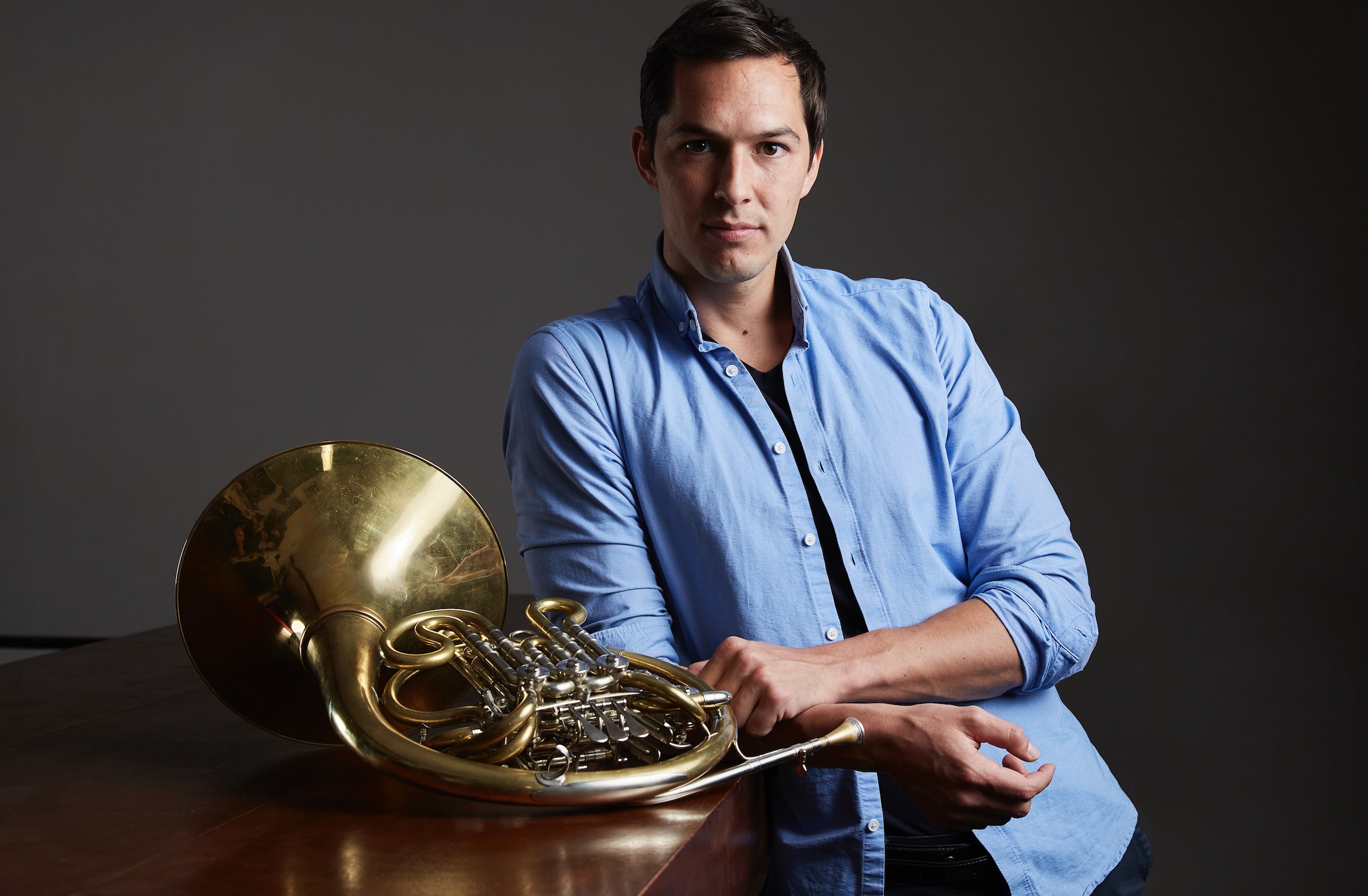
Nicolas Fleury

Some of us were lucky to hear this recital at all. The trio did manage to play live in Sydney, Newcastle and Adelaide ; they didn’t make it up here to Brisbane, or over to the Puritan Republican capital of Perth, and their Melbourne commitments remained unfulfilled. But Musica Viva found them a venue where the music could be aired and here we were on Saturday night, just like old times: huddled around the computer, linked up to our best sound systems and waiting for the entertainment to begin. It almost brought back memories of the war.

There’s not a big repertoire for the violin/horn/piano combination; maybe writers are deterred by the superb product from Brahms – one of his finer one-offs. Not that the catalogue cupboard is completely bare but other compositions in the genre haven’t caught on – with players, promoters or audiences. It’s roughly the same with concertos: after Mozart’s four and Strauss’s two, you’re scratching for a work that gives a single horn its individuality – plenty of group work, a myriad miniatures, but an Emperor Concerto equivalent? Nothing close, apart from the six specified above. There’s a wealth of contemporary compositions but the most recently-composed concerto I’ve heard is the Gliere of 1951.

In any case, it’s asking a lot of any horn player to deal with more than one major work on a program. So the Sun/Fleury/Farid finished the night with Brahms’ masterpiece. Preceding it, they all gave an outing to Ernst Naumann’s arrangement for their particular combination of Mozart’s Horn Quintet K. 407. In this version, horn and violin play Mozart’s original lines, while the piano handles what’s left – the two viola and one cello parts; well, that’s the way it operates for the opening Allegro and the following Andante. At the rondo, the arrangement gives some top viola work to the violin, and there are further peculiarities later in the movement where Naumann engages in a bit more re-distribution and a bit of abstraction, actually putting some work into what has, for two movements, been steadily unoriginal.

As the middle part to this program, Sun and Farid gave the premiere (well, the last of a series of first performances) of Gordon Kerry‘s Sonata for Violin and Piano in one movement.

I can’t be the only one who faces with trepidation any chamber music event featuring a horn player. I might be one of the few who dreads an orchestral concert that holds a significant solo for horn; Brahms Symphony in D, the Tchaikovsky No. 5, Mahler 9 – all make my stomach tense with fearful anticipation. It’s probably due to a life-time of poor playing, of eventually knowing where the cracks will appear, such trepidation leading to over-appreciation of a reading where the flaws are few, even if the production has been awkward and jerky. Fleury has recently been appointed principal with the Melbourne Symphony Orchestra and his work at this recital made me all too aware of what I will miss now that I’ve moved north.

First, in the Mozart’s initial Allegro, the opening bars impressed, specifically 34 and 36 where the horn’s semiquaver scales came across with clear production and calm delivery, not the all-too-familiar splatter. In fact, the only problem I could pick out was Fleury’s tendency to delay at the start of trills, as though you have to get the note fixed before you can flutter with it. as in the conclusions to bars 41 and 51. But the fluidity of the horn and Sun’s mirroring moderation added a relish to the repeat of the first part and a disappointment that the development-recapitulation pages were not subject to the same treatment – as they could have been.

Speaking of repeats, I missed the first part of the Andante being played again but took just as much pleasure as before in Fleury’s measured calm when he eventually appeared in bar 19, followed by dynamically controlled contributions in partnership with Sun, who followed the consensus policy of eschewing the temptation to hit the saccharine by generating a disciplined vibrato and a formidable strength of line that melded with the horn’s non-aggressive timbre. The violin had more to do in the rondo but Mozart focuses your attention on the horn and Fleury made telling work of the movement’s deft humour, notably in a bubbling chain from bar 25 to bar 31 with not a semiquaver hair out of place. More substantially, these pages were handled with care and a polished shade of brio so that the metrical oddity that sits at the heart of the main theme never intruded whenever it emerged. I must confess to having confidence in Fleury’s technical mastery pretty early in this work, to the point where, rather than wait for errors, I was able to notice Naumann’s textural games for Sun and Farid in this finale – a rare enjoyment.

Kerry’s sonata impresses as a set of episodes, or a mosaic, as the composer classifies it At first, the work seems lopsided in favour of the violin with Sun stringing (sorry) out a long cadenza-like line over some complex trills from Farid. Eventually, the piano comes into its own with three passages on the rise, culminating in further trills – or, better, shakes. The instrumental partnership firms into a series of textures reminiscent of the sonata’s opening but with the activity more equably distributed. Kerry changes his textures with remarkable legerdemain, giving some sul tasto work to Sun above low piano octaves, generating a dialogue of emotional gravity. Even the ensuing highpoint, as Berg would have nominated it, is texturally sparse, more inclined to explosive blurts than sonorous sweeps.

As a whole, the sonata’s character shows a delicacy or finesse of statement which is married to an ardent strain, especially in the violin writing which in its centre shows a capacity for tough, multi-stops rapidity – but not for long, even in a deliberate cadenza featuring pizzicati, isolated notes and trills eventually punctuated by the keyboard. Yet another dynamic climax for Sun with a subservient Farid whose part is sparked off into vehemence. The work’s latter segments seem stringently developed, giving the first-time listener a chance to recognize patterns and textures as the work hurtles to a triumphant acclamation.

Kerry’s new creation is an excellent display of how to write an interesting dialogue, in which the instrumental conversation follows a course of patterns that leads to a final concordance, with room throughout for individuality, a juxtaposition of personalities that are never static or over-repetitious. It’s not easy to imbibe but it doesn’t confront you with massive onslaughts of clever-clever battering, nor does it bewilder by elliptical glancing blows. We can only hope that it meets more widespread circulation than most other Musica Viva commissions over recent years. No, I agree: not just recent.

I listened to the Brahms a couple of times just for the pleasure of hearing a fine ad hoc ensemble at work and not putting a foot wrong; a toe or two, perhaps, but nothing disturbing. Your attention should be on the horn as the unusual instrument but this performance was so well-knit and expertly judged that the final impression was of the communality of the whole experience so that you couldn’t point to passages where any player took over to dominate unreasonably. It proved to be one of the more united fronts for this score that I’ve heard.

The pace was ideal for Brahms’ opening Andante, putting nobody under pressure to do anything but roll out those splendid melodies, with a marvellous shared surge from bar 37 to the easing of pressure at bar 51 – an early purple patch, soon balanced by an exemplary shared diminuendo from bar 67. This movement was loaded with such instances of fine judgement, but you could find individual touches as well. For Fleury, a sforzando direction is just that, and not an invitation to stay on a heightened dynamic level, and he observes an fp with just as much care. Later, you had to delight in the ideal invitation spread out for the horn at bars 130-131 by Sun and Farid, repeating the field-setting later on at bars 197-99. Further on, you could understand the shaping rationale behind Farid’s early start to the animato at bar 217, and warm in the balanced disposition of contributions across the last 11 bars of this moving set of pages.

Both fast movements – the Scherzo and Allegro con brio – were centred on Farid and his agility of response which only faltered at a few predictable places like the awkwardly positioned top fingers trills in bars 104 and 109 of the second movement, which actually sounded more convincing in the repeat. Fleury and Sun produced excellent dynamic mirroring in their Trio phrases, particularly across bars 294 to 298, and the horn player made no attempt in the outer segments to slow the speed, his responses as acute as those of his colleagues – no suggestions here of that bombastic testicle-dragging across the aural landscape to which less gifted players have recourse.

You could find very little to fault in the Adagio with each entry from Farid a model of linear placement and non-maudlin darkness. Neither violin nor horn dragged out the prime melody that starts in bar 5 but handled their lines without self-indulgence, even in the fraught forte lament from bar 69 to bar 76. Fleury went for the low C flat and B flat just before the main theme’s recapitulation, and they came off, if only just. Even though the final Allegro gives the initial running to violin and horn, once again your interest turned to the concerto-like explosions required of Farid who gave his all to this rapid-fire set of pages. Both Sun and Fleury halted their steady headlong rush to allow the pianist to make an impossible leap at bar 61 – and another, just as awkward, at bar 229 – but the movement succeeded largely due to Farid’s careful virtuosity; for example, in veloce explosions, like striding bass octaves answered by weighty treble chords, and in negotiating those irregular arpeggios that Brahms throws about so lavishly. It made an invigorating rounding off to this hour’s work, a fine exhibition of musicianship delivered, like all too many of its type these days, to an empty room.

Celebration for the seasonally woke

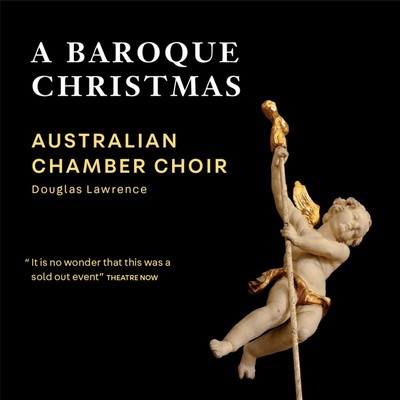
A BAROQUE CHRISTMAS

Australian Chamber Choir

Move Records MCD 607

What’s in a name? Well, Ms Capulet, if you’re lucky, specificity. This new CD from one of Melbourne’s leading choral bodies embraces some odd repertoire reaches in its catch-all title, which includes two works by Josquin, a motet by Victoria,(admittedly, a special case for period encapsulation), and – to end enigmatically – a Basque carol: The angel Gabriel, in David Willcocks’ 1970 arrangement. Still, it could quite easily be argued that, except for the last track which is now synonymous with British choral practice, all the music on offer – Bach, Sweelinck, Praetorius, Giovanni Gabrieli, Scheidt as mainstream representatives – could have been heard in Christmas celebrations during the (roughly) two centuries covered blanket-like by the term Baroque, as it pertains to music history.

One of the significant virtues of the album is its presentation of familiar texts and melodies in settings that you don’t often hear. Christmas music lovers in this country are likely to experience In dulci jubilo through the R. L de Pearsall version, but Douglas Lawrence and his singers have wiped away much Victorian-era sentiment with their two readings: one by Samuel Scheidt, the other a mixture of Bach and Luther’s associate, Johann Walter. Likewise, the Resonet in laudibus that can be heard most often in enlightened churches is the setting by Lassus, so having the opportunity to enjoy Eccard’s work on this particular text is welcome. Most of us have been indoctrinated to accept the opening and closing of Britten’s A Ceremony of Carols as giving the customary Gregorian shape to Hodie Christus natus est; but Sweelinck’s treatment offers a different type of richness. And our knowledge of the Von Himmel hoch tune has been conditioned by Bach’s chorale preludes, fughetta, and canonic variations (further complicated by Stravinsky’s orchestration of these last), so the Gumpelzhaimer revamp also served to crack away at pre-conceptions.

Alongside these, Lawrence and Company offer two O magnum mysterium motets (Victoria and Giovanni Gabrieli), Josquin’s Ave Maria and the Gloria from his Missa Pange lingua, three Praetorius’ treatments (Es ist ein Ros’ entsprungen, Singt und klingt, and three verses of Ein Kind geborn zu Bethlehem where the other four were written by Bartholomaus Gesius), a Halleluja, freuet euch by Andreas Hammerschmidt, and four Bach works (the afore-mentioned In dulci jubilo verses, Lobet den Herrn, the O Jesulein suss soprano solo, and the bookend movements to the organ solo Pastorale). The CD’s content lasts a little under 57 minutes, the Singt und klingt coming in well under a minute, with Lobet den Herrn the longest track at 7’22”.

To open, Lawrence supervises a moving account of the Josquin motet, with some excellent hocket-type syncopations, viz. the tenors from bars 44 to 50 (at the words Caelestia, terrestria nova replet, if you’re uncomfortable with subdivisions applied in later editions), and the altos joining in on the same text. As well, the ensemble work in block chords at the move to triple time – Ave vera virginitas – proved exemplary, as did the splendid reserved reaction at the motet’s wrenching final plea. The ACC’s clarity of delivery is apparent in the composer’s Gloria, recorded in a Hanover church with impeccable acoustic properties for this genre of choral work. [The other 16 tracks were recorded in two Melbourne churches: St. Andrew’s Brighton and Our Lady of Mount Carmel, Middle Park.] Apart from an odd falter in bar 81 (the final miserere nobis), this track is exceptionally fine – the delivery faultless, phrasing carefully intermeshed, inner buoyancy unfailing – and each line impresses for its freshness of timbre.

Victoria’s O magnum mysterium has one of those spine-chilling moments that choristers lucky enough to perform this motet never forget, although it comes early – at bar 10 when the basses first enter. For some reason, the effect of the motet’s first 4-part chord is extraordinarily rich and powerful after those bare 5ths that have dominated the ambience till this point. The choir’s interpretation settles into a regularity of tempo that could have been eased when the iacentem in praesepio text arrives. But the O beata Virgo is finely balanced, as are the overlapping entries and tailing-off to the (what passes in Victoria for) celebratory Alleluia conclusion. With the Gabrieli 8-part setting, recorded in the Middle Park buiuding, the actual recording sound is excellent: crisp, faithful to all lines, controlling the various timbres so that individual voices are subsumed in the overall complex. Only a coarse note from the tenors around the bar 7 mark disrupts a performance that you’d be lucky to hear in Venice for its eloquence and exemplary melding of forces.

Resonet in laudibus in 5 parts gives its extra line (I think) to tenors who tend to be swamped by the formidable female contingent. This is pretty stolid singing, sort of understandable given the composer’s harmonic plan which shows no flights of fancy, but the effect might have shown more festive with a brisker tempo and more punch on linear fulcrum notes. In contrast, you can hear a fair instance of rhythmic bite in the Sweelinck Hodie, to the point where you can forgive the singers for short-changing the third syllable of that word each time it comes around. Another five-line work, this has a deft Gabrieli-like alternation of parts, mirroring each other on a smaller scale than the giant constructions for St. Mark’s. Here again, the Middle Park church is sympathetic to all the forces involved.

The singers have no problem with Gumpelzhaimer’s harmonization of Von Himmel hoch, singing three verses and sparing us the remaining twelve. . It’s nicely carried-off, blokey work without any of those slippery chromatics that will bedizen the tune a century later. All the versions I’ve come across of Scheidt’s In dulci jubilo have two trumpet parts; these look pretty incidental throughout but could have been useful to add sparkle to some sustained notes, especially the final syllable which seems to have an extra C coming in late. Like the Sweelinck, this performance stresses the brightness of the occasion, the score full of spacious textures across its 8 lines and an excellent pair of treble groups leading the changes in metre and tempering their top As with discretion.

As with Gumpelzhaimer, so with Praetorius’ lucid four-part and non-fussy treatment of Es ist ein Ros’ entsprungen, the ACC singing three verses of the five available. They’re inclined to cut the final note of each first line, but you can understand why: taking a breath after accounting for the full note-length runs the danger of turning back the clock to those days when we endured Bach’s Passion chorales with a pause or fermata every time you turned your head. Further, each concluding phrase is carefully articulated with a tension-reducing piano that rounds out the original tune’s shape. For the little Singt und klingt, Lawrence and his choir stick to the German text and ensure that we register each consonant across the piece’s short duration, with a broad final cadence.

The alternation between Gesius and Praetorius for Ein Kind geborn zu Betlehem offers your normal garden-variety four part setting and some bare-bones verses, e.g. in two parts. The whole is well knitted together by the singers even if you have to exercise your perceptions to find much difference between the two Frankfurt cobbers and contemporaries. The following account of Hammerschmidt’s joyous effusion is effectively accomplished. Elizabeth Anderson provides the most subtle of continuo supports to a trio comprising two tenors and a bass with a four-part choir breaking in on them with an infectious Freude, Freude chorus, the whole rounded out with a bounding title refrain. This is music that spills over itself with enthusiasm and fervour – a standout among the choir’s offerings.

As for the concluding Bach group, the level of musicianship here is exemplary, as you’d expect. Soprano Elspeth Bawden is accompanied on the St. Andrew’s organ by Anderson and gives us three verses of this touching melody – well, she repeats Verse 1 – and the voice is an excellent vehicle for it with a persuasive clarity and warmth – a far cry from the hooting boy treble who usually gets to desex the innocent page. Anderson plays the two Pastorale excerpts on the Middle Park church’s instrument, finding plenty of room for its flute stops (what would you expect?) and reminding us that the first evidence some of us had of her talents was in a Bach keyboard concerto competition many years ago, well before she was a soloist/chorister in Lawrence’s choirs. The interpretation is direct and brisk in the work’s last pages, although I missed the sustained alto C in bar 10 on the first play-through; it was there on the repeat.

The large-scale motets are an essential part of this choir’s repertoire, so the Lobet den Herrn performance had much to commend it, including a definition of contour that kept you aware of the score’s progress. The linear interplay proved to be exemplary with few signs of fatigue even if the four tenors refrained from blazing out their top notes. The sopranos and altos showed no fear and made a joy out of the final stretch of sequences across the concluding 20 bars. I wasn’t sure about the very soft soprano/tenor treatment of the last syllable of Ewigkeit in Bar 85, and later didn’t see the need for a pause at the same word in bar 98. But the ACC has the excellent talent of making works like these seem fresh and colour-filled, so different to the dusty bombast and mind-numbing heftiness that typified performances in former times.

Alternating the harmonizations of In dulci jubilo between Bach and Walter made for a mildly interesting study in textures, principally because the latter gave the melody to his tenors, while Bach reserved a good deal of his attention for the bass line – not very clear in this recording from the Middle Park building. But the delivery of this composite impressed during the Walter verses – the middle two. Further, the choir treated this with the sort of care that it needs to preserve its lullaby nature; well, that’s how I see it, even more so in these complementary four-part chorales.

Last of all, Willcocks’ arrangement with its changing 12/8, 6/8 and 9/8 time signatures enjoys an excellent outing, free from British cathedral hooting and incomprehensibility. Here, the singers contrived to make the piece sound amiable without over-cleverness, not emphasizing the cross-accents from the altos and basses in verse 2 and often observing the arranger’s carefully organized expression markings, as well as providing a splendid if unnecessary hiatus on the penultimate chord. It made an impressive conclusion to a fine disc, but I’m damned if I know what this track was doing there.

Another Bach fest

THE OBBLIGATO SONATAS

Bach Akademie Australia

Melbourne Digital Concert Hall

St. James Church, King St., Sydney

Friday June 18, 2021

Madeleine Easton

(Image courtesy Melbourne Digital Concert Hall)

This organization is new to me; I suspect because its activities don’t involve much touring and so its appearances are mainly confined to Sydney. Or perhaps it hasn’t been that active over the years since its foundation in later 2016; from the Akademie’s website, the farthest afield it has travelled seems to have been Canberra, and that for one festival. At all events, last week the group went online so that a wider public was able to witness its artists at work. And, as the participants’ interest is enshrined in their title, we were suitably offered a night of Bach in the Sonatas for Violin and Keyboard; but not complete as one of the six – No. 4 in C minor – was omitted.

Nevertheless, violin Madeleine Easton, harpsichord Neal Peres Da Costa and viola da gamba Anton Baba gave period-rich readings of the other five. The process was pretty much a musicologist’s delight, although the fairly full church (judging by the MDCH camera in the St. James loft) that had braved the latest of Sydney’s pandemic breakdowns (NSW the gold standard, Prime Minister? Give us a break, you clown) showed high enthusiasm at the conclusion to each of the works. Some of them are rather thorny, especially where the composer rips into his contrapuntal master mode – mainly in the faster second movements – but you had to appreciate the individual texture constructed by the three instrumentalists, Easton playing without vibrato and Baba urging out a bass line that refused to loiter in the background but set up a worthy challenge to the work’s treble, the instrument being favoured by the MDCH recording team which put Da Costa into acoustic recess for parts of the night.

All the sonatas have four movements, except No. 6 which interpolates a harpsichord solo right at its centre. The main point of differentiation from other chamber works of the period is the (almost) complete writing out of the keyboard part. Bach’s first sonata in B minor began on this night with a free-wheeling Adagio, which ended in a quasi-cadenza from Easton. In place of vibrato, Easton manipulates attack and dynamic to give her line a character that is lissom and taut at the same time. The following Allegro brought the keyboard more prominence, especially when Easton moved to a low register as at bar 43 (not that this reticence lasted long) and also in the violin harpsichord duets in 6ths. Only one miscalculation from Easton disturbed the persuasive fluency of this elating (for a minor key) movement

Da Costa benefited also in the sonata’s Andante from Baba’s use of pizzicato throughout, so that the duet work in both treble clefs became more clear-voiced. Just as welcome was the pliability of line adopted by Easton through her excellent responsiveness to inbuilt phrasing, like the sequence beginning at bar 22 where the insertion of very slight pauses gave to a repeated pattern an interest that the maintenance of strict metre wouldn’t permit. And, by the time the final Allegro had finished, you had time to appreciate Easton’s consideration for the keyboard’s dominance on paper as she gave dynamic ground to Da Costa, particularly in the main part of the movement’s second half where you could discern most of the keyboard’s detailed output.

The gamba/bass has such a considerable part in the opening dolce to Sonata No. 2 in A Major that it might have been worthwhile leaving the line to Baba alone as, for a considerable amount of time, the movement turned into a string duet. Here was another effective set of pages, with only a mini-slip from Easton marring the calm surface of this pastorale. Da Costa made one obvious right-hand error in bar 4 of the following Allegro but this is a fairly cluttered web, compared to its surrounds. Once again, we had opportunities to admire Baba’s rapidity of negotiation, even if some of his rests got short shrift.

Given the required staccato nature of the Andante un poco‘s bass, Baba stayed silent and Da Costa moved into lute mode across a section that I found the most satisfying so far in terms of instrumental balance, noting as it sailed past how Easton doesn’t totally eschew vibrato but rather uses it sparingly at the end of a sustained note – a technique that so many (all?) singers of popular music adopt to the point where it has become a talent show cliche. Bach’s concluding Presto was treated as an allegro, which makes sense when faced with the four-square heftiness of its material, added to which a more rapid pace would have made you less aware of the delectable small imitative passages between all three staves. Here was a satisfying accomplishment with the string players outlining the pages with a considered vivacity.

Easton had all the work – melodically – in the opening pages of the E Major Sonata No. 3, the harpsichord relentlessly urging out a chord pattern and the bass line, at first, immovably static. In fact, the violin’s part is ornate concerto-style lyricism, Easton keeping it under control with her subtle elasticity of phrasing. Not that there’s anything too complicated about the next movement’s harmonic adventures, but the scholarship comes through strongly, its relentlessness dissipated by lots of welcome suspensions. It seemed as if the players were here faced with a labour of love, pages to be negotiated rather than relished. For all that, the reading was the right side of aggressive with some sparkling right-hand work from Da Costa.

It seemed to me that some fatigue crept into play during the C sharp minor Adagio, the violin timbre more attenuated than it had been so far. Still, the players showed a clear realization of what they were concerned with in the long intertwining arches framed by plangent repeated chords/double stops, and in their phrasing that demonstrated a unanimity in preparation and delivery. Not the best start to the finale and you could point to some questionable delivery of individual notes as the piece surged forward, although Easton came in spot-on with those high Es across bars 103 and 105. Bab impressed even further here with passages of brisk bustling – for example, bars 15 to 20, and a particularly purple patch stretching across bars 34 to 39. It’s an extended movement and doesn’t get easier with the introduction (and then abrupt dismissal) of triplets to exercise the players. Not these three, however, who kept the impetus constant throughout.

Da Costa took the high road in the long fugue-like opening to Sonata No. 5 in F minor, Easton a presence but rarely dominant in the contrapuntal mesh. I liked the abstinence from attention-attracting ornamentation from both sides, letting the gravity of these pages have full rein and was convinced by the assurance of all concerned in their steady progress that a discrepant penultimate bar almost went past unremarked. You get distracted in the subsequent Allegro by the seamless craft of the writing, even though it’s full of asymmetrical shapes while giving the impression of faultless regularity. This substantial Bach marvel, so much more creative and innovative than anything conceived by his contemporaries, enjoyed a deft run-through with very few notes short-changed and Da Costa exceptionally definite in his semiquaver work.

By contrast, the Adagio has two modes of operation and sticks to them throughout, the violin confined to double stops and a predictable harmonic progression while the keyboard seems involved in a two-part invention. Baba sat this segment out and, despite the subsequent sparer texture, the players were unable to invest this section with interest beyond counting off the key-changes. So much more welcome, then, was the Vivace final movement which gave Easton the limelight with a wealth of suspensions to negotiate, the counterpoint brisk and finely pointed – which is the great advantage of performances in this style: you can take in so much more than when the lines are coated in both wool and lanolin.

In the last work, the G Major Sonata No. 6, the optimistic Allegro opening gave us a delectable change of scene, reminiscent of a ritornello to one of the more sunny cantatas. The pages flew past with an infectious bounce infusing each sentence, Easton clearly revelling in dealing with a congenial key. Here also, you come across compositional skill of the highest order with craft complementing lucidity of emotion, the whole dominated by that inimitable certainty of speech. A brief Adagio made a positive impression for its alternately spacious and fitful content, heading towards the galant if not already there. Da Costa’s following solo could have been cleaner with palpable errors in bars 13 and 14, and later bars 39-40, with some occasional mishits in exposed places. I don’t know if it was pre-determined, but the movement’s second half was not repeated.

Then, you would be hard to please if you remained unsatisfied with the trio’s interpretation of the penultimate Adagio that delights with its final chromatic slide from the initial B minor to the relative major. Here was a second wind that lifted the performance back to its high level of execution and emotional insight, the small hesitations and emphases finely executed. Baba delayed his entry into the concluding Vivace gigue until the subject re-statement at bar 12; one of those small touches that were dotted through this night and of which I probably missed at least half. This made a fine balance for the sonata’s opening: more earthy and basic in its material but full of good humour and those imitation games that Bach transforms into art without trying. Even at the end, these musicians were operating at DEFCON-1, as evident by those whip-crack 6ths turns for violin and harpsichord at the start of bars 76 to 79.

As the program finished, I was delighted to have come across the Akademie, if in this truncated form. Well, it may be something of a moveable ensemble, since some of the organization’s previous concerts have apparently involved ad hoc amplifications of both instrumentalists and voices. Mind you, pseudo-perfectionists like myself were left chaffing for Sonata No. 4, but there was plenty here to be going on with. At the same time, this kind of enterprise is a demanding ask of any audience; it reminds me of the days when Ronald Farren-Price, Mack Jost and Max Cooke used to play the 48 as a job lot, or – if you want to talk about concentrated efforts – Calvin Bowman’s performance of the complete solo organ music in one day at the Melbourne Town Hall. Felicitations to Easton, Da Costa and Baba on their program, one that filled out our experiences of a neglected corner in the immense Bach catalogue.

And it’s goodbye from him

BARTOK MENDELSSOHN FISCHER

Australian String Quartet

Edge Auditorium, State Library of Queensland

Friday June 18, 2021

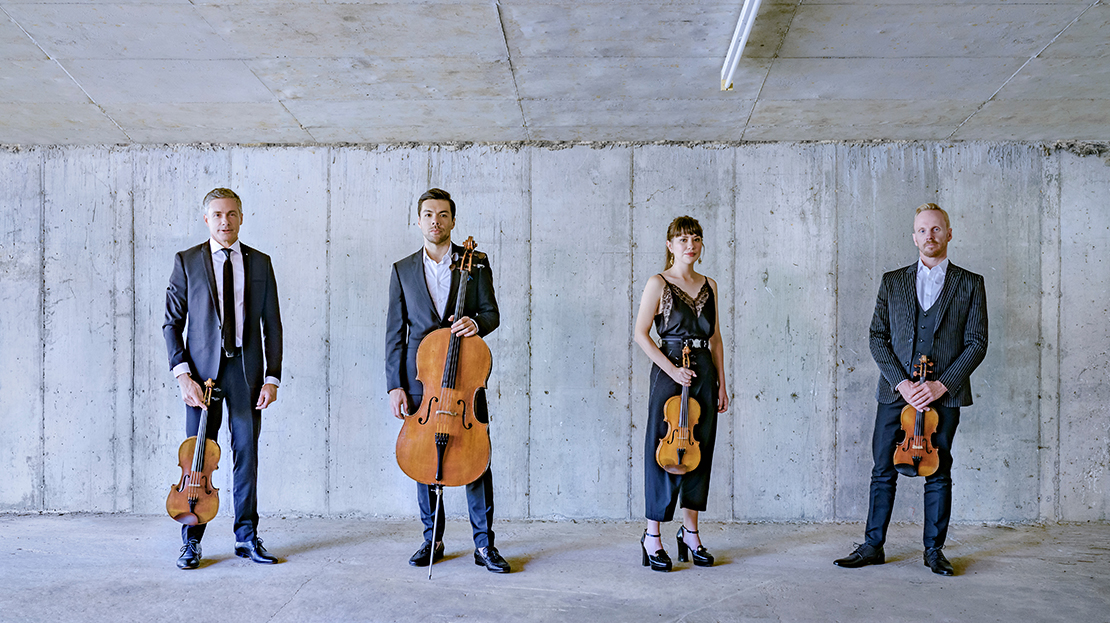
Stephen King, Michael Dahlenburg, Francesca Hiew, Dale Barltrop

Back in Brisbane after a year’s absence, the ASQ has a new member and, on this night, was losing an old one. Fresh-faced cellist Michael Dahlenburg has been a familiar face to Melbourne audiences through his time at the Australian National Academy of Music and his appearances as chief cello and supplementary conductor with the Melbourne Chamber Orchestra. In his new slim-line form, he has managed to slot into the national quartet with impressive facility, showing to fine advantage in this night’s music-making which moved from the sublime, through the comfortable, to the over-hyped derivative.

Leaving the ensemble after a 10-year stint, violist Stephen King has operated on a wider scale, more chamber-music savvy than many of his colleagues thanks to his years with the Australian Chamber Orchestra. Putting his instrument to one side, King is staying with the organization in a new role – Director of Learning and Engagement – and I hope he finds much fulfilment in a post that merges education with . . . well, more education. It’s always a positive sign that an ensemble can trust its tenor line to stay true to the task in all senses, and King has been a reliably confident voice in the ASQ, even through its problem years when certain members came close to shutting the enterprise down.

As King’s farewell, the ASQ administration opted for a set of three works, the last of which gave a fair dose of viola exposure. This was Pavel Fischer’s String Quartet No. 3, Mad Piper, based on the exploits of Bill Millin, who piped his regiment ashore through the D-Day landing at the behest of an infantile commanding officer with a penchant for national colour. First violin Dale Barltrop proposed traces of Scottish flavouring in the score, but I heard only middle-European folk-music influences – a poor man’s Bartok. Mind you, the performers were enthusiastic interpreters of this work, which was heavy-hitting in its percussiveness and almost involving through its employment of driving melodic scraps. From what I can recall, King fulfilled the main role in Movement III with almost all the limelight, while his colleagues gave a backdrop of uninflected, vibrato-less chords to his slow lyrical arches.

In fact, I found this segment the most convincing part of the work. A large-scale opening movement was intended to outline the activity of Millin on June 6, 1944 and the canvas drawn for us by Fischer, co-founder of the Skampa Quartet, showed a wild and hectic aural landscape but one that would have sufficed just as well for a particularly rough Moldavian rural engagement party. Even now, I’m unsure as to the point where the first two movements were separated but doubtless repeated performances will make the score’s parameters more clear. As its final Ursari movement shows, Fischer is adept at bringing out unusual sounds from his interpreters, at the same time rooting the composition in a solid folk tradition – in this case, judging by the title, Romanian.

As a wake-them-up demonstration of technical ability, Mad Piper has a decided impact, even if you tire of the hefty scraping involved and a chain of rhythmic vaults and turns that don’t surprise or disturb. At the end, the approbation was long and loud – a reaction that in my view fell somewhere between relief and approval. Despite the composer’s full-blooded relish of dissonances, his language is essentially tonal, based on the normal with lashings of distractions. In the end, you had to be happy to hear King’s swansong played with intense eloquence, yet you could also experience a fretting worry that the emotional content of this work sounded over-done, at its happiest when all four players were constructing walls of confrontational fabric that simply merged into each other without much intent beyond the activity itself.

In medias res, the ASQ aired Mendelssohn No. 1 in E flat Major, written in the composer’s 20th year and notable for its second movement Canzonetta which used to be an encore piece for quartets who found few rewards in the other three segments of the score. A different state of affairs on this night when the ensemble gave a warm-bodied and eloquent reading of the opening Adagio/Allegro, its middle and bass registers dominant while Barltrop attempted a counter-argument with a line that rises to a sustained high G twice but keeps below an E flat two octaves-and-a-bit above Middle C for the rest of the movement, for some of the time pursuing a close-current conversation with the rest of the group although the last 34 bars are a typical one-sided coda in the top violin’s favour.

Displaying fine taste, the players kept the second movement to Mendelssohn’s specified allegretto pace, undrelining the piece’s delectable spikiness within inbuilt limitations. Possibly the highpoint of the whole work comes in the Piu mosso G Major central Trio where shades of the Overture to A Midsummer Night’s Dream come dropping fast, excellently outlined by the upper and lower pairs in turn. I’ve never been enthusiastic about the following Andante, mainly because all the emphasis falls on the first violin, particularly the two sections that sound like recitatives starting at bar 19 and a more expanded version 17 bars from the movement’s end. Barltrop might have been feeling the need to hold back in these pages because the impression was of a restrained approach outside tutti passages.

The group gave the composer his required attacca into the finale which gives plenty of action to everyone but to these jaded ears presents as one L’istesso tempo too many. You couldn’t find fault with the executants’ determination and bounding energy but it’s a hard slog of a piece with very little harmonic interest, and the capitulation to E flat in the final bars is a disappointment after the preceding minor-coloured argument. Still, the packed audience welcomed with relieved enthusiasm this sometimes stodgy sample of the composer as a young man playing the part of a veteran, particularly after their exposure to the night’s initial offering.

This was Bartok’s String Quartet No. 3 and, to be fair, the score is still a confrontation for its harmonic bloody-mindedness, terse format and determination to follow its own path with no concern for anything extraneous. Each time I hear it, that startling story resurfaces in my memory about the first American performance of the Sonata for Two Pianos and Percussion in its orchestral format. Bartok partnered his wife Ditta, supported by the New York Philharmonic under Fritz Reiner. It’s a hard enough work to negotiate under ideal conditions but at one point in a rehearsal Bartok went his own way and showed perplexity amounting to annoyance when the rest of the musicians faltered. This was his last public performance and it’s not hard to understand why.

But the same confrontational dedication to formal ideals and an acerbic delineation of counterpoint informs this quartet more than any other similar composition that I know from this time (1927), apart from compositions by the Second Viennese School.. The ASQ interpretation had much to recommend it, although the opening bars cluster built on Dahlenburg’s C sharp+contiguous D harmonic failed to convince until Barltrop was well into his first long melodic arc. To my mind, the group impressed most in the slashing chords that punctuated the Prima parte‘s development, as in the vivid stretch from Rehearsal Number 7 to four bars past Number 8 (in the Boosey & Hawkes edition) which impressed for its dark deliberation. Nevertheless, the reading had settled into coherence by the time we reached the doubled scraps before the end three bars after Number 11.

Second violin Francesca Hiew‘s 39-bar-long D/E flat trill (with upper additions) gave a generously applied support for the opening to Bartok’s Seconda parte where Dahlenburg and King announced in pizzicato chords the simple folk-tune that provides a baics reference point for this movement before Barltrop span out the main feature with welcome refinement at Number 3. No group can avoid showing the near-disturbing intensity of effort required to handle the composer’s technical demands: sound-production devices that once seemed so revolutionary, for instance, as well as keeping a communal head in the fugal flurries that erupt in a hurtlingly rapid tempo that, apart from one brief rallentando, seems to increase in bite and headlong motion with each Piu mosso.

It’s still an alarmingly difficult Allegro to handle but I couldn’t detect any obvious faults in the ASQ’s interpretation which impressed for its precision and spirit of confrontation without relaxation. While the succeeding Recapitulazione della prima parte offered some relief from the dynamic and rhythmic tension, the linear interplay remained taut, particularly subsequent to Number 3 when the main content of the movement begins. And the players rose to meet the draining Coda with unflagging energy, Hiew and Dahlenburg contriving to cut across the violin and viola partnership at Number 5 with incisive delivery. This is exhausting music to experience: an Allegro molto that doesn’t let up once it hits the Meno vivo (but not much less) mark at Number 3 . Bartok is somehow able to convince you of a successful outcome in his last insistent chords – all 12 of them – but you are left both exhilarated and drained by the experience. Well, you should be, especially when the performance was delivered with this group’s level of insight and exacting delivery.

But the audience reaction struck me as lethargic, nowhere near as enthusiastic as that for the following Mendelssohn and Fischer. What can you do? Bartok’s score is nearly a century old and still has the potential to disturb and alienate, just as it did when I first heard it in Sydney some time during the late 1950s. For the majority of Brisbane’s ASQ patrons, it seems that sounds heard must be sweet; even century-old chamber music milestones can be discounted in this communally accepted triumph of diatonicism. Still, a tepid reaction didn’t upset me as much as the clown in seat F8 or 9 behind me, who coughed at regular intervals across the night; even his partner occasionally got in on the act. The rules are unwritten but clear, and I’ve seen them observed at orchestral concerts here; if you’ve got a cough, you get up and go out to put yourself in order, rather than sitting in the middle of a hall spreading COVID germs. I know Brisbane’s attitude to health is relaxed but there is such a thing as the public good.

So it’s a welcome to Dahlenburg and clear evidence on this night that he’ll make a welcome presence in this group that has almost settled into a regular pattern since Barltrop came to the first violin desk. But, as far as I can tell, there isn’t a replacement for King in the wings – or is there? Whatever he outcome, he will be missed for his reliability and individuality of output, his mastery across the repertoire and, as we have seen in the 2015 Highly Strung documentary, an admirable grace under abnormal circumstances and an impressively even temper; this last quality a must-have for any musical administrator.

Family and friends

EIGHT REFLECTIONS

Fraser Thomas Williams

. . . FOR SONJA

Tony Gould

Move Records MCD 517

Two different CDs here, as far as pretty every point of comparison goes. One is an amateur product, in both imagination and execution; the other comes from a one-time senior Melbourne academic and pianist with a wide performance spectrum. Fraser Thomas Williams was a Kyabram dairy farmer for half a century with deep ties to his local community In his senior years, Williams’ family has urged him to record some of his own compositions before they are forgotten; he has done so in a suite of eight miniatures on a disc that takes us into an oddly familiar home-grown territory, reminiscent of middle-grade AMEB piano books of many years ago. Gould’s re-issue from 2015 commemorates a friend, Sonja Krawatt, who died a decade ago; he bookends his ten tracks with original pieces named for Sonja Krawatt, while the remainder are arrangements of Jewish folk-tunes and melodies, with one exception – John Williams’ title theme for the Spielberg film Schindler’s List.

Both CDs offer accessible music on a small scale. Williams’ eight pieces combined last a little over ten minutes, while Gould’s offering falls a bit short of 42 minutes. While Gould’s treatments feature titles that are familiar to plenty of Jewish/Yiddish music aficionados – Tum balalaika, Raisins and almonds, At the fireplace – Williams aims, for the most part, to depict his farming life in Morning Showers, Looking Out, and Beauty All Around. The first of these, for instance, is a simple construct in ternary shape, 6/8 in its pulse, and with no chords – just a line per hand, played with some rubato but not over-sentimental. It sets the pace for what follows in being easy to assimilate, free from any complexities, complete in its own quiet parameters. Rather than following this pattern exactly, Looking Out takes an original motif and provides it with a series of melodic complements. Again, the texture is mainly note against note and the harmony firmly diatonic, but the looking process is slightly varied each time Williams casts his musical glance.

Christmas on the Spot was written for a family get-together for which the composer’s wife had no time to prepare for a proper piano duet, so her husband gave her a one-note left-hand accompaniment while he played a tune on top – for this piece, in chords. The oddest thing is that the opening phrase immediately calls to mind a popular Christmas song from the 1940s that I can’t trace. At all events, this track has a substantial coda relative to the rest of the content. Being Young presents as a more mildly exploratory piece with a well-exposed melody, although the rhythmic pattern – left hand three notes, then right hand three notes – is unbroken in its regularity. Still, it makes an impression of youthful mobility and, at the same time, nostalgia, especially in the first part’s reprise.

Beauty All Around begins unnervingly with an arpeggio left-hand figure that in its shape brings to mind Schumann/Liszt’s Widmung. But Williams’ melody is more orderly and less inclined to modulate beyond well-circumscribed bounds. This is one of the more substantial tracks on the disc; not simply in terms of length, but in the overall texture of the work which once again follows the composer’s preferred A-B-A framework. As for its significance, the piece proposes a view of beauty that is essentially harmonious and mobile, its aesthetic aspiring rather than static. Following this, The Williams Family is a fast hymn with an A-A-B-A format, its melody a well-crafted lyric with a four-square shape that has suggestions of both American revivalist hymns and Australian folk-songs (which, it seems to me, are inevitable revenants of British, Irish and Scottish melodies). What qualities does it suggest about the family? Straightforward, rural, appealingly calm – you can find all this in Williams’ placid memorial.

Sweet Mystery is the most salonesque of the reflections, with a melodic line that oscillates between bass and treble. Rather like Looking Out, this work has a certain unpredictability; you recognize the main motive/phrase, but Williams is not always following the party line as to where it leads. Certainly, the harmonic language is more advanced than in the first four tracks. Finally, Listening In takes its impetus from the composer’s three hearing aids, each of them sounding an individual note each time Williams puts them on. Another ternary piece, it shows a harmonic deftness, mainly at deviation-from-the-expected moments, which adds a gentle piquancy to the last in this miniature suite which is not difficult music but which speaks with an unselfconscious ease and buoyancy.

Gould begins his title track with a gentle meditative walk showing hints of Jewish tropes, including the repetitious shape of certain sequential phrases, the gentlest of intermediary seventh cords,, and suggestions of minor-inflected modes. Cellist Imogen Manins joins in for two interludes. The final track, Encore Sonja, treats the same material as this opening For Sonja, but it’s not simply a copy; rather, its character is more meditative and, to my mind, more introverted, as well as being substantially shorter . . . and all Gould, without Manins’ mellow line. Both tracks are character pieces, I suppose, in the 19th century manner, reminiscent of the mini-essays of Mendelssohn and Grieg, but couched in a placid, ruminative voice that has something of a lament about it, but the grieving is muted and non-demonstrative.

At the fireplace brings Manins back to play the lyric itself, followed by Adam Simmons working through a variant of the tune on what sounds like a saxophone even though he is billed on the CD cover as performing clarinet. Manins returns for a restatement, and finally both instruments perform the rhythmically elliptical tune together with Gould underpinning the process through an accompaniment that begins promisingly but settles into gentle predictability. Simmons returns in the next track, Let us all together, to explore his inner klezmer with lots of ‘bent’ notes, a bit of over-blowing and some mini-glissandi; both he and Gould share the melody, Simmons at his most affecting when shadowing the tune and fading in and out during the process.

Manins and Simmons take the lead in Peace unto you, Gould occasionally raising his head above the parapet in this gentle stepping song. The performance is considered, quiet and, like most of the traditional material that Gould mines, surprises only mildly when it steps into a major key; you try not to, but your mind is drawn to memories of Fiddler on the Roof and the curves of Jerry Brock’s melodies. More central European in character than much else in this collection, Raisins and almonds brings Manins to the fore twice but Gould’s supple keyboard work holds your interest for its delicacy and rhythmic ambiguity, especially in the piece’s first half where the pulse is unpredictable.

The trio participates as an entity towards the end of Tum balalaika, during which Gould enjoys an extended solo, Manins outlines the tune both straight and elaborated, and Simmons offers the most subtle of interference plays in an episode following his own yawp-inflected solo handling of the theme, which appears clearly on both guest instruments in a final round-up. Rayzele isn’t a traditional song, as the CD sleeve index proposes, but a song with multiple verses by the Yiddish composer/lyricist Mordkhe Gebirtig. Gould gives us a solo piano track here, in which he treats the four-square tune with plenty of flexibility and some interesting detours, although nothing far from a well-beaten harmonic track. And he invests it with a placidity that isn’t quite compatible with the original’s forthrightness. Jewish mother is probably the least substantial of the disc’s contents, with Gould handling the introductions, then Simmons outlining the tune – one I haven’t heard before – on what could be a bass clarinet but still has sax suggestions – with Manins playing it again, the whole furnished with a supple coda featuring the two soloists pushing the sentiment in a partnership of cosy 6ths.

Gould’s treatment of the Schindler’s List theme is no-nonsense, he and Manins sustaining a steady metre throughout and avoiding any self-indulgent suggestions. Manins partners the pianist in a brooding introduction before taking up the famous melody that brings to mind the human cost that lies at the core of this remarkable film. Gould allows himself an interstitial elaboration before Manins returns to conclude the longest track on the disc which concludes with its highest cello notes.. I don’t know if Gould’s dedicatee had a connection to the Holocaust – it’s hard to find a Jewish citizen or relative in this country who was not affected, many in shattering ways – but this aching melody fits with unquestionable ease into its surroundings, fleshing out gracefully this affecting musical memento.