NIGHT THOUGHTS
Move Records MCD 647
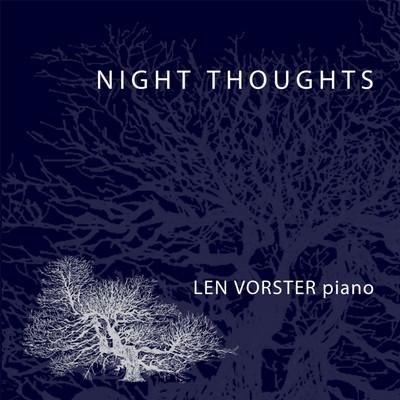
As you’d anticipate, a lot of this disc is given to nocturnes: by Tchaikovsky, Clara Schumann, Faure, Charles Tomlinson Griffes, Jillian Rose Tymms, Sculthorpe, Satie, Poulenc, Michael Easton and Leonid Desyatnikov. The other five tracks – by Bloch, Hindemith, Duparc, Peter Klatzow and Copland – use ‘night’ in their titles, not least the American whose work gives this CD its title. Just as importantly, the content has a general tendency to be slow-moving and ruminative, thereby giving rise to a generalization or six about music for the night coming from less joyful reaches of the compositional mind, if not downright depressing ones.
Vorster opens his recital with Bloch’s In the Night – A Love-Poem, an effusion from 1922 which comes in the rare key of A flat minor, even if it ends in the more erotically self-supportive A flat Major. This is a fluent effusion, bearing traces of impressionism, mysticism and a hint of exoticism, all calibrated with care by Vorster who observes every accent and expression marking to produce a gem both brooding and passionate. No 4 in Tchaikovsky’s Op. 19 Six Pieces of 1973 is a gentle C sharp minor Nocturne with a simple ternary shape, its coda based on the middle Piu mosso material; it has the requisite melancholy and enjoys a fluent expounding with plenty of rubato and a fetching recapitulation section where the melody shifts to the left hand and the upper part decorates with that slight intrusiveness typical of this masterful composer.
Clara Schumann produced a notturno as the second of her six Soirees musicales, written and published in 1836. V orster treats this with much the same latitude as he did the preceding Tchaikovsky, and with a similarly lavish use of the sustaining pedal. In this piece’s reprise, the main theme is kept in the right hand but transformed into a more ardent character. As well, the composer’s harmonic progressions intrigue momentarily, even if nowhere near as much as those of her husband. Faure’s Op. 104, composed just before World War I, comprises two pieces: a nocturne in F sharp minor and a barcarolle in A minor; Vorster presents the first, which is probably just as well because the alternative is oddly garrulous. By this stage, the composer’s harmonic language had become very sophisticated and this set of pages offers a wealth of chromatic shifts, carried off with sympathy and clarity by the executant.
At this point, Vorster introduces a work by a former piano pupil, Jillian Rose Tymms. This is Silberstreif and takes its impetus from Melbourne’s lockdowns during the COVID years, the title suggesting a light at the end of the infectious tunnel. The work proposes a general restlessness, despair and a longing for the way out; what we hear is, apart from one short harmonically disjunct segment, a Mendelssohn song without words, loaded with the rippling arpeggios and scales familiar from the German composer’s salon output. I’m sure it’s sincere and Vorster gives it mellifluous address but the music itself is too sweet and lacking in bite to match the times it represents.
Hindemith’s 1922. Suite fur Klavier has at its centre a Nachtstuck which bears the composer’s duality lightly. The harmonic language is tightly organized and sturdily framed; there are clear melodic shapes that are dealt with and revisited; the time signature (non-existent, really) stays at a pretty constant 3/2 (or 6/4, if you like); and the ternary structure features a sparkling central section to contrast with the framing more sombre pages, the dynamic climax reserved until bars 80 to 83 in a piece that lasts for only 97 of them. Vorster works through its three pages with a calm flexibility that belie Hindemith’s reputation for academicism.
Aux etoiles by Duparc either refers to the first part of Poeme nocturne, an orchestral triptych of 1878 of which this first section only survives, or (more likely) it’s the 1910 piano solo, orchestrated in the following year. This is an honest piece of atmospherics which opens and ends in C Major but moves to odd places in its long centre, which involves a not-very-convincing return to the tonic 15 bars from the end. It’s subtitled as an entr’acte pour un drame inedit; a slow-moving hiatus in the projected work, then. A brace of lines from Verlaine about a willow reflected in a pond preface the Notturno of Charles Tomlinson Griffes as we lurch to America for a while. This 1915 composition, the middle one of three Fantasy Pieces, is a cousin to Duparc’s starry vision, albeit one with richer chord structures and a plethora of rhythmic variations. Its rich-textured mixture of languor and virtuosity suits Vorster’s interpretative skills most adroitly.
A little touch of Sculthorpe in the night with the Tasmanian-born composer’s Nocturne – Seascape, a piece of plangent romantic/impressionist charm in E flat Major, all 1′ 57″ of it and with a free-flowing charm from the 19-year-old fledgling composer, still occupied with his European forebears. Satie’s Nocturne No. 1 precedes four others from 1919 and moves past with a reassuring placidity. My only gripe with Vorster’s reading of this slightly curious piece is his tendency to pause before changes in register, e.g. bars, 3,4,5 and 6. I felt more assured during the central Un peu plus lent qu’au debut break. Poulenc follows with his Nocturne No. 4, Bal fantome, from the 1929 set of eight. This also is not long – 1’29” – and stands as a waltz falling into four-bar clauses with muted harmonic spice to ginger up its C Major basis.
Michael Easton, an Australian-British colleague of Vorster who died in 2004 (can it be so long?!), appears next with the second movement of his 1993 Flute Sonata, appropriately entitled Nocturne. Transcribed by Vorster, this begins as a slow waltz, changes to a 2/4 rhythm and ends (more or less) in 6/8. It rambles very pleasantly, but not aimlessly and the arrangement has many picturesque touches to leaven the top-line/bass support that emerges in the piece’s middle pages. The Nocturne from Giselle’s Mania forms part of a film score written by Leonid Desyatnikov, the scenario concerning the ballerina Olga Spessivtseva who suffered mental breakdowns in 1934 and 1937. The music makes much of a cell comprising a rising minor 6th followed by a falling minor 2nd, altered to a Major 2nd near the end. This also meanders in a post-Rachmaninov way with some ardent flashes surging out of a melancholy, if not depressing, soundscape.
One of Vorster’s teachers at the University of Cape Town, Peter Klatzow, composed his four-movement Moments of Night in 1968, revising it in 1982. Vorster presents the last work in the suite which is an intriguing night-scape, gifted with a soft sparkle and following a broad, mobile path through a set of concise melodic cells that emerge and disappear sotto voce.
Last comes the CD’s longest track: Copland’s Night Thoughts (Homage to Ives), the composer adding his sub-title to give no grounds to his friends, neighbours, critics, decriers and the whole profanum volgus of commenting on the piece’s occasional similarities to Ives (and, even then, most of Copland’s cluster-bombs are tame compared to those from the older composer – you don’t need to go further than the second bar of Emerson in the Concord Sonata, let alone bars 6 and 7, to see the difference). Written for an American piano competition in 1973, the entrants were required to read the work at sight.
Not that the task is impossibly hard, as it would be to sight-read an Ives piece, say. The work is slowly paced, loaded with accidentals and rapid arpeggiated ornamentation. Even when the composer moves to four staves, the complex is easy to read and deliver. What the actual thoughts are remains open to each listener, but the work is not programmatic like Central Park in the Dark (particularly the opening); if anything, the suggestions are of long-held resonances (bells?), if discordant ones – albeit this night is full of more surprises than most. For all that, Vorster’s reading is firm and dynamically balanced – far more so, I’d suggest, than anything coming from those 1973 sight-readers, but that’s what you’d expect.
Copland’s work acts as a kind of capstone to this CD. It’s the most contemporary work of the whole 15, expressed in a language that is well removed from the smooth sweetness of many among its companions. If it offers more food for thought than bagatelles like the Duparc, Tchaikovsky or Poulenc pieces, Night Thoughts reminds us of serious music’s potential for spartan, aggressive gravity of utterance. For me, it concludes Vorster’s compendium with a quiet assertiveness – not exactly putting its predecessors on a shelf but relegating them to secondary status, no matter how expressive and circumspect they may be in their emotional and technical content.
 O'Connell the Music