MY HEART
Danae Killian
Move Records MCD 673
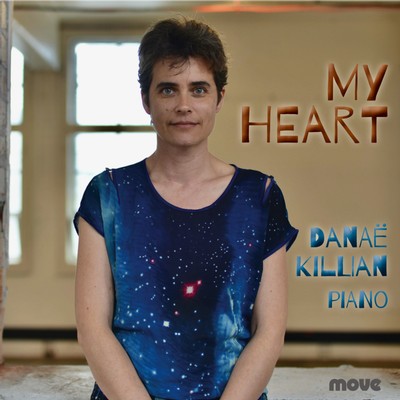
To be honest, I’m not on the wave-length of this Move Records CD from Melbourne pianist Danae Killian. Eight separate works provide the performer with plenty of material but seven of these break up the core of this presentation: a three-part construct by Killian called My Prussian Blue Heart. Originally written in 2017, then revised in 2024, this work is scored for pianist, tarot cards and piano – which strikes me as partly tautological in this case as Killian is definitely the piano performer and, I assume, takes on the pianist (speaker?) role, mainly because no other performers are listed on the liner notes/leaflet.
Exactly why the composer singles out that particular colour as a cardiac descriptor has me beat. Apart from its use by artists from the 17th century on, it also has strong medical applications; perhaps that’s a relevant association as the musical work could have some kind of therapeutic value for the composer/performer. Or it may have to do with Killian’s source of inspiration in German/Jewish poet Elsa Lasker-Schuler’s novel Mein Herz of 1912, an effusion of startling self-expression and revelation.
Killian’s first inter-leaver is Schoenberg, represented by his Drei Klavierstucke Op. 11 of 1909. This expressionist monument is followed by Mobius of 2012 by Melbourne writer Howard Dillon. Then, from another Melbourne resident, Christine McCombe‘s Asphyxed from 1991. After the middle movement of Killian’s composition, we hear some more Australiana in film-composer Amelia Barden‘s brief The Seventh Centre from 1992; and we stick with the Victorian region of the continent through senior jazz musician Colin McKellar‘s Birth Music of 2006 or 2008 or 2018, depending on your source.
Next, we make a temporary swerve geographically to Gregers Brinch from Denmark whose four-movement Two Minds suite dates from 2004. Then, just before the 39-second conclusion to My Prussian Blue Heart, back to home-base for Evan J. Lawson who appears through his Sikinnis III of 2015. He is the artistic director of the Forest Collective organization with which Killian is closely associated.
Another body that has proved a haven for several of these contemporary voices is the Melbourne Composers’ League, a body that has been operating for almost 30 years and is in the bread-and-butter business of presenting new music by local composers – although that categorization now stretches to include interstate and international voices, even if the avowed context of its presentations is covered by the term ‘Asian-Pacific’. As far as I can recall, my only experiences with this sector of Melbourne’s musical world has been through recordings, but it had an ardent advocate for many years in my erstwhile colleague-critic on The Age, Dr. Joel Crotty.
The first movement of Killian’s opus is a monologue which focuses on a single character: the pianist. You hear no music, from a piano or otherwise; just a pretty brief display of self-awareness on the narrator’s part. She appears to be suffering from an identity crisis but, to my mind, even if she fuses with the pianist figure, answers are a long way off. The second movement introduces piano sounds produced by striking the strings manually before settling into the orthodox note-production technique. Asa for the text, this has abruptly turned into a dramatic display bordering on sprechstimme but vehemently dramatic at its best, phantasmagoric more often in its imagery.
In fact, this long scena is highly aggressive, the piano’s innards a source of violent percussive attacks that reflect the narrator’s ramblings that present as a kind of image-laden narrative asking a good deal of the listener just to keep track of what’s being delivered. For all that, the admissions and self-observations move all too easily into the banal, both when concerned with mental states as well as physical. On top of this, we are treated to vocalizations of a hectic nature, yells and cries leading nowhere in particular. And the movement ends with a German text that could come from Lasker-Schuler, the whole singing to a final ‘Sterbe ich’ declaration – somewhat unnerving when you consider the previous indications of violent action.
As for the concluding phase of this work, it reverts to unaccompanied monologue, the pianist-subject in a happier place without any singing or piano scrapes – just a narrator reporting her current state of contented emotional stasis. Well, we’ve had a pianist as the focus of the work’s stages, and the middle segment features a piano in all its late 20th century glory. The tarot cards are mentioned but are irrelevant to this CD experience. Killian states that the full work also contains two interludes and a postlude; these interludes are apparently subsumed in the other composers’ music, and I assume the postlude disappears intro the ether.
As for the rest of the CD’s content, Killian’s reading of the Schoenberg piano pieces impresses for its strength of purpose. She is a stickler for observing every dynamic marking and is responsive to the frequent changes of pace across the composer’s free-flowing canvases. Very few details raise question marks, although the laid-back left hand entry at bar 45 of the second Massig seemed a puzzling choice. But the brisk oscillations between placidity and rapid outbursts that make the concluding Bewegt a sterling challenge for any pianist were unusually clear-cut and focused.
Dillon’s score lives up to its title by offering a repetitive cycle of individual notes and mini-chords that weave in and out of themselves in a pattern that seems like a moto perpetuo but allows for rubato moments – and a dead halt about half-way through. After which, Dillon appears to be considering his material in discrete fragments, as though the strip has become obstructed. Indeed, this meditative pattern remains with us for the remaining pages of the work as its world remains in a brooding ambience until the end, as though the performer realizes that the mobius construct leads nowhere.
By contrast, McCombe’s Asphyxed gives us a landscape of (mainly) single notes that creep slowly forward, interrupted at least twice by short, sharp gruppetti of chords and loud exclamation points. For all that, I don’t understand the title’s relevance nor the work’s intentions, even if Killian’s reading shows a willing sensitivity. What The Seventh Centre refers to escapes me also but in it Barden has constructed a soundscape as remote as McCombe’s, if one built on a clearer framework and employing a more obvious harmonic structure while occupying less than half the time-length.
Written around the time of his daughter’s birth, McKellar bases his work on a combination of bell-ringing charts and standard jazz progressions. He also has a penchant for single notes; understandable, given the nature of campanology in practice. Yet, for all the projected relationship between the two sources, Birth Music seems fragmented – possibly because of those single-note passages that are relieved by chords that have enjoyed permutation according to the bell chart being employed. We get idea after idea but it’s hard to find a focus.
Brinch’s first movement has the same title as his work and it cleverly proposes either two personalities or two aspects of the same consciousness. Each gets its individual say before the composer fuses them in concord and discord, although the les flamboyant mind has the last word – or does it? Reflective Intersections is less overt, although it opens with a meandering right-hand line supported by left-hand chords. As the piece moves beyond the half-way mark, the two intermesh and the texture becomes bass-heavy with whatever melody is left subsumed into sometimes gruff, other times brooding textures.
Third in this series, Homage, is something of a funeral march, especially in its later stages despite a florid upper texture. The piece opens with celebratory flourishes but soon settles into more sombre strophes. Of course, much depends on who or what is being paid homage and, being unaware of anything relevant, we are left to appreciate these pages as blanks, abstracts without context. Much of Drought is set at either end of the keyboard, so that initially I thought the low rumbles signified a protesting earth while the tinkles in alt were suggesting distant rain. But then, you wonder if Brinch’s drought is a physical one, or more simply a spiritual/emotional absence. Whichever it is, the writing is powerful and suggestive on its many disparate and (eventually) combined levels.
Last of Killian’s interstices is Lawson’s Sikinnis III, third (obviously) of a series based on a dance form from ancient Greek satyr plays. At the opening, I find this hard to fathom as the work’s progress is extremely slow, the composer celebrating the piano’s sustaining pedal with plenty of room for extended resonances. This composer is also a member of the single-note brigade that populates this CD. But then, the piece’s final pages are heavy with clangorous chords that enjoy a long fade to silence. It’s time for the less-aware among us to have a look at the lighter products of Aeschylus and Euripides to find some sort of footing for Lawson’s vision.
And that’s it. Killian has presented this collation in live concert for nearly a decade now and I suspect the exercise is more impressive in actual performance. I found individual works here very impressive but the whole strikes me as a collage of unfused parts – which you might say is what a collage is. Well, no: the craft comes in the fusion, as old Kurt used to say (and, if he didn’t. he should have). With My Heart, especially the disc’s focal work, I can’t detect more than a none-too-convincing melange.
 O'Connell the Music