THE DEVIL’S VIOLIN
Australian Chamber Orchestra
Hamer Hall, Arts Centre Melbourne
Sunday March 15, 2026
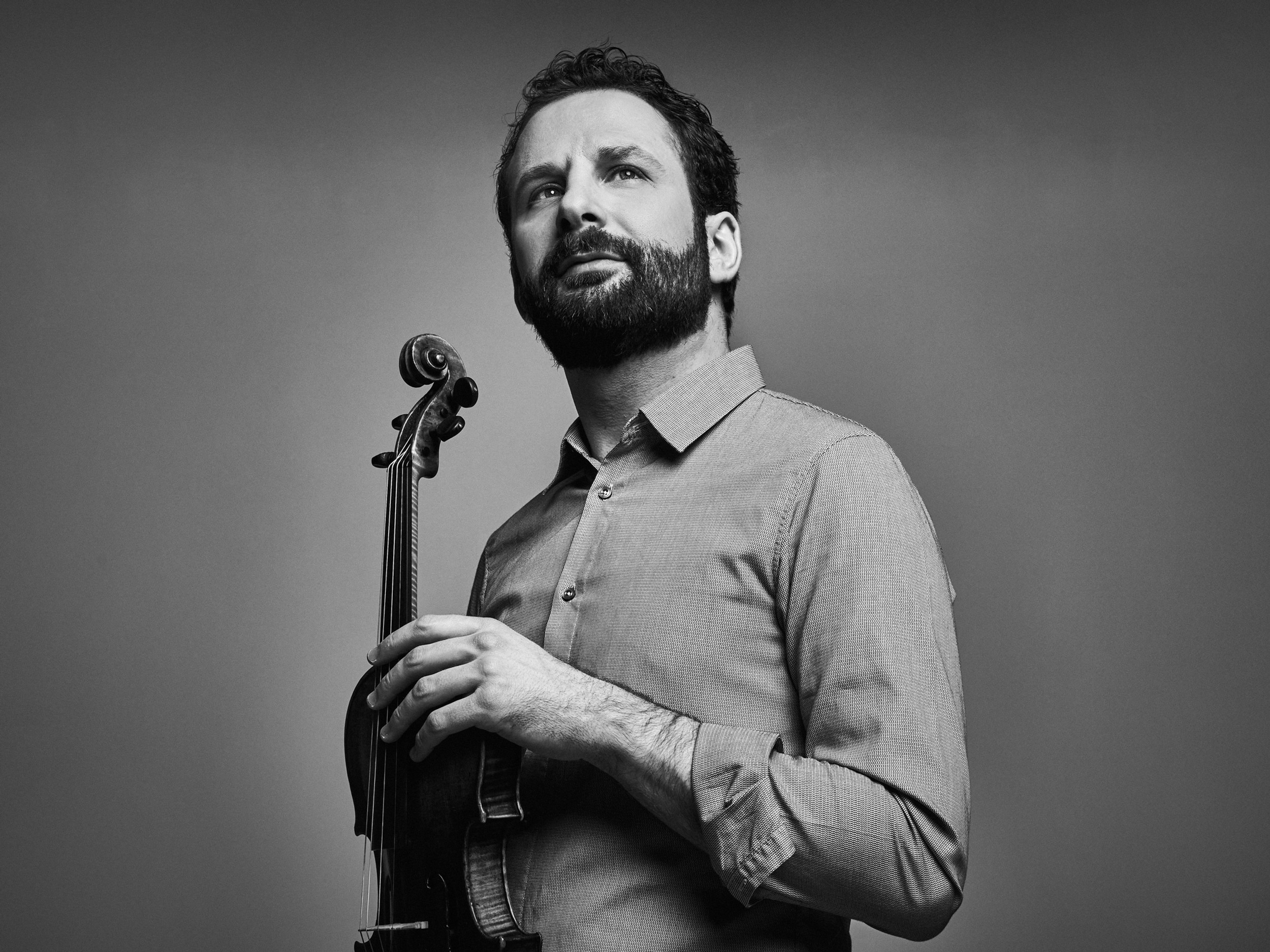
Ilya Gringolts
Perhaps someone was making a point about possession. A good deal of the program essay by Kate Holden for this afternoon’s Australian Chamber Orchestra concert concerned the instruments that both soloist Ilya Gringolts and his support are lucky enough to play, if not own – Guarneri, Stradivarius, Da Salo,, Maggini. As for the underworld connotations, I suppose the connection with Tartini’s Devil’s Trill Sonata was hard to resist, although a more convincing piece to play, other than the Italian composer’s tall-tale opus, might have been L’histoire du soldat, but that presents a whole new ball-game in requisite soloists.
For this event, apart from Gringolts’ presence as soloist in several concerti and leading everything else, only three extra musicians came into play: theorboist/Baroque guitarist Simon Martyn-Ellis. harpsichordist Masumi Yamamoto, and violist Thomas Chawner moonlighting from Brisbane’s Orava Quartet. In line with a mainly ‘old’ music undertaking, Gringolts confined his forces to six violins (including himself), pairs of violas and cellos, and the perennial Maxime Bibeau on double bass.
As for what Baroque music we heard, the visiting guest director offered two Vivaldi concerti – a solo and a double violin – as well as the Tartini sonata arranged by the ACO’s own Bernard Rofe for all the strings to swan in and out, Geminiani’s Concerto Grosso No. 12 called La Follia, and the slightest of lollipops in Westhoff’s Imitazione della campane extracted from his Violin Sonata No. 3 which was published in 1694.
Among all this period material, Gringolts inserted a trio of more or less contemporary scores. In the first half, we heard Gubaidulina’s String Quartet No. 2 of 1987 in an arrangement (unacknowledged) for the available eleven players, who appeared to share the original four lines while the director spent a good deal of time indicating the bar-lines.. As a lead-in to the second half, the strings played Mieczyslaw Weinberg’s Op. 9 Aria for string quartet from 1942, also amplified anonymously for the available forces. But the most recent composition on offer proved to be Paul Stanhope‘s Giving Ground, composed in 2021 to an ACO commission; this was based on the La Follia theme/bass and, at the conclusion to this program, leached into the Geminiani concerto/variations.
As the exercise progressed, you became aware of how much Gringolts was invested in everything, for all that the exercise lasted about half-an-hour less than normal. Naturally, he took the lead (only) role in Westhoff’s exercise in rapid broken chords; slowing down to break the 41 bars-worth rhythmic (and harmonic) monotony and varying his intonation between the bland and the rough; the piece giving us a chance to re-familiarise ourselves (Gringolts has toured twice over previous years for the ACO) with his individual voice which is a highly malleable one.
We moved straight into the solo Vivaldi concerto, D minor RV 237 published in 1716-17. After an initial bout of arpeggiating chords, the first movement’s solo part starts at bar 40 and runs through some familiar passage-work tropes with a rise in the interest level from bar 121 onwards for some athletic bouncing up to a high register in a neatly-packaged train of semiquaver foursomes. After an unassuming 32-bar Adagio which was an easy effusion for Gringolts and which he delivered without a trace of sentimentality, we arrived at the slightly elliptical Allegro finale which bounded past like a watery chablis that didn’t hit the sides. In the canon of memorable Vivaldi concertos, this one didn’t rank.
On to Gubaidulina’s challenging work which opens with a concerted examination of the note G, articulating it in several ways on various levels before moving to a more material-heavy second part and a brief conclusion. What made this performance more interesting than most was seeing the interweaving of individual players in the opening pages – an organizational feat of some distinction – before the more conventional later stages of the work. Still, Gubaidulina appeared to regard her score as the solution to a problem and, despite the finest efforts of insightful musicologists like Judith Lochhead and Joseph Williams, the work presents as more of a rigorous discourse than anything else, after its arresting opening.
As for the Tartini sonata (the composer alleged its composition date to be 1713; commentators suggest thirty years or so later), Gringolts began with an orthodox continuo of Martyn-Ellis, Yamamoto and the ACO principal cellist, Timo-Veikko Valve. I believe that the ACO’s other ranks started entering around the Tempo giusto but their efforts were all broad strokes filling out Tartini’s sparse texture. As you’d expect, the focus throughout this well-known work fell on Gringolts whose various modes of attack gave interest to these well-thumbed pages.
As you’re aware if you know the work, diabolic suggestions are non-existent. The piece proceeds in a respectably ordered path with some gymnastics for the violin in the Sogni del autore last movement. But you would have to be unusually susceptible to extra-musical suggestions to find anything but an assertive benignity across the composer’s canvas, especially in those euphonious trills that pop up to general satisfaction in the concluding pages.
Weinberg’s brief essay in chromatic slips and slides has its charms in quartet form; expanded, it somehow lost its harmonic interest, possibly because the inner workings sounded less striking when weighting had to be redistributed. But the great benefit was the timbral variety on offer with regard to those chugging quavers, especially a long passage for viola which here barely struck you as wearing even though the relentless chain of quaver thirds, fifths and sixths lasts from bar 33 to bar 53 in a piece that consists of only 63 bars.
The ACO’s principal violin Satu Vanska collaborated with Gringolts in the Vivaldi Concerto for Two Violins RV 507 from somewhere between 1713 and 1717. In this happy work – despite its brief E minor central Largo – the solo responsibilities are pretty fairly divided, except for the first Allegro where Gringolts had more of the running. For all the familiar sequence of harmonic steps and jaunty melodies, the chief interest here lay in the contrasting sound-colours of the soloists. Vanska’s output remained refined and lyrically eloquent but with an unflappable rigour, while Gringolts performed with more assertive verve.
You couldn’t call it brash or anywhere near coarse, but the visitor gave this rather unexceptional work an urgent vigour – just as athletic in treating the busy line as Vanska but offering a vital contrast in those frequent passages of close imitation, although he shepherded his dynamic when both soloists were in communal attack. Nothing here like the close similarity that David and Igor Oistrakh offered in the Bach D minor, or when Deller father and son worked through Sound the trumpet; rather, an unabashed juxtaposition of opposites.
Finally, we came to Stanhope’s clever set of variants on La Follia which seemed to be sticking to its harmonic last, except that it meandered off the prescriptive path easily enough and was able to employ sound-production techniques that wouldn’t have occurred to Corelli or Geminiani. You could tell when the Australian work ended and the Italian master’s 1729 concerto began but the blending was a deft move from Stanhope’s review of his opening bass-heavy scrapes to the spare statement that begins the older work.
Mind you, by the time Gringolts, Vanska and their forces reached the end of Geminiani’s 23 variations, I was all Follia-ed out and the later instances of vaulting virtuosity came close to wearing out their welcome. Not that you could find fault with Gringolts who maintained his enthusiasm until the end with an engrossing employment of dynamics and attack that exemplified what every musician has to do with these bare-boned scores: enrich listeners with an all-embracing view and find an emotional expansiveness to mine, rather than just work through the works’ outlines and only realize the notes. However, next time this excellent violinist visits, I’d welcome a lot more substance; fewer small bursts, no matter how pleasurable.
 O'Connell the Music