Diary November 2024

FRANKENSTEIN!! & THE GOOSE’S MUM

Ensemble Q

Concert Hall, Queensland Performing Arts Centre

Sunday November 3 at 3 pm

Not surprisingly, the second element in this concert’s title is Ravel’s five-part suite Ma mere l’Oye which exists in a piano duet version, a reduction for solo piano and a full orchestra transcription. What are we going to get this afternoon? Probably the piano solo version because Daniel de Borah is the only pianist noted in the personnel list and the remaining musicians number only twelve; too small for the Ravel orchestration. The group also attempts Saint-Saens’ Danse macabre, arranged by American Cicely Parnas for violin and cello; no worries about this ensemble’s cello – Trish Dean – but the violin role could be taken by Adam Chalabi or Anne Horton. Then there’s Poltergeist by William ‘Bolcome’, who I assume is William Bolcom. This is hard to pin down, as there’s a Poltergeist Rag written by Bolcom for solo piano but the advertising bumf claims that this work will be performed by a string quartet: Chalabi, Horton, Dean and viola Tobias Breider. I can’t find any such arrangement in the list of this famous American song-composer’s catalogue. So far, not so much work for the other eight listed participants. Things change for the other title work: Heinz Karl Gruber‘s 1971 ‘pan-demonium’ Frankenstein!! for chansonnier (probably Jason Barry-Smith who is listed in this cast list as ‘narrator’) and an ensemble that takes in everyone except de Borah: the string quartet plus double bass Phoebe Russell, flute Alison Mitchell, oboe Huw Jones, clarinet Paul Dean, bassoon David Mitchell, horn Peter Luff, percussion Jacob Enoka. But who’s playing trumpet? And where does harpist Emily Granger fit into this program, unless the Ravel work is being played in an unidentified arrangement? Anyway, tickets cost $75 or concession $55 with the usual QPAC add-on of $7.20 as a compulsory sting.

A SYMPHONY FOR WINDS

Queensland Symphony Orchestra

Queensland Symphony Orchestra Studio

Thursday November 7

This evening opens with one of Richard Strauss’s later works, the so-called Symphony for Winds No. 2 in E flat of 1944/5, sub-titled (by the composer) ‘Happy workshop’. The more constipated among us call it the Sonatina No. 2, but it’s of a substantial length and sits in happy comparison alongside Stravinsky’s 1920 briefer essay with similar participants but also involving a slew of brass. Strauss involves 16 instruments: pairs of flutes, oboes, bassoons, then four horns, a contra-bassoon, and five clarinets – an E flat, two B flats, a basset horn and a bass clarinet. In terms of time, it’s the longest work on the program. Then a complete change of personnel for Penderecki’s 1961 Polymorphia for 48 strings (24 violins and 8 of everybody else) which could probably be the most advanced music that the QSO has played all year: a splendid sample of graphic notation and a test of Umberto Clerici‘s directional powers. This is followed by British rock guitarist Jonny Greenwood‘s 2011 tribute 48 Responses to Polymorphia which can last either 15 or 19 minutes, depending on the number of movements attempted which will in turn determine whether all 48 players need their own pacay bean shakers. Well, to be fair, it’s not a tribute but a spring-board for an uninspired and unadventurous essay in harmonic conservatism. But that’s just my opinion; listen for yourself and have that finding reinforced. Tickets range from $79 for an adult to $35 for a student or child, with the QSO’s own outrageous $7.95 surcharge on every order.

This program will be half-repeated on Saturday November 9 at 3 pm as the Penderecki and Greenwood spin-off disappear to be replaced by Tchaikovsky’s Serenade for Strings to ensure an afternoon of harmonic emulsion. You’ll be happy to learn that the ticket prices don’t vary; nor does that over-ripe excessive booking fee.

SCOTLAND UNBOUND

Australian Chamber Orchestra

Concert Hall, Queensland Performing Arts Centre

Monday November 11 at 7 pm

Just as the Queensland Symphony Orchestra is finishing up this month, so too is Sydney’s own ACO ending its year with this tour fronted by Scotch-Japanese guitarist Sean Shibe who is going to treat us to a long belt of Hibernian musical craft. With ACO artistic director Richard Tognetti leading the string ensemble, Shibe starts off on a normal classical (acoustic?) guitar, working through some traditional Scottish lute solos collected by the 17th century aristocrat Lady Margaret Wemyss, about whom nobody seems to know anything except her parentage and that she died aged 18. We rush forward to From Galloway by contemporary Scot James MacMillan; this was originally a two-minute clarinet solo from 2000, here transcribed by Shibe. Who continues with a suite of folk songs – could be anything – before we enjoy a new commission from Canadian-born writer Cassandra Miller for guitar and strings. Then Shibe switches to his electric instrument for Lad by American academic and co-founder of the Bang on a Can organization, Julia Wolfe; this is another transcription from the 2007 original that asked for nine bagpipes. Following which it’s over to Irish composer David Fennessy for his Hirta Rounds of 2015 involving nine violins, three violas, three cellos and a double bass; this memorialises a group of now-abandoned islands in Scotland’s St. Kilda archipelago. Like the Miller and Wolfe compositions, Hirta Rounds is receiving its Australian premiere across Shibe’s tour. To end, the electric instrument returns for some selections from another Canadian-Scot: Martyn Bennett’s 1997 nine-track album Bothy Culture which is about all I’ve heard from this musician who died aged 33 in 2005. It’s another arrangement for guitar and strings, but there’s no indication who put this set together. Tickets can be as cheap as $25 for the lucky young and move up to $129 for the affluent old, always remembering that QPAC $7.20 surcharge for exercising your attendance prerogative.

VIRGILIO MARINO

Opera Queensland

Opera Queensland Studio, 149 Grey St., South Bank

Friday November 15 at 7 pm

Here, you take things on trust – not my favourite position. Virgilio Marino is a well-known Queensland tenor; probably less famous than Rosario La Spina but working in the tradition of local legend Donald Smith. I heard Smith in his prime, and La Spina (probably) in his; Marino I’ve yet to come across. Anyway, this occasional recital for the state opera company pairs him with Alex Raineri, so you know the accompaniments will be informed and supportive. But what’s he going to sing? According to the few lines of OQ site information, we’ll hear his ‘favourite arias and songs’ These could include La donna e mobile, Questa o quella and Parmi veder le lagrime because the most important role he has sung for our national company is the Duke of Mantua. Still, he’s performed a host of major roles for Opera Queensland – Don Ottavio, Rodolfo, Nemorino, Pinkerton, Almaviva and Alfredo. Those characters are entrusted with a wealth of arias; as for his ;songs;, I’ve no idea. The event lasts for an hour and you can attend it for $65 full price, $59 if you’re a student or concession-holder (whoopee-do) and a child gets in for $33. As far as I can tell, there’s no charge for using a credit card.

This recital will be repeated on Saturday November 16 at 2 pm but don’t bother: this hearing is sold out. Mind you, there aren’t many seats in the Studio to start off with – a couple of hundred at most.

UMBERTO & NATSUKO

Queensland Symphony Orchestra

Concert Hall, Queensland Performing Arts Centre

Friday November 15 at 7:30 pm

This program is being advertised as the season closing gala and all stops are out, as they say in rugby. The QSO chief conductor Umberto Clerici is conducting two overtures and Strauss’ Four Last Songs, but he’s also returning to his instrument-wielding days and partnering the orchestra’s concertmaster, Natsuko Yoshimoto, in the radiant Double Concerto by Brahms. I, for one, can’t get enough of this masterpiece, which is something of a rarity; the last time I think it was played in Brisbane was when the ACO’s Richard Tognetti and Timo Veikko-Valve gave a dazzling performance about 4 or 5 years ago. So, here we are again with expert soloists and a chance to enjoy the score’s rolling grandeur. But wait: there’s more. Clerici conducts Schubert’s Rosamunde Overture which is no such thing but is as joyfully exuberant (when it gets over its initial solemnity) as the Symphony No. 5. This makes for an amiable if irrelevant preface to the Brahms concerto. For the night’s second half, we begin with Wagner’s Overture to The Flying Dutchman which also sits at odds with the Strauss songs, here sung by soprano Eleanor Amy Lyons. What’s the link between the opera’s youthful wildness or heaped-up tension and the intensely sad final fruits of a resigned and near-disgraced old age? Well, it’s an end-of-term celebration and the aim is clearly to drench listeners in the soporific. Top adult price is $135; children’s tickets are $35 each and there’s plenty of options in between, if no escaping the $7.20 add-on for using your credit card.

This concert will be repeated on Saturday November 16 at 1:30 pm.

MUSICA ALCHEMICA

Musica Viva Australia

Queensland Conservatorium Theatre, South Brisbane

Wednesday November 20 at 7 pm

Last Brisbane cab off the rank for this organization in 2024 is an ensemble put together by Spanish-born violinist Lina Tur Bonet. In fact, there are only three other persons associated on this tour with the metal-transforming ensemble: baroque cello Marco Testori, archlute Giangiacomo Pinardi, and harpsichord Kenneth Weiss. The group has been a mobile one over the years and Bonet has collaborated with Testori and Weiss on some tracks from her records. Most of the 10-part program being presented tonight has featured on these CDs, like the two Biber Mystery Sonatas (Nos. 1 and 10), Westhoff’s Imitatione del liuto, Schmelzer’s Sonata No. 4, the Corelli G minor Sonata and the concluding D minor Sonata from his Op. 5 set, and (I suspect) the Sonata No. 2 from Cima’s Concerti Ecclesistici. The remaining three elements will be Muffat’s G minor Passacaglia for solo harpsichord, a Telemann cello sonata in D Major, and Piccinini’s Toccata (which one?). Entry for adult best seats costs $115; student rush tickets are $15 anywhere in the hall. Once again, Musica Viva stands tall among this city’s entrepreneurs by not adding on booking charges.

CINEMATIC

Queensland Symphony Orchestra

Concert Hall, Queensland Performing Arts Centre

Friday November 22 at 7:30 pm

Nicholas Buc is back to direct this 13-part sequence of soundtrack extracts from films known and unknown – to me. As usual, a lot of composers appear in the lists – two of them get a double serving – but I wonder how enjoyable the experience is if you’re left to summon up the visual recollections in your mind’s eye; it makes for a considerable and lengthy series of mental gymnastics. Proceedings begin with Danny Elfman‘s music for Tim Burton’s 1989 Batman, from which I recall only Jack Nicholson’s outrageously prominent Joker. A bit of Australiana follows with something from Caitlin Yeo‘s Ballarat-celebrating New Gold Mountain TV series score of 2021 (not actually cinematic but what’s in a name?). We can relish Carl Davis’ theme for the 1995 Pride and Prejudice TV adaptation, notable for Colin Firth’s totally unnecessary swimming exploits. Joe Hisaishi‘s 2001 score for Spirited Away is represented by One Summer’s Day; Hans Zimmer is honoured by a suite from his 1994 The Lion King score and later his music for Interstellar of 2014; John Williams also manages a double with his Superman march of 1978 and the theme from the original 1993 Jurassic Park. Continuing the TV encroachment, we hear another suite, this one by John Lunn for the Downton Abbey series that kicked off in 2010. Then a true blast from the past in Dukas’ The Sorcerer’s Apprentice, presumably included because of its use in the 1940 Disney Fantasia film starring Mickey Mouse and Leopold Stokowski shaking hands in a prodigious feat of cinematic legerdemain. John Powell is represented by part of what I assume is his music for the original 2010 How to Train Your Dragon which I’ve not encountered (probably because of my age-group, that being over 10). A confusing extract comes next from Alan Silvestri with both a promised suite from his Forrest Gump score of 1994 and a focus on the composer’s Feather Theme; means nothing to me because I gave up on Tom Hanks after his prissiness when faced with Ricky Gervais’ humour at the Oscars. To end, some Howard Shore in the form of The Lighting of the Beacons (the horns of Rohan loudly blowing) extracted from the last film in 2003 of The Lord of the Rings trilogy. Pianist Daniel Le is soloist but I don’t know a lot of this music so can’t tell in which parts he takes on prominence. Tickets range from top adult of $135 to a child costing $35 and you can eschew your Coke and popcorn bucket as you have to find $7.20 each order for the sake of QPAC’s accounting woes.

This program will be repeated on Saturday November 23 at 1:30 pm and at 7:30 pm. Prices for entry appear to be the same whenever you go.

BEETHOVEN’S ODE TO JOY

Queensland Symphony Orchestra

Concert Hall, Queensland Performing Arts Centre

Thursday November 28 at 7:30 pm

What’s puzzling about this reading of the mighty Symphony No. 9 is its projected length: 1 hour 25 minutes – and an interval is scheduled. Your average performance time is about 65-6 minutes. If you insert a 20-minute interval, you’d have to assume that the work is going to be cut in half, so that we go out for a drink between scherzo and adagio. Can’t see it myself: chief conductor Umberto Clerici plays his Mahler symphonies here straight through, so he wouldn’t be splitting up the more digestible Beethoven, would he? It could detract significantly from the vital experience of hearing the sequence of four movements, rather than just the over-used finale. Clerici’s four soloists are soprano Eleanor Amy Lyons (fresh from negotiating the Four Last Songs by Strauss a fortnight ago), mezzo Ashlyn Tymms, tenor Andrew Goodwin (that’s a brave sound to hear in the Froh variant when we go all Turkish), and bass Samuel Dundas. The Brisbane Chamber Choir will be prepared by director Graeme Morton. Tickets range from a good adult seat for $135 to a child being lucky enough to enjoy the experience for $35. And you won’t forget the joyful privilege of shelling out $7.20 an order to keep the QPAC financial team chuckling in an abundance of fiscal Freude.

This program will be repeated on Friday November 29 at 7:30 pm and on Saturday November 30 at 1:30 pm. No price reduction for the matinee.

Listening in a vacuum

DREAMING IN THE SAND

Bentley String Quintet

Move Records MCD 620

It’s hard to get a handle on this newly-recorded work. Robbie James is an unknown to me. although he has a listing in the Australian Music Centre files and he’s well-documented on web spaces like Facebook, Linkedin, YouTube and he clearly has a firm guitar-based relationship with the group GANGgajang and was at one time a member of the Yothu Yindi personnel. For all that, you won’t find much material about the composer and what material there is on internet sources is repetitious and not very informative.

Matters are complicated by the official data on his works at the AMC. For one thing, this particular disc is not mentioned, but four other string quintets are. First off is one from 1999 called Suzannah, which follows a female First Fleet convict who, at the work’s end, is left ‘dreaming in the sand.’ Next came Kangaroo in 2003 which gives you the animals’ view of the arrival of Governor Phillip in 1788. No. 3, as listed at the AMC, bears the title of The Dreamt World and dates from 2016. And finally – and somewhat confusingly – we come to String Quintet No. 4 which was produced in 2009. This is entitled The Marree Sisters and follows the paths of a mother and her four daughters who leave the small eponymous town at the fundament of the Oodnadatta and Birdsville Tracks to find new lives in Adelaide; these women are/were the composer’s own relatives.

So far, so fair. The out-of-sequence dates for the later two works aren’t that important. What is perplexing to those of us unfamiliar with James’ compositional trajectory comes with the constituents of this third quintet. The work begins and ends with Dreaming in the Sand tracks, which generic title is meant (I think) to cover all of these compositions. Then we encounter a Kangaroo movement, which could be the first movement of Quintet No 2. A little later, we arrive at Kangaroo Rides the Desert Skies and The Gentle Warrior, which are the fourth and third movements of this same quintet.

Track 3 is called Ghost on the Beach which, as near as I can tell, refers to the conclusion of String Quartet No. 1. Suzannah Sails is a definite reference to the same piece. Dance on the Divide was the original conclusion to the first live performance of Dreaming in the Sand in 2021, while The Crow and the Irishman (this CD’s penultimate track) appears to have no precedent, although James does refer to his use of Irish folk music in the Suzannah work.

So what do we glean from all this? You’d have to assume that the format of this (perhaps) new String Quintet No. 3 uses material from its predecessors. Or possibly the composer has re-assessed his previous efforts and recast them. We’ll probably never know because no recordings of the first two quintets are extant. We do know that the String Quintets 1, 2 and 3 all enjoyed their first performances on October 15, 2021 during Brisbane’s Restrung Festival; The Maree Sisters has been recorded by the ABC on July 29, 2022 as performed by the Bentley String Quintet. This ensemble has changed somewhat over the years but its surviving members are cellist Danielle Bentley and double bass Chloe Ann Williamson. The upper lines on this latest Move product are Camille Barry (violin 1), Eugenie Costello-Shaw (violin 2) and Charlotte Burbrook de Vere (viola).

String Quintet No. 3 has nine movements, as detailed above. The work lasts for 31’44” which gives us an average length per movement of about three-and-a-half minutes, so the aim is non-developmental in the usual sense. Nothing lasts long; the sketches of colonial/aboriginal/natural scenes make their presence known and are gone. The problem that the work faces is that very little of it is memorable; pleasant enough music-making, certainly, but nothing to challenge, astound, delight, or arouse. It’s not a half-hour that you grudge but I can’t go along with those commentators who find profundity or insight in these old-fashioned vignettes.

According to what I can glean from the available online sources, Robbie James is an auto-didact (according to the Australian Music Centre) as far as serious composition goes. Which is fine and not that unusual if you accept the claims of several writers who claim that they gained nothing from their teachers. What you have to do if you teach yourself is to work twice as hard so as to make up for what nobody tells you, and that’s why this quintet strikes you as well-intentioned but diffuse. Not that James should have taken to studying his Boccherini and Dvorak; who wants to offer interference? But writing without an awareness of what precedes you is to put huge trust in yourself and your capabilities.

James’ first track, Dancing in the Sand (part one), opens with a single diatonic line, joined by two other instruments; then the rest emerge into a nice harmonic mesh of no complexity. Another scrap emerges on the violin, is repeated, then supported in a restatement by underpinning sustained notes. It’s a nice tune that doesn’t venture outside a simple scale format. We get an antiphonal response from the lower strings, then another collegial chorale before an abrupt change where the lower strings provide a hefty chugging underpinning for a few bars, before a reversion to the pervading placidity and a final statement of the movement’s tune.

So what we have is statement and restatement, a touch of shared labour/melodic responsibility, but nothing that would befuddle any 18th century composer. It’s hard to se a contour to these pages; you get restatements and a harmonic scheme that would have been unremarkable in the early Renaissance. And that’s where auto-didacticism comes unstuck because, if you don’t know what’s been happening in Western (string quintet) music over the past 300 years, where is your edge?

Kangaroo is an improvement, chiefly because it sets up a mobile rhythm that keeps going until a restrained final page or so. The melodies employed are busy but come one after the other with little distinction. What this segment relies on is a three-note rhythmic figure that attracts more attention than anything else. To be fair, James’ vocabulary here moves up a notch in richness with some piquant added notes. When the composer introduces a few irregularities about a third of the way through, you are pleased, even if the performance level is ragged. But the movement might just as well have been called Magpie or Indian Mynah for all the suggestiveness you receive of the titular animal’s motion or natural standing.

Ghost on the Beach is a slow benevolent lament, I suppose, although for what I can’t imagine; the coming of the white man? There’s nothing supernatural about its colour or emotional landscape as it moves between chords that support a violin line which weaves a long contour holding no surprises. Beginning with a perky jauntiness, Kangaroo Rides the Desert Skies calms down to a hymn-tune and follows a stately path to its ambiguous conclusion; less of the wilderness here and more of a European concept of Heaven.

Who is The Gentle Warrior? Possibly the kangaroo because the movement comes from the quintet that deals with that animal. But no: it’s an Aboriginal male that Suzannah is destined to encounter when she arrives in this new land. Again, the mode is upbeat and jaunty with a few passages of decent part-writing alongside others that are clumsy. The interest lies in the rhythmic patterns, although these are nothing to write home about, least of all in 2024. For a little over half its length, Suzannah Sails states, restates and rehashes what sounds like a British Isles folk song; the polyphonic interplay is unsophisticated and the movement’s progress stops after some semiquaver flurries a little over half-way through before James embarks on another melody. But then I’m not sure whether this melody leads anywhere as later focus falls on a figure that seemed to be an accompaniment provided by the cello.

This is a reversion to the simple diatonic writing of the first movement; not that the language ever got far beyond such a happy state. Nothing novel emerges in that regard during Dance on the Divide which sounds like a hoe-down, especially when the movement forward drifts into some elementary syncopation. I think I counted about five tunes being announced but can’t be sure because they merged into each other and the basic key didn’t change – apart from a couple of try-hard momentary modulations near the end. Still, it was cheerful in character.

As is The Crow and the Irishman which boasts a melody line with some Celtic suggestions, although nothing you could definitely hang your hat on. In essence, it is a cross between a minuet and a waltz, graced with some excellent doubling of a subsidiary chain a little before its somewhat lopsided conclusion; I mean, it stops but not exactly on the note that formed part of your mental projection. Dreaming in the Sand (part two), the longest track, begins with a couple of solo violin scraps before we enter into some full-bodied chords and move along our predictable path where the composer seems to be trying out a few devices but coming back inevitably to harmonization exercises.

You could look on this composition as an essay in naivete. The stated attempt behind the exercise is a symbiosis of two cultures: an imposed white one and a pre-existing Aboriginal one. The trouble is that you look in vain for any traces of the latter; whatever the dreaming going in this particular sand is firmly based in a none-too-advanced European vocabulary, not helped by the fact that the only ‘other’ string production technique employed throughout is pizzicato. For all its aspirations, this quintet remains a divertissement; to get beyond this level, you simply have to have compositional technique – information and knowledge about the craft as it is practised today.

Funny thing, memory

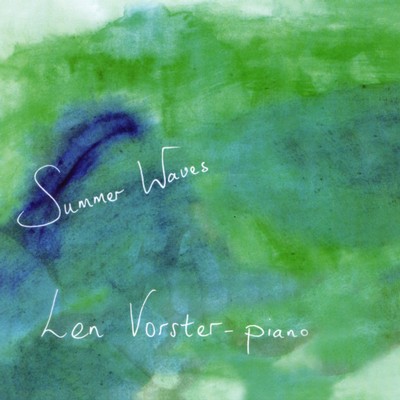
SUMMER WAVES

Len Vorster

Move Records MCD 661

This must be a re-issue because the pianist’s copyright on it goes back to 2004 and the credits listed on the slim leaflet point to original production and design by an entity called MANO MUSIC. This organization is listed as a Norwegian company and the sort of music it publishes these days is (as far as I can tell) soft-core pop. Whatever the history, here is Len Vorster‘s CD under the Move label and this musical content is impressive, if much of it is light. Still, that’s only to be expected when the background to the recording are this musician’s recollections of his youthful holidays by the sea in South Africa.

The leaflet also notes that Vorster is celebrating the centenary of one of the composers he performs: Lennox Berkeley, who was born in 1903 – which puts the recording into an even firmer temporal location. Mind you, it also means that these liner notes have not been updated; more to the point, a biographical screed printed here on Vorster is also possible to date from 2004 or thereabouts because his career details after that time remain unrecorded.

The CD opens with Gershwin’s three Preludes of 1926, familiar pieces that betray a sort of compositional constriction despite the ebullience of the outer numbers. Then we have a clutch of disparate pieces by de Falla: Cancion (1900), Serenata (1901), Nocturno (1896), Serenata Andaluz (1900), Vals-capricho (1900). Two pieces by Lord Berners follow – a 1941 Polka and a 1943 Valse. Continuing the sudden British detour, Vorster airs the 1945 Six Preludes for Piano by Berkeley. Two nocturnes follow – one in B flat Major of 1817 by Mr. Nocturne, John Field; the other more well-known one coming from Grieg’s Lyric Pieces of 1891. Then it’s all Gallic fun with Debussy’s La plus que lente waltz of 1910, Poulenc’s Les chemins de l’amour song dating from 1940 but here pianized, and Ravel’s Valses nobles et sentimentales of 1911 – at close to 15 minutes, the longest track on this recording.

As you’d expect, the so-called ‘jazz’ preludes enjoy an expert airing, the first Allegro not exactly in synch with the published dynamic markings and a heavier accent than most on the last quaver chord in bars 4 to 6, and later when that bass support pattern emerges. But there’s a delicious elegance in the forte-to-piano run pf demi-semiquavers across the penultimate bar and Vorster maintains his syncopated initiative from first bar to last. He takes the middle ‘blues’ prelude slowly and doesn’t really press forward during the middle F sharp Major interlude, taking the right path out of a contradiction between a tempo and largamente con moto.

And I liked the alternation between arpeggiating some of those 10th left-hand stretches and landing the notes together; sort of in keeping with the relaxed ambling pace of the composition’s most successful pages. For the final Allegro prelude, Vorster maintains a consistent rhythmic and dynamic output; my only complaint is that the final statement of the theme in octaves across the score’s final 8 bars impresses as hard-won rather than the virtuosic powerhouse made of it by other interpreters.

Fall’s Cancion follows Gershwin’s ternary shape and stands as an unremarkable, melancholy piece of salon music with a deftly reinforced re-statement of the composer’s balanced tune. A bit more national colour flavours the Serenata which is given with an agreeable rubato that invests the piece with a quasi-improvisatory ambience, even if all the notes are there to be articulated – in this case, with great sympathy. Not much distinguishes the Nocturno, apart from an infectious descending figure of two demi- and one semiquaver across a Major/minor 3rd; which lends the piece a kind of Andalusian kick. Otherwise, it’s a Chopin rip-off with no claims to longevity.

Speaking of that province, we come next to another serenade in the Serenata Andaluz which is a tad more diffuse in its shape than its precedents by this writer. Here, the colours applied have a very familiar character, not least the triplet that comes at the start of the bar which concludes several of the main tune’s phrases (after we get to a tune, 16 bars after a frippery-filled preamble). The piece oscillates between D Major and minor, expanding to a polonaise-rhythm coda that eventually recalls the decorative opening as de Falla harvests his material – sort of. But Vorster’s reading is infectious and eloquent.

After this composition, we enjoy yet another just as fulsome in its expression. The Vals-capricho is an ebullient piece of semi-virtuosic salon music, certainly more digitally challenging than anything we’ve heard in the Spanish composer’s output so far. The performance is excellent, finding out the rather trite sentiment and its flashy expression, maintaining a steady pulse throughout, handling the right-hand flights in alt with obvious mastery.

But it’s about this stage that I started to wonder about the relationship between Gershwin’s brassy combination of Latin rhythms and jazz, de Falla’s ambivalent unhappy fusion of his country’s folk music with the effete ‘art music’ of his youth, and Vorster’s summertimes at home in South Africa. You might call it all holiday music, possibly: nothing heavy, most of it pretty skittish, a lot of it amiable and forgettable. And the vivacity keeps on coming with the two dances by Berners, the Polka a heavy-handed romp with a penchant for ending a phrase on an inappropriate note, but the atmosphere jaunty and vulgar in a 1920s style – impossible to imagine without its generic forebear in Walton’s Facade of nearly 20 years previous. Vorster sounds comfortable with the piece’s flourishes and loud peroration, but the piano sound is inclined to be harsh and jangly.

The Waltz is longer as well as more polished in its modulation scheme and shape. Vorster performs it with a liberal rubato and plenty of languid hesitations but the most interesting element lies in its irregular phrase lengths and the whimsical interchange of the anticipated with the eccentric. You wouldn’t call it a serious dance by any means but you are drawn in by its impetus and spiritedness. Both these Berners pieces are emphatically tonal; any of the contemporary experiments and rule-breaking that the composer would have been more than well aware of, considering his rich field of acquaintances, find no place in his own work.

You have to assume that the inclusion of Lennox Berkeley’s Six Preludes would be partly due to Vorster’s friendship with Michael Easton, a pupil of the venerable English composer. While you might find traces of holiday romps in Berners’ frivolities, these almost contemporaneous pieces have more gravitas to them. The first, Allegro, is a serious near-toccata with a continuous run of triplets underpinning the aggressive chords that constitute the central matter. As becomes the pattern in the series, the second prelude is much more relaxed in tempo, a slow-moving Andante, following a recognizable developmental path and staying within the rather sophisticated harmonic boundaries that Berkeley set himself.

No. 3 of the set, Allegro moderato, is the shortest and another busy construct, loaded with purposeful activity and clever in its progress, if not leaving much to roll around the tongue. The following Allegretto is a slow-moving waltz based on a simple enough melody memorable for a mid-motion demi-semiquaver snap, its evolution cloaked in a sequence of ever-mobile modulations; the whole finely realized by Vorster whose delivery is both deliberate and insouciant.

No. 5 is an Allegro whose outer segments appear to be in 7/8, the central page moving to a regular 6/8. The material is light-hearted at either end with a piquant, elliptical stepping melody that is subjected to less stressful handling than its predecessor. Finally, the longest of these preludes, another Andante, takes us back to the quiet and contemplative ambience of the other even-numbered pieces, serving as a rather sentimental envoi to the set, here handled with excellent suppleness. Berkeley’s work, more than anything so far on this album, might suggest the happy days of the performer’s youth, if one spent in elevated company.

An odd miscellany follows, starting with Field’s Nocturne No. 5 that is distinguished for its gentle charm and dexterous right-hand writing, Vorster takes his time over the fioriture but gets to the heart of the gentle sentiment that colours these two pages. He brings admirable breadth to Grieg’s Notturno, notably the concluding nine bars where he makes a good deal out of the composer’s sleight-of-hand coda. As well, you have to admire the precision of those quiet, exposed trills in bars 16, 19, 57 and 60.

We end in France, first with Debussy in slower-than-slow mode. Here, the rubato direction is employed fully and the interpretation is one of quite legitimate pushes and pulls, fits and starts, action and languor. Even if it was written as a benign satire, La plus que lente is a highly effective, moody score that oozes seductiveness, more persuasive than pretty much anything else in the belle époque‘s musical output. Poulenc’s waltz-song, originally to Anouilh’s words, has a genial spirit with a considerable sweep to it, but it seems to me to be indistinguishable from many others of its type. Further, its language smacks of the music hall and presents as simplicity itself when compared to its Debussy companion. As we’ve come to expect, Vorster’s reading is excellent: an enthusiastic rendition of a piece of fluff.

Ravel’s collection of eight waltzes is remarkable as an extended essay in pianism if unsettling in its juxtapositions of tonal high spirits and bitonal or added-note chords in eventually-resolved discord-to-concord movement. Each of the constituents, apart from the concluding Epilogue Waltz 8 which is a downward-looking Lent, passes by rapidly. There is a kind of contrast available – for instance, the stentorian call-to-arms of the first Modere – tres franc, followed by the 7th-rich ambivalence of the following Assez lent. But the impression is of studied cleverness in the clashing thirds and fourths that pepper the No. 4 Assez anime which in turn is set alongside the quiet appeal of the lilting pp and ppp calm of Ravel’s Presque lent No. 5.

I’m not much of a fan of the middle F Major (ostensibly) pages in No. 7 where the accents get displaced and the outcome is a blurred mess; not Vorster’s fault but a triumph of smartness over sense. Still, the final quietly resonant pages with their premonitions of Britten’s Moonlight interlude bring this odd, challenging miscellany to a cogent end. Yet, for the last time, I have to wonder how these off-centre waltzes put us in mind of holidays. To me, they anticipate the 1920 La valse which some see as a glorification of the dance form, while the rest of us find it close to a post-war nightmare.

Faintly bowing

TOGNETTI. MENDELSSOHN. BACH

Australian Chamber Orchestra

Concert Hall, Queensland Performing Arts Centre

Monday, September 16, 2024

Einojuhani Rautavaara

First piece on the program for this latest ACO mid-tour appearance was not scheduled in the original material. Rautavaara’s Pelimannit – Fiddlers is a five-part suite for strings, fantasias on tunes by folk-fiddler Samuel Rinda-Nickola. This Opus 1 was originally a piano solo that the composer arranged for strings and it employs a good many fiedel techniques or – better – habits like no vibrato, flat-bowing, passages with unvaried dynamic and (I suspect but can’t prove) some microtonal output to establish roughness of group articulation.

The work was expertly carried off by the players, with an outstanding passage or two when ACO artistic director Richard Tognetti‘s violin shadowed the cello melody line of Timo-Veikko Valve – possibly in the second Kopsin Jonas movement – where the folk-music suggestiveness reached an apex; more convincingly than the strident sweeps of the suite’s outer movements where the ethnic flavours were slathered on. Naturally, what come to mind on exercises like this are the works of Bartok: the employment of national musics from across Europe in settings of folk tunes, if not the Hungarian master’s transmutation of such material into his own music.

In this arena, Rautavaara sounds dependent on the players’ vitality and community in combination more than making much of the melodies as subjects for treatment. In fact, my impression was that the variants didn’t travel very far from home-ground and the harmonizations were more intriguing for their timbral qualities rather than for any polyphonic interlacing. But then, the work comes from 1952, seven years after Bartok’s death and the composer was pushing his up-to-datedness hard at the age of 26 in an unadventurous environment. Still, Pelimannit enjoyed a performance that elevated the score to an absorbing level.

Adelaide-based composer Jakub Jankowski wrote his Ritornello to the ACO’s commission and the score is enjoying its premiere performances in this series. The score begins with gestures: all players extending their bows like duellists, swishing them, then a communal shout reinforced by a hefty foot stomp and the work proper begins with long, slow bands of sound that move into a melodic strand (a Ukrainian folksong, the composer claims). Several features struck me as original, like the harmonics produced on Maxime Bibeau‘s double-bass and a kind of orthodox tutti that seemed to me to be the ritornello itself. But the most novel sound came with a kind of regular one-note bouncing effect, thanks to some wooden comb-bows utilized by the performers.

Still, I’m probably all at sea about the ritornello source and character as the score carefully wound up its strands into a composite; e.g., those extended bow gestures being given to individual players who used them as directive punctuation points during the work’s progress. It is paying Jankowski no small compliment to observe that his score kept his listeners intrigued; not so much for the theatrics but for the exercise of tension and release, for the generous spread of sound-sources around the eleven participants, and by his afore-mentioned sense of shape, of formal probity.

We then experienced a Bach violin concerto, the BWV 1041 in A minor with Tognetti as soloist. I’ve not experienced the Bach recording of this, the E Major Concerto, the Violin and Oboe Concerto and the D minor Double Concerto that this violinist and his orchestra produced to significant acclaim in 2006. But this night’s reading was unsettling because of Tognetti’s interpretation which eschewed the bold strokes of most players and favoured a remarkably light right hand under which notes tended to disappear. I don’t mean tutti passages but solo-dominated sections where the executant is meant to administer a clear line.

So no soaring aspirations in this version which was equivalent to seeing through a glass darkly where all too often the progress of Tognetti’s voice drifted into inaudibility. Certain aspects of the supporting decet’s work also puzzled, like the sudden pizzicato that was employed once during the opening Allegro, and the vibrato-less chains of detached and continuous quavers that populate the middle Andante‘s length. Of course, this latter methodology gave the soloist a plain setting above which to outline the composer’s splendid arabesques. Again, reticence came into play and the movement’s emotional eloquence was ignored for a polite, unassuming series of statements, distinguished by an occasional rhythmic liberty amounting to a sort of slurring of a gruppetto.

The gigue finale moves too rapidly for much beyond slotting the notes into place but here again, the soloist was determined to be self-effacing. At bars 31-32, the semiquaver interruptions to the regular quaver set-up didn’t come as a relief but a faint set of quivers. As the movement bounced past, you looked in vain for any assertion of primacy in the top line; rather, Tognetti followed an eccentric path that dipped in and out of prominence, blending in with the ritornelli bursts but leaving even these pages to succeed by an inbuilt minor-flavoured vivacity.

After the break, we came back to a smaller ensemble for Anna Thorvaldsdottir‘s Illumine; the pairs of violas and cellos remained, as did the bass, but the violin forces were halved to Helena Rathbone, Anna da Silva Chen and Ike See. The briefest work programmed, this short nature (I believe) poem was meant to indicate a physical transition to light – or was it one solid movement from quiescence to enlightenment? Shuddering, slow bands of discordant (later, concordant) sustained notes, suddenly fore-fronted sounds yielding to complaining short scales, Bartok pizzicato snaps, finally a series of soft glissandi: it’s all there in an amiable compendium of technical tropes common to your contemporary writers. Will I want to hear it again? Probably not because I didn’t catch anything individual about it.

To end, we had more of the disappearing violin approach across Mendelssohn’s E flat Major Octet, one of the ACO’s showpieces. Tognetti and Rathbone divided the softly-softly attack style between them, with Ilya Isakovich and Tim Yu rounding out the requisite violin quartet. Here also, we met with the absence of a hero top line; rather, we were faced with one that was content to meld in with the ensemble, yielding place to anyone with a moderately interesting subsidiary contribution – just playing along with the gang. The first Allegro came into high focus for this approach as the lengthy exposition was repeated. Even the opening climactic points at bars 4 and 8, the sforzandi in bars 10 and 11: all were under-emphasized.

And the story continued through a shadowy interpretation of the Andante where the soft outline prefigured what was to come in the very light Scherzo. In this latter, miraculously deft movement, the emphasis on collegiality reached a new high; even that splendid counter-strophe that begins at bar 37 failed to rollick even subterraneously. Still, the sudden break into visibility that came with Stefanie Farrands‘ solo at bar 188 served to leaven the piano-to-pianissimo, leggiero affettuoso atmosphere that dominated proceedings.

Dynamically, the Presto conclusion gave us a relief from the soft-stepping of the preceding two movements with cellists Melissa Barnard and Valve making a welcome forte start to the composer’s opening fugato. Tognetti and Rathbone occasionally moved into a dominant role but my interest (when it was roused) fell on the violas and cellos who seemed to be straining against the bit, unleashing an impressive power and drive when exposed.

This was certainly the most polite version of Mendelssohn’s youthful masterpiece that I’ve heard; fit to be played at the British court of the composer’s time in its polite titillation and well-couched reserve. For all that, the QPAC audience sounded delighted with it. But these patrons were also more receptive than I’d expected to the Pelimannit and Ritornello excursions of the evening’s first half and at least two fellow-passengers on the train home declared their enthusiasm for the Icelandic writer’s exercise. As with nearly everything that the ACO brings to town, you could admire the ensemble’s overall achievement and its polish, but I missed the usual urgency and dramatic sweep that you usually encounter in readings of the two older works.

Diary October 2024

VIGNETTES

Queensland Symphony Orchestra

Concert Hall, Queensland Performing Arts Centre

Sunday October 6 at 11:30 am

The QSO’s Grand Panjandrum Umberto Clerici is guiding us through this French or French-connected set of scraps, with an emphasis on the saxophone, an instrument invented by a Belgian. This morning’s soloist will be Nick Russoniello who will front – inevitably, given this program’s nature – the Debussy Rhapsody for alto saxophone, written in 1911 with piano accompaniment, then orchestrated eight years later by Roger Ducasse. The only other element of the program featuring this instrument prominently is Ravel’s orchestration of Mussorgsky’s Pictures at an Exhibition where the second stop, The Old Castle, features a famous (alto) sax solo. Still, Clerici is conducting selections only from this showcase, so the odds of hearing this gem are about 15 to 1. Also in the allied rather than native-born genre will be Gershwin’s An American in Paris with its brilliant central blues and unintentional (one hopes) suggestions of a loud-mouthed tourist out of his depth. The event opens with a suite from Rameau’s 1735 Les Indes Galantes, hopefully (as footballers say) including that great finale Forets paisibles. Along the way we hear Les Gymnopedies by Satie – presumably all three. And the female-acknowledging extra will be the Overture No. 2 in E flat by Louise Farrenc, written in 1834. That’s an awful lot of playing to fit into a scheduled 70 minutes with no interval, but you’ll be charged from $76 to $109 full price, with various concessions (some of which are useful) as well as the usual outrageous transaction fee of $7.20 attached to every booking.

SOUNDS LIKE AN ORCHESTRA

Queensland Symphony Orchestra

Concert Hall, Queensland Performing Arts Centre

Friday October 11 at 11:30 am

Never too late to start. This program is aimed at children aged from Prep (Is it still called that? My younger granddaughter went through a process called Foundation last year, but that was in Victoria which might as well be a different country) to Grade 6. Conductor Jen Winley has a fair bit on her plate this morning but she’s being assisted by versatile composer/presenter Paul Rissmann and vocalist/educator Ashleigh Denning. First up is the first movement, Dance, from Coleridge-Taylor’s 1909 Othello Suite: a mildly ebullient excursion to get this familiarization process under way. The Brahms Hungarian Dance No. 5 in G minor is also fine, if not exactly calculated to enchant the target audience. For Oz content, we have Elena Kats-Chernin‘s Dance of the Paper Umbrellas from 2013 which exists in seven different versions and is perky enough in a Playschool minimalist manner to appeal to the most jaded of juvenile palates. Rimsky’s bumblebee enjoys a ventilation and the finale is the main theme to John Williams’ Star Wars music. Before that comes a Rissmann composition in Leon and the Place Between which will feature Denning as focal interpreter – a role that she has undertaken at previous airings of this setting of Angela Mcallister’s fantasy adventure. I can’t see anywhere else on the entertainment list where she could feature as well. Tickets are $35 straight, as far as I can tell; no card-use penalty added on.

This program will be repeated on Saturday October 12 at 10 am.

REEL CLASSICS

Queensland Symphony Orchestra

Concert Hall, Queensland Performing Arts Centre

Friday October 11 at 7:30 pm

All of this content is familiar and none of it comes from the John Williams era of composition for the screen, or soundtracks in a contemporary adolescent’s experience (or a young adult’s, for that matter). Conductor-host Vanessa Scammell brings in some adopted oldies, like the Intermezzo from Mascagni’s 1890 opera Cavalleria Rusticana, used in Scorsese’s 1980 Raging Bull film. She brings back Gounod’s Funeral March of a Marionette of 1872 which introduced Alfred Hitchcock Presents TV mysteries from 1955 on. But the rest is a sequence of memorable tunes. You have Henry Mancini’s subtle The Pink Panther from 1963; John Barry represented by both Born Free (1966) and Goldfinger (1964), both put in place by London-born arranger/orchestrator/composer Nic Raine; a selection from Elmer Bernstein’s The Magnificent Seven of music of 1960 as well as Leonard Bernstein’s Times Square sequence from that golden oldie of 1949, On the Town. You can’t go past Harold Arlen’s even older (1939) Somewhere over the Rainbow from The Wizard of Oz in an arrangement by ‘Hurst’ (can that be the ABC’s own Michael?); nor can you get away from the Carousel Waltz/Overture (1945) by Richard Rodgers. Bernard Herrmann is represented by a little suite from his music for Hitchcock’s Psycho, which made 1960 memorable. And we can never forgive/forget Kubrick’s use of Strauss filius’ The Blue Danube for his 2001: A Space Odyssey; written in 1866, the oldest music on this program and, dare I say it, the best? All this is yours for $95 to $135 full price, with lavish concessions for students and children, worthless ones for the elderly, and the usual $7.20 overcharge for taking your money.

This program will be repeated on Saturday October 12 at 1:30 pm. Tickets here cost either $115 or $135 full price; the concessions comments above still apply, as does the loathsome supercharge.

ENSEMBLE Q & WILLIAM BARTON

Musica Viva Australia

Queensland Conservatorium, Griffith University

Saturday October 12 at 7 pm

The country’s leading chamber music organization here presents Brisbane’s premier mixed ensemble; its nature is reflected in this program, as in everything it attempts. Didgeridoo master William Barton has become a familiar presence on concert platforms, playing others’ music but becoming more notable as his own composer. Tonight is the end of a fortnight’s tour for Musica Viva and the ensemble’s regulars take on a challenge, half the program devoted to works by its interpreters. They begin with Ligeti’s Six Bagatelles, derived from an earlier Musica ricercata (1953) for solo piano, here transferred to wind quintet: flute Alison Mitchell, oboe Huw Jones, clarinet Paul Dean, horn Peter Luff, bassoon David Mitchell. Then follows Paul Dean’s 2018 Concerto for Cello and Wind Quintet, fronted by Trish Dean with the oboe doubling cor anglais and the composer employing both bass and B flat instruments. The soloist also gets to star in the eloquent Brahms Cello Sonata No. 1 in E minor, eventually finished in 1865 and here arranged in 2007 for wind quintet and an ad lib double bass (in this instance, almost certainly Phoebe Russell) by German conductor and composer Heribert Breuer. Finally, Barton appears in his own Journey to the Edge of the Horizon, commissioned by Musica Viva for this tour. This involves all the night’s players and invites its listeners into the composer’s indigenous world-view, about which I know as much as most white Australians. Tickets range from $15 student rush to $115 full adult in the stalls. As far as I can tell, there’s no booking/transaction fee, which puts this organization in a class of its own.

CHAMBER PLAYERS 5

Queensland Symphony Orchestra

Queensland Symphony Orchestra Studio, South Brisbane

Sunday October 13 at 3 pm

Here’s another example of the QSO moving between the lines. All eight participants in this concert are cellists; I count seven in the orchestra list, but only six are specified in the material relating to this event. We have principal Hyung Suk Bae, Kathryn Close, Andre Duthoit, Matthew Kinmont, Kaja Skorka, and Craig Alister Young. No mention of Matthew Jones, who features in the QSO’s official cello line-up. And anyway, that leaves us one short. Whoever the lucky musician is, s/he/they will first off get to take part in what I assume is an arrangement of Grieg’s joyfully robust Holberg Suite; actually, I’ve found versions for five, six and twelve cellos, so there are certainly precedents. Popper’s Requiem follows, written for three cellos and piano (another un-named participant?), although I’ve also come across an orchestration of this one-movement work by the great 19th century Bohemian cellist-composer. A favourite encore for cello soloists is Faure’s song Apres un reve, which may or may not feature that spectral pianist, or it could be a solo with cello supporters rumbling underneath. Finally, we’ll enjoy Satie’s Gymnopedie No. 1 – as the publicity has it, ‘reimagined’ – although, if the phantom pianist really is there, you might have . . . No, it’s the cellos’ afternoon and God knows the music is malleable enough. Tickets range from $35 to $59 with the QSO’s home-ground money-wrenching tax of $7.95 added on to every purchase.

INTO PARADISE: FAURE AND DURUFLE REQUIEMS

Brisbane Chorale

Brisbane City Hall

Sunday October 13 at 3 pm

This is a lovely idea: matching up the two top French Requiems in one program. There’ll be a few moist eyes at the end of Faure’s In Paradisum setting of 1890, but the Durufle 1947 work grabs me from the outset with its Requiem aeternam based on the unforgettable plainchant. Both operate on a non-histrionic level and register as spirit-centred rather than the usual Timor mortis conturbat me tenor of Berlioz and Verdi – even Mozart. And we have the recent memory of Musica Viva’s guests, the Choir of King’s College, Cambridge, giving us the spartan choir+organ version of the Durufle to offer a comparison between the chaste all-male timbre and the more credible male-female complex. The two works will be conducted by the Chorale music director, Emily Cox, with venerable organist Christopher Wrench underpinning the process, while the Sinfonia of St. Andrew’s will probably provide smaller-scale accompaniments which exist for both works, although it seems to me that there’s a lot of leeway in the older work, thanks to the composer’s multiple over-writings and changes of opinion.. Soprano Sarah Crane and baritone Shaun Brown take part in the Faure and the Durufle, Crane shifting to mezzo for the latter. Entry ranges from $15 for children and students to a top of $55 for adults with some meagre concessions and a piddling, petty charge of $1.25 for each purchase.

RACHMANINOV’S PIANO

Queensland Symphony Orchestra

Concert Hall, Queensland Performing Arts Centre

Friday October 18 at 11:30 am

Well, you can’t expect the QSO to have imported an instrument used by the composer, can you? What they have in mind is an entertainment that features the Piano Concerto No. 3 in D minor, a work that these days depends for its reach on the 1996 film Shine, telling the story of David Helfgott. I think this work has now surpassed the once-inevitable Concerto No. 2 in C minor as far as regular live performances are concerned. It’s a cow to play but nowhere near as superhumanly demanding as the film makes out. Anyway, you can bet that guest Nobuyuki Tsujii will have it under control, even if he’s not recorded it. Continuing the obvious theme, the QSO under Eduardo Strausser (who, for a young conductor, will turn 40 next year) will perform Prokofiev’s Symphony No. 7 in C sharp minor. The composer wrote an alternate up-beat ending for this 1952 work in order to win a Stalin Prize but instructed that the original quiet finish should be substituted when the roubles were in the bag; as far as I can see, he didn’t win, in any case. But it’s a programming rarity, heard nowhere nearly as often as the Symphony No. 5 or the very popular and crisp Symphony No. 1. So good on (relatively) young Strausser for learning this work and giving it, the composer’s last in the form, a Brisbane airing. Full-price tickets range from $76 to $109 but a child can settle into a good seat for $35; as usual, you have to stump up QPAC’s $7.20 for dealing with your order.

This program will be repeated on Saturday October 19 at 7:30 pm with the addition of the Waltz from Tchaikovsky’s ballet, The Sleeping Beauty, presumably to justify the hike in entry costs. Tonight’s full-price tickets move between $95 and $135; your child can get a poor seat for $35, but don’t forget that spirit-grinding surcharge.

RACHMANINOV SYMPHONIC DANCES

Queensland Conservatorium Symphony Orchestra

Conservatorium Theatre, South Brisbane

Friday October 18 at 7:30 pm

Continuing the Russian composer’s fortunate run of performances, the Conservatorium musicians, under an as-yet unknown conductor, is performing this masterful product of Rachmaninov’s final years in America. Despite the writer’s innate melancholy and gloom, this score radiates as much energy and spiritedness as the Rhapsody on a Theme of Paganini with more than enough demands to keep what will be a large orchestra (including a big percussion group) operating at full bore throughout its three movements. Then, you can follow up yesterday morning’s reading of the Piano Concerto No. 3 from Noboyuki Tsujii with this evening’s interpretation of the Piano Concerto No. 2 from Reuben Tsang, a prize-winner at last year’s Sydney International and first place in this year’s Lev Vlassenko. The Rachmaninov double will be interleaved by works from Mozart and the Luxembourgeois/Australian near-recluse Georges Lentz who was highly favoured by Markus Stenz during his time as chief conductor of the Melbourne Symphony Orchestra. This event takes your regular two hours including interval and you can gain entry for $45 full price, $35 concession, $25 for a student. As usual, it seems that there’s no transaction fee – a mark in favour of this institution’s fiscal responsibility in times of duress for us all.

MAGIC, MYSTIQUE AND MELANCHOLY

Southern Cross Soloists

Concert Hall, Queensland Performing Arts Centre

Sunday October 20 at 3 pm

For the most part, this exercise sticks to its last of focusing on the Belle Epoque and the Ballets Russe. The outlier is a new work by Perth-based writer Lachlan Skipworth that involves the talents of didgeridoo player Chris Williams who is the Soloists’ actual soloist in residence. From what I can make out, the score will be a collaboration between Skipworth and Williams in the best ‘what do you do with this un-notatable instrument?’ tradition. There will be a dash of Tchaikovsky with the Meditation movement from the 1878 three-part Souvenir d’un lieu cher violin/piano duet. For an epoque grounding, we’ll hear Saint-Saens’ Le cygne from the 1886 Carnival of the Animals suite; it will/should probably be expounded by a cello. More populism follows with Faure’s elegant Pavane, originally for piano, from 1888; then the composer’s 1898 Fantaisie competition piece for flute and piano. Further to the period comes Dukas’ showy Villanelle of 1906 for horn and piano. The afternoon’s most challenging work features last: Stravinsky’s ballet Petrushka. I don’t know how this is going to be carried out; the original 1911 score requires a large orchestra and the 1946 revision isn’t that much smaller. There’s a transcription available of the original for symphonic wind band but most of the other versions are for piano solo, four hands, or two pianos. Perhaps here is where the concert’s two other soloists – violin Catherina Lee and trumpet David Elton – will feature, although it’s pretty obvious that Lee will forefront the Tchaikovsky scrap. If you’re under 30, you can get in for $35; if you have a concession card, you pay $73; normal price is a flat $88. Well, it’s not really flat as you’re lumbered, wherever you sit on the schedule, with QPAC’s $7.20 surcharge for attempting to support these players.

NOBUYUKI TSUJI

Queensland Symphony Orchestra

Concert Hall, Queensland Performing Arts Centre

Monday October 21 at 7:30 pm

A QSO guest performing the Rachmaninov D minor Piano Concerto a few days ago, Nobuyuki Tsujii here presents a recital that doesn’t appear in the orchestra’s schedule; so you’d have to assume that the real sponsor is QPAC on whose site I found this event. Not that the musician is casting a particularly wide programmatic net; for instance, he is opening with Beethoven’s C sharp minor Piano Sonata, the Moonlight. These pages are very familiar and you have to be something of a non-pareil to bring anything new to them. He then gives us a couple of Liszt works: the Consolation No. 2 in E Major (well, at least it’s not the following well-worn No. 3 in D flat) and the Rigoletto Paraphrase that focuses throughout on the Act IV Bella figlia dell’amore quartet and is a brilliant exhibition piece for anyone brave enough to enter its challenging cadenza-rich pages, Then follows the placid, ambiguous Pavane pour une infante defunte by Ravel, one of the composer’s best-known piano solo works. The evening’s novelty comes in Nikolai Kapustin’s Eight Concert Etudes from 1984 which are brilliantly voluble exercises in jazz/classical fusion: the sort of thing Gershwin might have written if he’d lived longer and heard more adventurous works. Kapustin has a keen technical insight into writing out what sounds brilliantly improvisational and he shows a mastery of the medium’s modes – cakewalk, blues, Michael Kieran Harvey-type toccata. It will make for a splendid finale to this otherwise predictable occasion. Mind you, there’ll be some trouble getting in: the performance is sold out, so all you can hope for are cancellations.

SOUNDS OF ITALY

Brisbane Music Festival

FourthWall Arts, 540 Queen St., Brisbane

Friday October 25 at 7 pm

This recital opens the second round of the festival’s recitals with artistic director Alex Raineri playing an unusually smaller role in the six events, all of which are offering repeat performances, usually on the following day. Here, the 26-year-old Italian pianist Andrea Molteni – on a tour that takes in Western Australia, the ACT, and Sydney – is presenting an action-packed program that features music by Italian writers and some other works thinly associated with that country. For instance, he opens with Bach’s Italian Concerto; well, to be honest, it’s cast as ‘in the Italian taste’, isn’t it? And he finishes with Liszt’s 1874 Concert Fantaisie on Bellini’s ‘La Sonnambula’ which is something of an adoption rather than home-grown. Still, the body of his presentation is authentic enough. He is playing old Italian in a Scarlatti sonata: the G minor K. 30, known as the Cat’s Fugue. And then he focuses on two contemporary greats. First is Dallapiccola’s Sonata Canonica su Capricci di Niccolo Paganini in four movements that utilize seven of the supreme violinist’s caprices in a language that closes a gap between modernity (in 1943) and Scarlatti’s formalism, especially in the final E flat Major-tinted pages. And then appear two pieces by Petrassi: the 1933 Toccata which in its concise but episodic character mirrors the earliest formats of this type of work, rather than the all-in unstoppable thunderings of the composer’s contemporaries; and the Beckett-inspired Oh! Les beaux jours, the composer’s final piano product which appears to be a diptych composed across a 35-year gap. Entry costs $25 with a $1.99 surcharge, dedicated by the Humanitix booking agents to computer science classes.

This program will be repeated on Sunday October 27 at 10 am.

RENAISSANCE

Brisbane Music Festival

FourthWall Arts, 540 Queen St., Brisbane

Friday October 25 at 9 pm

I’m not at all sure what to expect in this event. It presents as a solo violin recital from Julia Hill but there’s no indication of what she will be playing. The program refers to this player’s ‘touching story of recovery and resilience’, which suggests to me an illness or a breakdown, but references to any such crisis are absent on any of the many websites and accounts that focus on the young violinist. And then there’s the event’s title and that could mean anything from a spiritual awakening to a return to physical life. We know Hill is well-travelled, with an obvious penchant for Japan; she has also performed/studied in Switzerland, China and Singapore, thanks to several scholarships and a distinguished course of study at the Queensland Conservatorium. The only ‘dark’ reference I can find is to COVID, which curtailed a lot of Hill’s plans. Not only hers. Anyway, if you’re after a clean slate event where you go in knowing nothing and happy in anticipation, this is for you. Admission is $25 flat fee, with an additional Humanitix surcharge of $1.99 to subsidise books for schools.

This program will be repeated on Sunday October 27 at 12 pm.

PIANO ROOM

Brisbane Music Festival

FourthWall Arts, 540 Queen St., Brisbane

Saturday October 26 at 10 am

This enterprise is sponsored by HOTA, Arts Queensland, and the Regional Arts Development Fund. As far as one can tell, the exercise au fond combines poetry, background music, and actual live-performed music. The last-named is provided by Corrina Bonshek and Liszt, the latter in the form of his Chasse-neige study, last of the Transcendental Etudes in the set of twelve published in 1852. As for the poetry component, that will be provided by Merlynn Tong. Bonshek has a four-part function: concept, composer, sound-art and collaborative direction.. Tong’s role falls under three headings: writer, voice actor and co-creator. We are blessed with an ambience designer in Tiffany Beckwith-Skinner, and James Clark (also known as Tonepacer) is the sound engineer for this project. In the middle sits pianist Roger Cui. Piano Room is by way of being a ;fever dream’ and we’ve all enjoyed one or twenty of those in our time. The whole thing reeks of the happenings of three generations past and its publicity suggests a surrender of self and critical faculty that I would find hard, unless Cui’s playing is sensationally good – which it may well be, considering his career and achievements so far. Tong is best known as a playwright and an actor but there’s no ban against expanding into verse. In the end, you get to enjoy a sensual feast with lots of manipulated sounds thrown into the mix. Tickets cost $25 with the customary Humanitix $1,99 charge going towards books for schools.

This program will be repeated at 6 pm.

PRELUDE, ELEGY, BURLESQUE

Brisbane Music Festival

FourthWall Arts, 540 Queen St., Brisbane

Saturday October 26 at 12 pm

Two genuflections to tradition, then it’s on with the motley. This recital is being given by the Karlsruhe Concert Duo – cello Reinhard Armleder, piano Dagmar Hartmann – which has been in existence since 1998. The pair open with the G Major Prelude from Bach’s Well-Tempered Clavier Book 1 as arranged by Moscheles for cello and piano; well, the keyboard part seems to be original and there’s an added cello melody on top. Happy but mindless. The duo moves to a cello/piano classic with Faure’s Elegie of 1880 which is well-worn territory. Czech writer Jindrich Feld‘s Elegy and Burlesque of 1954/5 follow; unknown territory to me but a bona fide cello/piano duet. Sadly, these musicians then opt for Part‘s 1978 Spiegel im Spiegel where minimal creativity is brought into play; but, my word, it’s very popular and subject to many performance combinations, of which cello and piano is a permissible one. Enter American bassoonist and composer Chuck Holdeman whose Karlsruhemusik Concert Piece, written three years ago, is here enjoying its Australian premiere; nothing seems to be extant about this score but you’d have to suspect that it was written for this lucky pair of executants. Back to the North for Rautavaara’s 1955 Prelude and Fugue for cello and piano; the trouble is that he composed two of them – their fugues based on the names of Bela Bartok (B-E-B-A), the other on the name Einar Englund (E-A-E-G-D). On to another Burlesque, this for the cello-piano format by Nikolai Kapustin from 1999 and packed with jazzy cross-rhythms and syncopations. Finally, the atmosphere drops markedly for Piazzolla’s Le Grand Tango which I, for one, have heard too many times. But at least you have the preceding Kapustin as a benchmark for what you can achieve with popular tropes. Entry is $25, with the Humanitix $1.99 impost for computer science classes.

This program will be repeated on Sunday October 27 at 4 pm.

WAYFARING

Brisbane Music Festival

FourthWall, 540 Queen St., Brisbane

Saturday October 26 at 2 pm

We have three soloists in this event, the constant fulcrum being the festival’s artistic director and pianist Alex Raineri who accompanies baritone Camilo Lopez and cellist Michael Gibson. Raineri enjoys one definite solo in Debussy’s La plus que lente waltz of 1910, before he accompanies Gibson in Webern’s Op. 11 Three Little Pieces for Cello and Piano from 1914. To conclude the recital, the pair play Ligeti’s two-movement Cello Sonata, finished in 1953 and redolent of his senior countrymen Kodaly and Bartok. In the exercise’s first half, Lopez sings seven Latin/South American songs, most of which I don’t know. Famous Mexican composer Manuel Ponce’s 1912 Estrellita is a familiar quantity but the rest are well outside my ken. First off is Cantiga en la distancia from 1946 by the Cuban Cesar Portillo de la Luz. Then we hear the 1982 Todo cambia by the Chilean expatriate Julio Numhauser, followed by Gardel’s El dia que me quieras, the Argentinian writer’s popular (so they tell me) sung tango of 1934. Next comes Ahora by Otilio Galindez, a Venezuelan countryman of Lopez who wrote this piece in 1978, and then another Argentinian in Carlos Guastavino and his lushly Romantic 1942 La rosa y el sauce. Finally space is found for Venezuelan Simon Diaz’s folk song Caballo viejo which became immensely popular after its publication in 1980. Linking both halves of the recital, Gibson and the hard-worked Raineri perform Gaspar Cassado’s 1931 encore piece Requiebros. As usual, tickets cost $25 for all comers, with a $1.99 for Humanitix to cultivate literacy skills.

This program will be repeated on Sunday October 27 at 6 pm.

FAIRY TALES

Brisbane Music Festival

FourthWall, 540 Queen St., Brisbane

Saturday October 26 at 4 pm

Finishing this segment of his festival, artistic director/pianist Alex Raineri performs a three-part solo recital. He opens with Ravel’s three-part suite Gaspard de la nuit of 1908, its first movement – Ondine – fitting well into the fairy tale scheme. Le gibet which follows proposes a desolate landscape on which is found a scaffold while a bell tolls incessantly in the distance. Scarbo is a goblin, a very active one and possibly malicious into the bargain; but the piano writing is intensely difficult and marvellous to experience. After this we hear a new work by Ian Whitney, here enjoying its world premiere. So far, no news about a title or any content; let’s hope Raineri is more informed than we are. Finally, the pianist performs Melbourne-based academic/composer Melody Eotvos‘ Piano Sonata No. 2, A Story from the Sand Dunes, written three years ago. and commissioned by Raineri. The piece takes its inspiration from a Hans Christian Anderson story concerning a shipwrecked baby who is of noble birth but lives his life as an adoptee fishing on the Danish shoreline.. This substantial sonata – about 25 minutes long – falls into five segments and speaks in a unique voice that suggests mobile power and emotional restlessness.

This program will be repeated on Sunday October 27 at 2 pm.

QSO FAVOURITES

Queensland Symphony Orchestra

Concert Hall, Queensland Performing Arts Centre

Sunday October 27 at 11:30 am

Eduardo Strausser is back to direct this catch-all miscellany that bounds across the orchestral repertoire with frolicsome abandon. To help him on his way, Ashleigh Denning puts in another appearance, following her participation in the QSO events on October 11 and 12 (see above), to host this entertainment. Our morning begins with Bernstein’s Candide Overture from 1956, one of the composer’s smartest and sassiest products gifted with a finely-spun love theme, Oh, Happy We, in the middle of the ruckus. Our own Elena Kats-Chernin comes up next with her Dance of the Paper Umbrellas recycled from the QSO’s October 11 concert (see above). Violinist Ein Na, the orchestra’s Young Instrumentalist Prize winner last year, fronts the Saint-Saens Introduction and Rondo capriccioso delight from 1863 (to be honest, I’d rather hear the melting Havanaise). The Beethoven Symphony No 7 from the fateful year of 1812 is programmed also, but surely not all of it in this 70-minute, no-interval program. Likewise, Tchaikovsky’s 1889 ballet Sleeping Beauty is also on the schedule, but that must refer to the Waltz only – another recycle from Strausser’s October 19 QSO concert. Balancing out the arthouse pretensions of Kats-Chernin’s frolic, we are treated to The Man from Snowy River music by Bruce Rowland for George T. Miller’s 1982 film of happy memory. For a rousing finale, what better than Sibelius’ hymn to freedom, Finlandia? Composed in 1899, this is the ne plus ultra in high-minded nationalism and makes a somewhat lofty companion to Rowland’s derivative sound-track. Full-price tickets cost between $76 and $109 but a child can get a good or a lousy seat for $35; other reductions are available for concessionaires and students. All will pay the QPAC fee of $7.20 for a richly over-funded accounting exercise.

An airing for the natural and the piston

EVENINGS WITH THE FRENCH HORN

Mark Papworth & Rosa Scaffidi

Move Records MCD 640

For his latest excursion into the byways of horn performance and composition, Mark Papworth is again allying himself with pianist Rosa Scaffidi, following the success of their 2020 Siegfried’s Story disc with tuba Per Forsberg.   This time, the horn-piano duet presents two works only: a bona fide sonata for natural horn by Adolphe Blanc, a versatile 19th century chamber music composer whose life-span overlapped with that of Hector Berlioz, whose six-part song-cycle Nuits d’ete has been arranged for this recorded performance by Papworth.

Admittedly, this latter popular sequence of chansons has been arranged over the years since its first publication.  Originally set for mezzo or tenor and piano, later versions by Berlioz accommodated baritone, soprano and contralto.  But then, he directed that specific songs be addressed by particular voice types; ah, what a character.  That detail is ignored these days where  –  in concerts, recitals and on CDs  –   one singer is enough to cope with the series.  Nevertheless, as far as I can see, the composer didn’t arrange any of the set for a solo instrument; certainly not by the time he got around to finishing his orchestration of them all in 1856.

Naturally, in this new format the nature of the work changes and Gautier’s verses become unnecessary; well, without a voice, they would, wouldn’t they?   It’s fair to say that the horn is not the most malleable of instruments for this set of songs and this is apparent from the opening Villanelle which strikes me as laboured, right from the opening Quand viendra in the vocal line.   It’s as if Papworth is at pains to articulate each note, rather than handling Berlioz’s phrases as lyrical continuities.   As well, the horn’s weight sounds at odds with the repeated quaver chord accompaniment.

Le spectre da la rose works better, possibly because of the rhapsodic nature of the vocal line and Papworth does excellent service in outlining his part with well-honed phrasing.  Scaffidi’s reading of the bar 3 right hand differs from my edition and her attack on the two-bar interlude after the end of stanza 1 is too aggressive by far.  For Sur les lagunes, the break inserted in the middle of the held horn note across bars 12 to 14 sounds uncomfortable and the piano’s left-hand chord before Que mon sort est amer! fails to sound convincingly.   As this song progresses, you become aware of some notes in the horn part sounding ‘thin’,; I don’t know enough about the instrument to speak with certainty about the facility of even timbre across scale passages, but I’m assuming that certain phrase-shapes are hard to negotiate with a consistency of output.

But then, it must be a limitation of Papworth’s chosen instrument, which is a French piston valve horn.  This option is almost certainly brought into play because an 1880s horn should best align with the composer’s usual ‘sound’, rather than the later German rotary vale construct that obtains in most (all?) orchestras today.  Chromatic scales seem to be non-existent or rare in horn parts until late Romantic works.

Anyway, we proceed to Absence which presents as suited to the horn’s colour.  As well, the simplicity of the recurring refrain gives Papworth room to employ several modes of articulation while taking minimal liberties with the song’s caesurae and downward-plunging arpeggios.  You can enjoy some fine moments in Au cimitiere, even if the tempo is rock solid and the pleasures are mainly harmonic, like the piano shift in bar 5 and again in bar 12.   But the approach is head-down, tail-up and you miss a singer’s ability to invest tension generated by Gautier’s spectral suggestions.

As at the start, so at the end.  The concluding L’ile inconnue suffers from an orchestra’s absence, even if the work has an infectious grandiloquence in its best moments.   Scaffidi’s semiquavers underneath the second stanza are muffled and her dynamics are often at odds with the  original, e.g. an f for a ppp at the end of this section.   Papworth presents a malleable line, touching at the conclusion where the soft reprise of some of the poem’s opening lines offers a fine realization of the poet’s gentle questioning.

As for the sonata, here the ‘faint’ notes become more prominent because of the nature of Papworth’s instrument: a natural horn, the kind that would have been used by Mozart but which you rarely hear employed in live performances of his concertos for the horn  –  at least, in this country.   These performers repeat the exposition  of the first movement Allegro which strikes me as unnecessary because the form and melodic character are easy to assimilate and the orthodox lay-out of these pages means that you aren’t faced with any difficulties in recalling what is being established as subject to expansion.   No complaints about the horn line but Scaffidi’s quaver octave sequences are suspect in the opening pages and the semiquavers that follow the second subject’s treatment would certainly have benefitted from re-recording; at one point, they simply don’t appear.

However, this is solid writing with no surprises, even for 1861 when post-Berlioz orchestration was affecting a large number of French writers.   Much the same could be said of the following Scherzo which features an unexceptional falling arpeggio figure as its main impetus; the horn’s in F, the arpeggio’s in F, the movement’s in F, and the following harmonic shifts in the B flat Major Trio almost exclusively apply to the piano.   Once again, I’m not sure about some of Scaffidi’s imitative work in the first segment of this movement but the horn is untroubled in a set of pages that offer no real challenges.

During the third movement Romanze, you have more opportunity to notice the instrument’s ‘faint’ notes and engage in the perennial puzzle as to why the overtone sequence works the way it does.  As far as content is concerned, this is a Mendelssohnian bagatelle in A flat Major with a neatly shaped main melody and a middle interlude that begins in F minor and walks an uncomplicated path back to the home key.  Scaffidi’s work is reliable and Papworth exercises his presence in pages where the keyboard initially assumes the dominant role.

The concluding Allegro opens bravely enough but it’s in a hefty 6/8 in F and the horn’s inevitable weak notes are more common here than anywhere else in the sonata and more noticeable because the metrical accents are heavy.   Neither performer is totally convincing across these pages, the piano part occasionally clumsy in semiquaver passages, notably in the piu vivo coda which fails to sparkle but flounders along its path.   It makes an unsatisfying end to this recording that aims to give us an insight into the sound world of the horn as most of us don’t know it.   You’d probably need to to be a devotee of this particular musical corner and more receptive than most to its limitations and oddities.  As a final note, the CD is rather brief, coming in at a few seconds over 54 minutes long.

A fugue too far

SILENCE & RAPTURE

Australian Chamber Orchestra

Concert Hall, Queensland Performing Arts Centre

Monday August 19, 2024

Arvo Part

This concert was succeeding strongly across a little more than an hour of its 75-minute length. The alternations between music by Bach and Arvo Part did not rub the sensibilities as roughly as they might. Both dancers involved showed masterful athleticism, even if it was hard to find much cross-fertilization between some of the music and the choreography. On this final leg of a 12-performance national tour, the thirteen musicians were well played-in to their work. Admittedly, at the end some of us were rather stiff from sitting through an uninterrupted complete session, but you take that readily enough when a Mahler or Bruckner symphony is under way.

Yet the penultimate programmed component – a three-subject fugue from Bach’s Art of Fugue – came close to dissolving all the good that emerged from this event. It’s hard to tell why; maybe the extract’s complexity sounded at odds with the stage of the night that we had reached: the Into Silence bit. On either side of this contrapuntal web, we heard part of the minimalist Pari intervallo by Part and finally a left-field inclusion in the last movement to Hindemith’s Trauermusik which sets the chorale Vor (Fur) deinen Thron (not Wenn wir in hochsten Noten sein as the program notes have it). You can accept the slow-moving four-line Part piece, even the odd theological connotations that our coming before the throne of judgement involves silence (where have all those laudatory angels gone?). But the fugue, despite its proposals of abstractness and detachment, makes a solid complex – a marvellous web, and the opposite of silence.

The ACO’s artistic director Richard Tognetti and Sydney Dance Company’s equivalent Rafael Bonachela presumably put together their five-part exercise in tandem. They set up a basic alternating pattern through a Prelude that opened the night with an eight-voice canon in C Major by Bach which takes its own course once you set it in motion; followed by a Part toccata which is the opening movement from the composer’s Collage on B-A-C-H, making for some amiable scrubbing before we arrived at the first of the night’s scheduled three gardens.

First (appropriately enough) was the Garden of Eden where the snake appears straightaway in the concluding aria Wer Sunde tut, der ist vom Teufel from Bach’s Cantata Widerstehe doch der Sunde: a forbidding opening gambit, sung with eloquent chromatic ardour by counter-tenor Iestyn Davies who in fact recorded this work in 2017. To soften the blow of our expulsion, Tognetti performed the 38-bar long dolce from Bach’s A Major Violin Sonata, which served as a welcome reminder of the halcyon, God-concordant early days in this Biblical ambience.

Such a state of grace was followed by another effort from Davies with Bach’s alto aria Jesus ist ein guter Hirt, a grave if ornate G minor effusion from the placid Ich bin ein guter Hirt cantata which impressed for the buoyancy of the vocalist and the violoncello piccolo adaptation by (I think) Timo Veikko-Valve. Still, the singer occasionally produced some forced production that recalled the excesses of British cathedral choir altos. To conclude our time in this primordial ambience, we heard Part’s Fratres with which the ACO has previous experience, notably through an ABC recording in 2017. I assume this was the composer’s 1991 version for string orchestra and percussion; at all events, the effect was mesmerizing, in large part for the fluency of the participants in addressing this structurally simple score.

An abrupt move took us to Gethsemane with some more Bach in the Andante from the A minor Violin Sonata of which I remember nothing; it’s just a blind spot in a performance that left the stage illuminated (sort of) but cast the audience into exterior darkness, reliant on memories of a 17-section tapestry of music-plus-ballet in which this sample of Tognetti’s art left not a wrack behind. Still, it was well subsumed by Davies’ launching into more Bach with the Erbarme dich from the St. Matthew Passion: one of the composer’s great penitential arias, even if it does come after the Agony in the Garden chapter. It shouldn’t, but my interest in these pages is almost totally devoted to the mellifluous violin obbligato line, here accomplished with touching empathy.

Part’s Fur Lennart in memoriam was written for the funeral of former Estonian president Lennart Meri in 2006. Its core is a Slavonic hymn, but the surrounds comprise powerful bands of diatonic string sound which seemed appropriate to this segment of the evening. All that I found in question here was volume. The few performances of this threnody that I’ve come across are weighty, rich in string timbre; this abridged body of six violins, pairs of violas and cellos with one double bass was clear enough but not as overpoweringly dynamic as you might have expected.

To facilitate our exit from this venue for tears, Davies sang Part’s setting from 2000 of Robbie Burns’ My heart’s in the Highlands for counter-tenor and organ. The vocal line is a monotone on three different pitches and the singer spiced up his interpretation by mildly shadowing the SDC duo’s steps and hand motions. While the number slotted in to the general air of pre-Crucifixion despondency, I was perplexed by Part’s dour reaction to the poet’s mix of elation and nostalgia. Still, you could hardly fault the delivery of the piece which was as emotionally remote as you’d want.

The last garden is that of Heaven, to which we were welcomed by the 21-bar sinfonia to Bach’s Der Herr denket an uns cantata. This is stately and benign at the same time – definitely relevant for the saints among us approaching this garden – and carried out with an excellent underpinning energy and phrasing. Part’s Vater unser original, for boy soprano/countertenor and piano was arranged for the ACO and Andreas Scholl in 2013 for that counter-tenor’s tour with the ensemble. The music is doubtless sincere but represents the contemporary Nordic norm in religious writing: a melody that outlines the text clearly and without embellishments, a static harmonic scheme, and an absolute rejection of anything that has been written in the 20th (or 19th . . . or 18th) century. As well, it presented no challenge to either Davies or the ACO.

In further acknowledgement that we had arrived safely, Valve gave us the Prelude to Bach’s C Major Cello Suite. This is a triumph of certainty in its happy sequence of scales and sequences, building to the powerful stretch of displaced arpeggios based on a low G that stretches from bar 45 to 61. As far as I could tell, the reading was exact and eloquent: the sort of music that might well be played in this garden, written by a man who is, as Sagan (possibly) indicated, humanity’s boast.

Davies’ final contribution was the Et exsultavit aria from Bach’s Magnificat, usually undertaken by a Soprano II, so that the counter-tenor’s timbre took you by surprise, notably in some of the vocal line’s one-syllable curves. But its repetitions and fecund linear interplay simply continued where the cello suite movement left off. Once again, I’m afraid my interest fell away and onto the ACO’s sprightly escorting abilities. After this, we moved into the Into Silence trilogy which came close to cruelling this lengthy miscellany. But the insertion of Hindemith’s consolatory chorale setting made the end of our journey both moving and elevating.

The SDC dancers – Emily Seymour and Liam Green – demonstrated some engrossing movement phases that mirrored the abstract patterns of the music; fine for Part, hard to find fault with in the Bach instrumental scraps, but superfluous during the numbers sung by Davies – in particular, the cantata extracts. Nevertheless, the interlacing of their bodies and occasional bursts of mirroring rarely grated, often complementing the contrapuntal writing of Bach and balancing Part’s repetitions and simplicity of construction with impressive grace.

Finally, Chad Kelly oscillated cleanly between chamber organ and harpsichord across the program, the former instrument more audible in this large hall which is problematic for any musician operating a keyboard from stage level. As with the ACO itself, his work showed expertise and a devotion to the task throughout this largely successful undertaking.

A most clubbable composer

SUN FUN AND OTHER DISAPPOINTMENTS

Michael Easton

Move Records MCD 657

First off, an admission: I knew Michael Easton – fairly well, in fact. We were, for a time, co-critics on ‘The Age’ in Melbourne before he was rusticated for asking in one of his pieces the perfectly reasonable question of why was Mahler such a melancholy manic-depressive? A touchy editor who revered the composer took umbrage and so I lost another – and by far the best – in a long line of associates. He took me to lunch several times which, among other things, showed what a genial host he was – a bright light in the faded rooms of the Savage Club.

Further, he was a complete musician, far more at ease in his work than any other writer I have come across, except Peter Sculthorpe who shared with Easton a courtesy and ease with his fellow man that was most appealing in the context of Australian composition during the latter half of the last century. Like Sculthorpe, he never complained about criticism of his work – a more rare characteristic than you’d think among their peers. When he died untimely back home in England, he left a hole in the musical landscape of Melbourne where he was indefatigably active until his last sad years.

To commemorate the 20th anniversary of Easton’s death, Move Records has issued this CD which I think was originally put out in 1994, then reissued in 2004 by Len Vorster. Certainly, the prefatory comments on the Move disc’s attached leaflet by Michael Hurd speak of the composer as alive, so no work has gone into updating that appraisal; which would be particularly hard to do as Hurd himself died in 2006. And the time span of the works presented lies between 1981 and 1993 – just before Easton arrived in Australia (1982) and then three years after he co-established the Port Fairy Spring Music Festival (which continues to this day).

Two works date from 1981: Moods for piano solo, and the duo piano Cocktail Suite for two, five movements of which three are on this CD. Vorster plays the first of these – a four part collection – and collaborates with Easton in the alcohol-inspired dances. The Moods were written in the garden of the composer’s sister; they show Easton’s reaction to British pastoralism and are conveniently paired into slow-fast partners – In reflective mood, High spirits, Alone and lonely, Practical jokes – and last a little over five minutes as a collective.

None of these is particularly deep; they’re just deft expressions of . . . well, moods. All are concise and neatly argued constructs; a benign good humour peeking out of the odd-numbered ones, with a cleverly piquant sprightliness in the others. The language is unabashedly tonal – E minor, B flat Major, E flat Major, C Major in turn – with plenty of bitonality and harmonic quirks to keep us and interpreter Vorster on guard. But not aggressively; the set comprises four bagatelles, well worth the attention of inquisitive pianists of the time.

Easton and Vorster begin their duets with the Whisky Sour Waltz where the composer plunges happily into the world of the lounge pianist with an appealing melody that dodges and curves its way across the dance floor with post-Straussian gusto; the performers stay in sync for most of its progress. The following Martini Melody suggests Tea for Two and is loaded with Easton’s panache at imitating/encapsulating the two-step mode with a clever control of the keyboard, even if these executants tend to some sloppiness in their synchronicity close to the piece’s conclusion. Finally, the Schneider Cup Charleston refers to a drink that I don’t know. The Cup itself is easy to trace to an aviation prize in the Charleston era (roughly) but it’s not served in any bar I know. Still, the piece is suitably racy and suggestively derivative; your speakers will fairly drip with reminiscences of Bright Young Things.

How Pleasant to Know Mr. Lear sets five of the master’s products: three of the limericks, Mrs. Jaypher, and the work’s self-ridiculing title poem. Baritone Ian Cousins is accompanied by Vorster in another group that takes a little over five minutes to perform. There was an Old Man who said ‘Hush!’ is a clever take on Britten with its carry-on lines and angularity; There was an Old Man of the Hague presents to my ears as a lesson in bitonality; There was an Old Man of Whitehaven makes syllabic additions to lines 4 and 5 but offers a progress from Victorian-era sentimentality through an atonal glaze to a placid Edwardian resolution.

As for Mrs. Jaypher, Easton gives us a brilliantly lively setting – but of the first stanza only. Cousins is required to go falsetto for most of the heroine’s direct speech but it’s probable that the composer found little inspiration in the lemon-invested second stanza, which would also have required a massive amount of artificial sound-production. In contrast, we hear all eight stanzas of the title song which – for most of the time – follows a rhumba pattern and offers both executants some tests in pitching (for Cousins) and malleable rhythm (Vorster), which they master, for the most part.

The CD’s most substantial work is the Piccolo Concerto of 1986, written for Melbourne Symphony Orchestra flautist Frederick Shade and here recorded at the Port Fairy Spring Festival of 1992 with the Academy of Melbourne and its founder Brett Kelly conducting. You notice straight away the constant presence of the soloist, orchestral ritornelli being kept to a minimum. The score asks for an escort of strings with a percussionist contributing occasionally; in the first Allegro, it’s side-drum and tambourine, I think. The ambience is British pastoral, although the phrase lengths of the first subject are slightly off-kilter; still, the work follows a sonata form layout and this reading holds only one point where the soloist turns slightly flat on a sustained high note,

Easton’s following Andante con moto opens with the main melody confided to a solo cello, Shade eventually taking over with a counter before putting everyone in their places by following this opposing idea while the orchestra continues with the quiet lyric. Once again, the soloist is almost a continuous presence, even if his function is mainly high-pitched decoration or serving as an anti-strophe.

As with the first movement, Easton’s concluding Rondo features a principal theme that is slightly irregular rhythmically but loaded with an attractive piquancy that sets off the intervening episodes very cleverly. Here, the strings have more tutti exposure, if only for a few bars each time, but the work’s procedure offers a clever contrast between Malcolm Arnold-style humour and a controlled lyricism that could be Delius if the older composer held more firmly to a harmonic focus. Just before an ornate final main tune restatement, Shade is given an athletic cadenza which interrupts the prevailing jolliness just long enough.

From 1987 come Deux chansons pour l’arriere-saison – the first a Verlaine setting, Colloque sentimentale; the second by Gerard de Nerval, Dans les bois. Here the singer is soprano Kathleen Southall-Casey, with Vorster accompanying. The first might be familiar from Debussy’s setting of the same lines, but Easton makes it more of a rather difficult cabaret number; not that difficult for the pianist but quite a stretch for the vocalist. While the vocal line has an attractive elasticity, there is not much attempt to differentiate the separate lines and attitudes of the former lovers’ conversational gambits.

As for the rural excursion, the mood is frivolous with a modicum of regret in the third and final stanza. Of course, there’s not much you can do with a short outline of the love-life of a bird but Easton gives his pianist plenty of dexterous exposure and the final lugubrious suggestions are dismissed with a dismissive tail-flick that puts this frivolity in proper perspective.

Bidding farewell to the 1980s is the solo piano piece Conversations of 1988, here performed by Rebecca Chambers who does an excellent job of re-creating Easton’s mercurial temper. The work recalls a tedious restaurant dinner during which the composer was distracted by what he heard coming from other tables which contrasted with the far-from-sparkling talk at his own. It opens with a series of Prokofiev-like scrambles, before a change to a more measured dissertation (his dining partners?). But the bustle and buzz interferes in a less-than-subtle manner, illustrating all too well the composer’s suppressed irritation at being stuck in a conversational trough. Chambers’ reading is suitably aggressive and languid and she invests this brief outburst with the necessary vigour of precise articulation and dynamic heft.

We arrive at the 1990s through the CDs title work which sets four poems by Betjeman, with Southall-Casey again in Vorster’s company. You are instantly puzzled by the first piece, Song of a night-club proprietress which is also known as Sun and Fun; as well, there’s a rather well-known and predictable setting of these lines by Madeleine Dring. Easton views it as a sort of scena with a piano support that works as punctuation for a recitative-like vocal line which gets increasingly vehement and self-obsessed as the poem lurches through its five stanzas.

Harvest Hymn is a savage critique of contemporary farming with its pursuit of profit over the countryside’s good – an old story but a gripping one for those who believe in the myth of Merrie England. Easton’s setting is suitably feisty in the best Brecht-Weill manner; the piano part sets up a nightmare landscape where the machines are winning out while the voice declaims bitterly against the landowners’ greed and enslavement to possessions and wealth. Just a pity that the composer decided to resolve his penultimate, biting discord.

With In a Bath Teashop, Betjeman presents two lovers – an ordinary woman and a thug – looking lovingly at each other. Easton gives this everyday vignette a lavish Straussian vocal line and a throbbing accompaniment that might suggest the devotion underpinning the lyric. Southall-Casey gives a fine sweep to the higher aspirations of the song in its finishing couplet. To end, we get the Dame Edna-suggestive How To Get On In Society which treads the same boards as Walton, if the texts are more mundane. The poem is a monologue by a woman setting up her house for a tea-party; all very middle-class and concerned with trivialities. Easton captures the fussiness and self-absorption of the narrator, the vocal line appropriately four-square and affected. For some reason, the poem’s middle stanza is omitted. And I’m pretty sure – from three different sources – that the line runs ‘I know that I wanted to ask you’, rather than ‘I know what I wanted to ask you’.

From 1993 come two final works. The first is the Flute Sonata written for Richard Thurlby whom Easton met while the latter was studying at the University of Melbourne; from which point he went to the UK and since seems to have sunk from sight. For this CD, Thurlby is accompanied by Len Vorster. The work lasts for about 10 minutes and speaks the French-inflected compositional tongue that Easton inherited from his teacher, Lennox Berkeley. The opening Allegro malicioso strikes me as nothing of the kind, centred around a simple gruppetto of four semiquavers leading to a sustained upper note which serves as a sort of focal point for the movement that unfolds in concentrated swathes before a muted conclusion at odds with the swirling action that has preceded it.

Easton’s following Nocturne: Andante cantabile offers a fine fusion of sentiment and power; the emotional language sounds more determined and sincere than much on this CD. The composer was never one to scale the heights of modernity and the spices he employed in his work were usually mild; these pages in particular speak to the man’s professionalism and the ability to find a particular spectrum of operations, then explore it effortlessly.

The last movement is a moto perpetuo that brings to mind the Presto that rounds out Ravel’s Piano Concerto in G, including a final flourish that appears to borrow a leading figure from the French writer’s pages. Easton revisits that four-semiquaver motif from his first movement, as well as offering a reminiscence of his nocturne just before the final leap back into action. If the frenetic character of this movement reminds you of the Concerto, it still has its own quiet acerbity as both these executants turn it into an entertaining tour de force, eloquently written for the instruments themselves.

The second of these 1993 compositions is another four-part song-cycle: Dorothy Parker Says. This was originally the title of a stage-show for Australian actress Deidre Rubenstein, from which exercise Easton has extracted these vignettes; on this CD, Rubenstein is the vocalist, the composer is her accompanist. The set begins with General Review of the Sex Situation. The poem is a wry eight-line sequence of male-female generalizations that run past as a calm cabaret number, which is then repeated, half in quick-time, then back to the prevailing languor for the final quatrain’s repeat.

With the Song of Perfect Propriety, Parker belts out her desire to indulge in the derring-do of a modern-day pirate behaving like Blackbeard, but she is constrained, at the end of all this wishful thinking, to write slight verses. The song starts with a recall of the Ride of the Valkyrie and ends with a spurt from Mendelssohn’s Spring Song; in between, Rubenstein recites-sings with gusto her bloodthirsty ambitions for a once-upon-a-time masculine life on the ocean wave, etc. The obverse to this comes in Fulfillment which is half-spoken, half-sung. This reviews the writer’s early life under her mother’s care and the disillusionment of disappointed love in adulthood. In medias res, Easton enjoys a solo break before Rubenstein returns to repeat the poem’s final quatrain. It makes for a depressing plaint, if a familiar one and the vocalist makes excellent work of its torch-song potential.

Speaking of which, the last of these songs is a perfect example. But Not Forgotten speaks of a woman’s thoughts at the end of a relationship, one which has been intense enough to linger in the memory well after its disruption. This is a quiet, strolling reminiscence of no great overt passion but delivered with a fetching, breathy calm that finishes off this CD in a highly relevant way: it is hard, at least for some of us, to forget Easton and his unflappable skill.

Diary September 2024

CHAMBERS PLAYERS 4

Queensland Symphony Orchestra

Queensland Symphony Orchestra Studio

Sunday September 1 at 3 pm

Just two works being played this afternoon, one of which is a perpetual source of delight: the Brahms String Sextet No. 1 in B flat with its astonishing quantity of warm melodies enjoying the most benign of developments and restatements. As a partner, behold the Sonata for Two Violins by Miklos Rozsa, master of those legendary film scores stretching over a 45-year career. The Hungarian-born writer had the benefit of revising his score several times after its initial appearance in 1933 until the final version appeared in 1973. Which raises the question of what we’re hearing this afternoon because the original is listed as Op. 15, while the revision became Op. 15a; this program lists the former. Whatever happens, the nationalistically-inflected three-movement duet will be performed by Mia Stanton and Sonia Wilson, both from the QSO’s first violins desks. For the sextet, they are joined by violas Imants Larsens and Nicole Greentree, alongside cellos Hyung Suk Bae and Kathryn Close. Once again, I’m perplexed by the recital’s proposed length of 1 hour 20 minutes, as the Brahms lasts about 37 minutes on average while Rozsa’s sonata takes up about 17 minutes. Tickets rage from $59 full adult to $35 for a student, with the QSO’s inexplicably self-indulgent ‘transaction fee’ of $7.95 added on to every purchase.

PUCCINI DOUBLE BILL

Queensland Conservatorium – Griffith University

Conservatorium Theatre, South Brisbane

Tuesday September 3 at 6:30 pm

As usual with the Conservatorium events, I’m in the dark about most details regarding this three-performance season. As you’d expect, the organizers have left out Il tabarro; a pity, because of those two powerful, passionate duets involving Giorgetta. So here we get the trite religiosity of Suor Angelica and then the farce based on one joke that is Gianni Schicchi. You can get involved in the angst that runs through the story of Angelica’s last hour but the eventual redemption from the stigma of suicide sounds to me like special pleading of an unpleasant nature, particularly when faced with the suicide of Doria Manfredi in 1909. The final tableau always strikes me as ridiculously bogus, a sop to the composer’s bourgeois morality and a sad self-justification. The trouble with the comic opera is trying to establish personalities for so many of the dead man’s relatives; two of them are interesting (well, perhaps three), but in productions I’ve seen most of the other six are given nothing to do. Mind you, the compensations include two splendid arias for Rinuccio and Lauretta but the work’s dramatic success depends totally on Schicchi. For all I know, the Con has an able baritone to carry off this difficult role. The conductor will be the establishment’s opera guru, Johannes Fritzsch, and Lindy Hume directs. Tickets are a flat $55 with no extra costs.

This program will be repeated on Thursday September 5 at 7:30 pm and on Saturday September 7 at 2:30 pm.

EUCALYPTUS – THE OPERA

Queensland Symphony Orchestra

Concert Hall, Queensland Performing Arts Centre

Wednesday September 4 at 2 pm

From various sources, it seems that Jonathan Mills‘ new opera, based on Murray Ball’s all-but-forgotten novel, received its premiere at the Perth Festival on February 21 this year. The work is also on the schedule of Victorian Opera for mid-October, the difference being that the WA premiere was a concert version while the Brisbane and Melbourne presentations are fully-staged, this Concert Hall one directed by Michael Gow, set and costume designs by Simone Romaniuk. From what I can glean from various sites, Desiree Frahn is singing Ellen and her crazy father Holland will be taken on by Simon Meadows. Mr. Cave is sung by Samuel Dundas and the stranger with talk of a world outside the forest that circumscribes the heroine has been entrusted to Michael Petrucelli. Conductor at the premiere and in Melbourne – and therefore here, probably – is Tahu Matheson. The work is in two acts, I suppose; at least we are informed that the opera in its Brisbane shape lasts 2 hours 20 minutes including interval. The odd thing is that I can’t find out when the central body responsible for its creation – Opera Australia – will be mounting this work at its home base (let’s be honest: its home) in the Opera House. After all, the Perth, Melbourne and Brisbane co-commissioning companies have done it the courtesy of a prompt airing or two in their regular venues. Tickets at QPAC range between $89 and $120, with the usual $7.20 ‘transaction fee’ added on, just to ensure that the event attracts even fewer patrons than it might have done.

This performance will be repeated on Thursday September 5 at 7 pm.

SPIRIT OF THE WILD

Queensland Symphony Orchestra

Concert Hall, Queensland Performing Arts Centre

Friday September 13 at 11:30 am

Here’s an eerie three-part concert that vaults from one historical phase to an extreme opposite. In the beginning is the overture to Haydn’s The Creation oratorio: The Representation of Chaos which, to Haydn’s mind, meant withholding the resolution of cadences. It’s a very Age of Reason musical depiction of the colossal muck-up that preceded the Big Bang, the Grand Deflation, or whatever descriptor tickles your primordial fancy. The world having been established, Umberto Clerici and his musicians move to Nigel Westlake‘s oboe concerto that gives this event its title. In its original 2016 form, the work was scored for Diana Doherty‘s solo (which she recreates here), four horns, timpani, five percussionists, harp, piano and strings. Westlake found his impetus to write from a visit to Bathurst Harbour in Tasmania, although he knew about the state’s wilderness from his youth. The program’s second half involves American writer John Luther AdamsBecome Ocean of 2014 which is organised in three instrumental groups that will keep the stage crew busy throughout interval. The score works as a palindrome and the little I’ve heard should not perturb Debussy admirers; Adams spends his 40-plus minutes layering textures in what would function quite satisfactorily as the soundtrack to a sub-marine documentary. A child gets in for $35; the full adult rate is $109 for a good seat. And then there’s QPAC’s usurious credit-card-use fee of $7.20.

This program will be repeated on Saturday September 14 at 7:30 pm. Top price increases to $135 and most other costs rise too, but a child’s ticket continues to be $35.

TOGNETTI. MENDELSSOHN. BACH

Australian Chamber Orchestra

Concert Hall, Queensland Performing Arts Centre

Monday September 16 at 7 pm

For this appearance here, the ACO appears unrestricted by any guest appearance(s). The evening’s solitary soloist will be artistic director Richard Tognetti, who takes front position for Bach’s A minor Violin Concerto which he recorded with the ACO in 2006; some of musicians from that time still survive in the ensemble’s ranks. As a preface, the orchestra plays an octet: Illumine, written in 2016 by Icelandic composer Anna Thorvaldsdottir. I’m assuming that this will be expanded to include all 17 or so of the ACO forces; it originally asked for a double bass and cut back by one on the regular number of violins. Anyway, this short piece has nothing to do with intellectual or spiritual light, but dawn: a natural phenomenon that delights you some of the time. We’re also enjoying the premiere of a work by Adelaide-based composer Jakub Jankowski; it’s apparently for string orchestra so will fit right in here but – as yet – the score lacks a title. And the ACO concludes its night with another octet: that by Mendelssohn which we’ve heard from the group several times and which the ensemble recorded in 2013. Entry costs $25 for a student, plus almost an extra third of that price for daring to enter into a financial transaction with QPAC; top tickets for adults cost $139, plus that $7.20 supercharge.

KRISTIAN WINTHER & DANIEL DE BORAH IN RECITAL

Queensland Conservatorium – Griffith University

Ian Hanger Recital Hall, South Brisbane

Thursday September 19 at 7:30 pm

Here’s hoping that Conservatorium faculty member and pianist Daniel de Borah attracts a larger crowd than his last recital in the Hanger space attracted. Tonight he’s partnered with violinist Kristian Winther of whom I’ve heard and seen very little since he left the Australian String Quartet in 2014. In this short outing, the duo perform two 20th century gems. One is the Shostakovich Violin Sonata of 1968, written for Oistrakh and an unsettling instance in its first movement of the composer coming to terms with 12-tone music: that is – use it, then lose it. Still the remaining two segments make for an intensely involving experience. The other piece is Bartok’s Violin Sonata No. 1 in three movements. Written in 1921, this work shows the composer at his most hard-bitten and confrontational with some shatteringly virtuosic passages for both executants. What makes this event most attractive is not the quality of the playing (about de Borah, I have no qualms) but the fact that you rarely hear either of these works on a mainstream program; in fact, I’ve not come across either of them in years. Tickets are $22 and, as far as I can tell, there are no concessions. But there’s also no booking fee – o brave new conservatorium that has such accountants in it.

CHAMBER MUSIC SIDE-BY-SIDE WITH THE L. A. PHILHARMONIC

Queensland Conservatorium – Griffith University

Conservatorium Theatre, South Brisbane

Friday September 20 at 7:30 pm

This sounds sensational but, as you’d expect, needs to be taken with several grains of salt. For one, the Los Angeles orchestra has not arrived at the Queensland Con en masse; just a few of them have made the trip – a wind quintet. Indeed, the group is here primarily to give an Utzon recital in the Sydney Opera House on Sunday September 22. Perhaps there’ll be common ground between the two events but at this Brisbane exercise, the American players will be joined by staff and students for a solid two-hour presentation. The visitors are flute Denis Bouriakov, oboe Marc Lachat, clarinet Boris Allakhverdyan, horn Andrew Bain (whom I remember from a stint he put in with the Melbourne Symphony Orchestra over a decade ago), and bassoon Whitney Crockett. It’s great to see that the visitors are all principals with the LA Phil and – a special Californian tribute to the rightness of things – they’re all male. As usual, there’s no indication what the mixed ensemble will be playing; if you’re interested, you’ll just have to come along on spec. Students get tickets for $25 apiece, the concession rate is $35, and the full adult price is $45. In line with previous recital/concert bookings at this venue, I can’t detect a superimposed fee.

REQUIEM FOR THE LIVING

The Queensland Choir

Old Museum, Bowen Hills

Saturday September 21 at 7:30 pm

To begin, the choir will be singing Vivaldi’s Gloria RV 589 (vague memories of playing continuo organ for a joint PLC/Xavier performance in Monash University’s Robert Blackwood Hall too many years ago) which ranks among the composer’s best-known vocal works and remains buoyant throughout its half-hour length. I can’t find out the names of the three soloists, if there’ll be an orchestra (oboe, trumpet, strings, continuo), or who is conducting (Kevin Power, probably). After this comes the title work by American composer Dan Forrest, which exists in three versions; I suspect that the full orchestral one will not be given this evening. The composer sets his work in five movements: an Introit/Kyrie, an amalgamated set of Scriptural scraps in sympathy with the usual Dies irae (why not take on Thomas of Celano’s original?), an Agnus Dei (out of sequence in the Mass liturgy), then a Sanctus, finally a Lux aeterna. What I’ve heard of this work is heartfelt and simple-minded, traditional and smoothly accomplished with no problems for singers or instrumentalists. Finally, I’m unsure about the venue: the Choir’s website refers to ‘The Old Museum’, but the Old Museum (Bowen Hills) has nothing on its own website about this concert. Are there two Old Museums in this city?

FROM THE NEW WORLD

Brisbane Philharmonic Orchestra

Old Museum Concert Hall, Bowen Hills

Sunday September 22 at 3 pm

Here’s a lushly Romantic program that opens with two difficult pieces for any orchestra to negotiate, and then concludes with a magniloquent repertoire warhorse that holds a closetful of taxing moments. Conductor Steven Moore sets the bar high with the Prelude and Liebstod from Wagner’s Tristan und Isolde, following these studies in deferred resolution with Chausson’s Poeme de l’amour et de la mer. The afternoon’s hard-worked soprano in both works is Nina Korbe who will be tested early on by her instant entry into the Wagner outpouring. I remember a hapless guest singing with the Melbourne Symphony Orchestra many years ago, vocally clutching for her entry point and looking desperately at conductor Oleg Caetani for a note after the Vorspiel‘s unhelpful concluding, almost inaudible low G in the cellos and basses; she came in several steps away from the actual E flat required. The French composer’s three-part song-cycle makes a fine if controlled partner to Isolde’s massive stream of abnegation and assertion. Chausson sets up two eloquent vocal landscapes on either side of a refreshing, if puzzling, interlude. And good fortune to the players when venturing into Dvorak’s evergreen Symphony No. 9 with its double-sided character of being both a celebration of the composer’s time in America and his anticipated return home to the welcoming streets of Prague.

Variety with a rich French seasoning

THE CHOIR OF KING’S COLLEGE, CAMBRIDGE

Musica Viva Australia,

Concert Hall, Queensland Performing Arts Centre

Thursday July 25, 2024

Choir of King’s College, Cambridge

This distinguished group is making its ninth tour for Musica Viva Australia, and this time around it is playing to its strengths – at least as far as the Brisbane program is concerned. One characteristic not on show in this Program 1 is British music; whereas the second bill of fare includes pieces by John Bull, Tallis and Judith Weir, the solitary sample of home-grown art for us was Edgar Bainton’s Revelation Chapter 21 setting, And I Saw a New Heaven. For the rest of this event, the accent fell on France, the main element being Durufle’s Requiem of 1948, with two Messiaen organ solo side panels. A bit of German British maybe in Handel’s Zadok the Priest, a Venetian excursion with Gabriel’s O Magnum mysterium setting of 1587, followed later by an American detour for Martin Laurindsen’s 1994 popular version of the same text, and a friendly antipodean nod through Sydney-based composer Damian Barbeler‘s recent setting of Charlotte, a poem by Judith Nangala Crispin.

Not that you can complain about facing a mixed program because it shows the versatility of the executants – well, it’s meant to do so. But a real practical problem arrived when trying to work out which of the organ scholars – Harrison Cole and Paul Greally – was actually playing specific items. I found out later from the organization that the pair both contributed in the first half while Greally performed the Durufle. My eyesight is certainly not what it was and the players were a fair way up the back wall of the Concert Hall, but I had the allocation of labour completely wrong. Time for the opera-glasses, I suppose. Even so, I can’t specify who accounted for the two Messiaen extracts.

Warming up the listeners with a golden oldie, director Daniel Hyde and his singers opened the night with Zadok the Priest, one of the organists having to work through that long introduction with an abrupt shift in dynamic (keyboard?) early in the process and without the benefits of a true slow crescendo or the initial fluorescence of three violin lines, not to mention the original’s instrumental explosion of three trumpets and timpani when the choir begins its work at bar 23. On top of all all that, the sopranos were unusually faint (drowned?) in the opening choral strophes and the interpretation sounded effete and over-studied, especially when compared to sturdy, top line-reinforced performances like that at the recent British coronation ceremony.

It was unexpected to have an organ supporting the double choir Gabrieli motet, especially as I couldn’t find an edition with such underpinning. What you can come across are readings where some of the vocal lines are given to instruments (those trustworthy Venetian trombones), but who’s to determine what universals obtain when dealing with the Renaissance-to-Baroque crossover years? Here was a much more telling sound despite the work’s eight vocal lines, probably because of the disposition of these voices into a treble-dominated group set against a middle/bass-heavy complement-partnership. Further, the approach was informed by an attractive suppleness, notably in the shifts to the congruence of all parts, as in its first occurrence at bar 10. As with Zadok, the output sounded very well-mannered and lacking any European coarseness of dynamic or fracturing of the ensemble’s cool temper.

Whichever one of the scholars gave us Les anges from Messiaen’s La Nativite du Seigneur generated a mobile series of phrases and harmonic shocks (oh, those multiform modes of limited transposition) and a striking suggestion of ethereal animation, the specifically designated birth corps dancing on the heads of a plethora of needles – in this instance, to celebrate a very pointed moment of transubstantiation.

For a soft leavening, the choir sang the Laurindsen setting of O magnum mysterium which gave the audience a recovery space through its deft concordances and fluent part-writing. This is a gift to any choir with sufficient breath control and the Cambridge musicians made a strong case for its quiet benevolence, although to my ears the finest interpreters of this music are American university bodies whose sopranos yield little to these British boys in intonational exactness but whose basses are, at their best, more full-bodied and supportive. While the attack on the work’s two opening phrases was clumsy, the conclusion proved to be as spellbinding as ever.

Time now for the second Messiaen. This was the toccata specially written to replace the third movement of the orchestral version of L’Ascension when the composer decided to transpose it for organ: Transports de joie d’une ame devant la gloire du Christ qui est la sienne – always the man for a catchy title. One of the Cole/Greally partnership worked through this with some of the improvisatory eloquence shown by the composer in his own recording, even if a couple of manual changes were awkward (when are they not?) as the Swell sounded under-powered. But that might have come from an unfamiliarity with the Klais instrument, not much time elapsing between this appearance and the two Melbourne opening stops on this eight-session national tour. However, the executant made a brave showing in the final stanzas from the Plus vif to that exuberant final cadence.

Back to a more prosaic vision of bliss with Bainton’s treatment of the first four verses of St. John’s towering vision of the new Jerusalem. This is standard Anglican content from the venerable Parry/Stanford tradition (the composer was a pupil of the latter) and the level of ecstasy is kept to a restrained level; more noticeable when coming after the French organ master’s confronting excesses. As you’d expect, these singers were quite comfortable with this elegantly phrased anthem; you can see this in operation on an Easter 2020 performance under Hyde on YouTube which has the benefit of the rich acoustic in the College’s chapel.

Finishing the night’s first half was the new work by Barbeler, Crispin’s poem concerned with searching for information about her great-great-grandmother. The composer is fond of single chanted lines that can intermesh or stand in contrast with each other. These tend to be static while his harmonized passages alternate between sweet and discordant: a fair mirroring, then, of the poet’s journey to a kind of fulfilment. The more white civilization is referred to, the more strained the harmonic vocabulary – or so it seemed to me – but the work rises to an angry. declamatory climax. At the end, the singers throw sheets of paper into the air, a piece of theatre that seemed to this observer to represent a suddenly disturbed flight of white cockatoos. I found the gesture rather disturbing, but one old fellow a few rows back cackled with delight; as with our varied reactions to the Voice referendum, you just can’t tell. Still, Barbeler constructed a definite atmosphere reflecting the poem’s desolation in the search for and discovery of Charlotte’s photo.

The Durufle Mass features regularly on the King’s College Choir performance schedule at home, alternating in November with the Faure Requiem. You’d therefore anticipate an ease with its textures and dynamic stability, and this facility was pretty much in evidence, right from the plainchant Requiem aeternam setting up to the death-mollifying In paradisum. After the placid Introit, the choir’s Kyrie enjoyed some welcome Christe eleison angst. You were pressed to find fault here, as in the following Offertorium which distinguished itself with a memorably affecting final Quam olim Abrahae.

The organ ripples that sustain the Sanctus opening didn’t so much misfire as miss an ecclesiastical ambience; put simply, the Concert Hall acoustic proved too dry for many parts of this Mass, in particular these pages. But that deficiency was apparent even from the opening Zadok ritornello which has become familiar to us form performances recorded in more reverberant spaces.

I believe the solos in this reading – for the Offertorium, Pie Jesu and Libera me – were sung by groups, not individuals. Certainly the contralto Pie Jesu solo was handled by a group of boys who gave the final sempiternam a finely poised decrescendo. The return of full forces for the Agnus Dei brought us some of the night’s best concerted work, even if the organ’s swell-box manipulation sounded awkward at one point. And there is little left to say of the final three movements, except to note some intonational discomfort in a unison passage during the Lux aeterna, a worthy demonstration of reserved ferocity when Durufle gets around to the Dies illa of the Libera me, and a sense of regret for us all that the In paradisum is so short.

Very little drama disturbs the progress of this Requiem which is packed with soft floating passages, the composer avoiding the passions roused in so many other writers by the Sequence and the desire to make a visceral experience out of a mass for the dead. Like its Faure counterpart, it suits boy sopranos in its sober tranquillity. Despite lengthy stretches of calm meditativeness, the work’s standard of accomplishment pleased a well-packed Concert Hall which showed a desire to be gratified throughout – even by those striking organ solos. Sadly, this popular approval resulted in most of the Mass’s movements being greeted by applause – in many another case, not such a bad thing but, with this work, these interruptions disturbed the score’s cumulative effectiveness.

By the way, one of the sopranos – fourth from the left, facing the stage – embodied a delight that you sometimes come across in choirs: a lad who is transported by his work, slightly weaving in sympathy with the musical complex, lowering his score often enough to convince you that he knows the material thoroughly, ever alert to Hyde’s direction.