Rich partnership continues

BRAHMS CELLO

Zoe Knighton and Amir Farid

Move Records MD 3451

You’ll find the cello well-represented in the Brahms catalogue. We have the bountiful Double Concerto Op. 102 as well as multiple chamber works: three definite piano trios, three piano quartets, the F minor Piano Quartet, the clarinet trio and mellifluous quintet, a string trio, three string quartets, the two string quintets and two string sextets. But when considering the instrument as a more exposed voice in Brahms’ output, we’re left with the two cello sonatas: Op. 38 n E minor and Op. 99 in F Major, written 21 years apart. Still, these stand as highpoints of the form, each score a rich repository of power and brilliance, both indispensable elements in every aspirant instrumentalist’s repertoire.

Here is the latest collaboration for Move Records from cellist Zoe Knighton and pianist Amir Farid. It’s the sixth in a sequence that began in 2010 with the complete Felix Mendelssohn product for cello and piano. This was followed a year later by an Argentine collection of odds and sods, with Constantino Gaito’s Cello Sonata of 1918 as its culminating point. Then came the complete Beethoven in 2012, followed by a French collection in 2013 where Debussy’s sonata capped a series of bagatelles and arrangements. A Russian collation came by in 2015, with the Gretchaninov and Prokofiev sonatas taking pride of place. Most recently, in 2021 we heard the ‘complete’ Schumann through the Funf Stucke im Volkston and the Fantasiestucke Op. 73 juxtaposed with arrangements of 15 lieder by the composer’s wife Clara.

Put both Brahms cello sonatas together and you have about 58 minutes’ worth of music on this particular CD. To flesh out the length, these artists have provided three lieder as makeweights. We hear the first two of the Op. 43 set of four – Von ewiger Liebe and Die Mainacht – along with the middle member of the Op 63 Lieder, Meine Liebe ist grun. All are welcome as reminders of the composer’s mastery at plumbing emotional insights, as in the eternal love statement from the maiden in the first of these, where the rhythm moves from a solid 3/4 to the more consoling 6/8 and Brahms’ tonality changes to the major while his melodic line pursues a complementary path to that urged by the worrisome lad who thinks he’s throwing down a commitment gauntlet at the end of the seventh stanza.

No such affirmation in the melancholy depression of the May night wanderer who clearly thinks the search for his lachelndes Bild is fruitless, its only outcome this perfectly posed lied which surges to a compelling ardour in Knighton’s hands at the flattened supertonic downward arpeggio in the seventh-last bar: a superlative example of poetic self-pity.

Separating both is the happy outpouring about love’s freshness and the elation of its emergence in what I assume is a young man’s voice although, in these piping times of transgenderization, nothing can be taken at face value. Knighton and Farid approach this passionate lyric through a vivid realization of its Lebhaft direction, the pianist’s hands full of syncopated middle voices across the lied’s stretch, leavening the cello’s regularly-shaped vocal line.

You’ll find so many indelible pages in Brahms’ output that have maintained their power to move, years after your first experience: the Violin Concerto’s finale opening, the gloom-piercing Ihr habt nur Traurigkeit from A German Requiem, that amiable Menuetto from the D Major Serenade,, the subterranean hugger-mugger of the finale to the Symphony No. 3, an open-handed humanity from the opening bars of the G Major Violin Sonata, the enthralling breadth of the Piano Trio in B Major’s first 44 bars – you could go on for some time.

Among these passages of unforgettable responsiveness strikes is the first movement entire of the E minor Cello Sonata. Knighton and Farid’s reading works as something like a scouring revelation to those of us who play it as a tussle for supremacy; for example, the forceful contest between bars 54 and 65, or the lurching inexorability between bars 111 and 125. In this account, the duel remains rational and disciplined, thanks to Farid’s delivery of a moderate dynamic output. You find plenty of willing power in this disc’s interpretation but the intention of the players’ output is to emphasize the muffled drive of the composer’s construct, peppered with some eloquent detailed work, such as the slight hiatus heralding a change of key at bar 50, and Knighton’s haunting, veiled line at the repeat of the exposition’s opening.

An important factor in the appeal of this movement comes with the performers’ responsiveness to each other, especially in their mirrored phrasing, best exemplified across the development section’s pages which are a model of mutual pliability. Mind you, these musicians stick to a schedule, even at the relaxation of this movement’s coda when we change to E Major for a consoling lullaby and the pace is less stringently marked. Of course, that emotional ease after pages of controlled stress is one of the joys with which Brahms delights us, if nowhere more touchingly so than here.

When it comes to the Allegretto quasi Menuetto, the performers present the movement with an easy grace, their phrasing well-balanced and congruent, Farid happy to set the running from bar 47 to bar 59 where the piano has all the action over an unexceptional bass-reinforcing cello part. Here again, you can find details that pique your attention, as in the Boskovsky-like hesitation concluding bar 70 (that recurs at the end of the pleasantly fluid Trio’s second part).

Unlike most other assaults on the final Allegro, Knighton and Farid have a rather laid-back approach where the fugal lines are given plenty of air, the ambience less fierce than you’d expect. Still, this makes sense when you consider the clarity of the writing and the uncomplicated nature of the entries while the fugue is still in operation. Knighton makes an effective splaying of those solitary cello bass notes in the polemic of bars 25 to 29, But the most noticeable factor in this version is the lucidity of mass from both players, especially in those pages that are often handled as a sweaty welter, which includes pretty much everything from bar 147, through the Piu presto, up to the concluding clincher. This interpretation dances in well-heeled shoes rather than the all-too-common galoshes.

When we come to the Sonata No. 2, the atmosphere changes completely. Its first pages are notable for a tremolando urgency in the piano underpinning a vibrant, buoyant outpouring from the cello, the complex excellently handled by Knighton and Farid as Brahms moves from exuberance to less active, more measured elation, then back again to furious action from both participants. Later, you can relish the narrative directness of the development with its sequence of compressed treatments, culminating in the reversal of roles between bars 92 and 118 where the cello is all a-flutter while the piano articulates quiet, full-bodied chords, this passage remembered in passing before the emphatic conclusion.

An attractive sentiment typifies the Adagio affettuoso and a gentle and pliant approach makes for a reading that involves you, even if it doesn’t overwhelm with emotional weight. Neither player goes for the jugular, except possibly at the emphatic start to bar 64 where Knighton’s pizzicato is unexpectedly percussive; both maintain a consistency of pace and pointed emphasis in crescendodecrescendo tides, Knighton employing a healthy vibrato while observing the decencies, rather than spilling over into ripe blather.

Once again, you could find much to admire in the following Allegro passionato, particularly Farid’s sensible handling of some very thick writing, not least those hemiolas that start in bars 17-24 and recur (in both instruments) across the movement. Later, what a welcome delight to break out of a particularly emphatic batch of them at bar 109! Then, alongside the galumphing rhythmic high-jinks, you reach a lyrical pearl in the Trio from bar 180 to bar 191, even more welcome in its glowing repeat. Again, you have to thank these performers for the aural rewards they give us in the clear delivery of texture in these pages that are often treated with more bucolic gruffness than is necessary.

We arrive at the final Allegro molto and strike a friendly enough landscape, if not a particularly long-winded one. The only feature of its plain main melody that strikes interest is the flattened leading note in bar 3; the rest of the melodic terrain makes for plain sailing. One of the few later points of interest comes with Farid’s deft account of the right hand in bar 28 where the triplets against regular quavers are enunciated with admirable ease. But then Farid is a model of care in his work, as witnessed across these two sonatas with no detail glossed over and a high degree of consideration for Knighton.

So welcome to this new CD which provides us with a fine demonstration of a partnership in full fruition, the partners’ energies and talents exercised on a brace of cello/piano masterpieces. It makes a welcome addition to the libraries of Brahms enthusiasts and a true pleasure to the ears of those who delight in experiencing chamber music at its most appealing.

Old wine, refurbished skin

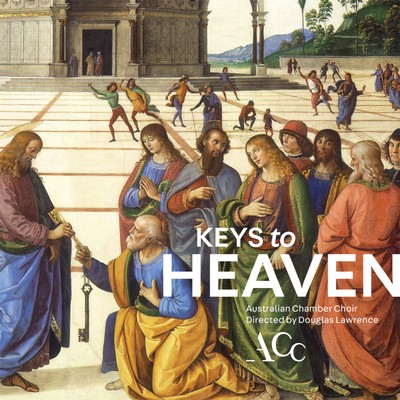
KEYS TO HEAVEN

Australian Chamber Choir

Move Records MCD 659

A reconstruction is the main point of interest in this new CD from the Australian Chamber Choir of Melbourne (similar to the Australian Chamber Orchestra of Sydney). Elizabeth Anderson, long-time ACC member and wife of the body’s artistic director/conductor, came across a fragment or six written by Agata della Pieta, one of that fortunate group educated at the Ospedale in Venice with which charitable institution Vivaldi’s name remains inextricably linked. Anderson discovered some parts for Agata’s setting of Ecce nunc (or Psalm 134) in Venice’s Benedetto Marcello Library and built up a working version for public presentation.

As well as this novelty, the choir has produced another reading of Palestrina’s Missa Aeterna Christi munera to sit alongside its previous recording of 2014/15. Among a scattering of bibs and bobs, Allegri’s Miserere enjoys an airing; I think I first heard the ensemble sing this polychoral warhorse in 2010. More Allegri comes with Christus resurgens ex mortuis for 8 voices. And there’s a neatly wound version of Palestrina’s papal office-affirming Tu es Petrus for six voices, director Douglas Lawrence making sure we hear the Secunda pars which is omitted in many recordings and scores.

The CD itself is a compendium with the Christus resurgens and Palestrina mass coming from a live performance in Our Lady of Mount Carmel Church, Middle Park, Melbourne given during November 2019. The latter composer’s motet also emerges live from a week before in St. Andrew’s Church, Brighton, Melbourne. The all-too-well-known Miserere setting seems to be a collation of two performances: one at the Middle Park church on August 23, 2023, the other three days later at Mandeville Hall in Toorak, Melbourne.

As for the Agata psalm-setting, the greater part of this recording took place in the Scots’ Church, Melbourne on May 4 2022, eleven days after the work’s world premiere in Terang, Victoria. One solitary track from the ‘new’ score – the contralto aria In noctibus – was taped at the Collins Street venue almost two years later on April 12, 2024. Which makes this last the most recent track on a disc which has enjoyed a five-year gestation.

Anderson’s realization divides the psalm into four sections. The first sentence is covered by two movements: a soprano solo with choral interference, then a plain soprano solo. Unfortunately, the booklet accompanying this disc allots to the aria a line of text that is actually included in the soprano-plus-chorus opener, which led to an inordinate amount of repeating the tracks to trace what was going on. The specially-recorded contralto solo takes care of the second sentence, and the third and final one is given to the chorus. Fleshing out this brevity, we hear a doxology in two parts, the initial Triune extolment given to two solo sopranos, the following unlimited-time guarantee fulfilled by a single soprano and chorus – just as at the work’s opening which provides its material.

Lawrence employs modest forces to bring this score to life, including a string quintet and Rhys Boak on organ. His choral forces are also modest with six sopranos and four each of altos, tenors and basses. Still, the work itself is hardly Baroque-Heavy, as you can predict from its opening ritornello: a mobile, gentle chain of semiquavers, delivered carefully if marginally out-of-tune at the end of bar 3: a predictable problem when playing non-vibrato in stile antico. Amelia Jones‘ soprano makes a clean business of the opening solo and the choral body continues the placid ambience established at the opening.

The following aria for Jones with Jennifer Kirsner‘s obbligato violin, Qui statis in domo Domini, presents an adroit duet contemporaneous with many another more complicated (and more interesting) exercise in this form to be found in Bach’s cantatas and Passions. Reconstructor-contralto Anderson also enjoys Kirsner’s assistance through her aria which shows that the singer’s voice has remained the same over the many years that I’ve been listening to it it; accurate, but awkward in delivery.

The Benedicat te chorus is brief, standing in as a palate-cleanser, just like a chorale in the more substantial German works being written at the same time as Agata was composing this gentle piece. A soprano duet – Jones and Kristina Lang – begins the doxology, distinguished by the excellent complementary timbre of the singers and the occasionally scrappy upper violin contributions in triplets. Then Jones enjoys a solo – shorter than in the opening movement – for the Sicut erat up to et semper, before the choir enters to re-appraise all the concluding lines of this placid wind-up to so many prayers in the Western Christian tradition.

As a whole, the newly-discovered setting gives us an eminently approachable sample of this period’s compositional style, Agata’s instance notable for its benign atmosphere and generally predictable progress. We’re introduced to a creative voice that few of us would encounter across our life-spans, and one that speaks with a sort of quiet confidence. How much is Agata and how much Anderson, we’ll probably never know, but the composite entity makes for attractive listening, excellent material for any chamber choir who wants to engage with a score that is gracious, elegant and reverent – not descriptors that you can apply to much that came out of the magniloquent city of St. Mark.

Palestrina’s motet enjoyed a straightforward interpretation; a bit four-square for my taste, sticking to its pulse with few signs of relaxation (except at the cadences to both parts). But the output remained dynamically balanced across all six lines and the not-too-long melodic arches came across as shapely, except for a length abridgement at the end of the first super terram where sopranos (canti), altos and tenors bounced off the final syllable in order to maintain the rigid tempo. But I suppose when you’re dealing with rocks, the inclination to present an inexorable surface is very tempting.

I’m assuming that there was something of a carry-over of personnel between the mass tapings across the 4/5 year gap; certainly I recognize a few names in this current CD list that were part of the ensemble when I was reviewing the ACC’s Middle Park events. Nothing else I’ve heard has come close to the 1959 recording of this work by the Renaissance Singers in the Church of St. Philip Neri, Arundel: the most riveting, ardent interpretation you could wish for. You’re in for a more balanced demonstration of Renaissance choral music in Lawrence’s hands. Here, tout n’est qu’ordre et beaute, sort of, but you can forget about the luxe and volupte even if calme is all the go.

The ACC’s Kyrie is a model of linear clarity and parity of parts; no change of pace for the Christe but a steady and regular field of play with almost the same disposition of singers as for the Ecce nunc, an extra bass giving substance to that gloriously singable line. More regularity emerged in the Gloria, resulting in a curtailed second syllable in the first Patris just before the Qui tollis chords. However, the ensemble made a fine fist of the piece as a complete construct and – marvel of marvel for us old-time Catholics – you could decipher every word.

A few details intrigued during the progress of the Credo, like the delicate breaks in the Genitum non factum statement up to facta sunt; also a softening of dynamic without the usual deceleration at the Et incarnatus moment; as well, a brightening of attack at the Et in Spiritum Sanctum affirmation; and the realization of those warm key changes at simul adoratur and Et expecto resurrectionem. Despite the rhythmic inevitability (to this geriatric mind, reminiscent of the Creed in Schubert’s G Major D. 167), the luminous pairing of lines that punctuate this movement sounded finely etched and even the two passages of rather ordinary counterpoint impressed for their transparency.

If you were going to exercise rhythmic fluidity, you’d have to engage in it during the Sanctus, where the Hosanna is ideally staged for drama and a suggestion of haste. Not here; Lawrence keeps his singers bound to an unvarying speed. Not even the Benedictus trio shows any deviation from the regular, although the Hosanna return manages to engender a restrained elation. You can actually sympathize with the conductor’s approach to this composition where the chaste sparseness of its content makes a clear parallel with the abstract eloquence of plainchant.

For the Agnus Dei, the pace is slower, more considered as the composer indulges in plenty of textual repetition (as compared with the speedy despatch of the Gloria and Credo). Again, the balance is very fine, each line distinct in the mesh. But the work’s glory is the expansion into five parts for the final pages. This splits the tenors in two and the ACC singers sound appreciably thinner. Still, they are distinguishable in this reading and refrain from braying their top notes but maintain a quiet and controlled output in sync with their colleagues.

There are very few pages in all Western music that offer the consolations of Palestrina’s concluding bars from the dona nobis pacem emergence to the end. When I’ve sung this in previous incarnations, the pace has generally slowed, possibly because of the nature of these final pleas. Very little compares with the subtle consolatory suggestions of those flattened leading notes in the tenor and bass lines as they approach that breathtaking, concluding plagal cadence, here articulated with cautious devotion.

There’s not much to say about the choir’s version of Allegri’s Miserere. Lawrence has rehearsed his men effectively so that the plainchant sections impress for their gravity and sense of space; just as in the best monasteries, there’s all the time in the world. The five-part choir shows itself willing to give power and impetus to their work while the solo quartet – sopranos Elspeth Bawden and Kate McBride, alto Anderson, bass Thomas Drent – operate comfortably in their remote, exposed roles. I don’t know which of these sopranos takes the high Cs but the pitching is exact, the ornamentation pretty lucid.

But the number of participants involved is only 18, which cuts down to 14 for the five-part body when you deduct the four soloists. More impressive is the solid output of the 21-strong group that presents the Christ resurgens motet. There’s plenty of power at the extremities with 7 sopranos and 6 basses surrounding quartets of altos and tenors. The sound is sumptuous throughout, with a nice difference in character between the two choirs at antiphonal passages, the full-bodied stretches a splendid affirmation, particularly during the powerful Alleluias that conclude the three Epistle to the Romans extracts which make up the elements of this polyphonic gem.

A broad gamut for the cello

BEING

Daniel Pini

Move Records MCD 622

Cellist Daniel Pini comes from a well-known Australian string family. His father Carl founded the Australian Chamber Orchestra, handing over artistic leadership to Richard Tognetti about 200 years ago, and he led the Melbourne Symphony Orchestra in the first half of the 1990s. I also remember a string quartet performance (part of an all-Beethoven cycle?) he led which was held in the Athenaeum Theatre many years ago. As well, Daniel Pini’s mother, Jane Hazelwood, still plays with the violas in the Sydney Symphony Orchestra, and some of his siblings are also musicians.

This is Pini’s debut CD album and he is promulgating local composers and their solo cello works with a will. Brett Dean provides the longest work in Eleven Oblique Strategies, written in 2014 for that year’s Emanuel Feuermann Competition held in Berlin. Carl Vine‘s 1994 Inner World for amplified cello and pre-recorded tape (the best kind) is next in size, followed by Liza Lim‘s Invisibility written in 2009 for French composer/cellist Severine Ballon. Red Earth, White Clay was written for Nicholas McManus by Victoria Pham in 2018, the product of an archaeological expedition to Sri Lanka during that year. As for the briefest piece, that comes from Deborah Cheetham Fraillon in her Permit Me of 2020, commissioned by the Canberra Symphony Orchestra and first performed by principal cello Patrick Suthers.

Dean’s work takes its impetus from a collection of aphorisms published in 1975 by Brian Eno of ambient music fame and visual artist Peter Schmidt. These mots were intended to provide either inspiration or stimulus, depending on the respondent’s state of play (or non-play), Dean’s first piece, Listen to the quiet voice, offers specific cells – quite a number of them – and hardly finishes elaborating some of them before he moves into the next piece without a pause: A line has two sides. This employs a vaulting interval that could derive from the first piece’s opening gambit, but the strategy concludes with a catchy, skipping motive familiar from the centre of the initial piece.

Don’t stress one thing more than another acts as a moto perpetuo in which the performer simply churns out notes in a repetitious pattern that obeys the instruction of not emphasizing anything. Until its ending when the action changes in dynamic to strong assertiveness before moving to a study in concentration with Look at a small object, look at its centre which revolves around an insistently repeated note with arabesques spiralling out from it. This piece is notable for the fulcrum study moving out-of-kilter into descending quarter-tones; possibly, an excess of concentration is implied.

When we arrive at What are the sections sections of?, Dean outlines some more cells that appear to juxtapose rather than intersect – a glissando mimicking the work’s opening gesture, a skittering dance fragment, finally a single yearning note that seems to be played consecutively on two different strings. Possibly, the answer to this segment’s question is that the sections are just sections – discrete, not sub-sections. Or perhaps the proposal goes in one ear and rattles in empty space, as so much does with me these days. In Don’t be frightened to show your talents, the composer revisits Strategy Three with a fast-moving chain of notes that gradually move from the cello’s bass to its centre before entering a new field where virtuosic double-stops interrupt the flow and the forward motion moves up the instrument’s register in a splendid mimesis of 19th century concerto writing.

This continues throughout Disciplined self-indulgence which consists almost entirely of double-,triple- and quadruple-stops with an accent on the last of these as the level of intensity – already sharp – rises to an extreme level. Suddenly, we are faced with a striking descending figure in single notes that prefaces Bridges – build – burn. We begin with a powerful rhetoric that returns to the slashing quadruple stops of the previous section, before the fabric slowly collapses in a descending sequence of tremolo shakes, moving down the cello’s range until an inevitable silence.

Ghost echoes is the longest of these short pieces and, as you’d guess from its title, the most ephemeral as we occupy a soundscape where nothing rises above the piano level; in fact, much of its length sounds to be played in pianissimo territory: a music of suggestions, inferences only with a few clear remembrances of aphorisms past. For the Buddhist Disconnect from desire, the composer asks for his player to administer a series of double-stops non vibrato, surely projecting the absence of emotion as a state of what I can only describe as mobile stasis; the music changes notes and register but the effect is a dissociative one.

To end, we are In a very large room very quietly where the atmosphere is just a tad less soft than in Ghost echoes and the sound palette is rich in harmonics and shadows, with a final hint of the leap at the opening to the whole work. Which makes a splendid, challenge-filled contribution to the solo cello repertoire, putting an interpreter through plenty of hurdles and sustaining a sure continuity as Dean juggles his brief bursts of activity with fine craft. I’m still a bit doubtful about Pini’s realization of some high-pitched, soft sections which seemed to waver in their security. But the work convinced for the player’s realization of its inbuilt dramatic shifts in attack and colour.

How big is Vine’s Inner World? It’s a multi-partite entity, for sure, which begins promisingly enough with a series of arresting gestures: a minor 10th vault upwards, sets of demi-semiquavers and hemi-demi-semiquavers, rapid flourishes after sustained notes, further and more elaborately finished variants on that initial springboard – then a tape is added, based on sounds generated by the piece’s original performer and dedicatee, David Pereira. Once this new voice enters, the piece embarks on an often predictable path with two fast segments urged on by a regular motor rhythm surrounding a lyrical, rich nocturne.

The opening sounds like free-fall where the approach is rhapsodic, with the live cello following a lyrical path while the tape provides background colour. This makes for a ‘modern’ sound if not too adventurous, even by the standards of 1994, But then a sequence of tape sparkles and a kind of duet between taped and live cello take over; the sparkles transform to a cimbalom punctuation and the duet/canon continues with more intensity, although the taped component leaves the imitative set-up quickly and opts for harmonic distancing.

The slow middle-or-thereabouts segment gives space to the live cello outlining a slow neo-diatonic melody with an active but hazy background from the other sound source. Some almost menacing taped glissandi and percussive knocks with an overload underpinning pulse bring us to the happy final section where notated and electronic glissandi lead to a happily concordant coda. complete with common-chord quadruple stops from Pini and an abstention from discord that would warm the heart of any reactionary who has endured those previous indications of experimentation.

A good deal of the tape content employs familiar electronic tropes, like the falling bird calls that eventually end the piece, blocks imitative of organ chords, percussive bands that propel the work’s progress with as much subtlety as a rock drummer. I’m not experienced enough in the field to tell if all this material came from Pereira’s instrument or whether some of it was manufactured by studio equipment, but the resulting entity impresses as a suite springing from the work’s first flourishes; rather like Dean’s Strategies.

Lim operates on an aesthetic level far beyond my ability to imbibe fully, but her scores offer an overwhelming breadth of sounds and timbres, each refined and directed to allow for little deviation. She presents a world of subterranean shifts in dynamic and textural shivers across the canvas of Invisibility which calls for two bows: one orthodox, the other with the hair plaited around the stick. To be honest, I don’t understand how the latter produces continuous sounds, but it works – in this recording and in other YouTube performances.

Still, the sonic output stretches the instrument’s array of sound production, even when the player shifts to an orthodox bow when the score accelerates its level of ferocity and initial bite. Towards the work’s conclusion, the player is called upon to use both bows simultaneously, the plaited one eventually ranging up and down the fingerboard in an eerie conjunction of the earthbound and the otherworldly. And that, to me, forms the attractiveness of the experience: a double-barrelled world where nothing can be anticipated and your ears are stretched by the whole engagement.

Easier to imbibe, Victoria Pham’s Red Earth, White Clay appears to exist in discrete sections that might have thematic links but presents on the surface as moving into distinct atmospheres through changes in pulse (where there is one) and the presence of key motifs. The composer’s intention is to revisit the sights and sounds of a dig in which she participated at the northern tip of Sri Lanka. During the central pages of the piece, we have aural references to village/tribal dancing through a repeated bass note punctuated by a melody and some brisk chords. The outer sections that mirror each other (with a bit of Bach suites-like broad-beamed arpeggios suddenly emerging) might pertain to the dig site itself and the impossible-to-convey title of the score.

Pham’s vocabulary, despite glissandi and other gestures towards the contemporary (including some striking harmonics), is conservative, the work beginning with emphatic suggestions of G and D minor; even the post-dance-chugging segment presents a melodic flow that is packed with Romantic nuances. In harmonic sympathy, Deborah Cheetham Fraillon employs an even more limited language in her Permit Me which opens with an A minor cell and stays with that tonality for much of its little-over-three-minutes’ length. The composer projects a mournful ambience, suggesting a lament or at least regret, peppered up slightly in the centre by an abrupt burst of action.

Still, I don’t know for what the composer is asking permission; every time I see those words, I’m reminded, in my culturally blinkered fashion, of the heroine’s address to Bunthorne in the Act 1 finale to Gilbert and Sullivan’s Patience. But you’d have to suspect that Cheetham Fraillon’s intentions are more severe, given the brooding quality of this near-elegy.

The CD is not a long one – about 49 minutes’ worth. Nevertheless, it’s a wide-ranging compendium of solo cello compositions written over a 26-year stretch, demonstrating the broad gap between the innate complexity and sophistication of senior writers when opposed to the reversions embraced by younger voices to that old-time creation. Pini’s performances, as far as I can tell without scores, are temperamentally faithful although a few details in the more complex works come over as wavering, uncertain, and I suspect that he takes the occasional rhythmic liberty. But he’s to be congratulated on putting his talents at the service of local creative minds, some of them highly demanding.

Revelatory retrospective

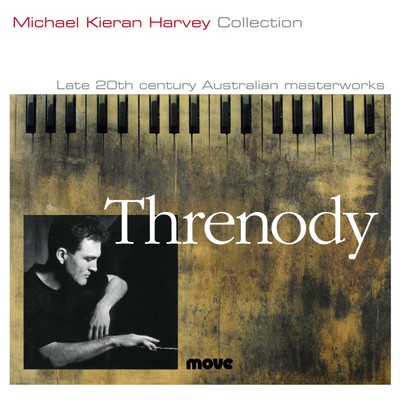
THRENODY

Michael Kieran Harvey

Move Records MD 3475

Here is a re-issue by Move of a recording that was printed almost 30 years ago by the Astra Chamber Music Society. Re-mastered by the indispensable Martin Wright, this CD underlines with pretty heavy scoring the debt that Australian music owes to Harvey, whose dedication to the local product (both the significant and the not-so-remarkable) has remained unswerving across his long, seemingly tireless career. What you hear in this collection is evidence of his professionalism and insights, handling works by six composers (and a couple of his own) with skill and sympathy.

Harvey begins with his own stunning Toccata DNA pf 1993 and later gives us his lesser-known Addict from the following year. Between these two, he plays Carl Vine‘s Five Bagatelles of 1994, Stuart Campbell‘s Quaquaversal from the same year, Eight Preludes by John McCaughey coming from 1991-3, Andrew Byrne‘s Within Stanzas of 1993, Eight Bagatelles by Keith Humble written in 1992, and James Anderson‘s 1994 Reveria im Neuen Stil. He splits the Vine pieces by conserving the last – Threnody – for his final track. All these pieces occupy a compressed compositional time-span, testament to the performer’s intense curatorship as well as demonstrating a sudden temporal rush to the Australian compositional head/brain from composers both well-known and obscure.

Still, there’s not much new to say about this re-issue of a significant body of work that’s been around for so long (that’s assuming that the Astra CD has been available over the years). The portentous opening to Harvey’s toccata with its slow-moving segments brings to mind the variety of Buxtehude before a launch into ostinato-heavy rapidity and that unstoppable headlong flight that seems to me inimitable, this composer-pianist’s own voice speaking with absolute conviction and generating the sort of excitement that you will find only at odd moments in this disc’s later tracks.

With Vine’s Five Bagatelles, we encounter another master-pianist/composer at work in a brilliantly balanced sequence, opening with a rather benign Darkly that presents some material that looks complex on paper but sounds transparent; for example at its splayed chord agglomerations between bars 22 and 25. This is succeeded by the raid-fire syncopations and time-signature oscillations of Leggiero e legato which enjoys a crisp, sparkling run-through.

The control of meshed colour returns in Gentle which opens and closes with more of those splayed chords surrounding the statement of a quiet melody that could have strayed in from an unpublished set of Debussy preludes; shadowy and suggestive in its outer reaches, placid at the core. The untitled fourth bagatelle proposes a raunchy jazz-inflected stroll, like Gershwin’s American brought forward 66 years, but the jauntiness interrupted by more sustained chords offering a brief hiatus, before a nifty note-cluster conclusion expertly accomplished by Harvey.

As many would know, Vine wrote his Threnody for the Australian National AIDS Trust fund-raising dinner, the other four pieces added later with the total work premiered by Harvey at the end of 1994, Its subtitle – for all the innocent victims – is reflected in its character which follows a simple stepping motion that suggests a hymn with an added high mixture stop at a 5th in alt. The result suggests resignation, calm acceptance of an inevitability, and the essential blamelessness of all those trapped in this once-fatal infection. It makes for a sobering conclusion to the CD, a respite from the complexities and abrasiveness of much that precedes it.

Coming round to Campbell’s Quaquaversal, we face a virtuosic complex opening with some massive chords reminiscent of a cathedrale engloutie for our times before a fugal interplay that alters to a ort of ostinato bass supporting a wealth of coruscating darts and flashes. Then the composer’s promise of fluency rather than development sort of takes over with several contrasting episodes (with a mid-level repeated chord featuring in the work’s centre, surrounded by a wealthy of Harveyesque bursts of brilliance). But then, the work was written for the pianist by this one-time member of La Trobe University’s Faculty of Music and it features some pages of dazzling pointillism as it approaches its toccata-like conclusion.

I’m sure a wealth of theoretical depth underpins this work which bursts with verve but you have to assume that the basic impetus comes from the title’s middle six letters. Whatever the case, this is a splendid vehicle for the pianist’s panoply of skills. From another one-time labourer in the La Trobe vineyard, McCaughey’s collection moves us into a more refined landscape; four of his preludes lasting less than a minute, the other four averaging 80 seconds in length. The opening Fluent lives up to its name with some restrained ambles at reserved speed up and down the keyboard. You hesitate to typify the vocabulary but I’d probably light on a compulsive atonality. Presto segreto is not a whirlwind rush but a series of lurches from one pivot to the next, eventually working into its own secret by slowing to a concluding crawl.

With No. 3, Animated, hastening, McCaughey takes us into just that: an atmosphere of abrupt bursts of action punctuated by pivotal mini-pauses, as though the protagonist is faced with a series of dead-ends that set him/her/them doubling back for an alternative outlet. Quick presents as a monophonic sprint, for the most part – possessed by a neurotic elfin urgency. Next, the odd aspect to A sense of slow background tempo is that you’re aware of a rhythmic reticence, as though the work’s progress is being conducted on two levels or in twin layers, even if the overall impression is of a sturdy post-Webernianism.

Mind you, Semplice carries on where its predecessor left off, typified by a forward mobility in which the motives or thematic cells meld into a well-woven fabric; more a handkerchief than a carpet. An overt contrast arrives with Leggiero, recitativo where the principal end is fitfulness, rapid squiggles providing the solid events in this brevity that you could call either whimsical or neurasthenic, depending on your currently predominant sense of aesthetic charity. McCaughey’s concluding Serene seems to be more a journey towards the proposed state rather than a depiction of its prevalence as the piece moves with a confident angularity that occasionally amounts to aggression before a brief resolution.

Byrne recently became a co-director with McCaughey of the Astra organization and he also nurtured his own academic roots in the La Trobe Faculty of Music. After an initial hearing, I thought I discerned four separate sections to this composer’s Within Stanzas; take a few more and you realize that there are a lot more of them. It’s just that they bleed into each other with remarkable fluency so that a sound-production gesture or a timbral-interplay sequence becomes part of a new context or landscape. Mind you, Byrne is lavish with his material which overwhelms your desire for instant auditory analysis, notably in the opening pages’ rhythmic and dynamic conundrums that dazzle with their effective unpredictability. Here again is anther composition tailored to Harvey’s brilliance and premiered by him at an Astra concert, but it is noteworthy that Byrne has withdrawn this score from sale or public performance. He has apparently moved on, and so should we.

Closer to a minute shorter than McCaughey’s preludes, Humble’s brevities show the pianist-composer in assured mode, the score rich in awareness of the instrument’s breadth of colours and most impressive in its rapid-fire virtuosity. You find an illustration of this in the opening Fast which exposes an assured forward thrust while ranging over the piano’s compass before a contradictory slow conclusion. The following Slow is still an instance of forward motion, couched in a compositional style that brings to mind the 19th century more than the composer’s dodecaphonic home ground, with a rich, sustained major chord to cap proceedings.

Easily the longest of these bagatelles is No. 3, For Tony P., very slow, molto rubato. This could be an elegy or just a quiet eulogy; it’s the most placid and stress-less of the collection, opening woth a minor 3rd cell and expanding on this in the best Berg style with a prominent byway to a set of major 3rds articulated at dead-slow before a diabolus in musica finishing interrogation. Move it opens with a confrontational syncopated sequence, full of fast-flying bravura before a fade-to-black close to its 30 seconds length. With Agitato, we’re in Harvey Land through a chain of rapid-fire oscillations across both ends of the keyboard in a fierce display of an unsettled musical state. The No. 6, EKE Bounce easily (and naturally) continues along the frenzy-in-short-bursts path with some brilliant percussive attacks from Harvey before the familiar wind-down final bars.

Slow impresses me as a valse sentimentale manquée, even if the pulse can work against it. But you sense a kind of regret, a nostalgia in this second-longest of the bagatelles, after the (in its context) substantial No. 3. To end, Humble gives us a burleske that is much shorter than the track listing. This is good-humoured and another opportunity to wonder at Harvey’s assured command of what amounts to a study in exuberance. This work brings to a close (as far as I can tell) the CD’s association with La Trobe University where Humble was the first Professor of Music from 1974 to 1984, that faculty eventually shutting down in 1999 to general dismay.

Anderson remains a shadowy figure in Melbourne’s musical world but his Reveria was written for Harvey which speaks to his presence on the city’s contemporary music scene in the early 1900s, at least. This reverie is pitched to the top half of the keyboard with a few low pedal notes to remind you how high is the piece’s operating field. Anderson’s projected state of detachment is packed with vivid flashes featuring frequent flurries of cascading gruppetti punctuated by solid blocks of notes and centre-register diversions. The composer’s emphasis on upper-level flashes does become wearying but Harvey’s account forefronts any inbuilt timbral and emotional variety.

The pianist’s Addict involves a collaboration with sound engineer Michael Hewes who brings computer processing into the mix, complementing Harvey’s playing. Here is the most advanced composition on the CD, chiefly because of its parallels and distortions of the live performance, if only in patches to begin with, but eventually the partnership becomes more challenging. Harvey begins with a rapidly repeated note like a tremolo and he finishes in the same way, but the work evolves soon enough into a rapid-fire moto perpetuo that flummoxes with its tiers of activity.

Hewses employs several electronic/computer techniques, none more prominent than that mirroring effect where Harvey’s sound is duplicated by what sounds like a West Indies steel drum; this has the effect of both reinforcing your impression of Harvey’s trademark agility and also distracts from its purity – which might be a comment on the title character’s state of mind. Whatever the case, the collaboration makes for a wild ride, the emotional state on view very hyped-up and certainly not comatose; this is an addict in search of relief and, even by the end, the sufferer is undergoing nightmares in recollection.

As noted above, Vine’s Threnody brings the CD to a close, an oasis after frenzy in more than one sense. Still, the recording is well worth obtaining (or re-obtaining) as a witness to Harvey’s unfailing musicianship as well as a document of this country’s (well, Melbourne’s, mainly) aggressively active music scene and the wealth of talent at work in it across these few years.

.

Gentle junctions

CROSSING PATHS

Ensemble Liaison and Tony Gould Trio

Move Records MD 3473

First, a few confessions – or better, admissions. I’ve known Tony Gould for about 50 years through our student days when working at a Master’s Preliminary year under Keith Humble at Melbourne University Conservatorium. Tony survived that ridiculously cavalier class and went on to greater things; I left the room and came back years later to take up the same degree with a real teacher. Further, I’ve known the Liaisons for a fair while: pianist Timothy Young since he took on the role of resident pianist at the Australian National Academy of Music in South Melbourne; the other Ensemble members – Svetlana Bogosavljevic and David Griffiths – since pretty close to the formation of this excellent group in 2007.

This CD is not so much a collaborative project but a set of juxtapositions. It begins with the Liaisons playing the Bach/Gounod Ave Maria in a straight arrangement – well, as straight as that sentimental hybrid can get. Then Gould and his colleagues – saxophone Angela Davis, bass Ben Robertson – give their version of the same piece. The Andantino middle movement from Faure’s Trio in D minor follows; again, turn and turn about. A change arrives with Satie’s Three Gymnopedies which the Ensemble plays complete, Young working the original No. 2 by himself with the outer pieces involving his partners. Gould and Co. offer their interpretation of No. 1 only.

Continuing the religious motif, we hear an ‘original’ version of Piazzolla’s Ave Maria before the jazz variant offers an essay in conciseness. We return to Faure with readings of the composer’s popular Apres un reve. Finally, we are treated to a transcription and a brisk interpretation of Schumann’s Traumerei. Then the CD seems to peter out in a version by the Liaisons of Schubert’s Ave Maria (what is it with this prayer?), followed by a piano solo from Gould of Gershwin’s Love Walked In.

All of this makes for what is called ‘easy’ listening, a sequence of tracks that raises no temperatures and plumbs no angst-ridden emotional depths. The Liaison group show their polish in a series of controlled tracks and this calm ambience is reflected in the contributions from Gould and his colleagues. Bach/Gounod’s golden oldie starts with the familiar piano ripples while Bogosavljevic outlines the French composer’s lavish melody with gentle authority and a carefully judged use of vibrato; second verse around, Griffith enters with an almost-not-there adjunct set of sustained notes that weave a most restrained counterpoint that informs but doesn’t intrude.

After a leisurely introduction, Davis generates a quiet meandering line over Gould’s re-invention of Bach’s arpeggio figure with Robertson following the Griffiths’ role of quiet subservience. The modulations are completely different and you’d be going to trace many parallels between the original tune and the sax’s quiet, breathy investigations. But the trio keeps in touch with the original material, a direct quote peeping through at various points.

For the Faure Piano Trio movement, Griffiths’ clarinet takes the original’s violin line with ultra-smooth results, nowhere better than those two points in this gentle movement where the non-keyboard lines operate on a single melody, most movingly in the last stretches from a bar after Number 8 in the Durand score of 1923 – the year of the work’s premiere. Oddly enough, the composer originally planned for a clarinet to take the violin’s usual place and (at least in this Andantino) there’s nothing that the wind instrument can’t achieve technically that makes the transcription a no-no. Faure’s score rises to two modestly passionate highpoints but the harmonic textures show as largely uncomplicated and the performance is suitably restrained in dynamic terms.

Gould and his colleagues’ reading is rather brief – about 2 minutes to the Liaison’s 6 – and the pianist appears to take his brief from bars 8 and 9 of the original, Robertson pattering away at a roving bass while Davis plays a short variant that I can’t source. Still, that’s part of the delight in this exercise where the mutations can take individual forms. Suffice to note that the jazz trio’s emotional stage is less fraught even than that even temper projected by Faure.

As you’d expect, Griffiths and Bogosavlyevic share melody duty in the first Gymnopedie: clarinet first, then cello each time. I’m indifferent to these pages, probably because it’s unclear what the Greek references do for the musical statements, if anything. The performance is clear and properly remote. Young’s solo exposition of the second in the series shows the requisite modesty and dynamic calm that typifies Satie’s prevailing sound-world, albeit with some more interesting chord juxtapositions than its predecessor. To end, clarinet and cello share the melody line turn and turn about while reinforcing the piano’s bass note when they aren’t in the ascendant.

To reiterate, this makes for an amiable enough experience, although I can’t see Satie’s little essaylets adding up to qualifying for inclusion for ‘their timeless beauty’ or ‘melodic and harmonic richness’, as the sparse CD cover text claims of the general content. The Gould Trio’s version of the first of these works is, for the piano, heavily based on the original, albeit with many harmonic changes; but the contours are obvious. Not so much with the sax’s delayed entry which introduces a novel spray of meandering arabesques, even if these settle down near the end of the operation to fall in line with the composition’s later melodic content. And the supple bass reinforcement-cum-elaboration from Robertson makes for a real pleasure as he follows Gould in the four-across-the-bar and duple-in-triple-time interludes in what amounts – in all three pieces – to a slow waltz.

Piazzolla’s setting (is it? I thought this was called Tanti anni prima) is placid enough – a simple ternary structure that begins in C and ends in F. The cello takes the melody at first; when a pronounced key change arrives at about bar 19, enter the clarinet; then both combine in unison/octave for the melody’s return. This last duet is distinguished by Griffiths’ sympathy with Bogosavljevic’s restrained timbre. To be frank, I enjoyed the jazz trio’s reading more than the original, especially when Davis got away from simply outlining the initial melody and introduced some rhythmic wiggles in collusion with Gould to brighten up some pretty bog-standard material.

No objections to the Liaisons’ account of Apres un reve. After the cello’s announcement of the first stanza – word-for-word according to Emmanuele Praticelli’s 2023 transcription of the original song – the clarinet joined in to play the rest of the piece’s melody in unison. All very even and an ideal example of how to match your performing parameters to your partner’s. But we didn’t really need the supplementary line, especially as the work is too well-known as a cello recital component or encore.

When Gould started his variant, you had to wonder what he was about as we heard a few bars of La fille aux cheveux de lin before he started his re-examination which turned out to be twice as long as the original and stuck to this latter’s outline for about half the track’s length, then doubling back for a looser appraisal with Davis’s instrument very breathy and close-miked. Again, the modern version intrigued for its unexpected formality and concentration of the composer’s resources in this most effective chanson.

Whoever did the Traumerei arrangement that the Liaisons played was happy to spread the joy. The marvellous melody with its risings and dying falls was given mainly to the clarinet, the cello vaulting between the various levels of the piano’s subsidiary lines. It looked as though Bogosavljevic was being entrusted with the gentle piece’s last sentence, but no: the clarinet got the last word. Now this was/is a work of timeless beauty and the ensemble’s handling here showed affection and insight.

Once again, Gould showed himself in playful mood, opening his trio’s reading with a reference to the Preambule to Carnaval, before weaving a path back for Davis to start her very individual take on this childhood scene. Just before the end of this extended review, Gould gave another reminiscence of the Op. 9 opening before he and Davis colluded in a reprise of the original’s last phrases almost as written. Yet again, we could relish a deft combination of the old and the relatively new, with some mildly left-field bursts from all three participants.

I missed a few of Schubert’s endless sextuplets from Young; they just failed to sound fully on occasions. Griffiths gave us the vocal line for stanza 1 of the lied, followed by Bogosavljevic in stanza 2, while the clarinet provided some very soft supporting sustained notes. We can all agree on the inestimable merit of this peerless melodic fluency and you could not wish for more benign treatment than that given by the Liaisons.

Gould’s final solo treats Gershwin’s classic liberally, inferring more than stating and an affectionate ramble on its chord sequences with occasional nods to the optimistic melody. Still, it makes for an off-centre rounding-out of this miscellany: a collection of emotionally placid works which kind of satisfies if you’re not looking for a dramatic confrontation in these crossing paths – which, more often than not, contrive to intersect satisfactorily.

Listening in a vacuum

DREAMING IN THE SAND

Bentley String Quintet

Move Records MCD 620

It’s hard to get a handle on this newly-recorded work. Robbie James is an unknown to me. although he has a listing in the Australian Music Centre files and he’s well-documented on web spaces like Facebook, Linkedin, YouTube and he clearly has a firm guitar-based relationship with the group GANGgajang and was at one time a member of the Yothu Yindi personnel. For all that, you won’t find much material about the composer and what material there is on internet sources is repetitious and not very informative.

Matters are complicated by the official data on his works at the AMC. For one thing, this particular disc is not mentioned, but four other string quintets are. First off is one from 1999 called Suzannah, which follows a female First Fleet convict who, at the work’s end, is left ‘dreaming in the sand.’ Next came Kangaroo in 2003 which gives you the animals’ view of the arrival of Governor Phillip in 1788. No. 3, as listed at the AMC, bears the title of The Dreamt World and dates from 2016. And finally – and somewhat confusingly – we come to String Quintet No. 4 which was produced in 2009. This is entitled The Marree Sisters and follows the paths of a mother and her four daughters who leave the small eponymous town at the fundament of the Oodnadatta and Birdsville Tracks to find new lives in Adelaide; these women are/were the composer’s own relatives.

So far, so fair. The out-of-sequence dates for the later two works aren’t that important. What is perplexing to those of us unfamiliar with James’ compositional trajectory comes with the constituents of this third quintet. The work begins and ends with Dreaming in the Sand tracks, which generic title is meant (I think) to cover all of these compositions. Then we encounter a Kangaroo movement, which could be the first movement of Quintet No 2. A little later, we arrive at Kangaroo Rides the Desert Skies and The Gentle Warrior, which are the fourth and third movements of this same quintet.

Track 3 is called Ghost on the Beach which, as near as I can tell, refers to the conclusion of String Quartet No. 1. Suzannah Sails is a definite reference to the same piece. Dance on the Divide was the original conclusion to the first live performance of Dreaming in the Sand in 2021, while The Crow and the Irishman (this CD’s penultimate track) appears to have no precedent, although James does refer to his use of Irish folk music in the Suzannah work.

So what do we glean from all this? You’d have to assume that the format of this (perhaps) new String Quintet No. 3 uses material from its predecessors. Or possibly the composer has re-assessed his previous efforts and recast them. We’ll probably never know because no recordings of the first two quintets are extant. We do know that the String Quintets 1, 2 and 3 all enjoyed their first performances on October 15, 2021 during Brisbane’s Restrung Festival; The Maree Sisters has been recorded by the ABC on July 29, 2022 as performed by the Bentley String Quintet. This ensemble has changed somewhat over the years but its surviving members are cellist Danielle Bentley and double bass Chloe Ann Williamson. The upper lines on this latest Move product are Camille Barry (violin 1), Eugenie Costello-Shaw (violin 2) and Charlotte Burbrook de Vere (viola).

String Quintet No. 3 has nine movements, as detailed above. The work lasts for 31’44” which gives us an average length per movement of about three-and-a-half minutes, so the aim is non-developmental in the usual sense. Nothing lasts long; the sketches of colonial/aboriginal/natural scenes make their presence known and are gone. The problem that the work faces is that very little of it is memorable; pleasant enough music-making, certainly, but nothing to challenge, astound, delight, or arouse. It’s not a half-hour that you grudge but I can’t go along with those commentators who find profundity or insight in these old-fashioned vignettes.

According to what I can glean from the available online sources, Robbie James is an auto-didact (according to the Australian Music Centre) as far as serious composition goes. Which is fine and not that unusual if you accept the claims of several writers who claim that they gained nothing from their teachers. What you have to do if you teach yourself is to work twice as hard so as to make up for what nobody tells you, and that’s why this quintet strikes you as well-intentioned but diffuse. Not that James should have taken to studying his Boccherini and Dvorak; who wants to offer interference? But writing without an awareness of what precedes you is to put huge trust in yourself and your capabilities.

James’ first track, Dancing in the Sand (part one), opens with a single diatonic line, joined by two other instruments; then the rest emerge into a nice harmonic mesh of no complexity. Another scrap emerges on the violin, is repeated, then supported in a restatement by underpinning sustained notes. It’s a nice tune that doesn’t venture outside a simple scale format. We get an antiphonal response from the lower strings, then another collegial chorale before an abrupt change where the lower strings provide a hefty chugging underpinning for a few bars, before a reversion to the pervading placidity and a final statement of the movement’s tune.

So what we have is statement and restatement, a touch of shared labour/melodic responsibility, but nothing that would befuddle any 18th century composer. It’s hard to se a contour to these pages; you get restatements and a harmonic scheme that would have been unremarkable in the early Renaissance. And that’s where auto-didacticism comes unstuck because, if you don’t know what’s been happening in Western (string quintet) music over the past 300 years, where is your edge?

Kangaroo is an improvement, chiefly because it sets up a mobile rhythm that keeps going until a restrained final page or so. The melodies employed are busy but come one after the other with little distinction. What this segment relies on is a three-note rhythmic figure that attracts more attention than anything else. To be fair, James’ vocabulary here moves up a notch in richness with some piquant added notes. When the composer introduces a few irregularities about a third of the way through, you are pleased, even if the performance level is ragged. But the movement might just as well have been called Magpie or Indian Mynah for all the suggestiveness you receive of the titular animal’s motion or natural standing.

Ghost on the Beach is a slow benevolent lament, I suppose, although for what I can’t imagine; the coming of the white man? There’s nothing supernatural about its colour or emotional landscape as it moves between chords that support a violin line which weaves a long contour holding no surprises. Beginning with a perky jauntiness, Kangaroo Rides the Desert Skies calms down to a hymn-tune and follows a stately path to its ambiguous conclusion; less of the wilderness here and more of a European concept of Heaven.

Who is The Gentle Warrior? Possibly the kangaroo because the movement comes from the quintet that deals with that animal. But no: it’s an Aboriginal male that Suzannah is destined to encounter when she arrives in this new land. Again, the mode is upbeat and jaunty with a few passages of decent part-writing alongside others that are clumsy. The interest lies in the rhythmic patterns, although these are nothing to write home about, least of all in 2024. For a little over half its length, Suzannah Sails states, restates and rehashes what sounds like a British Isles folk song; the polyphonic interplay is unsophisticated and the movement’s progress stops after some semiquaver flurries a little over half-way through before James embarks on another melody. But then I’m not sure whether this melody leads anywhere as later focus falls on a figure that seemed to be an accompaniment provided by the cello.

This is a reversion to the simple diatonic writing of the first movement; not that the language ever got far beyond such a happy state. Nothing novel emerges in that regard during Dance on the Divide which sounds like a hoe-down, especially when the movement forward drifts into some elementary syncopation. I think I counted about five tunes being announced but can’t be sure because they merged into each other and the basic key didn’t change – apart from a couple of try-hard momentary modulations near the end. Still, it was cheerful in character.

As is The Crow and the Irishman which boasts a melody line with some Celtic suggestions, although nothing you could definitely hang your hat on. In essence, it is a cross between a minuet and a waltz, graced with some excellent doubling of a subsidiary chain a little before its somewhat lopsided conclusion; I mean, it stops but not exactly on the note that formed part of your mental projection. Dreaming in the Sand (part two), the longest track, begins with a couple of solo violin scraps before we enter into some full-bodied chords and move along our predictable path where the composer seems to be trying out a few devices but coming back inevitably to harmonization exercises.

You could look on this composition as an essay in naivete. The stated attempt behind the exercise is a symbiosis of two cultures: an imposed white one and a pre-existing Aboriginal one. The trouble is that you look in vain for any traces of the latter; whatever the dreaming going in this particular sand is firmly based in a none-too-advanced European vocabulary, not helped by the fact that the only ‘other’ string production technique employed throughout is pizzicato. For all its aspirations, this quintet remains a divertissement; to get beyond this level, you simply have to have compositional technique – information and knowledge about the craft as it is practised today.

Funny thing, memory

SUMMER WAVES

Len Vorster

Move Records MCD 661

This must be a re-issue because the pianist’s copyright on it goes back to 2004 and the credits listed on the slim leaflet point to original production and design by an entity called MANO MUSIC. This organization is listed as a Norwegian company and the sort of music it publishes these days is (as far as I can tell) soft-core pop. Whatever the history, here is Len Vorster‘s CD under the Move label and this musical content is impressive, if much of it is light. Still, that’s only to be expected when the background to the recording are this musician’s recollections of his youthful holidays by the sea in South Africa.

The leaflet also notes that Vorster is celebrating the centenary of one of the composers he performs: Lennox Berkeley, who was born in 1903 – which puts the recording into an even firmer temporal location. Mind you, it also means that these liner notes have not been updated; more to the point, a biographical screed printed here on Vorster is also possible to date from 2004 or thereabouts because his career details after that time remain unrecorded.

The CD opens with Gershwin’s three Preludes of 1926, familiar pieces that betray a sort of compositional constriction despite the ebullience of the outer numbers. Then we have a clutch of disparate pieces by de Falla: Cancion (1900), Serenata (1901), Nocturno (1896), Serenata Andaluz (1900), Vals-capricho (1900). Two pieces by Lord Berners follow – a 1941 Polka and a 1943 Valse. Continuing the sudden British detour, Vorster airs the 1945 Six Preludes for Piano by Berkeley. Two nocturnes follow – one in B flat Major of 1817 by Mr. Nocturne, John Field; the other more well-known one coming from Grieg’s Lyric Pieces of 1891. Then it’s all Gallic fun with Debussy’s La plus que lente waltz of 1910, Poulenc’s Les chemins de l’amour song dating from 1940 but here pianized, and Ravel’s Valses nobles et sentimentales of 1911 – at close to 15 minutes, the longest track on this recording.

As you’d expect, the so-called ‘jazz’ preludes enjoy an expert airing, the first Allegro not exactly in synch with the published dynamic markings and a heavier accent than most on the last quaver chord in bars 4 to 6, and later when that bass support pattern emerges. But there’s a delicious elegance in the forte-to-piano run pf demi-semiquavers across the penultimate bar and Vorster maintains his syncopated initiative from first bar to last. He takes the middle ‘blues’ prelude slowly and doesn’t really press forward during the middle F sharp Major interlude, taking the right path out of a contradiction between a tempo and largamente con moto.

And I liked the alternation between arpeggiating some of those 10th left-hand stretches and landing the notes together; sort of in keeping with the relaxed ambling pace of the composition’s most successful pages. For the final Allegro prelude, Vorster maintains a consistent rhythmic and dynamic output; my only complaint is that the final statement of the theme in octaves across the score’s final 8 bars impresses as hard-won rather than the virtuosic powerhouse made of it by other interpreters.

Fall’s Cancion follows Gershwin’s ternary shape and stands as an unremarkable, melancholy piece of salon music with a deftly reinforced re-statement of the composer’s balanced tune. A bit more national colour flavours the Serenata which is given with an agreeable rubato that invests the piece with a quasi-improvisatory ambience, even if all the notes are there to be articulated – in this case, with great sympathy. Not much distinguishes the Nocturno, apart from an infectious descending figure of two demi- and one semiquaver across a Major/minor 3rd; which lends the piece a kind of Andalusian kick. Otherwise, it’s a Chopin rip-off with no claims to longevity.

Speaking of that province, we come next to another serenade in the Serenata Andaluz which is a tad more diffuse in its shape than its precedents by this writer. Here, the colours applied have a very familiar character, not least the triplet that comes at the start of the bar which concludes several of the main tune’s phrases (after we get to a tune, 16 bars after a frippery-filled preamble). The piece oscillates between D Major and minor, expanding to a polonaise-rhythm coda that eventually recalls the decorative opening as de Falla harvests his material – sort of. But Vorster’s reading is infectious and eloquent.

After this composition, we enjoy yet another just as fulsome in its expression. The Vals-capricho is an ebullient piece of semi-virtuosic salon music, certainly more digitally challenging than anything we’ve heard in the Spanish composer’s output so far. The performance is excellent, finding out the rather trite sentiment and its flashy expression, maintaining a steady pulse throughout, handling the right-hand flights in alt with obvious mastery.

But it’s about this stage that I started to wonder about the relationship between Gershwin’s brassy combination of Latin rhythms and jazz, de Falla’s ambivalent unhappy fusion of his country’s folk music with the effete ‘art music’ of his youth, and Vorster’s summertimes at home in South Africa. You might call it all holiday music, possibly: nothing heavy, most of it pretty skittish, a lot of it amiable and forgettable. And the vivacity keeps on coming with the two dances by Berners, the Polka a heavy-handed romp with a penchant for ending a phrase on an inappropriate note, but the atmosphere jaunty and vulgar in a 1920s style – impossible to imagine without its generic forebear in Walton’s Facade of nearly 20 years previous. Vorster sounds comfortable with the piece’s flourishes and loud peroration, but the piano sound is inclined to be harsh and jangly.

The Waltz is longer as well as more polished in its modulation scheme and shape. Vorster performs it with a liberal rubato and plenty of languid hesitations but the most interesting element lies in its irregular phrase lengths and the whimsical interchange of the anticipated with the eccentric. You wouldn’t call it a serious dance by any means but you are drawn in by its impetus and spiritedness. Both these Berners pieces are emphatically tonal; any of the contemporary experiments and rule-breaking that the composer would have been more than well aware of, considering his rich field of acquaintances, find no place in his own work.

You have to assume that the inclusion of Lennox Berkeley’s Six Preludes would be partly due to Vorster’s friendship with Michael Easton, a pupil of the venerable English composer. While you might find traces of holiday romps in Berners’ frivolities, these almost contemporaneous pieces have more gravitas to them. The first, Allegro, is a serious near-toccata with a continuous run of triplets underpinning the aggressive chords that constitute the central matter. As becomes the pattern in the series, the second prelude is much more relaxed in tempo, a slow-moving Andante, following a recognizable developmental path and staying within the rather sophisticated harmonic boundaries that Berkeley set himself.

No. 3 of the set, Allegro moderato, is the shortest and another busy construct, loaded with purposeful activity and clever in its progress, if not leaving much to roll around the tongue. The following Allegretto is a slow-moving waltz based on a simple enough melody memorable for a mid-motion demi-semiquaver snap, its evolution cloaked in a sequence of ever-mobile modulations; the whole finely realized by Vorster whose delivery is both deliberate and insouciant.

No. 5 is an Allegro whose outer segments appear to be in 7/8, the central page moving to a regular 6/8. The material is light-hearted at either end with a piquant, elliptical stepping melody that is subjected to less stressful handling than its predecessor. Finally, the longest of these preludes, another Andante, takes us back to the quiet and contemplative ambience of the other even-numbered pieces, serving as a rather sentimental envoi to the set, here handled with excellent suppleness. Berkeley’s work, more than anything so far on this album, might suggest the happy days of the performer’s youth, if one spent in elevated company.

An odd miscellany follows, starting with Field’s Nocturne No. 5 that is distinguished for its gentle charm and dexterous right-hand writing, Vorster takes his time over the fioriture but gets to the heart of the gentle sentiment that colours these two pages. He brings admirable breadth to Grieg’s Notturno, notably the concluding nine bars where he makes a good deal out of the composer’s sleight-of-hand coda. As well, you have to admire the precision of those quiet, exposed trills in bars 16, 19, 57 and 60.

We end in France, first with Debussy in slower-than-slow mode. Here, the rubato direction is employed fully and the interpretation is one of quite legitimate pushes and pulls, fits and starts, action and languor. Even if it was written as a benign satire, La plus que lente is a highly effective, moody score that oozes seductiveness, more persuasive than pretty much anything else in the belle époque‘s musical output. Poulenc’s waltz-song, originally to Anouilh’s words, has a genial spirit with a considerable sweep to it, but it seems to me to be indistinguishable from many others of its type. Further, its language smacks of the music hall and presents as simplicity itself when compared to its Debussy companion. As we’ve come to expect, Vorster’s reading is excellent: an enthusiastic rendition of a piece of fluff.

Ravel’s collection of eight waltzes is remarkable as an extended essay in pianism if unsettling in its juxtapositions of tonal high spirits and bitonal or added-note chords in eventually-resolved discord-to-concord movement. Each of the constituents, apart from the concluding Epilogue Waltz 8 which is a downward-looking Lent, passes by rapidly. There is a kind of contrast available – for instance, the stentorian call-to-arms of the first Modere – tres franc, followed by the 7th-rich ambivalence of the following Assez lent. But the impression is of studied cleverness in the clashing thirds and fourths that pepper the No. 4 Assez anime which in turn is set alongside the quiet appeal of the lilting pp and ppp calm of Ravel’s Presque lent No. 5.

I’m not much of a fan of the middle F Major (ostensibly) pages in No. 7 where the accents get displaced and the outcome is a blurred mess; not Vorster’s fault but a triumph of smartness over sense. Still, the final quietly resonant pages with their premonitions of Britten’s Moonlight interlude bring this odd, challenging miscellany to a cogent end. Yet, for the last time, I have to wonder how these off-centre waltzes put us in mind of holidays. To me, they anticipate the 1920 La valse which some see as a glorification of the dance form, while the rest of us find it close to a post-war nightmare.

An airing for the natural and the piston

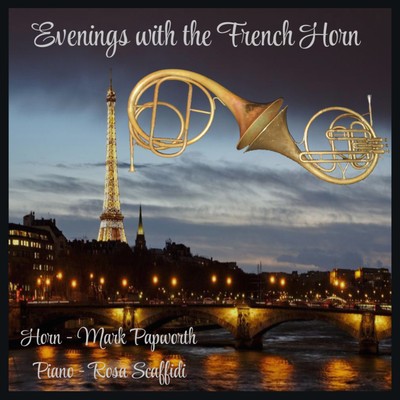
EVENINGS WITH THE FRENCH HORN

Mark Papworth & Rosa Scaffidi

Move Records MCD 640

For his latest excursion into the byways of horn performance and composition, Mark Papworth is again allying himself with pianist Rosa Scaffidi, following the success of their 2020 Siegfried’s Story disc with tuba Per Forsberg.   This time, the horn-piano duet presents two works only: a bona fide sonata for natural horn by Adolphe Blanc, a versatile 19th century chamber music composer whose life-span overlapped with that of Hector Berlioz, whose six-part song-cycle Nuits d’ete has been arranged for this recorded performance by Papworth.

Admittedly, this latter popular sequence of chansons has been arranged over the years since its first publication.  Originally set for mezzo or tenor and piano, later versions by Berlioz accommodated baritone, soprano and contralto.  But then, he directed that specific songs be addressed by particular voice types; ah, what a character.  That detail is ignored these days where  –  in concerts, recitals and on CDs  –   one singer is enough to cope with the series.  Nevertheless, as far as I can see, the composer didn’t arrange any of the set for a solo instrument; certainly not by the time he got around to finishing his orchestration of them all in 1856.

Naturally, in this new format the nature of the work changes and Gautier’s verses become unnecessary; well, without a voice, they would, wouldn’t they?   It’s fair to say that the horn is not the most malleable of instruments for this set of songs and this is apparent from the opening Villanelle which strikes me as laboured, right from the opening Quand viendra in the vocal line.   It’s as if Papworth is at pains to articulate each note, rather than handling Berlioz’s phrases as lyrical continuities.   As well, the horn’s weight sounds at odds with the repeated quaver chord accompaniment.

Le spectre da la rose works better, possibly because of the rhapsodic nature of the vocal line and Papworth does excellent service in outlining his part with well-honed phrasing.  Scaffidi’s reading of the bar 3 right hand differs from my edition and her attack on the two-bar interlude after the end of stanza 1 is too aggressive by far.  For Sur les lagunes, the break inserted in the middle of the held horn note across bars 12 to 14 sounds uncomfortable and the piano’s left-hand chord before Que mon sort est amer! fails to sound convincingly.   As this song progresses, you become aware of some notes in the horn part sounding ‘thin’,; I don’t know enough about the instrument to speak with certainty about the facility of even timbre across scale passages, but I’m assuming that certain phrase-shapes are hard to negotiate with a consistency of output.

But then, it must be a limitation of Papworth’s chosen instrument, which is a French piston valve horn.  This option is almost certainly brought into play because an 1880s horn should best align with the composer’s usual ‘sound’, rather than the later German rotary vale construct that obtains in most (all?) orchestras today.  Chromatic scales seem to be non-existent or rare in horn parts until late Romantic works.

Anyway, we proceed to Absence which presents as suited to the horn’s colour.  As well, the simplicity of the recurring refrain gives Papworth room to employ several modes of articulation while taking minimal liberties with the song’s caesurae and downward-plunging arpeggios.  You can enjoy some fine moments in Au cimitiere, even if the tempo is rock solid and the pleasures are mainly harmonic, like the piano shift in bar 5 and again in bar 12.   But the approach is head-down, tail-up and you miss a singer’s ability to invest tension generated by Gautier’s spectral suggestions.

As at the start, so at the end.  The concluding L’ile inconnue suffers from an orchestra’s absence, even if the work has an infectious grandiloquence in its best moments.   Scaffidi’s semiquavers underneath the second stanza are muffled and her dynamics are often at odds with the  original, e.g. an f for a ppp at the end of this section.   Papworth presents a malleable line, touching at the conclusion where the soft reprise of some of the poem’s opening lines offers a fine realization of the poet’s gentle questioning.

As for the sonata, here the ‘faint’ notes become more prominent because of the nature of Papworth’s instrument: a natural horn, the kind that would have been used by Mozart but which you rarely hear employed in live performances of his concertos for the horn  –  at least, in this country.   These performers repeat the exposition  of the first movement Allegro which strikes me as unnecessary because the form and melodic character are easy to assimilate and the orthodox lay-out of these pages means that you aren’t faced with any difficulties in recalling what is being established as subject to expansion.   No complaints about the horn line but Scaffidi’s quaver octave sequences are suspect in the opening pages and the semiquavers that follow the second subject’s treatment would certainly have benefitted from re-recording; at one point, they simply don’t appear.

However, this is solid writing with no surprises, even for 1861 when post-Berlioz orchestration was affecting a large number of French writers.   Much the same could be said of the following Scherzo which features an unexceptional falling arpeggio figure as its main impetus; the horn’s in F, the arpeggio’s in F, the movement’s in F, and the following harmonic shifts in the B flat Major Trio almost exclusively apply to the piano.   Once again, I’m not sure about some of Scaffidi’s imitative work in the first segment of this movement but the horn is untroubled in a set of pages that offer no real challenges.

During the third movement Romanze, you have more opportunity to notice the instrument’s ‘faint’ notes and engage in the perennial puzzle as to why the overtone sequence works the way it does.  As far as content is concerned, this is a Mendelssohnian bagatelle in A flat Major with a neatly shaped main melody and a middle interlude that begins in F minor and walks an uncomplicated path back to the home key.  Scaffidi’s work is reliable and Papworth exercises his presence in pages where the keyboard initially assumes the dominant role.

The concluding Allegro opens bravely enough but it’s in a hefty 6/8 in F and the horn’s inevitable weak notes are more common here than anywhere else in the sonata and more noticeable because the metrical accents are heavy.   Neither performer is totally convincing across these pages, the piano part occasionally clumsy in semiquaver passages, notably in the piu vivo coda which fails to sparkle but flounders along its path.   It makes an unsatisfying end to this recording that aims to give us an insight into the sound world of the horn as most of us don’t know it.   You’d probably need to to be a devotee of this particular musical corner and more receptive than most to its limitations and oddities.  As a final note, the CD is rather brief, coming in at a few seconds over 54 minutes long.

A most clubbable composer

SUN FUN AND OTHER DISAPPOINTMENTS

Michael Easton

Move Records MCD 657

First off, an admission: I knew Michael Easton – fairly well, in fact. We were, for a time, co-critics on ‘The Age’ in Melbourne before he was rusticated for asking in one of his pieces the perfectly reasonable question of why was Mahler such a melancholy manic-depressive? A touchy editor who revered the composer took umbrage and so I lost another – and by far the best – in a long line of associates. He took me to lunch several times which, among other things, showed what a genial host he was – a bright light in the faded rooms of the Savage Club.

Further, he was a complete musician, far more at ease in his work than any other writer I have come across, except Peter Sculthorpe who shared with Easton a courtesy and ease with his fellow man that was most appealing in the context of Australian composition during the latter half of the last century. Like Sculthorpe, he never complained about criticism of his work – a more rare characteristic than you’d think among their peers. When he died untimely back home in England, he left a hole in the musical landscape of Melbourne where he was indefatigably active until his last sad years.

To commemorate the 20th anniversary of Easton’s death, Move Records has issued this CD which I think was originally put out in 1994, then reissued in 2004 by Len Vorster. Certainly, the prefatory comments on the Move disc’s attached leaflet by Michael Hurd speak of the composer as alive, so no work has gone into updating that appraisal; which would be particularly hard to do as Hurd himself died in 2006. And the time span of the works presented lies between 1981 and 1993 – just before Easton arrived in Australia (1982) and then three years after he co-established the Port Fairy Spring Music Festival (which continues to this day).

Two works date from 1981: Moods for piano solo, and the duo piano Cocktail Suite for two, five movements of which three are on this CD. Vorster plays the first of these – a four part collection – and collaborates with Easton in the alcohol-inspired dances. The Moods were written in the garden of the composer’s sister; they show Easton’s reaction to British pastoralism and are conveniently paired into slow-fast partners – In reflective mood, High spirits, Alone and lonely, Practical jokes – and last a little over five minutes as a collective.

None of these is particularly deep; they’re just deft expressions of . . . well, moods. All are concise and neatly argued constructs; a benign good humour peeking out of the odd-numbered ones, with a cleverly piquant sprightliness in the others. The language is unabashedly tonal – E minor, B flat Major, E flat Major, C Major in turn – with plenty of bitonality and harmonic quirks to keep us and interpreter Vorster on guard. But not aggressively; the set comprises four bagatelles, well worth the attention of inquisitive pianists of the time.

Easton and Vorster begin their duets with the Whisky Sour Waltz where the composer plunges happily into the world of the lounge pianist with an appealing melody that dodges and curves its way across the dance floor with post-Straussian gusto; the performers stay in sync for most of its progress. The following Martini Melody suggests Tea for Two and is loaded with Easton’s panache at imitating/encapsulating the two-step mode with a clever control of the keyboard, even if these executants tend to some sloppiness in their synchronicity close to the piece’s conclusion. Finally, the Schneider Cup Charleston refers to a drink that I don’t know. The Cup itself is easy to trace to an aviation prize in the Charleston era (roughly) but it’s not served in any bar I know. Still, the piece is suitably racy and suggestively derivative; your speakers will fairly drip with reminiscences of Bright Young Things.

How Pleasant to Know Mr. Lear sets five of the master’s products: three of the limericks, Mrs. Jaypher, and the work’s self-ridiculing title poem. Baritone Ian Cousins is accompanied by Vorster in another group that takes a little over five minutes to perform. There was an Old Man who said ‘Hush!’ is a clever take on Britten with its carry-on lines and angularity; There was an Old Man of the Hague presents to my ears as a lesson in bitonality; There was an Old Man of Whitehaven makes syllabic additions to lines 4 and 5 but offers a progress from Victorian-era sentimentality through an atonal glaze to a placid Edwardian resolution.

As for Mrs. Jaypher, Easton gives us a brilliantly lively setting – but of the first stanza only. Cousins is required to go falsetto for most of the heroine’s direct speech but it’s probable that the composer found little inspiration in the lemon-invested second stanza, which would also have required a massive amount of artificial sound-production. In contrast, we hear all eight stanzas of the title song which – for most of the time – follows a rhumba pattern and offers both executants some tests in pitching (for Cousins) and malleable rhythm (Vorster), which they master, for the most part.

The CD’s most substantial work is the Piccolo Concerto of 1986, written for Melbourne Symphony Orchestra flautist Frederick Shade and here recorded at the Port Fairy Spring Festival of 1992 with the Academy of Melbourne and its founder Brett Kelly conducting. You notice straight away the constant presence of the soloist, orchestral ritornelli being kept to a minimum. The score asks for an escort of strings with a percussionist contributing occasionally; in the first Allegro, it’s side-drum and tambourine, I think. The ambience is British pastoral, although the phrase lengths of the first subject are slightly off-kilter; still, the work follows a sonata form layout and this reading holds only one point where the soloist turns slightly flat on a sustained high note,

Easton’s following Andante con moto opens with the main melody confided to a solo cello, Shade eventually taking over with a counter before putting everyone in their places by following this opposing idea while the orchestra continues with the quiet lyric. Once again, the soloist is almost a continuous presence, even if his function is mainly high-pitched decoration or serving as an anti-strophe.

As with the first movement, Easton’s concluding Rondo features a principal theme that is slightly irregular rhythmically but loaded with an attractive piquancy that sets off the intervening episodes very cleverly. Here, the strings have more tutti exposure, if only for a few bars each time, but the work’s procedure offers a clever contrast between Malcolm Arnold-style humour and a controlled lyricism that could be Delius if the older composer held more firmly to a harmonic focus. Just before an ornate final main tune restatement, Shade is given an athletic cadenza which interrupts the prevailing jolliness just long enough.

From 1987 come Deux chansons pour l’arriere-saison – the first a Verlaine setting, Colloque sentimentale; the second by Gerard de Nerval, Dans les bois. Here the singer is soprano Kathleen Southall-Casey, with Vorster accompanying. The first might be familiar from Debussy’s setting of the same lines, but Easton makes it more of a rather difficult cabaret number; not that difficult for the pianist but quite a stretch for the vocalist. While the vocal line has an attractive elasticity, there is not much attempt to differentiate the separate lines and attitudes of the former lovers’ conversational gambits.

As for the rural excursion, the mood is frivolous with a modicum of regret in the third and final stanza. Of course, there’s not much you can do with a short outline of the love-life of a bird but Easton gives his pianist plenty of dexterous exposure and the final lugubrious suggestions are dismissed with a dismissive tail-flick that puts this frivolity in proper perspective.

Bidding farewell to the 1980s is the solo piano piece Conversations of 1988, here performed by Rebecca Chambers who does an excellent job of re-creating Easton’s mercurial temper. The work recalls a tedious restaurant dinner during which the composer was distracted by what he heard coming from other tables which contrasted with the far-from-sparkling talk at his own. It opens with a series of Prokofiev-like scrambles, before a change to a more measured dissertation (his dining partners?). But the bustle and buzz interferes in a less-than-subtle manner, illustrating all too well the composer’s suppressed irritation at being stuck in a conversational trough. Chambers’ reading is suitably aggressive and languid and she invests this brief outburst with the necessary vigour of precise articulation and dynamic heft.

We arrive at the 1990s through the CDs title work which sets four poems by Betjeman, with Southall-Casey again in Vorster’s company. You are instantly puzzled by the first piece, Song of a night-club proprietress which is also known as Sun and Fun; as well, there’s a rather well-known and predictable setting of these lines by Madeleine Dring. Easton views it as a sort of scena with a piano support that works as punctuation for a recitative-like vocal line which gets increasingly vehement and self-obsessed as the poem lurches through its five stanzas.

Harvest Hymn is a savage critique of contemporary farming with its pursuit of profit over the countryside’s good – an old story but a gripping one for those who believe in the myth of Merrie England. Easton’s setting is suitably feisty in the best Brecht-Weill manner; the piano part sets up a nightmare landscape where the machines are winning out while the voice declaims bitterly against the landowners’ greed and enslavement to possessions and wealth. Just a pity that the composer decided to resolve his penultimate, biting discord.

With In a Bath Teashop, Betjeman presents two lovers – an ordinary woman and a thug – looking lovingly at each other. Easton gives this everyday vignette a lavish Straussian vocal line and a throbbing accompaniment that might suggest the devotion underpinning the lyric. Southall-Casey gives a fine sweep to the higher aspirations of the song in its finishing couplet. To end, we get the Dame Edna-suggestive How To Get On In Society which treads the same boards as Walton, if the texts are more mundane. The poem is a monologue by a woman setting up her house for a tea-party; all very middle-class and concerned with trivialities. Easton captures the fussiness and self-absorption of the narrator, the vocal line appropriately four-square and affected. For some reason, the poem’s middle stanza is omitted. And I’m pretty sure – from three different sources – that the line runs ‘I know that I wanted to ask you’, rather than ‘I know what I wanted to ask you’.

From 1993 come two final works. The first is the Flute Sonata written for Richard Thurlby whom Easton met while the latter was studying at the University of Melbourne; from which point he went to the UK and since seems to have sunk from sight. For this CD, Thurlby is accompanied by Len Vorster. The work lasts for about 10 minutes and speaks the French-inflected compositional tongue that Easton inherited from his teacher, Lennox Berkeley. The opening Allegro malicioso strikes me as nothing of the kind, centred around a simple gruppetto of four semiquavers leading to a sustained upper note which serves as a sort of focal point for the movement that unfolds in concentrated swathes before a muted conclusion at odds with the swirling action that has preceded it.

Easton’s following Nocturne: Andante cantabile offers a fine fusion of sentiment and power; the emotional language sounds more determined and sincere than much on this CD. The composer was never one to scale the heights of modernity and the spices he employed in his work were usually mild; these pages in particular speak to the man’s professionalism and the ability to find a particular spectrum of operations, then explore it effortlessly.

The last movement is a moto perpetuo that brings to mind the Presto that rounds out Ravel’s Piano Concerto in G, including a final flourish that appears to borrow a leading figure from the French writer’s pages. Easton revisits that four-semiquaver motif from his first movement, as well as offering a reminiscence of his nocturne just before the final leap back into action. If the frenetic character of this movement reminds you of the Concerto, it still has its own quiet acerbity as both these executants turn it into an entertaining tour de force, eloquently written for the instruments themselves.

The second of these 1993 compositions is another four-part song-cycle: Dorothy Parker Says. This was originally the title of a stage-show for Australian actress Deidre Rubenstein, from which exercise Easton has extracted these vignettes; on this CD, Rubenstein is the vocalist, the composer is her accompanist. The set begins with General Review of the Sex Situation. The poem is a wry eight-line sequence of male-female generalizations that run past as a calm cabaret number, which is then repeated, half in quick-time, then back to the prevailing languor for the final quatrain’s repeat.

With the Song of Perfect Propriety, Parker belts out her desire to indulge in the derring-do of a modern-day pirate behaving like Blackbeard, but she is constrained, at the end of all this wishful thinking, to write slight verses. The song starts with a recall of the Ride of the Valkyrie and ends with a spurt from Mendelssohn’s Spring Song; in between, Rubenstein recites-sings with gusto her bloodthirsty ambitions for a once-upon-a-time masculine life on the ocean wave, etc. The obverse to this comes in Fulfillment which is half-spoken, half-sung. This reviews the writer’s early life under her mother’s care and the disillusionment of disappointed love in adulthood. In medias res, Easton enjoys a solo break before Rubenstein returns to repeat the poem’s final quatrain. It makes for a depressing plaint, if a familiar one and the vocalist makes excellent work of its torch-song potential.

Speaking of which, the last of these songs is a perfect example. But Not Forgotten speaks of a woman’s thoughts at the end of a relationship, one which has been intense enough to linger in the memory well after its disruption. This is a quiet, strolling reminiscence of no great overt passion but delivered with a fetching, breathy calm that finishes off this CD in a highly relevant way: it is hard, at least for some of us, to forget Easton and his unflappable skill.

Dark and light juxtaposed

NORDIC MOODS & BAROQUE ECHOES

The Marais Project & Duo Langborn/Wendel

Move Records MCD 656

Not the longest of CDs, this one comes in under 40 minutes. Marais Project regulars – Susie Bishop (violin and voice), Tommie Andersson (guitar and theorbo), Jennifer Eriksson (viola da gamba) – collaborate with the duo of Catalina Langborn (violin [baroque violin]) and Olof Wendel (cimbalom).

As for their music, it’s an eclectic combination, as you’d expect from the Marais organization. For the oldest serious music, they have lighted on Charpentier: his Sans frayeur which is an amiable chanson of unrequited love that might have something to do with Corneille’s play Melite. There’s a little bit from their eponymous hero: three movements from his opera Alcione. As well, we hear a sonata for violin and continuo by Johan Heinrich Roman, a Swedish composer from the first half of the 18th century. This four-movement work I can only find in print as an oboe sonata but the composer was a professional player of both instruments and, let’s face it: we’re talking about the Baroque where anything goes, doesn’t it?

A little closer to our time is Pavane: Thoughts of a Septuagenarian by Esbjorn Svensson who was a formidable jazz pianist and composer before his unfortunate death through a swimming accident in 2006. This is a homage/arrangement by Andersson, who also worked with Wendel in re-scoring the three Marais opera scraps.

The CD begins with a traditional Swedish song, Death of the beloved, which eventually transmogrified into the country’s unofficial national anthem. It ends with another Swedish lyric: The crystal so fine. Both of these have been arranged by Wendel – the first for everybody, the second for his own duo. More from Wendel comes in his composition A leaf falls, which involves both ensembles, and there are two works by Eriksson: the first simply called Anna, written for a sick friend; the second a kind of binary product called Marais Echoes & Nordic Moods which initially takes the French viol master’s La Mariee and a Menuet as a jumping off point before yet another Swedish folksong arrangement, The flowers of joy, that the composer-arranger thinks has some resonances with the second Marais dance.

As you can see, this is a miscellany with several bearings on the CD’s title. As with most collections, some segments work well, while others struggle to find a relevant place in the mix. The opening track sets a sombre tone, as it describes the process of a young man riding home to find that his wife is dead. Bishop handles the insistent, march-suggestive vocal line with excellent clarity of output and a persuasive directness of emotion. The result is suggestive of Scottish or English folk-songs with a morbid bent; perhaps not as bloody-minded as The twa corbies, nor as eerie as the Lyke-Wake Dirge but running along similar tragic lines to Mary Hamilton. Wendel’s cimbalom makes a striking colour contribution to the keening, trudging accompaniment.

Anna unfolds over a ground bass and could have been written in the late Renaissance or early Baroque. Each of the five instrumentalists enjoys a solo (the composer pairing her violin with Langborn’s, Andersson continuing with his guitar) as the work unfolds in a sequence of predictable progressions, yet it lives up to the proposed semi-descriptor of echoing the Baroque. The real thing follows in the Menuet, Prelude and Gigue from Marais’ opera; the first of these concludes Act IV, the second introduces Act 3, and the third I can’t find anywhere, although it’s jaunty enough to come out of the sailors’ scene as well as being unexpected enough to form part of the final chaconne. All these scraps repeat their material several times and their content is charming and plain-speaking – unlike compositions by the composer’s better-known operatic contemporaries. Eriksson and Langborn make finely-matched upper lines, while cimbalom and theorbo reinforce each other with admirable discretion.

Svensson’s slow dance moves gently past, with just enough exposure for all in the quintet even if the violins are favoured. The composer sustains a quiet, nostalgic atmosphere across his blues-suggestive piece which follows an orthodox modulatory chain and ends with a quiet, mildly regretful four-bar coda that contrives to encapsulate the downward-heading nature of the pavane with the resigned consolation of reaching the title’s specified age; a pity that the composer only made it to his mid-forties.

La Mariee comes from Marais’ Book 5 of lute pieces and is an amiable bouree-of-sorts, here given to Erikkson (of course) in partnership with Wendel’s cimbalom and (I think) Andersson in a reinforcing bass role. The brief Menuet seems to feature the Marais Project personnel only; Andersson on theorbo, if those resonant bass notes are any guide. The version offered here of The flowers of joy is in three sections: the first an outline of the tune from Duo Langborn/Wendel, then a stanza sung by Bishop with Andersson’s guitar, finally an everybody-in with two violins and Andersson (I think) back on theorbo. All three pieces are presented as a harmonic compatibility but you’d be struggling to find much other connection between the Marais pieces and the folk song – in mood or melodic shape. Also, in other readings of The flowers of joy you hear a good many more stanzas, but I’m thankful for the timbral variety offered here.

Langborn plays the top line in Roman’s pleasant G minor sonata with Eriksson’s viol and Andersson’s theorbo serving as joint continuo. Across the opening Largo, the violinist was happy to cut a few notes short and not sustain others which led to a somewhat erratic output. The movement’s first part comprising 7 bars was repeated; the second section, 12 bars long, was not. Neither half of the following Allegro was repeated, but the jerkiness that interrupted the first movement’s second part was here more evident with several over-curt phrase endings.

Luckily, Roman’s Intermezzo is only 16 bars long, so both halves enjoyed repeats for an evenly distributed reading of this placid, courtly E flat Major interlude. A recurrence of the curtailed note-length practice emerged in the final Allegro which sounded more brusque than necessary, e.g. the truncated minims in bars 5 to 8. It might have been that the executants were trusting in the considerable echo that prevailed in their noticeably resonant recording situation at Atlantis Studios, Stockholm last July. Whatever the case, Roman’s score came across as spasmodic in its fast even-numbered movements.

Wendel’s melancholy autumn-scape brings in the whole ensemble, Andersson moving to his guitar. There isn’t much to this piece which has an appealing central figure and a prominent cimbalom solo. But the composer sustains his aural ambience well enough, right up to the last leaf’s settling, Perhaps the landscape has a touch of the Orient rather than the maudlin world projected by Joseph Kosma and Johnny Mercer that falling leaves always bring to mind. Still, you might just take it as a straightforward illustration of a Nordic mood. It partners neatly with Charpentier’s bouncy chaconne that begins and ends with Andersson’s theorbo setting out and finishing off the constant bass line. Bishop’s light soprano is a treasure in this mobile construct for which the instrumental lines are lithe and restrained, especially Langborn’s sinuous violin.

The last track features the guest duo in a specially soulful instrumental setting of a song about longing for a girl from the singer’s village. But he also addresses her as ‘most noble rose and golden chest of treasure’; she is also ‘outstanding in virtue’, which to me puts the beloved on a Marian level. The melody as outlined by Langborn is wrenchingly sad, like all the best love songs, with the cimbalom offering a decorative, original backdrop. So this CD ends in a minor key and suggests a bare physical and emotional world where hope is grounded in disappointment. Not exactly Nordic noir but, as a musical equivalent, coming close. Thanks to all for those extracts from the flashy Baroque – a fortunate complement/antidote.