Organ at both (historical) ends

PERTH CONCERT HALL RONALD SHARP ORGAN

Jangoo Chapkhana

Move Records MD 3464

We do live in two different countries. I’m not alone in knowing very little to nothing about serious musical activity in Perth, except that we share in the big travellers, i.e. the Australian Chamber Orchestra and Musica Viva. If you listen to ABC Classic, there’s every chance that the West Australian Symphony Orchestra will be heard at some time during the day and most individuals who come to Australia for a capital city tour will include the country’s most isolated one in their visitation rounds.

But I’ve never heard the Sharp organ in the Perth Concert Hall, although the leaflet that accompanies this CD gives a fair amount of information about its construction, its maker and its registration. Sharp built the organ in the Sydney Opera House, and this West Australian instrument is the maker’s second-largest creation; that’s by a long way, incidentally, as the Sydney organ has over 10,200 pipes while its companion has about 3,000. Also, I’ve not encountered Jangoo Chapkhana either, but a simple online check shows that he’s a considerable presence on the Perth music scene, a veteran choral conductor as well as an expert jazz pianist.

You might be puzzled by the choice of repertoire on this disc. Chapkhana pays homage to some of the grandfathers of organ composition: Sweelinck, Buxtehude, J. S. Bach and Balbastre. All fine and perfectly acceptable – just what you’d expect of a compendium to show off the organ’s capabilities at an apical point in composition for the organ and its surrounds. But then we leap forward two centuries from the Balbastre work of 1749 to a couple of Messiaen works of 1939 and 1951/2, a Langlais oddity of 1977, one of Eben’s Four Biblical Dances of 1990, a very short scrap from British organist Gary Sieling, and Chapkhana’s own seven variations on the chorale Jesu, Joy of Man’s Desiring – the CD’s most recent music dating from 2006.

The CD opens with Buxtehude’s chorale fantasia on Te deum laudamus which falls into five sections, the post-Praeludium segments based on fragments of the Gregorian chant. Chapkhana’s output speaks a forward language, the pedal register exceptionally clean and welded into the fabric of the mini-fugue that makes up the Praeludium‘s second part. A slight misstep occurs at the fourth bar of the Te deum laudamus but otherwise the movement proceeds with unstoppable forthrightness, the pedal line now dominant as it handles the melody line with reed-rich reinforcement. As for the long Pleni sunt coeli et terra setting, apart from the felicity of the part-writing, a good deal of interest comes from the manual chopping and changing, even if the overall timbral mix difference is slight in this reading.

For the In Martyrum, the pedal is again entrusted with the chant material, for which Chapkhana employs a resonant brass/reed stop (trumpet or trombone, I can’t tell) which is neatly balanced by the busy and sparkling upper lines. Last of all comes the four-subject fugue (not very elaborate) that blossoms during the Tu devicto arrangement. Both these latter stages continue along the firm, determined path that the interpreter traces with considerable eloquence throughout this happy harbinger, written when Bach was approximately 5 years old.

There’s no end to the arguments about the instruments you can use for Sweelinck’s keyboard music and I’ve heard the Fantasia Chromatica on organ, piano, harpsichord, even arranged for strings. Chapkhana’s interpretation is welcome for its clarity of line and, as with the preceding Buxtehude, an authoritative directness of address, the alterations in timbre respectful and organized in a manner that stays within the possibilities of an organ from the composer’s time. You will find it hard to fault the supple understatement of the lower lines and the dearth of encrusting ornamentation.

Suddenly, we hit the big time with Bach’s Komm, Heiliger Geist Fantasia BWV 651 and Chapkhana does it proud with a powerful full organ for the manuals and a splendid, full-bodied pedal outline of the cantus firmus. The interpretation manages to make an eloquent fusion of the three-part fugue and its thunderous underpinning, where the line-concluding note lengths follow traditional editions. This track kept drawing me back to revel in its digital agility and the welcome lack of delay in the pedal work; mind you, that attraction might also have been due to the buoyant image of the Paraclete’s endlessly beating wings over the resonant hymn of appeal and adoration from a militant humanity.

This is followed by another of the Eighteen Chorale Preludes: Nun komm, der Heiden Heiland, BWV 659 – the first of three settings in that publication. As every Bach-committed organist knows, in this setting the chorale tune is given by the right hand but is decorated to within an inch of its sustainability, here riding high above its placid, walking support with nasal penetration, probably helped along by a mixture stop (can’t be sure, it’s so long since I had access to an instrument of substance). What is also distinctive about this reading is its lack of self-indulgence in the face of the linear ornamentation; the organist sticks to his last and preserves the metrical pulse without any rubato, as far as I can hear.

Concluding the Golden Oldies section, Chapkhana airs one of Balbastre’s noels, specifically Votre bonte Grand Dieu from the Second Suite. I’m more familiar with the same type of composition by Daquin but this track shows a similarity between these contemporaries. The score comprises the tune itself and five variations with a rustic 6/8 interlude between the last two. Once again, the approach to this piece proved metrically consistent and packed with variety as the variations’ repeated halves swung round (except for the Leger Sans vitesse interruption). I came across only one flaw in this dangerously clear-voiced account: at the bar 96 repeat, a muffed right-hand A.

Then we jumped to our times, beginning with one of Langlais’ Book 1 Mosaiques: Sur le tombeau de Buffalo Bill. I believe that the famous bison killer was buried at Lookout Mountain, Colorado and the composer might have visited the site on one of several tours across the United States. In any case, the work was written in 1977 and begins with a gentle, melancholy theme that is subjected to several variations which become increasingly elaborate melodically before the work ends with a quiet reminiscence of the initial melody – a conclusion that might suggest Western plains and the wide open spaces that the dead man inhabited. It’s a rarity, a piece about which little has been published, but this account imbues it with a certain whimsical appeal.

Messiaen is represented by two works: Joie et clarte des Corps Glorieux from (unsurprisingly) Les Corps Glorieux, and the most well-known of the movements from this 1939 compendium; then Chants d’oiseaux from the centre of Livre d’orgue of 1951/2. It’s always enjoyable hearing how organists adapt what they have to the specifications that the composer asks for; in the first of these, the problem is less demanding because the work stays on an even keel for most of its length, but the changes asked for the orgy of bird-calls is ridiculously demanding.

It strikes me that Chapkhana is a sympathetic spirit when faced with Messiaen’s insistent ecstasy in fast mode. He invest the first of these excerpts with a disciplined excitement, even when dealing with its less voluble moments, as when the composer alternates two chords repeatedly. But the basic opening pattern and the following recitative-like flurries come off with infectious elan; it’s like listening to a more focused elder brother to the exuberant Transports de joie from L’Ascension of 1933/4. In contrast, the Chants d’oiseaux is a minefield requiring agility and control of the necessary resources. It has more timbral variety than the slightly later Catalogue des oiseaux – which is stating the obvious – and Chapkhana works carefully through its flurries of action and many punctuating points d’appui.

The composer is an intriguing character, mainly because of the arcane characteristics of his language – the Oriental rhythms, birdsongs, modes, febrile athleticism alongside super-slow meditations. I saw him once, in Hamer Hall, at a performance of the Turangalila-symphonie which he followed with a score; the Melbourne Symphony Orchestra had to import a last-minute player for the ondes Martenot because the originally scheduled artist couldn’t handle the work’s demands. But my favourite anecdote came from colleague Anna King Murdoch who accompanied the composer and his entourage to the Dandenongs in pursuit of a lyrebird’s song. At the crucial moment, Anna trod on a twig, which silenced the bird – to the chagrin of the squawk-fancier who was unable to transcribe the call into his lengthy collection; yet another case where love’s labour’s lost.

It’s inevitable that the Czech composer Petr Eben should be compared to Messiaen in that both were formidable players and composers for the organ. Juxtaposing the Chants d’oiseaux with Eben’s The Wedding at Cana from his Four Biblical Dances made sense, although the extract from Les Corps Glorieux sounds more relevant. Eben doesn’t go in for those pages of unbarred bird-song recitative or abrupt three-chord ejaculations but is more likely to treat with a full-blown melody. Mind you, he can do so with the same riotous facility that the French composer relishes, but this particular work sits in a more comfortable, orthodox framework. The dance is a lively one – no reverential pauses for water-to-wine miracles – and seems to feature a virtuosic role for pedals towards the end.

Gary Sieling’s Pavan differs from most of its kind by running to the pulse of 5/8. Chapkhana employs flute stops for this placid 2004/5 exercise in charming inoffensiveness where an ordinary harmonic vocabulary is spiced up by the gentle presence of a mild dissonance (see the piece’s last chord). The composer is something of an all-rounder in the best British tradition: he’s credited in the CD’s liner notes as Director of Music at Bromley Parish Church in London but no, he’s moved on from that to Reading and seems to be a mobile force in the UK’s organ world. His Pavan is a well-constructed bagatelle, a welcome pause on the way to this recording’s finale.

Which comprises Chapkhana’s set of variations. He states the chorale in a setting notable for crawling chromatics which manages to raise the unlikely combination of Ives and Reger. Moreover, you can forget that lilting 9/8 metre used (twice) by Bach in his Herz und Mund und Tat und Leben cantata, as well as those amiable concordant memories associated with Myra Hess’s arrangement(s) because here the chorale is given in 4/4 time. Variation 1, Alla Danza, is a saltarello for the right hand with the chorale – now in its original triple tempo – below it; the whole effect is bitingly bitonal, thanks to insistent treble dissonances above the imperturbable tune. Then we have Alternating Chords which are really thirds that set the theme as a quick-step duet for flutes.

A Scherzino follows, pitched at the top of the instrument’s range and passing very swiftly in a variant unflustered by any deviation from utilizing the melody straight. The canonic Variation 4 puts the chorale back into 4/4 in a prominent left-hand role while the softer upper line offers an elaboration of the tune with piquant harmonic clashes. A Plenum movement flattens the tune out into a march with plenty of filler to produce a thoroughly British ambience, suggestive of a fast voluntary heard in a provincial cathedral. Next comes a three-line Contrapunctus where the interplay is suggestive of an Art of Fugue exercise written by Hindemith: disciplined, possibly over-cerebral, cheerful.

Bringing the disc to a close is the final variation, a Toccata with the chorale thundered out by the pedals while a coruscating dance, like Variation 1’s gigue, bounces around in what I think could be octaves – a single line with occasional cadential moves into two independent parts. This strikes me as the most substantial segment of the score and it gives us a buoyant conclusion to a work that doesn’t take itself too seriously but shows a very able mind at work – and an excellent musician, as evident in the totality of this enjoyable CD.

Following well-furrowed tracks

BY THE WINDING RIVER

Lachlan Brown

Move Records MCD 652

I think this is the shortest of the three CDs of Lachlan Brown’s music issued recently in one fell swoop by Move Records; By the Winding River comes in at about 44 minutes. The 13 settings are of Chinese poets: six by Tu (Du) Fu, three by Ou Yang Hsiu (Xiu), two by Su Tung P’O (Su Shi) and one each from Li Ch’ing Chao (Qingzhao) and Mai (Mei) Yao Ch’en. As for participant musicians, these have appeared on one or both of the preceding Brown CDs: tenor Lyndon Green, soprano Jenna Roubos, pianist Len Vorster, and violinist George Vi.

Kenneth Rexroth’s translations are used, with no Mahler-like interpolations from the composer, even if the promotional material for this CD mentions Mahler and Das Lied von der Erde – the go-to score for a fusion of Chinese poetry and Western music. Indeed, Brown’s first song, Chang’s Hermitage by Tu Fu, the second-longest track on the album, speaks a kind of pentatonic language in both piano and vocal lines for long stretches, the piece a steadily pulsing commentary on self-isolation and its benefits as seen by an envying visitor. The song is dynamically restrained to match the quietly angular accompaniment and a vocal part full of repeated notes. It could be likened to Ravel’s La flute enchantee except for the absence of harmonic adventure.

Both this work and the following Green Jade Plum Trees in Spring (Ou Yang Hsiu) involve Green’s plangent tenor with Vorster accompanying, opening the second track with a one-hand (right, I suspect) outlining another pentatonic-suggestive melody that meanders pleasantly before the vocal entry, signalled by a more conventional underpinning. This song falls into two parts: the first a calm observation of the season’s fruitfulness; the second, a quieter evening scene where the human (tempting girls) appear and tint the landscape with warmer, more bass-heavy textures. This split personality of content is mildly mirrored in Brown’s harmonic vocabulary which enjoys the best of both worlds – suggestive Orientalism and French harmonic richness.

With the next song, Su Tung P’O’s Spring Festival, Green and Vorster come to a more straightforward compositional landscape where, for much of the time, three strands weave around each other, the keyboard being more mobile and steady in its regular quaver progress, the harmonic language firmly major key-centric. There’s a brusque shift of tonality in the last two lines, while the last itself – a kind of envoi – is unexpectedly passionate after an otherwise staid series of observations. The tenor’s output is framed by substantial prelude and postlude excursions.

Fisherman by Ou Yang Hsiu evokes a bleak scene, Green employing a small range while Vorster sets up a chain of drooping chords in a setting that attempts to depict a vague picture of a lone fisherman who can be faintly discerned in a landscape of high reeds, shrouding rain and secreting mist. This piece has a surprising effect: clear in every respect but emotionally veiled.

Apart from a short hymn-like passage near its conclusion, Farewell once more to my friend (Tu Fu) maintains the same pattern across its length of a left-hand rising arpeggio in pentatonic mode which works as a kind of binding cord for a lyric which is essentially nostalgic and regretful, the poet/singer happy for the meeting but almost in despair now that the good times have come to an end, probably never to be repeated. Brown doesn’t wallow in these depressing observations, although his low-pitched setting of the final line mirrors the poet’s pointed nihilism.

A change of pace now as soprano Roubos sings We Are Apart by Li Ch’ing Chao, the only female poet to grace the disc but her lines generate the composer’s longest response, albeit the concluding postlude is remarkably long. Here is an art song with no nationalistic colourations which might have been produced by a Delius aficionado if not for the chains of thirds that occur in Vorster’s right hand. Here you notice a peculiarity of Brown’s vocal line – repeated notes as the syllables glide past. You hear flickers of movement at some lines’ endings but you also come across a single note used for an entire line of these touching verses. The piano enjoys an extended solo before the final quatrain which finishes off the poet’s juxtaposition of nature and longing with luminous grief – and that, I suppose, is the rationale behind the lengthy concluding piano solo which offers its own harmonic ambiguity.

After this, naturally, we hear the CD’s shortest track in a playful Mai Yao Ch’en frippery, An excuse for not returning the visit of a friend. The reason for this social embarrassment is that the poet’s children are clinging to him – apparently not in fear but from that perverse affection which insists that a parent keep his focus where it belongs. Brown gives Vorster a lightly tripping accompaniment while Roubos vaults through her apology which at the end sounds ever so slightly manic.

Another Tu Fu meditation follows, this time Snow Storm which is unrelievedly negative, a series of observations of the natural world’s harshness and the futility of human contact. Brown’s piano accompaniment presents as a chain of ascending and sometimes descending arpeggio-type figures while Green’s tenor sets out a pretty dreary monologue with an odd attempt at word-painting on the word ‘coiling’. Its unfinished conclusion is echoed in the following The Spring will never reach me (Ou Yang Hsiu again) where Vorster’s piano ends the song with a kind of half-close. Here, Vi’s violin sounds as though it is being played at some distance from the central participants, oscillating between offering a linear support to piano,. then singer, then back again, etc. The harmonic vocabulary is bare but liable to resolve into concordances across this lyric of regretful nostalgia and longing for home in a bleak, unfriendly environment.

That delight in postludes becomes even more clear in Brown’s setting of another Tu Fu poem, By the winding river in which the instrumental post-lied commentary takes up almost half the track. Yet again, you are conscious of the composer’s preference for delivering whole lines on a single note; indeed, there are few requirements of Green to leap about his compass – just a spaced-out common chord or the shift of a 2nd but nothing to disturb the temperate self-questioning of the text which contrasts the universal quest for happiness with the writer’s own sacrifices for the sake of a career. As for the vocabulary, you can detect traces of Delius and Faure but the harmonic structures are simple when set alongside the chromatic slurries of these two formidable masters.

Nothing new arises with the setting of Su Tung P’O’s A walk in the Country. The piano provides a quaver support that stays in the same major key for much of the song while Green follows a (by now) predictable path with plenty of repeated notes and small excursions like the last two lines that involve two notes. The song moves pretty rapidly through the set lines and sets no problems for either executant. Much the same can be noted about the penultimate track, The House by the River (Tu Fu), in which the main interest comes from the initial rising tetrachord figure in Vorster’s part, across which Green sets out another quasi-recitative with few moments of linear curvature; see the last two lines (again) which phase out in a near-monotone before a postlude with one (possibly two) moments of harmonic interest, the merest frissons of change from the predictable.

Finally, Tu Fu’s South Wind involves both singers. Green sings the 8-line text, then Roubos joins him for a repeat, omitting one line for reasons that I can’t quite fathom. Suddenly we are translated to an atmosphere that is packed with Mendelssohnian sweetness, including some melting linear vocal 6ths and a fluent barcarolle-like accompaniment to this rather saccharine Spring scene complete with blossoms and coupling birdlife. It’s an amiable enough song and comes to me straight from the 1840s, making an odd conclusion to this collection that has veered most of the time to modal and pentatonic frugality.

What does all this amount to, once the 13 songs are over? Brown lives up to his claim of writing music in Romantic and Impressionist styles, and his take on Chinese poetry fits in with his chosen vocabularies. But the music is not original, despite some attempts to summon up your Oriental taste-buds. He is content to follow his masters – Mahler, Debussy, Delius – but he isn’t offering much else beyond imitation and faint reflection. As with the two preceding CDs recently issued of Brown’s music, you’ll find nothing to offend and not much to excite – just pleasant music performed with sympathy by under-stretched interpreters.


Splashes of depth, promises of adventure

CHAMBER WORKS

Lachlan Brown

Move Records MCD 651

Here is another in the series of three CDs put out by Move, all dedicated to the works of Australian composer Lachlan Brown. These chamber scores are a bit of a mixed bag as far as format is concerned. You have four piano solos – three performed by Len Vorster, one by the composer. Brown’s String Quartet No. 1 is preceded by a brief piece for the same format (different performers) and a similar short work for guitar quartet. Two duets appear, one for harp and cello, the other for violin and piano. As well, two other solo tracks are included – one for organ, one for harp.

First of the piano solos is Vorster’s reading of Little Emily in the Garden which has a series of stepwise descending 7th chords as its main motif and stands as a sanitised piece of post-Impressionist composition, not exploring new ground but happy in its quiet sprightliness. Pushing the painting nomenclature even more closely is Monet’s Garden which is very close to a Debussy prelude/esquisse with carefully pointed arpeggios along harp lines and suggestions of foliage and water droplets to animate the original paintings – those that have a definite scene rather than the water-only mammoths I think saw decades ago in the Jeu de Paume (or perhaps it was l’Orangerie).

Third in the piano solos is A New Day, played by the composer. This is a restrained ramble tending to wander around a falling Major 2nd motif, generally confined to the middle and lower reaches of the instrument. What you hear sounds quite conventional, not virtuosic but a gentle lyric with limited ambition in a regular diatonic framework. Finally, Vorster returns for the most substantial of these products: A Passing Cloud – near 6 minutes of placid slow-waltzing that gets an idea, toys with it for a fair while, then moves to something else. It’s all rather like a Satie composition without the quirkiness of melody.

Beginning the album are harp Megan Reeve and cello Zoe Knighton with Early Spring. You might expect something bucolic, possibly suggestive of those gentle miniatures written by British composers to celebrate their own soporific countryside. Which is what you get, beginning with a gently arpeggiated supporting line from Reeve and a winding, mild melodic cello melody that could go on for miles. Knighton generates a finely shaped senior voice while Reeve enjoys two short breaks/cadenzas and has the final delicately flourished word.

George Vi and the composer present the Romance for violin and piano with earnest emotional commitment although the string line is liable to clumsy production; not in its tuning so much but in the conviction of its bowing. Mind you, the line moves into the instrument’s highest reaches pretty soon after the opening and rarely moves into the territory of the lowest, or even the D, string. Here is another, if more focused, meander for the melody line while the keyboard confines itself pretty much to background chords – like the harp in Early Spring, but more so. The final impression is of a genteel charm without much harmonic levity.

On the Promenade, the first and briefest of the quartets, employs the talents of Vi as first violin, Marianne Rothschild on second, Karen Columbine‘s viola and cello Michelle John. A neat little study in 3rds for the violins while the viola provides a rather aimless secondary melody line and the cello gives a pizzicato bass, this is – again – restrained and Anglophile in its language, leaving no lasting impression. Pavane is played by the Melbourne Guitar Quartet: Dan McKay, Jeremy Tottenham, Ben Dix, and Michael McManus. A gentle, stepping motion from all participants sets a suitably grave, processional framework, and the opening melody has what can only be called an antique charm. Not much happens as the dance works through its patterns and repetitions with some chromatic slips occurring in two spots and passages with quiet triplets emerge from the consistent 4/4 rhythm. I can’t see that any players were over-stretched by this placid sequence.

Brown’s first essay in the formal string quartet four-movement lay-out is here played by violins Kathryn Taylor and Nick Waters, viola Helen Ireland, and cello Knighton. Here is a full-blooded composition, still written in a language that was extant a century ago but the first movement, for instance, has an unexpected intensity and spatial balance that shows a solidly informed mind engaged with his work. You can hear traces of Delius in the linear spaciousness of individual lines, but then Brown has cited the English writer as an influence. Mind you, the score starts off with some chord clusters that aggregate promisingly, but the whole breadth of these pages sticks to an orthodox tonality.

After the initial ‘Moderately’, the second movement is headed ‘With gravity and intensity’ and reminds you of the ardent chorale-like steps in the late Beethovens. Brown is keen on resolving his chord progressions quickly so that nothing hints at dissonance, apart from a slight subordinate semiquaver rustling right at the end – as though the devil is not quite muffled in this peaceful, hymn-suggestive atmosphere. For all that, the lower voices enjoy little prominence and the real action comes from the top violin.

For his next stage, ‘With movement, like a changeable wind’, the composer has invested a good deal of his effort; in fact, this segment alone is equivalent in time to the other three combined, being close to 12 minutes long. To my ears, it appears to fall into four chapters, the last echoing the first, with a concord-establishing coda. Along the way, we encounter passages in rich thirds for the upper lines, later lowered; another of Brown’s floating melodies that seems to operate around the most nebulous of axes; some thick contrapuntal pages that could have been attributable to an entrant in the Cobbett Prize; and whole sentences that promise stringency but eventually come down on the side of righteous resolution.

It’s an intriguing set of pages, more so than much else on the CD, probably because of its breadth and emotional concentration; not to mention the clear commitment and intonational clarity of its interpreters, viola and cello being long-time collaborators in the Flinders Quartet. And finally, we arrive at the fourth movement, ‘With easy movement, like a pleasant dance’, which is rich in concordant 3rds and 6ths for the violins and smooth sustained-note duets for the lower voices. It is pleasant and free from stress with not much argument and a fairly intact repeat in this ternary-shaped movement (not uncommon across this writer’s output).

Finally, you have the two non-piano solos: Snowcaps from James Leitch playing an unspecified organ, and Gentle Rain which lasts no time at all on Reeve’s harp. The first of these is the second-longest track here and another surprise for its harmonic writing which is packed with 2nds and 7ths, along with parallel chords of some complexity that suggest Messiaen but without the hysteria – not too many traces of alleluias sereins – but you encounter a hard-minded embrace of the instrument’s potential for dissonance similar to passages you can find in Jolivet.

This organ construct takes up a wide, sonorous canvas and Leitch exploits his instrument’s registrational potential with high efficiency, so that he makes a fine case for the piece’s melodic construction and coherence. On a smaller scale, Reeve makes easy work of the harp solo which maintains a falling series of 4ths as an upper ostinato throughout; it’s occasionally mirrored in the lower strings but the impact of this carefully crafted bagatelle has an unmistakable reference to its title, each scintillation droppeth effectively.

On this CD, I found more originality than on Brown’s The Night Sky Glory collection of vocal works. Some of the tracks leave little impression, yet you can see indications that the composer’s vision is not as easily defined as you’d think. He may have confided to us his empathy with Delius, Mahler and Debussy – and you can find traces of others in his output – but works like his string quartet, Gentle Rain and Snowcaps demonstrate a clarity and individuality that rouse your interest and generate hopes for further essays with similar adventurousness.

Deft but drab

THE NIGHT SKY GLORY

Lachlan Brown

Move Records MCD 650

The good people at Move have just published three CDs devoted to the work of Australian composer Lachlan Brown who – as far as the internet is concerned – remains an enigma. That is to say, I can’t find any information about him apart from what is on the Move website – and that’s very meagre. So you’d have to expect something out of the box from a writer who manages to get the country’s prime Australian composition promoter to publish a set of recordings – put out simultaneously, what’s more – that features a performing group involving some high-profile musicians.

This first offering features pianist Len Vorster, soprano Jenna Roubos, soprano/altos Holly Haines and Alison Rae-Jones and Elspeth Bawden, treble Jimmy Hilton, tenors Timothy Reynolds and Alastair Cooper-Golec and Lyndon Green, the composer himself doubling as tenor and bass, harp Megan Reeve, violins George Vi and Marianne Rothschild, viola Karen Columbine, cello Michelle John, and organ Lachlan Redd. As you can see, some of these participants have been (and continue to be) significant members of the country’s (mainly Melbourne’s) musical community.

But what of the music they reproduce? One of the few ‘facts’ we can learn about Brown is that he has been influenced by Mahler, Sibelius, Debussy, Delius and Faure: a worthy clutch of late Romantic and Impressionist writers – in fact, a few of them sit on the cusp between those schools/groups/ delineations. But I become instantly wary when such names are presented, chiefly because I suspect that what we are going to hear is derivative – not so much influences as imitations. Further, is any composer in current operation harking back this far? All pay homage to Bach, but is anyone writing continuously in his style? Or that of Beethoven? Or Wagner? Still, you could pursue this topic into odd corners where composers are happy to boast an affinity with Schoenberg or Stravinsky (but never Hindemith), while the fad for Cage, Stockhausen or Boulez is well and truly over. Now, the trend is towards Radiohead, Philip Glass or Lady Gaga.

Back to Brown and his first track. a Rilke setting: Fruhling ist wiedergekommen which is the 21st of the Sonnets to Orpheus, here carried out by Roubos and Vorster. Well, it’s sort of that particular sonnet with the first part revisited at the end for the sake of balance, I suppose, and a few lines and a stanza, at least omitted. The musical language is a cross between 19th century operatic cadenza and post-Schumann lied, both A parts of this ternary composition opening with a sort of vocalise. This is amiable, salonesque music which manages to sound open-hearted and optimistic, like the poem.

Vorster and tenor Cooper-Golec then present a Victor Hugo setting: Hier soir, which is fully Romantic but lacking in subtlety. It’s as if Baudelaire had never been born. As for the setting, it treads a conservative line in chromatic sliding, except for some questionable moments at the end of the first stanza. Cooper-Golec’s tiumbre is a touch over-nasal for a piece that might have been better suited to a baritone; as it is, the song sounds like a kind of plaint rather than an assertion of devotion. The whole reminds me of Duparc but without much attraction in its melodic curve.

Brown then takes on a well-known set of verses in Heine’s Auf Flugeln des Gesanges, forever associated with Mendelssohn who set the poem in his Op. 34 Six Songs. This new version employs two tenors – Reynolds and Green – with the string quartet mentioned above, the lower strings pizzicato while Vi weaves a third line around the intertwining vocal chain of 3rds and 6ths. It’s very mellifluous and just as richly conservative as Mendelssohn’s work in its vocal demands and its harmonic vocabulary.

Next come a pair of actual vocalises. The first involves Roubos and harpist Reeve and is an amiable enough exercise with a fetching vocal line above instrumental arpeggios, mainly (always?) rising. Brown stays fixed in a completely predictable metre with a few gestures towards late French Romantic modernity. To their credit, both artists handle this slender piece with sympathy. The second uses the boy treble Hilton with Redd providing supporting chords on an unattributed organ while the singer follows a melodic path of no particular character, alternating a step-wise melodic motion and a widely-spaced arpeggio three-note pattern. Again, there’s nothing here that speaks to any of Brown’s influencers, except possibly some suggestions of Faure of the Requiem.

Rilke enjoys another outing through Schon horch, also from the Orphean sonnets – No. 25 in the cycle – and Cooper-Golec and Vorster return for this number. Here we might be stepping into the 20th century with some efficient Delian slides and a setting of some drama, particularly for the singer who is tested across a wide tessitura. If it suggests anything, it’s one of Berg’s early songs, chiefly for the solidity of its piano material. But I can’t find much of a link between the text and the music; my fault, of course, that I never embraced the German poet’s taxing imagery.

We now arrive at the CD’s title-work, which is another vocalise for what I assume are multi-track voices. Only two are cited. Haines and Brown. but both are credited with double vocal types: soprano/alto, and tenor/bass. What we hear is a series of four-part (or are there more?) chords, revolving around a mobile axis in yet another very circumscribed harmonic ramble. Again, you’re reminded of Delius in a vague sense, but I don’t know the English master’s choral scores well enough to play pinpoint the similarity.

The composer is still indulging in vocalise for the next three tracks: Meditations for choir III, IV and V. The pairs of singers (each contributing at least two vocal strands) have no words, just an open vowel sound as they slowly meander around a rather ordinary sequence of chords. Rae-Jones and Brown are the personnel for the first two of this clutch, the No IV having more interest for the momentary individuality of line at its centre. The last, involving Bawden and Brown, builds slowly to a fine climax, and impressed for its multi-choral effects, but by this point my attention was wandering in an aural landscape where the elements were proving interchangeable..

More harmonic originality appears in a brace of Forest Voices from multi-phonicised Haines and Brown, still textless. The writing is loaded with droning open 5ths and some biting 2nds and 7ths that speak a language that is more contemporary than anything we’ve come across this far. Further, these pieces have a definite atmosphere: the forest they depict is no sweetly-wooded series of groves but something more menacing and aggressive.

To end, we have Night Falls in the Forest which continues the atmospheric suggestions of the preceding two tracks but much less stridently. Bawden’s soprano and alto have the melodic running although Brown’s tenor and bass are not stuck in the subsidiary positions they held in the Voices tracks. But seven tracks in a row of harmonic shifts and vocalisations seems to me to be too much of a moderately good thing.

When facing modern composition, I’m still sympathetic to Stockhausen’s saying that he asks ‘two things of a composer: invention, and that he astonish me.’ That’s still a tall order which might be more useful if the combination was actually a pair of alternatives. Brown’s music is not impressive for its inventiveness but moves along well-trodden paths, compositional tropes that are very common territory. Much of it is pleasant and deft in its organization but it ignores most of what has happened in Western music over the last 120 years. As for the question of astonishment, it does not arise. Nevertheless, I’m looking forward to experiencing further facets of the composer’s creativity in the other two Move CDs that were issued alongside this one.

The end of the line

A BEETHOVEN ODYSSEY VOLUME 9

James Brawn

MSR Classics MS 1473

So here we are at the grand finale of Brawn’s exposition of the 32 Beethoven sonatas, having left two of the most demanding scores till this climactic point. It’s a late period pairing: No. 28 in A Major (1816), and No. 29 in B flat Major (1818). Both make great demands on executants, the latter Hammerklavier a pianistic high-water mark of concentrated expression and formal skill. While the appearance of this particular A Major work on a recital program is not common, you can wait from one decade to the next to hear a pianist of stature presenting the big B flat score, most musicians happy to follow the usual round of Pathetique (No. 8), Moonlight (No 14), Waldstein (No. 21), and Appassionata (No. 23).

I believe that the last time I heard the Hammerklavier attempted was by Michael Kieran Harvey who participated in one of Stephen McIntyre’s Piano Landmarks days at the then Congregational Church (now St. Michael’s Uniting) in Melbourne’s Collins St. eastern heights. From memory, the first two movements passed along successfully, but then matters became directionless in the lengthy Adagio sostenuto; at all events, Harvey left the platform with the work incomplete. Mind you, he’d done this before when tackling Elliott Carter’s Piano Sonata for the Astra people; he lost his way but returned to finish the monster off. As did Carl Vine with the same work some years later, I seem to recall.

Since that truncated Hammerklavier, I don’t think the work has come my way in live performance; perhaps once. But you can see why, right from the first full bar with its right-hand minor 9th stretch – impossible for those of us with Dupuytren’s contracture without an arpeggiation. And there’s worse to follow in bar 3 with a full Major 9th. The left hand isn’t left unscathed; see bars 193-4. This first movement Allegro is necessarily peppered with these first theme statements in full (or even half) cry, before we even consider the intervening fluctuations in attack and digital negotiation across the pages.

As you’d expect, Brawn has no problems in handling these stretches. Following his customary path, he takes time to give breathing space to phrase changes as the exposition’s setting-out moves past and observes his own dynamic markings in the first outline and again in its repetition; the former straight after the change to G Major across the sequences in bars 47-62, while the latter is observable in the restrained sforzandi (in my Henle edition)) of bars 28-30 (actually, I think they’re ignored). Later, this pianist takes considerable pains to give a focus to the movement’s eccentric development with its taut fugato stretch and focus on cells (e.g. bars 189 to 200), even if the material come across as intractably dogged – which in other readings can result in plenty of hammering.

As shown throughout this odyssey, Brawn has a rare sensitivity to Beethoven’s apparent baldness of statement, pitching his responsiveness to a simple acceptance of the score and handling the work as a product of its time; which is preferable to turning a rhetorical movement such as this one into a hurtling monument to virtuosity and sheer heft. The following scherzo is handled with dispatch, its central motive in occasional danger of blurring the central repeated note/interval/chord that gives the movement its rhythmic interest and urgency. Even the central trio, with its going-nowhere arpeggio statements, passes in a blur before the oddities arrive with a disorienting presto, cadenza, and brief temperamental flurry in bar 113.

The conclusion to these pages with their double octave insistence on near stasis serves to unnerve the listener because, although Brawn conveys lightness and impetuosity in combination, you may be left uncertain as to the intention of the entire movement. Is it meant to be a throwaway bit of badinage with irritated outbursts, or should we prospect for deeper veins of impatience and dissatisfaction? Whatever your finding, Brawn inclines to the mercurial, which comes as a welcome intermission before the sonata’s great challenge. This Adagio is 187 bars long and often strikes me as interminable because, while its shape is apprehensible (eventually), the process of reaching a resolution is hyper-extended. Not that this reading is as wearisome as you can find in other recordings; it’s just that Brawn is ultra-sensitive to Beethoven’s tonality fluctuations and also inserts pauses that may point up phrase shapes but also substitute emotional sympathy for momentum.

Where you can see why the executant pauses before the move to G Major at bar 14, I can’t see why there is a hesitation before the totally anticipatable A Major opening to bar 39. Or the arrival at D Major in bar 53 where a comma breaks up an already inevitable sentence. A little further on, the written note values are treated pretty cavalierly (e.g. bar 62), but the handling of that ornate batch of demi-semiquavers from bar 87 to bar 103 shows a high degree of empathetic responsiveness to some awkward writing. Just as well-placed realizations come at the two points where a main motive is shared between bass and treble (bars 45 to 52, again at bars 130 to 137, with an after-taste at bars 134-138).

Also, as at the work’s opening, you can admire the even accomplishment of those frequent hand stretches (here, of various 10ths) that come across with remarkable facility; the last bars in particular indicative of the interpreter’s mastery of technique and sustained atmosphere. Nevertheless, it’s always a relief to leave these morose pages for the work’s finale which – after some more eccentric fantasia-like interludes – eventually arrives with the Allegro risoluto/yes-very-determined three-part fugue. There’s no way any executant can make this sound orderly and a post-Baroque example of the form; it’s neither. What marks Brawn’s effort is its clarity.

In part this comes from a modest employment of the sustaining pedal, notable right from the opening entries where the aim is linear probity which verges on the percussive. In my book, that’s fine and infinitely preferable to washes of fabric, no matter how imposing the sonorous output produced. What is significant is the way this player continues as he began with a welcome transparence in harmonic conflicts like those chromatic clashes (well, semitonal juxtaposition clashes) that begin with the change of key signature at bar 53). As well, you have to give credit to the deft treatment of Beethoven’s increasingly manic trills that reach their apogee of frequency between bars 235 and 246 before the overwhelming bass one on B flat that lasts between bars 373 and 380.

As a capping stone to this solid sonata, these pages stand as an extraordinary achievement, informed by an unstoppable vehemence and drive which simmers even during the D Major episode across bars 250 to 278. Brawn is able to sustain your involvement through his vivid approach that gives proper value to each line in what can become some of the thickest piano writing produced by this composer. I won’t say it’s not a relief to get to the end – it always is – but Brawn carries you along with a clear mastery of form and a confident delivery that eschews flashiness and pomp for plain-speaking and (God help us) bonhomie.

As for the Op. 101, the interpretation on offer has an attractive honesty, its character well established across the initial Etwas lebhaft – only a bit over a hundred bars of generally peaceful melodic arches with some unforgettably graceful, syncopated chord punctuation. Brawn is handy in implementing the empfindung that Beethoven asks for, but he has a keen eye for finding a phrase’s point – exactly where it should aspire and decline, reserving his heftiest dynamic until the climactic fulcrum at bar 86 before that lean digest of material in the last seven measures.

More formidable problems emerge in the ensuing march where the hand/finger shifts can prove ungainly. But you have to strain to fault the player’s contained impetuosity, which is only slightly decreased in bar 37, a scrap that comes across as hard-won for no apparent reason. Later, the canonic interplay that constitutes the main part of this movement’s trio flows with excellent precision, the lines lucid and carefully mirroring each other. Then Brawn lingers over the brief Langsam, stretching note-lengths liberally to make as much emotional hay as possible across this interlude.

Before he breaks into the sonata’s longest segment, the Geschwinde finale with its generally happy fugue centring the movement, the player has the welcome task of referring us back to the work’s opening phrases: one of the most felicitous of reminiscences in all Beethoven, a delight to encounter. The Allegro‘s enunciation comes across as slightly awkward in some passages with parallel thirds, sixths or fourths in one hand, but much of this conclusion is closely argued by Brawn, particularly in the more complex segments of the fugal development, e.g. bars 149 to 156 and bars 201 to 206. Moreover, the rest is negotiated with the attention to detail that is one of this pianist’s most consistent characteristics, including a finely achieved account of the fugue’s glowering pedal-point conclusion between bars 223 and 227.

These two sonatas provide a fine ending to Brawn’s readings of all the Beethoven sonatas. To my ears, he has given us interpretations of sincerity and security, packed with felicities that argue for a direct confrontation with the composer’s prodigious output. My generation grew up with compendiums by Kempff, Brendel, and Schnabel, encountering later complete sonatas sets from Barenboim, Pollini and Badura-Skoda. These days, pianists I’ve heard, like Fazil Say and Paul Lewis, have produced complete sets; as well, a plethora of performers I’ve not heard (or sometimes not heard of) have put forward their versions. Fortunately, Brawn is a high achiever in this company: if not as intellectually challenging as some more senior names, then just as pianistically gifted and insightful as his contemporaries.

From aspiration to anger

THE SPARROW AND THE MEAD HALL

Michael Kieran Harvey

Move Records MD 3471

The latest in Move Records’ collection of Michael Kieran Harvey’s products – as a performer and composer, often enough both – covers some of the ground covered in the COVID year of 2021. First come Four Ballades for piano; then Sonata, No. 7, called The Sparrow and the Mead Hall, which takes its impetus from an Epictetus dictum; another personal piece, Lawyers are Lovely Misunderstood People and We Should All Be Much Kinder to Them, which honours Hobart advocate/barrister/solicitor Craig Mackie; and an anti-opera, Death Cap Mushrooms, to a text by Harvey’s long-time collaborator Arjun von Caemmerer which takes its brief flight from the 2020 George Floyd murder in Minneapolis.

It’s not accurate to see the ballades as an extended entity rather than discrete pieces, but the composer points to a pair of links between them all. One is the use of Bach’s B flat-A-C-B natural musical signature; the other is the prevalence of a free-wheeling 12-tone series that enjoys exposure at the octave-rich start to Ballad No. 1, Stark. This row is announced in octaves and the first thing that struck me was the significance of the intervals between the initial notes, just as it obsesses number-crunchers in a transparent and willfully eccentric score like Berg’s Violin Concerto. Yet, before you have gone far in this movement, the composer-pianist’s flights have once again carried you off into his realm of ornate imagination where you can (after a few listenings) trace the intervallic sequence – or, more properly, fragments of it. That’s before you take on Harvey’s ambience which embraces so much.

He himself points to Liszt, Szymanowski, Bartok and Herbie Hancock as jumping-off points for these ballades, the investigation of any of which could take months. For example, I don’t know the Liszt ballades (all two of them) but am pretty au fait with some of the Legends with which the former have been linked by performers and editors. And, while boasting a fair acquaintance with Bartok’s piano output, the Elegies (again, both of them) have not crossed my path, at the keyboard or in the hands of anybody else. Ditto Szymanowski’s Masques (three in number) and Hancock’s 1973 album. All of which is more of a salute to Harvey’s catholicity of interest than anything else.

In spite of the two common attributes that permeate all four of these pieces, you will do your head in trying to work out the compositional processes at play.  For instance, the following Implacable ballade opens with a solid 5/4 bass sequence of chords which goes through a slight alteration in tessitura before a slight change in tempo, while all around the firm opening motivic construction disintegrates into patterns of angular quavers and clotting triplets that move into a whirlwind landscape occasionally broken up by semi-impressionist oases.

You can’t pass off Chopin’s four ballades as a sequence, like elements in a sonata. Each is emotionally discrete and - as far as I’m aware - there are no common elements shared between them; unlike Harvey’s compositions which might come under a communal umbrella. But this embrace won’t really wash because the differences between them all are vast and the shared elements are often near-impossible to find, let alone hear. When it comes to the third in the set, Quasi fantasia, the pages pass as a kind of phantasmagoria, images that rustle or thunder with even the delineation of the B-A-C-H motif in transposition hard to pick out, although the nature of the writing tells you that it must be there. 

Matters are a bit clearer in the final Fast manic bop which lives up to its name with a good deal of insistent double octaves and syncopations to invest a typically urgent energy into this finale which reminds us of Harvey’s earlier works (I’m talking of at least 20 years ago) where the impetus proved irresistible. Even in this ballade, the hectic nature of the musical progress is anchored in recognizable elements that pile up in dynamic terms before a gripping conclusion. Here again, the fecundity of this composer’s imagination is on display in a technical display that shows no breaks, no cracks in development.

With his new sonata, Harvey is in an abstract world of something between self-consciousness and good old-fashioned existentialism. He takes the Greek philosopher’s reported dictum – Non fui, fui, non sum, non curo – and uses each clause as a heading for his four movements. As you can imagine, the results are peculiar to the composer and I doubt that listeners will find easy engagement with the work’s intellectual underpinnings. For all that, the music is startlingly clear in its statement-chains as life’s progress follows the simple progress of a bird from darkness to darkness; there is no beginning and no end, is the message, and we are given the short life-flight only.

The assertion of past existence is both opulent and muted in Harvey’s first movement where high decorated lines contrast with emphatic bass plosives. The tentative string-plucked opening light-pricks give place to dramatic rhetoric, which could represent our individual striving to enter the world, the effort bringing on a formidable series of pre-creative efforts that come to nothing in the end, the initial texture coming back as a commentary on Epictetus’ sober evaluation of non-being: you have a sort of gestation, prodigal in its output, but finally coming round full circle, as the Buddha tells us. For all that, the pages are laced with vitality rather than navel-gazing and the main impression is of the pianist operating at two distinct levels of action; what they represent is left up to you to solve (or leave alone).

Moving to actually being in the world, Harvey labels his second movement ansioso, or eager.If you like, this is the composer in full spate, the notes pouring out in rapid virtuosic hammer-blows right across the keyboard.  It’s as if the executant wants to operate his life’s potential to full capacity, restlessly urging us to the next experience or sensation in page after page of exertion. Then, suddenly, it stops and we have returned to the opening movement’s initial stasis: single notes plucked out of the ether, as though the self is returning to its pre-conscious state. As changes of pace go, this one is hard to beat: the tumult and the shouting die and you’re left with an all-too-familiar plane of non-activity.

When it reaches the abnegation of existence, the music becomes appropriately disembodied with a sequence of tamped trills, sustained notes and a few abrupt Boulez-type stark four-member gruppetti before Harvey returns to the opening of Non fui – note-for-note, the first 9 bars. It’s a rounding out of sorts: we start out in the abstract, and so we end. This third movement is as long as its predecessor but here the style of communication is on resonances, a fermata dangling over the ending of each bar in the main body of the relevant two pages.

To end, we are faced with another movement that divides into two parts. Harvey uses the term distaccato to direct the requisite attack mode and the implied difference is essential: the right hand plays a set of three-note chords, the top note always E flat, the bottom note initially F and then moving to D flat while the inner part proposes a sort of melody. Still, the chords are repeated in a 5/4 pattern of three crotchets and a minim, occasionally leavened by a 2/4 bar of two crotchets. These aren’t brusque or classic staccato, but they are detached. Eventually, the left hand produces the by-now-familiar bass thunders and this briefest of the four movements crosses halfway through its length into the detached plucked strings mode that has run across this sonata as a dialectic connector. To my mind, this conclusion serves that creditable purpose of illustrating the indifference claimed by Epictetus (and probably by Harvey) to the passing of life: filled with light under the mead hall’s roof, but empty at both ends.

Coming to the lawyer-lauding piece, the listener is moved into a regular Harvey compositional world where the furious speed is well-matched with brusque syncopations that show what can be done with rock-jazz materials when the composer has a mind. It’s a headlong rush, something along the lines of the preceding sonata’s second movement but more aggressively jaunty, even menacing in its several frenetic moments. Harvey wrote this as a payment for lawyer Garvie’s professional services, along the lines of the post-impressionists and Cubist masters settling their cafe bills with art works now more valuable than the establishments that claimed them. It’s a genial concept but one that I can’t see being pursued in these nasty times of economic depression. All the same, it has to be said that Harvey’s piece shows the composer at his most coruscatingly brilliant.

I’ve not much to report about the anti-opera, written for the Australian National Academy of Music’s ANAM Set (2021). Its initial direction reads Muscular arrogant swaggering and the propulsive piano pulse that starts it off is eventually joined by a drum kit, vocalist Benjamin Cannings growling out von Cammaerer’s punk-poet text in one fell swoop, while Theo Pike alternates between piano and toy piano with Alex Bull generating the percussion contribution. The afore-mentioned Cannings also provides a guitar line in the work’s later stages. 

The work is a satirical slap in the face of Canberra’s politicians (with a side-kick at Trump) and the group mindlessness of American law and order when seen at its worst. For Harvey, this serves as a protest that takes on the mindless head-banger violence reinforcing prejudice and stupidity in this country (see Artarmon) and throughout the territories run by our great ally. While full of justifiable rage, the track makes an unnerving finale to what has been, up to this point, remarkable music-making of high quality.

Death-Cap Mushrooms is dedicated in its score to Hannah Pike; in the CD leaflet, the dedication is to Theo Pike. According to the Australian Music Centre’s site, Hannah and Bull played the premiere performance at ANAM on October 26, 2021; Theo is credited in the leaflet.  It’s all rather confusing, but not a vital distraction to any auditor who enjoys the slightly outrageous.

Miscellany from the archives

SHICHISEKI

Michael Kieran Harvey, Miwako Abe, Alister Barker, Martin Niedermair

Move Records MD 3470

As I understand it, this latest release in Move’s Michal Kieran Harvey Collection draws on recordings that have been made over the last 15 years or so, now brought out of the company’s archives and here released for the first time. Harvey is performing works by four contemporary writers – Kanako Okamoto from Japan, as well as Australians Andrian Pertout, Mark Pollard and Gabriella Vici – as well as three songs used in Barrie Kosky’s adaptation of Poe’s The Tell-Tale Heart: Bach’s Agnus Dei from the B minor Mass, Purcell’s Music for a while that comes from his stage music for Oedipus, and Wolf’s Verborgenheit which is one of the Morike Lieder.

Harvey contributes to each track, collaborating with violinist Miwako Abe in Okamoto’s Shichiseki of 2008 from which we hear the Romance first movement, and Pollard’s Beating the rusty nail of 2006; later working alongside cellist Alister Barker for Pertout’s 2007 Rishis and saints: for violoncello and prepared pianoforte, as well as accompanying cabaret tenor Martin Niedermair in the three Kosky-invested songs. He is soloist in Pertout’s Cinq petites melodies: for pianoforte of 2008 and Vici’s Piano Sonata written in 2020.

Most of this music saw Harvey participate in its first performance. Pollard’s work was first heard at the Perth International Arts Festival, inaugurated by Abe (its commissioner) and Harvey; ditto, Okamoto’s title track.  Pertout’s little melodies were premiered by Harvey in the Tasmania Conservatorium of Music and he recorded Vici’s sonata on the eve of the COVID pandemic. Barker and Harvey were co-presenters of Pertout’s Rishis and saints on its debut performance at the Resonance Music Series sponsored by the Bayside City Council. And, of course, Niedermair and Harvey worked together on Kosky’s theatre piece during its Malthouse presentation in Melbourne.

The disc begins with Okamoto’s movement: the first of two exemplifying peace, the second illustrative of anger. This is in line with the underpinning legend pf Vega and Altair being allowed to meet once a year by an Emperor angry at their clandestine marriage. So Okamoto is presenting us with (I think) a representation of the stars’ falling in love and being happy in their connubial bliss until the interference of secular authority who wanted to put the female forced (Vega) to work once again. This once-a-year meeting resulted in the (earthly) Shichiseki celebration in Japan held annually on July 7th.

The Romance has Harvey setting the scene high in the piano before Abe enters with a long arc of self-pivoting melody. A sequence of piano chords prefaces some impassioned repeated double-stops before a real duet opens out with the keyboard rumbling continuously under a series of rising violin ejaculations that pause each time on a striking 2nd or 7th that suggests strife and astral discord rather than spherical harmony. A scale-rich piano cadenza leads to a high-pitched petering out, like a satellite signal, followed by another violin solo.

What follows is a reversal of an earlier procedure, Abe supplying a high descending single-note support while Harvey coruscates with his inimitable flair and incisiveness before the violin flies alone to a high-altitude melismatic conclusion. The piece has great appeal for its wide-ranging emotional breadth and a searching-out of each instrument’s sonorous potential, as well as a fair allocation of responsibilities, even if Abe enjoys the more striking performance ambience.

Pertout’s piano bagatelles were created as a homage to Elliott Carter on his 100th birthday.  They use Mayan mythology alongside dance rhythms from Latin and South American cultures, all of which will mean more to the Chilean-born composer than to those of us inextricably bound up with an Anglo-centric transplanted musical culture.  Pertout gives his pieces French titles connecting colours with compass directions, e.g. Noir de l’ouest, Aqua du centre. This, plus the references to specific rhythms – Festejo, Toque de Sao Bento Grande – has the virtue of specificity couched in an alien language. Still, it means something to the writer and the rest of us must make the best of it.

For his first offering, Noir de l’ouest, Pertout uses two rhythms: Lando and Festejo, both distinct in content if not in tempo and, in the best miniature fashion, over before much has registered.  Jaune du sud employs Zamba and Chacarera, and these are very disparate despite sharing the same 6/8 time-signature; as well, the Zamba gets much more space than its companion with a high tessitura before a more solid and racy concluding section. Possibly I picked the turn from Plena to Bomba in the third Aqua du centre when the distribution of labour changed from right hand decoration over a mid-level melodic mass to the reverse; an alteration in texture more than a split.

Something similar came across in Rouge de l’est where the Toque de Sao Bento Grande led by way of a cadenza-like series of rising gruppetti into the Samba Partido Alto which glittered at the piano’s top reaches while the Toque had made much of the instrument’s low-to-middle register. Finally, the Blanc du nord makes a simple rhythmic shift from a 6/8 Bembe to a Guaguanco in 2/2 (albeit a fast and complicated one). Throughout, you hear traces of dance patterns but never anything as blatant as a heavily accented series of consecutive bars. But these short pieces are expertly written and articulated with a ringing clarity.

Pollard takes his impetus from blues and funk, with a rhythmic infusion from Taiko drumming. Well, the first is present in some chords from Abe’s violin, the funk in this case is irregular rock and its manifold repetitions of melodic, harmonic and dynamic patterns, and the Japanese element escapes me because my experiences with this form have been formed by occasional visits to Melbourne from Sydney’s Ian Cleworth and his Taikoz ensemble and those nights featured your normal range of time-signatures, not the jumpy quaver alterations of Pollard’s opening and closing pages – 7/8, 5/8, 3/8. 4/8 – surrounding a soft, placid middle. The composer suggests that he is beating out your usual systems of performance into new (possibly flattened) shapes. It’s vehement enough and the performers seem to be in sync throughout; whether you’re experiencing alternative modes of communication depends on your musical knowledge, I’d guess. Admire the players, sure, but the music-making doesn’t strike me as living up to its aspirations.

Pertout’s second work seems redundant in its title; as far as I recollect, a rishi is a saint. Whatever the definitional problems, Pertout has moved into another cultural world, albeit one closer to this country than the Americas. His one-movement composition was tailored for the talents of Barker and Harvey, who both get off to a frenetic, pattering start in a specific Indian tala before graduating to others. Both instruments begin with a repeated A that slowly moves out semi-tonally, a system that is further complicated by the prepared nature of the keyboard and a percussive rattling that I imagine is not generated inside the instrument but achieved with a stick. 

About a quarter in, and the percussively insistent rhythmic pulse changes to a slower and more meditative ambience, the cello providing the supporting rhythmic one-note pulse while the piano explores its topmost notes.  If you had the patience/energy, you could follow the composer’s employment of three variants to the triputa tala, but I find it hard to separate one grouping’s start from another. Further change brings us to a rapid, descending scale pattern, delivered almost at the pace of the opening, leading to an amalgam of the descending scale-mode and the percussive tapping of the work’s first section. I believe we end with the repeated A that kicked off the score, this time more ‘friendly’ as the players frisk around with interlocking scale patterns.

I appreciate Pertout’s energetic disposition of his material, as well as the vivacity with which Barker and Harvey address their work. Very few Australian composers have attempted to incorporate the intricacies of Carnatic rhythms into their own creativity, many of those extra-national writers from the 1960s on looking to easier fields like the Japanese or Indonesian musical languages – not to the mention Australian Aboriginal sounds which have been confined to the textural rather than the rhythmic. Kudos to Pertout for the incursion, then, and a final observation that his rishis must have effervescent minds and bodies if this piece is intended to depict their physical-philosophic status.

Niedermair takes easy options in Purcell’s well-known aria, mainly with breathing where short phrases feature some unexpected breaks. He and Harvy take their time over the bar 13-14 setting of ‘eas’d’ and bars 35-36 where ‘all, all’ seems to be heading for a full-stop. As well, the last 8-note vocal line is taken over by the piano, possibly for dramatic reasons. The singer’s voice is amiable and breathy, not urging itself to take on too many of the song’s high notes, hence worthy to stand alongside Sting’s readings of Dowland.

When it comes to the Wolf song, we enter new ground. Niedermair starts alone, without the two-bar piano prelude, and with no reference to the original vocal line’s sliding semitones but with a freedom of rhythm that would have surprised the composer.  Harvey joins in at bar 7 and interpolates some extra bars through the central strophes, presumably to give the singer time to collect himself. At the final reprise, Lass. o Welt, the piano moves into its upper reaches and contributes a skeletal support until the final bar which is left to the singer alone. Here again, the approach is cabaret; lieder aficionados get no comfort here.

Oddest of all is the Bach Mass segment where Niedermair moves into falsetto voice, giving a fairly decent representation of the alto solo that opens the Agnus Dei. He abandons the vocal line at one stage to recite some of Poe’s narrative; later, he takes advantage of the mid-movement caesura to give us Poe unaccompanied, then resumes the aria, Harvey filling in the vocal and instrumental lines as he sees fit, and speeding up the pace to disrupt the reverential nature of the original – which would be in the nature of the drama being presented, you’d expect. Niedermair comes across with much more vocal security than anticipated in his artificial production mode – on pitch and generally faithful to Bach’s melodic contours.

Last comes Vici’s three movement sonata, the disc’s longest entity. In her first movement – Fantasie. Adagio misterioso – the greater part is taken up with a powerful flurry in a harmonic vocabulary that suggests Scriabin, even if the material sounds more diffuse than that of the Russian. Harvey is a magniloquent apologist for these powerful, virtuosic pages, staying within the composer’s later Romantic dynamic range and presenting a vibrant interpretation, subduing his attack for the concluding slow segment which reverts to a language that is essentially tonal, if with dissonant accretions. Vici works on a large canvas here, the executant stretched although Harvey sounds as if he’s coping with impressive command.

A short Allegretto con grazia follows, taking the shape of a minuet-and-trio movement with a wry humour underpinning its progress.  These pages are reminiscent of many another reversion to Classical forms, in this case illuminated by a sophisticated harmonic array – loaded with contradictions to its melodic simplicity but made quietly appealing thanks to Harvey’s balanced treatment. 

For this pianist, Vici’s finale – Toccata. Allegro vivace – is an ideal vehicle, reminiscent in some ways of Harvey’s own compositions. The movement is episodic, time taken out for placid oases in between pages of driving energy and insistence. Parts of the more virtuosic pages are engrossing, as at the harnessed freneticism of the opening where the composer seems to be balancing three levels at once. Further, the piece takes on characteristics of every toccata you’ve heard – from Buxtehude’s alternations to Khachaturian’s inexorable drive with a dollop of Bartok’s Allegro barbaro in the mix.  As with the sonata’s other segments, a prime tonality obtains, supporting a wealth of action but Vici’s is an individual voice, if one whose career and characteristics remain elusive.

Touches of sweet harmony

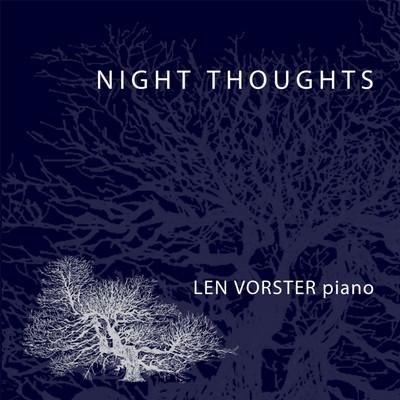
NIGHT THOUGHTS

Len Vorster

Move Records MCD 647

As you’d anticipate, a lot of this disc is given to nocturnes: by Tchaikovsky, Clara Schumann, Faure, Charles Tomlinson Griffes, Jillian Rose Tymms, Sculthorpe, Satie, Poulenc, Michael Easton and Leonid Desyatnikov. The other five tracks – by Bloch, Hindemith, Duparc, Peter Klatzow and Copland – use ‘night’ in their titles, not least the American whose work gives this CD its title. Just as importantly, the content has a general tendency to be slow-moving and ruminative, thereby giving rise to a generalization or six about music for the night coming from less joyful reaches of the compositional mind, if not downright depressing ones.

Vorster opens his recital with Bloch’s In the Night – A Love-Poem, an effusion from 1922 which comes in the rare key of A flat minor, even if it ends in the more erotically self-supportive A flat Major. This is a fluent effusion, bearing traces of impressionism, mysticism and a hint of exoticism, all calibrated with care by Vorster who observes every accent and expression marking to produce a gem both brooding and passionate. No 4 in Tchaikovsky’s Op. 19 Six Pieces of 1973 is a gentle C sharp minor Nocturne with a simple ternary shape, its coda based on the middle Piu mosso material; it has the requisite melancholy and enjoys a fluent expounding with plenty of rubato and a fetching recapitulation section where the melody shifts to the left hand and the upper part decorates with that slight intrusiveness typical of this masterful composer.

Clara Schumann produced a notturno as the second of her six Soirees musicales, written and published in 1836. V orster treats this with much the same latitude as he did the preceding Tchaikovsky, and with a similarly lavish use of the sustaining pedal. In this piece’s reprise, the main theme is kept in the right hand but transformed into a more ardent character. As well, the composer’s harmonic progressions intrigue momentarily, even if nowhere near as much as those of her husband. Faure’s Op. 104, composed just before World War I, comprises two pieces: a nocturne in F sharp minor and a barcarolle in A minor; Vorster presents the first, which is probably just as well because the alternative is oddly garrulous. By this stage, the composer’s harmonic language had become very sophisticated and this set of pages offers a wealth of chromatic shifts, carried off with sympathy and clarity by the executant.

At this point, Vorster introduces a work by a former piano pupil, Jillian Rose Tymms. This is Silberstreif and takes its impetus from Melbourne’s lockdowns during the COVID years, the title suggesting a light at the end of the infectious tunnel. The work proposes a general restlessness, despair and a longing for the way out; what we hear is, apart from one short harmonically disjunct segment, a Mendelssohn song without words, loaded with the rippling arpeggios and scales familiar from the German composer’s salon output. I’m sure it’s sincere and Vorster gives it mellifluous address but the music itself is too sweet and lacking in bite to match the times it represents.

Hindemith’s 1922. Suite fur Klavier has at its centre a Nachtstuck which bears the composer’s duality lightly. The harmonic language is tightly organized and sturdily framed; there are clear melodic shapes that are dealt with and revisited; the time signature (non-existent, really) stays at a pretty constant 3/2 (or 6/4, if you like); and the ternary structure features a sparkling central section to contrast with the framing more sombre pages, the dynamic climax reserved until bars 80 to 83 in a piece that lasts for only 97 of them. Vorster works through its three pages with a calm flexibility that belie Hindemith’s reputation for academicism.

Aux etoiles by Duparc either refers to the first part of Poeme nocturne, an orchestral triptych of 1878 of which this first section only survives, or (more likely) it’s the 1910 piano solo, orchestrated in the following year. This is an honest piece of atmospherics which opens and ends in C Major but moves to odd places in its long centre, which involves a not-very-convincing return to the tonic 15 bars from the end. It’s subtitled as an entr’acte pour un drame inedit; a slow-moving hiatus in the projected work, then. A brace of lines from Verlaine about a willow reflected in a pond preface the Notturno of Charles Tomlinson Griffes as we lurch to America for a while. This 1915 composition, the middle one of three Fantasy Pieces, is a cousin to Duparc’s starry vision, albeit one with richer chord structures and a plethora of rhythmic variations. Its rich-textured mixture of languor and virtuosity suits Vorster’s interpretative skills most adroitly.

A little touch of Sculthorpe in the night with the Tasmanian-born composer’s Nocturne – Seascape, a piece of plangent romantic/impressionist charm in E flat Major, all 1′ 57″ of it and with a free-flowing charm from the 19-year-old fledgling composer, still occupied with his European forebears. Satie’s Nocturne No. 1 precedes four others from 1919 and moves past with a reassuring placidity. My only gripe with Vorster’s reading of this slightly curious piece is his tendency to pause before changes in register, e.g. bars, 3,4,5 and 6. I felt more assured during the central Un peu plus lent qu’au debut break. Poulenc follows with his Nocturne No. 4, Bal fantome, from the 1929 set of eight. This also is not long – 1’29” – and stands as a waltz falling into four-bar clauses with muted harmonic spice to ginger up its C Major basis.

Michael Easton, an Australian-British colleague of Vorster who died in 2004 (can it be so long?!), appears next with the second movement of his 1993 Flute Sonata, appropriately entitled Nocturne. Transcribed by Vorster, this begins as a slow waltz, changes to a 2/4 rhythm and ends (more or less) in 6/8. It rambles very pleasantly, but not aimlessly and the arrangement has many picturesque touches to leaven the top-line/bass support that emerges in the piece’s middle pages. The Nocturne from Giselle’s Mania forms part of a film score written by Leonid Desyatnikov, the scenario concerning the ballerina Olga Spessivtseva who suffered mental breakdowns in 1934 and 1937. The music makes much of a cell comprising a rising minor 6th followed by a falling minor 2nd, altered to a Major 2nd near the end. This also meanders in a post-Rachmaninov way with some ardent flashes surging out of a melancholy, if not depressing, soundscape.

One of Vorster’s teachers at the University of Cape Town, Peter Klatzow, composed his four-movement Moments of Night in 1968, revising it in 1982. Vorster presents the last work in the suite which is an intriguing night-scape, gifted with a soft sparkle and following a broad, mobile path through a set of concise melodic cells that emerge and disappear sotto voce.

Last comes the CD’s longest track: Copland’s Night Thoughts (Homage to Ives), the composer adding his sub-title to give no grounds to his friends, neighbours, critics, decriers and the whole profanum volgus of commenting on the piece’s occasional similarities to Ives (and, even then, most of Copland’s cluster-bombs are tame compared to those from the older composer – you don’t need to go further than the second bar of Emerson in the Concord Sonata, let alone bars 6 and 7, to see the difference). Written for an American piano competition in 1973, the entrants were required to read the work at sight.

Not that the task is impossibly hard, as it would be to sight-read an Ives piece, say. The work is slowly paced, loaded with accidentals and rapid arpeggiated ornamentation. Even when the composer moves to four staves, the complex is easy to read and deliver. What the actual thoughts are remains open to each listener, but the work is not programmatic like Central Park in the Dark (particularly the opening); if anything, the suggestions are of long-held resonances (bells?), if discordant ones – albeit this night is full of more surprises than most. For all that, Vorster’s reading is firm and dynamically balanced – far more so, I’d suggest, than anything coming from those 1973 sight-readers, but that’s what you’d expect.

Copland’s work acts as a kind of capstone to this CD. It’s the most contemporary work of the whole 15, expressed in a language that is well removed from the smooth sweetness of many among its companions. If it offers more food for thought than bagatelles like the Duparc, Tchaikovsky or Poulenc pieces, Night Thoughts reminds us of serious music’s potential for spartan, aggressive gravity of utterance. For me, it concludes Vorster’s compendium with a quiet assertiveness – not exactly putting its predecessors on a shelf but relegating them to secondary status, no matter how expressive and circumspect they may be in their emotional and technical content.

Illuminated, elucidated Brahms

OVER UNDER

Luke Severn, Evan Fein

Move Records MCD 611

This disc comes out of a long-term, long-distance relationship between Australian cellist/conductor Severn and American pianist/composer Fein. A marriage of two aesthetics has apparently come about here and the musicians have a fairly well-established performance history (USA in 2019, Australia in 2022) from which comes one of the two works recorded here: Brahms’ Cello Sonata No. 1 in E minor. Following the California/New York accounts of Fein’s first Cello Sonata, they’ve set down here the other constituent of their Melbourne/Bendigo/Frankston recitals: Fein’s second essay in the form.

And that’s all there is: 28′ 55″ for the Fein, 28′ 34″ for the Brahms; near-equivalent in temporal terms. But, while you can admire the American’s work for its coherence and bursts of brilliant writing, its thunder is stolen by the Brahms reading which is distinctive in its vision and delivery. Which is the chief problem with this pairing: much as you’d like to find high merit in the Fein, the other outclasses it, to the extent that you wonder why the composer didn’t think to give his work a less striking companion.

The modern work is in four movements: Serene, warm; Redemptive, resonant; Molto scherzando; Lively, playful. It begins with a simple rising two-note cell in the cello that expands on itself. Straight away we’re in a benign atmosphere of something approaching hymn music, broadening to a firm declamation couched in a harmony that Brahms would have found comfortable, if eccentric. Then the work seems to meander into an episode rich in piano triplets, shared with the cello, and a development that moves into new material, both instruments in a close interface.

Once again, the declamation arises and we’re in late Romantic territory – both firmly assertive and ruminative as the opening cell recurs and the exposition’s processes are revisited. This is a music of alternating moods which, near the end, seems to see the triumph of the serene. But not so: Fein ends with a presto flourish for both players; it’s almost as though he’s providing a contrast with the placid rhythmic tenor of his movement’s procedure up till now.

When it comes to redemptive music, I’m not sure what to expect; it could be anything from the Dies irae to L’Ascension, and a world or six of religious music in between. Here, we have a slow sequence of repeated chords in the keyboard under the cello outlining a well-woven melody that stretches for some length towards a climax, that breaks off and then resumes its path with cello and piano more synchronised in their thinking, although the keyboard’s initial repetitions seem to be the spur to action. We are led to a consoling stretch of diatonic affirmation that ends up resembling a Bloch cantillation.

A sequence of common chords leads back to the opening repeated chords under the meandering string line; the same crisis, with the keyboard sustaining its support for a final mellifluously brooding semi-cadence. In these pages, the emphasis for me fell more on the resonant, the performers reaching two points of impressive suspense, as well as a brace of powerful statements that emphasized the possibilities for broad statements. For all that, the harmonic language is, in the main, orthodox; we just have to accept this mode of contemporary composition that is content with titillating the past, not building on it.

The following scherzo strikes me as far from molto, possibly hampered by a rhythmic irregularity/juxtaposition that obtains from the opening but gives way to a smooth body of play across the movement’s centre before returning to round out this simple ternary structure. The instruments are busy with some clever canonic scale descents that inevitably bring Shostakovich to mind, if without that composer’s verve and ferocity. Still, I did like the cello’s final ‘bent’-note slight portamento.

Further reminiscences come bursting in at the finale’s opening, chiefly of Saint-Saens’ Carnival of the animals with the piano’s high-register tinkling while the string line follows its restrained jollity before swinging into an amiable, crowd-pleasing melody. Much of what follows appear to be variants on these two elements with some late attempts at post-impressionist harmonic adventurousness. But Fein doesn’t stray too far from well-trodden paths; just when you think he’s heading in a dissonant direction with an unexpected modulation, he hauls us back to the plain-speaking path of diatonicism. Listen to the final minute or so which is an excellent example of leading towards calm acceptance before a semi-aggressive, if defiantly positive, resolution.

I need hardly record the players’ obvious intensity and painstaking care with Fein’s score. Is either of them taxed by this music-making? Not that much, although some parts of the last two movements have their pressure-points. Yet the sonata presents as rather lightweight, for all the grandiose passages in the opening movements. Certainly, Fein has produced a highly competent work yet it doesn’t hold much that could be termed striking or original. Even its passion is tautly leashed and its appurtenances fail to catch this listener’s interest.

What follows – the Brahms sonata elucidation – is quite remarkable. In the CD liner notes, Fein observes that ‘we dare to hope that some of our bolder musical decisions allow audiences to enjoy this beloved sonata in a new light’. Well, to those of us with a long-standing affection for the piece (many thanks, Daniel Horrigan, for those hours of tolerant rehearsal), this reading offers many insights. The duo takes the first movement’s ma non troppo direction seriously; this is a stately progress through the first subject, its only defect coming through an over-amplification of the cello line. But Severn and Fein have a fine eye for the work’s inner accelerations and dynamic contrasts which make this allegro an absorbing experience, with a good deal of the commonly accepted bravado muted into the composer’s inimitable introspection. Only an odd misfired cello A in bar 18 disturbs the exposition’s accuracy, which is flawless on the repeat.

The most obvious of those interpolated accelerandi comes at bar 50 in the vehement build-up to the B minor explosion of bars 57-8. What follows is a masterful depiction of the descent to gloom across bars 74 to 77. Later, in the development, a gradual increase in tension starting at about bar 102 is accomplished by a simple consensus of dynamic heft working towards the fortissimo F minor resolution of bar 126. Further re-acquaintance with the artists’ approach comes in the recapitulation which follows a similar pattern of subtle speed and dynamic increases and subtractions, highpoints the cello’s vital high in bar 222, determines a dark-shaded coda approach from bar 235 on, and culminates in a moving processional across the movement’s final 20 bars.

Severn and Fein hit on the ideal approach to Brahms’ Allegretto. It is given a minuet’s lilt in the outer sections, Fein picking and choosing which staccato directions he’ll observe (all of them in the opening bars, more selective in the left hand of the second half in this section [bars 16 to 27]). Adding to this excellent clarity of delivery, the central trio from Fein is clog-free with a welcome lack of glutinous pedaling, despite the direction to sustain from bar 79 in my old Breitkopf & Hartel edition. This helps give the movement a kind of unity, ensuring a continuity of output, even if the minuet’s return still piques because of the absence of its trio’s continuous two-semiquaver-plus-quaver pattern from the keyboard and a reversion to ye old-fashioned rustic courtliness.

To end, Brahms starts out a fugue, but it doesn’t sustain its formal characteristics. Fein states the subject with plenty of detached notes; not quite abrupt enough to come under a staccato heading and still maintaining a melodic contour. And the first climacteric at bars 24 to 25 is a true Brahmsian welter, if one where the instruments maintain audibility and their lines carry distinctly right through the interleaving of lines up to bar 53’s light relief and the rubato brought into play at bar 61 where dance wins out; the same gentle hesitation that the duo employed in the previous movement’s trio. I was struck by an odd tuning error from Severn on the B in bar 72, and a Fein slip in the C minor triad of bar 93. But almost immediately, the lack of brutal teeth-marks in the closely-argued mesh from bars 115 to 123 merits strong approval for its communication of polyphonic stress rather than instrumental effort.

If Severn and Fein come close to your traditional Brahms thickness round the waist, it’s in the final pages from bar 152 and through the coda Piu presto which is, compared to the rest of the interpretation, thunderous and virtuosic in the best sense of serving the score through craft. It brings this reading to a highly satisfying consummation. In the end, it realizes that declared intention of shedding ‘a new light’ on the score which here takes on an unexpected transparency in its instrumental interplay and a welcome immediacy due to an enlightened approach to dynamic levels and care in sound production.

An amiable window into the Baroque

BACH PIANO 2

Judith Lambden

Move Records MCD 653

For the first of her Bach CDs for Move, released in 2021, Lambden presented four of the toccatas, the Italian Concerto, and the Chromatic Fantasia and Fugue: a deft combination of the present-but-unexplored alongside two familiar scores. Something of the same combination obtains in this latest offering which comprises five works. Those that have general currency are the French Overture BWV 831 and the Capriccio on the departure of a beloved brother BWV 992. As for the arcana – well, I have barely encountered them – they begin with the Overture in F Major BWV 820, move to the Aria variata alla maniera italiana BWV 989, and wind up in the perplexing Fantasia and Fugue in A minor BWV 944.

Unlike a few recent publications on this label, Lambden’s CD runs a substantial length at 76 minutes (actually, adding up the individual tracks, I believe that it comes in closer to 79); nearly 33 of these are taken up with the first eight tracks: the French Overture, or Overture in the French style which is the longest suite in Bach’s keyboard catalogue. Immediately, you can see that this offering is a continuation of the pianist’s 2021 disc; there’s an authority at work but the performance is not a perfectly bland surface with everything in its allotted place. You can hear patches – no, seconds – of unevenness: glossed over notes in brief runs during the Ouverture‘s stately preamble (e.g., second time through, last three right-hand notes of bar 14), a slight slowing down as the voices accrete in the 6/8 fugal-gigue that follows.

And there are also interpolated passages of play that deliberately slow down the rhythmic inevitability beloved of contemporary performers who operate their Bach craft with metronomic regularity. You can hear plenty of examples in Lambden’s progress through this marvel, as at halfway through bar 85 when she simply changes gears, or the slight accelerations that push the envelope, like in bar 115 and beyond. The return of the stately opening impresses as more individual and imaginative with a more free approach to metrical regularity. I don’t want to complain too much but the executant refrains from repeating bars 20 to 163; yes, it’s exhausting for the pianist but there are so many linear delights to be savoured in these pages.

Still, this suit-yourself approach is everywhere in the following Courante which is packed with small pauses throughout, in both hands. The fluency is hard to cotton on to until the first half’s repeat where you learn to make adjustments for the piece’s occasionally fitful outline. During the Gavotte I‘s left-hand semiquaver groupings, you can detect some notes being articulated unevenly the first time round. on the return, nothing is out of place, each group sounding true and clear. Lambden treats the pair of Passepieds with a similar studied nonchalance which results in a certain amount of latitude with ornaments, as the start of bar 28 on each of its three appearances.

But there’s something to be said for this room-space. For sure, when the musician is taking time to insert acciaccature, mordents and appoggiature, you won’t be able to dance this suite with absolute certainty; but is Bach writing for potential footloose and fancy-free Leipzigers, or just using the form? The latter, of course., so Lambden is quite at liberty to pause where she sees a hiatus point, or – consoling the dodgy pianists among us – where the going gets a tad tough. I’ve got nothing but praise for the mobile Sarabande which is given without exaggerated gravity, notably in the thick (relatively) chords of bars 24 and 25.

The Bourrees enjoy direct treatment, especially the first where the opening detached note approach rouses us from a bucolic torpor. Still, there is the occasional missed (or misfired, probably) note and the slight ritardandi in Bourree II puzzle more than please. The Gigue that follows is handled with excellent calm; nothing is hammered in this chaste framework and the outlook is almost placid, even if a few (two?) notes go missing in the little bursts of semi-scalar fioriture/demi-semiquavers. Finally, the Echo swaggers past amiably, my only problem Lambden’s lengthening some of the bass quavers (bars 22 to 25, then bars 54 to 57) which brings to mind, in a small way, Busoni’s Bach transcription exaggerations.

This large-scale work is followed by a small relative in the BWV 820. Its short Ouverture is packed with ornaments in its opening 13 bars, a few of them wisely omitted here. Then the 3/8 burst into fugato energy comes across with quiet security that is rarely ruffled – although I’m coming round to thinking that those short breathing-spaces (scarcely that, in fact) are Lambden’s system of punctuating the work’s thrust, avoiding the Tic-toc-choc metallic assembly-line approach. In the Entree, this player introduces a great many more dotted quaver-semiquaver patterns than occur in my admittedly antique Breitkopf und Hartel score. Nevertheless, here the slow march holds the right Charpentier strut in its slight two-part sinews.

Not much to report about the Menuet-plus-Trio, Bourree or Gigue. As with the post-Ouverture dances in the BWV 831, Lambden observes every repeat faithfully, offering a piano repeat on the odd occasion but for the most part retaining those ornaments that she introduces first time through. Mind you, these three dance movements are brief and lacking in digital complications; Lambden’s slight rhythmic relaxations prove handy enough in adding some quirkiness to what are simple and internally repetitive structures.

Some desperates have been pointing to the Capriccio as one of the first examples of tone-poem narrative in Western music. Not really: it had plenty of choral and instrumental antecedents. But its brief pages hold some moving emotional content, especially in the Friends, Dangers, Lament and Farewell segments, Lambden making affecting work of the first, third and fourth of these scenes while somehow suggesting the Goldbergs‘ penultimate Quodlibet in the angular second. Especially honest is the melancholy character realized in the Lament mini-passacaglia, and the well-there-he-goes stolidity of the brief Abschied.

About the two concluding Postilion movements, I’m not so sure. There’s nothing urgent about the Aria which doesn’t propose a speedy journey but more of a leisurely jog as the octave jumps that are intended to imitate the driver’s instrument have no bite or energy. The Fugue would have gained from a more rapid tempo and a good deal more energy in the thicker meshes (bars 27 to 38, for example; even bars 45 to 47). Still, Lambden works through this last with careful craft, making as much as possible from one of the least satisfying final bars in the composer’s output.

Once again, the performer indulges in more hesitations and pauses while she works through the Aria variata’s unremarkable arches, laden on during the repeats with ornaments delineated in my edition. It sets up a ruminative atmosphere which is probably for the best with this undistinguished material. The trouble is that few of the following 10 variations have much to delight in them, but more an unusual number of disappointments, like Variation 2 with its going-nowhere triplets (bars 5 and 6); ditto Variation 3‘s bar 7; the aimless right-hand repetitions of shape and actual notes across Variation 5. In fact, it seems that inspiration flagged pretty consistently in the third bar of each variation’s second part. So much so, that it’s a relief to get back to the Aria‘s paraphrase in the final Variation 10.

It seems to me that Lambden is not really challenged by this work, its twists and turns rarely unpredictable – on a par with the preceding Capriccio. But her reading is composed and undemonstrative, the strands well balanced and distinctive, if some of the phrasing shapes sound a tad contrived and the short suspension of action for the sake of a grace note starts to grate in the repeats. Speaking of which, the second part of Variation 9 is not played again: a shock in continuity as every other part of this work is given a second run-through.

To end, we are offered the BWV 944, which opens with a fantasia that you improvise yourself on a series of 18-and-a-half chords, with the between-staves interpolation ‘Arpeggio’. Some publications spell it out with arpeggios travelling from one hand to the other; Lambden goes the same route but arpeggiates in contrary motion simultaneously. Nothing unusual in that, although it’s a rather ordinary way of negotiating the problem. Still, you can go a long way before you find somebody with an original take on these 10 bars, e.g. not just splaying out the chords or maintaining their written range.

The fugue opens bravely and confidently but the arrival of the third voice in bar 18 sees some initial fumbling and, by the time we get all bass-operative at bar 38, the pace has slowed, only to pick up a little further on. Also, the executant seems to slow down to accommodate a cadential trill too often for comfort. She finds the going tough from about bar 106 on to the bass pedal B that lasts for 4-and-two-third bars at the work’s centre; the polyphonic interplay here sounds laboured – which it is but it shouldn’t come across that way.

Near the end, the spirit of Liszt/Busoni takes over and there is a pronounced acceleration from about 19 bars before the conclusion, the dynamic level moves into a near fortissimo level, and the approach to the fugue’s concluding bars smacks of the grandiose. Mind you, the player can hardly be blamed for a touch of triumphalism after this active, long web of fabric. It makes for an unexpectedly assertive last word to this disc that is for the greater part characterized by restraint and a pliant, relaxed approach to rhythmic regularity. These offerings bring together an interesting range of works – from the highly demanding to the simple – and reinforce Lambden’s standing as a sincere and informed interpreter of Bach’s keyboard catalogue.