But is it?

SCHUMANN CELLO

Zoe Knighton & Amir Farid

Move Records MD 346 1

Not that I’m complaining – overmuch – but this CD’s title is ambiguous, if not misleading. Both Schumanns are treated here: Clara and Robert. Clara, I hear you cry? Yes: it’s far-fetched because the finest pianist of her time didn’t write anything for cello and piano – the only instruments in play when Zoe Knighton and Amir Farid are the featured artists. Although a short frisson of hope rose when I saw the CD’s accompanying leaflet.

Clara Schumann’s chamber music includes a piano trio and a violin sonata – and that’s all. What we’re given here are three of her song-cycles, and no – Knighton does not display another side to her talents but uses her instrument as a substitute for the vocal line to the Op. 12 Three Ruckert Lieder, the Op. 13 Six Songs, and the Sechs Lieder aus ‘Jucunde’, Op. 23. As for Robert Schumann, his output involving cello as an individual voice is more substantial, including the A minor Concerto, three piano trios, the piano quintet and quartets, and one definite cello/piano duet: Funf Stucke im Volkston. This last-named is included on this CD, as well as one of two other pieces where the cello is a possible participant: the Fantasy Pieces Op. 73 that the composer wrote for the clarinet/piano combination but allowed for violin or cello, just as he did for the Op. 70 Adagio and Allegro – originally for horn and piano, but capable of transference to violin or cello.

The Knighton/Farid combination has produced a fair swag for Move Records, including an album of pretty much everything Mendelssohn wrote for this combination; ditto Beethoven; a Russian catch-all, including Prokofiev’s Op. 119; Debussy’s sonata finishing off a French collection with lots of arrangements; and an Argentine Tango CD with only one Piazzolla track (a remarkable accomplishment), although it’s a substantial one. This Schumann release is the duo’s first collaboration in six years, their previous five Move products dating from between 2010 and 2015.

The 15 songs average about 2’42” in length; not much time for padding. But you could say much the same about Robert Schumann’s two works, which are generally concise and lacking in sprawl. Confounding expectations even further (or adding to the mystery), the text of each song is printed in English; presumably, so you yourself can sing along with the cello. Or, more realistically, this verse publication intends to give you an idea of what the Knighton/Farid duo are attempting to communicate. Actually, not just an idea but the full picture.

This disc opens with Clara Schumann’s Op. 13 settings of two Heine poems, one by Ruckert, and three by Emanuel Geibel. These are polished and lyrically crafted songs, Knighton performing the first three an octave below the vocal line, the final three at the original level. Of course, you can find traces of her husband’s characteristics and some specific phrases sound finely woven enough to have come from his catalogue, like the slightly asymmetric prelude and postlude to Ich stand in dunklen Traumen; possibly the performers make too much of the sustained D on gestehen and Traum in Sie liebten sich beide but the work needs some individuality; Liebeszauber was accomplished with excellent control of touch by Farid whose triplets were light and non-glutinous, while both artists shone in the ritardando across the poem’s last two regretful lines.

Knighton gave a remarkable reading of the vocal line to Der Mond kommt still gegangen, the 5th that features at the start of each stanza’s second line moving into territory as touching as any singer could make it. A similar sensitivity pervaded the duo’s reading of Ich hab’ in Deinem Auge, a finely constructed lyric with a silk-smooth ease of utterance. As for Die stille Lotusblume, both musicians found here an ideal capstone for the cycle with a sensitive realization of the piano part’s rhythmic regularity, a plangent cello line that followed the composer’s evolving melodic patterns with telling sympathy, the series ending with a fine reflection of the poet’s concluding question through an inconclusive dominant 7th.

Kingston shines even more in the Ruckert poems, the first played an octave lower than written while the others make a positive impression because the cellist gives them a carefully etched outline; not exactly overdoing the vibrato but staying the right side of intrusive. Both artists made excellent work of Er ist gekommen with its contrast of nervous Werther-like angst succeeded by a mellifluous Ruhig stanza, polished off with a meltingly fluid downward moving cello line in the composer’s repeat of the last stanza.

Liebst du um Schonheit also was handled with consideration, even if its material impresses as bland – probably because of the sameness at the start of each section, the mould only fractured in the second half of the last quatrain; Farid’s brief postlude an excellent instance of his talent in finding a level of warm pathos – nothing too much. As for the concluding Warum willst du, here you come across a small gem of expression where each phrase slots into the next with admirable craft and, as in its companions, the climax arrives with little bravura but a world of emotional conviction. It helps immeasurably that Knighton and Farid deliver each sentence in well-practised partnership, each slight pause pitched in unshakeable congruence.

Clara’s Six Songs taken from Hermann Rollet’s novel Jucunde are a mixed blessing in terms of attractiveness and emotional variety. Here, if anywhere, you miss a singer’s input because of a kind of textual similarity, both literary and musical. The opening piece, Was weinst du, Blumlein, prefigures the unalloyed optimism of the cycle’s last two numbers – Das ist ein Tag and O lust, o Lust. Mind you, this first number also aims for a folksy cuteness and it unfortunately succeeds, to the point where the third stanza, fairly predictable, verges on the tedious. Nothing against the following An einem lichten Morgen, but attention fell more on the piano accompaniment and its speckled arpeggios than on the cello line which remained measured and spacious – one might almost say orotund – in comparison.

It takes you a while to get into the vein of Geheimes Flustern which has a 3/8 time signature but sets up two rhythmic patterns that wrong-foot each other. Not that challenging, as things turn out, but a deft exercise with a fine melody which didn’t captivate the performers that much as they played only two of its three verses. A complement to the first song in the cycle, Auf einem grunen Hugel has the same simplicity of style, if in a minor key and langsam. The realization is just as much a contrast, too, as the performers take care with their continuity to weave the setting’s irregular statements into a convincing whole.

The last pair are brief essays in jubilation: the first celebrates spring with some familiar onomatopoeia in bird tweets and hunting horns, while O Lust, o Lust has the same 6/8 metre but speaks in wider arches than its companion (the shortest in the set) where the piano support is a jig. Farid’s contributions have a convincing energy to them; Knighton clearly delights in the euphony of her melodies, the instrumental web fluent and definite.

Then we arrive at Robert Schumann’s two works and more familiar territory. I came to know, if not to love, the Op. 73 Fantasy Pieces through student performances under its three formats – clarinet, violin and cello. – and prefer the clarinet version for its definition and parity of dynamic. Knighton and Farid give a worthy account on this disc but its contours are cloudy. This is not an avoidable problem but any partial solution lies in the cello’s ability to push itself forward; a big bull instrument would have more luck but in this instance the instrumental mix proved over-polite. Farid, as usual, was all consideration for his partner and this approach worked pretty well in the first two Eusebius pieces, although even here you were denied much insight into the undercurrents of restlessness that characterize Schumann’s emotional landscape.

The concluding Rasch und mit Feuer kept up the underpinning rhythmic ferment but the piano’s output came over as half-cocked, nowhere strong enough in loud concerted passages; not even at the one fortissimo marking in my edition four bars from the end. The sforzandi lacked much punch and that vehemence that should erupt when cello and piano unite for the main theme’s upward rush impressed as muddy. To my ears, the most lucid of the three pieces was the central Lebhaft, mainly because the actual writing is more transparent and – to use a technical term – bouncy.

On first hearing, you’d think that the Five Pieces in Folk Style puts the cello consistently in front position and, for some of the time, that’s true. Listen again and you become aware of the interesting nature of the keyboard accompaniment. Sometimes it stays just that, with chord support and melody doubling. Then, a burst of individualism emerges, and another; eventually you realize that the distribution of labour is not all one-sided. There is another intriguing factor in Schumann’s odd phrase-lengths. I’m assuming that the melodies are the composer’s own, not gleaned from mittel-European sources; as well, the tunes often range too far to have that necessary gnomic quality.

Speaking of gnomic, the first of these pieces is titled Vanitas vanitatum, which some commentators have taken to refer to a Goethe poem about a drunken soldier. Certainly, that seems to have informed this duo who rolick through it Mit Humor, as required, and a plethora of lurches. This is where you get the impression that Farid will be underused, but then the piano takes on prominence when the key changes to F Major and he is not backward in coming forward, even if Kingston is working on her lower strings. But then, in the following Langsam, the piano gets to shine for about 15 bars only with a statement of the mellifluous and wide-reaching tune before sinking back to secondary position.

Honours are more even in Nicht schnell, mit viel Ton zu spielen for which the piano has a tattoo-like pattern under the cello’s asymmetrical tune; then full chords under the cello’s double-stop 11 bars when the key changes to A Major (not kind for the instrument and an obvious strain for Knighton) during which the keyboard is set into arpeggio mode that recurs at a finger-stretching coda. Further on, in the penultimate Nicht zu rasch piece, Farid gave the full-bodied chords unexpected power, notably in the last two bars. Not that this is subtle music with its oddly four-square structure and non-subtle movement forward; added to this, Farid’s harmonic changes in the central section take attention away from the treble-clef cello line/theme.

The last piece, Stark und markirt, reminds you of the Cello Concerto’s outer movements with its surging power. Once more, Farid is far from a support only. Luckily, this piece was articulated with welcome briskness of attack and a determination to call a forte a forte. Further, you were left in no doubt that this piece was a thorough partnership, one furnished with dramatic character and emotional urgency: an attention-grabbing track that worked quite effectively to finish a CD that has its fair share of restrained, pensive rambles.

Original works that breathe

BASS INSTINCTS

Alicia Crossley

Move Records MCD 624

Straight on the heels of percussionist Claire Edwardes‘ new CD of works by female Australian composers comes this publication by Alicia Crossley of bass recorder compositions, again all by Australian women composers. There’s only one common element: Alice Chance whose Mirroring appears on the Edwardes disc, and a mutation called Inhaltations stands at the centre of Crossley’s production. The other names that Crossley promotes are Holly Harrison, Fiona Hill, Anne Boyd, Lisa Cheney, Amanda Cole and Jessica Wells. As far as I can tell, all of these are Sydney composers except Lisa Cheney, who is Melbourne-based. But it’s no good being absolute about this; you can check up on contradictory websites and information sources and still not wind up with the right facts; least of all in a these chop-me-change-you years where personal movement is hard to detect.

This CD moves into more advanced compositional territory than Edwardes’ recent product. Three of the works involve electronics, one allies itself to percussion, wind chimes appear in another and a multi-tracked bass recorder quartet stars in Chance’s work. Spending far too long chasing down information, I’ve come to the conclusion that all these pieces were probably commissioned by Crossley, although I can only swear to four of them being so blessed. As for their dating, three of them are definitely 2021 while the others are probably from that year. Thanks to Move Records’ promotion of local writers, I’ve come across isolated works by most of these composers – many more in the case of veteran Boyd – and traces remain of other pieces that came to the fore in concerts by the Melbourne Symphony Orchestra when in Cybec-modern mode, also at the occasional Musica Viva recital, and even one score heard during the Melbourne International Chamber Music Competition

It’s a hard ask for these writers. Even allowing for Crossley’s skill, her instrument is a limited one with a range of two octaves; hence, I suppose, the fact that only one work is for the bass recorder alone and unadorned. Everybody except Lisa Cheney has looked at opportunities for expansion. But this one unadorned work, Before You, is one of the more affecting offerings on this disc. As I understand, it’s a love-song to the composer’s newly-born baby daughter, Nora. The piece is not all slow-moving lullaby material but has some deftly-placed emphatic plosions and root-forming repeated notes, even some double stops (note plus humming?), and a touchingly curved lyrical section before the final monotone tattoo. It’s a strange and imprecise ambience we’re offered, where uncertainty and affirmation sit alongside each other: a fine summation of parenthood, in other words.

Slightly more varied in its instrumental source material, Anne Boyd’s Alhekulyele brings wind chimes into the mix. This piece revolves around illustrator and Aboriginal rights activist Olive Pink and the Botanical Garden that she established in Alice Springs, from which in her latter years she would watch the sun set on Mt. Gillen, the imposed name of Alhrkulyele. Boyd presents the work as both a meditation and a dance; as far as I can see, the dance reference doesn’t start until about the two-thirds point, the preceding material presenting an aural scene all too easily transferred into one’s preconceptions of the continent’s centre. The percussion element is introduced at various points, serving as aural brackets, while the recorder is gifted with a long, going-nowhere melodic line, interrupted by over-blowing passages that imitate the same effect on a didjeridu.

Again, Boyd uses a double-stop-producing technique which could involve breathing and/or fingering in a specific manner, such as we have come to know and love from contemporary flautists, the rot setting in (for me, at least) with the recordings of the incomparable Severino Gazzelloni. The dance segment is a piece of pattern-play that would probably not appeal to many choreographers because it stops and starts at its own sweet will, although the full and partial repetitions are suggestive of similar essays from Antill to Sculthorpe.

Beginning the CD is Holly Harrison’s Sylvan, a three-movement suite with erotic overtones. In the first, Crossley works in partnership with percussionist Joshua Hill on hand drums to show the woodwind instrument as a cool-eyed vamp, starting her act slowly and gradually rising to a jazz- and Latin-inflected climax. This is a deft piece of construction for its crescendo shape and for the juxtaposition of the recorder’s breathy sound quality against Hill’s snappy percussion. In the second movement, Harrison moves to a recorder-marimba partnership which pursues another cool jazz path; nothing over-aggressive but plenty of mild effects like small glissandi, breaths, flutter-tonguing, the whole capped by a moody, vibrato-rich coda. Hill’s marimba also works hard in the final piece which follows another catchy Latin rhythm but with more instrumental interweaving and a mid-way switch to a soft tinkling underpinning which suggests a cymbal used carefully, content to stay in the background of Crossley’s syncopated flights.

This is a fine opening as Harrison takes Crossley’s disc title and pursues one of its suggestions, if you allow ‘bass’ to become ‘base’. Still, Harrison’s communications of an earthy compositional stratum remain above the aesthetic navel and the suite suggests diversion rather than full-blown engagement.

Alice Chance’s Inhaltations – a cross between ‘inhale’ and ‘exaltation’ – is proposed as yet another dance, this one for the bass recorder and a multi-tracked bass recorder quartet; the whole sound complex supplied, I assume, by Crossley because no other artists are listed as contributors. It begins as a kind of slow chorale with the solo (live?) recorder line weaving a melodic line above the chords – more an incantation than an inhalation. A few dissonant harmonies appear at about the 3’40” mark but the greater part of the piece is unexceptional and follows an orthodox pattern, the solo line eventually moving into the centre of the chordal fabric. If there is a dance here, it has the character of a slow-moving pavane, and the exaltation is essentially spiritual, not physical.

The remaining three works involve bass recorder and electronics. Fiona Hill’s Lost in the Darkness takes as its starting point a poem by a refugee who had spent two years in detention with her younger sister. The atmosphere is, as you’d expect, dark and mournful with many sustained notes, tightly whispered words, a light use of electronics which seem to be based mainly on bass recorder sounds. At the centre, the solo wind line tends to be more volatile and unpredictable – rather like the federal government’s treatment of those dispossessed unfortunate enough to wind up on Australian shores.

Hill suggests very strongly the scenario of a captive bird struggling against restraints, as well as the futility and endlessness of the detention process, particularly in the final moments of her piece where the real-time output is mirrored by an electronic sustain. This makes for a fine piece of polemic, to my ears: presenting us with an aural equivalent to the isolation and quiet, depressing environment of people like those refugees who remain in Carlton’s Park Hotel while a spoilt Serbian tennis star has been able to tip his toe into their world and then fly home to his waiting minions and millions. It’s not an absolutely depressing piece; the solo line has many flights of restlessness and agitation. But the imprisoned spirit that it represents finds no way out – just a sustained, floating changelessness.

Microtones make a basic element in Amanda Cole’s Vibration Meditation which is focused on changes in timbre and production techniques more than rhythm and harmony which remain unadventurous across the work’s breadth. While the sustained electronic notes and chords give a certain weight to the score’s progress, the live recorder line holds the really interesting elements as Crossley employs pretty much all the same techniques as her colleagues, and then some. Her variation comes in that exposed line’s fluency, it seems to me, and not in the material itself which is content with a comfortable diatonic repetition – slowly altered, yet the same elements are sustained.

The CD’s last track has a schizoid form: The Clockmaker on the sleeve, The Clock in the booklet. It opens with electronic tick-tocks and a soft but perky recorder line, punctuated by percussive interpolations as the rhythm moves in a five/six alternating pattern. In fact, the electronic percussion takes on major importance with a sonorous passage for bell sounds and notes reminiscent of a steel band. Then the rhythmic insistence stops for a kind of free-wheeling lyric line supported by sonorous sound bands, before the ticking recurs and a faster tempo obtains as the composer revisits her initial material, although the electronic support is here more richly coloured. While the live recorder performs a sort of dribbling-away sign-off, the background persists in its energy until it fades into the distance.

This final piece has claims to being the disc’s most solid example of physical replication. Like many of its companions, The Clockmaker uses the bass recorder’s compass with a specific determination to display its timbral qualities, although this composer avoids most of the sound-production techniques brought into play by others with a more adventurous bent. All nine tracks show a musical world that is essentially soft-voiced and inferential – a circumscribed ambience with smooth edges. It soothes but is intriguing enough to engross rather than working as an aural narcotic.

Sweet and low

RHYTHMS OF CHANGE

Claire Edwardes

Move Records MD 3459

Of course, percussionist Edwardes is speaking of changing rhythms – the shifts in beat and pulse that Stravinsky and Bartok gifted us in the first half of the 20tm century, to the point where a predictable metre that lasts unchanged throughout a contemporary piece of music can be regarded as a failure of invention and/or imagination. Some regard it as a reassurance, to have the time signature stand as a monolith; if it was good enough for Paisiello, surely it’s good enough for us? More importantly, Edwardes is talking about something like a change in performance aesthetic. Each of the nine works performed on this CD has been commissioned by Edwardes from seven female composers, a result of the performer realizing how male-centric is (was?) the nature of her repertoire. These writers are Maria Grenfell, Ella Macens (two works) Alice Chance, Peggy Polias, Bree van Reyk, Elena Kats-Chernin (two works), and Anne Cawrse.

This is an interesting list; certainly for me because, Kats-Chernin apart, I don’t know any of them. Grenfell is currently a Hobart academic; Macens appears to be centred in Sydney where the bulk of her work is commissioned and performed; ditto Chance; the same with Polias; van Reyk breaks this mould by living in Newcastle (as far as I can tell); Kats-Chernin is the most well-known and prolific of all Australian women composers and resides in Sydney; finally, Cawrse takes us away from COVID Central (or has that distinction moved north?) by living and working in Adelaide. The age range that these composers represent is also wide – from 64 to 27. But what about a similar scope in the actual sounds we hear? Well, it’s not startlingly wide.

Grenfell has produced a three-movement suite for marimba solo. Macens’ first work involves vibraphone and crotales, while her second is for marimba alone. Chance’s Mirroring is a vibraphone solo, while Polias gets with the strength through one more marimba work. Van Reyk joins the Chance push with a vibraphone solo; Elena Kats-Chernin hits the marimba solo trail, then gives us a vibraphone piece; finally, Cawrse’s three Dance Vignettes round off the experience with a marimba. Focus on these two instruments was inevitable, given that Edwardes’ prescription to her composers was that their music had to be for solo mallet percussion and there’s not much left – xylophone and glockenspiel, possibly, but neither is used in your modern-day contemporary music-making, whereas the vibraphone has been employed by some impressive big names of the 20th century and the marimba forms an essential part of many music-making percussion nights in this century and the last – as I’ve found out to my cost.

Edwardes delivers Maria Grenfell’s Stings and Wings with assurance and a keen eye for its humour. The three movements – Jack Jumper, Dragonfly, Moth Hunt – depict insects with an attractive deftness, each presenting us with a motif or two and demonstrating the composer’s good husbandry with her material, be it a rising Major 2nd chord punctuating a syncopated murmuring, rapidly repeated notes and chords, a happily urgent single-note pattern that transforms into a melody but continuously returns to its original shape. The central piece interests for its middle section where Grenfell deviates from the expected path and works into more taxing, irregular rhythms and harmonic constructs, before calming us down with a return to her opening bar atmospherics.

As a job-lot, this suite is the CD’s second-longest construct but each segment passes with alacrity, the composer owning the inestimable gift of knowing how much is enough. While there’s little here to frighten conservative tastes, the work is an amiable delight – not too difficult in a technical sense but asking for a buoyancy of interpretation, here well realized by Edwardes.

Ella Macens’ Falling Embers refers to the aftermath of two bushfires – one that she personally experienced as a child, the second that terrific disaster of 2019-20. It’s a gently articulated piece, given a base by bowed sustained notes while an incrementally expanding melody in C minor emerges, vibraphone and three supplementary crotales making ideal complements in another work that refrains from mallet-crunching but sustains a placid, elegiac atmosphere that suggests calm and rest without a hint of any preceding terrors. Macens’ Verve dates from 2016; a marimba solo, it is skeletal in its matter but sets a few timing problems – nothing too serious for a modern percussion player, especially one with experience in Latin American dance steps. I don’t know where the title comes from; the piece is a neat exercise, if a repetitious one beneath the dressing, and happy to stay rooted pretty much throughout in A minor.

Mirroring by Alice Chance, a vibraphone solo, lives up to its name. Not that it’s packed with canons and cancrizans, but the piece presents its building blocks and plays with them in a glimmering sheet of variants, some of which you catch straight away while others nibble at the corners of memory. Chance’s world here is direct in its address but not strident, best appreciated in its rhythmical flow which seems to be continually on the move and not settling into a specific pattern, even if you sense that the pulse is unwavering in a subterranean manner. In different mode completely although having the pandemic and its effects firmly in its sights, Peggy Polias presents a vision of the COVID-19 virus as it attacks and recedes, eventually outfoxed by researchers and out-and-out virologists. Receptor is easily the most ‘modern’ music heard so far with a healthy atonality in operation, ameliorated by plenty of repetitions and textural varieties as it works through its four sections: Binding, Sequencing, Defending, Fading. This work’s last bars serve as a muted consolation, a soft requiem for the tragedy that many of us have faced.

Exploiting the vibraphone’s ability to generate differing sounds, Bree van Reyk exploits a range of techniques in Slipstreams, which revolves around pedal notes that last a bar while the fun goes on at different levels above them, particularly lengthy measured melodic chains and incidental, faster-paced small cymbal patterns. A harmonically plain work, van Reyk has also opted for an inexorability of rhythmic underpinning; still, the work is a sort of address to her younger self, focusing on sounds as qualitative units more than demonstrations of expertise or instrumental facility.

The oldest work in this collection is Elena Kats-Chernin’s 2010 Violet’s Etude, which celebrates the then-energetic nature of Edwardes’ daughter, a domestic presence as composer and performer prepared the former’s Golden Kitsch percussion concerto. A marimba solo, the work stays wedded to its 5/4 time-signature throughout, as well as an E minor tonality with modal inflections. As with every one of Kats-Chernin’s works that I know, this one is melodically idiosyncratic and deftly polished, reflected in Edwardes’ clear delivery, right down to the almost inaudible final gestures. Poppy’s Polka concerns Edwardes’ younger daughter and outlines the young girl’s day at school; another clever, almost facile vibraphone bagatelle, this time in A Major/minor in ternary shape, its meandering melody taking more than a little from Bach’s A minor Invention but the delivery packed with different shadings and styles of attack.

Last of all, Anne Cawrse’s three Dance Vignettes comprise the CD’s longest work: Meditations and Hymns, Fancy and Flight, Scamper and Scoot – all on a decreasing scale of length but just as atmospheric and as title-reflective as anything else in this collection. The first is loaded with intimations and imitations of plainchant, organum, tunes that might belong in a latter-day psalter; the whole sounds restrained and potentially meditation-accompanying with a great deal of repeated-note work and a restrained dynamic level. In the central piece, the fancy is light-stepping, initially in E Major and moving along its arpeggiated path with calm deliberation before entering into more complex rhythmic and harmonic territory between the half and three-quarter marks, then returning to the original 4/4 stepwise motion – the flight being harnessed at its end, or so it seems.

A fast linear duet finishes of the suite, the main interest coming from the combination of off- and on-beat accents, as well as the precision of output in a marimba piece that comprises two lines for much of its length, the 4/4 regularity interrupted by interpolated bars of disjuncture-causing irregularity, not to mention some brief glissandi near the conclusion. Scamper and Scoot serves as a happy romp with which to finish this display of Edwardes’ talents, even if – like many of its companions – it flirts with chromatic shifts but is firmly tonal. I don’t think many barriers are smashed through on this disc; even the more daring moments avoid angularity and dynamic shocks. But the final effect is one of careful craft being exercised, an overall evenness of temperament and address, the whole performed with sympathy and unfaltering devotion that speak out, no matter what level of virtuosity is required.

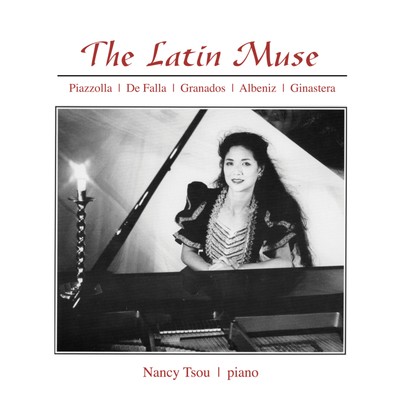
Gimme that old-time Espana

THE LATIN MUSE

Nancy Tsou

Move Records MCD 619

With her latest CD, Tsou is using the word ‘Latin’ in a trans-continental sense. At the start, she plays three familiar works by the Argentinian tango explorer, Astor Piazzolla; she concludes with another set of three pieces by the much more talented Argentinian writer, Alberto Ginastera. In the centre, we are treated to much well-circulated material in two works each by Granados, Falla and Albeniz – foundation-stones of 20th century Spanish music. The whole collection of a dozen tracks adds up to a little under 46 minutes but it has some interesting points – for me, these arise in the Ginastera Op. 2, the youngest music on the CD as it came from the composer’s 21st year.

Even at this early stage, you can relish the driving rhythmic energy, clear-voiced melodies and added-note harmonic clusters to be found in Ginastera’s masterworks like the contemporaneous Panambi ballet – a thunderbolt from my mid-adolescence when extracts appeared on Goossens’ 1958 recording alongside a truncated version of Antill’s Corroboree – and the more sophisticated 1953 Variaciones concertantes. These Danzas Argentinas begin with a Dance of the old herdsman – a particularly spry senior, it seems, with a taste for the bitonal as the right hand plays white notes exclusively while the left hand stays on the black with very few deviations. Tsou handles this with a clever mixture of restraint and jauntiness, my only problem her slight deceleration in tempo about 12 bars in after a very brisk opening. But the cross-rhythms are treated with excellent command.

The second dance, that of the Delightful Young Lady (more ‘elegant’, I would have thought), is a languid piece in 6/8 during which the melody gains an additional line that moves in 4ths and 5ths, acquires full chord status before sinking back to its quieter beginnings. The piece is more than a little suggestive of Piazzolla, albeit some decades earlier, and Tsou performs it with excellent malleability of its basic elements. Finally, Danza del gaucho matrero proves to be the most emphatically characteristic Ginastera work of the three with a welter of cross-rhythms to begin which Tsou complicates even more by adding in her own sforzandi; followed by a move into less bitonal territory and a clear tune weltered out on top of the constant whirl of a bass line. This interpretation is long on excitement if not on clarity, but then the composer was clearly intent on whipping up energy and bota-stamping enthusiasm, even if you had to keep an eye out for melodic syncopations that left-foot you and your expectations of predictability.

Those of us dedicated to the Australian Chamber Orchestra through successes and missteps became pretty familiar with Piazzolla at his best when Scots accordionist James Crabb collaborated with Richard Tognetti and his amiable band in a concert tour many years ago, the outcome one CD in 2003, Song of the Angel, and another two years later – Tango Jam, Vol. 1. Crabb is back this February for the first of the ACO national series concerts in a program that includes Libertango (still to be heard on the Tango Jam CD). Tsou’s two other Piazzollas – Oblivion and Milonga del Angel – also appeared on the ACO/Crabb 2003 recording.

This CD begins with Oblivion and Tsou handles it without any complications, but also without much interest. The composer’s melancholy melody is strait-jacketed into a shape where its sudden semiquaver bursts disappear and unexciting quavers balance each other in every second bar; the piece needs some bite but in this approach it suffers from an excess of rubato and a cloying lushness in the harmonic arrangement. Not much different comes in the Milonga where the harmonies are smoothed into cocktail bar inoffensiveness. Tsou’s ornamentation is welcome if not as spiky as I would have preferred and only a few liberties are taken with the metre. Libertango comes across as – eventually – clumsy. Tsou’s opening sounded fair enough as she worked through an extended introduction before hitting the chief melody, but at a few spots the rhythm paused while a glissando was negotiated with too much care, or a register move wasn’t snatched but proved ponderous. It’s a dance,. after all, and you have to provide certainty to the punters involved in this exhibition of self-indulgent strutting.

Granados appeared first in the Spanish contingent with his Spanish Dance Andaluza, fifth in the 12 Spanish Dances collection of 1890; not from the two Op. 37 dances as listed here, I believe. This is a familiar piece, Tsou tending to elongate the first downbeat notes in some bars – like the first. The interpretation is highly coloured, even if one of my favourite details goes missing: the little semiquaver figure that ends bars 16 and 17, in which the lower right-hand notes do not sound most of the time. Then, what to make of Tsou’s reading of the Intermezzo from Goyescas? Any suggestion of guitar pizzicato is absent, ritenuti are inserted at will. syncopations are mushy, the counter-melody that takes over at bar 40 is over-emphasized, the few fortissimo explosions are not emphatic enough, and the overall approach lacks firmness.

The Falla brace begins with an extract from The Three-Cornered Hat ballet, the Miller’s Dance which must feature among the composer’s most well-known works. Tsou makes a firm case for this boldly-contoured set of pages with no complaints coming to disrupt attention until the final accelerando which could have been less slow to take off. There’s no indication as to where this CD was recorded, nor by whom, but this particular track lacks acoustic resonance and would have gained from a favouring of sympathetic upper strings for a piano piece that stays firmly in the middle to low instrumental ranges. As for the second track, this is labelled La vida breve; it turns out to be only the Spanish Dance No. 1 from that opera’s score and the performance is a mixed bag with some nimble finger-work early on alongside some labouring when sections draw to a close. Most surprising of all is the conclusion that Tsou provides which is a light tinkle to round off the Animando poco a poco stretch; of the final Piu vivo 17/18 bars which usually bring this extract to a rousing conclusion, there is no sign.

Prelude/Asturias/Leyenda by Albeniz is one of the most popular pieces of Spanish music – up there with Rodrigo’s Concierto de Aranjuez middle movement and De los alamos vengo, madre – but you can see pretty quickly why it’s such a gift for guitarists. Tsou has the usual trouble in negotiating those full-blooded right-hand chords between bars 25 and 45, later bars 147 to 167: it’s very hard to make the jumps and keep in time. But her handling of the middle cantando (bars 63 to 122) is excellent, part from a tendency to cut short the rests after each fermata. Most of the staccato running line is clear and clean. Finally, No. 3 in Albeniz’s Chant’s d’Espagne finishes of the echt-Spanish tracks. Sous le palmier receives a fine interpretation, packed with atmosphere and highly responsive to the composer’s tango rhythmic underpinning but rhythmically fluid, Tsou secure enough to follow her instincts in shaping the melody line and inserting some subtle hesitations throughout this most successful of her essays in ye (comparatively) olde-time Spanish music.


Unabashed, continuous sweetness

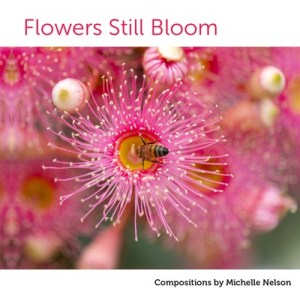
FLOWERS STILL BLOOM

Michelle Nelson

Move Records MCD 621

Well-known guitarist Nelson presents 22 tracks on her latest CD. The first three are, in terms of length, the most substantial, hovering around the 4-minute mark. The rest tend to be slight, particularly her Eight Bagatelles for recorder (Will Hardy) and guitar which average out to about 1′ 30″. Yet there can be quality in brevity, as Webern is our perennial witness. But then, Nelson is not weaving skeletal miracles of organization but vignettes that soothe your frazzled receptors into calm territory with a quiet amiability. And that intention is not to be disdained in times that hold unpleasant surprises and uncertainties around every press conference.

The composer’s bagatelles are surrounded by an Isolation Suite for solo guitar, four movements each side. As its title suggests to most Melbournians, the work gives various musical reflections on aspects of the First Great Lockdown of 2020; well, it wasn’t that impressive as it lasted a matter of weeks rather than the months that this year’s venture reached. But there’s more. Those first tracks comprise Two pieces for Harp and Guitar, with Megan Reeve supporting Nelson; as well, Nelson plays an isolated solo, La despedida, which is the CD’s longest work at 4’10”. Finally, Nelson branches out to offer Short & SweetThree Pieces for Concert Ukulele.

We start with the harp/guitar duets, beginning with Falling Ashes which is an excellent example of combining timbres to the point where their interweaving comes close to indecipherable. Starting with a falling arpeggio shape, the piece sort of inverts this motif, torquing it into mild transformations but eschewing the temptation to revert back to it verbatim. A gentle exercise all round, its 4/4 metre enjoying some slight compression in its latter pages. Falling Ashes‘ companion is Floating Free, which begins with some scene-setting of water sounds; here, the previous piece’s falling pattern is inverted – at least, until the harp enters, the guitar restricted for a long time to Alberti-type supporting groups while the partner instrument sets all the running with the upper line and some syncopation to add interest to its single-note pointillism. The water noises permeate the piece at various stages: you might be floating but this body of water is not to be trusted, it seems to me.

The lengthy Farewell guitar solo follows. Here is your classic rondo form – ABACA+coda – and a deftly couched main theme/melody to carry it all along. As you’d anticipate from its Spanish title, the work reflects a world of guitar salon music, but this piece has a deft, no-nonsense attitude to its leave-taking: the major key (D? I’m losing any capacity to determine tonality from open strings) dominates and both interludes don’t venture too far away, so that the chief tune’s return becomes more of a welcome than a goodbye. For all that, Nelson has a gentle if predictable lyricism to her compositional language that soothes, never confronts.

She then switches to the ukulele for three pieces: Poco allegro: espressivo e rubato, Vivace: quasi waltz style, and Moderato : delicato e rubato. Thanks to these descriptive titles, there’s mot much further to say. The first is a gentle piece operating on two levels – a regular, plucked (what did you expect, idiot?) bass and a top tremolo line that doesn’t have much vertical motion to it. In the waltz – a not-too-distant cousin to similar exercises by Sculthorpe and Michael Easton – the triple rhythm is regularly displaced by a 5-count bar but the work operates on a sort of three-layered system, the top lines outlining the melody in euphonious thirds. The final constituent of this brief collection is a numbingly repetitious offering in which each bar appears to begin with a triplet before the bar’s other three quavers emerge in regular tempo; and when I say ‘regular’, I mean ‘unchanging’. Well, that’s not exactly true as a modicum of modulation takes place, but the rhythmic pattern impresses as inexorable. The composer refers to using the guitar’s ‘ligado’ technique which, as far as I can hear, refers to the opening triplet being played in one stroke/attack. Or maybe I’ve missed the point entirely. Whatever the case, this is the longest of the three ukulele pieces and the least interesting in its material.

Nelson returns to the guitar for her salute to COVID – the first half of it, anyway. Each section has a suggestive title, the first rather oddly named Isolationist, which suggests a political attitude to me, rather than the state of being alone, which is Nelson’s intention. It’s a mainly one-line meander with a catchy opening motif; it could suggest the state of emotional/intellectual solitude to a suggestible listener. Quietude follows, proposing the silence of Melbourne’s physical world during a severe shutdown. Here again, the movement is single-note, operating on two levels with an upper melody followed by a lower arpeggio support that takes on a night-following-day regularity. With Steel Grey, the accent changes to ennui and depression as the days of solitariness creep ever onward. This piece starts boldly enough but soon settles into a tweaking of cells that suggest the unvarying nature of each unwelcome day and even a concluding tierce does little to raise the emotional stakes. A change of scene coms in a flowing Sunset Reflection which celebrates an uplifting, unexpected sight in a page (or half a page) of mild optimism; this is also the shortest element in the suite so far.

After the Eight Bagatelles, the suite resumes through Rising Tension which has two elements: a quick minor 2nd interval, time-honoured for suggesting unrest or a Disturbance in the Force; and a set of chords where the treble seems to stay the same but the lower harmonies change slightly, signifying the physical realization of social discord – a marvel of prescience, considering the demonstrations that have hit our capital cities on recent weekends when the disaffected have had to find some way to flesh out their new – and clearly undeserved – freedoms. Following this unconscious imagery connected to the recent Storming of the Winter Palace, we have Anamnesis working as a kind of curative element where a calm and predictable melody is played with consoling charm, calculated to revive the drooping spirit. Miller’s mental odyssey then turns to the concept of weathering the months of durance vile imposed by Daniel Andrews; Endure revolves around appoggiatura which eventually seems to appear in every beat of a slow march that rises and fades away like Mussorgsky’s Bydlo. If anything, this piece emphasizes the numbing repetition of time in universally enforced quarantine. Finally, we reach the CD’s title track which observes the hiatus between the southern capital’s two lockdowns and the advent of spring, the piece’s forward movement packed with promise in a major mode, leading from lower reaches to higher ones, the suite concluding with an alternation between major and minor. It’s as though happy days may be here again but they can be deleted from your expectations bank all too easily.

Sitting in the middle of these Melbourne mediations, the Bagatelles are excellent examples of easy-going duets; for instance, the first one, Allegro, has the recorder play the tune twice, then a deviation, and a return; pleasant and piquant without any affectations. More of the same comes with Poco allegro where the sequences are unsurprising, apart from some interpolations from Hardy, and an unexpected coda that cuts across the piece’s quietly busy ambience. Giocoso is a light jig with the recorder still maintaining top-dog status, the part animated by some delayed entries and a smidgeon of syncopation. This up-beat, naive mode continues with Poco allegro e cantabile, Nelson sustaining a steady single-note pulse throughout while the recorder follows the optimistic path set by a signature upward 4th leap.

The composer contributes a single-note 6/8 bass support in Piacevole which lives up to its name – not so much for the regular guitar underpinning but more the follow-your-nose aspect of Hardy’s contribution which every so often sounds improvised; it isn’t, but the later melodic twists are carried out with telling individuality. In fact, this musician’s essays at glissando spice up a pretty unconvincing Poco adagio in which the modulations – such as they are – don’t convince because of a sort of tentativeness that was not quite as obvious in the preceding movement . Yet again, the guitar’s role is a subservient one. A straight ternary shape provides the framework for Animato, another jolly jig which acquires some folksy quality with the occasional first-beat crushed 2nd from the guitar and an opening melodic gambit that suggests Pancakes, Lisela. Finally, another gentle if unadventurous melody arrives in Allegro e sempre legato which reinforces the characteristics of this collection: a clear-singing melody line that doesn’t move far outside its original scale range, a simple accompaniment that draws little attention to itself, an even dynamic level without any surprises, and a four-square structure as reassuring as that of Grieg.

Satire in short pants

CATALOGUE DES ERRANCES BIBLIQUES

Michael Kieran Harvey & Arjun von Caemmerer

Move Records MD 3457

Something out of left field here. It’s a further collaboration between Harvey and von Caemmerer; their target this time is religion, albeit only a corner of that substantial field – Christianity. Originally written for two pianos, this CD records a concert given at the Australian National Academy of Music on May 25, 2019 in which the participating forces were considerably enlarged. The composer leads the keyboard forces, seconded by ANAM’s resident pianist Timothy Young. Assisting on other keyboards are Sine Winther, Amanda Pang, Hannah Pike, Maggie Pang, Jennifer Yu and Liam Wooding. As well, this alternative version finds room for four percussionists: ANAM’s Head of Percussion Peter Neville playing drum kit; James Knight and Alexander Meagher on assorted instruments; Alison Fane handling the big guns on timpani. Alternating with the 25 music tracks, von Caemmerer reads his complementary poems. While these don’t appear on the small sheet that comes with the disc, they can be found on the Move website, if you need to find them; but the poet’s enunciation is clarity exemplified.

As are his texts, which are hard to ignore in favour of Harvey’s scores. Like the poems, Harvey’s 25 pieces are brief, several lasting a little over a minute, and their titles can be linked to von Caemmerer’s preceding theses. The compendium’s title has a sort of reference to Messiaen’s Catalogue d’oiseaux, a monumental inspiration that Harvey recorded 16 years ago. As well, the pianist/composer refers to another source in The Book of Mormon musical of 2011 – wasted on me as I don’t know the work and am unlikely to come across it. This also is a satire on religious beliefs, emphasizing their unrealistic aspects, and that seems to be part of the rationale behind Harvey/von Caemmerer’s list of Biblical ‘errancies’.

Von Caemmerer’s principal source appears to be The Encyclopedia of Biblical Errancy by American atheist Dennis McKinsey. It appears that much of the spoken material on this CD has been inspired by McKinsey’s publication or springs out of stimuli provided by it. At the end of the on-line booklet accompanying the CD, you can find a list of sources cited in the 25 spoken tracks. Very occasionally, the focus shifts from New Testament miracles and Old Testament history/prophecy to current topics put under a rationalist’s magnifying glass, or to simple instances of religion at fault. One you will encounter deals almost obsessively with George Pell, who is the easiest of marks when documenting Christian errors and a pretty facile choice of target when the CD’s collaborators could have gone after much more nuanced characters like Daniel Mannix, Norman Gilroy or Guildford Young. I can’t detect any time being expended on the towering offence or error in the modern-day Christian churches of paedophilia; you can write volumes about this sin/crime but it’s probably a big ask giving it any kind of musical correspondance.

In terms of targets, von Caemmerer selects an all-too-easy set of ‘errors’ but he also branches out into obvious myths as well as parables. So, alongside Cain and Abel and the Tower of Babel, you get the walking on the Sea of Galilee; with the various versions of the Bible is placed the water into wine at Cana; against the feeding of the thousands and raising of Lazarus are set the transfer of the Sabbath from Saturday to Sunday and the centuries of life-span attributed to the patriarchs. The impression is of a quick-fire farrago that also includes flights of fancy like the location of the Garden of Eden in Tasmania, the survival through two bushfires of St. Raphael’s Church in Hobart, the distortion of Ezekiel’s name to Easy-Kill, American housewife Diana Duyser’s financial killing thanks to her infectious pareidolia, and the estimated worth of the Catholic Church in Australia.

Some of this is clever; a bit less is entertaining; other parts are jejune word-play and the poet’s delivery is a clever combination of the not-so-wide-eyed innocent – a knowing Candide – and clever-clever undergraduate or Mr. Bean smarm. Luckily, it’s all pretty short and your hackles don’t get much of a chance to rise . . . the first time around. Repeated exposure causes impatience, for me at least, and I find the puns just not that amusing; reminiscent of re-reading Wodehouse as opposed to Decline and Fall or Lucky Jim.

Then there’s the music. Here I’m all at sea also. Harvey twins his titles to those of von Caemmerer; for example, the poet goes off on a tangent named Cheesus, where he lists various cheeses of the world and the breads that they could suit, casting Jesus/God as The Big Cheese, while Harvey’s commentary is called Jesus Christ? All right: not very subtle. Later on, The Miracle of St. Raphael is counterweighted by Belief in miracles; a later juxtaposition comes more obviously in Conversion Disorder – From Saul to Paul set beside the composer’s more unpretentious Mixed-up Paul. Which is nice to see: everything is intellectually focused and radiating around specific points. But Harvey preserves his mysteries, playing his satire very close to his chest.

Despite the plethora of keyboards employed and the addition of percussion, the Catalogue retains much of its two-piano focus, showing traces of works in this new model. For me, the most striking resemblance is to do with the physicality of such a sound, like the insistent jubilation found in the last of the Visions de l’Amen, or the visceral pounding of the Sonata for Two Pianos and Percussion; works with which the composer has history. But such comparisons take you only a short way towards Harvey’s creation. The first musical track, The Bible’s chaotic composition, is a welter for keyboards with plenty of percussion interleaving – cymbal crashes and marimbas among the mix. As for the keyboard element, this is bar after bar of double-octave/7ths semiquavers, the patterns pounding out simultaneously or at a short canon. There’s a relaxation into something close to swing before the opening hectic hammering returns. And its all over in 1’17”. The same pattern returns in the last musical track, Life after Biblical errancy, although more elaborate with the added element of massive rising and falling six-black-note arpeggiated chords in both hands disrupting the opening movement’s clarity, the whole sharing honours with a highly prominent percussive element.

The second Harvey track then moves into territory more directly related to jazz with an exploration of Jesus Christ? in 5/4 where the shades of Brubeck and Zappa brood over all with their bright wings. You get a same-but-different flavour in God’s Word where the initial time-signature oscillates between 13/16 and 11/16 with unsettling semiquaver rests in different keyboards at opposite ends of the bar and pertaining to different hands; all very disjunct but a cousin to the Mothers of Invention at their I’m-not-going-anywhere finest. Contradictions begins its deliberately disjunct path dominated by the electronic keyboards and moves towards normal piano sounds and back again, the performers not quite on the beat at a few stages; the effect is assertively querulous, if you like, or possibly just a brisk meander.

And on it goes – a series of bagatelles that rush past, complementing von Caemmerer’s texts in sprightliness and, like them, running through the ear and leaving not much of a wrack behind. Another separation of congruence arises by way of a delaying semiquaver rest, pages that suggest a kind of two-part invention that revisits its framework but piles on extra material. Even the various superimpositions impress as modified frenzies; striding crotchets against quaver triplets sounds harmless but here the interplay is close to impenetrable. A guitar-mimicking keyboard against a slow-moving regular base suggests Hendrix, but this is a simple interlude in a galaxy of rapid repeated block chords alternating between players, throwing you off balance by its carefully crafted irregularity.

You also encounter outbursts of juxtaposition, like the sudden burst of faux-Charleston that enters near the end of Bible characters, in the middle of a rigorous toccata. Or meet the ambling Gershwin-suggestive preamble to Injustice. Put alongside that the jerky pointillism of Science or creationism for which Boulez’s Structures could have been a progenitor. Or the pell-mell rush of Belief in miracles which again undermines expectations of toe-tapping predictability. Anti-Semitism, which moves with improbable rapidity and employs a suitably wide range of sound-sources, could have come straight from a contemporary jazz session, if only the performers had enjoyed an unshakeable sense of purpose. Then comes a track like Intolerance and anti-intellectualism which presents, at heart and like so many of these vignettes, as an elaboration on a rising scale (or note series) with a myriad of colours, some of which are definitely percussion while others could be keyboards with percussive capabilities. Whatever the outcome, the content is unabashedly clear and non-depressing.

Fake prophecies is a less frenetic construct up to about the 50″ mark of its 1’03” length; starting with a quiet murmuring complex, an increase in action bubbling below the surface before erupting into a vehement coda. An electronic siren precedes the pianos’ mixture in Predestination or free will, which enters its main frame with a kind of sophisticated rock rhythm, albeit one that is pure Harvey and complicated enough to scare off any mainstream band. Another side of the same coin emerges in Forty Bible errors which begins with a deadly predictable drum pulse that persists despite the fracturing that comes from the keyboards; there is an acceleration and a rapid dissolution-coda. Further juxtapositioning of opposites, Bible creation conflicts seems to have no set pulse at all, the atmosphere heavy on electronic keyboards with a guitar imitation leading the way in a tonal rhapsody; here the layering of sounds smacks of impressionism – a hazy oasis in a world of sharp edges.

We’re back to the virtuosic with Saturday or Sunday? bringing actual piano sounds into play across a typically chameleonic rhythmic sequence where syncopation rules. A reversion to tonality beguiles at the opening to Mixed-up Paul with a genial rising melody leading into at least two other layers that over-ride the initial placidity, both a restless bass and a sine-wave-type making for counterweights. With Fake Bible news, we’re in another all-man’s land where regular and dissimilar pile on top of each other; a snare-drum trying to impose a measurable metre is subjected to inroads on all sides including a cluster-rich ‘straight’ piano. Then Harvey returns to his atmospheric wash territory for Peter, Paul and Jesus conflicted in which a musing background texture is lit up by jagged piano bursts, mini-explosions in this ambience, all of them resurrecting memories of Stockhausen’s Klavierstucke as well as the could-go-anywhere blurts to be found in pretty much everything I’ve come across from Bussotti.

Throughout the Catalogue, Neville and his percussion colleagues have been a consistent presence, rising and receding over the music tracks – and the spoken ones – with so much authority and idiosyncratic speech that you realize how thorough was Harvey’s re-composition process. In Control by the elite, the percussion elements dominate, apart from a central unit where an electronic organ rushes through what could be taken for a fairly static chorale, all things being equal in this febrile musical world. And the penultimate musical statement, Other holy books, is a fast gallop with what sounds like a side drum and wood-blocks setting the pace while a piano main-line provides some linear interest, if barely touching the ground.

How you connect the compositions to their titles, let alone von Caemmerer’s words, is every listener’s private business. The musical execution is generally exact and consistently enthusiastic, even though it strikes me that the matter from some segments could be interchanged easily with others. Always an exhilarating ride, travelling with Harvey, and the tearaway excitement of many tracks here is well worth hearing. But the intention of the work as a whole remains hard to discern because the 50 tracks rush by so rapidly. The creators’ stance is probably anti-religious but their focus bounces all over the shop. Hence my impression that their product is a set of short satiric gasps rather than a solid assault; a catalogue, certainly, but one with pretty short entries.

Retrospective, but on the move

UNCOVERED GROUND

Felicity Wilcox

Move Records MD 3456

The dominating sounds in this collection of music come from the clarinets of Jason Noble. This musician appears in the first and last pieces recorded; a pity that I know nothing about him or his work but at the end he might just as well be an old friend, since his voices shine out in 8 out of the 10 tracks. Still, I don’t know anything of Felicity Wilcox’s music either, possibly because she has spent much of her creative life so far connected to film and theatre and is also linked to Sydney’s musical life and performing artists. Mind you, such a classification is based pretty much on this recording and the biographical details supplied in its accompanying leaflet; as well, I’ve not encountered her name on Melbourne programs or the little I’ve seen of those in Brisbane.

Her review of her own chamber music begins with People of this Place, a construct for solo bass clarinet that uses many sound-production techniques that became current in the 1960s. Wilcox has an affinity with and respect for the Aboriginal people of this country and parts of this piece resemble corroboree music as well as suggesting the landscape of the continent’s interior – motionless, remote, unadorned – as at the opening when the blown overtones suggest the didjeridu. In fact, the ‘worked-out’ pieces of the work have less interest than these colourful segments. Still, you can see how Wilcox is attempting to manage two separate systems of music-making and certain passages are tellingly effective – but mainly because the Aboriginal element predominates, as at about the 3’30” to 4’40” segment.

The CD’s title work constitutes another kind of fusion – no, that’s not the right word but it’s as close as this limited brain can get. The ground is a bass that Wilcox supplies herself but it’s not heard in its pristine form until near the end – rather like Britten’s lute piece Nocturnal. A double commission from the Sydney ensembles Offspring and Ironwood, its instrumentation is mixed: three Baroque strings from the latter group and violin, flutes, bass clarinet, percussion and piano from the contemporary experts. Wilcox works through juxtapositions of orthodox and adventurous, the work’s body a series of duets – modern and Baroque violins (Liisa Pallandi and Matthew Greco), viola and alto flute (Nicole Forsyth and Lamorna Nightingale), bass clarinet and cello (Noble and Daniel Yeadon), with prepared and normal piano (Benjamin Kopp) occupying the same sound-space; all the while, Offspring founder Claire Edwardes generating a percussion commentary. Mind you, it’s not as compartmentalised as this sounds with enough subsidiary action going on to disrupt any suggestions of a purely binary sound-spectrum.

The final statement – for the three Ironwood strings, I think (no vibrato) – is remarkably well achieved, rising smoothly out of the angular processes that come before. You’d need a full score to work out how Wilcox achieves her ends; after several hearings, you are left admiring a rich tapestry rooted in a baroque language from the first bars but which moves rapidly to a contemporary sound-field and back again. For those of us who have doubts about some hybrid sitting uncomfortably on a fence, or leaping awkwardly backwards and forwards across it, Uncovered Ground impresses for its lucid transitions. As well, the composer is blessed with sympathetic interpreters, notably in those sinewy duets.

Following this major score, we embark on the first of four (five?) tracks from Gouttes d’un sang etranger, Wilcox’s exercises in metamorphosis on parts of Marais’ Suitte d’un gout etranger. My first problem is that Wilcox’s initial piece is called Tambourin, yet that name is missing from the Marais collection of 33 pieces; I’ve tried several CDs and scores but this particular piece keeps its mysteries. In Wilcox’s novel format, Noble and Yeadon collaborate although the cellist has little to do but provide an octave drone on D while the woodwind plays a discernible. four-square melody with flights into melismata. All smoothly accomplished, sophisticatedly brooding and hence the complete opposite to any other tambourin I’ve come across.

A more experimental piece comes next with Le Tourbillon (electronic interlude). Here, Wilcox takes the initial version of her Marais reworking (No. 10 in the original suite) – a duet for viola da gamba (Anthea Cottee) and tenor saxophone (Nathan Henshaw) – and reverses it, with extra processing thrown into the mix. Not much happens beyond a gentle rumbling on several levels. It’s suggestive of Atmospheres but there’s only one. Immediately following is a clear (i.e. non-electronic and played forward) version of Wilcox/Marais’ Le Tourbillon, this time for clarinet (Noble) and baroque cello (Yeadon) where the performers oscillate in the spotlight; sometimes producing clear-cut Marais, more often following Wilcox’s processing of the original whirlwind musical imagery. Both Tourbillon constructs are brief and, while avoiding the pit of whimsical obscurity, are hard not to take at face value as diverting bagatelles.

The longest track on this CD, Vivre sa vie, composer’s cut, is a re-appraisal of Godard‘s 1962 film which was scored by Michel Legrand. Its 12 scenes provide Wilcox with a rough framework, inside which she gives the film’s heroine, Nana Kleinfrankenheim, a voice through Nightingale’s alto flute while Nana’s men – Paul, Raoul, the philosopher, the young man – all speak in the scenario through the bass clarinet (Noble). As well, Edwardes manages a percussion part, Kopp a subtle keyboard contribution. Now Wilcox makes it clear that this accompaniment to a film is a shorter effort than that of Legrand; Godard’s film is 105 minutes long, Wilcox’s suite 15′ 32″. However, I’m sure that a familiarity with Vivre sa vie would help immeasurably in understanding the music’s movement. But what if you’re not prepared to put in the time, no matter how worthy the exercise? It’s a conundrum at least as old as Alexander Nevsky; Prokofiev’s score is a masterpiece of sound painting against which the Eisenstein film can strike you as unnecessary, e.g. the Battle on the Ice.

You’d be engaging in a frustrating exercise if you focus on Wilcox’s product as a strict parallel to Godard’s twelve scenes-with-prefaces. For one thing, this new begleitungsmusik appears to begin with the film’s third scene where the heroine attends a screening of Dreyer’s La Passion de Jeanne d’Arc; Wilcox uses her own slow hymn-suggestive sequence later in her collection. Still, it could be a game for Godard aficionados in trying to match various musical episodes to the film’s narrative; both are episodic and structurally discrete (or so I gather from descriptions of Vivre sa vie). To its credit, the music walks a fine line in mood construction, and the identification game would probably be easier for aficionados when taking into account Wilcox’s efforts to mimic the cadences of the film’s dialogue in her flute/clarinet duets/exchanges.

After this substantial interlude, we rejoin the Marais experiment with La Reveuse, No. 28 in the Suitte but here transformed electronically into La Reveuse – Coda in which Henshaw’s tenor saxophone performance of Wilcox’s mutation is played backwards, with some pedal-work from Cottee’s gamba; then the last third of the piece is given over to Noble playing solo the Marais piece’s coda (did it have one?) straight – well, as straight as Wilcox has contrived it. As with the former electronic effort (Track 4), the results are softly undulating, deliberately non-specific nd atmospherically dour, this last also to be found in Noble’s single line contribution.

SON-ombra, Wilcox’s String Quartet No. 1, is a two-movement score; its first part is to do with sound, the second moves into the shadows – as you might have predicted. Put in simple terms, the movements offer direct speaking, then inferences and shadows. OK: here we get the solid stuff from an ensemble I’ve not come across before: the Sydney Art Quartet comprising violins Thibaud Pavlovic-Hobba and Anna Albert, viola Andrew Jezek, cello/founder James Beck. I know the first of these musicians from the times he has put in at the Australian National Academy of Music, then with the Australian Chamber Orchestra and, more recently, the Flinders Quartet; the other three quartet members are new names to me. Across the work’s duration, you hear a good many sound-production exercises put into effect in a vocabulary that is assertive and contemporary, even if the employment of glissandi gets a touch predictable. It’s above all a music of effects, the players able to encourage their inner taste for expressive hyperbole but not at the expense of sense.

Alone among the performances on this CD, this track is a live performance, recorded at Penrith’s Joan Sutherland Performing Arts Centre in late February 2018. Does the piece contribute to the historical development of the string quartet as a compositional entity? You can’t really judge by one movement alone but these SON pages offer reassurance of intent in their dogged pursuit of the recherche with an infectious and energetic drive accompanied by frequent success in maintaining attention by several unexpected strokes.

There’s a reversion to the Marais connection with Fragments I-IV which serve as side-dishes in the progress of Wilcox’s Gouttes. Slight scraps, gleaned from the French composer’s work, are shared between Noble and Yeadon but modulated and transmuted by Wilcox, the third of these electronic manipulations after Le Tourbillon (electronic interlude) and La Reveuse – Coda. My limited research facilities inform me that this piece was originally written for gamba (Cottee) and soprano saxophone (Henshaw); indeed, these two musicians are acknowledged in the CD’s booklet as participants in the ‘electronic section’ of this track. To my ears, their work is undetectably fused with the two live performers, except towards the end of the sequence where the textural manipulation becomes blatant. In their original shape, each Fragment lasts 3 minutes; this compendium of the four stretches to about 2/3rds of that length. In spite of expectations – of disparate flimsies, I suppose – the total effect is smooth and even, ephemeral rather than confrontationally gnomic.

To end, Wilcox presents Falling, the second movement of her variable trio Snow. In this performance we hear Noble and cellist Freya Schack-Arnott, both of whom assisted at the complete work’s 2016 premiere; the pianist here is Wilcox herself. What is falling is obvious, and it does so with mesmerising effect as the three instruments follow a repetitious sequence that comes close to a chaconne. The effect is placid enough, highly predictable after the first 30 seconds with only a short-lived mini-acceleration in mid-stream to brighten the path (F minor?) of this painless but bland essay.

This disc displays the work of a talented composer, one happy to operate in a generally well-trodden harmonic and melodic framework – with exceptions where a more ambitious and contemporary prospect is in plain view. What surprises me most is that the various tracks are not representative of the composer’s latest products; the Gouttes date from 2014, Uncovered Ground from 2015, People of this Place and Falling from 2016, Vivre sa vie from 2017 and the string quartet movement – the CD’s most original sequence – was written in 2018. This last shows Wilcox in a very different light to nearly everything else to be heard here and I, for one, would welcome more of the adventurous spirit promised in such material.

Easy atmospheres

SHADES OF IVORY

Bill Canty

Move Records MCD 605

I can’t honestly admit to knowing anything about Bill Canty; not unexpected, that, as the composer has carved out his career in more popular fields than those I frequent. This CD is a suite of 12 pieces for piano, performed by the composer and using no orthodox piano but rather altered, piano-simulating sounds by means of digital/electronic interference and manipulation. It turns out that the performer/composer is true to his promise and lives up to his descriptors and extract titles. I don’t think there’s much to the whole exercise beyond a satisfaction in arranging sounds into appealing formats. The question is: appealing to whom?

A further problem with this CD pressing is that the tracks that come up on my system are completely unrelated to Canty’s efforts but are entered under the name of Phil Broikos and one of his chef d’oeuvres, A Day in Music. I know what I’m hearing isn’t Broikos because I listened to some of A Day; the things you do for certainty. Anyway, Canty begins with a Fantasia which is a meandering piece of mood music – very euphonious and playing pretty games with arpeggios rolling across the keyboard. It’s all very pleasant and diatonic with bass pedals and a spoonful of upper register tinkling, and it leads straight into Glissade that has a metrically regular Alberti treble with some portamenti between notes, as well as an assortment of downward-heading scales. It starts in the minor and moves to a relieving major about half-way through, but doesn’t stay there long. Dollops of notes are sprinkled across the constant Alberti figure with accompanying bands of sustained bass before we revert to the glissandi/portamenti of the opening and a slowing down.

Immediatelt we are in Rubato land where the continuous quaver figure sustains the forward propulsion but with lots of the promised slowing down and make-up acceleration; a constellation of overheard notes almost meld into a melody, the texture suggestive of extra-terrestrial illustrative music such as you get in programs from NASA or organizations determined to sell you the idea that outer space is benevolent rather than the horrifying chaos we know it to be. But the emphasis is on atmosphere and the one-word titles leave interpretation very open, as you can see in the following Sanctuary. Canty makes reference to the bellbirds in Kew’s Studley Park and you hear plenty of bird-suggestive sounds; not the multi-coloured flourishes of Messiaen but little two-note oscillations piercing a brooding multi-layered backdrop. And that, unfortunately, brings to my mind suggestions of the Picnic at Hanging Rock soundtrack without the interference of Beethoven or pan-pipes.

Then there’s a change of pace as we enter Thirteens which Canty has based on the odd time-signature that opens Mike Oldfield’s Tubular Bells; all credit to Oldfield for creating a lasting album on his lonesome and all that nonsense but, as I read it, his initial track is in 7/8 which may have some mathematical relationship to 13 but I can’t compute it. As things turn out, a ‘straight’ piano plays the underpinning pattern throughout with superimposed dribbling until about the 3’30” mark where the unusual tempo dissipates and we are left with upward scales and growling bass sound bands. The pattern returns just prior to the turn into Droplets which has a fine imitation of that phenomenon in its treble, something like a cross between a finely-tuned marimba and a glockenspiel tinkling away above the (by now) inevitable bass layers that slowly shift. Here, Canty refers to his ‘fascination with controlled randomness’ – which suggests that he is employing some sort of program. But I found the actual musical progress loaded with extraneous gestures like downward-moving rapid portamenti, again suggestive of documentary soundtracks for visions of the moons of Saturn.

Statement begins with a sort of motive comprising a segmented scale that initially moves up, then down, while around it are shadows, delayed repetitions that offer a nimbus of distortions that have immediate reference to the base material. A sort of mental oasis follows in which nothing solid happens but the atmosphere is packed with soft gamelan-type patterns and fragments of what has been secondary in importance so far. The segmented scale returns, now at a higher pitch but with the same nimbus surrounding it. Trance opens with a repeated note – in stereo – being surrounded by accretions and attempted distractions like a heavy counter-rhythm in open 5ths. The repeated note falls in pitch step-wise, this motion setting the activity level for the surrounding matter; the jazzy 5ths continue to interrupt but most of the piece’s colour comes from swathes of texture that offer continuity of effect rather than variety.

In Rebound, we have a reaction to the bouncing of a ping-pong ball which is aurally depicted in the middle of the customary swathes. Once more, the electronic transformations suggest both the Orient and the extra-terrestrial, although I liked the overlapping bouncing lines. But it passes and we are called into the soundscape of Immersion, where gentle descending scales close down into a subterranean sound-wall with isolated piano notes setting off those various downward slides into the depths. Some upper register washes provide a counter-balance in this slow-moving celebration of stasis that comes to a halt before Lucid comes into view with a reversion to middle-layer Alberti pattern-making. The difference here is that Canty offers a tune in the forefront of his texture. This is unexpected and, while he gives it two or three airings, eventually it is abandoned for arpeggios and atmospherics. However, this ternary piece brings back its continuous quaver underpinning and another version of the melody which is not so striking this time around.

Finally, Canty offers a Toccata which is headed by a ‘straight’ piano line but one surrounded by plenty of echoing effects. Soon enough, a ponderous bass layer emerges before the piano and its overlays and mimicries takes off on a pretty predictable set of excursions that wear out their welcome because of an absence of rhythmic variety, something you won’t find in pretty much every toccata from Buxtehude onward. After some grandiose crescendo work, Canty arrives at an affirmative major key conclusion.

Each of the suite’s movements lasts about 5 minutes but, as indicated, most of them run into each other and sometimes you are hard pressed to find a delimiting point, The same can be said about the internal material of many of the pieces. Canty has a definite idea for each one of them, developing or simply stating and restating an idea to give aural sense to his particular title. Yet you come back to the over-arching question of: what is achieved by this exercise? Much of it is harmonically trite and melodically bereft; apart from Thirteens, you look in vain for rhythmic imagination or challenge. While the composer rings changes on his keyboard with transformations of a piano’s normal sounds, little of what we hear has the distinctive feature of novelty. At the end, it strikes me that this is a music that is not to be subjected to analysis but enjoyed as background to one’s own mental ramblings, or as support for rather trippy visual stimulation. Rather than falling in with the CD’s generation process, I’ve unfortunately taken on the cast of Shakespeare’s Cassius – and I don’t mean lean and hungry.

Elegant but insubstantial

TWO

The Marais Project

Move Records MCD 617

This brief CD (less than 40 minutes long) sprang out of the pandemic. Planning for 2020, the Marais Project intended to tour Tommie Andersson playing theorbo, guitar and gallichon and Jennifer Eriksson (the organization’s founder) on her trusty viola da gamba. Each would play a set of solos, then come together for a suite by the ensemble’s namesake. Sadly but predictably, the musicians encountered difficulties in getting around the country but, rather than seeing their efforts go to waste, determined to immortalise their labours through the graces of the ever-cooperative Move Records.

So here we are. Andersson’s contributions include Handel’s Sonata for a Musical Clock, arranged for the gallichon (bass lute), three guitar pieces by Jan Antonin Losy, Mozart’s Adagio for Glass Harmonica K. 536 (also re-shaped for gallichon), and participation in selections from Marais’ Books II and IV for gamba and continuo. Eriksson matches this with a D minor suite by Jacques Lambert du Buisson, the outer movements of a G Major sonata by Abel, a condensing of Paul Cutlan‘s Sarabande from the composer’s Spinning Forth suite, and the lead role in those Marais selections.

As a bonus, the CD’s final track is an anonymous love-song published in 1703: J’avais cru qu’en vous aymant. This begins with Andersson playing through the plaint solo (I think, on theorbo); Susie Bishop comes out of nowhere to add to the complex, eventually taking up her violin for a rehash of the by-now well-thumbed melody. I don’t know why the Rule of Two was broken but it’s always a pleasure to hear Bishop’s clear vocal timbre brought into play.

The Handel sonata seems to have been a two-movement affair; here, you find an Air and Minuet interposed. The pieces are slight and, despite plenty of repetitions, soon over. None of the writing goes beyond two parts, although the opening Allegro boasts a final full C Major chord. If I report that there’s little to say about any of the four parts, I’m overstating the case. Not even the timbre of Andersson’s gallichon brings a ruffle of interest to the surface.

Not much changes when Eriksson launches into the Lambert du Boisson suite. Some double-stops raise the listener’s eyebrow in the first Prelude, while the following Allemande variation follows a familiar path of one line with some cadential multi-string chords. A sarabande shows more emotional depth and the multi-string writing becomes more pronounced in the second half; the concluding courante is complex in this ambience. But the movements pass very quickly and you have only time enough to experience the movements’ shape; the gamba’s texture is finely spun – but that’s the only impression left, even after a few hearings,

Andersson plays the three guitar pieces expertly enough. The opening Prelude is another single line journey; its successor, an aria, has two independent lines – for a while; the concluding Gavote has a similar format, if quicker in tempo. As with the Handel sonata, these are flimsy constructs, and they would probably have been even more ephemeral if the repeats had been omitted. By contrast, Eriksson engages with only a few repeats and omits the central Allegro in my edition of Abel’s sonata. The performance follows a staid path with the frissons coming through some three- and four-part chords punctuating the concluding Minuet‘s progress.

Cutlan wrote his 2014 Spinning Forth suite in four movements for gamba and harpsichord, one of the commissioners being Eriksson. Its third movement, Slow and Sustained – quasi Sarabande, has been rewritten as plain Sarabande. This is one of the recording’s longer tracks – the 2nd most substantial, in fact – and I’m not sure how much rewriting has taken place. The first page of the original is the same as this new version, but I assume matters take a more radical turn at that point where the harpsichord enters in the first version. It’s a stately enough progress, very much in keeping with the other gamba content offered here, with the added charm of discordant intervals. Oddly enough, the piece doesn’t strike me as much of a sarabande but more a slow minuet, chiefly (I suppose) because the second beat gets no emphasis, large or small. Nevertheless, Eriksson’s account is full-bodied and sharply etched.

Mozart’s one-page Adagio serves an amiable purpose for its original instrument and Andersson makes a fair case for its movement to the gallichon, although this arrangement means that some of the secondary notes (lines?) go missing and most of the glass harmonica’s fragility of timbre flies out the window. The first repeat is observed; the longer second part of the piece gets a once through..

When it comes to the Marais compendium, the listener is invited into a world of some gravity; at least, at the start with a Prelude of intense grace and eloquence. A sprightly allemande follows; yes, perhaps that’s to oversell it as Eriksson lumbers through it with hefty support from Andersson. The following Air en Vaudeville/MesmeAir double begins with a downward-moving tune that has an irresistible resemblance to Joy to the world! The double is, it seems, a short variation. A sarabande is treated with high distinction, Eriksson’s melody-shaping a pleasure to experience for its supple breadth. But both players treat this brevity with respect and a keen eye for its shape.

Most of the gigues I’ve heard from Marais suites come across as fairly sober affairs, but this one is more buoyant and perky (at moments) than you’d expect. It’s still more of a tramp than a pieds-en-l’air exercise but its heftiness beguiles even to the very definite final chord. A pair of minuets proved more animated than expected, possibly because of the strength of the performers’ downbeats, but both flow past with an excellent demonstration of Eriksson’s talent at dynamic contouring. To finish, a Branle de Village is over very quickly, having just enough time to impress with its sophisticated rugosity.

The last track, that love-song, brings the Marais Project together – sort of. Bishop’s account of the first verse is accompanied only by Andersson; Eriksson then enters for her go at the tune; then all three combine for Verse 2. Bishop contributes her violin for a last instrumental recap – and that’s it. Certainly, this is a delectably melancholy conclusion to the disc and is in itself an argument for more of the same to offer a change of timbre in a collection of brief vignettes, amiable though they may be.

Art songs with insight

MOONLIGHT REFLECTIONS

Stacey Alleaume and Amir Farid

Move Records MCD 613

Now here’s an unapologetic, old-fashioned CD with content suited to a recital from several decades ago – except for some unexpected American interpolations. Soprano Alleaume has succeeded – as far as anyone can these days – with the national company. I can’t recall seeing her in Melbourne Opera Australia productions – but then, in my last years down south, I got to see very few of them. Here she is partnered with the one of our most gifted piano accompanists who has been stranded in his Australian base town, thanks to the world scourge.

Both artists are concerned with some fine music, a track or four of worthy arcana, and a couple of absolute forgettables. Their presentation lasts a little over 52 minutes in all, the longest track a Victor Hugo setting, the shortest an excerpt from Browning’s Pippa passes, both composed by Amy Beach. Some writers feature a few times – two songs each by Puccini, Massenet and Reynaldo Hahn; three from Respighi, with single submissions by Chaminade, Duparc, Frank Bridge, Pietro Cimara and Saint-Saens. Beach has four samples, the CD ending with her Three Browning Songs Op. 44.

Alleaume sings 18 songs – eight French, six Italian, and four English – which is versatile enough, especially if the intention is to hone in on a particular period. This collection’s earliest sample comes from c.1865 in Saint-Saens’ Clair de lune, while the latest is Reynaldo Hahn’s most popular product, A Chloris, dating from 1916. Most of the material was composed between 1888 and 1913 – 15 tracks in total – while the odd man out that misses these parameters (besides the two extremes) is one of the most famous art songs in the repertoire: Duparc’s 1870 L’invitation au voyage.

In a way stressing the basic difference in art-song potentialities, Alleaume and Farid begin with Chaminade’s L’ete, which is succeeded by the Duparc gem. The first is a show-piece, trimmed with decorative short roulades between a swift-moving melody while the piano curvets in support. It’s superficial, showy stuff and the soprano reaches every note with no indication of stress; perhaps the accompaniment might have been crisper but there also you can hear no flaws. With the Baudelaire setting, it seemed to me that both artists were intent on underlining the last word of each stanza because the approach impressed as slow-paced and indulgent. The chanson was devoid of forward motion; any invitation to travel to the Land of Heart’s Desire lacked direction apart from towards the bed and the piano’s restless accompaniment was slowed down to a sensual fluttering. To my mind, the second stanza’s canals were being viewed from indoors, rather than on a vessel bound for Cythera.

Bridge’s setting of Landor’s O that it were so! has a congenial sentiment underpinning its lyrical flow, excellently managed by both artists as they rise to the central climax and soothingly return to the calm of this song’s opening. There’s a worrying moment as both recover from the rallentando after ‘blest’, but the soprano shows her sense of taste by taking the lower alternative in the 6th last bar. Both Puccini songs enjoy sensitive treatment, the phrasing careful and almost all the sung notes ideally centred. Terra e mare holds indicators of the composer’s confidence in setting heavily Romantic lines while Sole e amore is a familiar friend, having provided material for the La Boheme Act 3 quartet when Mimi sings Addio, dolce svegliare. The oddest thing about this piece is the composer’s inclusion of the dedication (?) to be sung in the last bars, as well as the pretty trite lines, possibly by Puccini, that don’t fit with the music, once you remember their use in the opera for an unforgettable scene.

What do you learn from Amy Beach’s setting of Vicor Hugo’s Chanson d’amour? The American writer had a fine ear for the genre, certainly, best demonstrated in the three choruses of this work, throughout which cellist Zoe Knighton joins her long-time collaborator Farid in weaving some lush lines around Alleaume’s far-ranging part. It’s a persuasive piece, particularly for the care that Beach gave to the supporting material and her differentiations between the verses and choruses. Having said that, you won’t find much here that’s harmonically or melodically original but it slots into the then-contemporary French scene quite easily.

Pietro Cimara’s Stornello is an elegant urbanization of a rustic format wherein funsters capped each other’s lines to entertaining effect in accommodating bars/hotels. This one is a love song of some individuality in its verses by Arnaldo Frateili and a lean eloquence in the music which doesn’t range too far; a quiet, melancholy looking back to the first flush of rapturous love and presenting our performers with absolutely no challenges.

Both Hahn songs – L’enamouree and A Chloris – show restraint, probably a tad too much in the latter where a singer can achieve much with careful dynamic shadings and a disciplined employment of vibrato. But both musicians do the composer excellent service, illustrating an emotional insight that you wouldn’t anticipate from a writer who has been denigrated and minimzed for many years. Even the dropping sequences in the vocal part of the first song don’t irritate as much in performance as they do on paper, and Farid is impressively calm with the attention-grabbing accompaniment, complete with Bach-indebted ground bass, to Hahn’s most celebrated chanson.

In the three Respighi songs, Alleaume runs a cleverly contrived gamut of mainly mild emotions while Farid has plenty with which to make accompanists’ hay. Notte sets up a tautly drawn scene where a garden’s nocturnal placidity masks a world of possible despair; both musicians give the work plenty of breathing space, with an excellent transformation at the half-way point where the bass and alto line triplets rise to the surface while both voice and piano left-hand revisit the opening stanza. Nebbie remains constantly menacing and tragic from the start, a fine scena with lots of dramatic vocal material. Farid gave the impression of holding nothing back in an accompaniment that almost continually reinforces the vocal line with massive minim chords. And Contrasto offers a gently rolling allegretto accompaniment to an amiable if completely forgettable vocal contribution, the text offering an elementary premonition of Pierrot Lunaire with the moon weeping while lovers ignore its suffering; a placid piece that seems to present one side and, not living up to its title, omits the other.

It’s hard to fight against the self-centred rhapsody of Hugo’s Etre aime, as the author is so confident in his statements, emotionally flimsy though they may be. Massenet manages to smooth them out into something almost palatable and Alleaume sustains a nice oscillation between restraint and hothouse ecstasy in her account. The composer’s Amoureuse is a different kettle of semi-erotic fish in its somewhat stately apostrophes to the discontented lover, and the vocal and histrionic range is larger. Both performers do very well in maintaining a forward movement, eschewing the temptation to linger over-much in those scrappy bars treating the ante- and penultimate lines of each stanza. But then, this is not a poetry or a music with which I find much sympathy, perhaps because it impresses as being superficial and displaying a Proustian-corkwood insulation of address.

Saint-Saens has no other vocal portal in my experience beyond Samson et Dalila and his Clair de lune comes as an unexpected oddity, chiefly because his setting of Catulle Mendes’ poem is metrically challenging for its interpreters, notably at the start where the melodic line emphasizes a few unimportant syllables. Farid makes agreable work of the asymmetric piano part but the piece is vocally unremarkable and Alleaume is untested to any noticeable degree.

Beach’s settings of Browning begin with The year’s at the spring, and it reflects the optimism of the young girl as she sets out on her walk. The tone is moderately jubilant, necessarily so as it leads to that famous, life-affirming concluding couplet. You couldn’t call it volatile, but the atmosphere is not far from it and Beach was careful to avoid monotony of metre by stretching lines that she considered focal, as well as indulging in textual repetitions and displacements. Much the same happens in Ah, love, but a day where the repetitions seem more pronouncedly self-indulgent, even if this track ranks among the best on the CD. It also reveals an unexpected visitor in violinist Erica Kennedy who spends some of her time following Farid’s top line – but not slavishly so as she enjoys some passages of individual action. Which makes you wonder whether or not this obbligato is kosher; I can’t find it in any edition of these songs. Still, the piece holds a moving transition from F minor to F Major in the plaintive last 13 bars.

A more consistent achievement comes in the final I send my heart up to thee, the opening seven lines from the verse-dialogue In a Gondola. Here, the male lover’s ardour is expressed in a carefully shaped series of phrases that Alleaume treats with fine craft, using the ossia top note when offered except in the last bars where taking the pitch up an octave would be unnecessary to the lyric’s shape. Again, the composer offers variety for her singer inside the 9/8 time-signature with some lines stretched while others follow a predictable pattern.

Here’s an opportunity to experience Alleaume’s abilities in an unexpected field. She has appeared in several Opera Australia productions over the last six years and it looks as though her career is set to follow that trajectory. This collection of songs reveals an interpretative ability of some accomplishment, the soprano’s laudable efforts reinforced by one of our most insightful accompanists.