A double one-hander

CONNECTION 2: SUITE LIFE

Cook & Co.

Clifton Arts Precinct, Richmond

Tuesday July 25, 2017
                                                                                   Josephine Vains

All the connections in this slight playlet (which strangely included an interval) were conducted over the phone.   One of the entertainment’s two main forces, Leah Filley played a young cello-playing musician who talks with various acquaintances and family after her return from study overseas as she attempts to carve out a career in Australia.

Punctuating these generally one-sided phone conversations, Josephine Vains supplied a more physical connection on the set.   Her role was to provide interludes in the form of movements from each of the Bach Cello Suites – the Prelude to No. 1, Allemande to No. 2, all the way through to the Gigue concluding the final D Major opus.   Vains played from the organ loft above the Richmond Uniting Church’s altar wall; in an all-wood building, her projection was excellent, each note telling and vivid.   Pace Filley’s efforts, these musical breaks gave the evening most of its emotional colour and interest.

The trouble with Suite Life  –  second in a series of three productions in this Connections series  –  lies in its all-too-predictable dialogue/monologue.   The cello-playing musician wakes to a phone-call from her teacher in Spain, whose voice is amplified through the Clifton Centre’s sound system; she may be audible, but comprehensible?   I think I caught one word in four, possibly because of the thick Iberian-imitating accent adopted by the speaker.   Add to this the unremarkable nature of the text  –  elderly maternal know-all versus young, tolerant ingenue  –   and your tolerance was stretched to the point of something approaching discomfort.

In the next scene, the cellist talks with a clearly irritating friend (unheard by us) about their work, specifically our heroine’s preparation of the Borodin String Quartet No. 2.   She then rings one of her former professors, who has retired but still takes calls from importunate ex-students,  to ask him about a piece she is preparing for recital.   He feeds her a one-liner and that’s that.   So far, so superficial.   Yet you hold your horses, refraining from judgment because the situation depicted is possible: musicians are notoriously un-intellectual and monomaniacal, most of them incapable of sustaining a conversation that stretches beyond their own interests.

The Spanish teacher’s son, Jose, calls to inform our girl that her inspiring teacher has breathed her last  –  which leads to the remarkable claim by the former student that she’ll be there for the funeral; obviously, freelance instrumental work pays better than you’d thought.

Then comes a scene where the protagonist delivers some random observations  –  direct to the audience  –  on Bach. Yes, we’ve been hearing his music for some time throughout Suite Life and an observation or three would not be amiss.  But the address is packed with unconnected banalities – what sort of a dancer he would have been (judging by the cello suites, not so hot),  the size of his family – and its relationship to the musician herself is tenuous.   Finally, the cellist has a conversation of mind-numbing cliches with her mother before setting off to a gig, at which she will apparently play her teacher’s instrument and so release the music that is inside the cello itself.   Shades of Michaelangelo releasing the image from the marble.

I enjoyed Vains’ playing, chiefly the E flat Major suite’s Sarabande that ushered in the interval space.   Each sinuous melodic curve came down from the player’s lofty position with an unanticipated energy, the acoustic so responsive you could appreciate the hiss of bow on string and the player’s considered left-hand positioning.   For the more mobile dances, like the final C minor Gavotte and the portly Gigue, Vains went as far as any player should in observing a steady pulse, but the main impression I took away from this composite suite was of her instrument’s physicality and the labour involved in urging out Bach’s real and implied polyphony.

Hefty times in Hawthorn

SCHUBERT GALA WITH TIMO-VEIKKO VALVE

Flinders Quartet

Hawthorn Arts Centre

Tuesday June 20, 2017


                                           (L to R) Helen Ireland, Shane Chen, Zoe Knighton, Nicholas Waters

Moving out momentarily from the city, this long-lived ensemble lighted on the refurbished Hawthorn Town Hall as a possible future performing space, adding another option to the Recital Centre’s Salon, Collins St. Baptist Church and Montsalvat where the group currently presents programs across the year.   Not that the Boroondara Council’s refurbished centre is unknown to the city’s music-lovers as it was the site for Brett Kelly’s fine Academy of Melbourne concerts when that estimable organization was in play.   And the hall has been the venue for 3MBS’s marathon days dedicated to specific composers, so it has seen its fair share of recent chamber music action.

For reasons best known to sound engineers, this hall presents a notably clean acoustic framework, possibly because the players are positioned on or slightly in front of the proscenium; there’s no reflecting panel bank or screen, such as you find at ANAM recitals or Selby & Friends presentations at the Deakin Edge in Federation Square.   And the space is free of fabric, apart from some tightly-drawn and -anchored stage curtains.

At all events, we heard the Flinders voices at most points of their three-part program on Tuesday, even the glancing bird-imitation effects in the opening work: Peter Sculthorpe‘s String Quartet No. 18  –  his last and most emotionally pointed in the form.   This work is balm to an environmentalist’s ears as the composer follows a sort of thesis that begins with a celebration of a pristine Australia, followed by sound images of a wrecked landscape, ending with a sort of veiled optimism – there must be better days to come.   Sculthorpe always seemed to see the best in people but, in the seven years since this quartet’s creation, we’ve had little cause to share his hopes.

The score was commissioned jointly for the Tokyo String Quartet and the Flinders players, so these musicians have history with it – well, two of them do: violist Helen Ireland and cellist Zoe Knighton.  In recent times, the Flinders format has changed somewhat and the two violins today are Shane Chen and Nicholas Waters; I was hearing the latter for the first time in a string quartet format.   But when I first heard this piece in the Montsalvat Gallery in mid-2010, the violinists were Matthew Tomkins and Erica Kennedy.

Tuesday’s reading gave us a welcome re-acquaintance with this appealing piece that works best in its optimistic early stretches while the vividness later in the score of Earth’s degradation sounds less jagged and aggressive than you might have expected.   But the composer is not attempting to show the process of nature’s disintegration, more’s the pity.   Rather, he gives a sonic tableau of  barren land; the sedge is withered from every lake, and the singing bird noises from the start are tellingly silent.   As struck me at the first performance, the use of O God, our help in ages past jars in its context, which is heavily reliant on Aboriginal chants and songs; you can appreciate the sentiment, in that the Isaac Watts tune regularly appears at Aboriginal community days of mourning, yet its appearance here  seems like an after-thought – following the indigenous melodies’ freedom of direction and rhythm, a four-square hymn doesn’t make the best of end-points.

All the same, this performance proved to be a moving experience; the players sustained the requisite atmospheres across all five movements and made Sculthorpe’s novel production techniques merge into the work’s fabric and impulsive progress.

Two quintets followed, fleshed out by cellist Timo-Veikko Valve from the Australian Chamber Orchestra.   The D Major String Quintet by Boccherini, nicknamed Fandango, could have been a piece that the Flinders have played before; I can recall a work of similar nature being played by them, also at Montsalvat, but I thought that afternoon involved guitarist Karin Schaupp.    In fact, the quartet recorded a guitar quintet by Boccherini with Schaupp in 2010, also with the same suggestive sobriquet; the movements are identical with those we heard on Tuesday, with the first two reversed on the CD.    But, having no real memory of the piece played in Eltham and no longer owning the CD, I can’t make any further connections or identifications.   Nevertheless, it’s clear from Tuesday night’s showing that Boccherini, being a notable cellist himself, loved his instrument and this piece  –  like quite a few in his oeuvre  –   asks for two.

The opening Pastorale fared well enough: a congenial amble before a more assertive Allegro maestoso which lived up to its name, nowhere more so than in Valve’s contribution which surged into consideration pretty quickly.   Knighton matched him in forwardness and the players shared the prominent labours that fell to them.   As at Montsalvat, Knighton downed her cello in the final Fandango for a pair of castanets, expertly wielded and underlining the Hispanic flourishes in the score.   It’s an attractive movement, the most striking in the quartet even if, like so many writers determined to maintain a specific colour, Boccherini does go on about a minute too long.

Valve’s prominence in this work went even further in the night’s finale: Schubert’s C Major String Quintet.   He took the second cello line and was positioned mid-group facing front-on to the audience, so we got the full force of his projection.   These ad hoc ensembles are near-inescapable when performing this work, professional string quintets being pretty thin on the ground.   But it seemed as though Valve was unaware of his own dynamic level for a good deal of this Schubert’s length.

It didn’t help that Chen is a performer with an elegant line, not really inclined to push hard to make himself heard; or, for all I know, not accustomed to having to exert himself in the normal Flinders environment.   Judging by the final Allegretto and, to a lesser extent, the Scherzo, perhaps he should because notes kept disappearing at certain spots where the top line alone has the melody.   When Chen played at unison or at an octave with Walters or Ireland, the problem essentially disappeared but, without reinforcement in this performing context, Chen’s output travelled uncertainly.

All performers made a laudable effort with the luminous Adagio, Valve tamping down his attack mode and the three inner voices forming an exemplary blend for the first 27 1/2 bars.   Later, the finale came off well enough, the collegial approach to tempo changes satisfying to observe.   But you were left puzzled as to why somebody hadn’t picked up on the disparity of weighting at play – one of the executants, an observer, a coach – because it distracted markedly from the interpretation.   That didn’t stop the Flinders’ enthusiastic supporters from showing their pleasure at what they’d been hearing but, for me, it was a case of better luck next time.

Triple threat

BY ARRANGEMENT

Selby & Friends

Deakin Edge, Federation Square

Wednesday May 24, 2017


          Andrew Haveron                                                Timo-Veikko Valve

In association with the Sydney Symphony Orchestra’s concertmaster, Andrew Haveron, and the Australian Chamber Orchestra’s principal cello, Timo-Veikko Valve, pianist Kathryn Selby presented a large-framed program on the latest of her subscription series rounds; big music reduced in size to suit a piano trio.   As you’d expect with experts like these at work, the readings impressed for their balance and well-achieved realization of the arrangers’ intentions.   More unexpectedly, two of the three works performed offered us some rare insights, views of the interstices of well-worn scores and how they achieve their effects in normal form.

Selby began with the Haydn Miracle Symphony No. 96 in D as arranged by J. P. Salomon, the violinist/impresario who brought Haydn to England and did much to ensure his success there.   The arrangement is, as you’d expect, heavy on piano content; indeed, it was rare that Haveron or Valve enjoyed a non-doubled solo line.   Selby had responsibility for most of the first violins’ content, and even the odd woodwind outing, like the flute solo at bar 75 of the opening Allegro.   As Haveron pointed out in a post-performance address, the work in this format sounds like an early piano trio in its keyboard-takes-all style, but the content remained symphonic in its directness of address and a quality that, in the context of the later piano trios, sounded like simplicity.

A different experience emerged from young American musician Matt van Brink‘s version of Le tombeau de Couperin by Ravel which was originally (to re-state the bleeding obvious) a six-part piano solo suite from which the composer chose four movements to orchestrate.   Van Brink’s version gave both string players much more to handle and it walked a fine line between over-utilising the original and thereby handing Selby the work on a plate, and sharing more than the dominant melodic lines fairly.

Remarkably, van Brink’s arrangement reflected much of the composer’s orchestration but not slavishly;  some cello lines from Valve took on a sudden startling freshness, moving from other wind instruments into the string player’s domain.   For all that, the most successful movements were the outer Prelude and Rigaudon, the first for the splendid realization of the piece’s benign burbling, the latter for bringing out clearly the spiky harmonic content, especially of the foundation ritornello of this dance.

In some senses, this harmonic clarification proved the most interesting characteristic of this performance.   Where the piano version – or perhaps its interpretation by pianists who should know better – blurs the bright acerbities that leap out at every turn, thanks to the sustaining pedal, and the orchestration also attenuates the sparks because your ear is seduced by the change-ringing of textures that shift from woodwind to strings with a numbing haziness, this piano trio version puts the work’s forward motion in a sharper light; to the point where you are pulled up short by an unfamiliar chord or an unexpectedly stark subsidiary line.

A work well worth hearing, although I’m not convinced that it makes much of an addition to the repertoire of French chamber music, as Valve seemed to be saying in his little address.   But the evening’s final offering was a different matter.  This was Beethoven’s Triple Concerto Op. 56 which has a piano trio at its centre.

I have to confess to a partiality for this concerto above all the others in the composer’s canon.   Many years ago, while I was on a return trip from Amsterdam, the plane’s audio entertainment channel of serious music somehow got stuck on a repeat of this concerto and the Love Scene from Berlioz’s Romeo et Juliette Symphony.   Having nothing better to do – all the books read, all the films seen – I passed several hours in this Beethoven/Berlioz loop and, unlike most forced relationships. wound up with an affection for both.    Suffice to say that, ever since then, live readings of the Triple give rise to an extended anticipatory frisson.

Carl Reinecke, the eminent 19th century teacher and friend of Brahms (among others), cut down Beethoven’s full score so that the three soloists take on all the tutti passages, the subsequent construct a splendid sample of seamless organization.   Certainly, the players have to work hard with very few moments of relaxation for anybody (does the piano get any peace at all?) but the work gains in focus when all that extraneous support is removed.    Beethoven made sure that his soloists got equal time in the limelight, even if their relative tasks vary in degrees of difficulty.

This was a thoroughly amiable reading, Selby firing on all cylinders but giving her colleagues space to shine and be heard.   Haveron pulled his weight in full orchestra passages and then lightened his attack for the solo violin flights. The only problem I found with the cello line came at moments of high tessitura where Valve strained to maintain pitch, as in the first movement solo passages where the line moves into the treble clef and the cello is very exposed over a light piano accompaniment; rather puzzling as the problem emerged only fitfully during unaccompanied concerted trio passages.   Still, the occasional high A sounded strained.   The middle Larghetto, on the other hand, where most of the cello’s work lies in the upper clef, proved admirably even and well-pitched under Haveron’s benignly phrased upper part.

Still, it’s the polonaise-suggestive finale that raises the spirits and all executants worked to excellent effect throughout, Valve skittering through the semiquaver scales with plenty of push while Selby scampered across Beethoven’s busy demands with very few slips.   Above all, the trio gave full voice to the whole concerto’s benign expansiveness, a pre-Schubertian sunny quality that impresses in the substantial opening Allegro which makes its composer’s mind-set clear from the opening four-square bars but then travels through page after page of modulatory disquisitions, in no hurry to come back to the argument but just relishing the journey.

In realizing this unstudied, almost relaxed emotional fabric, Selby and her two friends made this a refreshing experience, a surprise for many in the audience I would have thought, given the dead silence that obtained after the first movement’s final chord – as if people were dumbfounded by the concerto’s obviously-stated contented benevolence.   Yes, the commentators decry the unadventurous nature of this score’s material and its garrulous outer movements but, for all that, you come away from it lighter of spirit.   And when it’s finely accomplished, as on this night, you’re not only mentally elevated but also grateful.   Mind you, for all Reinecke’s craft, it would be an even more gratifying experience to hear these players work through the piece with its original underpinning.

Once were giants

FROM RUSSIA WITH LOVE

Duo Chamber Melange

Melbourne Recital Centre

Thursday April 27, 2017

Duo Chamber Melange

                                                                             Duo Chamber Melange

On one of those Indeterminacy discs that John Cage put out more than half a century ago, he told a story about his then-cobber Stockhausen.   The famous electronic music master pronounced, ‘I ask two things from a composer: invention, and that he astonish me.’   Which possibly goes some way to explaining the intellectual isolation of the German composer’s last years.   At pretty much every concert or recital I get to, I’d be happy in being met with one of his two criteria in operation.   But it’s the kind of apophthegm  that’s hard to forget, once you’ve heard it,  because it usually applies to those phenomenal works that dominate our musical landscape in the world of Western art.

As I suspect, for the rest of us mortals outside the rarefied realm of Donaueschingen, one or the other could be enough, even if the days of astonishment come less and less frequently as the years wear on.   Sadly, the first work on this latest program from Duo Chamber Melange – violin Ivana Tomaskova, pianist Tamara Smolyar – satisfied neither benchmark, under-flying the inventiveness quality by many feet.   Alla Pavlova, born in Ukraine, has resided in New York since 1990 and has provided our duo with other pieces that I’ve not heard.   The six-part orchestral Suite from her ballet Sulamith, completed in 2005, has been recorded several times; she has abstracted from this suite a set of three movements for violin and piano which seem to come from the ballet suite’s first half: Introduction, Ritual dance and Love duet.

After a pretty lengthy opening statement from Smolyar, Tomaskova took over the running with some soaring melodic work, the atmosphere altering for the dance movement, then moving back to lyrical apostrophes for the finale.   Nothing wrong about the performance, even if the violinist urged out her high passages with a touch too much emphasis; the music passed over with no signs of stress.   But its vocabulary proved to be early Romantic, without even the harmonic grinding of Brahms or the chromatic interest of Chopin.   Every so often, the duet reminded me of a particularly fleshy Song Without Words, spiced up by some rhythmic energy in the middle movement which bore a trace of Khatchaturian-style folksy charm from over the Black Sea.   But inventive?   Not much.   Perhaps it all works better as ballet music in that dancers would find it easy to follow.   As for colours suggesting the world of King Solomon (whose love for the serving girl of the title provides the action), they escaped this listener.

Shchedrin‘s In the style of Albeniz is a slight encore piece, originally for piano solo but arranged to employ violin, trumpet or cello in a duo format.   After the Pavlova piece, this came as a welcome bagatelle of modernity.   Written in 1952, the pages offer something like a parody of the Spanish composer’s Espana but their flourishes and semi-moody languishings cleverly summon up the intended atmosphere, here delineated with plenty of firm directness of speech by both executants.

Smolyar then took a solo: an arrangement of the finale to Rachmaninov’s D minor Trio elegiaque No. 2.   This was constructed by the pianist and Anthony Halliday.   I don’t know the piece, although the score shows that it is piano-heavy.   Sadly, little of it remains in the memory apart from a gaucheness in its piling-up of episodes and a surprising lack of sophistication in the piece’s language; but then, Rachmaninov was only 20 when he wrote the work as a memento mori of the recently-departed Tchaikovsky.

The evening’s main work was Prokofiev’s Violin Sonata No. 1 in F minor which is rarely presented by any duo, glossed over in favour of the No. 2 in D Major, a re-working of the composer’s splendid Flute Sonata.  The collaboration throughout this score proved exemplary, if again inclined to stress the inbuilt polemics.   More impressive as an achievement was the whispering-winds-through-a-graveyard passage in both the outer movements, handled with discipline and muted confidence.   The Allegro brusco lived up to its title; the temptation here is to do a Shostakovich and remain on the one taut and loud level for too long.   The succeeding Andante proved masterly, a full-bodied elegy articulated clearly and in excellent dynamic balance, succeeded by a full-frontal, determined Allegrissimo.

What the players seemed to be pursuing in this interpretation was Prokofiev’s clear anti-war message, although, even in the brusco, he doesn’t venture far into the brutal but lightens the texture with something approaching satire.  The emotional atmosphere, despite occasional breaks, remains morose but not depressing.  To the credit of both musicians, we were taken faithfully on a dark journey, one whose ending the composer realized was not going to be achieved by the armistice of May 8, 1945.   Nothing astonishing here, but this sonata is brim-full with inventiveness and it gave a welcome depth to the duo’s presentation.

Scotch hall favours the brave

MAGIC OF FLUTE AND HARP

Wilma & Friends

Ian Roach Hall, Scotch College

Sunday March 19, 2017

Yinuo

                                                                                        Yinuo Mu    

In the acoustic clarity of Scotch College’s music auditorium, violinist Wilma Smith began her annual recital series on Sunday afternoon with an interesting program that involved a group of fine musicians.   Not that the music was intriguing because it was new; the second half comprised Beethoven’s early Serenade for flute, violin and viola while the recital finished with a luxurious masterpiece that rarely gets an airing because of the difficulties in assembling the necessary instruments: Ravel’s Introduction and Allegro for harp, string quartet, flute and clarinet.

Well, perhaps claiming infrequency of performance due to unusual personnel is only half the matter.  The score is an exercise in restraint and shading balance where the harp occupies central position in the action but depends on the associated pair of woodwind to observe the dynamic decencies.

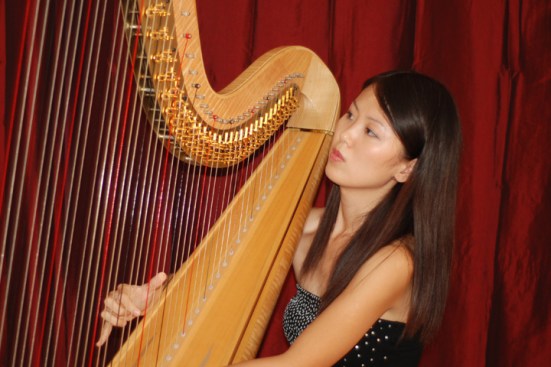
Having brought the Melbourne Symphony Orchestra’s harpist Yinuo Mu on board for the event, Smith used her talents to the full.   Mu took part in four of the five program constituents, thereby being the most hard-worked of the recital’s participants.   Not that you had any impression of stress; this musician was as elegantly energetic in the Ravel as she was at the opening where I think most of us were hearing, for the first time, Eugene GoossensSuite for flute, violin and harp.   Written in 1914 but published mid-war in 1917, this three-movement work beguiles with its lush, non-saccharine impressionistic colour washes.   With Smith on violin and the flute of Andrew Nicholson, this novelty impressed for an unaffected elegance; if not big on development, the three movements – Impromptu, Serenade, Divertissement – progressed by ramping up their activity level, the last movement a fast-paced gem of mild athleticism, its outer sections straddling a slower interlude with an unexpectedly Elgarian tang.

Goossens made full use of the information available to him through his harpist sisters, Marie and Sidonie, so that the instrument’s contributions fitted in to the prevailing texture and dominated it in turn.   This composer made a considerable impression during his Sydney years when he was conducting the Sydney Symphony Orchestra and directing the Sydney Conservatorium – a one-man (is there any other kind?)  fiefdom, taken over after his disgrace by a relative mediocrity.    Not that the impression he made was necessarily positive all the time: his own opera Judith might have given exposure to a young Joan Sutherland but its performances in Sydney were not resoundingly successful; despite his outstanding reputation with modern scores, his interpretations of orthodox repertoire could often irritate for their accelerated tempi.   But this Suite shows an emotional command and sensitivity that was finely delineated by these expert interpreters.

Joseph Jongen‘s Deux pieces en trio for flute, cello and harp brought Anna Pokorny to the stage.  Another late flower of Impressionism, these short bagatelles threw up some exquisite passages of play – a fine soaring passage at the octave for flute and cello in the Assez lent and, later, a similar moment in the temperamentally contrasted Allegro moderato.

Conte fantastique by Andre Caplet, a friend of Debussy, asks for harp and string quartet but, on this occasion, the double bass of Alexander Arai-Swale was added to the mix; I couldn’t see that he did much but reinforce Pokorny’s cello but it’s possible that I might have missed more subtle input.   Compared to its predecessors on this program, Caplet’s score verges on the adventurous, but Mu’s instrument is the main protagonist in this extended scene illustrating part of Poe’s The Masque of the Red Death short story.   The score engages in grinding harmonic clusters and angular melodic gestures as the composer follows the story of a dissipated dance/orgy, complete with ominous clock chimes, before Death appears to level the revellers.   For this extended scene, Smith took second violin while Zoe Freisberg did sterling service as first desk and Imants Larsens from the Adelaide Symphony generated a firm tenor line with his viola.   Even if you were not addicted to program music, this piece proved engrossing – for its swirling range of colours, the urgent excitement of its progress, and the confidence of all involved, especially Mu who capped the experience with a chameleonic, driving cadenza that led into the concluding six bars.

Beethoven’s Serenade brought Smith, Nicholson and Larsens together in a combination of high interest, chiefly for the equanimity of the collaboration despite the sparseness of the composer’s texture.  Nicholson’s flute remained impressive throughout the recital; his attack precise, articulation spot-on, all informed by a fluent approach to rhythm. Smith and Larsens complemented each other, the mellow violin contrasting with a more deliberate viola.   But the ensemble impressed right from the unisons and rapid interplay of the Entrata before an amiable reading of the Tempo ordinario d’un menuetto, gifted with two splendid trios.   Despite the difficulty of keeping one’s nose clean during the transparent Andante con variazioni, you had to listen hard to detect any pitch problems in those mellifluous pages, while the final two rapid movements showed an admirable deftness, especially in the infectious repetitions of the final Allegro‘s Mozartian main theme where violin and viola engaged in some subtle and unexpectedly courteous interweaving.

As for the concluding Ravel, Mu contributed a supple texture to the mix, taking her time with the interpolated cadenzas and showing an awareness of her primacy; after all, Ravel wrote the piece as a demonstration of the Erard’s new 1905 chromatic instrument.  The composite sound of the septet in this hall’s acoustic acquired a remarkable warmth, even in soft shimmering passages for the string quartet, but the outstanding feature of this version was an absence of hysteria or whipping-up of excitement through forcing the pace.  The Allegro followed its path with a poise that the composer would have appreciated, notably Mu’s solo two bars after Number 11, the explosion at the tres anime  point at Number 17, and the gradual acceleration 18 bars from the end.  Rather than over-pointing the work’s elation, these players opened windows on to its transparency and festively rhapsodic sparkle.

Movement at the station

YOUTH AND THE DANCE

Selby & Friends

Deakin Edge, Federation Square

Thursday March 9, 2017

Grace Clifford

                                                                                    Grace Clifford

Kathryn Selby began her subscription series in Melbourne with some depressing news, the most significant part being that she will be leaving the Deakin Edge space at Federation Square for another venue yet to be determined. Apparently, the Square authorities will not permit reservations longer than a year in advance, not even from regular clients – which flies in the face of sensible business practice but what would you expect from this white elephant?   Selby has been on this path before following her move from Melba Hall at Melbourne University (which now won’t hire to any ‘outsiders’ – don’t you just love exclusivist purity?) and her options are few and far between, especially as the new venue of necessity must stock a piano.   We can all think of spaces but those fit for the purpose are close to non-existent.    You’d automatically think of the Recital Centre and its Salon, but the audience for Selby & Friends recitals is usually larger than can be accommodated in that room.

The less important matter was that one of the series sponsors, Cleanskins Wine, was unable to provide interval drinks since an Edge/Square regulation requires the presence of security officers to police the disorderly inebriates who frequent chamber music recitals and Selby can no longer afford to pay for such functionaries.   Not that this bothers some of us; if I have an interval drink these days, I tend to nod off before the final work’s second movement.   But it’s an aspect of conviviality that many others relish and, for the life of me, I can’t recall these public guardians actually doing anything constructive during the time that the ensemble has been appearing in the venue.

This all took some time to get through before Selby invited her guests onstage.   Both violinist Grace Clifford and cellist Clancy Newman have appeared previously as Friends and so are accustomed to the venue and their host.   Thursday night began with that most agreable of young works by Beethoven, the E flat Trio Op. 1 No. 1 and, from the initial bars, Selby took control as expected.   Beethoven gives most of the interest in all four movements to the keyboard and, whether I was sitting in a hot spot or the tuner had somehow heightened the piano’s resonance, the piano part dominated proceedings with an unexpected force.   In fact, the two strings have few chances to shine and stayed recessed, even though Selby was discreet in segments where her content is figuration-work.

Still, both Clifford and Clancy came into their own during the A flat Adagio, typified by sterling collaborative support after the home-key return at about bar 90.   While the Scherzo began as evenly balanced in dynamic, both strings effaced themselves to wallpaper status in the Trio where admittedly they have little to do but drone.   And, as anticipated, the real interest of the finale emerged through the vim and bounce from Selby, exemplified in her ability to colour even brief phrases and in her talent at working animation into the wide-ranging lines that Beethoven created.

For the Saint-Saens Trio No. 1 in F, we heard a good deal more vehemence from Clifford, although she and Clancy presented their work in a guarded manner, not extroverted enough for the first movement’s inbuilt melodic surges, nor a balance for the piano’s quicksilver flights and style of delivery.   In her pre-performance address, Clifford referred to the hurdy-gurdy imitation found in the last pages of this trio’s Andante and she contrived successfully to raise the spectre of Schubert’s Leiermann at several points in pages that proved one of the recital’s high-points, made all the more bracing by all three interpreters treating these pages briskly.   Most of the third movement Scherzo worked very well, the only question-mark coming in the coda with its sur deux cordes instruction to the violin; carried out properly, I’m sure, but the results sounded uncomfortable.   I blame Berlioz.

Saint-Saens gives free play to his inventiveness in the trio’s last movement which has Beethovenian proclamations, page after page of semiquavers for the keyboard, a chorale moment or two, and a concluding molto allegro gallop. This material involved the string players more satisfactorily; even so, you still felt some reserve, an unwillingness to hurl themselves into the fray.   In other words, a neat interpretation but not one where sheer enthusiasm left you unaware of the formal cracks.

Dvorak in E minor, the Dumky, finished this night which had been further elongated by a preliminary set of observations from Newman and a long interval; some patrons had to creep out before the final movements, I suspect for public transport reasons.   The reading proved engaging, the performers keeping an eye on each other in a score packed with abrupt bursts of action and deliberate contrasts of slow melodic arches and abrupt bursts of folk-inflected angst.    Clifford experienced a bowing error during her first exposed statement in the initial Lento but this was a small lapse in pages that gave Clancy his first sustained exposure of the evening.   The violinist’s subdued support in the following Poco adagio made a subtle backdrop for the cellist’s moody announcement of the melodic content but Clifford sparkled in the pendant Vivace, although Selby let fly in both furioso sections.

The fourth movement, the Andante with muted strings, turned out to be the interpretation’s high-point, crowned with a luminously fine Allegretto coda – understated but eloquently shaped.   During the following Andante moderato/Allegretto scherzando, the problem of balance again reared up when Selby’s ringing upper register drowned out the strings’ obvious efforts, although the concluding Moderato proved exemplary.   Reassuringly, the final two movements progressed easily, the musicians functioning as an integrated ensemble with lots of regard for the nationalistic fervour with which Dvorak suffused this popular work.

So, the night lived up to its title with two pretty youngish pieces from Beethoven and Saint-Saens, complemented by a welter of dances strung out across the length of the Dvorak gem.   If the trio combination on this night might not have impressed as balanced throughout all three works, you couldn’t complain  about the level of expertise.

Next in the series on May 24 will begin a half-hour later than usual  –  8 pm  –  to allow Sydney Symphony Orchestra concertmaster Andrew Haveron sufficient time to get from Sin City to the Deakin venue.   Selby’s cellist will be the Australian Chamber Orchestra’s principal, Timo-Veikko Valve, and the program comprises a striking set of arrangements: Haydn’s Miracle Symphony No. 96, revamped for piano trio by the impresario Salomon for whom the composer wrote this work, and quite a few others; a version of Ravel’s Le tombeau de Couperin  from Matt van Brink – the four orchestral pieces, not the full piano solo set; and Beethoven’s Triple Concerto with the original’s solo instruments doing all the work in a transcription by Carl Reinecke.

All this and Harvey too

CONCERTO FOR PIANO AND TOY BAND

Adam Simmons Creative Music Ensemble

fortyfivedownstairs

Friday March 2 to Sunday March 5, 2017

adam-simmons

                                                                                   Adam Simmons

Not exactly an unknown entity in Melbourne, Adam Simmons and his Creative Music Ensemble have made creative jazz their playing field   The group is an octet – well, it was for this latest venture: three saxophones, two trumpets, trombone, double bass and drums. A combination that you might think would be top-heavy, but the range is pretty wide, especially when you hear the leader on sopranino sax and the high reaches gained by Gemma Horbury and Gavin Cornish with their trumpets.   For this one-work program, Simmons had also gained the collaboration of master-pianist Michael Kieran Harvey, soloist for his concerto.

Despite the coy disclaimers and reservations semi-articulated at the start of Thursday night’s performance by Simmons himself, this is a real concerto, one where the spotlight shines on the piano and the ensemble alike.   The composer has divided his score into three parts, topped, tailed and divided by a fragmented Confucian quote that had me bamboozled right from the start.   It refers to ‘the Grand Master of Lu’, whom I confused with the contemporary exponent of the True Buddha School, Lu Sheng-Yen  .  .  .  but it’s not him at all.   The quotes from the Grand Master refer to ‘the Ancients’ Music’ and its character; moreover, the cited performance descriptors have direct relevance to what the listener hears – a ‘strict unison’, an expansion of permitted ‘liberty’, then a ‘harmonious, brilliant, consistent’ tone that sustains itself to the music’s end.

All of which tends to project Simmons’ work onto a high plane of operations, moving up that major transcendental musical scale to enlightenment.   Except that this particular music is well-grounded in our worldly plane.   Right from the start, the concerto confronts the listener physically with the ensemble blasting away on a unison note in ever-mobile rhythmic patterns; an avalanche of unanimity scarred, of course, by intonative imperfections that you suspect are intentional.    After this pounding prelude, Harvey entered with a lengthy solo of compressed rigour, taking up on the variegated matter that followed the ensemble’s initial fanfare.

Simmons has constructed a real score, notated with, I suspect, some improvisatory insertions as the concerto moves forward, witnessed by the leader’s signals to stop playing after a sufficiently hectic climax has been constructed. Further, in the best Classical/Romantic fashion, you are presented with passages that fuse Harvey’s ever-mobile piano with the ensemble.   The composer has varied his output with some delicate arabesques serving as a relief from tension, the piano generating a neo-impressionist sound world, best exemplified at the stage where the other instrumentalists inflated balloons and placed them on the strings of Harvey’s grand, then removing and popping them.

The only miscalculation came right at the end when a tremendous fabric was constructed that had the saxophone trio heading a generous sonic wall with Harvey pounding out chord clusters, then hand-smashes, finally employing both arms to belt out welters of noise across the keyboard.   Simmons halted this abruptly; there was a blackout, and the audience burst into applause – excited or relieved, take your pick.   But the end of the concerto  – the final Confucian quote – was yet to come: a recited line and some muted valedictory fragments.

You can’t blame the listeners.  Most of them have been bred to a musical experience that demands a reaction after an exciting (for which, read ‘loud’) build-up ending with any form of cadence, orthodox or simply curt.   You see it year after year at the Myer Bowl free concerts by the Melbourne Symphony Orchestra where applause breaks out after every concerto or symphony first movement.   It’s a relief from tension, possibly, or a willingness to extend or participate in the energy an audience has witnessed.   In the case of this work, the clapping and yips of excitement were inevitable.

Another query came as you had to grapple mentally with the toy band nomenclature.   For a long time, the players did nothing out of the ordinary.   Eventually, toys were brought into play – rattles, toy trumpets and saxophones, tops, clappers, rubber fish/ducks/chooks, musical ratchets.   From memory, these took over at two specific points and acted as palate-cleansers before the players returned to their regular sound-sources.   You’d assume that these interludes fleshed out the philosophical underpinning that supported Simmons’ piece and, indeed, all his music.

I find it hard to comment on the concept that asks of art that it be useful.   Simmons is dedicated to this aesthetic and there’s much to commend it.   But, at present, I’m unclear as to what end the usefulness is being directed.  Towards the listener?  The creator?  The performers?  The state?  All of these?  And, most difficult of all, who determines whether or not the work has achieved its aim?  Of course: the critic.

Harvey played with that combination of refinement and vehemence we have come to anticipate on each of his appearances.   While the final full-body bout made marvellous theatre, the earlier sections where the keyboard writing’s content was digitally complex and dynamically sharp-edged yielded the more engrossing experiences, the pianist’s control and informed vitality as remarkable to watch as to hear.   Further, Harvey is one of the few pianists I know who can sit on the cusp of formal, fully-written composition and extemporisation, leaving you uncertain in which arena he is actually operating.

Simmons is fortunate in his ensemble, as well as in Harvey’s participation.   The front line sax trio with Simmons himself continuously bobbing with delight, a relatively reserved Cara Taber on alto and Gideon Brazil‘s ebullient tenor made an intriguing study in contrasts of all kinds; Herbury is one of the most enthusiastic trumpeters you’ll ever see, partnered by Cornish who can be just as strident in timbre.   Bryn Hills produced a highly mobile trombone line, very adept in the concerto’s more rhythmically complicated stanzas, with Howard Cairns‘ bass an amiable, bemused support.  The best compliment you can pay Hugh Harvey on drums is that he knows his place and that isn’t just drowning everyone else but rather offering a sturdy, right-on-the-beat reinforcement without attention-grabbing flourishes.

At a time when really adventurous musical events are rare, this night was a breath of fresh air, leaving you elated with its accomplishment.   Inevitably, it brought to mind other writers and other experiences, although some of the concerto’s more brutalist pages suggested nobody more than Xenakis.   Yet the innate flexibility of structure and obvious coherence took me a long way back to the jazz experimental forays of the 1950s and 1960s – not just in the United States, but also here when Barry McKimm, Robert Rooney and Sid Clayton were playing in a new style that fused freedom and discipline.   Simmons’ concerto operates on a similar plane of invention but has a novel edge through the composer’s appealing delight in his own good-humoured aggression.

Small packages

MOZART MARATHON

3MBS

Hawthorn Arts Centre

Sunday February 26, 2017

goldner-string-quartet

                                                                             Goldner String Quartet

A whole day of Mozart?  It would have delighted my one-time colleague on The Age, Kenneth Hince, who thought that the composer had a direct link to the Holy Ghost and would rarely allow any fault to be found in his (Mozart’s) work – although even he admitted that some of the minor dance music and divertimenti weren’t to be taken seriously, just as Mozart himself regarded them: note-spinning money-earners.

For the occasion, 3MBS assembled a fine array of local and interstate musicians to present six programs, each of 90 minutes’ duration and all of an internal variety that would have pleased the appetites of the radio station’s listeners more than musicologists.   For example, the day’s first offering comprised a piano solo, a piano trio, a piano quartet, the Oboe Quartet and a cello sonata movement by the younger surviving son, Franz Xaver.  Participant numbers fluctuated as the afternoon wore on, with a piano concerto in the third program, the Turkish Violin Concerto and the Clarinet Concerto in the pre-dinner event; inevitably, the Eine kleine Nachtmusik serenade finished the journey but in string quintet form involving players from the Melbourne Chamber Orchestra.

Nearly every program had a piano solo segment, usually a sonata or one of the last two fantasies.   Choral music emerged in a bracket from the 3MBS Choir under Michael Leighton Jones.  But aficionados enjoyed mainly chamber works, the few I heard coming from sensible musicians.   For instance, the opening gambit was the B flat Piano Trio K. 502 with Elyane Laussade handling the keyboard, Melbourne University’s Head of Strings Curt Thompson on violin, and 3MBS Board Chairman Chris Howlett providing the cello line.   For an ad hoc ensemble, these players produced a fairly comfortable reading if not over-endowed with polish.   Howlett had the easiest task but Laussade and Thompson worked competently in more exposed positions.

Hoang Pham kicked off the piano solos with the D minor Fantasy, a well-known quantity for every pianist and given with little deviation from the expected path; probably more stolid than it needed to be but outlined with exemplary neatness.  The Melbourne Symphony Orchestra’s principal Jeffrey Crellin headed the Oboe Quartet, escorted along his way by violin Markiyan Melnychenko, viola Simon Oswell and cello Josephine Vains.   Although this was another ensemble fabricated for the occasion, its members worked effectively together, Melnychenko presenting just enough of a challenge to Crellin’s dominant timbre to keep the work from tedium.  Still, it’s a slight product, benevolent and summery, and this reading met its uncomplicated requirements without fuss.

The Franz Mozart piece was an Andante espressivo from the composer’s solitary E Major Cello Sonata, the movement itself in B minor with a young performer, Charlotte Miles, coping with the notes supported by an unidentified accompanist.  It would take a more assured musician to make something memorable from these few pages but Miles and her associate gave it some gusto, although nothing of its melodic content lived in the memory a few seconds after it stopped.

Finishing the first program, the Australia Piano Quartet gave an intelligent account of the G minor K. 478 work.   Although these musicians have played at the Melbourne Recital Centre, I can’t remember encountering them there. According to what I have learned about them, the violinist of the group is Rebecca Chan, currently serving as an assistant leader in the Philharmonia Orchestra; her place for this work was taken by Sydney Symphony Orchestra concertmaster Andrew Haveron.   The remaining regular personnel are: a welcome constant on the MRC scene, pianist Daniel de Borah; the APQ’s artistic director, cellist Thomas Rann; and violist James Wannan, also a notable expert on viola d’amore.  The group gave an excellent reading of this splendid score: professional in attack, confident across all lines, the ensemble constantly malleable in phrasing and reliable in delivery.

Half an hour’s break, and Benjamin Martin opened the next recital with the Rondo in A minor.  Again, the performance proved unexceptionable, finding an appealing level of moderated melancholy in the bagatelle’s main recurring theme and plenty of fluent action in the episodes.  You might have expected more regularity in the trills, like those dominating bars 134-5 but Martin negotiated the piece’s mildly action-packed pages with tact and a refined delicacy to the sotto voce concluding six bars.  Tenor Andrew Goodwin, accompanied by de Borah, then sang two of the most well-known arias for his voice: Dies Bildnis from Act 1 of The Magic Flute, and Don Ottavio’s Dalla sua pace, originally written to replace Il mio tesoro –  nowadays, both arias are sung in Don Giovanni productions, fleshing out the nondescript character musically if not emotionally.   These were a pleasure to hear, Goodwin’s vocal colour typified by a strong and evenly applied line which shows an exemplary responsiveness to Mozart’s lyrical phrasing and the emotional points of da Ponte’s texts.   Has this singer been seen/heard in opera here?   He’s a gift to any company with enough nous to sign him on.

Laussade returned for Mozart’s A minor Sonata K. 310.   She left out the first movement exposition’s repeat, but then so did most of the other sets of performers I heard.   The work seemed to present some memory problems, a few fumbles coming at points that are not technically challenging, mostly in the concluding Presto where the texture is too spare to hide any flaws.   Finally, the Goldner Quartet which we so rarely hear live in this city treated us to the Dissonance K 465 in C Major.  These players have 22 years of uninterrupted mutual experience without any change of personnel, so their readings present as uncommonly fluent, the linear inter-twining negotiated with unflappable confidence and a remarkable, if expected, mutual dynamic awareness.

To be honest, I would have preferred to hear not just this one, but an entire program of Mozart quartets from the Goldners.  For that matter, it might have been useful to hear all the piano pieces – sonatas, fantasies and rondo – in one hit.   But then, the rest of the day’s programs involved music that is hard (impossible?) to partner with anything: the Gran Partita, the Clarinet Quintet, the Piano and Wind Quintet K 452 – works that suck the air from their surroundings. Yet, for all the programmatic leaping around, 3MBS patrons were able to enjoy juxtaposed greater and lesser products of an unparalleled musical genius.   I’m only sorry I couldn’t stay for more than these first two recitals but it seemed pretty plain that the audiences on Sunday were getting more than their money’s worth, whether they stayed for only one stanza of play or for the complete six.

Confidence, with personality

THE PIANO IN ARCADIA

Arcadia Quintet

Melbourne Recital Centre

Monday December 1, 2016

arcadia                            (L to R) Matthew Kneale, Kiran Phatak, David Reichelt, Lloyd Van’t Hoff,  Rachel Shaw

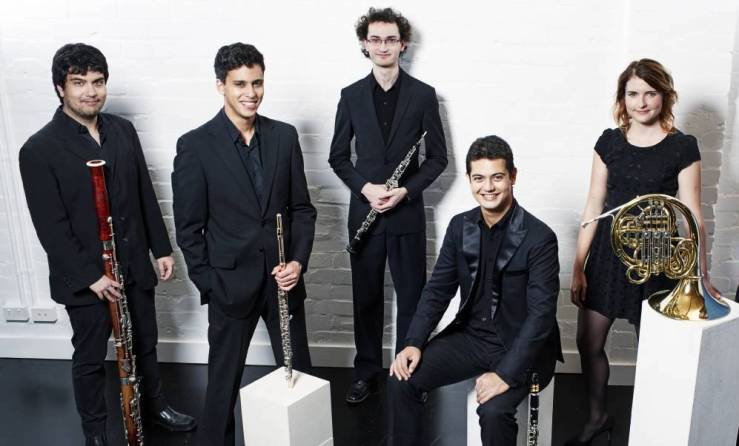
As you can tell from the photo, the Arcadians are a wind quintet. now three years old, comprising graduates of the Australian National Academy of Music.  For this appearance, part of the Recital Centre’s Spotlight series, the ensemble hosted pianist Peter de Jager who not only played in all four works programmed, but also wrote one of them.   With the enthusiasm of youth, these combined forces gave value for money, their event going some 20 minutes overtime.  I suppose that it would have been hard to cut back on anything, although the opening piece stuck out from the ruck pretty obviously.

Poulenc’s Trio for Oboe, Bassoon and Piano of 1926 served as a palate cleanser, enjoying a very affirmative account in the Salon space where audiences are close to the players; in this case, the ambience felt even more tightly knit, as though you were seated alongside the wind players, if not inside de Jager’s keyboard.   From the full-frontal initial Lent, it was evident we were in for a take-no-prisoners evening, de Jager powering across his opening 9 chords, followed by an intransigent semi-cadenza from Matthew Kneale‘s bassoon, climaxing in a low B flat, massively triple forte, with David Reichelt rounding out the pseudo-Baroque dotted-rhythm-plus-trills stateliness with a piercing elegance – all of which disappeared with the jump into Presto at Figure 2 where we hit the 1920s as that period struck a receptive composer on the watch for piquancy of harmony and instrumental character.

As delivered by these players, this trio  impressed as more rowdy in atmosphere than usual, where the emphasis tends to be placed on the effete.  While the central Andante hit the expected element of melancholy with a bite, at the Rondo finale in D flat these musicians found a permeating current of vigorous excitement, buoyant enough to communicate Poulenc’s restrained exuberance, if presenting as more muscular in contour than you are accustomed to hear.

In some ways leading on from this spiky opening gambit, Guillaume Connesson‘s four-minute moto perpetuo Techno Parade served as a tour de force for Kiran Phatak‘s flute, Lloyd Van’t Hoff‘s clarinet and de Jager on piano.  A relentless exercise in rapid-fire articulation and simultaneity, the piece came off  to fine effect, the wind duet work close to faultless and, if there’s not much to the score but boppy energy and a deft manipulation of jazz-inflected motifs, you could admire the execution for its confident drive.

Concerning the final two works on this night’s menu, what follows is unfortunately vague and, in some aspects, unreliable.  Not that the music itself was difficult to follow, but scratching notes in the dark as an aide-memoire is no way to guarantee precision of observation or evaluation.  Still, this is what I heard – or thought I heard.

De Jager’s own Disintegration in two parts, elliptically titled Before and After, received its premiere here.   It involved all the Arcadians with extra instruments emerging occasionally – Phatak’s flute alternating with piccolo, Reichelt tripling up with a cor anglais and an oboe d’amore.   Each half held six sub-divisions, both starting with a chorale and ending with a movement called Perotin which offered a contemporary take or two on the medieval organum/conductus nexus.

In the work’s first half, a Barcarolle impressed for its subdued menace, a duet for bassoon and one of the oboe group weaving its path above suspended chords and a rolling piano underpinning.   Mounds of Earth brought Shaw‘s horn into prominence in alliance with the piano although the title’s relevance to the movement’s emphatic linear content escaped me.   Phatak enjoyed a searching and emotionally appropriate cadenza in Melody: Hysteria.   For the second Chorale, de Jager opted for staccato wind chords juxtaposed with sustained keyboard sounds; Evaporated Earth gave a clear illustration of the composer’s economy of matter: his music’s progress is orderly, not obsessively dissonant but concerned with sounds and their placement  –  in this movement particularly, I heard suggestive echoes of Webern-like cells and acrostics.   Death Metal Depths eschewed the flute and oboe voices at its beginning – all bass rumbles and very loud ostinati, illustrating the title’s sonic potential persuasively, although the action eventually did spread upwards to involve the soprano voices.

Disintegration intrigues for a restless mobility, reflected in its multi-partite nature, and it is a clear success as an essay in timbres.   You’d have to hear it several times to acquire a definite appreciation of its structure; for example, I found little to distinguish the Death Metal Depths from its attacca consequent, Immolation, apart from some Zauber Feuer Musik trills; and the Techno Funk Fire passed by without making much of an impression – quite distinctive, of course, but standing as something of an intellectual hiatus in proceedings.   De Jager’s lyrical and harmonic vocabularies are assimilable, his intentions remain clear throughout and, as you’d expect from a band of colleague-friends, the execution on this occasion impressed for its persuasive energy and pretty reliable ensemble work.

The sextet then engaged with Brett Dean‘s Polysomnography, which took its inspiration from the technology associated with tracking and recording the brain’s activity when one is dreaming.   Five movements examined, in musical terms, various techniques and/or results from this process: theta and delta waves, myocloni (twitches and spasms and their release), sleep spindles (abrupt bursts of brain activity) and the composer provided a kind of summative assessment in a Dream Sequence that capped the experience.

Dean begins with theta waves where rhythmic motion is all over the shop; the acoustic spectrum is disturbed (or eased?) by having some executants breathe into their instruments  –  an unsettling music with sustained trills for flute over complex sound washes.   Myoclonus presents a very active sonic field that yields to a placid conclusion.  Dean’s Sleep Spindles are punctuated by woodwind arpeggios suggestive of that scene in Bartok’s Duke Bluebeard’s Castle where the unfortunate heroine discloses a lake of tears, a searching horn solo rising from the mesh.   As for the climactic dream, this opens with a series of ejaculations led by bassoon, the sleeper’s experience eventually rising to a frantic climax with rushing figures that recede but, in a telling inspiration, remain sotto voce under the concluding pages’ placid progress.

This is a remarkable construct, all the more so when you consider what Dean is attempting.   You can find musical data that depict the designated brain activity if your bent is towards the specific, but Polysomnography works even more satisfyingly on a more suggestive plane or two.   Besides exemplifying in some shape the referents that the composer’s titles propose, the work stands as a remarkable challenge for its executants, testing their mastery of synchronicity, of dynamic leaps and articulatory bounds, and of crafting their sounds into a highly exposed, clear fabric.  Without a score, I can’t make any assertions about the precision of this performance but it pleased the composer, who was present.   For all that, like de Jager’s new work, it would be worth resuscitating in a future Arcadia program – on this showing, an event to be relished.

The players have an attractive collegiality in their work, further emphasized by their attraction to new music rather than sinking back into more comfortable repertoire by Danzi, Reicha, Nielsen and Hindemith.   They hold back nothing, giving you the benefits of their craft unstintingly.   And, thank God, they have a sense of humour; mind you, negotiating a taxing (and long) program like this, you’d need one.

Trim and smooth

Trio Dali

Melbourne Recital Centre

November 15, 2016

trio-dali

                                                                                        Trio Dali

                                                  Jack Liebeck, Amandine Savary, Christian-Pierre La Marca

The Dalis have visited for Musica Viva before, appearing here in May 2012 with a similar program to this current one. Then, they performed Ravel and Schubert in E flat, as well as Australian Gordon Kerry’s Im Winde; this time, it’s Beethoven Op. 1 in E flat, Chausson’s Op. 3 and Roger Smalley‘s 1991 Trio, written as a compulsory hurdle for ensembles in that year’s Melbourne International Chamber Music Competition and becoming familiar over that week through sheer power of repetition.   Some things have changed over the years: violin Vineta Sareika has been replaced by Jack Liebeck, and Amandine Savary‘s piano now opens on the long stick – a mixed blessing.

As anticipated from the one previous exposure, this ensemble is nothing if not polished.  The opening movement to their Beethoven interpretation set a high standard in the melding of lines, no one hogging the spotlight.  Even though the temptation is there for the pianist’s taking,  Savary husbands her full power, exerting it rarely, and she avoids the trap of seeing a large level of activity in both hands as giving her a justified primacy.  By a careful and constant control over both sustaining and dampening pedals, she allowed her colleagues a dream run in the trio’s first half.   And if her contribution dominated the last two movements, there’s nobody to blame but the composer who gave his keyboard a rollicking conclusion to both halves of the Scherzo and all the running of the Trio; not to mention that attention-grabbing leap of a 10th to kick off the Presto finale and an irrepressibly effervescent field of action thereafter.

Liebeck  and La Marca make a well-matched string duo, the violinist  generating a line of elegant finesse with a keen sense of shaping his contribution into a piece’s framework, while the cellist shows more aggression although his output offers a marked counterweight to Liebeck in its emphases and mode of attack which, at heated moments, involves the incidental clunking of his bow’s frog as a sort of commentary on his awareness of a phrase’s force.

It surprised me to find quite a few recordings of the early Chausson work – Parnassus, Beaux Arts, Wanderer, even one by a Trio Chausson – but I can’t recollect any live performances at all.   The Dali players showed high enthusiasm for bringing this neglect to an end and their interpretation proved very persuasive.   While Chausson’s returns and reversions have a stilted character, possibly due to the flamboyance of the work’s readily accessible emotional language and a patchwork quality to the recapitulations, the four movements reveal a welcome variety of emotional character.   An urgent energy permeates the first Anime which reaches a strikingly hectic climax across its last two pages with a welter of very loud full chords in triplets for the piano.

The players preserved a piquant sprightliness in the Vite movement, including a finely graduated decrescendo as the movement sank into triple piano harmonics. The Assez lent brought out the string player’s sympathy in canonic and unison passages, even if Chausson makes heavy work for everyone by having his pianist double the other players’ lines for a good deal of the time.   As for the buoyant final Anime, the spirit of Cesar Franck loomed large with page after page of fraught chromatic shifting and broad melodic strokes.

Smalley’s work was presented by Liebeck as an in memoriam for the Anglo-Australian composer who died last year and whose work didn’t feature overmuch in the musical rounds of this particular eastern state.   His Piano Trio uses Chopin’s A flat Op. 59 Mazurka as a fulcrum/springboard although the references are elliptical at best.   But the Dalis infused it with more vivacity and sheer interest than I can recall from its several performances 25 years ago, particularly some haunting Brittenesque cello sounds in the second part’s Passacaglia.   You got the impression from this version – far more than  in others I can recall – that an awful lot is packed into a short time-frame, so much so that the score’s four segments, though clearly discrete, fly past – in this instance, with manifest concern and mastery.   If only all local content on Musica Viva programs could occupy this excellent and enlightening standard of accomplishment.

The Dali Trio plays again on Saturday November 19 at 7 pm.  Smalley’s work sits at the centre, surrounded by Mendelssohn No. 2 in C minor (the third performance here by  professional ensembles in 12 days) and Schubert in B flat.