All the old familiar faces

A LITTLE NIGHT MUSIC

Melbourne Chamber Orchestra Virtuosi

Deakin Edge, Federation Square

November 20, 2015

A new group on the local concert-giving scene  –  well, new to me  –  the Virtuosi has spun out of the MCO ranks over the past year or two and comprises some very familiar faces.   The central organization’s artistic director, William Hennessy, heads the second violin trio, Lerida Delbridge from the Tinalley String Quartet is Virtuosi director, the violas are veterans Justin Williams (also a Tinalley member) and Merewyn Bramble, cellos Michael Dahlenburg and Paul Ghica (Bramble’s colleague in the Patronus Quartet), and the double-bass-of-all-work is the dependable Emma Sullivan.

Lerida Delbridge (mco.org,au)
                  Lerida Delbridge 

Last night’s program, to be repeated tomorrow in the Melbourne Recital Centre, impressed as a consolidation of core repertoire for a string ensemble of modest numbers. A tad circumscribed in personnel for string orchestra staples like the Bach Brandenburg Concerto No. 3 (which needs a third viola and cello) or Vaughan Williams’ Tallis Fantasia (its subdivisions require extra personnel in every section), the group still contrived to put together a successful sequence of familiar works stretching from Boccherini and Mozart, through Tchaikovsky and Holst, to a new work by Australian writer Nicholas Buc with the provocative title A Little Night Music and set alongside Mozart’s sparkling serenade of the same name.

The Virtuosi began with the expatriate Boccherini’s appreciative Night Music on the Streets of Madrid, although I missed hearing the first segment dealing with the Ave Maria bells as the performance seemed to launch straight into the Soldiers’ Drum phase, two violins doing the honours in that phase from opposite sides of the Edge’s internal walkway.  But the main segments showed a well-rehearsed body with an appropriately fluid approach to rhythm; the only question arose in the Passa Calle where Dahlenburg’s solo melody line could have been projected with more aggression, particularly as the chief accompanying texture was pretty much continuous pizzicato.

In fact, the night’s soloist was Dahlenburg who took the central role in both Tchaikovsky offerings: the Nocturne and that melting moment, the Andante cantabile from the D Major String Quartet No. 1 in Tchaikovsky’s own arrangement which moved the pitch up a semitone, it seems, but graciously gave the cello an opportunity to play the folksong-indebted theme that it alone does not get to treat in the original score.  The solo strand travelled well in the Edge’s large air-space, with only a moderate vibrato employed and a fine sensibility brought to bear that let the music speak for itself, more clearly in the Andante than the Nocturne where the accompaniment, well-intentioned and firm, was overbearing in the piece’s later, mildly decorated pages.

Both the Eine kleine Nachtmusik and Holst’s St. Paul’s Suite enjoyed sterling interpretations, the Mozart cleanly executed with loads of animating dynamic variety and supple phrasing, especially in the simple but demanding Romanze where the violins resisted its temptation to gild the melodic lily.   Later, the English suite featured fine solo work from leader Delbridge and Williams’ diplomatically understated viola in the Intermezzo that alternates languour and ardour in just a few brilliant pages.  For both of these essential scores, the musicians spoke with impressive unanimity, realizing the promise shown before interval in a high-spirited run-though of Mozart’s F Major Divertimento K. 138 – another necessity for any string orchestra to have under its belt.

Buc’s new work has few obvious problems for its interpreters.  The work’s content is neatly constructed, the phrase-lengths predictable, its atmosphere suggestive of a standard film noir accompaniment – moody but not tragic, unabashedly lyrical, high on string colour, no pretensions to depth of meaning.   Buc has constructed an amiable nocturne and the Virtuosi, with the backdrop of several regional performances behind them, gave it a confident airing.  As a commissioned foray into modern music, A Little Night Music represents a tentative enough move; now for more challenging fields – Schoenberg or Tippett, anyone?

Full of the warm South

RICCARDO MINASI

Australian Brandenburg Orchestra

Melbourne Recital Centre

November 7-8. 2015

Riccardo Minasi

Saturday’s fine concert from Paul Dyer and his chamber orchestra was controlled by visiting virtuoso Riccardo Minasi, billed as the ‘fearless Italian Baroque violin’ – which is fine, if you have an apt attribution of what it is to be fearless.  For sure, Minasi bolts into action at the opening bar to every allegro; in his negotiation of rapid semiquaver figuration, nothing stands in the way; even with mediocre material, he remains in full-throttle delivery mode, urging his Brandenburg colleagues to maintain their impetus.

This style of performance is not exclusive to Minasi, but it is hard to find in many other period performances.  An outstanding instance of this approach first struck me when Il Giardino Armonico played their initial tour in Hamer Hall, a program in which machismo and individual flamboyance refreshed many well-worn pages.  Minasi operates with less flashiness but the results he brings out are similarly dust-free.  Mind you, the Brandenburgers have a head start in this style, as artistic director Dyer asks for the same clarity and vigour from his forces in every program that he himself leads.

Minasi compiled a set of nine works for his visit, all written by composers who flourished in Naples and who lived and flourished during that impossible-to-pin-down period of the Late Baroque.  Some of the names were familiar – Durante, Jommelli, Leonardo Leo; others were complete novelties, so much so that Dyer indicated that some of these scores by de Majo, Ragazzi, Manna and Fiorenza were possibly being heard outside Naples for the first time.  Arcane they might have been in provenance but their impact was continuously benign, the usual developmental tropes showing, and giving in to, the potential for shifting unexpectedly; Durante’s G minor Concerto No. 2 maintained this surprise element throughout its admittedly brief length.

Sharing the workload to some extent, Minasi brought members of the ABO strings to prominence in the evening’s second half with a 4-violin concerto by Leo in which he and guest concertmaster Shaun Lee-Chen performed in duo-opposition to Matt Bruce and Ben Dollman,  The final Allegro to this remarkably appealing score produced the evening’s most brilliant playing, a style galant promenade loaded with compressed energy and delivered with a flawless sheen.  Much the same immediacy and elegance followed in a three-violin sinfonia by Nicola Fiorenza, Minasi and Dollman partnering Matthew Greco in a small treasure, all too brief in its last three movements.

Other moments had their drawbacks.  Both horns and oboes were exposed in an E flat sinfonia by Gennaro Manna, the woodwind pitching noticeably off-centre in the work’s Trio; the brass were required to carry out some rapid trilling in this piece’s first movement which sounded laboured.  But then the program’s final offering, Jommelli’s Sinfonia from the oratorio La Betulia liberata found both oboes generating an excellent spritzig timbre while the sinfonia from Domenico Sarro’s Demofoonte remains in the memory for a series of sustained single-note crescendos from the horns, the string ferment riding the blast.

Minasi made a strong apologist for this neglected music from Naples which, like much of the South then as now, has always been denied a fair shake of the national parmesan cheese dispenser.   In this enterprise, he enjoyed unstinting support from the ABO musicians who played with a confidence and flair that reflected the character of their gifted, personable guest.

Happy 80th, Nigel

FROM SORROWING EARTH

Arcko Symphonic Ensemble

Iwaki Auditorium, Southbank

October 31, 2015

Nigel Butterley

This ambitious concert’s title refers to Nigel Butterley‘s 1991 score, a kind of symphony in one movement which can be read as a lengthy meditation on the planet’s destruction or in even more concrete terms as an active threnody on environmental ruin, albeit a plaint where the listener is eventually offered some grounds for optimism.

n fact, this night celebrated Butterley’s 80th birthday, which actually took place in May this year. Currently, the octogenarian is one of the few survivors of that optimistic period in Australian composition history when we attempted to catch up with the rest of the world after years of rehashing what passed for modern 50 years before.  Butterley’s Sydney-based contemporaries Richard Meale and Peter Sculthorpe have left the scene, their direct descendant David Ahern preceding them by several years.

From that 1960s period of ferment, apart from Ross Edwards,  Butterley’s remaining peers seem to be Melbourne residents, notably George Dreyfus, seven years his senior, and Helen Gifford; both are still productive, if relics of an active era here that mirrored Sydney’s world and included George Tibbits, Felix Werder and Keith Humble.  Agreed, the national musical history doesn’t start and end with these composers but their impact was considerable and more encouraged by the ABC and other concert-promoting bodies than seems to be the case today.  Certainly, their premieres were more keenly anticipated and more widely discussed than similar events in these piping times of benign indifference and undiscriminating tolerance.

Yesterday’s event, a partnership between Arcko Symphonic and ABC Classic FM, served a higher purpose than just recycling scraps from Butterley’s oeuvre.  Alongside an audition of In the Head the Fire, a still-gripping aural composite that won the 1966 Prix Italia, and the night’s-title symphony, the program saw the premiere of From Joyous Leaves, a freshly minted piano concerto by Elliott Gyger, this work taking its framework from Butterley’s 1981 piano solo, Uttering Joyous Leaves.

Zubin Kanga took us into this mesh gradually with an authoritative account of the short solo, idiosyncratic in its vocabulary but impressive for its bursts of deft spikiness; a complex construct but packed with devices and flourishes that document yet again the composer’s brilliant writing for keyboard. Later, in Gyger’s concerto, Kanga gave a gritty demonstration of unflinching insight, negotiating page after page of restless, demanding action.  Following the score’s opening statement for three violas, the pianist entered the work’s scheme and remained a constant presence for a remarkably long time.

One of the concerto’s features is the use of a prepared piano, bringing up memories of Butterley’s own performances of Cage’s Sonatas and Interludes.  The work moves with restless impetus and, using a chamber orchestra of woodwind sextet, brass quartet, two percussion with an often-near-inaudible celeste, and 13 strings, you are confronted with a succession of calculatedly juxtaposed colours, even from the piano which oscillates between normal sounds and the gamelan-like texture of the prepared strings.  A great deal is given to the listener in aural information and, before the tutti which disrupts the soloist’s urgent declamations, the concerto comes close to overload.

I’m not sure that simply playing the recorded performance of In the Head the Fire worked as a concert-going experience.  Yes, it was rewarding to hear the work in well-amplified conditions but these days most of us can achieve pretty much the same impact in our own homes.  Still, what else can you do with a work that wa recorded in different sites, its effect dependent on superimposed tracks and some sonic distortion?  Or perhaps it simply seemed out of place in the concert’s live performance context.

The symphony showed the extended Arcko forces in good form, director Timothy Phillips giving the work’s long paragraphs plenty of breadth.  For much of its length, From Sorrowing Earth moves forward steadily, but several agitated moments interrupt its measured progress; both wind and brass maintained an evenness and cohesion of ensemble that infused these livelier moments with real bite.   In the close acoustic of the Iwaki Auditorium, the general balance would have gained from greater string numbers, particularly both groups of violins which were liable to disappear in ardent full-orchestra pages.

Suggestive of the plainchant soaring over the last movement of Laudes, Butterley’s seminal octet and first major success which exposed many of us to his individual voice, the symphony eventually reaches a point of concord where the strife and stridency are replaced by block chords moving in parallel: a calm processional, an organum for the late 20th century.

For some of us, this would have been the first time we were hearing this striking and concentrated score live; the only recorded performance I can trace was made by the Melbourne Symphony Orchestra under Isaiah Jackson in September 1992.  Its reappearance many years later, delivered with exemplary dedication by the Arcko players, must have pleased its creator.  For Butterley’s admirers, this all-too-short tour d’horizon served to reinforce our admiration and affection for a personable, ever-rewarding creative voice: a timely tribute to his intellectual integrity in furthering the development of Australia’s musical progress.

Bach celebrates the Reformation

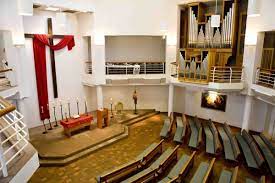
St. John’s Lutheran Church, Southbank

EIN FESTE BURG     

St John’s Bach Orchestra and Choir

St. John’s Lutheran Church, Southbank

October 25, 2015

In two years, the Reformation’s central act – Luther’s nailing of his 95 Theses to the door of Wittenberg’s Schlosskirche  – will be 500 years old, and it’s not stretching possibilities to foresee that Bach’s cantatas will form a significant part of those celebrations.

At this city’s most prominent Lutheran church, Graham Lieschke continues to promote and oversee regular performances of these musical statements of faith.  For today – Reformation Sunday – he presented No. 80 which uses Luther’s most famous hymn as its basis: a familiar tune that Bach transforms immediately into a polyphonic marvel as the opening chorus piles vocal and instrumental lines on each other, the composer testifying to his faith with a skill of construction and emotional enthusiasm that sweeps away all doubt.

At Southgate, these cantatas are inserted into the regular Sunday liturgy, a constant framework into which Bach inserted his own musical sermons.   In these more theologically relaxed times, the interposed cantata brings an extraordinary focus to the day’s liturgical observations, as well as to the readings and gospel which set the service’s tenor.  This morning’s cantata content spoke clearly to the concept of the spiritual war between God and the Devil expressed in military metaphors of bulwarks, fortresses, flags, battlefields, armaments, freedom and victory.

The St. John’s Choir gave a fair account of the opening movement, if inclined to be swamped by the ornate orchestration for oboe and trumpet trios, timpani, a bustling string body, and organ and harpsichord enjoying separate parts.  Singer numbers seem to have shrunk over the past few years and – as with most local bodies – the tenors sounded faint, especially in this initial complex.  But the later chorale verses  came across with  more aggression and verve.

A few bleeps from the period trumpets emerged in the work’s finale, although the lines are taxingly positioned.  Both oboists Kailen Cresp and Andrew Angus enjoyed more success with their solo contributions and the string corps show competence but a surprising lack of bounce, generating the work’s supporting weave but leaving it dynamically inert.

As usual, Lieschke benefited from a quartet of able young soloists.  Soprano Caitlin Vincent owns a clear-speaking instrument, even across its range for her counter-melody in bass Jeremy Kleeman‘s Alles, was von Gott geboren  aria. and her own very exposed Komm in mein Herzenshaus solo.  Kleeman made the most of an extended, ardent recitative but the morning’s most effective solo work came from alto Maximilian Riebl and tenor Jacob Lawrence in the cantata’s penultimate duet Wie selig sind doch die: mutually considerate, well balanced in vocal timbre, accurate in rhythmic definition and pitching.

The St. John’s  series continues on Sunday November 29, the run-up to Christmas being marked with Schwingt freudig euch empor, Cantata No. 36, written to celebrate the start of Advent in 1731 and hymning Bach’s great faith with impregnable certainty and infectious joy.