In the end, it’s all about the children

O RADIANT DAWN!

The Melbourne Octet

St. Dominic’s Catholic Church, East Camberwell

Sunday December 17, 2023

In festive celebration/observation, this experienced vocal ensemble presented a 13-item program of varied content, the exercise a simple one that featured minimal interruptions or distractions and – for once - leaving you with considerable thoughts about Christmas . . . well, more searching than those that usually follow attempts at seasonal musical entertainment.  After a week where local shopping centres and even my local library were invaded by groups of female retirees warbling through commercial tripe to general shopper/bibliophile indifference, the Octet exercised a particularly welcome professional skill after some trying exposure to Rudolf’s nose and pre-adolescent drummers.

This Advent sequence of optimistic hymns and motets took place in a Melbourne Dominican parish, so the music began with a processional chant: Veni, veni Emmanuel, arranged by Philip Lawson Very relevant for the time of year, it was graced with a resonant solo from tenor Timothy Reynolds in stanza four, supported by open 5ths from the basses. At the head of the cortege came the friars, with the Octet rationing the labour: stanza 1, males only; stanza 2, females and tenors. When all were ranged around the altar, it seemed clear that the direction (at least for this number) came from mezzo/artistic director Helena Ekins-Daukes; not that there’s much to do, either with the straightforward and familiar melody, or with a choral body as well-versed as this one.

The composition that gave this program its title followed, one of Scot composer James Macmillan’s Strathclyde Motets from 2007. This keeps to a safe tradition, the harmonic landscape a well-traversed one.  The performance enjoyed a pair of scouring high sopranos from Elspeth Bawden and Kristy Biber, soaring above the ruck, which included the splendid timbre of Jerzy Kozlowski‘s bass. For me, the finest moments from this piece came in its plaintive Amen conclusions.

Parish priest Father Paul Rowse welcomed us with a benevolent, brief address-cum-sermon, concluding with an Advent prayer to set us on our proper liturgical path, and the Octet swung into a setting of the Angelus ad virginem carol, here organized by the American composer Carol Barnett. This was distinguished by cleverly organized 9/8 bars to break up the inevitability of the original’s 6/8 scansion.  At the same time, you found no striking harmonic interest here; just a democratic allocation of melodic responsibilities with the introduction of a tambourine towards the end.  For all this, Reynolds seemed to be carrying out some light direction.

Josquin’s Christmas Mass sequence, Praeter rerum seriem, is a hard sing, not only for its motivic concentration but also because of its emotional gravity.  If anything, this run-through impressed me as driven but stilted, punctuated by a splendid rush of colour from bar 178 on, the words Mater, ave finishing the work with grave veneration. Everyone’s favourite, In dulci jubilo, followed in the Pearsall setting with a plangent solo from tenor Anish Nair at the O patris caritas stanza. My only whinge would have been a preference for taking the repeated final line - O that we were there - more slowly, although that seemed a minor deficit in a gentle and warm account of this Christmas gem.

Speaking of precious moments, they don’t come more striking than the sudden modulation in bar 10 of Victoria’s O magnum mysterium: a split-second that encapsulates all the feast’s marvel. Still, this reading sounded lacking in variety – of phrasing, of dynamic – as the motet’s shape was left to its own devices, with an exception for the treatment of in praesepio from bars 36 to 39.  For some reason, I found it hard to detect the alto line throughout much of this finest of settings.

Poulenc’s perky Hodie Christus natus est antiphon enjoyed a lively outing, notable for some excellently contrived communal shakes in the 5th- and 4th-last bars. Rutter’s arrangement of Stille nacht changes the expected opening to the first Schlaf in himmlische Ruh!; not to bruising effect, of course and, for all I know, the English composer is being faithful to Gruber’s original. Bass Oliver Mann articulated a solid solo in the carol’s second stanza, while the soprano duo enjoyed exposure in the melting-moment final verses.

I can’t recall hearing Byrd’s Atollite portas principes vestras before this rendition, either live or recorded. Initially, the most striking feature of this interpretation was the aggressive nature of the bass and tenor lines, possibly because the upper voices each have an individual part. Further, the psalm-motet was taken at a cracking pace, a startling heftiness emerging in both times we encountered the saeculum. Amen conclusion. Most of us know Rachmaninov’s setting of Bogoroditsye dyevo, a Hail, Mary of sorts, from the massive Vespers (All-Night Vigil) of 1915. Arvo Part’s version is a more lively creature, startlingly so for this Estonian writer who specializes in musically mystic stasis.  Not that I timed it, but the piece seemed to be over in less than two minutes, Slavic choral timbre being hurled out or muttered with convincing eloquence.

The only potentially challenging music found in this evening’s entertainment came in British composer Cecilia McDowall‘s Advent antiphon O Oriens where initial concords moved to discordant block chords and back again, although some of the composer’s signature grating 2nds are left dangling. At the second strophe Veni, et illumina, the same process is followed with initial consonance disturbed by upper-layer dissonance, the verses ending in a notably grinding tenebris, particularly in handling the word’s third syllable. Mind you, all is satisfyingly resolved at the work’s ending, even down to finishing in the E Major that began the score, with its Orthodox-sounding basses.

First of the last two traditional numbers on the program was Gaudete! Christus est natus, a Renaissance carol here arranged in six parts by Brian Kay, formerly bass in the King’s Singers. This made a gently spiky end to the Octet’s work with deftly organized harmonizations for both chorus and stanzas, each of the tenors enjoying a solo. In fact, the only singer from the group that I can’t recall having a spot in the sun was countertenor Christopher Roache, whom I’ve heard on previous occasions working to laudable effect.

We ended with Hark! the herald angels sing in the well-known Willcocks version. Twenty-two children from St. Dominic’s Primary School sang the soprano line, taking the second stanza to themselves. This wasn’t the happiest ending as the organ moved too slowly, as did the conductor – certainly not fast enough for the Octet and probably not for the congregation which was invited to join in. And, while I’m all for having children participate in a semi-starring role, it’s probably just as well if all of them can stay on the note. 

Still, if the current Gaza experience has taught us anything, it’s that a little tolerance goes a long way; if only the conflict’s legalized and guerrilla assassins could appreciate that, but then, it’s not their celebration, is it? A little child could lead them and, if this concert’s finale helped to remind us of Isaiah’s profound vision, then intonation matters less than a pinprick.

Caviar to the general

CONCORD

Brisbane Music Festival

FourthWall Arts, 540 Queen St.

Sunday December 10, 2023

Alex Raineri

Almost missing out completely on Alex Raineri’s excellent enterprise, I managed to get to this final-day recital featuring the artistic director himself performing Charles Ives’ mammoth Concord Piano Sonata No. 2, prefaced by the world premiere of Australian composer Lyle Chan’s Sonata en forme de cri. On this final day/night of the festival, Raineri took part in four of the five recitals on offer, but this was his only ‘solo’ performance (allowing for brief contributions from viola Nicole Greentree and flute Tim Munro in both sonatas).

Not that conditions for this event were ideal. Due to Translink’s decision to close the Gold Coast line on Sunday, I had to drive to South Brisbane, leaving the car at the only parking lot I knew; then travel two train stops, finally negotiating the uphill climb to the top of Queen Street where I joined 19 other enthusiasts in a small studio space (fortunately air-conditioned on this stinking hot day) to experience Raineri’s pianism at close quarters. Then, repeat the travel sequence in reverse post-recital. However, say not the struggle nought availeth because the sweat-inducing wriggles of getting there proved worthwhile.

Chan’s work left (as expected) scattered impressions, prefaced as it was by an address from the composer which informed us of nothing at all about his own composition but concerned itself with the Ives sonata exclusively. As Chan said, the American work is rarely performed here (or anywhere much in live performance); I recall only a few performances in Melbourne from Donna Coleman, neither of which I managed to hear. But the Concord Sonata has several worthy recorded interpretations and the work itself is over a hundred years old, standing firm as one of the bulwarks in American piano music history.

My own experience of the work has been structured through a recording of extraordinary power by Aloys Kontarsky, set down for Time Records in 1962. Quite a few critics disliked this interpretation, chiefly because they thought that the German pianist didn’t get Ives ‘right’. I believe that Kontarsky took what he found and turned it into a splendid tapestry, somehow imposing order on a work that other pianists view as a hotch-potch – and play it as such. To be sure, any other pianist sounds technically inferior to Kontarsky whose mastery of contemporary piano compositions was remarkable, but it’s true that he produced the fastest Concord on record. Which is not to say that it lacks the necessary profundity.

But then, you have to ask whether the sonata and its musical portraits of the New England Transcendentalists are that deep. Perhaps the finest achievement of the work is Ives’ ability to depict each of the four individuals/family – Emerson, Hawthorne, the Alcotts, Thoreau – as a creative composite, each movement incorporating the opening Beethoven Symphony No. 5 motif while investing each of them with its own distinctive material. This intellectual spread makes huge demands on the work’s interpreters, if not on a first-time audience, and I sense that some of us on Sunday were Ives neophytes.

What little I retain of Chan’s new sonata (and probably his only one, if he follows his practice of writing only one work in each of the canonic forms) is how much of it seemed to parallel the Ives score. On one hearing, you can’t expect to fathom Chan’s harmonic language, but in the actual moment it sounded very much as being on the older composer’s wavelength with crashing chords, an acerbically dissonant series of powerful climaxes, relieved by quiet interludes as a rhetorical contrast, with flute and viola duets serving in an antiphonal relationship with the keyboard, before all three coalesced in a momentary trio.

But after all the Sturm und Drang explosions and relief, presumably expounding the cry (of anger? grief? horror?) suggested in the score’s title, Chan offers a resolution that presents as a chorale-prelude; if I didn’t know better, I’d think it was based on Aus tiefer Not, but I wasn’t familiar enough with the theme about which was woven a near-traditional complex polyphonic web, couched in tonal language – rather like Ives’ third movement.

To make any sensible comment, you’d have to hear the work again – several times, to be honest. No doubting the composer’s emotional commitment to the task, yet his style of piling on the climaxes and powerful washes makes your involvement subject to numbness. As with the Ives, you can’t predict anything – except that there will be more plosive eruptions just around the corner. And, once again, you have to admire Raineri’s passion for contemporary art, here presenting a score that, whatever its merits, is probably not destined for many future hearings outside of the recording studio.

Taken as a whole, you found many riches in the pianist’s account of the Ives sonata. He took his time over the opening Emerson movement, the argument reaching powerful unremitting blocks before the Slowly and quietly interlude – doubly welcome for its page-long placidity – which again moved into thick, well-pedaled territory before the series of variations that start when the composer introduces a 7/8 8/8 alternating time signature and the passing relief of a vast stretch couched in C Major. While the later pages were treated with fair accuracy, the arrival of Greentree’s quiet viola triplets 12 bars from the end made for a refreshing timbre change – which is just the surprise that Ives would have intended, I suppose, after the fierce piano writing that preceded it.

Kontarsky takes the Hawthorne movement extremely fast, but he gives his right hand prominence when it’s a melody-bearing line. I got lost after Raineri’s first page, up until the E sharp and E natural cross-hands points in the narrative (such as it is). The executant made telling use of his 37 cm wood panel, the famous cluster-chords controlled and subservient to the left-hand melodic material. Later, at the repeated four bars interlude, I’d never heard before what the left hand was doing; not much, admittedly, but interestingly at organized cross-purposes with the upper staff’s content – something I wouldn’t have come across except for Raineri’s measured pace.

Raineri made fine use of the room that Ives leaves for diatonic relief at his G Major and F sharp Major soft harmonizations-extensions of the Beethoven motif. Yet the fast march time that Ives asks for six bars further on struck me as too restrained, over-cautious for its bouncy drive; still, by the time we reached that marvellously manic passage packed with five-note clusters, eventually in both hands, Raineri gave us a most persuasive entry into Ives’ most vehement dynamic landscape. Certainly, the prospect sounded rather thick as the march rhythm enjoyed a thorough exercise, but the last five-and-a-bit pages, starting at the From here on, as fast as possible direction, came over as very hard work. It’s not as though Raineri got all the notes, although I only picked up on exposed high pitches for most of the time, but much of this movement’s ‘developments’ are a trial to penetrate, let alone to articulate; the final flourish, following a faintly discordant echo of the hymn, fell into place most happily.

Not much to report about The Alcotts, even if the pace was very deliberate; even the faster exhortation after the A flat Major key signature is negated could have been accelerated without much exertion. Then again, Raineri invested a fine sentiment into the Stephen Foster melody that arrives with the E flat Major key signature in the movement’s second half. Of course, if you give this executant a triple forte demand, he will exercise a gratifying level of power-in-attack, as shown in the blazing C Major treatment of the movement’s main Beethoven Fifth variant right at the movement’s conclusion.

Of all the sonata’s parts, Thoreau impresses me as an indubitable success, mainly because of its husbandry; the composer keeps his aim focused on the final quiet peroration without straying into ragtime or diatonic harmony or the aggressive panoply employed in the first two movements. The lengthy flute appearance is a sign that the transcendent conclusion is near, and Raineri projected the intransigence of that underpinning, slow A-C-G bass motto with impressive calm. Certainly, these pages aren’t all impressionistic dreaminess or concerned with the upper planes; you can find textural complexity allied to dynamic power throughout, but the lyrical moments take on greater importance and Ives’ use of right-hand echoes leavens the urgent bravura of those technically challenging segments.

Once more, we have to thank Raineri as performer and festival director. I don’t know how he manages to attract the talent that can be seen during these recitals, nor how he contrives to keep the festival’s head above water, particularly when only a score of us turned up for this (to my mind) major event. No, he doesn’t do it all on his own, but his contribution to so many programs across this fortnight ranks as extraordinarily generous by any measurement standard. Perhaps I just happened to pick a program that failed to interest others; well, they missed a singular, engrossing achievement.

Diary January 2024

There’s no denying it: nearly everybody goes to sleep in January, as far as serious music is concerned. I’ve written before about Melbourne’s two festivals that brighten up an otherwise lacklustre month: the Organs of the Ballarat Goldfields and the Monington Summer. But these are – for want of a better phrase – out-of-town, and neither brightens the cityscape at all. You could visit Sydney and its outré festival that is souping up Bach, as well as giving Genevieve Lacey the chance to play Telemann recorder fantasias with the support of a dance corps (well, 32 untrained dancers are slated to take part), and Gluck’s Orfeo is on at the Opera House. But that all presupposes money and travel – for what I consider is scant reward.

But Brisbane has one recital-entertainment that should prove very popular, not least because it is a shining light in a pitch-black space.

WORLD TOUR

TwoSet Violin

Concert Hall, Queensland Performing Arts Centre

Tuesday January 25 at 7:30 pm

Being behind modern trends, I wasn’t aware of this violin duo – Eddy Chen and Brett Yang – until seeing them on YouTube where TwoSet Violin is overwhelmingly present, the pair covering a wide range of material – some of it entertaining, some of it worthwhile, some of it risible. Chen and Yang aim to make serious music accessible, an ambition that they achieve usually with success, mainly because both are engaging personalities with absolutely no pretensions and a respectable swag of knowledge. Most importantly, they enjoy themselves while exercising a humour that manages to be self-deprecating, mocking (each other), neo-undergraduate, and (for musicians) infectious. That they both gave up careers with the Sydney and Queensland Symphony Orchestras to take on the lifestyle of stand-up comedians with musical talent is admirable and I can’t think of anyone in serious competition with them, on their inexorable rise from a crowd-funded world tour to the heady heights of packed, enthusiastic houses wherever they go. In fact, I think this event is already booked out! If you can get in, their accompanist is Sophie Druml (who appears on some of their YouTube videos). Tickets range between $79.05 and $179.10, with the usual QPAC ‘transaction fee’ of $7.20 added on; you have to admire the sheer graft of it.

Working hard to make a Franck

WILDSCHUT & BRAUSS

Musica Viva Australia

Conservatorium Theatre, Griffith University, South Bank

Thursday November 23, 2023

Noa Wildschut and Elisabeth Brauss

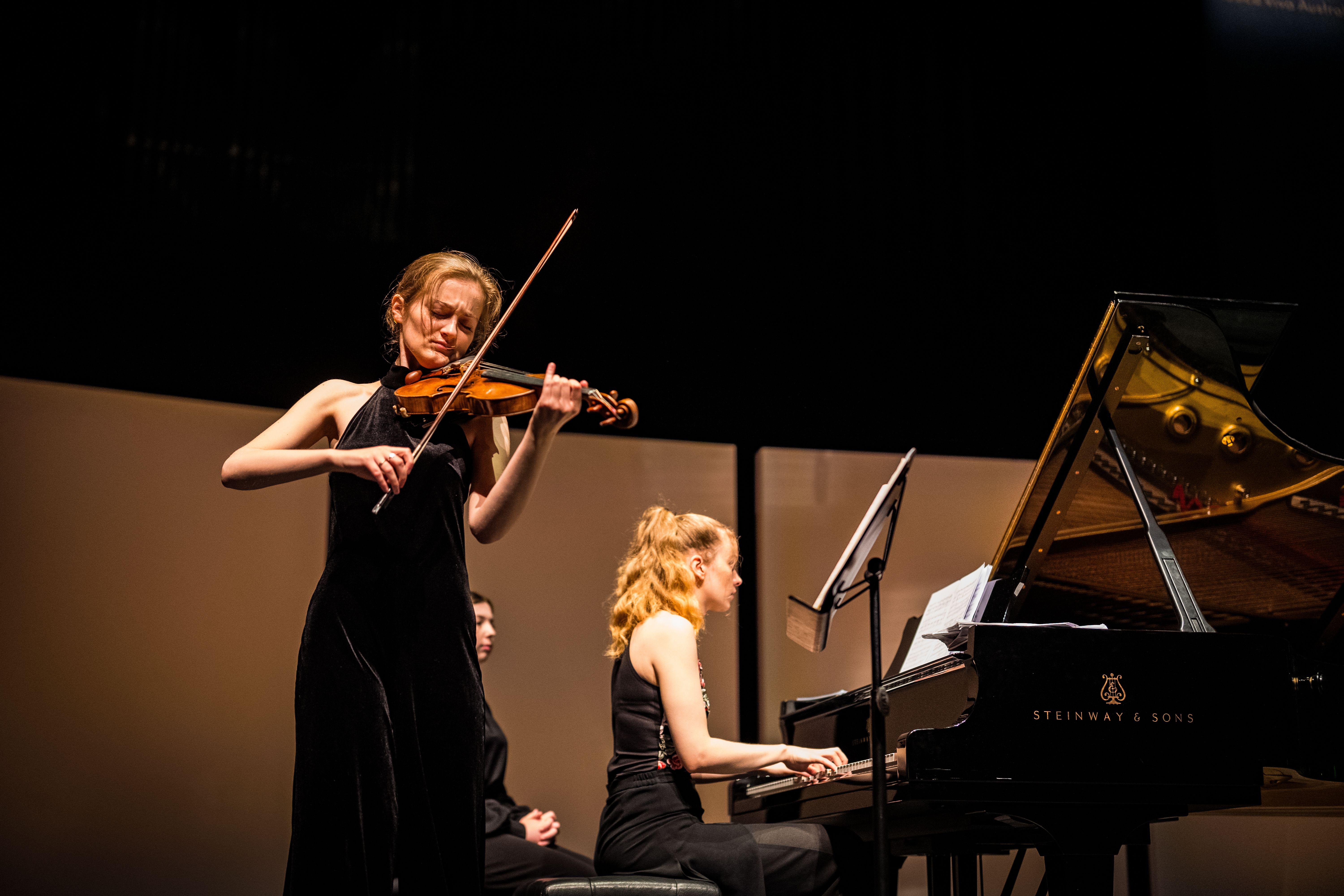
Musica Viva’s artistic director, Paul Kildea, heard this duo of Wildschut and Brauss performing the Franck A Major Violin Sonata online in 2019. So impressed was he that they are now here, touring nationally , with the sixth of their nine-stop series in Brisbane. You are confronted by a pair of excellent musicians, working well in their opening bracket of Schumann’s Violin Sonata No. 1 in A minor, Messiaen’s Theme et variations of 1932, and the formidable Sonata in G minor for Violin and Piano by Debussy – the composer’s final (1917) major work.

As for the evening’s second part, I wasn’t so impressed. The pair gave an airing to a new work by May Lyon: Forces of Nature, commissioned by Musica Viva for these players. But the Franck Sonata – the big finale – was only moderately successful; not simply because of some odd choices in delivery but mainly for a disconcerting theatricality hanging over the interpretation’s finale.

I’d done the usual preparation by listening to a few tapes and online readings of each item, apart from the Lyon work, and came to the Belgian masterpiece with an impressive student reading still lingering in the memory – violin Nathan Meltzer (19) and piano Evren Ozel (18), recorded at the ChamberFest Cleveland in 2019 – because of its security and refinement.

I’ve known this work well because of a few years’ playing sonatas in earlier times (many thanks, Andrew Lee). So I’m aware of the piano part’s technical problems (disasters, in my case). But the violin line impresses as one of the most luminous and clear-speaking in the repertoire. Franck certainly exercises the performer (he was writing it for Ysaye, after all) and you can see vehement, virtuosic writing thrown up across the two middle movements. But the craft of a superior reading comes, it seems to me, from generating an unaffected, even simple line. Still, of that, more later.

Wildschut made an impression straight away with a splendidly rich G-string melody at the start of the Schumann’s Mit leidenschaftlichem Ausdruck: 8 bars of a mellow viola timbre. Here, the musicians were on steady ground, the piano inclined to reticence which is not that problematic in this score which gains in semiquaver keyboard activity as the movement progresses. More pleasures came in the following Allegretto where the duo struck a nice balance of contrasts between the quiet, perky opening sentence or three and the broader melodic sweeps interspersed between them. The only problem emerged in the ritardandi and fermate that recur across these pages, for the first time at bars 2-3. Most of the way through, these adjustments to speed and address came off simultaneously, but every so often they didn’t – which spoke to me of insufficient awareness of intention between the players.

Still, the final Lebhaft passed by with loads of verve and satisfying virtuosity in the paired semiquaver patterns and the lyrical swathes of passages like the E Major interlude that mutates so deftly back into A minor so that the rhythmic and linear streams sound seamless in the change-over. It was almost enough to ride over the few slips in violin articulation and a tendency to backpedal from Brauss who gave the foreground to Wildschut, at times beyond the bounds of courtesy.

The pianist sounded more assertive in the Messiaen collation; not surprisingly, as the piano enjoys a good deal of exposure throughout, e.g. the first variation’s chord chains; the interlocking lines of the following Un peu moins modere where the violin takes the upper line but has to endure a mobile harmonic support until the 4th-last bar’s double octave piano explosion; a restless sequence of vehement interchanges in Variation 3 with some fierce keyboard outbursts; the bell-like right-hand quavers and left-hand triplets that set the pattern for Variation 4, leading to a powerful final 8 bars of ff to fff trills and tremolando; and the final apotheosis suggesting the end of the Quartet for the End of Time in its slow processional pace and the terrifyingly risky 6 bars of quadruple-forte at the segment’s core.

Compared with other readings, the Wildschut-Brauss interpretation proved individual because of its urgency, neither musician showing any signs of hesitation, no matter how complex the mixture; the work balanced by a clear definition of outline in both outer sections and a shared confidence. But then, this work is less open to idiosyncrasies than the preceding Schumann.

Or the Debussy sonata where Wildschut again impressed for her low register timbre, even if she came close to scraping in some places; a tendency that was not realized in the second movement Intermede. You could not fault Brauss’s control of dynamic and simple touch here – no crass blurts or attention-grabbing staccato insistencies. Certainly, these pages lived up to their Fantasque direction, but the corresponding leger came over fitfully, and the final dying-away of the last six bars was unusually positive for a good part of its length.

However, the finale proved to be a disappointment, beginning with the violin solo at the time-signature quasi-change to 9/16: a rhapsodic throwaway exuberance at its finest but here lacking punch and/or a rationale. Further, the violin’s output became too forceful for the music itself at certain points, so that you were fretful about upcoming forte passages, like the Molto rit. ten bars before Number 3 in the old Durand edition of 1917. And, while the movement is a creature of fits and starts (which you can actually say about the whole sonata), I found that through these pages the interpreters seemed to be grabbing at one technical problem after another. In short, the realization lacked coherence as a steady building unit.

There’s not much to report about Lyon’s new work. It began with a violin cadenza that supposedly suggested water and ice; it closed with a ferment that represented volcanic fire – or at least that’s what I gleaned from Wildschut’s introductory comments. Fine; that’s what I heard, going along with the composer. Of course, every auditor will have a personal response but Lyon lived up to her projections. All the same, you can’t find much that’s novel here – no ‘new’ sounds or singular developmental touches – and the executants seemed to be in command of a score that painted its illustrative colours with a mild-mannered hand.

It was hard to fault the first Allegretto of the Franck work, especially as it gave us a fair sample of Brauss’s output in the movement’s 2/3 piano solo passages, carried out with eloquence and exactitude. Further, Wildschut’s delivery showed fine restraint – right up to the con tutta forza aphorisms before the second piano solo which were over-emphatic, despite the direction. Even that active opening to the second movement Allegro enjoyed expert rapid-fire handling from Brauss, and Wildschut’s G-string entry cut through effectively. The next extended violin entry sounded over-strident but the delivery of the second theme resonated with well-shaped character.

The violin’s soft line 9 bars after the Quasi lento interruption was intended, I think, to be spectral; both instruments are under a pianissimo direction (in my Schirmer 1915 score) but you still have to phrase the lines, not just let them sit there uninflected. On the other hand, when both instruments at last state the main theme in unison, the violin’s carrying power was exactly proportionate to her escort.

Both players took a spacious approach to the Recitativo-Fantasia, Wildschut unhurried in her two cadenzas. As the pair entered the F sharp minor section, you felt that the sonata was unfurling with purpose, right through those sequences of thematic reminiscences and re-statements up to the climactic violin high F, delivered with loads of bite and gusto 13 bars before the hushed ending.

The first appearance of the main theme in the A Major concluding Allegretto was a delight, mainly because of the musicians’ unfussed attack – just following a tune in canon without giving it amplitude or weight. This ease was too good to last, of course, and the later E Major version that turns into a barnstorming that prefigures the final page was something of a slash feast. And you have to have a control of weight and phrase to get through the passage work either side of the key-signature change to B flat minor, and maintain the listener’s interest in following your journey.

Perhaps Wildschut gave out too much intensity too early – not that Brauss was keeping her powder dry – but the build-up to Franck’s explosion into C Major proved overdrawn: a series of efforts that crushed against each other, the resolution not serving as a mighty release but simply another climax in a series of exercises in crescendo. Mind you, that made the final appearance of the first theme very welcome, even if Wildschut’s intonation faltered as she negotiated the highest notes in her part.

My score for the final page reads poco animato but these musicians upped the ante considerably, racing through the work’s last 21 bars at a very quick pace. They’re not alone in this acceleration, for sure, but you have to consider the music’s poise and, by the time Brauss hit the ascending dominant and tonic dyads, sense flew out the window in a meaningless frenzy. This passage is meant to be a triumph, a powerful variant, but here it was reduced to a vulgarism; an unappetizing end to a recital of good quality, if not consistently so.

Touches of sweet harmony

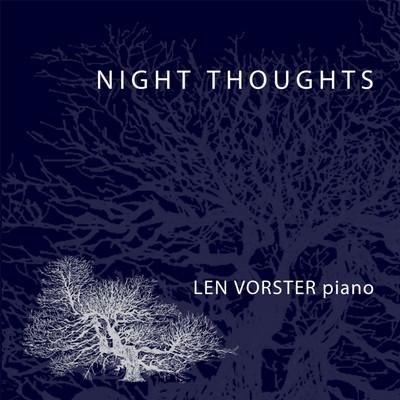
NIGHT THOUGHTS

Len Vorster

Move Records MCD 647

As you’d anticipate, a lot of this disc is given to nocturnes: by Tchaikovsky, Clara Schumann, Faure, Charles Tomlinson Griffes, Jillian Rose Tymms, Sculthorpe, Satie, Poulenc, Michael Easton and Leonid Desyatnikov. The other five tracks – by Bloch, Hindemith, Duparc, Peter Klatzow and Copland – use ‘night’ in their titles, not least the American whose work gives this CD its title. Just as importantly, the content has a general tendency to be slow-moving and ruminative, thereby giving rise to a generalization or six about music for the night coming from less joyful reaches of the compositional mind, if not downright depressing ones.

Vorster opens his recital with Bloch’s In the Night – A Love-Poem, an effusion from 1922 which comes in the rare key of A flat minor, even if it ends in the more erotically self-supportive A flat Major. This is a fluent effusion, bearing traces of impressionism, mysticism and a hint of exoticism, all calibrated with care by Vorster who observes every accent and expression marking to produce a gem both brooding and passionate. No 4 in Tchaikovsky’s Op. 19 Six Pieces of 1973 is a gentle C sharp minor Nocturne with a simple ternary shape, its coda based on the middle Piu mosso material; it has the requisite melancholy and enjoys a fluent expounding with plenty of rubato and a fetching recapitulation section where the melody shifts to the left hand and the upper part decorates with that slight intrusiveness typical of this masterful composer.

Clara Schumann produced a notturno as the second of her six Soirees musicales, written and published in 1836. V orster treats this with much the same latitude as he did the preceding Tchaikovsky, and with a similarly lavish use of the sustaining pedal. In this piece’s reprise, the main theme is kept in the right hand but transformed into a more ardent character. As well, the composer’s harmonic progressions intrigue momentarily, even if nowhere near as much as those of her husband. Faure’s Op. 104, composed just before World War I, comprises two pieces: a nocturne in F sharp minor and a barcarolle in A minor; Vorster presents the first, which is probably just as well because the alternative is oddly garrulous. By this stage, the composer’s harmonic language had become very sophisticated and this set of pages offers a wealth of chromatic shifts, carried off with sympathy and clarity by the executant.

At this point, Vorster introduces a work by a former piano pupil, Jillian Rose Tymms. This is Silberstreif and takes its impetus from Melbourne’s lockdowns during the COVID years, the title suggesting a light at the end of the infectious tunnel. The work proposes a general restlessness, despair and a longing for the way out; what we hear is, apart from one short harmonically disjunct segment, a Mendelssohn song without words, loaded with the rippling arpeggios and scales familiar from the German composer’s salon output. I’m sure it’s sincere and Vorster gives it mellifluous address but the music itself is too sweet and lacking in bite to match the times it represents.

Hindemith’s 1922. Suite fur Klavier has at its centre a Nachtstuck which bears the composer’s duality lightly. The harmonic language is tightly organized and sturdily framed; there are clear melodic shapes that are dealt with and revisited; the time signature (non-existent, really) stays at a pretty constant 3/2 (or 6/4, if you like); and the ternary structure features a sparkling central section to contrast with the framing more sombre pages, the dynamic climax reserved until bars 80 to 83 in a piece that lasts for only 97 of them. Vorster works through its three pages with a calm flexibility that belie Hindemith’s reputation for academicism.

Aux etoiles by Duparc either refers to the first part of Poeme nocturne, an orchestral triptych of 1878 of which this first section only survives, or (more likely) it’s the 1910 piano solo, orchestrated in the following year. This is an honest piece of atmospherics which opens and ends in C Major but moves to odd places in its long centre, which involves a not-very-convincing return to the tonic 15 bars from the end. It’s subtitled as an entr’acte pour un drame inedit; a slow-moving hiatus in the projected work, then. A brace of lines from Verlaine about a willow reflected in a pond preface the Notturno of Charles Tomlinson Griffes as we lurch to America for a while. This 1915 composition, the middle one of three Fantasy Pieces, is a cousin to Duparc’s starry vision, albeit one with richer chord structures and a plethora of rhythmic variations. Its rich-textured mixture of languor and virtuosity suits Vorster’s interpretative skills most adroitly.

A little touch of Sculthorpe in the night with the Tasmanian-born composer’s Nocturne – Seascape, a piece of plangent romantic/impressionist charm in E flat Major, all 1′ 57″ of it and with a free-flowing charm from the 19-year-old fledgling composer, still occupied with his European forebears. Satie’s Nocturne No. 1 precedes four others from 1919 and moves past with a reassuring placidity. My only gripe with Vorster’s reading of this slightly curious piece is his tendency to pause before changes in register, e.g. bars, 3,4,5 and 6. I felt more assured during the central Un peu plus lent qu’au debut break. Poulenc follows with his Nocturne No. 4, Bal fantome, from the 1929 set of eight. This also is not long – 1’29” – and stands as a waltz falling into four-bar clauses with muted harmonic spice to ginger up its C Major basis.

Michael Easton, an Australian-British colleague of Vorster who died in 2004 (can it be so long?!), appears next with the second movement of his 1993 Flute Sonata, appropriately entitled Nocturne. Transcribed by Vorster, this begins as a slow waltz, changes to a 2/4 rhythm and ends (more or less) in 6/8. It rambles very pleasantly, but not aimlessly and the arrangement has many picturesque touches to leaven the top-line/bass support that emerges in the piece’s middle pages. The Nocturne from Giselle’s Mania forms part of a film score written by Leonid Desyatnikov, the scenario concerning the ballerina Olga Spessivtseva who suffered mental breakdowns in 1934 and 1937. The music makes much of a cell comprising a rising minor 6th followed by a falling minor 2nd, altered to a Major 2nd near the end. This also meanders in a post-Rachmaninov way with some ardent flashes surging out of a melancholy, if not depressing, soundscape.

One of Vorster’s teachers at the University of Cape Town, Peter Klatzow, composed his four-movement Moments of Night in 1968, revising it in 1982. Vorster presents the last work in the suite which is an intriguing night-scape, gifted with a soft sparkle and following a broad, mobile path through a set of concise melodic cells that emerge and disappear sotto voce.

Last comes the CD’s longest track: Copland’s Night Thoughts (Homage to Ives), the composer adding his sub-title to give no grounds to his friends, neighbours, critics, decriers and the whole profanum volgus of commenting on the piece’s occasional similarities to Ives (and, even then, most of Copland’s cluster-bombs are tame compared to those from the older composer – you don’t need to go further than the second bar of Emerson in the Concord Sonata, let alone bars 6 and 7, to see the difference). Written for an American piano competition in 1973, the entrants were required to read the work at sight.

Not that the task is impossibly hard, as it would be to sight-read an Ives piece, say. The work is slowly paced, loaded with accidentals and rapid arpeggiated ornamentation. Even when the composer moves to four staves, the complex is easy to read and deliver. What the actual thoughts are remains open to each listener, but the work is not programmatic like Central Park in the Dark (particularly the opening); if anything, the suggestions are of long-held resonances (bells?), if discordant ones – albeit this night is full of more surprises than most. For all that, Vorster’s reading is firm and dynamically balanced – far more so, I’d suggest, than anything coming from those 1973 sight-readers, but that’s what you’d expect.

Copland’s work acts as a kind of capstone to this CD. It’s the most contemporary work of the whole 15, expressed in a language that is well removed from the smooth sweetness of many among its companions. If it offers more food for thought than bagatelles like the Duparc, Tchaikovsky or Poulenc pieces, Night Thoughts reminds us of serious music’s potential for spartan, aggressive gravity of utterance. For me, it concludes Vorster’s compendium with a quiet assertiveness – not exactly putting its predecessors on a shelf but relegating them to secondary status, no matter how expressive and circumspect they may be in their emotional and technical content.

Das Ewigweibliche wins again

CHOPIN & THE MENDELSSOHNS

Australian Chamber Orchestra

Concert Hall, Queensland Performing Arts Centre

Monday November 13, 2023

Polina Leschenko

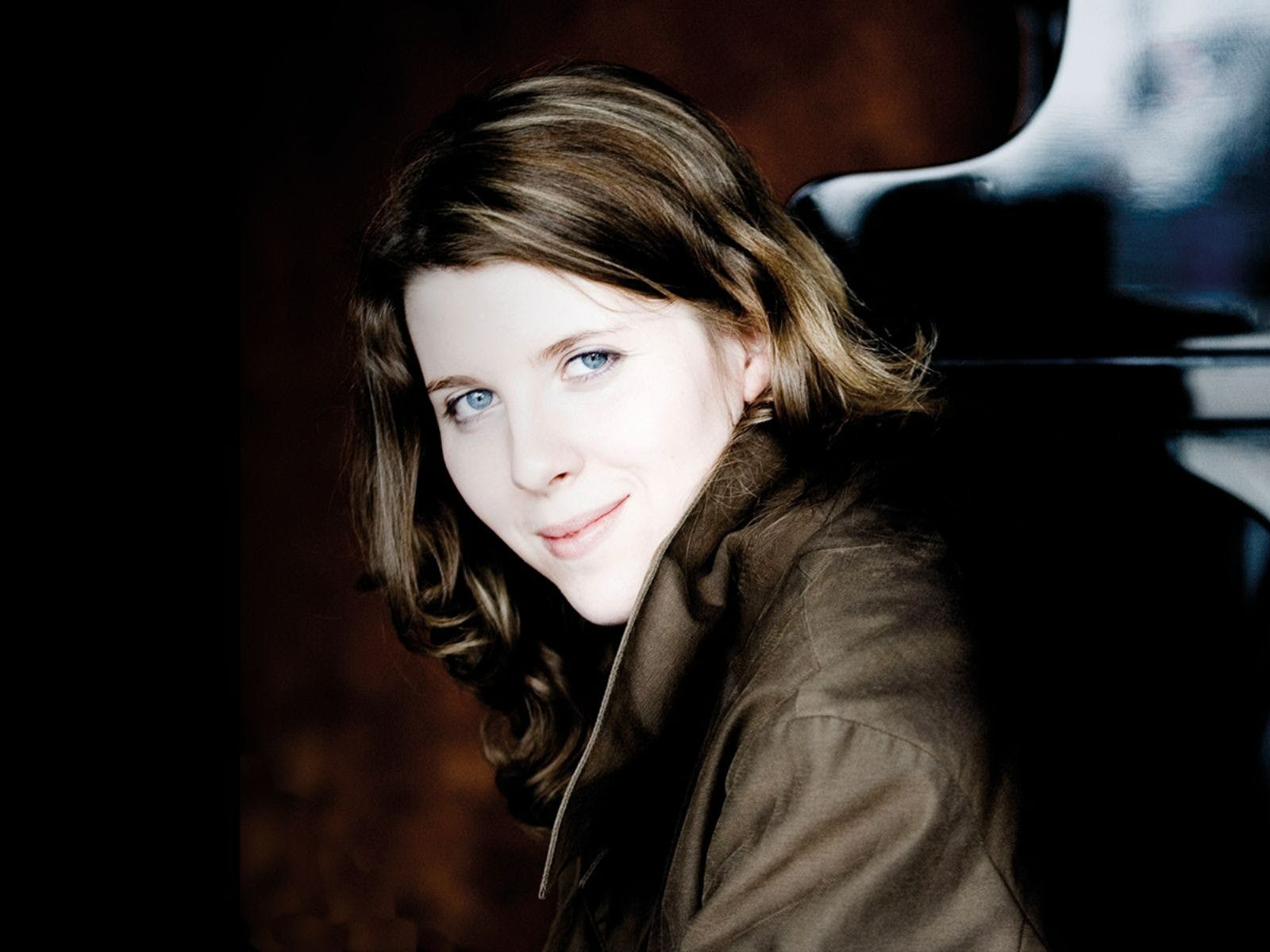
After a presentation in Newcastle and two in Sydney, the ACO presented its fourth rendition of this program here, led by artistic director Richard Tognetti and supporting a well-worked soloist in pianist Polina Leschenko who has appeared with this ensemble several times in the past few decades. For Monday’s exercise, L:eschenko took the solo line in Chopin’s F minor Concerto No. 2 as arranged by the Israeli pianist Ilan Rogoff for string quintet (here amplified to the ACO forces of 5-5-3-3-1); and also partnering Tognetti in Mendelssohn’s early Concerto for Violin and Piano in D minor – the original version for string accompaniment only.

The evening ended, Leschenko-less, with Fanny Mendelssohn Hensel’s String Quartet in E flat Major and this, for me, proved the most interesting and well-played work on the program. Only part of this success was due to the absence of the pianist; more importantly, the arrangement for all 17 of the ACO’s strings proved effective, particularly in the opening Adagio and the ‘slow’ movement Romanze, both of which gave the body space to exercise a free-flowing amplitude and display a mastery of phrase-shaping that typifies this orchestra’s work at its best.

Technically, Leschenko has always impressed as a thorough technician; it’s hard to think of one measure from her during this night that misfired in articulation or energy. But I’ve always found her performances solo-centric, even in a work like the Mendelssohn where dynamic allowances have to be made to give the violin room to be heard. This last wasn’t the case during the first movement; even as early as bar 83, the piano’s fierce volume was too great – both for the actual language of the piece, and for Tognetti who is no shrinking violet but was later swamped by his fellow-soloist’s output.

But then, Leschenko has a habit of pivoting a performance to herself by main force. She had less competition in the Chopin work, here deprived of its 13 wind and timpanist, as the string ensemble put up little competition and Tognetti was constrained to indicate the beat on only a few occasions (in fact, it was remarkable how often he was able to leave his players to follow their parts without direction). And, contrasting with her self-forefronting in the Mendelssohn concerto, the Chopin Larghetto made a positive impression, at least up to the middle segment’s rhetorical flourishes where the minor scale octaves sounded overcooked in this particular context – no, the keyboard was too prominent anyway because the wind contributions here are small almost to the point of intangibility.

As for the rest of this concerto, the composer was best served in the concluding Allegro vivace where Leschenko’s approach demonstrated a welcome restraint right from its initial 16 bar solo, following the score’s kujawiak impetus. later investing solo interpolations with an unobtrusive rubato. This control proved its worth particularly in the col legno interlude which, in this instance, enjoyed a clutter-free delivery with a successful balance between soloist and strings. I can’t say that the following pages of piano triplets engaged heightened attention but they don’t under the hands of more venerable pianists than Leschenko. At least these longueurs went their ways in an amiable fashion.

I suppose this artist has enjoyed more acquaintance with the F minor Chopin than she has with the Mendelssohn hybrid, yet it strikes me that somebody must have been aware how disjunct her approach was with her surroundings. The contrast in mirror passages, as between bars 157 and 167, proved distracting, if not irritating. Much the same took place in parallel work between piano and violin, e.g. bars 179 to 193, during which Tognetti was clearly playing but close to inaudible. And did the piano tremolo between bars 244 and 268 have to threaten like a Rachmaninov rumble?

However, the second movement Adagio with its exposed unaccompanied duets produced a successful chamber-music combination as the violinist’s piercing, true line was given exemplary exposition with few instances of a grab for attention from his partner. It didn’t last, of course; the following Allegro again piano-dominated in what I think was an interpretative fault-line where the requisite brilliance of this style of writing got confused with hammering. It’s easy to understand that the players might not have grasped how forceful Leschenko’s attack came across into the hall, but anyone who was present at a run-through (assuming there was one at QPAC) must have heard the discrepancies in attack and dynamics.

Having said that, I also have to report that the Brisbane audience responded to both concertos with high enthusiasm. I heard the Chopin after moving to the back stalls and an enthusiastic claque of one greeted the performance with the sort of rabble-rousing hoots that you usually encounter after the distorted vocal catastrophes of The Masked Singer. More to the point, Tognetti displayed every sign of enthusiasm and affection for his guest; so, if it’s good enough for him . . .

It was an unalloyed pleasure to come across the solitary string quartet written by Mendelssohn’s sister. This work speaks a consistently idiosyncratic tongue and follows an individual creative path. For example, the opening Adagio begins with a falling figure that takes an upward trajectory after five bars – and the two are deftly fused/juxtaposed/interwoven over the following 68 bars with an unstudied facility that maintains your interest, not least for the writing’s clarity (which must be even more obvious when this work is played as originally written) as well as the composer’s uncluttered style of development.

Later, you find the same good husbandry of resources informed by imaginative breadth in the Romanze where Hensel’s harmonic shifts surprise not so much for their own sakes but through the fluency with which they are accomplished. Added to the seamless part-writing, you were once again struck by the collegial output of the ACO, each line speaking with admirable authority, particularly the three violas who quietly took over the running in their bars 43-4 exposure: the only point in this movement where one part sings unaccompanied.

Putting a firm seal on this program, the players gave a bracing account of the final Allegro with an enthusiastic delivery that carried off the composer’s tendency to worry at a motive (cf. bars 21 to 33) or extend a theme beyond its expected parameters (bars 57 to 75) or keep two balls aloft simultaneously (as across bars 128 to 138). And then you could enjoy the warm embrace of fresh material at bar 217 and the subtle change of rhythmic pattern in the concluding bars. Of course, the work was welcome for its pedigree and its unfamiliarity compared to its predecessors on this occasion. But making assurance doubly sure was the aural comfort of the work in this orchestral format, a guise it assumed with more ease and success than some of the ensemble’s previous attempts at painting on an oversized canvas.

Diary December 2023

FESTIVAL GALA #3

Brisbane Music Festival

FourthWall Arts, 540 Queen St.

Monday December 4 at 7:30 pm

This isn’t the start of Alex Raineri‘s annual galaxy of recitals; they began last month but details came too late to be included in November’s Diary. However, there’s plenty to report for this month’s exercises, which have been condensed to a one-week span. We start with this triptych of stage works, opening with Menotti’s venerable The Telephone of 1947 with soprano Katie Stenzel and baritone Jon Maskell in the thankless role of the suitor trying to be heard by his mental rag-tag girlfriend. No orchestra, but two pianists accompanying in Francis Atkins and the omni-present Raineri. Poulenc rears his sixty-years-dead head with Le bal masque, a 1932 song cycle/cantata with a Stravinskyesque chamber accompaniment, here reduced to Raineri’s piano with baritone Jason Barry-Smith taking on the work’s vocal line. And for the third course we enjoy a new work: Staged, by Raineri and Finnian Idriss which involves soprano Ali McGregor, cellist Daniel Shearer, and Idriss manipulating electronics. Pace Poulenc, I think this last may be the most interesting element of the evening even if – as usual – contextual details are completely absent. Admission to all events in the Festival costs $25 a time; don’t know if any concessions are on offer or if a booking fee is added but I suspect this last is a reality because the handling agency, Humantix, is donating all such fees to disadvantaged children’s charities. Is that any excuse for charging such an impost anyway? Not in my book.

SCHUBERT’S LAST SONATA

Brisbane Music Festival

FourthWall Arts, 540 Queen St.

Tuesday December 5 at 7:30 pm

This is, of course, the big Sonata in B flat – well, some of it’s in that key. The work is substantial, even without observing the first movement repeat, and its repetitions and elongations can both inspire and irritate. Whatever you think, it’s a beast for any pianist; few of the great can offer a complete fabric in the outer movements but there’s always hope. I don’t know this evening’s executant, Laurence Matheson; at least, I can’t recall any of his Melbourne appearances. He put in his time at the Australian National Academy of Music, studying with the estimable Timothy Young, but whatever he played there passed me by. Still, he’s a young man and you might as well smash your aspirational head against this sonata as anything else. Which he is also doing by prefacing this Schubert with Chopin’s Grande valse brillante: a rather amorphous title, given that it could refer to the Op 18 or any one of the three Op. 34 compositions. As a gender differential, Matheson has inserted the middle one of Fanny Mendelssohn’s Funf Lieder Op. 10, which is called Abendbild and for which the pianist will doubtless incorporate the original’s vocal line to a text by Lenau. Tickets are $25 with a booking fee.

LIGHTS DOWN LOW # 2

Brisbane Music Festival

FourthWall Arts, 540 Queen St.

Tuesday December 5 at 9 pm

Put those lights down too low and everybody will go to sleep. At this recital – focused for some, diffuse for others – festival director Alex Raineri will perform Morton Feldman’s For Bunita Marcus of 1985 – all 75 uninterrupted minutes of it. The composer’s penultimate piano composition, the work hymns his pupil/colleague/partner Marcus while also being a tribute to his mother; as an insight into either woman, it serves as a voluminous veil. Nevertheless, these days few of us have the opportunity to hear a Feldman work live. I’ve heard a few from the Australian National Academy of Music performers of which little remains in the memory but gratified surprise that the experiences proved more incident-rich than I’d expected from a brief encounter with this standard-bearer of the American avant-garde in the 1960s. Full marks to Raineri for expounding this work that sounds so simple and yet keeps the performer on the edge of disaster with its constantly moving time-signature changes and seemingly endless transpositions of limited material. To get in, you pay $25 plus the usual extra fee for daring to exercise your state-given right to a credit card.

ANGELUS

Brisbane Music Festival

FourthWall Arts, 540 Queen St.

Wednesday December 6 at 7:30 pm

Four performers in four works, two of which enjoy their premieres in this country: exactly what you want from a chamber music festival offering a wide range of experiences. First up is the evening’s title work from approaching-Grand-Old-Woman-status Mary Finsterer; written in 2015, it was inspired by Millet’s painting of two field-workers pausing for the mid-day prayer and will involve the talents of clarinet Dario Scalabrini, cello Katherine Philp, and pianist Alex Raineri. An Australian writer working in London, Lisa Illean wrote fevrier to a commission for Radio France (hence, you suppose, the linguistic barrier-crashing title) and it involves the same instrumentation as the Finsterer composition. Next comes a world premiere from local jazz saxophonist Rafael Karlan; no details yet (isn’t that always the way with your true improvisation-wielding performer/composer?) but I’m almost certain it will involve the clarinet and piano. Finally, it’s just a local premiere for Irish writer Judith Ring. Her fine feathers far below the blue floor makes plenty of contemporary sounds and involves Scalabrini, Raineri and viola Nicole Greentree as well as the airing of a supportive tape. Tickets are $25, plus a booking fee of unknown proportions.

MAHLER 4

Brisbane Music Festival

FourthWall Arts, 540 Queen St.

Thursday December 7 at 7:30 pm

We’ve become habituated to Erwin Stein’s reduction of this symphony which omits the bassoon and horn lines but introduces piano and harmonium (shades of Herzgewachse). Nothing so flash here. The instrumental forces are reduced to two pianos – Laurence Matheson and Alex Raineri – with Katie Stenzel‘s soprano taking on that theologically glutinous finale. The arrangement is for two separate instruments by Jestin Pieper, an American organist, conductor and arranger who published this version in 2010. At least it’s not another version that I came across written for piano four-hands, which would have condensed the action to the point of claustrophobia. Still, not much is gained by Pieper’s reduction, least of all the variety of timbres that Mahler crafted, especially for his concertmaster in the second movement. But it will make the last movement lied all the more welcome and Stenzel will enjoy minimal dynamic competition. Then there’s the point of mounting this work in the first place, with its hints at the composer’s smaller-scale-than-most technical schemata and instrumental arrays. Anyway, good luck to all concerned with this slightly-less-than-an-hour complex; it will certainly be of interest to those who know the original well. Tickets are $25 each, with the usual handling fee superimposed.

DECLASSIFIED

Brisbane Music Festival

FourthWall Arts, 540 Queen St.

Friday December 8 at 7:30 pm

Adam Herd is an Australian musician, originally from Coffs Harbour, who is currently living and studying in Finland. Well, he’s not alone in following that path as the Helsinki-Australia connection seems to get stronger as the years pass. Today he is presenting a piano recital, one that will already have been performed at the Espoo Cultural Centre in Tapiola country on November 12. What do we and the more aesthetically aware Finns get? Herd begins with three of the 1984 Eight Concert Etudes by Russian writer Nikolai Kapustin: Pastorale, Intermezzo and Toccatina. This composer fused classical and jazz, they say, although that was probably a big deal in his country. We move to the politically polar opposite with some Earl Wild versions of Gershwin songs, now become 4 Virtuoso Etudes: Embraceable You, Fascinatin’ Rhythm, The Man I Love, I Got Rhythm. A bit of a Scandinavian detour gives us three pieces (all preludes) from Norwegian composer Trygve Madsen’s 24 Preludes and Fugues Op. 101. Back in Finland, Herd plays two folk-song arrangements by Oskar Merikanto: Jos voisin laulaa kuin lintu voi (If I could sing like a bird can), and Iso lintu merikotka (A big bird, the white-tailed eagle). Finishing off an avian trilogy comes the pianist’s own arrangement of McCartney/Lennon’s Blackbird from the 1968 White Album. All that certainly denotes declassification . . . unless Herd is simply asking us to detour into non-Classical zones. Admission is $25 plus the usual ticket tax.

POULENC TRIBUTE #2

Brisbane Music Festival

FourthWall Arts, 540 Queen St.

Saturday December 9 at 10:30 am

Good luck for the French composer who is being celebrated just on his own merits, not for any notable anniversary of birth, death or lifetime achievement. This program comprises works that I’ve never heard live – a situation that I believe may also be the case with other festival patrons. Cellist Daniel Shearer appears tonight in order to play the Cello Sonata with either Alex Raineri or Francis Atkins; the score occupied the composer off and on between 1940 and 1948 and the result is generally considered disappointing. One of the pianists (or perhaps they’ll divide the labour) will play two of the 15 Improvisations: No 7 in C Major and No 13 in A minor. Then one of them will outline the Soirees de Nazelles: eight variations and a cadence, surrounded by a prelude and a finale, all of which occupied Poulenc between 1930 and 1936 and comprise portraits of friends in the best Enigma mode. At night’s end, both pianists will be engaged in the Sonata for four hands of 1918, a three-movement and brief (6 minutes?) product of the composer’s late teens. That’s the point of a tribute, I suppose: you have to take the not-so-good as well as the outstanding – following our national trait of being all-inclusive as witnessed by the recent referendum. Tickets retail for $25 with an additional charge for having the cheek to buy them.

HELLISH CELLIST

Brisbane Music Festival

FourthWall Arts, 540 Queen St.

Saturday December 9 at 1 pm

What can we make of this? The cellist in question, Daniel Shearer, is taking, as the basis of his expedition, Bach’s Suite No. 1 in G. He is theatricalizing it, promising us a journey to emulate that of Virgil and Dante, while he himself (presumably: no other performers are cited) takes on an ‘unadulterated character’ – which throws up all sorts of questions, the chief one being: who says you were adulterated in the first place? Whatever shape the dramatic interpretation takes, the musical one is going to give Shearer a big problem in that the suite itself lasts about 20 minutes. As the recital is scheduled to stretch between 1 pm and 2 pm, is he going to work through it three times? Or will there be infernal interludes to illustrate the Nine Circles? That would be a big ask of a composer who was known to be Lutheran conservative, not given to Italianate excess. By the same token, Bach could arrive at gripping depictions of Hell’s menace (Sind Blitze, sind Donner, for instance) and the consequences of sin. All of this speculation does nothing to prepare us for the reality which could be truly disturbing; I hope so. If you want to see this, it will cost you $25, along with a booking fee for your impertinence.

NOTES FOR TOMORROW

Brisbane Music Festival

FourthWall Arts, 540 Queen St.

Saturday December 9 at 2:30 pm

In this recital, patrons are treated to three works of some relevance to the program’s title and one definite throwback in Poulenc’s aggressive Bagatelle in D minor of 1932 for violin and piano; in this performance, Courtenay Cleary and Alex Raineri respectively. As for the prospect of tomorrow, we’re greeted by Gerard Brophy‘s new score that gives the evening its title; this also involves Cleary and Raineri. Composed in 1995/6, Olga Neuwirth‘s Quasare/Pulsare also asks for violin and piano (prepared); there’s no hesitation in my mind at nominating Cleary and Raineri for the performance. Now, the odd one out is a song cycle by American writer/guitarist David Leisner. His Confiding for high voice and guitar, written during 1985-1986, sets ten poems ‘mostly Emily Dickinson and Emily Bronte’, that have to do with fluctuating relationships. In fact, Leisner sets four Dickinsons, four Brontes, and one each by Americans Elissa Ely and Gene Scaramellino. To handle this work, we’re to hear Blue Stockings – luckily, a voice-guitar duo comprising Alison Paris and Chloe Hasson. For this partly-futuristic cornucopia, you’ll be charged $25 admission, with an extra fee on top to show that – like the world to come – nothing is as it seems.

THE FIREBIRD

Brisbane Music Festival

FourthWall Arts, 540 Queen St.

Saturday December 9 at 4 pm

Plainly, the high-point of this recital should/will be Stravinsky’s ballet suite. Actually, you won’t hear all of it: just the Infernal Dance, Berceuse and Finale in a colossal transcription by Guido Agosti which should test the recital’s executant, pianist/festival director Alex Raineri. Before entering this maelstrom, he’ll perform Rachmaninov’s Sonata No. 2 in one of its various incarnations; no matter which, this is a much-neglected marvel for the instrument that I must have heard only once live in a long span of concert/recital exposure. A few Poulenc gems are embedded as a continuation of the festival’s homage to the French writer; in this case, the Pastourelle of 1927 (the composer’s contribution to the ten-composer ballet, L’eventail de Jeanne), and the 1934 Humoresque in G Major – both brief and illustrative of the composer’s brilliant facility. To open his innings, Raineri will play the Australian premiere of Jakob Bragg‘s latest production for piano solo: Fourteen piano transcriptions from across the plane (plain). This was given its first outing during February of this year by Raineri in Huddersfield where the composer is writing his Ph. D. Bragg describes the work as ‘a surveying of the geography of the piano across a unique x-y axis notational model’; well, you can’t say fairer than that. You want in, it’ll cost you $25, as well as the usual churlish booking fee.

COURTENAY CLEARY IN RECITAL

Brisbane Music Festival

FourthWall Arts, 540 Queen St.

Saturday December 9 at 6:30 pm

The young violinist is expending her gifts on a solo program that stretches over a lot of ground. She begins with a formal flourish in Bach’s Sonata No. 1 in G minor BWV 1001: all four movements, including that well-used second movement Fuga. Leap forward 300 years and we come to local string teacher Stephen Chin‘s Three Capriccietti which I can’t find in the composer’s voluminous catalogue; perhaps it’s a score confided to Cleary alone. We move to a more senior Australian voice with Ross Edwards and one of the versions of his White Cockatoo Spirit Dance; in Cleary’s version on YouTube, she sets in train an electronic background of high twitters before she starts on the work itself. Anyway, this is familiar Edwards in Maninyas mode, the piece written in 1994. Back a bit to 1947 for Prokofiev’s much-decried Sonata in D Major; actually, I find it remarkably sunny and easy-going, particularly when you consider the constant menace facing the composer at this time. Now come forward two decades for French writer Eric Tanguy‘s Sonata breve in three movements across an 8-minute time-span. In the end, Cleary leaves unexplored the period between 1720 and the end of World War Two; well, it’s performer’s choice and this artist is playing to her strengths. You can hear her for $25, plus a charge for your charging it.

ROMANCE BY THE BOOK

Brisbane Music Festival

FourthWall Arts, 540 Queen St.

Sunday December 10 at 10:30 am

Here is one of the festival’s more well-organized song recitals in which soprano Katie Stenzel partners with pianist/festival director Alex Raineri. They are working through eleven songs in total, four from musicals/operetta, Britten’s four Cabaret Songs, and an art song each by Liszt, Debussy and (the inevitable) Poulenc. I know Glitter and be gay from Bernstein’s Candide because of the delight that every aspiring coloratura takes in yodeling through its arpeggiated arabesques. No big deal that I know Kern’s All the things you are which has been assaulted by everyone from Ella Fitzgerald to Carly Simon; a favourite of jazz combos for all its 7th chords, or so I’m told. As for Natasha, Pierre and the Great Comet of 1812 by Dave Malloy, it’s clearly a slab of Tolstoy’s novel and No One Else should be sung by Natasha rather than Pierre. Somehow, I’ve seen Into the Woods (Victorian Opera?) but have no memory of On the steps of the palace but, if it’s Sondheim, it’s more challenging than most in the genre. As for the Debussy, it will be C’est l’extase, one of the Ariettes oubliees; the Liszt is Oh! quand je dors; Poulenc’s submission takes the form of a sentimental waltz, Les chemins de l’amour. I’m not as enthusiastic these days about Britten’s Auden settings, probably because they try to hard to be louche and were published well past their relevance date (if there actually was one). But they please popularly – well, a good deal more than the Michelangelo or Donne Sonnets. And they slot in well with the Broadway material. You can have all this for $25, plus the added financial hurdle of a service fee.

CONCORD

Brisbane Music Festival

FourthWall Arts, 540 Queen St.

Sunday December 10 at 1 pm

Alex Raineri isn’t presenting a peace-inspiring program, filled with charitable wishes concerning conflicts in Gaza, Ukraine or anywhere more local – like Townsville. His Concord is the Massachusetts town, famous denizens of which place made source material for Ives’ massive Piano Sonata No. 2: Emerson, Hawthorne, the Alcotts, and Thoreau. I grew up with the recorded performance by Aloys Kontarsky which for me stands out for its authority and impetus amid a plethora of interpretations, from Ives himself to Phillip Bush. Raineri is serious about living up to the composer’s demands by employing the short-lived services of Tim Munro on flute for the Thoreau finale and a viola from Nicole Greentree for the briefest of appearances in the opening Emerson movement. The entire Concord is a draining experience for any listener, but festival director Raineri has added to our aural burden by giving the world premiere of Australian writer Lyle Chan‘s Sonate en forme de cri, which may also employ the services of Munro and/or Greentree (and/or Raineri, so non-existent is the information about this new composition by a writer who apparently delights in giving nothing away). As with several other programs in this second grouping, Concord is a splendid example of real festival fare. All you need to hear it is $25 and a strongly-exercised forbearance in tolerating the credit-card-use fee.

TEN OF SWORDS

Brisbane Music Festival

FourthWall Arts, 540 Queen St.

Sunday December 10 at 2:30 pm

The recital’s title puts us in in Tarot territory, this card signifying defeat or resignation to your lot – as well as the more optimistic reading (and there always is at least one) of recovering from disaster by pulling yourself together and striving against the world’s negativity. What any of this has to do with the afternoon’s music-making will become clear, I’m sure, as the program continues. To begin, the Blue Stockings duo of soprano Alison Paris and guitarist Chloe Hasson are presenting songs of their own creation. Whether these connect to the Major or Minor Arcana is anyone’s guess but it’s more probable that the Stockings are linking in with the mystical pack than anything that follows. Which showcases clarinet Dario Scalabrini and pianist Francis Atkins in three duets: Elena Kats-Chernin‘s Grand Rag of 2021 and nobody enters into the ragtime spirit with as much enthusiasm as this composer; Schumann’s Drei Fantastiestucke Op. 73, that multi-varied collection which can also be heard with violin or cello as the non-keyboard element; and a Fantasy on themes from La Traviata, Verdi transmogrified by Donato Lovreglio, a southern Italian flautist who arranged several Verdi-based fantasies – none more flashy than this one which treats Ah! fors e lui, the Libiamo with a Di quell’amor from Un di felice interlude, and a final flashy splurge on Sempre libera. In other words, Lovreglio didn’t get beyond Act 1; still, there’s plenty of lyrical matter there, God knows. To hear this split-level program, you pay $25 along with a ticket tax of still-unknown proportions.

JINGLE FINGERS

Brisbane Music Festival

FourthWall Arts, 540 Queen St.

Sunday December 10 at 4 pm

A Christmas concert of sorts, to give the festival an emphatically seasonal spirit, this program comprises works for two pianos, with artistic director Alex Raineri and Adam Herd taking us through the late afternoon. They begin with a work by the newly-discovered American composer Amy Beach who has been transformed into a significant figure in that country’s musical development by people who should – and probably do – know better. Here is her 1924 Suite for Two Pianos Founded upon Old Irish Melodies. Four movements – Prelude, Old-Time Peasant Dance, The Ancient Cabin, Finale – give you a virtuosic set of arrangements on some defenceless tunes that get subsumed in the composer’s generously applied decorations/ornamentations. Then comes the festival’s final Poulenc salute: the Sonata for Two Pianos of 1953. This is a solid, sometimes clangorous construction that raises for me the spartan concentration of the Dialogues of the Carmelites, begun in the same year. It certainly makes for a bracing contrast with the ephemeral nature of the other Poulenc pieces we’ve heard in this second tranche of the festival. To end, we are treated to traditional Christmas Carols arranged by pianist Herd; perhaps he’ll confine himself to Finnish ones, including (if the recital’s title is being taken into account) a Scandinavian equivalent to Jingle Bells. On the bright side, you can hope for a sing-along to really get you in the mood for the commercial orgy that is to come. All this is available to you for $25 plus a handling fee to Humanitix for charitable purposes – the only way to do business.

THE SOUND OF CHRISTMAS

The Queensland Choir

The Old Museum, Bowen Hills

Saturday December 16

You can’t purchase tickets for this event until December. I can understand such reticence; who would want to be organized too far ahead? A little more worrying is the lack of decision about a time of day. But, by means of intrepid research, I’ve concluded that this will have to be an afternoon concern because Josh Daveta and the Sequins are taking over the space at 7:30 pm. Also, the organization’s previous two concerts have been presented at 3 in the afternoon and I can read a pattern as closely as the next code analyst. Still in the guessing game, I’d propose that the conductor will be Kevin Power, since he’s one of the two choir personnel noted on the group’s website. By exactly the same token, the accompanist (no organ at the Old Museum, so it’ll most likely be piano) is Mark Connors. There’s no way of predicting what these office-bearers and their forces will consider to be Christmas sounds but the outcome will most likely be the usual collection of British standards with some forays into the American seasonal repertoire. All seems rather vague? Well, what I know, you know – and, at present, that’s all there is to know.

4MBS CHRISTMAS SPECTACULAR

Brisbane Chorale

Brisbane City Hall

Sunday December 17 at 3 pm

The Chorale is not alone at this concert but will be in collaboration with the Brisbane Symphony Orchestra under conductor Stefanie Smith. This afternoon’s soloist will be soprano Mirusia Louwerse, familiar to many from Andre Rieu’s extravaganzas. And what will patrons hear? As with The Queensland Choir above, details are lacking. Everything will fall under the generic heading of ‘Christmas Carols and other traditional Christmas fare’, which last seems to be a promise of food appropriate to the feast-day. At least this event has a definite time of day, unlike the concert listed above. But I note that this event isn’t listed online among the concert activities of the orchestra; either their contribution is too slight to bother mentioning, or perhaps their administration is unaware of the ensemble’s participation. However, counterweight that with the booking of the Town Hall – so they’re expected. Once again, I’m predicting the customary stolid British content that prevails during this country’s Christmases: comfortable, Anglican, spiritually numbing. Tickets are available for between $25 and $85; wherever you sit and whatever your concession/status, you attract a $1.25 tax that is just applied without explanation or justification.
Impressive Vine yield

MUSIC FROM THE NEW WORLD

Out West Piano Fest

Blackdown Farm, Bathurst

Friday October 27 at 4 pm

Andrey Gugnin

Yet another regional festival, this one dating as far back as 2022 and a treat, I’m sure, for the cultural habitues of Bathurst; just as the Organs of the Ballarat Goldfields week is for that city’s illuminati, and the Mornington Peninsula Summer events delight the effete palates of Melbourne’s beachside (ho ho) Prues and Trudes. For this second-time around at the same farm venue, the organizers have acquired the artistic direction of Andrey Gugnin, winner of the Sydney International Piano Competition (now becoming Piano+; move over, Elon Musk) in 2016. I’m not sure how the remaining events will go but this initial exhibition gave us observers on the Australian Digital Concert Hall site quite a bit of thick meat to digest.

Gugnin has put himself into the performing personnel, as you’d expect. He’s assembled a line-up of Sydney artists in Clemens Leske, Tamara-Anna Cislowska and Yanghee Kim (replacing the scheduled Sonya Lifschitz) and half of the program involved two-piano works, the afternoon ending with a barnstorming Rhapsody in Blue from Cislowska and Kim. Leske and Kim opened our new world ears once more to John Adams’ Hallelujah Junction; Gugnin and Cislowska worked through a pre-interval work billed as ‘from Bachianas Brasilieras No. 5’, but it was neither the Aria nor the Danca although the Latin-American inflexions came through clearly.

For solo work, Cislowska gave us a rich reading of Ginastera’s Suite de danzas criollas (five of them, with an incomprehensibly separated Coda), and Carl Vine represented us splendidly with half of his Piano Sonata No. 1 from Leske (the Leggiero e legato second movement), while Gugnin swept all before him with the complete Sonata No. 2 – a gripping interpretation that almost eliminated from one’s consciousness the work’s indulgent working-out in the later pages of the second movement that begins Legato, senza pedale but takes us well away from that on a virtuosic odyssey.

Like the afore-mentioned Victorian festivals, the clientele for this exercise looked elderly – as far as you could tell from the ADCH cameras. In fact, the youngest person in the place seemed to be Gugnin himself. I don’t see that this sort of enterprise is in any way calculated to bring in young people, particularly as the concert manager and Gugnin himself (during a post-recital address in limited English) kept on referring to pre-event drinks and post-event dining which, from my vast experience, don’t hold much interest for the new puritans.

The Adams work divides into three sections on paper but it sounds like an amalgam of several more elements than that. The composer’s inter-phase/out-of-phase technique is apparent at the opening but dissipates as the work progresses. Its initial percussiveness rouses interest but there’s not much subtlety to be heard; each player simply has to keep his/her end up in a tightly argued onslaught. Mind you, when the dynamic weight increases, you can feel your involvement fading, particularly in those frequent pointillistic chord stabs. Kim had the right idea, using a note-pad, while Leske encountered several moments of discomfort handling his printed score, opting not to involve a page-turner at this point.

True to its school, this score puts you into a mesmerised state as you move in and out of half-connections, the players seeming to enter a compact of rhythm and dynamic only to either drift through or hammer out of it. But, the longer the work goes, the more you wonder where those initial interface passages went – until, suddenly, they re-surface and your logic is engaged once more. For all that, I can’t find any link between the score’s title and the truck-stop of that name on the border of California and Nevada; the composer points to ‘junctions’ in the piano writing and rhythms based on the word ‘hallelujah’ but, while there’s no doubting the first rationale, the second is much harder to follow.

In any case, both performers weltered their paths to a congruence. Cislowska’s solo followed, showing a deft hand with the second Allegro rustico dance, especially the Ivesian 8-note right-hand clusters – all 33 of them. While the slower pieces wafted past pleasantly enough, especially the Bartok-reminiscent No. 4, Calmo e poetico, the aggressive, Panambi-suggestive faster ones proved more entertaining. I would have been happier with the No. 5 Scherzando if it hadn’t been missing about 20 bars of its second page (in my Boosey & Hawkes edition). But Cislowska continued the pattern established by her predecessors of showing the contemporary bent for sonic onslaught (albeit the Adams comes from 1996, the dances between 1946 and their revision in 1956).

Vine’s Sonata No. 1 movement presents as a toccata for both hands in tandem at the start: same notes, different registers over an 4-bar loop, the left hand persisting with the semiquaver-pattern while the treble becomes concerned with melody/cell work. Compared to the only other interpretation of this work I’ve heard (Michael Kieran Harvey, its dedicatee and initial performer), this version tended to become blurred later after the initial dry semi-staccato attack. Also, the onward rush was momentarily interrupted at bar 227. Still, Vine changes tack in the movement’s centre for La cathedrale engloutie atmospherics, albeit with plenty of added notes to complicate any harmonic predictability.

In this more leisurely phase, Leske produced a full-bodied and resonant wash of sound, giving us a fabric that displays Vine’s post-Romantic sympathies – before a return to the opening toccata busyness and the run of repeated figures that eventually dies out for a placid conclusion. A respectable interpretation, then, if not as nervously exciting as Harvey’s efforts. This was followed after interval by Gugnin’s realization of the composer’s second essay in the form (from 1997, seven years after the Sonata No. 1). During his upcoming recitals in Melbourne’s Recital Centre and Sydney’s Angel Place Recital Hall, Gugnin will repeat the work, and patrons will get a rare opportunity to hear this substantial product from a now-venerable Australian composer/pianist.

At the opening, Gugnin approached the stentorian double-octave chords calmly, giving them resonance room; then, keeping an easy hand or two on the rhapsodic rush of arpeggios that obtain from bar 9 on . Towards the movement’s middle, the pianist showed a relish for the lush writing that once again suggested submerged cathedrals, even girls with flaxen hair – the former in a solid meditation at the latter end of the movement. For all that, Vine extends his score for a fair while, happy to repeat his colours (rich as these are) and patterns, if not accomplishing much by way of formal complexity.

We switch to an irregular jazz-inflected atmosphere in the following legato, senza pedale where a loud bass ostinato supports treble clef block-chord spits. You can see why Harvey (again, its dedicatee and first interpreter) would have delighted in this sort of pianism – for its rapidity, bounding across the instrument’s compass, and its clarity of texture. Gugnin brings a similar authoritativeness to these pages, responsive to the Ondine washes that precede the climactic hymn preceding a final gallop to the work’s quadruple forte final smash-and-grab.

This is a remarkable testament to Gugnin’s dedication to some Australian music, never forgetting that among the works he performed in the Sydney 2016 Competition was one of Harvey’s 48 Fugues for Frank. Yes, he used the score of Vine’s sonata – but then, so did Leske. It would be well worth hearing his reading live in either Sydney or Melbourne particularly when considering the odd Grieg/Tchaikovsky/Silvestrov/Stravinsky amalgam that surrounds it; you’ll be treated to an unusual exhibition of mastery from a young artist who deserves all the plaudits he’s amassed so far.

As I’ve reported, the program ended with Gershwin’s sprawling rhapsody in an arrangement I don’t know; it’s not Gershwin’s own, as far as I can tell. To a certain extent Cislowska and Kim shared solo duties, although the former enjoyed what I saw as the lion’s share. You’d be too kind to call this performance a perfectly congruent one: it wasn’t, even if nothing disastrous took place although the final cakewalk revealed some slips. Yet every so often the players complemented each other very well; for example, their role-sharing at Number 22 (in the two-piano score put out by T. B. Harms in 1924) where the main theme is restated in C Major at a Piu mosso section; and the huge mash-up at the D flat Major splurge five bars after Number 26 in the middle of the work’s central cadenza.

Cislowska was left alone with the next big cadenza at Number 32, Kim only entering with those lolloping left-hand chords eight bars before Number 33 (the Leggiero call-to-arms). But the rabble-rousing double glissando interpolated before Number 37’s fussy build-up to the work’s climax struck me as vulgar and unnecessary. Not that such a flourish was too out-of-place in this knock-’em-down, drag-’em-out version of this jazz/classic warhorse which was big and blowsy, without any Bernstein-style sophistication. If nothing else, the recital’s start and end gave us sterling examples of compositions from America that reveal the national psyche more faithfully than anything out of Nashville or Graceland. And we were lucky enough to hear some Australian work that, in its ambition and elevated spirit, negated the reduction to cretinism exemplified by Dutton’s gaggle of nay-sayers, just as the United States shows at its wild and wooly best in Gershwin’s amalgam rather than at a Trump-led MAGA rally of the red-necked and scrofulous.

Illuminated, elucidated Brahms

OVER UNDER

Luke Severn, Evan Fein

Move Records MCD 611

This disc comes out of a long-term, long-distance relationship between Australian cellist/conductor Severn and American pianist/composer Fein. A marriage of two aesthetics has apparently come about here and the musicians have a fairly well-established performance history (USA in 2019, Australia in 2022) from which comes one of the two works recorded here: Brahms’ Cello Sonata No. 1 in E minor. Following the California/New York accounts of Fein’s first Cello Sonata, they’ve set down here the other constituent of their Melbourne/Bendigo/Frankston recitals: Fein’s second essay in the form.

And that’s all there is: 28′ 55″ for the Fein, 28′ 34″ for the Brahms; near-equivalent in temporal terms. But, while you can admire the American’s work for its coherence and bursts of brilliant writing, its thunder is stolen by the Brahms reading which is distinctive in its vision and delivery. Which is the chief problem with this pairing: much as you’d like to find high merit in the Fein, the other outclasses it, to the extent that you wonder why the composer didn’t think to give his work a less striking companion.

The modern work is in four movements: Serene, warm; Redemptive, resonant; Molto scherzando; Lively, playful. It begins with a simple rising two-note cell in the cello that expands on itself. Straight away we’re in a benign atmosphere of something approaching hymn music, broadening to a firm declamation couched in a harmony that Brahms would have found comfortable, if eccentric. Then the work seems to meander into an episode rich in piano triplets, shared with the cello, and a development that moves into new material, both instruments in a close interface.

Once again, the declamation arises and we’re in late Romantic territory – both firmly assertive and ruminative as the opening cell recurs and the exposition’s processes are revisited. This is a music of alternating moods which, near the end, seems to see the triumph of the serene. But not so: Fein ends with a presto flourish for both players; it’s almost as though he’s providing a contrast with the placid rhythmic tenor of his movement’s procedure up till now.

When it comes to redemptive music, I’m not sure what to expect; it could be anything from the Dies irae to L’Ascension, and a world or six of religious music in between. Here, we have a slow sequence of repeated chords in the keyboard under the cello outlining a well-woven melody that stretches for some length towards a climax, that breaks off and then resumes its path with cello and piano more synchronised in their thinking, although the keyboard’s initial repetitions seem to be the spur to action. We are led to a consoling stretch of diatonic affirmation that ends up resembling a Bloch cantillation.

A sequence of common chords leads back to the opening repeated chords under the meandering string line; the same crisis, with the keyboard sustaining its support for a final mellifluously brooding semi-cadence. In these pages, the emphasis for me fell more on the resonant, the performers reaching two points of impressive suspense, as well as a brace of powerful statements that emphasized the possibilities for broad statements. For all that, the harmonic language is, in the main, orthodox; we just have to accept this mode of contemporary composition that is content with titillating the past, not building on it.

The following scherzo strikes me as far from molto, possibly hampered by a rhythmic irregularity/juxtaposition that obtains from the opening but gives way to a smooth body of play across the movement’s centre before returning to round out this simple ternary structure. The instruments are busy with some clever canonic scale descents that inevitably bring Shostakovich to mind, if without that composer’s verve and ferocity. Still, I did like the cello’s final ‘bent’-note slight portamento.

Further reminiscences come bursting in at the finale’s opening, chiefly of Saint-Saens’ Carnival of the animals with the piano’s high-register tinkling while the string line follows its restrained jollity before swinging into an amiable, crowd-pleasing melody. Much of what follows appear to be variants on these two elements with some late attempts at post-impressionist harmonic adventurousness. But Fein doesn’t stray too far from well-trodden paths; just when you think he’s heading in a dissonant direction with an unexpected modulation, he hauls us back to the plain-speaking path of diatonicism. Listen to the final minute or so which is an excellent example of leading towards calm acceptance before a semi-aggressive, if defiantly positive, resolution.

I need hardly record the players’ obvious intensity and painstaking care with Fein’s score. Is either of them taxed by this music-making? Not that much, although some parts of the last two movements have their pressure-points. Yet the sonata presents as rather lightweight, for all the grandiose passages in the opening movements. Certainly, Fein has produced a highly competent work yet it doesn’t hold much that could be termed striking or original. Even its passion is tautly leashed and its appurtenances fail to catch this listener’s interest.

What follows – the Brahms sonata elucidation – is quite remarkable. In the CD liner notes, Fein observes that ‘we dare to hope that some of our bolder musical decisions allow audiences to enjoy this beloved sonata in a new light’. Well, to those of us with a long-standing affection for the piece (many thanks, Daniel Horrigan, for those hours of tolerant rehearsal), this reading offers many insights. The duo takes the first movement’s ma non troppo direction seriously; this is a stately progress through the first subject, its only defect coming through an over-amplification of the cello line. But Severn and Fein have a fine eye for the work’s inner accelerations and dynamic contrasts which make this allegro an absorbing experience, with a good deal of the commonly accepted bravado muted into the composer’s inimitable introspection. Only an odd misfired cello A in bar 18 disturbs the exposition’s accuracy, which is flawless on the repeat.

The most obvious of those interpolated accelerandi comes at bar 50 in the vehement build-up to the B minor explosion of bars 57-8. What follows is a masterful depiction of the descent to gloom across bars 74 to 77. Later, in the development, a gradual increase in tension starting at about bar 102 is accomplished by a simple consensus of dynamic heft working towards the fortissimo F minor resolution of bar 126. Further re-acquaintance with the artists’ approach comes in the recapitulation which follows a similar pattern of subtle speed and dynamic increases and subtractions, highpoints the cello’s vital high in bar 222, determines a dark-shaded coda approach from bar 235 on, and culminates in a moving processional across the movement’s final 20 bars.

Severn and Fein hit on the ideal approach to Brahms’ Allegretto. It is given a minuet’s lilt in the outer sections, Fein picking and choosing which staccato directions he’ll observe (all of them in the opening bars, more selective in the left hand of the second half in this section [bars 16 to 27]). Adding to this excellent clarity of delivery, the central trio from Fein is clog-free with a welcome lack of glutinous pedaling, despite the direction to sustain from bar 79 in my old Breitkopf & Hartel edition. This helps give the movement a kind of unity, ensuring a continuity of output, even if the minuet’s return still piques because of the absence of its trio’s continuous two-semiquaver-plus-quaver pattern from the keyboard and a reversion to ye old-fashioned rustic courtliness.

To end, Brahms starts out a fugue, but it doesn’t sustain its formal characteristics. Fein states the subject with plenty of detached notes; not quite abrupt enough to come under a staccato heading and still maintaining a melodic contour. And the first climacteric at bars 24 to 25 is a true Brahmsian welter, if one where the instruments maintain audibility and their lines carry distinctly right through the interleaving of lines up to bar 53’s light relief and the rubato brought into play at bar 61 where dance wins out; the same gentle hesitation that the duo employed in the previous movement’s trio. I was struck by an odd tuning error from Severn on the B in bar 72, and a Fein slip in the C minor triad of bar 93. But almost immediately, the lack of brutal teeth-marks in the closely-argued mesh from bars 115 to 123 merits strong approval for its communication of polyphonic stress rather than instrumental effort.

If Severn and Fein come close to your traditional Brahms thickness round the waist, it’s in the final pages from bar 152 and through the coda Piu presto which is, compared to the rest of the interpretation, thunderous and virtuosic in the best sense of serving the score through craft. It brings this reading to a highly satisfying consummation. In the end, it realizes that declared intention of shedding ‘a new light’ on the score which here takes on an unexpected transparency in its instrumental interplay and a welcome immediacy due to an enlightened approach to dynamic levels and care in sound production.

Diary November 2023

SONATA PROJECT 1

Yundi Li

Concert Hall, Queensland Performing Arts Centre

Wednesday November 1 at 7:30 pm

Yundi Li, laureate in 2000 at the Chopin Competition in Warsaw and the youngest performer to win that distinguished event, began a world tour in 2019. In that year, he presented sonatas by Schubert, Chopin and Rachmaninov. He’s back again with a new, all-Mozart program: the K. 331 in A Major with the Rondo alla turca finale; the just-as-popular K. 310 in A minor; and the K. 457 in C minor which prefigures Beethoven’s Pathetique, they say. These latter two exhaust Mozart’s output of keyboard sonatas in minor keys. As well, Li will give us the hefty Fantasia in C minor K 475 which was published simultaneously with the K. 457 work. That’s quite a solid night, exhibiting the kind of concentration that most artists avoid, and it’s particularly interesting coming from an artist not known for his Mozart. Li has recorded the delectable K. 330 Sonata in C Major and he played the A Major Concerto K. 488 with the Staatskapelle Dresden during a 2017 tour of Germany and China. But his most sustained efforts have gone into Chopin with a little spattering of Liszt. Tickets range from $59 to $179; mind you, I tried booking just now and was met with an ‘error’ message every time I followed directions to make a reservation. Nevertheless, what I do know is that QPAC will still charge its disproportionate booking fee, no matter where your seat is.

INAUGURAL PADEREWSKI TOUR

Friends of Chopin

Old Museum, Bowen Hills

Saturday November 4 at 7 pm

A group that’s new to me, the Friends are commemorating (a bit early) the Australian 1904 tour by Paderewski, the famous pianist/composer/prime minister of Poland who was the most famous of the post-Liszt virtuosi who came to this country to be met with a wave of riotous enthusiasm. As with most events presented at the Old Museum, details are there on the website, but scant. For example, participants in this recital will be the Orava Quartet – expert and amiable locals – alongside pianist Aleksandra Swigut whose main claim to fame in the Chopin stakes is her experience on historical instruments. Hard to tell what she’ll be using for this exercise but I’m pretty sure it won’t be a Pleyel, Broadwood or Erard. Now, what are these musicians playing? Two of the names are familiar: Chopin and Penderecki; Swigut will be exercising her gifts on the former, the Oravas on the latter – in fact, the third (2008) one of Penderecki’s four quartets. The third composer is Wojciech Kilar, once a part of the New Polish School along with Penderecki and Gorecki, but turning his back on all that to write your normal harmonically conservative, sometimes folksong-inflected compositions including a string orchestral work, Orawa, which ties in neatly with our string quartet. As for Swigut’s contribution, that will consist of the Piano Concerto No. 1 in E minor, probably with the orchestra reduced to the available four strings. Tickets move between $40 concession (with a $3.35 fee for nothing) and $70 full (shackled to a $4. 86 fee – the $30 difference in price makes such a difference in handling?).

SPOTLIGHT ON THE DOUBLE BASS

Brisbane Symphony Orchestra

Brisbane City Hall

Sunday November 5 at 3 pm

Billed as this orchestra’s final concert for the year, the BSO takes over the Town Hall for this program that highlights Queensland Symphony Orchestra principal double bass Phoebe Russell taking on the solo part in Bottesini’s Double Bass Concerto No. 2 in B minor of 1853. Not that anybody should have anything against the bass but this piece is interesting mainly for its relationship to the cello concertos of its time and a little later; from the first solo notes (and they come pretty quickly), we’re in the Romantic world of quiet complaint and melancholy, which obtains through a substantial slow movement, changing to something more aggressive for a polonaise-rich finale. Still, it’s great to hear this instrument treated as a lyrical voice, for once (no, Mahler: you don’t count). As far as I can tell, only the first movement was scored for full orchestra (11 wind plus strings) and most through-performances feature string accompaniment only. Conductor Paul Dean finishes the afternoon with Sibelius’ Symphony No 5: an unadulterated joy from first to last of its three movements, with an unforgettably sprawling conclusion: Finland at its most triumphant. The event will probably begin with James Ledger‘s Signal Lost, commissioned by the Tasmanian Symphony Orchestra for a premiere in June this year and here enjoying its Queensland debut. It sprang from considerations of Beethoven’s deafness coming on him about the time of the Eroica, and a parallel loss of communication outlets for us all during the COVID crisis. From the composer’s notes, cantus firmus/passacaglia/ground bass (to repeat myself) seems to be the main operating fulcrum. This piece asks for the largest orchestral forces among the scores being essayed. Tickets range from $20 to $40 with no credit-charge-managing fee, as far as I can tell.

ORGAN RECITAL

Simon Nieminski

St. John’s Anglican Cathedral

Thursday November 9 at 7 pm

In a building of this type, you’re bound to have a few recitals for this Norman and Beard/Hill, Norman and Beard/Simon Pierce instrument, if only to expose its extensive four-manual range. This time round, we have Nieminski visiting from St. Mary’s Cathedral in Sydney where he is assistant director of music, working under the newly-appointed Daniel Justin, one presumes. As far as I can see, the recital consists of one work: Rachmaninov’s Symphony No. 2 in E minor, as transcribed by this performer. Well, that’s a 50-minute extravaganza, well-known to Melbourne Symphony Orchestra patrons of a certain age because of Hiroyuki Iwaki’s enthusiasm for it. You’d have to suppose that Nieminski will enjoy himself finding the variety of colours needed to animate this sometimes voluptuously expansive score; I’m thinking of that broad-beamed A Major Adagio and the ejaculation-rich E Major finale. Good luck to him; as far as I can find, nobody else has made another such transliteration of this score. Tickets range from $20 concession to $35, school students admitted free; there’s a 50-cents booking fee, which sounds about right, if you have to charge such a thing at all.

CHOPIN & THE MENDELSSOHNS

Australian Chamber Orchestra

Concert Hall, Queensland Performing Arts Centre

Monday November 13 at 7 pm

Rounding out our Chopin piano concerto experience for this month, here comes Polina Leschenko with the No. 2 in F minor, also in an arrangement for string support only. There’s precedent for this, with an arrangement for string quintet being published by Breitkopf und Hartel in 1836; added to which, the composer has suffered from being faulted as an orchestrator for nearly two centuries. As for the Mendelssohns, we first get to enjoy Fanny’s String Quartet in E flat Major of 1834, a work her brother disapproved of for its formal eccentricity (what a Victorian prude he was) but of which she changed not a note. We’ll be hearing a string orchestra transcription but so far I can’t find a name behind this expansion of forces. To end, we have Richard Tognetti, the ACO’s artistic director, collaborating with Leschenko in Felix’s Concerto for Violin and Piano in D minor. This will be the original version with string accompaniment only, as distinct from the later orchestration involving winds and timpani. Mind you, this work was a product of the composer aged 14, so don’t expect too much; it’s sturdy enough but, to my ears, completely unmemorable. Seats are priced between $59 and $149 with an astonishing $8.50 ‘handling fee’, which sounds like an extra service from a brothel, although there you get value for money.

MICRO-MASTERPIECES

Queensland Symphony Orchestra

Concert Hall, Queensland Performing Arts Centre

Friday November 17 at 11:30 am

To kill off the year in its regular venue (as opposed to the Lyric Theatre where the players will congregate for three rounds of the Wagner Ring in December), the QSO is being controlled by chief conductor Umberto Clerici. As part of an unremarkable observance that takes in the last three Mozart symphonies over three years (really?), the program glories in the Symphony No. 39 in E flat which may see the repeats observed in its finale. Clerici begins with Rossini’s Overture to The Barber of Seville – a joy in any context, even this specious one: the Italian is his country’s answer to Mozart. Also in this collection of small chefs d’oeuvre we find Prokofiev’s Symphony No. 1, called Classical. More Haydn than Mozart, this score is a diatonic marvel which demonstrates the composer’s melodic felicity and brilliantly appropriate orchestrational skill. In his QSO website puff-piece, Clerici talks about the Schubert Symphony No. 5 and this composer’s admiration for Mozart; but the work is not included in the program list below these prefatory remarks. If it were, the program would blow out from about 50 minutes’ worth to over 77 – improbable as the event is scheduled to take 65 minutes without interval. Tickets move between $45 for a student to $130 full price, both despoiled by the $7.20 hyper-charge for employing the only currency available: credit card.

This program will be repeated on Saturday November 18 at 7:30 pm.

A JOYFUL NOISE

Brisbane Chorale

Brisbane City Hall

Sunday November 19 at 3 pm

For this afternoon, patrons can be assured of two works, the first being Vaughan Williams’ Five Mystical Songs. I’m assuming the version being offered is that for baritone solo (and who would that be?) with SATB choir and orchestra. For this afternoon, the only musicians mentioned are the John Coulton Brass Ensemble and organist Christopher Wrench – along with regular conductor Emily Cox. I’m sure something practicable will be cobbled together, if stretching the sources specified by the composer. As well, we’re to hear John Rutter’s Gloria for choir, brass, percussion and organ (or orchestra if there’s one lying around). which has for me reminiscences of Belshazzar’s Feast, if not as dramatic or daring. Both these add up to about 40 minutes of listening experience, but the promotional material offers ‘ . . . and more!’ Such a prospect dizzies with its suggestiveness and I question what could cap these two British choral gems but more of the same? You can buy tickets for between $15 and $60, with a ‘Fees & Charges’ tax of $1.25; I suppose this is small enough, especially when compared to other organizations’ unreasonable levies, but why have it at all?

WILDSCHUT & BRAUSS

Musica Viva Australia

Conservatorium Theatre, Griffith University

Wednesday November 23 at 7 pm

This violin/piano duo is here at the half-way point of a national tour. As far as I can see, Noa Wildschut (violin) and Elisabeth Brauss (piano) have no long-standing relationship, if you judge by their published schedules. Following the practice of many another Musica Viva guest ensemble,, they are presenting two programs, although there’s only one major difference between them. Common elements are Schumann’s Violin Sonata No. 1 in A minor, Messiaen’s early Theme et variations, Debussy’s late (final) G minor Violin Sonata, and an Australian novelty in May Lyons’ Forces of Nature, commissioned for this tour (as is Musica Viva’s wont). The point of difference is that half of the recitals will hear Enescu’s folklore-infused Violin Sonata No. 3 in A minor; the other half (including Brisbane) have to settle for that welcome war-horse, Franck’s A Major (eventually) Violin Sonata. Well, these artists may not meet again after this set of recitals, but at least they’ll always have Australia. Tickets move between $15 and $109; I don’t think there are any extra charges.

HANDEL’S MESSIAH

Oriana Choir

Brisbane City Hall

Sunday November 26 at 3 pm

Thank God: for a moment I thought the barbarians had taken over and our annual Christmas dose of Handel’s oratorio wasn’t going to be spooned out. But here it is, presented by a near-20-years-old Sunshine Coast organization. Oriana has again gained the services of Andrew Wailes, long-time director of Melbourne’s Royal Philharmonic Choir and a consistent presence in a remarkable number of other choral bodies; in my experience, he has directed several outstanding performances of choral+orchestral music. He also has the outstanding quality among musicians of not measuring out his friendship in proportion to favourable reviews. His soloists are soprano Elisabeth Wallace Gaedtke, contralto Anne Fulton, tenor Tobias Merz, and bass Jason Barry-Smith – locals all, these days. But the bulk of the work falls to the chorus which, from its websites, sounds ultra-enthusiastic. The Sinfonia of St. Andrew’s will provide the instrumental support and this performance will follow an out-pf-town reading on the preceding night in Buderim. You can hear the Brisbane performance for between $15 and $55, with that usual added surcharge of $1,25 that seems to be peculiar to Brisbane Town (city) Hall presentations.

ZEPHYR: VOICE WITH WINDS

Brisbane Chamber Choir

St. John’s Anglican Cathedral

Sunday November 26 at 3 pm

This body is singing on its home turf in St. John’s where it is chamber choir in residence, but it also has strong affiliations with the University of Queensland School of Music with which it is affiliated. Its conductor is (and has always been) Graeme Morton, who is an eminence at both the cathedral and university. Alongside the singers we’ll hear a double wind quintet from the UQ School of Music, cellist Patrick Murphy, soprano saxophone Diana Tolmie, and organist Andrej Kouznetsov who is Morton’s assistant at the cathedral. As to what is on the program, details are scanty. Front and centre will be Stravinsky’s Mass for Mixed Chorus and Double Wind Quintet, the latter comprising two oboes, cor anglais, two bassoons, two trumpets and three trombones. All well and good; I’ve not heard this score in live performance and would appreciate the opportunity. But it lasts – at best – 20 minutes. Now we’re promised other music that puts voices and winds together but no details are available. Still, if you put your trust in these performers, you’ll give them the benefit of a fairly solid doubt. And, who knows? Perhaps the other works might explain the event’s title. Admission falls between $20 and $50 with a 50 cent booking fee per seat – which is cheap but irrational.