An amiable window into the Baroque

BACH PIANO 2

Judith Lambden

Move Records MCD 653

For the first of her Bach CDs for Move, released in 2021, Lambden presented four of the toccatas, the Italian Concerto, and the Chromatic Fantasia and Fugue: a deft combination of the present-but-unexplored alongside two familiar scores. Something of the same combination obtains in this latest offering which comprises five works. Those that have general currency are the French Overture BWV 831 and the Capriccio on the departure of a beloved brother BWV 992. As for the arcana – well, I have barely encountered them – they begin with the Overture in F Major BWV 820, move to the Aria variata alla maniera italiana BWV 989, and wind up in the perplexing Fantasia and Fugue in A minor BWV 944.

Unlike a few recent publications on this label, Lambden’s CD runs a substantial length at 76 minutes (actually, adding up the individual tracks, I believe that it comes in closer to 79); nearly 33 of these are taken up with the first eight tracks: the French Overture, or Overture in the French style which is the longest suite in Bach’s keyboard catalogue. Immediately, you can see that this offering is a continuation of the pianist’s 2021 disc; there’s an authority at work but the performance is not a perfectly bland surface with everything in its allotted place. You can hear patches – no, seconds – of unevenness: glossed over notes in brief runs during the Ouverture‘s stately preamble (e.g., second time through, last three right-hand notes of bar 14), a slight slowing down as the voices accrete in the 6/8 fugal-gigue that follows.

And there are also interpolated passages of play that deliberately slow down the rhythmic inevitability beloved of contemporary performers who operate their Bach craft with metronomic regularity. You can hear plenty of examples in Lambden’s progress through this marvel, as at halfway through bar 85 when she simply changes gears, or the slight accelerations that push the envelope, like in bar 115 and beyond. The return of the stately opening impresses as more individual and imaginative with a more free approach to metrical regularity. I don’t want to complain too much but the executant refrains from repeating bars 20 to 163; yes, it’s exhausting for the pianist but there are so many linear delights to be savoured in these pages.

Still, this suit-yourself approach is everywhere in the following Courante which is packed with small pauses throughout, in both hands. The fluency is hard to cotton on to until the first half’s repeat where you learn to make adjustments for the piece’s occasionally fitful outline. During the Gavotte I‘s left-hand semiquaver groupings, you can detect some notes being articulated unevenly the first time round. on the return, nothing is out of place, each group sounding true and clear. Lambden treats the pair of Passepieds with a similar studied nonchalance which results in a certain amount of latitude with ornaments, as the start of bar 28 on each of its three appearances.

But there’s something to be said for this room-space. For sure, when the musician is taking time to insert acciaccature, mordents and appoggiature, you won’t be able to dance this suite with absolute certainty; but is Bach writing for potential footloose and fancy-free Leipzigers, or just using the form? The latter, of course., so Lambden is quite at liberty to pause where she sees a hiatus point, or – consoling the dodgy pianists among us – where the going gets a tad tough. I’ve got nothing but praise for the mobile Sarabande which is given without exaggerated gravity, notably in the thick (relatively) chords of bars 24 and 25.

The Bourrees enjoy direct treatment, especially the first where the opening detached note approach rouses us from a bucolic torpor. Still, there is the occasional missed (or misfired, probably) note and the slight ritardandi in Bourree II puzzle more than please. The Gigue that follows is handled with excellent calm; nothing is hammered in this chaste framework and the outlook is almost placid, even if a few (two?) notes go missing in the little bursts of semi-scalar fioriture/demi-semiquavers. Finally, the Echo swaggers past amiably, my only problem Lambden’s lengthening some of the bass quavers (bars 22 to 25, then bars 54 to 57) which brings to mind, in a small way, Busoni’s Bach transcription exaggerations.

This large-scale work is followed by a small relative in the BWV 820. Its short Ouverture is packed with ornaments in its opening 13 bars, a few of them wisely omitted here. Then the 3/8 burst into fugato energy comes across with quiet security that is rarely ruffled – although I’m coming round to thinking that those short breathing-spaces (scarcely that, in fact) are Lambden’s system of punctuating the work’s thrust, avoiding the Tic-toc-choc metallic assembly-line approach. In the Entree, this player introduces a great many more dotted quaver-semiquaver patterns than occur in my admittedly antique Breitkopf und Hartel score. Nevertheless, here the slow march holds the right Charpentier strut in its slight two-part sinews.

Not much to report about the Menuet-plus-Trio, Bourree or Gigue. As with the post-Ouverture dances in the BWV 831, Lambden observes every repeat faithfully, offering a piano repeat on the odd occasion but for the most part retaining those ornaments that she introduces first time through. Mind you, these three dance movements are brief and lacking in digital complications; Lambden’s slight rhythmic relaxations prove handy enough in adding some quirkiness to what are simple and internally repetitive structures.

Some desperates have been pointing to the Capriccio as one of the first examples of tone-poem narrative in Western music. Not really: it had plenty of choral and instrumental antecedents. But its brief pages hold some moving emotional content, especially in the Friends, Dangers, Lament and Farewell segments, Lambden making affecting work of the first, third and fourth of these scenes while somehow suggesting the Goldbergs‘ penultimate Quodlibet in the angular second. Especially honest is the melancholy character realized in the Lament mini-passacaglia, and the well-there-he-goes stolidity of the brief Abschied.

About the two concluding Postilion movements, I’m not so sure. There’s nothing urgent about the Aria which doesn’t propose a speedy journey but more of a leisurely jog as the octave jumps that are intended to imitate the driver’s instrument have no bite or energy. The Fugue would have gained from a more rapid tempo and a good deal more energy in the thicker meshes (bars 27 to 38, for example; even bars 45 to 47). Still, Lambden works through this last with careful craft, making as much as possible from one of the least satisfying final bars in the composer’s output.

Once again, the performer indulges in more hesitations and pauses while she works through the Aria variata’s unremarkable arches, laden on during the repeats with ornaments delineated in my edition. It sets up a ruminative atmosphere which is probably for the best with this undistinguished material. The trouble is that few of the following 10 variations have much to delight in them, but more an unusual number of disappointments, like Variation 2 with its going-nowhere triplets (bars 5 and 6); ditto Variation 3‘s bar 7; the aimless right-hand repetitions of shape and actual notes across Variation 5. In fact, it seems that inspiration flagged pretty consistently in the third bar of each variation’s second part. So much so, that it’s a relief to get back to the Aria‘s paraphrase in the final Variation 10.

It seems to me that Lambden is not really challenged by this work, its twists and turns rarely unpredictable – on a par with the preceding Capriccio. But her reading is composed and undemonstrative, the strands well balanced and distinctive, if some of the phrasing shapes sound a tad contrived and the short suspension of action for the sake of a grace note starts to grate in the repeats. Speaking of which, the second part of Variation 9 is not played again: a shock in continuity as every other part of this work is given a second run-through.

To end, we are offered the BWV 944, which opens with a fantasia that you improvise yourself on a series of 18-and-a-half chords, with the between-staves interpolation ‘Arpeggio’. Some publications spell it out with arpeggios travelling from one hand to the other; Lambden goes the same route but arpeggiates in contrary motion simultaneously. Nothing unusual in that, although it’s a rather ordinary way of negotiating the problem. Still, you can go a long way before you find somebody with an original take on these 10 bars, e.g. not just splaying out the chords or maintaining their written range.

The fugue opens bravely and confidently but the arrival of the third voice in bar 18 sees some initial fumbling and, by the time we get all bass-operative at bar 38, the pace has slowed, only to pick up a little further on. Also, the executant seems to slow down to accommodate a cadential trill too often for comfort. She finds the going tough from about bar 106 on to the bass pedal B that lasts for 4-and-two-third bars at the work’s centre; the polyphonic interplay here sounds laboured – which it is but it shouldn’t come across that way.

Near the end, the spirit of Liszt/Busoni takes over and there is a pronounced acceleration from about 19 bars before the conclusion, the dynamic level moves into a near fortissimo level, and the approach to the fugue’s concluding bars smacks of the grandiose. Mind you, the player can hardly be blamed for a touch of triumphalism after this active, long web of fabric. It makes for an unexpectedly assertive last word to this disc that is for the greater part characterized by restraint and a pliant, relaxed approach to rhythmic regularity. These offerings bring together an interesting range of works – from the highly demanding to the simple – and reinforce Lambden’s standing as a sincere and informed interpreter of Bach’s keyboard catalogue.

They don’t forget; nor will you

VISION STRING QUARTET

Musica Viva Australia

Conservatorium Theatre, Griffith University, South Bank

Tuesday September 26, 2023

(L to R) Daniel Stoll, Florian Willeitner, Sander Stuart, Leonard Disselhorst

These latest guests for Musica Viva were here on the fourth leg of their national tour after performing in Newcastle, Melbourne and Hobart, from which last they were lucky to escape after sharing the national problem of flight delays/cancellations. Anyway, they got here with a couple of hours to spare and the experience didn’t seem to do them any harm, if you judge the situation by their extraordinary exhibition on Tuesday evening.

The big feature about the Visions is that they play from memory; not all the time, apparently, but all the way on this, their first Australian appearance. It seems that the German ensemble is presenting one program only as they move through all the state and territory capitals except Darwin. They begin with a brief Bloch Prelude, subtitled Receuillement in the best Baudelairean tradition: a five-minute effusion of mild passion. They end with Dvorak No 13 in G Major which celebrates – at length – being back home in Bohemia’s woods and fields after the composer’s mixed American experiences.

But what astounds is their reading from memory of Bartok No. 4, allegedly in C minor. This is a tour de force, not only of the obvious – learning the complex by heart – but also in the energetic certainty of the group’s interpretation. Here, what you are invited into is a radically new way of listening where the performers don’t focus on the printed notes but have internalized them so that their linear relationships aren’t just cerebral but totally physical. No screening from music stands or occasional eye-flicks: these four musicians focus on their collegiality where each knows exactly where and what his contribution is.

The result is that this searing music gains immeasurably, being presented as an unmediated entity and appearing (even though this cannot possibly be true) like a colossal exercise in shared improvisation. Of course, it isn’t: Bartok’s score is a solid object and the Visions work through it like so many quartets have done since March 1929. The difference is that these players have internalized every scrap and prepared it so thoroughly that you feel unshakeable confidence in their work. In the opening Allegro, the shared demi-semiquaver shakes that start at bar 58 have never sounded as uniform; each canonic pattern took on a cutting edge, e.g. the non-fugato from bar 104. Then there was that breath-taking escalation of tension that breaks out at the bar 126 Piu mosso where the action is too swift to imbibe.

Speaking of which, the Lyric Suite-indebted Prestissimo showed the benefits of knowing your place in an organism because it’s in your brain, rather than using the score as an aide-memoire. Here again, the interdependence proved absolute and justified, the ensemble grouping closely around the fulcrum of cellist Leonard Disselhorst as the motivic wisps swelled and faded before that startling burst of glissandi at bar 136, almost the dead-centre of this movement.

Disselhorst set the running for the work’s centre with a highly expressive account of the exposed solo from bar 6 to bar 34, first violin Florian Willeitner then taking over for the tinnitus-like portion of this night-music lento. What struck me here was the apparent freedom available to both players, pitching and weaving their lines with the assurance that their partners knew what they were up to and how they were working through their responsibilities before the meat of these pages emerged in bar 50’s poco allargando. As for the following all-pizzicato Allegro, we were treated to that rarity: exemplary dynamic gradations and contrasts, as in the abrupt forte arpeggiations of bar 63 preceding the triple-piano susurrus of bar 65 and the consequent catch-and-release processes in play up to bar 88’s Un poco piu mosso.

But there were so many other facets to this interpretation that deserve praise. The various pairings came over as razor-sharp in their clarity, rather than slightly sharp-discrepant, as witnessed by the outline of the final Allegretto‘s main theme (beginning at bar 15) by Willeitner and fellow violinist Daniel Stoll. Later, your spirits were elevated by the determination of Bartok’s frequent fierce canons, like that between the violins against Disselhorst and viola Sander Stuart beginning at bars 249/50, then 284/5. And I can’t recall being as struck at percussive simultaneity as in the col legno-punctuated stretch beginning at bar 329: a gripping uniformity of attack lasting till bar 340.

After interval, the Visions worked through the Dvorak work with just the same sweeping stamina, perfectly comfortable with the composer’s sonorous landscape of benevolent contentment. I watched this from the back of the Conservatorium hall which gave an opportunity to relish the group’s timbral warmth, particularly welcome during the Adagio second movement’s progress from that throbbing sul G/sul D initial strophe from Willeitner to the weltering grandioso C Major statement just before the key signature reversion back to E flat Major. In these hands, even that self-indulgently lengthy Allegro con fuoco finale maintained its grip as the group seemed to knot even tighter together while the episodes swept past, including that odd prefiguration of Harry Belafonte at the piu mosso 19 bars after Number 5 in the Eulenberg edition of (about) 1910.

You can argue that this group has numerous advantages not available to others. Three of them have been in the Vision configuration since 2012 – long enough to know each other’s musicianship and still tolerant enough to endure those personality quirks that have driven asunder other ensembles. Willeitner replaced Jakob Encke in 2021 but his slightly-less-than-two-years Vision experience clearly doesn’t tell against him. These musicians still have the heightened perceptions of youth on their side, all being in their very early 30s and I’d suggest at their prime level of physical reactiveness: they move remarkably quickly and with admirable discipline.

Best of all, as their Bartok reading shows, they have no fears of the difficult but show willing to master music that is still taxing after nearly a century since its publication. This readiness to enter fully into their work gives you hope for their future, although it’s probably expecting too much to expect that they will eventually be able to give a complete Bartok cycle from memory, for example. Despite that, I’m afraid that the Visions have spoiled us; from now on, I’ll be remembering their confidence and ensemble virtuosity when faced with any normal string quartet complete with music stands, no matter how essential these may be. Irrational, I know, but this group has set a remarkable precedent, regardless of what follows from them or anybody else.

Enthusiasm limited by naivete

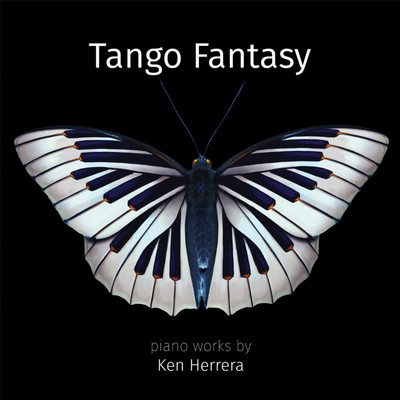
TANGO FANTASY

Ken Herrera

Move Records MCD 649

The composer/pianist presents four of his works on this disc: two short isolated pieces, and a pair of collections, finishing with the five-movement, 33-minute-long Tango Fantasy. Herrera studied piano at the Tasmanian Conservatorium of Music, then moved into composition. He appears to be self-taught in this latter field and – unfortunately – it shows. You’re not getting many contemporary sounds here; Herrera is content to manipulate a harmonic vocabulary of rudimentary proportions and his professed devotion to the tango is not persuasive when it comes to putting that particular dance into his own language,

For instance, the opening Tango Waltz begins with some flourishes that might suggest a tango but, 30 seconds in, the piece has settled into a 3/4 rhythm. Following this straightforward move to waltz-time, Herrera doesn’t move out of it. Furthermore, the melodic content is rather wayward; sure, there are repetitions of his basic tune, punctuated by episodes that have little relation to anything but themselves. Apart from a well-pedalled scale eruption about two-thirds of the way through, there’s not much here to raise expectations of virtuosity; some flourishes are welcome but the 2018 piece is couched in a pre-Nino Rota/Fellini atmospheric without the original’s spartan melancholy.

Pairing up with this waltz is the album’s other brevity, Herrera’s Third Nocturne from 2012 which aims to suggest a Latin American night spot complete with its atmosphere-establishing piano in a blending of bossa nova and blues. Well, you get the first-mentioned’s rhythm, all right – it obtains throughout – but the blues consists of some predictable chords and not much besides. Our nocturne isn’t in the Field/Chopin line but more along the lines of something you might hear at a cocktail bar; sadly, not one where you’re tempted to tip the pianist. As with the waltz, the piece sounds aimless in its right hand which wanders at its own sweet will in a chain of 7th chords and tinklings.

Herrera’s first major construct is a Suite dating from 2013. The inspiration comes from Bach – a laudable aspiration, although the shape of the collection puts it closer to Grieg’s Holberg or even the Karelia of Sibelius although its four elements are given non-suggestive tempo titles: Allegro, Allegro, Andantino, Presto. The first is proposed as an introductory toccata but the only shadow of that form comes close to the end in a quasi-improvisatory passage that recalls some of the foibles of Sweelinck. For the most part, it proceeds like a fitful study with left-hand cross-overs for excitement, building to a loud highpoint rather early in proceedings but, like a Buxtehude toccata,. owning several sections.

At the end of this opening, you’re also left with several questions about the movement’s harmonic shape which tends to follow a predictable path, if sometimes an ungainly one because it veers off from its own patterns more than little self-consciously. We’re in much more solid Bach territory with the second Allegro which begins like one of the Inventions but lacks the rigour to follow a simple contrapuntal matrix, the left-hand settling into a bass role where you expected a mirroring of the initial statement. Progress is sometimes quirky, but not in an adventurous way – for instance, a sequential pattern is held up for a moment when a repetition is interpolated so that you’re left feeling unbalanced when the sequence is resumed. Later, when the left hand gets hold of the initial line, the treble provides a functional harmonic accompaniment rather than a complement. At about the 1’30” point, we enter a new world of repeated chords for a moment, returning almost instantly to the suggested/unrealized linear interplay of the opening.

Herrera sees this as a lively dance movement; to me, it’s more in the nature of a march in that I can’t see any potential choreography beyond a military stamp. When it comes to the obligatory slow movement, we are offered an Andantino that opens with a simple old-fashioned melody, followed by a series of episodes that numb with their predictability in terms of shape and modulations. Added to which, the composer reaches some points where inspiration is at a premium and we experience a good deal of repetition and note-spinning, e.g. at about the 3′ 50″ mark and at 5′ 00″. An abruptly determined conclusion sits at odds with the placid opening; it’s as though the writer has turned semi-aggressive and avoided a tempering of his mood.

When we reach the Presto, Herrera points to the gigue conclusions to Bach keyboard suites and proposes a further historical reach by wanting to summon up the Irish jig spirit as well. He opens bravely, with a flourish that hints at Litolff’s Concerto Symphonique No. 4 Scherzo before we reach a melody peppered with hemiolas. Before long, the jig has turned into a momentary waltz, then coming back to jig with some slight suggestions of a blues chord or two. A descent to the bass register moves us back into the land of the totally expectable, followed by a rise in alt – and we’re back to Litolff, albeit rather laboured. A chromatic rise brings us to a reprise of the opening material, and a soft-dynamic ending with preparatory booming bass and ornamental sextuplets on top.

This is the most effective of the suite’s movements, mainly because of its energy and occasional charm, yet it still leaves an impression of beating the bounds through interludes – to the point where the exercise sounds like a disjunct rondo.

But there’s more. Herrera’s final offering is the 2016 Tango Fantasy in five movements that begins with a solid AndanteAllegroAllegrettoPresto sequence. The opening is a sort of recitative, beginning with a single line that acquires another as well as some gruff bass burps before reaching for some chord chains that would have satisfied more if the composer had been more severely self-critical, giving coherence to his modulations and animating the piece by using his instrument’s outer reaches with some purpose.

The remaining three sections are all tangos, taken at various speeds, the fourth being something of a recapitulation of the second although the pace doesn’t justify the Presto label. I found it difficult to detect how the Allegretto was related to anything else, although it opened in a quasi-improvisatory manner that suggested the piece’s first pages/bars. But a great deal of territory is covered by the fantasy nomenclature, so – as with Chopin and Schumann – you just have to go with the prevailing flow. We now come to a Vals – Allegro vivo which follows a similar Rota-type insouciance as we heard in the opening Tango Waltz; the main tune opens deftly enough but fails to live up to its promise with a rather aimless consequent to its initial statement. Here the intention is clearly to spike up the piece’s orthodox harmonic scheme with some wrong-note interpolations. That might have come off if the overwhelming tenor of the movement was not so traditional at its many harmonic fulcrum points. Added to this, some of the movement’ phrases didn’t balance; and you’d be working hard to find much vivo in these pages.

Now attention turns to the Milonga, the tango’s precursor; this movement is also set up as a Presto, which it isn’t. Here is a harmonically orthodox dance with some traces of the habanera’s triplets and at least four passages of fortissimo writing that come straight from the Lisztian handbook of virtuosity if not as dynamically sustained or as digitally taxing as in the Hungarian master’s workplace. An Andantino opens questioningly but follows an inchoate path, taking its time before settling into a languorous tango, then seeming to doodle a melodic path leading in no particular direction. In fact, this whole movement struck me as aimless if centred on a minor tonality (G?) – as is so much of the music on this CD – before a concluding over-emphasized tierce de Picardie.

at the start of the concluding Presto, Herrera introduces a key motif of five consecutive semiquavers rattled out like automatic fire before moving into a Piazzolla-reminiscent melody that gives a format to this rondo-tango which comes equipped with a substantial coda. Again, I’d question the tempo direction which, to my ear, sounds in actuality more like a tempo di marcia. But the real problem comes not from the piece’s impetus, which is well-sustained, but from the diffuse nature of its harmonic ramblings which lead into some thorny thickets before moving back into diatonic safety.

Nothing wrong with being a tango tragic. Never forget that splendid man-of-letters Clive James and his installation of a special room in which he could practise this specific dance: that’s enthusiasm. But, for a composer, you have to add something original to a field that boasts the riches of Albeniz in D, Por una cabeza, La Cumparsita, Besame mucho, and even Libertango. This CD is the work of a talent that appears devoted to this specific form but his output needs more focus, not to mention more sophistication.

Three sonatas from a new/old voice

TREING TO REMEMBER WHAT I CHOSE TO FORGET

Trish Dean, Graeme Jennings, Alex Raineri

Move Records MCD 642

Yet another compositional voice that has passed me by, Millward is best known for his collaborations with film makers and stage artists, although chamber music is a respectable element in his catalogued output. His language runs to the jazz/popular/sonic art vocabularies and his performances seem to tend to pre-recorded. In fact, much of his work has been recorded on three CDs, including a piano works collection by Sally Mays. Matters are further complicated by several works being sub-sets or spin-offs from larger constructs; it’s an instance of cross-transference, something like trying to chart Sculthorpe’s string quartets.

Still, this recording is Millward’s first for Move Records and it features three exceptional musicians. Despite the suggestive titles – Trying to Remember What I Chose to Forget; Contact – Connect – Tracer; Sadness to Madness – all three of the works presented are good old-fashioned duo sonatas. Pianist Alex Raineri is the constant thread in all three works; violinist Graeme Jennings performs the 2019 violin sonata (Trying to Remember . . . ), then tries his viola hand at the second (Connect etc.), written in 2021; Ensemble Q’s Trish Dean manages the two-movement cello sonata which came to fruition last year.

To begin, I’m having trouble with the composer’s CD title which applies not just to the violin sonata but also to the other two works. In essence, Millward is facing us with sounds that he has in his memory as well as sounds that he has chosen to obliterate from his memory – which is a mental tour de force that you confront at your peril. What is being proposed is a scouring confrontation with the self where you easily take into account the positive facets of your personality/identity, at the same time as facing up to events or characteristics that cast you in a less-than-flattering light. Further, Millward proposes that this admission of the traits we decide to eliminate isn’t just a personal failure but a cultural one.

I don’t think any of us would have an argument with this last projection. You only have to look at any arguments against the Voice to encounter a world of unconscious admissions of cultural failure – obvious time-honoured maltreatment dismissed in favour of self-righteousness, led by a character who seizes on Farnham’s words, ‘try and understand it’ while missing the relevance, inherited from his former career, of the lines, ‘How long can we look at each other/Down the barrel of a gun?’ So Millward has concerns with an unassailable truth: we do choose to forget – what we find uncomfortable, unpleasant, unconscionable.

How this translates into his music remains a mystery that could only be solved by a psychological journey into his compositional practice, an analysis separating the wheat from the one-time tares. But then you’re faced with discerning what the composer wants to use as material, has always wanted to use, and presents – but alongside or in between other compositional matter that has been ignored quite consciously and can now be recalled! It’s an intriguing double-take but I fear many of us won’t rise to Millward’s expectations, content in our intellectual sloth to take his work as a composite – that is, if we aren’t being confronted by an entire creative swathe that involves the formerly-repressed rising to the surface intact: not alongside, but instead of the consciously accepted inspiration for the composer’s products.

The CD’s title work opens with Partial Reflection in which Raineri’s part dominates for its block chords while Jennings presents a Hindemith-like strong, if meandering line. The contrapuntal interplay between both instruments is occasionally intense in its tautness but then gives place to some lyrically soaring flights for the string player, especially towards the movement’s conclusion while Raineri proposes an atmospherically varied backdrop. A meditative break follows in Memoire Omissions where an unhappy nocturne finds cells repeated, extended, varied, shared with sudden patches of orthodox harmony penetrating the atonal texture that dominates proceedings. A sudden burst into action from both players heightens the outward tension before a return to the opening’s melancholy reserve and a few aggressive concluding bars.

Which take us through an attacca into the final Tangled Tango. About a minute of violin cadenza reminiscent of Tzigane precedes Raineri’s entry into the partnership before the work’s progress becomes a sort of tango, if one that you wouldn’t have much luck dancing. After a dynamic climax/collapse, the players move into a tranquil zone that eventually takes up the tango rhythm en clair about 2/3rds of the way through before becoming a rather strident exercise in opposing and complementary ejaculations. A return to the tango prefaces a menacing conclusion on a looped phrase that suddenly cuts itself short. For sure, the tango (which bears an odd similarity to a polonaise at certain spots) is a miscellany of sectionalized inventiveness; as with its predecessors, I find it hard to trace the elements or to appreciate what Millward is doing with them. Adding to the unsettling character of this work, Jennings sounds under-miked in the opening movement, a second-stringer to the piano’s aggression.

On to the slightly longer (9 seconds) viola sonata and we seem to have landed in more immediately digestible territory with Raineri outlining a steady quaver pattern rather like an Alberti bass, the viola giving us a lean, meandering melodic line. Both instruments work into an angular duet that follows a steady pulse and into a well-integrated partnership. A change of mood actually means a change of output and emotional prospects with some savage double-stopping for the viola and a willful piano percussive exhibition. The closely-argued relationship of the first section is here a more frantic creature: the quaver pattern persists but much more explosively and fiercely. There is no relief: the pressure is maintained and the movement ends abruptly.

So why call it Contact? Possibly because of the duelling brought into play, both instruments intertwining but also exploding against each other’s activity. Further, the juxtaposition of moderate and rapid tempi exposes a dual arena of sorts in which the tactile scenario is pursued consistently, if under two different guises. It’s a more placid scene in the following Connect, the amiable soundscape a throwback to English impressionism. Where the viola weaves another generously lyrical line, the keyboard ranges across its compass in support as well as shifting backgrounds. The whole piece reminds me of Cyril Scott’s Lotus Land – which is probably being a bit unfair to both writers. But they share a kind of directed languor, relieved by an occasional spurt of temperament.

As for the concluding Tracer pages, I can only conclude that this refers to one instrument following the other’s path. From the opening, Raineri sets the pace while Jennings punctuates with decorative interpolations that distract from the somewhat steady keyboard progress. Then the roles are reversed and the movement soldiers on, like a hard-worked sample of kammermusik. Eventually, the moto perpetuo aspect dies off for a terse viola cadenza, before we return to the same patterns as the opening and the sonata ends on a question mark, like Petrushka.

Mind you, I could have this all wrong and Millward could be following a quasi-military inspiration; the contact-connect-tracer sequence might have something to do with warfare. But I doubt it; whatever the tracer suggestion, I don’t think it refers to bullets. Without a score, it’s impossible to discern the parallel contours (if there are any) of both instrumental lines and, while there is plenty of mimesis, it’s hard to see a continuous layering of timbres and melodies. Still, the performance is assured and clean, Jennings’ pitch invariably true and Raineri giving his part a welcome clarity, especially in the outer movements.

The cello sonata’s two movements are called, rather obviously, Sad and Mad. In the first, both performers seem to be goading each other into depression, Dean’s cello leading the way into an emphatically dour emotional landscape. Indeed, it’s a rare moment when the string voice isn’t clearly in the ascendant. A brief outburst of staccato high notes for Raineri is one of the few points of piano exposure, even if the instrument’s timbre is used deftly at either end of this movement to reinforce the cello’s low moans.

Another attacca launches us into new territory, the piano rumbling in its lowest register against a striving cello circling on itself. And suddenly we emerge into the relative light of a partnership that follows a coherent path for a few measures, only to lapse into a downward cello solo. The music takes a turn for the manic, the piano producing a chain of hand-muffled notes; followed eventually by eruptions, a high tinkling/near-harmonic that suggests mental disarrangement, if not an absence of mental control. But this is followed by a quietly balanced cello lyric, sensitively carried forward by piano chords, before the final ascent to a high sustained note that wavers (intentionally, you’d hope) into something like those woodwind multiphonics that were so popular in the 1960s.

Is this all intended to depict a crazed state with occasional facets of crisis and release? I suppose so and it’s effective in its chameleonic shifts from one phase to another and back. Certainly, it’s a fine demonstration of performance involvement from both executants who appear to be comfortable with Millward’s language and technical demands. The cello and violin sonatas share common ground, in particular a mobile dissonance that impresses for its clear sense of purpose, as opposed to the relative sweetness of the work for viola and piano. Nevertheless, the composer’s triple offering here is challenging and he is content to offer a fairly abstract set of observations to explain his field of operations; hence the diffidence of the observations above . Not a new voice, then, given the composer’s substantial academic and professional career, but one well worth knowing.

Diary October 2023

A QUEER ROMANCE

Michael Honeyman and Sally Whitwell

Opera Queensland Studio, 149 Grey St. South Bank

Friday October 6 at 7 pm

As for picking lyrical products for this song recital, I don’t think baritone Honeyman and his accompanist will have much success – that’s if the adjective ‘queer’ relates to sexuality and isn’t just used as a general term for off-centre or outre. You could go for the Michelangelo Sonnets of Britten – no: they’re written for tenor. What about Poulenc’s songs for Bernac? Fine, but you look for sub-texts in vain across the work of this repressed writer. You might have better luck with Ravel’s L’indifferent or Debussy’s Chansons de Bilitis although both are heard more often/successfully from female singers. But an actual romance along LGBTQI lines expressed in unambiguous music is pretty hard to come across; lots of hints and possibilities, very little that’s explicit . . . or maybe I haven’t heard of it yet. As for Honeyman, my experience has been limited to his Opera Australia appearances, best exemplified in a towering King Roger that threw the rest of that particular Melbourne season (2017?) into the shade. Whitwell I know nothing about, but she’s a Sydney musician and that city’s musical life hasn’t impinged on my consciousness for over 60 years. The recital is sponsored by Opera Queensland. Tickets range between $77 and $85; I don’t think there’s any credit-card gouging.

This program will be repeated on Saturday October 7 at 2 pm.

NOCTURNE

Orava Quartet

The Edge Auditorium, State Library of Queensland

Saturday October 7 at 7 pm

The city’s favourite ensemble of this shape is offering a delectable 90-minute program in a string quartet-favouring location, with a close acoustic from memory. The players – violins Daniel Kowalik and David Dalseno, viola Thomas Chawner, cello Karol Kowalik – open with Borodin No. 2 which features a slow-movement Notturno familiar to all lovers of the musical Kismet, not forgetting the Scherzo which, with its second theme, gave us Baubles, Bangles and Beads. But it’s a satisfying work in its own right, making me wonder yet again: why don’t we ever hear its predecessor based on a theme from a late Beethoven quartet? Then come the Five Pieces by Erwin Schulhoff of 1923 which show a facility that this composer possessed when pushing beyond Les Six. Finally, the Oravas offer us Sculthorpe’s String Quartet No. 9. Commissioned in 1975 by Musica Viva Australia, it’s a work I’ve not heard for many years. But you could say the same about most of the Australian writer’s output in this form, all of it very approachable. This occasion also marks the launch of the ensemble’s second album, for which no details are available. Tickets range from $25 to $69, organized through Eventbrite who will probably charge you for their services, limited as they are.

THE DINNER PARTY

Ensemble Q

Concert Hall, Queensland Performing Arts Centre

Sunday October 8 at 3 pm

The Ensemble is celebrating a famous dinner on the night of Strauss’s Salome premiere in Graz. Those present included Schonberg, his students Berg and Webern, his brother-in-law Zemlinsky, his idol Mahler, as well as Strauss himself and Puccini (in town for the spectacle). By some clever programmatic variety, we will hear Schonberg’s Six Little Piano Pieces of 1913, Berg’s Four Pieces for Clarinet and Piano from the same year, and Webern’s Three Little Pieces for Cello and Piano from the following year. Puccini is represented by his string quartet lament Crisantemi, composed way back in 1890 between Edgar and Manon Lescaut. Zemlinsky produced his 4-minute Humoreske for wind quintet in 1939 after escaping the Nazis. A neat confederation comes in Schoenberg’s 1920 arrangement of Mahler’s 1885 Songs of a Wayfarer for flute, clarinet, string quartet plus double bass, piano, harmonium, triangle and glockenspiel. Then, the night’s second half is all-Strauss: the Piano Quartet Op. 13, contemporaneous with Mahler’s song-cycle; and Till Eulenspiegel – einmal anders! in which the Austrian academic Franz Hasenohrl in 1954 reappraised the 1895 tone poem by reducing its content by about half and cut the orchestral forces to a violin-double bass-clarinet-bassoon-horn quintet. Don’t know who’s participating in any of the above except for baritone Shaun Brown who sings Mahler/Schoenberg’s four lieder. It’s at QPAC, so the tickets range from $55 concession to $75 full, with the gross impost of $7.20 as a penalty for giving up your Sunday afternoon.

EUROPEAN MASTERS

Academy of St. Martin in the FieldsAcademy of St Martin in the Fields Academy of St Martin in the Fields with Joshua Bell

Concert Hall, Queensland Performing Arts Centre

Wednesday October 11 at 7 pm

This famous British ensemble has allied with super-duper American violinist Bell, currently the Academy’s music director, for a tour that involves three nights in Melbourne’s Recital Centre (audience limited to 1,000), three nights in Sydney’s Opera House (God knows how many it holds after the latest re-configuration) and two nights in Brisbane; blessed be the east coast. I’ve heard them once at home and once in Melbourne; no question but that this group is top-notch with a burnished output that has been delighting us for 65+ years. The European writers that they’re presenting begin with Prokofiev’s Symphony No. 1, yclept Classical because it offers a modern-day (1916-17) Haydn flavour. It’s fine as long as it isn’t turned into a rapid-fire onslaught in the outer movements. I believe Bell will be front man for Bach’s A minor Violin Concerto BWV 1041; you see, this night’s work is emphatically popular and such a warhorse should go down a treat. The director will also probably take prime position for Saint-Saens’ Introduction and Rondo Capriccioso, in which I can already hear the sparks flying in the concluding Piu allegro. To end, Mendelssohn’s Scottish Symphony – his last in the form (probably because it took him so long to finish) and notable for its absence of breaths between movements and the snappy Scots references in the scherzo and finale. Tickets range from $89 to $199 (no concessions); well, they all need recompense for coming so far, don’t they? While splurging on this, never forget QPAC’s extra impost of $7.20 on any order.

CLASSIC GRANDEUR

Academy of St. Martin in the Fields with Joshua Bell

Concert Hall, Queensland Performing Arts Centre

Thursday October 12 at 7 pm

Following its array of popular favourites from last night, the Academy and its music director go straight for that old-time religion with a program that could have come from the 1930s. We are beginning with Mozart’s Overture to The Marriage of Figaro and it’s almost a certainty that Bell and his forces will spring no surprises with this brief burst of brilliance but will mount a crisp presentation; mind you, what else can you do? Bell steps forward for the Beethoven Violin Concerto which will be punctuated by the soloist’s own cadenzas; fair enough, as the composer didn’t supply any himself and who needs Kreisler’s any more? I can remember Nigel Kennedy playing them with timpani support on one of his visits here – probably taken from Beethoven’s own arrangement of the work for piano and orchestra. In any case, Bell’s cadenzas have been around for a while without causing controversy. And we return to Mozart for the Symphony No. 40 in G minor: the most popular of the set and a challenging task for any group of players faced with its inspired bravery and emotional conviction. Tickets cost the same as at last night’s event – $89 to $199, with the same booking-fee exaction of $7.20. Perhaps it’s worth the expense to see these fine flowers from Britain’s musical garden on display.

HEARTLAND CLASSICS

Queensland Symphony Orchestra

Concert Hall Queensland Performing Arts Centre

Friday October 13 7:30 pm

The orchestra’s one city concert for this month does come from the centre of Europe, beginning with the Hungarian frolic of Kodaly’s Dances of Galanta from 1933, oozing national colour and verbunkos format. It’s a friendly suite with some flattering orchestral work, particularly for clarinet which will give Irit Silver plenty of scope to exercise her skills. An Armenian guest then comes forward: violinist Sergey Khachatryan. This youngish (38) musician will take the solo line for Mendelssohn in E minor, which is about as close to music’s early Romantic heartland as you can get and the acme of the composer’s achievement in the concerto format. After this German effusion, we’ll hear Dvorak’s Symphony No. 7 in D minor from 1885 which certain commentators put at the forefront of the Czech composer’s output, despite the prevalence of the New World on every major orchestra’s annual schedule as the years roll on. I’ve a sneaking affection for this score as I first encountered it at the Melbourne Conservatorium where Noel Nickson conducted it in the early 1960s while I sat at the back of the violins and heard student tentativeness in full cry for the first (but not the last) time. Anyway, the conductor here is Otto Tausk from the Vancouver Symphony Orchestra. Tickets full-price fall between $90 and $130, but concessions are available; still, you can’t avoid that swingeing booking fee, no matter where you sit or what price reduction you manage to acquire.

This program will be repeated on Saturday October 14 at 1:30 pm

FLORESCENCE

Australian String Quartet

Ithaca Auditorium, Brisbane City Hall

Thursday October 19 at 7 pm

Here’s a fairly well-travelled group. Not that Brisbane is a constant on its touring schedule these days but, unlike quite a few other string quartets on the national scene, the ASQ doesn’t neglect us entirely. The ensemble – violins Dale Barltrop and Francesca Hiew, viola Christopher Cartlidge, cello Michael Dahlenberg – has survived the Great Interruption and comprises the same personnel format as when I heard the group some years ago. As for what they’re playing in this well-polished, atmospherically cold space, it starts with a Movement for String Quartet, written in 2020 by Justin Williams, associate principal viola with the Sydney Symphony Orchestra and a founding member of the Tinalley Quartet (although that ensemble hasn’t been heard of for some time now). This brevity (the composer’s first creative gambit) is followed by Haydn in B minor, first of the six in the Op. 33 set and the only one of them not in a major key (although the composer has his little ambisexual harmonic jest at the start). I assume there’s an interval break (after about 36 minutes’ playing) before we jump back to Purcell’s Fantasia No 6 in F which is a substantial work, considering most of its companions. To end, we have Dvorak No. 14 in A flat, the last of the composer’s output in this form and nowhere nearly as well-known (or performed) as No 12, the American (once called the Nigger, especially in slavery-enriched England). That’s a very original program with nothing familiar about it – and so to be highly commended. Tickets? $33 to $78 with no apparent extra charge: another cause for commendation.

THE NEW WORLD

Southern Cross Soloists

Concert Hall, Queensland Performing Arts Centre

Sunday October 22 at 3 pm

The Soloists are going all-American in this all-things-to-all-men compendium which begins with Caroline Shaw’s Entr’acte, last heard here from the Australian Chamber Orchestra on August 7; this time, in its string quartet format. Then we are treated to a bit of ersatz Americana in the Largo from Dvorak’s New World Symphony, Goin’ Home; presumably being sung to words provided by the composer’s American pupil, William Arm Fisher . . . otherwise, why not just stick with the piece’s original title? Then comes Artie Shaw’s Clarinet Concerto of 1940 which makes hay with the composer’s big band sunshine. The ensemble hits the inspirational if imaginary national vein with Three Scenes from Aaron Copland’s Rodeo ballet – which is odd as the usual collation features four of the work’s original five scenes. Konstantin Shamray will play his reading of Gershwin’s Rhapsody in Blue; presumably as a piano solo, but you can’t tell with the Soloists. The final essay is a Piazzolla (well, he lived in the USA for 10 or 11 years): Fuga y misterio which comes from the composer’s opera Maria de Buenos Aires. It’s a frustrated tango, or so it seems to me, despite its formal qualities that sound as natural as the instrumental section to Bernstein’s Cool. In the program’s centre is an as-yet unnamed new work/collaboration between guitarist John Jorgenson (of Elton John band fame) and Chris Williams, the Soloists’ Didgeridoo Soloist in Residence. You’d suppose that the work will feature both composers as executants but – apart from Shamray – other participants on the night remain anonymous. Tickets are from $35 (student) to $85; it’s QPAC-sponsored, so have your extra $7.20 ready.

SONGBIRDS

Ensemble Offspring

Brisbane City Hall

Saturday October 28 at 7:30 pm

Is this group in a state of constant expansion or contraction? Last time I looked, it appeared to be a mixed trio; from its website, you’d think it was a sextet. For this particular program, three sound-sources are nominated: flute, clarinet and percussion. This last is certainly the ensemble’s founder/artistic director Claire Edwardes whose name is well-established among adherents of Australia’s contemporary music activity. The flautist will be Lamorna Nightingale, the clarinets negotiated by Jason Noble; these musicians have participated in Offspring recitals earlier this year. Three composers are singled out for mention on one particular informational platform: Gerard Brophy, Fiona Loader, and Nardi Simpson All three will be represented by some ‘beloved’ works. We know that they’ll be Australian birds – Brophy’s 2019 Beautiful birds, Loader’s Lorikeet Corroboree of 2015, perhaps Simpson’s Of Stars and Birds (which you can see the Offspringers play on YouTube). And then we move away from the avian and more to the environment with two Hollis Taylor/Jon Rose collaborations in N’Dhala Gorge @ Ross River and Bitter Springs Creek 2014, alongside Brenda Gifford‘s Mungala (Clouds), Ella MacensFalling Embers, Alice HumphriesThe Visitor (Sorry, I can’t stay), and Bridget Bourne‘s Wood Grooves – all written between 2018 and 2022. Tickets aren’t yet on sale.

KINGS AND CASTLES

South East Queensland Symphonic Winds

Old Museum, Bowen Hills

Sunday October 29 at 2:30 pm

A few unusual features about this event, which is the only one in October’s calendar for the Old Museum that appeals. First, it’s a dress-up event: you come attired as a king (or queen) and you could win a prize – an initiative that would spark up many a more grave event at QPAC. Second, the program is remarkably broad – and vague. The 60-piece ensemble (that’s a massive lot of winds) under Adam Pittard is promising a feast of music from around the globe – royalty of all types and times. We will hear musical insurrections (Khovanshchina? Va, pensiero?) and Holy Grail quests (Parsifal? or more likely Indiana Jones?). Geographical locations move between Ancient Persia – we could all do with a dash of Ketelbey, or a few selections from Kismet – and the Kingdom of Siam, which for many of us is forever associated with Rodgers and Hammerstein’s The King and I. The Winds choose their repertoire from light classical, Broadway musicals, movie themes and original compositions; some of my suggestions above might obtain, although perhaps not the Wagner and Mussorgsky operas. Tickets fall between $19 and $24, a dollar extra if you buy at the door. And there’s a 2% credit card fee – a matter of cents, I suppose, but necessary?

Please, sir, I want some more

CONTRA

Contra Guitar Duo

Move Records MCD 644

IMPULSES

Hamish Strathdee

Move Records MCD 645

No sooner does Move put out one guitar duo recording than another comes hot on its heels. The Contra ensemble comprises Hamish Strathdee and Emma-Shay Gallenti-Guilfoyle, musicians who met as students 12 years ago. In this brief collaboration, they perform four works: Segovia’s slight Divertimento, an arrangement by Angelo Gilardino (the recently-deceased Italian guitarist/musicologist) of Puccini’s bagatelle for strings Crisantemi of 1890, three pieces by Australian Phillip Houghton (the first from 1976, the latter two from 1990), and Alexandre Tansman’s Variations on a Theme of Scriabin, originally a solo work written in 1972 for Segovia and here arranged for two by German guitarist Tilman Hoppstock.

Simultaneously, Strathdee has produced an EP of his own, on which he performs some works that inspired and ‘accompanied’ him across his student and professional years. These meaningful Impulses include two movements from Bach’s Keyboard Partita No. 1: the Saraband and Gigue as arranged by Hoppstock. As well, the disc contains Leo Brouwer’s 1996 Hika, In memoriam Toru Takemitsu, and a flamboyant piece of virtuosity in Napoleon Coste’s Le Depart, fantaisie dramatique Op 31 of 1856 which, like Beethoven’s sonata, also features a return.

Both CDs are rather short: Contra lasts 26’24”, Impulses 19’0″. Quality in small doses, you’d expect. And that’s the way the duo disc begins. Not that Segovia’s small-scale Divertimento makes claims to depth but these executants give it a handsome outing with a freshness of delivery – dynamic variation, linear attack (or its absence), rubato at logical points – that demonstrates a flawless confidence in each other and an affection for this F Major bagatelle. You can best read the collegiality in bars 15 and 16 when the imitations and counterpoint stop for a moment and the pair play a series of chords together – a generous balance obtaining here as it does in the piece’s four final bars which serve as a crisp chaser to the exercise.

As far as an arrangement goes, Gilardino’s work on Puccini’s Chrysanthemums shows a staid mind at work, Guitar 1 generally getting the top violin lines, Guitar 2 taking on viola and cello, although that can vary e.g. Guitar 1 taking up the cello’s bass note (F sharp in the original) across bars 57 to 62, and taking the viola part at bar 92 and beyond. As you’d expect, the piece’s fabric is necessarily changed, these performers not having the luxury of drawing out melody lines or being able to muffle accompanying semiquavers which are a feature of the middle segment starting at bar 32. Still, their treatment is consistent in its elegiac nature and takes its time negotiating the structural cracks.

The Mantis and the Moon is the first of Houghton’s Three Duets and it falls into two unequal parts, even if there are hints of a combination at the end. The opening is a march with triplet underpinning: quite brash, aggressive, with clear suggestions of the insect’s stridulations (to my over-active sensibility). This Prokofiev-style abruptness suddenly changes to a new landscape of an angular melody lying over a muted regular quaver support which stands in for a placid moonscape, with some suggestive antenna-waving in the final measures.

Lament is an elegy for one of Houghton’s friends, the composer/pianist Andrew Uren who died in 1989. The piece works as a threnody above a slow, constant bass; its atmosphere is funereal, verging on dirge-like but leavened by a strong melodic line that reaches a fierce highpoint before sinking back into the sombre inevitability of the piece’s opening. Alchemy is all movement and flashes of colour, operating over a sort of continuous undercurrent of triplets. Its 6/8 motion transforms into hemiola-like 2 crotchets in the bar at the end – a striking passage with vehement chords from both players. Houghton imagined his performers sparking off each other, the music mutating throughout – and so it does, although you can’t avoid the suggestions of the old scientific search for gold formed from disparate elements.

Finally, we’re treated to Tansman’s set of six variations on Scriabin’s 12-bar Prelude Op. 16 No. 4, originally in the recherche key of E flat minor. The Polish composer begins by moving the key to B minor (which I think Hoppstock has followed) and dividing the original between the players. I can’t see much difference from the original in the first two variations beyond a doubling of the melodic line. As well as an added richness of chording (all in keeping with Tansman) that operates throughout the longer Variation 3, the work gains from a sense of ease where the original’s responsibilities are shared.

I can only see one point in Variation 4 where the arranger adds anything beyond some doublings and transpositions down an octave, and that’s an unexpected semi-harmonic appearing at the start of bar 6; the rest moves placidly along its lento path. Again, in the Variation 5 quasi Mazurka, you can enjoy the part-writing more readily because of the division of responsibility, particularly in a page that holds a fair share of accidentals. To end, Tansman goes fugato with some close writing that threatens to progress into something full-blown – but then the contrapunctus stops in its tracks and he rounds off the piece by re-stating Scriabin’s prelude with a subtler harmonic content and the addition of a cadence-reinforcing last bar.

This is excellent work from both Gallenti-Guilfoyle and Strathdee: a sensitively structured partnership, obvious from the shared level of responsiveness, not to mention the technical balance and simultaneity on display, Not just in this Tansman, either; I doubt if Houghton’s duets have been better served by the various artists who have performed them since Tim Kain and John Williams issued their version in 1995.

MOVING to the Strathdee solo disc, his Bach sarabande is rather languorous in approach, with a few delays in getting off this dance’s pivotal second beat. Speaking of which, the second-beat chord in bar 8 has lost some of its components in this arrangement and the upward transposition of the original’s left-hand demi-semiquavers in each half’s last bar strikes me as unsatisfying. And I, for one, would have welcomed repeats! The reading of the gigue showed the player’s clarity of output and the piece avoided becoming a study – just. Strathdee repeated the first half but not the (admittedly longer) second part. I don’t know whether it was intentional but I missed the two ornaments in bars 5 and 7. In his transcription of the entire partita, Hoppstock moved the original tonality from B flat Major to D Major; a much more congenial arrangement for this instrument’s aficionados, of course.

Has Leo Brouwer incorporated any original Takemitsu strands into his elegy/eulogy? It’s hard to tell. He begins with a set of epigraphs, detached on the page and articulated as separate units by Strathdee. But, as we move into the piece, each fragment enjoys a generous variety of treatments: arches expanding or contracting by a short interpolation or its absence; flourishes of accidental chains that end in a suspended harmonic; two bursts of brief velocissimo; a central vivace providing for an abrupt volte face in personality before the initial calm resumes. Strathdee gives a vigorous account of this last but takes his time over the meditative stretches; importantly, he makes sense of this abschied‘s emotional permutations, setting up the initial framework with obvious empathy.

One authority has linked Coste’s Le depart to the Crimean War and the piece certainly has an emphatic martial quality. It’s not hard to read what you like into the piece’s progress so that, by the time you get to the concluding Le retour: marche triomphale, it’s clear that the military have been involved. Added to which, the first edition has a date for this concluding section – December 29, 1855 – by which point the war was almost over and it’s conceivable that Coste was indulging in a bit of chauvinistic self-congratulation; if the French troops (those that survived) weren’t already home, they were on their way.

Strathdee follows the piece’s narrative with an enthusiastic embrace of its emotional switches. A fulsome Andante Largo could accompany a soldier’s farewell coloured by patriotic aspirations; it’s certainly a personal, possibly sentimental statement, and framed in a positive E Major. The interpreter gives the soprano line a wealth of expressiveness, enriched by some brief inter-note glissandi/slides. Then the fireworks begin with some martial trumpet calls at an Allegro assai of 28 bars that suggests action, if rather well-organized. A brief three-quaver chord progression leads to an Andantino in B Major and an Agitato of 10 bars (the wounded followed by a final flurry before the peace is signed?), and we’re into the somewhat overlong E minor march, which continues the piece’s inspiration of serving as a brilliant display-piece for its creator – and later guitarists (a lot of them) – to display dexterity and responsiveness across this fine flower of mid-19th century Romanticism.

Le depart works well as a finale to Strathdee’s mini-recital which moves across a vast period of history with success. One of the finer factors of both CDs is that neither hits the all-too-familiar Spanish/Latin American repertoire that has been flogged mercilessly by guitarists for decades. You are spared the transcriptions of Granados, Albeniz or Falla; there’s not even a Piazzolla mundanity bringing up the rear. In fact, the only Spanish piece offered is an actual guitar duo written by the dominant figure in guitar across the last century.

It’s also worth noting that the more arresting sequences on both discs are semi-contemporary: Brouwer’s salute to his dead friend, and Houghton’s triptych. Still, the duo has (I hope) much more up their communal sleeve and you’d have to be confident that their next recording will be a more sustained experience for us all.

Comes with a high polish

SIDEKICK

Ziggy and Miles Johnston

Move Records MCD 648

This duo has been around the country – and overseas – for some time. At this point, both musicians are studying – as a guitar duo – at the Juilliard School in New York where their craft will continue to be honed to an even finer point. As is inevitable, these musicians have won prizes from operations like the Guitar Foundation of America, the Adelaide International Guitar Festival, and the Concert Artists Guild Competition. The brothers’ second CD, as far as I can tell, oscillates between Brazilian/Spanish voices and home-grown ones, with sideways glances at one of serious music’s best-known vignettes in Debussy’s Claire de lune, and Welsh composer Katie JenkinsSidekick, written specifically for these players by a co-student at the famous American academy.

Ziggy and Miles begin their excursions with Jongo, a rhythmically clever piece by Brazilian guitarist Paulo Bellinati; it alternates 6/8 with 3/4 in a time-honoured Latin tradition and bases its development on a catchy D Major tune that doesn’t venture outside its home key. We hear a cut version of this arrangement because the musicians omit about a minutes’ worth of ‘percussion work towards the piece’s ending where performers have the option of snapping strings at various points along the neck/fretboard or slapping the instrument’s side, outlining the same rhythmic interplay that has featured so far in the piece.

It all makes for a nice study in ensemble and this duo comes up trumps, even if the last bar’s arpeggiated chord is prepared by a carefully-considered chain of what you’d expect would be rapid acciaccature. Still, its determination leaves you in no doubt that we’ve reached the end of this frolic.

This is followed by the three-movement Tonadilla of Rodrigo. which you can find on YouTube, the Johnston brothers giving a most focused reading of this brightly textured suite. The initial Allegretto ma non troppo sets up the composer’s trademark 2nds, placing E in one instrument against E flat in the other, the bitonal suggestion a continuous spur as the players exchange material and unite for full-blooded rasgueado chords with sparkling clarity.

The second movement Minuetto pomposo doesn’t really get affected until a fair way in, beginning with a delectable alternation of material and spice added by ‘wrong-note’ chords like the opening D Major chord in Guitar 1 set against an F sharp minor triad on Guitar 2; this polarity persists but it’s not that remarkable – just a muted form of bitonality. The stately section starts well into the piece’s centre with a definite change of character, into the minor if anywhere, and a definite strut to the rhythmic motion. A series of concerted common chords (recalling bars 11 and 12 of the opening segment) follow a cadenza for Miles Johnston, and we return to the opening material and a curt conclusion.

Then the concluding Allegro vivace is an infectious rondo, notable for some stunning scale passages from both players. Here, the harmonic spikiness is underplayed although Rodrigo can’t bring himself to complete orthodoxy. But these pages exemplify the finer points of this duo’s abilities – from the carefully managed rubato and decelerandi to the fine timbral eloquence from Ziggy Johnston in a mid-movement minor mode bass-line solo, and the combined effervescence of the concluding bars’ semiquaver unison run.

Now we come to the CD’s longest track in Granados’ Ochos valses poeticos, written sometime between 1886 and 1894 for piano solo. All of them have been transcribed for two guitars, some of them by several arrangers, but the Johnstons have chosen the version assembled by the duo of Christian Gruber and Peter Maklar. In fact, the waltzes are preceded by a bright march-like introduction and the first of the dances recurs as a postlude to the whole collection. Right from the start, you’re aware of transpositions across bars 10-12 where the piano in alt can’t be handled by the guitar; as well, you hear a few supernumerary bass notes starting 13 bars from the introduction’s bridge/conclusion. But the players capture effectively the good-humoured charm of this preface.

Most of the waltzes are a page long in the original; repetitions abound, as they do in Chopin and Brahms, and the Johnstons give great pleasure in their ease of delivery and supple gradations of tempo and timbre. You can’t fault them for accuracy either with many striking passages of close duet. For all that, the waltzes are amiable salon matter, their phrases falling neatly into four-bar patterns with nothing needlingly sharp to their gentle progress. Certainly, the first Melodioso holds the most memorable melody, well worth revisiting at the conclusion to Waltz 8’s Presto in contrasting 6/8 and 3/4 (only an unadventurous two bars’ worth of this).

But the inner pieces have considerable charm under the Johnstons’ care: the gentle, ascending chromatic pattern of the second Tempo di valse noble; the slightly off-kilter shape of the following Valse lente with its groups of three four-bar phrases; an abrupt muffled pizzicato effect in the Allegro umoristico at bars 21 to 24, and later at bars 29 to 32 which are treated with precision by both players in turn; a telling Viennese-style hesitancy applied in Waltz 5, meltingly effective at bars 11 to 18 the first time round; followed by a carefully shaped Quasi ad libitum where the performers take their time but do so with a single mind; the impeccable realization of Gruber and Maklar’s division of labour in the Valse 7 Vivo, even if the piano’s full-blooded chords (e.g., bars 6 and 8) have been thinned out.

The set displays the brothers’ command of Granados’ none-too-complex emotional landscape in these unsophisticated bagatelles. Even the more introspective waltzes (Nos. 3 and 6) make no bones about the modesty of their forays into a (slightly) darker world. Still, the pieces meld successfully into each other, in this instance because of the interpreters’ uniform interpretative vision.

I’ve not much to say about the Johnstons’ transcription of Debussy’s famous piano extract from the Suite bergamasque. Their approach emphasizes the pages’ innate calm, even at the En animant change of key for six bars at the work’s climax. And the transcription manages to keep the melody line prominent – although that might be due to the players’ subtle treatment of the splayed chords/arpeggios at the un poco mosso from bar 27 on. An agreable 5 minutes’ worth.

Most senior of the three contemporary voices is Nigel Westlake‘s Songs from the forest in its original duo guitar form of 1994. I’ve heard the Grigoryan brothers play this work, possibly at Monash University – more a matter of history than actual reminiscence. It has a catchy opening gambit in the best Westlake style and the composer brings this back to round off his sonically effective score. Interpreters are kept busy with a wealth of effects and rhythmic slips and slides, demonstrating Westlake’s insights into his instruments’ capabilities. As expected, the Johnstons find the mellifluous melodic passages and the mildly aggressive interludes suit their partnership down to the ground and – if anything – the work accelerates in interest the further it advances.

Jenkins wrote Sidekick in 2021 during the COVID outbreak at the invitation of the Johnstons. It is intended to be a reflection of the brothers’ relationship, both fraternal and professional – which immediately presents interpretative problems. Which one is the sidekick – Miles or Ziggy? Or are they both each other’s offsider? I guess that Jenkins doesn’t have any narrative in mind; she’s not committing to a story like Macbeth, Don Juan or Till Eulenspiegel but potentially essaying a pair of thumbnails like Lavine or Pickwick. Yes, certain moments present intimations of sequential thoughts racing between the instruments, or even complementary ideas that find common expression, as well as times of divergence from each other.

All the same, the composer is at some pains to outline a kind of aesthetic compatibility where competing flurries of action lead to a common end, quietly fusing into a shared output. The experience is heightened by listening to the track through headphones where the two voices are spatially separate. But that’s the case for the whole CD, by which means you can detect the labour division – or better, the sharing of responsibility. Jenkins’ language is pleasantly catholic, moving into old-fashioned harmony near the piece’s conclusion but tracing a lightly acerbic path in its central pages.

Written last year, Ken Murray’s Trin Warren Tam-boree depicts wetlands in the north-west of Melbourne’s Royal Park; specifically, the bellbird waterhole that sits there, just behind those yellow and red slanted pillars that mark the Tullamarine Freeway’s starting point. Also written for the Johnston brothers, this presents as a meditation on the area’s restless placidity, the piece’s forward motion dominated for the greater part of its length by a minor 2nd oscillation: D-C sharp-D, for example. Over this underpinning, the players outline Murray’s wide-ranging melodic output, the whole complex packed with incident but not alarmingly so. This is an expertly pitched soundscape, created by one of the city’s leading guitarists and a solid contribution to the still-slim catalogue of serious Australian music for duo guitar.

Here is a welcome exposition of the Johnstons’ obvious talents, well placed in a field of musical practice that is not quite unknown or unrepresented but has rarely been graced with such expertise in execution. Admittedly, a substantial track (Granados) and a slight one (Debussy) are arrangements, but the execution of those and the original two-guitar works is exceptionally fine. This CD was recorded at the Skillman Studio in New York and the artists have been well-served by an operational team which captured every detail of their polished interpretations.

Diary September 2023

BIRDSONGS

Birds of Tokyo and Queensland Symphony OrchestraQueensland Symphony Orchestra

Concert Hall, Queensland Performing Art Centre

Friday September 8

And again, the QSO is seeking contemporary relevance by going into partnership with a rock band, viz. this five-man ensemble from Perth. Needless to say, I know nothing of the Birds of Tokyo’s output except that it is not avian-based; nor is it Far Eastern in flavour. But what’s a bit of nomenclatural misdirection between friends? The QSO publicity machine promises us works like Plans (2011), Lanterns (2014), Anchor (2015) and Good Lord (2020) from the Tokian oeuvre and, as with all such exercises, the QSO will be reduced to filling in the background – both physically and sonically. From limited (very) research, I’ve found that the Perth group has distinguished itself by playing at two AFL Grand Finals – a lesson in futility from my remembrances of these events: who is listening? Tickets range between $95 and $129 without concessions: this is no country for kids and the elderly. That usual $7.20 self-tip applies but, oddly enough, the QSO site has no seats on sale at the time of writing; nothing seems to be sold, but nothing is available. If the event materializes, the QSO will be led in their labours by Nicholas Buc who is well-versed in such trans-media exercises.

This concert will be repeated on Saturday September 9 at 7:30 pm.

UNDERWORLD: AN OPERATIC JOURNEY TO HELL AND BACK

Griffith University Faculty of Music

Conservatorium Theatre, South Brisbane

Saturday September 9 at 7:30 pm

This sounds more menacing than it is. The Griffith tyros will engage in excerpts from three operas dealing with the Orpheus myth: Gluck’s Orfeo ed Euridice, Offenbach’s Orpheus in the Underworld, and Philip Glass’s 1991 Orphee. Of the Gluck, I know everything; of the Glass, nothing except that it’s the first part of a trilogy that honours Cocteau by setting his film to music. You’d have to think that the Gluck bits would include Chiamo il mio ben, Che puro ciel, and Che faro: a nice night, then, for a tenor/soprano/mezzo/counter-tenor. As for the Offenbach frolic, there’s always the Galop infernal but much of the score involves a chorus or ensembles for the principals. What I’ve heard (today) of the Glass chamber opera shows the same promise as you can hear in Einstein on the Beach and Akhnaten, i.e. none. But that’s all right: we have a theme and doubtless the promised intersection of these three sources will result in an Orphic illumination. The whole is conducted by Johannes Fritzsch while the director is Michael Gow. Tickets are $40, $50 or $60, depending on your standing as adult, concession-holder, or student. As far as I can tell, there’s no credit-card-use extortion fee.

This performance will be repeated on Tuesday September 12 at 6:30 pm, Thursday September 14 at 7:30 pm, and Saturday September 16 at 2:30 pm.

VOYAGES

University of Queensland Symphony Orchestra

Concert Hall, Queensland Performing Arts Centre

Sunday September 10 at 2 pm

The University of Queensland players come down the river for a night of travel music. They start with a movement from an Hawaiian work by Michael-Thomas Foumai: Raise Hawai’ki: Kealaikahiki, the whole construct celebrating the round-world voyage of a voyaging canoe, Hokule’a, in 2017. It’s an eight-movement choral symphony but I suspect that we’ll be hearing an orchestra-only excerpt. The next trip takes us to Tchaikovsky’s Violin Concerto in the hands of final-year UQ student In Yi Chae. Finally, we travel to Saint-Saens for his Symphony No. 3 in C, the one with the organ, four-hands piano and an irretrievable association with Chris Noonan’s 1995 film Babe. Well, it’s not so much the world-travelling that is the point of this program, but the intellectual and emotional transplantations that come over us while we’re listening. The conductor is local musician Dane Lam who is directing a new Foumai work, Children of Gods, with the Hawai’i Symphony, an organization for which he is all too soon taking on the role of music director. Tickets move from $17 for children and students to $35 for adults, with the usual QPAC fee of $7.20 for handling your booking – the blight continues.

ICONIC CLASSICS

Queensland Symphony Orchestra

Queensland Symphony Orchestra Studio, South Brisbane

Thursday September 14 at 10 am

A Prep to Grade 6 morning where the young ears are attuned to music that sits at the forefront of that art. Truly? The program lasts 50 minutes but there are no details about anything connected with this exercise except that tickets cost $30 each and, for every 10 of these, a teacher gets in for free. That’s one way of ensuring a minimal standard of discipline in what could be a fraught situation. No specific conductor is listed; no particular works are marked down for a run-through. But the aim is to expose these very young people to great music. Can’t go wrong, can you? Especially in the close quarters of the Studio where the audience can get too close and personal with the sound sources and gaze in wonder at the artistry on display. And you’re expecting that from Prep-age children? No, this isn’t going to happen. By the time they approach Grade 6, young people have sometimes acquired the self-control of shutting up for 50 minutes; anything younger and you’ve got no hope. Of course, the program could be structured in such a way that each segment lasts 2/3 minutes – which is about the length of a good Wiggles number. But you can’t reduce many ‘iconic’ classics to that time-span – unless you want to fool your audience that great music comes in pop-song slices.

This concert will be repeated at 11:30 am.

ICONIC CLASSICS

Queensland Symphony Orchestra

Queensland Symphony Orchestra Studio, South Brisbane

Friday September 15 at 10 am

Following from yesterday, the QSO is playing today for students from Years 6 to 10. The program will necessarily change, you’d expect, given that the level of audience naivete will have substantially reduced in this morning’s patrons. By the way, ticket prices stay the same and the stipulation of one free teacher for every 10 paying students still applies. Again, no conductor is listed and no works are scheduled by name. From past experiences at Melbourne school concerts pitched at students in the upper reaches of these ages, you can expect about 5 minutes of tolerant bemusement, even if the work being played is familiar, But you need a charismatic MC or conductor and a few whizz-bang young soloists to encourage your garden-variety students to stay the course. If the orchestra is performing for music students, then you’d have no worries; but your average Grade 9 pupil is not susceptible to anything except the most obvious and loud classic. The organization probably believes in doing public service this way, opening horizons and expanding choices. Maybe so, in a small number of cases, but I believe that a real awareness of great music rarely starts until the age at which these concerts leave off.

This program will be repeated at 11:30 am.

BENJAMIN BRITTEN’S WAR REQUIEM

Brisbane Philharmonic Orchestra, Ensemble Q, Brisbane Chorale, Canticum Chamber Choir, Voices of Birralee

Concert Hall, Queensland Performing Arts Centre

Saturday September 16 at 7 pm

A work that has everything to satisfy a Britten admirer. I had an unalloyed enthusiasm for Britten’s work after coming across the first recording with Vishnevskaya, Pears and Fischer-Dieskau, then buying (and working through) the score, as well as relishing the opportunity to revisit all those Wilfred Owen poems that I’d studied five years before at school. Still, after 60 years, the score has many passages of remarkably affecting effectiveness: the Dies irae opening, the conclusion to The Parable of the Old Man and the Young, the pairing of Strange Meeting and In paradisum – all still impress me as showing the composer at his least prissy. As you can see from the list above, a good many of Brisbane’s musicians are participating; they’ll all be needed to cope with the composer’s triple grouping, including a large orchestra and a sizeable chamber ensemble. This night’s soloists are soprano Eva Kong, tenor Andrew Goodwin, baritone Hadleigh Adams, with the whole shebang conducted by Simon Hewett, taking time off from the opera/ballet pit to lead his forces through this flamboyantly sombre composition. There are no concession tickets; prices move from $49, through $65, to $75 although there are few of the expensive ones left.

GUY NOBLE’S GREAT TUNES

Queensland Symphony Orchestra

Concert Hall, Queensland Performing Art Centre

Sunday September 17 at 11:30 am

To celebrate the conductor/host’s 18 years of directing the QSO’s Music on Sundays series, the organization asked Guy Noble to nominate his favourite works and present them to us. It’s a very broad selection he’s put together but I’d guess it comprises pieces that have meaning for him. The program begins with Humperdinck’s Hansel und Gretel; not the whole thing, I expect, but probably the overture and not much else because no soloists or choir are listed as participating and most of the opera requires one or both. Chabrier’s Espana puts in a welcome appearance; I’ve not heard it live for some time. And another piece of national colour emerges with the first of Enescu’s Romanian Rhapsodies: a mittel-European delight and the sort of thing Bartok could have written if only he hadn’t been so hidebound by reality. We leave Europe momentarily for home with Nigel Westlake‘s Babe Concert Suite which, as far as I can see, involves three parts from the original score. A return to Europe, lurching to Finland for the conclusion to the Sibelius Symphony No. 5 in E flat with its superb move from Lemminkainen’s Return to a swaying sunrise paean. Down to Germany where Weber wrote an Andante e Rondo Ungarese for his viola-playing brother in 1809. By 1813, he’d recast it for a bassoon soloist and this morning we hear QSO principal Nicole Tait fronting this rarely-heard gem. Finally, Noble brings his 80-minute extravaganza to an American close with the end credits from Field of Dreams, the 1989 Phil Alden Robertson film with a score by James Horner. Tickets range from $30 for a child to a top price of $105 for an adult in a good seat – plus the $7.20 handling fee for taking your money.

CLERICI CONDUCTS MAHLER

Queensland Symphony Orchestra

Concert Hall, Queensland Performing Arts Centre

Friday September 22 at 7:30 pm

The orchestra’s chief conductor Umberto Clerici is continuing a Mahler cycle begun by Alondra de la Parra during her stint in Brisbane. I don’t know how far she got, or whether she took the process in numerical order so that Clerici is left with the final four: the big rump. In any case, here he goes with No. 6 in A. I’ve heard a complete series in Melbourne from Markus Stenz who was able to negotiate the vast No. 8 in the Exhibition Building as part of a Federation Centenary shindig. Sir Andrew Davis got through all of the nine except No. 8 which was scheduled for a performance at (I seem to remember) Rod Laver Arena. But that fell through thanks to the advent of COVID and I don’t know if it was ever re-scheduled. Anyway, good luck to all connected with this performance because it’s long and arduous – except for the hammer-player who gets his two (or will it be three?) points of exposure in the grim finale. As well, Clerici will give the premiere of Justin Williams‘ Symphony No. 1, a work co-commissioned by the QSO and the Sydney Symphony Orchestra where the composer is associate principal viola, if more familiar to many of us as the alto line in Melbourne’s Tinalley Quartet. Obviously, he was a colleague of the conductor in the latter’s cello-playing days; useful, that old school bow. Clerici speaks of Williams as a late Romantic voice; not actually a help to those of us who want something from our writers that takes into account developments across the last century, at least. Tickets run the usual gamut from $30 (child) to $130 (full adult in a good seat), plus the $7.20 shakedown/booking fee for the sake of it.

This program will be repeated on Saturday September 23 at 1:30 pm

POSTCARDS FROM ITALY

Australian Chamber Orchestra

Concert Hall, Queensland Performing Arts Centre

Monday September 25 at 7 pm

Only six members of the ACO will be playing at this geographically defined program: leader of the second violins Helena Rathbone, a second-rower violin in Ike See, head viola Stefanie Farrands and colleague Elizabeth Woolnough, principal cello Timo-Veikko Valve and his first desk support Julian Thompson. The night starts with a quartet playing the first movement, Venezia Notturna, from Thomas AdesArcadiana collection; not much to it, especially when compared to other elements in this collection. Valve offers his own arrangement of Bach’s Italian Concerto for an unknown number of participants – possibly a trio, if he’s confident enough. Mind you, the ‘Italian’ name is simply proposing contrasts; in the original, this is achieved by changing dynamics and (possibly) consoles/keyboards. We revert to the solidly Italian with Giovanni Sollima‘s Viaggio in Italia: not the whole thing,, but selections – presumably, ones without a vocal line . . . no, they come from a new version. The original for Schubert-style string quintet has 14 movements, so there’s plenty of scope for choice but, from what I’ve heard, a little goes a long way. Boccherini, that Italian/Spaniard hybrid, is represented by a quintet in the same format as Sollima’s: his Op. 45 No. 1 in C minor – 4 movements, 20 minutes’ worth. And, to end, Tchaikovsky’s Souvenir de Florence sextet, given this name because the composer conceived one of the work’s themes in that city when on an Italian sojourn with his brother following a disastrous attempt at marriage, so sensitively depicted in Ken Russell’s The Music Lovers 1971 film. For all its southern inspiration, the work is half-Russian (the later two movements), so the night will end on an ambiguous note (actually, a triad).

VISION STRING QUARTET

Musica Viva Australia

Queensland Conservatorium Theatre,. South Brisbane

Tuesday September 26 at 7 pm

This group – Florian Willeitner, Daniel Stoll, Sander Stuart, Leonard Disselhorst – is based in Berlin and is now 11 years old. The ensemble’s web-site is full of this visit to Australia, still going the full European scream about travelling to the ends of the earth. Which makes you wonder: how old are these people? Anyway, the lads are performing a standard program, with the extra bonus that they play from memory. First off is Bloch’s Prelude of 1925, subtitled Receuillement – about 5 minutes of eloquent late Romantic angst . . . but you could say that about a good deal of the composer’s more popular output. Bartok No. 4 follows, allegedly in C Major and a riveting score across its 23-minute length. The composer had ideas about expanding this work for string orchestra, so it would be handy to see what there is in this composition that is lacking in the Quartet No. 5 that Richard Tognetti recently expanded for his Australian Chamber Orchestra. To end, the ensemble performs Dvorak No. 13 Op. 106. A bit more lengthy, this delighted-to-be-home construct of 1895 lasts for about 40 minutes and helps to flesh out our chamber music experiences of this composer whose quartet output has been confined (in my experience) to one or two well-worn gems. Tickets can cost as little as $15 and as much as $109; I still don’t know whether Musica Viva charges a booking fee for its events but hope springs eternal.

An achievement with questions

DVORAK’S SERENADE

Australian Chamber Orchestra

Concert Hall, Queensland Performing Arts Centre

Monday August 7, 2023

Bela Bartok

Fourth in an eleven-concert series, this Brisbane appearance by the ACO under Richard Tognetti‘s artistic and concertmasterly leadership divided neatly into opposing halves. Before interval, patrons were offered a fairly contemporary opening with Caroline Shaw’s Entr’acte of 2011, a piece that the American composer wrote while a student at Princeton. This was followed by Tognetti’s new arrangement of the 1934 Bartok String Quartet No. 5, called ‘in B flat Major’ because it starts and ends in that key (roughly). After interval, we moved back in time a tad for Josef Suk’s Meditation on the Old Czech Chorale ‘St Wenceslas’, composed near the outbreak of World War One and used as a musical act of resistance against the German invaders (following in Sibelius’ anti-Russian footsteps). And we concluded with the night’s title, Dvorak’s delectable Serenade for Strings of 1875.

This last is a string orchestra staple but the ACO hasn’t recorded it, as far as I can tell. So what? There’s an awful lot of music for the same forces that the group has not dealt with, but the current personnel could make an impressive interpretation, worth setting down on something more public than the organization’s own tapes. Tognetti encouraged his players to give full vent to the composer’s throbbing expressiveness while keeping the lines clear. Not that clarity in this Romantic product would be a problem with this group where the bass lines feature three cellos and one bass only.

Once again, the two violin contingents made an impressive display, the seconds immediately with a finely shaped outline of the first movement’s opening subject, even more telling on its restatement at bar 13. In fact, the entirety of this Moderato demonstrated great care in preparation, from the soft high chords that concluded bars 22 and 24 to the modestly projected cello lines from bar 66 to near the movement’s end. But then, we’re treated here to one of Dvorak’s most tender lyrics, even quite early in his prodigious output.

The mellifluousness continued in the Valse/Trio with some danger spots deftly achieved, like the strings’ octave doubling from bar 11 on, which many another body plays with bursts of suspect intonation, and the delectable skipping exhibition for second violins and cellos at bar 37 which impressed by its grace and positivity. I admired the pace of the following Scherzo and a uniformity of address that typifies this body, particularly while they worked through the thick-and-fast canonic entries that dominate this movement’s progress. Even the lack of bass heft wasn’t too obvious at the bar 42 fortissimo-for-everyone tutti where cellos and bass have the running. And the ensemble created a finely-spun melancholy moment at the bar 286 a tempo as the melodic material is decelerated and subjected to a placid musing before the concluding rush.

You would be hard pressed to find a more appealing version of the ensuing Larghetto – from the delicate but disciplined opening, straight into the business, to the lightly tripping Un poco piu mosso beginning at bar 47 with not a double- or triple-stop unachieved briskly. Even the note-spinning high violin line that dominates proceedings from bar 54 to bar 63 (an odd creative lapse in this eloquent essay) exercised interest for the piercing thinness of its contour. While you could understand the need for tempo relaxation in the vivace last movement, I’ve never understood why everyone slows down for the episode beginning at bar 85. Is it viewed as the beginning of a new ‘step’, perhaps? At all events, we were caught up in the rapid scurrying of this allegro‘s central pages before the melting-moment return of the work’s opening theme at bar 344, and the brusque furiant that here brought us home to generous popular approval. Just as you’d expect from this outstanding body that is blessed with consistency of personnel.

Not much to report about Entr’acte which moves between rather ordinary chord groupings to some special effects harking back to the 1960s. The only thing I gained from this performance was an appreciation of the work’s variety of timbres – which are not apparent from available recorded versions. Or perhaps American orchestras aren’t fussed about these details which, as far as I can tell, are the work’s main interest . . . alongside the concluding cello solo, carried off here by Timo-Veikko Valve with a kind of phlegmatic consideration.

Similarly, not much remains in the memory of Suk’s brief hymn treatment. The opening pages are lushly scored although the harmonic vocabulary stays in A natural minor for the entire first part of 39 bars – not an accidental in sight. Double bass Maxime Bibeau was put to a difficult task, having to negotiate a part that called for three players, most obviously in the moving (and exposed) A Major triads of the last three bars. But the work was handled with considerable attention to its inbuilt surging character, based as it is on a kind of dour Gregorian chant and not the wider-ranging compass of the Tallis Fantasia with which Suk’s work bears slight comparison.

For my money, the night’s interest came with the Bartok arrangement. After a few days, I’m still doubtful about the point of this exercise, apart from giving the ACO an addition to its repertoire. From the opening avalanche of B flats, it was clear that we were in a new country where individual voices were subsumed in a kind of musical groupthink. Voices impressed as powerful blocks but some polish came off the details, like the trills in bars 21 to 23 of the opening Allegro. Not that this impression was uninterrupted, as in the second subject’s arrival in bar 44 which preserved its striking sinuosity, and the orchestral texture was pared back every so often, yet those unison/octave recurrences dominated the movement’s progress as at bars 59, 126 (minor 2nds, for a change), 159, and 210 – all of which served as anchors in a welter of thick part-writing; difficult to imbibe even in the original.

I seem to remember that the Adagio began with single instruments, the full corps entering at bar 10. Again, here significant details sounded blurred, like the five-note semi-chromatic rapid runs that begin at bar 26 but which lacked the original’s crepuscular mild stridulatory suggestiveness. It was a relief to get back to the slow-moving isolated trills after bar 50’s Piu andante.

Of the work’s five movements, the middle Alla bulgarese emerged best in this string orchestra garb, notably at the burst into a C Major/minor/modal three-bar break at bar 30: one of Bartok’s more folksy surprises. As well, the 3+2+2+3/8 Trio showed the ACO’s expertise in dealing with irregular rhythms; but then, the group’s had plenty of practice, ever since the group played the Sandor Veress Transylvanian Dances nearly 30 years ago. Even so, this Bartok is much more demanding. The composer’s counterpoint is less interwoven in these pages, even if the parallel and contrary motion passages are persistent, particularly in the Trio‘s later stages; so the employment of massed (and supple) strings doesn’t interfere with your enjoyment of this dance.

The outer stretches of the Andante maintained their shadowy atmosphere well enough, if the hard-worked Piu mosso from bar 64 to bar 80 proved wearying with the viola/cello/bass work opaque, if not muddy. Still, that made the following 10 bars of tonally inflected Tranquillo very striking for its purity, exercising a kind of static eloquence. Then, the vivace final movement proved an exercise in stamina, exemplified by an initial attack that was as ferocious as any I’ve heard from a quartet versed in this work. Of course, it had its inbuilt slackings-off and accelerations but the ensemble’s enthusiasm and responsiveness went a fair way to making a positive impression in the rapid-fire presto pages.

Even so, the quartet’s finale raised similar questions to those from the first movement. Has the transference achieved much beyond an emphasis on aggression? Is the exchange of intimacy for amplitude worth the transformation? Even with gifted trios of violas and cellos, is the sacrifice of individual lower voices compensated for by laudable collegiality of articulation? This is not the first of the ACO’s transliterations from quartet to chamber orchestra format but it is a questionable one, chiefly because so much goes on in the original that becomes either muffled or muted in the transference. For all that, the performance enjoyed a hearty welcome from last Monday’s audience here – which shows that – once again – I’m in the minority.