Even-tempered retrospective

ELEPHANTASY

Eve Duncan

Move Records MD 3454

Eve Duncan has been a strong force in Australian Music for many years; not just as a composer but also as a teacher and administrator. By this last term, I don’t mean a career-conscious functionary snuffling out a life in some university departmental office, but as a servitor of this country’s composers, principally as founder of the Melbourne Composers League and as a participant in enterprises like the Asian Composers League and director of Federation Music Week when we all decided in 2001 to celebrate a century since the legislated and constitutional combining of states. And we can all see these days how well that turned out.

On this CD, Duncan is chiefly represented by two major works: her 2012 piano concerto in two movements called Sydney Opera House, and excerpts from her opera The Aspern Papers, with a libretto by David Malouf extracted from the Henry James novella. This latter is one of the many products of the American writer’s fertile and prolix imagination with which I am totally unfamiliar. Like all opera-lovers, I know The Turn of the Screw, once upon a time even going back to read the original as a method of assessing Myfanwy Piper‘s skill in transforming the original into something simpler for the composer. Again, like all opera-lovers, I don’t know anything of Britten’s other James incursion, Owen Wingrave, which was also arranged for Aldeburgh consumption by Piper.

Apart from these well-known James-indebted operas, I’m completely ignorant about Douglas Moore‘s The Wings of the Dove 1961 adaptation, Thea Musgrave‘s 1974 The Voice of Ariadne (rising from the bones of The Last of the Valerii), Thomas Pasatieri‘s Washington Square of 1976, and two other treatments of The Aspern Papers by Dominick Argento in 1987 and Philip Hagemann in 1988. I once heard Donald Hollier‘s version of Washington SquareThe Heiress – in its premiere performance by ChamberMade at The Church Theatre in Hawthorn, some time in November 1988; not a rack remains behind. And, in another life, I’ve taught The Europeans but it remains as vague in the memory as an ill-advised assault on The Golden Bowl.

This CD opens with Approaching Venice, which is the prelude to Duncan’s opera. Later, we are treated to a duet – I told you, Mr. Vayne, nothing here is mine; a soprano aria, Do you think I am beautiful?; another couple of duets – Ah, but I do know his face, and Juliana and Jeffrey’s Love Duet; to end, a pair of trios – So this is the dragon’s den, and If you were a relation. These extracts take a little over half the CD’s running time, with a bit of space left for some short instrumental solos: Deep in Summer for trumpet and piano, From a Star Afar for piano solo, and Aer Turas for flute, clarinet and cello.

Adding to the complexity of these several tracks, Duncan has found inspiration and/or structure for many of them in architecture – Utzon’s bastardized masterpiece for the concerto, Palladio and the Venetian environment (somehow) for the operatic fragments. As well, the aria is internally referencing Korean court music on the underlying principle that Venice traded with the Far East. Does any of this help to clarify what we hear? I’ve tried to find connections but don’t have the requisite responsiveness or nimbleness of intellect, not even finding reminiscences of the city’s alleys in the singers’ intertwining lines. Still, over the past five decades I’ve spent only a few days during three visits in penetrating the city’s labyrinthine back-blocks, frequently getting lost, and so am under-prepared for Duncan’s compositional grids.

As an introduction to her opera, Duncan presents an optimistic and healthy view of the city; rather at odds with the unpleasant plot of the novella which involves greed, theft and monomania. The mobility of the cityscape is evident with plenty of rustling strings and brief tuckets, swift trombone glissandi, with some unsettling timpani as a tidal underpinning. Throughout, the emphasis is on action, or at least an active scenario is anticipated even before the curtain rises. Cymbal crashes add to the aura of sparkling light and, despite its sometimes grinding harmonic clusters, the overture’s conclusion is set in a bright brass-dominated major. No adagietto here as your boat crawls up the lagoon but a brightly coloured atmosphere, performed by the Philippine Philharmonic Orchestra conducted by Josefino Chino Toledo – and how that came about, I’ve no idea.

Next come the two parts of Duncan’s piano concerto with Michael Kieran Harvey investing his brilliance in its solo part. He is supported by an unspecified chamber orchestra conducted by ‘Timothy Philips’, who I assume is Timothy Phillips, director of the Arcko Symphonic Ensemble. In any case, the work was recorded by the ABC in the Salon of the Melbourne Recital Centre in 2016 – as were the six vocal excerpts from The Aspern Papers and the trumpet-piano duet.

Duncan begins her score with a semi-cadenza for piano which sets up another rustling soundscape with occasional interpolations from others – percussion, single brass and woodwind, a band of strings. The aim is to focus on Utzon: in Movement 1, he focus is directed to his influences and background as well as what can only be styled as his construction’s topography which the composer has used as a kind of palimpsest. You can pick out motifs and gestures, especially as the orchestral contribution expands, but the work’s impetus is left in the pianist’s hands. To be honest, the score tends to fade into effort when the keyboard is silent – which is fortunately rare. Harvey is quite at home with his peripatetic role, sounding more comfortable than the supporting ensemble, despite some startlingly lucid and confident contributions from clarinet and percussion.

Movement 2 opens with more collegiality as Duncan weaves her orchestra-based scintillations, suggestive of the Opera House site and surrounds. In what follows, the Utzon/piano figure is well-integrated with the other musicians and the texture takes on an Ivesian style of agglomeration before Harvey re-asserts his dominance momentarily at the half-way point. Apparently, this part of the concerto treats the architect’s interior world, the realization of his project being brought up short against the realities of New South Wales politics of the time: an apotheosis of philistinism. Utzon can be discerned putting his head above the parapet but is all too often swamped by the orchestral fabric and some wearing outbursts.

The score would doubtless yield more treasures than those discovered in the few hearings I’ve given it but staying on Duncan’s compositional continuum is very difficult. You can find many reflections of your own attitudes to both Utzon and the Opera House, although it’s more than probable that where I find suggestions of the relentless criticism – by troglodytes from both major political parties – that dogged the architect’s last years on the project, others will hear more benign forces at work, reflecting the industry involved in its protracted construction and the brilliant juxtaposition of the building, harbour and city in what has become a splendid national cliche over its 48-year history.

Harvey appears on the following duo track, with Tristram Williams playing trumpet. This work moves with an energy that relaxes only in its final bars, both instruments handling a limited number of motives to happy effect. As far as the work’s language goes, Duncan walks a kind of middle road between complexity and sophisticated simplicity where even the dissonances aim to strike few sparks and suggestions of tonal underpinning loom large. As anticipated, Harvey performs the solo From a Star Afar with admirable sympathy, the underlying vision here being of observing Earth from outside itself. No tricks as the piece winds its way along with a kind of calm determination – but it’s over very quickly, coming in at under 90 seconds.

The first of the opera extracts is sung by soprano Justine Anderson as Miss Tita and baritone Jerzy Kozlowski taking the role of Henry Vayne, the work’s fulcrum and a shady negotiator who is attempting to acquire memorabilia left by the dead poet Jeffrey Aspern. In the original, this character has no name but opera tends to collapse if anonymity is the go. The two singers engage in a dialogue where each is feeling his/her way into a relationship; it’s all very civilised and artificial with the chamber orchestra giving an appropriate pattering support. The vocal articulation is agreably clear and accurate but few demands are made on anybody. Still, it’s early days.

Soprano Deborah Kayser has the role of Juliana Bordereau, lover of the poet and now a century old vendor in need of money. She mocks Vayne by asking him if he finds her beautiful and sings of her past with something approaching rhapsody, although Kayser has to cope with some tough competition, including a persistent trumpet. Still, you can hear the shaping of a real character, a distant relation to Miss Havisham; the only problems come in Kayser’s breathing as she copes with an angular line.

In the next duet, the old woman shows Vayne a portrait of Aspern, painted by her father, which she might be prepared to sell if the price is right. Even while making the offer, she knows her visitor can’t afford it and appears to take some malefic delight in this realization. Again, Kayser is occasionally menaced by a heavy accompaniment but my main interest is wondering how this scene would be carried off, especially in its later pages where the orchestral contribution is intended (I believe) to be a commentary on the two characters’ mental/emotional states. Next comes a duet of sorts for Juliana and the shade of Aspern, sung by countertenor Dan Walker; well, he’s chronicled as owning that voice type but his sound here was really your normal tenor. The text consisted of both artists singing the other’s name, once more over a turbulent orchestral force. Well, the old lady is dying and Aspern is a ghost; nevertheless, the results are unconvincing; as they say on The Bachelor: what you can’t hear, you can’t feel.

Vayne and Miss Tita search Juliana’s room for Aspern’s letters, but the old lady wakes up from her delirium and denounces Vayne as she dies. Much of this is comprehensible and becomes a real duet while Kayser is confined to forcing out some low-pitched fulminations at the scene’s end. But Duncan does present her characters with skill here; when they sing, they have definite personalities, no matter how distorted or unpleasant they may be. As the crisis approaches, the instrumental forces take over with insistent energy. Oddly enough, the track ends on a tierce – possibly because Vayne has fled the scene.

Finally, Miss Tita asks Vayne to marry her; then he can have the papers in good conscience. He turns over the proposition but is too slow in responding and the deal falls through, whereupon she burns the papers. In a final trio, Juliana revives to carol with the two non-lovers in a calmly flowing retrospective, I suppose; the words are hard to make out, although the final word is a communal Respiro statement – patently not true for one character. I’m assuming this is the opera’s last scene; if so, matters wind down swiftly in a soft lyrical glow.

As far as I can detect, this ABC recording of the six extracts from The Aspern Papers – from October 26, 2016 – is the only time even parts of the opera have been performed in this country. The Australian Music Centre site suggests that a performance took place in Manila a year previously, but that occasion in all probability featured only the overture, Track 1 on this CD. Will we be likely to hear a complete performance at any time soon? Probably not, particularly considering the parlous state of contemporary Australian music in 2021, let alone the fits and starts that beset the larger, tradition-minded companies. A pity, because Duncan’s work has its advantages: its language easily assimilable, its characterization lucid, demands on vocalists and instrumentalists (a chamber group here, conducted by Phillips) falling well inside the competence of professionals.

Finally comes Aer Turas, which translates from the Gaelic as ‘air journey’. This is a reminiscence of travel to four sites: the monasteries of Leh, Tibet; North America’s Appalachians, particularly Mount Washington; the MacDonnell Ranges that lie in the southern reaches of the Northern Territory; and Wollemi National Park stretching from the Blue Mountains to the Hunter. Our participating trio – flute Lisa Breckenridge, clarinet Ian Sykes, cello Claire Kahn – travel with effortless collegiality through this piece which, I think, treats each of the specified destinations in turn; doing so with a deft alternation between curlicuing solos and disciplined ensemble writing.

In essence, this all represents a mini-retrospective of Duncan’s activity, bridging from 2012 (the Sydney Opera House concerto) to 2018 (Aer Turas and From a Star Afar). But its temporally cramped recording conditions – everything taped on the same day, apart from Approaching Venice, the piano solo and that final instrumental trio – indicate how difficult it is for a serious composer to be heard. Of course, the results here are blemished but that’s the cost of getting one chance at performing. However, this CD is commended to those who have sympathy with Australian composition, especially of a type that follows an approachable middle ground and avoids attention-seeking novelty for its own sake.
Fine, but not enough

DICHTERLIEBE

Andrew Goodwin and Vatche Jambazian

Melbourne Digital Concert Hall

Friday August 6, 2021

Vatche Jambazian

Of course, we all subscribe to the principle that length doesn’t matter; at my age, that can be taken as a fundamental tenet. But this recital was definitely under expectations. On average, Schumann’s song-cycle lasts about 20 minutes at its most orotund. The three songs by Rimsky-Korsakov would last between 7 and 8 minutes on a warm night. And that’s about all we got from this duo, the time augmented by a bit of enthusiasm and banter from Andrew Goodwin. You can talk about quality and get no disagreement from this quarter. But even the performers themselves realized that their presentation was light-on . . . which is why we got an extra Rimsky lied.

Working in the Chatswood Concourse Theatre, Goodwin and accompanist Vatche Jambazian entered into the cycle with plenty of drive and eloquence, both once again underlining what an unusual construct the series is as the composer leads from one unit into the next; there might be a cadence concluding Aus meinen Thranen but it’s disturbingly brief. And Jambazian’s left hand emphases in Die Rose, die Lilie added to the unsettled aura that sparks out from the opening 5 1/2 song,s which suggest happiness and optimism before a stinging reality hits home.

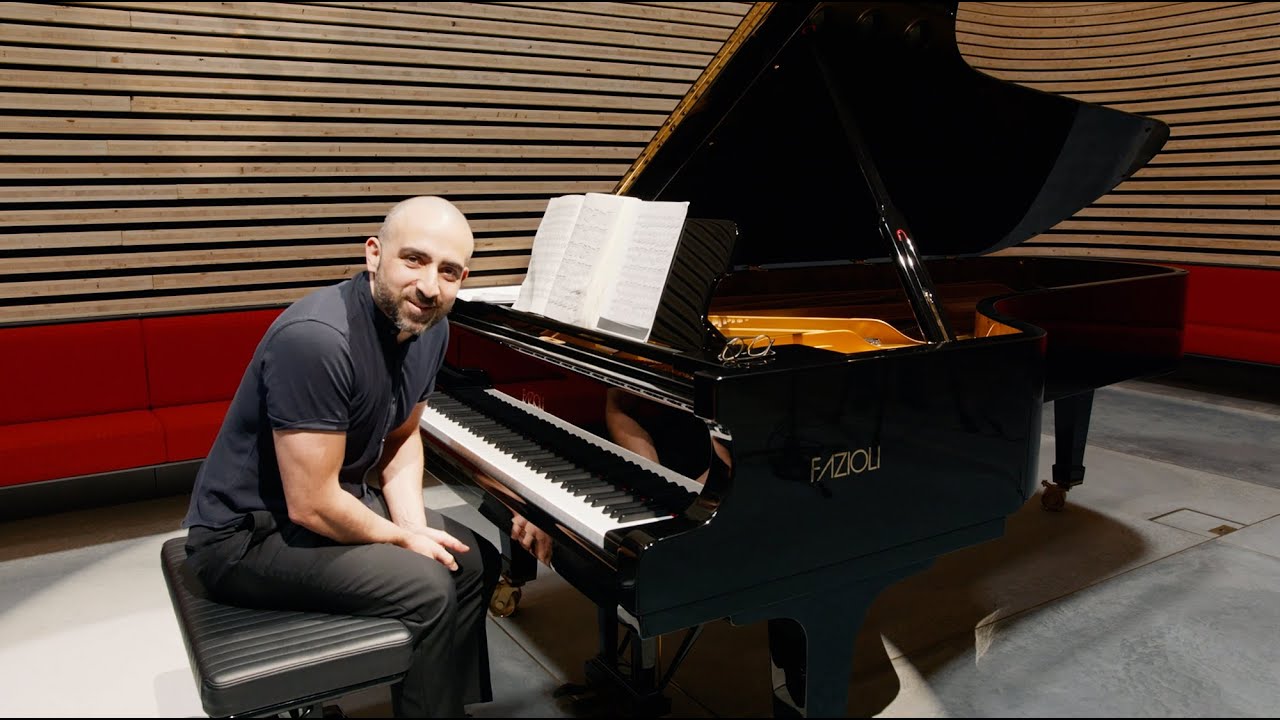
In the shot above, Jambazian is seated at a Fazioli instrument. In the Concourse, he had a Kawai that sounded rather tinny in its upper register; not that here’s much call for that in this score. But the effect was to make Goodwin’s elegant and resonant tenor present with extra character, particularly in his rapid-fire transfer of colour between songs that, in some cases, are over before they’ve begun. Both artists gave an ideal example of care with their material in Ich will meine Seele tauchen, Goodwin producing his four phrases with a restless subtlety of shape, Jambazian’s incessant left-hand demi-semiquavers restrained with only the postlude raising the temperature through that unexpected quartet of acciaccaturas.

Then the songs gain in tension, both artists giving Im Rhein an impressively full dynamic at the start before the work falls away, the singer drained of strength at his half-close while the piano moves steadily downward to negate the opening adamantine promise. Even better followed with Ich grolle nicht, the singer’s long notes smoothly manufactured and sustained – bars 3, 8, 9 and11 setting us up for a thrilling climb starting with a springing Ich sah’ dich ja and concluding with that punishing repetition of the lied’s title and obsessive keyboard finishing-off. More telling detail continued to emerge, like the sudden slower pace adopted for the final verse, Sie alle konnen’s to Und wussten’s die Blumen, and the piano’s lurch into disjointed triplet arabesques over the final 6 bars.

Jambazian took front row for Das ist ein Floten, insisting on his right hand contribution which always suggests a Mahler landler, while Goodwin made a powerful contribution as the heart-heavy observer. Again, the postlude impressed for its deft interweaving of action and gloom, right to that unhappy concluding tierce. In the following Hor’ ich da Liedchen klingen, Goodwin revealed once more his fine lyric insight, particularly his emphasis on Brust in bar 9 that signals a subdominant modulation that serves as a fulcrum, and later the measured delivery of his four last bars where the poet’s grief overwhelms him. The piano’s syncopated postlude impressed equally, particularly Jambazian’s emphasis of the sforzando-led inner part 7 bars from the end – a real out-of-the-depths moment.

Schumann’s counterweight Ein Jungling liebt ein Madchen, intended to lighten the ambience, achieves its end although the bitterness can still be found in the final couplet’s insistent repeated notes. As this pair demonstrated, any atmospheric lightening conceals a pain that goes beyond melancholy. Am leuchtenden Sommermorgen opened gracefully and amiably enough but something odd happened at the Es flustern und sprechen die Blumen line where Goodwin went off the rails momentarily; whether he’d jumped ahead to Sei unserer Schwester, I couldn’t tell but he recovered pretty quickly, Jambazian also made an equally uncharacteristic error in the song’s penultimate bar.

It’s rare that this tenor falters and his voice is such a refined instrument that you’re doubly surprised. It makes you nervous about what’s coming up and I lost track of him in the following Ich hab’ im Traum geweinet at the words noch lange bitterlich – probably my fault, but the song is pretty transparent. Then, a return to form in Allnachtlich im Traume, which is a lied guaranteed to display Goodwin’s clarity of production as it is left exposed without any distracting figuration in the accompaniment. Just as striking was the hunting-horn gigue Als alten Marchen, coming to a splendid declension at Ach, konnt’ ich dorthin kommen where both musicians found a mutual furrow of resignation that maintained traces of the initial joy in fairyland. The only question came with Goodwin’s restrained attack on Morgensonne that concludes the second-last line: an effort that didn’t quite succeed.

You could fine little to complain about in the final number, even if Goodwin’s lowest notes on the last syllables of the first stanza’s lines failed to carry – probably because too much was going on in the piano since the same notes came over much more easily in the poem’s concluding quatrain. Once again, you could relish the details, like that splendidly burnished ring on the top notes at Christoph, and that unforgettably consoling postlude that resolves from disturbance with unmatchable skill.

All three Rimsky songs – Na kholmakh Gruzii, Op 3 No. 4; O chem v tishi nochey, Op. 40 No. 3, and Oktava, Op. 45 No. 3 – are excellent example of the composer’s gift for generating a fluent line, although you’re hard pressed to find a point at which your interest quickened beyond an amiable imbibing . They’re a step up from salon songs, with the occasional burst of energy to give you something added to the mix. The first is notable for a vocal line opening that is packed with repeated notes before the composer sends both performers (including the tremolo-rich piano part) into a more expansive type of territory, including a splendid highpoint in the last lines of Pushkin’s poem. The next, a Maykov elegy, fell more into line with what was fashionable in France at the time: an infectious sweep to the melody, and plenty of crescendo/decrescendo surging up and down which is calculated to show Goodwin’s control to excellent advantage. Both performers invested the work with rubato and underlined its aura of veiled excitement; like Reynaldo Hahn, but a few steps outside the conservatory.

The addition/encore, again a setting of Maykov, is a florid address to the poet’s own verses and his aspirations for their success. This also builds to a powerful, brief burst of declamation on the final verse’s adverb ‘gracefully’ – which it almost was, thanks to Goodwin’s calm attack. The song’s unremarkable structure and material were well camouflaged by the obvious dedication of both executants, but it left us still waiting for something else. Sadly, the performers, with dutiful thanks to us, left the stage. A pleasure to hear the tenor, as always, and even better when he is appearing with a sympathetic partner. But they must have had something more in their combined repertoire, you’d think.

Joy in the afternoon

THE MARRIAGE OF FIGARO

Opera Queensland

Playhouse, Queensland Performing Arts Centre

Saturday July 25, 2021

Xenia Puskarz Thomas

To borrow the commonest of catch-cries: how good’s The Marriage of Figaro? Even better, seeing it in the flesh after some months of no opera on local stages. This Patrick Nolan-directed production represents the first major indication of life since the pandemic began in earnest. So it’s welcome both for breaking a long drought and for itself – the most beguiling and character-rich of Mozart’s operatic masterpieces. Added to which, Brisbane was clearly in the mood for it. This was a matinee but packed to the gills with enthusiasts coming from across all age groups, if the interval foyer was any guide.

Because it was an afternoon exhibition, we saw the second cast, which fact involved changes to only the main four principals. As Figaro, Timothy Newton replaced Jeremy Kleeman – which meant that he had a lot to live up to, Kleeman having built a sterling reputation since he appeared in a Musica Viva farrago some years ago. Susanna was sung by Katie Stenzel, in place of Sofia Troncoso – not much difference to me as I don’t think I’ve seen either soprano on stage [that’s wrong: I came across Troncoso in a Camerata concert last November]. The redoubtable Jose Carbo’s place as the Count was taken over by Shaun Brown; I know the former all too well, the latter not at all. And Eva Kong’s Countess gave way to that of Leanne Kenneally, both of these sopranos familiar to me from Opera Australia and Melbourne Symphony Orchestra appearances.

The rest of the cast remained constant, led by Xenia Puskarz Thomas‘ outstanding Cherubino: the production’s chief vocal delight. Hayley Sugars (Marcellina) was an unknown quantity, probably because much of her work has been in Queensland. Jud Arthur (Bartolo) is a regular with the national opera company and has also appeared for Victorian Opera. Tenor Bradley Daley (Basilio) is one of those singers that you feel you know well but, when put to it, can’t remember in what situation. As Antonio, Samuel Piper played a remarkably sober gardener, and Irena Lysiuk – like so many sopranos in her position – was deprived of Barbarina’s main chance to shine: L’ho perduta, introducing Act 4.

The company’s resident conductor, Dane Lam, headed the Queensland Symphony Orchestra – well, members of it – which has taken me aback mightily on previous occasions. No matter what’s happening on stage, the pit sound for Opera Queensland is top quality and Mozart’s brilliant overture emerged at concert hall standard. The only improvement would have been if the curtain had stayed down and we’d been spared the dumb show of Figaro moving in to his new quarters with chorus members carrying boxes and bed materiel across the stage in yet another vain attempt to provide visual stimulus from go to whoa. Why bother, when you’ve got white-hot effervescence in the pit?

On we went to the singing, Newton and Stenzel making fair work of the opening duet, although this Figaro could have made more of his sudden realization of the Count’s skullduggery during the Se a caso segment. The following recitative (all of them accompanied, so I understand, throughout the opera by Dane) was abridged and similar cuts were made at several points later on. Newton’s cavatina Se vuol ballare sounded confident enough, apart from the two si top Fs which were hurled out abruptly. I enjoyed this singer’s later Aprite un po’ quegl’occhi – addressed, as usual, from front of stage directly to the audience – but then that aria doesn’t rise above an E flat, And the Non piu andrai was dispatched efficiently yet lacked bounce and personality, especially in Figaro’s mock-heroic final 12 bars.

Stenzel’s character began well enough with a light touch throughout Act 1 and her interchanges with Sugars (their Via resti servita duet passed very quickly; was it cut?) pleased for their mobility as did her contribution to the trio involving Brown and Daley. The disguising of Cherubino throughout Venite inginocchiatevi went by without leaving a single memory (did it really happen?); Susanna’s Canzonetta sull’aria with the Countess proved too hard-edged for me, and it was taken at a pretty brisk allegretto which cut off any chances for indulgent dolcezza; but the Deh vieni was a highlight in a far too well-lit Act IV, that pizzicato support leaving this light soprano plenty of space to make her linear points without having to strive against orchestral force or vivacity.

Kenneally sang a forthright Countess, her character not given to self-pity yet not as aristocratic in bearing as you might have expected in the one person who should rise above the fray. Both the big arias – Porgi amor and Dove sono – came over with power and well-paced breathing control, but the singer’s vibrato strikes me as slow and steady, so it was something of a relief to reach the Ah! se almen moderate Allegro in the Act 3 aria. Still, the singer’s reliability and punch in the big even-act finales was very welcome in ensembles that occasionally veered towards muddiness.

As Almaviva, Brown made the most of some slim pickings: lots of ensemble work and rapid-fire recitative, but only one set solo. This last fared well enough, if rhythmically heavy-handed, but the inbuilt sense of outrage was present and – something like Newton’s opening solo – the only off-putting moment came with that top F sharp 8 bars from the end of Vedro mentr’io sospiro: a sudden blast of hefty effort cutting across the line’s carefully arranged phrases. Besides this one blip, Brown contributed with distinction to the Act 2 trio, and he kept his head through the audience noise that disrupted that moment of breathtaking humanity: Contessa, perdona.

The principal who put no foot wrong was Puskarz Thomas, who appeared to enter into her role with more conviction and energy than most Cherubinos I’ve seen. It helps if you are equipped with a smart-as-paint crispness of timbre and are working in a role that suits your abilities. For instance, her Non so piu made musical and dramatic sense (for once) with every note pitched accurately and her rapid phrases shaped with precision. Some time later, Voi che sapete impressed for its eloquent yearning and the naive assurance of Cherubino, who assumes that the world shares his outlook.

You could pick over this singer’s work but I took pleasure in small passages that often disappoint, like the Sospiro e gemo nervous semiquavers in the later pages of the Act 2 aria, and the clarity of her repeated B flats at ogni donna cangiar di colore and what follows in Non so piu. Another time, another place and we could have had two encores which, judging by the final curtain calls, would have been generally welcome. The only oddity came when the character was directed to mime disguising an erection; I’ve seen it done in other productions and, although it raises laughs, you’d have to work hard to find any such embarrassment consistent with the score.

Bartolo’s La vendetta aria impressed only fitfully, mainly as it reached its hectoring final strophes from Ogni Sevilla; but then Arthur had to labour against an improbable costuming and characterization which reminded me of a tennis coach of the Harry Hopman era – all whites and athletic bouncing around. Sugars sang a fine Marcellina, her mezzo clearly projected and working well in the Via resti servita duet and the Act 3 extended sextet Riconosci in questo amplesso even if some other cast members handled this recognition scene with a cack-handed lack of overt surprise. And I believe her Act 4 Il capro e la capretta solo disappeared; further, unless my concentration really lapsed criminally, so did Daley’s In quegl’anni in cui val poco so that his Basilio too seemed reduced to ensemble work. Ditto Piper’s Antonio (well, that’s right – he only gets some recitatives and the two big finales) and Lysiuk’s under-utilised Barbarina. Another gratifying aspect of the performance was the fact that the chorus – all 15 of them – stayed in tune and in time with Lam’s direction. The same could not be said of the Cosa sento trio in Act 1 where both male participants – Count and Basilio – at one stage wound up some way ahead of pit proceedings.

There isn’t much to say about the look of the piece. Modern costumes were all the go, the Countess’s outfits sometimes stylish and then grotesque. Marg Horwell‘s sets used grey as a fundamental, with wayward chandeliers resting on the floor another motif. A large sculpted head sat at front-of-stage for the duration, the associated body appearing for Act 4; probably a comment on the fate of unreconstructed aristocrats, and some decorative blood around the neck suggested that the premonitions of Beaumarchais might have been another of the setting’s reference points. As a production ‘look’, the result was deliberately shabby; nobody was going to much trouble over anything, least of all the upcoming nuptials, apart from a plethora of artificial flowers and a fountain of plastic cups.

Still, you don’t go to the opera to look but to listen. That’s right, isn’t it? In the end, this production held enough creditable arias and ensemble work to engage your attention and (sometimes) admiration. But the best points were that magnificent Act 2 finale, climaxing in a vital reading of the concluding septet, especially from the Piu allegro at Son confusa; and also the heartwarmingly buoyant Questo giorno di tormenti conclusion to the whole work. At these moments, you just shut your eyes – nothing is happening: the cast is just singing to/at you – and delight in unalloyed beauty. If a company can bring off these major points with success, most of a performance’s defects fall by the wayside.

Calm craft

BOWER

Genevieve Lacey & Marshall McGuire

Musica Viva

Saturday July 24, 2021

Marshall McGuire & Genevieve Lacey

This duo was scheduled to perform on Sunday July 25 at the Old Museum in Bowen Hills where I first made the acquaintance of Alex Ranieri and his Brisbane Music Festival. Because of lockdowns, both projected and actual, the recital could not take place here, so Musica Viva set up a video for us outlanders of one of the Melbourne performances – either Saturday July 10 or Tuesday July 13. The music came under a general heading/title that could have referred to the Australian/Papua New Guinean passerine that we celebrate for its catholicity of theft, or it might have been intended to summon up images of the leafy structure found in all the best gardens and wildernesses.

In fact, the name deliberately suggested both. In their little-over-an-hour of music, Lacey and McGuire raised an atmosphere of beguiling calm right from the start, walking on to a suggestive pseudo-set disposed decorously on the Melbourne Recital Centre stage. A scene of circumambient penumbra was focused on a lighting grid in which operated the two musicians, around whom spotlights shone diagonally to the roof with dry ice adding to the aura of being nowhere specific, although that soon faded with the opening work. Lou Bennett‘s Baiyan Woka, a Yorta Yorta song, was arranged for the recorder/harp combination by Erkki Veltheim; as well as giving Lacey the tune and several repetitions of it, the arranger provided an electronic backdrop incorporating relevant instrumental sounds, assorted percussion, and the hum that surrounds you in the deep bush.

What I enjoyed with this piece was the tight intersection of recorded and live strands which were not allowed to meander on their own sweet ways but kept together as a complex. Lacey used two recorders to outline Bennett’s melody and McGuire sounded at his best with low register output. The only questionable aspect were a rash of harp glissandi; no matter how much you try to turn these gestures into something old and strange, the suggestions of France are inescapable.

Moving back about 350 years, we jumped to John Playford’s The Dancing Master and a suite from that commodious collection that alternated sprightly with leisurely; nothing exceptional here but the playing which brought to the fore Lacey’s sterling talents in rapid-fire negotiations and lilting sweetness. As a pendant came Jacob van Eyck’s Bravade, with some paper interwoven with the harp’s lower strings (by Lacey, during the Playford cluster) to produce a light tambour effect, supporting the recorder’s brilliant elaborations in the Dutch piece, here handled with more metrical determination than you hear in many another version that feels drawn to rhythmic waywardness in works from the country’s musically dominant years.

Andrea Keller, whom I’ve only come across before as a jazz pianist, composed I Surrender during last year’s lockdown. It mirrors the nervous repetition of those days – nothing changes in lockdown, but you’re on edge – and moves into slowly administered additions to the melody line. I suppose the main difficulty with a pretty straightforward piece like this one is that it loses you in its own pattern-making, and that involved both players. At its heart I Surrender is unsurprising – normal and not over-ambitious – but you could relish the bird sounds inserted for Lacey (the first obvious ones I’d heard so far this night), and a suggestive, moody recession that rounded off the work.

As if to make up for avian absence, John RodgersBirds for Genevieve gave the recorder plenty of suggestive sounds in a cascade that included breathy over-blowing and passages of sparkling pointillism as the movement ranged across bird-calls with a lavishness that mirrored the male bower-bird’s taste for whatever falls in its path. Rodgers expertly fabricated a real atmosphere of controlled activity; not that any part of the Australian bush would have yielded the chain of calls that Lacey produced. But that’s hardly the point, as Messiaen could have told you. More impressive was the composer’s sustained contemporaneity: his piece sounded freshly minted, thanks to its novel material, and its language connected to a post-1950 creative world.

Lachlan Skipworth‘s Cavern was set against a sound-track of what could have been dripping water and clap-sticks. This set up a quiet but expectant aura which I found was disrupted by a reappearance of those salonesque glissandi from McGuire. Here, Lacey used a bass recorder, generating sounds that came close to a dijeridu, but much more clearly pitched and mobile. As a piece of suggestive music, it succeeded ideally in suggesting the composer’s experiences of a Margaret River area cave, the piece actually a cannibalisation of the first movement from his own Quintet for Bass Recorder and Strings.

Another contributor to this hour of patchwork came with Cipriani de Rore’s Io canterei d’amor, with Girolamo dalla Casa’s divisions on it, the whole a Lacey/McGuire arrangement, I know only the original madrigal and you could find plenty of familiar melodic fragments in this construct which gave some splendid extended ornamented flights for Lacey above McGuire’s functional chord work.

The next work was divided into five parts and I think I was able to pick them all out. Bree van Reyk‘s threaded in amongst the infinite threading began with Lacey taking up a contrabass recorder which looks rather like an organ flue pipe and interweaving (as you’d expect) with McGuire in a mildly tortuous manner, before moving to a new section with percussive work in the harp’s bass, eventually featuring some snatches of Bartok pizzicato, the recorder also showing itself a tappable, snappable sound source. The piece’s middle gave us bird sounds on a regular recorder, above harp ostinati and what can only be called scrubbing. Then, a shift to a sopranino (?) instrument operating in its top range, the harp also occupied in its highest strings, before a final section used the contrabass as a melody source while the harp produced telling isolated notes and further scrubbing.

Most of my notes concerned themselves with the accidents of this piece rather than what actually went on. And it seemed that appearance-in-performance constituted a large part of its effectiveness. Van Reyk’s musical language is based on the tonal system, but with digressions, sections apparently linked by harp bridging, but its philosophical underpinnings went way over my head. Unlike Froberger’s Lamentation on the death of Emperor Ferdinand III, here a solo from McGuire which enjoyed a free-wheeling attitude to rhythm but proved to be affecting in its use of almost predictable tropes, capped by a remarkable ascending scale in the final bars.

Veltheim’s own Nocturne over blue ruins involved a prominent tape contribution as it attempted to take on the bower-bird concept, here realised by single harp notes alternating with dyads repeated mercilessly. For some time, I had no idea what the recorder (bass) was doing, finding its timbre almost indistinguishable from the electronic sounds; possibly single notes were emitted but they did a successful job of attracting absolutely no attention. Veltheim has based his work on the bandwidth of the colour blue – the bower bird likes blue – as well as the bower-as-shelter concept. Of all the pieces in this program, this was most reminiscent of a ‘happening’ piece, in the old 1960s sense; but then, from its content, it was also close to the most non-happening work we heard, packed as it was with white noise and mind-numbing repetitions. In fact, there was no need for the work to end; we could be listening to it still.

Last of the modern works in this aural scenario that leapt whole centuries at a single bound was a collaboration between Madeleine Flynn and Tim Humphrey: A mutual support for precarious times. This would seem to be an improvised work, in that it takes a different form every time it is played, according to the creators. This piece also had a scene-setting soundscape, across which Lacey contrived some telling wobbles on her contrabass while McGuire did the contemporary thing by slapping his strings. The work’s background included some good old-fashioned sine wave sounds, with all sources indulging in sudden flickers that sounded like neurasthenia given physical form.

To end, we were given two luminous splendours, serving as memorable branches in the shape of this shelter. First, a version of Purcell’s Evening Hymn in which Lacey gave a brilliantly shaped vocal line to McGuire’s just-rich-enough continuo support; to a sensibility as time-warped as mine, that advent in bar 69 of the composer’s light but strong Hallelujah chain is one of the most wrenching passages in music, carried out here with near-flawless beauty. Then, arranged by Rodgers, Biber’s Passacaglia for solo violin, which closes his Mystery Sonatas, found the players sharing the load by swapping bass and treble, as between bars 73 and 92. Despite this even-handedness, the piece gave us a chance to revel in Lacey’s brilliance of timbre and agility, especially when the hemi-demi-semiquavers started flying at bar 41, not to mention the rapid-fire same-note triple explosions across bars 115 to 120. This light-filled sequence of brilliant effects made the happiest of conclusions to a remarkable – and deliberately miscellaneous – program.

An unfamiliar voice emerges

MIRABILE IN PRAGUE

Prague Radio Symphony Orchestra

Move Records MD 3448

It isn’t every day that you come across a local composer who has managed to get his work recorded by a well-known European orchestra, directed by a notable musician who has been active in Australia for many years. But that’s been the case for John Allan who has managed to achieve this fortunate outcome, one that is unfamiliar to many a better-known writer of serious music in this country. You’ll find seven tracks on this CD, two of them arrangements: Debussy’s La soiree dans Grenade, the central one of Debussy’s three Estampes; and the Scherzo from Brahms’ Piano Sonata No. 1 in C, his Op. 1.

The original pieces begin with an Aeolian Caprice, which was initially a piano solo but, 15 years on, Allan decided to orchestrate it. One of the major works follows, a Fantasia on Mahler’s Purgatorio: a variant on the third movement from Mahler’s incomplete Symphony No. 10. At the centre of the disc sit three works with the Latin adjective ‘mirabile’ in their titles. The first, like Aeolian Caprice, began life as piano solo celebrating the birth of the composer’s daughter; it was orchestrated a year later, then revised six years after that. As well, there’s Mirabilia Antipodia of 2005 which offers variations on the original ‘mirabile’ theme. Finally, another one of four Allan works that use the same motif/theme, comes Marcia Mirabilis – written a year before Antipodia but revised several times since: in 2010, 2014 and 2017 . . . which makes it the most recently visited work of the seven. The whole lot adds up to a little less than 49 minutes of music.

When I see a title like Aeolian Caprice, I’m reminded of occasional pieces, post-Mendelssohn in character, for amateur pianists. Of course, the naming is ambiguous: it could refer to the Aeolian mode, or it could refer to the Aeolian Islands north of Sicily, or it might be suggesting the wind-driven Aeolian harp. It starts with a suggestion of everything; clarinet-led low melody, low brass following the same pattern, until an orchestral explosion of some power, even if the heftiness is over-bearing. Then comes a series of full-blown melodies, with something a bit odd about the ensemble chording for wind and brass; can’t put my finger on it but it seems very thick and imbalanced. As the work proceeds, the texture gets thicker, then cuts back to leave the violins weaving a spacious melody, which yields to a clumsy passage for wind and percussion.

By this stage the metrical pattern is well established: a swinging (slowly) triple metre which doesn’t endear itself by a lack of variety. In fact, the piece impresses as unsophisticated, the disposition of forces clumsy, the crescendo towards the final-bar climax elementary in style. It’s the earliest work on the disc, and you can tell. As for those worries about Aeolian, I’ve no idea at the end. Probably not the harp; the score’s opening has the faintest traces of Bax’s Tintagel, so maybe the Sicilian islands.

Allan’s Mahler essay follows. Its main feature is to change the time-signature: the original 2/4 goes by the board for a deliberately unbalancing 5/8. That aside, half of this track’s length – no, a bit more than that – follows the original framework pretty closely; that is to say, you can ‘follow’ the published score’s flow without difficulty. Naturally enough, Allan has imposed his own orchestration (who hasn’t?) and so the textures have only shadings of the original. But motives and bursts of melody are transferred between woodwind, for example, or even interchanged between brass and strings. Allan moves away from this a little after the 6 minute mark and manipulates Mahler’s material for the final three minutes.

To his credit, the new score stays close in material to what we have heard already – through a glass splintered – and the entire exercise has an undeniable coherence. But, as the Australian composer observes, the work is changed considerably, its emotional intent less apparent, and the sound fabric less incisive. The whole thing is a clear homage but you aren’t quite sure what has been accomplished here. Allan takes the wind out of your carping sails, however, by calling his score a fantasia – which allows him absolute freedom; the wonder is that he didn’t take more.

At the opening of the root work Mirabile, you are reminded of Delius: a melody slowly rises out of a brooding bass before that melody is pronounced clearly in a solo horn, the lyric shifting harmonically – just like those incessant Delian bass murmurings. As the work progresses, there are shades of Hollywood sound-tracks, with some broadly swelling climaxes and plenty of swoops and ascents for the Prague orchestra to enjoy. Eventually, we come to a broad tutti statement, loaded with swelling strings. But there is also a sort of astringency added to the smooth surface with an input line or two from woodwind and/or brass. The ending is a reinforcement of the score’s orthodox harmonic nature, a triumph of sentiment over spice.

You’d like to think that Mirabile Antipodia has reference to this side of the world – Australia Olympica – but it’s more probable that the reference is formal. Allan has here transposed the voluble ‘mirabile’ theme for this piece; no, more than transposed – he has inverted it in the best Baroque or Webern fashion. The results are more disturbing than in the original work, as the accompanying material has taken on a harmonic complexity that the original didn’t contain. I found the writing here to be more sinewy – or the music’s workings were more discernible and the harmonic language a good deal more complex, although Allan cannot avoid popular tropes, like the downward movement for brass a little after the 3-minute mark, and the following full-orchestral blasts that lead to a full-blown peroration of large proportions, something like Berg piling up his forces. The whole thing then suspends for a reminiscence of Tchaikovsky – the melody’s there, if the supporting surrounds are different – before reverting to several restatement’s of the inverted ‘mirabile’ and a big finale.

So, in a real sense, this is a converse piece which largely avoids the sweetness and predictability of the previous track. Even if Allan indulges again in the lush orchestral resources available to him, they are much more interesting in their application. You feel that his compositional development has resulted in more confidence as a manipulator of possibilities. Mind you, I still think the textures are over-full, despite an attempt to add sparks; a fair bit of the brass writing is pure weight, a mid-ensemble spread.

The march based on the ‘mirabile’ melody would drive any corps to revolt: it’s too slow for military use. Not that you’d take as a principle that all marches have to be marchable; now that Tchaikovsky’s been mentioned, I can think of three major marches from his pen that also don’t fit the regimental bill. In fact, there’s not a good deal to be said about Allan’s march. I eventually found the relevant theme in the content, mainly because its initial phrase is eventually repeated till even the meanest intelligence gets the picture. This is the longest track on this CD, twice as long as the preceding tracks using the same theme; ditto for the Aeolian escapade and the Debussy rescheduling.

There’s a certain pleasure to be found in this work which strikes me as often being a bit of a ramble, despite its jaunty nature which carries it across quite a few trio interpolations. Still, it is very diffuse and, despite the efforts of Kram and his players, it could have stopped several minutes before it actually reached its big finish. Perhaps, if the composer revisits it for a fourth time, he might consider a touch more lopping than grafting because the unavoidable feeling at its end is that all concerned were labouring at their work – not that you could find much here to exercise them unduly.

If you want a benchmark for happy Debussy transcriptions, it’s hard to look past Grainger’s marvellous and richly textured arrangement of Pagodes for harmonium and tuneful percussion which I’ve heard live only once – at a John Hopkins Prom in the Melbourne Town Hall, I seem to recall. It’s colour without self-consciousness. Allan’s reworking of the next Estampe, Evening in Granada, is an orthodox piece of work in which most of the intervening chord work (bars 17-20, in the first instance) is scored in pragmatic fashion, even if the Prague players are not exact in their chord weighting. Also, I was pleased that the arranger took his time before introducing the inevitable castanets (bar 33). The horns came across as far too prominent in the Tres rythme segment; the piccolo at bar 98 was inaccurate; both Leger et lointain sections were far too slow; and surely the G sharp at bar 112 has to resolve two bars later.

Brahms’ scherzo is heavy in its humour, even in the piano original which I recently heard from one of the Sydney International Piano Competition entrants. Allan can’t do much to perk up its weightiness, although he comes close to it across the outer section’s reappearance. To his credit, he tries everything, not just content to make one version and leave it to be repeated; he’s re-scoring wherever you look. The only time anything is really unstuck is in the Trio where the chord at bar 13 – especially its top B flat – is bloated and painful to hear. Against that put the clever re-thinks that came up to revitalise your interest and you can be grateful to Allan for carrying off pretty well what many of us would have considered to be a thankless task.

An intriguing enterprise, this CD. It sounds as if David Kram and his Czech musicians could have gained more certainty from further rehearsal, as Allan could have benfited from the luxury of altering his orchestration at leisure after hearing it. But I admire the effort involved in getting the whole thing recorded and giving us the chance to make the acquaintance of this composer and his catalogue. What we have here is a small sample of his actual output, but it’s something to be going on with while we wait for the larger-framed scores to emerge – possibly from Kram and the biddable Praguers.

Unfortunately, that’s life

BARTOK, MY FATHER

Flinders Quartet

Melbourne Digital Concert Hall

Thursday July 15, 2021

Richard Piper

The rationale behind this digital broadcast was to spread far and wide something other than the pandemic. Constraints on the Flinders Quartet’s touring schedule ensured that many of its admirers would miss out on this program concerning the life and music of Bartok as seen through the eyes of his son, Peter. Hence the MDCH taking this venture into its packed schedule. In fact, the real mover and shaker in this enterprise appears to have been actor Richard Piper, who apparently made contact with Peter Bartok before his death early last December. Quoting from his own correspondence and from the book that gave this recital its title, Piper provided the filling between performances of some Bartok scraps, as well as the mighty Quartet No. 5 of 1934.

The actor’s contribution to this entertainment lies outside my purview; suffice it to say that the autobiographical excerpts slotted in deftly with the whole quartet movements, the last piece of the evening’s playing suitably celebratory. Piper seemed upset at one stage when dealing with the composer’s death, but that’s understandable; in the descriptions by Peter Bartok, the great composer’s American years appeared to be a welter of poverty, dislocation and illness. Well, there’s little doubt about the last, but Bartok was frail life-long. As for his living circumstances, interested parties in America have been anxious to downplay any suggestions of penury, although those of us brought up with Agatha Fassett’s The Naked Face of Genius would tend to differ. Certainly, the country of refuge, in particular its scholarly institutions, treated him poorly but, as far as European refugees in general during this period, that story is not uncommon.

Three of the small pieces inserted between readings came from the 44 Duos for Two Violins of 1931. Folk tune arrangements intended for pedagogical purposes, these are some streets away from the composer’s heftier products and these three performed for us begin the third volume of the four-tome series. First violin Thibaud Pavlovic-Hobba and second Wilma Smith accounted for No. 26, Teasing Song, with lots of fervour, rather more loud than the score suggests. Further along the night, the following Limping Dance was transposed for Helen Ireland’s viola and Zoe Knighton’s cello; this is a brief melody of no particular distinction but Bartok spikes it with plenty of sforzandi – 38 across the piece’s 30 bars. For the most part, these didn’t register – there must have been a momentary haze over my acoustic radar.

The third duo, Sorrow, has an introduction and mirroring postlude, the melody appearing twice – once simply outlined in the first violin, later given more intense handling by the second violin’s use of double stops. This made for a moving experience after Piper’s reading of accounts to do with Bartok’s last days and death. But then, of the three duos, it gave the players most meat to deal with, musically and temperamentally.

The exercise’s real focus lay with the Fifth Quartet. After a burst from Piper reading Peter Bartok’s early reminiscences about being his father’s boy-son-student, those trademark unison/octave B flats at the Allegro‘s opening made their usual stentorian effect, but some cracks started to appear early. The octave work between violins at bars 8 to 13 sounded untrue in intonation; Ireland’s viola sounded just as unhappy at bar 52, although a restatement-of-sorts at bar 70 was more secure; Knighton made little impression up until some splendidly carrying trills cutting through at bars 79 to 81. Despite all four performers showing tempo and dynamic control, the violins still showed discrepant across bars 87 to 96, an all-too-exposed passage over the lower strings’ overlapping ostinati. For sure, you could hear other places over this movement where the violins collaborated effectively – but that made the unfortunate moments all the more prominent.

Following verbal pictures of Bartok’s devotion to nature, forests in particular, the twitchy premonitions of night music beginning the Adagio molto gave way to those unexpected sustained chords from the three supporting players under Pavlovic-Hobba’s isolated chromatic motifs. This brief movement moved past without grief, even if it could have gained from a more meditative pace at the Largo rounding-out, and more care/precision across the segment’s crisis: the Piu lento beginning at bar 35.

Following a description of Bartok and Kodaly conducting their folk-song recording across Central-Eastern Europe (and beyond), the Flinders hit the mellifluously off-centre 4+2+3/8 Scherzo and made more of this set of pages than anything previous, coming to an early high-point in a riveting burst of vehemence at bar 30, and then some excellent performance diplomacy at the movement’s Trio, Pavlovic-Hobba making a marvellous surging creature of his melodic responsibility. The series of duets during the repeat starting at 71 sounded unhelpfully flabby but lapses of that kind were mercifully few and brief.

World War 2 arrived and Bartok left Hungary for America, a life-crisis that fitted in well with the ensuing Andante, which is the work’s fraught heart. After a successful short crescendo complex, the arrival point at bar 60 and after would have impressed more with greater uniformity of attack. Further on, both violins were too loud in the disposition of fabric importance at bar 82’s Tranquillo, although this imbalance could not erase the extraordinary beauty of this movement’s last phase.

Paul’s reunion with his parents in New York and their subsequent life there was covered, including several unpleasant vignettes, before the Allegro vivace finale started. I found much of this movement pretty rough around the edges, and it was hard to discern viola and cello at many places. Still, rays of light broke through, like the lightness of being at bar 485’s Allegretto capriccioso and the efficiently quavering block chords beginning at bar 673. But it is a furious slog, with precious few breaks and the final bars impressed as hard won – for Bartok, the players, and us.

Then came the end of the war, the composer’s swift succumbing to leukaemia, and death in September 1945, followed by the Sorrow Duo No. 28. Then, as a sort of summation, the Flinders musicians capped the celebration with the second movement, Allegro molto capriccioso, from the String Quartet No. 2 – an affirmative statement coming from the composer’s mid-life point, even if also mid-World War I. Here, the music-making (on a large scale) was at its most cogent and bitingly clear, a reading that got more engaging as it moved past. Its positioning was excellent, displaying Bartok at his energetic best. Yet, taking the program as a whole, the players did not sound comfortable with each other. Of course, rehearsal time would have been limited, given Melbourne’s unfortunate pandemic situations; but it’s clear that, even if these musicians have known each other for years, they have much work to do in becoming a convincing composite ensemble.

And then there were none – well, six

SYDNEY INTERNATIONAL PIANO COMPETITION

Session 22

Thursday July 15, 2021

Alice Burla

The only Canadian entrant and semi-finalist, Burla performed on a Steinway in the Musik Akademie, Basel; she made her recording of this program on March 28 and specified her theme as ‘Spiritual Journey’. Well, most of us would be prepared to go along with that when it comes o the last item played: Messiaen’s Regard de l’esprit de joie, No. X in the Vingt regards. But it’s more than a tad trite to claim Bach’s Overture in the French Style as spiritual, even if the consensus is that Bach wrote everything with a written or implied Laus Deo at the head/completion of every work, like the Ad maiorem Dei gloriam initials we were trained to put at the top of every written page at school. And you’re probably stretching it to find the spiritual in Debussy’s Feux d’artifice or Minstrels. There might be something to be said for Les fees sont d’exquises danseuses and Ondine if spiritualism is your bag and ephemeral beings have reality for you.

Whatever, Burla opened with Bach’s overture/suite and sent us hurtling back several decades to her countryman Glenn Gould and his remarkable Bach interpretations – free of Romantic blather and heavy pedalling . Her negotiation of the Ouverture‘s initial fits and starts, all that ornate ornamentation and abrupt turns, impressed for its sheer competence, particularly in laying bare the polyphonic skeleton, Burla played the first repeat before launching into the lengthy fast section which seemed to gain in mastery and interest the longer it lasted. Piano and forte contrasts passed by without overkill and the metrical drive was maintained without recourse to interpolated decelerandi – only the slightest trace at a few harmonic transitions. Sadly, Burla didn’t repeat these pages; but then, who does?

So on we moved to the dance movements, leading with a perfectly poised and accurate Courante. A right-hand trill flaw (bar 17) rippled across the limpid surface of Gavotte I, while the second showed this performer’s sense of style, of what’s appropriate when faced with what in Bach passes for bucolicism, here spiced up through a few delicious imposed triplets. The pair of Passepieds furthered your admiration for Burla’s precision of delivery, the second pellucid in the organization of its three lines. Bach’s Sarabande enjoyed a good deal of ornamental accretions but moved past all too rapidly, even if Burla observed both repeats, as she did with every number after the Ouverture. A flawless couple of Bourees led to a reading of the Gigue that would be hard to equal for its level-headed bounce and apparent ease of production, the whole apparently free of sustaining pedal use. Only in the Echo, at bar 26’s top B, came the slightest sign of a faltering.

You found it hard to take issue with Burla’s Bach – straining at gnats that were so infrequent as to be unimportant. I much preferred its sense of purpose and admirable control to her Debussy group, extracts from both books of Preludes. Even though she showed an unfoolable eye for the French composer’s finicky washes, her interpretation of Les fees etc. sounded over-studied, not as loose-limbed as anticipated and realizable in a convincing rendition. You could say the same about Ondine – you were often conscious of the bar-line – but Burla handled the effects and sudden rushes in this twitchy piece with a fine spiritedness, imposing a cooling veneer over the unsettled surface.

Much better came with Minstrels, although it seemed that Burla was following a latter-day trend of belting into this piece’s little bursts of ragtime, giving a lot of weight to its louder passages; yet in my old Durand edition, the only fortissimo comes in the final two chords. As for Feux d’artifice, the interpretation was exact in tempo, no matter which section you took, and sensible in giving the accompanying figuration its right value as a presence in Debussy’s fabric. I couldn’t swear to it but I believe Burla avoided the sustaining pedal until the score moved into three staves. The only question arose with her deliberate pause at the third-last bar.

The pianist spoke before starting her French bracket of identifying strongly with Messiaen; well, it could have been worse. As she worked through this rhapsody, I was working hard to glean some of the delight that Burla was trying to transfer but it looked as though she was working through a fiendishly difficult exercise, the whole effect a set of hurdles and any interest arising was conserved for the startling passages at both ends of the keyboard. Those hard edges of her Bach reading came to mind – all very precise, the ecstatic melodic sections ringing clear – but the result was less spiritual journey and more well-exercised bravura

Antonii Baryshevskyi

The second Ukrainian semi-finalist (standing alongside Artem Yasynskyy) and last of the competition’s twelve semi-finalists to perform, Baryshevskyi recorded this program in the Fazioli Hall, Sicile on March 17. His theme sounded cosmic – ‘Imagination’ – but he brought it down to earth with some halting introductions. As far as I could make out, this musician thought that each of his work had a program; maybe so, but you had to work hard to find it at the end. To be sure, his major offering was one of the more impressive examples of imagining in Western music, as we were (yet again)) admitted to the colourful semi-autobiographical world of Schumann’s Carnaval. A different kind of imagination emerged in Ravel’s Jeux d’eau: lapping with glittering cascades and sonorous buckets. And bringing up the rear came Messiaen’s Regard de l’esprit de joie – for the second time tonight, rounding out a program which struck me as an organizational oddity.

The Schumann Scenes mignonnes strutted out in a firm Preamble, turning into a rush at the Piu moto but the piece came off with excellent fidelity to the composer’s desire for a boisterous whirlwind. I was grateful to the pianist for his piano and forte juxtapositions: they weren’t all exactly the same in weight or lack of it. Throughout the score, Baryshevsyii made a moveable feast of repeats, avoiding them in Pierrot and Arlequin, this latter taking on unexpected weight, despite its innate skipping character. The Valse noble lived up to its adjective as the swooping of the bookend bars gave place to a gentle, malleable middle section. Eusebius enjoyed a placid, spacious interpretation – probably too kind to this wilting milksop, whose delineation was blessed with a fine left-hand contribution.

Florestan erupted onto the scene with an excellent mixture of enthusiasm and mania, the piece’s progress featuring one very loud passage. Baryshevskyi displayed individual ideas on dynamics in Coquette, all of them comprehensible if not in line with Clara Schumann’s directions. The pianist’s Papillons came across as sturdy insects who didn’t benefit from a D. C. ad libitum but fitted in with the ensuing spiky Lettres dansantes. Still, we were clearly in a vitality-loaded groove and Chiarina impressed as headstrong and muscular, although fortunately, Chopin enjoyed a rich bout of nocturne-like musing.

Estrella came over as particularly wayward (what is it about Carnaval‘s women?), and the bubbling Reconnaissance made a welcome appearance for its light character after some rich personalities. With Pantalon et Colombine, we’re back with the commedia dell’arte crowd, but this couple’s musical presentation was accomplished with splendid precision and plain-speaking., the which qualities also covered the Valse allemande. Paganini was all passionate, pell-mell action, fiercely rapid virtuosity, while that melting-moment Aveu enjoyed well-placed rubato during its second repeat. Both Promenade and Pause prepared the ground, in waltz-time and a headlong rush respectively, for a pompous Davisdbundler March, which turned into an object lesson in acceleration with a satisfying rush at the last Piu stretto. bringing this whole work to a satisfying, oddly agile conclusion.

He’s not just an urging player, though. Baryshevskyi made a glittering object of Ravel’s water-works, never forgetting the actual music by giving excellently judged weight to each bar, with a fine eye for the small notes and their place – present but fleeting – in the work’s progress. As an instance, you could see this discretion at its best in the chains of soft 2nds across bars 80 and 81: a soft cloud present, but that’s all.

As for this version of the Messiaen exuberance, I found more joy here than in the Burla performance. It’s still a series of events but the seams weren’t as obvious in this player’s portrayal. On the whole, this Regard struck me as more consistent because it was able to make its points with more weighty emphasis in the chugging centre-of-the-keyboard passages. As well, this reading involved you in its emotional scope. In other words, Baryshevskyi had the ecstatic rhetoric right in what was probably the best Messiaen performance I heard across the competition so far.

*****************************

Actually, so far is as far as I want to go. The finals begin in about 60 minutes from now but I’m not that interested. The jury has gone for Alexander Gadjiev and Adam Balogh, which I certainly endorse. Among the other four – Shion Ota, Calvin Abdiel, Artem Yasynskyy and Alice Burla – I heard exemplary performances in the semi-finals, but not much consistency across their programs. Worse, I can think of two in the penultimate twelve who haven’t cracked it for end-of-competition consideration and who would have brought me to my feet if I happened to be many decades younger.

Enough said; certainly, enough written about this oddly moving but half-cocked enterprise.

Pair give variable value

SYDNEY INTERNATIONAL PIANO COMPETITION

Session 21

Wednesday July 14, 2021

Yu Nitahara

One of two Japanese players to get this far, Nitahara took as his theme ‘Music born out of grief’, picking out two works that had their genesis in sad times for their respective composers. This musician used a Steinway sited at the University Mozarteum in Salzburg, recording his program on March 20. In the first instance, we heard Mozart’s Piano Sonata in A minor K 310, written near the time of his mother’s death and eventually showing marks of emotional stress. As a companion to this, Nitahara performed Mussorgsky’s Pictures at an Exhibition suite, written about the art, and in memory, of his friend Viktor Hartmann.

As seems to be customary in performances of most Classical and Romantic era sonatas, Nitahara offered no repeat of the Mozart’s Allegro maestoso exposition: a shame as it would have given us another chance to relish his sparkling treatment of the Non piu andrai bars 45 to 49. Although perhaps he might have been better served observing the second repeat after a spot of fumbling almost amounting to a stoppage at bars 72 to 73; a memory lapse that came out of the blue in the middle of an easy-flowing performance of ceaseless phrasing variety and a consistency of dynamic across the movement’s canvas.

More eloquent contouring came with the right hand outline of Mozart’s Andante cantabile (no repeat here, either) which seems to me to be one of the composer’s most benevolent mid-sonata movements. You come across a darkness that could suggest mourning at bars 43 to 51, but you’d be straining to find tragedy at any other stretch of this chaste benevolence . Nitahara was weaving a fine web until a simple error crept in at bar 69; so close to the end but enough to jolt the listener from bathing in the player’s excellent negotiation of these pages. Then the Presto finale worked well for its subdued energy, even if the pace sounded forced. No repeats at the A Major interlude; God knows why not – the halves are brief enough. A few slight errors crept in during the later stages, yet this pianist came up with an engrossing realization of those urgent last 27 bars.

Unlike some competitors, Nitahara has a massive stretch, with the largest pair of hands I’ve come across for many years. Yes, it might have been over-emphasized because of the camera angle, but I doubt it – he’s just spectacularly blest. Well-equipped then for the multiple tests of Mussorgsky’s gallery visit. A forward-thrusting Promenade sprang straight into Gnomus where the Vivo bursts were taken too rapidly. No troubles with the remaining elements, but a pity that the final top G flat didn’t sound. An excellent delineation of The Old Castle followed, gifted with a subtle fore- and backgrounding of the G flat ostinato; many pianists don’t bother, just letting it function as a bland drone. Nitahara probably over-favoured the tenor line’s downward creep in the 9th and 10th last bars.

A Mozarteum piano, but at this point I was confirmed in a belief that the B4 was slightly out of tune. Not that you could pick it out that easily in the Tuileries movement, even if it appears at the top 12 times in the middle interlude. This interpretation saw Nitahara exercise an individuality of sorts, taking his short breaths where he saw fit and stopping the patterns from becoming mechanical. Bydlo came through with a ponderousness that you could not fault. I didn’t see the point of that small hesitation before entering bar 16 – there’s a harmonic change but it’s not worth inserting a small boulder in the wagon’s path. Approaching the end, the player left his diminuendo until too late, I felt; in my edition, it can start as far back as when the treble clef goes back into the bass.

Nitahara’s Dance of the Unhatched Chicks impressed for its ideal light touch and high interest level; always a wonder how Mussorgsky brings off this brilliant aural image and the performer met expectations with delectable crisp ornamentation. I’m always unsettled by The Two Jews, even if the achievement of character is strikingly successful. But this reading could not be faulted, showing a fine schizoid even-handedness across the Andante. Grave combination.

That muscular (and substantial in length) final Promenade preceded a bustling and accurate picture of the Limoges Market, loaded with pianistic chatter that later smacked of the relentless, the whole rounded off with a sweepingly active four final bars before the safe stasis of Catacombs and its trembling pendant, Con mortuis. Nothing much to say about these quiet passages of play, the dead minor-key promenaders rustling unhappily before the composer’s light-filled final promise. Baba-Jaga hurtled in, all her sforzandi intact and only a few notes misfiring in the last third before a driving rush to The Great Gate – a gift to every pianist but especially one who can negotiate the clangour when the bells start. This movement held an impressive, full-bodied grandeur about it, the chant interludes treated with respect rather than impatience, and the final Meno mosso‘s bounding minim triplets across the bar burst on us with their satisfying, swingeing mobility.

Artem Yasynskyy

One of two surviving Ukrainian players to make the semi-finals, Yasynskyy came to us from the Artesuono Studio in Cavalicco (I think it’s in Udine), recording his program on March 31. Another performer who spoke before each offering, Yasynskyy worked at a Fazioli (an F278 Mk III?) as he proffered a set of four rarely-heard works – and their lack of currency was his theme, I gather. He was spot-on with his assessment; I’d never come across any of these rarities: Britten’s early Holiday Suite Op. 5, Myroslav Skoryk’s Prelude and Fugue in F Major, Jehan Alain’s L’oeuvre de piano Tome III, and Josef Hofmann’s Characterskizzen Op. 40.

Yasynskyy spoke at some length about each of Britten’s four pieces but, when he got to the centre of the first – Early Morning Baths – the sunny aspect had clouded over; his approach was fittingly fluid and flashy in its clever slashes yet the piece was heavy-going – more boarding school showers than anything to be remembered with pleasure. From the opening, Sailing could have been softer in dynamic, if the score is any indication, and the player might have handled it with a good deal more leisure, even a lackadaisical approach; for instance, Yasynskyy’s rendition of the central part where the winds come on strongly was not whimsical at all – no mucking-around-in-boats here but a near-escape from the North Sea.

At the Fun Fair, again, the approach proved over-aggressive, without much bustling pleasure imparted. Britten’s exuberance dissipated under a Prokofiev-like determination so that some rows of booths and rides came over as more duty than delight. In sum, the piece sounded like a study. But Night resisted hard-dealing: a series of chords at either end of the keyboard, investing the fabric with calm – the whole accomplished very satisfactorily as the performer inserted the middle motifs in keeping with their surrounds: smoothly, the notes telling but not made over-important.

Skoryk is a fellow countryman of this pianist – well, he was, and Yasynskyy played for him early in his life. The work is an odd amalgam of your anticipated formal structure and jazz, the prelude making its way through some bluesy chords and sequences. The whole impresses as a very sophisticated form of improvisation, the free-wheeling jazz elements undercut by conservative patterns and procedures. More memories of Brubeck and the MJQ rose up during the fugue with a stride bass cutting in after the subject’s introduction. As far as I could tell, it was in three voices, all formally announced before a sort of continuing oscillation between technical procedures and Newport on a summer’s day.

I know very little of Alain’s music, apart from Litanies of 1937, which I first heard performed by the composer’s sister, Marie-Claire, in Melbourne’s St. Patrick’s Cathedral – a memorable experience . His three Tomes of piano pieces seem to be collections from across his short compositional career and once more the performer gave introductions to each of the four in Volume III, although the content told us little about the individual pieces. Etude on a theme of 4 notes is just that, although its processes seemed more various than sticking to the title’s limitations; I’m sure a serious analysis would show the writer’s veracity. The piece is an atmospheric delight, leading past three discrete segments to a florid finale, negotiated with panache in spades. Second, a Petite Rhapsodie – half slow and half rapid – made little impression, apart from Yasynskyy’s taking liberties with the tempo, as though the option was left open whether or not to follow directions.

The same applied in the following piece based on Villon’s Ballade des pendus where the simplicity of its material begged for imposed interest, like a freedom of movement, reading accelerando in with crescendo, and storming through the admittedly massive treble chords at the piece’s highpoint . There’s a case to be made for fleshing out spartan material, of course: the whole early music scene relies on such dispensations. I’d like to hear this again, though, played straight. Finally, the Tarass Boulba piece left me nonplussed. It has the spectre of Bartok rearing over its block chords, coupled with Prokofiev for the work’s hurtling rigour. But what aspects of Gogol’s Cossack hero were meant to emerge, beyond galloping across the Zaporizhian countryside? Not a hindrance to Yasynskyy who gave it an idiosyncratic interpretation of impressive fervour.

Hofmann, reputedly the greatest pianist ever, was a prolific composer and this performer issued a CD in 2015 of some Hofmann works, including these Character Pieces. Naturally enough, the performances proved to be extremely proficient and authoritative. The first, Vision, showed Hofmann’s work to be a step-up from salon music, mainly because of its demands on technique with the executant most persuasive in the central Piu vivo e agitato – a chromatic-rich digital melting-pot. Then Jadis felt like a waltz/mazurka cross, most attractive in its surface matter but more conservative harmonically than late Chopin. Nevertheless, the interpretation impressed for its balance and the performer’s facility with the genre.

Nenien is a strange, elusive piece: melancholy, but with a spine. Not all of it sounded continuous – a sequence of linked parts, maybe – but it boasted page after page of passage work, a cut above the norm and congenial for Yasynskyy’s talents. And the collection came to a spectacular conclusion in Kaleidoskop: a piece calculated to round out an evening of fireworks with an almost uninterrupted chain of brilliant effects that begin with crisp energy and then move into a different room or two along the way before winding up in a festive clatter of over-lapping chords, a last zoom down and up, and a quick, widely-splayed cadence

I think all of us were happy to go along on this musician’s eclectic ride, taking in music we would never hear in the content-stratified (and even -stultified) recital halls of these times. Yet, for my taste, precious few of these scores live in the memory. All thanks to Yasynskyy and more power to his arm(s) but I’m not driven to investigate most of these, with the exception of Alain’s volumes. That’s the trouble with arcane music: it is what it is, even if for puerile, often unworthy reasons.

Head and heart

SYDNEY INTERNATIONAL PIANO COMPETITION

Session 20

Tuesday July 13, 2021

Yangrui Cai

This musician was the only member from a phalanx of six Chinese pianists to reach the semi-final round. I can’t speak for the others but Cai is a mightily gifted player, with an interpretative flair that is proving elusive to find as this week’s nights wear on. He worked on a Steinway in the 1900 Building, Mission Woods in Kansas City on March 28. As far as I could tell, his theme was ethereal, not coming down to anything approaching solidity. Indeed, it would be hard to find any common thread between the two works that Cai performed: Schubert’s Four Impromptus D. 899, and Stravinsky’s Three Movements from Petrushka. That lack didn’t stop the artist from introducing each work with small addresses that revealed some personality but laboured to find any common ground between the pieces he was presenting.

Despite that, Cai showed an individuality when he came into the core of the C minor Allegro con moderato impromptu. He has a varied approach to underlining Schubert’s modulations – sometimes applying a cosmetic touch, at others sailing straight ahead without adding any colour. The G minor section revealed a clear application to the task, which brought back memories of the finale to the final B flat sonata with its off-the-beat individual notes and, throughout all four impromptus, the never-suppressed penchant for triplets. Added to this, Cai avoided muddiness in the repeated notes and chords – the ostinati – that are often given a prominence well beyond their significance.

Cai’s light touch with pedalling came to the fore in a lucid reading of the E flat Major No. 2, his right hand triplets admirably even. It was all as regular as you’d want, the player reserving flexibility of approach to the central B minor episode where the tempo jockeying was applied with care. As far as I could tell, this – like its predecessor – was note-perfect. As, I suspect, was the G flat Major work where I noticed an old-fashioned oddity in Cai’s style whereby he lets his left hand have a split-second first say at the start of a bar; it doesn’t happen all the time but the effect can be helpful in setting up a harmonic status and also giving the melody an added primacy. His alto sextuplets murmured placidly and, from my seat, they were all properly filled in.

In Cai’s handling of the last piece in A minor, you noticed some details that hadn’t struck you much in all those interpretations from previous years, like his insistence on the right-hand quaver rest that concludes so many of those digested versions of the initial arpeggio figure. As well, he showed a chain of insights in phrasing this repetitious score and ferreting out the right notes to air, regardless of their position in the texture. At the end of the set you were left with two memorable facets to Cai’s performance: one, these impromptus were sincerely felt, the performer very involved in their emotional content; two, he is always on the grimace, the face never at rest. Stravinsky, speaking of Rachmaninov, praised his great compatriot above all else for never pulling faces; he wouldn’t have been happy here.

With the Stravinsky interpretation, you missed the ferocious excitement of Calvin Abdiel’s preliminary round execution but Cai gave a more considered interpretation, his Russian Dance ideal in its transparency, even with those consecutive rich block-chords in rapid succession. Rather than pounding the pages into submission, this time round the piece had the quality of a dance achievable by humans, not giants. Also, Cai added his own foot stamps at certain points, as involved in this music as he was in his Schubert.

After the rhythmic vitality of the opening, Cai retreated to Petrushka’s Room with a much more lithe approach, setting his own pace, particularly in a slower-than-usual Adagio, which turned out to be finely pitched to contrast with the upcoming Andantino. Loaded with abrupt shifts from loitering to mechanical, these pages made an intriguing study in mobile texture as the underlying choreography ran its course with excellent delineation of character and action. And, again, the clarity of this player’s output impressed mightily.

Even in The Shrovetide Fair conglomerate, you were given the precious gift of hearing everything in a movement that is packed with massive blasts. Cai kept the levels clear, improbably so in those three-stave very loud passages, especially the final instance of this where the obsessive chord sequence almost tips into mania. But Cai kept them startlingly detached, just as some interpreters of The Firebird do with that ballet’s final peroration.

I’m not given to predictions, having fallen flat too many times. But I’d be very surprised if this performer didn’t wind up somewhere near the top of the prize list, if not at its apex.

Philipp Lynov

This second Russian semi-finalist chose Sonata as his theme; enough said. He operated from the Central Music School in Moscow, taping his program on March 26. Here was another performer who spoke before each segment, having learned off his addresses; rather stilted and inclined to philosophical/musicological observations that came thick and fast, with no time to absorb (on our part) and left unamplified (on his side). However, Lynov at the keyboard covered a refined wealth of material: two Scarlatti sonatas, Beethoven No. 17 in D minor, and Bartok’s monster. One of the other Russian competitors spoke of the traditional big Russian piano sound, but this artist proved that such an expectation is not necessarily met on all occasions, although his reading of the Hungarian sonata smashed an already-bristling score out of the ball-park.

His approach to the Scarlatti, K. 27 in B minor and K. 113 in A Major, proved to be clean and circumspect, tending towards the neo-Romantic with some sustaining pedal work that many other players eschew. He observed the repeats and showed a keen sensitivity to the imitative entries in the first work. The second piece got off to an unfortunate start with an ‘off’ top A or B in bar 3, standing out like a sore thumb because of this player’s precision of articulation. He inserted some delays in his cross-over work and it took me some time to realize that this wasn’t a flaw in his legerdemain but that he was attempting to mark a difference between crotchets and minims in the bass.

Beethoven’s absurdly named Tempest sonata was preceded by a high-flown talk that flirted with the Shakespeare play, although not going further into parallels – a fruitless exercise – but proposing illumination through aesthetic verbiage. You had to admire Lynov’s mental determination while observing this futile requirement, as well as the effort he put into learning his text in a language that doesn’t quite flow from him convincingly. Nothing to be worried about with the first gambits of the Largo-Allegro, even if the bass E in bar 25 was fumbled and the exposition was not repeated. Still, the development came over with no deficiencies and the brooding final bars finished off a well thought-out interpretation – a real one, and impressively observant of the movement’s inherent drama and plentiful contrasts.

I’d never considered some details that Lynov brought out in Beethoven’s Adagio, like the obviously sensible breath before starting bar 27, because of its change of dynamic and sudden break into a major tonality; ditto at the same situation in bar 69. Here also we were treated to an uplifting interpretation that stuck close to contemporary editors’ dynamics. As with the first movement, the repeat at the start of the Allegretto did not happen. Upping the D minor ante, Lynov’s forte attack moved into the ff spectrum and he made a headlong assault on the bar 107 to bar 150 crisis that seemed almost certain to end in overkill; it came close enough to being a near thing. On the other hand, he was aware enough pick out certain points to lend his progress some finesse, like the left-hand crotchets found between bars 327 to 349. It was possible to find that this pianist was exercising that traditional Russian force and heft during this finale, if nowhere else.

But this was nothing compared to his approach in the Bartok sonata, which also enjoyed an introductory preamble with some distracting pronunciations. At the start of the Allegro moderato, intentions were made clear, gauntlets were slammed down, and we were left in no uncertainty that this ride was going to be a tough one. Even on the first page, the composer’s sforzandi were hammered; as for any double octave – solitary, or in a sequence – it stood no chance of passive handling. In spite of the overworked atmosphere, the pianist remained accurate while moderate expression markings were hyped up by a factor of 2, if not higher. Unlike my previous encounters with this work, this one from Lynov served up a spiky world of temperamental outbursts.

That repeated E across bars 2 to 6 of the Sostenuto e pesante was in danger of being forced out of true by heavy emphasis – and this comes early in the piece. Not much changed as the three pages passed by with unnerving deliberation, although, to be fair, Lynov was scrupulously observant of the sparse pianissimo directions. During an improbably rapid Allegro molto finale, the player took fierce delight in the chord clusters thrown out with growing frequency as the movement gains speed. But the melodic material – and there is a certain indispensable amount – disappeared in the assault, although it has to be admitted that the performer’s handling of those mighty dissonances proved flamboyantly impressive. The whole work showed every sign of expert preparation, but in the outer movements the (metaphorical) pedal was pressed flat for too long.

Two more talents on the rise

SYDNEY INTERNATIONAL PIANO COMPETITION

Session 19

Monday July 12, 2021

Kyoungsun Park

Park was one of this competition’s entrants whom I’d not come across before this. He presented his semi-final program from Alpheton New Maltings, Sudbury, recorded on a Fazioli instrument on March 29. As his thematic framework, he chose Op. 1 and C – in other words, he fell into the increasingly common group of those bemused young players who read ‘fact’ for ‘theme’. In fact, all three works here were in C and two of them were their famous composers’ Opus 1. Park chose to read out his preliminary statement; might as well – the whole process is seen as an obstacle by some survivors. And what could you expect? Some kind of aesthetic projection? A backgrounding of cultural/social/ethnic insights? The clever found a clear-cut if superficial identifier and stuck with that, rather than looking for links that threatened to prove tenuous.

Park opened with Mozart: Twelve Variations in C on a Minuet by Fischer K. 179, from the composer’s 18th year. These were despatched without repeats, apart from the penultimate Adagio which has them in-built. Now this musician’s approach was noticeably deft and clean with a liking for staccato, as in II, VIII and X, and a determination to stay on-track with his tempo, apart from oddities like the elongated trills in bars 9 to 11 of III. More difficult to understand was the accent on speed, moving through some defenceless pages with startling velocity, as in IV. His attack could be attractively bright – see VII – but some pages seemed as soul-less as a Clementi study. Certainly, Park has a talent in terms of polished delivery, as in the Alberti-basses and limpid scales of IX, and he has the confidence to use the sustaining pedal only rarely in this crystalline music. So, in the end, a sure and certain delivery but an interpretation that kept the composer at a distance.

Chopin published a Rondeau as his Opus 1: a sophisticated product, even for a composer of genius at 15 years old. This began auspiciously enough but suffered from fast tempi and inexplicable accelerandi, first seen at bar 45 where the performer seemed impatient with the pattern repetitions. The same take-to-the-hills ambience recurred from bar 100 up to the key-change to A flat; again, this might have been generated out of a desire to add interest to repeated mini-structures, but it wound up sounding garbled. As in the preceding Mozart, you came across eloquent and finely-spun work, as at the sequence after bar 230 up to the Piu lento at bar 275. Another clean reading in which Park wasted nothing – no note left untilled – but also deficient in freedom of motion, despite the employment of rubato and timbral spruceness by this entrant.

In the Brahms Piano Sonata No. 1, Park made a properly bold foray into the first subject, not using his sustaining pedal for ages – until the second subject? As with his Mozart, once through was enough and the exposition enjoyed but one hearing – a pity, as the following sections sounded deft but uninvolving. Then we reached the coda where the piece sprang into life with a strong Brahmsian majesty to it and some much-needed weight behind the delivery, especially welcome after a development segment that seemed like tinkering at the edges. The following Andante variations were sympathetically accomplished – and varied, as far as possible. No repeat of the Trio in the Scherzo – much missed as this was excellent playing – and Park tried for lightness in the outer pages, which here cried out for a more ponderous tempo and a heftier deliberateness.

This tendency to speed up everything reached its highpoint in the Allegro con fuoco finale. How much more sense the rondo would have made in its varied A sections if the fire had been applied to temperament rather than tempo alone. Fortunately, the performance came to a purple patch in the G Major interlude but, after the concluding Presto had been reached, errors started to creep in, too obvious to ignore, and the last crashing chords finished an interpretation that left me perplexed rather than satisfied at a major achievement.

Calvin Abdiel

This Australian/Indonesian competitor I had heard in the preliminary round and admired his slashing authority in some fiercely virtuosic material. For this semi-final, he remained in the Verbrugghen Hall of Sydney’s Conservatorium of Music, playing a Fazioli on March 29. Abdiel went for a simple jugular: his theme was Spain – just like many a restaurant or Scenic tour. As well, so far he is the most verbal (as our American allies say) of the participants, almost as full in his commentary as a program booklet. Did these discourses make much difference? They were fluent, for sure, and proposed the appearance of certain colours and emotions in his program, but I think we could have been left to discover most of these for ourselves.

The theme was clear and then illustrated in eight pieces. What I found a constant distraction throughout Abdiel’s recital was the sound quality. Perhaps it came from the crisp and clear acoustic of the preceding semi-finalists, but each of this pianist’s pieces came across as though the hall had suddenly acquired a lot of muffling fabric. This meant that headphones were crammed tight and the volume was close to the maximum, just to distinguish detail; a peculiar anomaly as Abdiel had the services of the same sound engineer at both recitals so far.

Another problem came with the program’s (necessary?) temporal cramping. Abdiel went back to Scarlatti (an honorary Spaniard, at the very least) and Soler, but then made a great leap forward to the trilogy of Albeniz, Granados and Falla, with a side-bar to the last-named’s significant student, Ernesto Halffter. So we left the Baroque/Classical for a set of four writers whose nationalism and use of colours was profound – and which brought about a plethora of similarities, even if aficionados can tell them apart with ease. By the end, to be honest, I was saturated in suggestions of blood on the sand, castanets in the cantina, and festive foot-stamping. But Abdiel lived up to his theme with bells on.

The Scarlatti sonata was a well-known quantity – the A minor K. 175. It came over as rather restrained, a significant shock to someone raised on Puyana’s electrifying version of 1966. Still, the repeats were observed, it was almost error-free (apart from a mishap at bar 62 in the repeat), and the player inserted some delicious ornamentation coming home in bars 100-102. The graver Soler sonata – No. 21 in C sharp minor – passed without blemish, taken at a sensible speed, like the Scarlatti, and invested with careful character, although I didn’t see much point in the pauses imposed at the trills in bars 68 and 124.

Abdiel began with two Granados works, both from the Goyescas suite: El Pelele and El Fandango del Candil. The first of these demonstrated the pianist’s talent for sustaining a metre without making its insistence irritating, mainly because of an attack style that impressed as benign, the outpouring in the closing pages all the more impressive as coming after a gradual slow crescendo. As an introduction to Abdiel’s powers of restraint, this made a considerable impact – smooth in delivery and poised in style. You found much of the same in El Fandango de Candil with passages of splendid subterranean murmuring and intonative delicacy, so that the sudden flurries into the sunlight burst out with added force. I lost track of Abdiel near the powerful conclusion – to my shame, I’m probably using an incorrectly modernised edition.

After the Scarlatti/Soler double, Abdiel presented two Albeniz pieces: El Corpus en Sevilla (from Book 1 of Iberia) and Eritana (the last number in Book 4). While he was introducing this pair, it struck me that the pianist was talking too much, the explanations verbose and, in some instances, self-indulgent as he struggled to find/remember the right word. Nevertheless, you came across fine treasures in the first piece, particularly a deftly drawn ebb and flow at the a tempo un peu plus calme point . Later, the work brought back memories of Rubinstein and Horowitz-style transcriptions, chiefly because of the fiddly manner of writing – not actually getting anywhere but marking time brilliantly. The sheen was definitely wearing off with Eritana, as far as content went; you could still find room to admire the grandeur of Abdiel’s interpretation, mirroring the score’s movements in every particular, despite the composer’s long-windedness.

Halffter didn’t bring much new to the party with his Danza de la gitana; at this point, I felt that we’d heard it all before, in particular the imitations of rasgueado strokes and hot collations of fast triplets. And it went over ground that had been treated by greater composers with more sophistication. Abdiel ended with Falla’s Fantasia Baetica of 1919, which has the gloriously atmospheric Nights in the Gardens of Spain written all over it – and very welcome it was. Here, the performer showed himself in full blistering flight, his glissandi breathtaking in their rapidity, the detail attended to with throwaway mastery, the whole an admirably persuasive pianistic tone-poem that, the mid-way Intermezzo apart, increased in intensity until its percussive – no, timpanic – ending. Oddly enough and very much to the player’s benefit, this solid work reanimated the Spanish theme rather than going over previously-tilled ground. Now, if only the recording character had been bright-edged enough to give this formidable artist more vital performing conditions.