Glittering aphorisms all round

PIANO SONATA NO. 6: 17 GRAEME LEE PRINTS

Michael Kieran Harvey

Move Records MD 3453

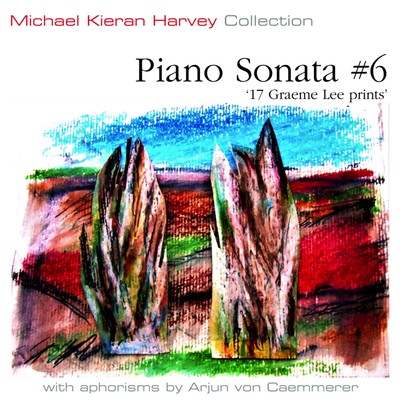
Another mixed media enterprise (of sorts) has recently emerged from Michael Kieran Harvey, who has been making the best of lockdown and isolation in Tasmania. He calls this his Sonata #6 and it has taken impetus from 17 prints by Graeme Lee: an artist long associated with Harvey, I believe, as, with his wife Margaret, Lee was part of the consortium that commissioned Carl Vine’s Piano Sonata No. 2, premiered by Harvey 22 years ago during that year’s Sydney Festival.

Or Lee could be some other fellow entirely.

At all events, here we are with a freshly-minted CD, its booklet showing us small-scale reproductions of the particular 17 Lee prints, as well as the cover one above that seems to be untitled. Along with these mini-prints, another long-time Harvey associate – Arjun von Caemmerer – has contributed 17 Leeward Epigraemes. which are accompanying aphorisms/observations/ Tasmanian haiku/apothegms which, for the more naive among us, tend to be more immediately relevant to the print’s titles than Harvey’s material. Not too surprising as the pianist/composer is employing a creative palette that fascinates for itself alone, without the need for us to find relationships or reflections in Lee’s art, not matter how clear these are to Harvey himself.

Some of the segments are epigrammatic: 46 “, 48 “, 49 ” – just long enough to make a running leap at your imagination or analytic faculty and then halt. The longest movement, Globe, comes in at 3’32” but the average length on this album sits at 2’19”. Finishing this very basic arithmetic summation, the entire work lasts for a bit over 37 minutes, or about as long as the Brahms Piano Sonata No. 3.

After a while, the tracks can appear to run into each other; it’s as though they’re using the same material but you can’t discern what’s happening to it because the actual level of activity is so unrelenting. The opening Floating Item begins with a sombre atmosphere that is immediately challenged by an ensuing mix of massive chords and coruscating flights that stand as portals to the following whirlwind. Hot Rolls is notable for its relentless syncopation, like a jazz session where the initial motive is all there is, the whole moving to bass statements that don’t fade away but remain as fierce as the initial ferocity of attack.

With Pyramid, you get a fine exhibition of Harvey’s armoury. Here also, syncopation seems to be winning the day and the opening passage is jazz-influenced with a highly mobile running bass under an upper line that is just as active. Abruptly, the onward rush stops for a series of portentous single notes, prefacing the composer’s trademark forceful pointillism where the spaces shrink, the tempo picks up and the piece reverts to a kind of restrained double layer of energy. Parts of this track are astoundingly virtuosic, as though some segments have been pre-recorded with moments when you’d swear Harvey had somehow got inside the piano lid to operate on the strings despite the extreme rapidity of the simultaneous keyboard content. By contrast, the brief White Shapes III sounds like an acerbic two-part invention, the lines yielding nothing to each other.

To the all-too-tutored ear, Vase has shades of Schoenberg’s Op. 11 Three Piano Pieces in its solid opening address and sudden shifts to flamboyance. In the context of its precedents, the piece strikes you as meditative, determined to forge its path using a methodology notable for sharply-etched definition. Probably the only thing I can say about Pattern is that the surface appearance has at least two, if not three; but they leave the space very quickly.

Globe takes me back to Pyramid because it appears to be operating on two distinct sound layers. Behind the scenes is a wide-ranging arpeggio-suggesting pattern up and down the keyboard, its progress soft and recessed. In front comes a main structure of firm shapes and chords. Gradually the undercurrent becomes more prominent, a full part of proceedings. This duality continues, repeats itself, but the construct impresses for its coherence, particularly the almost grandiose power of the full-frontal matter.

At about the midway mark, at Print No. 8, Lee’s Coloured M refers to the Macdonald’s fast-food chain because the titular ‘M’ as printed here is really the company’s golden arches. For all that, the print favours green across a somewhat irregular capital M. Harvey’s contribution is stentorian, brief and highly confrontational; like the print itself, you can find a statement in the score. Old-fashioned ternary form strikes in Stage with isolated notes and chord clusters or groups at either end with another Harvey moto perpetuo on two levels in the middle; it’s like a juxtaposition of classic theatre with the wild world of action drama,

A binary pattern typifies Gap which opens with some improbably piercing and rapid work in the piano’s treble, percussive and scintillating at the same time. Then the context shifts to an active bass that sounds jazz-inflected but occupies a world of rhythmic complexity well beyond the genre’s habitual practice. The contrast is repeated and you are left with plenty of mental food to investigate what is happening in this particular space between two strata of sound and timbre.

I don’t know what to make of Oysters. It’s fast-moving, follows a lead upwards, then half-way down; you come across one of the few obvious accelerandi (or perhaps two) in the whole collection; the time-signature appears to be more regular than in all the other fast-moving pieces. We’re back with the bi-planar in Tower where the main message comes in powerful chords and even more striking trills, all setting up a suggestion or two of massiveness and truculence before the recessed sound-scene emerges in its own right, then in combination with the loud battlements plosives.

For many, the most accessible track on this CD will be Black Bowl which verges on Debussy prelude status through its employment of atmospheric motives and Harvey’s adoption of a harmonic structure that recalls something the early 20th Century French musicians would recognize. Von Caemmerer’s versicle concerns the Buddha and that’s all it takes to set you off into recollections of the Orient as seen through those ultra-refined European eyes. Mind you, it’s not affected or soft-centred, but it speaks an attractive language that, in this context, could almost be called populist.

In Item Falling, Harvey plays with a spiky brilliance, moving through his piece typified by a remarkable angularity and flawless virtuosity, including a splendid octave fragment in the treble that emerges from nowhere – just like the sudden flights of notes that briefly sparkle up and down the instrument. Even so, there’s something almost too perfect about this piece’s execution as Harvey’s articulation borders on the superhuman. But then, there have been nights when I’ve seen him enter into comparable performance states.

Yet another two-level set-up emerges in Man Running, which illustrates again some of Harvey’s methodologies, beginning with an ostinato that is deliberately irregular in metre, then accelerates using the same pattern but ends up moving somewhere else before you realise it. As in the previous piece, the pianism is exceptionally crisp as the substance settles into two high and low mobile lines, the climax emerging in energetic block chords in the right hand; if you like, you can trace a particularly dedicated jogger’s path as the composition is oddly suggestive of physical motion.

Mound II, the penultimate movement, strikes me as particularly complex in every parameter. With Harvey, time signatures are a highly moveable feast, although he often settles into a pattern, but only for a short episode; no sign of that here in a metrically confounding operating room. As in previous tracks, you experience faint sound webs overpowered by fore-fronted elliptical strokes. Above all, Harvey presents a volatile progress where nothing is allowed to settle for a moment; even the pauses bristle with potential vehemence – and it always arrives.

Finally, Fitzroy Jazz II brings back memories of nights when Harvey would set the room on a roar with his overwhelming wizardry. It follows a simple ternary format but packed with transformed tropes, onslaughts that are essentially grist to a jazz musician’s mill but here fall over each other in a brilliant cascade, including chords of great complexity and running lines in both hands that fold seamlessly into each other. Once again, you seem to be settling into a normal syncopated rhythm, only to have the edifice tilt sideways into realms where the toe-tapping hipster is all at sea. As with each track on this CD, you come across passages that both amaze and amuse for their throwaway character, as here in an ascending series of triplets of excellent dexterity.

So, what we have is yet another in the series of this great artist’s CDs for the Move company. It’s a gift to us all, the Michael Harvey Collection – one that refreshes as each album emerges. A source of delight to me is that I still have two elements in this set waiting for examination. Further, the composer is clearly as creatively fertile as ever, regardless of the many limitations necessarily inflicted over the past ten months.

This Sonata #6 breaks some time-honoured rules of Western composition; for example, by eschewing the form’s usual discursive nature in favour of a suite in which the compositional patterns – Harvey refers to the movements’ mereology – are bogglingly complex, judging by the few score samples I’ve seen. As an exploration of the piano’s potential for novel sounds and whole new paragraphs of activity, this disc of brief bursts – even for those familiar with the composer/pianist’s previous achievements – is a must-have.

Sounds heard are sweet

QUEEN OF THE NILE

Sofia Troncoso and Camerata

Concert Hall, Queensland Performing Arts Centre

Thursday November 12, 2020

Sofia Troncoso

Here we are: back in the concert hall – not many of us, but enough to suggest that a corner has been turned. Will we get back to the ‘proper’ order of things and revert to valuing the packed-house syndrome as an indicator of success? Probably. but I suspect that any turning back to the way we were will take longer in the major cities because there’s so much to lose if something goes wrong. You could go the way of self-assurance and propose that people who attend serious music concerts and recitals are, by definition, non-COVID 19 carriers. But the virus is – as we have seen – indiscriminate and, although I may not be sweating and gasping all over you (as I would at a rave), there’s no confidence to be placed in an honest face – not these days.

Despite the ever-present risk, Musica Viva presented this Reconnect Brisbane program featuring the Camerata chamber orchestra in eight works from the Baroque or close to it. Chief soloist, soprano Sofia Troncoso, worked through three arias connected with the night’s Cleopatran theme, but the rest of the content had little to do with Egypt, the glaring exception being a sinfonia from Hasse’s opera Marc’Antonio e Cleopatra. Relieved by some short pieces by Locke, and Biber (the inevitable Battalia), the evening’s major work was a Pisendel violin concerto, with Camerata’s artistic director Brendan Joyce as soloist.

I couldn’t see what was the state of play in the stalls, but there were meagre numbers up in the balcony of the QPAC Concert Hall. We were well-spaced out, mainly in clusters of two – but it seemed that many Musica Viva patrons were not yet willing to take the plunge and come out to a recital/concert. The auditorium’s side boxes radiating down from the balcony were pretty much empty and the ambience upstairs could charitably be called ‘quiet’.

I was sitting in the last occupied row, I think, and have to confess that the acoustic properties were lousy in this position. For a body like Camerata, which is not a dynamically volatile body like the Australian Chamber Orchestra, the travelling power of their group product seems poor. But then, this room – its slight fan, its high roof, its plush seating and carpet – is not an ideal venue for transmitting performances rich in detail. For a Brahms symphony, a big Mahler, the Gurrelieder: fine. But my forebodings started when a chest of viols (2 violins, a viola, a cello, a bass and harpsichord) played the Curtain Tune from Locke’s music for The Tempest – which is the composer’s restrained musical depiction of the sounds and sweet airs, that give delight, and hurt not, punctuated by some intimations of Restoration storms. As far as I can tell from the score, a certain amount of repetition went on; no problem, and I’m sure it was common practice in the composer’s day while scenery was being hoisted into place. This reading proved to be plangent and restrained, lacking much bite from where I heard it and making you wish for a more aggressive approach that a group like the Australian Romantic & Classical Orchestra beings to this genre of composition.

Joyce then outlined the order of proceedings and led the full Camerata body – five each of first and second violins, four violas, three cellos and a double bass, with that harpsichord continuo – into Hasse’s Spiritoso e staccatoAllegroStaccato triptych which made a fine impression for its smooth unanimity of attack, but the quality of sound came up as wooly and without bite.

Troncoso gave an amiable account of Cleopatra’s last aria, Da tempeste, from Act 3 of Handel’s Giulio Cesare. In the lower reaches of this piece, her voice melded into the strings all too readily. As it progressed, you could tell that all the fioriture was there but it proved uninvolving, particularly in the exposed middle section from bars 85 to 94. The highest notes required – A and G sharp – came over well enough in semiquaver patterns, not so well as individual quavers.

The Concerto grosso No. 7 in G Major from the Op. 7 set of twelve by Giuseppe Valentini made a novelty of sorts. In his program briefing, Joyce wondered why this writer’s name was not as familiar as those of Vivaldi or Corelli. Well, it might have something to do with melodic originality and a facility of expression that didn’t show so much debt to formulae. Certainly the score had elegance and the Camerata gave it their best, but the five movements – Grave, Fuga, Adagio, Vivace and Allegro assai – proved unexceptional, apart from the last which featured some unexpected modulations.

Joyce’s violin added a pliancy to the slow opening, while some predictable suspensions and close-order chording gave the Fuga membership of many another similar work. The slow movement didn’t extend very far, despite the introduction of ornaments; the following lively-paced pages brought into play some welcome subdued hugger-mugger action. But the finale, along with those key-changes, also held a more visceral attraction with much crescendo/diminuendo work and a deft juxtaposition of forte and piano passages.

Cleopatra’s Piangero comes earlier in Act 3 of Handel’s opera than Da tempeste and has become well-known here since Opera Australia mounted the work to showcase the Baroque talents of Yvonne Kenny and the trio of counter-tenors in the company’s ranks some decades ago. Here, even without the original’s flute, Troncoso sounded more persuasive with an admirable ability in communicating controlled passion, alongside an added benefit in having more room to gauge a smoother level of production. The central Ma poi morta strophes succeeded pretty well despite an unfortunate top note (scored or introduced, I couldn’t tell) and even if the semiquaver runs might have been less stolid. In this piece, the Camerata players showed the singer every consideration; even I could hear each note of the outer segments to this aria.

Matters didn’t get off to a good start with the Pisendel concerto because I somehow was labouring under the false expectation that the piece was in G Major; it was actually in D . Then the only violin concertos I could find by this composer in that key required oboes or oboes plus horns. Whatever the case, my resources for this were dissatisfyingly small. A short interlude for three solo violins (with harpsichord) in mid-Movement 1 made for a welcome timbral oasis, and Joyce’s solo line came powering up with excellent clarity. Once again, you would have liked more energy in attack; this is the sort of work that Il Giardino Armonico throws off with flamboyance and – when I last saw them – something like musical machismo. It might have made more of an impression if the Camerata’s treatment had been less polite.

An Andante followed period tropes, invested with a walking-pace melancholy and more opportunities for Joyce to shine in a few outbreaks between unexciting ritornelli. The 6/8 finale began with an infectious sweep that didn’t sustain itself; no fault of the Camerata but more Pisendel’s contentment with note-spinning. Speaking of which, the soloist was put to hard labour in this substantial movement which every so often impressed for its verve. Eventually, the work ended in about nine bars of unison/octave work that seemed rather threadbare after the triad-rich if orthodox harmony at play during the preceding pages.

Biber’s descriptive scraps never fail to entertain, but I was a tad concerned that this audience was going to applaud every movement. That trend came to a stop after Die liederliche gsellschafft von allerley Humor where the composer goes in for bi- or tri-tonality; a little touch of Ives in the night. I think most of the standing players did a bit of in-place marching during the violin/double bass Der Mars duet, which brought up memories of the Australian Chamber Orchestra’s penchant for percussive footwork when performing Veress’s Transylvanian Dances. Still, this Battle is an easy accomplishment; nothing lasts too long and the scenes roll past – except for the final Lamento der Verwundeten which the Camerata dispatched with an admirable lack of maudlin self-indulgence. War is hell: get over it, as the former Cretin-in-Chief could have told you.

Troncoso ended the program with a stop-start aria from Vivaldi’s Il tigrane. Well, we say Vivaldi but he wrote only Act Two of this work; the outer acts by different composers have not survived. Squarciami pure il seno is sung by Cleopatra and is a fast-slow piece where the two tempi sit side by side rather than being confined to one or other of the work’s three segments. Here, Troncoso showed very willing in crossing between the schizophrenic Egyptian queen’s juxtaposed temperaments with an appealing limpid quality in the Lento interpolations.

An odd work, but taxing in its emotional vaults rather than in vocal technique. You could say the same about pretty much everything else we heard, apart from the violin concerto. In fact, the program mirrored the night itself in being not too hot, not too cold, not high-flying and not particularly popular in content. Rather, we eased back into going out to hear music. For all that, I’m not convinced that this is the venue that suits Camerata when working in this genre. The whole thing recalled those years when Melbourne Musica Viva presented its season in Hamer Hall; we got used to it over time but only realised what we’d put up with after the Recital Hall’s opening. I expect that there are buildings with a less booming acoustic around Brisbane and am looking forward to hearing Camerata in one of them some time soon.

Still on top

A FINAL OFFERING

Selby & Friends

Angel Place Recital Hall, Sydney

Saturday November 7, 2020

Susie Park

Nothing here to bring the blush of shame to the cheek of modesty: a very orthodox chamber music without surprises from Kathryn Selby and three familiar guests – violinist Susie Park, violist Stefanie Farrands and cellist Timo-Veikko Valve. All of these musicians are part of our continent’s musical life, but Valve leads this particular pack – or so it seems to me – in the breadth of his appearances. His omnipresence rivals that of Brett Dean in the violist/composer’s years presiding at the Australian National Academy of Music, during which time he participated in a plethora of activities.

This whole evening played to our lust for the well-known: Schubert’s Adagio/Notturno in E flat, the E minor Trio No. 2 by Shostakovich, and Schumann’s E flat Piano Quartet. As with the works, so with the performers – all of them in happy collegiality with very few signs of ensemble troubles. Which fortunate outcome you’d expect as all have participated in Selby’s recitals before.

As for the Schubert oddment – a not-too-distant relative of the String Quintet’s Adagio – it was treated with excellent sympathy, avoiding the temptation to sandpaper all the edges during the main theme’s treatments. Only the demisemiquaver at the end of many bars received a smoothing out, rather than bringing into play a short recurrent surprise, a brief interruption to the mellifluous melody. But you’d be clutching at straws to make much of this. Both of the proud internal episodes were handled with tempered vehemence, Selby’s triplets seamless as far as I could tell and the close lines of Park and Valve exemplary in dynamic unanimity and empathetic phrasing.

Coming into the Russian score, Valve worked through the opening six unaccompanied bars of harmonics without showing the stress that most other cellists communicate in this passage, an executive tension that doesn’t end with the violin’s appearance. A few high As near the end of this solo sounded near to danger but the final ascent before normal relations resumed spoke securely enough: Shostakovich’s eldritch summons fulfilled, the drama of sorrow, rage and resignation could proceed. This group favoured an emphatic delineation of the first Allegro‘s highpoint, not getting ahead of themselves – probably because they were conscious of what was coming up – with Selby establishing and maintaining a tempo that rejected the temptation of a cheap accelerando.

This broad outline was complemented by striking instances of telling synchronicity, like the strings’ creeping chromatic scales, the block-against-block interplay of violin-plus-cello against keyboard, Park’s fine juxtaposition of smooth phrases with multiple-stop scrapes, Valve’s well-crafted ability to remain audible and more than just a presence through the fraught climaxes. Later, in the second movement, the pace was mindful of the composer’s non troppo qualifier, which meant that every spicy dissonance and lavish swathe in those G Major interludes could be imbibed fully, without your being rushed across the work’s surface in a frantic presto.

No problems with the Largo: a threnody for the strings over a series of repeated piano chords and the closest thing I know to a contemporary Mourner’s Kaddish. This found both Park and Valve in fine form for the canons and duets that ruminate in muted language on tragedy (the death of dedicatee Sollertinsky? Babiy Yar 1941? The Odessa rioting of 1831? There’s a lot to pick from). Particularly moving was the eloquent accomplishment of the movement’s last nine bars, especially the beyond-grief harmonics in the final bar – one of the score’s finest moments.

With the purposeful Jewish-coloured content of the final Allegretto, it seems as though the composer is celebrating life or survival. He’s not: this is fierce music, as poundingly inevitable as the second movement but more wrenching and sardonic, soon seen in bar 28 where the strings alternate pizzicato quadruple stops – here, mightily impressive in character. Park added to the vehemence with a series of biting glissandi between D and E as she dealt with the movement’s main theme 16 bars after the caustic quadruple string chords stopped alternating.

Valve brought some humanity into the mix when the time signature changed to 5/8 and he surged through the soaring lament here under Park’s biting commentary. Even more gripping execution came in the movement’s core as the inter-linear welter increased and the instruments seemed to be chaffing against any restrictions before the change to an E Major key signature and a cascade of piano figuration relieved the crisis. Finally, it is hard to praise enough the players’ striking and emotionally valid interpretation of the work’s final subsidence which could be a benediction except for what has led to this point, in particular the composer’s reminiscence of his Adagio that begins 16 bars from the end and leads us to a chastening final vision.

Here was a finely spun version that ran across the complete work, intellectually consistent and contriving to keep its emotional reins taut while still rewarding you with a continuous current of tense pathos.

Finally, Farrands joined the party for Schumann’s welcome instance of life affirmation. His Piano Quartet, more than the Piano Quintet, speaks with a buoyant accent; even its working-out pages have a relish that, if it’s not actually rare, is remarkably jaunty. After the brief sostenuto, the first Allegro showed how the addition of an extra string voice can exert an influence on the balance, Selby being too polite by far for the first and fifth bars of the first subject. Park began impressively and enjoyed the prominences that Schumann gave her, but Selby made an unanswerable case for the piano’s dominance, even in slight details like her right-hand staccato scales 16 bars before Letter C in my aged Peters Edition score.

Indeed, the more you listen to this video, the higher your esteem for these musicians grows. Their accents are crisp, dynamic mirroring exact to a fault, octave and unison duets (or trios) precise, sense of place in the ensemble remarkably faithful and consistent. Have you ever noticed how much of the development to this movement is in the minor? Practically all of it. Yet these people made this harmonic oddity unremarkable, honing in on the underlying delight in motion even through some mighty predictable modulations.

For the Scherzo and its two Trios, you might have had an expectation of heftiness; it’s as though most interpreters can’t get their minds out of the bierhaus. The opening unison pattering from Selby and Valve set a higher bar with a delicacy that brought to mind Mendelssohn operating on a less fragile plane than usual. There are no real forte indications outside that fetching, syncopated Trio II and the executants aimed for quick-touch delivery in the Scherzo pages. Farrands distinguished herself with a clear-speaking solo in Trio I, but probably the most impressive feat in these pages came from the unfussed account of the second Trio which proved to be agreably fluent despite nearly everything being out of kilter with the pulse.

Everybody shares the honours in the following Andante cantabile, pages that are notable for the variants in accompaniment that Schumann contrives rather than for the sentimental melody over which he dawdles. Each of the strings took at least one turn in treating it and the results proved carefully shaped and mellow in timbre. But the movement shines in its coda which verges on the self-indulgent but endears itself for a kind of bare-threaded placidity.

And so to the Vivace finale with its endless repetitions of an irresistible opening motif: three chords, then a semiquaver rush to a quick cadence. As in the Piano Quintet, the composer indulges in plenty of fugato, even if in the quartet the exercises are less beefy in character. Once again, you could not fault the ensemble, least of all in those passages where Selby’s right hand went off the beat for half a bar’s worth. As well, some stretches gleamed, like the octave duet between Park and Farrands that begins 4 bars after Letter H following the key change to A flat Major and resumes shortly before the change back to the movement’s tonic: two lines soaring through the underpinning mesh with unwavering integrity.

This work is filled with optimism, not complex in its format or eccentric in thematic treatments; making a sharp contrast with the Shostakovich trio and finishing up this recital with something approaching jocularity.

After the first decade or so, you accept that Selby & Friends affairs will feature top-notch musicians; more often than not, even in these times of crisis and deprivation, you can also count on interpretations packed with insightful information and confident breadth of vision. Next year might see this organization back on its regular touring round, involved in live performances only. If that’s the case, we in the north will certainly miss these videos which have provided excellent sustenance over the long months of this unsettled year.

From dream to trauma

FRIDAY NIGHT LIVE

Tasmanian Symphony Orchestra

Federation Concert Hall, Hobart

Friday November 6, 2020

Lana Kains

At last, the Melbourne Digital Concert Hall has blossomed from disbursing an endless variety of twigs and branches into presenting something very like a sturdy sapling. For the next four Fridays, the organization is in collaboration with the Tasmanian Symphony Orchestra to present music that features a body rather more substantial than those we have been offered so far. This opening gambit, conducted by TSO principal guest conductor Johannes Fritzsch, comprised three connected works: songs by Wagner and Zemlinsky, and Schoenberg’s ever-green Transfigured Night in its string orchestra format.

Even in the liberated social climate of Hobart, the TSO performers had to be socially distanced; so you had twenty-odd strings for the Schoenberg, all at separate desks – which made following the composer’s direction about ‘stands’ (from bar 16 on) pretty difficult to fulfil. But this can be a thickly wrought score on many pages while the programmed songs don’t ask for as much interdependence as the transformed sexte

The TSO made a novel move by having Marta Dusseldorp preface two of the works with readings of the poems on which they were based. Before we heard the last of the Wesendonck Lieder, she gave an appropriately rhapsodic version of the lady’s Traume; and she previewed the Schoenberg with a sympathetic account of Richard Dehmel’s fraught stanzas of 1896. What she didn’t supply was any preface to the evening’s middle work which used verses that might have struck sparks of recognition from those familiar with Schumann’s Liederkreis, but for many of us would have proved less well known than Mathilde Wesendonck’s lied and Dehmel’s emotion-drenched stanzas where sorrow turns to ecstasy.

This piece was Zemlinsky’s Waldgespräch to an Eichendorff text that celebrates the legend of the Lorelei yet again. Still, as some latter-day insightful philosopher once sang, you can’t always get what you want and the composer gave the voice pride of place. Added to this, Hobart soprano Lana Kains made a pretty fair job of articulating the text cleanly and you hear enough clues in the clearer passages to give you the gist of the poet’s intention

Rather than over-tire Kains, Fritzsch and the TSO powers-that-be decided to eschew the vocal version of Träume and substitute one for solo violin with chamber orchestral support that the composer arranged in 1857 for a birthday performance below the poet’s bedroom window – shades of the 1870 Siegfried Idyll for wife Cosima; my, how he spread the riches around . . . eventually. On this night, the solo fell to TSO concertmaster Emma McGrath, who gave a sympathetic, stress-free account of the line after commentator Robert Gibson gave a lengthy salute to Aboriginal and Torres Strait Islanders, which groups are clearly taken most seriously on the island that wiped them out.

Wagner did little but follow his own vocal line, with slight variants like leaving no break at the end of Nichts vergangen and allowing a lengthy space for the song’s high F on the last appearance of the title word. McGrath employed a finely wrought and warm vibrato where she could, as well as a deft semi-portamento at appropriate places like the 4th and 6th intervals at und dann sinken. The composer also has the soloist join in the moving final five bars, unlike the poor Frauenstimme who has to stand mute through a postlude that always seems to be longer than it is.

He was about 25 when he composed his orchestral song (strings, harp, two horns) but Zemlinsky subscribed wholeheartedly to the late Romantic ethos, employing a harmonic language that stretched not far beyond Wagner, if not as far as his brother-in-law’s sextet written three years after Waldgespräch. Like their essay at the Wesendonck work, the TSO strings faced no fears with this G minor piece, having an easy time of it up to Letter B and the singer’s second line.

But the soloist herself was hardly over-pressed, so that the sudden small intervallic jumps at Schmerz mein Herz after a series of single notes made a warm impression out of all proportion to any actuality. The upward vocal leaps at the words O flieh! came across with telling power, as the Lorelei attempts to dissuade her prey. But the performance ran both hot and cold; for example, the upper strings gave excellent service just before Letter K in their treatment of a Schoenbergian phrase or two, but their ensemble work at Letter N where the opening motif is revisited could only be seen as sloppy. Counterbalancing this was the finely-worked line from Emma McGrath across the score’s last 35 bars.

Simply for reasons of length (the final Wesendonck lied about four minutes, the Zemlinsky a bit over seven), most attention focused on the evening’s final contribution, the early Schoenberg work that never seems to have been out of favour – unlike the gnarled masterpieces of later years. Fritzsch launched this successfully with effective crosses from solo lines to tutti in the first 24 measures: an excellent instance of balancing unevenly weighted textures. But it wasn’t roses all the way: at bar 29, the first violas took over the running, yet none too clear in their definition; and the violins, because of the afore-mentioned social distancing brought into effect found blending a problem with an individual voice surging through every so often. While the violas made messy work of their three-note pattern across bars 46 to 48, the violin lines at the octave made an impressive and stirring display at the Poco piu mosso change beginning at bar 69.

With the glide into E Major – one of the work’s marvellous emotional displacements – the approach and its achievement came over as scrappy, even more so at the spelled-out violin mordents in bars 124 and 125. To their credit, the three bass lines could not be faulted to this point, although their emergence across bars 145 and 146 sounded over-emphatic. But the ensemble delivered a persuasive weltering outburst when all mutes came off at bar 169. I would have preferred more of a whip-crack approach employed for the violin’s semiquavers in the repetitions across bars 175 to 177, mainly as a relief from stolidity.

Speaking of heavy-handedness, I don’t think I’ve heard a slower reading of the penitential passage from bar 188 to 200, though things picked up for the resumption of the work’s opening motif at bar 202, greeted with plenty of punch from second violins and first cellos. An eloquent, well-proportioned attack signified the start of the Man’s reassurance at bar 209 and McGrath span an exceptionally luminous line from bar 255 during the first transfiguration sequence. Something went wrong with the fp cello harmonic that penetrates bar 251, but the rest of the fluttering wove its anticipated magic.

For the first time, I appreciated the spectral four bars of communal ponticello playing from bar 266: a startling shift in sonority, here carried off with equanimity. Later, the body gave a fine realization of Schoenberg’s hothouse freneticism beginning at bar 303, eventually driving to a powerful climacteric in the universal triple forte explosion of bar 337. Again, the course didn’t stay smooth with a messy first viola phrase at bars 344-5. But relief came quickly with a fine sheen to the group’s timbre in the dynamic breaking-down from bar 356 onward and a flawless chording (because of so many solo lines?) at bars 368-369.

From the bar 401 A tempo to the score’s conclusion, you are in a luminous sphere, luxuriating in music of incomparable beauty that you wish would go on far longer than it actually does. The TSO achieved these hushed pages with a high degree of success even if – as usual – the six pianissimo harmonics in bar 414 were not quite universally secure. But I’ve always thought they make the following D Major chord and its susurrus dissolve all the more satisfying as a leave-taking.

The players fared well in this score which presents so many difficulties, especially long sections where the writing is active and thick. They came out of the struggle with a bit of skin missing; on the other hand, they gave Fritzsch a ready response with no shying away from Schoenberg’s demands for fully-bowed enthusiasm. This piece and its predecessors made an excellent introduction to the TSO’s talent, enough to rouse interest in further Friday entertainments from Hobart.

Joyful stop-over on this long trip

A BEETHOVEN ODYSSEY VOLUME 6

James Brawn

MSR Classics MSR1470

Expatriate pianist Brawn is still in Shanghai during the COVID-19 pandemic but has managed to put out another volume in his series of the complete Beethoven sonatas. Following this one, there are 9 works left to be recorded, well under a third of the total. Here he is fleshing out the earlier numbers in the catalogue with No. 4 in E flat Major, No. 11 in B flat Major and No. 12 in A flat Major; so he has completed all on the master-sheet from No. 1 to No. 12. After this, the pianist has a fair task in seeing out Nos. 13, 16, 18 and 22 as well as the colossal final bracket from Sonata 28 to the ne plus ultra Op. 111.

This CD is a noticeably sunny collection, apart from the grim Eroica practice piece in the A flat work, and even that slow-moving threnody manages to sound jubilant in places. Brawn has a firm grasp of the excited undercurrent that lies at the base of the opening Allegro of the E flat Sonata Op. 7. Actually, there’s nothing ‘under’ about it: the movement begins with a dominating atmosphere of fervent anticipation and energetic impetus. The only questionable point comes at the syncopations across bars 127 to 132 which sound rushed to me; but when Beethoven gets around to treating this figure between bar 153 and bar 168 at the start of the movement’s development phase, the displacement is impeccable, as are the reappearances at bars 397-312, and finally from bar 339 to bar 348.

Acoss these pages, you can hear plenty of felicities, like the rapid mordents in bars 109 to 110, and later from bar 209 to bar 211 – both handled with the lightest of touches; or those right-hand quaver-crotchet 13th leaps that add an off-beat buoyancy to the work’s forward motion, each time treated with agile confidence. Yet the outstanding quality to this reading is its realization of the composer’s unstoppable enthusiasm which begins as a single-note regular pulse and reaches out to us with irresistible sprays of ebullience.

The following Largo finds Brawn in excellent form, negotiating the 9th and 10th stretches with finesse and unafraid to take Beethoven’s direction as a licence to linger over block chords and accelerate slightly in bridging passages, as across bars 47 to 50 leading back to the main theme’s re-statement; and space out an elaboration, as in bar 62 which can all too often turn into a gabble. Only a few questions hovered around the ensuing Allegro and Minore both of which enjoy firm treatment throughout, especially the latter segment’s Erlking-redolent pages. The rests across bars 14 and 15 seemed short-changed, and the distinction between forte and fortissimo in the Allegro’s later pages (if, in fact, the performer was looking for one) was not particularly wide.

You couldn’t say that Beethoven had kept his best till last but the final Rondo is more surprising than this sonata’s preceding movements. starting with that benign falling melody with its unsettling dominant pedal underpinning. Brawn treats the grazioso elements kindly enough but gives the long minor episode – bars 63 to 93 – with powerful determination. You can also find small touches, such as the briefest of hesitations at crossover points, although the major one – at bar 155 with the enharmonic shift to E major for a little while – is treated quietly, flowing gently out of the preceding fermata minim chord.

The performer can’t help Beethoven’s fiddly stretches from sounding stuck-on; cf. the trills beginning at bar 36, or the chromatic octave syncopation from bar 146. But even these are produced without emphasis – they’re made to be part of the energetic drive that impels this long work to its moving, evanescent conclusion.

With the variations that open the A flat Major Sonata Op. 26, Brawn is very exact in articulation, the left hand clear with each chord constituent present and contributing. He sets a sensible pace at each of the five changes and keeps to it, although you can’t get much by way of alterations here as the movement is meant to be conceived and executed as a metrical constant, rather than a series of rhythmically differentiated vignettes. Here also you are met with a fine melody with the slightest touch of melancholy about it in the second phrase and a Lebewohl quality to the coda.

You’re faced with a weighty version of the Scherzo, if not the Trio, that follows. Brawn gets as much punch as he can out of every sforzando, but he might have pulled back on them in bars 26 to 28 in favour of a smoother negotiation of the right-hand groups of consecutive thirds which here sound studied. Then comes the Marcia funebre in A flat minor, keeping things in the tonic family. Here again, you will find much to appreciate, particularly the straight-down-the-line treatment of the long-winded theme where the internal movement emerges as a matter of course, rather than being given special weighting. Brawn gives great power to the middle 8 bars of major key salutes – a precursor of Berlioz’s drawn-sword excesses.

It takes a few hearings for Brawn’s account of the Allegro finale to reveal its breadth of delivery, but in the end it makes a splendidly cogent resolution to the entire work. Right from the opening, you are captured by the movement’s inbuilt energy, in part due to the pianist’s constant rise and fall in dynamic level and a careful weaving of phrases into each other, which is the keynote of this rondo’s A sections. Further, to pick out just one detail, you can see/tell what’s coming but the lead-back following the C minor episode is exactly right – from bar 96 up to the quiet fusion at bar 100: simple to play, here felicitously shaped. And that last observation pretty well sums up my reaction to these specific four tracks.

For his last offering, Brawn skips one back to the Sonata No. 11 in B flat, which is my favourite on this CD – both for the work’s qualities and for the broad optimism of its realization. I’m always bowled over by the bubbling anticipation that leads to the appearance of the first theme at bar 4, then the sheer wealth of material that spreads across the following pages. Later, Brawn draws a broad brush at that chain of modulations in the development stretching from bar 91 to bar 103; it’s not the most original sequence but you find a reassuring inevitability in the performer’s sensible pragmatism.

As far as I can make out, Brawn is punctilious about his semiquavers in both hands, delivering them faithfully and without muffling any patterns. No, it shouldn’t matter that he gets the notes out exactly but the task is accomplished without unnecessary harshness or suggestions of automatism. A similar quality is invested in the second movement Adagio with its chains of repeated quaver triads, which Brawn articulates with sensitivity and no signs of negotiating a functional accompaniment. My only question about this grave, satisfying interpretation is the use of slight pauses at the end of certain bars before a change of dynamic, e.g. bars 39, 44 and 45, with a hint at bar 51. But then, if you go looking, you can hear, from the first page on, slight hesitations and plain rubato all over the place, which latter is usually applied carefully, particularly to the left hand. And it all comes under the movement’s supplementary head-text: con molta espressione.

You are hard pressed to find fault with Brawn’s version of the Minuetto and Minore trio. He observes the restrained grace of the first eight bars before Beethoven shifts his train of thought to aggression in the Minuetto‘s second half and those aggressive running semiquaver clusters coupled with cadential emphatic chords; here, the interruption passes without attracting too many questions. And the left-hand study at the Minore emphasises the cursive line without hitting any pre-Pathetique button.

The Allegretto rondo that finishes this sonata is a chameleonic set of pages, beginning with a main theme that proposes Mozart in its first half, then veers into unexpected territory; not really a continuation of or balance to the first four bars but a semi-completion nonetheless. Brawn keeps a steady hand on each incident until unleashing a bit of temperament during the four bars leading up to the change to F minor semi-furibondo interlude. Later, he carries off a splendid shift of pace for the triplets that permeate the main theme’s final reappraisal.

Here is well-achieved and judicious playing, an impressive reading of this mellifluous sonata and one that reads each of the four movements with conviction and persuasiveness. Not that this CD comprises ‘easy’ works since each challenges a pianist’s self-restraint and sustained insight. But there’s a vast constellation to come in Brawn’s future recordings for this series – a welcome and worthwhile re-investigation of works that serve as the fundamental for Western piano music literature.

A master and an also-ran

OZART & ABEL

Melbourne Digital Concert Hall

Australian Romantic & Classical Orchestra

Cell Block Theatre, Darlinghurst

Friday October 23, 2020

(L to R) Julia Russoniello, Matthew Greco, Karina Schmitz, Simon Martyn-Ellis, Georgia Browne, Kirsty McCahon, Daniel Yeadon

We’ve had one Australian Romantic & Classical Orchestra recital/concert already in the Melbourne Digital series; now it’s the turn of the ensemble’s Sydney chapter to keep the Richard Gill flag flying, in which undertaking they were helped considerably by having Georgia Browne‘ s flute as either top line or stage-front in this program of which three-quarters was completely new to me. The organizers gave us a familiar Mozart in the D Major Flute Quartet K. 285 but balanced this with an early string quartet, K.157 in C Major. This brace was book-ended by two Carl Friedrich Abel scores: a three-movement (like everything on this night) flute quartet in A Major, unhappily juxtaposed with a work of the same genre by the younger master; and the Flute Concerto No. 5 in G Major, one of a set of six that are probably grist to every flautist’s mill these days.

A product of the Bach house through his studentship at St. Thomas’ School in Leipzig during Johann Sebastian’s years there, Abel was well known in his lifetime, notably for a time by association with Johann Christian Bach with whom he established a concert series in London. He also met the 8-year-old Mozart in that city when he himself was about 40 – which is a nice, if fleeting connection with which to yoke these two writers. But Browne has a stronger relationship with Abel’s music than most of her peers, as she has recorded this G Major Concerto (and several other flute-dominated works by this composer) with the Icelandic ensemble, Nordic Affect.

As the night turned out, Browne made the best of all possible cases for Abel through her fluent technical control and an unfailing search for variety of timbre and shape, even in the unabashedly learned pages of the concerto’s opening Allegro. As a sample of ensemble work, this score proved to be the night’s least satisfying – not because of the ARCO musicians’ expertise, but mainly because of a lack of substance from the string quintet and its one-line-per-instrument lack of ‘bloom’, as I’ve heard expert acousticians describe it. You had precision in spades, each note on the dot, but vibrato or open with no mellowing shades at all. Yes, we’ve been here before: this purity of output is a period music enthusiast’s nirvana and it is irrelevant in faster music, but middle movements from Andante down can be a trial.

It’s probably because of the continual close suggestions of a chest of viols, as though every work played here found its antecedent in a Lawes suite. This might suit some writers but you’d have to question the approach in a work like Mozart’s delectably optimistic flute quartets. Compositions where the sinews stand out – like Art of Fugue or A Musical Offering – benefit from this no-nonsense treatment but its apologists argue for a wider historical range of application than just the Baroque. At all events, one side of the argument is proposed by this organization, which is consistent in its application across the repertoire.

In the concerto, Simon Martyn-Ellis‘ theorbo took on the continuo function; in this situation, his contribution came across very clearly and made its presence felt throughout in this musician’s one appearance on the program. The same could be said of Kirsty McCahon‘s bass which, as always, contributed an enthusiastic line in support of her higher-pitched companions’ caperings, including those of cellist Daniel Yeadon. Even the reedy-textured violins of Matthew Greco and Julia Russoniello took on an infectious bounce in the first movement’s initial strutting tutti.

But the delight of this program constituent came in Browne’s appearance as a fore-grounded soloist in her own right, not as the top line of a quartet. Her first appearance was lengthy and, as the piece progressed, the flute’s elaborations on the opening march theme dominated proceedings. But Browne took all the tricks with an ideal placement of each note while Abel puts his soloist through a range of technical and breath-control tests; nothing flamboyant, but ever-demanding. He even managed to insert some thematic variants which Mozart might have been happy to imitate. I don’t know who wrote the cadenzas for this concerto – probably not Abel, if other manuscripts are any guide – but this one turned out sufficiently voluble and just long enough.

I think the middle Adagio was in G minor; whatever the case, these pages tested Browne’s sustaining power. She dominated the texture even more here but had to work hard because of the longer time for sweeping bow strokes allowed to the strings. To leader Greco’s credit, the pace proved sensible for all concerned; not over-weighty or insistent. Again, Browne’s cadenza brimmed with good judgement – but then, so did the ensemble’s approach, particularly in the treatment of ornamentation which emerged as it should: without fanfare or obviously basted onto a line, but just a slight disturbance in the Force.

Just how lively this ensemble can sound emerged when the Presto finale flurried into action, the results justifying the observation that this group (maybe just this section of the ARCO personnel?) sounds at its most convincing when the tempo is rapid. However, the flute gets total exposure when the tuttis end and Abel indulges in reams of rapid-fire sequence work. There’s an odd mix of the utterly predictable (thanks to repetitions, he being capable of three of a set phrase when Mozart would have been happy with two, at most) and a (in context) startling novelty, like a modulation which, in the normal run of events, was unanticipated.

Even against the light weight of a string quintet and theorbo combination, the period flute that Browne used was sometimes hard pressed to be heard, particularly when the instrument was operating inside its lowest fifth. But, in the main, the flute carved out its path with an appealing breathy quality, climaxing in yet another cadenza – which seemed unnecessary, given the amount of exercise the soloist had to put in throughout this movement. And the small ensemble brought the exercise to a gratifying end with a congenial solidarity.

Abel’s Flute Quartet in A Major Op. 12 No. 2 opened the recital with Browne taking top place above Greco, viola Karina Schmitz and Yeadon. Her breath allocation made an interesting study across the opening measures of the first Un poco Allegro; indeed, it continued throughout a somewhat jumpy line that reached a finely couched oasis at a sustained E across bars 76 and 77. As far as I can tell, Browne’s transpositions – actually, translocations would be a better term – were kept to a minimum.

Browne’s melding into the fabric during the following Adagio ma non troppo showed at its subtlest during the repeated E semiquavers across bars 21 to 23. She also gave us an elegant taste of the galant in her negotiation of the appoggiaturas in bars 34 and 36, while Greco’s violin entered into a delectable partnership with Browne at bars 51-53 to put a suitable cap on proceedings. With the Tempo di Menuetto, Abel sets up a melody that is deftly shaped as a comparable piece by Mozart, but it moves into ordinariness at bars 5 and 6 when the sheen of direct speech goes astray. Greco found it hard to tamp down his attack in this movement, although Browne maintained a soft dynamic for the most part, so he’s not totally responsible for his own prominence. This last rondo is amiable without much content – a certain fluffiness around the edges made it unmemorable in itself, if a fitting vehicle to introduce the musicians without much stress brought into play.

Mozart’s own quartet coming straight after Abel’s gave Browne even more opportunity to demonstrate the breathy purity of her output while Greco, Schmitz and Yeadon brought as a counterweight their trademark lack of vibrato and open-string fear. You could pick up on phrasing differences between flute and strings (violin and viola) at certain points but more distracting was the tendency by the upper strings to employ a crescendo/diminuendo effect all over the shop. And you missed some sparks from the violin’s 2nds in places like bar 115, even if Schmitz compensated for this with her own contributions between bars 132 and 135. I missed the repetitions of both halves in this movement but that absence was not confined to this movement which nonetheless revealed a firmness and unanimity of ensemble from all involved.

Thanks to the strings’ pizzicati, the Adagio is a gift for the flautist who holds our interest across all 34 bars. Browne maintained an even melodic flow with no abrupt dynamic shifts. typified by a carefully prepared soft high D at the end of bar 21. But then, across this night none of her high notes grated. In the brilliantly happy Rondeau, Greco sounded scratchy at the throwaway gesture in bar 20 but made a more secure showing at its reappearance in bar 99; he also failed to etch a definite path through the bars’ 133-139 partial episode. You could not fault Schmitz or Yeadon in this exhilarating movement which reached a delectable pianissimo for all in the last main theme restatement beginning at bar 231, the whole set of pages taken at a brisk, not breathless, pace.

Of all players on this occasion, Yeadon had the most trouble with his tuning, his instrument affected by Sydney’s seasonal humidity. Consequently, he had to spend some time getting ready for the Mozart string quartet; then he and the other members of the group – Greco, Russoniello Schmitz – did not show at their best in a slip-shod account of the 1772 composition’s first strophes. In fact, the ensemble’s balance sounded unsettled, as in the recessed contributions from Russoniello in bars 25 to 28. A major signpost in the violins’ triple- and double-stops at bar 60 came across as laboured, although a similar construction in the last bar presented with much more acuity. Finally, I didn’t see what was gained by the insertion of a short violin cadenza at bar 74.

The group did repeat the first part of the Andante; a kind structural concession that stood out on this evening. Yet, in spite of the sensibility shown in this movement, the combined texture at points like bars 16 to 21 sounded like a piano accordion in timbre, possibly because of the octave unison between first and second violins not helped by the viola’s bland arpeggio filler. Once again, Russoniello went missing between bars 57 and 64 despite having the principal matter (what there is of it) in her part.

Greco showed to better advantage from the outset of the Presto finale as he and Russoniello were kept busy by the brisk pace and the score’s racy character, the first violin’s address best illustrated by his biting attack in the section from bar 85 onward. Despite commentators directing you to hear operatic traces in this work because Mozart was writing these quartets at the same time as Lucio Silla, this movement is memorable for its lavish use of syncopation which tends to attract the attention of performers more than giving primacy to melodic development; not that there’s much of that in these rapid-fire pages, here gifted with some suitable abruptness at the final chord.

It’s an immature work and streets away from what was going to turn up ten years later in the quartets dedicated to Haydn. But it made for an indication of what Mozart could do with inspirations that were short-stemmed. It might have gained from a less timbrally astringent handling but, as a rule, pieces of near-juvenilia need top-notch performers to lift them out of the second or third tier level they occupy in a great composer’s output.

But ARCO deserves our thanks for this exercise because, although it might not make Abel converts of us all, the occasion gave us the opportunity to revel in Browne’s expertly honed performance skills and her ability to take an also-ran score and turn it into a miniature gem.

Power from four likely lads

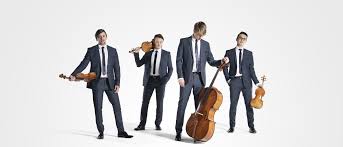
AN EVENING WITH ORAVA QUARTET

Melbourne Digital Concert Hall

Townsville Civic Theatre

Saturday October 17, 2020


Orava Quartet

Using the resources of the Australian Festival of Chamber Music which is being celebrated, as usual, in Townsville, Adele Schonhardt and Chris Howlett inserted this popular Queensland ensemble into their strong Melbourne Digital Concert Hall series, yet again showing that lockdown means nothing to administrators with a will. Mind you, the program was a brief one, with only two scheduled works: Haydn’s Sunrise Op. 76 No. 4, and Erwin Schulhoff’s Quartet No. 1 of 1924. Lucky I hung around at the end because the group came back to play a filler in the third movement, Tres lent, of the Ravel String Quartet.

It turned into a bit of a lop-sided hour with the Schulhoff score gaining most from the Oravas’ attentions. As expected, the young men made much of the vehemence to be found in the odd-numbered movements, but they were able to present an attractively dawdling version of the problematic second movement Allegretto and surprised with a non-indulgent treatment of the final affecting Andante – not flawless but assuredly insightful, living up to the composer’s emotional addresses (and distresses, for that matter).

The quartet’s score begins with a forte sempre dynamic direction across the board; the Oravas were quite happy to intensify the one term and obey the other. You could not want for any enthusiasm here in a Presto that owes much to Bartok and a little less to Stravinsky, and the pace was pretty inflexible up to two bars after Number 11 in the Philharmonia/Universal Edition score when the pizzicati, au talon and arco melange halts and the four lines come together in a four-octave-wide unison stringendo before a ferocious reversion to taws.

It sounds like an onslaught and in some ways it was, but the players found room for a bit of tempo flexibility along with the pressing motor-rhythms, so much so that the effect was far from freneticism for its own sake. The ensemble was crisp and exact as the players set out the ordered clash between modal and dissonant writing that started in D and ended in C. The result was pacy and entertaining to hear as the machismo level in the Townsville theatre took an upward turn.

Violist Thomas Chawner dominated the following Allegretto, his partners giving him an unobstructed field for his Number 1 solo. And he did not disappoint, generating a malleable and accurate line that exemplified the malincolia grotesca that Schulhoff required. Not to be outdone, cellist Karol Kowalik took up the reins after the the Tempo I marking: a 17-bar lyric of remarkable variety. All players made the sudden sul ponticello Nachtmusik a startling motion-packed melange before Chawner returned for a brief, acerbic cadenza leading to the last lingering and opening-recollecting violin solo; the texture quietly restless until the fade to darkness with a final squiggle from the top line.

It’s an unusual set of pages, organized but whimsical, and packed with effects that, for the most part, don’t get in the way. What I carried away was an awareness of the executants’ respect for every note and its placement, especially in the passagework of communal demi-semiquavers in pianissimo parallel motion. A turn back to the muscular broke in with the Allegro giocoso, a highpoint emerging at Number 2 with some gripping duets in fourths and a burst of unison work – the kind of fierce action that suits this group to a T. Nevertheless, five bars after Number 4 where the dynamic of the potentially Slovak melody is blazoned out, the composer’s forte enjoyed an upgrade to fortissimo. No wonder: this jaunty, affirmative and tautly written genre of composition presents an irresistible temptation to overload on testosterone.

In late Mahler mode, Schulhoff reserves his slow movement for the quartet’s finale: an Andante molto sostenuto of grave introspection, doubly telling after the hefty folksiness of its precedent. The cello has all the running to begin with, the bar-3 high A sharp not enjoying the most secure of treatments. But the landscape of dejection enjoyed some expertly accomplished interventions, like the viola and cello harmonics punctuations following Daniel Kowalik’s brief cadenza straight after Number 2, even if these sounded over-emphatic under the first violin’s sweet, atonal solo line.

The players completed their task with a moving account of the death-watch beetle mutterings in the final segment after Number 4, although the strictissimo sempre in tempo of the preceding violin two-bar cadenza proved to be something of a moveable feast. But the group made telling work of the quartet’s final, twitching bars in which several commentators have found intimations of Schulhoff’s concentration camp death 18 years later; stretching their levels of prescience, I think, since the writer’s state of mind at the time of this composition was more likely shadowed by his in-the-field experiences of World War I. Whatever your opinion, this haunting passage concluded an interpretation that successfully balanced brio and placidity, often on consecutive pages.

Opening their debut MDCH appearance, the Oravas ran through their chosen Haydn with its inane title. First violin Daniel Kowalik surprised with his rubato approach to the first aspiring theme, and you were unable to pick out a steady pulse until the semiquavers kicked off in bar 22. Still, the ensemble showed its teeth at places like bar 54 with a few bars of upper-level orderly scurrying. And, to their credit, the group stayed consistent in their schizoid interpretation, changing to ambling pace whenever the ‘sunrise’ theme emerged.

Along with the interrupted impetus approach, you could be surprised by individual touches as well, like the ringing top A flat from Daniel Kowalik at bar 85, the well-judged prefatory ritenuto at bar 108, cellist Karol Kowalik’s attention-grabbing slight delay at bar 166, and the clarity at work in the players’ output during polyphonic interchanges like those beginning at bar 130. Not that the balance remained perfect throughout. In the second movement Adagio, a sudden rush of blood meant that the first violin’s G across bar 2 disappeared in the forceful subsidiary E flats from second violin David Dalseno and Karol Kowalik. Urgency wasn’t actually in play here but the pace chosen seemed to me to be on the quick side.

Countering the steady-pace regularity came odd spots like the pause before starting bar 27, the reason for which was hard to fathom unless the group considered that the first violin’s leap from a staff-top G to a low E pointed to a need for opening a new sentence. A slow-down move at bar 35 heralded a pace that sounded more like an adagio. Later, progress came to an arresting halt at bar 51 for the first violin’s quaver rest, possibly to highlight the main theme’s resuscitation en clair. Dalseno took his time over his exposed semiquavers in bar 60, but then I would have liked more time expended on the C minor fermata chord in bar 65.

I liked the hesitant start to the Menuetto‘s main theme, as it made a point of the determination invested in the following measures, but it might have been varied with profit further down the track; you didn’t have to utilise that tic all the time. Haydn’s enigmatic Trio enjoyed a welcome equivalence of speed, rather than being slowed down for its minor/chromatic suggestions; the result gave a fine drive to the whole section, although – again – I thought the fermata at bar 97 could have been sustained a tad longer.

Another idiosyncrasy appeared early in the Allegro finale where both violins inserted a slight comma after their last note in bar 3 – and repeated this quirk every time the pattern was repeated. Nevertheless, these pages passed along with plenty of sustained fluent action, the only question mark coming through at the Piu allegro of bar 110, after which the dovetailing of lines could/should have been smoother. Yet you had to admire without question the full-bodied unison octave work at bar 161, these musicians relishing a final welter and carrying it off with refreshing panache.

To cheer us up after the Schulhoff, the Oravas decided to play the Ravel movement, but I’m not sure if you could say they lightened the mood overmuch. Possibly the players see this piece as a benign nocturne, which is fair enough as a general view of its main body, with some superb interludes based on the first movement’s initial theme. More memorable than worrying about this choice of program extra, the reading included some splendid moments, like the viola’s richly pointed contribution at the key change at Number 1, and again at Number 2; and like the subtle pause at six bars after Number 2.

I missed out on the cello’s pedal E three bars after Number 5 – surprising, since the lowest line is marked piano while the other three parts are pitched at pianissimo; but then, perhaps it was my equipment at fault. Later, I missed the distinction in diminished dynamics in bars 6 and 7 after Number 8. But Chawner made a welcome, direct and expressively balanced reappearance at Number 9, taking his colleagues into a fine conclusion, especially a carefully calculated interpretation of the last seven bars. It made for a reassuringly ‘sweet’ ending to the night but a better result might have been achieved by outing Ravel’s second movement Assez vif, which melds rhythmic excitement with this some of this slow movement’s subtle shadings.

It was a well worthwhile exercise, in the end. These young musicians have been successful in forming a musical alliance that works exceptionally well, four voices distinguished from several other high-profile Australian ensembles for a practically flawless purity of intonation, and an equally reliable balance of output that is so good that you notice immediately those few places where it falters. And, of course, their program gave us a welcome reminder of what ‘normal’ life looks like in a state that is coming closer than most to cultural resurrection.

The long and the short

NEW SOUNDS

Alex Raineri and Angus Wilson

Brisbane Music Festival

Saturday October 10, 2020

Angus Wilson

So what do we do from now on? This is the last of the recitals in this Festival sequence – the end of music-making in Brisbane for the year . . . well, the production of music that is reliable, serious and regular by nature. Yes, you expect some other bodies to put up their hands to present the odd program, and so some of them have done. But we have come to rely on Alex Raineri and his organization to supply us with fortnightly events of musical value. From here on, the Melbourne Digital Concert Hall has the field all to itself as far as generating streamed material of consequence goes.

Raineri has a big reputation for interpreting contemporary music and his wind-up for 2020 played to this strength. The night featured first performances of four Australian compositions, all written by Raineri’s peers and colleagues associated with the avant-garde Kupka’s Piano enterprise: Samantha Wolf, Jakob Bragg, Hannah Reardon-Smith and Jodie Rottle. These works featured piano and percussion – usually vibraphone, handled by Angus Wilson who is another Kupka associate.

Agreable as it was to hear these fresh works, they were all – deliberately, or by chance – brief. So the duo gave at least half of their allotted time to an import in John Luther Adams’ ten-year-old Four Thousand Holes which requires two-to-six musicians but also has a continuous electronic underpinning. This non-live component doesn’t actually do much except swell and diminish, ending as it began after a half-hour-plus round-the-block hegira. The human contributors to this reading were Raineri on piano – staying at the keyboard throughout, I think, rather than making forays under the lid – and Wilson handling vibraphone and glockenspiel, following the composer’s requirement for ‘metallic percussion sounds’.

This performance was bedevilled near its beginning by several cuts in transmission: some of them short, then later dilating to the point where the broadcaster had to put up a web-site frame. After the transmission was completed, Raineri posted a tape of the complete recital for those feeling short-changed by these missing fragments. I dutifully went back to hear the first moves in Adams’ work – never look a gift horse, etc. – but this extra exposure achieved very little in my case. To be frank, I rather enjoyed the moments of unintentional disruption; probably a generational overload of Cage-ean yearning for any signs of Zen in music, according to which there are no mistakes or flaws, even if there are. But I delighted in those passages where the sound came back intact while the players were freeze-framed in action.

As for what the live performers had to do, the essentials seemed to be plenty of chords from the piano, mainly major, and single notes from the percussion, although I’m probably wrong about that because Wilson kept two sticks/mallets ready in both hands; still, it seemed to me that his function was essentially pointillist while the piano amplified the ongoing electronic stream with chords that drifted in and out of consonance with it.

Actually, the in-and-out breaths of this sonorous back-cloth became annoying, possibly because of an absence of variety – harmonic, polyphonic, rhythmic: you name it – but chiefly because the mesh wound up sounding like an accordion and, given the unadventurous nature of its construction, a particularly elementary. Young Talent Time-reminiscent one. You’d suppose that all these long periods of stasis would engender a sympathy with Adams’ emotional landscape, which involves the wide open spaces of America’s northernmost state, residence in which shaped the composer’s aesthetic aspirations.

Wilson used both keyboards, sometimes by themselves, sometimes at the same time but the chief memory of his activity remains those single note patterns. Yet, even when his dynamic was at its most compelling and Raineri’s chords ranged widest, the work’s process and progress comprised a haze, scintillations breaking through but not intended to jar against the prevailing sound continuum. After a while, you were tempted to abandon hope of any analysis and just suppress the critical, sinking into the repetitions and the glowing taped-sound stratum. All that was missing was a chain of visuals, like sub-Arctic landscapes of snow and ice-filled vistas until the instruments stopped and the tape drew to its elongated diminuendo conclusion (in E Major?).

You are in sync with Adams or you’re not; he isn’t of the same ilk as the big-name minimalists and ‘modernists’ who can often enrage with their futility or pretension, but he works on a Cinemascope level in which the natural world fundamental is idealised. It’s easy to go along with this cosmic humming, the musical equivalent of a lengthy ‘Om’, but I’ve been suspicious for many years of works that ask you to ignore all that you know and surrender to a benign intellectual coma. For all that, both players did the composer excellent service with a reading that outstripped two other recorded interpretations that I’ve heard recently, their superior in exerting personality and finding space in an aural area where both were difficult to achieve.

Each of the Australian premieres was preceded by a taped short address from its composer, most of them revisiting topics that had already been made public in Raineri’s interviews, published on the internet some days before the event itself. Wolf’s Bull in A China Shop set piano and vibraphone in bitonal competition, the most interesting moments coming when both instruments played the same melody line in their own specific tonalities – the effect rather like an organ Mixture stop. You were hard pressed to find anything aggressively taurine here, particularly during the substantial middle section reminiscent of Pagodes that moved into a vibraphone ostinato supporting 5th-heavy piano chords. A moderate degree of deftness appeared in the final ‘fast’ section that had more than a touch of Bernstein in his dance mode about it.

Both players worked inside the piano for Bragg’s Nest of gravel in which the sounds produced related strongly to the composer’s desire to suggest the granular and dessicated. Wilson mounted a slightly grating ostinato with wire-brush strokes on the upper strings, graduating from one hand to two in the piece’s later reaches. Raineri contributed his own bevy of scrapes on the lower range of the instrument, using a variety of wood and (I think) plastic strips as well as various sticks while complementing his scrapes and block glissandi with punctuating stopped notes. The physical presentation looked device-heavy as we were confronted with a wide gamut of effects. Whether the whole thing lived up to its backdrop aims of illuminating COVID-19 lockdown life and the constricted world of refugees still imprisoned on fast-decaying Pacific islands depends on your response to auditory stimuli, of which this brief score offered a sizeable amount.

Reardon-Smith’s three questions of scale appeared to be over too soon for anything much to land. Her first movement, three ants carry a dead wasp/east coast-west coast fires, had Raineri operating inside his piano with a long stick ending in a knob, producing single notes both struck and stopped. Wilson’s vibraphone confined itself to single notes. The composer’s debt to Morton Feldman seemed most apparent in this section. The next segment, the continuous trickle of my cat’s drinking fountain/the port of beirut explosion, impressed for its unsettling mobility. Here, the pianist scratched out sounds with two drum-sticks and both players interchanged range areas to produce a mobile fretwork of sonorities, Wilson’s contribution enriched by two cow-bells. At its climax, the work simply stopped, the narrative halting with nothing left to say.

Finally, mould growing inside an unopened tub of coconut yoghurt/we have all run out of medicare-supported therapy sessions saw Raineri at the keyboard for an array of single notes, indulging in a pin-pricking intersection with the vibraphone. The content of this movement moved between the frantic, including one wild piano passage, and the refined. Wilson’s cowbells weren’t struck but patted and tapped near the end, the piano mirroring this reticence with isolated blips.

These comments are quickly-noted gleanings from a run-through that left little time for awareness of much beyond texture. Added to that, you were confronted with the same problem as the Adams work presents: how much do you invest in any composer-derived information? Reardon-Smith’s movement titles split into halves where one is highly personal, the other broader in its implications – even the last with its reference to a national health crisis. But does either half help you to understand the composer’s intentions? It’s an open question to which – of course – there’s no definite answer.

Last of the Australian quartet, Rottle’s Public Figure springs from the composer’s interest on how personalities use the internet and associated media to make their names. Another score for piano and vibraphone, it revealed some early dexterity with both instruments playing the same notes in unison, then just after each other, the piano’s right hand and the vibraphone working into catchy off-beat rhythms before Wilson picked up a large string-instrument bow to create an all-too-familiar unearthly effect, then gave the same soft treatment to a stray cymbal.

Raineri moved inside his piano for some short glissandi while the bowed vibraphone helped generate a cleverly atmospheric interlude – soft, with threadbare action – before the piano regained authority against a brushed cymbal and, from nowhere, emerged a five-note motif that brought memories of Close Encounters of the Third Kind to this irreverent mind. I started to wonder about the tuning in some of the piano’s lower notes but was taken aback by the subtle, inconclusive ending: a parable of the quest for public recognition, maybe.

Here was an ambitious program, a striking ending to the Festival’s 10-event series. It’s hard to emphasize to onlookers how much we are indebted to Raineri – and his guests – for keeping live music-making alive here. With limited resources, he has presented a splendid variety of programs in which we were lucky to enjoy several excellent interpretations. This final one had the added benefit of giving a small showcase to four young local voices, in which endeavour Wilson and Raineri demonstrated an unflinching probity, despite the physical (and, one hopes, transitory) handicap that the percussionist had to endure and the shared necessity of coping with such disparate creations.

A dry season trifecta

BERNADETTE HARVEY

Musica Viva

Thursday October 1, 2020

Bernadette Harvey

The latest in Musica Viva’s direct telecast recitals, this program found pianist Bernadette Harvey performing in a Sydney gallery to a small audience. As far as I can remember from previous MV escapades of this kind, having a live audience is a new move, a sign that what we used to consider as normal could be on the way back. Of course, the Melbourne Digital Concert Hall has been spruiking for live audience members over the past weeks but then Adele Schonhardt and Christopher Howlett have been at the forefront of pandemic-time musical activity since the first hit revealed that life for all artists had changed, these two blazing a trail for everybody else to follow – tentatively, in the main, especially considering the talent allowed to lie fallow that emerges in lots of orchestral rehashes and solo instrumental squibs.

No point in getting bitter, is there? Even if the thought of all that salaried talent fallen into quiescence makes you wonder about an absence of enterprise from bodies with pages of patrons and sponsorships, all quite content to show minimal signs of life, leaving real and useful activity up to the MDCH and Brisbane Music Festival’s Alex Raineri. Musica Viva is doing its best, faced with the enforced absence of its usual rota of overseas guests. So Harvey’s hour of performance brightened up an operational landscape that currently depends largely on the drive of three young musicians.

Her program fell into three sections: a completely unfamiliar (to me, if not to you, mainly because I can’t trace a published score or a recorded performance) Second Sonatine by Donald Hollier who stands among the least-performed of this country’s senior composers; a selection of five pieces from Chopin’s Op. 10 Etudes – Nos. 1, 3, 8, 9 and 4; and Alternating Current by the American writer Kevin Puts, which is one of Harvey’s party pieces as she recorded it for the Tall Poppies label in 2011 and on YouTube you can find her authoritative live performance from March last year in Tucson.

Written in 1997, Alternating Current proved to be the most interesting work on this program. Its three movements kept you engaged through their motoric energy and Puts’ mastery of making his material work to fine effect, both in terms of virtuosity and simple emotional messaging. The opening is reminiscent of a toccata – not necessarily a Bach, but more a Buxtehude with its constant changes of pace. This enjoyed a brilliant expounding from Harvey, who showed herself quite aware of the composition’s metrical dispositions and the often relentless digital precision required to swamp the listener in a benign hammering. Despite the brilliance of these pages – an exhilarating updating of Le Tic-toc-choc – I was more taken by the following slow movement with its descending bell-like chords and simple melodic motives – the whole a mono-chromatic canvas in the end where the insistence on a root tonality (E flat? Couldn’t tell for sure because of screen/sound delay and creative camera angles) generated an all-too-appealing immersive web of sonority.

For a finale, Puts went all out in another rapid movement, also something of a toccata but an intentionally bitonal one – each hand playing in the ‘key’ of the preceding movements. I tried keeping track of the matter under discussion but soon gave up because clearly the urgent forward motion was the prime aim. Here, Harvey proved most persuasive, generating full-bodied washes of sound, making light work of the deft syncopations. As with the first movement, you were taken up by the energy and insistence although, thanks to the superimposed tonalities, this finale showed more bite in its dissonances and more variety in its march towards a harmonically satisfying, if orthodox, conclusion.

Hollier’s 1996 Second Sonatine, subtitled On popular themes, runs to four movements and cites themes that everyone should know – if only they were recognizable. But it’s not the composer’s job to make his music over-simple, although Hollier goes some way towards that in his third movement Ayre: Nostalgico, con molto rubato – a rumination on the Lennon(?)-McCartney song Yesterday. Thank God Harvey told us at the end which other sources had been recast.

A choral (?) prelude made for an elegant opening in the slow and stately mode that the title probably was meant to suggest, samples of it discernible in everything of this genre from Bach to Reger. What first impressed you was Hollier’s whimsical mordents in the progress of his melodic line, which was punctuated by quick block chords moving in either direction. Climaxing in a state of quasi-hysteria, the movement covered itself with a dark, slow conclusion. This used Joseph Kosma‘s Autumn Leaves, carefully transmuted. A passacaglia followed, but nothing like the big C minor for organ; this was a dance that moved in metre between 5/8 and 6/8 and covered in its freneticism the title song from Jerry Herman‘s Hello, Dolly! Although the fluctuating time-signature suggests a bumpy ride, this was a steady set of pages, regularly irregular but well-equipped with clusters and rapid scale-work. And brief.

The Yesterday treatment brought to mind Grainger’s musings on Gershwin, although Hollier was not so tightly bound to his original, deviating from the original and lingering over fragments of the whining melody, like the rise and fall of a 6th at the words ‘Why’d she have to go? I don’t know, she wouldn’t say’. For all the clever loitering, this experience reminded me of nothing so much as the sort of thing you’d hear in an up-market piano bar. Harvey held on to some notes longer than any lounge pianist would dare, and Hollier’s ending sounded disappointingly bland and ‘easy’ – or perhaps he was making a sardonic comment on his material.

The sonatine’s finale, a Fugue: Allegro ritmico, was certainly that and more. Shades of Prokofiev and Bartok proved hard to ignore with loads of cutting harmonic clashes and the fugue’s lines running into each other rather than coalescing into a mellifluous whole. Hollier’s headlong progress came to a sort of stretto climax with hand-smashes across the keyboard, although the whole thing wound up with a kind of fugal flourish as the composer finished dealing with the Toreador’s March from Carmen (or was that just Escamillo’s aria from Act Two?) and Strangers in the Night by Bert Kaempfert. In the end, this unknown piece turned out to be great entertainment and a fine showcase for Harvey’s virtuosity and ready sympathy – a deft reflection from the other side of the Pacific on Puts’ powerhouse construct written a year later.

As a preface to the five Etudes, Harvey spoke of the differences between Chopin and herself, which didn’t lead to many insights, probably because the address seemed diffuse and unsure of what it intended to accomplish. During No. 1 in C Major, the right hand arpeggios proved pretty reliable, although a squeaky top D flat six bars from the end detracted from the work’s fluency. You could find much to like with No. 3 in E Major, even if Harvey showed a tendency to ‘point’ notes too often – lingering in a mini-rubato at melody-disturbing points. By contrast, her handling of the central poco piu animato section was powerful and eloquent in both passion and drive. No. 8 in F gave us a good deal of perky left hand work underneath the semiquaver-happy right hand which again did not maintain absolute accuracy.

You rarely hear No. 9 in F minor, unless the executant is presenting the complete set. Harvey made a persuasive case for the piece’s characteristic restlessness but also found out its declamatory quality, particularly when Chopin gives octaves to the right hand. I don’t know whether a decelerando in the final bars works, but if that’s what you think makes a suitable conclusion, you can only choose to disagree on principle when it’s accomplished with this amount of finesse. Harvey’s decision to wind up with No. 4 in C sharp during which both hands enjoy a thorough workout was successful; here, you could find few flaws in the technical work and she managed to sustain the study’s interest despite the temptation to segmentalise it into a series of two-, four- and six-bar challenges.

Again, thanks to Musica Viva for presenting this event, more worthwhile than many in that I’ve rarely heard Harvey in my time in Melbourne and am probably unlikely to experience her work live in the Light North. Among a plethora of artists with few conceptions about how to interpret difficult music, she has been – and continues to be – a welcome presence that should be exposed more often.