Grim but not hopeless

WAR SONATAS

Michael Kieran Harvey

Move Records MD 3477
Behind these three piano sonatas, Michael Kieran Harvey centres on some major crises of our age which are essentially colossal failures of action and inaction. The works operate in ways that are unfamiliar to those of us reared on the conflict portraits of Shostakovich, Nono, Penderecki and Britten; all four masters have compositions to their names that memorialize acts or states of warfare, scores that present emotional and intellectual challenges. Still, as we’re concerned with music, the underpinning principles (or lack of them) involved remain tacit as far as further elaboration is concerned.

Harvey’s Sonata No. 8 bears the title P. Singer, referring to the Australian philosopher to whom the composer is highly indebted for his findings on ethical behaviour and our treatment of the animal world. Much of the teaching of Singer would be familiar to anyone aware of his work with the Greens and his public statements while vying for parliamentary office. Can you present bio-ethical argument in musical form? Probably not but Harvey presents us with a powerful, lopsided sonata with a massive first movement and two much briefer addenda.

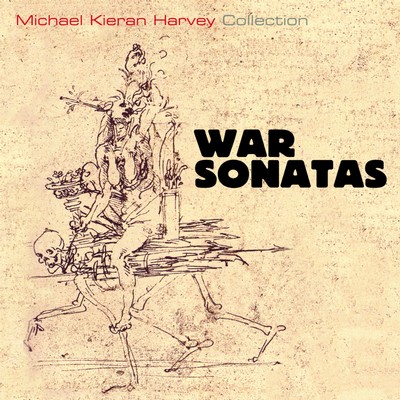
Actually, this emphasis on initial dissertations at some length obtains in the following two sonatas. the second entitled Sonata da Caemmerer refers to Harvey’s long-time colleague and friend Arjun von Caemmerer, while also having a bit of word play with the sonata da camera form, even if the most willing of us find it hard to figure out workable comparisons. Its opening Zappaesque lasts as long as the following Rubato and Giusto tempo combined. For Sonata No. 10, you can see the title reference on the CD cover above: Riding with Death. Leonardo’s illustration shows Envy riding on a casket, and I’m assuming that this concerns a different type of dissertation from the previous two personally dedicated sonatas as Harvey is concerned here with AI and its pernicious character in generating weapons used in conflicts across our world today. Here, the first movement lasts a little over fifteen minutes, its lone successor a little less than seven.

Apart from this tenth sonata’s monitory message against giving in to the machines, what have the other works to do that they fall under the War umbrella? The answer is to do with their environment rather than any imitation of the stuttering rifles’ rapid rattle. Harvey sees these three works as a triptych and it is unavoidable that you seek common elements in all of them, even if many of these are simply part-and-parcel of the composer’s compositional arsenal. They were all completed in a stretch of 19-20 months across 2022 and 2023, a time which saw a massive escalation in the war initiated by Russia’s invasion of Ukraine and at its end saw the opening of the Israel-Gaza conflict which has itself become an Old Testament-inspired annihilation. Despite Singer’s anti-Vietnam War stance, you have to stretch mentally to find resonances between that time so full of righteous protest and today’s oscillation of sympathies, compounded by the overtly destructive policies of Putin and Trump and the diplomatic flip-flops from leaders you ought to be able to trust.

In the second of these works, saluting von Caemmerer, the relationship with war comes from the empathy both Harvey and his colleague find in facing the soul-destroying realities of today’s partisanships and the disillusionment that every day produces as the sides in both conflicts become even more imbalanced and any trust in diplomacy proves hollow. Of the three parts to this triptych, this work presents as the least troubled, although that could be just a superficial judgement about its feisty rhythmic jaunts.

Certainly, the most enigmatic is the Riding with Death two-movement construct in which Harvey presents eight Hallucinations for a first movement – reductions to nightmarish scenarios where we waver against artificial intelligence while it weaves its multiple webs of influence and confusion. This is another large-scale essay, or series of paragraphs in which the activity level oscillates between slow angularity and fierce vitality. In the sonata’s second phase, less than half the length of the first, the lessening of humanity is entrenched, leading to a set of final pages where the aural onslaught is overwhelming as we surrender all power to mechanisms that pound us into nothingness – or worse, irrelevance.

The Singer sonata opens with an assertive Allegro giusto that emphasizes athletic leaps, and a motif consisting of a repeated note that accretes companions in an upward or downward-heading flourish, given in both hands. And abruptly, we are in the middle of a Harvey 4/4 mesh of semiquavers, syncopated accents, brief motifs, and an ardently driven energy. Relief comes in a rubato interlude that sees sustained chords wrapped in decorative foliage, the whole leading to a Lisztian climax of epic virtuosity before we return to the giusto and that obsessive wide-ranging percussiveness of the opening.

Another interlude, an A piacere, interrupts a plethora of sextuplets operating at cross-purposes before the composer presents a new chain of atmospheres by way of holding down unstruck chords with one hand and bringing their strings into voice by hammering out abrupt explosions in the other. Eventually we come to a dramatic triple forte climax and a statement of the dedicatee’s surname in complex soft chords; don’t ask me what notes represent S, I, N and R. For good measure, Harvey also gives us Singer’s name backwards in chords that largely have the same components as the originals.

A reversion to the giusto vehement drive, another dramatic a piacere and a series of fortissimo and pianissimo juxtapositions, and the movement ends on a final statement of the single-note-plus-accretions motif leading to a final bass chord of two discordant fourths. What’s next to do but propose a brief Onirico interlude, an unsettled dream that features gruff bass gruppetti and ornate right-hand arabesques while the substance lies in a chain of hefty ten-note sustained chords, the whole dissolving into a five-bar Liberamente excursion prior to folding into the final Ritmico pages.

This finale comprises six permutations and I can see some transferences between two of them but it’s probably best viewed as a set of discrete scenes that offer wide variations in rhythm and harmonic density. Which is not saying much when you look back over the rest of the sonata even if, as in this final movement, the oasis passages blend into the architecture so that the score sounds like a tapestry with consistent threads, brought together at the end by a vital restatement of the fixed-note-with-additions leitmotif.

Harvey begins his Caemmerer score with two identical bars of four double-dotted crotchets in 7/4 time, not wasting his time about submerging this simple material in syncopated cross-measures throughout a movement indebted to one of the composer’s inspirations: Frank Zappa. Disjunction is the game in play here as hefty accents bounce across the frenetic action that finds the executant oscillating between bars with irregular numbers of semiquavers so that you can’t settle into a regular toe-tapping pulse. But then you never can with Harvey who delights in establishing a rhythm that you think is formulaic but which turns out to be deceptive, the accent not where you thought it would be.

Without pause, the score moves into its second phase, Rubato, which proffers a limited meditation on the work’s opening four notes – or perhaps not. This is another set of pages that moves into lavish sound-washes that become more ornate after the movement’s staid, Satie-like opening. The splashes of sound are woven around sustained chords of remarkable complexity that build on the placid sequence initially articulated, before a small transition of about 20 bars Meno mosso breaks open the concluding Giusto tempo set in one of the composer’s most taxing rhythms: 11/16.

You hurtle here from climax through highpoint to explosion, one after another in a powerful exhibition of virtuosity which somehow emphasizes Harvey’s boundless energetic high spirits. You can recognize striding octave bass patterns that transfer to the right hand, punchy block-chords that call and respond across the instrument, hugger-mugger at-the-octave parallel passages like the most taxing five-finger exercises. The composer is here at his most ebullient, giving us some kind of representation of his friendship with von Caemmerer in a sparkling toccata that finally dwindles after a chain of dyads enjoy a diminuendo – as though the dialogue is paused, not ended.

While the first two sonatas in this sequence have been humanized by their dedicatees, the last moves into the realm of a cerebral conflict between AI and its creators. Across the first movement, Harvey offers eight scenarios, states where humans think they are in control. These vary markedly in activity level; a deftly outlined linear argument is followed by an initially calm state that is subjected to pinpricks of doubt or harassment. One of these hallucinations speaks with an updated Webernian angularity while another offers an initial calm underpinned by nervous semiquaver chains that eventually coerce the upper chords into a mirroring rapid angst.

Finally, we arrive at Hammered, relentless which offers a barrage of semiquaver chords in alternating hands with gruff chords as pivots. Harvey is wise enough, even in his anger, to vary the diet with abrupt changes of register and dynamic, not to mention those improbable time signatures that sweep your security blanket away. After some relieving pages in the more fluid ambience of triplets, the opening growling bass recurs and drives the forward motion into a maelstrom of strident chords that grow from seven, through nine to a concluding welter of insistent twelve note chords hammered martellato to an abrupt ending where the human is subsumed in the automaton.

In the end, Harvey’s latest sonatas don’t take war as their subject even if you hear emphatic bursts of energy that speak of turmoil and the suffering that large-scale conflicts bring about. More, the scores have been generated in tempore belli, a grim state that we have been inhabiting for some years, even insulated as we are in this place from the worst of its evils. The composer has been fortunate enough to find a framework for his considerations of these times in the species-broad altruism of Singer, and to hone his aesthetic in van Cammaerer’s friendship and collaboration. In the end, he faces us with the potential for inhumanity in AI and its assumption of authority. But, thanks to the brave agitation and fearlessness of his music, we can follow the best stoic directive and say not the struggle naught availeth.

Diary July 2025

MOZART AND THE MENDELSSOHNS

Melbourne Symphony Orchestra

Melbourne Town Hall

Thursday July 3 at 7:30 pm

What used to be simply called the Town Hall series has apparently been amplified in its geographical scope but the essentials remain the same. The Melbourne Symphony Orchestra is playing under its chief conductor, Jaime Martin, but the program isn’t as barnstormingly popular as you’d expect., Yes, the forces wind up this evening’s entertainment with Felix Mendelssohn’s Italian Symphony in A Major (well, half of it is) of 1833 which can never wear out its welcome from the first frothing wind chords to the emphatic saltarello‘s last belt. But, we begin with a true rarity, even in these anti-misogynist times: Fanny Mendelssohn’s Overture in C, written in 1832 and an intriguing chronological partner for her brother’s brilliant symphony. As for the essential concerto, the MSO offers four of its principals – oboe Johannes Grosso, clarinet David Thomas, bassoon Jack Schiller, horn Nicolas Fleury – as soloists in Mozart’s Sinfonia Concertante of 1778 . . . or is it really his? A lot of water has passed under the musicological bridge and the absence of an original score is only the start of questions about this quadruple concerto’s provenance. Standard tickets run from $45 to $105, concessions are a princely $5 lower, and anyone under 18 gets in for $20, but let these last beware of the $7 transaction fee that costs a third of your admission cost – that’s the way to get the young interested.

This program will be repeated in the Frankston Arts Centre on Friday July 4 at 7:30 pm, and at the Ulumbarra Theatre in Bendigo on Saturday July 5 at 7:30 pm.

JESS HITCHCOCK & PENNY QUARTET

Melbourne Recital Centre and Musica Viva Australia

Elisabeth Murdoch Hall, Melbourne Recital Centre

Monday July 7 at 7:30 pm

I wrote about this event (see March Diary 2025) while still living on the Gold Coast (ah, those halcyon years of heat and humidity) when the program was played at the Queensland Conservatorium on March 4 It seems a long time to be still on the road four months later for Jess Hitchcock and the Penny Quartet but here they are, fleshing out the Melbourne Recital Centre‘s monthly program and still (co-)sponsored by Musica Viva Australia. I have a feeling that the original program was altered before the March recital, but in its present format, nine composers offer arrangements of Hitchcock songs, including three by the singer herself as May Lyon, Matt Laing and Nicole Murphy have disappeared from the original list. It’s to be hoped that the Penny personnel stay the same – violins Amy Brookman and Madeleine Jevons, viola Anthony Chataway, cello Jack Ward – especially for the program’s final offering: a string quartet from American writer Caroline Shaw called Plan and Elevation: The Grounds of Dumbarton Oaks, written in 2015. Admission for your regular patron moves between $65 and $125, concessions on a sliding scale that operates between $56 and $110, the Under 40 bracket get in for $49, while First Nations peoples from any country only have to stump up $15. Your transaction fee at this site falls anywhere between $4 and $8.50 (a riveting exercise in fiscal logistics, reminiscent of Trump’s mercurial tariff rates) which is hard cheese for the Aboriginal, Torres Strait, Maori etc. patrons.

FOLK REIMAGINED: EAST IN SYMPHONY

Ryan Maxwell Event

Elisabeth Murdoch Hall, Melbourne Recital Centre

Wednesday July 9 at 7:30 pm

What you’re offered here is a transformation exercise: Chinese folk-song into symphonic form. The executants in this enterprise are the Guizhou Chinese Orchestra and a body called The Australia Orchestra. The visiting ensemble was founded in 2003 and is conducted by Long Guohong in its current Sydney and Melbourne appearances. The local group cannot be traced online (well, I can’t find it) but is to be conducted by Luke Spicer, who is a well-known presence in Sydney for work with the Sydney Symphony Orchestra and Opera Australia. And what do you hear? For openers, there’s the Guizhou Kam Grand Choir which will probably be singing a cappella. Then comes that well-worn fusion classic, the Yellow River Piano Concerto, followed by a symphonic sequence of scenes from four great classical Chinese novels, and more solid orchestra (which one?) work in a fantasy springing from the gaming activity Black Myth: Wukong which itself has to do with an Eastern monkey hero questing in the West. For soloists, you will hear Jiang Kemei playing a concerto called Deep in the Night on her jinghu (two-stringed violin) and Zhang Qianyang on the suona (double-reed oboe/horn) in one of the most famous pieces for her instrument, A Hundred Birds Paying Homage to the Phoenix. Admission costs between $35 and $169 with some piddling concession reductions; groups of ten-plus and students pay between $55 and $107. On top of this, factor in that swinging transaction fee of between $4 and $8.50; could that impost factor in Chalmers’ tax review, I wonder?

PASTORALE

Melbourne Chamber Orchestra

Elisabeth Murdoch Hall

Thursday July 10 at 7:30 pm

Since I’ve been away, Sophie Rowell has taken over the artistic directorship of the Melbourne Chamber Orchestra as well as having recently been posted to the role of associate professor of violin and chamber music at the University of Melbourne. She’s been busy over the years, what with the Tankstream/Australian String Quartet and the Melbourne Symphony Orchestra co-concertmaster position for eight years. Tonight, she takes her charges through two string masterworks at either end of the program: first, Barber’s Adagio for Strings of 1936 – a favourite when Americans want to be serious or funereal – and Tchaikovsky’s lush Serenade for Strings, written in 1880. Both of these are more than familiar, so it’s as well that the central works offer some variation. Aura Go will be soloist in Doreen Carwithen’s Concerto for piano and strings which the British composer wrote in 1948 and which is probably here enjoying its Australian premiere. The work’s three movements appear to be worked out in solid neo-classical style with definite tonalities obtaining across its half-hour length; there’s even a good old-fashioned cadenza in the Moderato e deciso conclusion. And the program takes its title from a Peter Sculthorpe excerpt, the central segment of his String Quartet No. 4 written in 1949, then upgraded to string orchestra standing in 2013. It has an even more checkered history in Sculthorpe’s own recollections. but it might well be his last ‘composition’, as the MCO publicity has it. Still, as it’s only about 4 minutes long, who wants to argue? Adult tickets range from $72 tp $124 with some reasonable concession reductions and a flat charge of $30 for students and children. The booking fee on the seat I selected was $7, which – to put it mildly – is excessive for the work involved.

This program will be repeated on Sunday July 13 at 2:30 pm.

YINYA DANA: LIGHTING THE PATH

Melbourne Symphony Orchestra

Hamer Hall,, Arts Centre Melbourne

Friday July 11 at 7:30 pm

In honouring the 50th anniversary of NAIDOC Week, the Melbourne Symphony Orchestra is paying an exceptional honour to Deborah Cheetham Fraillon whose compositions are the focus of this event. I’ve not encountered any of her music but I suppose that’s because her recent grounds of operation have been in Melbourne, particularly with the MSO who appointed her to a five-year tenure of their First Nations Creative Chair in 2021; I did experience her work as a soprano with Short Black Opera but that was some time ago. Details about what is actually being performed tonight are hard to find. but the range operates between her 2018 Eumeralla: a war requiem for peace (two movements of which were recorded by the ABC in 2020) and last year’s Earth. A pair of conductors share the honours: Aaron Wyatt and Nicolette Fraillon. as for soloists, Cheethem Fraillon will be singing, as will vocalists Jess Hitchcock and Lillie Walker. That sine qua non of Aboriginal serious music events, William Barton, brings his didgeridoo to the mix of colours and the MSO Chorus is joined by members of the Dhungala Children’s Choir, an offshoot of Cheetham Fraillon’s opera company. Standard tickets range from $68 to $113; concession prices are $5 cheaper which should bring on a chorus of that old favourite, Thanks for Nothing. Mob Tix are available for $25, but how do you prove your standing? Just be prepared to hand over the $7 transaction fee, whether you’re a member of the First Nations or a Johnny Come Lately like me.

BENAUD TRIO 20TH ANNIVERSARY CONCERT

Melbourne Recital Centre

Primrose Potter Salon, Melbourne Recital Centre

Saturday July 12 at 3 pm

Yes, it’s a celebration of a kind, if a short one as it’s only an hour long: no interval, quick in, quick out. The members of the Benaud Trio – brothers Lachlan Bramble (violin) and Ewen Bramble (cello), Amir Farid (piano) – still maintain a relationship; although the brothers are both associate principals with the Adelaide Symphony Orchestra and Farid is based in New York. They’re playing two works: Dvorak’s Dumky of 1891, which they have played here before in the heyday of their Benaud-Melbourne years; and Jakub Jankowski‘s Piano Trio No. 2. The latter is an Adelaide composer with a modest body of work to his name. The Benauds seem to have premiered this particular trio in 2018, a few months after the debut of Jankowski’s Piano Trio No. 1 from the Seraphim Trio. Now the piece is back for another airing. It would be handy if more information was available about the piece, but background is sadly lacking. Entry is a flat $50, concession $40, and you have to negotiate the Recital Centre’s odd ‘Transaction Fee’ charge that runs from $4 to $8.50 according to some criterion that escapes me.

This program will be repeated at 6 pm.

FIESTA! DVORAK’S CELLO CONCERTO & CHINDAMO

Melbourne Symphony Orchestra

Hamer Hall, Arts Centre Melbourne

Thursday July 17 at 7:30 pm

This was originally labelled ‘Journey to the Americas’ but has since been recast more sensibly so that it covers the entire night’s work. Yes, there is some emphatically relevant-to-the-Americas music on the program in Peruvian composer Jimmy Lopez’s Fiesta! Four Pop Dances for Orchestra, written in 2007 and the writer’s most popular work, here promoted by tonight’s conductor (and fellow-Peruvian), Miguel Harth-Bedoya who commissioned it. Joe Chindamo’s Americas connection might emerge in his Concerto for Orchestra of 2021, composed for the Tasmanian Symphony Orchestra; most of us would associate him with the field of jazz, and so easily American. And then we come to the large-framed Cello Concerto by Dvorak, completed in 1895 and written while the composer was living in New York during his last unhappy months directing the National Conservatory of Music. Here is a rich score loaded with melody and a splendid vehicle for its soloist, who on this occasion is German musician Raphaela Gromes; I believe she has made tours of North and Central America. Standard tickets range from $51 to $139; concession card holders might as well pay full price because their deduction is only $5. If you’re under 18, you are charged $20, which makes the compulsory transaction fee of $7 sting all the more sharply.

This program will be repeated in Costa Hall, Geelong on Friday July 18 at 7:30 pm and back in Hamer Hall on Saturday July 19 at 2 pm.

AXIS MUNDI

ELISION Ensemble

Primrose Potter Salon, Melbourne Recital Centre

Friday July 18 at 7 pm

The ELISION Ensemble is almost 40 years old, which puts into perspective a fair few of us who were around in its heady early years. Speaking of the few, some of the original musicians survive, including founder Daryl Buckley who remains one of the most adventurous guitarists I’ve come across. A fair bit of tonight’s program is up-to-date, beginning and ending with 2025 compositions. Melbourne-based academic Charlie Sdraulig‘s fresh Air opens us up in a septet (possibly) for flute (all three played by Paula Rae), bassoon (Ben Roidl-Ward), saxophone (Joshua Hyde), trumpet (Tristram Williams), trombone (Benjamin Marks), violins (interesting as there’s only one such player listed: Harry Ward) and contrabass (Kathryn Schulmeister). Then clarinet Richard Haynes performs John Rodgers’ Ciacco solo for bass clarinet of 1999 before we encounter Mexican-born Julio Estrada‘s yuunohui’ehecatl (2010?) to be played by trumpet, trombone, bassoon and contrabass. After interval comes the program’s title work, written for solo bassoon by ELISION evergreen Liza Lim in 2012-13, followed by indigenous composer Brenda Gifford‘s new score Wanggadhi for saxophone, trumpet, trombone and bass. Then we hear Victor Arul‘s Barrelled space featuring bass clarinet, saxophone, bassoon, trombone, percussion (Aditya Bhat and/or Peter Neville), and bass. If you haven’t had enough, you can wait around for a post-recital performance of Double Labyrinth v2, a new construct by British writer Bryn Harrison that calls for alto and bass flute, clarinet d’amore (Haynes had one made about five years ago), clarinet in A, flugelhorn (Williams, presumably), harp (Marshall McGuire), percussion and violin. Tickets are $55, concession $45, and don’t forget that peculiar transaction fee of between $4 and $8.50 that slugs every order you make.

MOZART’S CLARINET

Musica Viva Australia

Elisabeth Murdoch Hall, Melbourne Recital Centre

Tuesday July 22 at 7 pm

A trio of specialists take us through a set of works by Mozart and Beethoven in this latest Musica Viva recital. The entertainment features Nicola Boud on ‘historical’ clarinets, Sydney Symphony Orchestra cellist Simon Cobcroft, and Erin Helyard playing the fortepiano. I think their combined aim is to give us the experience of listening to this music as it would have sounded when it was written – a delight for musicologists, an aural adjustment or three for the rest of us. We begin with Beethoven’s Sonata for Fortepiano and Horn Op. 17 of 1800, arranged for basset horn (with the composer’s approval, apparently) by Josef Friedlowsky in about 1802. A touch earlier in his life, the composer wrote his Variations on Ein Madchen oder Weibchen from Mozart’s The Magic Flute for cello and piano in 1798; a puzzle as it’s catalogued as his Op. 66. All three players are involved in Mozart’s Kegelstatt Trio of 1786, even if the original called for a viola, not a cello. Back to Beethoven for the Aria con variazioni (four of them, with a coda) tacked on to the Three Duos for Clarinet and Bassoon WoO 27 and written somewhere between 1790 and 1792; you assume Cobcroft will stand in for the lower voice. Helyard then performs the familiar Sonata in C K. 545, composed for all piano learners’ delight in 1788, and the ensemble concludes this exercise with Beethoven’s Gassenhauer Trio Op. 11, written in 1797 with clarinet, cello and keyboard as the designated players. Tickets range from $20 to $153, and, on booking, you will encounter the $7 transaction fee: a disappointment we have always with us.

A GHOSTLY AFTERNOON

Selby & Friends

Primrose Potter Salon, Melbourne Recital Centre Wednesday July 23 at 2 pm

This recital features two young musicians in the latest Selby & Friends recital. Violinist Natalie Chee, Sydney-born and recently nominated as the Melbourne Symphony Orchestra’s concertmaster for 2026, and cellist Benett Tsai, fresh from delivering the Saint-Saens Concerto No. 1 with the Queensland Symphony Orchestra, will partner with Kathryn Selby in three piano trios. First comes an arrangement by the Linos Trio from 2001 of Debussy’s Prelude a l’apres-midi d’un faune – one of the more formidable works that ushered in a new musical era as far back as 1894. From the program title, you would have guessed that Beethoven’s Op. 70 No. 1 was on track for a hearing, and so it is although perhaps not as spectral as it seemed to listeners in 1809. To end, the group takes on the gripping Shostakovich Piano Trio No. 2, a 1944 work that never fails to absorb its listeners from the keening cello harmonics of the opening to the three last bars of soft E Major chords that offer a close but no consolation. Entry ranges from $63 for a student (and a concession card holder), to $79 for a senior, to $81 an adult. You’ll also pay between $4 and $8.50 if you order online or by phone. What if you show up at the box office, cash in hand? Worth a try.

This program will be repeated at 7 pm.

Mixed stop-gap

ACO UNLEASHED

Australian Chamber Orchestra

Hamer Hall, Arts Centre Melbourne

Sunday June 22, 2025

Satu Vanska

Something of a grab-bag, this program. That’s understandable since the original guest director, violinist Patricia Kopatchinskaja, bowed out due to an injury of some kind and the Australian Chamber Orchestra had to come up with something else that appealed to its clientele. Pushing forward the ensemble’s personnel in another celebration of the organization’s 50th birthday, artistic director Richard Tognetti absented himself from this particular felicity and gave three violinists and the principal cello a generous exposure in two concertos, as well as granting Satu Vanska the opportunity to outline her interpretation of Ravel’s Tzigane of 1924 with a reduced orchestra of strings, celesta and timpani/percussion.

As well as flaunting some front-line talent, the ACO demonstrated its collective skills in two arrangements: one by Tognetti of Beethoven’s String Quartet in F minor of 1810, the other the C minor Quartettsatz by Schubert from ten years later which was string-orchestrated by an anonymous musician. Both are short but the players attacked them with that carefully honed brusqueness which is a characteristic of this body when confronted with composers of this stature in curt mode. And Tognetti obviously takes pleasure in transcribing masterworks of this level for his forces who usually make them seamless accomplishments.

But you come across a different creature when you move from the single line to the many, no matter how determined and aggressive the groups of five violins, for example, in Beethoven’s opening Allegro. The first violin octaves leaps that start in bar 3 lose bite, as does the all-in-together menace of bars 18 to 20 when four whip-cracks become a sound-wall. The listener can sense the communal determination of output in the string orchestra format but you sacrifice an individuality of character that generates the main interest in string quartet recitals.

Well, I’ve made this comment before and it probably borders on the pointless, particularly because it could be worse. We could be hearing arrangements of music that relies on large-scale and diffuse orchestral timbres, like Rimsky’s Scheherazade, the Pines of Rome, or Berg’s Op. 6. Actually, no: we couldn’t: that’s several bridges too far. But there’s nothing to stop a spread into the Schubert Quintet which I’ve heard in full orchestra format; or the Brahms sextets which have also been converted for the larger string-rich palette.

And on you could go. But this predilection for regular and familiar quartets by Beethoven, Janacek, or Bartok is all more than a little disappointing as the repertoire for string orchestra is large. And, if you’re going to faff around with the pre-existing, I’d welcome a bit more adventure – like reducing Penderecki’s Threnody for your available forces, or doing the same for Boulez’s Livre pour cordes, or expanding the Schoenberg quartets, especially No. 2.

In any event, much of this afternoon’s activity comprised arrangements. We started with Bach’s Concerto for three violins, a reconstruction of a work using three keyboard soloists. Vanska, Helena Rathbone and Anna da Silva Chen (the ACO’s latest full-time member) performed the individual lines with an agreeable self-appreciation of their function in the complex, yet not slavishly imitating each other in the frequent staggered entries with which Bach peppers his work. Vanska gave us a firm exhibition across the opening movement, including two striking exposed solos (bars 63 to 72, bars 115 to 119), while Rathbone and Chen made exemplary complements, to the gratifying point where you could experience three differing styles of attack and release.

Still, the intriguing movement of this concerto is its finale with the potent solo for Violin 1 from bar 141 to bar 174, although not before some eloquent exposed passages for her partners. By the time we arrived here in this second public rendition of the program, the ensemble showed at its best through a forceful oscillation between ritornello and solo, all three of them vaulting into action with gusto, especially Chen who exercised an attractive personality here, both earthy and buoyant.

Vanska bowled into Tzigane without waiting for the greeting applause to die away, making fierce work of that vigo4rous opening of 27 bars on the G string only. You were left in no doubt that this player had the mastery of the thing as she handled its challenges with a precise ferocity and demonstrated for one of the few times in my experience how cimbalom-like that moment of left-hand pizzicato could be. Yet, behind the bravura and theatricality, I couldn’t help wondering if the player was showing us how satirical this piece of Gypsy music is with its fits and starts, not to mention its employment of all those Liszt-to-Sarasate Romany tropes that Ravel was utilizing to construct such a clever exercise in brittle musical frivolity.

Bernard Rofe, the ACO’s Artistic Planning Manager, carried out the arrangement of this exuberant gem and gave a large part of its colour spectrum to the celesta, here handled by regular ACO violinist Ike See. I suppose nobody in the ACO doubles as a harpist; that instrument sees far more action in the original than the 16 bars of light colour contributed by the celesta between Nos. 14 and 15 in the Durand score of 1924. Not that this imbalance in the back-drop matters that much when the spotlight shines almost uninterruptedly on the soloist and Vanska showed plenty of flair and apparent enjoyment in her work right up to the rather brutal three pizzicato quadruple-stop chords that finish the piece.

If you accept the character change of the string quartet arrangements, then you would have been impressed yet again by the ACO’s outlining of the Beethoven and Schubert program components. As you might have expected, the most persuasive section of the Serioso came in the Allegretto where the key is to keep the piece in fluid motion. I think the texture cut down at one point to a series of solo entries – the fugato at bar 34? – but the quiet, filled-out nature of the movement’s harmonic movement with its sideways slips gave us a welcome tranquillity between two driving sets of pages.

I enjoyed the Schubert movement because of its innate qualities that seem to lend it more easily to the orchestral framework, like the oscillation between bustle, as at the start, and the sudden soaring aspiration of the second subject in bar 27. Later, the rapid outward and inner surges between bars 77 and 80 proved striking in their unanimity of production and dynamic management, as were the transparent first violins’ step-by-step gradual descents across bars 105 to 124. It’s a striking fragment in its mode of address, making a virtue of simplicity . . . which is probably why it seemed more suitable for an expansion of forces.

To end, Timo-Veikko Valve fronted the Australian premiere of his compatriot/relative Jaakko Kuusisto’s Cello Concerto of 2019 which is scored for an orchestra of strings, timpani (here played by Brian Nixon) and percussion (the evergreen Daryl Pratt). This proved to be a gracious, expansive construct in an orthodox three movements, its progress outlined with exemplary earnestness by the soloist. The most lasting impression from this new (to us) composition is of a lyrical fluency coupled with harmonic sophistication, but Kuusisto’s vocabulary impresses as conservative: there are no disruptive signs in this work which takes its place in a long chain of such concertos which offer expressive gifts for their soloists while the orchestral support holds some challenges. Will we hear it again? Possibly, I suppose, but in my gut I think that this concerto might remain a local rarity.

Nevertheless, it was refreshing to hear an unmediated composer speaking his original tongue without reconstruction from any other source. Further, it brought this celebration to a satisfying conclusion, giving the ACO the opportunity to engage with a contemporary voice, sadly stilled before reaching its full complement of years, yet fortunate in these exponents who take up their work with exemplary devotion and relish.

No cease from exploration

FLUTE PERSPECTIVES VOLUME 4

Derek Jones, Jerry Wong, Joshua Hyde

Move Records MD 3476

Following his own particular path, flautist Derek Jones presents a fourth collection of music written for his instrument by (generally, in this instance) living local composers. His associate pianist is a carry-over from the preceding album, Jerry Wong, and the works on this particular CD cover a wide time-span. The oldest work is venerable Sydney composer Anne Boyd‘s Bali moods No. 1 of 1987; Boyd has also featured on the first and second in Jones’ Flute Perspectives discs. She is closely followed in time by Keith Humble’s five-movement Sonata for flute and piano of 1991, written four years before this notable writer’s death. Alan Holley‘s River Song and Rosella date from 1997 and 1999 respectively. Then we jump to Harry Sdraulig‘s Sonata for flute and piano of 2014, before coming to last year’s Firefly’s Dream by Linda Verrier (a writer who also featured on the previous Flute Perspectives CD) and Folding outward into traces by Joshua Hyde who features on the CD itself, escorting Jones electronically through his score.

Boyd is of the school that sees this country’s musical creativity as indebted to/part of Asia. I don’t know if this creed has maintained its former strong influence; there’s little sign of it in the current crop of younger composers, but Boyd has maintained the faith which also formed part of the inspiration for her teacher, Peter Sculthorpe. Bali rounds No. 1 is part of a triptych of flute+piano pieces that take their impetus from Indonesian sounds and modes. In form, it’s like a rondo with a gamelan-type scene-setting from the piano before the flute enters to toy with the piece’s opening pattern. This atmospheric segment recurs after two cadenzas for flute, one of them with some piano gong-chords, the whole coming to a fade-out conclusion.

As with several of Boyd’s works, this Indonesian-Balinese character is deftly accomplished in a score with a quiet attractiveness, its peaceful progress brought to stasis at the two cadenzas which sound free-form as far as rhythm is concerned. Worlds away in every respect is Humble’s sonata which is more attuned to the world of Boulez’s Sonatine pour flute et piano of 1946 in its bursts of action from both performers. You might expect suggestions of twelve-tone and you’d be right, but the disposition of the series is free-form, as far as I can make out – at least in the opening movement..

The abrupt fits and starts in an improbable rhythmic scheme dissipate near the movement’s end, which is dead slow and sombre. Much the same process occurs in the brief second movement which opens with splashes of sound that seem more formally organized than in the preceding pages. But there is a similar reduction in action to a quiet, brooding conclusion. With the third movement, you first encounter a similar landscape to those of its predecessors, if the process appears to be more prone to an even keener (or more practicable) synchronicity. The players’ mutual mobility comes to a halt for a long flute solo which again moves us into darker-hued territory with few signs of freneticism. A near-funereal coda from Wong concludes this pivotal segment of the work.

Humble’s brief fourth movement sees an ongoing juxtaposition of the leap-frogging calisthenics of post-Webern chamber music and a placid oasis or two of firm pulse and support rather than the bleep-and-commentary nature of the mise-en-scene in the score’s separate parts so far. Yet again, the final stages of these pages are more restrained, near-formal in some scale-like steps from Jones. And the not-quite-as-brief Final follows the same format with a pointillistic opening that gradually gives way to murmurs from both instruments. Not to say that all five movements are replicas of each other but the shape of each one has much in common with its fellows.

Still, this sonata shows the composer in a sharp-edged light with a more placid emotional aspect than in the handful of his works that I’ve encountered over the last near-60 years. But it speaks a European language in its active moments, as you’d expect from a writer who spent a significant amount of time and enjoyed success in France. Jolley’s two solo flute pieces are of a different heritage, one that sounds local in its suggestions of Australian Bucolic, as in River song which sets up its central motifs and more or less elaborates on them without straying too far from the originals. It’s a French-indebted work also, but more Debussy than Dutilleux and making no claims to rhythmic spasms or aggressive sound-splays.

The second of Jolley’s solos, Rosella, is just as concentrated in its material disposition with some more florid outbursts and its concentration is more noticeable as it’s less than half the length of River song. You won’t heard rosella sound transcriptions but a series of images that suggest the bird’s mercurial change of life-pattern, if delineated in a tautly stretched aural canvas. Both pieces show a solid workmanship in construction, as well as the composer’s talent at suggesting aspects of the bush and its denizens. Jones gives eloquent and sympathetic readings of these scenic pieces, engaging them both with a calm authority.

The sonata by Sdraulig is an early work, if his online catalogue is any indication as it comes from his second year of compositional operations. It’s in four movements – Prelude, Badinerie, Romanza, Finale – and the first two are brief while the last is the longest and something of a mixed bag. Nevertheless, the work has a clear shape and direct mode of address even while the composer explores his possibilities. For instance, the Prelude sets up a bitonal piano pattern of soft semiquavers in 5/8 before the flute enters with high sustained notes that acquire rapid-fire ornamentation. But despite a central complexity before reverting to the opening Moderato e molto misterioso, these pages have a firm character and ease of utterance.

The only badinerie I know is the final movement from Bach’s Orchestral Suite in B minor with its grasshopper flute line. Sdraulig applies a light fragility to his at the start with a repeated note in 6/8 (I think) to begin, skirmishing with the piano before setting out on a rapid-fire journey that offers stronger affirmations of the opening pattering and some assertive striding around for both players. Not that the performance here is forced but there are a few passages that come across as laboured and I can’t determine whether it comes from the performers’ determination or some awkwardness in Sdraulig’s writing. But the movement’s bookend pages are feather-light and deft.

Sdraulig’s Romanza presents as a slow waltz, one that meanders harmonically through the piano’s initial statement, immediately mirrored by the piano. Gradually, the intensity deepens and the movement rises to an emphatic climactic point before receding and returning to its origins in a kind of resigned leave-taking that eventually comes to a settlement. You could view it as a song, a lyric of both casualness and intensity. But the last movement is an assemblage where you can pick out some recurring features but the dynamic and emotional landscape is highly varied: fom a rapid-fire opening that recalls the Badinerie to long melodic arcs for the flute (including one exposed solo) that recall the Romanza. I think any listener can detect six or seven sections that are juxtaposed but, despite this variety, the effect is not really successful. Jones and Wong sound stodgy in some of the quick-fire passages and a lack of light touches, of sparkiness prove disappointing.

A more successful blending can be found in Linda Verrier’s piece where the atmosphere is pervasively melancholic. Where, in the summers of her youth, the composer saw fireflies galore, returning years later she finds only one. In any case, she celebrates the insect with a mobile line for alto flute, realized through plenty of trills and repeated notes to suggest a visible presence. At the same time, she seems to be lamenting its solitariness in strophes that come close to an elegy. To her credit, Verrier contrives to keep these two strands in balance in a score that taps into this instrument’s capacity for darker, chalumeau-type colours.

Hyde’s construct is the longest track on this CD, even if to my ears it splays out a limited amount of substance, some of which is extended well beyond its power to engage. Jones plays multiphonic chords or intervals while Hyde treats the given material electronically. For the first half of the work, the emphasis is on amplifying or subduing different layers of the flute/electronic construct. Sound strata come and go as lights do in an aurora. Later, additional sounds enter the mix; one sounds like a chainsaw but might only be an agglomeration of pitches; towards the end, we are hit with what sound like motorcycle exhaust noises.

Not that this welding of live and electronics is that novel a concept or practice. But there’s something endearing in Hyde’s exercise where you can hear the effort involved in his and Jones’ folding outward, taking notes and welding them into an unusual composite. Well, these days there’s not much that’s unusual but this work pursues its traces with determination and invention. In its concluding phases, Jones is subsumed into the texture, his original sounds mere trace elements in the sound environment. It’s a fine way to bring us up-to-date, concluding this latest exploration in Jones’ corner of Australian music.

Canons by the score

A THOUSAND BEAUTIFUL AND GRACEFUL INVENTIONS

The University of Queensland Chamber Singers

Move Records MCD 663

As you can see from the cover, this CD is concerned with canons from the eras when this device was integral to choral composition. What we hear comes from research conducted by Denis Collins and Jason Stoessel; both are academics with Collins an associate professor of musicology at the University of Queensland, Stoessel also an associate professor of musicology and digital humanities at the University of New England. In combination, these two are the CD’s artistic directors, even if the actual man out front is Graeme Morton, senior lecturer at Queensland University and probably the most well-credentialed choral conductor in that state.

In its display of canons, the CD holds 17 tracks. Six of these feature works by Palestrina and Agostini: first, a Sanctus and Agnus Dei from the former’s Missa Sacerdotes Domini; then, from Agostini’s Missa Pro vigiliis ac feriis in canone, the Kyrie, Sanctus, Agnus Dei and Sit nomen Domini which is a pontifical blessing that sends everybody home in high ecclesiastical spirits. Preceding these samples of canon in late Renaissance choral music, the University of Queensland Chamber Singers wend their placid way through another Kyrie and Sanctus from a 14th century manuscript found in the Cathedral of Tournai, written by anonymous hands (or a hand); the original manuscripts found between the pages of the celebrated Mass of Tournai. Then follows a group of three canonic pieces by Matteo da Perugia, Du Fay and Okeghem, a set of three chansons by Jean Mouton, before another triptych by Prioris, Josquin and Willaert.


It’s with reference to the last of these that the CD finds its title: a quote from Gioseffo Zarlino, the 16th century composer/theorist who was one of Willaert’s pupils and who wrote of his teacher in glowing terms: ‘One can hear daily many compositions by the most excellent Adrian Willaert which, in addition to being full of a thousand beautiful and graceful inventions, are eruditely and elegantly composed’. Well, you can’t say fairer than that, can you? But, as with every composer here, the emphasis is on a particular type of invention – the use of canon and the complexities that involves

Such complications start straight away. The Tournai Kyrie is for three lines but the canons are eventually sung simultaneously so that, despite the linear mesh, everybody sings the same words at the same time. It all works out neatly with nine sections – three Kyries, three Christes, three Kyries – and you can hear repetitions of patterns as the lines wind around each other, more obvious with some rapid semi-ornamental work in the final pages that is shared across the parts. When we get to the Sanctus track, your reception becomes easier as the entries into the canon are staggered (as in the Kyrie) but the canonic material is rather plain. Still, the same principle applies about the words which are (generally) sung simultaneously.

These opening tracks offer the UQ singers in exposed fashion, the Kyrie involving female singers, the Sanctus/Benedictus given to the males. Both groups are solid enough, the females having one individual whose timbre shines through at certain points, while the men have all the emotional control of a French monastery group from those mid-20th century recordings of Gregorian chant.

Matteo da Perugia’s Gloria Spiritus et alme presents as a simple section of the Common of the Mass but with interpolations at the end of certain lines which stand as praises to the Virgin; rather exceptional in the context of this extolling of the Triune God. Like a rather striking sample of conductus, this piece speaks with remarkable vivacity, clear in all its parts, but I think that might be due to the two dancing upper lines being sung by individual sopranos. Here, the canon is located in two slow-moving bass parts; for this impatient ear, you’d need a score to trace it.

Dufay’s Gloria ad modum tubae sets up two canons: the first is between two upper voices who follow each other without trickery or, for that matter, much melodic intrigue, while a pair of bass lines sing the same two notes in imitation of those promised trumpets; might have been better to use the actual instruments. But the effect is breezy and forthright: one of the quickest Glorias I’ve come across and handled with excellent pitching by the Singers’ women.

We move to the secular with Okeghem’s Prenez sur moi, a buoyant canon for three voices in which the UQ tenors acquit themselves very well, as do the sopranos, although the alto line is very restrained in volume. This is a sample of that generous well-crafted language, musical and literary, that exemplifies good old-fashioned cortoisie, if with a dose of cynicism, but expertly delivered here – twice, as it happens, as the singers repeat the piece.

Mouton’s three chansons begin with En venant de Lyon which documents a vignette – observing Robin and Marion up to some bawdy congress in a thicket. The canon is for four lines, each following the other in quick succession as though to delineate the rapid nature of the focal pair’s activities. The double canon that follows, Qui ne regrettroit on the death of fellow-composer Antoine Fevin, shows a more serious aspect, the soprano (cantus) in canon with the tenor, alto and bass pursuing each other in this calm, expressive elegy. Finally, Adieu mes amours presents another double canon, sopranos and altos dealing with one, tenors and basses with the other, all matched in a seamless web that sets forth plainly the composer/poet’s humorous farewell to life because the king hasn’t paid him.

The shadowy figure of Prioris (Johannes? Denis?) produced a brief sample of splendour in his Ave Maria setting which is an eight voice work featuring four canons. I have to admit that, while the first two canons can be followed part of the way through this brief score, the other two are almost impossible to pick out, even if you have the four Incipit phrases in front of you. For all that, the Chamber Singers invest it with a placid fervour, their output measured and finely-shaped even if the top sopranos dominate the texture.

Josquin, the master of the canon in every age, is represented in this tour d’horizon by his six-line setting of Se congie prens, which deals with a lover departing the scene before further suffering at the hands of his cold non-inamorata. The program notes speak of a canon between the two middle voices, but I can only hear one between what my score calls the Quinta Pars and the Sexta Pars, and an intermittent one between the two lowest voices (tenor and bass). The construction of his piece rewards study but in actual performance all you concentrate on is the countertenor part, here sung by some confident tenors who cope with a cruelly athletic line to fine effect showing only one sign of strain.

The mellifluous Willaert hits us with a double canon in his motet Christi virgo dilectissima; soprano and bass form one pairing, alto and tenor the other. In this performance, I think the alto line features male voices but I could be wrong, being sadly unfamiliar with the sound quality of the Queensland mezzo voice. This composer moves on from the rhythmic simplicity of his predecessors and has the lines operating in different time zones, adding contrapuntal complexity to the mixture. This is one of the more substantial tracks so far, helped in that by being divided into two segments to reflect the textual matter although both conclude with the same plea for help.

The interpretation is a strait-laced one with the dynamic range kept limited and that serves to underline the composer’s calm pace of inventiveness. Then we come to Palestrina, from whose Missa Sacerdotes Domini we hear the Sanctus and Agnus Dei. I won’t insist that we’ve come to a new plane of creativity, but it’s certainly different in its ease of utterance and the actual presence of six interdependent and independent lines. The opening sounds like a canon involving all the voices, but you could say the same about any number of Palestrina masses that open with the same scrap and then move onto their own paths that imitate details from each other without strictly following the set line.

When we reach the Pleni sunt caeli, the vocal lines cut to three and here the canon is emphatic but the male voices curvet around each other with apparent freedom, the UQ men having an amiable felicity with these pages. And you might be forgiven for seeking canons in the four-part Benedictus but it comes down to imitative entries that veer off onto individual trajectories. With the Agnus Dei, the singers give us only one of the three sentences; understandable as Palestrina apparently didn’t supply a separate dona nobis pacem setting. I think that the canon here obtains between the pairs of tenors because, while everybody takes up the initial bass phrase, several voices dip out on their own excursions by the time we come to Qui tollis.

You think its all going to be plain sailing when you arrive at Paolo Agostini’s Mass which begins with a transparent canon for four voices in its Kyrie, all the more eloquent for its brevity and the clarity of its structure. And so it proves to be with the entries just as plain in the Sanctus, Osanna, and the two settings for the Benedictus – the first without basses, the second without sopranos. As in the Palestrina, the Singers give us only the first verse of the Agnus Dei, a movement in close canonic quarters with a particularly fine amplitude effect at the miserere nobis.

The Sit nomen Domini blessing is notable for the addition of an extra bass line which operates with its partner in a rich sequence of consecutive thirds while your regulation soprano, alto and bass voices outline the canon entries on top in a brief touch of sweet harmony to finish the disc. And, with a few exceptions, that is a lasting impression – one of brevity. The length of each track is not given in the accompanying booklet but my count puts the CD’s length at 47’34”; the longest track is the Willaert motet (7’01”), followed by Palestrina’s Sanctus (6’58”), with Perugian Matteo’s Gloria coming third (5’10). Two offerings come in at under a minute, five at under two minutes, five a bit over two minutes, with the remaining two averaging four minutes between them.

What you get is a well-sung set of choral canons, most of them traceable by the ear alone. It’s a fair mixture of the sacred and profane, although the former predominate. Further, the performances are secure and controlled; full marks to an organization that escaped my notice during the years I spent in the neighbourhood.. And further congratulations to the felicitous ease with which all concerned handle what could have been a dry academic exercise.

Diary June 2025

SAMSON ET DALILA

Melbourne Opera

Palais Theatre., St’ Kilda

Sunday June 1 at 2:30 pm

it’s been quite a while since Saint-Saens’ enduring opera of 1877 has been staged here. The one and only time I can recall is from November 1983 when the Victorian State Opera forces, conducted by Richard Divall, presented a version in Hamer Hall, the company’s chairman, Sir Rupert Hamer, having to make a small statement defending the microcosmic amount of nudity that occurred during the Bacchanale. Mind you, this was during the oddly strait-laced premiership of John Cain Jr. who was no stranger to the art form. A lot was made of some naked bodies that were intended to spice up Act 3, Scene 2 and the more salacious among us were looking forward to a bit of real Philistine brouhaha, especially as you had to sit through a fair amount of tedium before the fun started and the roof caved in. Let’s hope that Melbourne Opera has better luck with its orgy. Details are slim: mezzo Deborah Humble is taking on the temptress role; tenor Rosario La Spina will wind up shorn but triumphant as the strongman judge, The director is Suzanne Chaundy, conductor Raymond Lawrence. It seems as though the company is not using the Palais lounge or balcony while ticket prices range between $69 and $199, never forgetting the $7 ‘handling fee’ which gives an expensive venture a little extra bite – and a fiscal necessity for reasons that nobody can explain to me without blushing.

This program will be repeated on Tuesday June 3 at 7:30 pm.

SCHEHERAZADE

Melbourne Symphony Orchestra

Hamer Hall, Arts Centre Melbourne

Monday June 2 at 6:30 pm

Have you ever heard a satisfactory live performance of this marvel of orchestration? I can’t say that I have, but my experiences have been limited to three state orchestras in this country. I mean, you can be wrapped in a pleasant cocoon of sound as Rimsky-Korsakov’s suite from 1888 moves from its snarling opening bars to the soaring, placid triumph of its conclusion, but an average reading loses your interest in the middle movements to do with the Kalendar Prince, and then the Young Prince and Young Princess which test the phrasing inventiveness of several exposed individual players. Conducting the Melbourne Symphony Orchestra in this gem is Elim Chan, the young Hong-Kong-born musician who has been wooed with various degrees of success by British and European organizations. Scheherazade is the only work on this program which belongs to both the Quick Fix at Half Six and the Meet the Music: Years 9-12 series which have different modes of preparation for their two distinct types of audience member. Mind you, it pays to be a secondary school student: their tickets are only $9 each. If you’re after the quick fix, your standard ticket costs between $62 and $99 (a hell of a lot for one work); concessionaires can expect to pay $5 less (big deal), and your child under 18 will pay $20. Add the compulsory $7 transaction fee, of course; administering your credit card deployment is so time-consuming.

STEPHEN HOUGH

Melbourne Recital Centre

Elisabeth Murdoch Hall, MRC

Monday June 2 at 7:30 pm

The formidable British pianist is a guest of the Melbourne Recital Centre and is always good value, not leat for the spread of his programming. This time round, Stephen Hough opens with a group of three pieces by Cecile Chaminade: Automne from the Op. 35 Six Etudes de concert of 1886, Autrefois from the Op. 87 collection of Six pieces humoristiques written in 1897, and the 1892 Les Sylvains. which is Chaminade’s Op. 60. Well, it’s his program but the little I’ve encountered from the French writer’s catalogue strikes me as fin-de-siecle Light. This triptych is followed by Liszt’s B minor Piano Sonata which will probably overshadow anything that precedes it, anyway. Hough then treats us to his own Sonatina Nostalgica, a 2019 work comprising three movements, all with a combined timing of less than five minutes. This mimics the positioning of the Chaminade in preceding another formidable score: Chopin’s final Sonata No. 3, composed in 1844 and enjoying less exposure in the modern recital hall than its predecessor, the Sonata No. 2 in B flat minor. You’d think this presents as a rather eccentric array of offerings; you’d be right. But Hough has the ability to maintain your interest, even in his easy-going moments. Standard tickets cost between $67 and $115, with some half-decent concessions for students and the elderly. There’s also the inevitable $7 levy for taking your money, an unreasonable tax which has apparently infected every musical enterprise across the city.

FIRST VOICES SHOWCASE

Melbourne Symphony Orchestra

Iwaki Auditorium, Southbank

Wednesday June 4 at 6:30 pm

Here is one of the Melbourne Symphony Orchestra‘s special excursions – the First Voices First Nation Composer program under a Music and Ideas banner. I don’t know how the organization is approaching this concept of giving a voice to Aboriginal writers but this strikes me as tentative. For one thing, it’s not hard to fill the Iwaki space. For another, the event is scheduled to last only an hour. For a final touch, all tickets are $15 . . . and you can add on almost half that again for the gouging transaction fee which pushes your price up to $22. Anyway, what do you get for your money? Three works, as it turns out. First comes James Howard‘s Nyirrimarr Ngamatyata/To Lose Yourself at Sea; followed by Leon RodgersSeven Sisters; the set concluding in Fragments by Nathaniel Andrew. Howard is a well-established academic with a solid background in tracing cultural heritage. The piece by Rodgers was programmed in last year’s First Voices concert, according to a still-extant website. Andrew presents as the most versatile musician with a strong base in performance both here and overseas. I know nothing of the work of any of them but, if in the audience, would be waiting with anticipation for any sign of innovation or irregularity elements that are absent all too often in the output of contemporary writers.

NORTHERN LIGHTS

Musica Viva Australia

Melbourne Recital Centre, Southbank

Tuesday June 10 at 7 pm

An inevitable title, given the Swedish-Norwegian background of this recital’s violinist, Johan Dalene. This young celebrity appearing for Musica Viva will be partnered by Hobart-based Jennifer Marten-Smith, latest in a long line of pianists who have partnered Dalene across an active schedule of performances. Mind you, some of the material he’s presenting tonight has been part of his duo programs for some time, like Rautavaara’s Notturno of 1993, and Ravel’s spiky Tzigane from 1924. Dalene also specializes in Grieg’s Violin Sonata No. 2, written in a nationalistic blaze during 1865. And he has been known to play Beethoven’s Violin Sonata No. 8 in G, last of the Op. 30 set of three written in 1902. Three other works that the artists present tonight seem to be new. The most unarguable in this respect us Tilted Scales by (fairly) young Australian Jack Frerer, commissioned for this national tour. Another is Tchaikovsky’s Souvenir d’un lieu cher of 1878 in which we will be hearing all three parts, not just the popular Meditation. And Lili Boulanger’s D;un matin de printemps enjoys a hearing, written near the composer’s death in 1918. Prices range between $20 and $153; don’t say you don’t have choices. And there’s no avoiding the $7 fee which will be really welcome for those who qualify for the cheapest tickets.

A REFLECTION IN TIME

Melbourne Symphony Orchestra

Hamer Hall, Arts Centre Melbourne

Thursday June 12 at 7:30 pm

Back in the well-furrowed trench of orchestral concerts as they were held in this country for years, this presentation follows a venerable pattern, its main components a concerto and a symphony. The difference this time around is that the night’s three components all show their composers at highpoints in their public careers. Conductor Benjamin Northey opens the event with Barber’s Adagio for Strings, originally the slow movement from the 26-year-old composer’s String Quartet Op. 11 from 1936. Christian Li, the Australian-born 17-year-old violinist, is soloist in Korngold’s concerto of 1945; this has become a standard these days, suffering no little neglect for several years after the composer’s death. Finally, Northey takes the Melbourne Symphony Orchestra through Shostakovich’s Symphony No. 5, written in 1937 allegedly as a response to Stalin-inspired criticism of the composer’s modernist tendencies. These days, the work is seen to have undercurrents of protest against the Soviet state and its oppression of artists. You’d be a noggin-head to take all that final movement bombast at face value but plenty of people do. Whatever the reaction you have, Shostakovich was seen as toeing the Party line, especially by the time-serving music critics in the Russia of that time. It’s all a fascinating reflection of the decade across which these works were written. Standard tickets tonight fall between $75 and $139, concession card holders enjoying a $5 discount, while children under 18 can get in for $20. And there’s the eternal $7 booking/transaction fee/extortion to add on to your cost.

This program will be repeated on Friday June 13 at 7:30 pm in Relaxed Performance mode with special consideration for audience members with disabilities (special prices apply for tickets on this occasion of $35 standard and $30 concession), and on Saturday June 14 at 7:30 pm under regular operating conditions.

ANAM AT THE CONVENT: ELISION ENSEMBLE

Australian National Academy of Music

Rosina Auditorium, Abbotsford Convent

Friday June 20 at 7 pm

The country’s premier contemporary chamber ensemble is playing in the Australian National Academy of Music precincts and also features among its ranks some ANAM alumni. All the same, I think that, from the publicity material, regular Elision Ensemble players will be reinforced by current ANAM musicians. In any case, tonight’s offerings hold memories for me, including the ensemble’s long-time advocacy for the works of Franco Donatoni, whose 1977 Spiri for ten instruments is being played here. Also, the voice of Liza Lim, an Elision essential, will be heard in her Veil for seven players of 1999. Then there’s a work by Xenakis to start the second half – his Eonta of 1964, written for a most mixed sextet of piano, two trumpets and three trombones.. We have an Australian premiere in German composer Isabel Mundry‘s Le Voyage, written in 1996 for four woodwind, three brass, two percussion and a string septet which makes it the most substantial work we’ll hear in terms of participant numbers. Lastly, Russian-born German-based writer Dariya Maminova is represented by her Melchior from 2021; scored for two synthesizers and samples, this promises to exhibit the composer’s attempts to fuse contemporary with rock – I know: an impossible task but the texts come from Edward Thomas and Pasternak, and the piece lasts for ten minutes. Pricing is one of those 1960s box office deals where you can offer $60 if you have the cash, $40 if you fit into the standard patron category, and $20 if you’re feeling the cost of living weighs heavily. And, to show that the organization is really a freedom-loving, libertarian revenant from the hippie era, your booking fee is only $5. As the old song has it, who could ask for anything more?

CLASSIC 100 IN CONCERT

Melbourne Symphony Orchestra

Hamer Hall, Arts Centre Melbourne

Friday June 20 at 7:30 pm

Not sure about these popularity polls for serious music because they usually display the responders’ lack of musical experience as the outcomes, especially near the top, are numbingly conservative. This year, the ABC Classic FM hosts and announcers have focused on the piano and are asking which work written for this instrument as a solo, as part of a chamber ensemble, or having the instrument in front of an orchestra happens to tickle your fancy. At moments, I feel like doing a Tom Gleeson and fixing the vote by having numerous people propose Boulez’s Piano Sonata No. 2, or Webern’s posthumous piano scrap, or Paisiello’s Concerto in D. You have until 1 pm on Monday June 2 to make your voice heard. Needless to say, patrons won’t be hearing the complete election result; rather, selections will be presented by the Melbourne Symphony Orchestra under conductor Benjamin Northey (who is also billed as having ‘creative direction’) , with Andrea Lam as the focal pianist who presents the concertos and solos and chamber music extracts: the sole fount of pianistic wisdom – all without Harry Connick Jr. Your normal everyday customer can pay between $59 and $109 for a seat; the concession reduction remains a risible $5 and the booking fee of $7 still obtains, despite the fact that you have no idea what you’re going to hear – although I’m guessing that surprises will be almost non-existent.

This program will be repeated on Saturday June 21 at 2 pm.

ACO UNLEASHED

Australian Chamber Orchestra

Hamer Hall, Arts Centre Melbourne

Sunday June 22 at 2:30 pm

A continuation of the Australian Chamber Orchestra‘s 50th birthday celebrations, this event serves to showcase some individual talents from the ensemble’s ranks. The program has been curated by artistic director Richard Tognetti, but he is shining the opening spotlight on violins Helena Rathbone, Satu Vanska and Anna da Silva Chen (the ACO’s latest recruit) through Bach’s Triple Concerto BWV 1064R, which actually enjoyed reconstruction as a three-harpsichord concerto during the mid-Leipzig years. Then Vanska takes the solo line in Ravel’s Tzigane of 1934, here arranged with a strings and percussion support). After this, we can relish Tognetti’s own arrangement of the Beethoven String Quartet No. 11, the Serioso. of 1810 which will be followed by Schubert’s 1820 Quartettsatz; that too will probably involve the ensemble rather than a select four – more’s the pity. Finally, we hear a true rarity in Jaakko Kuusisto’s Cello Concerto, written in 2019. It was the composer’s last completed orchestral work before his 2022 death from brain cancer and will have principal Timo-Veikko Valve taking the solo line; as in the Ravel arrangement, this piece’s orchestra comprises percussion and strings. Standard tickets range from $49 to $141 in the stalls, the cheapest rising to $71 in the circle. Top price for concession card holders is $113 while Under 35s can get in for a flat $35 for those seats still available.. But there’s a lavish $8.50 ‘handling fee to queer your economical pitch; at the moment, this sum tops the list in add-on costs for following live performances of serious music.

This program will be repeated on Monday June 23 at 7:30 pm.

PICTURES AT AN EXHIBITION

Melbourne Symphony Orchestra

Hamer Hall, Arts Centre Melbourne

Friday June 27 at 11 am

A short program in the MSO Mornings series, chief conductor of the Melbourne Symphony Orchestra, Jaime Martin, has charge of Mussorgsky’s formidable piano suite in its Ravel orchestration. For years, this has been held up as an ideal example of how to transcribe from one medium to another and the process is packed with memorable touches, like The Old Castle‘s saxophone solo, an exposed tuba powering through the first 20 bars of Bydlo, the strings’ bite throughout Baba Yaga, and the overwhelming cascades of sonority in the last pages of The Great Gate of Kiev. Fleshing out this experience, if not by much, comes Ravel’s Alborada del gracioso; originally a piano piece from the Miroirs collection of 1905 but orchestrated by the composer in 1918. All of which is very interesting if you know the piano originals of both works, although the orchestral tapestries are fascinating in themselves. Your everyday punter pays between $62 and $99, concession holders $5 less, children under 18 pay $20 – and you add on the $7 ‘transaction fee’ to flesh out that warm feeling that always accompanies meaningless, mindless charity.

Spotlight on a curiosity

THEREMIN & BEYOND

Australian Chamber Orchestra

Hamer Hall, Arts Centre Melbourne

Sunday May 18, 2025

Carolina Eyck

This was an afternoon full of listening material, some of it worthwhile, most of it entertaining. But it did come down to a case of special pleading for guest Carolina Eyck‘s specialization: the theremin. The Australian Chamber Orchestra‘s artistic director, Richard Tognetti, has taken on board some unexpected colleagues, like oud master Joseph Tawadros and accordion guru James Crabb. But Eyck’s is a pretty obscure sound-maker, even if it pops up in unexpected places – or sounds as if it does, as in the original Star Trek title music where the actual sound you hear on top is a soprano.

I’ve had to learn to distinguish it from the ondes Martenot that Messiaen uses to devastating effect in his Turangalila-symphonie; still, to my increasingly useless ears, both instruments sound remarkably similar. Does the thremin have a masterpiece like that to boast of in its catalogue of works? It seems not, but Eyck made something of a case for its use as a solo by performing a welter of scraps from the serious to the popular, with a few touches of humour along the way; never a bad thing in this context.

Throughout the program, the ACO presented some chamber works without Eyck, beginning with an extract from Brett Dean‘s Short Stories of 2005. This was the fourth of the set, Komarov’s Last Words, referring to the Soviet cosmonaut who died re-entering Earth’s atmosphere in 1867 – the first casualty of the space race. It’s a fast if not furious piece which somehow manages to suggest nervousness, fear and strong resignation all at once. Somehow, this linked in with Glinka’s The Lark, part of the composer’s A Farewell to St. Petersburg song-cycle of 1840 in which Eyck came to the fore playing the melody line, with pianist Tamara-Anna Cislowska providing some punctuation from the florid Balakirev transcription.

So far, so fair. Eyck produced a gentle version of the sung line, which served to underline the instrument’s inbuilt limitation of producing one note at a time. Then, Tognetti started his strings on the Air from Bach’s D Major Orchestral Suite (c. 1730), the one on the G string. After the opening strophe, Eyck joined in on the repeat and stayed a constant, playing the top violin line with no little grace and a few traces of the theremin’s glissando trademark effect..

For the last part of Offenbach’s Overture to his highly successful opera of 1858, Orpheus in the Underworld – the Can-can – Tognetti and his strings (with the aid of percussionist Brian Nixon) gave a fair simulation of the dance’s energy, even if we missed the brass timbre when the piece’s broadest theme breaks out at the key change to G Major. As well, at about this stage, you came to appreciate just how few of the ACO force were on board: five violins, pairs of violas and cellos, and one bass.. Yes, you can’t doubt the ability of any ACO member but both here and later on you felt the lack of weight in the ensemble’s output.

Anyway, this Galop infernal led into its parody by Saint-Saens in his 1886 Carnival of the Animals; the Tortoises, to be precise, where both Cislowska and Eyck figured. We also heard The Elephant, Aquarium and The Swan, all of which found the theremin taking pride of place or sharing the honours with the original front-runner (e.g. Maxime Bibeau’s bass dealing with the pachyderm). Still, my attention was taken more by Cislowska’s handling of the piano part across these extracts which proved as atmospheric and broad-beamed as the original’s two piano contribution.

It’s also worth noting that all four of these pieces from the suite are slow-moving and well-suited to the theremin’s ability to outline a top solo part with elegance. Much the same came just before interval with Miklos Rosza’s Spellbound Concerto, sourced from the 1945 Hitchcock film’s score which did use a theremin. So we came to a non-arranged work at last, even if the composer’s lush Hollywood score was presented here as a pallid reflection of its original full-bodied amplitude, and at half the original concerto’s length with an over-emphasis on Eyck’s instrument at the expense of Cislowska, the work’s real soloist.

Preceding this reminiscence-laden offering, the ACO played Schulhoff’s Five Pieces for String Quartet of 1924. These dances come from the pen of a young man intrigued by the wrong-note high-jinks of Les Six; the sore is dedicated to Milhaud. And the whole is clever and spiky as Schulhoff moves from waltz to tarantella with a deft mixture of vigour and not-too-serious eroticism. When the Signum Saxophone Quartet played the final three of these pieces here last week, I noted that you missed the bite of the original’s strings; now, I’m not so sure as the ACO players moved through this score with a fluency that flattened out its acerbities.

Straight after the break, we moved into our times with a vengeance. beginning in 1993 with Jorg Widmann‘s 180 beats per minute for string sextet where the young composer played a few amiable games with rhythmic displacement in an unpretentious jeu d’esprit. Much the same could be said of Holly Harrison‘s Hovercraft, commissioned for this tour and giving Eyck space to show off those special effects, like rapid glissando loops and burps, that make up part of her instrument’s reputation for special effects on film-tracks. This proved to be a clever example of scene-setting, the title mechanism’s swoops and starts (not to mention its periods of stasis) mirrored in this new score.

Moving back in time a shade, the ACO gave a hearing to Yasushi Akutagawa’s Triptyque for string orchestra, written in 1953 before the composer struck up his friendships with several Soviet writers, including Shostakovich and Kabalevsky. At this stage of his career, his compositions were competent, slightly British in sound as though he were a member of a colonial school like Australia or New Zealand. As far as I could tell, traces of his own country’s background were few and far between. But this comes from somebody who knows nothing of this composer’s later work which could have taken a huge turn after his time in Russia.

From here on, proceedings took an idiosyncratic turn in that we were confronted by Rimsky-Korsakov’s Flight of the Bumblebee from The Tale of Tsar Saltan opera, premiered in 1900. Naturally, Eyck took part in this, though not taking on as much of the buzzing as expected. But it was a remarkable demonstration of her deftness, particularly her right hand which determines pitch in the distance between her hand (or her body) and the instrument’s circuitry.

Then it was one thing after another. We all enjoyed Alexander Courage’s theme music for Star Trek, its raciness enhanced by Dixon’s backing, and memories of the three-handed (Eastwood, Van Cleef, Wallach) stand-off at the climax to The Good, The Bad and The Ugly 1966 film of Sergio Leone reared up in response to Morricone’s tense underpinning for this The Ecstasy of Gold scene. Somewhere along the way came Eyck’s own composition Oakunar Lynntuja (Strange Birds), the first of her Fantasias for Theremin and String Quartet from 2016; this left not a rack behind in this memory – too little, too late.

We endured a pretty lengthy handling of the 1966 Brian Wilson/Mike Love collaboration, Good Vibrations, here enriched by a true theremin rather than the electro-cousin/bastard used in the original recording. Again, Eyck’s timbre dominated this version, somehow reinforcing its association with the counter-culture at work in the naïve United States of those distant years.

As you can see, this was an exhausting collation, yet the mainly elderly audience enjoyed it, if an air of relief permeated Hamer Hall when familiar melodies emerged from the mix. Added to which, Eyck has a quiet personal charm that made her explanations and illustrations useful and entertaining. The instrument is a curious one and this musician’s handling of it quite exceptional. Yet you can understand why it wasn’t taken up by the electronic music laboratories and workshops that sprang up – for a while – when Stockhausen & Co. emerged to brighten up our lives with their mid-20th century experiments.

Pleasure regained

THIS MIRROR HAS THREE FACES

Selby & Friends

Primrose Potter Salon, Melbourne Recital Centre

Tuesday May 13, 2025

Kristian Winther, Kathryn Selby, Clancy Newman

One of the grievous losses about moving to the Gold Coast was the loss of Selby & Friends recitals; you can hear the various combinations in Sydney, Melbourne, Adelaide, Canberra, even Bowral, but crossing the Tweed has never been part of the organization’s reach. And a great consolation in leaving behind the Not-Too-Deep North’s sybaritic delights is a reacquaintance with Kathryn Selby‘s mobile set of musicians and the assurance that the high quality of these events has not diminished in the interim.

Selby is the fulcrum pianist for this annual sequence of five programs that usually follow the piano trio format and, for this Tour No. 2 in 2025, her associates were violinist Kristian Winther and a long-time favourite of these events in cellist Clancy Newman. The latter I remember seeing several times before leaving Melbourne and being favourably impressed by his enthusiasm and reliability. Winther was a constant presence up to his departure from the Australian String Quartet in 2014 under unsettling circumstances. Since then, his career has remained a series of sporadic appearances in my experience, but clearly the years have been kind to him as he’s playing with the same vivid personality and skill as he showed ten-plus years ago.

Selby encourages her colleagues to share in the introductory talks that have become part-and-parcel of chamber music recitals over the years. Sometimes these can be excruciating because of personal awkwardness or lack of preparation. Newman’s had a layer of personal interest as he introduced Lera Auerbach‘s Piano Trio No. 2 – Triptych: This Mirror Has Three Faces (which may be the case, even if the work holds five movements). This work was written in 2011 and was commissioned by the Arizona Friends of Chamber Music and the Weiss/Kaplan/Newman Piano Trio; the cellist has been asking Selby to program some Auerbach and here she has obviously succumbed.

This score from the Russian/American writer makes an arresting opening with some powerful piano output, and its progress can be traced from moderato to allegro even if the harmonic language remains unsettlingly familiar and confrontational in turn. The composer tends to play through from one panel into another as the several facets (of one person? of three?) that distinguish the construct’s intellectual process are mapped; fortunately the central waltz gave us a fulcrum to work with as the various personality idiosyncrasies of this venture piled up on either side.

As far as I could judge, the final adagio sounded the most substantial of the movements: a spacious postlude that brought to a simpler ground all the compositional complexities that preceded it. But Auerbach’s score is intriguing, even in the abstract; we don’t know what to look for in her mirror, whether the five panels (two exterior, three interior – it’s a triptych, after all) hold a common thread, if the images presented are personal or generic. At the end, it retains its stolid mysteries and, for this listener, it was worth hearing. Which you find hard to say after many another (near-) contemporary composition.

The players then moved to surer ground for their elderly audience through Schumann and Smetana. With the Czech master, you have no choice: he wrote only one, the draining G minor commemoration of his eldest daughter Bedriska’s death. As for Schumann,, you have a choice of three, with No 1 in D minor almost always the one that ensembles pick to display their talents. It’s been a long while in my experience since No. 3 in G minor has been played live, so full marks to Selby and her partners for giving it an overdue airing.

For all its unfamiliarity, Schumann’s opening Bewegt makes a compelling argument with a notably compressed set of materiel sources spiced up by unexpected touches as in a couple of Brahms-like hemiolas before the exposition ends, and a marked lightening of the atmosphere towards the end of the development where the atmosphere thins out to fragments and pizzicato. These players, however, appeared engrossed in the movement’s assertiveness and closely-knit temper, Selby having the most to contribute; at a few stages, she would have benefited from a brief fermata to regroup, but both strings powered forward.

Schumann’s piano part has less to offe4r at the start of the following langsam pages, which begin as a benevolent string duet, finely executed by both these executants with a sense of real reciprocity in their linear entwining. Selby entered the argument with something more than simple chords four bars before the Etwas bewgter direction when the keyboard serves as both protagonist and support. Despite an infusion of welcome placidity at either end of this section, the action in these central pages impressed more because of the amplitude on show, the performers fully invested in the abrupt shift to dynamic motion.

You could have asked for more more contrast in the scherzo, especially at the arrival of each trio in C Major and A flat Major, but they seemed of a piece with the rather hefty approach to the main repeated segment which took the Rasch direction as involving punch alongside the requisite rapidity. Both this movement and its predecessor impress as brief intermezzi, compared to the trio’s discursive bookends, but their pairing is yet more evidence of Schumann’s emotional versatility. When it comes to the Kraftig finale, we appear to be in a much more monochromatic landscape where the ebullient main theme is worked into the ground with restatement after reiteration, albeit consistently optimistic. You find few surprises in these pages beyond the sudden appearance of a rapid violin A Major scale 12 bars from the end, and the dominance of the piano contribution which acts as a doubling agent for much of the movement’s progress and in which role Selby excels.

After interval, we heard the Smetana trio which is well-trodden territory for Selby throughout her career across several distinguished trio combinations. Still, there are plenty of potholes along this score’s path; I may be partial but it seems to me that most of them lie in wait for the pianist, thanks to some pages of Liszt-style virtuosity. As well, you encounter swift changes in temperament that test the adaptability of all performers.

Winther took us all on board with the famous G string solo that sets the trio on its tempestuous path. Even more than with the Schumann interpretation, this treatment impressed for its determination in the clinches and the alternating lissomness of line in passages like the Alternativo 1 which in one page moves from insouciance to high-strung elation. Mind you, the tension was high from the start with Selby eventually exploding in bar 17 where the keyboard breaks free from its accompanying function.

Some moments linger in the memory, like Newman’s eloquent statement of the noble second subject in this first movement at bar 43, followed by Selby’s transformation of the first motif across bars 53 to 55 where optimism turns down its mouth in one of those wrenching changes of ;prospect at which Smetana showed such mastery, specifically in this score. And Winther brought his own voice to the mix with that soaring nine-bar solo beginning at bar 55 when a rhapsodic ascent sinks slowly back to earth. Beside all the heroic clamour of protest and tragedy, passages like these come back to life for days after their articulation if the performance has been vivid enough.

A little later, I was taken aback, as usual, by the sheer carrying power of Selby and Newman doubling a formidable triplet-heavy bass line from bar 80 to bar 89 underneath the violin and right-hand piano’s peroration treatment of this same theme. These players sustained the fire throughout the major part of the movement’s development with its fierce, close canons and harsh insistence before the opening returned and the composer worked his material towards that manic G-dominated acceleration to the end.

Just as striking were both the Alternativo interludes during the work’s central Allegro; first, the simple charm of the F Major, then the switch to grinding power at the E flat Major one’s climax in bar 187 where all three players reinforce each other in a slow march fragment oscillating between C Major and F minor, the strings in fierce competition with the keyboard chords through powerful triple and quadruple stop slashes. – a sudden burst of pageantry in this movement’s pervading aura of secrecy and scuttling.

With a few exceptions, the finale belongs to the pianist who sets the running for a solid initial stretch (bars 1 to 118), and Selby shines in these rapid-fire conditions, making the sudden emergence of Newman with a firm lyric all the more striking. What followed was one of the delights of this afternoon in the duet between cellist and violinist at the score’s Piu mosso marking: a fine instance of intermeshing lines blending in excellent partnership. A repeat of the opening ferment, a revisit of the string duet and we arrived at the movement’s gloomy core: a slow march using a fragmented version of the strings’ theme, followed by another frantic presto rush to an emphatic G Major ending which to me offers no consolation, just a gasp of release.

In sum, an event that reassured us of the consistently high standard that Selby and her confederates can achieve, especially when each of them is versed in both the practices and repertoire of chamber music. Even so, this combination proved singularly effective in its work. Yes, there were surface flaws, mainly of ensemble rather than individual miscarriages. But at the end you were swept up in the participants’ enthusiasm and devotion towards this presentation of contemporary, slightly obscure and all-too-well-known music.

Experts revisit us

HOLLYWOOD SONGBOOK

Musica Viva Australia

Melbourne Recital Centre

Tuesday May 6, 2025

Signum Saxophone Quartet (L to R David Brand, Jacopo Taddei, Blaz Kemperle, Alan Luzar), Ali McGregor

First off, you would find it hard to fault the musicianship of the Signum Saxophone Quartet. When these players are handling music that fits their talents and performing environment, they demonstrate exceptional musicianship; on this night, for example, when they treated us to three excerpts from Copland’s Rodeo ballet from 1942 arranged by Linda Waid, which brought us the brightest and most effective numbers on their program.

Three of the group’s members survive from their last tour in November 2022: Blaz Kemperle (soprano), Jacopo Taddei (alto), and Alan Luzar (tenor). Guerino Bellarosa from that tour has been replaced in the baritone chair by David Brand, who was in fact a former Signum member. So the musicians have experience with one another, and it shows throughout their ensemble stints which covered a wealth of 20th century material.

The saxophone ensemble opened with Stravinsky’s Circus Polka for a Young Elephant, written in 1942 for a troupe of gifted pachyderms. Here, the piece served as an establishment of sound level and timbre, the reading full-frontal with plenty of definition in the quick-march segments, if you missed the subtleties of the composer’s orchestrated version which shows as more hefty than the strident approach of the Signum group. A deft bagatelle, the piece travelled past evenly enough, but you were impressed once again by how powerfully dynamic this quartet combination can be.

More of the same arrived a little later with Schulhoff’s Five Pieces for String Quartet, from which collection we heard the final three: Alla Cseca, Alla Tango milonga, and Alla Tarantella. You missed the acerbity of the original’s strings and the slightly abrasive ‘wrong-note’ language that the composer employed at this optimistic time (1923), compared to what was waiting in the historical wings. When you have four reeds in play, the harmonic shifts are more in-your-face and probably succeeded best in the tango where the ensemble devoted themselves to spun-out lines rather than short sharp ejaculations and taking the pages on at very rapid speed.

To end the program’s first half, the Signum players gave us two well-known excerpts from Prokofiev’s 1935 Romeo and Juliet: Juliet as a Young Girl, and Dance of the Knights. Taking on this kind of work presents several problems, the main one being the ensemble’s monolithic timbre replacing one of the composer’s more brilliantly scored works. For the ponderous Knights’ Dance, the approach showed an awareness of the opening and closing strophes’ ponderousness, although Brand’s bass line came over as noticeably heavy; yet it is weighty in the original, if owning somehow less of an oompah deliberateness. On the other hand, you could admire Kemperle’s top line right from the start of the skittering presentation of Juliet: excellently clear and precise in articulating a difficult sequence.

We heard an authentic suite in Bernstein’s Three Dance Episodes from On the Town, extracted from the musical by the composer a year after the 1944 premiere for concert performance. By this stage, I suppose, most of us were hardened to the prevailing saxophone climate and, in any case, we were hearing a voice that spoke the instruments’ language, particularly in the raucous concluding Times Square: 1944 with its continued references to New York, New York – the only song from the musical that remains in common parlance. It might be an early work, but On the Town established the Bernstein voice – well, the most recognizable one – with its spiky rhythmic jumps and a sugar-and-salt melancholy that owes more than a little to Gershwin, viz. the solid lyric at the heart of Lonely Town: Pas de deux which could be part of the appropriate melancholy stage at the middle of An American in Paris.

Once again, the group gave us a vital, exhilarating account of the last section, packed with energy and an impressive precision on Bernstein’s stops and starts, with an attractive ebullience in their output that found the performers sharing the space like jazz artists, the middle voices of Taddei and Luzar taking the limelight with full-bodied ease, although that is probably due to the skill of arranger Izidor Leitinger who also arranged the Stravinsky and most of the songs.

As I said above, the Signum reading of Buckaroo Holiday, Corral Nocturne and Hoedown from Copland’s brilliant portrait of an America that never was (see also Appalachian Spring) made a striking impact because the simple directness and charm of the composition found a sympathy in these performers that carried us through on their enthusiasm, even during the alarums and excursions of the final piece – which is the most good-natured expression of national colour you will find of the nation, and how many of us would like to believe in it, too.

But you could take pleasure in all three segments; the first for its balance of lines and coherence, the second for its finely-spun lines of melody. As with their Bernstein, the ensemble impressed for their crisp coherence, so much easier to achieve in small numbers as compared to the original orchestral sprawl. And I don’t think any large body, no matter how well-coordinated, could have taken the Hoedown at the pace of these saxophonists, nor could they have achieved the same energetic bite in attack.

far as the vocal part of the night was concerned, I felt sympathetic but ambivalent. Ali McGregor is best known to me for her work in opera (The Magic Flute, Fidelio, Die Fledermaus) where she presented as a bright and polished soprano, informed by an infectious onstage sparkle. Most of this night’s work proved to be brooding, melancholy, if not downright sad, starting with the traditional ballad I Am a Poor Wayfaring Stranger which McGregor turned into a sort of blues over a drone-like backing from the Signum players. This made for a sombre start, but no matter: an attractive melody if not part of what normally passes for membership in a Hollywood songbook.

A brace of songs by Friedrich Hollaender made for a welcome introduction to the real thing. First came Illusions from Billy Wilder’s 1948 film A Foreign Affair which served to show (if you hadn’t picked up on it already) how amplified the singer’s voice had to be in order to cope with Leitinger’s arrangement. More accessible to most of us was Falling in Love Again which distinguished Josef von Sternberg’s The Blue Angel of 1930, helping to promote Marlene Dietrich. McGregor’s version was notable for a security of pitch and articulation which betrays a voice that is properly trained; enjoyable to encounter this classic sung with musicianship allied to mild theatrics.

Kurt Weill was represented by that ode to the bright side, One Life to Live from Lady in the Dark of 1941 and, from two years later, the clever I’m a Stranger Here Myself that graced One Touch of Venus with Ogden Nash’s words and a brilliantly meandering vocal line that found a responsive interpreter despite the often clamorous backing.

On the evening’s second half, McGregor gave a typical chanteuse (chantoosie?) version of Irving Berlin’s Let’s Face the Music and Dance from the Follow the Fleet film of 1936 where Fred Astaire sang it and then danced it into the ground with Ginger Rogers: a memorable Hollywood song which here was given with more power and vim than Astaire could have managed, and rose to a fine peroration at its high-note climax.

We then arrived at the four excerpts from Hanns Eisler’s The Hollywood Songbook of 1943 – the night’s raison d’etre: Hollywood Elegy Nr. 7, To the Little Radio, Die Landscaft des Exils, and The Homecoming. All of the texts were written by Eisler’s most famous collaborator, Brecht, but none of them lasted particularly long, although permeated with the composer’s desolation in a necessary exile. McGregor sang in English, with the exception of her third offering, and all of them recalled the nervous sadness that permeates the between-wars period in German and Austrian cabaret music. But, in the end, there was precious little to get your teeth into, apart from a vague atmosphere of displacement and depression.

We ended the program with two Hollywood evergreens: So in Love by Cole Porter from his Kiss Me, Kate of 1942; and Somewhere Over the Rainbow – an essential for any compendium of Hollywood songs – taken from 1939’s classic The Wizard of Oz film. Both of these succeeded largely through McGregor’s sheer verve when faced with several passages of glutinous support from the Signum men, notably in the Porter lyric – thick and busy at the same time.

An odd juxtaposition, then. Nearly all of McGregor’s material could claim to be Hollywood-bred, apart from the Dietrich reminder. But the saxophone quartet would have trouble finding a link for Schulhoff and Prokofiev; Bernstein’s musical was originally a Broadway production, and Copland’s ballet premiered at New York’s Metropolitan Opera. So not much Hollywood from the visitors. But they’re a smooth organization, experts in their craft, and watching high-quality musicians at work is always rewarding, no matter how haphazard the program’s organizing principles.

Diary May 2025

THE SOUL OF THE CELLO: TIMO-VEIKKO VALVE

Melbourne Symphony Orchestra

Melbourne Recital Centre

Saturday May 3 at 7:30 pm

After an out-of-town try-out at the Gippsland Arts Centre in Warragul the previous night, the Australian Chamber Orchestra’s principal moves to a same-but-different sphere with this Election Day program which reminds us of the cellist’s main arena of operations because both major works are arrangements for string orchestra and it’s only the MSO strings that will be heard tonight. Timo-Veikko Valve begins with a solo in the Prelude from Bach’s E flat Suite, which is followed by one of Mozart’s arrangements of Bach – suitably, an E flat Fugue. But I don’t know whether this is a version of The Well-Tempered Klavier‘s Book 2 No. 7, or the Trio Sonata No. 2’s fugue. Speaking of Mozart, Valve then presents his own arrangement of the String Quartet in D minor No. 15 K. 421, one of the set dedicated to Haydn. A touch of modernity appears with brother-of-Pekka Jaakko Kuusisto’s Wiima of 2011, a 13-minute landscape which Valve has promulgated since its composition in 2011. We finish with Schumann’s Cello Concerto without the original woodwind, horn and trumpet pairs and lacking timpani; I assume this is the transcription by F Vygem (Florian Vygen?) and a. Kahl (Andrea Kahl?). Remaining tickets at this venue for adults are from $57 tp $67, while; the young get in for $20. I assume that a booking fee is imposed but you can’t tell without putting your money down. If not, this would be a major advantage over where I’ve spent the last 5 1/2 years.

FOUR BASSOONS

Melbourne Symphony Orchestra

Iwaki Auditorium, ABC Southbank Centre

Sunday May 4 at 11 am

Necessarily, we’re talking arrangements again, given this unusual front-and-centre combination of Jack Schiller, Elise Millman, Natasha Thomas, and contrabassoonist Brock Imison; all escorted along their way some of the time by an MSO string quintet of violins Anna Skalova and Philippa West, viola Fiona Sargeant, cello Rohan de Korte, and double bass Ben Hanlon. Mozart starts the morning with an unspecified ‘suite’ arranged by Imison for bassoon quartet. Then, an abrupt jump to Wynton Marsalis and his Meeelaan for bassoon and string quartet: a fusion piece now about 25 years old and which lasts between 13 and 16 minutes. Imison revisits his arranger status, this time of Giovanni Batista Riccio’s brief Sonata a quattro, here organised for a quartet of bassoons. Australian writer Gerard Brophy scores with his Four Branches of 2015, dedicated partly to Imison and lasting about as long as the Riccio. Last comes Dutch bassoonist/composer Kees Olthuis’ Introduction and Allegro of 2006 for bassoon, contrabassoon and string quintet; at 20 minutes in length, this promises to be the focal work of the program. The Mozart apart (perhaps), these pieces are completely unknown to me but that has been an occasionally welcome surprise factor in these recitals by musicians who are rarely heard together in intimate converse. As for prices, you might as well forget it because this recital is sold out, thanks to the plethora of bassoonists in Victoria. Bad luck, unless you have high-level double-reed connections . . .

HOLLYWOOD SONGBOOK

Musica Viva Australia

Melbourne Recital Centre

Tuesday May 6 at 7 pm

Soprano Ali McGregor collaborates with the Signum Saxophone Quartet, a group I heard in Brisbane on their last tour supporting Kristian Winther in an arrangement of Kurt Weill’s Violin Concerto. Here, the participants’ combined efforts are centred on film music from the legendary American Dream Factory. We’ve heard of the Great American Songbook and know that this could refer to any collection of songs that your average schmuck could put together and then call his/her collation by that name; a con trick to equal Trump’s repeated clams to singular greatness. But the Hollywood Songbook was a reality: a compilation of 47 songs by Hanns Eisler to poems by Brecht, Holderlin, Goethe, Viertel, Eichendorff, the Bible, Morike and himself – all written in 1943 when the composer was an unhappy refugee in Los Angeles. McGregor and her colleagues will present selections from this liederbuch as well as some scraps by Weill, Porter, Berlin and Harold Arlen’s Over the Rainbow. Mind you, the Signata share the limelight with a few of Schulhoff’s Five Pieces for String Quartet from 1924, a set of numbers eviscerated from Prokofiev’s 1935 Romeo and Juliet ballet, a respectable composite in Three Dance Episodes from Bernstein’s On the Town musical of 1944, and then back to selection land for some chunks hacked out of Copland’s Rodeo ballet score, dating from 1942. Tonight will be the second in a series of eight performances and you can attend as a full adult for seats ranging between $65 and $125, with student rush places available for $20. But never forget the $7 transaction fee added on for a reason that no reasonable entrepreneur can explain.

DISCOVER SIBELIUS: SIDE BY SIDE WITH MYO

Melbourne Symphony Orchestra

Hamer Hall, Arts Centre Melbourne

Thursday May 8 at 7:30 pm

Yes, you can discover a sort of Sibelius tonight with newly-created stars from the Melbourne Youth Orchestra featured alongside MSO regulars. But what conductor Benjamin Northey and his forces offer is a Reader’s Digest version of the Finnish master; a little bit here, a morsel there, and perhaps enough to titillate – hopefully. But then, who needs this sort of itty-bitty introduction to one of the 20th century’s most individual and approachable voices? The night opens with Finlandia, the composer’s 1899 not-so-open act of anti-Russian propaganda that still thrills to this day with its combination of power and lyricism. Then comes the first movement to the 1902 Symphony No. 2, which is excellent but pales into the background when compared to the score’s sweeping finale. Likewise, we get the last movement of the Violin Concerto of 1904 (with an unknown soloist), but this acts as roughage when compared to the work’s preceding pages which give a fairer picture of the composer’s moody emotional environment. We then hear the Valse triste of 1903, one of the composer’s most frequently performed scraps, and about as useful a musical piece of information as Elgar’s Salut d’amour. To end this brief procession of delights, we come to something more mature in the Symphony No. 5 in E flat, written in 1915. Its grinding. inexorable ending tolerates no grounds for complaint as it simply carries all before it. Sorry, but I’d rather spend my cash on a full performance of either symphony or the magnificent concerto. If you’re under 18, you get in for $20; any older and you have to cough up $39. There’s no fee, unless you want your tickets delivered non-automatically, where you fall victim to the fiscal demands of supplying human contact; it’s not much, but enough to generate a slight feeling of sourness.

AN EVENING OF FAIRY TALES

Melbourne Symphony Orchestra

Hamer Hall, Arts Centre Melbourne

Thursday May 15 at 7:30 pm

You’ll get to enjoy your other-worldly experience here without a soloist; the main interest in a pretty pedestrian program comes from conductor Alpesh Chauhan, a British musician who began by playing cello, then sank to the level of directing orchestras – first in Birmingham, then Italy and Scotland, before landing back in Birmingham with side-trips to Dusseldorf. Tonight he expands our awareness with the 1892 Prelude to Humperdinck’s ever-welcome dose of gemutlichkeit, the opera Hansel and Gretel. We are then taken to Prokofiev’s 1944 vision of Cinderella, although nothing is definite here in the land of ‘selections’. Speaking of which, we enjoy more bleeding chunks of extrapolated pleasure in some extracts from Tchaikovsky’s The Sleeping Beauty of 1889 which admittedly lends itself to filleting. Not sure about such a night where you’re faced with extracts from two ballets and an opera and you have to do a lot of extrapolation and supplementary imaginative work to get much out of the whole exercise. Still, for all I know Chauhan has a magic baton that directs such music with brilliant transformative power. You pay full-price $139 in the stalls and circle of Hamer Hall, with a minor reduction to $127 for the balcony. Sit further back and you’re up for $81 or $93 respectively.

This program will be repeated in Costa Hall Geelong on Friday May 16 at 7:30 pm and in Hamer Hall on Saturday May 17 at 7:30 pm.

BACH TO THE BEACH BOYS AND BEYOND

Australian Chamber Orchestra

Melbourne Recital Centre

Saturday May 17 at 7:30 pm

Carolina Eyck is the centrepiece of this night’s work. She is a theremin player, mistress of that primal electronic instrument that provides the focus for so much of Messiaen’s Turangalila-symphonie. Richard Tognetti leads his ACO and includes among his forces ABC Radio celebrity pianist Tamara-Anna Cislowska. As for what this combination gets up to, the program is as wide-ranging as its title proposes. We start with Bach’s Air on the G String from the Orchestral Suite No. 2, and we end with a compendium of music from Miklos Rosza’s soundtrack to Spellbound (1945), Jonny Greenwood‘s background for There Will Be Blood (2007), Star Trek (Alexander Courage’s opening credits theme for the original series of 1966, you assume), Morricone’s 1966 score for The Good, The Bad and The Ugly, as well as Jim Parker’s title music for Midsomer Murders that actually used the theremin and which also dates from 1966. In between come Brian Wilson‘s Good Vibrations (you wouldn’t believe it – released first in that vintage year of 1966), Offenbach’s Can-can (originally from 1858), all Five Pieces for String Quartet of 1924 by Schulhoff, some off-cuts from Saint-Saens’ 1886 Carnival of the Animals as well as his Danse macabre of 1874, Rimsky’s 1900 bumblebee, Glinka’s The Lark romance from A Farewell to St. Petersburg written in 1840. And we’ll have a few samples of local content with the 2005 commission by the ACO of Brett Dean‘s Short Stories: IV. Komarov’s Last Words, plus a world premiere from Holly Harrison. Alongside these works, Eyck gives the Australian premiere to her own 2015 Fantasias: Oakunar Lynntuja for herself and a string quartet, and there’ll be an outing for Jorg Widmann‘s 180 beats per minute of 1993 for two violins, a viola and three cellos. Well, they say it’s the spice of life. Entry costs $49 to $158 for an adult, $75 to $128 for concessionaires, $35 for those under 35, and $30 for a student. There’s an extra fee of ‘between $4 and $8.50’ if you order online or by phone – which pretty much involves everybody in what amounts to an unabashed grab for extra cash.

This program will be repeated on Sunday May 18 at 2:30 pm in Hamer Hall, Arts Centre Melbourne, and back at the Melbourne Recital Centre on Monday May 19 at 7:30 pm.

STAR WARS: THE FORCE AWAKENS IN CONCERT

Melbourne Symphony Orchestra

Hamer Hall, Arts Centre Melbourne

Thursday May 22 at 7:30 pm

Nothing’s changed, then, in the past 5-plus years. Our chief orchestra sticks to a sure-fire dollar spinner with the old live soundtrack exercise although, to my mind, there’s little to commend this episode of the saga, the first of the third trilogy that I dutifully saw in the theatre, bought the DVD, then never looked at again. Visually startling and quite devoid of character-interest, the film once again features music by an incorrigible John Williams which on first hearing sped past my ears at warp speed. But that’s what the MSO, under Benjamin Northey, will be resuscitating tonight under the big screen. Are they still using subtitles so that the actors can be heard over the orchestral sub-text? Let’s hope so because, even in the original cinema screening, parts of dialogue bolted past, incomprehensible and unable to be relished. Still, another viewing is almost worth it just to see Han Solo killed by his psychotic son. Standard adult tickets range from $81 to $150; concession card holders and children enjoy a cut rate of a few dollars less. Makes you salivate, doesn’t it? As well, you have to cough up an extra $7 for a ‘transaction fee’, although I can’t find mention of that when I tried booking. To be honest, I find the MSO ticketing process to be all over the place – something like the entertainment on offer here.

This program will be repeated on Friday May 23 at 7:30 pm, and on Saturday May 24 at 1 pm.

GRIEG’S PIANO CONCERTO

Melbourne Symphony Orchestra

Hamer Hall, Arts Centre Melbourne

Thursday May 29 at 7:30 pm

While it’s hard to plumb securely the dim recesses of the past, this popular concerto was probably the first of its Romantic kind that I became aware of, thanks to an LP recording by Dinu Lipatti that I was somehow forced to buy while in a state of early-teen innocence. Still, the reading proved memorable enough to colour several later renditions – and there were many of them as the Grieg proved popular with entrants in the ABC’s Concerto and Vocal Competition staged during the 1950s and 60s. For all its renown, this is one of the easier examples of the Romantic barnstormer; little wonder that Liszt was able to sight-read it for the composer as it’s right up his virtuosic Hungarian alley. Tonight, Alexander Gavrylyuk makes another welcome Melbourne appearance to invest this familiar score with his considerable skill and insight. Surrounding this, Hong Kong-born conductor Elim Chan leads the MSO through British/United States writer Anna Clyne’s This Midnight Hour of 2015 which takes its kick-off from poems by Juan Jimenez and Baudelaire and serves as an aural feast for about 12 minutes – or so they say. To end, the orchestra will struggle through Rimsky-Korsakov’s Scheherazade, a voluptuous and still-testing feast from 1888 that celebrates repetition and instrumental colour in a brilliant exhibition of capture and release. One of the acting concertmasters, Tair Khisambeev or Anne-Marie Johnson, is in for a wild ride. To get in, you need between $75 and $142 for a standard ticket; concession card holders get a $5 reduction. A child is charged $20 but there’s a $7 transaction fee applied to each booking. Mind you, this information comes from the MSO website, so it should be right, right?

This program will be repeated on Saturday May 31 at 2 pm.